Tag: Piyush Goya

  • US sees India as trusted partner, trade ties remain strong: Piyush Goyal

    US sees India as trusted partner, trade ties remain strong: Piyush Goyal

    NEW DELHI / NEW YORK (TIP): Asserting that the India-US relations remain on a solid upward trajectory, Commerce and Industry Minister Piyush Goyal on Tuesday said Washington views New Delhi as a “trusted partner” and that the strategic and economic cooperation between the two nations continues to broaden despite global volatility. Addressing the Indo-American Chamber of Commerce here, Goyal dismissed concerns of any slowdown in bilateral engagement, emphasising that the partnership is anchored in “shared democratic values, diversity and a common vision for development”.

    He said trade negotiations with the US are a continuous process and progress across various sectors may move at different speeds, but India will always safeguard the interests of farmers, fishermen, small businesses and domestic industry.

    Deal can be worked out ‘soon’: US official
    A senior Trump administration official has said a trade deal between India and the US can be worked out “soon”. “Yeah, we were for sure very close. I’ve spoken to the ambassador…you know, we’ve had visits,” National Economic Council Director Kevin Hassett said in an interview with CNBC on Monday. On Tuesday, Commerce and Industry Minister Piyush Goyal said, “You will hear a good news” on the proposed trade pact.

    Bipartisan resolution on strategic ties
    Democratic US Representatives Ami Bera from California, the longest-serving Indian American Member of Congress, and Republican Joe Wilson of South Carolina, have introduced a bipartisan resolution “recognising the strategic value of the historical partnership between the US and India”. It also highlights India’s vital role in promoting regional stability, economic growth and a free and open Indo-Pacific.

    Highlighting India’s economic transformation, Goyal said the country has risen from being counted among the “Fragile Five” to one of the world’s top five economies in just over a decade. India, he projected, is poised to become the world’s third-largest economy by 2027, backed by strong banking systems, controlled inflation, improved fiscal indicators, robust consumer demand and large-scale infrastructure expansion.

    Quoting Prime Minister Narendra Modi, the minister said India is no longer just an “emerging market but an emerging model of development”, with its journey towards a developed nation by 2047 guided by inclusive growth, welfare-driven governance and a young skilled population.

    Goyal noted that India produces 2.4 million STEM graduates each year and is deepening its trade engagements with several developed economies through a series of free trade agreements either concluded or under negotiation.

    Touting India’s growth story as one of “resilience, reliability and security”, he pointed to the transformation of Uttar Pradesh into a major investment hub and the delivery of over four crore houses to poor families in the last 10 years, with two crore more in the pipeline.

    Even amid global economic turbulence, Goyal said India has emerged as an “oasis of stability”. He cited the surge in the stock market — up nearly four and a half times in 11 years — and the presence of more than 2,000 US-linked Global Capability Centres operating on Indian talent.

    On innovation, the minister highlighted government support for startups including the second Fund of Funds worth Rs 10,000 crore and the Rs 1 lakh crore corpus for research and development.

    Declaring that India is one of the biggest opportunities for global enterprises, Goyal invited US companies to enhance cooperation in frontier technologies such as AI, quantum computing and advanced manufacturing as India benchmarks itself “against the best in the world”.

    Expressing confidence that India will remain the fastest growing major economy in the foreseeable future, Goyal urged collective commitment to the nation’s 2047 goals. “When 1.4 billion Indians work together with unity and purpose, no challenge is insurmountable,” he said.

  • India, US ink MoU on chip supply chain

    India, US ink MoU on chip supply chain

    NEW DELHI (TIP): India and the US on Friday, March 10, inked a memorandum of understanding (MoU) on establishing semiconductor supply chain and innovation partnership.

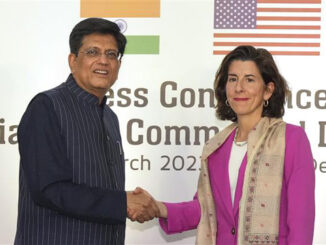
    US Commerce Secretary Gina Raimondo, who was present along with her counterpart Piyush Goyal, said the MoU was designed to help India achieve its aspirations to play a larger role in the electronic supply chain.

    The MoU was signed under the framework of India-US Commercial Dialogue which is being held for the first time since 2019. The US Commerce Secretary said the MoU had tasked semiconductor industries of both nations to prepare an assessment of gaps and the lack of resiliency in the supply chain.

    “We are absolutely thrilled to be working with India as part of the Indo-Pacific Economic Framework (IPEF). Through IPEF, the US, India and a dozen other partners are developing policies to create more resilient and secure supply chains, accelerate progress, green transitions and demonstrate our commitment to fostering a better business environment,” she said.

    “The MoU talks about how we will share information about the semiconductor commercial opportunities between our two countries, how we will have a continued dialogue around policies that would encourage private sector investment in the semiconductor ecosystem,” said Raimondo.

    However, she made no mention of labor standards and other markers that come along with the promise of more US investment and technology. Before her India visit, she had said in an interview, “I’m running the IPEF. And we’re saying sign up at the government-to-government level to labor standards, environmental standards, anti-corruption standards, rule of law standards. And in return, it’ll unlock US business, US capital jobs in India.”

    The Indian side also sought more clarity on the trade pillar of the IPEF from which it has disassociated while signing on to its other pillars.

    (Source: TNS)