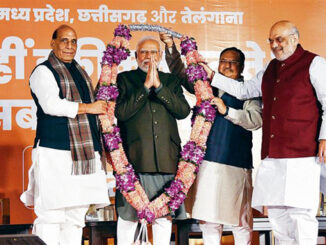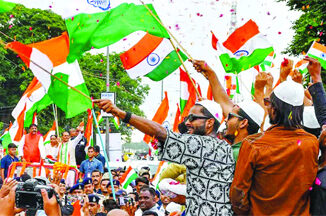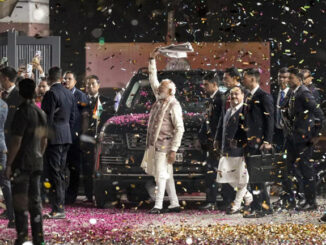
PATNA (TIP): With counting under way across Bihar, early trends on Friday, November 14, placed the National Democratic Alliance (NDA) far ahead of its rivals, positioning the BJP–JD(U)-led coalition for a resounding victory in the 2025 Assembly elections. Celebrations broke out outside the BJP headquarters in Patna as party workers danced to drumbeats, sensing an emphatic mandate returning the alliance to power.
As of this report, the NDA is leading in 204 out of 243 seats, leaving the Mahagathbandhan—an alliance of the RJD and Congress—far behind at 33 seats. The Jan Suraaj Party, despite visible campaign visibility, has yet to secure a lead in any constituency.
Tejashwi Yadav leads ; Raghopur Sees Tight Contest
One of the high-profile battles, Raghopur, saw RJD leader Tejashwi Yadav leading by 10,276 votes, but the broader electoral picture remains grim for the Mahagathbandhan. Constituency-level trends indicate widespread consolidation in favor of NDA candidates.
‘Victory of Good Governance Has Been Achieved’: PM Modi
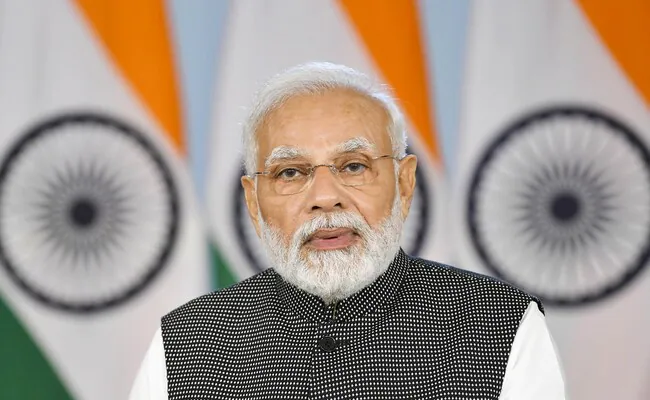
Reacting to the early numbers, Prime Minister Narendra Modi declared the mandate a “victory of development, victory of social justice,” crediting the alliance’s governance model, welfare outreach, and administrative stability. Nitish Kumar, who campaigned heavily on his welfare schemes for women, elderly, and marginalized communities, appears set to retain the Chief Minister’s position—once again emerging as “the man of the hour.”
Women Voters, Welfare Schemes, and Alliance Management Drive Success
Analysts attribute the NDA’s performance to several converging factors:
Women voters turned out in large numbers, reportedly driven by JD(U)’s welfare measures, including direct benefit transfers, schemes supporting girls’ education, and health-focused initiatives.
The coalition projected a unified front, capitalizing on its governance record and minimizing internal friction.
Union Home Minister Amit Shah is believed to have played a key role in micro-managing the campaign narrative, ensuring the alliance stayed disciplined on core issues.
BJP is likely to surpass its 2010 tally of 91 seats, strengthening its footprint in the State and pushing the Opposition further to the margins.
Opposition Raises Vote-Chori Allegations
With the Mahagathbandhan facing a near-complete rout, Congress and RJD leaders revived accusations of “vote chori” (theft) and questioned the integrity of the State’s intensive electoral roll revision process. However, according to the Election Commission of India (ECI), this is the first election in recent history in which no discrepancies were found at any polling station, and no repolls were recommended.
Smooth Counting Process Across Bihar
Counting is being conducted by 243 Returning Officers, assisted by an equal number of Counting Observers. The ECI has stated that final seat-wise outcomes are likely to be confirmed by evening, depending on the pace of counting.
Exit Polls Prove Wrong
In a dramatic reversal, almost all exit polls—which had predicted a tight finish or a mild NDA edge—stand discredited. The scale of today’s mandate suggests a significant shift in voter sentiment and a reaffirmation of the NDA’s political dominance over Bihar’s electoral landscape.
With numbers stabilizing and the NDA far ahead of the majority mark, it is now only a matter of hours before the final tally confirms the coalition’s return to power.
PORT OF SPAIN (TIP): The journey of the Indian community in Trinidad and Tobago is one of courage, Prime Minister Narendra Modi said, emphasizing that the hardships their ancestors endured could have “broken even the strongest spirits”. Mr. Modi made the comments at a community event at the National Cycling Velodrome, Couva, on Thursday (July 3, 2025).
He arrived in Trinidad and Tobago earlier in the day for a two-day visit.
The Prime Minister, whose first engagement in the Caribbean nation was with the Indian community, said that it felt completely natural, as “we are part of one family”. Trinidad and Tobago has a population of approximately 1300000, 45 per cent of whom are of Indian origin.
“The journey of the Indian community in Trinidad and Tobago is about courage. The circumstances your ancestors faced could have broken even the strongest of spirits. But they faced hardships with hope. They met problems with persistence,” he said.
“They left the Ganga and Yamuna behind but carried the Ramayana in their hearts,” he said, calling them messengers of a “timeless civilization”.
“The community programme in Port of Spain was spectacular. The energy and warmth of the people made it truly unforgettable. Evidently, our cultural bonds shine brightly!” he said in an X post.
In his address, the Prime Minister stressed that the Indian community members’ contribution has benefited Trinidad and Tobago “culturally, economically and spiritually”. Citing eminent Indian-origin figures in the country including Prime Minister Kamla Persad-Bissessar and President Christine Carla Kangaloo, he said the descendants of Girmitiyas are no longer defined by struggle, but by their “success, service, and values”.
Girmitiyas were indentured laborers from British India transported to work on plantations in Fiji, South Africa, Eastern Africa (namely Mauritius, Seychelles, Tanzania, Kenya, and Uganda), Malaysia, Singapore, and the Caribbean as part of the Indian indenture system. He added that work is ongoing to create a comprehensive database of the Girmitiya community across the world.
Mr. Modi said that between the past and the present, the friendship between the two nations has “grown even stronger”.
“Our bonds go well beyond geography and generations,” Prime Minister Modi said.
“The Indian diaspora is our pride. As I have often said, each one of you is a Rashtradoot — an Ambassador of India’s values, culture and heritage,” he said.
Mr. Modi said that India is the fastest-growing major economy in the world. “Soon we will be among the top three economies of the world.” “As we grow, we are ensuring that it is of mutual benefit to the world. Today’s India is a land of opportunities,” he said, adding that “India has a lot to offer”.
India not just a partner but co-traveler in Ghana’s development journey: PM Modi
Prime Minister Persad-Bissessar, who addressed the community before Mr. Modi, said that the Indian leader will be conferred on Friday (July 4, 2025) with ‘The Order of Trinidad and Tobago’, the Caribbean nation’s highest honor.
Mr. Modi, who is here as part of his five-nation tour, will hold talks with the top leadership of Trinidad and Tobago to further strengthen bilateral relations.
Earlier, he was received by his counterpart Persad-Bissessar at Piarco International Airport, where he was accorded a ceremonial welcome and a guard of honor.
This is his first visit to the country as a Prime Minister and the first Indian bilateral visit at the Prime Ministerial level to Trinidad and Tobago since 1999.
Prime Minister Modi is also expected to address a Joint Session of the Parliament of Trinidad and Tobago. His visit will impart fresh impetus to the deep-rooted and historical ties between the two countries.
New Delhi (TIP) – India is doing its duty as a ‘Vishwa Bandhu’ for global brotherhood, in the spirit of ‘democracy first, humanity first’, Prime Minister (PM) Narendra Modi said on Thursday, Nov 21, in Guyana on the last-leg of his three-country trip. Modi added that humanity guides India’s decision-making and that it has never moved forward with “selfishness, expansionist vision, nor harboured any feeling of seizing resources”.
He said India had shown that democracy is in our DNA, vision, and acts.
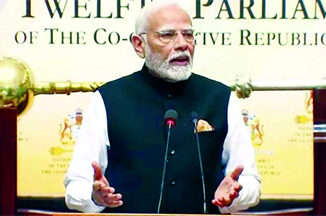
Speaking at the special session of Parliament of Guyana, the PM said that India does not view island nations as small countries “but as large ocean countries”. “Bharat says every nation matters,” he added, inviting them to visit India.
Talking about development partnership, he gave the slogan of ‘collaborate globally, act locally’.
Modi said India-Guyana ties were of ‘mitti’ (soil) and full of cordiality. He talked about his visit twenty-four years ago, when he had visited the island nation as a “curious person to learn about culture and heritage of this beautiful country”.
Modi began his three-nation trip on Sunday from Nigeria — the first visit by an Indian PM in 17 years.
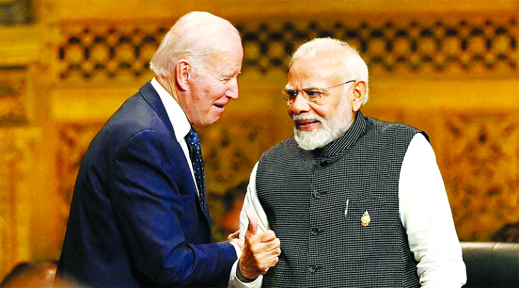
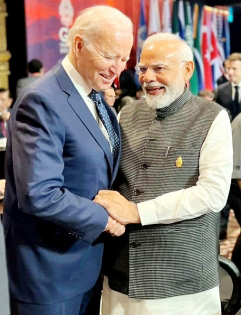
His next stop was Brazil to attend the G20 Summit, where he met top international leaders such as US President Joe Biden, French President Emmanuel Macron, and British PM Keir Starmer.
Guyana and Dominica conferred top awards on Modi for his contribution during the Covid-19 pandemic. The Indian PM became only the fourth foreign leader to be awarded ‘The Order of Excellence’ by Guyana.
In another ceremony, Dominican President Sylvanie Burton conferred the ‘Dominica Award of Honour’ upon the PM.
India had sent 70,000 Astra Zeneca vaccines to the Carribean nation in 2021.
As India gears up for its forthcoming elections, there’s a prevailing confidence in the prospects of the ruling BJP, setting the stage for Prime Minister Modi’s likely third term in office. This anticipation extends beyond India’s borders, drawing attention from global observers, including neighboring nations and major powers like the United States and China.
Prime Minister Modi’s adept diplomacy, his administration’s leadership in forums, notably the G20, and India’s rising economic potential have remarkably elevated India’s stature on the world stage. Many nations in the Global South seem to favor another term under PM Modi’s leadership, while the current Biden administration in the United States also sees promise in his reelection. This optimism stems from the significant strides made in enhancing strategic, economic, and defense partnerships between India and the U.S. in recent times.
Given the ruling party’s many strengths despite the controversies surrounding its nationalistic policies and some polarizing views on PM Modi’s aspirations for a ‘new India’, the opposition still faces a formidable challenge at the polls.
The 6-week long electoral process, starting April 19, marks a pivotal moment in India’s democratic journey. Observers worldwide will closely monitor this process, acknowledging its potential to influence the nation’s democratic resilience in the future. The response of global stakeholders to India’s electoral exercise remains crucial, raising questions about whether their future engagement will hinge on the elections’ adherence to democratic principles or be guided by broader strategic interests and values.
(Farwa Aamer is Director of South Asia Initiatives at the Asia Society Policy Institute)
Prime Minister Narendra Modi announced a reduction of Rs 100 in cooking gas cylinder prices on Friday on the occasion of International Women’s Day. This will significantly ease the financial burden on millions of households across the country, especially benefiting “Nari Shakti” (women power), he said in a post on X.
“By making cooking gas more affordable, we also aim to support the well-being of families and ensure a healthier environment. This is in line with our commitment to empowering women and ensuring ‘Ease of Living’ for them,” he said. In a related decision, the government on Thursday announced the extension of Rs 300 per LPG cylinder subsidy to poor women under the Ujjwala Yojana for the next fiscal starting April 1.
The government in October last year hiked the subsidy from Rs 200 per 14.2-kg cylinders for up to 12 refills per year to Rs 300 per bottle. The Rs 300 per cylinder subsidy was for the current fiscal, which ends on March 31.
New Delhi (TIP)- In his sharpest attack on the INDIA bloc, Prime Minister Narendra Modi on Friday said the bloc leaders “will struggle to save their deposits in the upcoming General Election” even as he accused them of dividing people on caste lines. In a no-holds-barred criticism of the Opposition, the PM singled out the Congress and said, “The members of Congress royal family are calling the youth of Banaras ‘nashedi’ (drunken/intoxicated). Those who are themselves not in ‘hosh’ (senses) are calling our youngsters ‘nashedi’. What kind of language is this?” the PM said, addressing constituents of his Lok Sabha segment Varanasi. The PM said INDIA leaders were busy dividing the society on caste lines and predicted their defeat in the 18th General Election.
“These days, there is one more reason behind the anxiety and anger of INDI leaders. They are unable to stomach the new look of Kashi and Ayodhya. Look at how they attack Ram Mandir in their speeches, the kind of utterances they use to undermine the Ram Mandir. I did not know that the Congress hated Lord Ram so much,” PM Modi said. He slammed dynastic parties and said such parties “cannot look beyond their families and vote banks”. “That is why they ally before every election and when the result is ‘neel battey sannata’ (zero divided by zero equals nothing), then they abuse one another and part ways. But they do not know this is Banaras. Everyone is a guru here. Here the machinations of the INDI alliance will not work,” PM Modi said. He said the entire Uttar Pradesh should know that the INDI alliance was the “same old stuff in a new package”. “This time they will have to struggle hard to even save their deposits,” the PM said.
Earlier in his speech, he termed the recent remarks made by Rahul Gandhi as “shocking”.
“You will be shocked to learn what did the royal family of the Congress say? They are saying UP youth are ‘nashedi’. What kind of language is this? They have spent two decades abusing Modi but now they have started venting frustration on people of UP,” the PM said, adding family-based parties of the Opposition should know that the youth of UP were working hard to build a developed state and golden futures.
Rahul, during his Bharat Jodo Nyay Yatra in Varanasi, had said, “The youth here are inebriated, lying on the streets, dancing at night. The future of the youth of UP is intoxicated.”
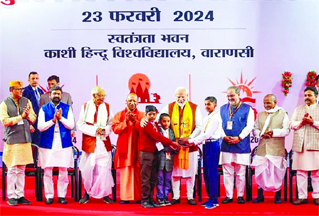
On a visit to his parliamentary seat, the PM addressed an event to commemorate the 647th birth anniversary of Sant Ravidas and also unveiled his statute, engaged the winners of the ‘Sansad Sanskrit Pratiyogita’ at BHU, and inaugurated projects worth over Rs 13,000 crore.
Source: TNS
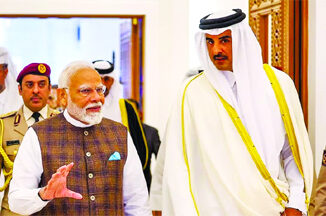
Prime Minister Narendra Modi on Thursday, Feb 15, held talks with Qatari Emir Sheikh Tamim bin Hamad Al Thani to strengthen bilateral ties but neither side spoke on Doha freeing eight former Indian Navy personnel who were sentenced to death or the $78 billion deal to import Qatari gas from 2029 for the next 20 years, said to be the world’s largest-ever extension of a gas contract.
“Had a wonderful meeting with Sheikh Tamim Bin Hamad. We reviewed the full range of India-Qatar relations and discussed ways to deepen cooperation across various sectors. Our nations also look forward to collaborating in futuristic sectors which will benefit our planet,” posted the PM on X. PM Modi arrived in Doha on Wednesday night after a two-day visit to the United Arab Emirates. Shortly after his arrival, Modi met Qatari Prime Minister-cum-Foreign Minister Sheikh Mohammed bin Abdulrahman Al Thani. “The two leaders exchanged views on expanding bilateral cooperation in sectors such as trade, investment, energy, finance, and technology. They also discussed recent regional developments in West Asia and emphasised the importance of upholding peace and stability in the region and beyond,” said the Ministry of External Affairs (MEA). “During the meeting, they discussed cooperation relations etween the two friendly countries and ways to support and develop them, especially in the fields of energy, commerce and investment,” said the Qatari Foreign Ministry. Source: TNS
Prime Minister should follow in Lord Rama’s footsteps to ensure justice for all
“Ram Mandir has succeeded in restoring Hindus’ pride in their religion. That is a positive development. What’s left is for Modi to follow the principles of good governance associated with Lord Rama for dispensing justice to all. There were no Muslims and Christians in Bharat in those ancient times. But they are there now. Their only prayer to Modiji is that they be counted as equal citizens of Bharat, as Lord Rama, the epitome of justice and good governance, would have done.”
By Julio Ribeiro
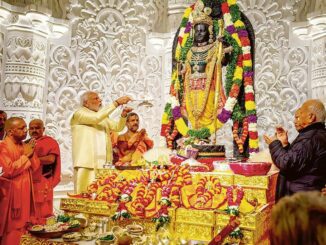
It was awe-inspiring to watch the consecration of the Ram Janmabhoomi temple in Ayodhya. PM Narendra Modi stole the show with his march to the spot where the idol of Ram Lalla was installed and his unforgettable address to the 7,000-odd guests.
I was moved to instruct my domestic help to light a diya, as our Prime Minister had requested. Even I, normally a critic of the government, was carried away by the moment!
The sheer magic of the occasion, the unmistakable devotion on the faces of the invitees and the pride in being a Hindu that was reflected on the countenance of the diaspora worldwide lent a new dimension to the dharma of our people and our ancestors. I was moved to instruct my domestic help to light a diya, as our Prime Minister had requested. Even I, normally a critic of the government, was carried away by the moment!
The temple will be completed in a year or so, but it has been consecrated ahead of the Lok Sabha elections. It is expected to play the role that the Balakot airstrikes did for the BJP in the 2019 Lok Sabha elections. PM Modi is expected to win a third term.
If the INDIA bloc does not get its act together soon, the ‘mother of democracy’ (our PM’s words) will metamorphose into an autocracy. Even after Rahul Gandhi hinted that Congress chief Mallikarjun Kharge would lead the coalition, Mamata Banerjee announced that the Trinamool Congress would fight the Lok Sabha polls in West Bengal on its own.
Nitish Kumar had expected himself to be anointed as ‘primus inter pares’ (first among equals). He is frustrated because he has to share the honor with Kharge. Arvind Kejriwal wants an all-India footprint for AAP. He demands seats in Gujarat, Haryana and Goa, where his party has a small presence.
Even Akhilesh Yadav, who has been eclipsed by CM Yogi Adityanath in Uttar Pradesh, thought that his Samajwadi Party was entitled to representation in Madhya Pradesh. All in all, the INDIA bloc is hopelessly placed against the BJP’s juggernaut. And with the Ram Temple being projected as Modi’s baby instead of Lal Krishna Advani’s, to whom it legitimately belongs, the battle can be written off as far as INDIA is concerned.
Yogi has captured the imagination of the residents of Uttar Pradesh (which has 80 Lok Sabha seats) with one major achievement — he has brought the state’s criminals to heel. In the beginning of his reign, he encouraged the use of unconventional, even illegal, methods to instill fear in the minds of the law-breakers. Wiser counsel later advised him to change tack. To all appearances, it seems that conventional methods (except the bulldozer) are currently at play.
A newspaper article by a young IPS officer, Vrinda Shukla, currently SP of Bahraich (UP), quotes figures from the National Crime Records Bureau to show that because of “scaled-up monitoring at all levels”, conviction was obtained by the UP police in 71 per cent of the cases of crimes against women in which the trial was completed. The corresponding figures for Rajasthan and Maharashtra are 37.2 per cent and 11.2 per cent, respectively. Public prosecutors, who had stopped taking ownership of the cases and become unaccountable, have begun feeling the heat generated by Yogi, says Vrinda.
Those who dream of forming a government in any state will need to adopt the UP CM’s attitude to corruption and the legal steps he has put in motion to control crime and criminals. More than ‘development’ that our Prime Minister harps on, citizens want security of life and property. He or she who can provide this will win.
In the meantime, Modi will milk the devout Hindu’s devotion to Lord Rama for electoral gains. A politician can hardly be blamed for exploiting public sentiment to influence voters. The only regret a sensitive BJP follower can possibly have is that the originator of the Rath Yatra, Advani, was left out in the cold. But these are games ambitious politicians play. They dump their rivals in their own party when the opportunity beckons. Politics, after all, is a cut-throat enterprise. Only one who is adept at the game comes out on top.
The media shows Modi feeding cows at his home and visiting temples in Kerala and Andhra Pradesh, both southern states where he is keen to open his party’s account. Public memory is notoriously short. The voter may forget our PM’s piety and opt for the communists or the Congress in Kerala and for CM Jagan Mohan Reddy or his sister YS Sharmila, who has taken on the responsibility of resuscitating the Congress in Andhra Pradesh.
A group of 200-odd retired diplomats, civil servants and police officers, called the Constitutional Conduct Group (of which I am a part), had drafted an open letter to the PM, lamenting that he involved his high constitutional office and government agencies in the run-up to the idol’s installation in the Ayodhya temple. A secular country, constitutionally mandated to strictly separate religion from the State, had been subjected to the spectacle of its PM performing puja in South Indian temples and finally in Ram Mandir.
There is no objection to the PM visiting and praying to his god as an individual. But to do so as the country’s pre-eminent elected leader and committing government resources to such an event is neither constitutionally acceptable nor ethical or moral. The Election Commission should decide whether this is permissible under the election laws on the use of religion for garnering votes.
The founders of Pakistan used religion to secure for the Muslims a separate country. The military regime of Gen Zia-ul-Haq Islamized it to the hilt. The results of such religiosity are for all of us to see. Pakistan today needs the US and China to keep itself functioning. There are not many nations today that incorporate religion into governance. Those that follow this path have not prospered.
Ram Mandir has succeeded in restoring Hindus’ pride in their religion. That is a positive development. What’s left is for Modi to follow the principles of good governance associated with Lord Rama for dispensing justice to all. There were no Muslims and Christians in Bharat in those ancient times. But they are there now. Their only prayer to Modiji is that they be counted as equal citizens of Bharat, as Lord Rama, the epitome of justice and good governance, would have done.
(The author is a former governor and a highly decorated retired Indian Police Service (IPS) officer )
The Congress needs to go beyond the current focus on the negative aspects of the ruling dispensation or its perceived faultlines
“The Congress can build on this base, but to take this process forward, it needs to project a clear ideological narrative and articulate its own politics. For a start, it shouldn’t try to outdo the BJP as a ‘more Hindu’ party, particularly when voters have the option to go for the real thing. The ideological counter must reflect a different model of development with an emphasis on rights-based welfare, especially employment guarantees interlaced with social harmony. In sum, the Congress has to reboot its political discourse by foregrounding something substantive, which is best done by advocating a positive agenda that can galvanize the electorate and goes beyond the current focus on the negative aspects of the ruling dispensation or the perceived faultlines within it and the politics it has promoted.”
By Zoya Hasan
The Congress’ remarkable victory in Telangana was overshadowed by its devastating defeat in the Hindi heartland in the just-concluded Assembly elections. The Congress has suffered a big blow as it lost all three states — Madhya Pradesh, Rajasthan and Chhattisgarh — it had won in 2018. The Bharatiya Janata Party’s (BJP) comprehensive victory was backed by support across most regions in these states and a strong showing in urban areas. But the Congress, despite its defeat, has managed to retain its vote share — Madhya Pradesh (40.4 per cent), Rajasthan (39.5 per cent) and Chhattisgarh (42.23 per cent). The BJP has gained mostly at the expense of others in the fray. With these triumphs, the BJP has expanded its dominance of a key region ahead of the 2024 General Election. However, the Congress vote share holds considerable significance in the run-up to the Lok Sabha elections.
The Congress tried to highlight issues such as joblessness and caste discrimination in the hope that it would appeal locally in the state elections and nationally in the General Election. But its two-pronged plank of welfare schemes and social justice was upstaged by the subtext of Hindu nationalism and communal politics. The BJP’s victories highlight the consolidation of Hindu nationalism and the great resonance it enjoys in the heartland states. The use of state machinery, ample financial resources and the party’s organizational framework, buttressed by RSS cadres, have helped it promote itself as a champion of a strong nation, development and welfarism as well as of Hindu interests and the Hindu religion.
From the outset, the BJP’s campaign pivoted on Prime Minister Narendra Modi, relegating established state leaders to the sidelines. The party decided not to nominate a chief ministerial candidate for any of the states going to the polls. This meant that even popular state leaders of the Congress like Ashok Gehlot and Bhupesh Baghel were not pitted against their local BJP rivals, but against Modi himself. The PM’s huge popularity in north and central India neutralized the public acceptance of these leaders.
Taking a cue from its experience in Karnataka, where the visibility and prominence of local leaders paid off, the Congress projected state leaders, who were given a free hand. However, the infighting and overweening ambitions of its leaders in Rajasthan and Chhattisgarh put paid to this strategy. Factionalism and divided state leadership, which have been the undoing of the Congress in many states, was on full display throughout its term in office in these two states. Leaders were attacking each other until a few months before the elections, which sent a message to voters that this was a party that couldn’t keep its house in order. A settlement was forged between the warring leaders in both states, but it was a case of too little, too late.
Apart from factionalism, there was no accord or concord between the state leadership and the high command. The Congress campaign lacked coherence; it appeared disjointed, with powerful state satraps unwilling to countenance any interference on their turf. In contrast, the BJP’s campaign was intensive and focused and the party spoke in one voice. This is not surprising, as the contemporary BJP is a highly centralized party, while the Congress, in a departure from the past, is relatively decentralized.
To make matters worse, there was no agreement between the Congress and its allies in the state elections. The 28-party INDIA grouping led by the Congress, which came together to fight the BJP, did not feature in the state polls due to inter-party rivalries. Opposition parties should have negotiated state-specific alliances and seat adjustment in a spirit of give-and-take. This is easier said than done. Seat-sharing didn’t happen, which hurt the Congress as well as the INDIA bloc, which the voters saw as a divided house. The fate of the Congress and other parties in this election makes it clear that they can tackle the BJP only when they are united against it.
A caste-based census was the big battlecry of the Congress to undercut the BJP’s support among the OBCs, but it turned out to be a ‘no-ball’. This call had little traction on the ground, with the issue not paying dividends — the BJP’s share of OBC votes has increased. In any case, it is doubtful that the demand for a caste census is an inspiring or effective counter to Hindu identity politics, which holds much greater appeal for subaltern groups in the current conjuncture. Caste politics and ideas of social justice were not enough without a clear political plank to serve as a counterpoint to the BJP’s politics in these states or effective campaigning, ideological clarity and organizational cohesion to communicate its message.
There is limited evidence of a correlation between state and national elections. Yet, there’s little doubt that the Congress’ decisive defeat at the hands of the BJP in straight contests has undermined its credibility and is bound to demoralize it at a crucial time when the Lok Sabha elections are just five months away. However, all is not lost as the majority of the voters have opted for non-BJP parties in these critical states.
The Congress can build on this base, but to take this process forward, it needs to project a clear ideological narrative and articulate its own politics. For a start, it shouldn’t try to outdo the BJP as a ‘more Hindu’ party, particularly when voters have the option to go for the real thing. The ideological counter must reflect a different model of development with an emphasis on rights-based welfare, especially employment guarantees interlaced with social harmony. In sum, the Congress has to reboot its political discourse by foregrounding something substantive, which is best done by advocating a positive agenda that can galvanize the electorate and goes beyond the current focus on the negative aspects of the ruling dispensation or the perceived faultlines within it and the politics it has promoted.
(The author is Professor Emerita, Centre for Political Studies, JNU)
The least resilient among the INDIA members are in danger of disappearing from the political scene
“PM Modi’s most urgent task is to lift millions of his countrymen from the poverty in which they are mired. The affluent are certainly much better off since 2014. The stock market is booming. Those who have invested in stocks will become even richer if he is re-elected in 2024. The freebies now given away to the rural poor will eventually have to be stopped. The youth of those poor households, belonging mainly to the lower castes, must be equipped with skills to enable them to fend for themselves. Industrialists and entrepreneurs, who have prospered in the last 10 years, should be motivated to enter less-profitable segments of the economy so that jobs are created for our unemployed youth.”
By Julio Ribeiro
I write this piece as a member of a minority community — just 2 per cent of the country’s population. In a ‘first past the post’ system of electing people’s representatives, the BJP has swept the Assembly polls in the Hindi heartland. The Congress lost the tribal and women’s votes. The shift in votes from the Congress to the BJP catapulted the latter to power in Madhya Pradesh, Rajasthan and Chhattisgarh.
‘Sabka Saath, Sabka Vikas, Sabka Vishwas’ needs to be put into practice instead of being merely parroted every now and then.
The difference in the overall vote share of the BJP and the Congress was roughly 2 percentage points in Rajasthan and 4 in Chhattisgarh. It was 8 percentage points in Madhya Pradesh, where the winner garnered 48 per cent of the votes as against 40 per cent by the Congress.
It was a resounding victory for the BJP and Modi in particular. Not even his bitterest critic can say that he is not the most popular and charismatic of all political leaders in the country. It looks certain that he will be elected for a third term. The Hindi heartland is with him and that should tilt the scales in his favor. The South is not with him, but the West is his for the taking. What is in store for the country after the 2024 Lok Sabha elections? In the past decade, India has been divided on communal lines. The consolidation of the Hindu vote was what the Hindutva forces strived for. It succeeded to the extent of ensuring the BJP’s poll victories. Muslims and Christians together make up just 16 per cent of the population. The Sikhs account for less than 2 per cent.
After the 2024 polls, the forward castes in the Hindu fold will be the chosen ones, like the Christian Brahmins and Kshatriyas were in Goa during the Portuguese rule. The BJP under Modi, influenced by the RSS, will placate the OBCs and the Scheduled Castes/Scheduled Tribes, counting them within the 80 per cent whose pride in being Hindu has to be ‘created’.
The Muslims were in the doghouse in Modi’s first two terms. Beef-related lynchings, ‘love jihad’ accusations and the fear generated by the CAA-related NRC had stifled their quest for equality as citizens of India. Now, I envisage that they and the Christians, who are next in line on the extremists’ hit list, will have to adjust to second-class citizenship like Hindus and Christians in Pakistan have done in that religion-influenced country.
Delivering his victory speech at the BJP’s headquarters in Delhi, PM Modi mentioned ‘appeasement’, besides corruption and dynastic politics, as the evils that he has been fighting. I do not know what he means by ‘appeasement’. If he is referring to the Muslims, it is only the mullahs who were appeased by the Congress, and that too in religious matters. That is not the mandate of a democratically elected government. Muslims should be ‘appeased’ like all poor communities, such as the Scheduled Castes and the Scheduled Tribes, in terms of education and healthcare. Religious issues should be sorted out by the community itself or by the courts.
Extremist elements in the Hindutva camp have consistently railed against the Muslim minority. There have even been calls to exterminate Muslims and boycott their traders selling vegetables and fruits in Hindu localities. Modi should rein in these extremists by ordering penal action against them as ordained by law. He hesitates to do that for fear of losing their support. They, in turn, misinterpret this silence as tacit approval.
PM Modi’s most urgent task is to lift millions of his countrymen from the poverty in which they are mired. The affluent are certainly much better off since 2014. The stock market is booming. Those who have invested in stocks will become even richer if he is re-elected in 2024. The freebies now given away to the rural poor will eventually have to be stopped. The youth of those poor households, belonging mainly to the lower castes, must be equipped with skills to enable them to fend for themselves. Industrialists and entrepreneurs, who have prospered in the last 10 years, should be motivated to enter less-profitable segments of the economy so that jobs are created for our unemployed youth.
The possible re-election of Modi and the BJP in 2024 will consolidate the right-wing economic trend in the country. All left-of-center parties, like the Congress, TMC and the AAP, should come together to form an effective Opposition. If they fail to do so, the least resilient among the INDIA members are in danger of disappearing from the political scene. Many leaders of those parties, such as Arvind Kejriwal, will find themselves targeted by the ED, the CBI and other Central agencies with ruthless precision just before the elections.
Nearly a century ago, writer-philosopher Aldous Huxley, in his futuristic work Brave New World (1932), prophesied: “By means of ever more effective methods of mind manipulation, the democracies will change their nature; the quaint old forms — elections, parliaments, Supreme Courts and all the rest — will remain. The underlying substance will be a new kind of non-violent totalitarianism. Democracy and freedom will be the theme of every broadcast and editorial… Meanwhile, the ruling oligarchy and its highly trained elite of soldiers, policemen, thought-manufacturers and mind-manipulators will quietly run the show as they see fit.” Does that ring a bell? An Opposition-mukt democracy is no democracy.
PM Modi has often stated: “India is the mother of democracy.” If he really believes what he says, we, members of the minority in our own land, will be reassured if ‘Sabka Saath, Sabka Vikas, Sabka Vishwas’ is put into actual operation instead of being merely parroted every now and then.
(The author is a highly decorated Indian Police Service (IPS) Officer and a former governor)
Prime Minister Narendra Modi on Saturday, August 26, announced that to mark the success of Chandrayaan 3’s Moon landing, August 23 will be celebrated as National Space Day. Modi’s announcement came as he was addressing the Indian Space Research Organisation scientists at the ISRO command centre in Bengaluru.
Modi visited the space agency’s Telemetry Tracking and Command Network Mission Control Complex to congratulate the Chandrayaan 3 team on the mission’s success. During his visit, the PM also announced that the touchdown point of Chandrayaan 3 on the Moon’s surface will be called ‘Shiv Shakti’, adding that the point where Chandrayaan 2 crash-landed on the Moon in 2019 will be called ‘Tiranga’. “Women scientists have played a key role in Chandrayaan 3 mission..the ‘Shiv Shakti’ point will inspire the upcoming generations to use science for the welfare of people…” he said. He also lauded the ISRO scientists for taking the ‘Make in India’ initiative to the moon.
NEW DELHI (TIP) : India and Greece on Friday, August 25, elevated their ties to the level of strategic partnership and agreed to have an institutional dialogue framework at the level of national security advisers during PM Narendra Modi’s daylong visit to Athens, the first by an Indian PM in 40 years.
We will strengthen our strategic ties by increasing cooperation in defense and security, agriculture, education, new technology and skill development.
Both sides also decided to expand cooperation in defense and security, infrastructure, agriculture, education and new and emerging technologies during talks between PM Modi and his Greek counterpart Kyriakos Mitsotakis.
“After 40 years, an Indian PM has come to Greece. Yet, neither the depth of our relations has diminished, nor has there been any decrease in the warmth of our relations. Therefore, today the PM and I have decided to take the India-Greece partnership to a strategic level,” the Greek PM said.
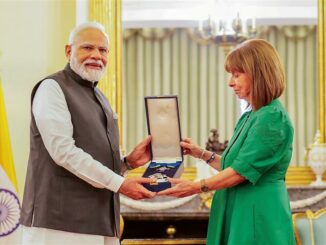
PM Modi was also conferred with the “Grand Cross of the Order of Honour” award by President of Greece Katerina Sakellaropoulou.
From the ramparts of the historic Red Fort, Prime Minister Narendra Modi delivered his tenth Independence Day speech – he equalled the record of hoisting the tricolour for 10 consecutive times – in which he vowed that the country would become one of the top three economies of the world and that the nation now identified as a ‘Vishwamitra’.
Sporting a multicolor Rajasthani bandhani print turban with an off-white kurta and churidar, PM Modi in his Independence Day speech highlighted how his government had brought transformation to the nation and added that decisions and actions taken during the “Amrit Kaal” – the period until 2047, the centenary of India’s Independence – will impact the millennium to come. “The decisions we make in this Amrit Kaal, our actions and sacrifices, would pave the way for a glorious history spanning the next millennium,” PM Modi said, adding, “The events of this era will impact the next millennium.”
During his speech, Prime Minister Modi also spoke of the various schemes his administration has launched since coming to power and also made the announcement of a new scheme – the Vishwakarma Yojana.
Let’s take a closer look at what this new scheme entails and also the other ones he mentioned in his address to the nation.
Vishwakarma Yojana
Addressing the nation on the occasion of the 77th Independence Day, Prime Minister Narendra Modi announced the Vishwakarma Yojana for traditional workers and craftsmen with an initial allocation of Rs 13000- Rs 15,000 crore.
PM Modi said, “In the coming months we will launch Vishwakarma yojana for those who work with their tools, such as goldsmiths, ironsmiths, washermen, hair-dressers and masons who mostly come from the OBC class.”
The scheme will be flagged on Vishwakarma Jayanti, 17 September and seeks to help workers from the OBC community such as barbers, tanners, and blacksmiths. The scheme, according to the prime minister, carries the objective to drive economic growth and social progress among individuals possessing traditional skills.
The Vishwakarma scheme was initially announced in this year’s Budget presented by Finance Minister Nirmala Sitharaman. At the time, it was said that the scheme aimed at improving the quality, scale and reach of products and services of artisans and craftspeople and to integrate them with the domestic and global value chain.
The finance minister had said that this would result in the economic empowerment of such workers, especially those belonging to the Scheduled Castes, Scheduled Tribes, Other Backward Communities, women, transgender and other weaker sections of the society.
The PM had hailed the scheme at the time of its announcement, saying: “There are many of them (artisans) who can become suppliers and producers for our MSME sector. The industrial world can increase production by linking these people with their needs.”
Drone training for women
Apart from the Vishwakarma Yojana, PM Modi also made mentions of other schemes and announced a new scheme for women in which they would be trained to operate and repair drones. Pitching the importance of technology in agriculture, he said that 15,000 women self-help groups would be given training to handle and repair drones.
“We will train them in operating and repairing drones. Many self-help groups will be provided with drones. These agricultural drones can be utilised effectively. The initiative will begin with the flight of drones by 15,000 women’s self-help groups,” he said.
Increase in Jan Aushadi Kendras
Speaking on the occasion of the 77th Independence Day, PM Modi said that his government is working to increase the number of ‘Jan Aushadhi Kendras’ from 10,000 to 25,000. These centres are a part of the larger scheme, the Pradhan Mantri Bhartiya Janaushadi Pariyojana that aims to provide quality medicines at affordable prices to the masses.
PM Modi in his speech said that holistic healthcare was the demand of the hour after COVID-19, adding that his government had even established a separate Ayush department and now the world is taking note of Ayush and Yoga.
“The world is now watching us because of our commitment,” Modi said, adding that India has emerged as “Vishwa Mitra” (friend of the world) in the post-COVID period.
Earlier in March, Bhupender Yadav, a minister in the Modi government, had said that more than 9,000 Jan Aushadhi Kendras had been opened across the country by the central government to make healthcare accessible to people.
Housing scheme
PM Modi also announced that his government was planning a scheme in which those who were living in substandard conditions would get receive relief on the interest that they would pay on debt that they would undertake towards proper housing.
Such beneficiaries would be those living in slums, unauthorised settlements, ‘jhopdis’ and ‘jhuggis’, largely in urban areas.
PM Modi already has the Pradhan Mantri Awas Yojan -Urban (PMAY-U), which was launched in 2015. Under this scheme, around 1.18 crore houses have already been sanctioned until 31 July, out of which 76.02 lakh have been delivered to the beneficiaries.
Prime Minister Modi also used the opportunity to highlight his government’s other achievements and his vision for the country. According to many poll pundits, this speech gains even more significance, as it his last before the 2024 general elections.
And Modi ensured that he spoke of his governance in his speech which also saw him ditching the regular ‘Mitron’ address and repeatedly referring to the people as ‘parivaarjan’, which means family members. In fact, at the end of his speech, he explained why he used ‘parivaarjan’, saying, “I am one of you. I have come from amid you. My sweat is for you. I work for you not because you entrusted me with the responsibility. I do it because you are my family members. And I can’t see your suffering, your dreams crashing.”
NEW YORK / PARIS / NEW DELHI (TIP): Marking a historic moment for India, France bestowed Grand Cross of the Legion of Honor on Prime Minister Narendra Modi. It is the highest French honour in military or civilian orders. Modi is the first Indian PM to receive this honour.
In the past, the Grand Cross of the Legion of Honor has been received by select prominent leaders and eminent personalities from across the world. These include Former President of South Africa Nelson Mandela, King Charles – the then Prince of Wales, Former Chancellor of Germany Angela Merkel, Boutros Boutros-Ghali, former Secretary General of the United Nations, among others.
Modi was accorded a red-carpet welcome as he arrived in Paris on a two-day visit on Thursday, July 13. He will join Macron for the French National Day celebrations on Friday, July 14 as the Guest of Honour.
Ministry of External Affairs (MEA) spokesperson Arindam Bagchi tweeted photographs from the award ceremony that took place at the Elysee Palace here, saying, “A warm gesture embodying the spirit of partnership. PM @narendramodi conferred with the Grand Cross of the Legion of Honour, the highest award in France by President @EmmanuelMacron”.
“Prime minister thanked President Macron for this singular honour on behalf of the people of India,” the MEA said in a statement.
Earlier, the French President and First Lady Brigitte Macron hosted a private dinner for Modi at the Elysee Palace.
On Thursday evening, Modi addressed the Indian diaspora here and announced an agreement for the use of UPI in France, opening a huge new market for the Indian innovation in cashless instant payment.
In his nearly an hour-long speech to the enthusiastic crowd at the La Seine Musicale — a performing arts Center on an island in the river Seine — Modi outlined India’s fast-paced development and asserted that while the world is moving towards a new order, India’s strength and role is also changing very quickly.
Modi announced the opening of a new Indian consulate in Marseille in France and told the cheerful audience that Indian students doing masters in the European country will now get five-year-long post-study work visas.
Noting that France is celebrating its national day, in which he is the guest of honour, Modi said he has been to the country many a time but it was special this time, as he lauded its support to India and the strength of ties between the two countries, which mark 25th anniversary of their strategic partnership.
Describing people-to-people connect as a key foundation of the India-France partnership, he also asked the diaspora members to invest in India, noting that global experts are recognizing the country’s attractiveness as an investment destination and the country is taking rapid strides in development.
Meanwhile, in New Delhi, the Defence Acquisition Council (DAC), the apex decision-making body of the Ministry of Defence (MoD), today, July 13, cleared two separate ‘Make-in-India’ proposals for manufacturing three additional Scorpene submarines and sourcing 26 marine version Rafale fighter jets.
The key proposals are expected to come up when Prime Minister Narendra Modi meets French President Emmanuel Macron in Paris. The DAC, chaired by Defence Minister Rajnath Singh, granted the ‘acceptance of necessity’ (AoN) for procurement of the Rafale Marine aircraft along with associated ancillary equipment, weapons, simulator, spares, documentation, crew training and logistic support for the Indian Navy from the French Government based on the Inter-Governmental Agreement (IGA), the MoD said.
The price and other terms of the purchase will be negotiated with the French Government after taking into account all relevant aspects, including comparative procurement price of similar aircraft by other countries. Further, integration of India-designed equipment and establishment of ‘Maintenance, Repair & Operations (MRO)’ hub for various systems will be incorporated into the contract documents after due negotiations, the MoD said. The DAC also granted the AoN for procurement of three additional Scorpene submarines, which will be constructed by Mazagon Dock Shipbuilders Limited (MDL). The submarines would be made in India under a ‘repeat clause’ of the existing project to make six of these under a joint venture between the MDL and the Naval Group France. These submarines, called “Kalvari class”, have been manufactured and the last one is in the process of sea trials.
“The procurement of additional submarines with higher indigenous content will not only help in maintaining required force level and operational readiness of the Indian Navy, but also create significant employment opportunities in the domestic sector. It will also help the MDL in further enhancing its capability and expertise in submarine construction,” the MoD said.
In addition, the DAC approved the proposal to lay down guidelines for achieving the desired indigenous content in all categories of capital acquisition cases.
The Shanghai Cooperation Organization and the G20 discussed
NEW DELHI (TIP): A week after returning from a Summit meeting with US President Joe Biden, Prime Minister Narendra Modi on Friday, June 30, phoned Russian President Vladimir Putin and informed him on his “international contacts”, including ones during his recent visit to Washington, said a Kremlin readout.
In connection with the events of June 24 (revolt by the Wagner chief) in Russia, PM Modi expressed understanding and support for the decisive actions of the Russian leadership to protect law and order, ensure stability in the country and the security of its citizens.
The conversation came a day after National Security Advisor Ajit Doval spoke to his Russian counterpart Nikolai Patrushev.
The situation around Ukraine was touched upon as well. The Russian President gave his assessment of the current state of affairs in the special military operation zone, having stressed Kiev’s utter refusal to undertake political and diplomatic steps to resolve the conflict, said the Kremlin read out. “While discussing the situation in Ukraine, PM Modi reiterated his call for dialogue and diplomacy,’’ said the Indian read out. When discussing topical issues of bilateral cooperation, they underscored the importance of further consistent implementation of the major joint projects in various areas and noted with satisfaction substantial growth in trade throughout 2022 and in the first quarter of this year, said Russia. They reviewed progress in bilateral cooperation and exchanged views on regional and global issues of mutual interest, said the PM’s Office here.
Particular attention was paid to interaction within the Shanghai Cooperation Organisation and the G20, in which India currently holds the presidency, as well as in the BRICS format, said Kremlin.
“The conversation was substantive and constructive. The leaders reaffirmed their mutual intention to strengthen the special and privileged strategic partnership between Russia and India and agreed to maintain contact,’’ said the Kremlin readout.
A day earlier, Putin had praised PM Modi as a “great friend of Russia” and lauded his “Make in India” initiative during an event in Moscow on Thursday, June 29. The Russian President drew on India’s example to encourage domestic products and brands in his own country during his speech. He also highlighted how the initiative had a positive impact on the Indian economy.
“Our friends in India and PM Modi, a great friend of Russia, a few years ago presented a concept—’Make in India’. And it had a very visible effect on the Indian economy,” said Putin.
(Source; TNS)
WASHINGTOIN, D.C. (TIP): Indian Americans have played a significant role in the all-round development of the nation they live in and also in strengthening the India-US relationship, Prime Minister Narendra Modi said on Thursday.
Modi was addressing the State Dinner hosted in his honor by US President Joe Biden and First Lady Jill Biden at the North Lawn of the White House. More than 400 guests were invited for the dinner and they included big names in the tech world and billionaire industrialists such as Mukesh Ambani, Anand Mahindra, Google CEO Sunder Pichai, Microsoft CEO Satya Nadella and Apple CEO Tim Cook. During his address at the State Dinner, Modi raised a toast for his ‘wonderful’ hosts.
He raised it for good health, prosperity and the pursuit of happiness to liberty, equality and fraternity, and to the ever-lasting bonds of friendship between India and the US.
“With every passing day, Indians and Americans are getting to know each other better. We can pronounce each other’s names correctly. We can understand each other’s accent better. Children in India become Spider Man on Halloween, and America’s youth is dancing to the tune of ‘Naatu Naatu’,” the prime minister said.
Americans love baseball, but cricket is also becoming popular in the US, he said. “The American team is trying its best to qualify for the Cricket World Cup to be held in India later this year. I wish them good luck and success,” the prime minister said. Modi told Biden that he has gathered a group of exceptionally talented and remarkable people tonight. “I must commend you for that. These people symbolize so much about India-US relations, our energy, our dynamism and our nation,” he said.
“Indian Americans have come a long way in the US. They are proud of India’s values, democratic traditions and culture and have always found a respectful place in America’s melting pot. Indian Americans have played a significant role in further strengthening the inclusive society and economy of the US,” Prime Minister Modi said.
“Be it hospitals or hotels, universities or research labs, gas stations or logistics management, they are making their mark everywhere,” the prime minister said.
Modi spoke in Hindi with the speech being translated to English.
President Biden in his remarks said the bonds between India and the US stretch back to America’s earliest days.
“In 1792, our first president, George Washington, established one of the first consulates in Calcutta a hub of commerce and culture…,” he said. Biden said there are reasons the two democracies endure, allow and reflect to renew generation after generation.
“I see in my visit to India. I see in the diaspora here in America, in the arts, education, in the media, law, medicine, science and businesses of every size, in Spelling Bee champions, even in cricket clubs across the country, including back in my home state of Delaware and a record number of Indian Americans in Congress who are here tonight,” the President said.
Prime Minister Modi is visiting the US from June 21-24 at the invitation of President Joe Biden and the First Lady.
The guest list also included human rights activist Martin Luther King III, tennis legend Billie Jean King, filmmaker M Night Shyamalan, fashion designer Ralph Lauren, Grammy award winner Joshua Bell and entrepreneur Frank Islam.
Indian Americans lawmakers on the list were Pramila Jayapal, Shri Thanedar, Ro Khanna, Ami Bera and Raja Krishnamoorthi.
Members of the Biden family at the dinner included Hunter Biden, Ashley Biden, James Biden and Naomi Biden Neal. Vice President Kamala Harris, who will host a luncheon for Prime Minister Modi, was also present.
India’s National Security Advisor Ajit Doval and External Affairs Minister S Jaishankar attended the dinner along with US diplomats and members of the Biden administration.
(Source: PTI)
This week we are looking at Prime Minister Narendra Modi’s visit to Washington, which saw US President Joseph Biden roll out the red carpet for him. PM Modi’s visit included a private dinner at the White House, a ceremonial welcome, a state banquet, an address to the US Congress joint session and lunch at the State Department.
PM Modi is the third international leader, after French President Macron and South Korean President Yoon Suk Yeol to be invited as a State guest to the Biden White House. He is also the third Indian leader to be invited as a State visitor to Washington. In 2009, Prime Minister Manmohan Singh was invited by President Barack Obama, and in 1963, President Sarvepalli Radhakrishnan was invited by President John F Kennedy.
“Decades from now — decades from now, people will look back and say the Quad bent the arc of history toward “global good,” as the Prime Minister describes it. Together, India and the United States are working closely on everything from ending poverty and expanding access to healthcare to addressing climate change to tackling food and energy insecurity stoked by Russia’s unprovoked war on Ukraine,” U.S President Joe Biden said.
“We were strangers in defense cooperation at the turn of the century. Now, the United States has become one of our most important defense partners. Today India and the US are working together, in space and in the seas, in science and in semi-conductors, in start-ups and sustainability, in tech and in trade, in farming and finance, in art and artificial intelligence, in energy and education, in healthcare and humanitarian efforts, PM Narendra Modi said.
High-Tech partnership
The big deal announced during this visit was the MoU for a co-production deal between GE and HAL to manufacture GE-F414 jet engines in India for Tejas Light Combat Aircraft
Semiconductor supply chains: Micron Technology will invest $800 million toward a new $2.75 billion semiconductor assembly and test facility in Gujarat- the Indian Semiconductor mission will fund the rest of the project
Under the newly launched Initiative on Critical and Emerging Technology (iCET), a number of innovation partnerships, also on India and the United States have established a Joint Indo-U.S. Quantum Coordination Mechanism to facilitate joint research looking at Quantum, Advanced Computing, and Artificial Intelligence
India to join the 11-nation minerals security partnership (msp) meant to reduce dependence on China for critical minerals
Defense cooperation
India will buy 16 Drones- armed MQ-9B SeaGuardian UAVs.
The US Navy has concluded a Master Ship Repair Agreement (MSRA) with Larsen and Toubro Shipyard in Kattupalli (Chennai) and is finalizing agreements with Mazagon Dock Limited (Mumbai) and Goa Shipyard (Goa).
Placing Indian liaison officers at 3 US commands
Launch of India-U.S. Defense Acceleration Ecosystem (INDUS-X)— between private defense industries in US and India
Space cooperation:
India signed the Artemis Accords, joining 26 other countries working on exploration of the Moon, Mars, and beyond.
NASA will provide advanced training to Indian Space Research Organization (ISRO) astronauts with the goal of launching a joint effort to the International Space Station in 2024.
NASA and the ISRO are developing a strategic framework for human spaceflight cooperation by the end of 2023
Trade and Consular issues
Resolution of six of seven outstanding WTO disputes between the two countries through mutually agreed solutions, market access
India to set up consulate in Seattle, 2 other US cities. US to set up new consulates in Ahmedabad and Bengaluru
Relaxation in H1B visa norms for in country renewal and more availability of visas
The broad geopolitical takeaways of the Modi visit
Reaffirmation of India-US strategic ties, also within Quad and the Indo-Pacific, although no specific messaging on China.
High technology partnerships will drive the next phase of the relationship, just as the nuclear deal, or the defense agreements, or the search for an FTA once did. In particular, the Jet engine deal if it goes through could pave the way for more technology transfer that has thus far eluded the relationship
Leadership level summits and meetings continue to ensure India-US ties grow year on year as they have over the past two decades. Biden will visit India for the G20 summit in September, and there’s speculation PM Modi will be invited to California for the APEC summit in November, where leaders of 21 countries including US and China will meet.
Reading the fine print- the left-outs
The big-ticket item on this visit- for the GE F414 jet engines to be co-produced in India still has a long regulatory road ahead- a manufacturing license agreement has now been submitted for Congressional Notification. US Congress will need to clear the deal on two counts of Export Administration Regulations (EAR) and International Traffic in Arms Regulations (ITAR). Questions are still open on just how much technology will actually be transferred- and whether India will accept conditions attached to that….some of the reasons previous attempts on jet engine tech transfer, as the two countries attempted from 2010-2019 under DTTI, failed.
Indian regulations have similarly held up the Indo US nuclear deal between Nuclear Power Corporation of India Limited (NPCIL) and Westinghouse Electric Company (WEC) for the construction of six nuclear reactors in Kovvada, Andhra Pradesh. 8 years after Modi-Obama announced the nuclear deal is done, and worked a way around the CLNDA, there’s still no techno-commercial offer. ‘
The Biden administration has made it clear it has no interest in continuing the Trump-era FTA talks, and the Modi government has made it clear it still expects the Biden administration to restore India’s GSP status for exports. But no movement during this visit
The big ticket deal from 2019 on an Indian investment in a US LNG plant- specifically the $2.5 bn planned by Petronet in Tellurian’s Driftwood LNG project- has not been revived, nor was any announcement made on GAIL India’s plans to invest in US LNG plants.
India and US agreed to disagree, but differences over the Russian war in Ukraine remained- while Biden referred to what he called Russia’s brutal war on two occasions, PM Modi didn’t, nor did the Joint statement reflect it.
Human Rights-this remains as prickly an issue as it was in 2014, when PM Modi visited India for the first time after his visa was revoked in 2005. Ahead of this visit as many as 75 members of the US Congress wrote to President Biden demanding that he raise concerns over human rights and democracy in India publicly, which he did not.
And former President Obama said this in an interview that released the same day as the State visit:
“I think it is true that if the President meets with Prime Minister Modi, then the protection of the Muslim minority in a majority Hindu India, that’s something worth mentioning. Because, and by the way, if I had a conversation with Prime Minister Modi, who I know Well, part of my argument would be that if you do not protect the rights of ethnic minorities in India, then there is a strong possibility, and at some point, starts pulling apart. And we’ve seen what happens when you start getting those kinds of large internal conflicts”
When asked at a rare press event with – where he answered a few questions from the media, here’s what PM Modi said
“We have proven that democracy can deliver, and there is no discrimination in India on the issues of cast, creed, religion”
World View Take
Quite aside from the moment at hand, the underlying logic for India-US relations, especially between its people has always been strong- and is the reason relations remained close despite cold war tensions. PM Modi’s state visit to Washington is one more step in ties that have grown year on year over 2 decades and are poised to take the next leap on technology transfer. When it comes to questions over Indian democracy, that are internal to India, PM Modi made a rare exception in taking questions in the US, but it is the answers he gives to Indians in India on democratic freedoms that will actually count.
Clouds of coercion on Indo-Pacific, says Modi in his second address to US Congress
I.S. Saluja
WASHINGTON, D.C. (TIP): Terrorism is an enemy of humanity and there can be “no ifs or buts” in dealing with the scourge, Prime Minister Narendra Modi said as he sought action against its state sponsors, in an oblique attack on Pakistan.
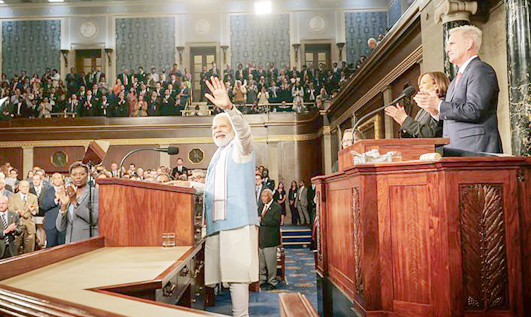
In his address to the joint meeting of the US Congress on Thursday, June 22, Prime Minister Modi said that more than two decades after 9/11 and over a decade after the 26/11 attacks in Mumbai, radicalism and terrorism still remain a pressing danger for the whole world.
“These ideologies keep taking new identities and forms, but their intentions are the same. Terrorism is an enemy of humanity and there can be no ifs or buts in dealing with it. We must overcome all such forces sponsoring and exporting terror,” Modi said in his 60-minute address in English.
The Prime Minister also talked about the virtues of democracy, the ties that bind India and the United States, and India’s economic and development trajectory. He also touched on issues of global concern, such as the war in Ukraine and the situation in the Indo-Pacific.
Mr. Modi’s speech was heard by a packed chamber and he received several standing ovations, but over 70 members of Congress had raised concerns about democratic backsliding in India ahead of his address. A handful of them boycotted the event. “Democracy is one of our sacred and shared values,” the Prime Minister said as he referred to India as the “mother of democracy”.
“I am here to speak about our calling for this century,” he said, characterizing as an “exceptional privilege” the opportunity to address Congress twice (his first address was in June 2016).
He talked about the digitization of the Indian economy and said that India would soon be the third-largest economy in the world. “When India grows, the world grows,” Mr. Modi said.
He depicted India’s development as being led by women and a blend of ancient values and modern capabilities, such as in technology.
“Be it creative reels on Insta or real-time payments, coding or quantum computing… the youth of India are a great example of how a society can embrace latest technology,” the Prime Minister said.
“We celebrated a remarkable journey of over 75 years of freedom, after a thousand years of foreign rule in one form or another,” Mr. Modi said. (This is apparently a reference to both British rule and Mughal rule. The BJP has previously alluded to the Mughals as being essentially foreign).
He also spoke about India’s environmental commitments, linking them to India’s culture.
On the Russian invasion of Ukraine, Mr. Modi said the world order was based on respect for the United Nations Charter, sovereignty and territorial integrity and the peaceful resolution of disputes.
“War has returned to Europe. It is causing great pain in the region,” he said, adding that the countries of the so-called Global South were particularly impacted.
“As I have said directly and publicly, this is not an era of war. But, it is one of dialogue and diplomacy,” Mr. Modi said.
Modi also made a veiled reference to China, saying the global order is based on respect for the principles of the UN Charter, peaceful resolution of disputes, and respect for sovereignty and territorial integrity. Representing 1.4 billion Indians, Modi said it is always a great honor to address the US Congress and an exceptional privilege to do so twice.
Modi became the first Indian leader to address the joint session of the US Congress twice on Thursday. He first addressed a joint meeting of the US Congress in 2016.
Modi said as there have been many advances in AI- Artificial Intelligence – in the past few years, at the same time, there have been even more momentous developments in other AI- America and India.
“We were strangers in the defense cooperation at the turn of the century. Now, the US has become one of our most important defense partners,” said Modi, who is currently on his maiden state visit.
His words received a standing ovation from US lawmakers.
Modi said democracy is one of their sacred and shared values.
“It has evolved over a long time and taken various forms and systems. Throughout history, however, one thing has been clear. Democracy is the spirit that supports equality and dignity. Democracy is the idea that welcomes debate and discourse,” he said.
Democracy is the culture that gives wings to thought and expression, he said, adding that India is blessed to have had such values from times immemorial.
In the evolution of the democratic spirit, India is the “Mother of Democracy” he added.
(With inputs from PTI)
WASHINGTON, D.C. (TIP): Ahead of Prime Minister Narendra Modi’s State Visit, US Secretary of State Antony Blinken has said economic ties are at the heart of the Indo-US strategic partnership and added that the two countries are helping shape innovations of the future and the norms governing them.
Modi has been invited by President Joe Biden and First Lady Jill Biden for an official State Visit, which will include a State Dinner on June 22. Addressing the annual India Ideas Summit of the US-India Business Council (USIBC) here on Monday, June 12, Blinken said, “At the heart of our strategic partnership is our economic ties. And under the leadership of President Biden and Prime Minister Modi — and private sector leaders like you — it is growing stronger by the day.”
Blinken added that last year, trade between the two countries reached a record USD 191 billion, making the US the largest trading partner for India. American companies have invested at least USD 54 billion in India — from manufacturing to telecommunications. In the US, he said, Indian companies have invested over USD 40 billion — in IT, pharmaceuticals and more — supporting 4,25,000 jobs from California to Georgia.
This February, Air India announced the historic purchase of more than 200 Boeing aircraft that will support an estimated one million-plus jobs across 44 states, the diplomat said during his address.
“We’re here ahead of a historic State Visit by Prime Minister Modi — one that will further solidify what President Biden has called a ‘defining relationship’ of the 21st century,” Blinken said.
“We see this defining relationship in our unique connection as the world’s oldest and largest democracies, with a special obligation to demonstrate that our governments can deliver for and empower all our citizens.”
Blinken said both the US and India are making transformative investments in their own countries — through Biden’s USD 1.2 trillion Bipartisan Infrastructure Law and Modi’s Rs 100-trillion infrastructure plan — to make their respective economies more productive and attractive for investors.
“India has joined three pillars of our new Indo-Pacific Economic Framework — committing to build more resilient supply chains, seize clean energy opportunities and combat corruption,” he said.
“Together, we are helping shape the innovations of the future and the norms governing them — from artificial intelligence to quantum computing,” Blinken said and added that in January, USIBC co-hosted a roundtable where the two governments inaugurated a new Initiative on Critical and Emerging Technologies.
“We’re elevating and expanding the strategic technology partnership between governments, businesses, and academic institutions in the US and India because we believe how technology is designed and used should be informed by democratic values and respect for human rights,” he said.
Central to that cooperation is diversifying and deepening the supply chains with trusted countries while also reducing strategic dependencies, he said.
Secretary of Commerce Gina Raimondo and her counterpart Union Commerce and Industries Minister Piyush Goyal recently established a partnership to make the semiconductor supply chain more resilient.
In Tamil Nadu, the US International Development Finance Corporation provided USD 500 million to help a leading US company build a solar manufacturing facility. This project will power roughly 30 million light bulbs in homes, schools, and businesses across India, create over a thousand jobs for Indians and Americans, and shift a key component of the US’s clean energy supply chain to a close partner, the diplomat noted.
According to Blinken, the trajectory of the Indo-US partnership is unmistakable and filled with promise.
“It is being written in places like North Carolina, where our growing engagement is benefiting both our countries,” he said. The Tar Heel State has become a hub for Indian investment with tech companies such as HCL creating 2,400 jobs and training American high-schoolers for careers in the IT industry.
On the other hand, Charlotte-based Honeywell is employing 13,000 people from Kolkata to Mumbai, making safer airplanes and energy-efficient buildings. Duke University has established a presence in Bangalore, strengthening academic and research exchanges between the people of the two countries, he said.
According to the top diplomat, one North Carolina entrepreneur from Gujarat — commenting on this explosion of US-India commercial activity — observed, “‘This couldn’t have happened 15 years ago’.”
(Source: PTI)
NEW YORK (TIP): Indian-Americans are preparing for a cultural extravaganza for Prime Minister Narendra Modi as he arrives in the American Capital from New York City after leading a yoga session at the UN Headquarters.
On the 9th International Day of Yoga on June 21, Prime Minister Modi will lead a yoga session for the first time at the UN Headquarters. Modi will address an invitation-only gathering of diaspora leaders from across the country at the Ronald Reagan Building and International Trade Center in Washington on June 23.
More than 160 artists are rehearsing for the past week to stage as many as 25 cultural programs representing 15 Indian states. Most of them are dances, songs and musicals reflecting the rich cultural diversity of India.
The performance would be staged at the historic Freedom Plaza near the White House in front of the Willard Hotel from 10 am in the morning to 2 pm, which would coincide with the arrival of the Prime Minister. A large number of Indian Americans are planning to gather at the Freedom Plaza to welcome the Prime Minister with ‘Vande Mataram’ and wave the tricolor. Engagement with the Indian Diaspora has been a signature part of Modi’s overseas travel. Most of the time, the prime minister spends some time with his diaspora followers, interacts with them and takes selfies.
The visit by U.S. Defense Secretary Lloyd Austin to India precedes PM Modi’s official state visit to White House next month
WASHINGTON, D.C. (TIP): United States Defense Secretary Lloyd Austin will embark on a four-nation trip including India from next week, according to the official statement released by the US Department of Defense. The first stop in his four-nation trip is Tokyo where he will meet with Japanese Defense Minister Yasukasu Hamada and other senior leaders and visit U.S. troops stationed in Japan.
According to the statement, Secretary Austin’s visit comes as the United States and Japan take important strides to modernize Alliance capabilities, optimize U.S. force posture, and build links with like-minded partners following the historic US-Japan “2+2” Ministerial meeting earlier this year.
Later on, Mr. Austin will travel to Singapore where he will deliver plenary remarks at the International Institute for Strategic Studies (IISS) 20th Shangri-La Dialogue in Singapore.
On the margins of the Dialogue, the Secretary will meet with key leaders to advance US defense partnerships across the region in support of our shared vision for a free and open Indo-Pacific, anchored in ASEAN centrality.
After completing his trip to Singapore, Mr. Austin will visit India. At the third stop in New Delhi, he will meet with Defense Minister Rajnath Singh and other leaders as the United States and India continue to modernize the US-India Major Defense Partnership. This visit provides an opportunity to accelerate new defense innovation and industrial cooperation initiatives and drive ongoing efforts to expand operational cooperation between the U.S. and Indian militaries.
Secretary Austin will conclude his trip in France to participate in events commemorating the 79th anniversary of D-Day and meet with French and United Kingdom defense leaders.
Quad partners on the right track despite irritants
The relations between India and Australia are going from strength to strength. The two nations are getting closer not only bilaterally but also as Quad partners. Prime Ministers Narendra Modi and Anthony Albanese have already met each other six times in the past one year. PM Modi’s just-concluded visit to Australia ticked all the right boxes. Both countries decided to seal a comprehensive trade deal by the year-end. They also signed a migration and mobility partnership pact that is expected to open up opportunities for students, academic researchers and business people and curb illegal immigration. This agreement comes just two months after the Australia-India Education Qualification Recognition Mechanism was finalized during Albanese’s visit to India.
Considering the priority being given to strong ties in the education sector, India and Australia need to effectively tackle the menace of visa fraud. With some Australian universities refusing admission to Indian students, a large-scale clean-up is required to weed out unscrupulous immigration and education consultants.
Even as the talks focused on cooperation in a wide range of sectors — education, green hydrogen, defense and security, trade and investment, critical minerals — PM Modi raised India’s concerns over the attacks on temples and the activities of Khalistan sympathizers in Australia. The two governments decided to exchange information and coordinate with each other regarding action against separatists and vandals who have been defacing community centers and temples with anti-India graffiti. This is an area where Australia needs to be proactive to ensure that its territory is not misused by radical elements. Dealing firmly with such troublemakers can pave the way for a deeper engagement between New Delhi and Canberra.
(Tribune, India)
Walking the tightrope seems to have paid off for India, but the multilateral challenges it faces will multiply
“While India’s attempts at being a “balancing force” (as a senior official put it) are playing out much more visibly, it is also setting off a trend — many countries in South East Asia and the Global South, not to mention countries such as Saudi Arabia, the United Arab Emirates, Turkey and Israel, are managing their ties with the West without joining its stand on Ukraine or sanctions. France’s latest reiteration of “Strategic Autonomy” after French President Emmanuel Macron’s visit to Beijing indicates that even the western coalition has its fissures on this point. Clearly, autonomous strategy or multi-alignment has paid off for India in this critical year.”
By Suhasini Haidar
As Prime Minister Narendra Modi embarks on a week-long journey to Japan, Papua New Guinea and Australia from May 19, a number of substantive global issues are on the anvil in his discussions with leaders of the G-7 outreach in Hiroshima, Japan, as well as during his travels from there, with bilateral issues taking a back seat to India’s position in the multilateral sphere. These mandate a very careful balance between the two ends of an increasingly polarized world that has been blown apart after the Russian war in Ukraine. This is also a world that looks uneasily at facing the geopolitical challenge from China, worries over trade access, supply chain reliability, and food and energy security.
Although the Quad Summit (Australia, India, Japan, U.S.) due to be held in Sydney has been cancelled in the wake of U.S. President Joe Biden’s domestic troubles, all four Quad leaders will meet on the sidelines of the G-7. Following this foray with the Indo-Pacific “coalition of democracies”, Mr. Modi will be in Washington in June for a state visit — a rare honor accorded by the U.S. President, that has been reserved for only two Indian leaders in the past, President Sarvepalli Radhakrishnan (1963) and Prime Minister Manmohan Singh (2009). This visit will be marked by many strategic forays to bring India-U.S. ties closer.
Almost immediately after his return, Mr. Modi will need to pivot to the opposing coalition however, hosting the Shanghai Cooperation Organisation (SCO) Summit scheduled for July 3-4, where he is expected to receive China’s President Xi Jinping, Russia’s President Vladimir Putin, the Pakistan Prime Minister Shehbaz Sharif, leaders of central Asian states, the soon-to-be added SCO members, the President of Iran, Ebrahim Raisi, and the President of Belarus, Alexander Lukashenko, and other guests.
The world of the SCO
The composition of the SCO, which includes those being inducted as observers such as Myanmar, gives the impression of it being a largely anti-western grouping, with practically every country sanctioned by the West as a part of it. With the SCO, a grouping that represents most of the world’s population, GDP growth, and energy reserves, India has comfort in its common stand against unilateral sanctions such as those against Russia.
A lesson or two may also be learnt from the Shanghai Cooperation Organisation Council for Foreign Ministers (SCO-CFM) held in Goa earlier this month, where India’s bilateral relations with mainly Pakistan, but China and even Russia, were allowed to overshadow more substantive multilateral outcomes. This is of particular annoyance to Central Asian countries, that have always insisted that no bilateral issues are brought up at the SCO, lest it go the way of the other regional South Asian grouping, the South Asian Association for Regional Cooperation (SAARC). A week after the SCO summit, Mr. Modi will pivot back to the European Union, as chief guest at France’s national “Bastille day” parade; visits to other European capitals are likely. August will see yet another turn, with the BRICS summit in South Africa. Mr. Modi will engage with the leaders of Russia, China, Brazil and South Africa on an alternative BRICS payment mechanism to the dollar-dominated international system, along with other ideas on the agenda seeking to build a counter-narrative to the U.S.-European Union combine. In September, as Mr. Modi hosts every global leader at the G-20 summit in Delhi, his diplomatic skills will be tested again — not since 2010 have leaders of all permanent members of the UN Security Council visited Delhi in the same year, let alone at the same time.
Striking a balance
The timing of these engagements is no accident; nor is it explained by India’s traditional adherence to the principle of non-alignment. If anything, Mr. Modi has consistently refused to attend Non-Aligned Movement in-person summits thus far, and has preferred his own version of “multi-directional engagements”. In 2017, the same year that India took part in reviving the Quad in the face of overt belligerence from Beijing, India also joined the SCO as a full member, agreeing to host the summit this year. New Delhi also exchanged places with both Italy and Indonesia in order to host the G-20 in 2023. If it is hosting the two major summits in the same year, it is by choice, not coincidence.
It is to India’s credit that it continues to maintain this balance, and is being courted by countries across the global divide, even as it seeks to hold out against two nuclear-armed land neighbors at its frontiers. Mr. Modi has even managed to maintain India’s “sweet spot” without needing to follow Indonesian President Joko Widodo’s example in travelling to Kiev, or inviting Ukraine’s President Volodymyr Zelenskyy and its Foreign Minister Dmytro Kuleba to address the G-20, in order to strike a balance on the war.
While India’s attempts at being a “balancing force” (as a senior official put it) are playing out much more visibly, it is also setting off a trend — many countries in South East Asia and the Global South, not to mention countries such as Saudi Arabia, the United Arab Emirates, Turkey and Israel, are managing their ties with the West without joining its stand on Ukraine or sanctions. France’s latest reiteration of “Strategic Autonomy” after French President Emmanuel Macron’s visit to Beijing indicates that even the western coalition has its fissures on this point. Clearly, autonomous strategy or multi-alignment has paid off for India in this critical year.
Disturbing the balance
There are a few unlikely “black swan” events that could jolt India off its careful tightrope walk and force a rethink of its policies one way or the other. A sudden success for Ukraine in its much-delayed, upcoming spring offensive, for example, would require New Delhi to reconsider its unalloyed ties with Moscow. Any major aggression by China across any part of the Line of Actual Control would be another such event requiring a strategic overhaul. India may also be forced to rethink if Russia turns more belligerent over the payment problem or withhold supplies of defense hardware to India under pressure from China. Equally, any decision by the U.S. and Europe to “force a choice” on India: to go forward with unilateral sanctions for the increase in Russian oil inflows processed at the Rosneft-owned refinery in Gujarat, or through the old threat of Countering America’s Adversaries Through Sanctions Act-Related Sanctions (CAATSA) for India’s acquisition of the Russian S-400 missile systems. In the absence of these ‘at present unlikely’ scenarios, India is likely to continue to try to work its interests on both sides of the geopolitical fence.
India’s tasks ahead will be made more difficult if New Delhi fails to ensure at the SCO summit in July or during the BRICS summit in August, that Moscow and Beijing accede to a consensus on a joint communique at the G-20 summit in September. The U.S.-led G-7 bloc seems sanguine in allowing the differences in text to continue, suggesting that the “two outliers” can be ignored, or even omitted from the group. For India, tasked with forging a consensus, which has accompanied every G-20 summit in the past, the failure to issue a joint statement would be an ignoble distinction. Given the high stakes involved, the next 100 days will decide whether India can retain its reputation in forging a fair balance between its conflicting interests across the global divide, while remaining a gracious and successful host as the world comes home for the G-20.
(The author is an editor with The Hindu. She can be reached at suhasini.h@thehindu.co.in)
President Joe Biden will host Prime Minister Narendra Modi for an Official State Visit to the United States, which will include a state dinner, on June 22, the White House announced on Wednesday, May 10. “The upcoming visit will affirm the deep and close partnership between the US and India and the warm bonds of family and friendship that link Americans and Indians together,” White House Press Secretary Karine Jean-Pierre said in a statement while announcing the visit. Prime Minister Modi’s visit will strengthen two countries’ shared commitment to a free, open, prosperous, and secure Indo-Pacific, she said, amid China’s aggressive behaviour in the strategic region. The visit will also elevate the bilateral strategic technology partnership, including in defence, clean energy, and space, she said. “The leaders will discuss ways to further expand our educational exchanges and people-to-people ties, as well as our work together to confront common challenges from climate change, to workforce development and health security,” she added.
Prime Minister Modi’s visit to the US comes ahead of the G20 summit being hosted by India in September.
He visited Washington in September 2021 at the invitation of President Biden for a bilateral meeting and also attended the first in-person Quad Leaders Summit.
Modi will join Biden and his counterparts from Australia and Japan at a summit of the Quad leaders in Sydney on May 24 that is expected to focus on implications of the Ukraine conflict and the overall situation in the Indo-Pacific.
Before travelling to Australia, Modi is likely to visit the Japanese city of Hiroshima to attend the annual summit of the Group of Seven (G7) advanced economies which is scheduled to take place from May 19 to 21.
President Biden will attend the G7 leaders’ summit in Hiroshima as well as the Quad summit in Sydney.
Earlier, Prime Minister Modi met President Biden on the sidelines of the G20 Summit in Bali, Indonesia in November last year. The two leaders also met on the sidelines of the G7 Summit in Germany in June, 2022 and before that in May on the sidelines of the Quad Leaders Summit in Tokyo.
WASHINGTON, D.C. (TIP): President Joe Biden will host Prime Minister Narendra Modi for an Official State Visit to the United States, which will include a state dinner on June 22, the White House announced on Wednesday, May 10. This would be the first State Visit of an Indian leader after then President Barack Obama invited then prime minister Manmohan Singh for a State Visit in November 2009.
President Biden and the First Lady Dr Jill Biden will host Prime Minister Modi for an Official State Visit to the United States June 22, White House Press Secretary Karine Jean-Pierre said in a statement while announcing the visit.
“The upcoming visit will affirm the deep and close partnership between the US and India and the warm bonds of family and friendship that link Americans and Indians together,” she said.
Prime Minister Modi’s visit will strengthen two countries’ shared commitment to a free, open, prosperous, and secure Indo-Pacific, she said, amid China’s aggressive behavior in the strategic region.
The visit will also elevate the bilateral strategic technology partnership, including in defense, clean energy, and space, she said.
“The leaders will discuss ways to further expand our educational exchanges and people-to-people ties, as well as our work together to confront common challenges from climate change to workforce development and health security,” she added.
Prime Minister Modi’s visit to the US comes ahead of the G20 summit being hosted by India in September.
After becoming the Prime Minister in 2014, Modi has made more than half a dozen trips to the United States for bilateral and multilateral meetings with all the three American presidents, Obama, Donald Trump and now Biden, but this is for the first time he has been invited for an official State Visit, a privilege accorded to America’s close friends and allies.
He last visited Washington in September 2021 at the invitation of President Biden for a bilateral meeting and also attended the first in-person Quad Leaders Summit.
Modi will join Biden and his counterparts from Australia and Japan at a summit of the Quad leaders in Sydney on May 24 that is expected to focus on implications of the Ukraine conflict and the overall situation in the Indo-Pacific.
Before travelling to Australia, Modi is likely to visit the Japanese city of Hiroshima to attend the annual summit of the Group of Seven (G7) advanced economies which is scheduled to take place from May 19 to 21.
President Biden will attend the G7 leaders’ summit in Hiroshima as well as the Quad summit in Sydney. Modi’s State Visit is reflective of the importance that the President Biden attaches to his personal relationship with him and the India-US ties. “It is entirely good and proper that the world’s two greatest democracies further cement their strategic, economic, and technology convergence in these turbulent geostrategic times. The State Visit will remind the world that India and America still have so much more potential to capture in our bilateral relations, reflecting the energy and talent of our demographics and our systems, which serve to empower our free peoples,” US-India Business Council president Atul Keshap said. Earlier, Prime Minister Modi met President Biden on the sidelines of the G20 Summit in Bali, Indonesia in November last year. The two leaders also met on the sidelines of the G7 Summit in Germany in June 2022 and before that in May on the sidelines of the Quad Leaders Summit in Tokyo. Meanwhile, India’s ambassador the US Taranjit Singh Sandhu, on May 10 said: “Prime Minister Narendra Modi’s visit to the US will show that the partnership between the two nations is people-centric, people-driven, and is good for the world at large”, even as he called the visit “historic.”
“The PM’s forthcoming official state visit to the US, at the invitation of President Biden, is historic. Prime Minister and President Biden have together imparted significantly new vigor and momentum to our bilateral ties,” India’s Ambassador to the US, Taranjit Singh Sandhu told PTI. “The visit will be an opportunity for the two leaders to spend time together, take stock of the progress achieved and provide guidance on the future limitless possibilities. The visit will also underscore that India-US partnership is people-centric and people-driven, and that it is not just for the two countries, but for the world at large,” Sandhu said.
(Source: PTI)
Signup to our Newsletter!
Don’t miss out on all the happenings around the world