Tag: politics

  • Senators spar over FBI Report on Brett Kavanaugh: Protests erupt against Kavanaugh

    Senators spar over FBI Report on Brett Kavanaugh: Protests erupt against Kavanaugh

    WASHINGTON(TIP): Democrats are angry over FBI “clean chit” to President Trump’s nominee for Supreme Court Brett Kavanaugh. Protests have erupted in Washington against Brett Kavanaugh whose   confirmation vote is soon to be taken up by the Senate.  Republican Senators appear confident that Kavanaugh will win confirmation.

    The FBI report, sent by the White House to the Senate Judiciary Committee in the middle of the night, was denounced by Democrats as a whitewash that was too narrow in scope and ignored critical witnesses. But Republicans moved forward with plans for a key procedural vote on Friday and a final vote on Saturday on confirming the conservative federal appeals judge chosen by Trump for a lifetime job on the nation’s top court.

    The FBI report represented the latest twist in a pitched political battle over Kavanaugh, and comments by two crucial Republican senators — Jeff Flake and Susan Collins — indicated it may have allayed concerns they had about the judge. Flake was instrumental in getting Trump to order the FBI investigation last Friday.

    Republicans control the Senate by a razor-thin margin, meaning the votes of those two could be crucial in securing Kavanaugh’s confirmation. Collins said the investigation appeared to be thorough, while Flake said he saw no additional corroborating information against Kavanaugh, although he was “still reading” it.

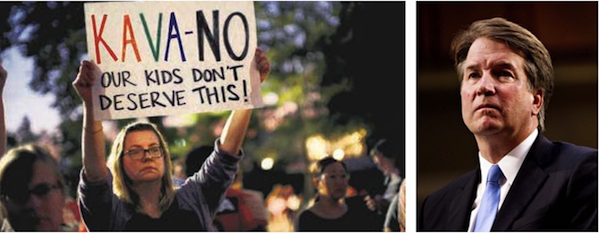
    Protesters in Washington on October 4.
    Screen shot /NBC News

    A previously undecided Democratic Senator, Heidi Heitkamp, said she would vote against Kavanaugh, citing “concerns about his past conduct” and questions about his “temperament, honesty and impartiality” after his defiant testimony a week ago to the Senate Judiciary Committee. Heitkamp’s decision left Senator Joe Manchin as the only undecided Democrat. Most Democrats opposed Trump’s nomination of Kavanaugh from the outset.

    Meanwhile, Kavanaugh, in a column for the Wall Street Journal Judge Brett Kavanaugh has admitted to saying some things he should not have during a Senate hearing last week, a tacit acknowledgement of the questions being raised about his conduct and emotions as he seeks confirmation to the Supreme Court.

    “I was very emotional last Thursday, more so than I have ever been. I might have been too emotional at times,” Kavanaugh wrote. “I know that my tone was sharp, and I said a few things I should not have said.”

    Kavanaugh also said in the column that he would be an independent and nonpartisan judge.

    More than 2,400 law professors from across the political spectrum signed a letter this week arguing that the lack of “judicial temperament” that Kavanaugh displayed would be disqualifying for any court, let alone the highest in the land. A former Supreme Court justice, John Paul Stevens, has also weighed in, calling Kavanaugh’s hearing performance disqualifying during an event Thursday, according to the Palm Beach Post.

    Thousands assembled today, October 4, to protest Supreme Court nominee Brett Kavanaugh by marching on the Senate Office Building where his confirmation vote will take place. Among the masses a few celebrities have been spotted speaking out against the judge, with Amy Schumer and Emily Ratajkowski ending up detained by law enforcement.

  • Gopal, Turner Bill to Ensure State Workers are Paid for Time Lost During Budget Shutdown Advances

    Gopal, Turner Bill to Ensure State Workers are Paid for Time Lost During Budget Shutdown Advances

    TRENTON, NJ(TIP): – Legislation sponsored by Senator Vin Gopal and Senator Shirley K. Turner which would require state employees who could not attend work due to a budget shutdown receive their full salary or wages advanced from the Senate State Government, Wagering, Tourism, and Historic Preservation Committee.

    “During times when a consensus on the budget cannot be reached before the June 30th deadline, state workers should not have to suffer the consequences, especially since it is no fault of their own,” said Senator Gopal (D-Monmouth). “This bill will ensure state workers get the wages they are due in a timely manner.”

    The bill, S-2756, would provide that state employees, who are subject to an involuntary disruption of service because of a shutdown of state government due to a state budget impasse, are entitled to their full salary or wages. The bill would apply in any fiscal year when there is a late enactment of a state annual appropriations act.

    “The legislature should not have to vote on whether or not to pay state workers every time there is a government shutdown,” said Senator Turner (D-Hunterdon/Mercer). “They deserve the peace of mind to know they will get paid if a shutdown prevents them from going to work.”

    The bill advanced from committee by a vote of 5-0, and next heads to the Senate Budget and Appropriations Committee for further consideration.

  • A Nationalism That’s Anti-National

    A Nationalism That’s Anti-National

    By Yogendra Yadav

    What the RSS needs is an exposure to Indian culture and a deeper understanding of Hinduism itself

    The RSS was among the few organizations in independent India that refused to honor some of the key symbols of the Indian republic: the national flag, the national anthem and, of course, the Constitution of India. It speaks volumes that the head of the RSS has to clarify, nearly seven decades after the promulgation of the Constitution, that his organization believes in it, something explicitly contradicted by his predecessor. Notwithstanding its recent claims to the contrary, the RSS does not quite subscribe to any of the key tenets of the Constitution: socialism, secularism, federalism and, indeed, democracy.

    The recent outreach by the Rashtriya Swayamsevak Sangh (RSS) at Vigyan Bhavan in Delhi seems to have succeeded in its principal objective: an image makeover for a niche audience. Thanks to an obsequious media and a commentariat ever willing to suspend disbelief, the event has yielded the soft, liberal gloss the RSS needed and desired. Sadly, the critics limited themselves to questions that the RSS anticipated, indeed wanted: Does the RSS exercise influence on this government? Is the RSS anti-Muslim?

    It is time we asked a harder and deeper question: Is the RSS anti-national?

    Theory and practice

    On the face of it, this is an odd question. Nationalism, Indian-ness and Hindutva are very much the calling card of the RSS. This is not put on. I have known the RSS from inside and outside. Having met hundreds of swayamsevaks and many pracharaks, I know that an average RSS volunteer carries this nationalist self-image. I can also attest that just like the communists or old-time socialists, an average RSS worker tends to be more honest and idealist than a run-of-the-mill political leader. I am aware that on more than one occasion, the RSS has done exemplary rescue and relief work during national disasters. If anything, its critics accuse it of being ultra-nationalist. Thus, to question its nationalist credentials might appear outrageous.

    Yet this question needs to be debated in all seriousness and all fairness. Given the salience of the RSS in our national public life today, this is a pressing question. We worry, rightly so, about the impact of Islamic fundamentalist groups and Maoist insurgents on our nation. We debate, as we should, the challenge posed by separatism in Kashmir and Nagaland to our nationhood. But we no longer debate with any seriousness the challenge posed by the RSS and its associates to the project of nation-building the Indian nation. The question is about the theory and practice of the RSS as an organization and its relation to the Indian nation, its past, present and future.

    The nation and the past

    Let’s begin with some indisputable facts about its past. Right from its inception in 1925, the RSS was not in any way active during the national movement. In fact, its associates such as the Hindu Mahasabha actively opposed the national movement. It is also a well-documented fact that V.D. Savarkar, whose ideology inspired the RSS’s founders and who remains its icon, was released from Cellular Jail in the Andaman and Nicobar Islands after he wrote four mercy petitions to the Viceroy pledging loyalty to the British empire. After his release, he lived off a stipend from the British government and obeyed faithfully the conditions it had imposed on him. Shyama Prasad Mookerjee, another Hindu Mahasabha leader, actively collaborated with the British during the Quit India movement while the RSS kept aloof from this biggest anti-colonial uprising. The two-nation theory was propagated by Hindu nationalists, much before the Muslim League. And it is no secret that Nathuram Godse was once an RSS member and was very much a part of its extended family when he murdered Mahatma Gandhi. Bluntly put, the RSS made zero, if not negative, contribution to the national struggle. But that is not sufficient to dub it anti-national today.

    The role of the RSS after Independence is more relevant here. How did the RSS contribute to the project of nation-building? Sadly, the answer is again in the negative. The RSS was among the few organizations in independent India that refused to honor some of the key symbols of the Indian republic: the national flag, the national anthem and, of course, the Constitution of India. It speaks volumes that the head of the RSS has to clarify, nearly seven decades after the promulgation of the Constitution, that his organization believes in it, something explicitly contradicted by his predecessor. Notwithstanding its recent claims to the contrary, the RSS does not quite subscribe to any of the key tenets of the Constitution: socialism, secularism, federalism and, indeed, democracy.

    The secessionists challenge the territorial integrity of India. The left-wing extremists challenge the writ of the Indian state. The challenge posed by the RSS is much deeper: it challenges the very idea of India, the swadharma of the Republic of India. If this is not anti-national, what is anti-national?

    In practice, far from being a part of the solution, the RSS was always a part of the problem that India faced in its difficult journey of nation-building. The legacy of Partition and the challenge of bringing together immense diversities posed an unprecedented challenge to the nascent Indian nation. During this delicate phase, the RSS was at best an irresponsible denominational pressure group for the Hinduisation of the Indian state, opposing any and every concession to minorities and advocating a hawkish foreign policy. At worst the RSS became a fulcrum of organized subversion of the constitutional order, as in the demolition of the Babri Masjid in 1992. If constitutional patriotism is the heart of national political life, the RSS has repeatedly stood in opposition to the nation.

    More than anything else, it is the theory and practice of its nationalism that shows the RSS to be a European import, out of sync with Indian nationalism. The RSS subscribes to the now outdated European model of nation-state which assumed that the cultural boundaries of a nation must match the political boundaries of a state. In Europe it meant a uniform race, religion, language and culture as the defining features of a nation. In India it meant Hindu-Hindi-Hindustan, the slogan coined by Savarkar. India’s home-grown nationalism challenged this European model and its futile and bloody quest for matching cultural and political boundaries. Instead, Indian nationalism was about creating political unity in conditions of deep diversity of culture, religion and language.

    Paradox of its workings

    Today, as a rapidly diversifying world seeks to learn from the Indian model, the RSS clings on to an alien, borrowed and fractious understanding of nationalism. Worse, its model of separatism of the majority is clearly the biggest obstacle for Indian nationalism. Isn’t it odd that an organization that claims to work for national integration has, or has had, little time and energy for an amicable resolution of some of the issues that challenge our national unity? These include intractable regional disputes (the Karnataka-Tamil Nadu and Punjab-Haryana water disputes), intra-regional tensions (demand for Telangana or Vidarbha), language issues (Punjabi-Hindi, Kannada-Marathi) or differences with racial and ethnic dimensions (violence against migrants from the Northeast in Bengaluru, Hindi speakers in Mumbai).

    The RSS version of nationalism comes into play only when there is a religious angle to any issue. It is not that they care for Hinduism either. The RSS ideologues have little knowledge of or interest in Hindu traditions. In fact, the version of Hinduism that it seeks to impose is itself a parody of orthodox Islam and orthodox Christianity and against the basic spirit of Hinduism, let alone the spirit of humanism that informs all religions. Unfortunately, the principal focus of the RSS has been to foment Hindu-Muslim differences, division and hatred. Since Hindu-Muslim violence poses the biggest single threat to national unity today, those who work for the exacerbation of Hindu-Muslim tension must be seen as anti-national, and guilty of treason.

    The secessionists challenge the territorial integrity of India. The left-wing extremists challenge the writ of the Indian state. The challenge posed by the RSS is much deeper: it challenges the very idea of India, the swadharma of the Republic of India. If this is not anti-national, what is anti-national?

    I am not for a ban on the RSS. Its theory and practice represent a cultural-political malady that needs a deeper cure rather than a ban. It originates in an inferiority complex of a modern Hindu, made worse by a westernized, deracinated form of our secularism. This might sound odd, but what the RSS needs is exposure to Indian culture and its multiple traditions, greater appreciation of culturally more confident Indians such as Tagore and Gandhi and a deeper understanding of Hinduism itself. If it introspects rather than hold an outreach at Vigyan Bhavan, I am sure its Sarsanghchalak would recommend to the RSS what Gandhiji suggested to the Congress party: dissolve itself.

    (The author is National President of Swaraj India and a psephologist/academic formerly with Lokniti, Centre for the Study of Developing Societies, New Delhi)


  • Trump says he prefers to keep Deputy A-G Rosenstein: Thursday Meeting postponed: White House

    Trump says he prefers to keep Deputy A-G Rosenstein: Thursday Meeting postponed: White House

    WASHINGTON(TIP): President Donald Trump has postponed his planned meeting with Deputy Attorney General Rod Rosenstein until next week, the White House announced on Thursday, September 27.

    White House press secretary Sarah Sanders said Trump spoke briefly with Rosenstein on Thursday and the two men agreed to meet next week to avoid interfering with the focus on the Senate Judiciary Committee’s hearings with Supreme Court nominee Judge Brett Kavanaugh and Christine Blasey Ford, who has accused Kavanaugh of sexually assaulting her when they were teenagers.

    “They do not want to do anything to interfere with the hearing,” Sanders said in a statement.

    Trump and Rosenstein were set to meet Thursday in person to discuss Rosenstein’s future in the administration after The New York Times reported last week that Rosenstein suggested secretly recording the President and attempting to remove him from office via the 25th Amendment.

    Trump signaled during a news conference on Wednesday that he might delay his meeting with Rosenstein, saying he might “ask for a little bit of a delay to the meeting, because I don’t want to do anything that gets in the way of this very important Supreme Court pick.”

    “I don’t want it competing and hurting the decision, one way or the other,” Trump said.

    Trump declined to say whether he had made up his mind on Rosenstein’s future in his administration but said he “would much prefer keeping Rod Rosenstein.”

    “We’ve had a good talk. He said he never said it, he said he doesn’t believe it. He said he has a lot of respect for me, and he was very nice and we’ll see,” Trump said. “We have caught people doing things that are terrible. I would much prefer keeping Rod Rosenstein, much prefer.”


  • Ayodhya dispute: SC declines to refer to larger bench whether mosque is integral to Islam

    Ayodhya dispute: SC declines to refer to larger bench whether mosque is integral to Islam

    Hindu groups hail Supreme Court verdict.   ‘High-powered’ saints’ panel to decide future action on Oct 5

    NEW DELHI(TIP):  Hindu groups welcomed, September 28, the Supreme Court decision refusing to refer to a larger Bench its 1994 verdict that said mosque is not integral to Islam, thereby weakening the Sunni Wakf Board’s claim over the disputed land.

    The BJP’s ideological fountainhead RSS and its affiliate Vishwa Hindu Parishad expressed satisfaction while hoping for an early decision on the matter. Stating that all sorts of impediments to “delay the matter” (construction of a Ram temple at Ayodhya) have now been removed, VHP president Alok Kumar said the next course of action would be decided at a high-powered committee of saints on October 5.

    “I am satisfied that this impediment has been removed and the way is now clear for hearing of appeals in the title suits on Ram janmabhoomi. We feel all sorts of impediments were being put up to delay the main matter (construction of Ram temple), including pleas that the matter be heard after the 2019 Lok Sabha elections. We understand that the next hearing on the case has been fixed for October 29. The matter has been pending in the Supreme Court for long. We hope and expect that the SC will expeditiously hear the pleas,” he said.

    On whether the construction of the temple would begin before the 2019 elections, he said the two issues “were not related”. A high-powered committee comprising saints associated with the Ram janmabhoomi issue will gather on October 5 and take a call on the next course of action, he said.

    RSS office-bearers are expected to be present at the meeting to decide whether the matter should be left to the SC, Parliament or required fresh impetus. Notably, the issue related to the 1994 ruling has delayed the hearing in the title case. Now that the hearing will start on October 29, the most important implication of Thursday’s order could be speeding up of the title case. With less than a year to go for the polls, political observers see it as a “favorable” situation for the BJP, which had promised a “grand Ram temple “in its manifesto.

    Recently, RSS chief Mohan Bhagwat, while speaking at a Sangh conclave “Bhavishya Ka Bharat — An RSS Perspective”, was also clear that a grand Ram temple should be constructed at Ayodhya as soon as possible. Rather, it should have been built by now, he had said.

    “It (Ram temple) is the question of faith of crores of Hindus, it should have happened by now. It is only right that a grand Ram mandir is built at the place Bhagwan Ram was born. The building of the temple will end a major issue of friction between Hindus and Muslims. And if it is done amicably, it will automatically silence those who point fingers at the Muslim community,” Bhagwat had said.


  • The UN Shudders as ‘Trump Week’ Closes in

    The UN Shudders as ‘Trump Week’ Closes in

    NEW YORK(TIP): A year after his bombastic debut at the United Nations as president of the United States, Donald Trump returns on Monday, Sept. 24, to lead a US effort to spur global action to stem the narcotics and opioid plagues. Could the US be asking the UN for help this time?

    The morning meeting on drugs on Monday, in which Secretary-General António Guterres is also scheduled to speak, may be a soft landing in New York for Trump. On Tuesday morning, Sept. 25, he will address the opening session of the 73rd General Assembly, the centerpiece of his visit and his opportunity to vent about his enemies, his friends and the organizations he disparages. The audience will be politely hunkered down.

    On Wednesday, Sept. 26, however, diplomats and commentators expect a potentially explosive scene in the Security Council when Trump will take the Council president’s chair, coincidentally held by the US for September. He could turn the occasion into a sustained attack on Iran and a defense of his decision to withdraw from an internationally backed nuclear deal with the Iranians.

    On Sept. 4, Nikki Haley, Trump’s loyal ambassador and accomplice at the UN, told reporters in a televised briefing there that the Sept. 26 Council meeting would be solely about Iran. She acknowledged that under Council rules the meeting would give the Iranians the right to speak in their defense.

    A personal confrontation between Trump and an Iranian official, possibly President Hassan Rouhani, and tense arguments with Europeans and other supporters of the Iranian deal apparently caused a scramble in the White House to change how to define the Council meeting. The scramble seems to confirm recent reports that high-ranking officials close to the president have been working behind the scenes to curb his worst instincts for his compulsive behavior and combative language — especially weeks before the US midterm elections.

    The description of the Council meeting has been broadened to circumvent a direct Iranian role. “In addition to addressing Iran’s destabilizing aggression and sponsorship of terrorism, the President will address a broader range of issues given the challenges facing the world at this time,” the US mission at the UN says. “During the Security Council meeting, the President will address the proliferation of weapons of mass destruction, including chemical, biological, and nuclear weapons and ballistic missiles.”

    That change doesn’t guarantee there won’t be arguments over the 2015 Iran nuclear agreement, formally titled the Joint Comprehensive Plan of Action, which took five years to negotiate as the best hope for curtailing nuclear-weapons development by Iran. The deal is supported by all four other permanent Council members — Britain, China, France and Russia– and the European Union well as Japan. The US has also reimposed sanctions on Iran unilaterally, ignoring Council resolutions.

    If Trump expects to change opinions on his Iran policy, which is strongly opposed by many critics among member nations and officials of the UN, he is likely to meet a stone wall from the agreement’s supporters, who are struggling to save the deal. Even President Vladimir Putin of Russia expressed his opposition to Trump’s policy publicly after meeting Trump in Helsinki on July 16.

    The Reuters news agency reported recently that Russia’s Deputy Foreign Minister Sergei Ryabkov said early in September that Washington was “mistaken” if it thinks it can change any minds. He predicted that “the Americans won’t have an easy walk at this meeting.”

    In addition, European firms that stop doing business with Iran because of reimposed US sanctions could be sanctioned by the European Union, a special adviser to the bloc’s top diplomat warned in August.

    It would not be an overstatement to say that Trump’s reputation for erratic pronouncements, his often-voiced contempt for international institutions and bullying will make his presence a focus of much attention at UN headquarters. The UN has never known an American president quite like Trump.

    Sacha Sergio Llorentty Soliz, the ambassador of Bolivia to the UN, a  current Security Council member from a country frequently critical of the US, said in an interview with PassBlue that he didn’t want to speculate how Trump could be received, “But for us, regardless of what he says, what we’ve seen in the last year and a half is a complete disregard of international law, multilateralism and the use of the UN as a lemon so to speak: they squeeze it, get as much as they can and throw it away.”

    Stephen Schlesinger, who wrote the classic history of the founding of the UN, “Act of Creation,” and a leading analyst of the organization’s story over seven decades since, is not optimistic about Trump’s visit.

    “Trump’s appearance at the UN is going to be a bizarre and troubling spectacle for the organization — perhaps somewhat like Hugo Chavez’s strange and erratic performance at the UN when he claimed he smelled sulfur in the room in reference to George W. Bush,” Schlesinger said in an email exchange.

    “By now, most member nations of the UN know that Donald Trump, the leader of the most powerful nation on earth, is a troubled man with a disordered mind,” he added. “He is a proven liar, a compulsive braggart and a thoroughly unpredictable chief executive. These are not the traits normally associated with the individual who runs one of the greatest democracies on the planet.”

    “It is clear that Trump intends to focus all of his energies in his UN appearances on condemning Iran, using the presidency of the Security Council as his base of attack,” Schlesinger added. “He openly plans to step into a hornet’s nest of opposition from practically all the members of the Council.”

    On US policies and actions in the Middle East — which Secretary-General Guterres has said disqualify the Trump administration from being an impartial mediator — Trump has aligned the US squarely behind the Israeli government of Prime Minister Benjamin Netanyahu, including on Iran. The US has also cut off most aid to Palestinians and closed their office in Washington. These actions are being criticized from within the American Jewish population by the liberal pro-Israeli, pro-peace group J Street, which also opposed the recognition of Jerusalem as Israel’s capital and the relocation of the US Embassy there, moves overwhelmingly rejected by UN member nations in a vote in the General Assembly last December.

    Media reports and polls testing what effect Trump foreign policies may have on his mostly conservative, largely rural voting base in the US are suggesting that voters in agricultural states, while mainly supportive of the president’s tough-guy approach, are concerned about loss of income from corn, soybeans and pork exports as Trump’s self-imposed tariff wars begin to backfire on them. The impact, or not, of this issue will be tested in the midterm American elections in early November, when members of Congress are up for election. He needs distractions.

    “Most of all Trump’s address to the UN is about appealing to his conservative voter base,” Schlesinger wrote. “He will assert that his policies have reversed all of the weak-kneed actions of the Obama Administration; that he has rebuilt the US military; that he has re-established US primacy and prestige around the globe. But, for the UN, his delusional avows of ‘winning’ around the globe, most UN delegates will privately shake their heads at his nonsensical claims and just try to figure out how best to get through the next two years of his term without suffering too much further damage to themselves and to the UN.”

    On the domestic American scene generally, there is increasing alarm about a very different issue: the opioid crisis that is killing more people every year. This is where Trump’s sideline event on Sept. 24 on drugs and crime fits into his UN headquarters agenda, and where the US is asking — indeed demanding — the world’s help.

    The grandly titled “Global Call to Action on the World Drug Problem,” the subject of the US event, has 33 co-sponsors from mostly Asian, African and Latin American nations, a number of which vote reliably with the US at the UN. The document they are promoting essentially if subtly accuses other countries and UN convention-monitoring bodies and drug agencies of not doing enough to stop the manufacture and transfer of drugs.

    No mention is made in the call to action about the consumer market in the US that feeds much of the illicit manufacture and export abroad; there is only a glancing reference to reducing demand everywhere.

    The demand the US will make at the UN echoes a three-pronged US national program unveiled by the White House in March, calling for improvements in education and prevention, treatment and recovery and law enforcement and interdiction, including across borders. Early this year, the US Department of Justice unveiled its first indictments against Chinese makers of Fentanyl, a powerful narcotic painkiller that, when abused, leads to addiction.

    At the Sept. 24 UN meeting called by the Trump administration, according to the draft program circulated among UN diplomatic missions, there will be a few speeches and a group photograph: good for the Trump base. In the 45 minutes scheduled for the morning event, the US will commit, at least on paper, to global cooperation after more than a year of insulting, belittling and threatening international institutions. As of this writing, 113 nations have backed the Trump event, including Mexico but not Canada.

    As Trump Week approaches, the 193 member nations of the UN and organization officials have no illusions about the US president’s unpredictably, irrationality and capacity to offend — changing his mind and his targets, at will. Last year, Kim Jong Un, the abusive dictator of North Korea, was “little rocket man” on a suicide mission and in peril of having his country wiped off the face of the earth. This year, Kim is an honorable man and trustworthy buddy, with a second summit being planned. (Kim is not scheduled to speak at the UN General Assembly.)

    The US State Department just announced that Secretary of State Mike Pompeo intends to lead a UN Security Council meeting on North Korea on Sept. 27, to reinforce UN sanctions.

    Repeating his America First mantra to the world in the General Assembly in 2017, Trump extended his fierce defense of national sovereignty for all counties but not to ones he did not like, freely threatening them. He left some government leaders and diplomats in the audience gasping.

    This year, when Trump is again reported to speak about sovereignty, the audience in the General Assembly will be on guard, more so because when Trump arrives in New York, he will be leaving behind a White House in administrative shambles, rocked by scandals and shadowed by an unprecedented investigation into possible acceptance of Russian aid in securing a win in the 2016 presidential election.

    He could choose to air his litany of grievances with the rest of the world, but he wouldn’t find much sympathy.

    (Source: Passblue.com)


  • Indian American former US ambassador comes out in support of Preston Kulkarni

    Indian American former US ambassador comes out in support of Preston Kulkarni

    HOUSTON, TX(TIP): Indian American Democrat Sri Kulkarni has received a helping hand from an ex-colleague at Foggy Bottom, former US Ambassador to India Richard Verma.

    Verma, the first and the only Indian American who served as a US ambassador in India, Wednesday, September 19,  sent out an email on behalf of Kulkarni requesting campaign donation and help to elect the Texan.

    Highlighting Kulkarni’s 14-year stint at the Department of State, Verma stated in the email, “Today, more than ever, we need leaders like Sri who will champion diplomatic solutions and put country over politics.”

    The 22nd district, which includes several Houston suburbs, has the largest Indian American population in the state. A quarter of the district’s population is Hispanic and Asian Americans comprise 18 percent.

    If he wins, Kulkarni will become the first Indian American congressman from Texas.

    Verma served as US ambassador to India from 2014 to 2017. He is currently a vice chairman and partner at The Asia Group, which provides strategic and business advisory services to companies and organizations working in Asia.

    Verma’s email:

    “I want to tell you about my friend, Sri Kulkarni. Sri and I both served at the State Department together when I was the U.S. Ambassador to India — Sri is a proven leader who has served his family, community, and country for his entire life.

    Sri represented America for 14 years as a Foreign Service Officer with overseas tours in Iraq, Israel, Russia, Taiwan and Jamaica. He then served as a foreign policy and defense advisor on Capitol Hill assisting Senator Kirsten Gillibrand on the Senate Armed Services Committee.

    Sri has spent his career fighting to ensure that American values are represented in our foreign policy. Now, he’s returned to Texas to fight for them here at home.

    Today more than ever, we need leaders like Sri who will champion diplomatic solutions and put country over politics. Make a contribution of $25, $50 or $100 right now to help Sri share his message with voters in TX-22 and bring his diplomatic experience to Congress.

    Sri isn’t just talking about our values: he’s acting on them right now. His team is committed to expanding voter turnout in their district and has volunteers reaching out to people in over a dozen languages. He is committed to making sure that everyone’s voice is heard in our democracy.

    But with only 48 days left until the election, we’re running out of time to make sure everyone in Sri’s district hears his message. Make a contribution of $25, $50, $100 or whatever you can, and let’s help Sri fight for our values in Congress.

    Rich Verma

    United States Ambassador to India, 2014-2017”

  • Vijay Jolly, BJP Leader from India meets with local BJP leaders

    Vijay Jolly, BJP Leader from India meets with local BJP leaders

    BJP Leader Vijay Jolly with American -Indian BJP leaders including New York State Assembly Member Andrew P. Raia at Chai pe Charcha on Modi Govt.’s Achievements in USA, September 15
    Photos / Jay Mandal-on assignment
    American Indian Muslim Leader Selman Khan welcoming BJP Leader Vijay Jolly at New York Namo Tea Party in USA, September 15
    Photos / Jay Mandal-on assignment
  • Mayor Bill de Blasio appoints Amy Peterson as Director of the Mayor’s Office of Workforce Development

    Mayor Bill de Blasio appoints Amy Peterson as Director of the Mayor’s Office of Workforce Development

    NEW YORK CITY(TIP): Mayor Bill de Blasio appointed Amy Peterson as the Director of the Mayor’s Office of Workforce Development. The office is responsible for equipping New Yorkers with a variety of skills and connecting them to quality jobs across the city. Peterson will continue to lead the Mayor’s Office of Housing Recovery and Build it Back as the office and program enter the final stages of their Sandy recovery efforts.

    “When I was elected, the Build it Back program suffered from bureaucratic entanglement, and thousands of New Yorkers were left to fend for themselves. Then Amy Peterson took over, streamlined the program and people finally began getting the help they needed to recover,” said Mayor Bill de Blasio. “Amy has nearly worked herself out of a job, and she managed to do this while training and connecting over 1,600 New Yorkers affected by Hurricane Sandy to quality jobs. I’m confident Amy will continue this great work at the Office of Workforce Development and connect countless more New Yorkers to high quality jobs, taking us a step closer to creating the fairest big city in America.”

    “The Mayor’s Office of Workforce Development will create opportunities for all New Yorkers to build and benefit from our economy,” said Deputy Mayor for Strategic Policy Initiatives Phillip Thompson. “Amy Peterson has a track-record of delivering results by engaging communities, which I know will be key to our success moving forward.”

    “Mayor de Blasio’s commitment to creating the fairest big city in America has resulted in remarkable progress over the last four years. His initiatives, stemming from Career Pathways to the numerous initiatives launched across City agencies, have taken us steps closer to building a more inclusive economy that works for all. I’m excited by the challenge that lies ahead and look forward to working with Deputy Mayor Thompson to build on these efforts and to continue helping New Yorkers find a pathway to the middle class,” said Amy Peterson, Director of the Mayor’s Office Housing Recovery and the Office of Workforce Development.

    Amy Peterson will lead the Mayor’s Office of Workforce Development and build on the work of the last four years to fully align the City’s work in advancing opportunities for New Yorkers. Some of her priorities include bringing together the many workforce initiatives across City agencies; establishing new initiatives that will provide good jobs for New Yorkers and setting ambitious goals focused on training and employment. Peterson also will engage with communities directly to build initiatives across neighborhoods linking community based-organizations, City agencies and local businesses in efforts to expand opportunities across the City. She will continue to lead the Office of Housing Recovery as it completes the Build It Back program and focus on priorities for recovery preparedness for the future.

    To date, 95 percent of 8,300 homeowners affected by Hurricane Sandy are back in their homes, received reimbursement or have sold their homes to the City. 99 percent of City managed construction projects are complete. The City currently is working to complete the final most complicated elevations and rebuilds in Coney Island, Sheepshead Bay Courts and Queens.

    Under Peterson, over 1,600 New Yorkers were connected to high quality jobs through the Build it Back and Sandy Recovery Workforce1 programs. These jobs include union construction careers as roofers, plumbers, electricians and carpenters. Peterson also created the Sandy Recovery Hiring Plan which focused on training and connecting Sandy-impacted residents to construction jobs. Over 20 percent of trades workers in Build It Back were residents affected by Sandy.

    “Congratulations go to Amy Peterson on her new position in Mayor de Blasio’s administration. She has been an outstanding administrator of the Build it Back program, working tirelessly to help victims of super storm Sandy get their lives back together. She will do a great job,” said Council Member Alan N. Maisel.

    “The Build It Back program was an absolute nightmare when Amy Peterson took over and she turned the program completely around to deliver real results for more than 8,000 homes and provide thousands of New Yorkers with the training to sustain long-term quality employment,” said Council Member Donovan Richards. “In her new role as Director of the Mayor’s Office of Workforce Development, I have no doubt she will bring her hard work and expertise to the job to help turn the tide for many more New Yorkers struggling to find a good job.”

    About Amy Peterson:

    Prior to her time at the Office of Housing Recovery, Amy Peterson managed workforce development programs at the New York City Human Resources Administration where she oversaw the implementation of the Workforce Investment Act, a federal program designed to help job seekers access employment, education and workforce training. She also oversaw the launch of new City contracts which assessed training and employment opportunities for New Yorkers. From 2007 to 2014, Peterson was President of Nontraditional Employment for Women (NEW), which prepares, trains and places women in careers in the skilled construction, utility and maintenance trades, helping women achieve economic independence and a secure future. Amy Peterson was appointed Director of the Office of Housing Recovery in 2014.


  • The Big Bank Theory: Mergers should not be Tools to hide NPA Mess

    The Big Bank Theory: Mergers should not be Tools to hide NPA Mess

    The government has opted for a convenient tactic to address the Rs 10 lakh plus crore mess in public sector banks (PSBs). Dena Bank — one of the worst performing PSBs — was forbidden by the RBI from extending new credits under its stringent prompt corrective action (PCA). But it has now received a fresh lease of life by the recent three-bank merger. With this deft move, the government has effortlessly shifted Dena Bank’s liabilities to two healthier siblings — Bank of Baroda and Vijaya Bank. The logic is appealing. Two strong banks will absorb a weak bank and create India’s third largest bank with much greater lending power. The government seems unmindful of the fact that rogue banks such as Dena got into trouble because of indiscriminate, often fraudulent, lending. Will the merger absolve Dena Bank of its misdemeanors? If not, who are the culprits for the sorry state of Dena Bank? Will the merger become a cover to conceal a financial crime and protect the offenders, including irresponsible bank officials, forever? The people, the ultimate owners of public sector banks, must be informed unambiguously.

    In its hurry to contain the rising non-performing assets (NPAs), the government should not commit another blunder. It should professionally evaluate the State Bank of India experiment before proclaiming it as a universal solution. The net profit of SBI has dropped alarmingly after it was forced to absorb five of its associate banks besides the Bharatiya Mahila Bank. Similarly, the takeover of the ailing IDBI by LIC cannot be termed as a sound business decision.

    There is nothing wrong in mergers and acquisitions (M&A) per se. They are acceptable tools for corporates to expand and consolidate their businesses. M&As must, however, happen purely on commercial considerations and must not be politically imposed. While PSBs are promoted by the government, they are run by their respective professional boards, which alone should take such decisions. Their state of affairs suggests that the right approach should be to change their governance structure to eliminate excessive political interference that resulted in unmanageable NPAs.

    (Tribune, Chandigarh)

  • Texas Gov. Greg Abbott heads for India, hoping to woo investment and jobs

    Texas Gov. Greg Abbott heads for India, hoping to woo investment and jobs

    AUSTIN, TX(TIP): There is a rising demographic force in North Texas — Indians, as in people from South Asia’s largest country.

    It soon will be the earth’s most populous nation, home to one of about every six people.

    In Dallas-Fort Worth as well as in the rest of Texas, political bloodhound Greg Abbott has the scent.

    The Republican governor senses something big is happening and admits his nine-day jaunt to India that began Thursday is about far more than commerce.

    The mostly well-educated, affluent Indians who have flocked in big numbers to upscale and in some cases downright ritzy suburbs of Dallas are breaking barriers, running for office and embracing assimilation into their adopted country.

    Their participation in Texas communities is building a potential bloc of votes and political contributions that Abbott hopes to someday harvest.

    “The Indian community in Texas is more Republican than the Republican Party in Texas,” Abbott said as he flew into Mumbai on a nine-day trade mission Friday.

    “They are genuine economic conservatives. They strongly believe in the free enterprise system and a governmental structure that supports that. And they are very strongly pro-family and pro-military. They’re just very patriotic.”

    Southern Methodist University political scientist Cal Jillson said Abbott is eager to broaden his base of support.

    “Most Texans, including Gov. Abbott, know and follow the injunction to ‘hunt where the ducks are,’ ” he said. “More and more of these ducks are South Asian, with professional educations and incomes, able to make political contributions and increasingly willing to step out as voters and candidates.”

  • Paul Manafort and special counsel close to deal for guilty plea, reports CNN

    Paul Manafort and special counsel close to deal for guilty plea, reports CNN

    WASHINGTON(TIP): Paul Manafort, the former Trump campaign chairman embattled by criminal indictments, may no longer fight the charges related to his Ukrainian lobbying operation, says a CNN report.

    He and the special counsel’s office are close to a deal for a guilty plea ahead of his upcoming trial, according to a source familiar with the matter. A deal is expected but the source cautioned the two sides have been close before.

    The incentive appears to be to reach a deal ahead of a pretrial motion hearing scheduled for Friday and before jury selection begins Monday in DC District Court. That’s also a week before Manafort and prosecutors make new filings in Virginia to discuss the charges and convictions he faces there.

    A plea Friday, September 14, would bring to an end one of the most active criminal cases in the DC federal court system this year. Manafort’s lawyers have filed hundreds of pages in courts to fight prosecutors’ allegations and have brought two appeals unsuccessfully, and his legal fees mounted to more than a million dollars, according to two people familiar with his case.

    Proceedings scheduled for Monday would kick off a second grueling, expensive, politically explosive three-week-or-longer trial in federal court. Manafort faces seven counts of foreign lobbying violations, money laundering conspiracy and witness tampering. The trial was likely to put on display the secret dealings of Washington’s lobbying and law firm elite.

    Manafort is accused in DC of not disclosing to the Justice Department his work for Ukrainian politicians and laundering that income. Prosecutors allege he set up meetings with lawmakers and fashioned public relations efforts in the US on the Ukrainians’ behalf.

    A jury convicted Manafort in Virginia last month on eight bank and tax fraud charges related to his lobbying wealth after a three-week trial. The evidence was largely about how he had kept money off his books and relied on others to help him lie to banks and the government. At trial, prosecutors showed how Manafort worked for pro-Russian Ukrainians and funneled millions of dollars in income through Cypriot accounts.

    It was not clear if the deal with the special counsel’s office would include cooperation. The plea is expected to address both sets of charges he faces — for the upcoming trial in DC and the 10 counts he still faces in Virginia.

    Manafort has not yet entered a new plea before the judge in DC and prosecutors have not yet revealed the terms of any deal reached with him. If a deal comes through, it will likely be announced at the court hearing at 11 a.m. Friday.

    Plea signs

    In the last few days, the prosecutors’ activities shifted from trial preparation to negotiations, according to a person familiar with the case.

    Then indications added to the possibility that a plea deal was in the works. Members of Manafort’s legal team were spotted spending several hours at the special counsel office’s Thursday, even sending a junior member of the defense team to bring lunch inside. Uzo Asonye, a prosecutor who tried Manafort’s case in Virginia, was also at the office Thursday.

    Several news outlets reported on possible ongoing talks this week. ABC News reported Thursday evening that Manafort had tentatively agreed to a deal.

    The judge overseeing his case in DC, Amy Berman Jackson, delayed a major court hearing about his upcoming trial twice this week. First, she moved it from Wednesday to Friday. Then, as lawyers inside the special counsel’s office began to leave Thursday, the judge pushed the hearing back another hour and a half Friday morning, giving no reason.

    Months of pressure

    Manafort has maintained that he is not guilty since special counsel Robert Mueller’s office first charged him with foreign lobbying and financial crimes last October. But he has had several reasons to cut a deal. With it, he could lessen the risk of another conviction and of harsh sentences, escape paying thousands of dollars for three or more lawyers to try the case and avoid the attention on himself, his associates and family.

    His unwillingness to cooperate with prosecutors since before his indictment has unspooled into several sets of new charges, making his case more complicated.

    Adding to the complications in the negotiations, Manafort’s legal team has attempted to preserve the possibility of a presidential pardon, the prospect of which a lawyer for President Donald Trump suggested to members of his earlier legal team, according to people briefed on the matter.

    After the first indictment in October, the White House distanced itself from Manafort and downplayed his time leading the Trump campaign. But in recent weeks, as Manafort faced a conviction in his related case in Virginia, Trump sympathized with him.

    “I feel very badly for Paul Manafort and his wonderful family,” the President tweeted the week of his conviction. ” ‘Justice’ took a 12-year-old tax case, among other things, applied tremendous pressure on him and, unlike Michael Cohen, he refused to ‘break’ – make up stories in order to get a ‘deal.’ Such respect for a brave man!”

    Manafort, Trump’s top political operative from May to August 2016, has long been considered one of the bigger fish for the special counsel’s office to hook in its probe into Russian interference in the 2016 election and possible coordination with the Trump campaign. In addition to the financial and lobbying charges against Manafort, the special counsel’s team has said it’s investigating allegations he colluded with Russia while working for Trump.

    It is not known the extent that Manafort was still in touch with his Russia-friendly clients from Ukraine in 2015 and 2016, though even after his arrest he has stayed in touch with a Russian associate, Konstantin Kilimnik, whom prosecutors say has ties to the country’s military intelligence agency.

    Speculation that Manafort could flip to help prosecutors has built since his first charge, even leading to a judge in Virginia accusing prosecutors of trying to get Manafort to “sing” and “get” Trump. “You really care about what information Mr. Manafort can give you that would reflect on Mr. Trump or lead to his prosecution or impeachment or whatever. That’s what you’re really interested in,” Judge T.S. Ellis said in court in Virginia in May.

    One year under indictment

    Over the past months, Manafort’s legal options slimmed as the special counsel notched several wins against him, including sending him to jail, securing several cooperators and gaining convictions.

    Manafort’s case marked the first indictment in Mueller’s investigation. The allegations revealed last October reiterated a year of news reports that Manafort had secretly funneled income from Ukrainian lobbying contacts for years.

    After his arrest in October, he was detained by the court in his Alexandria, Virginia, home for more than eight months.

    Prosecutors pressured Manafort further when they filed new mortgage and tax fraud charges against him in February — weeks after they discovered he was offering to secure his bail with homes tied up in his alleged mortgage fraud.

    At the time, prosecutors gave Manafort the option of keeping all his charges in the DC federal court. Instead, he gambled on splitting the case into two trial tracks, in two demographically different courts.

    Prosecutors also gained the cooperation of his longtime associate Rick Gates, who had been indicted alongside him. Gates pleaded guilty in February to helping Manafort use bank accounts in Cyprus and Grenadines to hide millions they had made while lobbying for Ukrainian politicians. Gates testified against Manafort in the Virginia trial, saying his former boss had directed him to commit the fraud.

    The special counsel’s office added a second potential cooperator against Manafort in late August when another lobbyist for Ukrainians, Sam Patten, pleaded guilty to a foreign lobbying charge. Patten’s name is likely to appear in evidence against Manafort, prosecutors said, and he has agreed to help the special counsel’s office as part of his plea. Patten worked with Manafort’s Russian associate Kilimnik through 2017 and admitted in court to illegally using a straw purchaser to buy Trump inaugural tickets for an oligarch.

    In June, prosecutors won another boost when a DC-based grand jury added witness tampering charges to Manafort’s indictment.

    Manafort and Kilimnik were accused by prosecutors of reaching out to potential witnesses in his case and coaching their possible testimony. Kilimnik has not appeared in US court or entered any plea. He has not been charged with other crimes.

    After the witness tampering accusation surfaced, a federal judge in DC revoked Manafort’s bail, sending him to jail. He is still being detained in Alexandria.

    On August 21, prosecutors won the first conviction of Manafort following the trial. Though the Virginia jurors convicted him of eight counts, they deadlocked on 10 remaining charges, splitting 11 guilty votes to one not guilty. The judge declared a mistrial on those counts. Prosecutors had not yet said what they’d do with those charges, and Manafort had not yet appealed the conviction.

    (Source: CNN)

  • Letitia (Tish) James pulls historic victory in Attorney General Race

    Letitia (Tish) James pulls historic victory in Attorney General Race

    NEW YORK(TIP):  New York City Public Advocate Letitia James has won a four-way Democratic primary for attorney general in New York. The race was a competition over who could best use the office to antagonize President Donald Trump.

    James would become the first black woman to hold statewide elected office in New York if she wins in the general election.

    In her victory speech Thursday, September 13 night, James took aim at Trump, saying he “can’t go a day without dividing us” and telling her supporters they’re “in the middle of a fight to save our democracy.”

    She said Trump “can’t go a day without threatening our fundamental rights,” or the rights of immigrants.

    The 59-year-old was an early favorite in the race after getting endorsements from Gov. Andrew Cuomo and other top Democrats.

    James is a favorite to win, as she faces a little-known New York City attorney, Republican Keith Wofford, in November. Even otherwise, New York is considered a preserve of Democrats.


  • Andrew Cuomo wins Democratic nomination for New York governor

    Andrew Cuomo wins Democratic nomination for New York governor

    BROOKLYN, N.Y (TIP):  Gov. Andrew Cuomo won the Democratic gubernatorial nomination for the third time Thursday, September 13, overcoming a spirited progressive challenge that highlighted the ongoing ideological divide within the Democratic Party.

    Cuomo defeated Cynthia Nixon, 52, an actress and education activist backed by an array of left-leaning groups, who had trouble convincing voters that she had the experience needed to run the fourth-largest state in the country.

    Both Cuomo and Nixon sought to make the election about Trump. “Together, we can show the entire country that in the era of Donald Trump, New Yorkers will come together and lead our nation forward,” Nixon wrote Wednesday evening in a final message to supporters.

    Cuomo, for his part, spent millions on ads to argue that he’s the most qualified candidate to push back against the White House. He also touted liberal accomplishments such as gun control, free public college tuition and a higher minimum wage.

    Cuomo, 60, a two-term incumbent, is due to face Dutchess County Executive Marc Molinaro, a Republican, and former Syracuse Mayor Stephanie Miner, a Democrat running as an independent, in the November general election. He is heavily favored to win a third term.

  • “We have no aspiration of dominance”- RSS Chief Mohan Bhagwat

    “We have no aspiration of dominance”- RSS Chief Mohan Bhagwat

    Manu Shah

    CHICAGO(TIP): It was a time for connecting and reflection for the 2500 Hindu delegates who had gathered at Hotel Westin in Chicago for the 2nd World Hindu Congress from 7-9 September. The mega initiative, a brainchild of IITian Swami Vigyananand, assessed ways to raise the visibility of Hindus on the world stage and work on challenges facing the community globally. Hindus from 60 countries were present with sizable delegations from Bharat and the US.

    The event had a historical significance as it commemorated the 125thanniversary of Swami Vivekananda’s iconic address at the World Parliament of Religions in Chicago.

    (Also Read ‘Fake Saviors of Hinduism at the World Hindu Congress in Chicago’ on page 9)

    Against the backdrop of a life like statue of Swami Vivekananda, RSS Chief Dr. Mohan Bhagwat, at the inaugural event, addressed the congress on the core theme drawn from the Mahabharat, “Think collectively, Act Valiantly.”

    He highlighted the need for Hindus to work together and said “We have stopped our descent and are contemplating how to ascend. Our universal values, now called Hindu values, lead to the welfare of the individual, the society, nature and the environment. It is the duty of Hindus to remind the world, the universal values from time to time.”

    Stressing the need for unity, Bhagwat said if a lion is alone, wild dogs can invade and destroy the lion. We must not forget that.”

    “We want to make the world better. We have no aspiration of dominance. Our influence is not a result of conquest or colonization,” he noted.

    Chair SP Kothari, said he and many speakers attending the conference received calls and petitions from organizations and individuals to withdraw from the Congress on the ground WHC or some of its organizers are “socially and religiously divisive.” “I urge them to listen to my talk and reflect on whether it is tainted with hate. I have chosen to disregard those petitions as originating from a lack of complete understanding of the World Hindu Congress.”

    Coordinator Dr. Abhaya Asthana stated that WHC is not an event, it is a community movement.  It seeks to encourage Hindus around the world to ascend to the highest levels of excellence. This Congress was important so we “may graduate from individual success to collective success.”

    Award winning actor Anupam Kher said “Hinduism is a way of life and one becomes a Hindu by living like one. Tolerance was the centerpiece of Vivekananda’s message. My roots are steeped in Hinduism… As a Hindu, it pains me deeply to see how ignorance and half knowledge are trying to destroy one of the oldest, world’s most peaceful religion.”

    Vice Chair, Raju Reddy, urged Hindus worldwide to become more visible as positive change makers in their respective countries they call home, wherever they may be today. He added, Hindus as a community should become economically more prosperous and be viewed as an economic powerhouse. Our immense soft power of Hindu teachings, Vedic knowledge and thought will be limited in its acceptance and reach without the accompanying economic power.

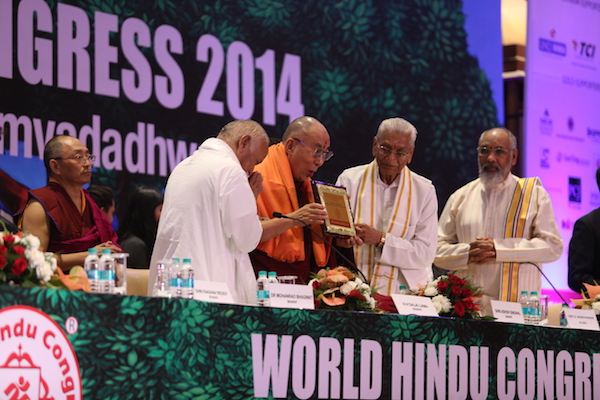
    India’s Vice President Venkaiah Naidu, keynote speaker for the concluding session, renewed Swami Vivekananda’s message and elaborated on some of the essential elements of Hinduism. Also seen in the picture is India’s Ambassador to the United States Navtej Sarna.
    Photo /Jay Mandal-on assignment

    India’s Vice President Venkaiah Naidu, keynote speaker for the concluding session, renewed Swami Vivekananda’s message and elaborated on some of the essential elements of Hinduism namely the breadth of its vision in treating the world as one family, tolerance and acceptance of plurality, and unity in diversity. True nationalism is in the preservation of India’s invaluable heritage, he said.

    Swami Poornatmananda of Bharat Seva Ashram, Chinmaya Mission Spiritual Head Swami Swaroopananda, Swami Paramatmananda, secretary general of Hindu Dharma Acharya Sabha, Satguru Dalip Singh of Namdari, Madhu Pandit Dasa, chairperson of Akshaya Patra Foundation, ISKCON, Bangalore were some of the spiritual leaders who spoke at the event. Messages by Prime Minister Narendra Modi, his Holiness the Dalai Lama and Art of Living Guru Sri Sri Ravi Shanker, BAPS Spiritual Guru Mahant Swami Maharaj were played via video.

    Congressman Raja Krishnamoorthi, (D-IL) said “Some of my friends and constituents were very concerned about my presence here today…I decided I had to be here because I wanted to reaffirm the highest and only form of Hinduism that I’ve ever known and been taught…namely one that welcomes all people, embraces all people, accepts all people regardless of their faith including all my constituents.”

    (Also Read ‘U.S. Congressman Krishnamoorthi Challenged for World Hindu Congress Appearance’ on Page 13)

    Lt. Governor of Illinois Evelyn Sanguinetti, Congressman Bill Foster, Congressman Bruce Fraser were also present. Other eminent dignitaries who spoke were Vice-president of the Republic of Suriname Ashwin Adhin, entrepreneur and Grammy nominated artist Chandrika Tandon, renowned classical dancer Sonal Mansingh, author Amish Tripathi of the Shiva Trilogy and Mohandas Pai chairperson of Board of Manipal Global.

    Four organizations were recognized for their outstanding contributions to spreading Hindu philosophy. BAPS was honored for their architecturally beautiful temples, Chinmaya Mission for explaining the essence of the Gita, Geeta Press, Gorakhpur for making sacred Hindu literature accessible, and ISKCON for spreading the message of Gita.

    Seven conferences and three plenary sessions over the course of three days highlighted issues facing Hindus. The Political Conference suggested the need for a permanent secretariat in the US or UK for the cause of Hindu rights around the globe, asserting a strong political voice especially in countries like the Caribbean, Fiji and the African countries, and developing young political leaders.

    Other parallel sessions were on youth, media, economy, women, education, and Hindu organizations.

    To create awareness about atrocities committed against Hindus around the world, speak out against biased portrayals of Hindus, freeing temples from government control, making writing contemporary and relevant to the present generation, finding new ways to open trade, skill development, an Angel Investor group for women entrepreneurs and a global Hindu Women Business directory, a strategy for developing scholarship in religious studies were some of the recommendations of the conferences.

    Prominent Houstonian, Col. Raj Bhalla said “Being a Sikh, 87 years old, I always had a personal belief that Sikhs are part of Hindus. The World Hindu Congress further enlightened me and strengthened my conviction. My earnest desire is, in India, Sanskrit should be taught to children at a very young age so they learn about Vedic, Spiritual and Scientific knowledge that Hindus gave to the world 5000 years ago – a rightful matter of pride.”

    The third World Hindu Conference will be held in Bangkok, Thailand, from Nov. 4 to 6, 2022. The theme will be “Victory of dharma, not adharma.”


  • U.S. Congressman Krishnamoorthi Challenged for World Hindu Congress Appearance

    U.S. Congressman Krishnamoorthi Challenged for World Hindu Congress Appearance

    CHICAGO, IL(TIP):  Over the two days leading up the launch of the World Hindu Congress (WHC) 2018 in Chicago, delegations from Organization for Minorities of India (OFMI) visited U.S. Congressman Raja Krishnamoorthi’s (D-IL) district office in Schaumburg and his Capitol Hill office in Washington, D.C. to register protest against the congressman’s presence at the event.

    “The World Hindu Congress is a point of concern for us as citizens, as voters, and also as advocates of those who are underrepresented because the World Hindu Congress, under the guise of a religious event, is actually a partisan political event,” remarked activist Jada Bernard in a September 6 meeting at the Schaumburg office.

    In conversation with Staff Assistant Yasmeen Bankole, he said the WHC was organized by the Vishwa Hindu Parishad (VHP) and featured Rashtriya Swayamsevak Sangh (RSS) leaders as its keynote speakers. Describing how these groups fall under the umbrella term “Sangh Parivar,” he explained, “Sangh Parivar groups represent Hindutva, which is Hindu supremacy. That ideology is responsible for violence in the past, and because it’s responsible for violence in the past, any association with this group in the present could damage elections in the future. That’s pretty much our warning. Voters care about lives, even if the Sangh Parivar groups don’t.”

    On the previous day, Pawan Singh visited Krishnamoorthi’s D.C. office. In a meeting with Legislative Director Sam Morgante, he explained how the RSS engages in violence against minorities in India. Discussing the groups involved in the conference, Singh named Vishwa Hindu Parishad of America (VHPA) and Hindu Swayamsevak Sangh (HSS), pointing out that the HSS is the international wing of the RSS.

    “When Mr. Morgante asked me if the RSS in India is any different from the HSS, I told him no,” says Singh. “Everything falls under the RSS shell organization. I told him our concern is that events like this are trying to legitimize the genocides of minorities committed by the RSS. Our concern is that these terrorist groups should not be given a platform on American soil.” Speaking in Illinois, Bernard added, “We also want to make other congressional representatives aware of this, but we also want to kind of give a warning because, when congressional representatives show up at events like this, it associates them with the ideology.”

    Both Bernard and Singh presented the offices they visited with an 18-page information packet. The executive summary of the packet states, “The organizers and many keynote speakers are part of a militant religious nationalist movement which, according to the U.S. Commission on International Religious Freedom, ‘holds non-Hindus as foreign to India.’ As per reports from Amnesty International, Human Rights Watch, and the U.S. State Department, these groups persecute India’s minorities (especially Muslims and Christians), sponsor pogroms, and are implicated in daily acts of violence against marginalized peoples who do not participate in their supremacist agenda.”

    On Capitol Hill, Singh also visited the offices of Representatives Ro Khanna (D-CA), Ami Bera (D-CA), Zoe Lofgren (D-CA), Jeff Denham (R-CA), David Valado (R-CA), John Garamendi (D-CA), and Tom McClintock (R-CA), and had a brief personal meeting with Rep. Jack Bergman (R-MI).

    Subsequently, on September 8th and 9th, protestors demonstrated outside the WHC for several hours each day. One protestor, a local Muslim man, commented on a placard which read, “VHP, RSS, BJP carried pogrom of Gujarat.” Describing how the Sangh Parivar groups perpetrated violence against Muslims, he said, “I would like the city of Lombard and our congressman, Raja Krishnamoorthi, to not share dais with these killers and hate-mongers.”

    Adding that he had previously voted for the congressman, he said, “I was very much impressed when he came out at O’Hare to talk about anti-immigration when Trump administration banned visas for six Muslim nations. I like the speech which Raja Krishnamoorthi gave at O’Hare. I’m a big supporter of his speech.” In conclusion, he suggested that “I would, definitely” continue supporting the congressman if he had withdrawn from the WHC, as did Congresswoman Tulsi Gabbard, who called it a “partisan Indian political event.”

    Organization for Minorities of India was founded in 2006 to advance individual liberties of Christians, Buddhists, Dalits, Muslims, Sikhs, and all Mulnivasi people of South Asia by encouraging secularism, progressive human rights, liberation of oppressed peoples, and universal human dignity. Visit OFMI.org for more information.

    (Based on a Press Release issued by OFMI)

  • Indian American Anshdeep Singh Bhatia is the first Sikh in Trump Security

    Indian American Anshdeep Singh Bhatia is the first Sikh in Trump Security

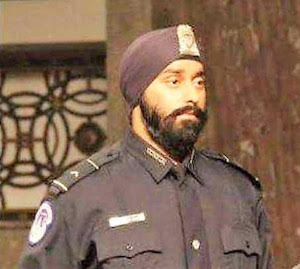
    WASHINGTON(TIP): Ludhiana-born Anshdeep Singh Bhatia has become the first Sikh to have been inducted into the security detail of US President Donald Trump.

    Anshdeep was inducted last week after he completed his grueling training in the United States.

    His family moved to Ludhiana from Kanpur during the 1984 anti-Sikh riots. He lost his uncle and a close relative after the frenzied mob stormed their house in Kanpur’s KDA Colony in Barra. His aunt’s marriage was scheduled in second of week of November and the family was busy making an arrangement.

    Anshdeep’s father Devendra Singh was also injured in the attack and had received three bullet wounds.

    His grandfather Amreek Singh Bhatia, a manager with Punjab and Sind Bank, opted for a transfer to Ludhiana. His father, who was into the pharmaceutical business in Kanpur, married in Ludhiana and moved to the United States with his family in 2000. Anshdeep was 10 at that time.

    Anshdeep who dreamt of making to the President’s security one day stumbled upon a block when he was told he would have to change his looks. But Anshdeep moved the court against the riders and the decision came out in his favor. “

  • WORLD HINDU CONGRESS SET TO WELCOME MORE THAN 2,500 DELEGATES FOR 2018 CONFERENCE

    WORLD HINDU CONGRESS SET TO WELCOME MORE THAN 2,500 DELEGATES FOR 2018 CONFERENCE

    Vice President of the Republic of India to Commemorate 125th Anniversary of the Landmark Parliament of Religions Speech in Special Ceremony

    Manu Shah

    CHICAGO, IL(TIP):  The World Hindu Congress (WHC) announced, September 5, that attendance goals for the 2018 conference have been smashed, with more than 2,500 delegates and 220 eminent speakers confirmed for this year’s iteration. Convening September 7-9 at The Westin Hotel in the Yorktown Shopping Center, Lombard, IL, the 2018 WHC is celebrating the 125th anniversary of Swami Vivekananda’s Parliament of

    Religions speech in Chicago in 1893. Upon completion of WHC deliberations, the Honorable Mr. M. Venkaiah Naidu, Vice President of the Republic of India, will participate in a special ceremony to commemorate the 125th anniversary of Swamiji’s Chicago speech.

    “The 2018 World Hindu Congress will be a landmark event,” said WHC Coordinator Dr. Abhaya Asthana. “We are primed and eager to host an unprecedented convergence of Hindu leadership unified in purpose: To connect, share ideas, inspire one another, and impact the common good.

    The WHC provides a unique opportunity for participants to exchange ideas on a global stage and draws upon expertise of speakers from a wide range of fields and backgrounds.”

    Featuring seven parallel conferences that will explore economics, education, media, politics, women, youth and organization, the 2018 WHC will feature prominent speakers such as economist Dr. Arvind Panagariya, academic Dr. Makarand Paranjape, author Amish Tripathi, and Grammy-nominated artist and entrepreneur Chandrika Tandon.

    Additionally, there will be poster presentations at the event that includes 55 posters from various Hindu Leaders and Researchers on topics such as Non-Violence: Our Greatest Gift to the World and Hindu Culture and Life-style studies.

    About World Hindu Congress

    Held once every four years, the World Hindu Congress (WHC) is a global platform for Hindus to connect, share ideas, inspire one another, and impact the common good. Founded in 2014, the first World Hindu Congress in Delhi birthed the seven parallel conference platform to showcase the values, creativity, and entrepreneurial spirit of the global Hindu community. For more information, visit www.worldhinducongress.org

  • Why These Trade Talks with Canada are getting so Tough

    Why These Trade Talks with Canada are getting so Tough

    By A.D. Amar

    By far, the biggest contributor to its export income has been the USA. Seventy-five percent of its exports are to America. Because of this enormity of its exports to America that bring in many billion dollars into the Canadian economy (about $50 billion just for selling cars to the USA), if American exports are interrupted, Canada will face huge economic and social problems. That is why, it is understandable that Canada is going to fight tooth and nail to keep its exports to America going unhindered, while not importing goods to protect its local producers and to preserve its cash. Ironically, American political and business leaders, because of Canada’s influence on American politics and business, want the status-quo to continue.

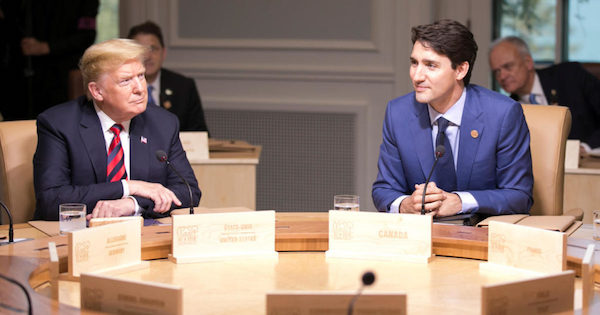
    Watching the currently going US-Canadian trade talks will make anyone understand why no US president in decades, spanning both political parties, dared to get into renegotiating America’s trade deals that had been sealed and practiced for so, so long ago, even though unfair.

    The deal with Canada, or NAFTA on a broader scale, is not an isolated case of a trade deal that is unfair to America. Almost all American trade deals are unfair, and that is why, American Presidents decided to stay away from them. They knew that the reopened trade talks will open tough issues that had been so negotiated that America had to open its borders to the other country such that it could export to America unabated, whatever and how much it wanted to export. However, when it came to importing from America, the other country, according to the deal, could engage in protectionism in whatever form it wanted. Take, for example, Canada’s imposition of a 300% tariff on all dairy products imported from America. And America tolerated this. In essence, basically, America always became the only free market in every deal. There was no laterality.

    Through the kind of trade deals described above, for the last more than seventy years, America has made the whole world wealthy, whether it had been the countries in Asia, Europe, or North America, including Germany, Japan, China, South Korea, Canada, and Mexico, to name just a few. The trade agreements that they signed legitimized the unfair trade practices against the USA. The outcome had been a constant outflow of wealth from the United States to other countries. Consequently, during the ensuing decades, America fell from holding the top position in almost every measurable economic or social indicator to the bottom of its heap. And, the previously named are the countries among those that replaced America. Since it had been going on for so long, these nations had gotten used to exporting to America to earn cash to pay for imports for their needs from other countries who sold them at the lower prices, or they did it to fulfill their obligations of the deals they signed with the other countries who traded with them. They treated their trade deal with the USA as an entitlement. Because of the effort needed to conduct these negotiations afresh, and the low probability of an outcome that would satisfy the populations involved had the American presidents maintain their status-quo.

    Let us, again, take the case of Canada. By rank, it is the 38th country in the world by population size, but 10th when it comes to exports, making it a very powerful, global exporter. Until 2007, it was America’s largest trading partner (lost that position to China). By far, the biggest contributor to its export income has been the USA. Seventy-five percent of its exports are to America. Because of this enormity of its exports to America that bring in many billion dollars into the Canadian economy (about $50 billion just for selling cars to the USA), if American exports are interrupted, Canada will face huge economic and social problems. That is why, it is understandable that Canada is going to fight tooth and nail to keep its exports to America going unhindered, while not importing goods to protect its local producers and to preserve its cash. Ironically, American political and business leaders, because of Canada’s influence on American politics and business, want the status-quo to continue.

    Now, let’s take the other side of Canadian foreign trade. While America takes in 75% of Canadian exports, America is not Canada’s largest trading partner. No surprise, it is China. And, do not wonder; that is the case in almost all America’s trading partners. That is how, America did not have well-paying jobs for its population, and had to fund its budgets by taking loans, mostly from its trading partners.

    The above given analysis provides us enough to accept that, in spite of exporting so much to America, mostly America’s trading partners do not import enough from the US to help balance the bilateral trade. Each of these countries uses its export dollars earned from America to buy more from China, European Union and other countries, leaving for America an annual trade deficit that was $566 billion in 2017. This is the problem that the Trump Administration is attempting to rectify through these, so called, the new NAFTA negotiations. The situation is exactly the same when we look at almost all of America’s major trade deals. The toughest and the largest one of them all is the trade deals with China. And only Trump has the understanding, desire and the stamina to take on these trade fights, simultaneously, to halt the outflow of these many, many billion American dollars every year that we could use to bring back to the top of the global ranks the standard-of-living and quality-of-life of our population.

    (The Author is Business Professor at Seton Hall University. His areas of expertise are strategy, knowledge, and operations. He can be reached at AD.Amar@shu.edu; Tel: (973) 761 9684)          

  • PRIME MINISTER MODI’S PERFORMANCE AND POTENTIAL IN THE NEXT GENERAL ELECTION

    PRIME MINISTER MODI’S PERFORMANCE AND POTENTIAL IN THE NEXT GENERAL ELECTION

    “Modi has failed so far.  It is possible that between now and the election, Modi will wake up and execute political skills of Kautilya.    I must say it is too early to make any predictions.  In six months, there could be big changes.  Will Modi use his vision and modernize India?”


    By Ven Parameswaran

    “However, I would give him only B for his government”, says the author.

    Prime Minister Modi will be facing voters in India’s General Election six months from now. It is therefore timely to evaluate his success and failure and give him a suitable grade.  Modi started off with new energy and enthusiasm.  Though BJP alone received only 31% support, he was able to convince others to join him.  Thus, he was able to form the government with a large mandate from the people.  The expectations were high, and the results speak for themselves.   However, I would give him only B for his government.

    MODI’S POLITICAL SKILLS ARE A+ IN CAMPAIGNING AND GETTING ELECTED

    Modi has charisma. His political skills have delivered him huge success in the elections and delivered mandate.    Unfortunately, he has not been able to transform his success to governing.  One gets the impression that he is operating in a vacuum.  We also get the impression that the all powerful Indian bureaucracy retains control and fails to implement his policies.  Modi has failed to beef up the Office of the Prime Minister, equivalent to the White House in the USA.   Will Modi take action to win the corrupt and powerful bureaucracy.   I must point out that the Indian bureaucracy is very powerful, and no Prime Minister can govern and rule India without its cooperation.  Nehru, Indira Gandhi and Vajpayee had powerful and most competent Principal Secretary to Prime Minister.  P.N. Haksar delivered Bangladesh to Indira Gandhi.  Brajesh Mishra emboldened the Office of Prime Minister Vajpayee.  He was the architect behind the nuclear test, that was kept as secret even from the C.I.A.  He also established a direct pipeline with the Bush White House.  If Modi selects a topnotch bureaucrat with reputation and competence, it will go a long way to streamline Modi’s policies.

    MODI’S ACHIEVEMENTS

    It was reported last week that India’s GDP is growing at 8.2%.  This is a great news on the eve of the general election.  Indian stock market has gone up from 25000 to 38000.  390 million have access to internet. India is fortunate that 50% of its population is under 25 and 2/3rds under 35.  This is a huge asset for India.   When every major country is getting older and older, India is the only country getting younger and younger.  Educated and developed population is an asset.  Modi must capitalize on this strength.   India has invested $15 billion in the USA and continue to invest.  But the US has invested in India only $20 billion during the same period.  India must deregulate and encourage foreign private investment.    Modi has enabled issuance of visas online helping the tourists and businessmen. These days we do not hear of complaints from visa/passport applicants in the USA – Modi changed it for better.

    FAILURE TO MODERNIZE INDIA

    India has been unable to deliver water and electricity for 24/7 to all its people.  It has failed to build mass transportation in Mumbai, Hyderabad, Chennai.   New Delhi metro system seems to be working efficiently.  It is taking too long to build mass transportation in Bangalore.  The subway system in Calcutta is inadequate.  India has built most modern airports in New Delhi, Bombay, Hyderabad, Bangalore, and Calcutta.

    There is no system in India to remove garbage.  Modi delivered toilets but there is no sewerage system.

    There are more vehicles than the roads everywhere.  As a result, the traffic does not move.  This contributes to economic waste of valuable time.  Time is money.

    The courts have too many backlogs resulting in justice delayed or denied.

    Failure to build modern infrastructure has impacted on manufacturing, shortage of housing, and loss of export business.  India is unable to accept orders to deliver 100 million under wears unlike China.

    MODI’S RELATIONS WITH THE MINORITIES NOT LAUDABLE

    The Sikhs and the Christians may be small in number.  But they are highly educated and economically well to do.  They are also a source of foreign exchange.   Modi has failed to develop satisfactory relations with these minorities.    The U.A.E. offered $200 million to Kerala victims of floods, but Modi government rejected it. Why?  Is he not spiting Kerala, not governed by BJP?

    India has the second largest Muslim population in the world.  Indian Muslims are peace loving.  The BJP has not treated them with the respect they command.  Beef is banned from the restaurants.  Muslims are punished for killing cows.  But India is a leading exporter of meat, primarily buffalo meat, deriving $5 billion in foreign exchange.  If it is o.k. to slaughter cows for export why it does not apply for domestic consumption.

    MODI MAKES GOOD IMPRESSION ON FOREIGN LEADERS BUT FAILS TO TRANSFORM THE RELATIONSHIP

    Modi visited the USA, UK, Canada, Australia and others and created most favorable relationships.  He addressed huge rallies of Non-Resident Indians.   On his return to India, he has been unable to transform the goodwill and solid relationship into meaningful policies.   Because he has no link with the mighty Indian bureaucracy, nothing gets implemented.  Lack of strong Principal Secretary to Prime Minister is the main cause of his failure.

    FAILURE TO FOLLOW KAUTILYA’S PRINCIPLE – KING MUST BE FEARED AND LOVED.

    Modi is not feared. Modi has been unable to formulate dynamic and meaningful political and foreign policy strategies.   He started off well by inviting the heads of all South Asian neighbors including Pakistan.  Here again, there was no follow up.  During Modi’s term, China has encircled India by dominating its power and influence in Nepal, Maldives Islands, Sri Lanka, Bhutan, Sikkim and Bangladesh.  India should not have allowed China to interfere in the coastal waters of India – Indian Ocean, Arabian Sea and Bay of Bengal.  The US, Japan, Australia, S. Korea had offered joint naval exercises, but India has not taken full advantages.  Instead, India has joined naval exercises with China, Pakistan and Russia!

    INDIA NEEDS ACCESS TO LATEST TECHNOLOGIES. WILL MODI EMBRACE TRUMP’S OFFER?

    Technology is the ultimate weapon that wins modern wars, not large army.  India was shut off from the Western technology for over 30 years till President George W Bush gave India civil nuclear deal.  The US Secretary of State and the Secretary of Defense are now in India for 2+2 talks.  Trump has offered India relationship on a par with its closest allies.  The offer was made six months ago and if Modi were a master strategist and followed Kautilya he could have solidified the closest strategic relationship with the superpower, USA.  Modi is forgetting that relations with others such as Russia and Iran should be secondary.  Hope Modi will not miss the big picture and conclude the deal with the Americans.   Agreeing to close strategic relationship with the USA will prevent China from its adventures in South Asia.  The US also has decided to support and finance several developing countries to prevent domination by China.

    WHAT ARE THE CHANCES FOR MODI TO GET REELECTED?

    In U.P. Modi’s performance was par excellence grabbing almost 100%.  But in his own Gujarat, BJP barely won, and this was shocking.  Why did this happen?  The Congress Party gave him a shock.   Modi is not in power in many important States – West Bengal, Punjab, Karnataka, Tamil Nadu, Andhra Pradesh, Kerala and others.  Modi has failed to privatize public sector corporations. He has not sold even the loss-stricken Air India.  Skilled politician should be able to negotiate with the opposition be it Rajya Sabha or important States where his party is not in power.   The fact remains that has failed in 4-1/2 years to consolidate and influence.  Who influences whom, when, where and how is the essence of politics.  Modi has failed so far.  It is possible that between now and the election, Modi will wake up and execute political skills of Kautilya.    I must say it is too early to make any predictions.  In six months, there could be big changes.  Will Modi use his vision and modernize India?

    (The author is Diplomat-in-Residence and Senior Adviser to Imagindia Institute, New Delhi; Chairman, Asian American Republican Committee, Scarsdale, N.Y. He can be reached at vpwaren@gmail.com)

  • 2+2 talks take Indo-US ties to new high

    2+2 talks take Indo-US ties to new high

    Defense, trade, terror top agenda; Concerns on Russia, Iran sanctions highlighted

    NEW DELHI(TIP): India and the United States on Thursday, September 6, sought greater political convergence with a long-term view of relations and enhanced synergy between respective foreign and defense ministries through the inaugural 2+2 dialogue.

    Defense Ministers Nirmala Sitharaman and James Mattis and Foreign Ministers Sushma Swaraj and Michael Pompeo sat down for separate discussions before the 2+2 dialogue.

    Three sessions on energy and people-to-people ties, defense and regional security were part of the dialogue that included all four principals and their delegations.

    Followed by lunch and joint press statements, the leaders collectively called on PM Modi. According to sources, there was no laundry list of irritants to be resolved overnight, rather shared understanding of mutual concerns as regards trade ties, reducing the deficit, visas, US sanctions against Iran and Russia as well as counter-terrorism cooperation and Indo-Pacific strategy.

    Pompeo shared notes following his meetings with Pakistan PM Imran Khan and Army Chief Bajwa in Islamabad en route Delhi and the missives shared to act on terror and towards reconciliation efforts in Afghanistan.

    “On the 10th anniversary of the 26/11 attacks, we recognized the importance of justice and retribution for the masterminds behind this terrorist attack,” said Swaraj.

    “India supports President Trump’s South Asia Policy. His call for Pakistan to stop its policy of supporting cross-border terrorism finds resonance with us,” she added.

    Pompeo reportedly mentioned that “it is too early to judge the new Imran Khan government, but Pakistan has been asked to step up counter-terrorism efforts and encouraged to take right decisions and actions”.

    “Pompeo assured the ministers that ‘we have a long ask of the new Pakistan government’, while sharing concerns about Hafiz Saeed roaming freely,” said an official privy to discussions.

    India has asked the US to sustain pressure on Islamabad to crack down on terror entities, sources say.

    The sentiments are reflected in the joint statement issued after talks in a significant tweak.

    India impressed upon the US to use “under Pakistan control, instead of territory” referring to terror groups operating out of PoK and driving home territorial integrity issue, pointed out officials. “The ministers denounced any use of terrorist proxies in the region, and in this context, they called on Pakistan to ensure that the territory under its control is not used to launch terrorist attacks on other countries,” underlines the statement that was work in progress till late into the night.

    Ties with Iran and Russia came up for discussion from the Indian side during the dialogue, but without any specific mention of the S400 missiles purchase, sources said.

    Americans reportedly shared India’s position that its defense security systems or energy suppliers could not be switched overnight to US platforms. But India assured it was working to reduce high bilateral trade deficit that Donald Trump has disapproved of openly.

    Indian officials sounded hopeful of a carve out on Chabahar port, given its strategic importance to Afghanistan, to avoid heat of US sanctions against Iran.


  • Indian-Origin British Lawmaker Challenges Theresa May’s Brexit Strategy with a ‘Stand Up 4 Brexit’ campaign

    Indian-Origin British Lawmaker Challenges Theresa May’s Brexit Strategy with a ‘Stand Up 4 Brexit’ campaign

    LONDON (TIP): Indian-origin Conservative party lawmaker and former UK Cabinet minister Priti Patel has joined the race along with 20 other party rebels who are challenging British Prime Minister Theresa May’s Brexit strategy with a ‘Stand Up 4 Brexit’ campaign.

    The grassroots drive against any negotiations with the European Union (EU) that could lead to a so-called soft Brexit is being backed by another ex-minister Ian Duncan Smith and is expected to mount pressure on May to ditch her Chequers plan, which is rejected by Eurosceptic lawmakers within her Conservative party.

    ‘Stand Up 4 Brexit’ supporters, who also include former foreign secretary Boris Johnson’s key ally Tory lawmaker Conor Burns, pledge to fight plans to keep the EU rules on British goods and free movement in terms of migration.

    Ms Patel, a leading pro-Brexit voice in the lead up to the referendum in favor of Britain’s exit from the EU in June 2016, has previously called on the government to be “tougher” in its negotiations with Brussels.

    The Stand Up 4 Brexit campaign is building momentum as Mr Johnson, the poster boy for the pro-Brexit camp, launched a scathing attack on Theresa May’s plans in his weekly newspaper column in ‘The Daily Telegraph’ on Monday, saying the approach agreed at Chequers “means disaster” for Britain.

    Mr Johnson said negotiations based on the Chequers plan had so far seen the EU take “every important trick”, adding, “The UK has agreed to hand over GBP 40 billion of taxpayers’ money for two-thirds of diddly squat [nothing].”

    The so-called Chequers plan put forth by PM May would see Britain agreeing a “common rulebook” with the European Union for trading in goods, in an attempt to maintain frictionless trade at the border.

    Critics of the strategy argue this would leave the UK tied to the EU rules even after it formally leaves the economic bloc on March 29 next year and prevent Britain from striking its own trade deals in years to come.

    As the UK’s parliamentary recess period of August comes to an end and the political parties in the country prepare for their annual party conferences this month, the battle lines around Brexit are expected to deepen further.

    Even after the UK and the EU have reached some sort of an agreement over their future trading relationship, any agreed plan will then be tabled before lawmakers for a vote – a process which will be accompanied with its own share of upheavals.


  • Indian American Tech Executive Anita Malik wins Arizona 6th district Democratic congressional primary 

    Indian American Tech Executive Anita Malik wins Arizona 6th district Democratic congressional primary 

    ARIZONA(TIP): Indian American Anita Malik has won the Democratic party primary in Arizona’s 6th congressional district. She is the 11th Indian American to win the nomination of one of the two major parties in the midterm elections.

    Malik will face GOP Rep. David Schweikert, who won the Republican primary unopposed, on November 6.

    The primary in Arizona was held on August 28, but the 6th district race was too close to call on the election night, with Malik leading her nearest rival Heather Ross by a narrow margin of 383 votes.

    But, as the absentee ballots were counted and certified, the Indian American’s lead grew to 2,402, according to the official results posted on the Maricopa County Recorder website.

    Malik, who quit her job as the chief operating officer of the tech startup ClearVoice to run for Congress, was declared the winner.

    According to the official tally, Malik received 22,522 (42.04 percent) votes, while Ross received 20,120 (37.55 percent) votes.

    “I am proud that my campaign reflected a broad, grassroots coalition of Arizonans who came together to support our vision of creating jobs and ensuring the ability of families to work, live, and thrive in the 6th congressional district,” Malik said in a statement posted on her Twitter account on August 31st.

    “Arizonans deserve someone who will work hard to represent them and build a stronger future for our community, our state and our country,” she added. “As the daughter of immigrants — people who believed in the promise of American — I want to help everyone have that opportunity to build a better life for themselves and their families.”

    As soon as her victory was announced, Malik quickly went on the general election campaign mode. Focusing on corruption, which is likely to be a major midterm issues, she tweeted: “Indictments, corruption, and ethical violations are the norm in today’s Congress. I’ll fight to root out corruption and enact higher ethical standards, starting with our own district.”

    On Labor Day, she tweeted in support of workers: “Today we honor those who have built this country. It’s a strong reminder of the course correction the country needs to bring our voices back to the table. The future of work is already here, it’s time to move boldly and swiftly to protect and support American workers.”

    Born in Kansas City, Missouri, Malik’s family moved to Arizona when she was 7. She graduated summa cum laude with degrees in computer information systems and finance from Arizona State University.

    She also has a master’s degree in journalism from the University of Southern California.

  • OPPORTUNITY FOR USA AND INDIA TO BECOME CLOSE ALLIES

    OPPORTUNITY FOR USA AND INDIA TO BECOME CLOSE ALLIES

    “A true strategic partnership offers tremendous benefits to both nations.  India gains an opportunity to become a real global power, and the US gains a mammoth regional ally and counterweight to China, with the potential for greater cooperation on issues of global security.  Establishing a lasting US-India partnership would be a game-changing success for President Trump and Prime Minister Modi.” 

    Trump administration’s decision in July to grant India Tier 1 Strategic Trade Authorization status, a designation given only to close allies has created a golden opportunity for India and the US to become close allies.    Will the US be bolder and seek to transform the US-India relationship into a robust strategic partnership?

    TWO PLUS TWO MEETING IN NEW DELHI

    Secretary of State Pompeo and Secretary of Defense Mattis can begin executing an ambitious strategic partnership with India when they meet with Prime Minister Modi in New Delhi in September for the Two plus Two meeting.    Will the Government of India and the Indian media discuss this seriously before September?

    President Trump has started creating a new world order.  Make America Great and America First call for revolutionary changes in US foreign policy and trade relations.   Trade deficit is the largest with China.  Trump seems to be ready to do serious business with India.   India has a comparative advantage over China because the wages are substantially lower in India.  If India is able to replace China as the source of American imports of consumer and industrial goods, the US will gain.

    Will India be prepared to liberalize its economy and embark on using capitalistic tools as China did with America’s help?  Will India be prepared to privatize all its public sector corporations and release the assets for building a modern India?   Will India adopt new policies to attract large scale foreign private investments?

    INDIA’S RELIANCE ON RUSSIA FOR MILITARY HARDWARE

    Modern wars are won by using sophisticated technology.    Though Russia has been a reliable supplier of military hardware, we know no country can compete with the US and Israel on latest technology and sophisticated weapons systems.    While India has purchased weapons systems from the US to the tune of $15 billion since 2008, its use of Russian equipment poses interoperability problems and raises concerns about compromising sensitive technology.

    India’s decision to procure S-400 Russian air-defense systems is particularly troubling, since those typically involve substantial service and training components.  The presence of Russian personnel at the heart of India’s air defenses, even if only temporary, could hold up future US-India defense deals.  If the S-400 sale cannot be canceled, the best scenario would be to persuade India to limit the scope of Russian support services and turn to another country with a strong record of using and improving Russian defense equipment—namely Israel.

    JOINT MILITARY EXERCISES

    Meanwhile, the Trump administration can broaden US-India defense cooperation by increasing the number of joint military exercises and expanding the annual Malabar war games. The members of the Quadrilateral Security Dialogue, an informal dialogue initiated in 2007 by Japan’s Prime Minister Shinzo Abe among the US., Japan, Australia and India, should also be formalized and meet more regularly.

    MODI CALLED THE U.S.A. AN INDISPENSABLE PARTNER DURING HIS 2017 VISIT

    Close alliance with India would provide the US with a valuable, democratically committed to thwarting China’s intensifying efforts to dominate the region.  Already India has been keen to enhance its relationship with America.  Prime Minister Narendra Modi called the USA an “indispensable partner” during his 2017 visit to Washington.  As India scholar Ashley Telis put it, Modi’s “daring decision to collaborate wholeheartedly” with America shows he recognizes that the “the US holds the most important keys for India’s long-term success.”   Greatly concerned about China’s economic and diplomatic expansionism in the Indo-Pacific, India has turned to the USA for support. Pakistan’s increasingly anti-American and pro-Chinese policies have also brought the USA and India into a closer embrace.

    INDIA’S DEPENDENCE ON IRAN FOR OIL

    The resumption of US sanctions on Iranian oil exports Nov.4 will pose a challenge.  India has no affection for the Islamic Republic, but after China it is the second-largest importer of Iranian oil, bought at a substantial discount.  As the US rightly seeks to block Iranian oil exports, it must be adroit in persuading India to join.  Washington needs to grant India a temporary waiver from the sanctions and help New Delhi find acceptable alternative energy sources, perhaps by persuading Gulf allies to sell oil to India at prices comparable to Iran’s.

    TRADE TENSIONS NEED TO BE RESOLVED

    India has made a formal complaint with the WTO over US tariffs on steel and aluminum, and it is preparing to impose retaliatory tariffs up to 70% on key agricultural exports. Additional rounds of tariffs are reportedly under consideration.  Given that India sells $48.6 billion in goods and services to the US, its largest export market, a good way to proceed would be to grant India a waiver on the newly imposed tariffs and work on negotiating a comprehensive bilateral trade deal.

    CHALLENGES TO CLOSE PARTNERSHIP

    India’s reliance on Russia, India’s dependency on Iran for oil, and US-India trade tensions are challenges that will require policy makers to negotiate hard and make difficult compromises.   A true strategic partnership offers tremendous benefits to both nations. India gains an opportunity to become a real global power, and the US gains a mammoth regional ally and counterweight to China, with the potential for greater cooperation on issues of global security.  Establishing a lasting US-India partnership would be a game-changing success for President Trump and Prime Minister Modi.   I must recall the warm hug and embrace between Trump and Modi at the White House in 2017 and its far-reaching consequences.

    (The author, a 64-year resident in the USA, is Chairman, Asian American Republican Committee (30thanniversary). Email: vpwaren@gmail.com)

  • The demonetization debacle: Collateral damage needs immediate redress

    The demonetization debacle: Collateral damage needs immediate redress

    The Modi government’s biggest policy decision to flush out black money has officially turned out to be a colossal failure. In November 2016, the government had taken the entire nation by surprise when it scrapped bank notes of Rs 1,000 and Rs 500 denomination worth Rs 15.41 lakh crore. The expectation to unearth black money amounting to around Rs 3 lakh crore now stands belied. After wading through the mountains of scrapped notes, the verdict is that about 99.3 per cent of the demonetized notes have returned to RBI’s vaults. It could add up to almost 100 per cent if we include the demonetized notes held by NRIs and in neighboring countries such as Nepal and Bhutan.

    The RBI’s data, thus, lands us in a quandary — either the country never had any black money at all, or the entire black money has been laundered. The first explanation is hard to believe and the second one hard to prove. It is difficult for any government to admit its mistakes, but no one can defend the indefensible. Rightly, the government has abandoned the alibi of unearthing black money. The other justifications — a boost to digital economy, curb on terror-financing and an attempt to weed out fake currency — have also lost appeal in the absence of corroborating data.

    The RBI data suggests that post-demonetization, Indian households have quickly rebuilt their cash reserves, contradicting claims of increased digital transactions. It is also evident that terrorism continues unabated despite demonetization while the National Crime Records Bureau concedes the continued circulation of fake banknotes. The benefits of demonetization are elusive, but its adverse impact on the economy is evident, slowing the country’s growth rate by almost 1.5 per cent (a notional loss of Rs 2.25 lakh crore). The worst sufferers have been the poor, whose informal economy was shattered due to a cash crunch after November 2016. The government should assess the damage done to this section of society and help it recover.

    (Tribune, Chandigarh)