Tag: politics

  • Supreme Court seeks response from Sajjan Kumar in 1984 anti-Sikh riots cases

    Supreme Court seeks response from Sajjan Kumar in 1984 anti-Sikh riots cases

    The Supreme Court on Thursday sought response from Congress leader Sajjan Kumar, accused in the 1984 anti-Sikh riots cases, on a plea filed by SIT challenging the anticipatory bail granted to him by Delhi HC. The apex court said it is high time that these cases are tried at the earliest

    NEW DELHI (TIP): The Supreme Court on July 5 sought response from Congress leader Sajjan Kumar, accused in the 1984 anti-Sikh riots cases, on a plea filed by the Special Investigation Team (SIT) challenging the anticipatory bail granted to him by Delhi high court.

    A bench of Justice AK Sikri and Ashok Bhushan said it is high time that these cases are tried at the earliest.

    The bench said it was an over 30- year-old case and it took around “200 pages” for the high court to grant anticipatory bail when it could have been done in just “40-50 pages”.

    Additional solicitor general Maninder Singh, appearing for the SIT, said the investigation started against Kumar only in 2016 and now he has come armed with a battery of lawyers and dictates his statement to the investigating officer of the case.

    The ASG said that while granting anticipatory bail to him, the high court had said that everything will be tested in trial of the case but at the end it granted him the relief saying there was no evidence.

    To this, the bench said whether all this was considered at the time of anticipatory bail. Singh said, “Yes. This is totally contrary to the established procedure of law.” The bench then issued notice.

    The Delhi HC had on February 22 upheld a trial court order granting anticipatory bail to Kumar in two anti- Sikh riots cases of 1984, saying that according to records, he was available throughout the investigation.

    The Congress leader was granted anticipatory bail by the trial court on December 21, 2016, in two cases of killing of three Sikhs during the riots which had occurred after the assassination of then prime minister Indira Gandhi.

    Kumar had submitted that his name was never taken earlier and it was a case of fresh allegations coming up after 32 years.

    Source: PTI

  • EPA Administrator Scott Pruitt Resigns in the face of ethics issues

    EPA Administrator Scott Pruitt Resigns in the face of ethics issues

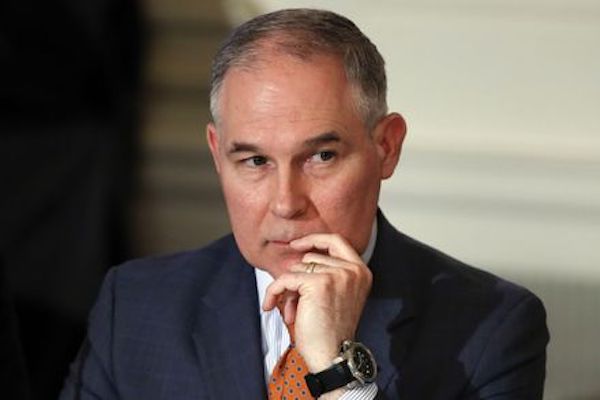
    WASHINGTON(TIP): Scott Pruitt, the administrator of the Environmental Protection Agency who was key to implementing President Trump’s conservative agenda but came under intense scrutiny for a series of questionable ethical decisions, resigned Thursday, July 5 afternoon. Pruitt’s deputy at the EPA, Andrew Wheeler, will serve as the agency’s acting administrator starting Monday, President Trump said in a tweet.

    “I have no doubt that Andy will continue on with our great and lasting EPA agenda,” Mr. Trump tweeted. “We have made tremendous progress and the future of the EPA is very bright!” 

    Donald J. Trump

    @realDonaldTrump

     I have accepted the resignation of Scott Pruitt as the Administrator of the Environmental Protection Agency. Within the Agency Scott has done an outstanding job, and I will always be thankful to him for this. The Senate confirmed Deputy at EPA, Andrew Wheeler, will…

    3:37 PM – Jul 5, 2018

    Pruitt had been the subject of a seemingly endless deluge of stories about his behavior and spending practices. It began earlier this year when it was revealed that Pruitt had rented a room at a favorable rate from a well-connected energy lobbyist. Pruitt’s lavish spending on his own security then came under scrutiny, as did his decision to install a $43,00 private phone booth in his office. There were also allegations that Pruitt had created a toxic professional atmosphere at the EPA that penalized his critics.

    Pruitt said his decision to leave the EPA was a hard one in his resignation letter to Mr. Trump.

    “It is extremely difficult for me to cease serving you in this role first because I count it a blessing to be serving you in any capacity, but also, because of the transformative work that is occurring,” Pruitt wrote. “However, the unrelenting attacks on me personally, my family, are unprecedented and have taken a sizable toll on all of us.”

    Mr. Trump defended Pruitt Thursday evening while speaking to reporters on Air Force One. He said there was “no final straw” and that he had not requested Pruitt’s resignation.

    “Scott Pruitt did an outstanding job inside of the EPA,” the president said. “We’ve gotten rid of record breaking regulations and it’s been really. You know, obviously, the controversies with Scott — but within the agency we were extremely happy. His deputy has been with me actually a long time. He was very much an early Trump supporter. He was with us on the campaign. He is a very environmental person. He’s a big believer, and he’s going to do a fantastic job.”

    The government had launched numerous investigations and probes into Pruitt’s behavior, although he continued to insist that he had done nothing wrong. At the time of Pruitt’s resignation, the EPA inspector general was looking into his protective service detail, his traveling at taxpayer expense, and the allegedly excessive raises he gave to some members of his staff. Swamped by requests and stretched thin by the sheer number of audits into Pruitt, the EPA inspector general had also agreed to look into his housing arrangements and allegations that he had staff members perform his personal errands, among other issues.

    Pruitt is the fifth member of Mr. Trump’s cabinet to resign or be fired since he took office. The others were former Acting Attorney General Sally Yates, former Health and Human Services secretary Tom Price, former Secretary of State Rex Tillerson, and former Veterans Affairs secretary David Shulkin.

    (Source: CBS News)

  • Consuls in NYC Team Up to Call for Family Reunification

    Consuls in NYC Team Up to Call for Family Reunification

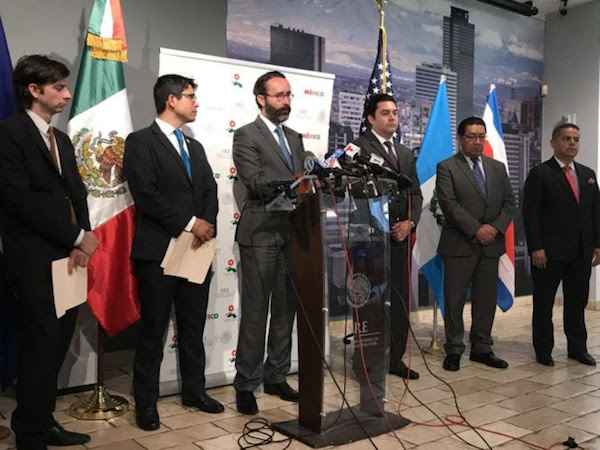
    NEW YORK(TIP): On Tuesday, the New York-based consuls of Mexico, El Salvador, Honduras, Guatemala and Costa Rica joined Mayor Bill de Blasio and Gov. Andrew Cuomo in demanding the Trump administration provide “complete and transparent” information on the migrant children who have been separated from their parents at the border and sent to New York.

    The Central American diplomats created a common front to protect the children and analyze the tools with which they hope to be able to access the federal data but warned that a prompt reunification will be difficult if Washington continues to refuse to release the information.

    “This goes beyond policies and countries; it is about human dignity, and what we need to do is ask the government to clarify the information and promote reunification,” said Juan Diego Zelaya, consul of Honduras, adding that so far, they know there are 449 minors from his country in New York City.

    The diplomat said that he has already met with a number of children who are under the care of the Cayuga Center in Manhattan. There, he was told that the center has information on each one of the minors but is prevented from sharing it without federal authorization.

    “[They said that] when a child is detained at the border and has been separated from their father and mother, there is a special file detailing where the parent and the child were sent, and we requested access to that information to be able to help,” added Zelaya.

    Similarly, Guatemala’s consul Pedro Tzunún said that there are 692 Guatemalan minors in New York, 500 of them male and mostly teenagers. He added that it is painful to know that they are away from their families.

    “It is hard to see that the kids don’t even know or understand what is happening. The youngest is a 5-year-old girl. She does not talk much, but you can see the sadness in her, and it hurts to see that they will end up traumatized,” said the consul, who also asked to have access to the children’s data.

    Mexican Consul Diego Gómez Pickering said that there are three minors from his country in New York and that the joint effort of the diplomatic delegations is meant to create channels of cooperation to help the minors.

    For his part, José Vicente Chinchilla, consul of El Salvador, mentioned that the information his office has received is so vague that they only have an estimate of between 100 and 150 Salvadoran children separated from their parents in the country, with no specific information on how many of them are in New York.

    “Without that information, we cannot operate. We believe that, ideally, the children should travel with their parents. We intend to have the families reunited, but we want to make it clear that we respect the laws of this country, even when we do not share this decision to separate them,” said the Salvadoran diplomat.

    The consul of Costa Rica, Rolando Madrigal, said that he only knows of one minor from his country in the city.

    While the consuls agreed that everything is uncertain at the moment due to the federal administration’s refusal to share the children’s data in a “transparent and clear” manner, Council member Carlos Menchaca warned that many of the children – particularly the youngest – may get lost in the system and never see their parents again unless swift action is taken.

    “That might happen if nothing is done,” said the chair of the City Council’s Committee on Immigration. He added that he is especially concerned about the fate of a 9-month-old baby who is currently in New York City.

    “It is so jarring that this is happening now, and we need to focus on that child – who is 9 months old and can’t even talk – and bring justice. We need to reunite [the baby] with the parents immediately because they have rights, and not even the government can take those rights away,” said Menchaca.

    The politicians also said that if the federal government fails to promptly provide the data the group is requesting, they may consider taking legal action.

    “We are going to explore every option to stop this administration, which is creating a humanitarian crisis with these children, and we are going to use the courts, but our priority right now is to get a hold of the information because at the moment, we don’t even know how many children there are or where their parents are,” said Menchaca.

    (Source: El Diario)

  • QUEENS UNVEILS TECH ZONE STRATEGIC PLAN

    QUEENS UNVEILS TECH ZONE STRATEGIC PLAN

    Roadmap for Equitable Job Growth in NYC’s Future Tech Hub

    QUEENS, NY(TIP):  Borough President Melinda Katz, the Western Queens Tech Task Force, Coalition for Queens and HR&A Advisors unveiled the long-anticipated Western Queens Tech Zone Strategic Plan (“Tech Plan”) – entitled Live, Work, Create: A Roadmap for Equitable Growth of the Western Queens Tech Ecosystem – during an event held today at WeWork Queens Plaza in Long Island City. The Tech Plan offers a roadmap for equitable job growth within the tech economy of Western Queens along the East River waterfront. Borough President Katz also announced the formation of the Western Queens Tech Council, charged with implementing the Tech Plan, identifying a tech-driven brand for the area and promoting a coordinated strategy for the tech district.

    The Tech Plan identifies strategic opportunities to build upon the area’s burgeoning tech ecosystem and proposes six initiatives to support its future growth as New York City’s future tech hub. The creation of the Tech Plan was first initiated by the Western Queens Tech Task Force in 2011 and funded by the New York State Department of State under Title 11 of the Environmental Protection Fund. The Tech Plan can be viewed in its entirety here.

    “Tech jobs, on average, pay more and are growing at a faster clip than jobs citywide,” said Borough President KATZ. “Western Queens offers a coveted, dynamic mixed-use community where workers can live, ideas can synergize, and businesses can thrive. We commissioned the Tech Plan to facilitate a more equitable growth of this emerging global innovation hub and the City’s next leading tech ecosystem. By leveraging its inherent assets, as well as training locally and hiring locally, we will steer our borough into a more competitive lane of the digital age.”

    “Through smart development and innovative planning, Western Queens is on the verge of something great,” said ROSSANA ROSADO, New York Secretary of State. “The New York Department of State is proud to have put forth $150,000 toward these important projects that will embrace the growing tech market and promote economic growth across the Borough.”

    “As we enter the phases of implementation, our success in reaching the Tech Plan milestones will hinge upon continued engagement from all stakeholders vested in Western Queens’ growth, including those entrusted on the Tech Council,” Borough President KATZ said.

    The 21 individuals appointed to the Western Queens Tech Council are: Tristan Bel, NYDesigns; Karen Bhatia, NYC Economic Development; Seth Bornstein, Queens Economic Development Corporation; Tracy Capune, Kaufman Astoria Studios; Carol Conslato, ConEd; Samuel Cooper, Mayor’s Office of Chief Technology Officer; Samantha Dolgoff, NYC Department of Transportation; Commissioner Nicole Garcia, NYC Department of Transportation; Thomas J. Grech, Queens Chamber of Commerce; Jukay Hsu, C4Q; Michael Hulbert, Estee Lauder; Saeed Jabbar, Inclusion; Bill Keller, Queens College; Paula C. Kirby, Plaxall; Debbie Markell Kleinert, Queens Community Board 2; Tara Lannen-Stanton, Queens Library; Elizabeth Lusskin, Long Island City Partnership; Gail Mellow, LaGuardia Community College; Brian Shoicket, Uncubed; Jane Swanson, Cornell NYC Tech; John Young, NYC Department of City Planning.

    The Tech Plan’s six initiatives are grouped into three focal points and laid out in immediate, intermediate-term and long-term steps aimed at creating equitable access to tech jobs:

    People-Focused Initiatives (supporting talent pool growth and development of robust and stable workforce pipeline):

    • Prepare disadvantaged residents to succeed in existing tech training programs. Secure federal and state funding to leverage and expand pre-training programs designed to help close gaps between existing tech training programs and Western Queens residents, with an emphasis on supporting people underrepresented in the area’s tech ecosystem.
    • Strengthen the tech workforce pipeline to better align with job placement opportunities. Build stronger partnerships between City and tech employers to develop a shared understanding of their needs and expand opportunities for on-the-job practical training.

    Place-Based Initiatives (fostering the creation of new tech-supportive physical spaces):

    • Define 300 acres of strategic nodes to focus investment. Create a density of activity to attract and link residents, students and tech firms, boosting the Western Queens tech ecosystem and encouraging informal connections.
    • Develop a 40,000 – 60,000 square feet physical hub for tech and innovation open to the entire community. Build a central tech hub to expand access to tools, training and affordable office space and increase connections between the tech ecosystem and the broader community.

    Programmatic Initiatives (incentivizing tech growth in Western Queens and on clearly articulating the value of the area):

    • Expand marketing of Western Queens tech opportunities. Create a recognizable brand for Western Queens that leverages its growing tech ecosystem, as well as the many opportunities that the area offers to grow tech businesses, through targeted outreach campaigns for residents and developers.
    • Customize regulatory tools and incentives to attract more tech firms. Create new economic development tools to incentivize private sector investments and job creation, such as increasing the existent 10-20 percent State tax credit for investments into qualified firms, as well tapping into the NYC Entrepreneurial Investment Fund.

    The partners on the Western Queens Tech Task Force who made the Tech Plan possible were: 500 Startups; Association for a Better New York (ABNY); Center for an Urban Future; Citigroup; Coalition for Queens; Con Edison; Cornell Tech; Flux Factory; Google; IBM; Inclusion; JetBlue; Kaufmann Astoria Studios; LaGuardia Community College; Local Data; Long Island City Partnership; Mayor’s Office of Tech and Innovation; Noguchi Museum; NYC Department of Buildings; NYC Department of City Planning; NYC Department of Education; NYC Department of Transportation; NYC Digital; NYC Economic Development Corporation; NYCHA; NYDesigns; NY Tech Meetup; Office of Councilman Jimmy Van Bramer; Ontodia; Open Tech Institute; Partnership for New York City; Plaxall; Queens Chamber of Commerce; Queens College; Queens Community Board 1; Queens Community Board 2; Queens Economic Development Corporation; Queens Public Library System; Queens Vocational & Technical High School; Queensbridge Residents Association; REES Neighborhood Zone (NYCHA); Roosevelt Island; Shapeways; Tech:NYC; TF Cornerstone; Uber; Uncubed; Urban Upbound (ERDA); Verizon.

    Follow Borough President Katz via @melindakatz or www.facebook.com/queensbpkatz

  • A hard outlook will have pitfalls in Kashmir

    A hard outlook will have pitfalls in Kashmir

     By Arun Joshi

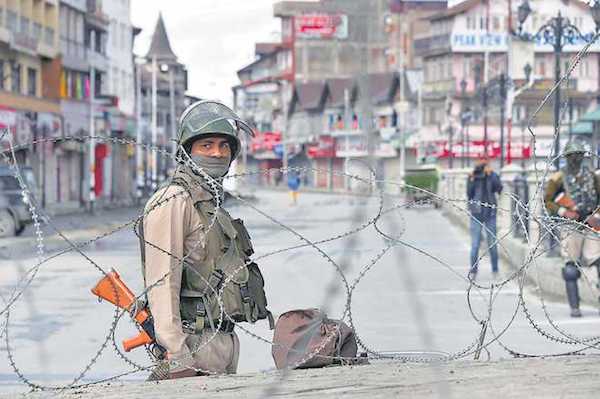
    The state is hurting. Some degree of sensitivity and a ‘highly disciplined’ approach will possibly yield better results. The security forces must remain calm in the event of any provocation.

    Kashmiris happy, somewhat. The PDP-BJP split was much awaited; by people who were unable to reconcile to the rule of the saffron party by proxy. Fear was deeply entrenched in the minds of the locals that right-wing Hindutva forces, with the high pitch for the abrogation of Article 370, may succeed in undermining Kashmir’s special status. Naturally, Kashmiri Muslims were insecure after the alliance came about. And so, it became easier to support the forces of violence, as for them, the PDP had committed an unpardonable sin by shaking hands with the BJP; and getting nothing in return. The first shocker came when the Centre delayed the flood relief package by more than a year after the devastating floods in the autumn of 2014, a couple of months before the Assembly elections that year.

    The PDP-BJP government has disappeared from the corridors of power, but the apprehensions of Kashmiris have not. Aware of political expediencies and vulnerabilities of the parties, they suspect more political compromises may be in the offing. They are waiting and watching the developments very closely. The street mood will be determined by the governance they get, and the way they are treated at their homes, and out on the streets. Kashmiris have become hyper-sensitive about their identity and dignity — siding with secessionist forces is a manifestation of that emotion.

    Some voices in the BJP are linking a ‘hard approach’ toward militants as a way of pulling out Kashmir from the vicious cycle of violence it finds itself in. They believe the militants would/should be hunted and neutralized but forget that this approach prevailed earlier too, and nothing came of it.

    What is really needed is to take into account the attendant pressing matters that have come into play over the past two years — the civilian population, mostly youth with rocks thronging encounter sites and disrupting anti-militancy operations; and the clashes that follow as a result of accidental civilian killings, or what is seen as ‘collateral damage’. Over these two years, the civilian population has identified itself with militants, primarily for two reasons. First, many militants are locals. They are boys they saw in the neighborhood, hence the affinity which exists in the well-knit Muslim society.

    Second, they do not perceive the violent acts as being out of sync with their newly-acquired ethos of resistance. It is a big shift — this ‘new-found’ relationship between the civilians and the militants. In the 1990s, the militants were seen as mujahideen (warriors). There were no doubts. They had picked up the gun and should be ready for the consequences — to die fighting the security forces. Sympathy and sentiment was surely with them, but it was not manifested in the desperate and visible attempts to save them while risking their own lives; as we see now. This is the fundamental truth of the changed situation in Kashmir. The psyche of the common Kashmiri has undergone a sea change.

    Today, the way of looking at the militants has changed, almost hero-like: their arms training may be limited to few weeks, even less, but they are hardened. They have shown their will and grit to fight unto the last. What is more, there is societal approval of their ‘sacrifices’.  Some of them have spurned appeals of their parents to return home.

    Some extraordinary real-life visuals have paled the reel-life images — the mother of Saddam Padder, a top militant of Shopian in South Kashmir recently killed in an encounter, giving a gun salute to her slain son. Her gesture left a deep impact on the minds of youngsters who watched the video that went viral on social media; and is seen as a universal endorsement of militancy by their mothers.

    In such circumstances, reckless actions, with the rhetoric of hard approach, (BJP general secretary Ram Madhav has distanced his party from it) — without taking into account the fallout — have the potential to blow up in the face. The way forward should be specific operations without making much noise. It will help keep civilians out of harm’s way. This is important, because there is widespread impression that the security forces will be striking hard, not necessarily a militant-specific action. It will be deemed as an action against the people who would come to defend them. Stone-throwers will not only seek to disrupt the cordon and search operations — a prelude to the actual gunfight with militants — but also attack patrol parties.

    This phenomenon is interlinked. Militants attack convoys of security forces even as stone-throwers use tactics to distract, thereby creating situations where the Army and police either suffer casualties or inflict casualties. At times, both sides suffer casualties, speeding up the cycle of killings.

    Kashmir-centric parties, the PDP and the National Conference are convinced that the hard approach is not the answer to the problem. Other ways can be found to ease the situation without making the hard approach visible: the security forces must change their attitude towards the public at large. Treating the common Kashmiri with contempt and suspicion will only breed a psyche of resistance and rebellion. A highly disciplined approach would yield better results. Effort should be made to stay calm in the event of any provocation.

    The past cannot be reversed, but the future can be built on, with a new and sophisticated approach.

    (The author can be reached at ajoshi57@gmail.com)


  • Indian Origin Amul Thapar among Potential Supreme Court nominees to replace Justice Kennedy

    Indian Origin Amul Thapar among Potential Supreme Court nominees to replace Justice Kennedy

    WASHINGTON(TIP): Indian Origin Amul Thapar, 49 is one of the potential Supreme Court nominees to replace Justice Kennedy.

     Amul Thapar, 49, a McConnell favorite, was handpicked by Senate Majority Leader Mitch McConnell to serve as the US attorney for the Eastern District of Kentucky. In 2006, he went on to a seat on the US District Court for the Eastern District of Kentucky.

    Trump nominated Thapar to the 6th US Circuit Court of Appeals in 2017. He was born in Michigan and served in government as well as private practice. In 2007, Thapar was the first American of South Asian descent to be named to an Article III federal judgeship.

    Justice Anthony Kennedy, a longtime member of the Supreme Court and frequent swing vote, announced Wednesday that he will retire, giving President Donald Trump the chance to fill his seat.

    The opportunity will allow Trump to make a major, lasting mark on the nation’s highest court by putting in place a second justice, after his choice to elevate Neil Gorsuch to the Supreme Court last year following the death of Justice Antonin Scalia in 2016.

    Trump, reacting to the news at the White House, said he had spoken with Kennedy earlier Wednesday and asked the outgoing justice about possible contenders to replace him.

    “(We) had a very deep discussion. I got his ideas on things,” Trump said in the Oval Office. “I asked him if he had certain people he had great respect for that could potentially take his seat.”

    During his remarks, Trump pointed to a list of potential picks for the court that he had maintained during the campaign and updated last fall.

    Here are a few names of possible contenders for the vacancy.  Brett Kavanaugh, former Kennedy clerk; Amy Coney Barrett, former Notre Dame professor; Raymond Kethledge, former Kennedy clerk; Mike Lee, Utah senator; and Thomas Hardiman, runner-up for Gorsuch seat.


  • Indian American Aruna Miller loses Democratic primary in Maryland’s 6th Congressional District

    Indian American Aruna Miller loses Democratic primary in Maryland’s 6th Congressional District

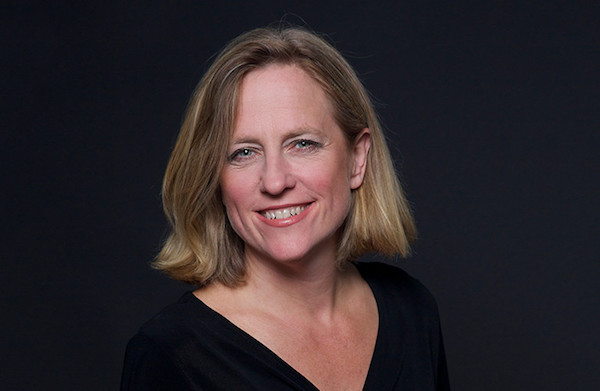
    MARYLAND (TIP): Indian American Aruna Miller lost the Democratic primary for the state’s open sixth congressional district on June 26.

    Miller finished second with 17,315 votes, roughly 5,000 fewer than the winner, businessman David Trone.

    Only 55,000 registered voters cast their votes in the Democratic primary. The presence of two Asian Americans — pediatrician and author Nadia Hashimi and State Sen. Roger Manno — did not help Miller’s cause.

    Hashimi received 4,764 votes, Manno got 4,245 votes.

    Trone, founder of Total Wine & More, reportedly spent $12 million of his own money for the campaign, vastly outspending Miller, who raised $1.5 million.

    Trone had spent more than $10 million in the Democratic primary from the neighboring 8th district in 2016, when he finished second behind Jamie Raskin, who now represents the district in Congress.

    Speaking to roughly 200 of her friends and supporters at a Gaithersburg, MD, restaurant, the candidate vowed to continue to fight for the issues she ran on.

    “When I first started out this journey to run for Congress people said to me… ‘Aruna look you really want to give up a safe seat in the House of Delegates and take on this role of running for Congress?’ I said you know what you better believe it. I do, and the reason why is because our democracy, our future and our liberties for every one of the kids that are here today, it’s worth fighting for and risking everything for and I don’t regret it one bit.”

    She said the campaign was about “what we fight together, what we’re seeking together,” she said. “Tomorrow, we’re gonna get up and we’re gonna fight for democracy. We never take our eye off that. It is something worth fighting for. People have marched for and died for so we, you and I, could have the liberties and the freedoms and all the things that we have today. And that’s our responsibility to do that for the future generation.”

    Miller also thanked the Indian American community for its support.

    “They’ve been incredibly supportive and I’m grateful for that support,” she said. “I think the Indian American community, along with the nation, has woken up from their political slumber after the presidential election and are beginning to understand now why it’s important to be politically engaged.”

    Miller further added in her speech the way forward.

    I’m sure most of you know the story — and every immigrant knows his story — that my mom and dad risked it all came to the United States, stepped out of their comfort zone in order to give greater opportunities for their children. And I’m thankful for that. … They taught me a lesson in that that you should always step out of your comfort zone. That’s when life really begins. Get comfortable with the jagged edges, get comfortable with being uncomfortable. That’s what my mom and dad and every immigrant that comes to this nation has taught me and that’s something that I hope you can take away no matter what you do in life.

    I just want to say: Look, it isn’t over [tonight] … Life is full of disappointments. This is only one data point in that we’re gonna get up tomorrow, we’re gonna fight for democracy, we’re gonna make sure, as we move forward, that it’s about an inclusive America that we want to create. You know I spent my entire life, and I’m sure some of you have also been in this space, trying to fit into a space that didn’t have me in mind right and that’s not what America is about. We’re about expanding that space, so everyone belongs and that’s what I want to work towards.

    She went ahead and congratulated all.

    I want to congratulate every one of the people that ran in [the 6th] congressional district, to all the candidates who gave up their self, their time, their energy and gave the best of themselves to share with the voters. And the voters you know made a decision and they elected an individual and you know we’re gonna have to get up tomorrow morning, we’re gonna have to get up again to work towards something bigger than ourselves, something more important just than our campaign. It’s about moving the ball forward. It’s about moving that needle more towards progress. Progress comes in incremental steps. It’s never over. There is no final destination, but it’s about moving towards it little at a time. And I hope that you will all join us in making sure that we do this.


  • Hoboken Mayor censured for ‘unethical’ conduct by N.J. Supreme Court

    Hoboken Mayor censured for ‘unethical’ conduct by N.J. Supreme Court

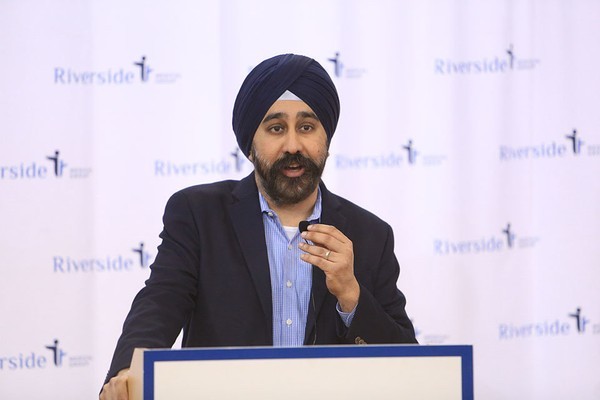
    HOBOKEN, NJ (TIP): Mayor Ravi Bhalla was censured by the New Jersey Supreme Court last week after a disciplinary board chided him for not setting aside over $6,000 for a former employee’s retirement account between 2008 and 2009.

    The June 13 action came six months after the board said the facts of the case “clearly and convincingly” establish that Bhalla acted unethically and violated three rules of professional conduct. The board voted 4-3 to recommend censure instead of a three-month suspension of Bhalla’s law license.

    The disciplinary board said that Bhalla’s actions would have warranted a reprimand had he not been admonished in 2010 for record-keeping violations and for paying a client and himself from a check that had not cleared, actions deemed “improper,” according to its 15-page December decision. The board found that a censure was due because of Bhalla’s “nonchalance” regarding the employee’s missing retirement contributions, the decision says.

    “This matter amounts to an oversight by a small business owner that was immediately rectified once made aware of it,” Bhalla told The Jersey Journal.

    The timing is not optimal for Bhalla, who is the subject of a critical vote at Wednesday’s Hoboken council meeting. The nine-member council, which has been hostile to the mayor, is scheduled to adopt an ordinance that would require Bhalla offer extensive and regular details about his part-time gig working for law firm Lavery, Selvaggi, Abromitis & Cohen.

    The censure stems from a dispute involving the private practice Bhalla, a Democrat, ran before he joined the council in 2009. The details are spelled out in the disciplinary board’s December decision.

    Attorney Alexander Bentsen worked for Bhalla in 2008 and 2009. Bentsen, who made a $60,000 salary, asked Bhalla to withhold 10 percent of his gross income to be deposited in an IRA account at UBS Financial Services, with Bhalla matching Bentsen’s contributions by up to 3 percent, the decision says.

    But Bhalla did not make the required deposits, leaving Bentsen’s IRA underfunded by $6,208 for the two years, according to the December decision. Bhalla also failed to remit Bentsen’s 2008 Social Security withholding taxes, totaling $4,000, until 2013 or 2014, the decision says.

    The mayor told the disciplinary board that he thought the payroll company he had hired took care of the funds intended for the employee’s IRA account, according to the decision.

    Bhalla did not take any steps to remedy Bentsen’s financial situation until he was interviewed by the Office of Attorney Ethics seven years after the issue arose, the decision says.

    Lawyers in New Jersey can be punished in five ways. The least serious action is admonition, followed by reprimand, censure, suspension and disbarment.

    “Ravi Bhalla accepts, but respectfully disagrees with the ruling,” said Bhalla spokesman Rob Horowitz. “This was an inadvertent payroll mistake, resulting in the underpayment of an employer match on an IRA retirement program more than 10 years ago when Mr. Bhalla operated his own small law firm. The employee never informed Mr. Bhalla and then waited seven years and filed an ethics complaint. As soon as Mr. Bhalla realized there was an underpayment, he immediately paid the amount due.”

    Bentsen made “numerous requests” to rectify the matter, according to the December decision.

    Wednesday’s council action involves a proposed rewrite of the city code that would require the mayor to submit quarterly reports on any outside employment listing all income and a list of all clients and or contracts. Brian J. Aloia, Hoboken’s corporation counsel, recommended to the council in a six-page memo that it not adopt the ordinance, calling the change “invalid and unenforceable.”

    Bhalla’s critics on the council — there are seven — have said they believe the mayor’s part-time job with the Lavery firm raises potential conflict-of-interest issues.

    (Courtesy The Jersey Journal / Terrence T. McDonald)

  • Indian American Republican and Democrats attend Impact Summit 2018

    Indian American Republican and Democrats attend Impact Summit 2018

    WASHINGTON, DC (TIP)–  Indian Americans hosted an event “Impact” urging fellow politicians to expand the ranks of Indian Americans in government, politics, and public service.

    Puneet Ahluwalia, from President Trump’s Asian Pacific Advisory Committee praised and criticized in the same vein as Democrat Senators Kamala Harris from California and Cory Booker from New Jersey led the way for the speakers. There were over 200 Democrat Party leaning Indian American candidates, elected officials, philanthropists, leaders, and activists in attendance at the inaugural Impact Summit in Washington, DC.

    Senator Booker in his opening keynote remarks said, “We so urgently need Indian American leadership — not just because of the dynamism it has brought to other sectors of American society — but also because this is a time when the very idea of America is under assault.” With an indirect assault on Republican Party affiliated US President Donald Trump’s policies, Booker added, “We have a time now where Indian American pride, where Indian American strength, where Indian American ideas are critically needed.”

    First Indian-heritage US Senator Kamala Harris in her closing keynote remarks urged the Democrat Party leaning audience to “speak truth.” Harris also focused on the anti-immigrant policies of President Trump arguing, “This country was founded by immigrants. Unless you’re native American or your ancestors were kidnapped and brought over on a slave ship, you people are immigrants.”

    Welcoming the efforts, Ahluwalia said, “I applaud the effort of the Indian Americans and the organizers of Impact Project to propel the community in the mainstream politics. It is heartening to see the excitement and a sense of arrival on the political scene.” On the subject-line followed by the speakers to lambast Republican policies, especially ones of President Trump, Ahluwalia reminded his fellow citizens with the same heritage and background, “But it is President Trump who appointed the first Indian American, Ambassador Nikki Haley to a cabinet position along with many others. The Republican Party and its leadership has done far for more for the Indian Americans and India under their governance.”

    “The real truth is to talk about legal immigration and work with Republican president and its leadership in identifying solutions for those who are in our country illegally. But when offered opportunity, the democrats make it into a political theatre,” noted Ahluwalia. He lamented that “at every platform the Democrats and their leaders always blame President Trump and Republican leadership for their commonsense policies by giving lip service and empty words to make inroads into the community.”

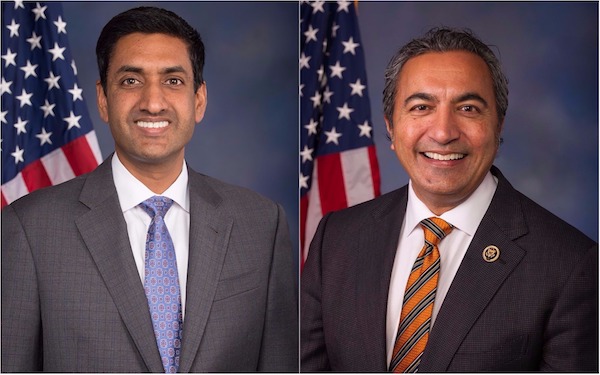
    US lawmakers Ami Bera, Pramila Jayapal, Ro Khanna, and Raja Krishnamoorthi attended and also gave remarks. Also, in attendance were over 40 elected officials and candidates, including Hoboken Mayor Ravi Bhalla and eight candidates for the US House of Representatives.

    “This historic summit is proof that the Indian American community has truly arrived on the political scene,” said Raj Goyle, co-founder of Impact and a former member of the Kansas House of Representatives.

    “The energy, enthusiasm, and talent of our elected officials and candidates is truly inspiring,” added Deepak Raj, co-founder of Impact and chair of the Impact Fund. “Impact is proud to stand with them — and we look forward to expanding their ranks at every level of elected office.”

    Founded in 2016 by Raj Goyle and Deepak Raj, and formally launched earlier this year, the Indian American Impact Project is supposed to focus on encouraging Americans of Indian heritage to run for office and an affiliated organization, the Indian American Impact Fund, endorses and supports Indian American candidates running for office. But in reality, the organizational setup, speeches and other allied flavors are all Democrat in essence and nature.


  • The abrupt end of an unlikely alliance

    The abrupt end of an unlikely alliance

    The PDP and the BJP were always going to part ways. It’s clear Kashmir is headed for troubled times

    By Happymon Jacob
    “At a time when Opposition parties are uniting nationally to mount a challenge to the BJP in 2019, the latter’s act of dumping its ally in J&K is likely to strengthen the Opposition’s resolve to take the fight to the BJP”.

    “In the days ahead, the BJP is likely to justify its stated reason for withdrawing from the coalition by ratcheting up proactive military operations in Kashmir and putting further pressure on the separatist camp. An uncompromising militarist approach, which the BJP will perforce have to adopt, would inevitably mean more militant recruitments from within Kashmir and consequent civilian, military and militant casualties. What happens in Kashmir is directly linked to the higher infiltration on the Line of Control and International Border and more fire assaults between the Indian and Pakistani militaries. Furthermore, given the political humiliation it has suffered, the PDP will be left with two choices: extinction or a return to its soft-separatist stance. If the PDP adopts the latter, it would further vitiate the politico-security atmosphere in the State, at least in the short term. Howsoever one looks at it, Kashmir is headed for troubled times with potential implications for the rest of the country.

    The alliance between the People’s Democratic Party (PDP) and the Bharatiya Janata Party (BJP) in Jammu and Kashmir (J&K) began as an act of necessity, persisted due to sunk-costs and political expediency, and has finally ended as a result of political opportunism. With its sudden decision to withdraw from the coalition government in J&K, the BJP may have ended the political agony for both parties, but it has certainly left the PDP embarrassed and isolated. To be clear, the collapse of the coalition will not only have serious implications for the security situation in the sensitive border State; it also indicates how the BJP intends to use the Kashmir question in the 2019 elections.

    Politics of opportunism

    From the time the PDP and the BJP started negotiations to form a coalition government in January 2015, till June 19 this year when the BJP pulled the plug on the coalition, the alliance has reeked of political expediency and opportunism. The two bitterly opposed parties had come together to form a government primarily for instrumental reasons rather than for normative purposes. Such political expediency became clearer when they decided to keep aside the visionary agenda, negotiated over two months in early 2015, and started focusing on the mundane. As for the PDP, the Agenda of Alliance was its stated raison d’etre for staying in the coalition. But it decided to cling to power in the State even though its coalition partner summarily rejected most of the suggestions in the joint document. Almost no major item on the Agenda of Alliance has been taken up for implementation till date.

    For the BJP, this was the most opportune moment to dump the PDP, given that it not only does not need the PDP anymore, but it has indeed become a liability for its future political pursuits. Having formed the coalition, the BJP achieved what it had long wanted — to be part of the J&K government for the first time in the State’s history. Its leaders were accommodated in key positions in the State government with attendant benefits enjoyed by party functionaries. It might not have grown in Kashmir from an organizational point of view — which it always knew it would not be able to — but it certainly kept its local unit in Jammu content so far. More so, the BJP would now be better off without a ‘soft-separatist’ PDP in tow, especially given that the PDP’s prospects in the State in 2019 are hardly promising. The BJP, in that sense, has used and thrown the PDP. And by being the side that broke ties first, it has gained the first mover political mileage.

    Moreover, the BJP’s support base in Jammu was upset about the manner in which the State police went after the accused in the Kathua rape-murder case and how the two BJP Ministers in the J&K government had to resign due to the controversy arising from the incident.

    Having pulled out of the coalition government, the BJP now could potentially wean away PDP legislators (if the Assembly is not dissolved) and rule the State through the Governor. Individuals of its choice would be appointed as key advisers to the Governor who would act as de facto Ministers in the State.

    However, at a time when Opposition parties are uniting nationally to mount a challenge to the BJP in 2019, the latter’s act of dumping its ally in J&K is likely to strengthen the Opposition’s resolve to take the fight to the BJP.

    The BJP’s ‘stated reasons’ for pulling out of the coalition are perplexing at several levels. Its leadership argued that “there is grave concern over the deteriorating security situation in the State” and went on to say that the responsibility for the difficulty in the coalition lay with “the other side”. This is a problematic argument. While it is true that the security situation in Kashmir has deteriorated, the reality is that the armed forces operating in J&K go by the directives of New Delhi rather than of the State government even though the J&K Chief Minister is the chair of the Unified Command in the State. Second, the BJP was very much part of the government that has failed, and therefore pinning all the blame on the PDP is a cheap excuse.

    Having admitted that the security situation has deteriorated in the State, the BJP has also indirectly admitted that its Kashmir policy — the mainstay of which has been the use of crude force bereft of political strategy — has been flawed to begin with, and that it has not only failed to stabilize the State, but its policies have actually increased violence, terrorism and infiltration. More so, it has further alienated Kashmiris. This deterioration in the situation, let us be clear, is not the result of a soft approach but the direct result of a hardline approach: use of pellet guns against protesters, unwillingness to relent on the issue of AFSPA, or the Armed Forces (Special Powers) Act, and sending the Central agencies after the dissident leadership in Kashmir. The Mehbooba Mufti government could not have stopped any of these policy steps.

    Staring at extinction

    For the PDP, it’s a no-win situation. Having completely lost political legitimacy in Kashmir, the only support base it had, the party and its leadership are looking at a stark future and Ms. Mufti might not find it easy to revive the party any time soon. That is unfortunate given that the PDP had filled a significant political vacuum that existed between the mainstream parties and separatists in the State. Had the party ended the alliance with the BJP earlier, or at least before the BJP did, it would have retained some moral claim about taking normative positions. It was clear for at least two years now that the alliance was bleeding the party dry, but the party leadership lacked the wisdom and courage to say no to the attractions of power.

    In the days ahead, the PDP will struggle to maintain its relevance in the face of the anger of the local Kashmiris (who felt betrayed from day one of the alliance), mainstream parties such as the National Conference and the Congress looking to strengthen their position in J&K, and the BJP which will try to wean its legislators away. The PDP did not have Jammu — now it stands to lose Kashmir too.

    Security implications

    In the days ahead, the BJP is likely to justify its stated reason for withdrawing from the coalition by ratcheting up proactive military operations in Kashmir and putting further pressure on the separatist camp. An uncompromising militarist approach, which the BJP will perforce have to adopt, would inevitably mean more militant recruitments from within Kashmir and consequent civilian, military and militant casualties. What happens in Kashmir is directly linked to the higher infiltration on the Line of Control and International Border and more fire assaults between the Indian and Pakistani militaries. Furthermore, given the political humiliation it has suffered, the PDP will be left with two choices: extinction or a return to its soft-separatist stance. If the PDP adopts the latter, it would further vitiate the politico-security atmosphere in the State, at least in the short term. Howsoever one looks at it, Kashmir is headed for troubled times with potential implications for the rest of the country.

    (The author is Associate Professor of Disarmament Studies at Jawaharlal Nehru University, New Delhi)

  • House Rejects GOP Hardline Immigration Plan: Vote on Compromise Bill Delayed

    House Rejects GOP Hardline Immigration Plan: Vote on Compromise Bill Delayed

    WASHINGTON(TIP): House Republican leaders further delayed vote on GOP immigration bill until next week in the face of opposition. Earlier, the House of Representatives on June 21 voted down a conservative immigration bill introduced by Judiciary Chairman Bob Goodlatte (R-Va.).

    House Republican leaders abruptly postponed a high-stakes vote Thursday on GOP immigration legislation that appeared headed to defeat, despite President Trump’s last-minute lobbying.

    Several GOP hard-liners said Thursday, June 21, there was nothing leaders could do to convince them to vote for the bill. “I’m a big fat ‘no,’ capital letters,” said Rep. Lou Barletta (R-Pa.). “It’s amnesty, chain migration, and there’s no guarantee the wall will be built.”

    Republican leaders had set up two votes on their GOP bills — one on a hardline measure, the other on a compromise negotiated by conservatives and moderates.

    In the first vote, the House rejected the hardline measure that would have imposed limits on legal immigration and provided temporary relief to young undocumented immigrants. The vote was 231-193.

    As the vote occurred on a chaotic day on Capitol Hill, word circulated that the second vote would be postponed.

    The legislation would have provided a pathway to citizenship for young undocumented immigrants, imposed limits on legal immigration and provided $25 billion for Trump’s border wall. The bill also would have kept migrant families together at the border in detention centers.

    Neither bill was negotiated with Democrats or was expected to garner any Democratic votes. The separations crisis has prompted Democrats to dig in against the Republican immigration efforts barring a complete reversal of Trump’s “zero tolerance” policy.

    “Democrats are dedicated to securing our border, but we don’t think putting children in cages is the way to do it,” Minority Leader Nancy Pelosi (D-Calif.) said Thursday. “This is outside the circle of human behavior.”

    As prospects on Capitol Hill appeared to dim, Trump teed off on Democrats during the outset of a Cabinet meeting at the White House, suggesting that they were standing in the way of Republican success on immigration reform.

    “They say no to everything,” Trump said. “They’re obstructionists because they think that’s good politically. I think it’s bad politically — for them, I think it’s bad politically. We’ll see.”

    Trump attacked Pelosi and Senate Minority Leader Charles E. Schumer (D-N.Y.) as “extremist open-border Democrats” but also said he would welcome their presence at the negotiating table.

    “We should be able to do a bill,” Trump said. “I’d invite them to come over to the White House anytime they want.”

    The White House has made a last-minute push to pass legislation amid the brewing border crisis prompted by the family separations that resulted on the U.S.-Mexico border from Trump’s “zero tolerance” immigration policy.

    Trump, Attorney General Jeff Sessions and Homeland Security Secretary Kirstjen Nielsen have all appeared on Capitol Hill this week to urge Republican lawmakers to pass legislation. They have not specifically urged passage of one alternative, which stands to end with Republicans split on their preference and neither bill passing.

  • Dinesh D’Souza, Once Ousted from Job for Adultery, Now Pardoned by President Trump ​

    Dinesh D’Souza, Once Ousted from Job for Adultery, Now Pardoned by President Trump ​

    By M. P. Prabhakaran

    “Let me put in my two cents worth: Donald Trump issued the pardon because he wants Dinesh D’Souza out there, continuing his favorite job of spewing anti-Obama venom, says the author.

    First, a clarification: The pardon President Trump issued on May 31, 2018, has nothing to do with the adultery Dinesh D’Souza committed a few years ago. The adultery did cost this Indian-American his job as president of an evangelical college in New York. But for Donald Trump, himself an adulterer and philanderer, it’s no big deal. More about the adultery, in a little bit.

    Trump and D’Souza have one thing in common. They both hate former President Barack Obama. Each has been engaged in his own character assassination campaign against Obama for nearly a decade now. Since Obama left office and Trump entered it, the latter added one more goal to his campaign: to erase all traces of the achievements Obama had during his eight years in office. The pardon he issued last month, absolving D’Souza of the crime he committed during the 2012 election, is his way of rewarding him for the stupendous work he did in spreading anti-Obama venom. It is also aimed at enabling him to continue that work. More about the pardon, in a little bit.

    Trump’s destroy-Obama campaign started even before Obama became president, soon after he became the Democratic Party nominee for president. It started with a lie. The lie was that Obama was born in Kenya and hence ineligible even to enter the presidential race, let alone be president. The only basis for Trump’s claim was that Obama, though born to an American mother, had a Kenyan father. And since Trump became president, he has been making every effort to demolish the legacy the Obama presidency has left behind.

    D’Souza Questions Obama’s Patriotism

    Though the lie was exposed, with documents proving that Obama was a native-born American, the fact that Obama was born to a Kenyan father gave both Trump and D’Souza ample material to build a conspiracy theory questioning Obama’s patriotism. Building conspiracy theories based on figments of their imagination has been a favorite pastime of both Trump and D’Souza. To cite a few such theories D’Souza bandied about: Obama is against business because of the anti-colonialist trait in his character, which he inherited from his Kenyan father; the 9/11 terrorist attacks happened because of “America’s moral decadence” caused by liberals; the scandalous incident at the Abu Ghraib, Iraq, prison was the fault of liberals, because the soldiers who did those despicable things, Lynddie England and Charles Graner, were divorced, sex-crazed partiers, acting out “the fantasies of blue [Democratic] America”; the liberal billionaire-financier-philanthropist George Soros, who was a Jewish child in Nazi-occupied Hungary, was really a Nazi collaborator; etc., etc.

    When D’Souza, a native of India who became a naturalized citizen of America, questioned the patriotism of a native-born American, he may have evoked chuckles in many quarters. But he knew full well that playing the patriotism card is the surest way of getting accepted in the ultra-right wing of the Republican Party.

    According to D’Souza, all economic policies Obama adopted, and actions he took in pursuance thereof, could be traced to his anticolonialist mind-set. He dwelt at length on this theorizing in a cover story he wrote for Forbes magazine. The story, titled “Obama’s Problem with Business,” was published in the September 27, 2010, issue of the magazine. It portrays anticolonialism as evil and elaborates on his outlandish idea that President Obama was executing in this country the anticolonial agenda of his Kenyan father. A person born and brought up in a former colony portraying anticolonialism as evil did come as a shock to many. I was one of them. I wrote a response to D’Souza’s Forbes article and published it in this space, on September 21, 2010, under the title “An Indian of Quisling Ancestry Ridicules Obama’s Anticolonialist Ancestry.” The most important point I made in my response was:

    “If anticolonialism is evil, Mahatma Gandhi of India, Jomo Kenyatta of Kenya and even the founding fathers of America were guilty of having espoused an evil ideology.”

    D’Souza’s article in Forbes ended thus: “Incredibly, the U.S. is being ruled according to the dreams of a Luo tribesman of the 1950s. This philandering inebriated African socialist, who raged against the world for denying him the realization of his anticolonial ambitions, is now setting the nation’s agenda through the reincarnation of his dreams in his son. The son makes it happen, but he candidly admits he is only living out his father’s dream. The invisible father provides the inspiration, and the son dutifully gets the job done. America today is governed by a ghost.”

    D’Souza dwelt at length on the same idea in his book, The Roots of Obama’s Rage, published in 2010, and a documentary based on the book, released in 2012. Though many in the country found the idea stupid and sickening, the book sold very well. The documentary, titled 2016: Obama’s America and produced with financial help from another Obama-hating conservative, billionaire Joe Ricketts, “was one of the highest-grossing political documentaries of all time, behind only Michael Moore’s Fahrenheit 9/11,” according to The New York Times. D’Souza was happy to note that spreading hatred for Obama pays.

    The ideas he promoted through his numerous articles, nearly a dozen books, two documentaries (the second documentary, Hillary’s America: The Secret History of the Democratic Party, was released on July 22, 2016) and appearances on radio and television talk shows won him a large following among conservatives in the Republican Party. With the publication, in 2007, of the book What’s So Great About Christianity, he also became the darling of the evangelical wing of the party, making him a much-sought-after speaker at mega-churches in the country. His career also rose meteorically. His new-found status among evangelicals won him the top-most position at The King’s College, an evangelical institution in New York. The presidentship of the college came with a seven-figure salary.

    Extramarital Affair

    But the fame and prestige, which the presidentship of an evangelical college brought him, lasted only two years, from August 2010 to October 2012. On September 28, 2012, the man who masqueraded as a holier-than-thou-Christian was spotted in an un-Christian-like act. He was seen sharing a room with a woman at a hotel in South Carolina. His explanation that he had already been divorced from Dixie Brubaker, his wife since 1992, and that Denise Odie Joseph II, the woman he was with, was his fiancée turned out to be only half-true. Nobody believed, either, his plea that “nothing happened” in the hotel room between him and Denise.

    Reporter Warren Cole Smith from World Magazine broke the story on the illicit affair in the October 16, 2012, issue of the magazine. World is a biweekly Christian news magazine published by God’s World Publications. Smith later discovered that D’Souza filed for divorce from Dixie only on the day his story appeared in World. In the wake of the controversy the scandal stirred, The Smith’s College forced D’Souza to resign.

    I had written an article on the controversy and D’Souza’s fall from grace and published in this space, under the title “Obama-Baiting Indian-American Eased Out of His Job for Adultery.” The article, among other things, said:

    “A man losing his job for an extramarital affair may come as a surprise to many, especially in this day and age. But we are not talking about just any man and just any job. The adulterer we are talking about is one who steadily advanced his career by extolling Christian values and kissing up to the extreme right wing of the Republican Party. And the job he has been eased out of is the presidentship of an evangelical college whose mission statement emphasizes a “commitment to the truths of Christianity and a biblical worldview.”

    That the immoral act took place at the conclusion of an event at which 2,000-odd people had gathered “to hear high-profile Christians speak on defending the faith and applying a Christian worldview to their lives,” as the Smith story, puts it, made it all the more appalling. Dinesh D’Souza was the keynote speaker at the event and Smith’s report exposed his hypocrisy.

    Illegal Campaign Contribution

    It seems 2012 was the cruelest year thus far in D’Souza’s career. While the immoral act mentioned above cost him his job and the prestigious position he enjoyed among evangelicals, an illegal act he committed the same year made him a liability for the Republican Party. Until President Trump came to his rescue, that is. Let’s briefly go through what happened:

    In the 2012 mid-term election in the country, the Republican candidate for Senate from New York was Wendy Long, a friend of D’Souza’s since his Dartmouth College days. Ms. Long had requested him to help her raise campaign funds by appealing to wealthy Indian doctors in Westchester. D’Souza knew that he was the last person whom even Republicans among Indians would lift a finger to help. So, he found another way of helping his friend. He persuaded the woman he was having an affair with (the same Denise Odie Joseph II, married and 22 years his junior, who shared a hotel room with him in South Carolina) and her husband; and another couple (a young employee working under him and her husband) to contribute to Long’s campaign fund. The total contribution came to $20,000. Strictly speaking, there was nothing illegal about it, the legally permitted limit of individual contribution being $5,000. But the $20,000 which the four individuals contributed was reimbursed by D’Souza, as per his prior arrangement with them. In other words, he used the four people as straw donors, a practice prohibited under campaign finance laws.

    Sometime in 2013, when the F.B.I., while going through the campaign records of Wendy Long, spotted large sums appearing in the middle of small contributions. It raised a red flag. On further investigation, the Justice Department was able to trace the source of the $20,000 donation to D’Souza. He was charged with breaking campaign finance laws, “willfully and knowingly,” and causing a false statement to be made to the Federal Election Commission. The fact that his friend lost the election to her opponent, the incumbent Democratic Senator Kirsten Gillibrand, did not make his illegal contribution less of a crime.

    For four months D’Souza refused to plead guilty, arguing that he was a victim of “selective prosecution.” He was being targeted, he said, because he was a “sharp critic of the Obama presidency who has incurred the president’s wrath.”

    Richard M. Berman, the judge who presided over the case, dismissed D’Souza’s arguments as “all hat and no cattle.” On September 23, 2014, he issued his verdict. D’Souza was fined $30,000 and sentenced to five years’ probation, including eight months in a supervised “community confinement center.”

    He was languishing in infamy, at least in the eyes of many, when he received the heart-warming news about his being pardoned by the president. The first thing D’Souza did, after he heard of the pardon, was to send out tweets thanking Trump and railing at President Barack Obama. His tweet to Trump said: “Obama & his stooges tried to extinguish my American dream & destroy my faith in America. Thank you @realDonaldTrump for fully restoring both.”

    The next tweet, sent out on the same day, was directed at Preet Bharara, the Indian-American who prosecuted his case. It read: “KARMA IS A BITCH DEPT: @PreetBharara wanted to destroy a fellow Indian American to advance his career. Then he got fired & I got pardoned.”

    Preet Bharara was the U.S. attorney in New York and the investigation of D’Souza’s wrong-doing was undertaken by his office. Both D’Souza and Donald Trump treated him as their nemesis. As was expected, he became one of the early casualties of Trump’s erase-the-Obama-legacy campaign. No reason was given for his abrupt dismissal. Presidents don’t have to give any reason for dismissing anyone in the executive branch. It was rumored, though, that Bharara’s involvement in the investigation into the Trump campaign’s alleged collusion with the Russian meddling in the 2016 election and his being a protégé of Senator Chuck Schumer, the Democrat from New York who is also the minority leader in the U.S. Senate, had something to do with it. Since his dismissal, Bharara has been a vehement critic of Trump.

    Bharara defended his prosecution of D’Souza via a tweet of his own, which said: “The President has the right to pardon but the facts are these: D’Souza intentionally broke the law, voluntarily pled guilty, apologized for his conduct & the judge found no unfairness.”

    The Real Reason Behind the Pardon

    ​Yes, the president has the right to pardon anyone. But impartial observers can never stop wondering what made him pick D’Souza for this preferential treatment, ignoring all established procedures for granting pardons and disregarding more than 10,000 pending cases that are deserving of presidential pardon. The reason could be, many of them say, that the character assassination campaign against Barack Obama, which D’Souza has been conducting, resonates well with the one Trump has been engaged in. He doesn’t care that his action could be criticized as a clear abuse of president’s pardoning power.

    The New York Times has come up with another explanation: “Maybe the president is sending a signal of loyalty and reassurance to friends and family members who may soon find themselves facing similar criminal charges in connection with the special counsel’s Russia inquiry” (“Dinesh D’Souza? Really?” – editorial, nytimes.com, May 31, 2018). It is relevant to note here that one of the crimes that Trump’s lawyer Michael Cohen is now being investigated for is the same as the one D’Souza was convicted of.

    Let me put in my two cents worth: Donald Trump issued the pardon because he wants Dinesh D’Souza out there, continuing his favorite job of spewing anti-Obama venom.

    (The author is editor and publisher of The East -West Inquirer. He can be reached atmpprabha@juno.com)


    ​​


  • Half of Americans back Trump’s handling of North Korea: Poll

    Half of Americans back Trump’s handling of North Korea: Poll

    WASHINGTON(TIP): According to a Reuters/Ipsos opinion poll released on Wednesday, June 13, just over half of all Americans say they approve of how President Donald Trump has handled North Korea, but only a quarter think that his summit this week with Kim Jong Un will lead to the denuclearization of the Korean peninsula, according to a

    In a joint declaration following their meeting in Singapore on Tuesday, June 12 the North Korean leader pledged to move toward complete denuclearization of the peninsula and Trump vowed to guarantee the security of the United States’ old foe. Forty percent of those polled said they did not believe the countries would stick to their commitments.

    Another 26 percent said they believed the United States and North Korea would meet their commitments, while 34 percent said they did not know whether they would follow through.

    Thirty-nine percent believe the summit has lowered the threat of nuclear war between the United States and nuclear-armed North Korea, slightly more than the 37 percent who said they did not believe it changed anything.

    Trump has pursued what he calls a “maximum pressure” campaign” against Pyongyang to force it to give up its nuclear weapons. He toughened up international sanctions to further isolate North Korea and then agreed to meet directly with Kim after South Korea’s president convinced him that the North was committed to giving up its nuclear weapons.

    The Reuters/Ipsos poll suggests the Republican president has broad support for one of his biggest foreign policy efforts, despite criticism from non-proliferation experts that Trump had exacted few concrete commitments from Kim on Tuesday on dismantling his nuclear arsenal.

    Republicans appear much more enthusiastic than Democrats about the potential benefits of the summit. The poll found that Republicans were twice as likely as Democrats to say that the meeting lowered the threat of nuclear war, and they were three times as likely to say that both sides would follow through on their commitments.

    Democrats typically give Trump low approval ratings – only 12 percent approve of his overall job performance. But about 30 percent said they approved of his handling of North Korea.

    Trump, who returned to Washington early on Wednesday, hailed the meeting with Kim, the first between a sitting US president and a North Korean leader, as a success that had removed the North Korean nuclear threat. Their seemingly friendly meeting was in sharp contrast to their tit-for-tat insults and bellicose rhetoric late last year while Pyongyang carried out its biggest nuclear and missile tests.

    In the poll, Trump received a 51 percent approval rating for his handling of North Korea and also led the list of leaders who should take the most credit for the summit and the joint pledge. Forty percent say the former real estate developer should take the most credit, followed by South Korean President Moon Jae-in with 11 percent. Kim was third with 7 percent.

    Trump has repeatedly touted his role in bringing the reclusive North Korea to the negotiating table, a feat that he says his predecessors were unable to pull off.

  • Indian Origin Tommy Thomas to be Malaysia’s New Attorney General

    Indian Origin Tommy Thomas to be Malaysia’s New Attorney General

    KUALA LUMPUR(TIP): Indian origin Tommy Thomas, a top ethnic lawyer was appointed Malaysia’s new Attorney General on June 5thby the King, who appealed to Malaysians  not to “create religious or racial conflict” over the decision, amid protests from Islamic groups against his nomination.

    A palace statement said Sultan Muhammad V has approved terminating the current Attorney General Mohamad Apandi Ali and replacing him with Mr. Thomas, who is the first person from the minority community to hold the post in 55 years in the Muslim-majority nation.

    Prime Minister Mahathir Mohamad had recently proposed to nominate Mr. Thomas, 66, as the Attorney-General, the official agency reported.

    The king called on all Malaysians to accept that the appointment of the Attorney-General should “not create religious or racial conflict as every Malaysian should be fairly treated regardless of race and religion.”

    The appointment of Mr. Thomas as the top legal officer would not affect the special rights and privileges of the Malays and Bumiputeras, as well as the status of Islam as the federal religion, the agency said.

    The King also expressed his disappointment and worry about “inaccurate and negative” media reports of late which could threaten peace and harmony in the country, it said.

    Mr. Thomas is best known as a constitutional law expert and a civil litigator in court cases in matters as varied as administrative law, banking, finance, corporate and commercial law.

    He has been a lawyer in Malaysia for 42 years, having been called to the Bar in the United Kingdom in 1975 and called to the Malaysian Bar in 1976.

    Kuala Lumpur-born Thomas is also an alumni of Victoria Institution, the University of Manchester and the London School of Economics.

    He had also served the legal community in peninsular Malaysia through the Malaysian Bar’s governing body Bar Council, which he was a member of during 1984-1988 and 1993-2001 – including a stint as Bar Council secretary from 1995-1997.

    The appointment of Tommy Thomas has caused division among the Malaysian public as petitions – both objecting and supporting his nomination – have cropped up.

    Parti Islam Se-Malaysia’s information chief on May 2ndalso protested against the government’s pick, saying that the candidate should be an individual “who can protect Islam as the official religion of the country”.

    The Malaysian government had defended its nomination of Mr Thomas, saying that it would be the right signal to send to Malaysians and the rest of the world that the new administration was serious about reforming the country’s institutions.

  • Indian American Techie Shubham Goel is California’s youngest Governor Candidate

    Indian American Techie Shubham Goel is California’s youngest Governor Candidate

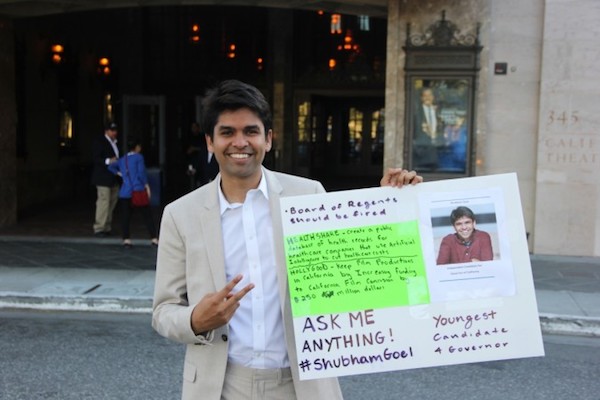
    SACRAMENTO(TIP): Indian American Shubham Goel, who has his roots in Uttar Pradesh is the youngest candidate running for governor of California, Mr. Goel calls for “fresh voices to change the state government”. He was born and raised in California and campaigns for need for practical solutions to problems that the state faces.

    A virtual reality manager by profession, the 22-year-old has been using social media platforms to reach out to the public. His campaigns show him on the streets of California with a megaphone in hand, advocating transparency in the political system.

    In a video he posted on Twitter, the young techie in a dark blue t-shirt is seen asking people at a carnival to support him, while one of his aides is standing beside him holding a big, white placard to pitch his candidacy for California governor.

    Mr. Goel will contest alongside 27 other candidates, according to a two-page state governor contest list that shows he does not have a party preference.

    Another video posted on his Twitter profile shows him campaigning on virtual reality or VR platforms. “Technology has been able to fix a lot of issues. I want to run for governor just to implement technologically feasible platforms,” he said.

    Shubham Goel recently graduated from the University of California or UCLA and holds a degree in economics and film studies. Calling himself an “everyday person,” soon after he announced his candidacy, he tweeted, “California is struggling and this is the moment for change!”

    According to Mr. Goel, the primary reason for running for office is that one needs no political backing or funding to bring about change. “I wanted to run to show that in state-wide offices, it is presumed that to run for office, you need loads of money and fame and loads of political backing. I want to show that all you need is efficiency, platforms and conviction,” he said.

    If elected, Mr. Goel hopes to take California back to its Gold Rush period, arguably one of the most significant events to shape American history.

    Mr. Goel campaigns on a seven-point platform that includes a handbook for the governor that talks of creating centralized and digitalized profiles on social media for office-holders. The profiles will show their economic interactions for the past 10 years with regards to money and donations they have received from any source.


  • Indian American Democrats Ami Bera, Ro Khanna win California primaries

    Indian American Democrats Ami Bera, Ro Khanna win California primaries

    SACRAMENTO, CA(TIP): Indian American Democrats Ami Bera and Ro Khanna have won their primaries in their bid to hold on to their congressional seats in California.

    Bera, the longest serving Indian American in the US House of Representatives, polled nearly 52 percent of the total votes cast in the California District 7 on June 5th. He will face Republican Andrew Grant, who finished second with 33 percent votes.

    Ami Bera was first elected in 2012, when he defeated incumbent Dan Lungren by two percentage points. Since then both his reelection runs were very competitive.

    Freshman congressman Ro Khanna finished first in District 17, winning 59 percent of the votes. Republican Ron Cohen, who received 25 percent of votes, will challenge the Indian American in the November election.

    Khanna, who represents Silicon Valley, entered Congress by beating incumbent and fellow Democrat Mike Honda in 2016.

    In the statewide elections, Indian American Vivek Viswanathan, who ran for treasurer, finished third.

    The former Hillary Clinton aide, who ran an innovative campaign by running on his sneakers from one end of the state to the other, polled nearly half a million votes. Fellow Asian American Fiona Ma received more than 1.6 million votes (43 percent) — nearly double the votes polled by his nearest rival, Republican Greg Conlon.

    In California, there is only one primary, and candidates from all parties compete, with the top two finishers advancing to the general election.

    Last month, two Indian American Democrats won primaries in Texas and Arkansas.

    Sri Preston Kulkarni won the runoff for Texas’ 22nd Congressional District, while school teacher Chintan Desai won Arkansas’ first congressional district Democratic primary unopposed.


  • No longer seeing eye to eye?

    No longer seeing eye to eye?

    With India recalibrating its relations with other powers, the India-U.S. equation is not quite balancing out

    By Suhasini Haidar

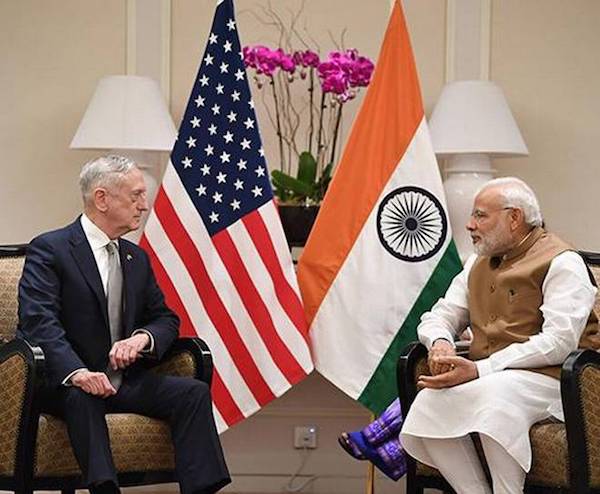
    At his speech at the Shangri-La Dialogue in Singapore last week, billed as a major foreign policy statement, Prime Minister Narendra Modi spoke of India and the U.S.’s “shared vision” of an open and secure Indo-Pacific region. Yet his words differed so much from those of U.S. Defense Secretary James Mattis, who spoke at the same event, that it seemed clear that New Delhi and Washington no longer see eye-to-eye on this issue, and several others as well.

    Oceanic gulf

    To begin with, Mr. Modi referred to the Indo-Pacific, a term coined by the U.S. for the Indian and Pacific Oceans region, as a natural geographical region, not a strategic one, while Mr. Mattis called the Indo-Pacific a “priority theatre” and a “subset of [America’s] broader security strategy” for his military command, now renamed the Indo-Pacific Command. While Mr. Modi referred to India’s good relations with the U.S., Russia and China in equal measure, Mr. Mattis vowed to counter China’s moves in the Indo-Pacific and referred to the U.S. National Defense Strategy released this January, which puts both China and Russia in its crosshairs as the world’s two “revisionist powers”.

    The divergence in their positions, admittedly, are due more to a shift in New Delhi’s position over the past year than in the U.S.’s, when Mr. Modi and President Donald Trump met at the White House. A year ago, the Modi government seemed clear in its intention to counter China’s growing clout in its neighborhood, especially post-Doklam, challenge the Belt and Road Initiative (BRI), and back a Quadrilateral grouping of India, the U.S., Japan and Australia to maintain an open Indo-Pacific. Today, the Doklam issue has been buried, the BRI isn’t as much a concern as before, and the government’s non-confrontational attitude to the Maldives and Nepal indicates a softened policy on China in the neighborhood. Meanwhile, Mr. Modi now essays a closer engagement with Chinese President Xi Jinping and a relationship reset with China after the Wuhan meeting.

    The Quad formation, which is holding its second official meeting today in Singapore, has also been given short shrift. India rejected an Australian request to join maritime exercises along with the U.S. and Japan this June, and Navy Chief Admiral Sunil Lanba said quite plainly last month that there was no plan to “militarize” the Quad. Contrast this with India’s acceptance of military exercises with countries of the Shanghai Cooperation Organisation (SCO), the Russia-China led grouping it will join this week in Qingdao, and one can understand some of the confusion in Washington. Pentagon officials, who had come to accept India’s diffidence on signing outstanding India-U.S. foundational agreements, are now left scratching their heads as India publicly enters the international arena in the corner with Russia and China, while proclaiming its intention to continue energy deals with Iran and Venezuela in defiance of American sanctions.

    Era of summits

    In a world where summits between leaders have replaced grand strategy, the optics are even clearer. Mr. Modi will have met Mr. Xi and Russian President Vladimir Putin four-five times each by the end of the year, if one counts informal and formal summits, as well as meetings at the SCO, BRICS and G-20. In contrast, nearly half the year has gone in just scheduling the upcoming 2+2 meet of Indian and U.S. Ministers of Defense and Foreign Affairs.

    Trade protectionism is clearly the other big point of divergence between India and the U.S., which have in recent months taken each other to the World Trade Organisation on several issues. There has been a surge in disputes between the two countries: on the new American steel and aluminum tariffs, the proposed cuts in H1B professional visas and cancellation of H4 spouse visas, on India’s tariffs and resistance to U.S. exports of dairy and pork products, on Indian price reductions on medical devices, and Reserve Bank of India rules on data localization on Indian servers for U.S. companies.

    The row over Harley-Davidson motorcycles is a case in point, where what should have been a small chink in the relationship has ended up denting the discourse quite seriously. When Mr. Trump announced to Harley executives and union representatives in February last year that he would stop countries “taking advantage” of them, no one in New Delhi paid much attention. Over the year, Mr. Trump grew more vocal in this demand, including twice during meetings with Mr. Modi in Washington and Manila, calling for India to scrap its 75-100% tariffs, given that the U.S. imposes zero tariffs on the import of Indian Royal Enfield motorcycles. Mr. Modi tried to accommodate U.S. concerns, and even called Mr. Trump on February 8 this year to tell him that tariffs were about to be cut to 50%. But after Mr. Trump divulged the contents of their conversation publicly, trade talks were driven into a rut. Officials in Washington still say that if India were to slash its rates, it would see major benefits in other areas of commerce, while officials in New Delhi say that with Mr. Trump having gone public with Mr. Modi’s offer, it would be impossible to back down any further. In fact, a new cess has taken tariffs back up to 70%.

    The biggest challenges to a common India-U.S. vision are now emerging from the new U.S. law called Countering America’s Adversaries Through Sanctions Act and the U.S.’s withdrawal from the Iran nuclear deal with the threat of more secondary sanctions. Both actions have a direct impact on India, given its high dependence on defense hardware from Russia and its considerable energy interests in Iran. In particular, India’s plans to acquire the Russian S-400 missile system will become the litmus test of whether India and the U.S. can resolve their differences. Clearly the differences over a big-ticket deal like this should have been sorted out long before the decisions were made; yet there is no indication that the Trump administration and the Modi government took each other into confidence before doing so.

    In the face of sanctions

    Defense Minister Nirmala Sitharaman’s avowal of the S-400 agreement, and Foreign Minister Sushma Swaraj’s open defiance of U.S. sanctions on Russia, Iran and Venezuela at separate press conferences this month couldn’t have helped. It also didn’t help that owing to Mr. Trump’s sudden decision to sack Rex Tillerson as Secretary of State in March, the 2+2 meeting in April, which may have clarified matters, was put off. The truth is, building a relationship with the Trump administration in the past year has been tricky for both South Block and the Indian Embassy in Washington, as more than 30 key administration officials have quit or have been sacked — they have had to deal with three National Security Advisers, two Chiefs of Staff, as well as two Secretaries of State as interlocutors.

    It is equally clear that the India-U.S. equation isn’t balancing out quite the way it did last year, when Mr. Modi and Mr. Trump first announced the idea of the “2+2” dialogue. Ms. Swaraj, Ms. Seetharaman and their American counterparts have their work cut out for them during their upcoming meeting in Washington on July 6. If a week is a long time in politics, in geopolitics today a year is an eternity.

    (The author is Deputy Resident Editor & Diplomatic Affairs Editor, The Hindu. She can be reached at suhasini.h@thehindu.co.in)


  • The Karnataka effect: Mending fences with Advani & allies

    The Karnataka effect: Mending fences with Advani & allies

    BJP president Amit Shah is busy making pilgrimages to places he had rarely bothered to visit while his party logged a steady record of victories in state elections. His first port of call was Matoshree, home to Shiv Sena chief Uddhav Thackeray to be followed by a closed-door meeting with the Badals in Chandigarh. His boss, PM Modi is on a pacifying and reconciliation mission too: an olive branch to party veteran LK Advani after studiously ignoring him all these years and there is talk of rapprochement with other estranged party elders as well.

    A walk-back in politics, as in war, is an accepted tactic to cut the losses and recoup energy. The message from the high-value losses in UP and Karnataka seems to be that the BJP’s brand of ethno-religious political activism and the Modi charisma may not be adequate in a bipolar competition in 2019. It is also a realization that the NDA needs to again summon the spirit of 2014 but with a slight twist in the arrangement: it is no longer the rising tide of Modi’s populism and antipathy to the Congress that unconditionally brought allies to the BJP’s fold.

    The Congress’ readiness to take the backseat in Karnataka and play the understudy to the BSP and SP in UP have also brought a matching pressure on the BJP to be accommodative to its allies as well. However, power brings in its own complications. The BJP has a much harder task on hand in trying to separately renegotiate the terms of alliance with its partners. For its allies of UP and Bihar, the BJP needs to allay their fears of abandonment and emasculation; with Akali Dal and Shiv Sena, conciliation is easier on the back of decades of association but the ball game in the South is different: the BJP may have invested in the wrong AIADMK faction in Tamil Nadu, is without a partner in Karnataka and divorced but not separated with the TDP in Andhra.  J&K also requires a greater flexibility of alignment. A helping hand from the sidelined elders could make this arduous task easier.

    (Tribune, Chandigarh)

  • New Jersey will have Smoking- free beaches

    New Jersey will have Smoking- free beaches

    Sweeney-Gopal-Smith Bill would ban Smoking on NJ Beaches

    Approved by both Houses, Legislation goes to the Governor

    TRENTON, NJ(TIP): Legislation sponsored by Senate President Steve Sweeney, Senator Vin Gopal and Senator Bob Smith that would ban smoking on New Jersey’s beaches was approved by the Senate, June 7.  The bill, S-2534, would prohibit smoking on all public beaches by extending the existing provisions of the “New Jersey Smoke Free Air Act” to public beaches throughout the state.

    The legislation was amended to extend the smoking ban to state, county and municipal parks, making it identical to the Assembly version. Approved by both houses, the measure now goes to the governor.

    “This is an issue that impacts the environmental quality of the Jersey Shore, the health of beachgoers exposed to second-hand smoke, the quality of life for residents and visitors, and ultimately, the economic well-being of Shore communities,” said Senator Sweeney. “We don’t want our beaches littered with cigarette butts, the air polluted with smoke or the ocean wildlife exposed to threat of discarded cigarettes.”

    “The Jersey Shore has always been one of New Jersey’s most treasured natural assets,” said Senator Gopal. “We have the best beaches and the most desirable beachfront communities in the country – and we want to keep it that way.  They have environmental and economic value that should not be lost or damaged by the ill effects of smoking on the beach. This legislation ensures that our beaches will be free of cigarette butts and our lungs free of smoke.”

    “It’s time to get smoking off the beach,” said Senator Smith, chairman of the Senate Environment Committee. “Not only do you have a nice beach for you and your kids and your grandkids, but you’re also cutting down the costs of maintenance for towns on the beach in terms of keeping them clean.”

    Cigarette filters are among the top types of litter collected from beaches, according to environmental advocates, who collected an estimated 25,000 cigarette filters from New Jersey beaches in “beach sweeps” last year alone.

    The smoking ban would not include beach parking lots and it would allow municipalities to designate up to 15 percent of a beach for permitted smoking, according to the legislation.

    In 2005, under the original “New Jersey Smoke Free Air Act,” the Legislature found and declared tobacco smoke to constitute a substantial health hazard to the nonsmoking majority and found it in the public interest to prohibit smoking in most enclosed indoor places of public access and workplaces. This bill amends the 2005 law to extend the ban to state, county, municipal beaches and state parks.

    A violation of the proposed law would include a fine of not less than $250 for the first offense, $500 for the second offense and $1,000 for each subsequent offense.  It would take effect 180 days after enactment.

    Nationwide, more than 300 coastal communities have banned smoking on their beaches, according to the American Nonsmokers’ Rights Foundation. In New Jersey, an increasing number of beach communities have enacted local smoking bans on their own in recent years, with at least 19 towns enacting the prohibition.

    The Senate vote was 32-1.

  • How Congress stunned Akalis in Shahkot

    How Congress stunned Akalis in Shahkot

    By Harjap Singh Aujla

    Shahkot by-election in Punjab was caused by the death of an Akali former minister Ajit Singh Kohar. In order to cash in on sympathy wave, the Akali supremo allotted the party ticket to Naib Singh Kohar, son of the deceased. Of course, sympathy was there. The Congress reposed confidence in a rich farmer and local sand mining satrap Hardev Singh Laadi Sherowalia. The Akalis enjoyed initial advantage. Their leadership had the deepest pockets and money makes the mare go. They were getting excellent response, and this was partly due to the feeling of overawe generated by the perception of their power and pelf created over a period of a decade.

    Then the ruling party injected all the ministers into the campaign. They worked day and night like never before. They visited riverine areas near the notorious bed of the polluted Sutlej. This area is famous for illicit distillation of liquor and was heavily patronized by the deceased leader. So far, the Congress was alien to this stronghold of SAD. Some positive response was noticed.

    The team of ministers fanned out in every nook and corner of the constituency. One minister Balbir Singh Sidhu spent two weeks in the campaign. The Akali leadership started poaching the gullible former leaders of AAP. Virtually the entire former leadership of AAP was in the SAD camp. The wealthy strong arm SAD leadership fished for some Congress leaders too, but the traffic became two- way. The campaign was neck and neck and was giving sleepless nights.

    Cabinet Minister Navjot Singh Sidhu was sidelined for a long time. Then some leaders from the Majha Region suggested the induction of Sidhu into the campaign. The strategy worked. Navjot Singh Sidhu campaigned for three days. In his aggressive style he exposed all the weak points of the most powerful brothers in law in Punjab. He highlighted how this family monopolized the TV in Punjab through PTC and Fastway. How the big boss monopolized the transport business by owning 800 luxury buses, like Mercedes Benz European built integrated coaches. He fully exposed how the liquor trade was exploited for financial gains by the previous government. He also explained the phenomena of sand mining for enrichment of the very rich.

    In three days of campaigning by Navjot Singh Sidhu, the tide was completely reversed. The Congress campaign was upbeat. The leaders were relaxed, the battle was almost won.

    As an icing on the cake the Chief Minister Captain Amarinder Singh, on the last day of campaigning, conducted a day long road show on the pot-holed dusty roads of Shahkot constituency. And that is the way it was, the Congress getting 82000 votes trounced SAD by 39000 votes.

    (The author can be reached at harjapaujla@gmail.com)

  • Five Worst Dictators in the last 100 years- We Are The People Report

    Five Worst Dictators in the last 100 years- We Are The People Report

    Prime Minister of Bangladesh Sheikh Hasina tops the list

    NEW YORK (TIP): We Are The People (WRTP) is a human and civil rights organization based in New York, USA. The Organization focuses on immigrant population from all over the world, especially, those from South Asian community.

    WRTP focused an investigation in to persecution of people in the countries around the world. On   May 30th, 2018, WRTP Press Secretary Prima Rabbany released a report “FIVE WORST DICTATORS IN THE WORLD IN HUNDRED YEARS”.  Sheikh Hasina, Prime Minister of Bangladesh tops the list.The Indian Panorama is placing the unedited report in the hands of readers with the request to send in their comments for publication.

    Five Worst Dictators in the Last 100 Years Declared by WRTP

    On May 30th, 2018, New York USA based Human & Civil Right Organization WRTP (We Are the People) named 5 Worst Dictators in the world in the past 100 years. In order to select these dictators, WRTP created a panel of three a year ago:

    1. Jilani Warsi: a former professor at HARVARD UNIVERSITY and four-time gold medal recipient: Chairman
    2. John P. DeMaio, Esq: An Attorney at Law, Former Clerk of a Justice of Supreme Court: Member
    3. David Korngold, Esq: An Attorney at Law, Former Assistant District Attorney: Member

    For the past year, this panel worked tirelessly to compile this list of five worst dictators. Primarily, they selected 25 Worst Dictators based on their personal lives including education, how they were elected as chief executive of a state, their governing style, their success and failure in governing, crime statistics during their regime, their country’s judicial system, their kindness and brutality on their own people including those who opposed their rule, development of their country and the beneficiaries of the development, etc. Later, they conducted hundreds of interviews of educators, journalists, historians and literates from the countries where those dictators reigned. After the results were tabulated, this panel debated among themselves and selected five worst dictators of the world in the last one hundred years.

    The following are the five worst dictators in the last 100 years

    1. SHEIKH HASINA:(2009 – PRESENT) BANGLADESH

    Sheikh Hasina is the daughter of Bangladesh’s first dictator, Sheikh Mujibur Rahman. Even though Sheikh Mujibur Rahman was the leader at the time of the liberation war of Bangladesh, under his regime, hundreds of thousands of people died in abject poverty and tens of thousands of people were brutally murdered, especially, those who opposed his rule. In 1975, Sheikh Mujibur Rahman was assassinated. The entire country celebrated the departure of a dictator. In 2009, the daughter of former dictator, Sheikh Mujibur Rahman, Sheikh Hasina took power as Prime Minister with the blessings of our mighty neighbor India and Bangladesh Army – which was intimidated by India as Bangladesh is surrounded by them on three sides. In 2008, the Indian-supported regime held an election in which intimidation, kidnapping opposition, killing leaders and opposition workers, hijacking ballot boxes and random rigging were prevalent. Through all of these massive brutalities and irregularities, in 2009, Sheikh Hasina became the Prime Minister. As soon as she became the Prime Minister of Bangladesh, she began killing leaders, workers and supporters of all opposition political parties and their affiliates. Tens of thousands of Bangladeshi citizens were killed like animals. Since her father was assassinated by a small group of Bangladesh army soldiers, she used Indian help to take revenge to kill hundreds of senior officers of Bangladesh Army since India did not like the existence of a well-disciplined Bangladesh Army. Bangladesh became a killing field as dead bodies began floating in the lakes, ponds and rivers. Scores of dissidents were kidnapped and murdered, and their relatives were made constant targets of the government. Sheikh Hasina became the inventor of extra judicial killing. She also ordered her goons and armed mercenaries to remove two chief justices in a row and throw them out of the country. Press is tightly controlled by her armed cadre. Most of the financial institutions are on the verge of collapse, as her own son stole almost a billion dollars by hacking the computers of Bangladesh Central Bank. Under her rule, Bangladesh has become a modern MAFIA land, where breaking a law is the law and killing opposition or a citizen has become a source of getting affluent.

    Just to prolong her regime and consolidate her absolute power, she signed hundreds of agreements with India which are not beneficial for Bangladesh. There is a significant sign that Sheikh Hasina will be the second head of the state after Kazi Lhendup Dorjee,who destroyed her country first and then handed it over to India for her greed of power and wealth.

    2. SAMUEL DOE: (1980-1990) LIBERIA

    In 1980, a Master Sergeant named Samuel Doe took over the presidency of Liberia after staging a small military coup as none of Liberian Military were involved with that coup d’état. He was supported by the President of the United States of America, President Ronald Reagan. As soon as he was endorsed by the American government, he killed all the senior officers of Armed Force services of Liberia and all political leaders, workers and supporters who did not support his regime. During his time, even though almost all of the financial institutions collapsed, he and his family members became the wealthiest among Africans. He sacked all justices and replaced them with military personnel those who were from other ranks. He was signing agreement one after another with different countries which were not beneficial to Liberia. In 1990, citizens of Liberia had had enough. Poverty and hunger went up to a level that the citizens of Liberia took to the streets and later dragged him out of his palace and mutilated his body before brutally killing him.

    3. RAFAEL TRUJILLO: (1930 – 1961) DOMINICAN REPUBLIC

    Rafael Trujillo was president of the Dominican Republic from February 1930 until his assassination in May 1961. His 31 years of rule is called the Trujillo Era by Dominicans, the bloodiest era ever in the Americas. During his presidency, he murdered innocent civilians, men, women, and children, and the most heinous carnage was the infamous Parsley Massacre. He started killing tens of thousands of Haitians, falsely accusing them of harboring his former Dominican opponents. When Lescot becomes president of Haiti, Trujillo expected him to be his puppet, but Lescot turned against him. Furious about Lescot’s defiance and refusal to comply, Trujillo tried to assassinate him in 1941 unsuccessfully. He also tried to kill one of his staunch opponents, Betancourt, on June 24, 1960, by planting a bomb in Betancourt’s car, but Betancourt survive the bomb attack. Trujillo killed anyone who spoke against him, and this included three Mirabal sisters, Patria, Maria, and Minerva. He brutally murdered them on Friday, November 25, 1960. His ruthless killing of his opponents met with severe criticism, and the Dominican people became restless and indignant. The United States of America also gradually withdrew its support of Trujillo.

    Soon after that, on Tuesday, May 30, 1961, when Trujillo was traveling in his blue 1957 Chevrolet Bel Air, he was ambushed and killed by a number of men. Even after his assassination, the killing of the Dominicans did not stop. The Trujillo family avenged his assassination by hunting down the members of the plot, captured most of them, and executed all of them methodically.

    4. JOSEPH ESTRADA: (1998-2000)

    An actor turned politician. Estrada became a mayor, then a senator, and then vice president under President Fidel Ramos. In an unstable political atmosphere, almost everyone knew that he was America’s Man in the Philippines. He ran for presidency and won the election in 2000. He won the election with American blessing. As soon as he won, he wanted to impress Americans by ordering the military to kill every Muslim in the country under the false pretext of “War against Terror.” He began an “all-out-war” against the Moro Islamic Liberation Front and captured its headquarters and several other camps. Thousands of innocent men, women and children were killed in his so-called war against terror. He became filthy rich as his people started looting and confiscating Muslims properties, including land. He started imprisoning opposition political leaders, workers and supporters who opposed his policies. Day by day, he became increasingly corrupt as almost all financial institutions collapsed. Unemployment, recession and corruption by the president himself, brought the presidency of Joseph Estrada to an abrupt end. In 2007, Estrada was sentenced to a lifetime in prison for embezzling $80 million from the government. He was given clemency by President Arroyo and ran for president in the 2010 presidential election, but he was defeated by his opponent by a landslide margin.

    5. NGUYEN CAO KY: (1965-1967) SOUTH VIETNAM

    In 1965, America found the right ally in Nguyen Cao Ky of South Vietnam. He was Major General of South Vietnam Air Force. He was so ambitious that he was willing to give up his nation in exchange for power. He was helping Americans to prepare a plan to kill the Vietnamese. He allowed Americans to take out Vietnamese natural resources and assets. Under his rule, citizens did not have freedom of speech. He was controlling the press with his iron fist. He enlisted South Vietnamese by force and forced them to work for the Americans. Thousands of Vietnamese died under his rule. He was reported to have said, “If someone asks me who my hero is, I say: Hitler.” But at one point, the Americans found a better option in General NguyễnVănThiệu. The Americans forced Nguyen Cao Ky to work under Nguyen Van Thieu, once his lieutenant. Americans gave him valor and other honor but deposed him as soon he became America’s burden.

    After North Vietnam defeated South Vietnam, it was impossible for him to stay in Vietnam. Nguyen Cao Ky fled to the United States of America on April 30, 1975 and settled in Westminster, California. He died on July 30, 2011 at a hospital in Kuala Lumpur, Malaysia, where he was being treated for respiratory complications.


  • Trump’s efforts to scare away Immigrants aren’t working very well

    Trump’s efforts to scare away Immigrants aren’t working very well

    DALLAS, TX(TIP): In the last two months, the Trump administration has mobilized the National Guard to all four Southern border states, implemented a “zero tolerance” policy mandating prosecutions for unauthorized crossings and begun systematically separating mothers from their children when they are caught crossing illegally.

    None of that has stopped the migrants from coming.

    The number of illegal crossings increased slightly in May, to nearly 52,000, according to figures released Wednesday by the Customs and Border Protection agency. That total includes 11,568 people who came through legal ports of entry, some of whom were asking for asylum or other humanitarian protections under U.S. law.

    Tyler Houlton, press secretary for the Department of Homeland Security, painted a bleak picture about the situation at the border in an accompanying statement.

    “These numbers show that while the Trump administration is restoring the rule of law, it will take a sustained effort and continuous commitment of resources over many months to disrupt cartels, smugglers, and nefarious actors,” Houlton wrote. He highlighted that border arrests had jumped 160 percent over May of last year.

    The truth is those numbers remain low by historical standards. Border Patrol arrests stand at roughly 252,000 so far for the fiscal year, which began in October. That would put them on track to exceed last year’s exceptionally low number of 304,000 arrests, but the predicted yearly total would still represent only a quarter of the 1.6 million arrests recorded in 2000. And an increase in illegal crossings during the spring months is typical ― the weather is warmer.

    For the last few years, border arrests have hovered at their lowest levels since the early 1970s. Since 2014, people seeking humanitarian protections ― particularly from the violence-plagued Central American countries of El Salvador, Guatemala and Honduras ― have made up a large percentage of all unauthorized crossings.

    Nonetheless, the numbers are sure to infuriate President Donald Trump, who has made cracking down on immigration a signature issue. Most of the measures his administration implemented over the last two months aimed to deter asylum seekers, whom the White House accuses of exploiting legal “loopholes” in order to gain lawful entry to the country or avoid getting locked up indefinitely in immigrant detention.

    (Source: Yahoo.com)

  • Preet Bharara for NY State Attorney General?

    Preet Bharara for NY State Attorney General?

    NEW YORK(TIP): Preet Bharara, the former United States attorney in Manhattan who was fired by President Trump, has registered as a Democratic voter in New York for the first time in more than a decade amid speculation that he might run for attorney general, New York Times says.

    Mr. Bharara’s registration in Westchester County occurred during the window for candidates to gather signatures to qualify for the Democratic primary in September. A candidate needs thousands of signatures across half the congressional districts by mid-July — meaning time is short for Mr. Bharara to jump in.

    The Democratic primary for attorney general is already crowded. It includes Letitia James, the New York City public advocate, who was nominated at the state party convention; Representative Sean Patrick Maloney of the Hudson Valley; Zephyr Teachout, a law professor and former candidate for governor; and Leecia Eve, a former adviser to Hillary Clinton and Gov. Andrew M. Cuomo.

    They are running to replace Eric Schneiderman, who resigned suddenly last month after multiple women accused him of physical abuse. Barbara D. Underwood, who was chosen last month to replace Mr. Schneiderman, has said she would not seek election in November.

    Mr. Bharara, who has become an outspoken commentator since Mr. Trump fired him last year, has built a liberal following. He addressed the idea of running for attorney general last month on his podcast.

    “I think politics is not really for me, but it’s an important job, it’s an important time so we’ll see,” said Mr. Bharara, who is also a former aide to the Senate minority leader, Charles E. Schumer, Democrat of New York.


  • Former President of India Pranab Mukherjee at RSS Headquarters defines India and Patriotism

    Former President of India Pranab Mukherjee at RSS Headquarters defines India and Patriotism

    Says any attempt to define India through religion, intolerance will dilute its existence

    NAGPUR, INDIA(TIP): Highlighting the pluralistic and secular strengths of “our democracy” former President of India and Congress veteran Pranab Mukherjee on Thursday, June 7 spoke from an RSS platform to declare nationalism was not bound by race or religion.He cautioned that any attempt to define India through “religion, dogma or intolerance” would only dilute the country’s existence.

    His half-an-hour address had a lesson for everyone. To the RSS, the former President recalled “vasudhaiv kutumbakam” (the world is one family) as the soul of Indian nationalism; to new Sangh recruits he spoke of the need for harmony; to his parent party Congress, he emphasized the need for dialogue and to PM Narendra Modi, he quoted Kautilya’s lessons in governance.

    Unfazed by the fact that he was standing with people he had ideologically opposed all his life, Mukherjee used the occasion to drive home “diversity and acceptance” as the bedrock of Indian nationalism and to remind the pracharaks of the need for unity.

    “We derive our strength from tolerance. We accept and respect our pluralism. We celebrate our diversity. Any attempt at defining our nationhood in terms of dogmas and identities of religion, region, hatred and intolerance will only lead to dilution of our national identity,” the former President said.

    To sceptics, including his daughter Sharmishtha, the ex-President said informed public engagement was essential in democracy. “A dialogue is necessary not only to balance competing interests, but also to reconcile them. We may argue, may agree, may not agree but we cannot deny the existence of multiplicity of opinions,” he said.

    Wading through India’s past, Mukherjee spoke of how through 3,500 years of being ruled by dynasts, India’s 5,000 years of civilizational unity remained unchanged while foreign elements were absorbed to create a new synthesis of national unity.

    “Multiplicity of cultures, faith and languages makes us special,” Mukherjee repeated to 707 pracharaks, passing out after rigorous RSS training. He carefully dotted his speech with quotes from S Radhakrishnan, Rabindranath Tagore, Mahatma Gandhi, Jawaharlal Nehru and Bal Gangadhar Tilak to hammer home his point. “When Tilak spoke of swaraj, he meant a swaraj for people encompassing all castes and religions and languages.”

    He lauded the Constitution at a gathering full of RSS sympathizers, saying, “For us, democracy is not a gift, but a sacred trust… The Constitution is not a legal document but a Magna Carta for the socio-economic transformation of society. From our Constitution flows our nationalism.”

    The former President also commented on the “routine of violence” in the country, saying India may be the fastest growing economy but it was lagging on the World Happiness Index.

    “You are young. I must tell you that manifestations of rage are tearing our social fabric. We must free public discourse of violence, both physical and verbal. We must move from anger and conflict to love and harmony. Our motherland is asking for happiness. Our motherland deserves happiness,” Mukherjee said as he marveled the fact that 1.3 billion Indians used 120 languages, 1,600 dialects, followed seven major religions, belonged to three ethnic groups and still stood united under one flag, one Constitution and one identity.

    “This is Bhartiyata,” the former President said at the RSS headquarters after he had paid tributes to Sangh founder KB Hedgewar, calling him a “great son of Mother India”. Earlier, RSS chief Mohan Bhagwat spoke of the irrelevance of controversy around Mukherjee’s visit.

    Veiled message to PM 

    “When we go to Parliament, just above the lift at gate no. 6 is inscribed Kautilya’s quote “In the happiness of people lies the happiness of the king, their welfare is his welfare. The State is for the people. People are at the center of all activities of the State and nothing should be done to divide them. The aim of the State should be to galvanize them to fight a concerted war against poverty, disease and deprivation. Only then can we create a nation where nationalism flows automatically.”

    Message to Sangh

    “India’s nationhood is not one language, one religion and one enemy. It is perennial universalism of 1.3 billion people who use 122 languages and 1,600 dialects… practice 7 major religions… live under one system, one flag and one identity of being Bharatiya and have no enemies”.

    Bhagwat on visit

    RSS Chief Mohan Bhagwat said on Mr. Mukherjee’s address: “Pranab Mukherjee will remain what he is and the Sangh will remain the Sangh even after the event. The RSS wants to unify the entire society, and no one is an outsider for it. People may have different views, but they are all children of mother India.”

    Congress comments

    Hours after Congress leaders had slammed former President Pranab Mukherjee for attending an RSS event, the party on Thursday praised him for showing “mirror of truth” to the Sangh by reminding it of India’s pluralism, tolerance, secularism and inclusiveness as an article of faith and soul of the country.

    The party also said Mukherjee reminded the Prime Minister Narendra Modi of his ‘Rajdharma’ and that “Indian nationalism is constitutional patriotism”.

    Congress spokesperson Randeep Singh Surjewala said Mukherjee’s visit to the RSS headquarters had caused wide-ranging discussion, comment, concern and even consternation amongst a large section of Indians, who have an innate belief in foundational values of democracy, pluralism, and diversity.

    His statement came soon after Mukherjee had delivered his nearly 30-minute address at the RSS headquarters during its third year annual training camp.

    Earlier, several Congress leaders, including Ahmed Patel and Anand Sharma, had slammed Mukherjee for attending an RSS event in Nagpur.    Patel, who is UPA chairperson Sonia Gandhi’s confidant and has been her political secretary, voiced his view on Twitter, in reply to Mukherjee’s daughter who too spoke out against the decision of the former President to address the RSS event. “I did not expect this from Pranab da!” Patel tweeted.

    Congress senior spokesperson Anand Sharma also took to Twitter to express his anguish after Mukherjee’s images attending an RSS event in Nagpur appeared on television. “The images of Pranab Da, veteran leader and ideologue at RSS Headquarters have anguished millions of Congress workers and all those who believed in pluralism, diversity and the foundational values of the Indian Republic,” he said. “Dialogue can only be with those who are willing to listen, absorb and change. There is nothing to suggest that RSS has moved away from his core agenda as it seeks legitimacy,” he added.

    ‘Dirty tricks at play’

    Tagging a morphed picture showing Pranab sporting the RSS cap, his daughter and Congress leader Sharmishtha Mukherjee said: “See, this is exactly what I was fearing and warned my father about. Not even few hours have passed, but BJP/RSS dirty tricks dept is at work in full swing!”

    Mr. Mukherjee came, spoke and left. But his visit to RSS headquarters is now a part of contemporary and future history of India. For long, political parties and political analysts will be commenting over the 30-minute speech of one of the most experienced and best-known politicians of our times.

  • Indian American Nima Kulkarni defeats the Democratic incumbent to be the Kentucky House District 40 Democratic nominee

    Indian American Nima Kulkarni defeats the Democratic incumbent to be the Kentucky House District 40 Democratic nominee

    KENTUCKY (TIP): Indian American Nima Kulkarni took everyone by surprise in the Democratic primary for Kentucky House of Representatives’ District 40 on May 22, when she defeated Dennis Horlander who has served in the house for more than two decades.

    She defeated the Democratic incumbent to secure her spot in the general elections, which will be held on November 6.

    The other Democrats whom she defeated are Logan Gatti and Kelly Gibson.

    Kulkarni won 46.59 percent votes against Horlander’s 25.37 percent.

    Kulkarni will now face Joshua Neubert, who was elected unopposed in the Republican primary.

    Kulkarni was born in India and moved to the United States when she was six with her parents, Suhas and Surekha, and her brother Nikhil.

    The family owned and operated the 8 to 8 grocery store in Germantown, Kentucky, where Nima and Nikhil worked delivering groceries.

    Kulkarni graduated from Atherton High School and received a bachelor’s degree in English and MBA from the University of Louisville.

    She is a recipient of the Doctor of Jurisprudence degree from David A Clarke School of Law at the University of the District of Columbia, in Washington, DC.  She is a member of the Georgia and Kentucky bar associations.

    Kulkarni founded the Indus Law Firm that specializes in immigration, employment, and business law. Kulkarni is also a member of both the Georgia, Kentucky and Louisville Bar Associations.

    Kulkarni currently lives in the St. Joseph’s neighborhood of the District 40, with her husband Raegan Maddox.

    A community leader, she founded a non-profit, New Americans Initiative, to educate, engage and build awareness of immigration and immigration-related issues.

    She serves on a number of boards, including that of Louisville Public Media, the Community Foundation of Louisville, the Indian Professional Council of Kentucky and the Beaded Treasures Project.