Tag: Pollution

  • India’s journey of triumphs, trials and transformation

    India’s journey of triumphs, trials and transformation

    When the clock struck midnight on August 15, 1947, a newly free India stepped into the unknown-scarred by Partition, burdened by poverty, yet fuelled by an unyielding spirit. As Pandit Nehru spoke of the nation’s “tryst with destiny,” few could have imagined that within eight decades, this struggling colony would emerge as a global powerhouse-economically dynamic, technologically advanced, and democratically resilient.
    But progress has not been even. India’s post-independence journey has been a tale of two realities: extraordinary achievements on one hand, and stubborn challenges on the other.
    Achievements: Building a Modern Nation
    Democracy: India’s Greatest Triumph
    Universal Adult Franchise from Birth: Unlike many new nations that restricted voting to the educated or wealthy, India trusted its citizens fully. Every adult, regardless of caste, gender, or literacy, had a vote.
    Stable Democratic Institutions: Over seventeen general elections and hundreds of state polls, India has witnessed peaceful transfers of power-even after deeply divisive campaigns.
    Robust Judiciary and Free Press: The Supreme Court’s power of judicial review and an independent media have kept governments in check. Historic judgments-from Kesavananda Bharati (1973) protecting constitutional supremacy to Navtej Johar (2018) decriminalizing homosexuality-reflect India’s evolving social contract.
    Innovation in Electoral Processes: Electronic Voting Machines, Voter ID programs, and massive voter awareness drives have made India’s electoral process both efficient and inclusive.
    Agricultural Transformation:
    From Famine to Surplus
    Green Revolution (1960s-70s): Led by M. S. Swaminathan and supported by Prime Minister Lal Bahadur Shastri’s call to “Jai Jawan, Jai Kisan,” India introduced high-yield crop varieties, irrigation expansion, and fertilizer use.
    Result: India went from importing food under PL-480 aid programs to self-sufficiency in grain production by the 1970s, and today is a leading global exporter of rice and wheat.
    White Revolution: Operation Flood, spearheaded by Verghese Kurien, transformed India into the largest producer of milk, empowering rural farmers.
    Economic Growth and Global Integration
    Planned Economy to Liberalization: Post-independence India followed Nehruvian socialism, building public-sector heavy industries, dams, and premier institutions (IITs, AIIMS).
    – 1991 Economic Reforms: Facing a severe foreign exchange crisis, PM P. V. Narasimha Rao and Finance Minister Manmohan Singh dismantled the License Raj, liberalized trade, and attracted foreign investment.
    – Results: GDP growth accelerated, millions entered the middle class, and India emerged as a hub for IT, outsourcing, and software exports. By 2023, India became the fifth-largest economy globally.
    – Digital India Revolution: In the 2010s, Aadhaar biometric ID, UPI payment systems, and massive telecom penetration brought financial inclusion to millions, changing everyday life.
    Science, Technology and Strategic Power
    Space Achievements:
    – Aryabhata (1975)-first satellite launch.
    – Mangalyaan (2014)-world’s lowest-cost Mars mission.
    – Chandrayaan-3 (2023)-soft landing on Moon’s south pole.
    – Nuclear and Defense Programs: India developed indigenous nuclear capability (Smiling Buddha test in 1974, Pokhran-II in 1998) and built advanced missiles under the Integrated Guided Missile Development Program.
    – Healthcare and Pharma: India became known as the “pharmacy of the world”, supplying affordable medicines and vaccines globally, particularly during the COVID-19 pandemic.
    Social Justice and Inclusion
    – Abolition of Untouchability (Article 17): Legal equality laid the foundation for social reforms.
    – Affirmative Action: Reservations in education and employment uplifted Scheduled Castes, Tribes, and OBCs.
    – Education Expansion: Literacy rose from 12% in 1947 to over 77% today, driven by schemes like Sarva Shiksha Abhiyan and Mid-Day Meals.
    – Women in Leadership: From Indira Gandhi to President Droupadi Murmu, women have assumed the highest offices, while legal reforms improved inheritance, workplace equality, and political participation.
    Challenges: The
    Unfinished Agenda
    – Poverty, Inequality, and Unemployment
    – Progress but Uneven: Extreme poverty dropped sharply-from 45% in 1983 to under 10% today-yet income inequality has widened, with wealth concentrated among a few.
    – Jobless Growth: While GDP has surged, employment generation has lagged, creating frustration among India’s vast youth population.
    Population Pressure and
    Infrastructure Deficit
    – Demographic Dividend at Risk: India’s young workforce (median age \~28) could fuel economic growth-but only with adequate jobs, skills, and infrastructure.
    – Urban Overcrowding: Cities like Delhi and Mumbai face congestion, housing shortages, and pollution, reflecting planning gaps.
    Governance and Corruption
    – Institutional Weaknesses: Despite RTI laws and digital transparency, high-profile scams (Bofors, 2G spectrum, coal allocations) have eroded public trust.
    – Bureaucratic Inefficiency: Delays, red tape, and inconsistent policies continue to discourage investment and reforms.
    Social Harmony Under Strain
    – Caste, Religious, and Regional Tensions: Violence, discrimination, and political polarization challenge the vision of “unity in diversity.”
    – Need for Inclusive Nationalism: Social cohesion must rise above divisive rhetoric to ensure long-term stability.
    Environmental and Climate Crisis
    – Pollution and Resource Stress: India is home to some of the most polluted cities, and rivers like the Ganga remain under stress despite cleanup efforts.
    – Climate Vulnerability: Erratic monsoons, droughts, and heatwaves threaten agriculture and health. Sustainable energy and urban planning are critical for the future.
    The Road Ahead: Vision for 2047
    As India approaches its centenary of independence in 2047, the nation has set an ambitious goal: to become a developed country. Achieving this vision requires a multi-pronged strategy:
    Inclusive Economic Growth
    – Invest heavily in education, vocational training, and entrepreneurship to turn the youth bulge into a demographic dividend.
    – Strengthen manufacturing through initiatives like Make in India and build global supply chain integration.
    Good Governance and
    Institutional Strengthening
    – Deepen transparency using e-governance, AI-powered services, and judicial reforms.
    – Ensure federal balance, empowering states to innovate while maintaining national cohesion.
    Sustainable Development
    – Aggressively expand renewable energy (solar, wind) to meet climate goals.
    – Implement urban reforms to create smart, liveable cities with better public transport and waste management.
    Social Harmony and Equality
    – Expand affirmative action into quality education and skill-building programs, not just quotas.
    – Promote dialogue, cultural exchange, and inclusive nationalism to reduce caste and communal divides.
    Global Leadership
    – Use India’s position in G20, BRICS, and the Quad to shape global economic, security, and climate policies.
    – Leverage India’s soft power-Bollywood, yoga, diaspora, IT leadership-for cultural diplomacy.
    A Nation Still in Motion
    India’s journey since 1947 is a testament to resilience. From a country battling famine to a spacefaring power and global economic leader, its achievements are undeniable. Yet, poverty, inequality, and social divisions remind us that independence is not a destination but an ongoing project.
    As the world’s largest democracy marches toward its centenary, India must marry growth with justice, modernity with tradition, and power with compassion. The promise of 1947 still shines bright-waiting to be fully realized by 2047.

  • Tributes pour in for Justice Kuldip Singh, Justice Harjit Singh Bedi

    Tributes pour in for Justice Kuldip Singh, Justice Harjit Singh Bedi

    Justice Kuldip Singh

    Justice Harjit Singh Bedi

    Tributes poured in for two stalwarts of the Indian judiciary – Justice Kuldip Singh and Justice Harjit Singh Bedi – who passed away in November this year.
    Justice Harjit Singh Bedi died on November 21, followed closely by Justice Kuldip Singh on November 25.
    “Their passing has created an irreplaceable void, but their contributions and values will continue to inspire us as we move forward,” a resolution, signed by former judges, including Justice S S Sodhi, Justice M S Liberhan, Justice Mehtab Singh Gill, Justice S S Saron, Justice Ranjit Singh Randhawa, Justice Nawab Singh, Justice Rajiv Narain Raina, Justice Nirmaljit Kaur, Justice Jaishree Thakur, and Justice Sabina, expressed deep sorrow at the untimely passing of both luminaries within days of each other, stated.
    Justice Kuldip Singh
    (1 Jan 1932 – 25 Nov, 2024)
    Justice Kuldip Singh was a renowned jurist and former judge of the Supreme Court of India, recognized for his unwavering commitment to environmental protection and human rights. His tenure in the judiciary left a significant impact on Indian jurisprudence, particularly in public interest litigation (PIL) and environmental law. Below is a detailed profile of his illustrious career and contributions.
    Early Life and Education
    Justice Kuldip Singh was born on January 1, 1932, in Punjab, India. He pursued his education with distinction, earning his degree in law from Panjab University, Chandigarh. After completing his studies, he embarked on a legal career that would see him rise to prominence in the Indian legal system.
    Legal Career
    Justice Singh began practicing law in the early 1950s, specializing in constitutional, civil, and corporate law. His expertise and dedication earned him widespread respect within the legal fraternity. Over the years, he was involved in several landmark cases, which helped cement his reputation as an advocate of justice and fairness.
    He was designated as a Senior Advocate by the Punjab and Haryana High Court, a recognition of his legal acumen and skill. Subsequently, he served as the Advocate General for the state of Punjab, a role in which he provided legal counsel to the state government on critical legal and constitutional matters.
    Appointment to the Supreme Court
    Justice Kuldip Singh was appointed as a judge of the Supreme Court of India on December 14, 1988. During his tenure, which lasted until December 21, 1996, he delivered several landmark judgments that have had a lasting impact on Indian law and society.
    Landmark Contributions
    Justice Singh’s judicial philosophy was marked by his emphasis on social justice and environmental sustainability. His notable contributions include:
    Environmental Jurisprudence
    Justice Singh is often referred to as the “Green Judge” for his landmark rulings in environmental cases. Under his watch, the Supreme Court actively employed the principle of sustainable development to balance environmental protection with economic progress.
    In cases like Vellore Citizens Welfare Forum v. Union of India (1996), he emphasized the importance of the “precautionary principle” and the “polluter pays principle” in managing environmental challenges.
    He also played a pivotal role in directing measures to control industrial pollution, protect forest cover, and preserve biodiversity.
    Public Interest Litigation (PIL)
    Justice Singh was a strong proponent of PILs as a tool to address societal inequities. Through his judgments, he expanded the scope of PILs to include issues like environmental degradation, human rights violations, and corruption. His rulings empowered ordinary citizens to approach the judiciary for redressal of public grievances.
    Human Rights Advocacy
    Justice Singh demonstrated a profound commitment to upholding human rights. He authored judgments that safeguarded the rights of marginalized communities, upheld personal liberties, and strengthened the implementation of constitutional guarantees.
    Electoral Reforms
    Justice Singh was instrumental in advocating for transparency and fairness in the electoral process. His judgments stressed the need for free and fair elections, ensuring the sanctity of democratic institutions.
    Legacy and Recognition
    Justice Kuldip Singh’s judicial career left a deep imprint on the Indian legal system. His proactive approach to environmental and social justice earned him widespread recognition, both domestically and internationally. He is celebrated for bringing environmental issues into the mainstream of judicial discourse in India.
    Post-retirement, he continued to contribute to legal and social causes. He chaired various committees and commissions, including one on electoral reforms, where he made significant recommendations to enhance transparency and accountability in India’s democratic processes.
    Justice Kuldip Singh is known for his humility and dedication to public service. Despite his high-profile career, he remained grounded, focusing on issues that affect the common man.
    Justice Kuldip Singh’s legacy as a jurist lies in his progressive judgments and his commitment to the ideals of justice, equality, and environmental sustainability. His contributions continue to inspire legal practitioners, environmentalists, and social activists in India and beyond.

    Justice Harjit Singh Bedi
    (Sept 5, 1946 – Nove 21, 2024)
    Justice Harjit Singh Bedi (September 5, 1946 – November 21, 2024) was a distinguished Indian jurist who served as a judge of the Supreme Court of India. His legal career was marked by significant contributions to the Indian judiciary, characterized by fairness, integrity, and a deep commitment to justice.
    Early Life and Education
    Born in Sahiwal (formerly Montgomery), now in Pakistan, Justice Bedi hailed from a family of agriculturists. Notably, he was a direct descendant of Guru Nanak, the founder of Sikhism, being 17th in the line. Following the partition of India, his family settled in Fazilka, a township near the India-Pakistan border. His father, Tikka Jagjit Singh Bedi, served as a judge on the Punjab and Haryana High Court until his retirement in 1969.
    Justice Bedi completed his schooling at Bishop Cotton School in Shimla, obtaining his Senior Cambridge certificate in 1962. He pursued higher education in law, which laid the foundation for his illustrious legal career.
    Legal Career
    Enrolled as an advocate with the Bar Council of Punjab & Haryana on July 17, 1972, Justice Bedi practiced in civil, criminal, and writ matters. Between 1974 and 1983, he also served as a part-time lecturer in the Department of Laws at Panjab University, Chandigarh, demonstrating his dedication to legal education.
    His career in public service began with his appointment as Deputy Advocate General for Punjab in 1983. He was designated as a Senior Advocate in 1987 and subsequently served as Additional Advocate General until 1989. In 1990, he was appointed Advocate General of Punjab, a position he held for about a year.
    Judicial Appointments
    Justice Bedi’s judicial career commenced with his appointment as an Additional Judge of the Punjab and Haryana High Court on March 15, 1991. He became a permanent judge on July 8, 1992. His judicial acumen led to his elevation as the Chief Justice of the Bombay High Court on October 3, 2006. Shortly thereafter, on January 12, 2007, he was appointed as a judge of the Supreme Court of India, where he served until his retirement in 2011.
    Notable Contributions
    Beyond his tenure on the bench, Justice Bedi was entrusted with significant responsibilities post-retirement. In 2012, the Supreme Court appointed him as the Chairman of a Special Task Force monitoring committee to oversee investigations into custodial deaths in Gujarat. His report, submitted in 2019, identified misconduct in several cases, underscoring his unwavering commitment to human rights and accountability.
    Additionally, he was tasked by the Jammu and Kashmir Government to probe the mysterious death of National Conference activist Mohammad Yousuf Shah, approaching the assignment with the tenacity and care that defined his career.
    Justice Bedi’s personal life was deeply rooted in his family’s legal tradition. His son, Justice Jasjit Singh Bedi, continues the legacy, serving as a judge of the Punjab and Haryana High Court.
    Colleagues and friends remember Justice Bedi as a gentleman judge, whose judgments were known for their clarity and compassion. His demeanor combined gentle firmness with a profound sense of humanity, leaving an indelible mark on Indian jurisprudence.

  • For an expanse of blue, with air so clean 

    For an expanse of blue, with air so clean 

    On International Day of Clean Air for Blue Skies (September 7), there is urgent need to address risks posed by pollution

    • By Benno Boer, Srishti Kumar, Neha Midha

    “The world is not just grappling with climate change, but also with another silent killer — air pollution. Global health statistics reveal a disturbing scenario with lung cancer claiming 10 million deaths worldwide in 2020, as stated in the World Health Organization (WHO) factsheet published in 2023. This could soar by another 3.2 million by 2050 according to a report, ‘Mapping of global, regional and national incidence, mortality and mortality-to-incidence ratio of lung cancer in 2020 and 2050’, by the Indian National Institute of Health. South Asia, home to two billion people, is also home to nine of the world’s 10 most polluted cities, including Delhi, where the air quality continues to pose a perilous long-term threat putting its inhabitants at risk each day. While policy measures have led to statistical improvements in the Air Quality Index (AQI), the health risks associated with Delhi’s polluted air persist. Delhi is knocked to its knees every winter facing hazardous levels of air pollution.”

    Youngsters around the world are taking charge of environmental advocacy, running marathons, and tracking real time data of air quality, creating environmental awareness. But the absence of a specific Sustainable Development Goal (SDG) for ‘Clean Air to Breathe’ indicates a lack of global attention.

    Dr. Benno Boer

    According to UN Secretary-General António Guterres, the earth has entered the era of global boiling. Scorching heatwaves, devastating floods and erratic weather patterns are stark reminders for an urgent need to address the triple-planetary crisis of biodiversity loss, climate change and pollution.

    The world is not just grappling with climate change, but also with another silent killer — air pollution. Global health statistics reveal a disturbing scenario with lung cancer claiming 10 million deaths worldwide in 2020, as stated in the World Health Organization (WHO) factsheet published in 2023. This could soar by another 3.2 million by 2050 according to a report, ‘Mapping of global, regional and national incidence, mortality and mortality-to-incidence ratio of lung cancer in 2020 and 2050’, by the Indian National Institute of Health. South Asia, home to two billion people, is also home to nine of the world’s 10 most polluted cities, including Delhi, where the air quality continues to pose a perilous long-term threat putting its inhabitants at risk each day. While policy measures have led to statistical improvements in the Air Quality Index (AQI), the health risks associated with Delhi’s polluted air persist. Delhi is knocked to its knees every winter facing hazardous levels of air pollution.

    Lung cancer, cardiovascular disorders, respiratory ailments, and mental health issues continue to destroy lives. Delhi’s air, a lethal mix of SO2 (sulphur dioxide) and NOX (nitrogen oxides), along with high particulate matter concentrations (2.5 or even 10µg/m3), carbon monoxide and ozone, deprive over 30 million residents of their human right to breathe clean air.

    The air pollution toll is troublesome especially for immunocompromised individuals, pregnant women, children, and the elderly. As per a Lancet Report, 1.67 million pollution-related deaths were attributed to air pollution in India in 2019, accounting for a staggering 17.8% of the total deaths in the country.

    Efforts to combat this crisis are already being made. State governments, research institutions, and NGOs are pioneering solutions such as the PUSA Decomposer, developed by the Indian Agricultural Research Institute (IARI), employing biotechnology to address agricultural pollution. State-level policies such as GRAP 3 (Graded Rapid Action Plan), monitoring air quality in hotspots, and establishing Green War Rooms, have shown some potential. Many innovative startups involving young entrepreneurs are turning agricultural waste into valuable products.

    Viable solutions

    Acknowledging the existence of air pollution remains the primary step towards solutions. Next comes a debate on viable solutions and actions, many of which are already known. Eventually, these best practices need to be implemented. Without implementation, the best laid out plans will not lead to any improvement. Globally, cities such as Ljubljana (Slovenia), Accra (Ghana), Seville (Spain), Bogota (Colombia), Medellin (Colombia), epitomize the power of prioritizing human health and environmental sustainability. Car-free zones, green spaces, smart urban designs, electrified public transportation, nature-based solutions, and innovative biotechnology demonstrate positive results. China’s shift to clean energy and e-mobility after battling severe pollution, Indonesia’s project on ‘Carbon Efficient Farming’ assessing biomass to reduce CO2 emissions, Thailand and Vietnam undertaking measures to reduce open straw burning, are all gleams of hope.

    UNESCO’s initiatives to combat air pollution include implementing an internal carbon tax on all flight tickets, and investing in emission reduction measures. The World Air Quality Project allows residents to make informed decisions by real time Air Quality data. In collaboration with UNEP, environmentally conscious practices have been introduced such as digital working via the ‘Virtual Meetings’ project. Clean-Air-For-Schools is spreading education among all for clean air. Other laudable activities include switching to electric vehicles, replacing lighting systems to greener LED arrangements, implementing solar powered offices, protecting historical sites by developing strategies to curb air pollution, and effective green solutions ( urban forests, parks, green corridors).

    Youngsters around the world are taking charge of environmental advocacy, running marathons, and tracking real time data of air quality, creating environmental awareness. But the absence of a specific Sustainable Development Goal (SDG) for ‘Clean Air to Breathe’ indicates a lack of global attention.

    However, in 2019, laying emphasis on the interest of the international community for clean air, and the need to improve air quality, the UN General Assembly decided to designate September 7 as the International Day of Clean Air for Blue Skies. Nevertheless, clean air remains a long stride in many mega-cities and other places. We hope that a concerted action to systematically improve the air quality including in Delhi will receive priority attention. The problem has been caused by people, so it should be people who will find and apply solutions, supported by innovative adequate air quality policies and action plans. As we inhale the consequences of our actions, the ultimate question beckons: are we the torchbearers of change for the future of our planet or will we be silent bystanders who let pollution script a tragic ending?

    (Benno Böer is the Chief of the Natural Sciences Unit, UNESCO Multisectoral Regional Office for Bangladesh, Bhutan, India, Maldives, Nepal and Sri Lanka. Neha Midha is the National Programme Officer, UNESCO Multisectoral Regional Office for Bangladesh, Bhutan, India, Maldives, Nepal and Sri Lanka. Srishti Kumar is a UNESCO Natural Sciences Intern. UNESCO is a member of Team UN in India, together helping deliver on the Sustainable Development Goals)

  • Make your skin look younger with bottle gourd

    Make your skin look younger with bottle gourd

    Bottle gourd might not sound as a delight for your taste buds but knowing about the benefits it has on your skin, you will surely fall in love with this pale veggie. Bottle gourd (commonly known as lauki/ghiya) not only gives you the right nutrition to your body, but it also ups your beauty quotient. Wrinkle-free skin With powerhouse nutrients such as vitamin C and zinc, bottle gourd helps in tackling premature ageing. The juice helps slow down cell ageing and prevents wrinkles from appearing on the face. You can have the lauki cooked or in the juice form for consumption. You can also apply the juice externally on your face and neck area for beautiful skin.
    For that natural glow
    Loaded with minerals, antioxidants and vitamins, bottle gourd juice can do wonders to your skin, lending it a healthy glow. Use it as your morning mantra as it aids proper functioning of your digestive system and makes your skin radiant. Have a glass full of bottle gourd juice every morning on a regular basis for better results.
    Haircare
    You will be shocked to learn that the staple from your kitchen can also tackle and control premature greying of hair. It contains vitamin B that has a cooling effect on your scalp and thus, helps reduce discolouration and frizziness of your natural hair. Regular intake of bottle gourd can also control hair fall. Grate a few pieces of bottle gourd and mix it with yoghurt or apple cider vinegar and use as a hair pack. You will be relieved of your hair problems after regular usage.
    Reduces pimples and acne
    Bottle gourd juice effectively cleanses the system and keeps dirt, pollution and oil under control. Hence it balances the secretion of oil from the pores which in turn reduces pimples and breakouts. You can consume it cooked or as a juice to combat your skin related problems.
    Smooth and clear skin
    As bottle gourd purifies the blood, it helps in making the skin smooth and supple. It cleanses the body internally which eventually leads to healthy, glowing and clear skin. Make a smoothening face pack using cucumber and bottle gourd in equal proportions. You can also add besan and curd if you wish. Apply it on your face for around twenty minutes and wash off with warm water. It will nourish your skin to the core and give it a butter-smooth feel at the same time.
    Puffy eyes
    You can get rid of your eyes bags naturally using bottle gourd. It is the cooling effect and water content of the vegetable that does the trick. The remedy also works to relax and relieve your eyes. Press bottle gourd round slices onto your eyes and lie down relaxed. Wait for 20 minutes and then remove the slices. You will love the soothing impact it will have on your eyes.

  • The bipartisan infrastructure bill is finally on its way to President Biden’s desk

    The bipartisan infrastructure bill is finally on its way to President Biden’s desk

    House Approves $1.2 trillion infrastructure bill in the bipartisan 228-206 vote

    I.S. Saluja

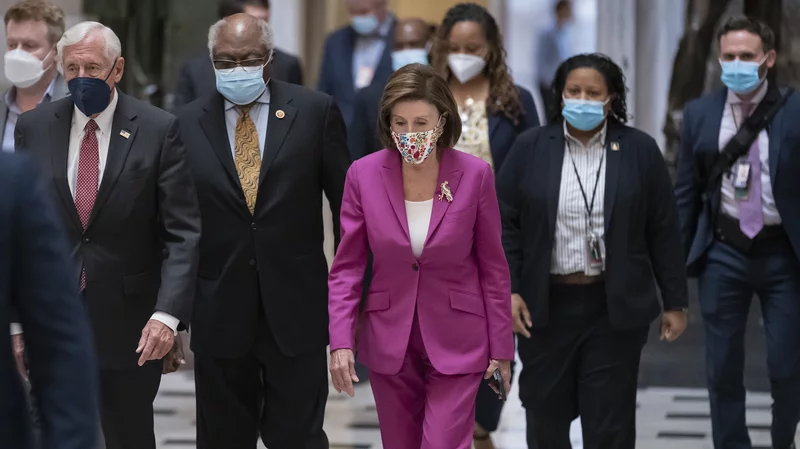
    WASHINGTON, D.C. (TIP): After months of intense debate between Democrats’ warring factions, House Speaker Nancy Pelosi (D-Calif.) on Friday, November 5, secured passage of an approximately $1.2 trillion infrastructure bill to upgrade the nation’s roads, bridges, pipes, ports, broadband, and other public works. The bipartisan 228-206 vote marked the final milestone for the first of two pieces in the president’s sprawling economic agenda. The outcome sends to Biden’s desk a sprawling initiative that promises to deliver its benefits to all 50 states, a manifestation of the president’s 2020 campaign pledge to rejuvenate the economy in the aftermath of the coronavirus and “build back better.” The infrastructure proposal, nearly half of which constitutes new spending, marks one of the most significant investments in the country’s infrastructure since Congress responded to the Great Recession. It seeds new funding in the hopes of delivering urgently needed fixes to the country’s outdated inner-workings while setting the U.S. on track to tackle more intractable future challenges, including the fast-worsening climate crisis. The bill includes more than $110 billion to replace and repair roads, bridges and highways, and $66 billion to boost rail, making it the most substantial such investment in the country’s passenger and commercial network since the creation of Amtrak about half a century ago. Lawmakers provided $55 billion to improve the nation’s water supply and replace lead pipes, $60 billion to modernize the power grid and billions in additional sums to expand speedy Internet access nationwide.

    Many of the investments aim to promote green energy and combat some of the country’s worst sources of pollution. At Biden’s behest, for example, lawmakers approved $7.5 billion to build out a national network of vehicle charging stations. Reflecting the deadly, costly consequences of global warming, the package also allocates another roughly $50 billion to respond to emergencies including droughts, wildfires and major storms.

    The bill now heads to the White House for Biden’s signature more than two months after Senate lawmakers approved it on a rare and overwhelming 69-30 bipartisan vote. Its success reflected Biden’s considerable toils alongside Democrats and Republicans — including Sens. Kyrsten Sinema (D-Ariz.) and Rob Portman (R-Ohio), two of its lead negotiators. In the end, though, it was the Democratic Party’s unexpected struggles in two key elections Tuesday that provided the most resonant catalyst for action. A loss in Virginia’s gubernatorial race, and a tighter-than-expected victory in the fight for the governor’s mansion in New Jersey, left Democrats reeling and ready to forge ahead on their long-stalled priorities.

    Taking to the House floor, some Democrats even appeared to acknowledge that their rare and narrow majority remains at risk unless they can deliver on their wider array of campaign promises before the 2022 midterms. “This legislation will mean that our majority will have delivered a major victory for the American people in a bipartisan way,” House Majority Leader Steny H. Hoyer (D-Md.) said in a speech.

    House lawmakers had hoped to adopt the infrastructure bill sooner. But it quickly became a critical bargaining chip in a broader battle between liberal and moderate Democrats over the scope of Biden’s spending vision and the future of the party itself. By holding up infrastructure, liberals hoped to force moderates including Sinema to accept more spending than they otherwise might have as part of a second, still-forming package that aims to overhaul the country’s health care, education, immigration, climate and tax laws.

    On one hand, the strategy appeared to work: After months of public sparring, Biden helped marshal a compromise that Democrats later turned into a $2 trillion tax-and-spending plan. That opened the door for House Speaker Nancy Pelosi (D-Calif.) to try to bring both to the floor on Friday — though the process that proved more politically treacherous than first anticipated.

    The Senate approved the measure on a bipartisan basis in early August, but the legislation then languished in the House as liberal lawmakers refused to back the measure without assurances that Biden’s broader social spending package would be approved.

    The infrastructure package contains $550 billion in entirely new investments, including money for electric-car charging stations and zero-emission school buses. The spending is mostly paid for — without raising taxes. The bulk of the funding comes from repurposing unspent coronavirus relief money and tightening enforcement on reporting gains from cryptocurrency investments. The bill would add about $256 billion to the debt, according to the Congressional Budget Office.

    This is how the money will be spent.

    $550 billion in new investments

    Almost half of the $1.2 trillion package is going toward new investments in transportation, utilities and pollution remediation.

    TRANSPORTATION: $284 billion

    1. Roads & Bridges: $110 billion
    2. Railroads: $66 billion
    3. Public Transit: $39 billion
    4. Airports: 25 billion
    5. Ports: 17 billion
    6. Electric Vehicles: $15 billion
    7. Road Safety: $11 billion
    8. Reconnecting communities: $1 billion

    UTILITIES: $240 billion

    1. Power Infrastructure: $65 billion
    2. Broadband: $65 billion
    3. Water Infrastructure: $55 billion

    Resilience: $47 billion

    1. Western Water Structure: $8 billion
    2. Pollution Remediation: $21 billion
    3. Additional $5 billion is made up of small provisions to aid different groups.

    (Source: Congressional Budget Office)

    (With inputs from Agencies)

  • What a $5 trillion economy would look like

    What a $5 trillion economy would look like


    By Pulapre Balakrishnan

    At the meeting of the Governing Council of the NITI Aayog , middle of June, , Prime Minister Narendra Modi announced the target of a $5 trillion economy for India by 2024. It is necessary to think big when seeking to make a difference, for transformation does not come from modest plans. Hopefully, the Prime Minister will also use the drive to growth to place India’s official statistics on a firmer footing, so that we can be sure that economic policymaking is based on reality. However, getting the numbers right will not ideally end the task. What this task is may be illustrated by a question that was asked some years ago when a high-speed expressway connecting the polar extremities of one of our States had been proposed. A wit had asked what we would hope to find once we have reached our destination.

    A similar question can be asked of plans for growing the economy. What would we like to see in the proposed $5 trillion economy? Moreover, unlike in the case of an expressway, which can always be built by simply borrowing money and ideas from the global market, a quantum leap in the size of the economy is not so easily achieved. It will require design, funding and governance.

    Without investment

    The importance of funding, and to an equal extent design, may be seen in the failure of the quite sensible aspiration, ‘Make in India’. Though technically applicable to every sector, it was clearly focused on manufacturing. Articulated very early on in Mr. Modi’s first term (2014-19), and accorded a certain prestige in the pronouncements that followed, it played out as a damn squib. One of the reasons for this was the absence of commensurate investment outlay. To raise the share of manufacturing in the economy from its present 16% to 25%, an ambition declared by both the United Progressive Alliance and National Democratic Alliance governments, requires a scaling up of investment. This did not come about.

    Whether this was due to the corporate sector, Mr. Modi’s chosen vehicle, not having the wherewithal or due to it not being convinced of the plan is beside the point. Investment there must be and if the private sector is, for whatever reason, not coming forward to invest, then the government must. This is no more than accounting, but Mr. Modi’s government seems to be unfavorable to this diagnosis, perhaps on ideological grounds. Remember ‘minimum government’?

    A small digression should clarify matters. The first attempt to make in India was in the 1940s. Finance Minister Shanmukham Chetty’s first budget speech had identified increasing “internal production” as the economic priority. And this was achieved quite soon. Along with the quickening of the economy as a whole, the share of manufacturing had risen, the mocking epithet ‘Hindu rate of growth’ notwithstanding. This had not emerged as part of the moral victory of an oppressed people. The reason was that it had resulted from a surge in investment, led by the government. That resources could have been mobilized on such a scale in so short a time in an economy devastated by colonial rule is testimony to the availability of the three ingredients — design, resources and governance — necessary when contemplating a move to the next level, which is what aiming at a $5 trillion economy amounts to.

    The wish list

    While lauding the efforts of leaders of early independent India, however, we would do well to remember their follies. Principal among them was the failure to articulate, possibly even adequately imagine, the contents of the economy that was being raced towards. If this is repeated now, a moment of triumphalism different in character but nevertheless there, it would amount to not having learned the lessons of history. Something missing from “internal production” and ‘Make in India’ is the difference these intentions would make to the lives of Indians. At least in the 1940s, the priority was to get the economy moving in the first place. This is no longer the issue. Today the economy must be evaluated in terms of how much it contributes to the ease of our living. So what would be some of the characteristics of a valuable economy?

    First, Indians should feel empowered by the economy. We know that currently they do not feel so. India is placed very low in the United Nations’ World Happiness Report. Happiness, best understood as a sense of well-being, is directly related to empowerment, or being able to undertake the functioning’s we value. This is, in the first instance, related to being educated and experiencing good health. We are in India facing an education sector that is broken down and the majority are battling with almost non-existent public health infrastructure. The private sector has some worthy initiatives in these areas but they await an effective public presence on a gigantic scale. So, the first attribute of the valuable economy would be access to quality health and education for all.

    The second attribute of a valuable economy would be equality of opportunity. For over three decades now income inequality has been rising in India. According to some measures, India is today more unequal than China, itself a society widely perceived as highly unequal. Now some part of inequality of opportunity is related to unequal distribution of income but a part of it is not. Gender inequality manifested as women having less opportunity in life is not going to go away with a re-distribution of income along class lines or across social groupings. India is a serious outlier in this regard, and becoming richer as a society may do little to change the status quo. Shockingly, a sex ratio, already unfavorable to women, has shown a secular worsening since 1947. Inequality in India can only be ended by equalizing capabilities across individuals. Concerted public action via education is the means to this outcome. Income transfers, pushed relentlessly by policy entrepreneurs, evade the issue altogether.

    Conserving nature

    Finally, an economy, whatever its size, cannot be meaningfully evaluated independently of the extent of presence in it of natural capital. Till now, by referring to the imperative for growth, to eradicate poverty, any effort to conserve nature has not just been ignored but treated with derision, by both right and left. This is no longer a credible political stance. Two-thirds of the world’s most polluted cities are in India, when we accept less than a fifth of its population. Air pollution shortens lives and lowers productivity, reducing the capacity to earn a living when alive. The poor are the most affected as they cannot afford to live in gated communities that somehow manage to commandeer scarce natural resources. Some part of environmental depletion in India is due to the pursuit of unbridled growth.

    This implies that any improvement in the life of the majority would require a re-alignment of the growth process so that it is less damaging. This would very likely require that we have slower growth but the process can be configured to channel more of it towards poorer groups. We may end up in a situation of less tangible goods in the aggregate than otherwise but one in which more people are happier than in the past. Such an economy is more valuable.

    (The author  is Professor of Ashoka University, Sonipat and Senior Fellow of the Indian Institute of Management, Kozhikode)

  • UN’S 2018 WORLD ENVIRONMENT DAY: BEAT PLASTIC POLLUTION

    UN’S 2018 WORLD ENVIRONMENT DAY: BEAT PLASTIC POLLUTION

    By Mabel Pais

    “In 1950, the world’s population of 2.5 billion produced 1.5 million tons of plastic; in 2016, a global population of more than 7 billion people produced over 300 million tons of plastic – with severe consequences for marine plants and animals” UN

    • We buy 1 million plastic bottles every minute.
    • We use over 500 million straws every day in America.
    • 500 billion disposable plastic bags are used worldwide every year.

       Plastic bags are used for an average of 12 minutes only.

    • 90% of bottled water found to contain plastic particles.
    • 83% of tap water found to contain plastic particles.

    World Environment Day (WED), June 5th, 2018, is the people’s day for doing something to take care of the Earth; so, we can join hands to bring the change needed to save all life on our planet.  The theme for 2018 is beating plastic pollution.

    WED is UN’s most important day for encouraging worldwide awareness and action for the protection of our environment.

    On World Environment Day, the United Nations with The Ministry of Environment, Forest and Climate Change, India, invited Isha Foundation to partner with it for the United Nations Environment Program to hold awareness drives in over 270 iconic locations around the world and thus spread awareness for banning single-use plastic.

    Children in Princeton, NJ support World Environment Day (WED)
    Participants in NY Cruise fundraiser
    WED supporters at Niagara Falls
    WED supporters at Central Park, NY
    Photos / Courtesy Isha Foundation

    This year’s environment day theme is Beat Plastic Pollution, and the host is Delhi, India. Sadhguru Jaggi Vasudev, yogi, mystic, humanitarian, founder-head of the international organization, Isha Foundation, was invited to speak with Erik Solheim, Executive Director of UN Environment Programme (UNEP), on this occasion and this event was live web-streamed.  Dia Mirza, former Miss Asia Pacific, UN Goodwill Ambassador for India, moderated the discussion.

    Since it began in 1974, World Environment Day has grown to become a global platform for public outreach that is widely celebrated in over 100 countries.

    Sadhguru began one of the world’s largest environmental campaigns in 2017 with his RallyforRivers30-day all-India drive.  He personally drove across 16 States of India in 30 days.  The campaign witnessed an unprecedented participation of over 162 million people from all walks of life, in different capacities.

    “Eric (Solheim) has spent the last week or more traveling through India, visiting different cities, interacting with people, and his energy and his enthusiasm is awe-inspiring,” noted Dia Mirza, former Miss Asia Pacific.

    Being a long-time admirer of Sadhguru, Mirza said “You have been instrumental in making so many of us love nature and ourselves and help us understand that we humans are not separate from nature, but we are part of nature. What we do to our environment, we do to ourselves, to our health.”

    “I’m very proud to have participated in the campaign, ’Rally for Rivers.’  It was a movement that galvanized civil society like no other. It has seen a kind of participation that is unprecedented.  And I know that your concern and love for India’s rivers is deep.  And, I think the theme of ‘Beat Plastic Pollution’ is so deeply connected with ‘Rally for Rivers’.”

    Sadhguru said, “Plastic is one of the most fantastic materials.  Such a wonderful material has become poisonous. This (is) a material that can be recycled 1000s of times, over and over again, that can be of use in a cycle.”

    “It is a serious problem if we do not handle this on a war-footing.  I’m using the word ‘war’ intentionally because every day the way we’re living, is a war… with everything.  At least, let’s reverse the war towards our well being. It has to be done (as if) we have a war on our hands.”

    “Without the push of law, the larger population will not move (for change). If it has to change quickly, law has to come into place.  That is why we are looking at single-use-plastic-ban.”

    Eric Solheim observed that a couple of days earlier, the team visited the beautiful southern State of Andhra Pradesh.  They watched a number of farmers transforming their agriculture into nature-based farming.  “It was fantastic to see beautiful trees, fantastic landscape, hard working farmers. Then all of a sudden we came to some open fields that were full of plastic.”  Then, again, while they traveled from Agra to Delhi, they saw plastic bags, plastic pollution of all sorts along the railway tracks.  “This is bad,” said Solheim.

    So, there is no doubt we need to change.  We need to change for the sake of Mother Earth.  We need to change for the sake of the animal kingdom.  But, we need to change for the sake of ourselves. This is in the most simple and clear terms, I hope, why we have started this global campaign: Let’s Beat Plastic Pollution.

    He was happy and proud to note that the Indian Government, Prime Minister Modi, many Chief Ministers and political heads of India, even some of whom are not supportive of Mr. Modi, have all picked up this cause because they believe in change and they believe in making India clean.

    And, finally, he wished to remind all Indians that the greatest of all Indians, and one of the greatest of human beings that ever-walked planet earth, Mahatma Gandhi, who said it very rightly: ‘Cleanliness is (next to) Godliness.’ And believed that it was not God’s plan that we humans should pollute our Mother Earth.  “It’s God’s plan that we should cater for Mother Earth as we cater for our children.  This is the most beautiful, one planet that we have, and we have to take good care of it,” he said.

    Join Hands To Beat Plastic Pollution:

    • On the weekend of June 2, local city-based events and global online campaigns, across the US and Canada, created awareness through social media.
    • The United Nations is organizing the worldwide #BeatPlasticPollution game of tag on social media towards this initiative.

    How can we humans help?

    The task of creating awareness continues by people sharing with their friends, families and colleagues what they are doing to change their single-use plastic habits.  This can be spread through influencers, media, politicians, schools, businesses and organizations.

    For example: You can share photos and videos to show how you changed a

    habit like using canvas shopping bags, metal straws or any other reusable products, then tag ten friends, inspiring them to do the same. The person tagged should post a photo with their reusable items within 24 hours and nominate 10 more. Please add #BeatPlasticPollution #Sadhguru #WorldEnvironmentDay as well.

    Please share your ideas, photos and creative solutions on twitter.com/IshaUSA and facebook.com/IshaUSA by tagging #Sadhguru #BeatPlasticPollution #WorldEnvironmentDay

    If you are an organization and would like to partner with Isha, please write to wed@ishausa.org.

    (Mabel Pais writes on The Arts and Entertainment, Social Issues, Health and Wellness, and Spirituality)


  • Debate Why Hinduwadis are obsessed with Cow?

    Debate Why Hinduwadis are obsessed with Cow?

    Cow is not sacred and beef is not forbidden to Hindus, according to Vedas 

    By Dave Makkar

    The author finds no mention in Hindu scriptures about cow being referred to as “mother” or as “holy”. He finds no evidence that cow slaughter was ever prohibited, that beef eating was forbidden. He wonders why Hinduwadis are so obsessed with cow. The Indian Panorama, with this article, is initiating a debate on an issue which has fiercely divided the Indian nation. The views expressed here are the author’s own.

    The current atmosphere in India on the issue of cow defies all sane logic, Hindu religious Texts, thousands of years old sacred history, historians and scholars.  On one hand the current Modi government talks of making India the biggest economic power in the world surpassing America and China. On the other hand, his own party and his Hindu affiliate’s members talk of what people can eat or cannot eat, how many children the Hindu couples should produce, what the women should wear, adult girls cannot be seen in the company of opposite sex friends, Hindu girl cannot marry a non-Hindu and any criticism of government policies make you anti-national that includes refusing to say Bharat Mata ki Jai or Cow is our mother.

     Modi himself and his team members are biggest hypocrites on the issue of cow or meat. As CM of Gujarat under Modi meat production 10,600 tons in 2001-2 went up to 35,286 tons in 2011-12. Still Modi accused UPA government for cow slaughter for their support to meat exporters “Pink Revolution” during the run up to the 2014 elections that brought him to power. Ironically under Modi’s watch bovine/cow meat export has gone up by 70% according to the Commerce Ministry website. Now India is number 1 exporter of bovine/cow meat in the world.

     Modi’s confidante Amit Shah during the 2014 campaign made several speeches that cow slaughter will not be banned in north eastern states of India. As BJP’s party president on May 28, 2015 in Goa; Amit Shah ruled out a nation-wide beef-ban or cow slaughter.  Union Government and Goa Government both under BJP are jointly running a slaughterhouse in Goa.

     Sangeet Som, the Hindutva poster boy & one of the main accused in 2013 Muzzafarnagar communal riots, UP Assembly Member and now Minister in Adityanath Yogi’s government had been personally associated with two meat processing and export companies, Al-Dua and Al-Anam. Al-Dua is one of the India’s leading halal meat export companies which exports meat to Arab countries.

     BJP candidate Sreeprakash on April 2, 2017 in the run up to the Mallapuram Lok Sabha by election in Kerala said, “I will ensure quality beef and standard abattoirs in my constituency.”

     Modi’s Minister of State for Home Affairs Kiren Rijiju in Aizwal on May 27, 2017 said that, “I eat beef, I’m from Arunachal Pradesh and can anybody stop me? So let us not be touchy about somebody’s practices. This is a Democratic country. Sometime some statements are made which are not palatable.” Kiren Rijiju also described as “unpalatable” his colleague Mukhtar Abbas Naqvi’s remarks that those who eat beef should go to Pakistan, and questioned whether anyone could stop him from eating beef. The BJP leaders in Arunachal, Meghalaya, Sikkim, Mizoram, Nagaland have been making statements to their constituents, sale of beef at subsidized rates is their commitment to them. After the new Cattle Trade Rules announced by the Modi government they went to the extent of saying “No Beef No Support to BJP”

     BJP’s Karnataka spokesperson Vaman Acharya on May 28, 2017 while participating in a panel discussion on Suvarna News opposed the beef ban. He said that people from all communities including the Brahmin community, consumed beef. Before India became an agrarian nation, beef had been a staple diet. Even today, several people, including indigenous tribes in the North Eastern States consumed beef as a staple. Acharya had also said that as chairman of the Karnataka Pollution Control Board, he gave permission for the setting up of 16 abattoirs in the State.  Lastly, he had said that he didn’t subscribe to the religious sentimentality attached to the cattle. He retracted his statements on June 6, 2017 under party pressure.

     Modi’s Home Minister Rajnath Singh in Aizwal on June 12, 2017, said that people are free to choose what they want to eat.  When asked about protests against the government’s ban on sale of cattle for slaughter, Singh clarified that the Centre will not impose any restrictions on one’s choice of food. However, even as Singh spoke, scores of people in the Mizoram capital participated in a “beef ban bashing banquet” organized by a local organization. (PTI)

    Kerala BJP and RSS have joined hands to start a co-operative society to sell meat which includes bovine meat as well as fish, a Malayalam daily Deshabhimani reported on July 5, 2017.

    July 17, 2017 Goa’s BJP CM Manohar Parikar who also holds the animal husbandry portfolio in the assembly session replied to BJP assembly members concern over the poor quality of Beef imported from Congress ruled neighboring state Karnataka; “Approximately 2,000 kg beef is produced per day at the state abattoir of the Goa Meat Complex Limited, while rest of beef is brought in from Karnataka. Parrikar said he would issue directions to the department concerned to carry proper inspection of beef imported from Karnataka. Parrikar further added that “The Goa Meat Complex Ltd has no problem in slaughtering more animals if they are brought there by traders,”

    Modi’s New Cattle Trade Rules that have been stayed by the SC on July 12, 2017 violates Right of a Person to Freedom of Choice regarding Food as enshrined in Indian Constitution and it is also violating the rights of the farmers to trade. Under this law farmers cannot sell the cattle in the market for slaughter but slaughter houses can come to the farmer and buy cattle for slaughter. Then majority of the farmers are not educated how they can comply with filling out numerous forms about the origin & ownership of the animal in question? First, the farmers/dairy operators will be exploited by the bureaucracy and then by Slaughterhouses that can make a cartel to give them less price for their cattle.

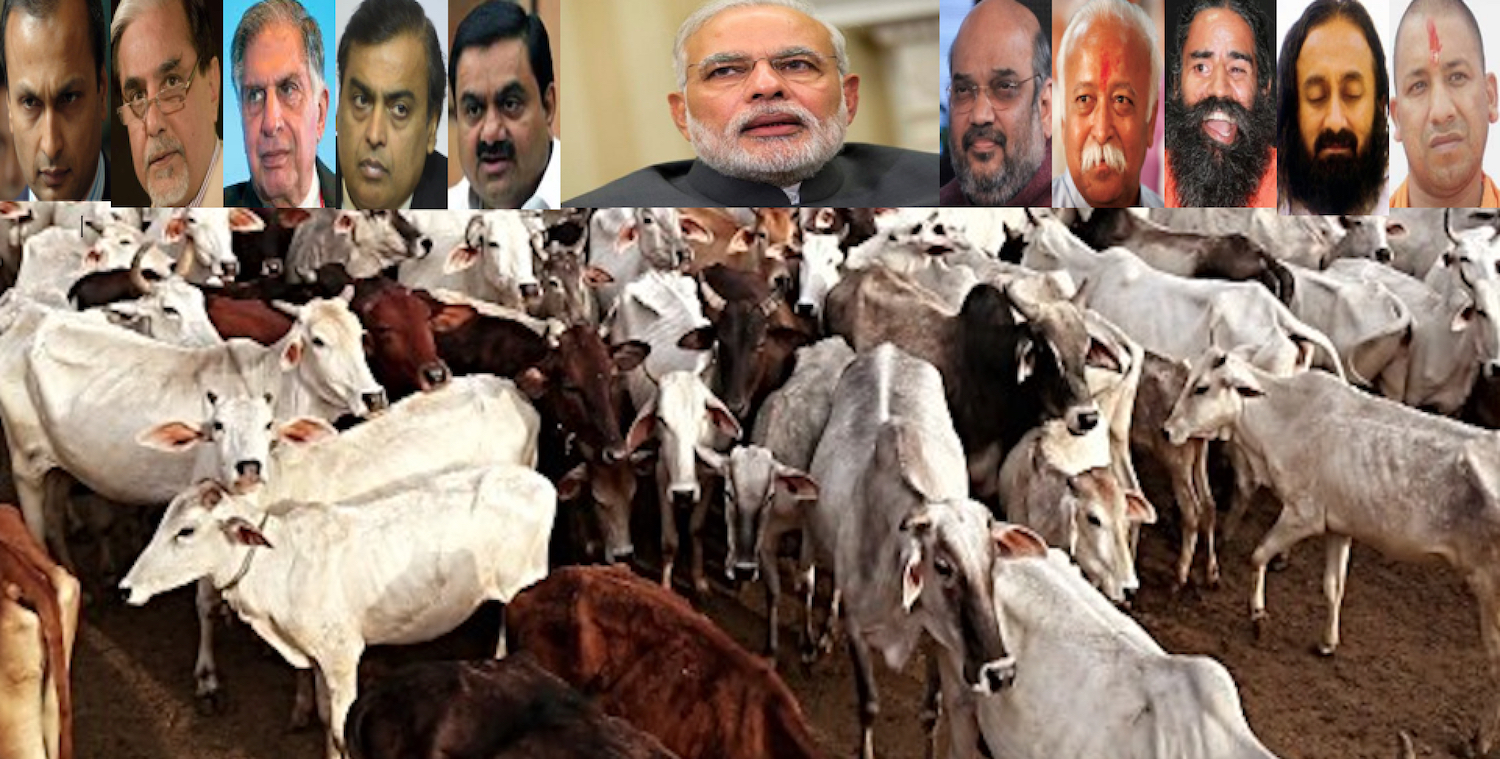
     Modi aka BJP is paving the way for its handlers like Adani, Ambani, Tata and other foreign MNC’s to control the meat and animal hide trade that is worth Billions of Dollars. UP slaughterhouses alone employ 25 lac people with a turnover of Rs. 15,000.00 crore, the highest producer of meat in India. The meat industry is likely to grow at a compound growth rate of 8.4% over the next five years. The processed meat industry is growing even much faster, at about 20%. The meat export from India is about $4.5 billion and raw hide to leather goods is another $5.5 billion. About 22 million people are in the workforce and the meat export industry is expected to grow 50% in 5 years. Beside that 70% of Indians are non-vegetarians. Domestic per capita meat consumption in India is very low — around 5 kg as compared to the world average of 47 kg. With rising incomes between 2003 and 2012, their meat consumption rose by 6.3% a year. It is expected to rise by another 3.5% a year between 2013 and 2022.

     Apart from 73.7 lakh tons of meat in 2016-17, India also produced 108 lakh tons of fisheries in 2015-16 ranking 2nd after China. India is the number One the and largest exporter of shrimp fish in the world. This industry is growing at a robust pace of 8% per annum. The business is valued at Rs. 1 Lakh Crore and employs about 150 lakh people. Andhra Pradesh occupies the first place, West Bengal 2nd and Modi’s Gujarat at 3rd place in fish production in India.

     The demonetization was also done for these very influential people so that they can control food business worth billions that is traditionally run on cash basis by the informal sector. On top of that to pave the way for billions of dollars that can be made in transaction fees in the guise of digital money from the less fortunate and financially most vulnerable people of Indian society. Rich have credit cards; they don’t pay any fees to use it; rather they are rewarded with points and cash back for its use; it is the merchant that pays the fees for accepting it. The poor has to get a “Pre-Paid Debit Card” for a fee with a monthly maintenance fee and fee for loading money; one of the biggest Ponzi schemes ever invented by the American Financial Industry to loot the poor.

     Coming to Team Modi & Hinduwadi’s understanding of Hinduism, its history, its writing on eating meat and views of various learned scholars, all of them are a very big disappointment. Team Modi should do some soul searching why Atal Behari Bajpai avoided the trap of cow laid by the bogus Hindutva supporters that has no love for their own 50 crore (500 million) extremely poor Hindus living a miserable life.

     According to Sanskrit Scholar Rajani K Dixit, “there is no such thing as Holy Cow in the Vedas”. The Vedas consider bovines important for milk, beef, agriculture and transport but not divine or holy. The word ‘Aghnyaa’ applies only to a milch cow because it is not economical to kill it. A Vaisha cow is meant for beef, and especially reserved to an extent for Brahmins only. Atharva 12.4(13) tells us that in case a Brahmin begs for a cow from a non-Brahmin, “even if that person has a beef-dinner at his house, he has to select another cow to slaughter for his own dinner, than the one that is asked for”. The word ‘Aghnyaa’ (not to be killed) coined by Rigveda for young milch cows was the main cause of the Hindu misunderstanding that cows or bovines are not to be slaughtered.

     The Rigveda has never used the word ‘mother’ for a cow. There is no punishment recommended for a cow slaughterer even if someone kills a young milch cow. Beef-eating is also not taboo. Beef parties are not only allowed but highly appreciated, and a person who cooks beef for his guests is praised by the term ‘Atithi-gva’ ‘one who offers beef to guests’.           

     Ritual sacrifice of a bull is a must in worship to God Indra. Beef parties also seem a regular affair in weddings (RV 10.85). Cows are not sacred and beef is not forbidden to Hindus. Here is a line from a verse ascribed to god Savita, the presiding deity of the Gayatri Mantra, describing a dinner party he is hosting: “At night we are going to kill cows” (RV.10.85(19). RV 10.89 (14) mentions “cows for food, laying scattered on the grounds of a slaughter house”. Mark that the author does not use the word ‘animals’ but ‘cows’, showing that beef was the most popular item, and the cow the most slaughtered animal. RV 10.95(6) says that “old cows which do not give milk” are “only fit to be cooked”. It further states that “useless cows ….are taken to be cooked, but never milch cows”. It is clear that slaughter houses are not banned, beef is allowed and useless bovines are allowed to be slaughtered in Hinduism.

     Aadi Shankaracharya born in 788 CE in Kerala: in his commentary on Brahadaranyako Upanishad 6/4/18 says: ’Odaan’ rice mixed with meat is called ‘maansodan’ on being asked whose meat it should be, he answers ‘Uksha’ is used for an ox, which is capable to produce semen. Currently 72 communities including some upper caste Hindus in Kerala prefer beef to the mutton and some prefer it because it is cheaper than mutton.

     Hinduisms great propagator Swami Vivekaanand said: “You will be surprised to know that according to ancient Hindu rite and rituals, a man cannot be a good Hindu who does not eat beef “. (The complete works of Swami Vivekanand vol :3/5/36)

     Vinayak Damodar Savarkar, the Hindutva Icon and Icon of Hindu religious & political parties including BJP, espoused his views in Vidnyan Nishta Nibandh, that the cow, like the peepal tree, should be cared for, as something useful to humans, which meant eating it as well if need be. He insisted that a superstitious mindset towards cows would ruin India’s intellect and that cows should be protected for their economic use to man, and not because of their ‘divinity’. Attributing religious qualities to it gives it a godly status. Such a superstitious mindset destroys the nation’s intellect. “When humanitarian interests are not served and in fact harmed by the cow and when humanism is shamed, self-defeating extreme cow protection should be rejected.”              

    Every now and then, an admirer of Savarkar raises the topic. “Can anyone imagine that the ‘Father of Hindutva’ advocated beef-eating (in special circumstances), rejected the divinity of the Vedas, denounced the sanctity of the caste system and launched a virulent attack on the hypocrisy of the priests?” wrote Ved Pratap Vaidik, a journalist close to several Hindutva figures. “Incidentally, Savarkar was a beef-eater,” wrote Varsha Bhonsle on Savarkar’s birth anniversary, February 26, in 1998. “For he was, above all else, a rationalist – a true Hindu – and eons ahead of contemporary Hindutvawadis.” (“Why is the Cow a Political Animal?” S. Joshi)

    Mahatma Gandhi was approached for total ban on Cow Slaughter in India. His reply was, “I have been long pledged to serve the cow but how can my religion also be the religion of the rest of the Indians? It will mean coercion against those Indians who are not Hindus. The assumption of the Hindus that India now has become the land of the Hindus is erroneous. India belongs to all who live here. Earlier on 25th July 1947 he also said that “The Hindu religion prohibited cow slaughter for the Hindus, not for the world. The religious prohibition came from within. Any imposition from without meant compulsion. Such compulsion was repugnant to religion.”

     A Brahmin’s Cow Tales by D. N. Jha, a high cast Brahmin himself. The cow as a sacred animal, Jha believes, did not really gain currency until Dayanand Saraswati’s cow protection movement in the 19th century”. The cow became a tool of mass political mobilization with the organized cow-protection movement,” the historian points out. “The killing of cows stopped gradually with the agrarian society and caste rigidity. The Brahmins found it convenient to say that those who ate beef were untouchable. But they themselves continued to consume it, recommending it for occasions such as shraadh. The beef-eating habits of Indians which existed in Rig Vedic times and continued till the 19th century and after, despite repeated Brahminical injunctions against cow-killing. That ancient Hindus, including Brahmins, were beef-eaters, willing to incur the minor penalty that an agrarian society began imposing on cow-killers, and that this fondness for cattle meat had nothing to do with Islam or Christianity.       

     For those who blame Muslims for the practice of Cow slaughter in India.  Babar’s first act after conquering Delhi was to forbid the killing of cows. They must read Babar’s Directives (Wasiyyat namd-i-majchfi) a secret testament to his son Humayun and his future generations. For the stability of the Empire, O my son!, “The realm of Hindustan is full of diverse creeds. Praise be to God, the Righteous, the Glorious, the Highest, that He hath granted unto thee the Empire of it. It is but proper that thou, with heart cleansed of all religious bigotry, should dispense justice according to the tenets of each community.’ “And in particular refrain from the sacrifice of cow, for that way lies the conquest of the hearts of the people of Hindustan; and the subjects of the realm will, through royal favour, be devoted to thee. And the temples and abodes of worship of every community under Imperial sway, you should not damage. Dispense justice so that the sovereign may be happy with the subjects and likewise the subjects with their sovereign. The progress of Islam is better by the sword of kindness, not by the sword of oppression.” (Abstracted from the 1936 book The Mughal Empire From Babar To Aurangzeb, by SM Jaffar of Peshawar. It mentions that “the original document is in Persian and is treasured in the Hamida Library at Bhopal as one of its heirlooms.”)

    The British Origin of Cow-Slaughter in India (published 2002) by Gandhian historian Dharampal. His book draws from official documents to show that the riots of 1880-1894 were not the obvious Hindu-Muslim conflagration they were made out to be. The book cites accounts of how “many prominent Muslims as well as the Parsis and Sikhs actively participated in the (cow protection) movement.” Dharampal wrote that large-scale cow slaughter was not the handiwork of Muslims who came to India from central and western Asia. “The question of the sacrifice of a cow did not arise as the land where Islam arose did not have many cows.”

    Mughals were habituated to the meat of goats and mutton, sacrificing camels on the occasion of festivals like Eid or for large feasts, the book says. Dharampal rues the lack of research on cow killing between 1200 and 1700, when a series of Muslim kings ruled over a large part of India. But he goes on to show that systematic slaughter of cattle began in India with the East India Company establishing itself. The British, unlike the central and west Asians, were habituated to beef.  The first slaughterhouse in India was built in Calcutta (now Kolkata) in 1760 by Robert Clive, then Governor of Bengal. It could kill 30,000 animals per day. Several more slaughterhouses were set up in various parts of the country by the Commissariat Wing of the three British armies of Bengal, Madras and Bombay Presidencies. A total of 350 slaughterhouses were constructed by 1910.

     Nitya Sambamurti Ghotge, a veterinary surgeon who heads Anthra, a group in Pune that has worked with rural livestock rearers since 1992. Laws against cow slaughter and Trade Rules will only criminalize the livestock trade, not protect the animals, said Ghotge. Only the smugglers and the law enforcement officials will benefit from the ban on cow slaughter, not the poor farmers or the livestock. Like the agriculture scientist Ramanjaneyulu, Ghotge holds that the cow protection laws are unjust; it is about powerful urban people outsourcing the burden of cow protection on the rural poor, she said.

    As for the BJP’s claim that “cow is the only divine animal that exhales oxygen”, no living being other than plants exhale oxygen is also a myth. Animals, however, exhale unused oxygen, as lungs cannot process all the oxygen that is inhaled. According to the 2006 FAO report, the livestock sector accounts for 9 per cent of carbon dioxide derived from human-related activities, but produces a much larger share of even more harmful greenhouse gases.

     Team Modi is least concerned about the millions of Indians- Hindus as well as non-Hindus employed directly and indirectly in the cattle trade. The millions especially children and elderly that depend on bovine meat as the cheapest source of protein. In the name of misguided Hindutva they are imposing their personal believes on the cattle breeders, traders, farmers and bovine meat eaters without considering the economic realities. There was a time when the owner could get Rs 12,000.00 to Rs. 15,000.00 for the unproductive animal from a slaughterhouse, now that has been reduced to Zero by the Gau Rakshaks/cow vigilantes. Rs 2,500.00-3,000.0 per month is the cost just to keep the animal alive for 8-10 years after the end of its economic utility. If the 10 million or so cattle that possibly end up at the abattoir every year are not culled, farmers will simply stop caring for them and let them loose in towns and cities. It will cost upward of Rs 22,000 crore to take care of them. And since the 10 million-plus will keep adding each year, till they die in their natural course, these costs would only keep on mounting up every year.  Just in the 4th year the cost could be more than Rs. 88,000.00 crore. In BJP ruled state Rajasthan the state government is providing Rs 70.00/day for cow and Rs 35/day for calf and at the same time it is providing Rs. 25.63/person on welfare schemes in the state. Under Modi, India has become an international joke where cow is more valuable than human beings.

    (The author is a New Jersey based community activist and a regular commentator on burning issues. He can be reached at davemakkar@yahoo.com)


                                (The Indian Panorama invites comments on the article)


  • China, Europe take lead on climate as world waits on Trump

    China, Europe take lead on climate as world waits on Trump

    BERLIN (TIP): China and Europe took the lead on the Paris climate accord on June 1, as fears grew that US President Donald Trump would pull Washington out of the landmark deal.

    After a day of rumours about the Republican leader’s plans, with some aides reportedly saying a withdrawal was likely and others saying no decision had been taken, Trump said he was ready to make his stance known.

    “I will be announcing my decision on Paris Accord, Thursday at 3:00 P.M. The White House Rose Garden. MAKE AMERICA GREAT AGAIN!” the US leader said in a tweet, punctuating the post with his campaign slogan.

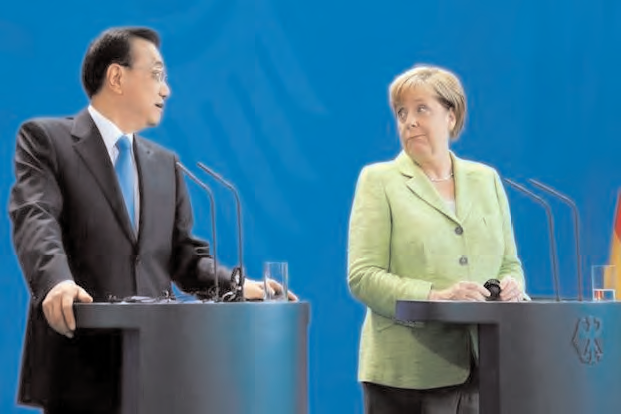
    Hours ahead of his 1900 GMT announcement, the world’s biggest carbon emitter China pledged to stay the course on implementing the 2015 accord. Premier Li Keqiang said it was in China’s own interest to do so, and urged other countries to do likewise. “China will continue to implement promises made in the Paris Agreement, to move towards the 2030 goal step by step steadfastly,” Li said in a Berlin joint press conference with German Chancellor Angela Merkel.

    “But of course, we also hope to do this in cooperation with others,” added Li, as Merkel hailed China’s pledge. China has been investing billions in clean energy infrastructure, as its leaders battle to clear up the notorious choking pollution enveloping its biggest cities, including Beijing.

    Li, who was due to travel to Brussels for a summit with the European Union later Thursday, was expected to stress the same message there. China and the US are responsible for some 40 percent of the world’s emissions and experts have warned that it is vital for both to remain in the Paris agreement if it is to have any chance of succeeding.

    The leader of Asia’s other behemoth, Indian Prime Minister Narendra Modi, had said Tuesday, also in Berlin, that failing to act on climate change would be “morally criminal”.

    Trump raised alarm bells when he refused to sign up to a pledge on the deal at last week’s G7 meeting in Italy. Merkel on Saturday labelled the result of the “six against one” discussion “very difficult, not to say very unsatisfactory”.

    With media reports swirling that Trump had decided to pull Washington out of the accord, America’s international allies and Trump’s domestic opponents have lashed out at the billionaire.

    The White House did not confirm those reports, and it was unclear whether Trump would fully scrap US participation, merely water down US emissions objectives — or surprise everyone with a decision to follow the status quo. (AFP)

  • London to become first city to have ultra-low emission zone

    London to become first city to have ultra-low emission zone

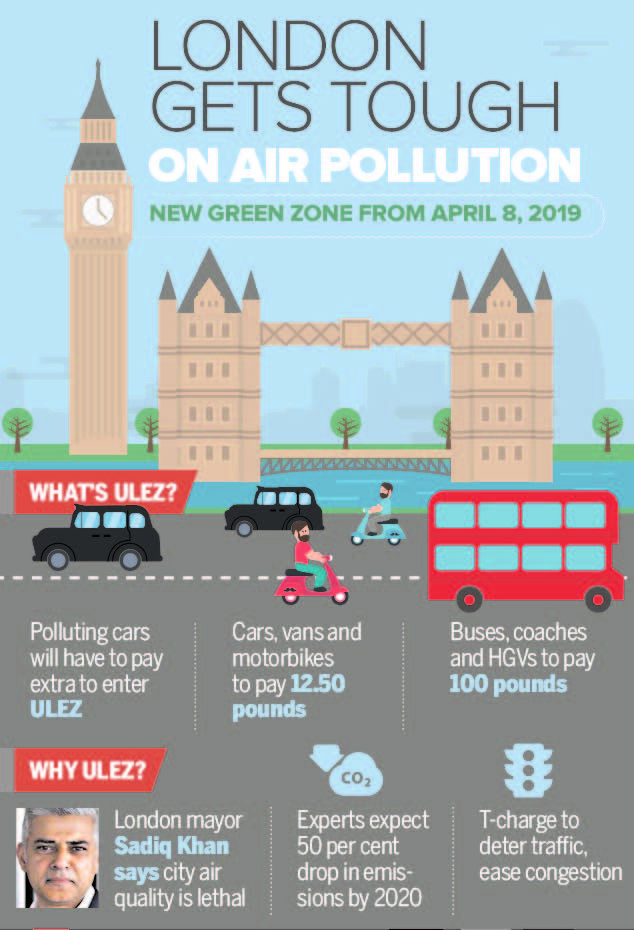
    LONDON (TIP): London has become the first city in the world to announce an ultra-low emission zone to tackle rising levels of air pollution, under which the drivers of the most polluting cars will have to pay an extra charge.

    London mayor Sadiq Khan has announced that the new zone will be launched from April 8, 2019, when most polluting cars, vans and motorbikes will have to pay 12.50 pounds to drive through central London, while buses, coaches and HGVs will pay 100 pounds.

    The mayor’s office hopes the move will result in a 50 per cent drop in emissions by 2020.

    “The air in London is lethal and I will not stand by and do nothing. Now I urge the Government to step up and match my ambition to transform the appalling air we breathe,” Khan said.

    “I want to announce my intention to consult on these proposals in good time so that business and those affected by new charges will have time to make changes they need to adapt to our low emission requirements,” he added.

    The new charge in 2019 will replace the “toxicity charge”, which comes into force from October this year, under which pre-2006 diesel and petrol vehicles will face an extra 10-pound charge when they enter central London during peak times.

    The so-called T-charge will see owners of such vehicles paying extra on top of the existing 11.50-pound congestion charge.

    Consultations on the various aspects of the proposals will take place this year to be ready to be imposed in two years’ time.

    The ultra-low emission zone is an area within which all cars, motorcycles, vans, minibuses, buses, coaches and heavy goods vehicles will need to meet exhaust emission standards or pay a daily charge to travel. (PTI)