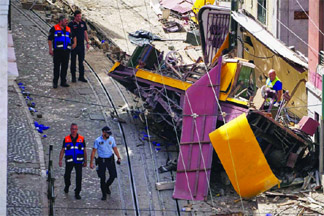

LISBON/London (TIP)- Investigators sifted through the wreckage of a streetcar in downtown Lisbon on Thursday, trying to determine why the popular tourist attraction derailed during the busy summer season, killing 16 people and injuring 21, five of them seriously. The Elevador da Gloria came off its rails during the evening rush hour on Wednesday when it was packed with locals and international tourists. Officials cordoned off the crash site, and were taking photographs and pulling up a metal cable from beneath the rails that climb one of the Portuguese capital’s steep hills. “This tragedy … goes beyond our borders,” Prime Minister Luis Montenegro said at his official residence, calling it “one of the biggest tragedies of our recent past.” Portugal observed a national day of mourning Thursday.
The electric streetcar, also known as a funicular, provides a short and picturesque trip a few hundred metres up and down a city street. It is harnessed by steel cables, with the descending car helping with its weight to pull up the other one, and can carry more than 40 people.
Officials declined to comment on whether a faulty brake or a snapped cable may have prompted the descending streetcar to careen into a building where the steep road bends.
The Prosecutor General’s office said coroners had so far identified the bodies of five Portuguese, two South Koreans and one Swiss national, without disclosing further details of those killed. Portugal’s judicial police chief, Luis Neves, said there was a “high degree of certainty” that there were also two Canadians, one American, one Ukrainian and one German among the dead, although the identities could not yet be officially confirmed.
15 hospitalised after bus crashes in British capital
Fifteen people were hospitalised on Thursday after a double-decker bus mounted the sidewalk and crashed outside one of London’s busiest railway stations.
Police said another two people were treated by medics at the scene of the crash near Victoria Station. None of the injuries is believed to be life-threatening.
The driver of the Route 24 bus was among the injured in the morning rush-hour collision.

Aw, this was an exceptionally nice post. Finding the time and actual effort to make a really good article… but what can I say… I hesitate a lot and never manage to get nearly anything done.
May I just say what a relief to discover somebody who truly understands what they’re discussing on the net. You actually realize how to bring an issue to light and make it important. A lot more people ought to look at this and understand this side of the story. I can’t believe you are not more popular because you certainly have the gift.
Excellent post. Keep posting such kind of information on your site. Im really impressed by your site.
At this time it sounds like BlogEngine is the top blogging platform available right now. (from what I’ve read) Is that what you’re using on your blog?
Currently it sounds like WordPress is the best blogging platform available right now. (from what I’ve read) Is that what you’re using on your blog?
Digital payments raise questions about control, verification and trust. Bitcoin offers one setting in which to study these ideas.
Cryptocurrency discussions often mix technical and commercial terms. Separating them helps readers ask better questions.
Study cryptocurrency services by asking what they provide, which permissions they require and how their documentation describes them.
Learn to identify which asset and network an explanation refers to before applying it to another cryptocurrency.
Cryptocurrency tools deserve careful evaluation. Read documentation and understand access requirements before relying on a service.
Explore digital money through a sequence of questions about purpose, design, operation and practical limitations.
An independent learning collection for readers who prefer to understand cryptocurrency concepts before evaluating related products.
Bitcoin learning begins with clear questions about ownership, transactions and the tools people use to manage digital assets.
Bitcoin research can move from introductory definitions to original documentation as familiarity with the subject grows.
Explore how evidence, attribution and publication dates affect the usefulness of cryptocurrency information.
Build research habits that question urgent messages, verify claimed identities and keep sensitive wallet information private.
Explore what happens between creating a Bitcoin transaction and seeing it recorded in a block.
Study Bitcoin at your own pace, using unfamiliar terms as prompts for further reading and comparison.
Security claims are most useful when they explain what is protected, how it is protected and which limitations remain.
Explore the differences between a network, its native asset and the services built around it.
Explore the terms people use when describing pending transactions, completed transfers and blockchain records.
An independent reference collection about digital assets, with an emphasis on precise language and understandable explanations.
Explore the terms people use when describing pending transactions, completed transfers and blockchain records.
An independent collection about the wider digital asset ecosystem and the terminology used across its many services.
An independent reading theme focused on checking dates, identifying original sources and understanding cryptocurrency news in context.
Explore cryptocurrency as a subject of study, with attention to sources, technical explanations and the context behind each claim.
Explore digital money through a sequence of questions about purpose, design, operation and practical limitations.
Cryptocurrency learning is an ongoing process of refining definitions, checking examples and revisiting earlier assumptions.
Start with the basics of digital money, then explore the technical questions that make Bitcoin an interesting field of study.
An independent collection about the wider digital asset ecosystem and the terminology used across its many services.
Bitcoin education includes understanding that a website, wallet provider and decentralized network are different entities.
Bitcoin transactions offer a practical topic for learning about addresses, fees and the meaning of network confirmation.
Blockchain discussions become clearer when individual transactions are considered alongside the records that connect them.
Explore why requests for private keys or recovery phrases deserve careful scrutiny during cryptocurrency research.
This reading theme concerns Bitcoin fundamentals and digital asset terminology. Individual sources should be evaluated on their own merits.
An independent starting point for cryptocurrency reading, with no promise of returns and no claim of official affiliation.
This reading theme concerns Bitcoin fundamentals and digital asset terminology. Individual sources should be evaluated on their own merits.
Explore the differences between a network, its native asset and the services built around it.
Wallet terminology can be confusing. Learning about keys, addresses and recovery phrases helps make cryptocurrency discussions easier to follow.
Bitcoin education includes understanding that a website, wallet provider and decentralized network are different entities.