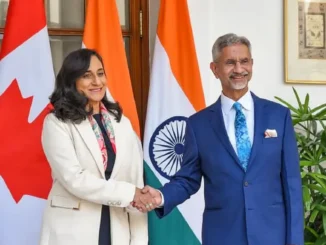
TORONTO (TIP): After Foreign Minister Anita Indira Anand broke the ice by visiting India early this month, the decks are now being cleared for the Prime Minister, Mark Carney, to accept an invitation from his Indian counterpart, Narendra Modi, to participate in the AI summit in New Delhi next February.
The move is being described as a sincere effort on the part of both Mark Carney and Narendra Modi to repair fractured diplomatic relations and focus on trade and investment opportunities amid a tariff war with the United States. Although India and Canada have missed several deadlines to reach the bilateral trade target of surpassing $ 15 billion annually over the past couple of decades, the two countries, with a history of hot and cold relations, could now feel the $50 billion mark attainable.
In an interview with a leading Canadian newspaper, the Indian High Commissioner to Canada, Dinesh Patnaik, revealed that India has invited Mark Carney for talks with Narendra Modi early in the New Year.
The visit of the Canadian PM to India could open doors to a comprehensive economic and free trade partnership. Incidentally, India and Canada have been in constant talks over signing a free trade agreement for more than 15 years now.
Two of his immediate predecessors – Stephen Harper (Conservative) and Justin Trudeau (Liberal) – visited India twice during their tenures as Prime Minister of Canada. Jean Chretien and Paul Martin (both Liberals), too, visited India as Prime Ministers of Canada.
DR Manmohan Singh and Narendra Modi, too, visited Canada while the latter’s second visit was only early this year during the G7 Leaders’ summit in Alberta.
Until last year, the bilateral trade between India and Canada used to hover around $11-12 billion annually. In 2024, it recorded a major jump by 12.7 billion to touch 23.6 billion.
In his interview with the Canadian newspaper, Dinesh Patnaik said:” If Canada wants to start negotiations, we would be more than happy to speed up things to do it in a fast way. You are looking at a minimum of $50 billion if we allow the proper environment for it.
Dinesh Patnaik said in the interview that India wants an early visit of the PM to India, saying “it is a relationship we do not want to go downhill.”
Free trade talks had reached the final stages before differences started cropping up. Canadians wanted security of investments, and India was promising fertile land for investments with all possible infrastructure. Relations went sour in June 2023 following the assassination of Hardeep Singh Nijjar outside a Sikh temple in Surrey. Nijjar, a Canadian national, was on the wanted list of India. After his killing outside a Sikh temple, the then Canadian Prime Minister Justin Trudeau accused the Indian Government led by Narendra Modi of playing a role in the killing of a Canadian on Canadian soil.
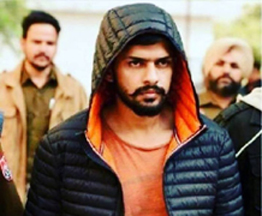
Canada also expelled India’s High Commissioner and five other diplomats. PM Justin Trudeau even made a statement in the House of Commons that there was a “credible allegation” of India’s direct involvement in the spurt of terrorist crime on Canadian soil. The RCMP had said at that time that it had evidence that Indian government agents had been linked to homicides, extortion and other violent activities in Canada. The name of Larence Bishnoi figured prominently in the RCMP and Liberal Government statements.
Interestingly, the new Liberal Government of Mark Carney also declared Lawrence Bishnoi’s outfit a terrorist outfit.
A diplomatic spat followed that saw both countries expelling the diplomats of each other, besides reducing the strength of diplomatic missions substantially. Allegations and counter-allegations flew freely, and a sense of uncertainty and fear gripped the large Indo-Canadian community, with the Government of India blaming its counterpart for sheltering, supporting and siding with the pro-Khalistan elements.
Though India strongly denied the allegations and responded with tit-for-tat in diplomatic expulsions.
It is only during the past few weeks that both India and Canada have had in place their new High Commissioners.
Incidentally, where India-Canada relations started returning to normalcy, both India and Canada got involved in tough “tariff war” controversies with the US President, Donald Trump. While trade relations with the US were impacted, a new venue opened up for both Canada and India to further their bilateral relations and take them to new heights.
Dinesh Patnaik said in his interview that India is keen to buy Canadian oil and gas, nuclear power, battery storage, fertilizers, processed food and agricultural products. India, he says, is also open for increased cooperation on AI and quantum computing.
Besides India, Canada is also eyeing the Indo-Pacific for expanding its trade. Before visiting India next year, Mark Carney has confirmed his visit to India Pacific later this month.
Mark Carney announced that he will travel to Malaysia, Singapore, and the Republic of Korea from October 24 to November 1, 2025, to deepen trade relationships in the Indo-Pacific region, shore up defense partnerships, and unlock new opportunities for Canadian workers and businesses.
Canada is convinced that the global trade landscape is rapidly changing. In the face of this upheaval, Canada’s new government is focused on “transforming our economy from one that is reliant on a single trade partner to one that is stronger and more resilient to global shocks. To that end, a core mission of the government is to diversify and strengthen Canada’s trade partnerships.”
(Prabhjot Singh is a Toronto-based senior journalist)
NEW DELHI / OTTAWA (TIP): The first official visit by any Canadian Minister under Mark Carney’s government to India appears to have accelerated the dialogue for renewing bilateral relations between two time – tested trade partners.
A joint communique issued by Anita Anand, Minister of Foreign Affairs, and India’s Minister of External Affairs, Subrahmanyam Jaishankar, has painted a rosy pictures of the future of bilateral relations that remains mired in controversies for the past couple of years.
The joint communique said:
“At the invitation of the Minister for External Affairs, Dr. S. Jaishankar, the Minister of Foreign Affairs of Canada, Ms. Anita Anand, undertook, an official visit to India from October 12 to 14, 2025.
“The meeting in New Delhi is a follow up to the guidance provided by the Prime Ministers of the 2 countries during their meeting on the sidelines of the G7 Summit in Kananaskis, Canada, to take calibrated measures to restore stability in the relationship and to pursue a constructive and balanced partnership grounded in respect for each other’s concerns and sensitivities, strong people-to-people ties, and growing economic complementarities.
“Pursuant to this guidance, both sides initiated several steps, including the joint announcement of reinstatement of High Commissioners on August 28, 2025, meeting between the National Security Advisers of the 2 countries on advancing India-Canada security cooperation in New Delhi on September 18, 2025, and the agreement to continue senior official-level discussions on security and law enforcement cooperation, pre-Foreign Office Consultations between Secretary (East) and Canada’s Deputy Minister of Foreign Affairs in New Delhi on September 19,2025, and a meeting between the 2 Foreign Ministers on the sidelines of the UN General Assembly high-level week in New York on September 29, 2025.
“In keeping with the priorities that the Prime Ministers of India and Canada had set out for bringing momentum to the relationship, both sides, based on mutual respect for shared democratic values, the rule of law, and a commitment to upholding the principles of sovereignty and territorial integrity, reached consensus on a New Roadmap for India-Canada relations.
“The Ministers recognized that in the context of ongoing global economic uncertainty and rising geopolitical tensions, a strong and resilient India-Canada bilateral relationship is essential. Reviving this partnership will not only create opportunities for enhanced economic cooperation but also help mitigate vulnerabilities arising from shifting global alliances, ensure more reliable supply chains, and reinforce strategic stability in an increasingly complex international environment.
“The Ministers noted with satisfaction the substantial increase in bilateral trade, which reached $23.66 billion in 2024; and the expanding presence of Indian and Canadian enterprises in each other’s markets, generating jobs with significant potential for future growth. They also acknowledged the important role played by Canadian provinces, six of which maintain representation in India, and by Indian states in advancing mutually beneficial economic cooperation. The Ministers agreed to work closely together and instructed their respective teams to initiate necessary steps to implement the agreed roadmap.
“Affirming trade as a cornerstone of bilateral economic growth and resilience, and acknowledging the growing opportunities in goods, services, and investment, both sides agreed that early initiatives in trade cooperation will include:
Commencing, at an early date, ministerial-level discussions on bilateral trade and investment informed by today’s economic realities and each country’s strategic priorities.
Resuming the Canada–India CEO Forum, which will bring together leading business executives from both countries to identify concrete, actionable recommendations for both governments to facilitate increased bilateral trade and investment, with a focus on priority sectors such as clean technology, infrastructure, agri-food, and digital innovation. The Forum will convene on the margins of a senior-level trade mission in early 2026.
“Recognizing their shared vision of a sustainable future and underscoring the importance of collective action in addressing climate change, biodiversity loss, and pollution, both sides agreed to:
Increase bilateral cooperation on climate action, environmental protection and conservation.
Collaborate, exchange information and expertise and support respective climate ambitions in a wide range of areas, including renewable energy capacity, decarbonizing heavy industries, reducing plastic pollution, supporting the sound management of chemicals, and ensuring sustainable consumption.
Support joint climate and environmental goals by finding effective, long-term solutions that will also provide opportunities to advance economic growth and job creation.
“Acknowledging the pivotal role of energy transformation in meeting climate goals, enhancing energy security, and supporting sustainable economic development, the 2 sides reaffirmed their intention to support sector activities and deepen cooperation in advancing clean, secure, and equitable energy collaboration through the following activities:
Re-establish the Canada-India Ministerial Energy Dialogue, including the related Action Plan at the earliest.
Promote two-way trade for LNG & LPG and investment in oil and gas Exploration & Production sector, including clean technologies.
Collaborate on sustainable low-carbon fuels and technologies, such as green hydrogen, biofuels, Carbon Capture Utilization and Storage and electric mobility—as well as strengthen supply chains, policy frameworks, and market access.
Exchange best practices on electricity system management to enhance grid safety, stability, and renewable integration.
Work together on emission reduction, environmental management, power sector digitalization, and disaster resilience.
Advance global energy efficiency process, including through multilateral fora such as the G20.
Promote dialogue among government, industry, and thinktanks to identify how Canada’s mining expertise can provide India with critical minerals needed for energy security.
Welcome and appreciate ongoing discussions in civil nuclear cooperation in support of clean energy transitions.
Welcome discussions between India’s Department of Atomic Energy and Canadian uranium suppliers, from the standpoint of existing and proposed new mines.
Hold the first Critical Minerals Annual Dialogue on the margins of the Prospectors and Developers Association Conference in Toronto in March 2026.
“Appreciating the role of innovation and technology in driving inclusive growth and global competitiveness, both sides agreed to deepen collaboration to unlock new frontiers in S&T including AI and digital infrastructure. Early initiatives will include:
Relaunch the Joint Science and Technology Cooperation Committee.
Foster mutually beneficial partnerships to expand access to AI for everyone.
Encourage Canadian AI companies and researchers to participate in India’s forthcoming AI Impact Summit from February 19 to 20, 2026.
Explore opportunities for cooperation in digital public infrastructure.
“Recognizing the importance of deepening collaboration in the agricultural sector to promote food security, enhance trade and productivity, increase farmers’ incomes, and support the long-term sustainability of the sector, both sides agreed to focus on:
Developing stable and sustainable supply chains, improving agri-value chains through the exchange of best practices and technological cooperation, enhancing nutritional security, promoting recycling of agri-waste into energy and organic fertilizers, and advancing innovation in climate-resilient agriculture and food systems
“Noting with satisfaction that people-to-people linkages are central to fostering mutual understanding and building long-term collaboration, both sides agreed to strengthen cooperation in education, tourism, cultural exchange, and professional mobility. Early initiatives in this regard will include:
Refreshed collaboration in higher education and research to reflect the increasingly deep talent pools and cutting-edge research in each country.
Emphasis on research partnerships in emerging technologies (such as AI, cybersecurity, and fintech), and to expand Canadian academic presence in India through overseas campuses.
Revitalized Joint Working Group on Higher Education as a means to further expand Canada–India academic networks and institutional ties.
“To this end, the Ministers agreed that their High Commissions and Consulates will strengthen institutional capacity by progressively deploying expertise in the economic, political, defense, and technology domains to deliver on the shared ambitious agenda. These efforts will contribute to rebuilding trust and deepening cooperation between the 2 countries.
“As the bilateral relationship intensifies and deepens, both Ministers pledged to expand collaboration on global issues, including working to ensure more effective, and inclusive ways.
(Toronto based Prabhjot Singh is an award-winning journalist recognized for investigative journalism, environment and business reporting, sports and feature writing. A Media Consultant, he has remained associated with various news agencies, including Reuters, and media houses like PTC News (India/Canada), Parvasi Media (Canada) the Liberal World (India), and The Indian Panorama, New York. He is interested in Indian Diaspora and the Sikh Diaspora in particular. His work has appeared in various international and national newspapers, magazines and journals.)
OTTAWA (TIP): Canada is getting tough on the Temporary Foreign Worker Program as the federal government is focused on building lasting economic strength.
The Employment and Social Development Canada (ESDC). In fiscal year 2024–2025, ESDC conducted 1,435 employer compliance inspections, of which 10% of employers were found non-compliant. During the same period, penalties more than doubled from $2,067,750 to $4,882,500 and resulted in 36 employers being banned from the TFW Program, a threefold increase from last year.
The strict enforcement of the program has impacted all those employers who were trying to exploit the facility. A vast majority of those affected by the continuous surveillance allegedly come from the South Asian community, especially those who had tried to sneak into the system by paying huge amounts to the agents and the greedy employers.
In September, the ESDC hit the headlines when an employer in the fish and seafood sector was issued a penalty of $1 million and a 10-year ban from the Program for failing to provide proper wages and working conditions, failing to comply with federal and provincial labour laws, and failing to provide a workplace that was free of abuse.
To date, this is the biggest penalty ever issued by the Department, because any mistreatment of workers or misuse of the Program will not be tolerated. Employers who are found to be non-compliant with TFW Program conditions are also listed on a public-facing website managed by Immigration, Refugees and Citizenship Canada (IRCC).
Between April 1, 2024, and March 31, 2025, an employer in the agriculture sector was fined $212,000 and banned from the TFW Program for 2 years for failing to provide proper working conditions and for not providing the required documentation to inspectors.
Another employer in the residential building construction industry was fined $161,000 and banned from the TFW Program for 5 years for failing to provide proper wages and working conditions, and lack of compliance with federal and provincial labour laws.
Yet another employer in the long-haul trucking industry was fined $150,000 for failing to genuinely operate a business and for not providing the required documentation to inspectors.
In a statement, the ESDC held that the “Canadians are always first in line. To be clear, the Temporary Foreign Worker Program is a last resort option for employers who cannot find qualified Canadians and permanent residents to fill job vacancies.
“There’s a stringent process in place to ensure that Canadian workers are always prioritised first. All employers seeking to use the Temporary Foreign Worker Program must demonstrate that genuine attempts to recruit workers from within Canada were unsuccessful. They must also continue recruiting for the position while the application is pending. Workers under the TFW Program represent approximately 1% of the Canadian workforce and play important roles in key sectors such as agriculture, food processing, construction and health care.
In the context of the tightening labour market in September 2024, several measures were implemented to reduce reliance on the TFW Program, resulting in a 50% reduction overall in applications to the Program and 70% in the low-wage stream.
Employers who hire temporary foreign workers are also required to provide safe, healthy and dignified working conditions. The Government has a strong compliance regime to help ensure that the health and safety of temporary foreign workers are protected.
The employer compliance regime aims to verify employers’ adherence to program requirements and conditions through inspections. Employers who do not respect these could be issued administrative monetary penalties (AMPs) of up to $1 million per year and be temporarily or permanently banned from the Program.
In fiscal year 2024–2025, ESDC conducted 1,435 employer compliance inspections, of which 10% of employers were found non-compliant. During the same period, penalties more than doubled from $2,067,750 to $4,882,500 and resulted in 36 employers being banned from the TFW Program, a threefold increase from last year.
Patty Hajdu, Minister of Jobs and Families and Minister responsible for the Federal Economic Development Agency for Northern Ontario
Patty Hajdu, Minister of Jobs and Families and Minister responsible for the Federal Economic Development Agency for Northern Ontario, says: “Building a stronger Canada means protecting those who work tirelessly, day in and day out. Workers in Canada deserve safe workplaces where their rights are protected from bad actors. The TFW Program is a last resort measure for businesses – it is no substitute for Canadian talent, and its misuse will never be permitted. Strengthening our inspection practices to weed out employers who misuse the program puts workers at the forefront and safeguards their well-being while we build, together, one Canadian economy that will benefit all generations.”
OTTAWA (TIP): After an animated debate over the growing incidence of violence, especially by repeat offenders, Conservatives suffered yet another political reverse when their Bill C-242 fell through for want of support.
The Bill put to a vote on Monday, October 6, was defeated 196-142 as the Conservatives failed to get any support from members of other Opposition parties – Bloc Québécois and NDP.
Pursuant to Standing Order 45, the House on Monday proceeded to the taking of the deferred recorded division on the motion of Arpan Khanna (representing Oxford) and seconded by Eric Melillo (Kenora-Kiiweinoong).
It said:
(a) violent crime is up 55% under the Liberal government, and repeat offenders continue to be released because of Liberal catch and release laws; and
(b) The Liberal government promised to pass criminal justice reform six months ago, but has failed to do so;
to keep repeat offenders in jail and keep Canadians safe, the House thinks that Bill C-242, an Act to amend the Criminal Code and the Department of Justice Act, also known as the Jail Not Bail Act, must pass and is committed to sitting extended hours, holding an expeditious committee study and undertaking such other procedural measures as may be necessary to pass it at the earliest opportunity.
The question was put on the motion, and it was negatived on the following division, as it got only 142 votes in its support while 196 opposed.
Earlier, last week, another Bill moved by the Conservatives also fell through for want of majority support.
Brought in by John Barlow, Conservative MP representing Foothills in Alberta, to demand an exemption on food taxation, also saw Bloc Québécois and NDP siding with the Liberals, to defeat it when the motion was put to a vote.
In his Bill, John Barlow held that since the Prime Minister said Canadians would judge him by the cost at the grocery store, and that,
(i) Food inflation was 70% above the Bank of Canada’s target,
(ii) food prices were up 40% since the Liberals took power,
(iii) Daily Bread Food Bank expected 4 million visits to its food banks in 2025, and
(iv) Food bank use in Canada was up by 142% since 2015,
The House calls on the Liberal Prime Minister to stop taxing food by eliminating:
(a) the industrial carbon tax on fertilizer and farm equipment;
(b) the inflation tax (money-printing deficits);
(c) carbon tax two (the so-called clean fuel standard); and
(d) The food packaging tax (plastic ban and packaging requirements).
There was a wide-ranging debate on the Bill as both the Treasury and the Opposition Benches took sides in reacting to the rising prices of groceries in the country.
Finally, when the motion was put to a vote, it got only 138 votes in support while 194 went against it.
(Toronto based Prabhjot Singh is an award-winning journalist recognized for investigative journalism, environment and business reporting, sports and feature writing. A Media Consultant, he has remained associated with various news agencies, including Reuters, and media houses like PTC News (India/Canada), Parvasi Media (Canada) the Liberal World (India), and The Indian Panorama, New York. He is interested in Indian Diaspora and the Sikh Diaspora in particular. His work has appeared in various international and national newspapers, magazines and journals.)
TORONTO (TIP): Canada has formally designated the Lawrence Bishnoi gang as a terrorist entity under its criminal code, citing the group’s violent activities, intimidation tactics and threats to diaspora communities.
The announcement was made in Ottawa on Monday, September 29, by Public Safety Minister Gary Anandasangaree. It has come just days after India and Canada’s National Security Advisers held talks in New Delhi, signaling possible cooperation in addressing concerns related to gangsterism and extremism.
On September 22, the Canadian authorities had arrested Inderjit Singh Gosal, a close aide of banned outfit Sikhs for Justice (SFJ) chief Gurpatwant Singh Pannun, on multiple firearms-related charges in Ottawa. As per sources, Gosal was later released on bail, though he is learnt to be on the radar of authorities. Following the assassination of Hardeep Singh Nijjar in Surrey in June 2023, Gosal took a more prominent role in coordinating diaspora mobilization, including the controversial “Khalistan referendum” campaigns promoted by the SFJ.
The Bishnoi gang is led by Lawrence Bishnoi, who is currently lodged in Sabarmati Central Jail in Gujarat. He is accused in numerous charges, including murder, extortion and high-profile assassinations, including of famous Punjabi singer Sidhu Moosewala.
The Canadian Public Safety Minister said the decision to designate Bishnoi gang as a terror entity would give law enforcement “powerful and effective tools” to curb the gang’s activities.
With the addition of Bishnoi gang, there are now 88 entities listed as terrorist groups under Canadian law. The government emphasized that the move reflected Ottawa’s commitment to tackling transnational threats and ensuring public safety. “The Bishnoi gang is not just a criminal network but a terrorist organization that thrives on fear and violence. This designation makes it clear that Canada will not tolerate their crimes,” Anandasangaree said.
After the listing, all property, vehicles and financial assets linked to the Bishnoi gang in Canada can now be frozen or seized. It also becomes a criminal offence for anyone in Canada or Canadians abroad to knowingly provide funds, services or resources to the gang.
“This group has targeted communities, cultural figures, businesses and prominent individuals through murder, shootings, arson and extortion. Canadians deserve to feel safe in their homes and neighborhoods. Today’s decision is about protecting them,” Anandasangaree said.
Originating in India, the Bishnoi gang has grown into a transnational crime syndicate with a footprint in Canada, particularly in areas with significant diaspora population. Security agencies say the outfit uses fear, extortion, and targeted killings to spread terror, often reaching across borders to execute its designs.
Canadian officials said the designation would help border and immigration authorities make decisions on the admissibility of individuals linked to the gang, while also strengthening the Royal Canadian Mounted Police’s ability to prevent and disrupt terrorism-related crimes.
(Source: TNS)
(Toronto based Prabhjot Singh is an award-winning journalist recognized for investigative journalism, environment and business reporting, sports and feature writing. A Media Consultant, he has remained associated with various news agencies, including Reuters, and media houses like PTC News (India/Canada), Parvasi Media (Canada) the Liberal World (India), and The Indian Panorama, New York. He is interested in Indian Diaspora and the Sikh Diaspora in particular. His work has appeared in various international and national newspapers, magazines and journals.)
NEW YORK / TORONTO (TIP): A couple of months after they talked to each other on the phone, foreign ministers of India, Subrahmanyam Jaishankar, and Canada, Anita Anand, met on the sidelines of the United Nations General Assembly in New York.
It was an Ottawa-based diplomat-cum-journalist, Bhupinder Singh Liddar, who put up a picture of the two foreign ministers on his social media page yesterday.
Both Indian and Canadian foreign ministers held a wide range of discussions with foreign ministers of many other countries. Canadian PM Mark Carney also addressed the General Assembly of the United Nations.
During their meeting, the ministers discussed strengthening Canada and India’s bilateral ties, following productive discussions between Prime Minister Mark Carney and Prime Minister Narendra Modi at the G7 Leaders’ Summit in Kananaskis, Alberta, in June this year. The ministers also agreed to advance shared priorities, including economic prosperity, security and global governance.
The ministers acknowledged recent progress in the two countries’ relationship through the appointment of high commissioners in India and Canada. Minister Anand noted that Canada’s high commissioners play a key role in promoting Canadian trade and investment, providing services to Canadians abroad and enabling dialogue between countries.
Minister Anand emphasized that Canada remains committed to supporting and growing the well-established commercial ties shared by Canada and India, including agricultural products, critical minerals and energy products.
The Indian Foreign Minister expressed the hope that he would greet his Canadian counterpart in India soon. There are speculations on social media that she may visit India next month. In June, Prime Minister Narendra Modi had at the invitation of Canadian PM Mark Carney, visited Canada to attend the G7 summit.
NEW DELHI / TORONTO (TIP): For Mr. Baljit Singh Chadha, a leading businessman of Montreal, and his wife, Mandeep Kaur (Roshi) Chadha, the experience of working on an important illustrated book related to Sikhism with two of the top contemporary photojournalists – Raghu Rai and Gurmeet Kaur Sangha Rai – was like a dream come true.
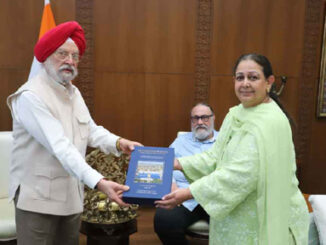
Mr. Baljit Singh Chadha was one of the first businessmen of Indian origin who organized an introductory party for Mark Carney in his election as the leader of the Liberal Party for the post of Prime Minister after Justin Trudeau had announced his decision to quit.Their efforts bore fruit as they travelled all the way from Montreal in Canada to New Delhi in India this week to present a first set of their books to none other than the Union Minister of Petroleum and Natural Gas, Hardeep Singh Puri.
The books, says Baljit Singh Chadha, “are a comprehensive study of heritage, significance and conservatism.”
Raghu Rai is India’s top photojournalist who worked for some of the top media houses in the country, and his wife, Gurmeet Kaur Sangha Rai, is a leading architect.
Gurmeet, who got married at the age of 23, balanced her family and her architectural goals with Raghu Rai. Interestingly, she managed to balance work and family obligations while working on important UNESCO projects, including the GT road project and the Sri Harmandir Sahib project.
OTTAWA (TIP): Dinesh Patnaik of India was among six new heads of foreign missions in Canada who presented their letters of credence before formally commencing their diplomatic duties in Canada.
With his assuming office, India’s full-fledged diplomatic relations have been restored. All six new heads of commission presented their credentials to the Governor-General of Canada, Mary Simon, at a ceremony held at Rideau Hall.
Mary Simon officially welcomed all six new heads of mission to Canada.
Six heads of mission after presenting their credentials to the Governor-General of Canada, Mary Simon, in Ottawa on Thursday, September 25, 2025 (Picture by Governor-General’s Media team)
The new heads of missions are: Karl Anthony Amadeus Dhaene, Ambassador of the Kingdom of Belgium; Anthony Dessources, Ambassador of the Republic of Haiti; Hanne Ulrichsen, Ambassador of the Kingdom of Norway; Andrii Plakhotniuk, Ambassador of Ukraine; Dinesh Kumar Patnaik, High Commissioner for the Republic of India; and Stefan Tomašević, Ambassador of the Republic of Serbia. With the presentation of their letters of credence, they formally commenced their diplomatic duties in Canada.
There is a famous saying that institutions grow taller than the men and women who built them, holding that men and women come and go, but the institutions they build stay forever.
How true? See Pierre de Coubertin, a French educator and historian, co-founder of the International Olympic Committee, or James Naismith, inventor of basketball.
It is why they say if the founders are good, great people, institutions they start to become immortal.
And of late, a lot has been happening in the world of sports. Take the example of Kerry Packer, the man who revolutionized the game of cricket. Many still remember him as the father of instant or shorter versions of cricket. And now the shorter and instant versions of cricket have taken the game to territories where they were unheard of two to three decades ago.
Cricket may have originated in England, but more than 60 per cent of European territory remained free from its influence for most of the 20th century. But now the sport is taking Europe by storm.
The start of the European T20 Premier League (ETPL), for example, was a step in the right direction. Within months, the ETPL has announced a series of leadership appointments that underline its ambition to become cricket’s next global powerhouse.
In a significant move, Brian MacNeice, Chair of Cricket Ireland, has been appointed Chair of the ETPL Board, while Andrew May, CFO of Cricket Ireland, will continue as a Board Director and core member of the ETPL founding team. These appointments further strengthen the partnership between Cricket Ireland and the ETPL, underscoring the league’s commitment to strong governance and long-term ambitions.
Further strengthening the leadership team, Warren Deutrom, former CEO of Cricket Ireland, joins the ETPL on a full-time basis as Director, ETPL and Chair of Rules X, the parent company of the ETPL.
Widely respected as one of the most accomplished administrators in world cricket, Warren Deutrom was instrumental in Ireland achieving ICC Full Member status and establishing itself as a growing force on the global stage. His appointment brings global credibility and vision to the ETPL’s leadership.
Speaking on his appointment, Brian MacNeice said: “The European T20 Premier League marks an exciting new chapter for the game in Europe. It carries the potential not only to inspire a new generation of players and fans but also to firmly establish Europe as a vibrant and credible cricketing destination. At Cricket Ireland, we are delighted to be a founding partner in this journey, and we look forward to working closely with the ETPL leadership team to deliver a league built on the highest standards of professionalism, integrity and governance.”
Warren Deutrom, on being appointed as Chair of Rules X, the parent company of the ETPL, said : “I am delighted to be given this exciting opportunity to remain involved in European cricket, and to help bring this longstanding vision to reality. Strong indicators such as Italy’s recent qualification for next year’s men’s T20 World Cup, the positive impact of the Olympics for cricket’s recognition on the continent, and ICC’s digital data prove that European cricket is on a growth journey. We believe that the ETPL can play a vital role in galvanizing the world’s 2nd biggest sport in the world’s 2nd biggest sports market by establishing a world-class professional T20 league that can attract top players, partners and, ultimately, fans. I can’t wait to work alongside such an exceptional team to make this vision a reality.”
The ETPL was founded by Abhishek Bachchan (Bollywood superstar and sports entrepreneur), Priyanka Kaul (media and business strategist), Saurav Banerjee (media and investment leader) and Dhiraj Malhotra(former CEO of Delhi Capitals and ex-GM of the BCCI). Together, they have built the foundation for the ETPL to be developed as a truly world-class, professionally governed global league.
The league has already attracted significant attention across the cricketing and investment world. With Abhishek Bachchan’s celebrity and sports credentials, the strategic expertise of its co-founders, and the backing of leading advisors such as Oakvale Capital and KPMG India, the ETPL is emerging as one of the most sought-after new T20 properties worldwide.
The European T20 Premier League (ETPL) is aiming to become Europe’s premier franchise T20 league. Backed by Rules X – in partnership with the official cricket boards of Ireland, Scotland and the Netherlands – the ETPL is bringing together international stars, European cricket boards and world-class investors to create a premier cricketing experience. Launching in 2026, with its powerful blend of cricketing pedigree, governance excellence, celebrity ownership and global investment expertise, ETPL is poised to transform the landscape of cricket in Europe and beyond. (Prabhjot Singh is a Toronto-based senior journalist. He can be reached at prabhjot416@gmail.com)
OTTAWA (TIP): While former Deputy Prime Minister and Finance Minister Christina (Chrystia) Alexandra Freeland made public her exit from Federal Politics within hours of the new Finance Minister François-Philippe Champagne announcing that the new Liberal government under Mark Carney will table its first federal budget on November 4.
Early in the day, Chrystia Freeland announced her departure from federal politics, confirming she will step down from Cabinet and not seek re-election.
In a letter to constituents she expressed gratitude for the trust placed in her over five terms representing University–Rosedale riding in Greater Toronto Area. She thanked both Prime Ministers Justin Trudeau and Mark Carney for the opportunity to serve in Cabinet, as well as her colleagues, staff, and family for their support.
It was her resignation on the day in December last year she was to present her fiscal report during the previous Liberal Government under Justin Trudeau, that rocked the federal politics. She had then resigned both as Deputy Prime Minister and Finance Minister.
She joined the race to head the Liberal Government after Justin Trudeau quit but lost it to the incumbent Prime Minister Mark Carney. She contested the last federal elections on April 28 and won comfortably.
Interestingly, while the Leader of Opposition Pierre Poilievre, after losing the April 28 elections, made a triumphant entry to House of Commons by winning a byelection from Alberta, Chrystia Freeland, made public her decision to quit federal politics.
Incidentally, she has been appointed international envoy to Ukraine and will help as an envoy in its reconstruction.
After she quit Justin Trudeau’s Cabinet, a Liberal MP of Indian origin, Chandra Arya, became the first member of the Liberal caucus to propose the name of Chrystia Freeland for the Prime Ministers’ office. Interestingly, he himself became the first candidate to join the race for the party leadership. However, the party high command rejected his credentials for the leadership race.
It did not end there. Subsequently, his nomination as a Liberal candidate from Nepean riding in Ottawa was also turned down. Instead, it is Mark Carney, the Prime Minister, contested successfully from there. It may be just a coincidence that in the current House of Commons, both Chandra Arya and Chrystia Freeland, would be missing from members’ list.
Freeland highlighted key accomplishments during her tenure, including trade negotiations with Europe, the renegotiation of NAFTA, economic protections during the pandemic, infrastructure investments, and Canada’s support for Ukraine.
Explaining her decision, Freeland said the demands of public office had become too great and that she wishes to dedicate more time to her family. She emphasized her pride in serving Canadians and expressed confidence in the country’s resilience.
“Canada has faced great challenges, but it will emerge stronger than ever,” she wrote.
When she quit in December last year, she called out her own government’s economic stewardship and “costly political gimmicks.” Her exit escalated caucus pressure on Trudeau to resign, triggering a leadership race that she ran in, but that ultimately made Mark Carney leader. The Liberals would go from 20 points behind the Conservatives to a comeback win in April’s election.
She’s attracted ire from Trump, who called her “toxic,” and from Russia, which sanctioned her back in 2014.
Sources say Canada-U.S. Trade Minister Dominic LeBlanc will absorb Freeland’s internal trade duties and government House leader Steve MacKinnon will take on transport.
Meanwhile, Finance Minister François-Philippe Champagne announced that the Liberals would table the federal budget on November 4.
The Opposition has been criticizing the Liberals for delaying the budget. Even on the first day of resumption of Parliament, the Conservatives mounted attacks that instead of much delayed budget, it was now being shifted to November instead of October.
The long-awaited spending plan will be the federal Liberals’ first under Prime Minister Mark Carney.
It will also be the first budget as finance minister for Champagne, who announced the date during question period Tuesday.
He billed the plan as a “generational investment” in Canada’s future.
“We’re going to present a great budget in this house on the fourth of November, mister speaker,” he said.
“We’re going to build this country, mister speaker, we’re going to protect our communities, we’re going to empower Canadians.”
Carney has billed the budget as one of both cost-cutting and investment as Ottawa looks to protect Canada’s economy against U.S. trade disruption.
The federal budget typically arrives in the spring but the Liberals delayed it until the fall.
The minority Liberal government will need support from at least one other party to pass the budget in the fall session of Parliament.
Carney has announced a series of big-ticket spending items since the spring election, including billions of dollars in new spending on defense and infrastructure.
The federal government also cut personal tax rates in the lowest tax bracket by a percentage point as of July and has announced an expenditure review to trim day-to-day spending across the public service.
Many fiscal observers are expecting the federal deficit to balloon in the fall budget. Carney has pledged to balance the operating side of the budget within three years even as capital spending is expected to grow.
(Prabhjot Singh is a Toronto-based senior journalist)
OTTAWA ((TIP): Politics is an amazing game. At times, it says so much without creating a furor. Then there are times when it leads to uproars without anything substantial said or done.
On Monday, when the House of Commons reassembled, it not only accorded a warm welcome to the Leader of the Opposition, Pierre Poilievre, back on the floor of the House, but also saw a couple of first-time MPs of Indian origin – Jagsharan Singh Mahal and Amarjeet Gill – on their feet.
They participated in both government business as well as private members’ statements period.
The limelight, however, was on Prime Minister Mark Carney and Conservative Party Leader Pierre Poilievre as they held their first-ever verbal joust in the House of Commons. It marked the beginning of the second sitting of the House as MPs returned to Ottawa for the fall sitting.
While Prime Minister Mark Carney had made his debut in Parliamentary debates when the new House constituted after the April 28 general elections held its first sitting.
New to electoral politics, Mark Carney was on his legs several times in the House last spring to take questions from opposition MPs, but Pierre Poilievre was not there at the time, having lost his long-held Carleton seat in the April 28 election.
When he got on his feet for the first time in the new House, Pierre Poilievre apologized for being late, saying “I had some meetings with extremely important people in East-Central Alberta. ” Poilievre, who got elected through his August byelection win in the Alberta riding of Battle River-Crowfoot.
He thanked the electors of his new riding, which was held by former MP Damien Kurek, who resigned his House seat to allow Poilievre to run. And Pierre Poilievre had a record number of more than 200 candidates on the ballot paper.
Poilievre also thanked Carney for rapidly calling the byelection after Kurek resigned, as he had initially pledged. “I wonder if one day he might regret that decision.”
Pierre Poilievre probably did not want to spoil the bonhomie of the opening day as he did not raise or ask any embarrassing questions or launch an attack on the Liberal government, as he is well known for.
Quick to acknowledge the warm reception, Pierre Poilievre said: “In a spirit of good faith, I wonder if he agrees that our goal should be a Canada where hard work is rewarded, where food and homes are affordable, where streets are safe, where borders are solid, and where we’re all united under a proud flag.”
Prime Minister Mark Carney was not far behind in continuing with his rhetoric, saying, “I’m sure I speak for all parliamentarians in welcoming the member for Battle River-Crowfoot back to the House of Commons,” to which the House, including members of the Liberal caucus, applauded.
The prime minister added that Poilievre might notice a “few things that have changed since he was here last.” He mentioned the Liberals’ having the largest women’s caucus in Canadian history and the “spirit of collaboration” that led to the passage of the Building Canada Act and the Bloc Québécois bill to protect supply management in future trade negotiations.
“I agree with the sentiment and objectives of the Leader of the Opposition,” Carney said.
Conservatives had been instrumental in the spring in helping the minority Liberals pass the Building Canada Act, contained within Bill C-5, due to opposition from the Bloc Québécois and NDP. The two parties had opposed the bill due to their concerns that it would allow Ottawa to bypass existing federal legislation to fast-track major projects, while the Tories supported the legislation as a “better-than-nothing” approach.
Things became more thorny between the two leaders from then on.
Poilievre sarcastically said that it was true that things have changed in the Commons: “I look around this place, and when I left, there was a Liberal prime minister who was making excuses about breaking promises, running massive deficits. Costs, crime, chaos were all out of control,” he said.
“And whereas today we have a Liberal prime minister breaking promises, making excuses, running massive deficits, with costs, crime, and chaos out of control.”
Poilievre added that in a “nonpartisan spirit”, Tories would simply insist that Carney respect his own promises in relation to making Canada’s economy the strongest in the G7 or on reducing the cost of food.
Carney shot back that he understands Poilievre “was busy” and missed the Liberal income tax cut, the passage of Bill C-5, which also brought down federal barriers to internal trade, the removal of the GST on new homes under $1.5 million for first-time buyers, and the launch of the new housing agency Build Canada Homes.
“This government has been absolutely focused on improving affordability for Canadians,” Carney said. “We are building the strongest economy throughout the worst crisis in our history.”
It is not fiction. It is a real-life drama where an individual, a professional, stood by his ideals and brought the mightiest of the nations of the world on its knees.
It is the story of a doctor of Indian descent who withstood the onslaughts of the criminal system of the most powerful nation of the world, the United States, for a little over three years, before coming out clean of all legal adjudications. He may have suffered immensely, both physically and mentally, but the ultimate triumph, vindication of his professional uprightness, has been so overwhelming that he now wants to share his story with the world.
And the story was narrated by none other than Veteran actor Kabir Bedi “Sandokan” (“Octopussy”) who is all set to play as Dr. Raj Bothra, the hero of USA vs Raj, a biographical drama about an Indian-American surgeon’s three-and-a-half-year imprisonment that ended in full acquittal.
And all these revelations were made as a part of the ongoing Toronto International Film Festival that has brought together the elite and cream of the world cinema on a single platform.
Neha Mehta and Sunil Hali introducing the cast and the authors besides the family members of Dr Raj Botha.
The Presser saw Neha Mehta and Sunil Hali introducing the cast and the authors besides the family members of Dr Raj Botha.
Present at the release of “USA vs Raj” biography by Dr Raj Bothra and co-author Jennifer Debellis, were Ramesh Sippy of “Sholay” fame and Hollywood and Bollywood iconic star Kabir Bedi. The story of “wrongful doing of a powerful state that has shaken the foundations of public trust in the justice system with a harrowing account of one of the most shocking false arrests and continuous imprisonment of a doctor of Indian origin, it was announced would be rolled into a film.
Ramesh Sippy releasing the book “USA vs Raj”. L to R: Author of the book, Dr. Raj Bothra, Ramesh Sippy, and Kabir Bedi
Emily Shah joins the cast as Sonia Bothra, playing the physician’s daughter who stood by him during the legal battle. The film, an adaption of “USA v/s Raj,” was presented at this year’s Toronto Film Festival by “Sholay” director Ramesh Sippy and “Fire” filmmaker Deepa Mehta.
Interestingly, the film that is all set for a next year release, has Oscar-winning sound designer Resul Pookutty of the Slumdog Millionaire fame heading the technical team while Zill-e-Huma, Shubho Deep Pal, Hussain Dalal and Abbas Dalal have been mandated to work on the script of the film.
Prashant Shah of Bollywood Hollywood Productions will work with London’s Twickenham Productions. Sunny Vohra and Superna Sethi of Twickenham Studios will be the executive producers.
The film, directed and shot by Ravi K. Chandran (“Bhramam”) and targeting a summer 2026 release, will tell the story of Dr. Raj Bothra, who faced 54 federal charges at age 79 before being cleared by a unanimous jury verdict in June 2022. The doctor spent more than 1,300 days incarcerated while repeatedly denied bail.
In a powerful and unflinching debut, USA v Raj is set to shake the foundations of public trust in the justice system with a harrowing account of one of the most shocking false arrest and imprisonment cases in recent U.S. history. This tell-all memoir, based on a true story, is more than a personal narrative—it’s a bold exposé on systemic abuse, prosecutorial overreach, and the resilience of the human spirit.
Panelists included, among others, Ramesh Sippy, Kabir Bedi, and Dr. Raj Bothra
USA v Raj dares to share the truth behind a nearly four-year-long nightmare endured by a respected Indian-American surgeon and interventional pain specialist who found himself at the center of a federal scandal. Wrongfully indicted, falsely imprisoned for 1,301 days, and subjected to inhumane treatment, Raj fought an uphill battle that culminated in a unanimous jury acquittal—a rare and resounding vindication.
“This isn’t just my story,” says Raj, “it’s the story of what can happen when power goes unchecked, when the government’s obsession with ‘winning’ overrides truth and justice. But it’s also about faith, perseverance, and never giving up—even in the face of darkness.”
From humble beginnings in India to achieving the American dream through hard work and integrity, USA v Raj retraces a journey that was nearly destroyed by a corrupt system. Yet, through the injustice, Raj emerges not broken, but emboldened—an advocate for truth, justice reform, and the protection of the innocent.
This memoir is both a cautionary tale and an inspiring testament to the strength of character in the face of unimaginable adversity. Readers will be gripped by the twists and turns of Raj’s legal and emotional battle, and inspired by his enduring gratitude and unwavering faith.
For two decades Dr Raj spent a month each year in India at his own expense to bring awareness on issues like Drug Abuse, HIV AIDS and Smoking Tobacco. For that he was awarded one of the highest civilian honors- Padma Shri- by the President of India. He produced educational documentaries on HIV AIDS, Smoking. He travelled across the country to bring awareness on these issues. He worked with Mother Teresa and had the opportunity to brief Pope John Paul I at the Vatican on health issues in third world countries. He ran Nargis Dutt Charity Foundation for a decade to provide state of the art medical equipment to multiple hospitals in India. Here in America and in India he participated in political discourses and wrote multiple papers on various medical and political issues.
Ramesh Sippy is speaking on the occasion (Photos by Maninder K. Chandhoke)
He worked for two countries he loves most- India and U.S.A. He was wrongly imprisoned by the federal government for 1301 days without trial. On June 29th, 2022 he was acquitted unanimously by a Jury of 12 common men and women. Nothing else was fair or just in the U.S. judicial system. The culture of “Winning At Any Cost” is so pervasive that justice has become blind. This book is to bring awareness and some commonsense proposals to bring in changes that no person has to spend 1301 days and eventually declared innocent by Jury.
Co-author Jenifer DeBellis, is a transformational speaker, PhD candidate, and award-winning author of Warrior Sister, Cut Yourself Free (Library Tales Publishing), New Wilderness (Cornerstone Press), and Blood Sisters (Main Street Rag). She hosts the Restore Your Inner Warrior® Podcast, edits Pink Panther Magazine, and directs the Detroit Writers’ Guild (501c3). She’s featured in Psychology Today and her writing appears in CALYX, Medical Literary Messenger, The Good Men Project, Solstice, and elsewhere. For more information visit JeniferDeBellis.com.
Dr Raj Bothra, who moved to the US, and started practicing medicine, narrated hist story saying one fine morning he was shocked when gun trotting cops told him he was arrested. He was taken to a police station where four other co-accused, too, were brought.
“All were released on bail the same day. They, however, refused me bail not once but nine times and imprisoned me for more than three years without letting me know why I was being singled out as all fellow co-accused very enlarged on bail the first day.
“They wanted to extort a confession out of me that I refused. I stood strong and underwent untold misery and suffering while being imprisoned. I could not trust such a thing could happen in a country like the US. I had one of the largest private practices in the US. The police made 54 charges against me, with each of the charges could send me to imprisonment for 20 years.
“They even tried to pressurize my wife, Pammi, and daughter Sonia but I stood firm. “Ultimately, when the trial went to jury I was acquitted of all charges and came out clean.
“My only question was could the system return my years in prison,” said Dr Raj Bothra at the book release event.
Life is a big struggle for them. They never get time to be at peace with themselves. Moving back and forth from their dilapidated homes to shelters has become a routine for them. The last six months have been both trying and hard for them. At times, their nationality was called into question. Since nature wiped out all man-made boundaries, they cut across the natural, geographical and man-made barriers to share whatever was left of them to bail each other out of their worst natural calamity aggravated by the apathy of those in authority. To such an extent that the historic Gurdwara Sri Kartarpur Sahib was inundated for a couple of days. Sikhs had fought for decades to gain access to one of their holiest shrines, just a few km away from the international border.
As Kartarpur Sahib Endures Floods, Its Legacy Stands Against the Tide. (Credit: The Wire)
It is the story of two Punjabs tormented by war and water. Ever since the British, before leaving India, divided them into Indian and Pakistani nationalities, they have lost the meaning of peaceful coexistence. In the meantime, they have managed to learn to move quickly when danger – natural or man-made – comes alive.
For the last six months, life has become extremely difficult and painful for them. Though they have been uprooted several times since the two nations – Pakistan and India – got what they called “independence from the British”, the past six months have wreaked havoc with their lives more than any time before since 1947.
The recent floods in Indian Punjab have once again exposed the poor river embankments.
It all started when India and Pakistan went into war, though briefly, and now again when the Monsoon let loose its fury.
Living on the border has never been easy. Denied basic civic amenities, every now and then, they face eviction or evacuation. With limited resources and means of sustenance, they always remain suspect in the eyes of the security forces of either side. Those sitting in the administration far off, making decisions – both political and administrative, without ever bothering about their plight and their survival.
Stop the natural flow of water in rivers, they think, has come to their domain, and they can decide which way rivers flow or how the poor farmers survive with their small land holdings across the fenced borders.
Punjab declared all 23 districts flood-hit. Half a million people are affected by the floods. In urban areas, the absence of a proper drainage and sewage system is mostly to blame for inundations.
While farmers on the Indian Punjab side are lucky that they have insurance policies – maybe in papers only – both for their crops and their cattle, those in other Punjab have no such support to fight both natural and man-induced disasters.When division took place, the British divided the territories but were clueless on how to divide the natural bounties, including the rivers. Punjab draws its name from the number of rivers that crisscross its territory. Of the five rivers, Ravi and Sutlej have been sustaining hundreds of thousands of small and marginal farmers across the borders.
Hundreds of Indian – Punjab farmers haplessly watched their milch cattle being swept across the manmade borders by the devastating Ravi and Sutlej waters.
Thousands of acres of agricultural land have been deprived of their nutrients in the floods. From fertile fields, they have become barren pieces of land.
The rivers’ shifting courses and riverine terrain have complicated border demarcations for decades.
This year’s rigorous southwest monsoon has not only left hundreds of people dead in two Punjabs but also caused the deaths of a large number of head of cattle. While in Indian Punjab, farmers rely on mechanized farming, they are also largely dependent upon milch cattle for supplementing the family income. In Pakistan’s Punjab, agriculture is still done by traditional means, where cattle are still largely used in cultivating fields.
Allegations flew free as Pakistan officials accused their Indian counterparts of releasing surplus waters into the Ravi and Sutlej rivers. Though Indian officials denied the allegation, maintaining that Pakistani authorities were informed well in time before the release of overflowing waters into the Pakistani portion of the rivers. Whatever the position, the sufferers are none other than poor people, irrespective of their nationalities.
(Prabhjot Singh is a Toronto-based award-winning independent journalist. He was celebrated by AIPS, the international body of sports journalists, for covering ten Olympics, at its centennial celebrations held at UNESCO Centre in Paris during the 2024 Olympic Games. Besides, he has written extensively about business and the financial markets, the health industry, the public and private sectors, and aviation. He has worked as a political reporter besides covering Sikh and Punjab politics. He is particularly interested in Indian Diaspora and Sikh Diaspora in particular. His work has also appeared in various international and national newspapers, magazines, and journals. He can be reached at prabhjot416@gmail.com)
TORONTO (TIP): Diwali is the time when people of Indian origin go all out for the festivities. Adding to their festivities, Cricket Canada has decided to hold its marquee event, the first-ever T10 Tournament, both for men and women, at BC Place. Holding this premier event from October 8 to 13 will mark a new chapter in Canadian cricket. The Canada Super 60, an exciting ten-over-a-side cricket league featuring some of the world’s top players, is now all set for a launch at BC Place Stadium with the announcement of its dates. It will be the first time that international cricket of this level will be played indoors, under artificial lights, at a top-tier venue on Canada’s West Coast—a truly historic moment for the sport in North America.
Cricket in North America has been gaining momentum primarily because of its growing population of migrants from South Asia in general and India in particular. Former Test cricket star Yuvraj Singh is the brand ambassador of the Canada Super 60 event.
Canada Super 60 is a groundbreaking new cricket league launching in 2025, introducing the unique 10-over-a-side format with both men’s and women’s competitions from its inaugural season—a global first. Backed by Cricket Canada, the league aims to elevate Canada’s place on the world cricket map while offering fans a thrilling mix of power and strategy between T20s and ODIs.
The tournament will be hosted at the iconic BC Place Stadium in Vancouver, making it the first major cricket league to debut on Canada’s West Coast. The Canada Super 60 is more than just a tournament—it’s a celebration of sport, diversity, and opportunity designed to grow the game in North America and give Canadian players global exposure.
As the largest multipurpose venue of its kind in Western Canada, BC Place provides a spectacular home for international, professional, and amateur sports; entertainment; commerce; cultural experiences; and community gatherings for the benefit of all British Columbians.
BC Place is a part of BC Pavilion Corporation (PavCo), a provincial crown corporation of the Ministry of Tourism, Arts, Culture, and Sport that owns and operates the Vancouver Convention Centre and BC Place.
The tournament will showcase men’s and women’s competition as part of its debut season, making it one of the most inclusive and ambitious cricket initiatives in Canadian history.
With Canada recently qualifying for the ICC T20 World Cup, the timing could not be better, as it would also coincide with the festival season.
Gurdeep Klair, Treasurer of Cricket Canada and a member of the ICC Executive Committee, believes the Canada Super 60 can be a landmark in the country’s cricket development. “This tournament is a steppingstone for the next generation of Canadian cricketers. It offers them high-quality exposure in a professional setting, right here at home. Playing at a globally recognized venue like BC Place demonstrates the significant progress Canadian cricket has made—taking the sport to this level is historic. And having a women’s competition from Day One sends a strong message to young girls across the country: cricket is for them too, and they can aspire big.”
Former Scotland captain and now Assistant Tournament Director, Kyle Coetzer, shared his excitement about the venue and its impact. “Canada Super 60 is a truly unique opportunity—a tournament that blends top-tier entertainment with real development potential. It will benefit players not just from Canada but from associate nations across the world, offering them a platform to compete, grow, and learn alongside international stars.
With player registration now open, the enthusiasm around the tournament is already palpable. It’s a moment for players to challenge themselves and excite fans in one of the most dynamic sporting environments anywhere.”
Vancouver will witness a cricket event like never before—fast-paced matches under a retractable roof, electrifying fan experiences, and a celebration of sport, community, and culture all in one. With prime-time games scheduled throughout the week, the Canada Super 60 is set to establish Vancouver as a global cricket destination.
Ticketing details for the Canada Super 60 will be announced soon. With cricket rapidly emerging as one of the fastest-growing sports in North America, the tournament promises not only electrifying matches but also a transformative cultural and sporting experience for Vancouver.
(Prabhjot Singh is a Toronto-based award-winning independent journalist. He was celebrated by AIPS, the international body of sports journalists, for covering ten Olympics, at its centennial celebrations held at UNESCO Centre in Paris during the 2024 Olympic Games. Besides, he has written extensively about business and the financial markets, the health industry, the public and private sectors, and aviation. He has worked as a political reporter besides covering Sikh and Punjab politics. He is particularly interested in Indian Diaspora and Sikh Diaspora in particular. His work has also appeared in various international and national newspapers, magazines, and journals. He can be reached at prabhjot416@gmail.com)
TORONTO (TIP): Smuggling of contraband across their international borders has been a concern for both the United States and Canada. While the US is constantly threatening Canada with heavier tariffs for its failure to prevent smuggling of deadly fentanyl across the international borders, Canada has not retaliated even while trade relations between the two great neighbors and longtime trade partners have touched a new low.
Between January 1 and July 10, 2025, the CBSA seized a total of 1,164 kg of cocaine originating from the United States, alongside 514 kg from other countries combined. Besides cocaine, various other drugs are also being smuggled into Canada from across the US border. Recent seizures indicate that there has been little or no let-up in the smuggling of drugs across the border. Even a former Canadian Olympian is alleged to be a kingpin of one of the gangs involved in the illicit drug trade.
While Canada has launched a massive program to strengthen its border patrol, the US has expressed little satisfaction over the newer controls introduced to check the movement of fentanyl into the US territories, where it has been allegedly claiming a heavy toll of human life.
Last month, the Canada Border Services Agency (CBSA) claimed a significant seizure of cocaine at the Blue Water Bridge port of entry in Point Edward, Ontario. On July 23, 2025, a commercial truck arriving from the United States was referred for a secondary examination at the Blue Water Bridge port of entry. During an inspection of the trailer, border services officers found seven bags containing bricks of suspected cocaine. The total weight of the alleged narcotics was 197 kg, with an estimated street value of $24.6 million. The CBSA arrested Onkar Kalsi, 29, of Caledon, Ontario, and transferred him and the suspected narcotics to the custody of the Royal Canadian Mounted Police (RCMP). Kalsi has been charged by the RCMP with smuggling cocaine and possession of cocaine for trafficking under the Controlled Drugs and Substances Act.
The investigation is ongoing. Between January 1 and July 10, 2025, the CBSA seized a total of 1,164 kg of cocaine originating from the United States, alongside 514 kg from other countries combined.
“This seizure by our dedicated border services officers demonstrates our commitment to stopping criminal activities and safeguarding our communities. Our message is clear: Canada will not tolerate any attempts to undermine the integrity and security of its borders,” says Minister of Public Safety Gary Anandasangaree.
While talking about the recent seizure, Michael Prosia, Regional Director General – Southern Ontario Region, Canada Border Services Agency, says, “This significant cocaine seizure highlights the critical role our border services officers play in disrupting the illegal flow of drugs into Canada. This success is a result of their vigilance and dedication, as well as the strength of our ongoing collaboration with the RCMP to protect our communities. “
108 candidates have registered so far, beating the previous record of 91
By Prabhjot Singh
TORONTO (TIP): Canadian Conservative leader Pierre Poilievre is poised to enter the record books for contesting two consecutive elections with a record number of candidates on the ballot. While the number of candidates in Carleton in April was 91, it is inching towards the triple figure in River Battle-Crowfoot.
The number of candidates in an election for MP running into a three-figure mark would be historic, and Battle River-Crowfoot is all set to achieve it.
After Pierre Poilievre lost to Liberal Bruce Fanjoy by 4,513 votes in the last general elections on April 28 in Carleton, a riding that had its boundaries redrawn after the results of the 2021 Canadian census, he decided to run in a byelection in Battle River-Crowfoot in Alberta to regain a seat in the House of Commons. Conservative MP Damien Kurek, who has held the riding since 2019 and won re-election by more than 46,000 votes, quit his seat to make room for the party leader to enter the lower House of Parliament.
His defeat in Carleton did not bring an end to a protest movement, as the Longest Ballot Committee reiterated its intention to target the byelection in the Alberta riding of Battle River-Crowfoot. The group that spearheaded the Longest Ballot Paper campaign in Carleton has now set a target of getting 200 names on the ballot paper when the riding witnesses a by-election on August 18. With the deadline for filing nomination papers still 12 days away, 74 candidates of the Longest Ballot campaign have already been registered as candidates for the Battle River-Crowfoot riding. Until today, 78 candidates have filed their nominations. The Conservative leader, Pierre Poilievre, is one of them. The Liberal Party and the NDP have yet to officially register their candidates for the by-election.
The Longest Ballot Committee (LBC) is still short, however, of the group’s objective to run 200 candidates in the byelection. The movement opposes the first-past-the-post system and is calling for electoral reform. Voters in the Ottawa riding of Carleton during the April 28 general election had 91 names to choose from on their ballots as the group targeted Poilievre’s long-held seat.
The LBC came into being to protest Canada’s first-past-the-post system. It fielded over 90 candidates in Carleton. The ballots were nearly a meter long and had to be folded multiple times to fit into voting boxes. Canada does not use Electronic Voting Machines (EVMs) for polling.
The longest ballot movement is linked to the satirical Rhinoceros Party of Canada, which was founded in 1963 and has policies and plans like making “Sorry” the new official motto of Canada and a pledge to open “tax havens” in all provinces. The independent and Rhinoceros Party-aligned candidates received 817 votes on April 28, while Fanjoy’s margin of victory over Poilievre was 4,315 votes.
The LBC laid out its plan in an email sent to supporters, saying the riding of Battle River-Crowfoot “needs 200 candidates” and the group will “do our best to make a long ballot happen.” The group also called for those living in or near the riding to help collect nomination signatures for the candidates because each person needs 100 local voters’ signatures to be nominated. Pierre Poilievre wants this number to be raised.
The move mirrors the group’s targeting of the Ottawa-area Carleton riding that Poilievre lost in the April 28 election to Liberal candidate Bruce Fanjoy. Fanjoy received 50.8 per cent of the vote in the riding, while Poilievre received 45.8 per cent, coming in second for the first time since he was first elected in 2004.
It is not Pierre Poilievre alone whose name will appear on the longest ballot paper in four months after he unsuccessfully contested in Carleton. Some of the contestants from the Carlton election may also be the candidates in the Battle River-Crowfoot as well.
One name that is a constant is Tomas Szuchewycz, who served as the official agent for Longest Ballot participants in Carleton and has the same role in this byelection. It’s the agent’s job to manage the campaign’s finances and report back to Elections Canada. Pierre Poilievre has not taken the protest movement well. He assailed the move in his election campaigning. “We need to get rid of this long ballot,” he was quoted by the media as saying, thus maintaining that there’s “no justification for it.” He, instead, suggested increasing the number of signatures required to be able to run as a candidate.
SACRAMENTO (TIP): Attorney of Law Jaspreet Singh Gill could not have asked for more. A staunch follower of Sikhism in general and Sri Guru Nanak Dev Ji in particular, he has been named Professor of Eminence at a leading university of Punjab, Guru Nanak Dev University, Amritsar.
Jaspreet Singh Gill moved from Chandigarh to the United States in the 80s. He now successfully runs his legal firm in New York, California, New Jersey, and Maryland. Over the past two decades, he has handled over 10,000 immigration, asylum, and deportation cases, including special cases under the ‘Torture Victim Protection Act.’ His dedication to service and Sikh values has earned him a distinguished place in the Sikh community in the U.S.
With this appointment, Jaspreet Singh Gill, who comes from a family of legal luminaries—his father was a District and Sessions Judge—will directly engage with students, providing them with world-class legal education. This will enable students to understand and address global social, legal, and human rights challenges.
By appointing him as a Professor of Eminence, Guru Nanak Dev University has marked a significant milestone in its academic sphere by recognizing not only the talent of an outstanding son of Punjab but also a prominent member of the Punjabi Diaspora. This appointment is set to strengthen the university’s international academic collaborations and provide students with a golden opportunity to engage with world-class scholars.
The appointment was made on the recommendation of a special committee of legal experts constituted by the university. The committee included Prof. (Dr.) Davinder Singh, Vice-Chancellor of Dr. Bhim Rao Ambedkar National Law University, Sonipat; Prof. (Dr.) Ajay Ranga, Registrar of J.C. Bose University of Science and Technology, Faridabad; and Prof. (Dr.) Rattan Singh, former Chairman of the Law Department at Panjab University, Chandigarh. The committee meeting was chaired by the university’s Vice-Chancellor, Dr. Karamjeet Singh, with the Dean of Academic Affairs also in attendance. The committee unanimously recommended S. Jaspreet Singh’s appointment, citing his exceptional qualifications, international recognition, and social service contributions.
Prof. Karamjeet Singh said that this appointment would be beneficial for students. Jaspreet Singh Gill shall contribute to the academic growth of the university’s legal education law department and international law. S. Jaspreet Singh, Attorney at Law, has been making immense contributions to the field of law, commerce, and media as he practices in the area of US immigration and nationality law. He has an excellent track record in negotiating and litigating. He has extensive experience in representing clients in complex cases with his strong wisdom and good communication skills. He is perfect in leadership and organizational skills. He is also associated with the Punjabi community in helping and advising in legal matters and providing legal assistance to low-income and elderly immigrants, as he is a very articulate and persuasive litigator with the ability to work within the constraints of the system to achieve justice for all.
Vice-Chancellor, Dr. Karamjeet Singh, stated, “S. Jaspreet Singh’s appointment will reinforce our university’s commitment to providing world-class education. It will broaden the perspectives of our students and elevate the university’s academic journey to new heights. Notably, Jaspreet Singh has also provided financial assistance of ₹3.5 crore under an agreement with the university to establish the “Sikh Studies Chair.” The objective of this chair is to promote the teachings of Guru Nanak Dev Ji, emphasizing equality, service, and human unity through academic research and dissemination worldwide.
TORONTO (TIP): Decks have been cleared for the leader of the Conservative Party, Pierre Poilievre, to return to the House of Commons. The Prime Minister, Mark Carney, has already announced that a by-election to Battle River-Crowfoot in Alberta will be held on August 18. A by-election has been necessitated as Conservative MP Damien Kurek stepped down so Conservative Party leader Pierre Poilievre could have a chance to hold a seat in Parliament.
Elections Canada has already initiated the process of holding the by-election on August 18.
It is pertinent to mention here that in Canada, dates of federal elections and related by-elections are decided by the prime minister and not Elections Canada, a statutory body that oversees the conduct of federal elections.
Since the Leader of the Opposition, Pierre Poilievre, lost in the recently concluded federal elections, Prime Minister Mark Carney, in a sporting gesture, announced that he would not delay holding a by-election to facilitate the return of the Leader of the Opposition to Parliament.
The Prime Minister could delay a by-election to a maximum of 180 days. But in this case, the by-election was declared immediately after the sitting MP Damien Kurek stepped down at the end of the preliminary session of the new House of Commons on June 17.
Meanwhile, Conservative MP Damien Kurek has announced his new role with a strategic communications company.
Kurek, who was re-elected in the riding of Battle River—Crowfoot, offered to step down on May 2 after Poilievre lost his riding of Carleton during the federal election.
Meanwhile, Conservative Leader Pierre Poilievre, while going full throttle on his electioneering, has announced that he would not accept severance pay that is available to members of Parliament who lose their seats. Poilievre lost his Carleton riding in Ottawa in the recent federal election, which he had held for 20 years.
Poilievre’s MP salary was $209,800, according to the parliamentary data, and he is also entitled to $99,900 as leader of the Official Opposition. The House of Commons rules mean Poilievre is also entitled to 50 per cent of his MP salary, which would be around $150,000.
“Former Members who are not eligible for an immediate pension may be entitled to a severance allowance equal to 50 per cent of the sessional allowance and any additional annual salary payable to Members occupying certain offices (such as that of a Minister, House Leader, Whip, or Parliamentary Secretary),” says the House of Commons website. Accept any severance fee.
Pierre Poilievre, who is all set to return to the House of Commons as the Battle River–Crowfoot in Alberta is considered the safest Conservative seat, has decided not to accept any severance pay.
A lot has been said and written about air disasters in general, and the recent crash of AI 171, a flight from Ahmedabad to Gatwick (London), in particular. The flight was carrying 169 Indians, 53 Britons and seven Portuguese nationals in addition to a lone Canadian (a woman dentist).
The plane, a Boeing 787-8 Dreamliner, crashed just minutes after taking off from Ahmedabad International Airport.
Going by the Aviation Safety Network database, it was the first crash of a Boeing 787 aircraft. It is not only Air India, the national flag carrier of India, that has Boeing 787-8 Dreamliners in its fleet; Air Canada has eight Boeing 787-8 aircraft in its fleet and 32 Boeing 787-9 Dreamliners. Another Canadian carrier, WestJet, has seven Boeing 787-9 Dreamliners in its fleet.
Incidentally, the ill-fated Air India Dreamliner took off from Ahmedabad, one of the eight Indian airports maintained by Adani Airport Holdings Ltd (AAHL). Of late, the Indian aviation industry has quickly moved from the public sector to the public-private sector mode. These are not only the airports, but also the airlines that have witnessed a change in management and control. Air India was taken over by the Tata Group in 2022.
Though the civil aviation sector has witnessed phenomenal growth in India, issues related to safety have at times been compromised.
But has the growth of the aviation industry been supplemented by the trained staff, including pilots, cabin crew and ground staff? Both Indigo and Air India have been announcing their ambitious plans to expand their fleet. But are they getting a sufficient number of trained and experienced pilots to operate the new, sophisticated and technologically advanced aircraft?
The issue was highlighted in one of my latest blogs, reproduced below:
“Who is killing civilian pilots?”
The death of a promising Air India pilot earlier this month (April) has set in motion an animated debate about the health and well-being of pilots employed by national and international airlines. Did Captain Arman Singh Chaudhary have his promising career cut short due to the non-implementation of Flight Duty Time Limitations (FDTL)?
Captain Arman Singh Chaudhary, an Air India Express pilot, reportedly died of a cardiac arrest shortly after landing a Srinagar – Delhi flight earlier this month.
His death was not an isolated incident of its kind. There had been instances when pilots had died in distress while on duty. In August 2023, an IndiGo pilot, Manoj Balasubramanian, fell unconscious while on duty at Nagpur airport and passed away soon after. “He took ill at Nagpur airport and was rushed to the hospital where he unfortunately passed away,” Indigo Airlines had said in a statement on August 17, 2023.
A substantial percentage of air disasters are blamed on “human factors” or human failures. “Fatigue” or “overload” on pilots who fly more than the stipulations is equally important causes of air accidents.
“Fatigue” or long hours at the wheel used to be the major factor for devastating accidents on roads, as poorly paid truck and bus drivers would doze off while at the wheel, leading to huge losses of human lives. Now, the same “fatigue” factor has come to worry the aviation sector.
The deaths of pilots have been sending alarming signs for a long time. Intriguingly, little or no serious attention is paid to such “unnatural deaths” of an extremely scarce trained manpower. The question being asked in aviation circles is: How many pilots have lost their lives due to the non-implementation of FDTL rules as per standards of the Federal Aviation Administration (FAA) and the European Union Aviation Safety Agency (EASA)?
Pilot FDTL Rules are designed in favor of corporate airlines so that they can make more money at the expense of pilots. Since the issue has been a subject of judicial adjudication, there is a court direction that the new FDTL rules be implemented in a phased manner from July 1. The airlines, as the reports indicate, are reluctant to implement these directions as they would be forced to employ more and more pilots.
Trained and experienced individuals are an asset for any airline. Though they are highly paid but they always carry a huge responsibility on their shoulders by flying hundreds of passengers across different destinations day in and day out.
Pilots are assets as they are heavily paid. If civil aviation is considered one of the safest modes of travel or communication, it is because of the competence of pilots.
Under the present rules, a commercial pilot is not supposed to travel more than 35 hours a week. But revenue crazy airlines are expanding their operations by flouting the FDTL regulations with impunity.
The Pilots’ associations have been seeking the intervention of the courts. The corporate houses, as major airlines in India are, just want profits and profits. Their appetite for more and more revenue is not getting satiated.
While airlines want their cake to grow bigger, pilots are getting rubbed on the wrong side.. Prima facie, fatigue is killing pilots as they are overworked.
Though the Director-General of Civil Aviation has ordered an investigation into the circumstances leading to the death of a young and bright pilot, Capt. Arman Singh Chaudhary. According to reports, he wanted to report on the fateful flight. But his plea was turned down, and he was made to fly. All these things are expected to come out when the Inquiry Committee set up by the Director-General of Civil Aviation comes out with its report in its stipulated six months.
The aviation industry has its issues and problems. While the managements want more and more revenue, the deserved attention to the well-being and health of the crew and other stakeholders is compromised. This is supported by a statement made at a FAA symposium in 2016.
“It has been estimated that 4-7% of civil aviation incidents and accidents can be attributed to fatigued pilots. “In the last 16 years, fatigue has been associated with 250 fatalities in air carrier accidents.” Robert Sumwalt, NTSB vice chairman, said at an FAA symposium in July 2016.
The ball is now in the court of the Union Ministry of Civil Aviation as well as its front agency, the Director-General of Civil Aviation.
Fingers have also been raised at the growing control of the private sector not only for the operation, management and development of airports but also on sensitive issues like security and safety of air travel. Some big players already have their own security teams in operational mode at important airports that are generally under the operational, management and maintenance control of private players. The role of the state agencies, including paramilitary forces, has been marginalized.
Introduction of multiple layers of security has also been reportedly responsible for the growing incidence of “conflict of interest” between private agencies and the state paramilitary agencies. While the personnel of the State paramilitary forces are deployed at airports with proper training, the same cannot be said of the private agencies engaged by the private players given the mandate to operate, maintain and manage important airports.
Going by its website, the Adani Group (AAHL) claims that it made its maiden venture into the airports sector by emerging as the highest bidder for the operation, management, and development of six airports: Ahmedabad, Lucknow, Mangalore, Jaipur, Guwahati, and Thiruvananthapuram. It signed concession agreements with the Airports Authority of India for all six airports.
AAHL also holds a 73% stake in Mumbai International Airport Ltd, which in turn holds a 74% stake in Navi Mumbai International Airport Ltd. With eight airports in its management and development portfolio, AAHL is India’s largest airport infrastructure company, accounting for 25% of passenger footfalls and 33% of India’s air cargo traffic.
“The Adani Group is committed to offering best-in-class airport infrastructure to passengers, ensuring a seamless and secure airport experience. Through Adani Airports, it envisions redefining the city-airport relationship by building shared facilities that cater to the ever-evolving global travel, lifestyle, and work requirements,” claims the website.
Other than airports, the most important component of the aviation sector is the airlines. The government-run or public sector airlines no longer hold sway. At present, the biggest player is Indigo as it has become one of the fastest-growing low-cost carriers in the world and the largest airline in India. Its success has been attributed to its unique business model, which reduces costs. According to Wikipedia, it operates a single type of aircraft, the Airbus A320 family, in a similar seating configuration, which simplifies crew training and maintenance. The airline strikes bulk deals with Airbus, reducing unit costs. The airline targets a quick, 20-minute turnaround time to prepare the aircraft for the next flight, ensuring planes fly about 12 hours per day. Employees share multiple roles, with a check-in staff doubling as baggage handlers.
In July 2023, the Indian aviation controlling authority Directorate General of Civil Aviation, imposed a fine of ₹30 lakh (US$35,000) on IndiGo for certain systemic deficiencies concerning documentation pertaining to operations, training, and engineering procedures. In March 2025, the Income Tax Department imposed a penalty of ₹944.20 crore (US$110 million) on InterGlobe Aviation, IndiGo’s parent company, for the assessment year 2021-22.
With headquarters in Gurugram, Indigo has become the largest airline in India by passengers carried and fleet size, with a 64.1% domestic market share as of April 2025. It is the second largest Asian airline and one of the largest in the world in terms of passengers carried, with more than 31.9 million passengers carried in the fourth quarter of 2025. As of June 2025, IndiGo operates over 2,200 daily flights to 127 destinations – 91 domestic and 36 international. It operates cargo services under its subsidiary, IndiGo CarGo. Its primary hub is at the Indira Gandhi International Airport, Delhi. Its turnover is now touching 90,000 crore with a net profit after taxes past 8,000 crore.
Established as a private company by Rahul Bhatia of InterGlobe Enterprises—an Indian multinational conglomerate based in Gurugram— and Rakesh Gangwal in 2005. It took delivery of its first aircraft in July 2006 and commenced operations a month later, on August 4, 2006. The airline became the largest Indian carrier by passenger market share in December 2012. The company went public in October 2015.
Air India is the flag carrier of India with its main hub at Indira Gandhi International Airport in Delhi and secondary hubs at Kempe Gowda International Airport in Bengaluru and Chhatrapati Shivaji Maharaj International Airport, alongside several focus cities across India. Headquartered in Gurugram, Haryana, India, the airline is owned by Air India Limited, which is owned by the Tata group (74.9%) and Singapore Airlines (25.1%). As of November 2024, the airline serves 102 domestic and international destinations, operating a variety of Airbus and Boeing aircraft and is the second-largest airline in India in terms of passengers carried after Indigo. Air India became the 27th member of Star Alliance on July 11, 2014.
Of all airlines in India, Air India has one of the worst track records of air and passenger safety.
Some major air crashes involving India
June 12, 2025
Air India Flight 171
A London-bound Air India Boeing 787-8 Dreamliner crashed into a residential area in Meghani Nagar shortly after take-off from Ahmedabad, with 242 people onboard. Several casualties are feared. The flight was piloted by Capt. Sumit Sabharwal and co-pilot Clive Kunder.
August 7, 2020
Air India Express Flight 1344
During the COVID-19 pandemic, Air India Express Flight 1344 crashed while landing in heavy rain at Kozhikode airport. The repatriation flight overshot the tabletop runway, fell into a valley, and broke apart. Of the 190 on board, 21 people, including both pilots, died.
May 22, 2010
Air India Express Flight 812
Air India Express Flight 812 overshot the runway while landing at the Mangalore International Airport in Karnataka. The Boeing 737-800, coming from Dubai, plunged into a gorge beyond the tabletop runway and burst into flames, killing 158 people.
July 17, 2000
Alliance Air Flight 7412
Alliance Air Flight 7412 crashed into a densely populated residential area in Bihar’s Patna while attempting to land. The Boeing 737-200 experienced a stall at low altitude due to the reported improper handling during the final approach. Sixty people were killed, including five on the ground.
November 12, 1996
Charkhi Dadri mid-air collision
India’s deadliest air disaster claimed 349 lives when Saudia Flight 763 and Kazakhstan Airlines Flight 1907 collided mid-air near Charkhi Dadri, Haryana. A communication lapse and the Kazakh aircraft’s descent below its assigned altitude caused the crash. The tragedy led to mandatory Traffic Collision Avoidance Systems (TCAS) installation on all commercial aircraft in India.
February 14, 1990
Indian Airlines Flight 605
An Indian Airlines flight crashed while approaching Bengaluru’s HAL Airport, killing 92 of the 146 people on board. The Airbus A320, a relatively new aircraft in India at the time, descended too low and hit the ground short of the runway, skidding onto a golf course.
October 19, 1988
Indian Airlines Flight 113
An Indian Airlines Flight 113, a Boeing 737-200, crashed on its approach to Ahmedabad Airport. The flight, arriving from Mumbai, struck trees and crashed short of the runway, killing 133 of the 135 people on board.
January 1, 1978
Air India Flight 855
A Dubai-bound Air India flight, a Boeing 747, plunged into the Arabian Sea shortly after taking off from Mumbai, killing all 213 people on board. The crash took place in nighttime conditions over the sea, contributing to the crew’s spatial disorientation.
May 31, 1973
Indian Airlines Flight 440
The Indian Airlines Flight 440 crashed during its approach to Delhi’s Palam Airport. The Boeing 737-200 encountered severe weather and struck high-tension wires just short of the runway. Of the 65 people on board, 48 died. Among the dead was prominent Indian politician Mohan Kumara Mangalam. The crash underscored the need for improved weather radar at Indian airports.
(Prabhjot Singh is a senior journalist who writes with equal aplomb on sports and politics. He can be reached at prabhjot416@gmail.com)
With tears running dry and emotions flying high, relatives and friends of the victims of the Air India Flight 182 disaster assembled at various venues in Canada, Ireland, and India at commemoration ceremonies to mark the 40th anniversary of one of the worst terrorist attacks in modern history.
On June 23, 1985, Air India flight AI 182, Air India, operating on the Montreal-London-Delhi route, was blown up by a bomb at an altitude of 9,400 meters and crashed into the Atlantic Ocean while in Irish airspace.
A total of 329 people, including 268 Canadians, were killed in the bombing. Two more people were killed in a separate, but related, bombing at the Narita Airport in Japan.
Picture of a tree being planted at Canada House in New Delhi to perpetuate the memory of the victims
Relatives of the victims travelled to Ireland in the days following the bombing. The Irish Naval Service led a recovery operation to retrieve the remains of the victims and the wreckage of the flight. Many of the relatives stayed with the villagers of Ahakista, County Cork, during this time. A permanent memorial was erected by the village in 1986, and a commemoration is held there each year on the morning of 23 June.
Canadian Prime Minister Mark Carney, in a message remembering the families and friends of the victims, said, “Forty years ago, innocent civilians, including over 250 Canadians, were killed in the bombing of Air India Flight 182. This terrorist attack remains the deadliest attack in our country’s history—one we must never forget.
“As we mark the National Day of Remembrance for Victims of Terrorism, we remember the victims of the Air India bombing and all others who have lost their lives to terrorism.
A Commemoration Ceremony
Canada will continue to work with our allies and partners, at home and around the world, to better detect, prevent, and respond to the threat of terrorism and violent extremism. We are also increasing funding for national security, defense, and law enforcement, and enhancing intelligence sharing with our allies.
“Canada’s new government unequivocally stands against terrorism, and we will deliver on our mandate of change to keep communities safe,” Mark Carney concluded.
In New Delhi, the Charge d’affaires of Canada, Jennifer Daubeny, and the Irish Ambassador to India, Kevin Kelly, joined families of the victims, including the crew members of the ill-fated Air India Flight 182 disaster, at a commemoration ceremony at Canada House to mark the 40th anniversary of the terrorist attack.
Senior officials from the Government of India and members of the diplomatic community attended the ceremony.
Speaking on the occasion, Ms. Daubeny said, “Today is the National Day of Remembrance for Victims of Terrorism in Canada—a day that marks the anniversary of the bombing of Flight 182 and the lives lost. As we mark its 40th anniversary, we join with the families of the victims in paying homage to each one of the precious lives lost in this tragedy. This anniversary is a reminder that we need to work together to defeat the forces of terrorism and support the peace and safety of our citizens.”
Another Commemoration Ceremony (Photos: courtesy Canadian High Commission in New Delhi)
Ambassador Kelly said, “40 years on from the tragedy of Flight 182, we remember with sorrow the 329 innocent lives lost to an evil act of terror. It is with some solace that we recall how the people of Ahakista in County Cork came out to support the families of those who died. Today, here in India, in Ireland, and in Canada, we stand in solidarity with their families. May their memory live on and be a reminder of the fact that innocent civilians need to be safe from terror wherever they are in the world.”
Guests signed a remembrance book on the occasion and planted a tree in memory of the victims. A minute’s silence was also held to remember those who died on Flight 182 and those who lost their lives in the very recent tragic air crash in Ahmedabad.
TORONTO (TIP): When were discussing the restoration of diplomatic ties with the appointment of High Commissioners in each other’s countries, an unsavory controversy was waiting to unfold. NDP Premier of British Columbia, David Eby, called on the federal Liberal government to classify India’s Bishnoi gang as a terrorist group. Conservative Mayor of Brampton, Patrick Brown, seconded his demand and three of his immediate deputies.
Mayor Patrick Brown, who ran for the leadership of the Conservative Party but later withdrew his candidature, was joined by Deputy Mayor Harkirat Singh and Regional Councillors Gurpartap Singh Toor and Navjit Kaur Brar, in formally submitting a request to Prime Minister Mark Carney and Minister of Public Safety Gary Anandasangaree, urging the Government of Canada to designate the Bishnoi gang as a terrorist entity.
Before Narendra Modi left the shores of Canada after attending to the G7 summit on June 16 and 17, the demand for declaring Lawrence Bishnoi, currently lodged in Sabarmati Jail in Gujarat, started hawking media headlines as the constituents of two main Opposition parties – New Democrats and Conservatives – wanted the Liberal government led by Mark Carney to act.
Though initial demand for action against Lawrence Bishnoi gang came from constituents of both the NDP and Conservatives, the call for action has grown louder countrywide demanding action against Lawrence Bishnoi, a transnational criminal network led from India, linked to a growing wave of violence, extortion, and intimidation targeting South Asian communities in Surrey in British Columbia and Brampton in Ontario. The gang’s operations—allegedly involving hundreds of international operatives—have created a climate of fear and instability, particularly through the exploitation of vulnerable individuals, including international students.
A day before David Eby made the initial demand, a meeting of victims of extortion and transnational crime was held in Surrey.
Surrey and Brampton have the largest Sikh population in Canada.
The demand to declare the Bishnoi gang as a terrorist entity has set a political storm in motion, holding that the gang was carrying out its activities in Canada at the behest of certain agencies and agents. Intriguingly, no police force has come out openly with any evidence linking Lawrence Bishnoi to threats, kidnappings, extortions and killings.
Premier David Eby called on the federal government early this week to classify India’s Bishnoi gang as a terrorist group.
Eby said he plans to write to the federal government this week to request the terrorist listing for the Bishnoi gang.
“This is a serious step,” he said. “It gives police significant investigative tools. We don’t make this recommendation lightly, but this activity strikes at public confidence in the justice system, in our democracy and the safety of the community, and it erodes public confidence in the rule of law.”
A terrorist listing means the federal government can freeze any property of that group in Canada. It also gives police more tools to prosecute terrorist offences, including those related to financing, travel and recruitment.
Since British Columbia in general and Surrey in particular have witnessed a steep hike in cases of extortion and threats, police have been generally reluctant to comment on a link between the extortion and the gang. It could be the reason that the Opposition in British Columbia was taken by surprise at the demand made by David Eby.
Elenore Sturko, Opposition critic in British Columbia, while questioning David Eby’s demand, said she was not aware that police had “definitively” linked the Bishnoi gang to any extortion cases. “The police have not come out and told my community that this gang is responsible for these incidents,” she told the media, calling the announcement “dramatic” and “headline-grabbing.”
Former B.C. solicitor general Kash Heed accused Eby of “raising Bishnoi’s profile” by linking him to terrorism: “It’s a political response when what is needed is an operational response.” He said that while Bishnoi’s name has certainly been mentioned by extortionists in their threats, it is unclear if the gang is behind the extortion or if it is simply being invoked as an intimidation tactic.
In Brampton, Mayor Patrick Brown said, “The safety of residents is our top priority. Designating the Bishnoi gang as a terrorist organisation would provide law enforcement with the tools they need to disrupt and dismantle this dangerous network. This is about protecting our communities from violence, intimidation, and criminal exploitation.”
Mayor Brown and members of Brampton Council reaffirm their commitment to working with all levels of government to keep communities safe.
The police organisations hold that once the Bishnoi gang was declared a non-entity, it would enhance their investigation powers.
Essentially, an organized crime group in northern India, the Bishnoi gang had reportedly spread its tentacles to many parts of the world, including North America, which appears to have extended its influence to North America in recent years. Its main source of funding, Indian media reports suggest, has been extortion.
Though lodged in a Gujarat jail, the head of the gang, Lawrence Bishnoi, has been able to maintain communication with his associates. One of his confidants, Goldy Brar, initially believed to be based in Canada, had allegedly claimed responsibility for the killing of Punjabi singer Sidhu Moose Wala. Brar has been eluding arrest.
Though both BC police and Peel regional Police in Ontario have received dozens of extortion reports for the past couple of years, they have been reluctant to reveal any evidence against Larence Bishnoi or any other gang of Indian origin. Even the victims have been reluctant to come out openly for police assistance, fearing the worst. There has been an uptick in the number of people receiving letters, phone calls and social-media messages demanding money under threat of violence.
Several houses and businesses, both in British Columbia and Ontario, have also been targeted in recent weeks in cases linked to extortion.
After British Columbia Premier David Eby’s revelation that the gang had been linked to some extortions and other crimes against South Asian community members in B.C., Alberta and Ontario, now the Brampton Mayor and his senior deputies, too, have come out openly against growing gang operations.
Maninder Singh Dhaliwal, 35, is believed to be the leader of the criminal group responsible for the extortions. Police had previously said he was affiliated with the Brothers Keepers gang. Earlier this year, he was arrested on unrelated charges in the United Arab Emirates. Canada has applied to extradite him to face charges in the extortion scheme.
The arrest of four Indian nationals in the murder of Surrey Sikh activist Hardeep Singh Nijjar in 2024 renewed interest in the Bishnoi gang’s links to Canada. All four — three Edmonton residents and a fourth arrested in Ontario — allegedly had some association with the group.
Media quoted Brenda Winpenny of the anti-gang Combined Forces Special Enforcement Unit of British Columbia saying the “agency was aware of individuals operating under this name, Bishnoi, and we are working with our partners to share any kind of intelligence or information.”
Balpreet Singh of the World Sikh Organisation of Canada said he supported Eby’s request, claiming the Indian government has been using the gang as a proxy to commit violent acts.
Former Prime Minister Justin Trudeau had said in 2023 that “Canadian security agencies have been actively pursuing credible allegations of a potential link between agents of the Government of India” and Nijjar’s killing.
Here is the Letter from the Mayor and his team written to PM Mark Carney:
Dear Prime Minister Carney and Minister Anandasangaree,
Subject: Request to Designate the Bishnoi Gang as a Terrorist Entity
We, the undersigned, are writing to urgently request that the Government of Canada designate the Bishnoi gang as a terrorist entity. This criminal organization, led by Lawrence Bishnoi from within Sabarmati Central Jail in India, poses a significant threat to public safety in Canada, particularly in the Region of Peel, through its involvement in heinous crimes terrorizing our communities.
The Bishnoi gang has been linked to several high-profile criminal activities in Canada, including murder and extortion, with a particular impact on the South Asian diaspora.
In the Region of Peel, the Bishnoi gang’s activities extend beyond murder to include widespread extortion schemes targeting South Asian business owners. These schemes involve threats of death or violence, creating an atmosphere of fear and undermining public confidence in law enforcement and our justice system. The gang exploits vulnerable individuals, including international students and those struggling with addiction, recruiting them as “shooters” to carry out these crimes. This predatory recruitment strategy destabilizes our communities and disproportionately harms marginalized groups. Peel Regional Police are also in support of this designation as a helpful investigative tool, enhancing their ability to combat this criminal network.
The Bishnoi gang’s operations, reportedly involving over 700 operatives internationally, mirror the tactics of terrorist organizations by publicly claiming responsibility for high-profile murders to intimidate and assert influence over the Indian diaspora. Their actions threaten the safety and security of residents in Brampton and the broader Region of Peel, necessitating immediate federal action.
Designating the Bishnoi gang as a terrorist entity would empower law enforcement with critical tools to investigate, disrupt, and dismantle their operations. This step would also send a clear message that Canada will not tolerate transnational criminal networks that endanger our citizens. We echo the call of British Columbia Premier David Eby and the World Sikh The organization is urging this designation to address the escalating crisis of violence and extortion in our country.
Thank you for your attention to this pressing matter. We are available to discuss this request further and provide any additional information required.
No comprehensive joint communique as Donald Trump cuts short his G7 summit attendance
By Prabhjot Singh
KANANASKIS (TIP): The US President, Donald Trump, did it again. For the second time, he left the G7 summit mid-way, putting the Israel-Iran conflict an excuse for his action as the political leadership of the elite G7 nations assembled at Kananaskis in Alberta amid growing splits between the United States over foreign policy and trade, with host Canada striving to avoid clashes with President Donald Trump.
The summit concluded on a mixed note. Mark Carney, Prime Minister of Canada, had every reason to feel pleased with the Canadian Presidency. “In Kananaskis, Canada’s Presidency showed that we’re ready to create new international partnerships, deepen alliances, and lead member nations into a new era of global co-operation. Canada has the resources the world wants and the values to which others aspire. Canada is meeting this moment with purpose and strength,” said Mark Carney.
As Mark Carney and Narendra Modi had a one-to-one meeting after the Canadian Prime Minister addressed his G7 Presidency Press Conference, they agreed to appoint new High Commissioners in each other’s country, thus paving the way for the restoration of diplomatic relations that had virtually stood snapped since last year.
Mark Carney and Narendra Modi reaffirmed the importance of Canada-India ties, based on mutual respect, the rule of law, and a commitment to the principles of sovereignty and territorial integrity. The leaders agreed to designate new high commissioners, with a view to returning to regular services to citizens and businesses in both countries.
They discussed strong and historic ties between our peoples, partnerships in the Indo-Pacific, and significant commercial links between Canada and India, including partnerships in economic growth, supply chains, and the energy transformation. Prime Minister Carney raised priorities on the G7 agenda, including transnational crime and repression, security, and the rules-based order.
The leaders also discussed opportunities to deepen engagement in areas such as technology, the digital transition, food security, and critical minerals.
The last time Canada played host, in 2018, Trump left the summit before denouncing then Canadian Prime Minister Justin Trudeau as “very dishonest and weak” and instructing the U.S. delegation to withdraw its approval of the final communique. This time, when he left after dinner on the second night of the summit, he even sounded positive, saying in case a need arose, he might come back.
In an increasingly dangerous and divided world, co-operation with reliable partners is more important than ever. With G7 partners, Canada will build a new era of collaboration – one rooted in mutual support and resilient partnerships. Canada is ready to lead.
Under Canada’s Presidency, this G7 deepened co-operation with joint statements in the areas of securing critical minerals supply chains; adopting, powering, and sharing artificial intelligence; collaborating on quantum innovation; preventing, fighting, and recovering from wildfires; countering foreign interference, including transnational repression (this issue largely addressed the bone of contention between India and Canada in recent years); and fighting transnational crime, such as migrant smuggling.
Prime Minister Carney also announced various measures in support of Ukraine, including sanction on individuals, entities, and vessels that continue to support Russia’s aggression in Ukraine (Incidentally, President Donald Trump suggested during the summit that Russia should be taken back to make it G8); an additional $2 billion in military assistance this year; disbursement of a $2.3 billion loan to Ukraine through the G7 Extraordinary Revenue Acceleration Loans mechanism; and allocation of $57.4 million in security-related assistance.
Canada will also be taking action to build stronger economies and international systems.
As the Prime Minister Mark Carney started day 2 at the summit by calling on Donald Trump, holding that his priorities were strengthening peace and security, building critical mineral supply chains and creating jobs, issues such as U.S. tariffs and the conflicts in the Middle East and Ukraine, issues related to global security, economy and foreign trade figured prominently during various sessions of the annual gathering of the big seven. Mark Carney also held a one-to-one meeting with the Indian Prime Minister, Narendra Modi, after addressing his G7 Presidency Press Conference at the end of the summit.
The summit, which returned to Kananaskis for the second time since 2002, also had its highs and lows as late invitations to the Crown Prince of Saudi Arabia, Mohammed bin Salman and Indian Prime Minister Narendra Modi, as leaders of outreach nations, generated huge controversies. While Narendra Modi attended, the Crown Prince of Saudi Arabia, however, did not show up at the elite gathering.
Indian touch to the G7 summit
India-Canada reset relations. “Had an excellent meeting with Prime Minister Mark Carney. Complimented him and the Canadian Government for successfully hosting the G7 Summit. India and Canada are connected by a strong belief in democracy, freedom and rule of law. PM Carney and I look forward to working closely to add momentum to the India-Canada friendship. Areas like trade, energy, space, clean energy, critical minerals, fertilisers and more offer immense potential in this regard”: PM Modi. (Photo : X)
When the invitees started arriving in Calgary, the capital of Alberta, Mayor of Calgary, Jyoti Gondek, a UK-born woman of Indian origin, Premier Danielle Smith and First Nations representatives greeted leaders from the G7 nations and invited non-member countries as they arrived. Danielle Smith, who has been hawking media headlines for her statements, played host to the visiting leaders at an evening reception in Calgary and held bilateral meetings throughout the summit.
Another member of the Indian Diaspora, invited to attend the summit, was Ajay Banga, President of the World Bank. One of the top officials entrusted with the security of the summit was Superintendent Joe Brar, also of Indian origin.
The G7 members include Canada, USA, UK, France, Germany, Italy, and Japan
Also attending at Carney’s invitation are Indian Prime Minister Narendra Modi and Ukrainian President Volodymyr Zelenskyy, along with Australian PM Anthony Albanese, and the leaders of Brazil, Mexico, South Africa and South Korea.
It also witnessed a series of protests as throngs of people chanted and waved signs at designated protest zones, many directing their anger at U.S. President Donald Trump and the Indian Prime Minister, Narendra Modi, and other dignitaries attending the summit an hour away in Kananaskis. Hundreds of Khalistani supporters also held a procession in support of their demand.
Several organizations held rallies outside Calgary City Hall, including demonstrations for Indigenous water rights, peace in Kashmir and an end to violence in Ethiopia’s Amhara region. Hundreds of pro-Palestine supporters also joined a procession that marched through downtown, blocking traffic on Macleod Trail and prompting additional road closures.
For Prime Minister Mark Carney, who was elected leader of the Liberal Party and Prime Minister of Canada only in April this year, hosting the US President Donald Trump and other world leaders like President of France, Prime Ministers of the United Kingdom and Australia bedsides leaders of the world’s biggest democracies for three days for talks at the Pomeroy Kananaskis Mountain Lodge, where the 2002 G8 gathering was held, was a huge challenge.
Hectic schedule for Mark Carney
Prime Minister Mark Carney had a hectic and tight schedule throughout the three days of the summit. Starting with the official reception of the Prime Minister of the United Kingdom, Keir Starmer, on his arrival in Ottawa on June 15, he had a meeting with Keir Starmer, and the Chief Executive Officer of Cohere, Aidan Gomez, before leaving for Calgary to attend the summit.
On arriving in Kananaskis, he first met with the Prime Minister of Australia, Anthony Albanese, followed by his meeting with the President of South Africa, Cyril Ramaphosa. Before the end of day 1, Mark Carney also met with representatives of the Treaty 7 First Nations and the Chancellor of Germany, Friedrich Merz.
He started his day 2 by calling on the President of the United States, Donald J. Trump, before he formally welcomed G7 leaders to Kananaskis, Alberta. He participated in the G7 Working Session I on the global economic outlook, before his meetings were held with the President of the European Council, António Costa, and the President of the European Commission, Ursula von der Leyen.
After participating in the G7 working lunch on economic growth, security, and resilience, Mark Carney met the Prime Minister of Japan, Shigeru Ishiba , besides participated in the G7 Working Session III on making communities safe.
In the afternoon on Day 2, he called on the President of France, Emmanuel Macron, and also met the Prime Minister of Italy, Giorgia Meloni.
Then there was the G7 family photo before the working dinner on making the world secure.
Mark Carney started his third and final day of the summit by welcoming and holding a meeting with the Secretary General of the North Atlantic Treaty Organization, Mark Rutte.
He later welcomed and met the President of Ukraine, Volodymyr Zelenskyy, and participated in the G7 working breakfast on a strong and sovereign Ukraine with G7 leaders and guests.
Carney closes summit with promises to forge ‘a new era of cooperation’.
After participating in the G7 closing session, he welcomed outreach countries and international organizations and joined them in a G7 family photo with outreach countries, international organizations, and guests.
Mark Carney met the Secretary-General of the United Nations, António Guterres, President of Brazil, Luiz Inácio Lula da Silva, and attended the G7 working luncheon on energy security with outreach countries and international organizations.
He addressed his G7 Presidency press conference before holding the much-awaited meeting with the Prime Minister of India, Narendra Modi.
Mark Carney’s last two meetings of the G7 summit were with the President of the Republic of Korea, Lee Jae Myung, and the President of Mexico, Claudia Sheinbaum.
Incidentally, seven comprehensive communiques about the deliberations during the three-day sessions were issued at the end of the summit.
Since the German Chancellor, Friedrich Merz, had stated before the start of the summit that Israel-Iran conflict “would be very high on the agenda of the G7 summit” holding that his goals were for Iran to not develop or possess nuclear weapons, ensuring Israel’s right to defend itself, avoiding escalation of conflict and creating room for diplomacy,
The participating G7 leaders issued a joint statement, saying
“We, the leaders of the G7, reiterate our commitment to peace and stability in the Middle East. In this context, we affirm that Israel has a right to defend itself. We reiterate our support for the security of Israel.
“We also affirm the importance of the protection of civilians. Iran is the principal source of regional instability and terror.
“We have been consistently clear that Iran can never have a nuclear weapon.
“We urge that the resolution of the Iranian crisis leads to a broader de-escalation of hostilities in the Middle East, including a ceasefire in Gaza.
“We will remain vigilant to the implications for international energy markets and stand ready to coordinate, including with like-minded partners, to safeguard market stability. A new global conflict, a fresh global summit and an expected spike in global oil prices were the issues on which the participating leaders focused during their deliberations. The leaders of the seven countries also talked about economic growth concerns, including energy security and critical minerals.
Building energy security was one of the key themes Prime Minister Mark Carney, as G7 host, had set on the summit’s agenda, although it has been a perennial issue discussed by the group over five decades of annual meetings.
The G7 leaders also talked about the role of critical minerals, which were needed for the energy transition and the development of storage battery technology.
(Prabhjot Singh, is a Toronto-based award-winning independent journalist, He was celebrated by AIPS, the international body of sports journalists, for covering ten Olympics at its centennial celebrations held at UNESCO Centre in Paris during the 2024 Olympic Games. Besides, he has written extensively about business and the financial markets, the health industry, the public and private sectors, and aviation. He has worked as a political reporter besides covering Sikh and Punjab politics. He is particularly interested in Indian Diaspora, and Sikh Diaspora in particular. His work has also appeared in various international and national newspapers, magazines and journals.)
OTTAWA (TIP): Disappointments were galore as none of the MPs of Indian descent could find a place in an exhaustive list of Parliamentary Secretaries announced by the Prime Minister, Mark Carney, for building Canada strong. Mark Carney named 39 Parliamentary Secretaries. He also announced that Élisabeth Brière will serve as Deputy Chief Government Whip, and Arielle Kayabaga will serve as Deputy Leader of the Government in the House of Commons.
“Canada’s new parliamentary secretary team will deliver on the government’s mandate for change, working collaboratively with all parties in Parliament to build the strongest economy in the G7, advance a new security and economic partnership with the United States, and help Canadians get ahead,” Mark Carney said in a statement after making the appointments.
Of the 14 Liberal MPs of Indian descent, four figure in the Council of Ministers of Mark Carney. They are Anita Indira Anand (Foreign Affairs), Maninder Sidhu (Minister of International Trade) and two Secretaries of State, Ruby Sahota (Combatting crime) and Randeep Serai (International Development).
Some of the senior members of the Liberal caucus of Indian descent include Sukh Dhaliwal, Anju Dhillon, Sonia Sidhu and Bardish Chagger.
While Maninder Sidhu, Minister of International Trade, is currently on a visit to France after touring several countries in South America, Anita Indira Anand will embark on a two-day visit to the United Kingdom and France from tomorrow.
An official communiqué stated that Canadians elected this new government with a mandate to define a new economic and security relationship with the United States, to build a stronger economy, to reduce costs, and to keep our communities safe. Parliamentary secretaries will support their respective cabinet ministers and secretaries of state to deliver on this mandate.
Members of the new parliamentary secretary team will be attached to Ministers of various departments. They are:
Karim Bardeesy – Industry; Jaime Battiste – Crown-Indigenous Relations; Rachel Bendayan, Kody Blois – attached with Prime Minister; Sean Casey – Veterans Affairs and Associate Minister of National Defence; Sophie Chatel – Agriculture and Agri-Food; Madeleine Chenette – Canadian Identity, Official Languages and Sport; Maggie Chi – Health; Leslie Church – Labour, Seniors, Children and Youth, and Jobs and Families (Persons with Disabilities); Caroline Desrochers – Housing and Infrastructure; Ali Ehsassi – King’s Privy Council, Canada-U.S. Trade, Intergovernmental Affairs and One Canadian Economy (Canada-U.S. Trade); Mona Fortier- Foreign Affairs;
Peter Fragiskatos – Immigration, Refugees and Citizenship; Vince Gasparro – Combatting Crime; Wade – Environment and Climate Change; Claude Guay – Energy and Natural Resources; Brendan Hanley – Northern and Arctic Affairs; Corey Horgan – Energy and Natural Resources; Anthony Housefather – Emergency Management and Community Resilience; Mike Kelloway – Transport and Internal Trade; Ernie Klassen – Fisheries; Annie Koutrakis – Jobs and Families; Kevin Lamoureux – Leader of the Government in the House of Commons; Patricia Lattanzio – Justice and Attorney General of Canada; Ginette Lavack – Indigenous Services; Carlos Leitao – Industry; Tim Louis – King’s Privy Council for Canada and Canada-U.S. Trade, Intergovernmental Affairs and One Canadian Economy (Intergovernmental Affairs and One Canadian Economy; Jennifer McKelvie – Housing and Infrastructure; Marie-Gabrielle Ménard – Women and Gender Equality and Small Business and Tourism; David Myles – Canadian Identity and Culture and Official Languages and Parliamentary Secretary to the Secretary of State (Nature); Yasir Naqvi becomes Parliamentary Secretary to the Minister of International Trade and International Development; Taleeb Noormohamed – Artificial Intelligence and Digital Innovation; Rob Oliphant – Foreign Affairs; Tom Osborne – Treasury Board; Jacques Ramsay – Public Safety; Pauline Rochefort – Rural Development); Sherry Romanado – National Defence; Jenna Sudds – Government Transformation, Public Works, Procurement and Defence Procurement); and Ryan Turnbull – Finance and National Revenue, Canada Revenue Agency and Financial Institutions.
(Prabhjot Singh, is a Toronto-based award-winning independent journalist, He was celebrated by AIPS, the international body of sports journalists, for covering ten Olympics at its centennial celebrations held at UNESCO Centre in Paris during the 2024 Olympic Games. Besides, he has written extensively about business and the financial markets, the health industry, the public and private sectors, and aviation. He has worked as a political reporter besides covering Sikh and Punjab politics. He is particularly interested in Indian Diaspora and Sikh Diaspora in particular. His work has also appeared in various international and national newspapers, magazines and journals.)
Justin Trudeau to collect two pensions, $104K in severance
The former PM is entitled to one pension for his nearly 17 years as a Member of Parliament and a second for his decade as Prime Minister
By Prabhjot Singh
“Should a retiring Prime Minister get two pensions?,” is the subject of an animated debate that has been set in motion by the Canadian Taxpayers Federation (CFT) as it released its calculations about the estimated pension and severance payments to be paid to 110 Members of Parliament who were either defeated or did not see re-election to the 45th House of Commons.
At least six members of the outgoing House of Indian descent who either lost the April 28 elections or decided not to seek re-election are among the beneficiaries. They are Chandra Arya, George Chahal, Kamal Khera, Harjit Singh Sajjan, Jagmeet Singh and Arif Virani.
While Chandra Arya, Harjit Singh Sajjan and Arif Virani did not contest, the remaining three – Jagmeet Singh, Kamal Khera and George Chahal – were defeated in the last federal elections held on April 28.
While releasing its calculations, the CFT said that “defeated or retiring MPs will collect about $5 million in annual pension payments, reaching a cumulative total of about $187 million by age 90. In addition, about $6.6 million in severance cheques will be issued to some former MPs.
“Former Prime Minister Justin Trudeau will collect two taxpayer-funded pensions in retirement. Combined, those pensions total $8.4 million, according to CTF estimates. Trudeau also takes a $104,900 severance payout because he did not run again as an MP.
“The payouts for Trudeau’s MP pension will begin at $141,000 per year when he turns 55 years old. It will total an estimated $6.5 million should he live to the age of 90. The payouts for Trudeau’s prime minister pension will begin at $73,000 per year when he turns 67 years old. It will total an estimated $1.9 million should he live to the age of 90,’ the CFT said in its statement.
Going by the statement, it not only gave details of all 110 Members of Parliament who will no longer sit in the House of Commons but has also raised a pertinent question as to whether a retiring Prime Minister should be entitled to two pensions or the government should promulgate a law to end the second pension for all Prime Ministers.
“Taxpayers shouldn’t feel too bad for the politicians who lost the election because they will be cashing big severance or pension cheques,” said Franco Terrazzano, CTF Federal Director. “Thanks to past pension reforms, taxpayers will not have to shoulder as much of the burden as they used to. But there is more work to do to make politicians pay affordable for taxpayers.”
“Taxpayers need to see leadership at the top, and that means reforming pensions and ending the pay raises MPs take every year,” Terrazzano said. “A Prime Minister already takes millions through his/her first pension, he/she should not be billing taxpayers more for his/her second pension.
“The government must end the second pension for all future prime ministers.”
There are 13 former MPs who will collect more than $100,000-plus a year in pension income. The pension and severance calculations for each defeated or retired MP can be found.
Going by the CFT statement, four of the six members of the outgoing House of Indian descent, will be entitled to severance payments varying between Can $74000.00 and Can $ 1,54,000 besides getting a pension between Can $ 45000 and Can $ 77000.
George Chahal, who lost the election, would get a severance payment of Can $ 1,04,900. Kamal Khera, who was a federal minister and lost the April 28 election, would get the highest severance payments among MPs of Indian descent as she would be entitled to draw Can $ 1,54,850 as a severance payment.
Harjit Singh Sajjan, who also remained a federal minister in Justin Trudeau’s government, would draw the lowest severance payment as his entitlement has been worked out to be Can $ 74000.
Only MP of Indian descent to head a national party, Jagmeet Singh, who lost the April 28 election from Burnaby Centre in British Columbia, would get a severance payment of Can $ 1,40,300.00. Another federal minister in Justin Trudeau’s government, Arif Virani, would get a severance payment of Can $ 1,04,900.00.
Chandra Arya, whose candidature as Liberal candidate from Nepean was revoked, would now draw a pension of Can $ 53000, while pension of Jagmeet Singh will be Can $ 45000. The pension is calculated on the number of years a Member has served. Former federal ministers – Kamal Khera (Can $ 68000), Harjit Singh Sajjan (Can $ 77000) and Arif Virani (Can $ 66000) would also get pensions as former MPs.
Jagmeet Singh’s pension remained a subject of regular debates in the House of Commons when it took up no-confidence motions moved by the Conservatives against the minority Liberal government headed by Justin Trudeau. NDP led by Jagmeet Singh twice bailed out the government while the House took up no-confidence motions moved by the Leader of the Opposition, Pierre Poilievre, Incidentally, Pierre Poilievre, was also among the 110 MPs who either lost or did not contest the April 28 elections.
(Prabhjot Singh is a Toronto-based award-winning independent journalist. He was celebrated by AIPS, the international body of sports journalists, for covering ten Olympics, at its centennial celebrations held at UNESCO Centre in Paris during the 2024 Olympic Games. Besides, he has written extensively about business and the financial markets, the health industry, the public and private sectors, and aviation. He has worked as a political reporter besides covering Sikh and Punjab politics. He is particularly interested in Indian Diaspora and Sikh Diaspora in particular. His work has also appeared in various international and national newspapers, magazines, and journals. He can be reached at prabhjot416@gmail.com)
For 25 members of the House of Commons of South Asian descent, the swearing in of the new Council of Ministers headed by banker-turned-politician Mark Carney marked a new beginning.
The community could not have asked for more, as six of its members—four as Cabinet Ministers and two as Secretaries of State—have been inducted into Carney’s new Council of Ministers.
Prime Minister Carney has also tried to maintain gender equity by naming 14 men and an equal number of women in his Cabinet, excluding himself. Six of his Secretaries of State are men, and the remaining four are women. Besides Anita Anand, Ruby Sahota is the other woman of South Asian descent to figure in the new Council of Ministers.
Mark Carney preferred Anita Anand as Minister of Foreign Affairs to her predecessor Melanie Joly, who has now been named as Minister of Industry and Minister responsible for Canada Economic Development for the Quebec regions, and Registrar General.
Maninder Sidhu, on elevation as Cabinet Minister, becomes Minister of International Trade.
Ruby Sahota will be Secretary of State for combating crime, and Randeep Serai has been named Secretary of State for International Development.
Other than Anita Anand, Mark Carney named five other South Asians, including Gary Anandasangaree, Shafqat Ali, Maninder Sidhu, Ruby Sahota and Randeep Serai in his new Council of Ministers. Ruby Sahota and Randeep Serai would not sit in Cabinet meetings but would hold charge as Secretaries of State in different departments.
Shafqat Amanat Ali was born into a Punjabi Muslim family in Lahore, to noted classical singer, Ustad Amanat Ali Khan and his wife Almas Amanat Ali Khan, on 26 February 1965, making him the seventh generation of the Patiala Gharana, which was founded in the mid-late 19th century by his great-grandfather. He has made a name in the Real Estate industry in the Greater Toronto Area.
Anita Anand has been the toast of ceremonies, for she continues to be in the top echelons of Canadian politics.
58-year-old lawyer, academician and accomplished politician, Anita Anand has been going through her most eventful year of her career. She was the first Hindu to become a federal minister in Canada when Prime Minister Justin Trudeau named her the first woman Defense Minister of the country. Later in her previous term, she was also the President of the Treasury Board and the Transport Minister.
After Deepak Obhrai, the longest-serving Member of the House of Commons representing the Canadian Hindu Community, Anita Anand has been holding the fort for the present without ever getting involved in partisan politics. Deepak Ubhrai represented Alberta in the House of Commons for seven successive terms.
Incidentally, the new Canadian Prime Minister was elected from a riding in Nepean, in the capital city of Ottawa, after the candidature of another sitting Hindu MP, Chandra Arya, was revoked.
In December last year, when internal strife started rocking the minority Liberal Government, Prime Minister Justin Trudeau offered to quit both as Leader of the Liberal Party and Prime Minister of Canada.
Anita Anand was considered one of the front runners as a replacement for Justin Trudeau. She, however, preferred to stay aloof. Instead, she announced that she would prefer to go back to academics and take a break from politics.
Chandra Arya was among the first to announce his candidature for the Liberal Party leadership. The election committee of the Liberal Party, however, did not proceed with his candidature on technical grounds.
Since Mark Carney holds Anita Anand in high esteem, he reportedly persuaded Anita Anand to change her mind and contest again. She agreed and returned to retain her seat in the House of Commons to become the Foreign Minister.
More about Anita Anand
Suave, sober and assertive Anita Anand has done Canada’s South Asian community proud. On Wednesday, May 14, she was sworn in as Canada’s first Hindu Foreign Minister to add yet another feather to her distinct cap.
Anita Anand was first elected as the Member of Parliament for Oakville in 2019. She was re-elected in 2021. She served most recently as Minister of Innovation, Science and Industry and has previously served as Minister of Transport and Internal Trade, President of the Treasury Board, Minister of National Defense, and Minister of Public Services and Procurement.
As Minister of Public Services and Procurement, Anita led contract negotiations to secure vaccines, personal protective equipment, and rapid tests for Canadians during the height of the COVID-19 pandemic. Later, as Minister of National Defense, she spearheaded initiatives to tackle sexual misconduct and bring about cultural change in the Canadian Armed Forces. She also led Canada’s efforts to provide military aid and personnel to train Ukrainian soldiers following Russia’s illegal invasion of Ukraine.
As President of the Treasury Board, Anita spearheaded a government-wide spending review and worked to reduce red tape for small businesses and entrepreneurs. Her time at Transport Canada yielded Canada’s first-ever high-speed rail project and historic progress in eliminating interprovincial trade barriers.
In her latest portfolio, Anita has been focused intently on protecting Canadian workers and industries in the face of President Trump’s unjustified trade war.
Anita is a scholar, lawyer, researcher, and mother of four children. Born and raised in rural Nova Scotia, she moved to Ontario in 1985. She holds a Bachelor of Arts (Honors) in Political Studies from Queen’s University, a Bachelor of Arts (Honors) in Jurisprudence from the University of Oxford, a Bachelor of Laws from Dalhousie University, and a Master of Laws from the University of Toronto. She was called to the Bar of Ontario in 1994.
Anita and her husband, John, raised their four children in Oakville. She is a devoted leader with a proven record of service. In her Oakville community, she has served on the Board of Directors of the Lighthouse Foundation for Grieving Children, Oakville Hospital Foundation, and Oakville Hydro Electricity Distribution Inc.
Incidentally, it is the 75th anniversary of South Asians in Canadian politics. In 1950 Giani Naranjan Singh Grewal had made a triumphant entry in Canadian politics when he was elected as a member of the Mission City Council in British Columbia. Since then, the community has come a long way.
Anita Anand’s appointment also becomes significant as Canada’s relations with India are far from cordial. Both India and Canada have to discard acrimony to restore the bonhomie that the two nations once enjoyed.
For the immigrant community, the most important portfolio is that of the Minister of Immigration, Refugees and Citizenship. Mark Carney has named Lena Metlege Diab as the new Minister of immigration, Refugees and Citizenship. The immigrants would be looking forward to new and favorable changes in the immigration policies after several radical changes were made in the last six months of the previous Liberal government.
(Prabhjot Singh is a Toronto-based award-winning independent journalist. He was celebrated by AIPS, the international body of sports journalists, for covering ten Olympics, at its centennial celebrations held at UNESCO Centre in Paris during the 2024 Olympic Games. Besides, he has written extensively about business and the financial markets, the health industry, the public and private sectors, and aviation. He has worked as a political reporter besides covering Sikh and Punjab politics. He is particularly interested in Indian Diaspora and Sikh Diaspora in particular. His work has also appeared in various international and national newspapers, magazines, and journals. He can be reached at prabhjot416@gmail.com)
Signup to our Newsletter!
Don’t miss out on all the happenings around the world