Tag: Prabhjot Singh

  • Celebrating their 75th anniversary in Canadian politics, East Indians send 25 of their nominees to Parliament

    Celebrating their 75th anniversary in Canadian politics, East Indians send 25 of their nominees to Parliament

    Prabhjot Paul Singh

    The rapidly growing East Indian community, as the Canadian regime of the early 20th century used to describe it, is rejoicing at its overwhelming success in the just-concluded federal elections.

    As almost every fourth of its candidates—25 of 96—was declared successful in the election to the 45th House of Commons, the community could not have asked for more in a country where its population is less than 4 per cent of the total 40 million.

    Riding a wave of political successes, both for the ruling Liberals and the main Opposition, the Conservatives, the community lost its sole national party leader when the New Democratic Party chief, Jagmeet Singh, was defeated in the Burnaby riding in British Columbia.

    Quick to admit his defeat, Jagmeet Singh has offered to step down from the leadership of the party. Another politician of the East Indian clan to lose the election has been federal minister Kamal Khera. She lost to a compatriot Conservative candidate, Amarjeet Gill from Brampton West.

    Since 1993, when the East Indians sent three of their nominees – Gurbax Singh Malhi, Herb Dhaliwal and Jag Bhaduria (all Liberals) – the community has never looked back, taking its strength to a record quarter century mark in the 45th House of Commons. These 25 East Indian MPs are almost equally divided between two major parties – the ruling Liberals and the main Opposition, the Conservatives. Liberals have 14 and the Conservatives remaining 11 in a House of 343. Their sole representative in the NDP – Jagmeet Singh – no more sits in the House of Commons.

    Never before have Conservatives had so many East Indian MPs.

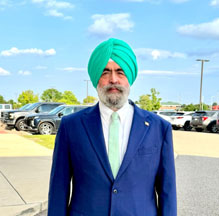
    Interestingly, the Canadian voters have elected six Sikh MPs with the same surname – Gill. All of them belong to the Conservatives. They are Parm Gill, Harbinder Gill, Dalwinder Gill, Amanpreet Gill, Sukhman Gill and Amarjeet Gill.

    Incidentally, one of two Amarjeets – Amarjeet Sohi, a former Cabinet Minister in Justin Trudeau’s government – lost while trying to stage a comeback in federal politics. He is currently the Mayor of Edmonton. He lost to an East Indian and a Sikh candidate, Jagsharan Singh Mahal.

    Other former MP, Parm Gill, however, succeeded in re-entering the House of Commons from Ontario. He had been a minister in the previous Stephen Harper Conservative government.

    The results of the April 28 polls have shown that the ruling Liberal party, led by its new leader Mark Carney, will be four members short of a clear majority as it could win only 168 seats against 153 it had in the last House.

    The Conservatives performed better under their leader, Pierre Poilievre, by improving their tally from 120 in the previous House to 144, but had the misfortune of losing their leader from a riding – Carlton –  he had been representing for a long time.

    NDP led by Jagmeet Singh performed miserably as it could retain only 7 of its 24 seats. Jagmeet was among the losers. The third major political outfit, Bloc Québécois, too, performed below its expectations and ended with 23 seats, 10 short of its strength of 33 in the previous House.

    Though both the ruling Liberals (15) and the main Opposition Conservatives (24) gained numbers, neither could clear the majority mark, thus leaving the country to its third consecutive government. Though the first two minority Liberal governments in 2019 and again in 2021 were led by Justin Trudeau, this time a seasoned banker and a newcomer to electoral politics, Mark Carney, spearheaded the party campaign amidst threats of tariff war and repeated mocking by the US President Donald Trump to make Canada 51st state of his country.

    In 2004, when Liberals led a minority government with 135 members in a House of 301, things did not change much except for a majority government each by the Conservatives ( Stephen Harper in 2011 with 166 of 308 seats) and the Liberals ( Justin Trudeau in 2015 with 184 seats – the highest by any party in the current centennial). All the remaining – 2006 Conservatives,  2008 Conservatives,2019 Liberals and 2021 Liberals – were minority governments.

    Unlike many other democracies, Canada has successfully demonstrated over the years the concept and success of minority government, though none of these has completed its full term in office. The last Liberal government, first led by Justin Trudeau and then Mark Carney, survived a couple of no-confidence motions to survive for nearly three years, mainly due to an understanding with one of the Opposition parties – the NDP.

    How Mark Carney now manages a confidence vote on the Throne speech and financial bills would be an issue of animated interest. The defeated leader of the Conservatives, Pierre Poilievre, says that his party would continue to confront the minority government on issues of Canadians’ interest.

    How long the new Mark Carney government lasts is anybody’s guess. For the time being, the strong East Indian community is feeling relieved for its increased presence in the House of Commons and hopes that toxic issues like immigration, international students, and above all, relations with India, would be taken up on a priority basis for a lasting peace.

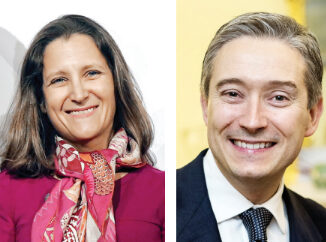
    The community would also be watching with tremendous interest as how many of its 14 Liberal MPs get represented in the new Cabinet of Mark Carney, with names of Anita Anand, Bardish Chagger, Maninder Sidhu, Randeep Serai,  and Anju Dhillon running high on the list.

    Here is the list of the  East Indians elected to sit in the 45th House of Commons:

    Liberal Party (14 MPs)

    1. Anita Anand – Oakville East / Ontario

    Re-elected. Former Defense and Treasury Board Minister. Academic and legal scholar with a University of Toronto background.

    1. Bardish Chagger – Waterloo / Ontario

    Fourth-term MP. Former Minister for Diversity, House Leader, and Small Business. Strong community credentials in Kitchener-Waterloo.

    1. Iqwinder Gaheer – Mississauga–Malton / Ontario

    Second-term MP. Harvard Law graduate; legal professional with a business background from the Schulich School of Business.

    1. Ruby Sahota – Brampton North / Ontario

    Fourth-term MP. Former Chief Government Whip and Minister. Lawyer by training; active in women’s and multicultural advocacy.

    1. Maninder Sidhu – Brampton East / Ontario

    Third-term MP. Entrepreneur and founder of The Kindness Movement Charity. Focused on education and international development.

    1. Sonia Sidhu – Brampton South / Ontario

    Worked in the healthcare field as a diabetes educator and research coordinator.

    1. Amandeep Sodhi – Brampton Centre / Ontario

    First-time MP. Limited background details available; emerged as a grassroots community choice.

    1. Param Bains – Richmond East–Steveston / British Columbia

    Second-term MP focus on youth engagement.

    1. Sukh Dhaliwal – Surrey Newton / British Columbia

    Re-elected. Veteran MP and businessman. Known for strong links with both Indian and Canadian diaspora groups.

    1. Gurbax Saini – Fleetwood–Port Kells / British Columbia

    First-time MP. Background yet to be fully detailed; described as a rising Liberal face in British Columbia

    1. Randeep Sarai – Surrey Centre / British Columbia

    Fourth-term MP. Lawyer, entrepreneur, and Chair of the Justice Committee. Longstanding civic involvement.

    1. Anju Dhillon – Dorval–Lachine / Quebec

    Re-elected. Among the early Punjabi women in federal politics. Legal and advocacy background.

    1. Gary Anandasangaree – Scarborough-Guildwood- Rogue Park

    Re-elected, former Minister

    1. Juanita Nathan – Pickering-Brooklyn

    First-time MP

    Conservative Party (11 MPs)

    1. Amarjeet Gill – Brampton West / Ontario

    First-time MP. Defeated sitting minister Kamal Khera. Known for grassroots organizing.

    1. Shuvaloy Majumdar – Calgary-Heritage

    Second time MP

    1. Harbinder Gill – Windsor West / Ontario

    First-time MP. Local economic campaigner with a focus on jobs and manufacturing revival.

    1. Parm Gill – Milton East / Ontario

    Returned to federal Parliament after serving provincially. Former Ontario minister. Experienced legislator.

    1. Arpan Khanna – Oxford / Ontario

    Second-term MP. First elected in a 2023 by-election. Focused on youth participation and infrastructure.

    1. Amanpreet Gill – Calgary Skyview / Alberta

    First-time MP. Background not publicly documented at the time of the election.

    1. Dalwinder Gill – Calgary McKnight / Alberta

    First-time MP. Veteran realtor and community activist. Known for neighborhood-level engagement.

    1. Jasraj Hallan – Calgary East / Alberta

    Re-elected. Advocate for affordable housing. Prominent voice on economic policy within the party.

    1. Jagsharan Mahal – Edmonton Southeast / Alberta

    First-time MP. Defeated former mayor Amarjeet Sohi. Known for education and interfaith outreach.

    1. Tim Uppal – Edmonton Gateway / Alberta

    Re-elected. Deputy Leader of the Conservative Party. Former Harper cabinet minister. MBA holder from Ivey.

    1. Sukhman Gill – Abbotsford South–Langley / British Columbia

    First-time MP. Farmer and agriculture advocate. Strong rural base and ties to Moga, Punjab.

     (Prabhjot Singh is a Toronto-based award-winning independent journalist. He

    was celebrated by AIPS, the international body of sports journalists, for

    covering ten Olympics, at its centennial celebrations held at UNESCO Centre

    in Paris during the 2024 Olympic Games. Besides, he has written extensively

    about business and the financial markets, the health industry, the public and

    private sectors, and aviation. He has worked as a political reporter besides

    covering Sikh and Punjab politics. He is particularly interested in Indian

    Diaspora and Sikh Diaspora in particular. His work has also appeared in

    various international and national newspapers, magazines, and journals. He

    can be reached at prabhjot416@gmail.com)

  • G-7 Foreign Ministers condemn the egregious terrorist attack in Pahalgam

    G-7 Foreign Ministers condemn the egregious terrorist attack in Pahalgam

    • By Prabhjot Singh

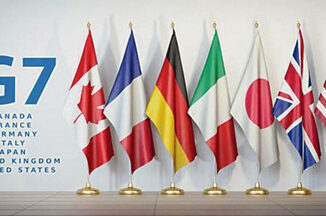
    TORONTO (TIP): Canada and the US joined the foreign ministers of G-7 and the High Representative of the European Union in condemning the egregious terrorist attack at Pahalgam while appealing to both India and Pakistan to de-escalate military operations.

    The Foreign Ministers’ issued a joint statement on Friday, May 9 saying: ‘We, the G7 Foreign Ministers of Canada, France, Germany, Italy, Japan, the United Kingdom, the United States of America and the High Representative of the European Union strongly condemn the egregious terrorist attack in Pahalgam on April 22 and urge maximum restraint from both India and Pakistan. Further military escalation poses a serious threat to regional stability. We are deeply concerned for the safety of civilians on both sides.

    “We call for immediate de-escalation and encourage both countries to engage in direct dialogue towards a peaceful outcome. We continue to monitor events closely and express our support for a swift and lasting diplomatic resolution,” the statement said.

    Interestingly, Canada has refrained from issuing any statement or making its stand public on the ongoing armed conflict in the South Asian subcontinent.

    However, condemnation of egregious terrorist attack on innocent tourists at Pahalagam in Kashmir on April 22 has been well received in diplomatic circles.

    Prime Minister Mark Carney has exercised restraint in making any statement on contentious issues like Canada-India bilateral relations that touched a new low during his predecessor Justin Trudeau’s time. Early this week, he visited the US for a meeting with President Donald Trump.

    Canada has strong segments of immigrants from both India and Pakistan.

    Economists say an escalation in military operations would impact not only the economy of the Indian subcontinent but also have a cascading effect on geopolitics and the global economy.

    Though the G-7 Foreign Ministers have appealed to both India and Pakistan for exercising utmost restraint to de-escalate military operations, the situation continues to be grim and tense with neither of the sides willing to scale down the hostilities.

    The United States, the United Kingdom, France and other G-7 nations have been cautious and guarded in their statements without getting drawn into any controversy over blame game for the present crisis.

  • Jallianwala Bagh, a conspiracy or a planned massacre?

    Is it time for the British Empire to apologize for the worst massacre reported in recent times?

    The Jallianwala Bagh massacre, also known as the Amritsar massacre, took place on 13 April 1919. A large crowd had gathered at the Jallianwala Bagh in Amritsar, Punjab, British India, during the annual Baisakhi fair to protest against the Rowlatt Act and the arrest of pro-Indian independence activists Saifuddin Kitchlew and Satyapal. In response to the public gathering, the temporary brigadier general R. E. H. Dyer surrounded the people with his Gurkha and Sikh infantry regiments of the British Indian Army. The Jallianwala Bagh could only be exited on one side, as its other three sides were enclosed by buildings. After blocking the exit with his troops, Dyer ordered them to shoot at the crowd, continuing to fire even as the protestors tried to flee. The troops kept on firing until their ammunition was low and they were ordered to stop. Estimates of those killed vary from 379 to 1,500 or more people; over 1,200 others were injured, of whom 192 sustained serious injury. Britain has never formally apologised for the massacre but expressed “deep regret” in 2019.    (Wikipedia)

    The Massacre. The Jallianwala Bagh massacre, also known as the Amritsar massacre, took place on 13 April 1919. Estimates of those killed vary from 379 to 1,500 or more people; over 1,200 others were injured, of whom 192 sustained serious injury.
    By Prabhjot Singh

    After Parliamentarian Bob Blackman asked the British Government to formally “apologize” for the Jallianwala Bagh massacre, former MP and Chairman of the National Minorities Commission, Mr Tarlochan Singh, has urged the first turbaned Sikh British MP, Tanmanjeet Singh Dhesi, to endorse his fellow MP’s demand.

    In a letter to Mr Tanmanjeet Singh Dhesi, Mr Tarlochan Singh wants him to raise the issue in the British House of Commons to seek an “official apology” for one of the worst “massacres of innocents” in the last century.

    Demanding the apology on the lines the Canadian Prime Minister Justin Trudeau tendered in the House of Commons for the Komagata Maru episode, Mr Tarlochan Singh said that “the gravity of the Jallianwala Bagh massacre was much more serious as innocents were greeted with cannon when they assembled for a peaceful congregation to demand independence.”

    Justin Trudeau had tendered an unconditional apology for the Komagata Maru incident on May 18, 2016, in which hundreds of Sikhs, Muslim and Hindu passengers were denied entry to Canada and forced to return to an uncertain and ultimately violent fate in India.

    The Then-Opposition Leader, Rona Ambrose, NDP Leader Tom Mulcair, BQ Leader Rheal Fortin, and Green Party Leader Elizabeth May also rose to add their voices and endorse the apology.

    “Canada does not bear alone the responsibility for every tragic mistake that occurred with the Komagata Maru and its passengers, but Canada’s government was without question responsible for the laws that prevented these passengers from immigrating peacefully and securely. For that, and for every regrettable consequence that followed, we are sorry,” Trudeau said in his statement.

    Though demand for a similar apology has been raised from time to time, including during the visit of the British Monarch and Prime Ministers to India, it has not progressed beyond “regrets” expressed by the British top elite.

    As the worst massacre approaches its 106th anniversary, the demand has surfaced again, this time a British MP, Bob Blackman, raising it.

    It is time to analyze the issue in perspective. It was not only the worst massacre in recent memory of mankind, but it also infringed upon various sensitive issues, including human rights and freedom of expression.

    Let us have a look at the broader issues and sequence of events that led to this darkest phase of the Indian freedom struggle.

    Issues

    • Did it give birth to the concept of state terrorism
    • Was it the handiwork of General Dwyer alone
    • Has the country done justice to martyrs and their families
    • Is it time to look beyond rituals
    • Bagh’s epoch and media
    • Punjab’s tryst with Censorship
    • Should the British Government apologize for the Jallianwala Bagh massacre?

    In a liberal democracy, the media have a vital role to play. Though acknowledged as the fourth Estate, freedom of the Press has become a mere bogey as it was during the Jallianwala Bagh epoch.

    Not many would know that it was the Jallianwala Bagh epoch that saw the British using the draconian law to curb the freedom of the Press. They resorted to Censorship, not once, but twice, to gag the media. Still not satisfied, the then Editor of The Tribune, Mr Kalinath Ray, was taken into custody for opposing the Empire.

    A section of media, including The Tribune, served its readers as a fearless voice of the people of Punjab. When one looks back at the Jallianwala Bagh massacre, one cannot overlook the role the media played.

    Gruesome massacre

    The Jallianwala Bagh massacre was a gruesome episode that changed the narrative of the freedom struggle. It not only symbolized the brute power that the British used to contain the growing demand of the populace for freedom, liberty and equality, but also exposed the desperation of the rulers in suppressing the growing revolt. This epochal event not only gave a new direction to the war for independence but also changed the course of sub-continental history. It paved the way for Mohan Dass Karam Chand Gandhi to become Mahatma.

    Before the Vaisakhi 1919 massacre, Jallianwala Bagh was a dumping ground of no political significance. But things witnessed a massive change afterwards. It provided the much-needed launch pad that guided the destiny of the nation. Interestingly, many in the crowd had come to Amritsar to join Vaisakhi celebrations at the Golden Temple, and some others were there for the annual cattle fair. To kill time, they headed for Jallianwala Bagh without realizing what was in store for them. That day no leader in the Bagh could control or keep the gathering together.

    Historian VN Dutta believed that the alleged culprit was Hans Raj, chief organizer of the rally. It was he who prevented people from dispersing. Rather, he asked everyone to sit down as the Government would not resort to feared fire.

    “After a while, he waved his handkerchief, signaling to Dwyer and his Indian soldiers to open fire. Hans Raj had already left. He was an agent provocateur. He was later moved away to Mesopotamia, and his house in Amritsar was burnt,” V.N. Dutta had said in an interview. General Dwyer refused to believe that the crowd that had assembled at Jallianwala Bagh was innocent but hostile and had come prepared to defy authority.

    The renovated Jallianwala Bagh , Amritsar.

    Has the nation given Jallianwala Bagh and its martyrs their due? The Bagh may have been renovated and given a facelift in recent years. But does that mitigate the anguish of the people who lost their near and dear ones or the countrymen who wanted freedom from the British empire? The British Government is still not ready to apologize for its action 106 years ago. It should have taken a lesson from the Canadian government that offered an unconditional apology for its comparatively lesser grave action in the Komagata Maru episode.

    Six years ago, rituals were gone through meticulously as the events unfolded for observing the centenary of the epochal event. The country’s Vice-President came, laid a wreath, joined a ceremonial salute to the unknown martyrs, released a coin and a set of postage stamps to mark the historic event. Unfortunately, after 106 years, no one knows how many freedom seekers laid down their lives in a most controversial, barbaric action that in the present day would have put to shame the infamous 9/11 terrorist attack on the twin towers in New York.

    At that time, there were no human rights activists, and not many would know what terrorism, including state terrorism, was all about.

    Even after more than a century,  the majority belief that the Jallianwala Bagh massacre was the result of a conspiracy that has not been satisfactorily countered. Was it a unilateral action on the part of then Lieutenant Governor Sir Michael O. Dwyer? Or was it the culmination of incidents, including the widespread violence following the arrest of some Punjab leaders, including Dr Saifuddin Kitchlew and Dr Satya Pal, besides the murder of five Europeans and the assault of missionary Miss Sherwood? Or was it because of the infamous Rowlett Bills?

    Whatever be the background or provocation, it was one of the single largest instances of brutal misuse of state power against innocent, unarmed, and peaceful protestors. Was the punishment given to the victims proportionate to the violation of law committed by them, wittingly or unwittingly? Not many references were made in those days about terrorism, what to talk of State terrorism. Now, when the world has redefined terrorism and state terrorism, social scientists in general and those studying armed conflicts will have little or no hesitation to identify the Jallianwala Bagh massacre as probably the beginning of State terrorism of suppressing or silencing the voice of dissent with brute firepower. It was the worst or blatant violation of human rights.

    While the demand for apology from the British for this unprecedented massacre has been growing louder year after year, many still see it as a major aberration or act of rashness on the part of General O’Dwyer. He believed that by killing innocent people in Jallianwala Bagh, he was sending a message to Punjab and the world that he would manage to put a finger in the dyke. Provoked by the Punjab rebellion, especially after incidents of April 10, 11 and 12, O Dwyer became furious and aggressive. With 25 Gurkhas and an equal number of Baluchis, he reached Jallianwala Bagh on the fateful day. The troops fired about 1650 bullets.

    The number of people killed in the firing and those who jumped into the well could not be authenticated even after 106 years. Even today, no one has an authentic number of those who attained martyrdom that day. Many injured died due to a lack of medical attention.

    The figures of 359 or 379 killed in firing were not working figures. Local newspapers, however, put the figure of those killed at over 1,000. Historian VN Dutta held that as many as 700 were killed in the firing. Besides, several thousand were injured who received treatment at non-official clinics or health centers. All O’Dwyer wanted was to send a strong message that Amritsar in Punjab could become a storm center of rebellion against the British Empire, and the evil had to be nipped in the bud.

    Realizing that Vaisakhi was a big event and there could be massive turnouts for protests against Rowlett Bills, the British ordered prohibitory orders on April 12 and 13 that banned public rallies, taking out of processions or gathering of groups of people at a place.  Without any warning to the crowd, he ordered fire. Havoc ensued. The gathering, terrorized by the firing, broke up. People ran for shelter, and the narrow passageways were all crammed. Some jumped into the well for safety. Those who tried to climb the walls were caught.

    Killing armless innocent people in cold blood in Jallianwala Bagh probably gave birth to ruthless State Terrorism. For Punjab, it was nothing new except that the magnitude this time was enormous.

    The Jallianwala Bagh massacre was also a litmus test for the media, which at that time was in its infancy and limited to a few newspapers. One of the newspapers that the British tried to dismiss as a small local newspaper was The Tribune.

    Media coverage of the events became a subject of considerable comment and criticism. The State used law not only to prevent publication of what was called “: objectionable material”, but the publishers of several newspapers, including those who were opposed to the British Empire, were accused of “secessionist propaganda”. But it did not deter upright media. Punjab was the center point of growing turbulence. Intriguingly, the laws the British framed to curb freedom struggle have subsequently been used by Independent India. Not many would forget the days after the then Prime Minister Indira Gandhi tried to curb freedom of the Press during the draconian emergency days. Subsequently, Punjab, too, suffered its repeated doses of censorship both during and after Operation Bluestar.

    In a liberal democracy, the media have a vital role to play. Though acknowledged as the fourth Estate, freedom of the Press has become a mere bogey as it was during the Jallianwala Bagh epoch. The concept of the notorious “Gaudi Media” has of late come to stay. The coverage of the farmers’ agitation in recent years has been an example. And the latest is the case of the stand-up comedian Kunal Kamra. Not many would know that it was the Jallianwala Bagh epoch that saw the beginning of censorship.

    The British used the draconian law to curb the freedom of the Press. They resorted to Censorship, not once, but twice, to gag the media. Still not satisfied, the then Editor of The Tribune, Mr Kalinath Ray, was taken in custody for opposing the Empire.

    In 1919, a section of media, including The Tribune, served its readers as a fearless voice of the people of Punjab. When one looks back at the Jallianwala Bagh massacre, one cannot overlook the role the media played.

    It was repeated during the 1977 emergency when again Editor of The Tribune, Madhavan Nair, and senior journalists like Shyam Khosla and Makhan Lal Kak had to face the wrath of the black laws, including detention under the draconian National Security Act and Maintenance of Internal Security Act (MISA). In 1984 again, these draconian laws were frequently used by the State to gag  Indian media in general and that of Punjab and Chandigarh in particular.

    ( Prabhjot Singh is a veteran journalist with five decades of experience covering a wide spectrum of subjects and stories. He has covered  Punjab and Sikh affairs for more than four decades, besides covering 10 Olympics and several major sporting events and hosting TV shows. For more in-depth analysis, please visit probingeye.com  or follow him on Twitter.com/probingeye)

  • Vaisakhi, the Khalsa Sirjana Divas, and Canadian elections

    Vaisakhi, the Khalsa Sirjana Divas, and Canadian elections

    By Prabhjot Singh

    Will Vaisakhi, one of the biggest Indian festivals after Diwali, bring luck to 50-odd candidates of “East Indian” origin in the ensuing federal elections in Canada? It is the timing of the polls that assumes significance as the East Indian community in general and the Punjabi community in particular, gets fully involved in celebrations that mark the birth of “Khalsa”, “Khalsa Sirjana Divas” in Punjabi parlance.

    Celebrated with fervor and gaiety, Vaisakhi is fast becoming a global event.  It has given the overseas Punjabis and the Sikhs a distinct socio-economic-cultural identity.

    Besides its religious significance – birth anniversary of the Khalsa, the pure – it has traditionally been correlated to the start of harvesting season (of wheat crop) in north India reflecting in the process great socio-economic strides the farming community of North has made. Besides, for many Indian communities, it marks the start of a New Year.

    After the Covid pandemic subsided, major public events, including commemorating Vaisakhi through  City Parades or Nagar Kirtan processions, resumed in 2023 after a few years’ hiatus.. They could not be organized in 2021 and 2022. Instead, special gatherings were held at Sikh temples – gurdwaras – by following the safety protocols of wearing face masks and maintaining a physical distance.

    In 2022, the “Nagar kirtan procession” was replaced by a special congregation held in Toronto on April 24. Similarly, other major cities in North America also held special “Vaisakhi” celebrations by following the official guidelines.

    It was on this day in 1699 that the 10th Sikh Guru, Sri Guru Gobind Singh, chose the historic town of Sri Anandpur Sahib in Punjab for the launch of the Khalsa. Though main religious celebrations are held at Takht Sri Kesgarh Sahib (Sri Anandpur Sahib), Golden Temple (Amritsar) and Takht Sri Damdama Sahib (Talwandi Sabo), the Sikhs all over the world mark the festivities not only by holding special congregations in gurdwaras but also in a global show of their progress in social, political, art, culture, sports, and economic fields as followers of one of the most recent and modern religions.

    Since Sikhism had its origin in Pakistan – Nankana Sahib, the birthplace of the first Sikh Guru, Sri Guru Nanak Dev – groups of the devout also visit Sikh shrines there as a part of Vaisakhi celebrations that are held in the second week of April every year. After almost 230 years of the birth of Guru Nanak Dev, Sri Guru Gobind Singh had given the Sikhs new identity of the Khalsa by introducing the concept of Saint Soldier.

    Vaisakhi celebrations’ global significance can be measured from ever-expanding numbers of cosmopolitan and metropolitan cities the world over that reverberate to the beats of bhangra and display of traditional martial art of gatka as part of “Nagar Kirtan processions” or Sikh Parades. Sikhs pride in claiming to be one of the most affluent minorities in the world.

    While Sikhs in India have Nagar Kirtan processions and special congregations on the Vaisakhi day, overseas Punjabis make it special with lavish celebrations. There, Nagar Kirtan processions or Sikh parades alone do not mark the celebrations. They come as a socio-cultural package comprising competitions in games, sports and cultural events, besides holding special religious congregations that continue for weeks together.

    Holding of community kitchens, illumination of the entire route of the procession and distribution of literature about Sikhism, besides updated copies of telephone and business directories, have come to stay as an integral part of celebrations. One of the latest additions to the event witnessed in some major North American cities has been the use of smaller aircraft for showering floral petals over the processions.

    Khalsa Sajna Diwas: आज है खालसा पंथ का साजना दिवस, पढ़ें 5 प्यारों की कथा - khalsa sajna diwas-mobile

    This year, the “Vaisakhi” celebrations will have added significance as Canada is all set to hold its Parliament elections, ending in the last week of April. The electioneering has been picking up pace and is expected to peak a week before the polling day. And a day before the poll day, there will be a massive Sikh Day Parade or Nagar Kirtan procession in the Greater Toronto Area.

    Incidentally, more than 60 percent of all candidates of the “East India” origin participating in the 2025 federal elections are Sikhs.

    Since the Sikhs are a growing political minority, leaders of various political parties, both at provincial and federal levels, make it a point to get their presence noticed during the celebratory processions or special congregations in major centers like Toronto, Vancouver, Surrey, Calgary, Edmonton, Brampton and several other Canadian cities.

    Though celebrations are held worldwide, major focus remains on Sikhs in Europe (UK, Germany, Italy, France, Greece, the Netherlands and Sweden), the Americas (USA, Canada), Australia and New Zealand, Africa (Kenya) and Asia (Malaysia, Thailand and Fiji).

    Besides the major Commonwealth nations like England, Canada, Australia and New Zealand, several other countries have accorded recognition to some of the major Sikh festivals in general and Vaisakhi in particular. In 2015, for example, the Malaysian government allowed Sikhs an off day on Vaisakhi day.

    In 1999, when the entire world celebrated the tercentenary of the Khalsa, Canada became the first country other than India to take out a commemorative stamp to mark the occasion.

    Vaisakhi celebrations are now held inside Parliament complexes, including Parliament Hill in Ottawa, besides several Provincial Parliaments in other Commonwealth nations. In the United States, Sikh Parades are held in almost every major city, including New York, San Francisco, Los Angeles, and Yuba City.

    In England, besides London, they are organized in several cities, the biggest being in Birmingham.

    Historically, the Sikhs had to struggle hard not only to shrug off the blot of “second-rate citizens” in many parts of the erstwhile Commonwealth but also had to fight democratically for their rights and absorption in the mainstream of their new countries of abode.

    In fact, the concept of the Nagar Kirtan processions, or the Sikh Parades, has proved to be an effective tool for the overseas Sikh community to introduce itself as a peaceful and hard-working group that has no qualms about making their present countries of abode their homes.

    It has been this commitment that has helped them to script an unprecedented success story the world over. Though the Punjabis – described as Hindus – started reaching Canada in early 1900, they were denied voting rights in British Columbia from 1907 onwards. They had to wait for 40 long years to win back the right to vote. In 1947, the requirement to be a voter was changed to Canadian citizenship in addition to being a British subject. It was in 1950 that the first Sikh –  “Giani” Niranjan Singh Grewall – was elected to the City Council of Mission in British Columbia.

    The first ever-Sikh Parade or Nagar Kirtan procession was organized on January 19, 1908, along Second Avenue in Vancouver. On August 28, 1912, Hardial Singh Atwal earned the distinction of becoming the first Canadian-born Sikh.

    Each Nagar Kirtan Procession comprises, among other things, a tastefully decorated truck trailer that carries sacred Guru Granth Sahib in a golden or silver palanquin, followed by five baptized Sikhs (Panj Pyaras) who carry Kesari flags (Nishan Sahibs), Gurbani reciting groups or “Parbhat Pheris” besides Bhangra and gatka players.

    The scale at which the Nagar Kirtan processions are now organized in North America started in 1978 when the Canadian Sikhs organized a massive Nagar Kirtan procession to mark the 500th birth anniversary of Guru Amar Das. Since then, the holding of the Sikh Parade has become an annual feature.

    Many historians and social scientists subscribe to the view that the Nagar Kirtan or Sikh Parade paved the way for the consolidation of the overseas Sikh community as a strong political group that ultimately saw a turbaned Sikh – Gurbax Singh Malhi – in the Canadian House of Commons. It was he, who six years later, persuaded the then Liberals to hold inside the Parliament Hill a big celebration to mark the tercentenary celebrations of Khalsa on Vaisakhi Day. In May 1999, Canada issued a 49-cent special commemorative stamp to mark the tercentenary of the Khalsa.

    Not only major TV channels but also the mainstream Media run special features and articles on Sikhs and their immense contribution to the economic growth of the new countries of their abode. Success stories of young Sikh boys and girls, too, are played up as a buildup for the Vaisakhi supplements.

    Since then, Vaisakhi celebrations inside Parliaments and State Assemblies have become a regular feature both in the Commonwealth and some European and African nations.

    The celebrations not only ensure the holding of competitions, tournaments, folk events and religious congregations but also the organization of lavish feasts where the local populace is invited as a part of the “know your neighborhood communities better” programme launched by some of the enterprising Overseas Sikh Organizations. This was necessitated more as a mode of defense and awareness to thwart growing incidents of hate violence witnessed in several parts of North America after the 9/11 terrorist attack.

    Traditionally, religious celebrations comprise of taking out a nagar kirtan procession – that is normally done a day or two before the actual Vaisakhi day – besides holding a special religious congregation at gurdwaras, where at community kitchens – langars – jalebis are a special attraction.

    Normally, one or more jathas (groups)  of Sikhs go to Pakistan to join the Vaisakhi celebrations at  Gurdwara Sri  Janam Asthan,  Nankana Sahib, the birthplace of Sikhism,  besides other historic shrines there. The political uncertainty notwithstanding, jathas of Sikh pilgrims went there this year also, though the size was much smaller.

    (Prabhjot Singh is a Toronto-based senior journalist. He can be reached at Prabhjot416@gmail.com)

  • War of attrition for political supremacy is getting murkier

    By Prabhjot Singh

    “As Canada approaches its federal election on April 28, 2025, the two leading contenders, Prime Minister Mark Carney of the Liberal Party and Conservative leader Pierre Poilievre, are under increased scrutiny. Carney, who succeeded Justin Trudeau, faces allegations of plagiarizing parts of his 1995 Oxford University thesis, with claims of uncredited use of work by scholars like Michael E. Porter. His previous role at Brookfield Asset Management has also drawn attention due to the firm’s use of tax havens. Poilievre, known for his populist approach, has been criticized for his past support of the 2022 Freedom Convoy protests and alleged foreign interference in his 2022 leadership campaign. These controversies add complexity to an election already influenced by U.S. President Donald Trump’s trade policies and annexation threats.”

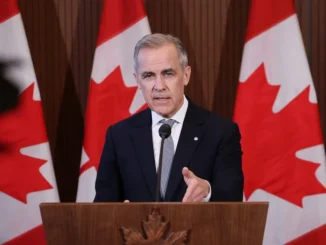
    Liberal Mark Carney  (Photo: Liberal International)
    Liberal Mark Carney (Photo: Liberal International)

    The war of attrition for political supremacy is getting murkier with allegations and counter-allegations flying high with each of the main political players trying to woo voters with promises of cutting down the cost of living and making life more affordable.

    Led by rookie Mark Carney, the ruling Liberals face an uphill task in countering the well-orchestrated campaign of the main Opposition party, the Conservatives.

    After two terms of running minority governments, the Liberals are fighting with their backs to the wall. The change of leadership weeks before the electoral battle may have augured well for Marc Carney and his party. But that alone may not be enough to prevent the Conservatives from achieving their single-point agenda of wresting back the power they lost to Justin Trudeau and his Liberals in 2019.

    Though Liberals have been rallying behind Marc Carney,  he continues to be the target of all Opposition criticism and attacks. He has been accused of plagiarism in his Ph.D. thesis. A  national daily came out with a startling revelation in this regard.

    A report in the National Post has accused him of taking other people’s ideas as his own in the federal election campaign.

    “It isn’t new,” the report said.

    The newspaper obtained a copy of Carney’s 1995 thesis for his doctorate in economics from Oxford University titled “The Dynamic Advantage of Competition.” It showed 10 instances of apparent plagiarism, according to the judgment of three university academics who reviewed the material.

    The newspaper report further says that in several sections of his thesis, Carney used full quotes, paraphrases, or slightly modified quotes from four previous works without proper acknowledgement or attribution.

    “He’s just directly repeating without quotations. That’s what we call plagiarism,” said Geoffrey Sigalet, an assistant professor and member of UBC Okanagan president’s advisory committee on student discipline, which handles plagiarism cases for the university.

    The National Post provided the 10 examples to Carney’s campaign team. He was sworn in as prime minister on March 14, and is currently running in an election that will be held on April 28.

    Marc Carney heaved a sigh of relief as some academicians came to his rescue. “I believe you are mischaracterizing this work. As an academic of nearly 40 years, I see no evidence of plagiarism in the thesis you cited nor any unusual academic practices,” said American economist Margaret Meyer, Official Fellow of Economics at Nuffield College, in the provided statement.

    “Mark’s thesis was evaluated and approved by a faculty committee that saw his work for what it is: an impressive and thoroughly researched analysis that set him apart from his peers,” added Meyer.

    Besides the plagiarism controversy, power seekers – Liberals and Conservatives – are sparing no opportunity to convince an average Canadian of their policies and programs through which they promise to make life affordable by cutting down costs of groceries, house rent and taxes.

    Conservative Party Leader Pierre Poilievre gestures after speaking at a campaign event in Toronto on April 2, 2025 (Photo: Cole Burston / The Canadian Press)

    Liberals, NDP and Bloc Québécois have been accusing  Pierre Poilievre of benefiting from “external” support in his leadership run a couple of years ago. The accusing fingers point towards India. They have been mounting an attack on the Conservative Leader and Prime Ministerial candidate for refusing to go for security checks that enable the national leaders to get confidential security briefings.

    One of the major issues facing Canada is its future relationship with its big brother, neighbor and biggest trade partner, the US, besides trying to rein in immigration and making housing affordable.

    Excitement of the immigrant communities in general and the Indo-Canadians can be judged from the number of candidates they are putting up for the April 28 polls.

    The response of the Indo-Canadian community is massive. Going by the lists of the contestants makes interesting revelations. Of all political parties, the largest number of candidates of Indian origin are being fielded by the Conservatives. It reveals a visible and significant shift from the Liberals to the Conservatives.

    Three of the long-standing members of Indian descent who will be missing from the next house are Harjit Singh Sajjan, Arif Virani (both were Cabinet Ministers in Justin Trudeau’s government) and Chandra Arya, an ardent supporter of India.

    While Harjit Singh Sajjan and Arif Virani decided to give a miss to the next election, the candidacy of Chandra Arya was revoked by the Liberal Party. Earlier, his candidature for the leadership race, too, was rejected.

    (Prabhjot Singh is a veteran journalist with five decades of experience covering a wide spectrum of subjects and stories. He has covered  Punjab and Sikh affairs for more than four decades, besides covering 10 Olympics and several major sporting events and hosting TV shows. For more in-depth analysis, please visit probingeye.com  or follow him on Twitter.com/probingeye)

  • Will Canada’s federal polls in April end the era of minority governments?

    Will Canada’s federal polls in April end the era of minority governments?

    By Prabhjot Singh

    TORONTO (TIP): After Justin Trudeau decided to step down as leader of the ruling (though minority) Liberal Party and Prime Minister, Canada decided to go for a snap poll. On the recommendation of Mark Carney, the Governor-General ordered the next federal elections to be held on April 28 in a bid to end the impasse of minority governments in the country.
    Canada already had 13 such minority governments in a little more than the last 100 years. The incumbent Liberal government, incidentally, had the longest tenure in office. In the current centennial, it was Paul Martin (Liberals), who presided over a minority government from 2004 to 2006, followed by another minority government between 2006 and 2008, led this time by the Conservative leader Stephen Harper. Stephen Harper headed his second minority government between 2008 and 2011. Since 2019, the present minority Liberal government has been in office.
    Besides fighting a tough “tariff” war with its big brother and largest trade partner, the US, Canada is witnessing an interesting ideological war that will determine its political future. The new Prime Minister, Mark, faces the arduous task of leading the Liberals in the battle of political survival with the Conservatives breathing heavily down their necks. Though in the outgoing House of Commons, the Liberals, after earning the distinction of heading the longest-serving minority government in the country, had 153 members, it now wants to browse the majority target of 170, in the House of 337.
    Conservatives (120), Bloc Québécois (33), NDP (25), Independent (4), and Green (2) were the other major players in the dissolved House. After taking over from where Justin Trudeau left, Mark Carney, a financial wizard, promised, set upon himself the arduous task of restructuring the Canadian economy that has been on the brink ever since Donald Trump, after taking command for the second innings, rolling out new policies and “tariff” plans that are proving detrimental to Canadia in general and its manufacturers and exporters in particular.
    After wresting the initial advantage that saw a steep rise in its popularity in opinion polls, the Liberals have started showing signs of cracking under pressure from the Conservatives, and in their desperation to surge ahead, have unleashed a powerful campaign attacking Mark Carney for shirking to make his asset disclosures and other issues. Mark Carney has also made some announcements to woo the voters, including relief for domestic consumers on the carbon fund, besides a slew of other benefits. The battle lines have been drawn for a rare battle of the ballot in April. Technically speaking, the election becomes due in October. The new Prime Minister, facing his first-ever electoral test, has decided to contest from Nepean in Ottawa after revoking the candidature of sitting MP Chandra Arya, who was incidentally among the first to declare his candidature and get rejected in the Liberal Party leadership race. Now, he has lost his riding to the new Prime Minister. Ruby Dhalla, like Chandra Arya, who was also a candidate in the Liberal Leadership run, came out in support of Chandra Arya after the revocation of his candidature.
    Ruby Dhalla, a former Liberal MP, and Chandra Arya were the only candidates of Indian origin in the run to become Canadian Prime Minister. Both were disqualified on technical grounds by the election and expense committees of the Liberal Party. Ruby Dhalla’s protest was rejected as she accused the party leadership of creating a “sham” for electing a new leader, as she maintained that it was all planned for the “coronation of Mark Carney”. What Canadian voters have to say about their political future will be known by the evening of April 28 when results of the next federal elections start pouring in.
    (Prabhjot Singh is a Toronto-based senior journalist. He can be reached at Prabhjot416@gmail.com)

  • Recalling the 1975 World Cup Hockey Triumph: A feat India is yet to emulate

    Recalling the 1975 World Cup Hockey Triumph: A feat India is yet to emulate

    By Prabhjot Singh

    Notwithstanding back-to-back bronze medals in the Olympic Games, India has yet to emulate its title triumph in the elite World Cup Hockey Tournament it last won 50 years ago. In between, India managed to add its eighth Olympic gold in Moscow in 1980; it, however, continues its endeavor to add its fourth World Cup Hockey medal to its kitty.
    Starting its World Cup campaign with a bronze in 1971 in Barcelona, India improved its standing to a silver in Amtelveen in 1973 and peaked to glory in Kuala Lumpur in 1975.
    Since then, it has competed in all editions of the elite FIH event without a podium finish.
    The story of the 1975 triumph stands out for more than one reason.
    All was not well with India’s administration and performance after its silver medal finishes in the 1973 Amstelveen World Cup and the 1974 Asian Games in Teheran. However, in the 1972 Olympic Games in Munich, India retained the bronze medal it last won in the 1968 Mexico Games.
    Not only the supremacy of Indian hockey was challenged; dissensions had started appearing in the administrative side of the game. Ashwani Kumar, who had been at the helm of affairs, started feeling the heat of his sworn opponents’ hue and cry.
    Unable to dislodge him, they took political recourse. An incident that Ashwani Kumar shared with an elite gathering of the followers of our “unofficially” acknowledged game to choose the best-ever Sikh hockey Olympian was revealing.
    Ashwani Kumar recalled what he described as the “most agonizing moment” of his decades-long association with the sport. He was summoned to the union capital by the then Prime Minister Indira Gandhi to be confronted with an “unsavory query” as to “why Indian hockey teams were studded mostly by Sikh players?”. He said he was stunned at the question. Dejected and depressed after the meeting, Ashwani Kumar returned and submitted his resignation from the top position of the Indian Hockey Federation to the then President of the Indian Olympic Association, Raja Bhalendra Singh.
    It happened in the second half of 1974, just in time for the country to start preparing its team for the 1975 World Cup. Confusion prevailed. It led to uncertainty as there was more than one claimant for the top post of the Indian Hockey Federation (IHF) as it was known at that time. Even a whiff of a parallel IHF staking claim to be the genuine body cropped up.
    Realizing the gravity of the crisis, the then Punjab Chief Minister, Giani Zail Singh, offered to train the Indian team for the Kuala Lumpur World Cup. The offer was gleefully accepted by the IOA, the parent body of Indian sports. The Punjab government managed to rope in both the Postgraduate Institute of Medical Education and Research (PGIM ER) and Panjab University while deciding to hold the training at the Panjab University campus. A newly constructed hostel, which was meant for female students, was made the camping venue for the camp. That camp was held under the watchful eyes of Balbir Singh Senior and Gurcharan Singh Bodhi, in which physical fitness trainer Dr SS Gill from Panjab University and a team of doctors led by Dr Rajinder Kalra of PGI were associated. The camp management always used the services of psychologists, dieticians and others.
    While all these efforts were going on to build and train a strong team, the developments in the Indian Hockey Federation were far from conducive. As the dates of the tournament were approaching, Indian players served an ultimatum that they would go to Kuala Lumpur under the IOA banner.
    And the rest is history. India won the coveted World Cup on the lush green playfields of Merdeka Stadium, which is no longer used for hockey or football. Hockey and football have their new ultra-modern complexes at nearby Bukta Jalili. I had a chance to visit the ground where India scripted history on March 15, 1975, by defeating its archrival and neighbor, Pakistan, in the final.
    Since I was a student of the first batch of journalism at Punjabi University, Patiala, I chose hockey for my dissertation. It was a great delight to me when India returned home with its first-ever and only gold from a World Cup. I considered myself lucky, as I used to frequent the camp at Chandigarh at regular intervals to interact with the probables.
    A lot of water has flowed down the Sutlej since then, as Panjab University now has a synthetic hockey turf on the ground where World Cup players used to train. And the hostel where they stayed for several months is now rightly serving as a women’s hostel as it was planned.
    A couple of years ago, Playwrite, an organization that provides a platform for those associated with sports in various capacities as players, organizers, administrators, doctors and journalists, held its session where Balbir Singh Senior (manager), Ajit Pal Singh (captain) and mercurial Ashok Kumar (forward and gold medal-winning goal scorer) and Dr N. Mohan (Professor of Panjab University) participated to recall those golden moments of 1975.

    Looking Back – When I visited Merdeka Stadium

    It was in 2019 that I got an opportunity to visit the Merdeka Stadium, the historic venue where the 1975 World Cup final between India and Pakistan was played. On March 15, 1975, India scripted history. After winning a bronze in the first World Cup in Barcelona, India finished runners-up in the second World Cup in the Netherlands, losing to the hosts in a tiebreaker after having taken a 2-0 lead early in the game. The wait for glory and the crown ended only in Kuala Lumpur on this day, 48 years ago.

    I had an opportunity to revisit Merdeka Stadium in September 2019. The grassy field on which two great traditional rivals and neighbors slugged out for the gold is no more a hockey venue. Instead, Kuala Lumpur has a new ultramodern hockey complex where all major international hockey events are organized.

    The Stadium Merdeka has a long history. It is known as the site of the formal declaration of independence of the Federation of Malaysia was declared on August 31, 1957, almost 10 years after India got its freedom. Subsequently, it was chosen as a venue for the promulgation of Malaysia on September 16, 1963. At one stage it was the largest stadium in Southeast Asia before it underwent structural changes.

    The stadium has a lower and an upper terrace, with a total capacity of 25,000, as well as 14 tunnel entrances, a covered stand, 50 turnstiles and four floodlight towers. It remained the main venue for holding all major sporting events in Kuala Lumpur till Bukit Jalal National Stadium was built in time for the 1998 Commonwealth Games.

    Besides the World Cup Hockey final in March 1975, it was also the venue for an Olympic Qualifier football event when Malaysia last qualified for the 1980 Moscow Olympic Games. It also used to be the venue for the Merdeka Cup Football Tournament.

    Some members of the 1975 World Cup champion Indian hockey team, including Ashok Dhyan Chand, Aslam Sher Khan and Brig Harcharan Singh, have very fond memories of the event.

    Since then, India has played host to this prestigious FIH tournament four times – 1981-82 in Bombay (now Mumbai), 2010 in New Delhi, 2018 and 2023 in Odisha. Unfortunately, India, as hosts could not even reach the semi-finals of the World Cup. In the last edition held jointly in Rourkela and Bhubaneswar, India touched a new low by failing to qualify even for the quarter-finals.

    Hockey has also come a long way since the maiden 1975 gold medal triumph. From grass, it has moved to synthetic surfaces. It was a year after the Third World up in Malaysia, and the 1976 Summer Olympic Games saw the introduction of synthetic surfaces for hockey competitions. It also marked the beginning of the downfall of Indian hockey. Though India won the gold medal in the 1980 Olympic Games in Moscow, it was primarily because of a boycott by US US-led Western world. The truncated hockey competition saw India winning narrowly against Spain in a closely contested gold medal match.

    Between 1980 and 2021, India did not get any Olympic medals in hockey. It got a reprieve in the 2020 Tokyo Olympic Games held in 2021 when it returned to the podium to win a bronze. But the subsequent World Cup in Odisha in January this year came as a big disappointment and India finished a poor joint ninth with Argentina.

    Ashok Dhyan Chand, who was in Chandigarh to participate in the Playwrite Sports seminar says that each member of the 1975 World Cup champion team enjoys the right to claim his role in bringing singular honor to Indian hockey in the 52-year history of the World.

    Personally speaking, 1973 was our best chance, and I still hold we missed a great opportunity to bring the trophy home after taking a 2-0 lead in the final against the hosts, the Netherlands.

    “Though we had been Olympic champions before but were never a World Cup winner,” says Ashok Kumar who scored the match-winning goal against Pakistan in the final. Pakistan had taken the lead which fullback Surjit Singh neutralized with a penalty corner conversion. It was left to mercurial Ashok Kumar to score the decisive goal. Earlier, it was Harcharan Singh whose goal in the semi-final got India into the final.

    “We all members of the 1975 World Cup champion have only one desire – to see India back on the podium with the gold medal,” says Ashok Dhyan Chand revealing that an exclusive Hockey Museum in memory of his father and Hockey Wizard is under construction at Jhansi. The museum when completed would cost Rs 19 lakh.
    (Prabhjot Singh is a Toronto-based Senior Journalist. He can be reached at Prabhjot416@gmail.com)

  • Is Canada heading for a snap poll by end of April?

    Is Canada heading for a snap poll by end of April?

    By Prabhjot Singh

    TORONTO (TIP): Prime Minister Mark Carney looks set to avoid the embarrassment of facing a no-confidence motion in less than a fortnight of assuming the office. He is expected to call on the Governor-General this Sunday to recommend the dissolution of the House of Commons and the holding of fresh federal elections either on April 28 or May 5.

    His 23-member Cabinet has endorsed his proposal of holding a snap poll before the prorogued House resumes its sitting on March 24.

    Mark Carney has yet to decide the riding from where he would love to contest the ensuing election.

    Two of the three major Opposition parties had been gunning for the Liberal government even after the change of its leadership from Justin Trudeau to Mark Carney.

    The Canadian media has been agog with the speculations that Mark Carney will make the final call this weekend, with a snap election slated as early as April 28. The alternate date for the poll could be May 5. The federal elections are otherwise scheduled for the end of October.

    Should that happen, Carney, on return from a trip to Europe, is expected to visit the Governor General and request the dissolution of Parliament. The election campaign lasts for a minimum of 36 days and usually around 40 days.

    This will be Canada’s 45th federal election. Immediate factors behind the current thinking in the Mark Carney Government recommending a snap poll are the rapidly changing economic developments following U.S. President Donald Trump’s trade policies and rhetoric that have fueled a rise in Canadian nationalism, strengthening the Liberals’ prospects.

    After change of the command, the Liberal’s graph has shown upward movement narrowing the gap with the main Opposition party, the Conservatives. Until the turn of the year, the Conservati9ves were far ahead of the Liberals.

    However, with the change in the leadership of the Liberal Party and the tough stand taken by the minority government against the US tariff war threats, the recent opinion polls conducted by different organizations have shown that Liberals have surged ahead of the conservatives.

    The Liberals want to capitalize on this surge rather than lose the advantage by facing the ignominy of a no-confidence motion, its third in the last five months.

    The latest poll shows the federal Liberals have surged to 42 per cent, five points above the Conservatives and leader Pierre Poilievre. Three months ago, the Liberals were polling at a near-all-time low of just 16 per cent.

    Carney was sworn in as Canada’s new prime minister on March 14. The opposition Conservatives wanted the elections with Justin Trudeau still as Prime Minister. The popularity of Justin Trudeau had been on a downward trend following rising living and housing costs besides growing unemployment and immigration surge.Immediately after taking over on March 14, Mark Carney held his first Cabinet meeting where among other decisions was the elimination of consumer carbon tax to undo Trudeau’s signature climate policy. He called his government “Canada’s new government” to distance himself from Trudeau.

    “We will never, in any way shape or form, be part of the United States,” Carney said. “America is not Canada. We are very fundamentally a different country.”

    Mark Carney has already declared that he was ready to meet US President Donald Trump provided he shows respect for Canadian sovereignty. This week, he made his first trip abroad, visiting France and the U.K. before stopping in Iqaluit.

    The Canadian and US media have been quoted saying that Donald Trump has expressed his preference for a Liberal victory under Carney over the opposition Conservatives. However, many political pundits have said it’s believed to be posturing by the current U.S. President, who regularly referred to Trudeau as “Governor Trudeau.”

    Trump had announced 25 per cent tariffs on Canada’s steel and aluminum besides threatening sweeping tariffs on all Canadian products on April 2. He has threatened economic coercion in his annexation threats and suggested the border is a fictional line.

    The U.S. trade war and Trump’s talk of making Canada the 51st U.S. state have infuriated Canadians, who are booing the American anthem at NHL and NBA games.

  • USA halts Canada’s progress in the  Women’s T20 World Cup 2026 Americas Qualifier

    USA halts Canada’s progress in the Women’s T20 World Cup 2026 Americas Qualifier

    By Prabhjot Singh

    BUENOS AIRES (TIP): Buenos Aires and women’s cricket! Amazing! Isn’t it? Until a few years ago, it would have sounded only like a fantasy.

    Argentina is better known for its soccer and field hockey in team sports. Cricket was till the turn of the century an unknown entity in this South American nation.

    Last year, the USA  and West Indies jointly organized the ICC Men’s T20 World Cup.

    But things have changed. International Cricket  is a reality now. Buenos Aires organized the ICC Women’s T20 World Cup 2026 American Qualifier. USA prevailed in a winner-takes-all matchup on the final day. The win  against traditional rivals and neighbors Canada sees them claim the top spot and a place in the next stage – the ICC Women’s T20 World Cup 2026 Qualifier

    A dramatic final day saw a rampant USA snatch the top spot and a place in the next round,  thanks to a commanding 78-run victory over Canada.

    Eight days of competitive action preceded the top-of-the-table clash. Both the USA and Canada knew that victory would advance them to the ten-team Qualifier, which would lead to the final stage on the road to England and Wales in 2026.

    Electing to bat first after winning the toss at the St Albans Club Ground, the USA started its innings brightly. Young openers Disha Dhingra (16) and Chetna Pagdyala (35) saw off Canada’s opening attack to set the foundations, with Ella Claridge (20) and skipper Anika Kolan (34) also chipping in with valuable run-a-ball scores.

    A sharp 17 from 12 balls by Isani Vaghela helped the USA add to its competitive total. Despite the efforts of Terisha Lavia (two for 19),  USA closed its innings at  131 for six from 20 overs – the second-highest total recorded during the competition.

    In response, Canada stuttered in the early overs and never recovered. Falling to 20 for three by the fifth over, a slight reprieve in the form of a partnership between top-scoring Achini Perera (19) and Kainat Qazi helped them stabilize to 36 for three before Qazi’s wicket at the hands of Saanvi Immadi heralded a brisk collapse.

    More wickets from Player of the Tournament Ritu Singh and the introduction of Chetnaa Prasad were the catalysts for the finale, with Prasad blitzing through the lower order to record figures of four for five from her two overs, including the wicket of Mannat Hundal to secure the 78-run victory amid jubilant scenes in the Argentine capital.

    USA captain Kolan, said: “I’m incredibly proud of the team for our dominant victory in the ICC Women’s T20 World Cup Americas Qualifier. This win reflects the hard work, resilience, and unity we’ve built as a squad. Every player stepped up, and we showcased the growing strength of women’s cricket in the USA.

    “Securing America’s representative spot in the global qualifiers is a huge step forward, and we’re excited for the journey ahead.”

    The ICC Women’s T20 World Cup 2026 in England and Wales will see a greater number of competing teams (12) and matches (33) than ever before.

    Eight teams that have already gained automatic qualification to the event are  England as hosts, Australia, India, New Zealand, South Africa and the West Indies by their performances at the 2024 edition, plus Pakistan and Sri Lanka, who were the two next highest ranked teams on the ICC Women’s T20I rankings table on 21 October 2024.

    The four remaining spots will be determined through the ten-team Qualifier, comprising Scotland, Bangladesh, USA and subsequent teams that advance from regional pathway events held in Africa, Asia, Europe and the East Asia-Pacific in 2025.

    Scores in brief

    USA 131 for six from 20 overs (Chetna Pagdyala 35, Anika Kolan 34; Terisha Lavia 2 for 19)

    Canada 53 all out in 16 overs (Achini Perera 19; Chetnaa Prasad 4 for 5, Ritu Singh 2 for 12)

    USA won by 78 runs

    (Prabhjot Singh is a Toronto-based award-winning independent journalist. He was celebrated by AIPS, the international body of sports journalists, for covering ten Olympics, at its centennial celebrations held at UNESCO Centre in Paris during the 2024 Olympic Games. Besides, he has written extensively about business and the financial markets, the health industry, the public and private sectors, and aviation. He has worked as a political reporter besides covering Sikh and Punjab politics. He is particularly interested in Indian Diaspora and Sikh Diaspora in particular. His work has also appeared in various international and national newspapers, magazines, and journals. He can be reached at prabhjot416@gmail.com)


  • Can Mark Carney reverse the party’s cratering support and beat Conservative Leader Pierre Poilievre in the upcoming general election?

    By Prabhjot Singh

    Mark Carney never accepted any interim political position in the jinxed Justin Trudeau government. Instead, he chose the hard way of bagging the party leadership position through an open, transparent and democratic election process that lasted less than two months. At the end of it, he overcame symbolic resistance from “bigwigs” of his predecessor’s government, like his Deputy and Finance Minister, Chrystia Freeland, and the Leader of the House, Karina Gould. But the overwhelming vote and support from the registered party delegates – 85.6 percent – was indicative of the choice the party made – putting their faith in a financial wizard rather than those with proven political acumen.

    Chrystia Freeland may have tackled the threats and challenges US President Donald Trump may have posed during his first term in the office, but things, including geopolitics the world over, have changed dramatically. There are major unresolved conflicts, including the Russia- Ukraine war and the Israel – Hamas attrition.

    Mark Carney has not only to see Donald Trump eye-in-eye but also handle Canada’s global standing that got some severe hits in the recent years.

    Canada’s role in the Indo-Pacific region, its political and trade relations with China and bilateral relations with India have been the subject of considerable debate in the recent past.

    What options does Mark Carney have to see Canada through its current international crises? How is he going to handle the imminent challenge of the main Opposition parties in the House of Commons who have been sharpening their scalps for a feast on the minority Liberals with no-confidence motions?

    Political circles are agog with speculations that Mark Carney would avoid a no-confidence motion in the House of Commons that is scheduled to resume its sitting on March 24 after a long recess.

    Instead, he, as a new Prime Minister, may walk to the office of Governor-General with a recommendation to dissolve the House of Commons and order fresh federal elections.

    Ever since Justin Trudeau announced his decision to quit both as Leader of the Liberal Party as well as the Prime Minister of Canada, the party graph has started moving up the curve.

    Pollsters predict that a shorter election campaign would be beneficial for Mark Carney on his first major political battle of ballot as the main Opposition party, the Conservatives, under Pierre Poilievre have been trying desperately to take advantage of their popularity graph that had till the turn of the year put them “far ahead” of all others in the ensuing federal elections.

    Things are changing and changing rapidly. The ball is in the court of Mark Carney. How he conducts himself as the new Prime Minister in the first 10 days will determine not only his future but also that of the Liberals, as well as of Canada.

    For the strong Indo-Canadian community, Mark Carney got instant acceptability. Not only were most of the sitting Liberal MPs supportive of his leadership campaign, but various socio-cultural institutions of South Asian communities also backed him.

    Business tycoon Baljit Singh Chadha of Montreal, for example, was among the first to host an interaction with leaders of business and trade with Mark Carney. Sikh Gurdwaras and Hindu Temples, too, lapped up the opportunity to declare their support for him in the leadership run-up campaign.

    When he constitutes his new team – Cabinet and Parliamentary Secretaries – though for a short period, he may give the Indo-Canadian community its due as was done by his predecessor.

    Time is a great factor. Between March 14 and March 24 lays hidden the future of Canada and its politics!

    (Prabhjot Singh is a Toronto-based award-winning independent journalist. He was celebrated by AIPS, the international body of sports journalists, for covering ten Olympics, at its centennial celebrations held at UNESCO Centre in Paris during the 2024 Olympic Games. Besides, he has written extensively about business and the financial markets, the health industry, the public and private sectors, and aviation. He has worked as a political reporter besides covering Sikh and Punjab politics. He is particularly interested in Indian Diaspora and Sikh Diaspora in particular. His work has also appeared in various international and national newspapers, magazines, and journals. He can be reached at prabhjot416@gmail.com)


  • Mark Carney takes over as the 24th PM of Canada; He may give up his British and Irish citizenships

    Mark Carney takes over as the 24th PM of Canada; He may give up his British and Irish citizenships

    By Prabhjot Singh

    OTTAWA (TIP): Mark Carney, who was sworn in as Canada’s 24th Prime Minister on Friday, has three citizenships: Canada, Ireland, and Great Britain. He has already initiated steps to renounce the last two. Earlier, Justin Trudeau resigned as the 23rd Prime Minister of Canada. Born in Fort Smith, NWT, and raised in Edmonton, the 59-year-old renowned banker is an economist who attended Harvard and Oxford. He has led two countries’ central banks: Canada’s from 2008 to 2013 and Britain’s from 2013 to 2020.

    His wife, Diana Fox Carney, is a British economist. They first met at Oxford and have four daughters: Sophia, Amelia, Tess, and Cleo. Has never run for Parliament but is known to many people in the Liberals who held key portfolios in the Trudeau government.

    Interestingly, one of his Oxford friends married Chrystia Freeland, who was Justin Trudeau’s finance minister. Catherine McKenna, the former environment minister, and Anita Anand, the current Transport Minister, are also counted among friends of the new Prime Minister.

    The role he played in weathering the 2008 financial crisis in Canada and the 2016 Brexit shock in Britain made him a sought-after expert on another emergency, the pandemic. It led to his installation as an informal adviser on COVID-19 economic strategy.

    He became so indispensable that Justin Trudeau toyed with the idea of making him finance minister in place of Chrystia Freeland. However, the move created ripples. Chrystia Freeland surprised everyone with her resignation hours before she was to present the fall Financial Report in the House of Commons. It also helped trigger the leadership race that brought Mark Carney the top job. Chrystia Freeland has known Mark Carney for years, as has her husband, Graham Bowley, who studied with him at Oxford.

    In his run for the Liberal Party leadership, Mark Carney maintained that he would retaliate dollar for dollar against U.S. tariffs and help Canada weather the shock by reducing its internal trade barriers and exploring new international markets. He also declared that he would phase out carbon pricing at the consumer and business level but not the industrial level.

    Before his carnation, Mark Carney has divested all assets, other than cash and real estate, into a blind trust, a spokesperson told media without divulging how much those assets were worth, so it was not clear how wealthy the former corporate executive was before entering politics.

    Going by indications, he is likely to call a snap election within days, setting up a fierce battle of ballots between his Liberals and Pierre Poilievre’s Conservatives in late April or early May for political supremacy in Canada for the next four years. Soon after assuming office, he is expected to travel to London and Paris for talks, including with British Prime Minister Keir Starmer, as Europe and Canada have much to discuss to retaliate against steel and aluminium tariffs by the United States.

    Meanwhile, before relinquishing office, Justin Trudeau posted a goodbye video to social media, saying he leaves the prime ministership “proud to have served a country full of people who stand up for what’s right.”

    After braving two no-confidence motions in November and December last year, Trudeau announced his decision to step down as Prime Minister after his party had chosen his successor this past weekend. Mark Carney, as expected, downsized his Cabinet, while retaining Mélanie Joly in Foreign Affairs, David McGuinty in Public Safety, and Dominic LeBlanc in Finance so that they continue to concentrate on the Canada-U.S. trade dispute. In January, the Governor-General had, at Justin Trudeau’s request, prorogued Parliament until March 24, suspending all House business that could bring the minority government down while the leadership race was in progress.

    The new Prime Minister has the option to call a snap election before the House of Commons resumes its sitting. He may do this the week before the prorogation ends.

    Political circles are agog with speculations that April 28 or May 5 may be election dates under consideration, giving parties just more than a month on the campaign trail, a fairly standard length for federal elections.

  • Anita Anand revises her decision to contest 2025 federal polls

    Anita Anand revises her decision to contest 2025 federal polls

    By Prabhjot Singh

    OTTAWA (TIP): Canada’s Transport Minister and President of Treasury Board, Anita Anand, who announced earlier this year her decision to skip the 2025 federal polls, has changed her mind.

    Realizing the difficult times ahead because of the ongoing tariff war with the largest trade partner and neighbor, the United States, Anita Anand, while reiterating her commitment to making “Canada first”, said that she would continue to serve the people of Canada through their difficult times.

    Anita Anand, who became the first woman of Indian origin to hold the portfolio of Defense, had declared early this year that she plans to go back to academics.

    While she was considered a strong candidate for the Liberal Party leadership and Prime Minister of Canada after Justin Trudeau made an announcement to quit the Liberal Party leadership as well as the office of the Prime Minister after a growing dissent in the Liberal caucus, she opted out.

    There were repeated attempts by the main Opposition party, the Conservatives, to bring down the Liberal Government under Justin Trudeau. He, however, managed to survive two no-confidence motions brought in by the Conservatives, thanks to support by the fourth largest party in the House of Commons, the New Democrats.

    Later, when New Democrats also turned hostile and announced to bring in a no-confidence motion against his government, Trudeau offered to quit and requested the party high command to choose his successor. At the same time, he called on the Governor-General to seek prorogation of the House of Commons till March 24 so that the Liberals could choose their new leader.

    The House of Commons was to resume its sitting on January 27. The governor-general acceded to Justin Trudeau’s recommendation and prorogued the House till March 24.

    Four candidates – Mark Carney, Frank Baylis, Chrystia Freeland and Karina Gould – are in the run for the Liberal Party leadership. The election process will be completed by March 9.

    Meanwhile, the number of sitting members of the House of Commons in general and the Liberal party in particular opting out of the 2025 federal elections started growing. At one stage, three Cabinet ministers of Indian origin – Anita Anand, Harjit Sajjan and Arif Virani – also joined the list of those not seeking re-election.

    Anita Anand has, however, relented and decided to seek election from Etobicoke, a riding she has been representing in the House of Commons. The Liberal Party website, however, does not reflect Anita Anand as a candidate from Etobicoke so far.

    Anita had taken to X handle to announce her revised decision. She said: “Canada is facing a crucial moment in our nation’s history. In the time since early January, when I made my announcement to step away from public life, the gravity of this moment has only grown in significance. Now, I look forward to continuing to serve and to running in the next federal election.

    “Over the past seven weeks, I have been heavily engaged on the Canada-US file and have made headway on reducing interprovincial barriers to trade, with more work for me to do on both fronts,” she said revealing that “the words of my late mother ring even louder in my ears today. She often said to me, ”you must serve your country.”

    (Prabhjot Singh is a Toronto-based award-winning independent journalist. He was celebrated by AIPS, the international body of sports journalists, for covering ten Olympics, at its centennial celebrations held at UNESCO Centre in Paris during the 2024 Olympic Games. Besides, he has written extensively about business and the financial markets, the health industry, the public and private sectors, and aviation. He has worked as a political reporter besides covering Sikh and Punjab politics. He is particularly interested in Indian Diaspora and Sikh Diaspora in particular. His work has also appeared in various international and national newspapers, magazines, and journals. He can be reached at prabhjot416@gmail.com)

  • PIOs make a satisfactory start to electoral battles

    By Prabhjot Singh

    TORONTO (TIP): The Indo-Canadian community has every reason to feel satisfied with the performance of its candidates in the first electoral battle of 2025 by retaining all the seats they held in the outgoing Ontario Provincial Parliament (Assembly). While Hardeep Grewal, Prabhmeet Singh Sarkaria, Amarjot Sandhu, Deepak Anand and Nina Tangri ( all representing the ruling Progressive Conservatives from various ridings of Brampton) retained their seats, other candidates of the South Asian origin – Adil Shamji (Don Valley East), Vijay Thiagarajan (Scarborough Rouge Park), Dolly Begum (NDP) (Scarborough Southwest), and Chandra Pasma (NDP – Ottawa West) – also retained their seats. In all, candidates of South Asian origin ended with nine seats.

    Other candidates in the contest performed well, as elections were called more than a year ahead of the scheduled recorded 45.4 percent turnout. Incidentally, after more than 140 years, elections were organized in the wintery conditions of February after a series of snowstorms had impacted the biggest province of Canada.

    Timing and weather failed to dampen the spirit of the ever-growing Indo-Canadian community that put up candidates not only for major political outfits – Progressive Conservatives, New Democrats, Liberals, Greens – but also for a new entity – New Blue Party – besides a few Independents.

    Looking back at the performance of unsuccessful candidates of Indian origin, several finished second, and a few placed third, thus raising hopes that they can improve their acceptability and vote share in the coming times. In several ridings, especially in Brampton, Mississauga, and Scarborough, the votes of the South Asian community were divided because of the multiplicity of community candidates.

    One of the most interesting ballot battles involving the Indian community was in Brampton East, where it captured the first three positions. The sitting legislator, Hardeep Grewal, retained his seat by polling 14,795 votes, against Vicky Dhillon of the Liberals, who received 8519 votes, and third-placed Martin Singh of the NDP, who polled 3106 votes.

    In Brampton Centre, Williams Charmeins of the Progressive Conservatives won, Sukhamrit Singh of the NDP finished third, and Kamal Preet Kaur of the New Blue Party placed fifth. In adjoining Brampton North, Ranjit Singh Bagga of the Liberals, with 9270 votes, finished second to Graham McGregor of the ruling PC.

    In Brampton South, incumbent Prabhmeet Singh Sarkaria defeated three candidates of Indian descent – Bhavik Parikh (Liberals – 9324 votes), Rajni Sharma (NDP – 2410 votes) and Rajinder Boyal (Greens – 911 votes).In the fifth riding of Brampton area (West), Amarjot Sandhu of the ruling PC defeated, among others, a candidate of Indian descent – Pushpek Sidhu (Independent).

    In Niagara Falls riding, new face Shafoli Kapur, contesting on the Liberal ticket, finished third with 3398 votes, while in Markham Unionville, another first-timer, Jagbir Dusanjh put up a good fight to finish second by polling 10,158 votes.

    In Oshawa, where there were two candidates in the run, Viresh Bansal of the Liberals finished third with 3891 votes. His candidature remained mired in controversy over the comments he had made against the Sikh community. He apologized for his utterings before the polling after the Liberal leader Bonnie Crombie threatened to strip him of the Liberal party tag. Another candidate of Indian origin in the run was Rahul Padmini Soumian, an Independent, who ended sixth with 142 votes.

    In Parkdale-High Park, Rimmy Riarh, representing the Communists, also had a sixth-place finish with 283 votes.

    Another first-timer, Gurwinder Dusanjh, contesting on a Liberal ticket, was placed third with 3038 votes.

    Among the Green Party candidates of Indian origin, Mini Batra gave one the best performance by polling 1302 votes in Pickering Uxbridge to finish fourth.

    Another candidate of Indian origin, Vandan Patel (Liberal), was placed third with 2918 votes in the Haldimand-Norfolk riding.

    Pit Goyal, who contested on the Ontario Progress Party ticket from Willowdale, ended fifth in the contest as he got 217 votes.

    Scarborough that has emerged as a new center of people of South Indian descent, saw Anita Anandarajan (Liberal – 8316 votes) and Naveenethan Thadsa (NDP – 2496 votes) making their political debut in the Scarborough North riding. From Scarborough South, Sonali Chakraborty (NDP) ended third with 2628 votes.

    From Ottawa-Vernier, Rishab Bhatia, a candidate of the New Blue Party, was placed sixth with 495 votes. From neighboring Ottawa South, Nira Dookeran (Green) ended fourth with 1214 votes, while Maria Dsouza of New Blue Party was placed fifth from Ottawa Centre.

    Gurwinder Dusanjh (Liberal) was placed in the number three slot after polling 3038 votes in Sault Ste. Marie riding.

    Raymond Bhushan, who contested from Richmond Hill riding, finished third with 1771 votes.

  • “Sweet and Sour”- When bureaucrats turn writers

    “Sweet and Sour”- When bureaucrats turn writers

    • By Prabhjot Singh
    The Legacy Tree signed by alumni

    “Just overwhelmed”. Thank you all for your welcoming and warm messages, phone calls and kind wishes conveyed in person to the first episode of my new monthly blog. I sincerely hope you will continue to back this offbeat venture as it is about you and me and our common friends.  On my side, I shall make every endeavor to sustain your interest by recalling events or talking about developments that are of mutual interest.

    Incidentally, February turned out to be an eventful month. A  lot was happening around. A visit to my alma mater – Department of Languages, Culture and Journalism in the College of Basic Sciences and Humanities at Punjab Agricultural University – was most fulfilling.

    It was more than a reunion. Returning to the Department on the first floor of the infamous Pal Auditorium revived memories of the  Functional English classes we used to attend in the Department.

    Dr Satbir Singh Gosal addressing the audience

    We were three students – Bhagwan Dass, AP Singh, and me – when the M.Sc. in Agricultural Journalism degree programme was revived after a gap of a couple of years. At that time, Dr Hazara Singh was the Head of the Department of Languages, Culture and Journalism.

    From the earlier batches, senior journalists like Surinder Sud and PPS Gill, besides  Rantej Singh and Shiv Jagday, were among the successful passouts. The Masters in Agricultural Journalism was introduced when Dr M.S. Randhawa was the Vice-Chancellor and Promila Kalhan of the Hindustan Times was roped in as  Guest Faculty and Head.

    The Department’s claim to fame is based on a rich crop of journalists it has produced over the years. The successful alumni include Ramesh Vinayak, Aditi Tandon, late Sarabjit Pandher, Amardeep Bhattal, Varinder Walia, Umesh Dewan, Ramaninder Bhatia, Dr Balwinder Singh, Kamlesh Singh Duggal, Anupam Bhagria, Jai Raj Kajla, Bandeep Singh, Amarpal Singh and Kanwal Preet Kaur, and several others.

    A view of the dais (from left to right) Dr Balwinder Singh Dhaliwal, Mr Ramesh Vinayak, Dr Satbir Singh Gosal and Dr Amarjit Singh Hayer

    Professor Hazara Singh, a perfectionist, would keep us amused by narrating his encounters with some of the freedom fighters. An ardent and committed follower of Shaheed-e-Azam Bhagat Singh, Professor Hazara Singh was a teacher of an altogether different genre. He would get his lectures typed – there were no computers those days – and give us copies.

    Ms Ramaninder Kaur Bhatia

    He was not only an excellent teacher but also a great motivator. He inculcated in his students the qualities of inquisitiveness and scientific temperament. He also religiously followed the progress of each of his students and would volunteer to help in case any one of us needed extra classes or help as two of us – myself and Mr Bhagwan Dass – came from a different system of education while PAU followed the American 4.0 grading system with weekly and monthly tests. We both had done our Bachelor of Journalism from Punjabi University, Patiala, while our other class fellow, AP Singh, an excellent photo artist, was a PAU graduate.

    Meeting my batchmate AP Singh was gratifying. Dr Amarjit Singh Hayer, who also taught English to students of the subsequent batches, has been the spirit behind organizing the reunion. Dr Amarjit Singh Hayer, now settled in Mohali, misses no opportunity to stay in touch with all passouts from the Department.

    Dr Amajit Singh Hayer

    The Vice-Chancellor of PAU, Dr  Satbir Singh Gosal, must have cancelled all his appointments to spend the entire day with the alumni. He not only participated in all events but also interacted freely with all old students, applauding the role media has been playing in the dissemination of information, thus bridging the gap between the research institutions and farmers, the ultimate beneficiaries, and the agrarian societies.

    Also in attendance were the Dean of College of Basic Sciences, Dr Kiran Bains, Acting Director of Communications Centre, Dr T.S. Riar, Prof (retd) Dr Amarjit Singh Hayer, Dr Sheetal Thapar, Head of Department of Journalism. Dr Hina Goyal played master of ceremonies while students of the Department volunteered to make the day memorable for all of us.

    Three of the outstanding alumni – Ramesh Vinayak, Executive Editor, Hindustan Times; Ms Ramaninder Bhatia, a former senior Assistant Editor of Times of India; and Dr Balwinder Singh, who had a stint as a teacher in the Department, before moving to Canada, where he runs Radio Sargam – made excellent presentations on the theme of the reunion “Reaping Stories: Sowing Ideas.”

    Among the alumni were senior journalists, including senior Tribune staffer  Umesh Dewan, Jai Raj Kajla (ex-Commissioner, Income Tax),  Kanwal Preet Kaur,  Bandeep Singh, Brampton-based Satbir Singh, Amarpal Singh (Ludhiana Head of  Daily Savera), Anupam Bhagria, and an accomplished teacher of journalism Kamlesh Singh Duggal, besides others.

    Dr Kiran Bains, Dean, College of Basic Sciences

    To make the event memorable, all guests signed a “Heritage tree” while students regaled the audience with some popular Punjabi folk numbers to give a musical finish to the day-long event.

    Other than the “Reaping Stories: Sowing Ideas” event, I had a chance to meet several old timers and friends in sports like Gurmangal Dass, who, after his degree in Engineering, returned to his village Rurka in the Doab. In the last 30 years, he has not only taken his native village to the world soccer map through his football club – YFC  – but also got it on a select list of five cities that run the Generation Amazing programme to empower youth. Rurka is the only center in India.

    Meeting Gurmangal Dass after a long gap was both illuminating and rewarding.  He is perhaps the first person in the subcontinent to talk about the “Right to Sports” and believes education through sports is the best way to take a nation forward.

    Starting with a modest budget of Rs one lakh, YFC Rurka Kalan now spends Rs 18 crore a year in its endeavor to produce world leaders of tomorrow.

    Gurmanagl Dass with Nassar Ali Khori

    “We are thrilled to deepen our partnership with YFC Rurka Kalan, building on the strong foundation, we established in 2017, remarked Nasser Ali Khori, Executive Director of Generation Amazing, who was present at the inauguration of the GA Multi Sports Facility at Rurka Kalan that includes football pitch, synthetic courts for basketball, tennis, volleyball and picket ball as well as a multi-activity hall and a modern 50-station gym. Additionally, the facility features a 200-seat auditorium for community events and training sessions. It has on-site accommodation and dining facilities where, at present, 60-odd athletes, including soccer players and wrestlers, are training under the watchful eyes of qualified trainers.

    Developed with the support of the Generation Amazing Foundation, the Supreme Committee for Delivery and Legacy of the FIFA World Cup 2022, and the contributions from non-resident Indians, the US$ 1 million project will provide free access to children and youth in the community.

    The backbone of this project has been the support it has been getting from the overseas Indian community. Gurmangal Dass recalls how his first trip to England helped him to collect £30,000 for his Youth Football Club (YFC) Rurka Kalan, the forerunner to the newly launched Generation Amazing programme.

    Talking about the new facility,  Gurmangal Dass says that the “inauguration of this facility is a proud moment for the YFC Rurka Kalan and the entire community. I can say that this facility is more than just a sports complex – it is a beacon of hope and opportunity for thousands of young people in Punjab.

    Yes, weaning youth away from the menace of drugs, sports is the best way.

    Among others, he is supported in his endeavor by his college classmate, Amandeep Singh Marwaha,  and his elder brother Rajeev Rattan, also known as Tony Sandhu.

    Those who have been lending all support from overseas include Balbir Singh Sandhu, ex-Deputy Mayor of Derby, and Ravinder Singh Sandhu, past District Governor, Coventry.

    It is time to stand by people like Gurmangal Dass in their endeavor to put disenchanted Punjabi youth back on track to progress and prosperity. 

    (Prabhjot Singh is a Toronto-based award-winning independent journalist. He was celebrated by AIPS, the international body of sports journalists, for covering ten Olympics, at its centennial celebrations held at UNESCO Centre in Paris during the 2024 Olympic Games. Besides, he has written extensively about business and the financial markets, the health industry, the public and private sectors, and aviation. He has worked as a political reporter besides covering Sikh and Punjab politics. He is particularly interested in Indian Diaspora and Sikh Diaspora in particular. His work has also appeared in various international and national newspapers, magazines, and journals. He can be reached at prabhjot416@gmail.com)

  • Snap winter election a challenge, but Elections Ontario says it is ready for a freezing voting day

    Snap winter election a challenge, but Elections Ontario says it is ready for a freezing voting day

    • Prabhjot Singh

    TORONTO (TIP): When Shafoli Kapur, an immigration consultant, moved to Canada in 2009, she couldn’t have imagined that she would be running for a seat in the Ontario Provincial Assembly in 2025. Her journey to becoming a dedicated community leader and advocate is rooted in her strong educational foundation and relentless drive to make a positive impact on the lives of others.

    It is after 143 years that provincial elections are being held in February. Incumbent Conservative Premier Doug Ford called the election on January 28, launching a 31-day campaign with voting on February 27. It is also more than a year early. Ford already had a commanding majority and had time until June 2026 to hold the polls.

    The short campaign and the wintery weather have thrown wrenches into election planning. Still, Dave Allston, returning officer for Ottawa Centre and a veteran Elections Ontario employee, says the province is ready for election day.

    Ontario in general and GTA in particular witnessed unprecedented snowstorms last week. The weather has tossed another curveball thanks to the snowiest February in Ottawa in nearly a decade. The snow has made it difficult to put up election signs, so candidates have chosen to zip-tie signs to fences and poles. City bylaw officers and Elections Ontario workers must use wire cutters to remove signs that have been placed illegally, particularly those that were too close to advance polling stations.

    “We were going out today buying salt. My biggest worry was snow on election day, but now it’s looking like two or three days of thaw followed by a flash freeze,” says Dave Allston.

    “Then there are the stations themselves. We will have 2,000 people walking through with slush on their boots that create a slipping hazard. We’re hiring extra people to clean.”

    Snowbanks and narrow streets might also cause parking woes around some polling stations, “but that’s not something Elections Ontario can control,” he said. Fortunately, in urban ridings like Ottawa Centre, no one should be more than five or six blocks from their polling station.

    The weather has failed to dampen the spirit of the contestants. Despite a fall in several contestants and the ongoing tariff war with the neighboring US – Donald Trump has once again deferred the new tariffs until the first week of April – the battle of the ballot involving four major political parties, including the ruling Conservatives, New Democrats, Liberals and Greens, there are new entrants to the political scenario, including New Blue Party.

    Nearly three dozen candidates of Indian descent are in the fray. If Shafoli Kapur is representing Liberals, who are trying to wrest back a major share in the political domain of the biggest province of Canada, young Indo-Canadians are representing all major political parties. A few of them are contesting as Independents as well.

    After completing her degree in Electrical Engineering, Shafoli Kapur embraced the entrepreneurial spirit and, over the past 12 years, has built a thriving business from the ground up.

    As a successful business owner and a respected regulated Canadian immigration consultant, Shafoli has worked closely with newcomers, witnessing first-hand how immigrants strengthen local economies and enrich communities. Her deep understanding of the challenges they face—coupled with her expertise in guiding them toward success—has fueled her commitment to policies that foster inclusion, economic growth, and opportunity for all.

    In addition to her work in business, Shafoli is an unwavering advocate for women’s rights, mental health awareness, and social justice. She has dedicated much of her time to volunteering with women’s shelters, supporting survivors of abuse, and advocating for accessible and effective mental health resources. She is deeply committed to addressing the stigma surrounding mental health and ensuring that all individuals, regardless of their circumstances, have access to the support they need to live fulfilling lives.

    Her belief in the power of advocacy extends to her role on the Parent Involvement Advisory Committee (PIAC), where she fought for greater inclusion of families from diverse cultural backgrounds. As a strong voice for many families, she worked tirelessly to ensure their concerns were reflected in school decision-making processes, helping to create a more equitable and inclusive educational environment for all students.

    Beyond her advocacy work, Shafoli is a passionate mentor and community leader. She has provided guidance to small business owners and entrepreneurs, empowering them to overcome challenges and achieve their goals. Recognizing the vital role that small businesses play in local economies, she has dedicated herself to fostering an environment where entrepreneurs can flourish, create jobs, and contribute to the prosperity of their communities.

    As an immigrant, entrepreneur, and advocate, Shafoli symbolizes accomplished new immigrants and understands the importance of building strong, inclusive communities where everyone—regardless of their background—has access to the opportunities and resources they need to succeed. As MPP, she is committed to ensuring that Niagara Falls remains a place where residents can access high-quality healthcare, affordable housing, and economic opportunities.

    With a deep understanding of the economic and social forces that shape communities, Shafoli is ready to be a strong voice for Niagara Falls at Queen’s Park. She will work tirelessly to improve healthcare, make life more affordable, and support small businesses so the region can thrive. With her leadership, determination, and passion for real change, Shafoli is prepared to build a prosperous, inclusive, and sustainable future for all.

    And in the February 27 Ontario Provincial elections, she will have several others, including first and second-generation immigrants of Indian descent in the fray.

    If Shafoli represents the new generation of immigrants, then Ranjit Singh Bagga, also a Liberal candidate, is a dedicated long-time resident of Brampton and a successful Canadian businessman with over 30 years of experience in the hospitality, entertainment, recreation, and leisure sectors. As the owner and operator of a successful chain of 10 golf courses, he has created countless jobs and made significant contributions to the local economy.

    Another candidate of Indian descent is Vicky Dhillon who is a business professional with an abundance of personal and political experience in serving the public.

    He served his community of Wards 9 and 10 for eight years as a City Councilor in Brampton. During his time as a Councilor, Vicky played a pivotal role in policy development which included Brampton’s budget approvals and long-term planning. He was the Chair of Community Services, Vice-Chair of Planning Design and Development, and was elected by his colleagues to represent the City of Brampton at the Federation of Canadian Municipalities. Vicky consistently worked hard on behalf of his constituents and advocated for the issues that mattered most.

    He has deep roots in the community where he works, raises his family and continues to proudly call Brampton East his home for over 15 years.

    Gurwinder Dosanjh, a Liberal candidate for Sault Ste. Marie, is another candidate of Indian descent. He is deeply committed to addressing the pressing concerns of his community, including healthcare access, housing affordability, and economic development. As the owner and operator of a gas station and convenience store, he transformed them into award-winning establishments, enhancing local services and contributing to economic revitalization.

    Recognizing the critical housing shortage in his area, where homelessness has risen by over 72% since 2021, Gurwinder established Pioneer Park. This land-lease community offers modular homes with essential services, providing affordable housing options and addressing the community’s urgent needs.

    In his role as a senior customer service representative for BMO Financial Group, Gurwinder has honed his expertise in financial services and customer relations, equipping him to navigate complex economic challenges. His decade-long commitment to his riding is evident through his service as Vice-President of the Algoma University Students’ Union and as a Walk-Safe attendant on campus. He has actively participated in initiatives such as the Kiwanis Pancake Breakfast and founded the Algoma Sikh Association, leading charitable efforts like One-Billion-Rising donations to Women-in-Crisis Algoma and Pauline’s Place.

    Representing NDP is Martin Singh. He is a licensed pharmacist and a partner in the Precision Health Group company which has over 300 employees and owns care facilities in Ontario and Nova Scotia. In terms of his education, Martin has four university degrees in chemistry, chemical engineering, pharmacy, and a Master’s in Business Administration.

    Martin has a strong history of supporting environmental protection and reproductive rights at the national level where he was a board member for the Sierra Club of Canada and Planned Parenthood Federation of Canada. Martin is very active in Brampton where he works to improve the opportunities for Brampton youth. Martin is the former Commanding Officer of the 557 Lorne Scots which is Brampton’s only army cadet corps with approximately 220 cadets. During his time in command, the 557 Lorne Scots were the largest Duke of Edinburgh award center in all of Canada. For this achievement, Martin received a Commanding Officer’s Commendation from the Army General in charge of all cadets in Canada.

    Martin also works to get the cadets in the 557 Lorne Scots their First Aid qualification as well as keeping them physically fit with a long-distance hiking program on the Bruce Trail. Most recently, Martin has been nominated for King Charles III’s Coronation Medal. Other awards and recognition include being a delegate from Canada for the International Planned Parenthood Federation Conference in Mexico City in 2008 and the Nova Scotia Department of Health Award of Recognition for the Community Medication Management Program that Martin designed and implemented.

    Another NDP candidate Sukhamrit Singh is a graduate of the University of Waterloo and is currently studying law at the University of Western looking to pursue a career in union-side labor law fighting for working people.

    “I have seen and lived the struggle that afflicts working people in Brampton. Whether from inadequate healthcare or ever-increasing housing/rental prices, the people of Brampton deserve better,” he says.

    Sukhamrit Singh has served the community of Brampton through his time at Seva Food Bank and Credit Valley Conservation, but recently through his service as a reservist with the Canadian Armed Forces.

    (Prabhjot Singh is a Canada based senior journalist. He can be reached at prabhjot416@gmail.com)

  • Canadian Olympic medalists awarded cash incentives, thanks to the Malaviya Foundation

    Malviya Foundation, run by Sanjay Malaviya, a Canadian healthcare tech entrepreneur of Indian descent, contributed upwards of $1.4 million towards the Team Canada Podium Awards to support Canadian medalists at Paris 2024 and Milano-Cortina 2026.
    By Prabhjot Singh

    OTTAWA (TIP): All 50 Canadian athletes, who won medals in the 2024 Paris Olympic Games, have been awarded cash incentives of $ 5000 each, thanks to a generous donation by the Malaviya Foundation, an organization run by Sanjay Malaviya, a Canadian healthcare tech entrepreneur of Indian descent.

    The Canadian Olympic Foundation announced that all Team Canada Olympic medalists from the Paris 2024 Olympic Games have been awarded $1.75 million through donor support and the Canadian Olympic Committee’s Athlete Excellence Fund.

    In May last year, the Canadian Olympic Foundation and the Paralympic Foundation of Canada announced the Team Canada Podium Awards to support Canadian medalists at Paris 2024 and Milano-Cortina 2026. The Malaviya Foundation contributed upwards of $1.4 million.

    It was announced that under the Team Canada Podium Awards, the Canadian Olympic Foundation and the Paralympic Foundation would award the Paris 2024 and Milano-Cortina 2026 medalists a $5,000 grant per medal earned. Additionally, $100,000 will go to Olympic and Paralympic Next Generation Initiatives, helping to fund the highest priority needs of the Canadian Olympic Foundation and the Paralympic Foundation of Canada.

    Jacqueline Ryan, Chief Executive Office of the Canadian Olympic Foundation and Chief Brand and Commercial officer of the Canadian Olympic Committee acknowledged the gesture, saying “The Malaviya Foundation’s generous commitment to Team Canada athletes is invaluable. Despite our very best efforts, athletes still don’t have all the resources to compete at the highest levels. We are so grateful for the Malaviya Foundation’s continued leadership ahead of Paris 2024 and Milano-Cortina 2026, at a time when athletes need it the most. We hope this gift inspires Canadians to support Team Canada this summer and beyond.”

    “The funding support that the Malaviya Foundation has granted the Paralympic Foundation of Canada over the years has been instrumental in creating opportunities and achieving greater equity for Paralympic athletes to fulfil their full potential,” Dean Brokop, Executive Director of the Paralympic Foundation of Canada and Chief Philanthropic Officer of the Canadian Paralympic Committee, had also welcomed the donation. “We are truly thankful.”

    This gift follows the Malaviya Foundation’s $1.2 million donation to the Canadian Olympic Foundation and the Paralympic Foundation of Canada in 2022, which celebrated Team Canada’s medalists at the Tokyo 2020 and Beijing 2022 Olympic and Paralympic Games.

    “Canadian sport catalyzes uniting the nation and bringing communities together,” Sanjay Malaviya, the Canadian healthcare tech entrepreneur behind the Malaviya Foundation, said in a statement while announcing the donation. “Team Canada athletes are inspirational in many ways and it’s an honor to be able to support and celebrate them as they represent our country at the highest level of competition.”

    The Team Canada Podium Awards are in addition to the funding that Olympians and Paralympians receive for winning a medal from the Canadian Olympic Committee’s Athlete’s Excellence Fund and the Paralympic Performance Recognition Program, which was established in part by a gift from the Malaviya Foundation in January 2024.

    The medalists received a combined $935,500 through donor support in recognition of their podium performances at the Paris 2024 Olympic Games, marking the highest amount ever granted through donor support to celebrate medalists’ achievements. This funding has been made possible through the Team Canada Podium Awards, funded by the Malaviya Foundation, and the Tania Esakin Fund.

    Each Team Canada medalist from Paris 2024 has received $5,000 per medal earned through the Team Canada Podium Awards, and $13,210 each from the Tania Esakin Fund.

    Malaviya Foundation has been regularly funding the Canadian Olympic Foundation since 2022 as earlier donations were used to celebrate Team Canada medalists at the Tokyo 2020 and Beijing 2022 Olympic and Paralympic Games.

    Additionally, the Malaviya Foundation donated $200,000 in 2024 to Olympic and Paralympic Next Generation Initiatives in support of up-and-coming Canadian athletes. The Team Canada Podium Awards will also be granted to Team Canada’s medalists from the Milano Cortina 2026 Olympic Winter Games.

    The distributed grants also came from the Tania Esakin Fund, established through an estate gift to the Canadian Olympic Foundation from Cecile Esakin. At his wishes, the fund was divided equally among Canadian medalists from Beijing 2022 and Paris 2024. In addition to donor funding, $815,000 was also granted to Team Canada’s Paris 2024 medalists from the Canadian Olympic Committee’s Athlete Excellence Fund, a support and reward program that provides Canadian athletes with performance awards of $20,000, $15,000 and $10,000 for winning Olympic gold, silver, or bronze medals, respectively.

    The Athlete Excellence Fund also provides funding of $5,000 for performances at World Championships (or equivalent) during non-Olympic years, to support living, training, and competition expenses.

    Looking ahead to Milano Cortina 2026 and Los Angeles 2028, the Canadian Olympic Foundation looks to build on the increased momentum of donor support in helping Team Canada athletes reach their Olympic potential and in celebrating their achievements at the Olympic Games.

  • Tariff War: Former Prime Ministers want Canadians to fly Maple Leaf on Saturday  as Premiers land in Washington

    Tariff War: Former Prime Ministers want Canadians to fly Maple Leaf on Saturday as Premiers land in Washington

    By Prabhjot Singh

    While Canadian premiers landed in Washington in a historic solidarity effort to convince US lawmakers, business groups, and lobbyists to oppose President Donald Trump’s plans for devastating duties, five former Prime Ministers have asked Canadians to fly Maple Leaf flags on Saturday to express their solidarity.

    It is the first time all 13 premiers have travelled to the American capital together. Ontario Premier Doug Ford, chair of the Council of the Federation, appealed to members of the U.S. Chamber of Commerce on Tuesday to send a message to Trump that tariffs would hurt the American and Canadian economies. Incidentally, Doug Ford had called early provincial elections on February 27. He has taken time out of his hectic election schedule to plead for the withdrawal of tariffs on Canadian exports to the US. Since his return to the White House last month, Trump has rapidly implemented tariffs to reshape global trade and American foreign policy. This has surprised the world, as some trade-partnering nations have announced counter-tariffs.

    Donald Trump signed executive orders on the first day of the week to impose 25 per cent levies on all steel and aluminum imports into the United States, including Canadian products, starting March 12.

    The imposition of new duties was announced one week after Donald Trump agreed to a month-long pause on his plan to slap Canada with 25 per cent across-the-board tariffs on imports, with a lower 10 per cent levy on Canadian energy. As a pause was announced, five Prime Ministers, while cutting across their political affiliations, want all Canadians to fly the maple leaf on Saturday to stand up to Trump as this weekend marks 60 years since the flag was first raised on Parliament Hill. All of the country’s living former prime ministers are asking Canadians to fly the red maple leaf this weekend in a huge display of national pride as the country stares down U.S. President Donald Trump’s threats to its economy and sovereignty.

    Joe Clark, Kim Campbell, Jean Chrétien, Paul Martin and Stephen Harper have jointly written an open letter, telling Canadians to “show the flag as never before” as the country contends with “threats and insults from Donald Trump.”

    “Let’s fly our flag with pride. Let’s show the world that we are proud of our history and proud of our country,” the former first ministers write.

    “We’ve had our share of battles in the past. But we all agree on one thing: Canada, the true north, strong and free, the best country in the world, is worth celebrating and fighting for.”

    Canada observes Flag Day on February 15 every year to mark the raising of the red and white maple leaf flag on Parliament Hill in 1965 for the first time to replace the Canadian Red Ensign.

    The five former prime ministers said in their joint message that they have “witnessed a surge of Canadian pride and patriotism” in the wake of Trump’s threats and they are heartened to see so many people “come together to express their love for our country and their determination to defend Canada’s values and our independence.”

    Since his installation on January 20, Trump has repeatedly mocked Canada’s economy and military and has threatened to use “economic force” to somehow convince Canadians to join the U.S. as the 51st state. Polls show Canadians are overwhelmingly against the idea.

    Just last weekend, Trump said Canada was “not viable as a country” without U.S. trade, and warned that the founding NATO member can no longer depend on the U.S. for military protection.

    After brokering a trade war pause with Prime Minister Justin Trudeau last week, Trump announced Monday he is going ahead with punishing 25 per cent tariffs on Canadian steel and aluminum in March.

    U.S. tariff threats and the possibility of a trade war are already having an impact on how some Canadians spend their money, with many saying they’re boycotting American products and buying Canadian.

    Several social media groups have emerged urging Canadians to buy Canadian products besides urging them to boycott the American goods.

    Feeling the people’s pulse, former Premiers Clark, Campbell, Chrétien, Martin and Harper have taken the lead in asking Canadians to put the country’s national symbols on display as a show of strength.

    All six candidates in the run for the Liberal Party leadership – Mark Carney, Chrystia Freeland, Ruby Dhalla, Karina Gould, Frank Baylis and Jaime Batiste – also issued a joint statement urging Canadians to fight the Tariff war unitedly.

    Mark Carney welcomed the “show of unity and leadership” in the wake of Trump’s abuse, holding “Canada is so much bigger than our politics.”

    Conservative Leader Pierre Poilievre is planning a “Canada First” rally in Ottawa on Saturday where participants would be encouraged to wear red and white in honor of the nation’s flag.

    In a letter of her own to Canadians, Heritage Minister Pascale St-Onge said it’s important “this year, more than ever” to celebrate the flag and “remind ourselves what it represents: our values, our resilience and our sovereignty.”

    St-Onge said there will be a special ceremony in Ottawa on Friday where officials and youth will unfurl the flag along the historic Rideau Canal. “This national emblem represents the values we all cherish — generosity, openness, respect and equality. A flag that could not be mistaken for any other, it connects us to our national identity, to our Canadian pride and to each other,” she said.

    St-Onge also encouraged people to cheer for Team Canada at Saturday’s much-anticipated Four Nations Face-Off hockey game. Flags will be on display as Canada, led by captain Sidney Crosby, plays the U.S. in Montreal.

  • The start of the tariff war sets to hit people-to-people relations

    The start of the tariff war sets to hit people-to-people relations

    By Prabhjot Singh

    More than “tariffs,” a war of attrition set in motion by both the US Administration and the Canadian government may fuel an unending socio-economic conflict that impacts people-to-people relations between two major trade partner nations.

    Within hours of U.S. President Donald Trump making good on his tariff threat, declaring an economic emergency to impose a 25 per cent tariff on Canadian goods and a 10 per cent tariff on energy, including natural gas, oil, and electricity, his Canadian counterpart, Justin Trudeau, retaliated by chairing a Cabinet meeting, holding a virtual meeting with provincial and territorial premiers, and speaking with the President of Mexico, Claudia Sheinbaum, before imposing 25 per cent immediate tariffs on American goods worth $30 billion.

    Justin Trudeau announced that an additional $125 billion in duties on American products would follow in 21 days, allowing Canadian consumers and supply chains to find alternatives.

    When Justin Trudeau, who has already announced his decision to step down and not contest the ensuing federal elections, was joined by the Minister of Foreign Affairs, Mélanie Joly, the Minister of Finance and Intergovernmental Affairs, Dominic LeBlanc, and the Minister of Public Safety, David J. McGuinty while announcing the retaliatory steps.

    The White House says the tariffs are being placed on Canada until it “cooperates with the U.S. against drug traffickers and on border security.”

    “There is growing production of fentanyl in Canada, and enough fentanyl was seized at the northern border last fiscal year to kill 9.8 million Americans,” reads the statement posted to social media. “Additionally, illegal border crossings from Canada reached historic new highs every year for the last four fiscal years.”

    Free Trade Agreements (FTAs) have become part of history. Nothing will come across the borders with a duty tag on it.

    The “tariff war” is expected to impact the people-to-people relations and movements across international borders as routine or household groceries done across the border would not be exempt from the new tariff order. Imports below that sum are now allowed to cross into the United States without customs and duties.

    Hundreds of thousands of. Canadians shuttle across the international borders regularly for their routine requirements. With the “tariffs”, the vehicular movements, including those of truckers, would be adversely affected as the entry points on either side of the borders would be jammed awaiting customs clearances.

    The order signed by Trump contained no mechanism for granting exceptions, the official said, a possible blow to homebuilders who rely on Canadian lumber as well as farmers, automakers and other industries.

    The US President has been categoric in his statements that his country needs nothing from its neighbor though the United States imported 4.6 million barrels of oil daily from Canada in October last year, according to Energy Information Administration.

    Cutting across their affiliations, leaders of various Canadian political outfits, both federal and provincial, have assailed the US move.

    Ontario Premier and Progressive Conservative Leader Doug Ford, who has called for early provincial elections on this issue of the US tariffs, said in a statement that he was “extremely disappointed” by Trump’s actions, reiterating his support for a “strong and forceful response” by the federal government.

    “I wish we were not here. I wish Ontario and Canada were working together with our American friends and allies to make our two countries the richest, most successful, safest, most secure on the planet,” said Ford. “Instead, President Trump has chosen to move forward with tariffs that will only hurt America and make Americans poorer. Canada now has no choice but to hit back and hit back hard.”

    The Leader of the official Opposition party, the Conservatives, Pierre Poilievre condemned the “massive, unjust and unjustified tariffs on Canada’s already weak economy” in a press release. He reiterated his call for Parliament’s return, advocating for dollar-for-dollar tariffs, an emergency tax cut and other measures to support businesses, workers and the economy.

    A similar call has been made by NDP leader Jagmeet Singh as he has urged the federal government to protect workers as it responds to the incoming tariffs from the U.S.

    “It is urgent that the government is ready to put financial help into the hands of workers who are impacted, and that we protect as many jobs as possible with a strong commitment to buy Canadian,” he said in a statement.

    Liberal leadership candidate Mark Carney, who had been a Governor of the Bank of Canada, issued a statement, calling the tariffs a clear violation of our trade agreements which require “the most serious trade and economic responses in our history.”

    “Canada will not bow down to a bully. We won’t stand by as illegal US tariffs hurt our workers and their families. As Canadians, we need to face this challenge as one united team,” said Carney.

    “I support dollar-for-dollar retaliatory tariffs aimed where they will be felt the hardest in the United States but will have the least impact in Canada. At the same time, we need a coordinated strategy to boost investment and to support our Canadian workers through what will be a difficult moment.”

    (Prabhjot Singh is a Toronto-based award-winning independent journalist. He was celebrated by AIPS, the international body of sports journalists, for covering ten Olympics, at its centennial celebrations held at UNESCO Centre in Paris during the 2024 Olympic Games. Besides, he has written extensively about business and the financial markets, the health industry, the public and private sectors, and aviation. He has worked as a political reporter besides covering Sikh and Punjab politics. He is particularly interested in Indian Diaspora and Sikh Diaspora in particular. His work has also appeared in various international and national newspapers, magazines, and journals. He can be reached at prabhjot416@gmail.com)

  • Montreal Sikh businessman endorses Mark Carney

    Montreal Sikh businessman endorses Mark Carney

    By Prabhjot Singh

    TORONTO (TIP): After the closing of nominations for the Liberal Party leadership, all aspirants for the top political post have stepped up their campaigns to reach out to the maximum number of party members.

    The contestants will traverse through the length and breadth of the country in the coming weeks before a successor to incumbent Justin Trudeau is named in March, a fortnight before the prorogued House of Commons resumes its sitting on March 24.

    Endorsements from members of the Cabinet, the Liberal caucus and party members who are Canadian citizens or permanent residents are some of the initial steps that can decipher the success of one of the seven contestants. The contestants of the Liberal leadership race are Chrystia Freeland, Mark Carney, Karina Gould, Chandra Arya, Ruby Dhalla, Jamie Battiste and Frank Bylis. They have taken to their social media handles to enlarge their reach and to regularly update their accounts.

    Hardcore supporters of the candidates, too, have been in the super active mode. Captains of industry, trade, businesses, financial institutions and others are working overtime to ensure the success of their respective candidates.

    Diplomatic spats between India and Canada notwithstanding, the election of a successor to Justin Trudeau has been generating lot of interest back home in India as two of the contestants – Chandra Arya and Ruby Dhalla – are of Indian descent.

    Some of the members of the Liberal caucus, including Sukh Dhaliwal, Parm Bains, Randeep Serai, George Chahal, and Harjit Singh Sajjan, have endorsed Mark Carney. Justice Minister Arif Virani has thrown his weight behind Chrystia Freeland.

    Though dominated by the second largest Opposition party, Bloc Quebecois, Quebec, which has produced or supported a substantial number of Prime Ministerial candidates in the past, has been witnessing a beehive of political activity for the ensuing Liberal Party leadership race.

    One of the frontrunners for the top post, Mark Carney, launched his campaign from Edmonton, Alberta, and has garnered substantial support from the South Asian community.

    In Montreal, a leading businessman, Baljit Singh Chadha hosted a reception for 100 businessmen at his residence for what he described as “the soon-to-be new Prime Minister of Canada, Mark Carney.”

    It was Mark Carney’s first meeting in Quebec during his campaign. Baljit Singh Chadha, who immigrated to Canada from Mumbai in the early 70s, shared details of the meeting he organized for the “future Prime Minister of Canada” with his friend back home and former Rajya Sabha member Tarlochan Singh.Baljit Singh Chadha, a leading captain of business in Montreal, has no political affiliations. As a philanthropist, he has established a Sikh Gallery in Montreal Museum.He is President and founder of Balcorp Limited, an international trade and marketing firm and a leader of the Sikh community in Canada. Mr. Chadha immigrated to Canada in 1973 from India to study Business Administration.

    His grandfather Sardar Sahib Sardar Mehar Singh Chadha, his father Sardar Jagjit Singh Chadha and his brother Sardar Dilmohan Singh Chadha of San Francisco, USA, have been devoted Sewadars of Darbar Sahib (Golden Temple), Amritsar.

    Born in Bombay (Mumbai) in 1951, Mr. Chadha obtained his undergraduate science degree (B.Sc.) at the University of Bombay before immigrating to Canada. He obtained a Diploma in Business Administration (DBA) at the Richard Ivey School of Business at the University of Western Ontario and a Master of Business Administration (MBA) from Concordia University in Montreal. He also holds corporate director certification (ICD.D) from the Institute of Corporate Directors.

    Beginning with just a rented desk and 100% borrowed capital, Mr. Chadha founded his own business, Balcorp Limited, in Montreal in 1976, later opening offices in Bombay and New Delhi.

    Balcorp is now an international marketer of a broad range of products and services. Mr Chadha is known for his depth of knowledge and expertise in international trade and strategic planning, both within his own company and across the breadth of his growing global business interests.
    In 2003, the then Prime Minister Jean Chrétien named him to the Security Intelligence Review Committee, and also to the Queen’s Privy Council of Canada.

    (Prabhjot Singh is a Toronto-based award-winning independent journalist. He was celebrated by AIPS, the international body of sports journalists, for covering ten Olympics, at its centennial celebrations held at UNESCO Centre in Paris during the 2024 Olympic Games. Besides, he has written extensively about business and the financial markets, the health industry, the public and private sectors, and aviation. He has worked as a political reporter besides covering Sikh and Punjab politics. He is particularly interested in Indian Diaspora and Sikh Diaspora in particular. His work has also appeared in various international and national newspapers, magazines, and journals. He can be reached at prabhjot416@gmail.com)

  • The Indian Diaspora is in a piquant situation

    The Indian Diaspora is in a piquant situation

    By Prabhjot Singh

    TORONTO (TIP): Notwithstanding its political clout, the Indian diaspora is locked in a piquant situation. Starting last year, when an unprecedented and unpleasant diplomatic spat erupted between the country of its origin (India) and the country of its present domicile (Canada) over “foreign interference,” the nearly two-million-strong community has landed in political and economic wilderness. Its problems have been aggravated further by the change of administration in the neighboring United States and a political upheaval in Canadian federal politics.

    Thriving strongly for more than a century on people-to-people bondage without much political support from either of the countries, it now faces an uncertain future as special schemes and incentives, including express entry, free flow of student visas, and family reunification programs, have either been suspended or their provisions made tougher to remain attractive. Changes are bound to impact people-to-people bondage.

    Its political clout too has been blunted as the only candidate of Indian descent in the Liberal party leadership run, Chandra Arya, has been declared ineligible for the top political position in Canada. His exclusion, leaving six candidates in the contest, has sparked controversy and questions regarding the transparency and legitimacy of the Liberal Party’s leadership election process. The only other candidate of Indian descent left in the contest is Ruby Dhalla, a former Liberal MP from Bampton-Springdale. The Liberal caucus has 16 members of the Indian descent.

    Two of them – Anita Anand and Harjit Singh Sajjan – who have enjoyed the privilege of becoming the first politicians of South Asian descent to head the sensitive Ministry of Defense have made public their intent not to contest the 2025 federal elections. Most of the other members of the Liberal Party of South Asian origin, including Sukh Dhaliwal, Parm Bains, Randeep Serai, George Chahal, and Gary Anandasangaree – have thrown their weight behind former Governor of Bank of Canada, Mark Carney, in the Liberal party leadership race. Harjit Singh Sajjan has come out supporting Mark Carney, but Anita Anand has kept her cards close to her chest.

    Another contender and Foreign Minister Melanie Joly not only pulled herself out of the leadership run but also decided to support Mark Carney, an acclaimed financial or economic wizard, who has been promising to pull Canada out of its present debt-torn fragile economy.

    None of the South Asian MPs in the Canadian House of Commons has supported other candidates in the leadership run, including former Deputy Prime Minister and Finance Minister Chrystia Freeland, Leader of the House Karina Gould.

    In the present House of Commons, Liberals have the largest number of MPs of South Asian descent followed by the official Opposition Party, the Conservatives, and the fourth largest party, New Democrats. Liberals have 16, Conservatives four and the NDP one in its leader Jagmeet Singh. The third largest party, Bloc Quebecois, is not represented by the community.

    Among those representing the South Asian community in the present House of Commons include Anju Dhillon, Bardish Chagger, Ruby Sahota, Kamal Khera, Sonia Sidhu, Anita Anand, Chandra Arya, Parm Bains, Randeep Serai, Sukh Dhaliwal, George Chahal, Iqwinder Ghaheer, Arif Virani, Gary Anandasangaree Maninder Sidhu, (all from Liberals), Tim Uppal, Jasraj Singh Hallan, Arpan Khanna and Shuvaloy Majumdar (all Conservatives) and Jagmeet Singh (NDP).

    With all three opposition parties clearly on the warpath to bring down the minority Liberal government at the first available opportunity and the threatened tariff war by the United States hanging looking imminent, the new Liberal Prime Minister will be daunted by an unspecified tenure in office that could extend from a few weeks to a couple of months as the federal elections are due in October. A no-confidence motion can bring the government to an abrupt end anytime it resumes its sitting on March 24.

    How many of the sitting MPs of South Asian descent will find their place back in the next House of Commons depends largely on the choice of the new leader-cum-Prime Minister and the way the Government takes on the Donald Trump Administration-II. Challenges are mammoth.

  • Republic Day Parade: Sports stars feature in the Services tableau

    Republic Day Parade: Sports stars feature in the Services tableau

    By Prabhjot Singh

    Olympians Balbir Singh Kular, Tajinder Pal Singh Toor, Jitu Rai, and Paralympian Muralikant Patkar are among 10 defense officers, both serving and retired, feature in the Services tableau during the ceremonial Republic Day parade on Sunday, January 26.
    The Parade assumes special significance this year as it marks the 75th anniversary of the Indian Republic. The President of Indonesia will be the guest of honor at the parade where the President of India, Draupadi Murmu, will unfurl the national flag.
    It is one of the rare occasions when eminent sports heroes of the country participated in the ceremonial parade.
    Several States, Union Territories, government departments and non-government organisations are represented at the parade through specially designed tableaus. The tableaus are approved by a screening committee of the Union Ministries.
    After missing the last two parades, Punjab had its tableau dedicated to Sufi poet Sheikh Farid. Selected slokas of Sheikh Farid, acknowledged as the first Sufi poet of Punjab, were recited during the parade. The tableau also featured a pair of oxen to symbolise its agro economy besides displaying traditional musical instruments, associated with poetic recitation to the State’s rich cultural heritage.
    Another tableau that highlighted the achievements of sportspersons of Punjab will be that of Services. Of 10 defence personnel chosen to be abroad, the tableau were hockey Olympian Col Balbir Singh Kular of Sansarpur, the nursery of hockey.
    Colonel Balbir Singh, who was chosen to represent India in the 1968 Olympic games, was one of the youngest Olympians to get decorated with both Padma Shri and Arjuna awards.
    It was the second time that he represented in the Republic Day Parade. He first appeared in this prestigious parade after the 1966 Asian Games when India won the gold for the first time. A postage stamp issued to commemorate the Bangkok Asiad success carried an action picture of the final against Pakistan featuring four players, including that of Balbir Singh Kular.
    Other officers, both serving and retired, chosen for the 2025 Republic Day Parade, include shot putter Tajinder Pal Singh Toor, also Asian Games gold medallist; handballer Wing Commander Gurmeet Singh Sandhu; shooter Jitu Rai; Veer Nari Lieut-Col Ravinderjeet Randhawa; Paralympian swimmer Muralikant Petkar; Yachter Homi D. Motiwala; kabaddi star Ram Mehar Singh; besides Flt Lieut Ruchi Saha and Naval Lieut-Cdr Mani Aggarwal.

  • Will Canada be represented at Donald Trump’s coronation?

    Will Canada be represented at Donald Trump’s coronation?

    By Prabhjot Singh

    OTTAWA (TIP): Notwithstanding recent visits of federal ministers, political delegations, and premiers of the provinces to Mar-a-Lago in Florida, the question of whether Canada would be represented at Donald Trump’s coronation on January 20 continues to elude an answer.

    Going by the media reports, there is no indication of the US President-elect Donald Trump soliciting the presence of any of the political bigwigs of Canada or Mexico, the two immediate neighbors that he has threatened with extra 25 per cent tariffs over the contagious issue of cross border smuggling of both drugs and illegal aliens.

    No official word has been said about whether or not the White House has extended any special invite to Ottawa’s Parliament Hill. The silence of the minority Liberal government caught in its political turmoil is understandable.

    Justin Trudeau, who has already announced his decision to quit the leadership, was in the United States some days ago to attend the funeral of former President Jimmy Carter. During his two-day visit to Washington, he also met some US business leaders and gave an interview to a news channel.

    This was his second visit to the US since November when he accompanied by some of his Cabinet members and other officials visited the US President-elect Donald Trump at his Mar-A-Lago resort in Florida where he was embarrassed when his host mocked for the first time saying Canada would better become 51st state of the United States and Justin Trudeau its Governor. It took more than six weeks for the outgoing Canadian PM to issue a rejoinder to the repeated mocks of Donald Trump.

    Since the process to elect Justin Trudeau’s successor has already started, the country and the rest of the world have to wait till March 9 to know who the next Prime Minister of Canada will be. When Donald Trump assumes office for his second term in the Oval Office of the White House, Canada will still be under the command of a Prime Minister who has remained a subject of continuous mocking by Trump.

    Some senior Canadian ministers, including Foreign Minister, Melanie Joly, and the new Finance Minister, Dominic LeBlanc, also made trips to the US in recent days as they still maintain a role in responding to the tariffs. They have maintained that they will not join the leadership race.

    The recent statement of Donald Trump that it was not dependent upon Canada for any of its requirements aggravated the situation. Canada retaliated by quoting recent bilateral trade figures between the two nations.

    Traditionally, the coronation ceremony of the President is treated as a “domestic” event with little or no participation of heads of friendly nations. But recently, invites were sent to some select heads of state. This time some heads, including those of Argentina and Italy besides China, were stated to be on the official invite list. Canada and Mexico, the two largest trade partners of the US, did not figure on that list.

    From the Canadian side, the most talked about visit has been of the Alberta Premier Danielle Smith. She visited Donald Trump at his Mar-a-Lago resort in Florida on January 11, as well as at his golf club the following day.

    Smith, who appears with Trump and Canadian entrepreneur and “Shark Tank” investor Kevin O’Leary in photos she posted on social media from the visit on Jan. 12, said she talked about the importance of the Canadian energy sector to the United States.

    “We had a friendly and constructive conversation during which I emphasized the mutual importance of the US-Canadian energy relationship, and specifically, how hundreds of thousands of American jobs are supported by energy exports from Alberta,” she said.

    She said she also met with “key allies” of the incoming Trump administration during her visit, adding that she was “encouraged to hear their support for a strong energy and security relationship with Canada.”

    Smith said that both countries need to maintain their independence while strengthening their partnership. Trump has said on different occasions that he wishes for Canada to become part of the United States, and that he may use “economic force” to merge Canada with his country.

    “The United States and Canada are both proud and independent nations with one of the most important security alliances on earth and the largest economic partnership in history,” Smith said. “We need to preserve our independence while we grow this critical partnership for the benefit of Canadians and Americans for generations to come.”

    After giving a miss to the President’s coronation, a delegation of Canadian premiers will visit Washington on February 12 to discuss the issue of trade.

    In response to the tariffs, Ottawa has announced a $1.3 billion plan to strengthen border security, which includes creating special task forces, and deploying more helicopters and drones and other tools. Finance Minister and former Public Safety Minister Dominic LeBlanc, who still maintains a role in responding to the tariffs, has said he will not join the leadership race to focus on his role, as has Foreign Affairs Minister Melanie Joly.

  • Anita Anand and Melanie Joly say they are not in the federal Liberal leadership race

    Anita Anand and Melanie Joly say they are not in the federal Liberal leadership race

    By Prabhjot Singh

    Transport Minister Anita Anand – have opted out of the federal Liberal leadership race, the election process of which was formally made public last week. Of the four senior women members of the Liberal caucus, only two—former Deputy Prime Minister and Finance Minister Chrystia Freeland and leader of the House Karina Gould—initially tipped as strong contenders are still considered in the running after both Anita Anand and Melanie Joly clarified that they are not in contention for the Prime Ministerial post. Another woman candidate in the running is the former Premier of British Columbia, Christie Clark. After Justin Trudeau announced his decision to step down as leader of the ruling Liberal Party, the Liberal Party has now set in motion the process to choose a replacement for him. The new leader would be named on March 9.

    Chandra Arya, MP from Nepean, was the first to declare his candidature for the top political post even before the details of the election process were made public.

    The new election procedure shows many changes from the process when the last election process to name the party leader was held in 2013. After a frenzy of formal and informal meetings last week, the Liberal Party’s national council decided to complete the process by March 9, ahead of March 24, the date on which the House of Commons, now prorogued, would resume its sitting.

    In the election programme announced, the party has increased the entry fee for potential candidates from $ 75,000 it had set in 2013 to $350,000 — a significant jump. Candidates will have to declare their intention to run and pay the entry fee by January 23. Party followers can register to vote in the leadership race until January 27.

    The party has also formalized the eligibility criteria for who can vote in the leadership contest. Canadian citizens and permanent residents, above the age of 14 shall be eligible to vote, contrary to the eligibility criteria for the general elections where the voting age is 18. In Canada, parties can set their age restrictions. The Conservatives allowed people 16 years or older to vote during their last leadership contest in 2022.

    Previously, non-Canadian residents were allowed to vote in Liberal Party riding nomination and leadership contests. This was called a “gateway” for foreign interference, an issue that dominated the proceedings of the current session that was adjourned for holiday break on January 18. A growing number of Liberal MPs have urged the party executives to heed those warnings.

    A number of cabinet insiders — including Innovation Minister François-Philippe Champagne, Natural Resources Minister Jonathan Wilkinson and Employment Minister Steven MacKinnon — have said they are considering running for the top job, but said they want to see the rules first.

    Former central banker Mark Carney has also said he is interested. Former finance minister Chrystia Freeland, former B.C. premier Christy Clark and House Leader Karina Gould are said to be gathering supporters, too.

    Besides Chandra Arya, a former Montreal MP, Frank Baylis, is also in the running.

    Whoever is chosen to take over for Trudeau, will have a tight timeline before the House of Commons returns. The possibility of the new Prime Minister running into a no-confidence motion immediately after the House resumes its sitting looks imminent as two of the main parties, including the official Opposition party, the Conservatives and the New Democrats, who had been bailing out the Trudeau government throughout, have declared the intent to bring down the government at the first possible opportunity.

  • Rules on family reunions put on hold

    Rules on family reunions put on hold

    By Prabhjot Singh

    OTTAWA (TIP): The New Year did not augur well for those hoping to reunite with their wards in Canada in the next couple of years. After slashing down the immigration quotas and discontinuing LMAI points in the Express Entry scheme, the Government of Canada has delivered yet another blow to parents and grandparents of immigrants. It has now decided to suspend the application process for sponsoring parent and grandparent permanent residency.

    The latest directive published in the Canada Gazette reiterates that the government remains committed to family reunification but will not accept any new applications under the scheme. Instead, it will focus on processing applications received last year.

    The suspension of the application process, says the directive, corroborates Immigration Minister Marc Miller’s opinion that this will “best support” the government’s goals around immigration and family reunification.

    It is not only the family reunification, other immigration streams, too, have seen new sponsorships paused to help clear the existing backlog.

    Recent changes have met with mixed responses from politicians, social scientists, economists and immigration specialists. Mayors of some of the smaller towns in Ontario and British Columbia have been voicing their concerns over the changes and want the Federal Government to reconsider them. They have argued that while they have been encountering negative population growth, they have no takers for the jobs they have to offer. In addition, new immigrants contribute immensely to the local economies. They insist that the federal government should abide by its original immigration levels.

    The recent changes, however, see an overall decrease in immigration over the next three years. Since the government has been under immense pressure from the Opposition parties and various other organizations, it has been constantly reviewing its plans and targets. Under the family reunification scheme, especially in cases relating to parents and grandparents, the goal was to admit more than 24,000 people through this stream this year.

    The new directive says a maximum of 15,000 applications made in 2024 through the family reunification program will be processed thus leaving a huge gap. Under the parent and grandparent program, 35,700 randomly selected people were invited to submit applications in 2024, to accept 20,500 applications. According to the 2024 annual report to Parliament on immigration, tabled by Miller, there were more than 40,000 parent and grandparent permanent residency sponsorships in the inventory as of the end of 2023. The report puts the average processing time for a sponsorship application at 24 months.

  • Chandra Arya declares his candidacy for Prime Ministership

    Chandra Arya declares his candidacy for Prime Ministership

    By Prabhjot Singh

    TORONTO (TIP): Chandra Arya, Liberal MP from Nepean, sprang a surprise on Friday, January 10 by declaring his candidature for the position of Prime Minister of Canada.

    In a social media post, Arya announced his candidature, holding that he was “ready to lead a small, more efficient government to rebuild our nation and secure prosperity for future generations.”

    While the process to choose a successor to Justin Trudeau is still to be formally initiated, he has become the first candidate to make public his intent. He is known for his “pro-India stance” as he has been openly opposing any proposals or motions brought up on the floor of the House in support of Sikh separatism or “anti-India campaigns.”

    Justin Trudeau often faced criticism by the Government of India for not taking any action against those performing “anti-India activities carried out from the Canadian soil.”

    When Deputy Prime Minister and Finance Minister Chrystia Freeland sprang a major surprise by sending a stunning resignation letter to Justin Trudeau on December 17, hours before she was to present her fall Financial Statement in the House of Commons, Chandra Arya was the first member of the Liberal caucus to declare his support to her as replacement of Justin Trudeau.

    He was also the first Liberal MP of South Asian descent to ask Justin Trudeau to step down as he claimed he had a “difference of opinion” with the Prime Minister on various contagious issues. He posted a letter on his social media handles within a few hours after Justin Trudeau rejigged his Cabinet following Chrystia Freeland’s resignation.

    “I am running to be the next Prime Minister of Canada to lead a small, more efficient government to rebuild our nation and secure prosperity for future generations. We are facing significant structural problems that haven’t been seen for generations and solving them will require tough choices.

    “I have always worked hard for what is best for Canadians, and for the sake of our children and grandchildren, we must make bold decisions that are necessary. If elected as the next Leader of the Liberal Party, I offer my knowledge and expertise to do so. We have a perfect storm: many Canadians, especially younger generations, face significant affordability issues.

    “The working middle class is struggling today, and many working families are retiring directly into poverty. Canada deserves leadership that is not afraid to make the big decisions. Decisions that rebuild our economy, restore hope, create equal opportunities for all Canadians, and secure prosperity for our children and grandchildren.

    “Bold political decisions are not optional—they are necessary. With prudence and pragmatism as my guiding principles, I am stepping forward to take on this responsibility and lead Canada as its next Prime Minister. Join me in this journey. Let us rebuild, revitalize, and secure the future. For all Canadians, for generations to come,” he said in his social media post.

    He said that more details, including his policy proposals, were in the statement next in the thread. You can also visit my website http://AryaCanada.ca which will be operational later today,” he concluded.

    (Prabhjot Singh, is a Toronto-based award winning independent journalist, He was celebrated by AIPS, the international body of sports journalists, for covering ten Olympics at its centennial celebrations held at UNESCO Centre in Paris during the 2024 Olympic Games. Besides, he has written extensively about business and the financial markets, the health industry, the public and private sectors, and aviation. He has worked as a political reporter besides covering Sikh and Punjab politics. He is particularly interested in Indian Diaspora and Sikh Diaspora in particular. His work has also appeared in various international and national  newspapers, magazines and journals)