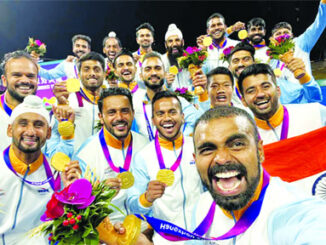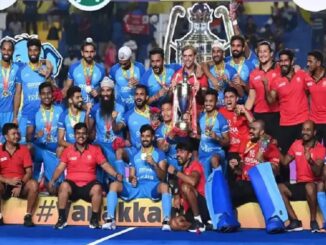
Those who had written Indian hockey off a couple of years ago are now forced to eat their words. India is back and back with a vengeance. In the past one year, Indian men have been making a clean sweep of all continental tournaments. And the just concluded Asian Games in Hangzhou is the latest. In August, India won the Asian Champions Trophy in Chennai.
It not only makes India a direct qualifier for the 2024 Paris Olympic Games Hockey competition, but also makes former Olympic champions an undisputed leader of the continental hockey.
India exhibited great team effort and played superbly throughout the tournament scoring 58 goals and emerging the only unbeaten team in the tournament. India’s arch-rival, Pakistan, however, could not end the tournament the way it wanted. Though Pakistan ended on a winning note defeating Malaysia in the playoff for the fifth and sixth position, it expected to finish a little higher, at least on the podium.
Now previous champions Japan, Korea, China, Pakistan and Malaysia will have to go through the rigmaroles of playing the Olympic Qualifying tournaments for a berth in the 2024 Paris Olympic Games. Though initially Pakistan had offered to host one of the Olympic Qualifier Tournaments in Lahore, but it was taken away by the International Hockey Federation (FIH) quoting internal strife in the country as the reason. The tournament will now be held in Oman, the new hockey center of the continent after Bhubaneswar, Rourkela, Kuala Lumpur and Ipoh. India’s return to the top was the culmination of a long-drawn effort that saw it making a clean sweep of continental tournaments it played this year.
It added its sixth title to its kitty by defeating defending champions Japan 5-1 in the Asian Games final. Earlier in the pool matches India recorded its biggest ever win (10-2) over arch rivals Pakistan.
India started with a style by notching up 16-0 win over Uzbekistan in the opener followed by 16-1 win over Singapore. After taking a comfortable 3-0 lead against Japan in the next match, India conceded two goals in the closing stages of the game to end with a 4-2 win over defending champions Japan. After a record 10-2 win against Pakistan, India had little trouble in defeating Bangladesh 12-0 in its last pool game to finish at the top of the table.
In the semi-finals, South Korea put up a splendid fight but it was not enough to upset the rhythm of the Indians looking for glory. India won the semis 5-3 for a place in the gold medal match. Pitted against the 2018 champions Japan in the final, India reiterated its supremacy to prove that earlier 4-2 win in the pool games was no fluke. India ended the summit clash with an impressive 5-1 win.
Harmanpreet Singh. (Photo: Twitter)
India’s title triumph was also a personal gratification for the team captain Harmanpreet Singh, a drag flicker. Though in the last FIH World Cup for men hosted jointly by Bhubaneswar and Rourkela, one of reasons attributed for India’s poor ninth finish, was fewer goals from Harmanpreet than expected. He proved he is still the best as he scored in every match of significance. Even in the final, two of five goals came from his lethal drag flicks.
India’s return to top position after a gap of nine years has warmed the cockles of the hearts of Indian hockey fans the world over. Now the focus will be on the bigger challenge, the summer Olympic Games. Harmanpreet had incidentally played sheet anchor when India returned to podium at the 2020 Tokyo Olympic Games by remaining one of the top scorers. And in Hangzhou he proved beyond doubt that he is still the number one.
Earlier this year, the FIH Hockey5s Asia Cup in Oman, India recorded a 2-0 win in a penalty shootout after a 4-4 draw with Pakistan in the final. Only a week earlier, Indian women had won the gold medal at the same venue. Never before in the history of hockey any team had won so many continental titles in a row. As of today, India is the winner of Asian Games for men, Asia Cups, both for men and women, Asian Champions Trophy for men and Asia Cups, both for junior men and women.
After the Asian Games title triumph, India has joined the hosts France, Australia men and women and the Netherlands men and women, as direct qualifiers for the 2024 summer Olympic Games. Later this month, Pan Am Games in Santiago will decide the teams, both men and women, that will represent Americas in the Paris Olympic Games.
(Prabhjot Singh is a senior journalist. Read his articles at www.probingeye.com)
Immigrants contribute to the ethnocultural diversity of the farm population. This is important because a diversified farm population provides a broad range of skills, experiences, perspectives and cultural influences that can boost the potential for increased productivity within the agricultural sector.
By Prabhjot Singh
Punjabi is the second largest mother tongue of Canada’s immigrant farm population, says the latest report of the Statistic Canada released on Friday. According to the report 18.5 percent of total immigrant farm population has Punjabi as its mother tongue. German tops the list with 23 percent while Dutch comes a close third with 18.2 percent.
The Report has listed five top mother tongues of the Canadian immigrant farm population. They are German (23 percent), Punjabi (18.5 percent), Dutch (18.2 percent), Mandarin (4.5 percent) and Italian (2-9 percent).
It further says that the share of the immigrants in the total farm population of Canada in 2021 was 6.9 percent. Incidentally, 23.1 percent of total population of Canada was of immigrants.
As of 2021, the total farm population was 5,90,710. It comes to 1.6 percent of the total population of Canada.
In 2001, immigrant farm population was 6.8 percent of the total farm population.
The report further says that Canada’s farm population comprises farm operators (people responsible for the management decisions in operating a farm) and the individuals in their households. In 2021, the farm population (590,710 people) represented 1.6% of the total population in Canada.
Results from the “Agriculture–Population Linkage” show that the face of Canada’s farm population is changing. Farm households are becoming more diverse and becoming smaller. Additionally, greater percentages of farm households are living in urban areas, while their income continues to outpace that of the total population. The immigrant farm population plays a role in shaping Canadian agriculture.
Immigrants contribute to the ethnocultural diversity of the farm population. This is important because a diversified farm population provides a broad range of skills, experiences, perspectives and cultural influences that can boost the potential for increased productivity within the agricultural sector.
In 2021, immigrants made up 6.9% of Canada’s total farm population, up slightly from 6.8% in 2001. By comparison, the proportion of immigrants in Canada’s total population increased from 18.7% in 2001 to 23.1% in 2021. Another revelation of the Statistics Canada report is that under 4% of people in the farm population are part of a racialized group. In 2021, individuals from racialized groups accounted for 3.7% of the total farm population in Canada. Meanwhile, individuals from racialized groups made up more than one-quarter (26.6%) of Canada’s total population.
Among the 21,910 people in the farm population who self-identified as being from a racialized group, over half (53.0%) were South Asian, followed by Chinese (15.8%). Black (5.9%) and Latin American (5.9%) were tied as the third-largest racialized group.
Another important aspect of the report has been about the increasing percentage of the Indigenous farm population. In 2021, 2.8% (16,705 people) of the farm population self-identified as Indigenous. This was slightly higher than the percentage reported in 2001 (2.3%). Meanwhile, 4.8% of Canada’s total population self-identified as Indigenous in 2021.
Métis (11,225) remained the largest group among the Indigenous farm population in 2021, accounting for over two-thirds (67.2%) of the total. The second-highest group was First Nations people (4,825), who made up 28.9% of the Indigenous farm population in 2021.
Incidentally, the farm population has a higher percentage of men and older people than the total population. In 2021, over half (52.5%) of the farm population were men, whereas just under half (49.4%) of the total population were men.
The farm population also has a higher percentage of older people. In 2021, over 4 in 10 men (40.3%) in the farm population were 55 years and over, compared with 31.2% in the total population. Meanwhile, 41.0% of women in the farm population were 55 years and over, compared with 33.5% for the total population.
Conversely, the farm population had smaller proportions of men and women under 35 years when compared with the total population. In 2021, 38.2% of men in the farm population were under 35 years, compared with 42.8% for the total population. Meanwhile, 34.4% of women in the farm population were under 35 years, compared with 40.1% for the total population.
Another finding of the report has been that the farm population is more likely to report a religious affiliation than the total population. In 2021, nearly three-quarters (72.5%) of the farm population reported a religious affiliation, whereas 65.4% of the total population reported a religious affiliation.
Among the farm population that reported religious affiliations, the most frequently reported religion in 2021 was Catholic (39.3%), followed by Christian, Not Otherwise Specified (NOS) (14.6%) and the United Church (13.8%). This differs from the total population, where Catholic (45.8%), Christian, NOS (11.6%) and Muslim (7.5%) were the three most frequently reported religions among those who reported religious affiliations.
Farm population and farm household trends reflect decreasing farm numbers, the report said. Farms have become increasingly sophisticated operations that harmonize automation and modernization advancements. This has corresponded with declines in the number of farms and the farm population in Canada. In 1971, 1 in 14 Canadians was a member of the farm population. By 2021, that number decreased to 1 in 61 Canadians. Overall, from 1971 to 2021, the farm population declined by 62.2% to 590,710 people.
The decrease in the size of households in Canada is a widespread societal trend, and farm households are no exception. In 1971, the average size of a farm household was 4.3 people. By 2021, it decreased to 2.8 people. By comparison, the average household size of the total population in 1971 was 3.5 people. By 2021, it fell to 2.4 people.
Total income of a farm household includes income from all of its members, regardless of whether their income sources are related to farming or not. In 1970, the median income of farm households was $36,511 (in constant 2020 dollars). This was 34.0% lower than the median income of households within the total population.
In the past two census periods, the median income for farm households has been higher than that of households within the total population. In 2015, the median income of farm households was $89,230, 17.3% higher than the median household income of $76,048 in the total population. By 2020, the median income of farm households was $95,142, 14.6% higher than the median household income of $83,000 in the total population.
The diversification of income sources within the farm population, says the report, has evolved over time. In 1970, within the farm population, the average annual self-employed person’s non-farm income was $845 (in 2020 constant dollars). By 2020, it had increased 71.4% to $1,448. This increase in non-farm income suggests that the farm is not the sole contributor to farm household income.
Against the backdrop of the COVID-19 pandemic, the proportion of farm households reporting other sources of income as their major source of income increased from 23.7% in 2015 to 29.0% in 2020. This percentage increase may have been impacted by other income from government sources, such as federal government emergency benefits received during the pandemic, which is included as other sources of income.
Private retirement income is also a component of other sources of income that increased. In 2020, private retirement income made up 7.4% of farm household income, up from 6.0% in 2015. This reflects an aging farm population where more members of the farm household are reaching retirement age.
As was also the case in 2015, wages, salaries and commissions were the most frequently reported major source of farm household income in 2020, with 45.9% of farm households reporting this as their major source of income. However, this was lower than what was reported in 2015 (48.9%)
The report also established that a greater percentage of the farm population is living in urban areas. More of the total population is living in urban areas, and the same is true for the farm population. In 1971, 7.5% of the farm population resided in urban areas. By 2021, that figure grew to nearly one-quarter (24.5%), up from 16.1% in 2016.
The proportion of the farm population living in urban areas differs widely by province, with the highest proportion reported in Newfoundland and Labrador (42.2%), followed by British Columbia (37.8%) and Alberta (28.3%).
In 2021, just over 4 in 10 people (40.8%) in the farm population connected to farm operators working on fruit and tree nut farms and vegetable and melon farms resided in urban areas.
The farms primarily situated in rural areas have a demand for large areas of agricultural land for growing field crops and grazing livestock. In 2021, almost three-quarters (72.2%) of the farm population that comprises farm operators working on oilseed and grain farms lived in rural areas.
In 2021, the vast majority (93.6%) of farms classified as dairy cattle and milk were reported in rural areas. On average, these farms reported the third-largest acreage in Canada compared with other types of farms. Dairy cattle and milk farms require frequent supervision and intervention (e.g., milking twice per day), implying that farm operators, and consequently their household members, would likely live close to the farm.
(Prabhjot Singh is a veteran journalist with over three decades of experience of 14 years with Reuters News and 30 years with The Tribune Group, covering a wide spectrum of subjects and stories. He has covered Punjab and Sikh affairs for more than three decades besides covering seven Olympics and several major sporting events and hosting TV shows.)
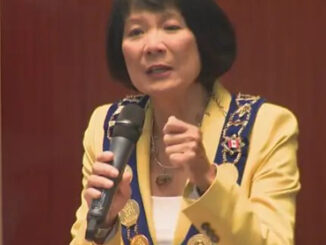
TORONTO (TIP): Olivia Chow has become the first person of color to be sworn in as Mayor of Canada’s most populated city of Toronto. Her swearing-in ceremony, attended by councilors, guests of the elected mayor, former mayors, city staff and agency representatives was held at the city hall. The 66-year-old Olivia Chow, widow of former NDP leader Jack Leyton, was elected in the bye election held last month. Chow, a former NDP MP and past city councilor, defeated 101 other candidates to win last month’s mayoral election to replace John Tory. Her victory vaults a progressive into Toronto’s top job for the first time in over a decade.
In her first address after the ceremony, Olivia Chow pledged to build what she calls a more caring and affordable city. She received a standing ovation from her colleagues on the council for her push for a better city.
“Let’s build a Toronto that is more affordable, safe and caring, where everyone belongs,” she said after signing the declaration. “Together we can, and today we start.”
The new Mayor has a host of issues on her plate. These include a massive budget shortfall, driven in large part by decreasing transit revenues and increased shelter costs.
During her opening remarks as mayor, she chose to call on both the federal and provincial governments to step up and help refugees who are facing housing issues in the city. “Even in the face of those steep challenges, people have sent a clear message that change is not only possible, it’s absolutely necessary,” said Chow.
Chow, known for her passion for cycling, elected to bike to work on her first day in office. Cycle Toronto hosted a group bike ride to City Hall to mark her inaugural day, with Chow joining the short ride and briefly addressing the group.
Since the June by-election, she has been holding meetings with city staff, finalizing her team and holding transition engagements with civil service and non-profit groups on priority issues to get to her work.
She made it clear that she will need cooperation from everyone in her endeavor to make Toronto the most livable city. She affirmed that city councilors will continue to do “what they love to do.”
“They will be contributing the way they want to contribute,” she said, “and accomplish what they want to accomplish in these three years that we have in front of us.” Since John Tory’s resignation and departure in February, the role and responsibilities of mayor have been held by Deputy Mayor Jennifer McKelvie.
DALLAS (TIP): Guru Nanak Dev Global University (GNDGU) has announced the appointment of four distinguished individuals to its esteemed Advisory Board. Dr. Daljit Singh, Dr. Jagbir Singh, Paramjit Singh, and Prabhjot Singh will bring their wealth of expertise and experience to enhance GNDGU’s commitment to academic excellence, sports, and journalism collaboration.
Dr. Daljit Singh is an eminent academician, administrator, and renowned law specialist. With a distinguished career spanning several decades, he has made significant contributions to the field of legal education and administration. Dr. Singh’s experience includes serving as the founder Director of the Army Institute of Law, Patiala, and as a Professor and founder Head of the School of Legal Studies, Former Vice Chancellor of Rayat Bahra University. His visionary leadership and commitment to education will be invaluable to GNDGU.
Dr. Jagbir Singh is a distinguished scholar and educator with a remarkable career in Punjabi literature and religious studies. Currently serving as the Chancellor of Central University of Punjab, Bathinda, he has made significant contributions to academia throughout his illustrious journey. Dr. Jagbir Singh’s deep knowledge and scholarly background will enrich the academic initiatives at GNDGU.
Paramjit Singh, a trailblazing coach from Faridkot, Punjab, has transformed the Gwalior Women Hockey Academy into a powerhouse of talent and significantly contributed to the growth of women’s hockey in India. With over 25 years of experience, his coaching expertise has nurtured numerous players who have represented India in international competitions. Paramjit’s valuable insights and passion for sports will greatly enhance GNDGU’s sports programs.
Prabhjot Singh, a highly accomplished journalist, brings his extensive experience spanning four decades to the Advisory Board. His outstanding work in investigative journalism, environment and business reporting, sports coverage, and feature writing has earned him accolades. Prabhjot Singh’s journalistic expertise and global perspective will contribute to the university’s focus on journalism and media studies. “We are thrilled to welcome Dr. Daljit Singh, Dr. Jagbir Singh, Paramjit Singh, and Prabhjot Singh to our Advisory Board,” said Dr. Shivinder Singh Gill, Founding Member of Guru Nanak Dev Global University of Dallas. “Their diverse backgrounds, exceptional achievements, and commitment to excellence will significantly strengthen our university’s position as a global leader in education, sports, and journalism. We look forward to their invaluable contributions and guidance in shaping the future of Guru Nanak Dev Global University.”
With the addition of these accomplished individuals to the Advisory Board, Guru Nanak Dev Global University reinforces its commitment to fostering collaboration between academia, sports, and journalism, providing students with a holistic educational experience that prepares them for success in their chosen fields.
About Guru Nanak Dev Global University:
Guru Nanak Dev Global University (GNDGU) of Dallas is a prestigious educational institution founded with the vision to provide holistic education, promote research and innovation, and nurture the values of compassion, equality, and social responsibility based on Guru Nanak Dev’s teachings. The university strives to become a global leader in education, research, and positive social impact. By aligning its mission goals with the United Nations Sustainable Development Goals, GNDGU actively contributes to the achievement of these global objectives. By 2035, we strive to establish five world-class centers of excellence that prepare students to become enlightened global citizens, actively contributing to society. For more information, please visit www.gndgu.com
New immigrants have contributed in a big way to help Canada achieve yet another milestone as its population touched the 40 million mark on Thursday, June 15. According to data released by Statistics Canada, the country’s population is currently growing at a record-setting pace. In 2022, the number of Canadians rose by 1,050,110. This marks the first time in Canadian history that its population grew by over 1 million people in a single year, and the highest annual population growth rate (+2.7%) on record since 1957 (+3.3%).
While that previous record is mostly attributed to the high number of births during the post-war baby boom, international migration accounted for nearly all growth recorded in 2022 (96%).
If this rate of population growth was to stay constant in the years to come, the Canadian population could double in about 26 years, Statistics Canada said. In 2021, more than 8.3 million people, or almost one quarter (23%) of the population, were or had ever been, landed immigrants or permanent residents in Canada. This was the largest proportion since Confederation, topping the previous 1921 record of 22.3%, and the highest among the G7. This growth is reflected across Canada. In 2022, every single province and territory recorded a growing population, except for the Northwest Territories. Canada’s population clock uses a real-time model based on Statistics Canada’s quarterly demographic estimates. The numbers for Canada and for each province and territory are updated in real-time based on the most recent birth, death and migration data.
The clock also shows the time it takes for a demographic event (birth, death or migration component) to occur in Canada. However, the clock does not reflect when the events themselves actually occur. Rather, it shows the average pace of Canada’s population renewal in real-time.
The census of population is conducted every five years. It provides a snapshot of Canada at a specific point in time and also provides counts for small regions and characteristics of the population according to various variables. Statistics Canada complements this data with ongoing population estimates that track demographic shifts between censuses.
Canada is by far leading the G7 countries for population growth. This was certainly true in 2022 and has been the case for the last two decades. In 2021, more than 8.3 million people, or almost one quarter (23%) of the population, were, or had ever been, a landed immigrant or permanent resident in Canada. This was the largest proportion since Confederation, topping the previous 1921 record of 22.3%, and the highest among the G7.
Canada’s Indigenous population continues to grow much faster than the national average. It increased by 9.4% from 2016 to 2021, surpassing the growth of the non-Indigenous population over the same period (+5.3%).
The 2021 Census counted 1.8 million Indigenous people, accounting for 5% of Canada’s total population, up from 4.9% in 2016.
Statistics Canada has been tracking the growth of Canada’s population since the very first national census, conducted in 1871.
Canada has known several important waves of immigration. One of the biggest was at the very beginning of the 20th century, which saw many immigrants settling the Prairies. In 1913, Canada welcomed over 400 000 immigrants. A record that was only surpassed in 2021 (and again in 2022).
The period after the Second World War (1946-1965) also saw very high rates of population growth, mostly because of the baby boom. The average number of children per woman at that time peaked at 3.94 in 1959, compared to 1.4 in 2020.
The fertility rate started declining after the 1960s. By 1995, immigration overtook natural increase (births minus deaths) as the main source of population growth.
In 2015, there were more Canadians aged 65 and older than between 0 and 14 for the first time in Canada’s history.
Canada’s immigration targets have been increasing since 2016, in an effort to address labor shortages and an aging population. In 2020-2021 population growth slowed due to border restrictions put in place to curb the spread of COVID-19. But as recent numbers show, it quickly bounced back.
Defending champions India overcame a 0-1 deficit to defeat spirited Japan 3-1 for its second successive win in the AHF Junior Men’s Asia Cup Hockey Tournament at Sultan Qaboos Youth Complex for Sports and Entertainment in Salalah, Oman, on Thursday, May 25. With this win, India shares top spot with Pakistan with two wins each.
On May 24, Pakistan had beaten Thailand 9-0 for its second straight win. The main architect of its second big win was Abdul Rehman, who scored five of nine goals for his team. Pakistan had beaten Chinese Taipei 15-1 in its opening game.
India was cautious as it took to the field against Japan for its second game after a flattering 18-0 win over Chinese Taipei yesterday. The Japanese, who were playing to a strategy, with man to man marking, drew the first blood when Kumpei Yasuda scored a brilliant solo after dodging past the entire Indian defense. His goal in the 19th minute was a stunner for India that immediately went into attack.
After trailing 0-1 at half time, India came back strongly in the third quarter, scoring twice. It was Araijit Singh Hundal, hero of yesterday’s big win, who restored parity with his specialist reverse flick from the top of the striking circle in the 36th minute. Three minutes later Sharad Nand Tiwari made it 2-1 with a penalty corner conversion. Skipper Uttam Singh finally made it safe with his 56th minute goal to make India a strong contender for a semi-final berth from the pool.
Remembering the Hockey Wizard: He was a real “King.”
By Prabhjot Singh
Last month I was in Nairobi to witness the Vaisakhi Hockey Tournament organized by Sikh Union, Nairobi, perhaps one of the oldest sports clubs in the world. The Club will be celebrating its centenary in 2026. One of several luminaries the Club proudly claims to have produced is Avtar Singh Sohal, “Tari” to his friends and fans the world over.
Tari belongs to a rare band of hockey Olympians who attended six Olympics, four as a player, one as a coach and one as a Technical Delegate.
Interestingly, he represented two “Kenyas” in the prestigious quadrangular Games. In 1960, his first Olympics, he represented British Kenya. Subsequently, he represented independent Kenya in 1964, 1968 and 1972 Olympic Games. We often meet, exchange notes, talk hockey and share some interesting encounters/episodes on and off the hockey field.
Recently when I buttonholed him in Nairobi, I asked Tari who had been his favorite Indian hockey player. Overwhelmed, he smiled back : “those days, all Indian players were outstanding and great. I was always a fan of VJ Peter, Joginder Singh also known as Gindi, and of course the great Balbir Singh Senior. But my all-time favorite was Prithipal Singh, one of the greatest fullbacks the game has produced. He was an icon – ruthless, tough and the best penalty corner hitter of his times.
“Since I also played as a fullback, I used to watch him closely. I learnt so much from him. Besides being an outstanding player with whom I played in a couple of Olympic Games, including 1964 and 1968, he was a simple man, a thorough gentleman,” recalls Avtar Singh Sohal.
There cannot be a better tribute from an Olympian to another Olympian, from an outstanding fullback to one of the greatest fullbacks of his time. They rubbed shoulders and opposed each other many times on the playfield but remained great friends.
“I was deeply anguished when I heard of his untimely death in 1983. Hockey needed him for a much longer period,” adds Avtar Singh Sohal.
Those who know “Bhaji” will fully endorse what Tari says.
Besides being an accomplished hockey player, he was a top administrator and was Director, Students Welfare, at Punjab Agricultural University, Ludhiana. He, himself, held a master’s in agriculture.
His soul used to be in lush green playfields of Punjab Agricultural University. And those who ever invaded the playfields for activities other than sports knew the punishment. Hockey was his passion. He, however, never compromised on his principles.
Not many would have known that he refused to bow to the pressure tactics of the then hockey chief, Mr. Ashwani Kumar. To the great dismay of Mr. Kumar, he quit Punjab Police and joined Railways. He knew this step may cost him a place in the 1964 Olympic team. But for him his principles and ideals were higher than begging for a place in the team.
As expected, his name was missing from the initial list of players chosen for the Olympic Games camp. Prithipal was not traceable. He had gone underground. There was a lot of hue and cry in the media about his exclusion from the Olympic list.
The IHF relented and recalled him not only to the camp but also included him in the team. The mischief IHF played was quickly spotted by Prithipal Singh. He was categoric that he would go to Tokyo Olympics as a fullback and not a halfback as announced by the IHF selection committee.
The team left for some warm up games in New Zealand on the way to Tokyo Olympic Games without clarifying his position. He did not play in the first match that India lost badly. Criticism in the media back home was so loud that the team management led by the manager Inder Mohan Mahajan had to relent and named him in the squad for playing subsequent games. But he was not named as a fullback.
Prithipal refused to take field as a halfback and offered to be flown back home instead.
The team management was in a fix as it was aware that he was “stubborn” and would not compromise.
Ultimately, he was fielded as a fullback, and he helped India win with his penalty corner conversions. His awe was so much that India won the last Test match against New Zealand by a huge margin. The morale of the team after wins in the last two games touched a new high as it arrived in Tokyo.
Prithipal Singh receiving an award
Prithipal scripted history in Tokyo with his lethal strikes and helped India not only reach the final but also helped the former champions regain the gold they had lost to Pakistan in Rome. It was his penalty corner strike that got India a penalty stroke from which Mohinder Lal scored the match clincher. It was at Tokyo that Prithipal was crowned “Penalty King.” He became the first sports star to be awarded both the Arjuna award and Padma Shri.
In 1975 when Indian hockey was in doldrums after Ashwani Kumar had quit, Punjab offered to train the team. And India led by Ajitpal Singh won the 3rd World Cup in Kuala Lumpur, Prithipal Singh was back in the limelight. The new IHF Chief, Dr MAM Ramaswamy, named him as Chairman of the Selection Committee.
But this did not last for long as Prithipal refused to compromise his position. After the 1976 Montreal Olympic games debacle, when Dr MAM Ramaswamy, decided to name Aslam Sher Khan as captain of the Indian team for participation in the Quaid-e-Azam invitation tournament in Lahore without consulting him, he resigned. He refused to take it back even after Dr Ramaswamy tried to persuade him. This was Prithipal, steadfast, and uncompromising. He always remained “bhaji” to those who knew him well.
I used to be one of his confidants. At times I would get a call from his personal staff for drafting letters or statements. His tone and tenor used to be straight, to the point and always in the larger interest of the sports in general and hockey in particular. In one of the then popular Guru Nanak Dev Memorial Cricket Tournaments, I was declared second best wicketkeeper and Bhaji was the chief guest. “So, you play cricket also. I thought hockey is your game,” quipped Bhaji at the prize distribution function.
Believe me, he was all sport when I persuaded him to play an exhibition cricket game between Hockey players (mostly Olympians) and the PAU cricket team. He was a superb hitter of the ball. It was fun watching Bhaji don white flannels.
If politics was his passion, contesting elections was his pastime. From panchayat to gurdwara elections, state legislature to parliament, he figured prominently in almost every election that took place in Punjab at least since the reorganization of the State in 1966. His slogan “raaj nahin sewa” met with the same overwhelming popularity as were his “atta-daal” and “free water for farmers” schemes.
He was a master appeaser. He knew people’s pulse. Staying in power was his biggest ambition that he successfully achieved by serving this border State as Chief Minister for five times, besides leader of Opposition thrice and Member of Parliament and Union Agriculture Minister in Morarji Desai’s government.
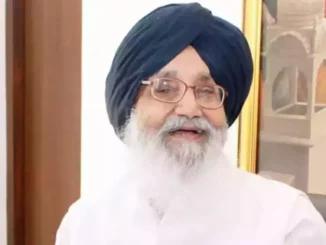
His demise at the age of 95 will make a huge difference not just to Punjab or Akali politics but also to national polity and coalition politics. He scripted the success of coalition politics in the country, first with the Jana Sangh, then during JP’s movement Janata Party and later with the Bharatiya Janata Party. Though subjects like center-state relations were dear to his heart, he died seeing Centre becoming more powerful than what it was at the early stages of his political career. The decision to walk out of the SAD-BJP coalition was not by choice but by compulsion. And the defeat in the 2022 assembly elections to an unknown political entity of Aam Aadmi Party (AAP) marked an end to a glorious political career that shaped the destiny of present Punjab.
He was no different than most of other Akali stalwarts or “Taksali” leaders. He, too, started his political career as a Congressman. He, however, quickly moved to the Shiromani Akali Dal fairly early, but always remained a “moderate” without allowing himself to be swayed by the demand for a separate Sikh State or Khalistan. Though the Shiromani Akali Dal came out with the Anandpur Sahib resolution in 1973 for more rights to States, he was one leader who refused to give in to separatists. If the Shiromani Akali Dal, the oldest regional party in the country, witnessed divisions and partitions as the State of its influence, Punjab, did, he always stood for cordial center-state relations.
Various initiatives of the Centre , including Indira Gandhi award, Shah Commission report and even the Rajeev-Longowal accord saw the moderates confronted both in Punjab and SGPC politics, he remained steadfast and was the last to get into politics of confrontations. It is why lots of criticism was heaped on him for not getting any of the long-standing demands of the State conceded by the center.
He always believed that the Akali Dal was the political face of one of the most affluent, patriotic and hardworking minority communities that made more than 80 percent of total sacrifices in the freedom struggle and was not only left without a capital but also lost some of its prestigious projects it built after independence.
As a staunch supporter of peaceful negotiations for resolving the long-standing demands, he was successful in carrying not only the Sikh community but also the Hindu community in the State as well. With the center dilly dallying on conceding any of the demands, he had the difficult job of representing the interests of a minority community that had at times the growing influence of hardcore elements demanding separate Sikh state without being in opposition to the majority community, or seeking to mobilize its own support in hostility to the majority community. This was a herculean task that not many Akali Dal leaders, including only other Akali Chief Minister in last more than four decades, Surjit Singh Barnala, tried to handle with tact while performing this balancing act.
The demand for a separate Sikh state, Khalistan, even after more than 75 years of independence , has refused to die down. Governments of the time may have tried to dismiss it as an extremist slogan but none has ever tried to resolve it amicably. Sikh leaders, especially those representing the Shiromani Akali Dal, have never lent any support to the demand but also did nothing to get the other long-standing demands of the State, including transfer of Chandigarh and water works to Punjab.
Parkash Singh Badal always played safe and subscribed to the philosophy of peaceful coexistence maintaining universal brotherhood, tranquility and peace after more than two decades of bloodshed that ravaged the State. Intriguingly, his name remained associated with some of the major controversies, including the start of Sikh-Nirankari clashes on Baisakhi day that ultimately pushed the State into militancy as the demand for the acceptance of Sri Anandpur Sahib resolution grew louder and clearer.
He always believed that peace and progress would put behind the demand for Khalistan. He needed the center’s support that came at times but conditionally. Punjab is the only state in the country that has witnessed two partitions in the last 75 years. First of these came with the Independence, and second followed Sikhs’ continuous demand for a separate Punjabi speaking or lingual State.
The Akalis, who in coalition with Congress were generally ruling the State between the first and the second partition in 1966, had their political aspirations upped and parted ways with Congress before an interim government was stalled in the State. As a sequel to that clarion call, many Sikh leaders came out of the Congress government and Parkash Singh Badal was one of them. After non-Congress governments took over from where Congress left before the 1966 reorganization, Akali’s started gaining political ground. After initial reluctance, the Centre too was forced to reorganize some states on a linguistic basis. The Centre, however, played a game by drawing a long list of concurrent subjects, in which the Centre and the states both have the right to legislate, and the automatic right of the Centre to prevail over a state in any concurrent legislation.
Some of the demands Punjab subsequently raised were at the core of the 1973 Anandpur Sahib resolution. There was a lot of hue and cry after the resolution hit the public domain. It had several additional points that sought to placate more extreme elements which wanted to combine regional autonomy with religious exclusivity. In 1978, fresh resolutions that proclaimed themselves to be based on the Anandpur Sahib resolution were passed, but they eschewed ambiguous language that could lend itself to separatist interpretations. The Akalis became champions of states’ rights, and it was during this time that the baton passed into the hands of Badal.
Events elsewhere in the country set in motion a debate over center-state relations. A few non-Congress governments supported the federal structure before various Opposition-led states came together to demand restructuring of Centre-state relations. This led to the appointment of the Sarkaria Commission. The recommendations were just shelved in the cold store. The only positive, though theoretical, was the creation of the Inter-State Council. Badal had been a votary of implementation of the Sarkaria Commission recommendations, especially with regard to the consultative appointment of a state’s Governor. But then his efforts bore no success and he continued to enjoy power.
Badal’s alliance, first with the Jan Sangh, and later with its successor party, the BJP, stood at odds with his championing of states’ rights. Still, until last year, continued to stand by his alliance partners.
Badal as a man had a multi-faceted personality. Reading newspapers was his very priority every morning. Clips of news reports were regularly filed and maintained at his instance.
I used to interact with him regularly. He was not averse to criticism but at times insisted on getting his version played prominently. Sukhbir Singh Badal, after a brief stint in central politics wanted to make a flashy arrival in State politics. Those days, lots of stories were planted and played prominently about his imminent elevation as Chief Minister. He started calling meetings of bureaucrats and even Ministers and legislators. The old man stood cool and calm and made certain decisions that made it obvious who was the boss. Besides, it also cleared all speculations of his making room for his son. I did a special story saying that Badal remains firmly saddled. To my pleasant surprise I got a couple of calls early in the morning from CM’s house. Since I used to go for my morning game, and there were still no cell phones, I got a message that he wants to talk to me.
I called and he quickly came on line to acknowledge my story saying that factual position has been highlighted.
Otherwise, there were only a couple of other occasions when I got calls from him. One such occasion was when I was doing my story on how politicians were holding the public transport system to ransom. He called to say that he would love his version to go as prominently as parts of my serialized stories were going. Afterwards, the government went with full page ads in support of its transport policy rather than seeking a rejoinder to my series. Our relationship, as always, remained truly professional and criticism, if any, was taken sportingly.
One of his programs, Sangat Darshan, though popular with the masses, provided a lever to opposition parties to criticize him for diverting public funds to serve the political constituencies of his party members. Since, some parties, including Congress, also held him responsible for accepting money for the controversial SYL canal, he tried to silence his critics by notifying the acquired land and returning it to original owners. It, however, did not end the ongoing dispute between Punjab and Haryana. Staunch supporter of ideology and commitment to public services, he always denounced vendetta politics. Whatever his critics may have to say, he was not one of but the tallest of all politicians the State has produced in the post-independence era. It is one reason he commanded respect from leaders of all opposition parties for his secular and national outlook. Tailpiece: He always held he was doing “sewa” and not “raaj”. Interestingly, this “sewa” mostly came when he was in “satta” (raaj).
Money, equipment and bulging numbers do not modernize or improve efficiency of a police force. Training and motivation are the key elements that distinguish between an efficient force in uniform and huge squads of lathi wielding shabbily dressed men with big pot bellies.
By Prabhjot Singh
Society gets the police it deserves, is an adage that appears to be fast losing its relevance. Times have changed. So have societies. They say change is the only thing that is permanent. Police have changed but not to the expectations of the population at large. People still view men in uniform as aggressors and not law enforcers. It is one reason that even politicians at times would demand investigations of cases hawking media headlines by central agencies, including CBI, and not by their own “efficient and modernized State police forces.” Why? Why State police forces in general and Punjab Police in particular, have been targets of criticism. Are the police forces acting at the behest of their political bosses rather than abiding by the mandate given to them by the law of the land? Or something else is ailing the police?
Reasons may be many.
Growing awareness about human rights in general and the right to live a decent life in particular have put law enforcement agencies on the backfoot. There is growing criticism for inept handling of cases that hawk media headlines. Of late, Punjab police have been at the receiving end. Its unending battle against growing drug menace, gangsterism, extremism, religious sensitives and mafias controlling licensed supplies has greatly impacted its credibility. Of late, the Amritpal Singh case has not only put it in a tight spot but also raised serious doubts about its capabilities of apprehending offenders of law, leave aside gangsters, ultras and fugitives.
What is wrong with Punjab Police? Top heavy law enforcement agency with an active strength of 80,000 plus appears to be fighting a battle for credibility as Amritpal Singh and his accomplice escaped its planned dragnet on March 18. Since then, it has come out with various theories, amusing stories and corroboratory CCTV footages. Its investigations are leading nowhere. Also failed is the intelligence network. Equally intriguing is the role of central police forces and intelligence agencies, who too, have been on the trail of Amritpal Singh and other members of his infamous Waris Punjab De group.
There was a time when the police complained of antiquated weaponry, worn out vehicles, dilapidated buildings housing police stations, poor communication networks and lack of training in handling the changing face of crime.
But that is history. Punjab Police has been one of the major beneficiaries of modernization of police force initiative of the Union Government. The State was flushed with money, vehicles, gadgets as new buildings were built for police stations, new training centers, including those of anti-terror and cybercrime, were set up. New commando squads were raised, and the States were also financially assisted in raising the State Armed Reserve Battalions. Double barrel guns were replaced by self-loading rifles and assault weapons. Latest telecommunication was added to the police network to enhance its detection capabilities. Money, equipment and bulging numbers do not modernize or improve efficiency of a police force.
Training and motivation are the key elements that distinguish between an efficient force in uniform and huge squads of lathi wielding shabbily dressed men with big pot bellies. Training of police has always remained a highly debatable subject.
(The author is a senior journalist) To be concluded
There has been a phenomenal growth of education infrastructure in the country in general and Punjab in particular. The number of private universities, including technical universities, have multiplied many times. The State is dotted with medical, dental, engineering, education and engineering colleges.
By Prabhjot Singh
Education has it all. The simple test for gauging the progress of a state or a nation. is to look at its education standards. From Kindergarten to higher education, it is a single continuous process that chat while responding to societal and national requirements changes rapidly. From curriculums to methodology, from classroom teaching to use of technology and from textbooks to on training have all been part of the changing face of education. Today, education has become global as regional, territorial or geographical boundaries have become irrelevant in transfer and transmission of learning procedures and technologies.
The concept of tie-ups between local, regional and national institutions on one hand and foreign universities has become the trend of the day. A part of your degree course can be in the educational institution on your home turf while the other half or part of it can be in an overseas institution.
For many, education has grown beyond the sanctity of a sacred profession and become more of a business especially in the domains of providing quality education in sophisticated air-conditioned environs of lavishly built high rise or multistoried modern complexes.
While developing nations are facing a major problem of brain drain, the developed and advanced nations appear to be instant beneficiaries. Last week, the Indian Parliament was told that the number of students going abroad for post-secondary or higher education has been rising rapidly. The number has almost doubled in the last one decade.
There has been a phenomenal growth of education infrastructure in the country in general and Punjab in particular. The number of private universities, including technical universities, have multiplied many times. The State is dotted with medical, dental, engineering, education and engineering colleges.
Intriguingly, a large number of seats in these privately run or managed institutions remain vacant. The disturbing trend is that the number of these vacant seats has been increasing year after year.
Almost all major prestigious Boys Colleges in the State had to shed their “gender” to remain operational. They are now co-educational institutions with more than 50 per cent of their seats going to girl students. The exclusive girls colleges are doing well though their admissions, too, have come down over the years.
Though existing institutions and established universities are fighting a losing battle, private institutions and universities have shown phenomenal growth. Examples of Lovely Professional University, Chandigarh University or Chitkara University are all before us.
What is wrong with the State sponsored education system? Why is it losing out fast?
The reasons may be many.
After a long debate, the Union Government has given its nod for elite foreign universities to set up their Indian campuses. It has met with mixed responses. Some have hailed it while others have gone all out to assail this change in policy as a direct invasion of core educational values of the traditional Indian education system. The debate continues unabated.
Convinced that education is a flourishing business, many States, including Punjab, Haryana, Himachal Pradesh and even Union Territory of Chandigarh came out with the concept of Education Cities by providing the adequate basic infrastructure.
Besides major private players as mentioned above, a few others, claiming themselves to have pioneered quality education in the country, too, are spreading their network. Narsee Monjee Institute of Management and Amity University are among them.
Narsee Monjee Institute of Management (NMIMS) has set up its first campus in the country’s northern belt. Set up in Chandigarh, the first private deemed university in Chandigarh in 2021, it has been trying to make a name for itself with its state-of-the-art infrastructure, highly qualified staff, and unique pedagogy and curriculum in line with NMIMS.
The campus, says Dr Jaskiran Kaur, its Director, has brought new opportunities to the region by setting a new standard in higher education. It offers a variety of programs, including Commerce, Law, and Engineering, with the mission to prepare students to be lifelong learners through thoughtful mentoring, assuring their success.
NMIMS University’s one-of-a-kind approach to education is enhanced by its efficient multi-campus coordination, leading to seamless content delivery to improve students’ skills by harnessing their potential. The profound impact of learning at the University leaves such an indelible mark on the students that even after they leave the campus precincts, they continue to carry the legacy and culture of the institute.
Aligning with the University’s philosophy of holistic development, the campus also provides students with clubs and societies to participate in co-curricular activities, furthering their overall development and preparing them for the future.
The fee charged by NMIMS may be on a slightly higher side with an average of Rs 2.1 to Rs 2.5 lakh a year.
Dr Jaskiran Kaur emphasizes the overall development of its students that encompasses physical, intellectual, ethical, and philosophical enhancement. “India has always been at the forefront of quality education. This philosophy has been followed by India since the days of yore. At the Chandigarh campus, we believe in bringing the Indian ethos of teaching by following indigenous teaching methodology ingrained in our DNA,” she says.
Dr. Jaskiran Kaur expressed her pride in the rapid progress made by the campus and its standing as a leading higher education institution in Chandigarh. “Since its inception in the academic year 2021-22, it has made rapid progress, with a focus on employability rather than employment. Our faculty members are outstanding scholars in their respective disciplines, and the curriculum is developed through industry and academic integration. We are committed to continuing the more than 41-year-old legacy of NMIMS and its focus on providing quality education and excellence in technological and management research through our ever-evolving pedagogy. We believe in providing our students with the best resources and opportunities to help them succeed and become the leaders of tomorrow.”
Established in 1981, the Narsee Monjee Institute of Management Studies (NMIMS) is today recognized as a globally reputed university with strong industry linkages. It has duly earned every coveted accreditation and top ranking over the years, making its credibility unshakeable. It offers multiple disciplines across eight campuses that consist of 17 specialized schools, more than 17,000 full-time students, and about 800+ full-time faculty members, including ten faculty members with the Fulbright and Humboldt Scholarships for post-doctoral research.
Challenges, if taken seriously, are often productive as they determine the path of progress. The turn of the year is the time not only to look back but also to set new challenges and targets ahead.
Punjab, once the sword and sports arm of the country, is at a crossroads. Its economy is tottering at the brink. Problems of drug addiction, suicides, unemployment, continuous exodus of youth, gangsterism, pollution, diversification of agriculture and poor delivery of civic services are aggravating day by day. Though AAP, the new ruling party in the State, has been in the saddle for more than nine months, long standing problems continue to elude solutions. The State needs a perestroika to be back on its footing as a dynamic and prosperous leader.
The Bhagwant Mann Government in the State has been patting its back for a number of revolutionary decisions it has taken in the first nine months of its governance. These include “zeero electricity bills”, start of 100 Mohalla clinics besides starting bus service to Indira Gandhi International Airport in New Delhi from various district headquarters, it has taken in the first nine months. It is also claiming credit for introducing “single pension for MLAs”, regulate supply of sand and gravel at affordable rates, control corruption in public offices and improving school education. The less said the better.
Intriguingly The State government was concerned more for wowing voters in Gujarat and Himachal Pradesh in its party fold than redress the chronic problems facing the State. Inserting full page advertisements in newspapers not read in the State and on TV channels that have larger viewership outside the geographical terrains of the State have evoked severe criticisms, both from the political opponents as well as eminent social scientists. These extra ventures in far off “greener” pastures even failed to get the ruling party mileage it was expecting to get. The only gain, as it claims, has been in its status of becoming a national party with its nominees sitting in four Assemblies. The progress on the national political horizon may be commendable for a party that made its debut less than a decade ago. Still, it falls far short of expectations of the people who have been posing their electoral trust in hoping it to be a harbinger of change in a country that has primarily been ruled by two parties – Congress and Bharatiya Janata Party – with brief spells of rule by alliances.
AAP may be working for a larger agenda as it has set its eyes to be a major political opponent to Narendra Modi’s BJP. It has been preparing itself for its bigger political challenge, the 2024 general elections. To succeed, it has to keep its already acquired flock together. Punjab and Delhi will be its biggest testing grounds. It has additional challenges and issues confronting the State. Farmers are still up in arms. Industry is facing a plethora of problems. Health care and basic civic infrastructure, including provision of safe potable water and disposal of solid garbage have been engaging the attention of the State but without much reprieve.
One of the major challenges facing the State is shortage of funds. It keeps looking towards the Centre for special packages rather than cutting down its wasteful expenditure, including its publicity budget besides rationalizing its security expenditure. Growing budget of subsidies and diminishing channels generating revenue coupled with rapidly increasing expenditure on maintenance of establishment, including the security of Chief Minister and other VIPs, are all contributing factors for the deteriorating fiscal health of the State.
Strong statesmanship and all-out effort to redress some of the chronic problems of the State are the minimum the people of the State expect from the incumbent government in the New Year. Looking for help from outside, including investments, is laudable but the State cannot be dependent upon others and the doles from the Centre. Punjab needs a hard and strong push as it will have to fight its own battle. Think more of Punjab than Delhi or Gujarat should be the motto of Bhagwant Mann government.
(Prabhjot Singh is a senior journalist. He can be reached at prabhjot416@gmail.com
Phone: +1 647 241 3806/+91 98140 02189
visit probingeye.com or follow him on Twitter.com/probingeye)
Every year is unique in itself. If you love soccer and happen to be a fan of Argentina, the year 2022 could not have ended on a better note. The FIFA World Cup 2022, first mega soccer event to be held on Asian Arab soil, may have brought the world, riddled by factionalism and unending East-West rivalry, together but peace continues to elude the globe.
The world, even after two years, is still scarred by a possible revival of Corona pandemic in new attire. With economies shattered and inflation remaining uncontrollable, challenges of 2023 may shake humanity to its bones, with reliable quality health care remaining the biggest global challenge. Though the Russian President Putin has been quoted saying that he wants an immediate end to war in Ukraine, indications of the present conflicts make exit look remote. New Year 2023 will bring in new hopes, new challenges and a more complex and competitive world to live in. International travel will be no more the same. With uncertainty over Covid pandemic travelling to the coming year, a new world order, especially the one opposed to mandates and lockdowns, may push the global economies into a new fix. With interest rates rising and the household going out of control with no visible signs of inflation remaining within reasonable limits, the socio-economic fabric of the world at large is set for a drastic change. Governance and politics will face unforeseen challenges to set new equations in global order based on fiscal health of nations, both developed and developing. While 2022 will be part of history by the end of the week, it would, as usual, be remembered for witnessing heightened strife, partial to major failure in controlling disease and human suffering, and emerging new icons of global power. If international air travel got a big hit in the beginning of the year, air travel became a contentious issue with major airports presenting chaotic scenes with their inability to control rush as people wanted to enjoy freedom from shackles of state-induced mandates. Though the sports industry worth over 140 billion Euros started to vibrate again with major world sporting events, including FIFA World Cup, the 2022 Winter Olympic Games (boycotted by Political leaders of many nations, including the US and Canada), Commonwealth Games, T20 World Cup and US Open minus Novak Djokovic being held with spectators filling the stands, still many events, including the 2022 Asian Games, remained on hold. Russia and Belorussia continued to be on the hit list of both the IOC and the US-led lobby for its invasion of Ukraine, the world witnessed a number of nations, including Sri Lanka, crumbling under their fractured economies. Afghanistan landed in hands of the Taliban and the Chinese aggression over its claim of Taiwan remained bullish. When the year 2022 started, no one would have imagined China, Russia and Pakistan getting on one side leaving the US red-faced. India surprised all with its neutral stand on Russian invasion of Ukraine besides taking over the Presidency of the G20 promising to work for ending global terrorism and restoring the right of dignified existence of smaller and less powerful nations. Welcome year 2023. Let it be a year of the common man and not those playing with human values and lives. Hope you, 2023, bring along solutions to problems – poverty, disease, unemployment and inflation – for which the current powers have no answers.
(Prabhjot Singh is a senior journalist. He can be reached at prabhjot416@gmail.com
Phone: +1 647 241 3806/+91 98140 02189
visit probingeye.com or follow him on Twitter.com/probingeye)
After successfully holding the Asian Games, Afro Asian Games and the Commonwealth Games, India has now set its eyes to host the world’s biggest sporting event, the summer Olympic Games in Prime Minister Narendra Modi’s home state of Gujarat in 2036.
Though India is yet to make a formal bid, its chances of becoming the fourth Asian city to hold the quadrangular sporting event will depend on the pitch it makes at the IOC session in Mumbai in September 2023. It will be for the first time ever that India will be hosting the IOC general session.
“This is the right time to host the Games. If India is making news in every sector from manufacturing to services, then why not in sports. Gujarat has several times expressed interest in hosting the Olympics. They have the infrastructure – from hostels and hotels to airports and sports complexes,” says Union Sports Minister Anurag Thakur.
Anurag Thakur, who comes from Himachal Pradesh, says that the Union Government would stand by the new look Indian Olympic Association when it bids for the 2036 Olympic Games. Only early this month, the new look Indian Olympic Association elected its first ever Olympian PT Usha as its President. PT Usha is also a nominated member of Upper House of Parliament, Rajya Sabha, and represents the ruling Bharatiya Janata Party.
Though Gujarator Ahmedabad have never held any major sporting event under the banner of the International Olympic Committee (IOC), it has of late shown great inclination after New Delhi, Pune and Hyderabad to host a world level sporting competition.
Anurag Thakur in his recent media interaction said that “if India can host the G20 Presidency in such a big way, I am sure the government will be able to host the Olympic Games along with the IOA. Since the slots are already booked till 2032, the earliest India can hope to host the Games is 2036. After 2036 onwards, we have hopes and I am sure India will prepare and bid for the Olympic Games.”
Indian government, he said, would prepare a roadmap in consultation with the Indian Olympic Association to be presented during the September 2023 IOC session in Mumbai. Hosting the prestigious IOC session for the first time on Indian soil offers a great opportunity for the country to showcase its potential as a host of major sporting events.
Going by Anurag Thakur, the Gujarat Government has already initiated plans to prepare itself for the mega event.
( Prabhjot Singh is a former editor of Tribune, India)
The hosts India will take on Spain in its opening game of the 2023 FIH Odisha Hockey Men’s World Cup at Rourkela on January 13. The schedule of the matches to be played at Bhubaneswar and Rourkela was released by the International Hockey Federation (FIH) on Tuesday, September 27. The 2016 Olympic Gold medallists Argentina and Africa’s highest-ranked nation South Africa will play the opening match of the mega event at iconic Kalinga Stadium on January 13. The last edition of the FIH Odisha Hockey Men’s World Cup in 2018 was also held at Kalinga Stadium in Bhubaneshwar. India will play its second match against England on January 15 at Rourkela. The hosts will play their third and final pool game against Wales at Bhubaneswar on January 19.
In all 44 matches will be played during the Odisha World Cup.
All teams will play at both Bhubaneswar and Rourkela.
The final will be played on January 29 at Bhubaneshwar.
The second match of the first day in Bhubaneswar will see world’s number one Australia taking on France, in a repeat of the 2018 World Cup quarter-final.
Later on the same day, a “derby” between England and Wales will set the event rolling at Rourkela. It will be followed by the hosts India playing in front of its home fans against Spain.
All teams will play in both venues.
January 18 and January 21 will be the rest days.
On January 19, all four games – Malaysia vs New Zealand, the Netherlands vs Chile, Spain vs England and India vs Wales will be played at Bhubaneswar.
On January 20, Rourkela will be the venue for all the four final pool games – Australia vs South Africa, France vs Argentina, Belgium vs Japan and Korea vs Germany.
The draw held on 8 September in Bhubaneswar determined the four Pools as follows:
Pool A: Australia, Argentina, France, South Africa
Pool B: Belgium, Germany, Korea, Japan
Pool C: Netherlands, New Zealand, Malaysia, Chile
Pool D: India, England, Spain, Wales
Chile and Wales have qualified for the Men’s World Cup for the very first time.
Belgium are the current World Champions, having defeated the Netherlands in the Final of the 2018 edition.
India’s greatest woman tennis player Sania Mirza is making waves in her year of retirement. She is the lone Indian woman player competing in the National Open Tennis Championships. And she has already left a mark in Toronto.
It may be a mere coincidence that the ongoing National Bank Open Tennis championship may be the last tournament for a couple of top tennis stars of yesteryears. Incidentally, one of the greatest women tennis players, Serena Williams (United States) , played her last match on Canadian soil on Wednesday, August 10. After making her first semi-final in mixed doubles in the oldest Grand Slam Wimbledon early this year, Sania created a sensation in Toronto on Wednesday, August 10. Sania and partner Madison Keys of the United States toppled top seeds Veronika and Elise Mertens of Belgium.
Sania Mirza and Madison Keys put together 2 thrilling wins to reach the QF at the WTA 1000 Canadian Masters.
The Indian-American pair won 3-6,6-4, 10-8 to secure a place in quarterfinals. Earlier, in the first round, Sania and Keys had beaten Alize Cornet and Jil Teichmann 6-4, 3-6, 10-6.
At 35, Olympian Sania played some excellent ground strokes in both the matches in National Bank Open championships in Toronto. She is currently ranked 24th in women’s doubles.
In April 2015, she became the first ever Indian woman to climb to world’s number one position in women’s doubles.
Sania had announced that after 2022 she would retire from active tennis. Incidentally, in July it was Sania Mirza’s first Wimbledon semi-final in the mixed doubles. Previously, she had made the mixed doubles quarterfinals in 2011, 2013 and 2015. With Sania Mirza playing her final season of professional tennis, this was her final match at the Wimbledon – the very tournament that helped her leave her first mark on international tennis almost two decades back. In 2005, she became the first Indian woman to win a singles WTA Tour title, picking up the crown at her hometown event in Hyderabad; also first Indian woman to lift a Grand Slam doubles title (2015 Wimbledon) and first Indian woman to rise to No.1 in either singles or doubles (did so on April 13, 2015).She represented India in 2008, 2012 and 2016 Olympic Games. In the 2016 Rio Olympic Games, she in partnership with Rohan Bopanna missed her first Olympic medal by a whisker. She and Rohan lost to Rajiv Ram and Venus Williams in the semi-finals.
Both Rohan and Sania are playing the Canadian Open this year. Rohan is competing in men’s doubles at Montreal.
In 2003, Sania Mirza, then 17, won the Wimbledon girl’s doubles title with Russia’s Alisa Kleybanova, becoming the first Indian female tennis player to win a Grand Slam of any kind. “This is where it all started for me in 2003. That was the beginning of the big things for me. This is the biggest stage of tennis,” Sania Mirza had said.
Twelve years later, Sania Mirza went on to win a senior Wimbledon title. In partnership with Martina Hingis of Switzerland , she won the women’s doubles title. That was the only time she won a Wimbledon title after her girls doubles title triumph. “I am going to miss Wimbledon but I think it is time to move on,” an emotional Sania Mirza, mother to a three-year-old son Izhaan, had said after losing in the first round of Wimbledon women’s doubles. “There are things in life that take priority over playing tennis matches and I am at that stage now.” Sania is married to Pakistan Test cricketer Shoaib Malik.
(Prabhjot Singh is a veteran journalist with over three decades of experience covering a wide spectrum of subjects and stories. He has covered Punjab and Sikh affairs for more than three decades besides covering seven Olympics and several major sporting events and hosting TV shows. For more in-depth analysis please visit probingeye.com or follow him on Twitter.com/probingeye. He can be reached at prabhjot416@gmail.com)
By Prabhjot SinghFormer Ontario NDP leader Andrea Horwath announces bid for Hamilton mayor while Sukh Dhaliwal is to run for mayor of Surrey
Politics is a game of beautiful uncertainties. Essentially mandated to serve people at large, politicians are known for sudden shifts in their roles. The shifts are mostly induced by denial of roles they wanted to perform. Being a Federal or a Provincial Minister once, some find it little hard to subsequently adjust as an elected representative alone. There may be other reasons for changing priorities or offices they want to hold in a system full of opportunities for those who have enjoyed electoral success at some level. It keeps them moving ahead, eyeing new opportunities. It is perhaps the dynamics of politics that has seen many senior parliamentarians opting to serve their local communities as Mayors. Most recent example has been Andrea Horwath, who until last month was in the running for Premiership of Ontario as the leader of the NDP, is now running for mayor in Hamilton to help the city “realize its potential.” In British Columbia, long time MP from Surrey Newton, Sukh Dhaliwal, has also announced his candidature for Mayor of Surrey. Another former MP and MPP, Jinny Sims, too, is in the running for Mayor of Surrey, the second biggest city of British Columbia.
Mayoral elections are due in October.
Andrea Horwath, the former leader of the Ontario New Democratic Party (NDP) has announced to quit her post as Member of Provincial Parliament (MPP) for Hamilton Centre to enter the mayoral race. She says the work she has done all her political life is for her city of Hamilton. It would be a really exciting time to be part of the realization of the great opportunities that are ahead, she told select media ahead of her public announcement. Horwath joins three others in the race for the job: former mayor Bob Bratina, newcomer to politics Keanin Loomis and labor advocate Ejaz Butt. Current Mayor Fred Eisenberger announced last month he would not be seeking re-election.
Horwath, born and raised in the city, was Ward 2 city councilor from 1997 to 2004 before becoming Hamilton East MPP for the NDP. In 2007, she became Hamilton Centre MPP and eventually leader of the Ontario NDP.
During her time as leader, she helped the NDP go from not having official party status to being official opposition twice. The party won 40 seats in 2018 but the recent election in June saw that number decrease to 31. She announced her resignation as party leader the evening of June 2 within hours of the declaration of the results.
If she wins the Mayoral election, she will be the first woman in 175 years to do so. Many believe that change of course followed Horwath’s unsuccessful attempt to become Ontario premier. Coming to British Columbia, where the leadership race has been thrown open by Premier Horgan deciding to quit before next leadership election for which eight of Ministers have said no to join the race, decks are almost clear for the Attorney General David Eby to be the next Premier.
Olympian-turned politician and Job Minister Ravi Kahlon who was considered a possible choice for Premiership has already said he would not run . He has, instead, supported his cabinet colleague David Eby for the top spot.
After Ravi Kahlon made clear his position, several other Ministers including Finance Minister Selina Robinson, Health Minister Adrian Dix, Lands Minister Josie Osborne, Municipal Affairs Minister Nathan Cullen, Tourism Minister Melanie Mark, Minister of State for Infrastructure Bowinn Ma and Minister of State for Childcare Katrina Chen, have said they will not run for leadership.
This leaves the field open for David Eby. His election may be unanimous as of today there appears to be no other candidate willing to join the leadership race. Since no one was coming forward, the announcement made by David Eby about his candidature for the Premiership ended weeks of speculation over who might replace John Horgan as party leader and premier of British Columbia. Interestingly all other high-profile New Democrats have bowed out of this fall’s leadership election. As of now, David Eby looks the frontrunner and perhaps the only candidate for the leadership to be decided on December 3. Born in Kitchener, David Eby will turn 46 on Thursday (today).
Yet another Member of Parliament has decided to run for Mayoral post. This time, it is none other than Sukh Dhaliwal, the sitting MP from Surrey Newton. He made his decision known on Monday that he will be joining the race for the position of Mayor of Surrey, the second largest city of British Columbia. Before him, three MPs, including ex-MPs, have moved from federal to local politics. One of them, who was a cabinet minister in the previous Justin Trudeau Government, Amarjit Sohi, is Mayor of Edmonton.
Another ex-MP, Jinny Sims, who after a stint in the House of Commons, moved to provincial politics, has now decided to opt for local politics. She had announced her candidature for the post of Mayor of Surrey last month.
Bal Gosal, who incidentally was one of the first MPs, to try his luck in Mayoral politics, was unsuccessful in the Indian-immigrant rich city of Brampton from where Patrick Brown was elected Mayor in the last elections.
Incidentally, Patrick Brown, who was in the run for the Conservative Party leadership but faced “disqualification” on grounds of violating the election laws, has announced his decision to re-run for the Mayoral post in October.
The race for Surrey mayor, however, has assumed special importance as it is set to witness a quadrangular contest involving a former NDP MP, Jinny Sims, current sitting MP Sukh Dhaliwal, Councilor Brenda Locke and incumbent Mayor Doug McCallum.
Sukh Dhaliwal’s decision to move back from Ottawa to Surrey came after months of deliberations and speculation. “Over the last four years, we have seen divisive politics, unprecedented division, partisanship, no focus on the citizens of Surrey,” he said.
Calling Surrey’s current council “secretive” and “biased,” Dhaliwal added that he plans to “repair a divided city,” media reports quoting him from his Monday’s Press Conference said. Dhaliwal has run against Sims in three federal elections and was a key organizer for McCallum when he was first mayor in the 1990s. Dhaliwal announced his action plan while setting his election campaign in motion.
If elected, he says, there will be a roll back of a $200 increase to the yearly parcel tax that Surrey council enacted in 2020, besides “an immediate one-year tax freeze.” This will help the people that need the help now, because we are going through unprecedented uncertainty, he said. To meet the loss on account of tax cut, Dhaliwal hopes to meet it through Surrey’s accumulated surplus that would facilitate the changes. “We have accumulated wealth, almost $300 million and we can use that money that we have accumulated to make sure that we are able to help the ones that need the most by freezing those taxes,” he told a section of media.
Dhaliwal said he has no intention of reversing the biggest development of McCallum’s tenure — the transition to an independent municipal police force from the Surrey RCMP. While Locke is promising to overturn the transition and Sims has promised to study the details before making a decision, Dhaliwal says the move is too far underway to reverse now.
“It is my understanding that almost 300 people are already hired in the city police. We have come a long way.”
With Sukh Dhaliwal joining the race, it could split the strong Indo-Canadian community in the second largest city of British Columbia. If it happens, the chances of incumbent McCallum winning another term in office may brighten up. Academicians and other experts also hold that Surrey residents may also want a clean slate after McCallum dominated news headlines for many years in controversial ways, including a criminal charge for mischief that won’t be fought in court until after the election. The field is still open for more candidates to join the Mayoral race as a former White Rock mayor, MLA and MP Gordie Hogg, may also throw his hat in the ring.
(Prabhjot Singh is a veteran journalist with over three decades of experience covering a wide spectrum of subjects and stories. He has covered Punjab and Sikh affairs for more than three decades besides covering seven Olympics and several major sporting events and hosting TV shows. For more in-depth analysis please visit probingeye.com or follow him on Twitter.com/probingeye. He can be reached at prabhjot416@gmail.com)
Punjab and Haryana have already been locked in unending battles over various contagious issues, including future of Chandigarh, sharing of rivers water, transfer of Punjabi speaking areas, bifurcation of Punjab and Haryana High Court, introduction of Central Pay scales for employees of the Union Territory of Chandigarh and bringing Panjab University under central control.
By Prabhjot Singh
Growing concerns over continuous felling of trees and shrinking green cover notwithstanding, the Chandigarh Administration on directions from the union home minister, is all set to allot a huge green strip of land adjoining KalaGram on Chandigarh-Panchkula Road for construction of new Haryana Vidhan Sabha complex.
More than an animated debate that has been set in motion over the announcement of the Union Home Minister Amit Shah, it has also stirred a hornet’s nest as ecologists and environmentalists, too, are up in their arms to protest against allotment of a green patch of land. Amit Shah made this announcement in Jaipur during the Northern Council meeting late last week.
Needless to reiterate, this “provocative” action of the BJP leadership has prompted various political parties, especially their Punjab and Haryana units, to launch their fresh political tirades over one of several inter-State issues evading solutions for a long time.
Punjab and Haryana have already been locked in unending battles over various contagious issues, including future of Chandigarh, sharing of rivers water, transfer of Punjabi speaking areas, bifurcation of Punjab and Haryana High Court, introduction of Central Pay scales for employees of the Union Territory of Chandigarh and bringing Panjab University under central control.
Some of these long-standing issues are at different stages of adjudication at various forums. The rivers water issue is pending before the Apex Court.
The demand for separate High Courts for both Punjab and Haryana has been in the boiling pot for more than a decade now. Same is the case with transferring control of Panjab University to Centre. Interestingly, Panjab University is technically already under central court as the Vice-President of India is its ex-officio, Chancellor. Though Panjab University owes its roots to Lahore, now in Pakistan, it got its new campus in Chandigarh after the 1947 partition. As a part of the Reorganization Act, 1966, its status changed from a state university to a partial central government monitored university. In the case of State universities, the Governor is the Chancellor. Speaker of Haryana Vidhan Sabha Gian Chand Gupta had been raising the demand for more space for Haryana in the existing Vidhan Sabha complex that forms a part of the Capital complex.
His argument has been that a portion of the complex allotted to Haryana was far short of the agreed upon ratio of 60:40. Issue raised by him was nothing new as Haryana had been demanding for a long time a separate Haryana High Court against the present set up of a joint Punjab and Haryana High Court. Now the demand for allotment of land for construction of separate High Courts has also gained momentum. Latest to join the separate High Courts chorus are incumbent Chief Ministers of the two States. A couple of months ago, the Union Home Minister Amit Shah had announced the implementation of Central Pay scales for employees of the Chandigarh Administration. At the time of reorganization, it was suggested that till the time the future of Chandigarh was decided, it would draw its employees from Punjab and Haryana in the 60:40 ratio.
However, in late 80s and early 90s, the Chandigarh Administration at the instance of the Union Government went ahead with its plan to create a Union Territory cadre thus gradually diminishing the share of employees on deputations from Punjab and Haryana.
A stage has now reached when UT cadre has grown to a strength that employees on deputation are not required any more. Earlier, the employees were mostly getting Punjab Pay scales. There were times when the Chandigarh Administration employees also got Central Pay Scales but whenever Punjab announced its revised pay scales, the UT employees would agitate and demand Punjab Pay scales. But now when the Central Government pay scales offer better wages and 60 years as retirement age, Chandigarh employees’ demand for central pay scales was conceded by Amit Shah to the great dismay of the Punjab government.
The SYL issue cropped up in recent months after an AAP MP from Delhi said that Haryana would get its share before the next Assembly elections in the State.
The Northern Council meeting, where all northern States participate and raise issues agitating them, especially those pertaining to neighboring States, has now once again revived jurisdictional issues. After Haryana welcomed the announcement of Amit Shah, Punjab Chief Minister, Bhagwant Mann, too, joined the issue demanding a similar allocation for both Punjab Vidhan Sabha and a separate Punjab High Court. At the Jaipur meeting, Haryana CM Manohar Lal Khattar also made another announcement that his State would go for delimitation of its Assembly constituencies before the 2029 assembly elections. Once delimitation is notified, the Lok Sabha and Vidhan Sabha constituencies would be redefined suggesting that the number of both Lok Sabha and Vidhan Sabha members will go up from the present strength of 10 and 90, respectively. After delimitation, the State will send 14 members to Lok Sabha and will have 126 as Vidhan Sabha members.
The demand for new Vidhan Sabha complex was made on the plea that the present complex was also congested for the existing 90 members and once the number of members goes up to 126, it will need a bigger complex.
“There is not enough space available in the existing building to even accommodate these 90 MLAs. Not only this, but it is also not possible to carry out the expansion, because it is a heritage building. It is, therefore, requested that sufficient space may be given in Chandigarh for the construction of a new additional building for the Vidhan Sabha,” Chief Minister Manohar Lal Khattar said in his statement. The Haryana Speaker held a Press Conference in Chandigarh to support his demand. “We have been trying to get land for the last one year. The Chief Minister has a big role to play in taking the matter to Lok Sabha speaker, Vice President, and Union Home Minister.
“The present building doesn’t have space for ministers and Vidhan Sabha committees. Once we get the site, we will soon start the construction,” Gian Chand Gupta said.
Both Manohar Lal Khattar and Gian Chand Gupta have been categoric in maintaining that land for a new Vidhan Sabha complex did not mean or suggest that Haryana would leave its rightful share in the existing Vidhan Sabha building. Partap Singh Bajwa, Leader of Opposition, Punjab, went a step ahead suggesting that if Haryana wants its separate Vidhan Sabha building, it should build it outside Chandigarh and preferably in Panchkula.
(The author is a veteran journalist with over three decades of experience covering a wide spectrum of subjects and stories. He has covered Punjab and Sikh affairs for more than three decades besides covering seven Olympics and several major sporting events and hosting TV shows. For more in-depth analysis please visit probingeye.com or follow him on Twitter.com/probingeye. He can be reached at prabhjot416@gmail.com)
Punjab has been one of those states that has not only won against two-decade long terror-driver turbulence but also for its reiteration and trust in strong democratic norms. After partition of the country in 1947, Congress domination in State politics continued till 1966. Since then, Punjab has been witnessing a fierce tussle for power between a national party — Congress — and a regional party — Shiromani Akali Dal (SAD).
This time, the State may have a new political party or alliance at the helm of affairs. Both Shiromani Akali Dal and Congress have witnessed groups of senior leaders walking out to form their own outfits. Punjab Lok Congress is the offshoot of Congress while Samyukta Akali Dal is the breakaway group of Shiromani Akali Dal.
In the last elections in 2017, the new entrant, Aam Aadmi Party (AAP), after its roaring success in Delhi, managed to push the SAD-BJP alliance to third position by winning 20 seats.
Among new entrants are the Shiromani Akali Dal-Bahujan Samaj Party alliance, Bhartiya Janata Party-Punjab Lok Congress-Samyukta Akali Dal alliance and Samyukat Samaj Morcha (Balbir Singh Rajewal).
Incidentally, SAD had always enjoyed the support of Bharatiya Janata Party, a major national party, as its alliance partner. In 2021, this oldest alliance crumbled after the Union Government passed the three Farm Laws.
The Congress and the SAD, as two major political opponents, have been ruling the state alternately since reorganization of the State on November 1, 1966. Their rules have been punctuated with spells of varying periods of the President’s rule. These Presidential intervention on recommendation of the Governor were either because of political uncertainty or because of terrorism that engulfed the state for over two decades since late 1979.
It was because of terrorism that State also witnessed major boycott of the electoral process, first in 1985 when certain wings of the Akalis stayed away and then in 1992 when the mainstream Akali Dal boycotted the elections. In 1991 when Chandrasekhar was Prime Minister and elections were called to restore democracy in the State, Congress decided to stay away. Intriguingly, a day before polling was to be held in the State, elections were called off as the Centre Congress had come back to power and the minority government of Chandrasekhar bowed out.
Akalis had protested the last-minute cancellation maintaining that more than 30 candidates had fallen to the bullets of terrorists while reposing their faith in democracy. Subsequently when elections were called again in February 1992, Akalis led by Parkash Singh Badal, boycotted. Only a fraction of Akalis led by Amarinder Singh contested on 58 of 117 seats and won on three. BJP, the traditional alliance partner of Akalis, however, participated in the 1992 elections though without much success. Even its Hindu card at that time did not work.
While the Congress has enjoyed seven full-term governments — those of 1952, 1957, 1962, 1972, 1992, 2002 and 2017 the Shiromani Akali Dal that made history in 1997 by becoming the first non-Congress party to complete its first full term in office since Independence, has repeated its 1997 feat in 2007 and 2012.The only time Punjab electors did not give any party or alliance a clear mandate was the 1967 election, the first after the reorganization of the State. Congress got only 48 in a house of 104.
It was during this time that the Akalis had their first tryst with power by getting the entire Opposition united to form the United Front government. It was the first multi-party coalition government in the State. In 1985, after signing of the Rajiv-Longowal accord, Akalis graduated to absolute power, winning 73 of the 100 Vidhan Sabha seats they contested. In the 1997 elections, they took this supremacy for power a step further by improving their individual tally to 75 out of 92 seats contested by them.
The story of defections has continued since the early 60s.
Defections have become an integral part of politics. Essentially, they lure the defector with power while overlooking the political ideology, discipline and respect for constitutionalism. Though legislation was brought in 1985 to check this political menace, the 1985 Anti-Defection Law has failed in many ways as it has its own limitations. The outgoing Punjab Assembly is an example. Many legislators announced leaving their parties and joining others but none was unseated.
Defections are primarily of two types. In the first group come those who have enjoyed perks and privileges as a legislator of one party or the other and at the end of their terms, they look for a change. The other group comprises those who want to change their ship or the boat midstream. They generally try to indulge in anti-party activities as they want their parties to expel them so that they could stay as Independent or unaffiliated legislators.
Whatever be the situation, defection is something that will continue to be politically detestable though mostly rewarding for the beneficiary. There are instances when established leaders after quitting their prime parties failed to win the mandate in their subsequent electoral battles. In recent times, many political turncoats got the rejection slip of the electors.
If there is a growing list of leaders, including legislators, defecting to one party or the other on the eve of the coming Assembly elections, it is primarily for a ticket or a coveted Constitutional appointment. Laws or no laws, defections are a reality and cannot be just wished away.
If Punjab pioneered coalition politics in India, Haryana wrested the initiative with the concept of political defections. The adage Aaya Ram Gaya Ram owes its origin to Haryana.
It was coined as an expression in politics meaning frequent floor-crossing, turn coating, switching parties and political horse trading in the legislature by the elected politicians and political parties. Former Chief Minister Bhajan Lal was credited to engineer the concept in 1967.After reorganization, he did it in Haryana where excessive political horse trading, counter horse trading and counter-counter horse trading took place; triggering several rounds of frequent political defections by the serial-turncoat politicians within a span of few weeks; resulting in the dissolution of the Haryana Legislative Assembly and consequently the fresh elections were held in 1968.
The concept was virtually reduced to a joke as its frequency picked pace. Between 1967 and 1973 some 45 State Governments were toppled with as many as 2700 cases of defections. Nearly 60 per cent of the legislature during that period were involved in the game of defections. Ultimately, an attempt was made to check it as the anti-defection law was made in 1985. The trend, however, has continued unabated.
The outgoing Punjab Assembly witnessed frequent instances of legislators resigning from their parties to join others. Intriguingly, in most of the cases, their resignations were not ratified and status quo continued.
Defections are nothing new to Punjab. Haryana may have fueled mass or collective defections, Punjab had been experiencing this bane since early 60s. Looking back, Congress played the lead role in defections in Punjab between 1962 and 1966 as it engineered 23 defections. These were mostly from Akali Dal and Independents.
After reorganization, the first United Front Government in Punjab led by Justice Gurnam Singh, faced several rounds of defections, starting with an Independent Bhajan Lal, withdrawing support from the government at the instance of the Congress. The Chief Minister retaliated and got three Congress legislators – Satnam Singh Bajwa, Jagtar Singh and Amar Singh Dosanjh – into the United Front to ensure the election of Joginder Singh Mann as Speaker. Before the election of the Speaker could be held, Congress managed to win over an Independent Bakhtawar Singh. Later, four Congress MLAs – Balwant Singh, Baloo Ram, Shiv Chand and Gurmeet Singh – besides an Independent – Raja Narinder Singh – defected to the United Front. It did not end there. The process of defections continued as Congress persuaded Baldev Singh to leave the United Front. However, the United Front continued its political poaching and got Shangara Singh and Bakhtawar Singh in its fold.
The defection story peaked in November 1967, when Congress managed to get Lachman Singh Gill and 16 of his supporters to topple the United Front Government. Lachman Singh Gill was accompanied by Piara Ram (Republican), Faqir Chand, B.N. Makkar, Shangara Singh and Bakhtawar Singh (all Independents), Dr Gurcharan Singh and Dr Jagjit Singh (Republican), Mahant Ram Parkash (Independent), Karnail Singh, Parkash Singh Majithia, Harbhajan Singh, Jasdev Singh, Hardit Singh and natha Singh (all from Akali Dal – Sant), Sardara Singh Kohli (Akali Dal Master) and Raja Narinder Singh (Independent).
This was the first joint defection that led to the fall of the Justice Gurnam Singh Government. Lachman Singh Gill became the new Chief Minister. The story of defections has continued since then.
In Punjab politics, Congress was the mastermind behind the concept of defections. After reorganization of the State on November1, 1966, it went out of power for the first time. Stung by the electoral reverses, both in 1967 and 1969, it unleashed a concerted campaign to engineer defections in the ruling coalitions. The Congress itself could not escape the wrath of defections. In four years – from 1967 to 1971 – as many as 124 defections took place in the State that led to the collapse of four governments, including those of Justice Gurnam Singh (twice), Lachman Singh Gill and Parkash Singh Badal. The impact of defections was so much that none of these four governments could spend more than 10 months in office. In the subsequent 1972-1981 period, there was a significant change. Defections were getting noticed with contempt. The rate of change of political loyalties fell considerably and only 11 defections were reported in the intervening period.
Analysis of defections during its worst period – 1967-1971 – makes interesting reading. Akali Dal (Sant) suffered 57 losses while it gained 56 in the process. Akali Dal (Gurnam Singh) was the major beneficiary as it had 45 gains against 29 losses. Congress was a sufferer as it lost 19 and gained only 6 from defections. Also, a major gainer was Punjab Janata Party, which emerged in the political scenario. It lost one and gained 17 from defections.
While initially Congress got the blame for introducing the concept of defections in Punjab politics, the role was gradually taken over by the Akalis. In fact, Punjab happenings could not be studied in isolation.
The menace of defections that spread across the country was mainly a brainchild of Congress as it wanted to stay in power. State Governments of the opposition parties were toppled and the States, especially Punjab, were frequently brought under President’s rule. This is perhaps one reason that no non-Congress government in Punjab could complete a full five-year term in office till 1997 when the SAD-BJP government scripted this historic success.
What Congress did to wreak havoc with the elected governments at that time is now being replicated by the ruling Bharatiya Janata Party. What happened in West Bengal is an example. Defections were engineered from the ruling Trinamool Congress as the BJP had an ambitious plan to come to power. But the plan flopped. TMC emerged both victorious and stronger and many of its senior leaders, who had left the party, returned to its fold shortly after the people of West Bengal reimposed their trust in the leadership of Mamata Banerjee.
Similar attempts were made in other States.
Now is the turn of Punjab where the BJP has shed its “junior alliance partner” status to play a more aggressive role. Its alliance partners – Punjab Lok Congress and Sanyukat Akali Dal of Sukhdev Singh Dhindsa – still do not have enough winnable political manpower to contest all 119 seats. It has now gone about its task of scouting Sikh faces to make a dent in the territory ruled till now by both the Shiromani Akali Dal and Congress.
There are two key players in the entire game of defections – the Speaker of the Assembly and the Governor of the State. Though they do not have any direct role in engineering defections, they can play the “Master” in nipping the evil in the bud.
Since the concept of Minority government failed to catch on in India, proving majority on the floor of the House is the only alternative to find legitimacy of those heading or seeking to head an elected government. Conventions are that leader of the single largest party should be invited to form a government by seeking help or support of like-minded parties or legislators. Here comes the discretion. Balance of power in such situations is held by either Independents or parties with a small number of legislators.
The institution of the Speaker, like that of the Governor, is Constitutional. Besides conducting the business of the Assembly, the Speaker is vested with powers that can decide the status of a legislator, especially in cases where there is a dispute between the party high command and the legislator, or the legislator has decided to defect.
Ironically, while Speakers remain glued to their political affiliations, the Governors often play to the diktats of the Union Government. The system needs to be more transparent and democratic. Inordinate delays in taking decisions should be dispensed with. Instead, time limits need to be set up for taking decisions on issues that scuttle democratic processes.
If Congress lost its rule and popularity not only at the Centre but also in many States, it must blame itself for it. The BJP should have drawn lessons from the experiences of Congress. Instead, it is more aggressive than its predecessor, in its political intolerance.
Elections are still some weeks away. Defections have picked up pace putting political opportunism above the sworn ideal of serving people. The ball is in the court of the electors. They will decide.
(The author, a former Tribune editor and a senior journalist, is a regular contributor to The Indian Panorama. He can be reached at prabhjot416@gmail.com)
India’s highest medal tally ever : One gold, four Silver and two bronze medals
Tokyo 2020 Paralympic Games
India’s highest medal tally ever: Five gold, eight Silver and six bronze medals.
Tokyo 2020 – Olympic and Paralympic Games – will go down in the annals of Indian sports as a year of consolidation of gains this liberal democracy has made over decades of its participation in these global mega sporting events.
Not many would remember, 2018 was the watershed year. It was at Buenos Aires in the Youth Olympic Games that India started sending out signals of its emergence as a new power in sports.
India ended 14th on the medals tally with three gold, nine Silver and one bronze medal. It was perhaps the first global event conducted under the banner of the International Olympic Committee that India finished a select band of nations with 10 or more medals.
Since then, India has not looked back.
It was “lucky” 13 of Buenos Aires that has provided a new dynamic direction to Indian sports. The Youth Olympic Games not only provide a record number of medals but also projected on the global horizon many new faces.
It was at Buenos Aires that projected young shooters Manu Bhaker and Saurabh Chaudhary. Both were gold medal winners. Indian hockey teams, both men and women, ended with silver medals. Vivek Sagar Prasad and Lalremsiami were members of silver medalist Indian men and women Hockey5 teams that were subsequently inducted into Olympic teams. The medals trail set in motion at Buenos Aires climaxed at Tokyo 2020 Olympic Games where India got its first ever medal, a Gold, in track and field besides returning to the victory podium in men’s hockey after a gap of 41 years.
The gains were further consolidated at Tokyo 2020 Paralympic Games where India finished 24th with 19 medals, including five gold. Beginning with Buenos Aires, all the IOC events – Youth Olympic Games, Olympic Games and Paralympic Games – have shown India’s firm climb up the medals ladder.
The medal winning performances, mostly in individual events, have been acting as a catalyst for aspiring players to take to sports as a career.
Neeraj Chopra (Javelin throw, Tokyo 2020 Olympics), Sumit (Javelin throw in F64 category of Paralympics), Krishna Nagar (Badminton, SH category), Pramod Bhagat (Badminton, SL 3 category), Manish Narwal (Shooting, Mixed 50 m, SH1 category), and Avani Lekhara (Shooting, SH 1, 10 m Air Pistol) have emerged as the new icons of Indian sports for winning gold medals in Olympics or Paralympic Games.
Shooters Singhraj Adrana and Avani Lekhara won two medals each in Paralympics. Besides a Badminton coach, Pramod Bhagat, a District Magistrate of NOIDA, Suhas Yathiraj, too gave India medals in Badminton. While Bhagat won a gold, Yathiraj lost the gold medal to his French rival to end with a Silver.
For Avani Lekhara, it was a gold and a bronze. She became the first women shooter to win a medal in the Olympics or Paralympics. Likewise, Harvinder Singh of Kaithal had the distinction of winning the country’s first medal in archery in the Paralympics or Olympics.
It may sound as an exaggeration that finally Indian sports have come of an age and the country has been successful to an extent of creating sports temperament. Sports is now being accepted as a respectable profession.
India’s progress in some sports and games, especially Badminton, Boxing, Golf, Shooting, Track and Field, Table Tennis, Tennis and Wrestling has been noticeable.
Diminishing farm productivity notwithstanding, Punjab continues to hold aloft its flag of leading the country in political productivity. Acknowledged as a pioneer in coalition politics, Punjab has given to the country not only one of its oldest regional political parties in Shiromani Akali Dal, it has also thrown on national horizon several political outfits, think tanks and forums representing different sections of society, including vociferous ex-servicemen. While the elections to the State Assembly are still a couple of months away, a couple of new political outfits and a think tank are already in the process of guiding financially wrecked Punjabis back to their golden days. A group of eminent superannuated bureaucrats, diplomats, academicians, defense personnel, industrialists, businessmen and social scientists have come together to launch Sanjha-Sunehra Punjab, a forum that will guide this strife torn State back to good old days.
Convenor, K.C. Singh while speaking at the launch event said, the Manch wants to focus on challenges facing Punjab today and take to the people their views. The aim is to solicit the reaction of Punjab residents, both in urban and rural areas. The Manch, he said, hopes to voice the outcome of this interactive dialogue.
Audience at the launch function of Sanjha Sunehra Punjab.
The critical issues facing Punjab include farmers’ agitation against farm laws; agrarian crisis due to dependence on rice-wheat cycle and its impact on water table, environment etc.; low agricultural growth and deficient investment in industry. He added, then there are issues like poor education facilities, healthcare facilities and housing facilities.
“Equally challenging are issues affecting youth, especially jobs and above all, there is a need for systemic change and ways to check mafias controlling sand extraction, liquor trade and drugs. Systemic reforms are not possible without Punjab deciding what kind of political leadership it elects. Manch’s aim is to spread awareness about these challenges, possible solutions and a roadmap for a golden future.”, he added.
In his address, Mr. K C Singh shared the vision of the Sanjha-Sunehra Punjab Manch. He said “This platform will work towards finding solutions to the pressing issues facing the people of Punjab. We will offer our solutions, but more importantly go to the people and seek their advice. We wish to become the voice of all Punjabis “He said, Punjab needs a second Green Revolution, where new markets are created, and farmers ensured dignity and financial prosperity “
Col LJS Gill, who has served in the Indian Army for 24 years and also held senior positions in the corporate world said, “People who say it cannot be done, should not interrupt those who are doing it “
Dr K S Aulakh, Ex Vice Chancellor, PAU, said, “Punjab which used to be the number one State on per capita GDP basis forty years ago has slipped down to the 16th position, 5th most corrupt and most indebted state of India. There is desperation and chaos all around. For this people of unimpeachable integrity, vision, determination and commitment are needed to rehaul and transform it back into a viable State.”
Prof Ronki Ram, who has several years of teaching and research experience at Panjab University and other universities besides being a recipient of several awards, said, “We need to promote skill-based education, supported by a revived government school setup for the generation of respectable employment at the grassroots”.
Maj Gen Satbir Singh (retd.), who has served as an instructor at four premier institutions in the Indian Army, said, “Bold measures need to be initiated to reverse the trend to qualitatively improve the Gross Domestic Happiness in tandem with Gross Domestic Product (GDP).”
He added, “The Manch recognizes the services and sacrifices made by our armed forces. Ex-Servicemen must be granted the dignity they deserve, and their services incorporated in the larger interest of Punjab.” Presently Chairman of Indian Ex-servicemen Movement (IESM) and Advisor United Front of Ex-Servicemen (UFESM) Jantar Mantar, he has led the One Rank One Pension Movement for Defense Personnel.
Among founder members of the Sanjha-Sunehra Punjab include policechiefs Dr. D R Bhatti\ and PS Gill, Air Marshal P S Gill, Bhai Baldeep Singh, Dr. Harshinder Kaur, Capt. Vikram Bajwa, Shooter Gurbir Singh Sandhu (Arjuna Awardee), DPS Gill, Justice Kamaljit Singh Garewal, Amritjit S Narang and Jaideep Singh.
Diplomats as politicians Of all civil servants, diplomats have scripted a grand success story in politics.
Starting with Brajesh Mishra, some members of the Diplomatic Corps – K. Natwar Singh, Mohammad Hamid Ansari, Meira Kumar, Mani Shankar Aiyar, Subrahmanyam Jaishankar (India’s External Affairs Minister) and Hardeep Singh Puri (Petroleum Minister)- have had equally successful innings in politics after their stints in Indian Foreign Service.
Then there is Mr. Pawan Varma, who joined Bihar Government after quitting foreign service.
Latest to join this clan is Mr. Krishan Chander Singh (KC Singh to his friends). He retired from foreign service after serving as India’s Ambassador to both UAE and Iran. He was Deputy Secretary to the President Giani Zail Singh during turbulent (1984) years. He is the brain behind Sanjha-Sunera Punjab. Though Forum is yet to unfold its poetical cards, it may seek direct or indirect entry to Punjab politics.
Before Mr. KC Singh arrived on scene, a former diplomat Harinder Singh Khalsa, has been successful in getting to Lok Sabha, initially as an Akali and later as Aam Aadmi Party nominee. Now he is with the Bhartiya Janata Party.
Punjab has been a fertile land for political experimentation. After Shiromani Akali Dal, the country’s oldest regional political party, Punjab was also the first State to give ex-servicemen a political outfit – Rashtriya Raksha Dal.
As the 32nd Olympic Games enter their final phase of competitions, China is fast emerging as a new force in sports, pushing the traditional leader USA to the second spot. On Day 13, China was at the top of the table with 32 gold medals and a total of 71 – the same aggregate it had in Rio with 26 gold. The USA that achieved a rare 1000th gold medal mark in Rio had finished at the top of the tally in 2016 with 46 gold medals and an aggregate of 121 medals. But this time the US till day 13 won only 27 gold medals and a total of 83 medals. Besides China, Japan, maybe as a host, has already surpassed its Rio tally and was placed at number three with 21 gold in a total of 40 medals. Though the competitions are being held with stands empty, there is no let up in excitement that this mega sporting event carries with it. Records are being smashed or rewritten and a number of new champions have been thrown up. China’s newly acquired sports supremacy goes across almost all sports and games as it has won laurels in its traditional strongholds of gymnastics, diving, swimming, table tennis and badminton besides making rapid inroads in shooting, weightlifting and also athletics. Another noticeable feature of the games this time has been the position of Russia. It is perhaps the only superpower that is competing in the games here under the name of its Olympic committee Russian Olympic Committee. Canada got its fourth gold medal, and first for men, when Andre de Gasse won the 200 m sprint. Otherwise Canada has 16 medals so far. India were trailing at 60 plus position in the medals tally with a silver and three bronze medals. The last bronze came from men’s hockey.
For India, the games have become special as Indian men’s hockey team after a grueling 41 cruise finally got its foot back on the podium by winning a bronze medal. India beat four times Olympic champions Germany 5-4 in a pulsating bronze medal match. Last time India beat Germany for bronze medal was in Mexico 1968 where India had won 2-1. Indian women, too, made it to the medal round and were to play the defending champions Great Britain for the bronze.
India is keeping its hopes on javelin thrower Neeraj Chopra, who in the qualification round cleared 86.56 m. Another gold or silver medal hopeful was wrestler Ravi Kumar Dahiya as he had made the gold medal round.
Coming to some of the exciting events of the games so far has been an incredible race run by Karsten Warholm of Norway in the 400 m hurdles final. The world record holder broke his own record in the astounding time of 45.94 sec. Second placed Rai Benjamin of the USA also broke the oldworldrecord.
Elaine Thompson of Jamaica did a rare double double.She won 100 m and 200 m sprints in 2 Olympics, Rio 2016 and Tokyo 2020.
Armand Duplantis of Sweden, the world record holder, won the men’s Pole Vault event at Tokyo Olympics 2020 with a height clearance of 6.02 m. He attempted to create a new world record of 6.19 m but did not succeed.
Armand Duplantis is also the World Pole Vault record holder, both outdoors and indoors. He is only 21.
Christine Mboma of Namibia who won a silver medal in 200 m sprintfor women with a time of 21.81 sec is only 18 years and 2 months old. Her time of 21.81 sec. is now a new under 20 Worldrecord.
Athing Mu of the USA who won the Gold medal in 800 m for women is only 19 years and 25 days old. Her time 1:55.26 sec, a new National record.
Extraordinary Race
American Sydney McLaughlin Breaks World Record in 400m Hurdles at Olympics.
Sydney McLaughlin (21) of the USA shattered the World and Olympic records in 400 m Hurdles (women) with a time of 51.46 sec. Rio Olympics champion, D. Muhammad of USA who won the Silver medal in a career best 51.58 sec also bettered her Olympic record. F. Bol of Netherlands won the Bronze in a time of 52.03 sec.
Kenya won Gold and Silver in 800 m for men while Poland finished third.
Poland also won Gold and Bronze in Hammer throw men and Norway got the Silver Medal.
22-year-old Peruth Chemutai of Uganda was a clear winner in women’s 3000 m Steeplechase (women) asthe USA andKenya finished second and third.
Andre de Grasse of Canada finally won a Gold in 200 m for men by returning an excellent time of 19.62 sec. Before this race Andre had been finishing second or third as he did in the 100 m sprint earlier in the games. Finally, he has broken the jinx. K. Bednarek (19.68) and N. Lyles (19.74), both of the USA, finished second and third respectively.
Elaine Thompson-Herah was in a class of her own, winning the 200m Olympic gold medal in a time of 21.53 seconds, with Namibian Christine Mboma taking silver. Gabby Thomas of the U.S. rounded off the podium in third place.
Mboma became only the second Namibian to win a medal at the Olympic Games clocking a new world under-20 record of 21.81, with Thomas following shortly on her heels for the bronze medal, clocking 21.87.
Only two nights earlier, Thompson-Herah raced to a new Olympic record in the 100m final to keep her hopes of a second sprinting double alive.
Thompson-Herah highlighted her imperious form in the half-lap sprint event posting the second-fastest time in history, just 0.19 short of the world record the iconic Florence Griffith-Joyner set at the Seoul 1988 Olympic Games.
Tokyo 2020: India men beat Germany in a thriller to claim first Olympic medal in 41 years
Indian men’s hockey team defeat Germany to clinch bronze, win medal after 41 years.
A titanic struggle spread a little over four decades and which took India across different continents has scripted success for once world leaders in hockey, India.
Eight times gold medalist, India has got its foothold back on the Olympic podium, this time for a bronze medal, its third. Last time India beat Germany for the bronze medal was in Mexico in 1968 where they won 2-1.
The victory this time, however, was exciting as India overcame 0-1 and 1-3 goal deficits to finally emerge 5-4 winner against four times Olympic champion Germany.
India scripted history in one of the most dramatic bronze medal matches in Olympic hockey.
The sensational 5-4 victory over Die Honamas was instrumental in sealing India’s place on the podium. The win was masterminded by new and old faces together as Simranjeet Singh (2), Harmanpreet Singh, Rupinder Pal Singh and Hardik Singh got their names written in golden letters in the history books. Their goals denied Germany a medal at a fourth successive Olympic Games (Gold: Beijing 2008, London 2012, and Bronze: Rio 2016).
Timur Oruz put Germany into the lead just two minutes into the contest after India failed to clear its defensive lines before Simranjeet Singh levelled the scores early in the second quarter with a fierce backhand strike.
Simranjeet’s effort was the first of five goals in the second quarter, with Germany dominating to open up a fully deserved 3-1 lead thanks to goals from Niklas Wellen and Benedikt Furk before India hit a quick-fire double through Hardik Singh and the exceptional Harmanpreet Singh to take the score to 3-3 at half time.
India’s momentum was not interrupted by the half time break, with Rupinder Pal Singh scoring a penalty stroke before Simranjeet Singh chipped home a fifth to put the eight-times Olympic gold medalists into a commanding 5-3 lead going into the final quarter.
Germany have proven time and time again that it never knows when it is beaten, and set about the task of attempting a comeback with typical determination. It reduced the deficit 12 minutes from time when Lukas Windfeder slammed home a low penalty corner, setting up a dramatic climax to the contest.
Die Honamas threw everything they had at their opponents and were given one final chance to salvage the contest when they were awarded a penalty corner with just six seconds remaining. However, the drag-flick from the top of the circle was brilliantly saved by India goalkeeper PR Sreejesh, becoming the hero that sealed India’s bronze medal here at the Olympic Games Tokyo 2020.
“That is something which I never felt in my life until today”, said Sreejesh after the match. “That’s a great feeling. I think I need to go back to my home to realize what it is actually. Just waiting for that. I just called my dad because he was the reason behind me being here and I just wanted to tell him that I achieved it.”
India captain Manpreet Singh said: “I don’t know what to say right now. It was fantastic, the way we played today. I think we deserved this medal as we have worked so hard, and the last 15 months has been so difficult for us, being in Bangalore away from our families. From the whole team and the coaches, we would like to dedicate this medal to our doctors and front-line warriors who have been checking us and saved so many people’s lives in India.”
It was a heart-breaking finish to the contest for Germany and its legendary captain Tobias Hauke, with the double Olympic gold medalist unable to add a second bronze to that which he collected at Rio 2016 during the final match of his extraordinary playing career.
The 613 athletes named to the U.S. roster mark the largest delegation by a non-host nation, and the second-largest delegation for Team USA, following the 648 athletes at the Atlanta Games in 1996.
“Team USA is ready. Our roster includes 613 remarkable athletes, one of our biggest teams ever”, said USOPC CEO Sarah Hirshland.By Prabhjot Singh
While the Corona agony continues unabated in the Olympic city of Tokyo, hundreds of players and sports officials continue to descend on the Japanese capital to participate in what may go down in the Olympic annals as “games of the brave”. Interestingly, there are no calls for “boycott” or “stay away” from the games, even while there are apprehensions of a third wave sweeping the world in coming weeks.
The United States Olympic & Paralympic Committee has sent a 613-member 2020 U.S. Olympic Team that will compete at the upcoming Olympic Games Tokyo 2020. Following the year-long postponement due to the COVID-19 pandemic, the Opening Ceremony is all set to take place Friday, July 23, with competition beginning July 21 and concluding Sunday, Aug. 8.
Canada is sending a 350 plus squad while Indian Olympic contingent of 126 will be the biggest ever to leave the shores of the country. Other countries, like China, Germany, Great Britain, France, Sweden, Australia and New Zealand, too, are sending full strength squads to Tokyo.
“Team USA is ready. Our roster includes 613 remarkable athletes, one of our biggest teams ever, all who qualified to participate in these Games,” said USOPC CEO Sarah Hirshland. “In these extraordinary times — these athletes have shown perseverance, dedication and focus and have inspired us all. We are thrilled to support them as they live their dreams of competing on the biggest stage in sport.”
Needless to reiterate that the US is also a world leader in sports. Since 1896, the US has been miles ahead of other nations in winning medals in the games since 1896. Before the start of events in Tokyo 2020, the USA has in its tally (1022) more gold medals than the next three nations combined with Germany at 296, Great Britain 256 and Italy 242. France has 239.
Swimmer Michael Phelps has 23 gold medals to his credit. His individual tally is higher than the total gold medals tally of 66 nations, including Argentina, Ecuador, Uruguay, India, etc., etc.
India has, since 1928, won 9 gold medals, including eight in hockey.
The US organizedthe summer Olympic games for the first time in 1932 in Los Angeles. The games returned to Los Angeles 52 years later in 1984. Those were the games where for the first time, players of Indian origin won one gold medal and one bronze medal while Indian contingent returned home empty handed. The gold medal went to cyclist Alexi Singh Grewal in the 184 km road race and the bronze was taken by Kulbir Singh Bhara as a member of the Great Britain hockey team that finished third.
When the games returned to the USA in 1996 at Atlanta, India had the consolation of winning a bronze medal in Tennis as Leander Paes lost the semi-finals to the ultimate winner Andre Agassi.
Other than Alexi Singh Grewal, another player of Indian origin, Rajeev Ram, was the winner of a silver medal in the 2016 Rio Olympic games. Honors came to him in the mixed doubles after the US paid had beaten India’s top combination of Sania Mirza and Rohan Bopanna in the semi-finals.
That is about India-US sports connections. And in Tokyo, two Table tennis players of Indian origin – Kanak Jha and Nikhil Kumar – will don US colors in Tokyo 2020.
The 2020 U.S. Olympic Team features 193 returning Olympians – including one seven-time Olympian, six five-time Olympians, 15 four-time Olympians, 39 three-time Olympians and 130 two-time Olympians. The slate of veterans features 104 Olympic medalists, including 56 Olympic champions, 33 athletes who have won multiple Olympic medals and an additional 22 who won multiple Olympic gold medals.
The multiple medalists are led by eight U.S. women with four or more medals, including track athlete Allyson Felix with nine, swimmer Allison Schmitt with eight, swimmer Katie Ledecky with six and gymnast Simone Biles with five. Four athletes have won four medals each, including basketball players Sue Bird and Diana Taurasi, fencer Mariel Zagunis and swimmer Simone Manuel.
“The journey to be a part of the 2020 U.S. Olympic Team was like no other,” said Rick Adams, USOPC chief of sport performance. “This team is special; these Games are special. The commitment from Team USA athletes and the National Governing Bodies never wavered, and for that we are grateful.”
The 2020 Olympic Games will welcome new events added for the first time. Baseball and softball return to the Olympics for the first time since 2008, while four new sports make their Olympic debut, including surfing, karate, skateboarding and sport climbing.
In alignment with previous games, the roster of 613 athletes does not reflect athletes currently registered for the Games as alternates. In effort to provide added flexibility to nations competing in the Tokyo 2020 field hockey, team handball, rugby, soccer and water polo competitions, the IOC and respective International Federations announced new policies for athletes registered as alternates in their sport.
For the Tokyo Games, accredited alternate athletes in these sports are immediately eligible to be called into game day rosters and, in that case, will become Olympians. The USOPC, in compiling the roster of the 2020 U.S. Olympic Team, followed these guidelines and will update the roster accordingly. Existing athlete replacement protocols remain in place for the remaining sports on the Olympic program.
The US contingent includes 329 women and 284 men, marking the third straight Olympic Games with more women on the U.S. roster. The Rio 2016 team included 294 women and 264 men, while London 2012 had 268 women and 262 men.
Canada has 225 women athletes in its contingent of 371.India has 52 women athletes in its Olympic squad of 126.
There are at least six sets of siblings on the US team, including Jessica and Nelly Korda (golf), Henry Leverett and Jack Leverett III (shooting), Phillip and Ryan Chew (badminton), Kristen and Samantha Mewis (soccer), Erik and Kawika Shoji (volleyball), and Aria and Makenzie Fischer (water polo), while Canada has two.The 613 athletes named to the U.S. roster mark the largest delegation by a non-host nation, and the second-largest delegation for Team USA, following the 648 athletes at the Atlanta Games in 1996.
Four athletes on the roster have competed at the Olympics previously for other nations. Phillip Dutton will be making his seventh Olympic appearance, his fourth on Team USA, as he competed for Australia in 1996, 2000 and 2004. Amro El-Geziry competed in pentathlon for Egypt in 2008, 2012 and 2016; Ildar Hafizov wrestled for Uzbekistan in 2008; and Sally Kipyego ran track for Kenya in 2012.
Dutton leads all returning Olympians and will make his seventh appearance at the Olympic Games. The six five-time Olympians include equestrian Steffen Peters, basketball players Sue Bird and Diana Taurasi, track athletes Abdi Abdirahman and Allyson Felix, and fencer Mariel Zagunis.
About the author
Prabhjot Singh
Prabhjot Paul Singh, better known as Prabhjot Singh, is a veteran all round journalist with over 40 years of experience of working with print and electronic media, including 37 years with The Tribune – the oldest and largest circulated English daily of North India. He had also worked as Executive Editor, PTC News, the world’s largest Punjabi TV network, for more than 8 years. He did his M.Sc. in Journalism from PAU, Ludhiana, MA (Eng) and BSc (Medical) from Panjab University, Chandigarh, and Bachelor of Journalism from Punjabi University, Patiala.
The man with solid ethical core, integrity, strong communication skills with knowledge of English, Urdu, Punjabi, Hindi, German, French as well as courageous attitude and analytic mind had won KK Birla Foundation Fellowship on Media and Terrorism and also KC Kulish (Rajasthan) award for Excellence in International Journalism.
In fact, he had been a pioneer in introducing the concept of sports page in Jalandhar (vernacular) newspapers in February 1975, months before he was offered a job as a Sports Reporter by The Tribune group of newspapers.
In 2012, Vienna based International Press Institute (IPI) recognized his commitment to promote free exchange of accurate, balanced news among nations and for Excellence in Journalism, for publishing an investigative series into the loot of the public transport system in Punjab-by-Punjab politicians, he was awarded IPI-India award.
The Sunday magazine section of The Tribune from Chandigarh dated 25 November 1984, carried an article titled “Profile of an assassin”, which is his most recognized work. Though he has many feathers in his cap yet efforts to make IXC(Chandigarh airport)active will be remembered always as a blessing for Punjabi diaspora. His tireless pen had made Chandigarh airport as Chandigarh International Airport. He had raised issues related to IXC at various platforms.
His love for sports can be witnessed from his travels to six summer Olympic games, one winter Olympic games, seven World Cups in Hockey, FIFA World Cup in 2006, besides three World Cups in Cricket, and two editions of Pan Am Games (Toronto and Lima). He has also covered Asian Games (New Delhi and Jakarta) and Commonwealth games in Melbourne and New Delhi. Also, he has been to many other important international events and did spectacular stories of human interest.
In 1958 when the then Prime Minister Pt Jawahar Lal Nehru asked Milkha Singh what he wanted for becoming the first Indian to win an individual gold medal in athletics in the Cardiff Commonwealth Games, the ace sprinter requested a “national holiday” in the country. And 63 years later, on Friday night, he himself embarked upon a long holiday leaving not only the entire nation but the whole sporting world sobbing and grieving.
He was christened “Flying Sikh” by the Martial Law Administrator of Pakistan, General Ayub Khan, after he set the stands of a Lahore stadium ablaze by defeating the local hero, Akhlaq, who was better known as “Ghorra” (horse), in a great sprint contest.
A victim of the 1947 partition, Milkha Singh, was successful in joining Indian Army at a recruitment rally in Srinagar. Running was his passion, and he would work hard to be the best. And true to himself, his training and his ambition, he remained the best to make sure that there could be no two “Milkhas”.
After winning a gold at Cardiff, Milkha went on to win a double in the 1958 Asian Games before his memorable record-smashing run at the 1960 Rome Olympic Games where he missed a medal by a whisker. And that remained his greatest regret. Ahead of all his competitors, Milkha, close to the finish line, made a mistake of looking back. And that cost him heavily. Instead of a podium finish, he was placed fourth.
When the then Punjab Chief Minister Partap Singh Kairon asked him to come out of Indian Army and join the State Government in its Sports Department, he reluctantly accepted the offer. Initially, he would travel between Delhi and Chandigarh every day before making the City Beautiful his permanent home.
In between he had met Nirmal Saini, an outstanding volleyball player, who was working as a Physical Education teacher in a Punjab college. Ultimately, they married.
Milkha Singh, who by then had become world famous as “Flying Sikh” took control of school sports in the Education Department of the State while Hockey Olympian Balbir Singh was in the State sports department.
It may be a mere coincidence that the three greats of Punjab Sports – Balbir Singh Sr, Flying Sikh Milkha Singh and Nirmal Milkha Singh – had worked together.
As luck would have it, Milkha Singh could not attend the cremation of his life partner as at that time he was fighting for his own life at the PGI. The end came five days after his wife had breathed her last at a private hospital in Mohali.
Known for their robust health and fitness, both great stalwarts were lost to Corona, sad indeed. While Milkha Singh was 91, Nirmal was 85.
Milkha Singh as Additional Director, Youth Services and Sports in the Education Department, used to take hundreds of schoolboys and girls to Srinagar every year for the summer (off season) coaching camps. That was the reason that Punjab remained at top in school sports.
A born runner, Milkha Singh was always a sportsman. After retiring from athletics, he took to golf and was an accomplished golfer. His son, Jeev, too, is a star golfer.
Besides Jeev, Milkha and Nirmal leave behind three daughters – Aleeza (she was with Air India), Dr Mona and Sonia – and their families.
(Prabhjot Singh is a senior journalist)
Signup to our Newsletter!
Don’t miss out on all the happenings around the world