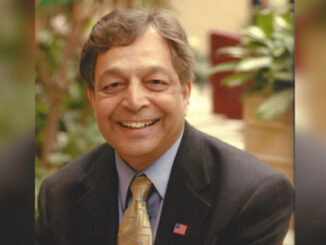
Tag: Pranab Mukherji

  • AAPI Mourns the Passing Away of Dr. Sampat Shivangi

    AAPI Mourns the Passing Away of Dr. Sampat Shivangi

    “Dr. Shivangi has left an indelible mark on the Indian American community”: Dr. Satheesh Kathula

    CHICAGO (TIP): “We are deeply saddened and shocked by the sudden passing away of Dr. Sampat Shivangi, a physician, an influential Indian American community leader, and a veteran leader of the American Association of Physicians of Indian Origin (AAPI),” said Dr. Satheesh Kathula, President of AAPI.

    Describing Dr. Shivangi as “A trailblazer of the Indian Diaspora,” Dr. Kathula, who has known Dr. Shivangi for decades and has worked closely in several AAPI-led initiatives, said, “Dr. Shivangi has left an indelible mark on the Indian American community. Over the decades, he dedicated his time and efforts to serving AAPI and numerous other Indian American organizations. His leadership, vision, and tireless commitment to advocating for the community set him apart as a pillar of strength and guidance.”

    “AAPI is proud of Dr. Shivangi’s numerous accomplishments, leadership, and contributions to the greater cause of the Indian Diaspora, Indo-US relationship, and particularly for his dedication to enhancing the mission of AAPI,” said Dr. Sunil Kaza, Chair of AAPI Borad of Trustees.

    Among many other initiates that Dr. Shivangi led at AAPI during his decades long association, the most outstanding has been his leadership in organizing the annual Legislative day under several Presidents of AAPI. He was instrumental in personally contacting and inviting several lawmakers, including prominent US Senators and Congressman to the Legislative day.

    Dr. Amit Chakrabarty, President-Elect of AAPI said, “The Indian American community has lost a great leader, philanthropist, and friend whose contributions will continue to resonate for generations. Through his philanthropic efforts, Dr. Shivangi touched countless lives, always striving to make a positive impact both in the healthcare sector and within the broader community.

    Dr. Shivangi has been actively involved in several philanthropic activities, serving with Blind Foundation of MS, Diabetic, Cancer and Heart Associations of America. Dr. Shivangi has a number of philanthropic works in India including Primary & middle schools, Cultural Center, and IMA Centers that he opened and helped to obtain the first ever US Congressional grant to AAPI to study Diabetes Mellitus amongst Indian Americans.

    It was only about a month ago that the President of India, Droupadi Muramu inaugurated the newly built Dr. Sampat Kumar S. Shivangi Cancer Hospital in Belagavi, Karnataka. Spanning 1,75,000 square feet with a capacity of 300 beds, the hospital was built with cutting-edge technology with funds donated and raised by Dr. Sampat Shivangi, a distinguished Indian American community leader with a profound impact on healthcare, education, and cultural preservation across India and the United States.
    “A dream comes true! It fills my heart with immense pride and gratitude for the new state-of-the-art Dr. Sampat Kumar S Shivangi Cancer Hospital in my beloved home state, Belagavi, has finally become a reality,” Dr. Sampat Shivangi, who donated his family fortunes to build this much needed, cancer hospital in a rural region in the state of Karnataka, said here. “Having lived in India for three decades, in not so privileged and progressive parts of the world, it always touched my heart and Atma why so and why not we all have equal playing field on earth,’ Dr. Shivangi said, when asked about what led him to his decision to donate his money, time, efforts and skills.

    “During my years in hospitals as a student, resident and staff, I was devastated. I had a great desire to do something that helps people, including for the need to establish a cancer hospital in my native town, where people have to travel hundreds of miles away for such a treatment and possibly could not afford the travel, stay, or medical expenses.”

    Dr. Shivangi contributed immensely “to the greater cause of the Indian Diaspora, Indo-US relationship, and particularly for his dedication to enhancing the mission of AAPI”, said Dr. Sunil Kaza, Chair of AAPI Borad of Trustees. He was recognized for his contribution at the highest levels. In this picture he is seen receiving the coveted Pravasi Bharatiya Samman Award from the then President of India, Pranab Mukherji

    Describing the goals of the Cancer Hospital and the Charitable Foundation, Dr. Shivangi, a soft-spoken physician says, “The Charitable Foundation was set up several years ago to establish, promote, and provide the needy and the downtrodden fellow human beings with opportunities to access quality education, promote mental health awareness, ensure healthcare equity, support tribal communities in their holistic development, empower women to break barriers, and leverage sports as a catalyst for positive change.”

    In addition to establishing the Dr. Sampat Kumar S. Shivangi Cancer Hospital in Karnataka, through the Dr. Sampat Shivangi Foundation, Dr. Shivangi has established multiple charitable institutions in India, including primary and middle schools, community halls, and healthcare facilities, greatly enhancing educational and healthcare access for underserved communities.

    In the U.S., Dr. Shivangi has contributed to establishing a Hindu Temple in Jackson, Mississippi, providing a cultural and spiritual hub for the Hindu community and beyond. Recognized for his exemplary service, a street in Mississippi bears his name, a testament to his contributions to healthcare and community welfare.

    Over the years, in the pursuit of its vision, the Dr. Sampat Shivangi Foundation has come to be known for its belief and tireless efforts that every individual deserves an opportunity to thrive, and is a beacon of hope, fostering resilience and building a more inclusive and harmonious world for all.

    At the heart of societal transformation, the Dr. Sampat Shivangi Foundation stands as a testament to unwavering commitment and compassion. The foundation is built upon the pillars of education, healthcare, mental well-being, tribal support, women’s empowerment, and sports development. With a profound understanding of the multifaceted needs of underprivileged communities, we have designed a range of initiatives that address these vital aspects of human well-being.

    As the first Indian American to serve on the Board of the Mississippi State Department of Mental Health, Dr. Shivangi has made significant strides in mental health advocacy. His leadership extends to national positions, serving on the National Board of Directors for the Substance Abuse and Mental Health Services Administration (SAMHSA), appointed by Presidents Donald Trump and Joe Biden.

    Dr. Shivangi was a veteran leader of the American Association of Physicians of Indian Origin (AAPI). From L to R: AAPI President Dr. Satheesh Kathula, Dr. Sampat Shivangi.

    A dedicated advocate for Indo-U.S. relations, Dr. Shivangi has contributed to key initiatives, including the Indo-U.S. Civil Nuclear Agreement, collaborating with President George W. Bush to strengthen ties between the two nations. His commitment to India is further reflected in his coordination efforts with the White House to lift sanctions against India during President Bill Clinton’s administration.

    A recipient of numerous awards, including the Pravasi Bharatiya Samman Award, The US Congressional Recognition Award, the Ellis Medal of Honor Award, Lifetime Achievement Award by the Indo-American Press Club, Dr. Shivangi’s legacy reflects a lifelong dedication to improving lives through healthcare, philanthropy, and international diplomacy.

    Dr. Shivangi said, he always thought about why, the Indian Americans especially, the Physician fraternity, consisting of more than 100,000 physicians in the United States are not willing to undertake philanthropy in their homeland or in USA. “My hope and prayers is that, many more will follow me just as my dream has come true today. I urge my fellow Indo-American physicians to join this movement and help change the world for the better. My humble request is that let us be the change, and bring this movement to make our world different tomorrow. I hope my prayers will be answered one day and all humanity lives in a better world.”

    Dr. Shivangi is married to Dr. Udaya S. Shivangi, MD, and the couple are blessed with two daughters: Priya S. Shivangi, MS (NYU); and Pooja S. Shivangi, who is an Attorney at Law. “His legacy will remain an inspiration for all who knew him, and his absence will be deeply felt. Our thoughts and prayers are with his family and loved ones during this profoundly difficult time,” Dr. Kathula said.

  • Tribute to a Stalwart

    Professor Emeritus Harkishan Singh, Padma Shri Awardee

    Harkishan Singh (25.11.1928 – 20.03.2020)
    India’s President Pranab Mukherji conferred on Dr. Harkishan Singh Padma Shri- one of the nation’s top civilian awards
    Dr. Harkishan Singh (extreme right in a wheelchair) with the President, Prime Minister and his ministerial colleagues, and fellow awardees at Rashtrapati Bhavan
    Dr. Harkishan Singh through a will transferred his entire library , awards and honors to NIPER.

    Professor Harkishan Singh, , Ph.D., D.Sc. (University of Science, Philadelphia, PA, USA & Punjab University, Chandigarh, India)  was Professor Emeritus at the Panjab University (Chandigarh, India), is a well-recognized pharmaceutical academic, medicinal chemistry researcher and a science historian. He has experience of over half a century to his credit. He has worked at the Banaras Hindu University, University of Saugor and Panjab University in India, and abroad at the University of Maryland, University of Mississippi and the University of London.

    His scientific research has been in organic chemistry, medical chemistry, and natural products. Nearly 50 master and doctoral theses have been completed under his supervision. There have been 125 original scientific research papers. 14 patents have been obtained. His research group has been successful in designing a clinically useful drug candocuronium iodide (INN) (chandonium iodide, HS-310), which is a synthetic azasteroid.

    Dr Singh has lectured on his research at several of the institutions and conferences in India, United States of America, Canada, United Kingdom, Switzerland and China. He delivered invited lectures at the Harvard School of Medicine and at the International Symposium on Molecular Structure sponsored by the International Union of Crystallography at Beijing.

    As a science historian Professor Singh has examined the history of pharmaceutical developments in India of the nineteenth and twentieth centuries. His history research studies have been on pharmacopoeias and formularies, pharmaceutical education, pharmacy practice, biographies of pharmaceutical luminaries, and pharmaceutical journalism. He has published over eighty articles. In addition to his scientific and history research papers, Dr Singh has authored and/or co-authored many books and review articles, including several book chapters. He has written extensively on educational, scientific, historical and professional issues.

    All told,  his total publications come to well over 400, including eighteen books. Selected publications are listed on his website and Wikipedia. Professor Singh has been on many academic, scientific, professional and governmental bodies. He was a member of the Committee on International Education of Medicinal Chemists of the International Union of Pure and Applied Chemistry, which prepared the Report on the International Education of Medicinal Chemists (IUPAC Technical Reports Number 13; 1974).

    His affiliations with several scientific and professional organizations include emeritus membership of the American Chemical Society, life memberships of the Indian Pharmaceutical Association and Association of Pharmaceutical Teachers of India, and memberships of the American Institute of History of Pharmacy and British Society for History of Pharmacy.

    Professor Harkishan Singh was a recipient of several scientific and professional awards and recognitions. He has been a National Fellow of the University Grants Commission, New Delhi. He has been General President of the Indian Pharmaceutical Congress. He received the Eminent Pharmacist Award of the Indian Pharmaceutical Association. Lifetime achievement awards have been conferred on him by several bodies; the recent one is the Lifetime Achievement Award by the Punjab Academy of Sciences. Dr Singh’s standing as historian has been recognized through his election to the Academie Internationale d’Histoire de la Pharmacie. The University of the Sciences in Philadelphia and Punjab University in Chandigarh conferred upon Professor Harkishan Singh the degree of Doctor of Science (Honoris Causa) in recognition of his distinguished academic career and outstanding contributions to scientific research in organic and medicinal chemistry and the history of pharmacy

    Professor Harkishan Singh is also known for his creation of National Institute of Pharmaceutical Education and Research , SAS Nagar, Punjab along with Dr. Parvinder Singh, MD, Ranbaxy. Today, NIPER is the only postgraduate research and research institute in Pharmaceuticals as AIIMS is to Medicine and IIM is to Management. NIPER.

    Professor Harkishan Singh had the biggest collection of pharmaceutical 1750 books/ bound volumes, magazines and publications collected from around the world, his awards and certificates and all photographs including his original degrees, citations, proclamations including his Padma Shri. His collection was described to be priceless worth millions at one point and was referred to as a historical archive. This treasure collection is now at the NIPER’s Pharmaceutical Heritage Center at Professor Harkishan Singhs Archival Collection Center. Here with attached find NIPERS 114-page listing of this collection per Professor Singh’s will was fully transferred to NIPER in January 2020, two months before he chose to bid farewell to the mundane world on March 20, 2020.
