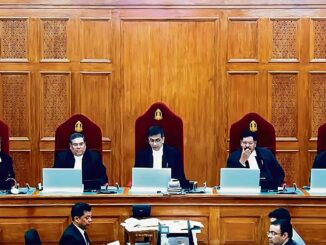
Tag: Prashant Bhushan

  • The Indian judiciary is  ‘between a rock and hard place’ moment

    The Indian judiciary is ‘between a rock and hard place’ moment

    Solutions to address the key issues of misconduct and corruption and appointments exist, while also keeping the independence of the judiciary intact

    By Prashant Bhushan

    The facts in the Justice Yashwant Varma case are indeed disturbing. In an apparent accidental fire in an outhouse on the premises of his official bungalow in New Delhi (while he was not in town), the fire department seemed to have found several sacks of high value currency notes (₹500), which had been burnt, some partially. Someone in the police/fire department recorded a video when the firemen were trying to douse the fire.

    The next evening, the Delhi police chief reported the incident to the Chief Justice of the Delhi High Court, where Justice Varma is a senior judge. This was then conveyed to the Chief Justice of India (CJI), who convened a meeting of the Collegium. A decision was taken to repatriate Justice Varma back to his parent court, the High Court of Allahabad. Justice Varma’s response was also sought where he denied that any money had been stored in that room and even suggested that it might be a conspiracy against him.

    However, when the news of the incident spread, it caused such a public furor that the CJI convened other meetings of the Collegium and decided to institute an in-house inquiry conducted by a three-judge committee which included two Chief Justices of the High Court of Himachal Pradesh and Punjab and Haryana, and a lady judge from the Karnataka High Court. The CJI also sought the call records of Justice Varma as well as those of his staff for the last six months. The CJI decided to release all the information related to the incident in the public domain, which included the video of the currency notes being found. These steps were indeed a case of welcome transparency. The CJI thereafter advised the Chief Justice of the Delhi High Court not to assign any judicial work to Justice Varma till such time as the inquiry is completed. Though Justice Varma’s explanation does not appear to be very credible, one should still await the findings of the inquiry committee. There is no doubt that the report of the committee will shed light on what really happened.

    A triggering of the government

    The public furor that erupted has enabled the government to fish in the troubled waters of the judiciary, and the government is now using this incident to try and retake control of the power of appointing judges. To this end, the Vice-President of India (and the Chairman of the Rajya Sabha) has invited political leaders from the government and the Opposition to discuss why the National Judicial Appointments Commission (NJAC) Act, which was struck down by the Supreme Court of India as violative of the basic structure of the Constitution, should not be brought back. The NJAC Act essentially formed an appointment committee comprising the CJI, two senior judges of the Court, the Union Law Minister and two eminent persons to be nominated by a committee comprising the CJI, the Prime Minister of India and the Leader of the Opposition in the Lok Sabha. It also placed the secretariat of this commission with the Law Ministry. Seven judges of the Court held the view that this would provide substantial scope to the government to interfere with judicial appointments and that would erode the independence of the judiciary, which is part of the basic structure of the Constitution. Thus, despite the NJAC Act having been brought by way of a constitutional amendment, it was declared invalid by the Court.

    Government’s game plan

    In the recent past, the Narendra Modi government has seriously interfered with the appointment of judges despite the law being that the power of selection is with the Collegium of the Supreme Court and that the government can only return the name of the judges selected by the Collegium once to the Collegium if it is dissatisfied. Thereafter, if the Collegium reiterates its choice, the government is left with no option but to notify the appointment. However, in recent years, the Modi government has stymied the selection of independent judges by the Collegium, by sitting on recommendations, sometimes for years, without any response, and without notifying the appointments. Even when it is forced to respond and it returns the names with objections, and thereafter, even after it is unanimously reiterated by the Collegium, it has still not notified the appointments of many judges who are considered ‘inconvenient’ to the government. At the same time, it is quick to notify the appointments of those judges that the government likes.

    During these years, on several occasions, the Collegium appears to have bent backwards to appease the government by selecting some judges who are favored by the government in order to get some of those that it has recommended, appointed. This has led to the appointment of many judges who are either committed to the government’s Hindutva ideology or who are weak and unable to resist the diktats and wishes of the government. As a result of this, the independence of the judiciary has been substantially eroded in recent years.

    Now, using the Justice Varma case, the government is seeking even greater control and say in the matter of appointments of judges. If the government succeeds in this attempt, it will no doubt erode the independence of the judiciary — already in a precarious state — even further. This government has been trampling on the fundamental rights of people, rampantly misusing the enforcement agencies and bulldozing the rule of law by using bulldozers. In these circumstances, it is essential for public opinion and the Opposition to see through the government’s game plan and resist such an attempt. There is no doubt that the collegium system of the appointment of judges is far from perfect and that its lack of transparency and any proper criteria for selecting judges have led to much nepotism and improper appointments through the Collegium as well. However, the solution is not greater government control. The problem with the Collegium is that it comprises sitting judges who are very busy with their judicial work and have little time to devote to this task.

    Appointment of judges, issue of corruption

    Every year, hundred judges of the High Court and the Supreme Court are to be selected. In any proper selection process, at least 1,000 candidates have to be examined for their relative merits and demerits. For this, the right criteria and method to judge people on those criteria should be devised. Unfortunately, this has not been done. The solution is to have a full-time judicial appointments commission, comprising retired judges and other eminent public men, who are totally independent of the government, and with a secretariat under their control which would select judges in a transparent manner. This would be a much better solution to address the problem of the appointment of judges — and what the Campaign for Judicial Accountability & Judicial Reforms has been advocating for a long time. However, the particular problem highlighted by the Justice Varma case is the problem of corruption in the Indian judiciary, which also needs a solution. The Constitution only provided for impeachment as a method. But this method has not been found to be practical or desirable because it starts with the signatures of 100 Members of Parliament to begin with, and ends with a vote in both Houses of Parliament.

     Mixed bag for Supreme Court collegium in judicial appointments

    Both are political processes, which often get politicized by political parties. This is why no judge has ever been successfully impeached in the history of the country, despite public knowledge that there is much corruption in the higher judiciary. What we need is a high-powered and full-time judicial complaints commission comprising five men/women who are independent of the government as well the judiciary. This complaints commission can receive complaints against judges of the higher judiciary from people. If they feel that there is a prima facie case, they can have the matter investigated or hold the trial of the judge through another committee, much like the judges inquiry committee.

    However, the commission should decide what needs to be done with that judge, and their decision should be final, subject to judicial review only in exceptional circumstances. These matters should not go to Parliament at all. This would address the problem of judicial misconduct and corruption to a substantial degree.

    (Prashant Bhushan is a Public Interest Lawyer practicing before the Supreme Court of India)

  • Indian military export to Israel – aiding genocide

    Indian military export to Israel – aiding genocide

    The top court’s dismissal of a petition on the subject highlights the limits of judicial review over executive decisions in matters of foreign policy, especially in violations of humanitarian law

    By Prashant Bhushan, Cheryl Dsouza

    A Bench of the Supreme Court of India, headed by the Chief Justice of India, recently dismissed a petition filed by former civil servants, academics, and activists. The petition, in Ashok Kumar Sharma and Others vs Union of India, had sought the suspension of existing licenses and the withholding of further licenses by the government to public sector and private companies, for exporting military equipment to Israel during the ongoing war. While the Court made it clear that it was not ruling on the merits of the case, it went on to issue a somewhat detailed judgment. The dismissal raises important questions about the limits of judicial review over executive decisions in matters of foreign policy and especially where there are grave violations of international humanitarian law.

    ICJ opinion

    The challenge was in view of the International Court of Justice (ICJ), in January, ordering provisional measures against Israel, for violations in the Gaza strip, of obligations under the Genocide Convention. The provisional measures included an immediate halt to all killings and destruction being perpetrated by Israel. In light of this judgment, United Nations experts warned against the transfer of weapons to Israel which may “constitute serious violation of human rights…and risk State complicity in international crimes”. In July, the ICJ rendered a detailed opinion declaring that the sustained abuse by Israel renders “Israel’s presence in the Occupied Palestinian Territory unlawful”. The ICJ observed that “all States are under an obligation not to render aid or assistance in maintaining the situation created by Israel’s illegal presence”.

    Earlier, in an adjudication before it regarding military support by Germany to Israel (Nicaragua vs Germany), the ICJ had significantly stated that “the Court considers it particularly important to remind all States of their international obligations relating to the transfer of arms to parties to an armed conflict, in order to avoid the risk that such arms might be used to violate the above-mentioned Conventions”. Following this there have been challenges to the export of arms to Israel in various global jurisdictions, with the Hague Court of Appeal ordering the Dutch government to halt the export of F-35 fighter jet parts to Israel given the risk that “components to be exported to Israel will be used to commit serious violations of international law”.

    Many countries that are parties to the Geneva and Genocide conventions have halted the supply of military equipment to Israel, in furtherance of these binding obligations. Canada, Spain and even the United Kingdom have suspended licenses of companies supplying arms to Israel.

    As a party to these Conventions, India has similar obligations incumbent upon it. India is obligated under the Genocide Convention to take all measures within its power to prevent genocide. Article III of the Convention makes states’ complicity in genocide a punishable offence. The obligation not to supply weapons to states that are possibly guilty of war crimes is an obligation directly based on common Article 1 of the Geneva Convention. The principles in these Conventions are peremptory norms of international law. India, therefore, cannot export any military equipment or weapons to Israel, when there is a serious risk that these weapons might be used to commit war crimes.

    Where the Supreme Court failed

    In its judgments, the Supreme Court of India has held that India is under obligation to interpret domestic law in the light of the obligations under the conventions and treaties that India has signed and ratified. However, the Court while dismissing the present case has held, that first, international obligations are not binding, since the country (Israel) which is in violation of international law (the Genocide Convention), was not before the Court. The state of Israel not being a party before the Court in such a challenge is irrelevant, since no relief was being sought against Israel, but against the government of India and private companies exporting arms to Israel, thereby violating international law obligations. The Court further stated that the petitioner’s submissions were with regard to the “conduct of an independent sovereign nation, namely Israel” and that to grant the reliefs sought, it would have to enter findings with regard to the petitioner’s allegations against Israel. Again, the allegations by the petitioner were with respect to the conduct of India in sanctioning military exports, thereby abetting genocide. And the determination of the conduct of the state of Israel was premised on the ICJ, that had in a detailed order of the full court, while ordering provisional measures against Israel, noted the numerous reports by UN Special Rapporteurs and international aid organizations documenting how Gaza was a place of “death and despair”.

    The Court’s rationale is also indefensible given its judgments that “Constitutional provisions must be read and interpreted in a manner which would enhance their conformity with the global human rights regime…and the Court must adopt an interpretation which abides by the international commitments made by the country particularly where its constitutional and statutory mandates indicate no deviation” (2017) 10 SCC 1. The ICJ has also held that states that are party to a particular convention “whether or not it is a party to a specific conflict, is under an obligation to ensure that the requirements of the instruments in question are complied with.” (Legal Consequences of the Construction of a Wall in the Occupied Palestinian Territory, Advisory Opinion, I.C.J. Reports 2004 (I), pp. 199-200, paragraph 158). Such an obligation “does not derive only from the Conventions themselves, but from the general principles of humanitarian law to which the Conventions merely give specific expression” (Nicaragua vs United States of America).

    Second, the Court reasons that seeking a suspension of licenses with regard to contracts with international entities, including with the state of Israel, may involve a breach of contracts and other fallouts. Certainly, that is what the petitioners prayed for — a halt to all licenses for the export of military arms to Israel in view of the genocide and yes, pending contracts. The Court’s fear that this would lead to a breach of contract is misplaced, because any party to a contract to export of arms can always claim force majeure (here, due to the outbreak of a war and genocide by Israel). The same situation would arise if the Government of India were to itself suspend the licenses, which it can do in such situations, as done by many other countries. Being aware of the serious risk that acts of genocide could have been committed by Israel, the government is bound to employ all means reasonably available to it to prevent genocide, which would include suspension of export licenses for military aid to Israel. No contracting party can argue and let alone the court endorse as it does in this case, that licenses cannot be suspended by the government (in a situation of genocide) because it affects the “financial viability” of the companies concerned.

    And, third, the “self-imposed restraint on Courts entering areas of foreign policy” was raised as another bogey to dismiss the challenge. India has binding commitments under international law, especially in the context of the application of Conventions that it has signed and ratified, and once the Supreme Court has held that such international law obligations which are not contrary to municipal law, must be read into the law of our land, the Court must step in to exercise its judicial discretion and caution the executive government when it acts in violation these laws.

    The fallout

    In the midst of an unimaginable humanitarian crisis in Palestine and the international outcry against Israel’s continuing genocide, the Supreme Court’s failure to ensure that the Indian government halts its military aid to Israel and complies with its commitments under international law, will have serious repercussions in this war and its devastation that continues unabated.

    The top court’s dismissal of a petition on the subject highlights the limits of judicial review over executive decisions in matters of foreign policy, especially in violations of humanitarian law

    (Prashant Bhushan, a public interest lawyer in the Supreme Court of India. and Cheryl Dsouza, Advocate, Supreme Court of India, Secretary, Campaign for Judicial Accountability and Reforms,  were the counsels for the petitioners in the challenge to export of arms to Israel)


  • Supreme Court nulls electoral bonds scheme, seeks info on donors

    Supreme Court nulls electoral bonds scheme, seeks info on donors

    February 15, 2024

    NEW DELHI (TIP): Ahead of the 2024 Lok Sabha elections, the Supreme Court on Thursday, February 15,  declared “unconstitutional” the electoral bonds scheme that allowed individuals and companies to make unlimited anonymous donations to political parties. Noting that voters have right to know, a five-judge Constitution Bench led by CJI DY Chandrachud said the scheme violated Article 19(1)(a) of the Constitution, which guaranteed right to freedom of speech and expression and included right to information within its ambit.

    “We are of the opinion the information about funding to a political party is essential for a voter to exercise their freedom to vote in an effective manner. The electoral bonds Scheme and the impugned provisions to the extent that they infringe upon the right to information of the voter by anonymizing contributions through electoral bonds are violative of Article 19(1)(a) (right to freedom of speech and expression),” the Bench said. The Beach, which also included Justices Sanjiv Khanna, BR Gavai, JB Pardiwala and Manoj Misra, said the disclosure of information regarding electoral bonds was necessary to identify corruption and quid pro quo transactions in governance. “Such information is also necessary for exercising an informed vote,” it added.

    The top court ordered the State Bank of India to stop issuing electoral bonds immediately and submit all details by March 6 to the Election Commission which shall make all donations public by March 13. All electoral bonds within the 15-day validity period shall be returned by political parties to the purchasers, it added.

    Justice Khanna delivered a separate but concurring judgment. Welcoming the verdict, petitioner Association for Democratic Reforms’ counsel Prashant Bhushan said: “This is a salutary judgment which will enhance our democratic process.” The Constitution Bench also declared unconstitutional amendments made to the Representation of the People Act (RPA), 1951, the Income Tax Act, 1961, and the Companies Act, 2013, through the Finance Act, 2017, to facilitate introduction of the scheme.

    Earlier, political parties had to declare all contributions more than Rs 20,000 with no exceptions, and maintain a record of all donations exceeding Rs 20,000 for tax purposes. In a financial year, companies could contribute a maximum of 7.5% of their average net profits from the preceding three years. The amendments did away with the restrictions to allow political parties to receive funds through electoral bonds.

    Introduced through the Finance Act, 2017, an electoral bond is a bearer instrument like a promissory note which can be purchased by an Indian citizen or an Indian company whose identity would remain secret from everybody except the SBI from whom it has to be purchased. Once purchased, the buyer can give it to a political party, which could encash it using its bank account.

  • President to appoint CEC, ECs on advice of committee comprising PM, LoP, CJI

    President to appoint CEC, ECs on advice of committee comprising PM, LoP, CJI

    Supreme Court of India says in a landmark judgement

    NEW DELHI (TIP): In a historic judgement, a Constitution Bench of the Supreme Court on March 2 directed that the Chief Election Commissioner (CEC) and Election Commissioners (ECs) will be appointed by the President on the advice tendered by a committee of Prime Minister, Leader of Opposition (LoP) in the Lok Sabha or the leader of the single largest party in opposition and the Chief Justice of India (CJI).

    The court said “fierce independence, neutrality and honesty” envisaged in the institution of the Election Commission of India (ECI) requires an end to government monopoly and “exclusive control” over appointments to the highest poll body.

    The court said the high-powered committee would continue to advise the President on the appointment until the Parliament enacts a law on the appointment process of Election Commissioners. Chief Election Commissioners and Election Commissioners have so far been appointed by the President on the advice of the Prime Minister.
    The judgment came on petitions filed through advocates Prashant Bhushan, Kaleeswaram Raj, Ashwini Upadhyay and senior advocate Gopal Sankaranarayanan for an accountable and transparent appointment process. The judgment has now brought the appointment process of Chief Election Commissioners and Election Commissioners on par with that of the CBI Director.

    Justice K.M. Joseph, who authored the unanimous judgment for the five-member Bench, said what the Election Commission of India requires are “honest, independent” commissioners who could distinguish right from wrong, those who can “ordinarily and unrelentingly take on the high and mighty and persevere in the righteous path”.

    In a concurring opinion, Justice Ajay Rastogi added that the procedural safeguards in place for effecting the removal of a Chief Election Commissioner (CEC) should be extended to the Election Commissioners under the first proviso to Article 324(5) of the Constitution. A CEC, like Supreme Court judges, can be removed from office only by way of a parliamentary process. However, no such protection of tenure is available to the Election Commissioners. In his judgment, Justice Joseph said the fate of political parties and democracy rests in the hands of the Election Commission and “the buck stops at the table of the Chief Election Commissioner and the Election Commissioners”. In a substantive democracy, the power to vote is “more potent than the most powerful gun”. People depend on an honest Election Commissioner, blessed with extraordinary powers, to guard the purity of the electoral process.

    “The people of the country look up to the Election Commissioners… A person who is weak-kneed before the powers that be cannot be appointed as an Election Commissioner. A person who is in a state of obligation or feels indebted to the one who appointed him, fails the nation. Such a person cannot have a place in the conduct of elections which forms the foundation of democracy… An Election Commissioner should be one who holds the scale evenly in the stormiest of times by not being servile to the powerful and by coming to the rescue of the weak and the wronged. This would qualify as true independence,” Justice Joseph wrote.

    The court noted that 75 years have passed since Independence, yet successive political dispensations which have come to power so far have not lifted a finger to frame a law guiding the appointments to the Election Commission. “Political parties betray a special interest in not forthcoming with a law. The reasons are not far to seek… There is a crucial link between the independence of the Election Commission and the pursuit of power by parties, their consolidation and perpetuation… An insatiable quest to continue in the saddle requires a pliable Election Commission who functions as an unfair and biased overseer of the electoral process which lies at the very heart of democracy… An Election Commissioner who obliges the powers that be, perhaps even offers an assured gateway to the acquisition of power,” Justice Joseph observed.

    The court further made a “fervent appeal” to the Parliament and the Union Government to set up a permanent secretariat which draws its expenses directly from the Consolidated Fund of India and not the government.

    “One of the ways the Executive can bring the Election Commission to its knees is by starving it off requisite finances much needed for its independent functioning… A vulnerable Commission, faced with the prospects of lack of funds, may kneel to the pressure of the Executive, and that would result in an insidious conquest of an otherwise defiant and independent Election Commission,” Justice Joseph said.

    In his opinion, Justice Rastogi noted that the Election Commission has been a multi-member body since 1993. The CEC and the Election Commissioners have “equal participation in transacting the business of the Election Commission” which includes superintendence, direction and control of electoral rolls and conduct of elections to the Parliament, State legislatures, offices of the President and the Vice-President of India.

    “It is the need of the hour and advisable to extend the protection available to the CEC under the first proviso to Article 324(5) to other Election Commissioners as well until a law is framed by the Parliament… It is desirable that the grounds of removal of the Election Commissioners shall be the same as those of the CEC and Supreme Court judges,” Justice Rastogi said.

    CECs and apex court judges can be removed only by an order of the President passed after an address in each House of Parliament supported by a majority of the total membership of that House and by a majority of not less than two-thirds of members present and voting, and presented to the President in the same session. The grounds of removal are limited to “proved misbehaviors or incapacity”. The judge noted that the conditions of service of Election Commissioners, after appointment, should not be “varied to their disadvantage”. These directions hold that the tenures of the Election Commissioners should not be disturbed in any way. The Election Commission (Conditions of Service of Election Commissioners and Transaction of Business) Act, 1991 requires that the CEC and Election Commissioners must hold the post for a period of six years.

    Lately, the Election Commission has seen appointments who have not been able to serve the full six-year period.
    (Source: The Hindu)