Tag: Punjab

  • The MAGA turn: Global fallout and India’s dilemma

    The MAGA turn: Global fallout and India’s dilemma

    India cannot blame Western xenophobia while succumbing to it at home

    “Normally, domestic and foreign policies of countries are inter-related. The Trump administration demonstrates that by aligning its foreign policy with its MAGA supremacism. The BJP managed to largely insulate domestic politics from foreign policy, except in South Asia. While adopting nationalist-majoritarian politics at home, with boundaries between religion and politics removed, its foreign policy continued the old secular line, at least superficially. The US State Department’s reports on human rights practices in India berated the constriction of religious, individual and press freedoms. The 2024 report listed the Citizenship Amendment Act and anti-conversion laws as raising concerns. It, however, ignored the BJP’s non-liberal political trajectory weakening democracy. India-US relations were considered more crucial to the global American strategy.”

    By KC Singh

    US President Donald Trump completes one year in office on January 20. The Economist magazine says he has “turned domestic and international politics on its head”. During the campaign, he looked past Project 2025, produced by the conservative Heritage Foundation. However, in office his barrage of executive orders began implementing Project 2025. This included mass, forceful deportation of suspected aliens without hearing, domestic military involvement (now halted by the Supreme Court), dismantling of the bureaucracy, outsourced to Elon Musk, whose Department of Government Efficiency failed drastically.

    The external policy changes began with the April “Liberation Day” arbitrary tariffs on imports. Then emerged a closer alignment with Israel, a pro-Russia tilt in handling the Ukraine war, an escalated trade standoff with China and a transitory compromise. European NATO allies played along, preferring non-confrontation while examining self-reliance, to manage the US pullback from defense commitments. The National Security Strategy (NSS) of December 4-5 confirmed major US policy mutations.

    The new foreign policy priorities list the “Western Hemisphere” on the top. It refers to the Americas — North and South — resurrecting the 19th century’s Monroe Doctrine, which barred European rivals from interfering in Latin-American affairs. Next comes Asia, with focus on the Indo-Pacific. Unlike the past NSS documents, China is not named as a threat, though it colors the Asian strategy. On December 8, the US allowed the sale to China of Nvidia’s advanced H200 chips.

    India figures as a subtext, expected to help ensure Indo-Pacific security. Then follows Europe. Under the subtitle “Promoting European Greatness”, the NSS document argues that the European challenge exceeds economic stagnation and low military spending. The “real and more stark” prospect is of “civilizational erasure” due to migration policies. Europe’s loss of self-confidence is attributed to the regulatory check on the “growing influence of patriotic parties”. This refers to the far-right’s ascendancy in major European nations. This theory is MAGA-inspired, with the US administration desiring a “new Western order”, dominated by governments led by white Christian nationalist-populists.

    In the UK, the Nigel Farage-led Reform UK is polling 30 per cent support; while in France, Marine Le Pen’s National Rally is at 33.4 per cent and Germany’s AfD is scaling 26 per cent. Europeans saw this support-signaling as regrettable interference in their internal affairs. German Foreign Minister Johann Wadephul retorted that they did not “need to get advice from any other country or party”. German intelligence sees AfD as an extremist group.

    In this disrupted post-1945 global order, where does India fit? Normally, domestic and foreign policies of countries are inter-related. The Trump administration demonstrates that by aligning its foreign policy with its MAGA supremacism. The BJP managed to largely insulate domestic politics from foreign policy, except in South Asia. While adopting nationalist-majoritarian politics at home, with boundaries between religion and politics removed, its foreign policy continued the old secular line, at least superficially. The US State Department’s reports on human rights practices in India berated the constriction of religious, individual and press freedoms. The 2024 report listed the Citizenship Amendment Act and anti-conversion laws as raising concerns. It, however, ignored the BJP’s non-liberal political trajectory weakening democracy. India-US relations were considered more crucial to the global American strategy.

    The BJP would welcome the NSS document now, recommending non-interference in the internal affairs of other nations. The US bureaucracy handling those issues stands disbanded. But domestically, the rising xenophobia in the US is impacting the Indian diaspora, especially their religious practices. The New York Times wrote about the troubles of Sikh truck drivers in the US after two August accidents. Sikhs in the trucking business, many on asylum-related visas, number 1,50,000, probably a quarter of the Sikh diaspora. Federal authorities have asked states like California to review their driving license policy. Canada and Australia have capped student visas, raised fees, heightened scrutiny of forms, etc. The transition to work visas may also be tightened. In New Zealand, a Sikh religious procession was last month disrupted by a far-right Christian group.

    The rising xenophobia in Christian Anglophone and western nations raises concerns. The BJP surely realizes that Hindu groups in India targeting Christians, particularly this year, can provoke retaliation against the Hindu diaspora. Occasional lynchings of Muslims did not impact India’s relations with the Islamic world because the Modi government had successfully engaged the principal Gulf-ruling families. Pakistan only had Turkey and an isolated Iran to join the condemnation. A divided Organisation of Islamic Conference (OIC) lacked the thrust to target India. But Pakistan stands diplomatically revived after wooing Trump and engaging Saudi Arabia and the UAE. It is now better positioned for India-baiting.

    Plus, Bangladesh may elect next month a right-wing government, probably under Islamist Jamaat-e-Islami’s influence. Pakistan and its ISI would celebrate that. Simultaneously, Assam and West Bengal face elections. Communal polarization helps the BJP electorally, especially by brandishing Bangladeshi illegal migration. Can India blame the western xenophobia while succumbing to it internally?

    Punjab may suffer if deportations from the US mount. Narrowing opportunities abroad will block the Punjabi youth’s escape route. Thus, Punjab must develop economic opportunities. Green Revolution 2.0 is overdue. The agricultural and dairy sectors need production and supply chain modernization. If over two lakh Sikhs could salvage the Italian dairy industry and parmesan cheese production, why not the same in Punjab? Similarly pioneering work exists in turning rice stubble into biofuel and organic fertilizer. The chemical fertilizer lobby suppresses such new approaches.

    Punjab needs pro-innovation leadership. Delhi requires non-partisan statesmanship.

     (K.C. Singh is a retired diplomat)


  • Indian Parliamentary Delegation Engages with Indian Diaspora at the Consulate

    Indian Parliamentary Delegation Engages with Indian Diaspora at the Consulate

    NEW YORK CITY (TIP): A visiting Indian Parliamentary Delegation, led by BJP MP Daggubati Purandeswari, held an engaging interaction with members of the Indian-American community at the Consulate General of India in New York on Thursday, October 30.

    The event, hosted by Consul General Binaya Srikanta Pradhan, brought together members of the Indian diaspora and lawmakers representing a broad political spectrum from India. New York State Assemblyman Anil Beephan, the first Indian-American Republican elected to the New York Assembly, also addressed the gathering, lauding the strong and ever-growing ties between the two largest democracies.

    A Cross-Party Representation from India

    The delegation accompanying Purandeswari included Rekha Sharma, Dilip Saikia, Bhola Singh, and Saumitra Khan from the BJP; Sandeep Pathak from the Aam Aadmi Party; P. Wilson and Thamizhachi Thangapandian from the DMK; G.K. Vasan from the Tamil Maanila Congress; Sajda Ahmed from the Trinamool Congress; Indra Hang Subba from the Sikkim K

    Consul General Binaya Srikanta Pradhan in his welcome address apprised the delegation members of the tremendous contribution the Indian Diaspora is making in the US.

    rantikari Morcha; and Joyanta Basumatary from the United People’s Party Liberal (UPPL).

    The multi-party delegation is currently in New York to participate in the ongoing United Nations General Assembly session, where they are articulating India’s positions in various committees and engaging with UN officials and diplomats. This is the second such group of Indian MPs to attend this year’s UNGA session.

    Diaspora’s Growing Global Footprint

    In his welcome remarks, Consul General Pradhan highlighted the strength and influence of the Indian-American community, which now numbers 2.4 million in the U.S. — the largest Indian diaspora anywhere in the world.

    Parliamentary delegation leader Daggubati Purandeswari spoke highly of the Indian Diaspora

    He shared that Indian-Americans contribute 6% of total U.S. taxes, lead several Fortune 500 companies, and hold 10% of all U.S. patents. The community includes over 22,000 faculty members teaching in top universities across the country.

    On the cultural front, Pradhan noted that Indian-Americans have inspired 10% of Americans to practice yoga, with 36,000 yoga studios and 2,200 Ayurveda clinics now operating nationwide. In 2024, the diaspora’s philanthropic contributions topped $1.5 billion, underscoring their growing social impact.

    A view of the gathering at the Consulate to interact with the delegation.

    “The U.S. remains India’s largest trade partner and investor,” Pradhan added, citing the $212 billion bilateral trade recorded last year as evidence of deepening economic ties.

    Building Bridges for India’s Future

    During the session, MPs acknowledged the diaspora’s multifaceted contributions in education, technology, healthcare, and entrepreneurship. They urged Indian-Americans to continue acting as cultural ambassadors and economic partners in India’s growth story.

    Daggubati Purandeswari emphasized that India is moving steadily toward its goal of becoming the third-largest economy by 2047, the centenary of independence, and that the diaspora’s engagement will play a critical role in achieving that vision.

    Lawmakers also touched upon domestic challenges such as drug addiction in Punjab, assuring the audience that the government is implementing targeted measures and collaborating with state authorities to address the issue comprehensively.

    A Shared Vision

    Several participants described the evening as both inspiring and thought-provoking. The MPs and diaspora members exchanged views on how to strengthen educational linkages, attract investment in India’s innovation sectors, and promote youth exchanges to deepen mutual understanding between the two nations.

    The meeting concluded with a shared call for unity — encouraging the Indian diaspora to remain deeply rooted in their culture and traditions while continuing to contribute to India’s development and to the prosperity of their adopted homeland.

    As Consul General Pradhan aptly summed up, “The Indian diaspora is not just India’s pride abroad — it is India’s bridge to the world.”

    The Delegation members with the Diaspora members for a photo session at the Consulate on October 30, 2025 (Photos : Ashish Chandratreya)
  • Northern States get reprieve from rain but grapple with the aftermath of floods

    Northern States get reprieve from rain but grapple with the aftermath of floods

    NEW DELHI/NEW YORK (TIP): Even as northern Indian States experienced some relief from relentless rainfall on Friday, September 5, 2025, they continued to grapple with the aftermath of monsoon rains that have wreaked havoc across the region.

    According to the India Meteorological Department (IMD), in the 24-hour period ending 8:30 a.m., rainfall was recorded at a few places in Uttarakhand, Jammu and Kashmir, Uttar Pradesh, west Rajasthan, while east Rajasthan saw isolated heavy rainfall. In Punjab and Haryana, rains were observed at many places, while in Himachal, it was across most places. The IMD has predicted light to moderate rainfall at most to many places over the country’s northwest and west region during the next seven days.

    Isolated heavy rainfall is very likely over west Rajasthan on September 5 and 8; Uttarakhand on September 6-7; Himachal Pradesh on September 8-9; Haryana, Chandigarh and Delhi during September 8-10; Punjab on September 10; east Uttar Pradesh on September 10-11 and east Rajasthan on September 8, as per the IMD forecast on Friday.

    In Himachal Pradesh, in the past two days, under a rescue operation spearheaded by the State government, as many as 1,166 stranded ‘Manimahesh Yatra’ pilgrims were evacuated from the Bharmour area. Since June 20, following the onset of the monsoon, the hill State has so far witnessed a loss of 197 human lives, as per data from the disaster management cell of the State Revenue Department.

    Relief for Punjab

    Punjab Revenue Minister Hardeep Singh Mundian said with rainfall subsiding in upper hilly regions as well as in Punjab, the State had witnessed relief from floods. Also, since water level at Bhakra Dam on Sutlej river has decreased to 1678.66 feet, down almost half a foot from yesterday’s level of 1679.05 feet, it has come as a respite to the flood-hit areas.

    In Punjab, 43 people have lost their lives since August 1 due to ongoing rains and floods while crops on 1.72 lakh hectares have been damaged. Several roads, low-lying areas and farmland have been inundated. The rains have left rivers Sutlej, Ravi, and Beas, flowing through Himachal Pradesh and Punjab, in spate.

    Union Agriculture and Farmers Welfare Minister Shivraj Singh Chouhan, who on September 4 visited flood-hit areas in Punjab, in a post on X, said the Central government stood with the people and farmers of Punjab in this hour of crisis. “We need to work in a planned manner for the reconstruction of the flood-affected areas. To bring Punjab out of this crisis, we will have to prepare short-term, medium-term, and long-term plans.”

    In Delhi, the water level in the Yamuna continued to drop during the day after reaching the season’s highest on Thursday (September 4). Over 8,000 people who have been evacuated from along the banks of the river are currently lodged in tented relief camps. While there have been complaints about a lack of sanitation and access to clean water and food from those residing in the camps, Delhi Chief Minister assured people that no negligence would be tolerated and instructed officials to keep a 24X7 vigil.

    In Haryana, parts of which experienced little rain, there were water-logging and flooding in a few areas. Haryana Public Works Minister Ranbir Gangwa said the State government would compensate for the crop loss caused by water-logging.

    Jhelum recedes

    In the Kashmir valley, water levels began to recede below the danger mark in the Jhelum river on Friday and infused a sense of relief among the flood-affected populations. Hundreds of local people rushed to survey the damage inflicted on large swathes of apple orchards in Anantnag and Pulwama districts. In the periphery of Srinagar’s Lasjan, houses remain inundated in areas close to Zoonipora, where a breach was reported on Thursday night. Locals said ripe paddy fields had also been marooned in floodwaters in areas near Srinagar, Pulwama and Budgam after the breach.

    Uttarakhand’s disaster management secretary Vinod Kumar Suman told media persons that the State had received unprecedented rains this season, and suffered an estimated loss of around ₹5,702 crore.

    Meanwhile, the Central Water Commission on Friday warned of widespread flooding across several States, with 22 river monitoring stations reporting ‘severe flood’ situation and 23 others ‘above normal’ water levels. According to the daily flood situation report, eight stations each in Bihar and Uttar Pradesh, and one each in Gujarat, Delhi, Jharkhand, Odisha, Rajasthan and West Bengal have reported to be in the ‘severe flood’ category.

    (Source: The Hindu)

  • 15 Aug 2024 to 15 Aug 2025: India’s hits & misses

    15 Aug 2024 to 15 Aug 2025: India’s hits & misses

    A Year of Contrasts: From space milestones and semiconductor breakthroughs to economic turbulence and climate calamities, India’s story from August 2024 to August 2025 has been one of ambition tempered by reality. The challenge now is clear: translate scientific and strategic achievements into broad-based prosperity while safeguarding people against economic and environmental shocks. If India can bridge this gap, the road to its centenary of independence in 2047 will be far more secure and sustainable.

    As India marched past its 78th Independence Day on August 15, 2024, it carried the momentum of an economy on the rise, a space program gaining global attention, and a rapidly digitizing society. Yet, the following year also brought sobering reminders of deep-rooted vulnerabilities-from economic turbulence to climate shocks.
    The period between August 2024 and mid-2025 was marked by scientific breakthroughs, infrastructure gains, and diplomatic assertiveness-but also by economic strains, natural disasters, and policy challenges.
    The Hits: Bright Spots in India’s Progress
    Space Successes and Tech Ambitions
    – ISRO achieved satellite docking in December 2024, making India the fourth country after the U.S., Russia, and China to master this complex capability.
    – Preparations for Gaganyaan, India’s first human spaceflight, moved into final abort-test stages, strengthening India’s credentials in crewed space exploration.
    – ISRO also intensified outreach programs, inspiring millions of students and predicting a Rs 40 lakh crore space economy capable of generating 3 crore jobs in coming decades.
    Digital Leap and AI Leadership
    – India led the world in Generative AI training enrollments in 2024-25, reflecting its drive to upskill youth for the future economy.
    – The National Academic Depository pilot advanced secure digital credentialing, reducing document fraud and boosting employability.
    Semiconductor Push and
    Manufacturing Growth
    – The government approved four semiconductor manufacturing projects worth Rs 4,594 crore in Odisha, Andhra Pradesh, and Punjab- part of India’s ambition to become a global chip hub.
    – Defense Public Sector Undertakings (DPSUs), led by HAL, continued to build indigenous aerospace capability, cutting dependence on foreign suppliers.
    Climate Action and
    Sustainability Recognition
    – Mission LiFE (Lifestyle for Environment) gained traction, promoting eco-friendly practices nationwide and earning international support.
    – A women-led self-help group in Karnataka won the UN’s Equator Initiative Award for millet-based natural farming and biodiversity conservation, highlighting India’s grassroots climate leadership.
    Strategic Diplomacy and Global Standing
    – India deepened engagement with G20, BRICS, and Quad partners, using forums to push for tech cooperation, clean energy investment, and balanced global governance.
    – Efforts to establish a global code of conduct against pilot poaching reflected India’s growing voice in international aviation policy.
    The Misses: Setbacks and Challenges
    Economic Strains and Market Volatility
    – GDP growth slowed to 6.5% in FY 2024-25, the lowest in four years. While agriculture and construction performed well, manufacturing and job creation lagged.
    – A stock market crash in mid-2025, fueled by global uncertainty and foreign fund withdrawals, shook investor confidence and triggered government intervention.
    Climate Disasters and Resource Stress
    – The 2024 monsoon floods affected over 7.7 million people and caused nearly 1,900 deaths across multiple states.
    – A record heatwave (April-July 2025), with temperatures soaring to 48°C, led to over 450 deaths, crop failures, and severe water stress.
    Diplomatic and Trade Frictions
    – India-Canada tensions deepened over allegations in the Nijjar case.
    – India-U.S. trade relations soured, with Washington imposing a 25% duty on Indian imports-prompting India to lean further into partnerships with BRICS, Russia, and China.
    Innovation and Skills Gaps
    – Despite leading the world in AI course enrollments, India still faces a critical skill gap-too few workers are industry-ready in advanced technology fields.
    – India continues to lag in creating homegrown global tech giants, with systemic hurdles in R\&D investment, venture capital access, and commercialization.
    Social and Governance Concerns
    – Organ donation rates remained far below potential, with institutions like KGMU performing only 29 cadaveric transplants despite capacity for 50 annually, revealing structural and cultural challenges.
    – Persistent wealth inequality and youth unemployment dampened the benefits of headline economic growth.
    Looking Ahead: Lessons from a Mixed Year
    India’s year since Independence Day 2024 showcases a nation in rapid transition-capable of reaching the Moon and preparing for human spaceflight, yet vulnerable to economic shocks and climate extremes.
    To sustain momentum and avoid future setbacks, India must:
    – Close the skills gap by aligning education with industry needs in AI, robotics, and semiconductor manufacturing.
    – Diversify the economy, boosting manufacturing while ensuring rural development.
    – Invest in climate resilience, including heat-resistant infrastructure, urban water management, and disaster preparedness.
    – Strengthen global trade diplomacy to prevent tariff disputes and maintain investor confidence.
    – Build inclusive social systems, ensuring the benefits of growth reach every section of society.

  • India’s freedom struggle: From first invasion to midnight of Independence

    India’s freedom struggle: From first invasion to midnight of Independence

    India’s journey to freedom was neither swift nor simple-it was a centuries-long saga of resilience, rebellion, and renaissance. While the climax arrived on 15 August 1947, the struggle had its roots in the earliest invasions that disrupted the subcontinent’s autonomy. This story spans from medieval conquests to colonial exploitation, from fragmented resistance to unified nationalism, and from armed uprisings to non-violent mass movements.
    Before the Raj: Early Invasions
    The Turkish and Mughal Periods

    The first significant foreign incursions into India’s political structure began with Mahmud of Ghazni’s raids in the 11th century, followed by Muhammad Ghori’s conquests in the late 12th century. These invasions led to the establishment of the Delhi Sultanate (1206-1526), which reshaped governance and trade but also saw resistance from local rulers like the Rajputs.
    The arrival of the Mughals in 1526, under Babur, ushered in a new imperial order. While the Mughal period (especially under Akbar) was known for cultural synthesis, by the 18th century, weakening central control allowed European trading companies to gain influence.
    The European Footprint: Traders to Rulers
    Portuguese and Dutch Presence
    The Portuguese, led by Vasco da Gama’s arrival in 1498, were the first Europeans to establish a foothold, controlling ports like Goa. The Dutch East India Company followed, though their influence remained largely in trade.
    The British East India Company
    An official of the East India Company in processionSurrounded by Indians, a colonial official of the British East India Company moving on horseback in a procession. Watercolor on paper, c. 1825–30. The British first arrived not as conquerors, but as merchants, drawn by India’s extraordinary wealth, which had been famous in the West since Greek times. They arrived to find India dominated by the vast Mughal empire, which had been established in the 16th century by the conqueror Babur and now ruled most of the subcontinent. In 1613, the Mughal emperor Jahangir granted the British permission to establish a trading post in Surat, Gujarat, which would become the first British foothold in India.
    Over the following century, the British East India Company established additional trading posts and also gradually increased its economic and political influence throughout the subcontinent. After the death of Emperor Aurangzeb in 1707, the Mughal empire entered a rapid phase of decline, providing an opening for various regional powers, including the Marathas, the Sikhs, and the northern Rajput chiefs to assert their sovereignty. By the middle of the 18th century, there was no longer a single dominant power in the subcontinent, leaving the region vulnerable to colonial ambitions.
    The Battle of Plassey
    The Battle of Plassey in 1757, part of the larger Seven Years’ War between Britain and France, was a turning point in the British conquest of India. The East India Company had increasingly solidified its position and was now regarded by native rulers as a serious threat. The nawab (ruler) of Bengal, Siraj al-Dawlah, favoring an alliance with the French, had previously attacked company trading posts. With the help of some of the nawab’s own generals, the British were able to defeat and depose the nawab at the Battle of Plassey and appointed their own administration in Bengal. This crucial victory marked the transformation of the British East India Company from a mere mercantile presence into a military and political power in India. The company would go on to consolidate its power over the Indian subcontinent through a series of military campaigns. It established its dominance in Bengal and Bihar with the Battle of Buxar (1764), in southern India with Tipu Sultan’s defeat in the fourth Mysore War (1799), and in the Punjab following the second Sikh war (1848-49).
    The Rebellion of 1857 and the British raj
    By the 1850s, the company had consolidated its rule over much of India, fostering widespread discontent and a pattern of unrest that produced localized uprisings such as the Sannyasi Rebellion in the late 18th century and the Santhal Rebellion of 1855–56. On May 10, 1857, however, a rebellion erupted in Meerut that would profoundly alter the dynamic between India and Britain. Sepoys (Indian soldiers) in the company’s service shot their British officers and marched to Delhi, rallying local troops to their cause. By the evening of May 11, they had declared the aged Bahadur Shah II the emperor of India, symbolically restoring the Mughals to power and rejecting British rule.
    The Rebellion of 1857, often called as the Sepoy Mutiny in traditional British historiography, spread rapidly across northern and central India. It produced fierce battles at Delhi, Kanpur, and Lucknow, and it eventually involved leaders such as Nana Sahib, Tantia Tope, and Lakshmi Bai, the rani (“queen”) of Jhansi. Lakshmi Bai in particular became a legendary symbol of resistance against British rule; after the British attempted to annex Jhansi using the pretext of the doctrine of lapse, Lakshmi Bai took command of the rebels in the Bundelkhand region and fought valiantly before being killed in battle on June 17, 1858.
    By the end of 1858, the revolt was largely suppressed. The British captured Bahadur Shah II and exiled him to Rangoon (now Yangon, Myanmar [Burma]), where he died in 1862, marking the end of the Mughal dynasty. In response to the revolt, the British government recognized the administrative failures of the East India Company, and the British crown assumed direct rule of India, initiating the period known as the British raj.
    The failure of the revolt had a profound psychological impact on the people of India. The sepoys, the native princes, the queen of Jhansi, and the heir of Mughal grandeur had made their stand against the British—and they had failed. From this time all serious hope of a revival of the past or an exclusion of the West diminished. The traditional structure of Indian society began to break down and was eventually superseded by a Westernized class system, from which emerged a strong middle class with a heightened sense of Indian nationalism.
    Formation of the Indian National Congress
    Yet the struggle continued. On December 28, 1885, the Indian National Congress (Congress Party) was formed, marking the inception of the first major nationalist movement to emerge in the British Empire outside Britain. Led largely by Allan Octavian Hume, a retired British civil servant sympathetic to the cause of Indian freedom, the Congress Party was initially established as a platform for educated Indians to discuss political issues and advocate for a greater role in governance. The first meeting was held in Bombay (now Mumbai), drawing 72 delegates from across the Indian subcontinent. These initial delegates were largely Western-educated and from elite backgrounds and focused on moderate reforms rather than outright independence.
    By the early 20th century, a strong “extremist” faction emerged within the Indian National Congress in response to British policies, especially after the 1905 partition of Bengal, which was widely viewed as an attempt to weaken nationalist sentiment in the region. The partition of Bengal sparked the Swadeshi Movement (swadeshi: “of one’s own country”), the first organized mass action against British rule; though it declined by 1908, its central aim was achieved when the partition was annulled in 1911. By 1907, a clear delineation existed within the Congress between the “extremists,” led by Bal Gangadhar Tilak, Bipin Chandra Pal, and Lala Lajpat Rai, and the “moderates,” led by Gopal Krishna Gokhale.
    Formation of the All-India Muslim League
    The All-India Muslim League, the first political party for Muslims in India, was founded in Dhaka (now the capital of Bangladesh) on December 30, 1906. This development was driven by the increasing dissatisfaction among Indian Muslims with the Indian National Congress, which many perceived as primarily representing Hindu interests. The party was heavily influenced by the visionary Indian Muslim leader Sir Sayyid Ahmad Khan, who had died in 1898, and was founded by leaders including Mian Muhammad Shafi, Nawab Waqar-ul-Mulk, Nawab Mohsin-ul-Mulk, Syed Ameer Ali, Mualana Mohammad Ali Jouhar, and Sir Sultan Mohammed Shah (the league’s first president, also known as Aga Khan III). Sir Muhammad Iqbal would emerge as a key voice within a few years of the party’s founding.
    The league aimed to safeguard the rights of Indian Muslims and initially espoused loyalty to the British raj as a means to achieve greater civil rights and counterbalance the dominance of the Congress Party. The Muslim League would eventually lay the groundwork for modern Pakistan. Mohammed Ali Jinnah, who joined the league in 1913, would later transform the political party into a mass movement for Muslim autonomy.
    Gandhi’s return from South Africa
    Mohandas Karamchand Gandhi, later known as Mahatma (“Great Soul”) Gandhi, was born in 1869 in Porbandar, India, and initially trained as a lawyer in England before relocating to South Africa. There, he advocated for civil rights and developed his foundational philosophy of nonviolent resistance. After spending over two decades in South Africa, Gandhi returned to India in 1915 amid the backdrop of World War I and joined the Indian National Congress. Initially, he remained at the periphery of the movement, supporting the British war effort and refraining from political agitation. However, his perspective shifted dramatically following the enactment of the Rowlatt Act in 1919.
    The Rowlatt Act is passed
    In February 1919 the British government passed the Rowlatt Act, which empowered authorities to imprison suspected independence activists without trial and allowed for certain political cases to be tried without juries. The object of this act was to replace the repressive provisions of the wartime Defence of India Act with a permanent law. Indians felt profoundly betrayed after their support of Britain throughout World War I, and resentment spread throughout the country. Gandhi, provoked by the act, announced his initial satyagraha (“clinging to truth”) struggle, advocating nonviolent civil disobedience, which would lead to a political earthquake throughout the spring of 1919.
    The Jallianwala Bagh Massacre
    On April 13, 1919, British troops under the command of Gen. Reginald Dyer fired on a crowd of unarmed civilians in Amritsar. Following Gandhi’s calls for resistance and a one-day general strike earlier that month, protests had broken out across the country, particularly in Punjab. In Amritsar, following the arrests of prominent Indian leaders, protests had turned violent on April 10. A force of several dozen troops commanded by General Dyer was tasked with restoring order, and among the measures taken was a ban on public gatherings.
    On the afternoon of April 13, a crowd of at least 10,000 men, women, and children gathered in the Jallianwala Bagh, a public garden near the Golden Temple that was nearly completely enclosed by walls and had only one exit. It is not clear how many people there were protesters who were defying the ban on public meetings and how many had come to the city from the surrounding region to celebrate Baisakhi, a spring festival. Dyer and his soldiers arrived and sealed off the exit. Without warning, the troops opened fire on the crowd, reportedly shooting hundreds of rounds until they ran out of ammunition. It is not certain how many died in the bloodbath, but, according to one official British report, an estimated 379 people were killed, and about 1,200 more were wounded. After they ceased firing, the troops immediately withdrew, leaving behind the dead and wounded.
    The shooting was followed by the proclamation of martial law in Punjab that included public floggings and other humiliations. Indian outrage grew as news of the shooting and subsequent British actions spread throughout the subcontinent. The Bengali poet and Nobel laureate Rabindranath Tagore renounced the knighthood that he had received in 1915. Gandhi was initially hesitant to act, but he soon began organizing the noncooperation movement (1920–22), his first large-scale and sustained nonviolent protest campaign.
    The noncooperation movement
    Launched in 1920 Gandhi’s noncooperation movement, backed by the Congress Party, was a mass protest against British authority advocating nonparticipation in colonial institutions. Indians were encouraged to resign from their titles; boycott government educational institutions, courts, government services, foreign goods, and elections; and, eventually, refuse to pay taxes. The noncooperation movement rapidly gained momentum amid growing national anger toward the British raj, particularly in the wake of the Rowlatt Act and the Jallianwala Bagh massacre. The heavy-handedness of the British government and its failure to adequately address the actions of General Dyer only intensified the Indian resolve for self-governance.
    By 1921 the British government, confronted with a united Indian front for the first time, was visibly shaken. The noncooperation movement had definitively shown the potential of united, nonviolent civil disobedience against the colonial regime; additionally, it marked the transition of Indian nationalism from a middle-class movement to a nationwide struggle. Gandhi, at this point, emerged as the de facto leader of both the Indian National Congress and the independence movement itself. The noncooperation movement also drew support from the Khilafat movement, which was mobilizing Muslim protest against the dissolution of the Ottoman empire after World War I. Gandhi’s solidarity with the Khilafat movement helped strengthen Hindu-Muslim unity during this phase of the independence struggle.
    However, Gandhi called an end to the noncooperation movement in 1922 after an angry mob in Chauri Chaura killed 22 police officers. Gandhi feared that the movement was becoming violent, contrary to its principles. Gandhi was arrested for sedition that year and sentenced to six years in prison. Jawaharlal Nehru, a young leader within the Congress Party who would later become India’s first prime minister, had been arrested the previous year for anti-government activity and released a few months later.
    Gandhi was released in 1924 after serving only two years of his sentence. By the time of his release, the political landscape had changed significantly. The Indian National Congress had split into two factions: one led by Chittaranjan Das and Motilal Nehru (the father of Jawaharlal Nehru), favoring participation in the British-dominated legislative councils as a means to gain political influence, and the other led by Chakravarti Rajagopalachari and Vallabhbhai Patel, opposing this approach and advocating for a more assertive stance against British authority. Additionally, the unity between Hindus and Muslims had deteriorated. In 1924 Gandhi was named president of the Congress Party, a position he held for a year.
    Declaration of Purna Swaraj
    On January 26, 1930, the Indian National Congress publicly declared its Purna Swaraj (“Complete Self-Rule”) resolution, decisively rejecting the idea of dominion status within the British Empire and establishing full sovereignty as the goal of the independence movement. Initially, some leaders within the movement had aimed for dominion status, which would have given India a position similar to that of Canada and Australia within the British Empire. However, as the movement progressed, this idea was increasingly viewed as inadequate by Congress Party leaders.
    The resolution was initially passed by the Congress Party on December 19, 1929, during the presidency of Jawaharlal Nehru, who at the time was the youngest person to hold that position in the party. The resolution was publicly declared the following month, with the Congress Party urging Indians to celebrate January 26 as Independence Day. Although August 15 was later chosen as India’s official Independence Day after achieving independence in 1947, the date January 26 remained significant. The constitution of India was drafted to take effect on January 26, 1950, to honor the 1930 declaration, marking India’s transition to a republic. Today, January 26 is celebrated annually as Republic Day in India.
    The Salt March
    In March 1930 Gandhi launched the Salt March (popularly known as the Dandi March), a satyagraha campaign against the British monopoly on salt. Salt production and distribution in India had long been a lucrative monopoly of the British. Through a series of laws, the Indian populace was prohibited from producing or selling salt independently, and instead Indians were required to buy expensive, heavily taxed salt that often was imported. This affected the great majority of Indians, who were poor and could not afford to buy it. Indian protests against the salt tax began in the 19th century and remained a major contentious issue throughout the period of British rule.
    Gandhi decided to mount a highly visible demonstration against the increasingly repressive salt tax by marching through what is now the western Indian state of Gujarat from his ashram (religious retreat) at Sabarmati (near Ahmadabad) to the town of Dandi (near Surat) on the Arabian Sea coast. He set out on foot on March 12, accompanied by several dozen followers. After each day’s march the group stopped in a village along the route, where increasingly larger crowds would gather to hear Gandhi speak about the unfairness of the tax on poor people. Hundreds more would join the core group of followers as they made their way to the sea, until on April 5 the entourage reached Dandi after a journey of some 240 miles (385 km). On the morning of April 6, Gandhi and his followers picked up handfuls of salt along the shore, thus technically “producing” salt and breaking the law.
    In May Gandhi was arrested after informing Lord Irwin, the viceroy of India, of his intention to march on the Dharasana saltworks. Gandhi’s arrest further fueled the movement, prompting tens of thousands more people to join the satyagraha. On May 21 Sarojini Naidu, a well-known political activist and poet, led a march to the saltworks, where many of the 2,500 peaceful marchers were brutally attacked and beaten by police. By the end of 1930 approximately 60,000 people were imprisoned as part of the civil disobedience campaign. In January 1931 Gandhi was released from custody and began negotiations with Irwin, leading to the Gandhi-Irwin Pact, signed on March 5, 1931. This truce ended the satyagraha campaign and allowed Gandhi, accompanied by Naidu, to represent the Indian National Congress at the second section of the Round Table Conference in London later that year. This session, however failed to reach agreement, either on a constitutional framework or on communal representation.
    The Poona Pact, Ambedkar, and the movement against “untouchability”
    The Poona Pact, signed on September 24, 1932, was a significant agreement between Hindu leaders and Dalit representatives, granting new rights to Dalits, Hindu caste groups then labeled “untouchables.” This agreement arose from the British government’s Communal Award, which proposed separate electorates for Dalits to ensure their political representation. Bhimrao Ramji Ambedkar, the most prominent Dalit leader, supported the proposal, believing that it would allow Dalits to advance their interests. However, Mahatma Gandhi opposed separate electorates, fearing that it would divide the Hindu community and weaken India’s fight for independence. While imprisoned, Gandhi began a fast unto death on September 18, 1932, to protest the separate electorates. Faced with Gandhi’s deteriorating health, Ambedkar and Hindu leaders negotiated the Poona Pact, which increased Dalit representation within the Hindu electorate instead of creating separate electorates.
    Ambedkar’s advocacy of Dalit rights was rooted in his personal experiences of discrimination and his extensive education. Born on April 14, 1891, into a Dalit Mahar family, Ambedkar faced severe social exclusion from an early age. Nonetheless, he excelled academically, to the extent that he came to the attention of Sayajirao Gaekwad III, the maharaja of Baroda (now Vadodara). The maharaja provided financial support for Ambedkar’s education at Bombay’s Elphinstone College and later at Columbia University in the United States and the London School of Economics in Britain. Ambedkar would use this education to champion the cause of Dalit rights upon his return to India. Ambedkar would also later become the chairman of the Drafting Committee of the Constitution for the future Republic of India.
    Although the Poona Pact was a significant development in the movement against “untouchability,” Ambedkar felt coerced into the agreement by Gandhi’s threat of suicide by starvation. Nonetheless, Ambedkar’s work would continue. He would found several journals for Dalits and, through his later role in drafting the Indian constitution, secure special representation for them in legislative councils. His efforts laid the foundation for future advancements in social justice and the eventual outlawing of untouchability, although cultural caste prejudice continues to persist in India.
    Provincial elections of 1937
    Following the Government of India Act of 1935, which granted significant autonomy to the provinces of India in response to increasing momentum in the struggle against British rule, elections were held during the winter of 1936–37, and results were declared in February 1937. The Indian National Congress emerged victorious in seven provinces, demonstrating its popularity with the Indian populace. This allowed the Congress Party to form provincial governments, giving Indians significant control over local governance for the first time in over a century. The Muslim League, however, was unable to establish a government in any province, even the Muslim-majority provinces of Punjab and Bengal. The Congress Party ministries resigned only a few years later, in 1939, in protest against India being declared a belligerent nation in World War II without consultation.
    World War II begins
    With the outbreak of World War II in 1939, the Indian Independence Movement entered its last, crucial phase. The viceroy of India, Victor Alexander John Hope (commonly known as Lord Linlithgow), declared that India was at war with Germany, to the dismay of the Congress Party, which had not been consulted. Throughout the war, Indian soldiers would fight for Britain in Asia, Africa, and Europe.
    The Indian National Congress, under the leadership of figures like Mahatma Gandhi and Jawaharlal Nehru, grappled with how to respond to the war. Gandhi, a staunch anti-fascist, was fundamentally opposed to all forms of violence, including war. However, he was equally critical of British colonialism. Initially, the Congress Party was willing to support the British war effort, provided that Britain assured India of eventual self-governance. However, the British did not agree to this condition, leading the Congress Party to distance itself from Britain as the war progressed. In contrast, the Muslim League fully supported the war effort.
    The Lahore Resolution and the idea of Pakistan
    In March 1940 the Muslim League fully resolved to chart its own path. In Punjab’s ancient capital of Lahore, the league called for the creation of a separate state for Muslims, under the leadership of Mohammad Ali Jinnah. The famous Lahore Resolution, later known as the Pakistan Resolution, was passed by the largest gathering of league delegates just one day after Jinnah informed his followers that “the problem of India is not of an inter-communal but manifestly of an international character.” The league resolved, therefore, that any future constitutional plan proposed by the British for India would not be “acceptable to the Muslims” unless it was so designed that the Muslim-majority “areas” of India’s “North-Western and Eastern Zones” were “grouped to constitute ‘independent States’ in which the constituent units shall be autonomous and sovereign.” Although the term “Pakistan” was not mentioned in the resolution itself, it was popularized by the Hindu press in their coverage shortly after the resolution was passed, and the term was then widely adopted by Muslims. Jinnah later clarified that the resolution envisioned the establishment of not two separately administered Muslim countries but rather a single Muslim nation-state—namely, Pakistan.
    The Quit India Movement
    On July 14, 1942, the Congress Party passed its “Quit India” resolution calling for an immediate end to British rule in India. The involvement of India in the war outraged many Indian political leaders, who, despite a range of opinions on the just nature of the war, thought it was morally wrong for the British to force their subjects into the fighting without consulting Indian leadership and to use Indian resources for the effort. By the war’s end 2.5 million Indians had served in the British armed forces, though the majority were volunteers.
    As the war continued and Japanese armies swept through Britain’s Southeast Asian colonies—Singapore, Malaya (now Malaysia), and Burma (now Myanmar)—a faction of the Congress Party began to call for India to gain immediate independence from Britain in order to avoid a Japanese invasion. Japanese forces moved into the Bay of Bengal, attacked British ships, and bombed the east coast ports of Visakhapatnam and Kakinada, thus making the threat of full-scale war on Indian soil seem imminent. Gandhi became more adamant about the departure of the British colonists and less concerned about internal squabbles among Indian leadership. He notably demanded of the British in his magazine Harijan on May 24, 1942: “Leave India to God. If that is too much leave her to anarchy.”
    The Congress Party’s resolution authorized Gandhi to lead a mass nonviolent protest movement if independence was not granted. The slogan “Quit India” was coined by the mayor of Bombay (now Mumbai), Yusuf Meherally. When the British government failed to meet its demands, the Congress Party met in Bombay and voted on August 8 to initiate the Quit India Movement. During that meeting, Gandhi delivered his “Do or Die” speech, in which he famously declared: “The mantra is ‘Do or Die.’ We shall either free India or die in the attempt; we shall not live to see the perpetuation of our slavery.”
    The morning after the Quit India resolution was agreed upon in Bombay, British authorities invoked the Defense of India Act, which permitted detention without a trial, to arrest Gandhi and dozens of other leaders of the Congress Party, including Jawaharlal Nehru, Abul Kalam Azad, and Vallabhbhai Patel. Concern for Gandhi’s age and fear of worldwide condemnation persuaded the British not to jail Gandhi, and instead they confined him in the Aga Khan summer palace in Pune along with his wife, Kasturba, his secretary, and some followers. The British authorities erroneously hoped they could stifle the movement by imprisoning its leaders.
    The British authorities were, however, misguided. Younger leaders stepped forward; among the most prominent of these was Aruna Asaf Ali, who presided over the August 9 Congress session in Bombay, hoisted the Congress flag, and galvanized protesters across the country. The absence of senior Congress leaders also enabled more militant forces to turn the movement in a more incendiary direction. The British government, particularly secretary of state Leopold Amery in a radio address, further fanned the flames by justifying the arrests of the Congress Party leaders as a means of preventing mass violence. Amery’s description of the movement’s disruptive tactics might have inadvertently given voice and legitimacy to those very actions among more militant protesters. Also partly due to the lack of Congress Party leaders emphasizing nonviolence, many demonstrations turned into attacks on the British themselves and parts of the British raj’s infrastructure. Telegraph lines and railroads were destroyed, and hundreds of railway stations, post offices, and police stations were burned down or damaged.
    The British response to these protests was often brutal. The military, already present in India in larger than usual numbers for the war effort, was deployed to disperse rioters, and in a few cases airplanes were instructed to fire their machine guns on the crowds from the air. Parts of the United Provinces, Bihar, the North-West Frontier, and Bengal (now West Bengal state and Bangladesh) were bombed and strafed by pilots as the British raj resolved to crush all Indian resistance as swiftly as possible. Thousands of people were killed or wounded, and roughly 60,000 arrests were made in the first few months. Most of those arrested, along with the leaders of the Congress Party, were imprisoned for the duration of World War II to prevent further protests, although Gandhi was released on May 6, 1944, because of his failing health.
    Although the movement failed to achieve its stated aim of gaining India’s immediate independence from British rule, its impact was profound. The Quit India Movement demonstrated the willingness of ordinary Indians to take action to advance their independence and proved to the British government the necessity of decolonization after World War II.
    Subhas Chandra Bose and his Indian National Army
    Running parallel to the activities of Gandhi, Nehru, and the other nationalist leaders was the career of Subhas Chandra Bose, an individual with a biography worthy of Shakespearean tragedy. Commonly known as Netaji (“Respected Leader”), he was at times an ally and at other times an adversary of Gandhi. Dedicated to the independence movement from a young age, he advocated for broad industrialization, in contrast with Gandhi’s preference for cottage industries, and favored a militant approach to the independence struggle, as opposed to Gandhi’s insistence on nonviolence.
    During World War II, Bose sought alliances with Germany and Japan. Desperate for military support, he believed that they could aid India in driving the British out. In 1943, with Japanese aid and assistance, he proclaimed the establishment of a provisional independent Indian government and formed a trained army of about 40,000 troops in Japanese-occupied Southeast Asia, which he called the “Indian National Army” (Azad Hind Fauj). Alongside Japanese troops, his forces advanced to Rangoon (now Yangon) and thence overland into India, reaching Indian soil on March 18, 1944, and moving into Kohima and the plains of Imphal.
    In a stubborn battle, the mixed Indian and Japanese forces, lacking Japanese air support, were defeated and forced to retreat; the Indian National Army nevertheless for some time succeeded in maintaining its identity as a liberation army, based in Burma (now Myanmar) and later broader Southeast Asia. With the defeat of Japan, however, Bose’s fortunes ended. A few days after Japan’s announced surrender in August 1945, Bose, fleeing Southeast Asia, reportedly died in a Japanese hospital in Taiwan as a result of burn injuries from a plane crash.
    World War II ends
    By the end of World War II, Britain was greatly diminished, under immense international pressure to decolonize and, following the Quit India Movement, increasingly recognizing the necessity of withdrawal from India. In the 1945 United Kingdom general elections, Churchill’s Conservative Party government was voted out of power, and the new Labour Party prime minister, Clement Attlee, appointed one of Gandhi’s old admirers, Lord Frederick William Pethick-Lawrence, as Secretary of State for India and Burma. With the dawn of the atomic age in August and Japan’s surrender, London’s primary concern in India was how to find the political solution to the Hindu-Muslim conflict that would most expeditiously permit the British raj to withdraw its forces and to extricate as many of its assets as possible from what seemed to the Labour Party to have become more of an imperial burden and liability than any real advantage for Great Britain.

    The 1946 Cabinet Mission
    In 1946 Pethick-Lawrence personally led a three-man cabinet deputation to New Delhi with the hope of resolving the Congress Party–Muslim League deadlock and, thus, of transferring British power to a single Indian administration. Richard Stafford Cripps was responsible primarily for drafting the ingenious Cabinet Mission Plan, which proposed a three-tier federation for India, integrated by a minimal central-union government in Delhi, which would be limited to handling foreign affairs, communications, defense, and only those finances required to care for such unionwide matters. The subcontinent was to be divided into three major groups of provinces: Group A, to include the Hindu-majority provinces of the Bombay Presidency, Madras (now Chennai), the United Provinces (now Uttar Pradesh), Bihar, Orissa, and the Central Provinces (virtually all of what became independent India a year later); Group B, to contain the Muslim-majority provinces of Punjab, Sindh, the North-West Frontier, and Balochistan (the areas out of which the western part of Pakistan was created); and Group C, to include the Muslim-majority Bengal (a portion of which became the eastern part of Pakistan and in 1971 the country of Bangladesh) and the Hindu-majority Assam. The group governments were to be virtually autonomous in everything but matters reserved to the union center, and within each group the princely states were to be integrated into their neighboring provinces. Local provincial governments were to have the choice of opting out of the group in which they found themselves should a majority of their populace vote to do so.
    Punjab’s large and powerful Sikh population would have been placed in a particularly difficult and anomalous position, for Punjab as a whole would have belonged to Group B, and much of the Sikh community had become anti-Muslim since the start of the Mughal emperors’ persecution of their Gurus in the 17th century. Sikhs played so important a role in the British Indian Army that many of their leaders hoped that the British would reward them at the war’s end with special assistance in carving out their own country from the rich heart of Punjab’s fertile canal-colony lands, where, in the kingdom once ruled by Ranjit Singh (1780–1839), most Sikhs lived. Since World War I, Sikhs had been equally fierce in opposing the British raj, and, though never more than 2 percent of India’s population, they had as highly disproportionate a number of nationalist “martyrs” as of army officers. A Sikh Akali Dal (“Party of Immortals”), which was started in 1920, led militant marches to liberate gurdwaras (“doorways to the Guru”; the Sikh places of worship) from corrupt Hindu managers. Tara Singh (1885–1967), the most important leader of the vigorous Sikh political movement, first raised the demand for a separate Azad (“Free”) Punjab in 1942. By March 1946 many Sikhs demanded a Sikh nation-state, alternately called Sikhistan or Khalistan (“Land of the Sikhs” or “Land of the Pure”). The Cabinet Mission, however, had no time or energy to focus on Sikh separatist demands and found the Muslim League’s demand for Pakistan equally impossible to accept.
    Direct Action Day
    As a pragmatist, Jinnah—terminally afflicted with tuberculosis and lung cancer—accepted the Cabinet Mission’s proposal, as did Congress Party leaders. The early summer of 1946, therefore, saw a dawn of hope for India’s future prospects, but that soon proved false when Nehru announced at his first news conference as the reelected president of the Congress Party that no constituent assembly could be “bound” by any prearranged constitutional formula. Jinnah read Nehru’s remarks as a “complete repudiation” of the plan, which had to be accepted in its entirety in order to work. Jinnah then convened the league’s Working Committee, which withdrew its previous agreement to the federation scheme and declared August 16, 1946, to be “Direct Action Day,” a day of nationwide protest by the “Muslim Nation.” Thus began India’s bloodiest year of civil war since the mutiny nearly a century earlier. The Hindu-Muslim rioting and killing that started in Calcutta sent deadly sparks of fury, frenzy, and fear to every corner of the subcontinent, as all civilized restraint seemed to disappear.
    Lord Mountbatten’s arrival
    Lord Louis Mountbatten (served March–August 1947) was sent to replace Archibald Percival Wavell as viceroy as Britain prepared to transfer its power over India to some “responsible” hands by no later than June 1948. Shortly after reaching Delhi, where he conferred with the leaders of all parties and with his own officials, Mountbatten decided that the situation was too dangerous to wait even that brief period. Fearing a forced evacuation of British troops still stationed in India, Mountbatten resolved to opt for partition, one that would divide Punjab and Bengal, rather than risk further political negotiations while civil war raged and a new mutiny of Indian troops seemed imminent. Among the major Indian leaders, Gandhi alone refused to reconcile himself to partition and urged Mountbatten to offer Jinnah the premiership of a united India rather than a separate Muslim nation. Nehru, however, would not agree to that, nor would his most powerful Congress Party deputy, Vallabhbhai Patel, as both had become tired of arguing with Jinnah and were eager to get on with the job of running an independent government of India.
    The Indian Independence Act
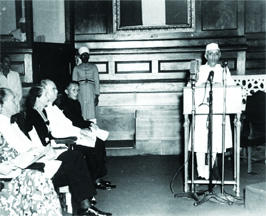
    Britain’s Parliament passed in July 1947 the Indian Independence Act. It ordered that the dominions of India and Pakistan be demarcated by midnight of August 14–15, 1947, now celebrated annually as Independence Day in both Pakistan (August 14) and India (August 15). It was both a glorious and a tragic moment. The peoples of the subcontinent, though deeply divided, were now free and the masters of their own destinies. Just before midnight, Nehru made his famous “Tryst with Destiny” speech to the Indian Constituent Assembly in the Parliament House.
    The Partition of India and Pakistan
    The Indian Independence Act ordered that the assets of the world’s largest empire—which had been integrated in countless ways for more than a century—be divided within a single month. Racing the deadline, the Boundary Commission, appointed by Mountbatten, worked desperately to partition Punjab and Bengal in such a way as to leave the maximum practical number of Muslims to the west of the former’s new boundary and to the east of the latter’s. The commission consisted of four members from the Congress Party and four from the Muslim League and was chaired by Cyril Radcliffe, a lawyer who had never before been to India. With little agreement between the parties and the deadline looming, Radcliffe made the final determination of the borders, which satisfied no one and infuriated everyone.
    Dividing Punjab and Bengal, the provinces with a slim Muslim majority, caused tremendous problems, as the demographic distributions of those regions were heterogeneous and diverse. The new borders ran through the middle of villages, towns, fields, and more. When Pakistan was created, East and West Pakistan were separated by about 1,000 miles (1,600 km).
    The commission also effectively cut in half the large Sikh population in Punjab. The western half of the community reacted with great concern over potential Muslim rule: the Mughal emperors had persecuted the Sikh Gurus in the 17th century, and the legacy of that persecution remained deeply felt. Although the commission had placed Amritsar, the Sikhs’ most sacred city, under Indian dominion, many other important Sikh shrines and landed estates were set to become part of Pakistan. Some Sikhs of western Punjab tried initially to retain control over their estates by pushing out local Muslims, but their attempts were met with violent reprisals. Nearly the entirety of the Sikh community ultimately fled to areas that would become part of India.
    The transfer of power was completed on August 14 in Pakistan and August 15 in India, held a day apart so that Mountbatten could attend both ceremonies. With the birth of the two independent countries, the British raj formally came to an end on August 15, 1947.
    The borders of the new countries were not published until August 17, two days after the end of British rule. This set the stage for an immediate escalation of communal violence in areas around the new borders. Many people did not understand what partition meant until they were in the middle of it, sometimes literally. If a border village was roughly evenly divided between Hindus and Muslims, one community could argue that the village rightly belonged to India or Pakistan by driving out or killing members of the other community.
    As soon as the new borders were announced, roughly 15 million Hindus, Muslims, and Sikhs fled from their homes on one side of the newly demarcated borders to what they thought would be “shelter” on the other. Some people were able to take trains or buses from one country to another, but most were forced to flee on foot, joining refugee columns that stretched for miles. These columns were the target of frequent ambushes, as were the trains that carried refugees across the new borders. In the course of that tragic exodus of innocents, as many as 2 million people were slaughtered in communal massacres (although scarce documentation left a wide range of estimates). Sikhs, settled astride Punjab’s new division, suffered the highest proportion of casualties relative to their numbers.
    While the worst of the violence took place during the first six weeks of partition, the consequences of those weeks played out for decades. Even provinces that had initially escaped violence later saw outbreaks of conflict; for example, Sindh struggled to absorb large numbers of refugees (muhajirs) from India who, although Muslim, belonged to different ethnolinguistic groups from the local population. Disparities that arose from the hasty creation of Pakistan led ultimately to a devastating war in 1971 between its eastern and western provinces, which resulted in the independence of East Pakistan as Bangladesh. Territorial disputes between India and Pakistan, particularly the question of the Kashmir region, have also led to multiple wars. Moreover, tensions over the rights of Sikhs and the preservation of their communal integrity have also led to violent confrontations in India, most notably with the storming of the Harmandir Sahib in 1984 and the subsequent assassination of Indira Gandhi.
    The assassination of Mahatma
    Gandhi and aftermath
    Amid growing communal violence, Gandhi traveled to New Delhi, India’s capital, to take part in a fast for peace and to participate in prayer meetings. His presence on the day of his death, January 30, 1948, attracted a crowd of followers estimated at between several hundred and 1,000 people. About 5:15 PM, Gandhi and his two granddaughters left Birla House, where he had been living, with the intent of leading his followers to a nearby summer pagoda where he often made his evening devotions. Nathuram Godse approached the frail politician, greeted him, then fired three shots at close range from a small-caliber revolver that he had hidden in his clasped hands, striking Gandhi in the upper thigh, abdomen, and chest. As Gandhi fell to the ground, he put his hand to his forehead in the Hindu gesture of forgiveness. He was quickly carried back into Birla House and placed on a couch, his head resting in the lap of his granddaughter Mani, who minutes later told the crowd: “Bapu is finished.” His final words were, allegedly, “He Ram, He Ram” (“Oh God, Oh God”).
    News of Gandhi’s death spread quickly throughout India, generating a sometimes violent response. In Bombay (now Mumbai), riots set fundamentalist Hindus against terrified Muslims. In New Delhi, throngs of people left their homes and businesses to mourn at Birla House. Troops were sent to maintain order. A few hours after Gandhi’s death, a balcony window at Birla House was opened and Gandhi’s body was carried outside and placed in a chair facing the crowd. Prime Minister Jawaharlal Nehru gave a radio address later in the evening in which he proclaimed a day of national mourning and appealed for calm:
    The light has gone out of our lives, and there is darkness everywhere. I do not know what to tell you and how to say it. Our beloved leader, Bapu as we called him, the Father of the Nation, is no more.…We will not run to him for advice and seek solace from him, and that is a terrible blow….The light has gone out, I said, and yet I was wrong….The light that has illumined this country for these many years will illumine this country for many more years, and a thousand years later, that light will be seen in this country and the world will see it and it will give solace to innumerable hearts.
    At the end of his speech, Nehru informed listeners that Gandhi’s body would be brought out at 11:30 AM the following day and taken to the banks of the Yamuna River, a tributary of the Ganges, and cremated there at 4 PM.
    Nathuram Godse was an acolyte of a right-wing fundamentalist political ideology known as Hindutva, championed at the time by the Rashtriya Swayamsevak Sangh (RSS), a Hindu nationalist organization. Godse was tried by a special court inside the historic Red Fort in May 1948. When it came time for him to speak, Godse read a 30,000-word confession in which he referred to Gandhi’s murder as “wholly and exclusively political” and held Gandhi responsible for partition and communal violence. Godse said he acted alone, although seven others were later convicted in relation to the murder. Godse and an accomplice, Narayan Apte, were executed by hanging on November 15, 1949; the other six were sentenced to life in prison.
    Yet Nehru carried on at India’s helm, and, owing in part to his secular enlightened leadership, not only did India’s flood of religious hatred and violence recede, but also some progress was made toward communal reconciliation and economic development. Nehru spoke out fearlessly against India’s “caste-ridden” and “priest-ridden” society, which, as a Hindu Brahman pandit, he could do without fear of too much upper-caste criticism. His charismatic brilliance, moreover, continued to make him a major vote-winner in each election campaign that he led (1951–52, 1957, and 1962) throughout his 17 arduous years in office as the Indian National Congress—opposed only by minor parties and independent candidates—dominated political life. Nehru’s modernist mentality and cosmopolitan popularity helped to hide the traditional continuity of India’s internal problems, few of which disappeared under his leadership.
    The promulgation of the Indian constitution
    The dominion of India was reborn on January 26, 1950, as a sovereign democratic republic and a union of states. That day is celebrated annually as Republic Day, a national holiday commemorating the adoption of India’s constitution on January 26, 1950. The constitution was crafted under the chairmanship of Bhimrao Ramji Ambedkar and resolved to secure for its citizens liberty, equality, and fraternity.
    With universal adult franchise, India’s electorate was the world’s largest, but the traditional feudal roots of most of its illiterate populace were deep, just as their religious caste beliefs were to remain far more powerful than more recent exotic ideas, such as secular statehood. Elections were to be held, however, at least every five years, and the major model of government followed by India’s constitution was that of British parliamentary rule, with a lower House of the People (Lok Sabha), in which an elected prime minister and a cabinet sat, and an upper Council of States (Rajya Sabha). Nehru led his ruling Congress Party from New Delhi’s Lok Sabha until his death in 1964. The nominal head of India’s republic, however, was a president, who was indirectly elected. India’s first two presidents were Hindu Brahmans, Rajendra Prasad and Sarvepalli Radhakrishnan, the latter a distinguished Sanskrit scholar who had lectured at the University of Oxford. Presidential powers were mostly ceremonial, except for brief periods of “emergency” rule, when the nation’s security was believed to be in great danger and normal constitutional procedures and civil rights were feared to be too cumbersome or threatening.

  • Documentary Screening on Vivek Tankha draws a large crowd of Indian Diaspora Leaders at the New York Indian Film Festival

    Documentary Screening on Vivek Tankha draws a large crowd of Indian Diaspora Leaders at the New York Indian Film Festival

    NEW YORK CITY (TIP): The Indian Overseas Congress (IOC) USA hosted a remarkable celebration on Saturday, June 21, at the iconic Village East by Angelika theater in Manhattan, marking the screening of “The Renaissance Man”, a documentary film chronicling the inspiring life and legacy of Vivek Tankha. The event was part of the New York Indian Film Festival and drew an enthusiastic audience, including senior leaders of IOC-USA and distinguished members of the Indian diaspora.

    The documentary highlights the extraordinary journey of Shri Vivek Tankha ji —Senior Advocate of the Supreme Court of India, former Additional Solicitor General, sitting Rajya Sabha MP, and a dedicated humanitarian. His contributions span multiple sectors, including public interest litigation, tribal healthcare, education, disability rights, and disaster relief. The film captures both his legal brilliance and his compassionate leadership, especially through his widely acclaimed initiative “Rahat”, which has provided critical medical and disaster aid to marginalized communities in Madhya Pradesh, Chhattisgarh, and beyond.

    Photos of documentary viewing of film “ The Renaissance Man: Life and Times of Vivek Tankha” at the New York Film festival on June 21, 2025. showing Shri Vivek Tankha ji (sitting in center) responding to questions from the audience.

    During the post-screening interaction, Mr. Tankha shared powerful insights into his motivations and lifelong mission to use law and public service as instruments for justice and upliftment.  He spoke of landmark cases, including his pivotal legal work for the Bhopal Gas Tragedy victims, and emphasized the need for ethical and empathetic leadership in contemporary India.

    The event was held under the leadership of Mohinder Singh Gilzian, President of the Indian Overseas Congress USA, who opened the celebration with high praise for Mr. Tankha.

    “If even one percent of India’s population embodied the intellect, integrity, and compassion of Vivek Tankha,” said Mr. Gilzian, “India would be a different country. His life offers a blueprint for the kind of leadership our nation urgently needs.”

    Adding to the evening’s grace and significance, Mr. Sam Pitroda, Global Chairman of Overseas Congress Department of A.I.C.C., sent a heartfelt video message applauding Mr. Tankha’s decades of service in law, policy, and social reform.

    “Vivek is not just a legal scholar; he’s a people’s advocate. His work touches lives where it matters most,” Mr. Pitroda said.

    The celebration was inaugurated with an inspiring and powerful opening remarks by Harbachan Singh, Secretary-General of IOC-USA, who recognized very highly Mr. Tankha’s awesome enduring legacy of justice and social responsibility.  He likened all the solid attributes of Shri Vivek Tankha ji to those of Mahatmas and Heros and made a moving equation of his personality and service to them.  Mr. Tankha embodied humility, softness and a profound depth of knowledge and human experience which has drawn crowds of people to him in total acceptance of him as no less than acclaimed Mahatmas and Heros.

    The screening was more than a celebration of an individual—it was a tribute to a life of purpose, service, and vision. It resonated as a rallying call to the Indian diaspora to identify, support, and champion leaders like Vivek Tankha, whose integrity and impact go far beyond the boundaries of law and politics.

    The event was graced by a wide array of IOC-USA leaders who honored Mr. Tankha with a bouquet and a traditional shawl, a symbolic gesture of respect and admiration.  Among the IOC USA senior leaders present were: Working President (North East Zone) Pradeep Samala;  Vice President John Joseph: Vice President Baldev Randhawa;  General Secretaries; Sharath Chandra, Sophia Sharma and  Rajeev Mohan;  President of Maryland Chapter Chaudhry Pratap Singh;  President of Andhra Chapter Srinivasrao Bhimineni; Chairman of the Punjab Chapter; Phuman Singh Ibrahimpur; Secretary, IOC.USA Jaswinder Singh Kang and his team; Dr.Yogesh Dayma from Boston: Rockland Chapter President Shaimi Jacob: Amanpreet Aman and Mukesh (Mike) from New Jersey: Patel Sridhar Reddy from Telengana Chapter Detroit: Harpreet Singh Happy and Sunny Singh:   Harvendar Singh and Qayam Masumi representing the New Jersey Chapter, among others.

    In addition, several local IOC-USA leaders, business professionals, lawyers, dignitaries, activists, and scholars from across the United States traveled to New York to attend the event and personally extend their congratulations to Mr. Tankha.

    The event concluded with a vibrant Q&A session, where attendees engaged with Mr. Tankha on a range of topics—from his legal battles and legislative work in Parliament to his grassroots efforts for the underprivileged and youth empowerment.

    The screening was more than a celebration of an individual—it was a tribute to a life of purpose, service, and vision. It resonated as a rallying call to the Indian diaspora to identify, support, and champion leaders like Vivek Tankha, whose integrity and impact go far beyond the boundaries of law and politics.

    At the reception, Secretary General  Harbachan Singh led with the award of a Proclamation of Honor by Shri Vivek Tankha ji and Mohinder Singh ji to Attorney Jaspreet Singh in appreciation of his outstanding leadership, benevolent services and support of the community.

    Following the above, Harbachan Singh requested the entire gathering to rise in solemn observance of a moment of silence in condolence and sympathy of the victims of the recent Air India airplane crash and sharing the sorrow and pain with the aggrieved families.  Similar solemn observance was also observed to grief the sudden, shocking and painful to bear demise of the brother of Shri Vivek Tankha ji in India the day before this event accelerating the swift return to India of Mr. Vivek Tankha ji.  May all the departed souls Rest in Peace! by the grace of Almighty God.

  • Punjab cadre IPS officer Parag Jain to head R&AW, played key role in Op Sindoor

    Punjab cadre IPS officer Parag Jain to head R&AW, played key role in Op Sindoor

    NEW DELHI (TIP): Senior Indian Police Service (IPS) officer Parag Jain, widely known for his expertise in intelligence gathering and affairs related to India’s neighborhood, has been appointed as the new head of the country’s external intelligence agency, the Research and Analysis Wing (R&AW), officials said on Saturday.

    Jain is a 1989-batch IPS officer of Punjab cadre. He will succeed Ravi Sinha, who completes his tenure on June 30.

    Sinha is a 1988 batch IPS officer of Chhattisgarh cadre. Jain is currently heading the Aviation Research Centre, which played a vital role during ‘Operation Sindoor’ by collecting intelligence on the Pakistani armed forces.

    Jain has previously served as Senior Superintendent of Police (SSP), Chandigarh, and has represented India in Canada and Sri Lanka. He has also been posted in Jammu and Kashmir, where he played an important role in the Centre’s counter-terrorism strategy in the strife-torn Union Territory.

  • Royal Challengers rout Punjab Kings to storm into final

    Royal Challengers rout Punjab Kings to storm into final

    Mohali (TIP)- Royal Challengers Bengaluru raced to their first Indian Premier League final since 2016 with an eight-wicket pounding of Punjab Kings in a lopsided Qualifier 1 here on Thursday, May 29. Punjab Kings’ ultra-aggressive approach backfired on the day as RCB skittled out the home team for 101 in 14.1 overs.
    RCB, who are yet to win the IPL despite reaching three finals (2009, 2011, 2016) since the league’s inception in 2008, gunned down the small target in 10 overs courtesy a belligerent fifty from opener Phil Salt (56 not out off 27). With a near perfect performance, RCB marched to the title clash scheduled in Ahmedabad on June 3.
    Punjab Kings, who reached the play-offs for the first time since 2014, will get another shot at reaching the final in Qualifier 2 in Ahmedabad on June 1. The home team batters found it difficult to hit through the line but it seemed Salt was batting on a different surface, collecting boundaries for fun.
    He ended up smashing six fours and three sixes including a crisp pull off pacer Arshdeep Singh.
    The match ended prematurely when RCB skipper Rajat Patidar slog swept Musheer Khan for a maximum. Punjab Kings were blown away by RCB but Kyle Jamieson got the home crowd going for a brief period by bowling a stellar wicket maiden that included the wicket of Virat Kohli (12 off 12).
    Number three Mayank Agarwal was left clueless in the same over with Jamieson getting the ball to swing away.
    “We need to go back to the drawing board. We have lost the battle but not the war,” said Punjab Kings skipper Shreyas Iyer after a rather heavy loss.
    Earlier, the all-out attack strategy of the Punjab Kings contributed to their downfall after they were put in to bat. Their innings lasted just 14.1 overs. The RCB pace trio of Josh Hazlewood (3/21), Bhuvneshwar Kumar (1/17) and Yash Dayal (2/26) exploited the conditions well before leg-spinner Suyash Sharma (3/17) made it worse for the opposition.
    Punjab Kings’ steep slide began when in-form opener Priyansh Arya was caught at cover off Dayal as he couldn’t check his drive. His opening partner Prabhsimran Singh (18 off 10) followed him back into the dugout in the following over from Bhuvneshwar.
    Having collected two straight boundaries on the charge, Prabhimsran stepped out for a third swipe but Bhuvneshwar pulled his length back to induced the edge. Captain Shreyas Iyer, who has been central to the team’s success this season, went for a wild slog off Hazlewood on his third ball of the innings but was caught behind. The Australian pacer then sent back his country man Josh Inglis off a rising ball that the former could not control, creating a sense of panic in the dressing room.
    The batters continued to go for their shots to hasten Punjab Kings’s slide. Against leggie Suyash, the likes of Marcus Stoinis (26 off 17) and Shashank Singh went for the slog sweep but could not connect to the googly. Musheer Khan, making an unexpected IPL debut as an impact player with wickets falling in heap, too fell to a sweep off Suyash, who got his googly to turn sharply.
    Having put up a poor effort with the bat, Punjab Kings would take some confidence from their league stage outing against KKR when they defended 111 on a challenging surface here.

  • Thousands of  Sikhs Participate in the 37th  Sikh Day Parade  In New York City

    Thousands of Sikhs Participate in the 37th Sikh Day Parade In New York City

    NEW YORK, NY (TIP): Organized by the Sikh Cultural Society, Richmond Hill,  New York,  with the cooperation of the Sikh Gurudwaras and the  Sikh organizations of the Tri-State area of New York, New Jersey and Connecticut, the 37th Sikh Day Parade on April 26 in Manhattan, New York, attracted, as usual, large crowds of Sikh men, women and children from far and near. Contingents of the Sikhs came from as far as Philadelphia and Maryland.

    Saturday’s dreary weather didn’t stop a full day of traditions, history, food and music at the Sikh Day Parade in Midtown.

    Colorful displays of the Sikh faith made their way down Madison Avenue, ending with free meals for thousands. As the floats made their way down the wet pavement, the sounds of Sikh traditions were heard loud and clear.

    For the 37th Annual Sikh Day Parade, many in their colorful turbans and cultural clothing — most of them wearing rain ponchos — lined up to celebrate Vaisakhi. The day which originally is the celebration of harvest, is also the day when the Tenth Master of the Sikhs, Guru Gobind Singh Ji, created a sect called Khalsa, and gave it a distinct form and appearance. Thus, the day is both a socio-cultural festival and a celebration of the birthday of Khalsa (more popularly known as the Sikhs)

    “Today is  a celebration of Vaisakhi, and also a celebration of the creation of our faith, and we are here celebrating,” paradegoer Baldev Singh Grewal who is founder -publisher of a leading Punjabi newspaper Sher-e-Punjab,  said.

    The parade concluded with a meeting at Madison Square Park, where community leaders made speeches and  free food , called langer in Sikhism, was served.

  • Guru Gobind Singh Ji : The Saint Soldier

    Guru Gobind Singh Ji : The Saint Soldier

    Guru Gobind Singh, (1666–1708) the 10th and last master of the Sikhs, was born on 7th day of the month of POH, samvat 1723, (22nd December, 1666 AD ) at Patna Sahib in Bihar. Guru ji was a great revolutionary whose greatest achievement was the creation of the Khalsa Panth on Baisakhi Day of 1699 at Anandpur Sahib in Punjab. Guru ji was a linguistic familiar with many languages Iike, Persian, Arabic, Sanskrit as well as his native Punjabi. Guru ji codified Sikh law,wrote martial poetry and music ,fought many battles and won.
    Guru ji wrote the renowned holy Granth called the Dasam Granth..The noted prayers included in this Granth are Jaap Sahib, Chandi Di Vaar, Tav-Prasad Savaiye, Zafarnamah, Bachittar Natak, Akal Ustat, Chaupai Sahib and more.
    Guru Gobind Singh Sahib Ji was a revolutionary prophet who practiced his spiritual ideals to counter the forces of tyranny and injustice. Tyranny in all its forms – social, political, and religious was to be countered and annihilated. A state which could not provide basic human rights, social justice, equality and religious freedom was to be opposed.
    Guru Gobind Singh Ji’s contributions not only shaped Sikhism into a vibrant, sovereign, and spiritual tradition, but also inspired resistance against tyranny and uplifted the downtrodden. His establishment of the Khalsa in 1699 and his declaration of Guru Granth Sahib Ji as the eternal Guru remain the two most defining moments in Sikh history.
    Early Life of Guru Gobind Singh Ji
    – Birth Name: Gobind Rai
    – Born: December 22, 1666 (7 Poh, Samvat 1723), Patna Sahib, Bihar
    – Father: Guru Tegh Bahadur Ji (9th Sikh Guru)
    – Mother: Mata Gujri Ji
    Childhood in Patna and Anandpur Sahib
    Guru Gobind Singh Ji was born in Patna Sahib, where his early years were marked by brilliance in language, philosophy, and martial training. His family later moved to Anandpur Sahib, which became the center of Sikh learning and resistance under his leadership.
    Martyrdom of Guru Tegh Bahadur Ji
    In 1675, Guru Tegh Bahadur Ji was publicly executed in Delhi by Mughal Emperor Aurangzeb for defending the religious rights of Kashmiri Hindus. At the young age of nine, Guru Gobind Rai was formally anointed as the Tenth Guru, taking on an enormous spiritual and social responsibility.
    Leadership and Transformation of the Sikh Community
    From the age of nine onward, Guru Gobind Singh Ji led the Sikh Panth with vision, strength, and purpose, shaping it into a resilient and sovereign spiritual order.
    Creation of the Khalsa (1699)
    On Vaisakhi Day in 1699, Guru Gobind Singh Ji summoned thousands of Sikhs at Anandpur Sahib. Through a dramatic call for sacrifice, he created the Khalsa Panth, a community of initiated warrior-saints who embodied the virtues of:
    – Spiritual devotion (bhakti)
    – Martial courage (shakti)
    – Equality, justice, and righteousness
    The Khalsa was required to uphold the Five Ks (Kakaars) and live by a strict code of conduct, known as the Rehat Maryada.
    “When all other means fail, it is righteous to draw the sword.”
    -Guru Gobind Singh Ji
    This transformation empowered the Sikhs to resist religious persecution, caste oppression, and political tyranny.
    Teachings and Philosophy
    Guru Gobind Singh Ji’s teachings combine devotion, discipline, and dharam yudh (righteous warfare). He emphasized internal purity, service to humanity, and unwavering faith in One God.
    1. God is One and Formless
    Guru Ji reinforced the belief in Ik Onkar-the One Universal Creator. He rejected idol worship and rituals, calling instead for:
    – Meditation (Simran)
    – Honest living (Kirat Karni)
    – Sharing with others (Vand Chakna)
    2. Equality of All
    He denounced the caste system, declared all human beings equal, and promoted gender equality.
    “Manas ki jaat sabhe ek pehchaanbo” – Recognize the whole human race as one.
    3. The Ideal Saint-Soldier
    Guru Gobind Singh Ji conceptualized the ideal Sikh as a Saint-Soldier (Sant-Sipahi)-a person of high spiritual awareness, humility, and martial readiness to fight for justice, never out of anger or greed.
    4. Fearlessness and Self-Sacrifice
    He emphasized the cultivation of Nirbhau (fearlessness) and Nirvair (without hatred). His own life, and the sacrifices of his family, are unparalleled in Indian history.
    Literary Genius and Writings
    Guru Gobind Singh Ji was a scholar of Persian, Braj, Sanskrit, and Punjabi, and composed an extensive body of spiritual and philosophical literature.
    Major Works
    – Jaap Sahib – A poetic composition praising the attributes of God
    – Akal Ustat – Hymns in praise of the Timeless One
    – Chandi di Var – Heroic ballads of the divine feminine (Chandi/Devi)
    – Zafarnama – A Persian epistle to Aurangzeb, criticizing his tyranny and dishonesty
    These texts form a part of the Dasam Granth, a collection of Guru Gobind Singh Ji’s writings.
    Personal Sacrifices and Battles
    Family Martyrdom
    Guru Gobind Singh Ji’s life was marked by immense personal loss:
    – His father, Guru Tegh Bahadur Ji – Beheaded for defending religious freedom
    His four sons:
    – Sahibzadas Ajit Singh and Jujhar Singh – Martyred in the Battle of Chamkaur
    – Sahibzadas Zorawar Singh and Fateh Singh – Bricked alive by the Mughals in Sirhind
    – His mother, Mata Gujri Ji – Passed away in captivity upon hearing of her grandsons’ death
    Despite these tragedies, Guru Ji remained steadfast in faith, mission, and purpose.
    Key Battles
    He fought several defensive wars against the Mughal and Hill Rajput rulers, including:
    – Battle of Bhangani (1688)
    – Battle of Chamkaur (1704)
    – Battle of Muktsar (1705)
    These battles were fought not for power, but for dharma (righteousness) and freedom of belief.
    Declaration of the Guru Granth Sahib as the Eternal Guru
    Before his passing in 1708, Guru Gobind Singh Ji abolished the line of human Gurus and declared the Guru Granth Sahib Ji as the eternal, living Guru of the Sikhs:
    “Sabh Sikhan ko hukam hai, Guru manyo Granth.”
    This ensured that the Word of God, not a person, would guide the Panth forever.
    Martyrdom at Nanded
    Guru Gobind Singh Ji passed away on October 7, 1708, in Hazur Sahib, Nanded (Maharashtra), after being attacked by an assassin. Even in his final moments, he remained composed, instructing the Sikhs to uphold the Khalsa and revere the Guru Granth Sahib.
    Legacy of Guru Gobind Singh Ji
    – Founder of the Khalsa Panth
    He gave Sikhs a unique identity and unified purpose-to be selfless, courageous, disciplined, and God-fearing.
    – Champion of Human Rights and Freedom
    – Guru Gobind Singh Ji’s message resonates universally: stand for the oppressed, live truthfully, and never bow before injustice.
    – He was not only a warrior but also a visionary poet and philosopher. His writings inspired generations to live lives of spiritual and ethical excellence.

  • Ustad Zakir Hussain: Tabla loses its vibrant voice

    Ustad Zakir Hussain: Tabla loses its vibrant voice

    The tabla fell silent as Ustad Zakir Hussain (1951-2024), one of the greatest global ambassadors of Indian classical music, passed away on Monday (December 16, 2024) after a brief illness in San Francisco, California. A maestro who transformed the modest instrument into a robust voice for universal peace and humanity, Hussain’s incredible speed, dexterity, and creativity mesmerised audiences across cultures.
    Having grown up singing odes to Mother Saraswati, verses of the holy Quran, and hymns of the Bible as a daily ritual, India’s syncretic soul echoed through Hussain’s rhythmic art. With a flair for carving stories out of percussive sound, his conversational music buzzed with a spark of spontaneity. Natural flow defined his music and personality. The Padma Vibhushan would impress the purists, enthrall the seekers of fusion, and handhold the fans of Bollywood music into his creative space with equal felicity. At the peak of his creativity genius, he bagged three Grammys in one night this February.
    Like his carefully designed free-flowing style, the versatile artist would execute complex rhythms, intricate patterns, and nuanced dynamics and then move on to items like the sound of traffic signal and deer’s walk, without putting music into brackets. In tune with technology, over the years, he experimented with frequencies to highlight the subtle shades of the instrument to establish that tabla is not just a rhythmic instrument but also a melodic one. He emerged on the scene alongside eminent tabla artists like Anindo Chatterjee, Shafaat Ahmed Khan, Kumar Bose, and Swapan Chaudhuri, but Hussain’s role in popularising tabla and providing it a global platform remains unparalleled.
    Born to Ustad Alla Rakha, the eminent accompanist of Pandit Ravi Shankar, credited with taking tabla to foreign shores, tabla chose Hussain. He grew up in Mumbai in an environment where his father believed that every instrument has its spirit. Hussain befriended the tabla at the age of three and by the time he hit teenage, the instrument had become his muse for life and perhaps an extension of his personality. After watching him play, one couldn’t see playing tabla as a chore in classical music.
    His other two brothers, Taufiq and Fazal, are also noted percussionists but Hussain took his father’s legacy to the next level by adding a touch of showmanship and expanding the riches he inherited from the Punjab gharana. A keen learner and listener, Hussain was like a responsive satellite in orbit as an accompanist, shone like a star in his solos, and reserved the adventurous streak of a meteor for creating fusion music.
    A child prodigy who gave his first professional performance at 12, Hussain was not regimented by his teacher-father. Rooted in Indian tradition, he was allowed to develop wings and explore new shores. His day would start with devotional music that would invoke Hindu deities followed by polishing Koranic verses in the neighbourhood madarsa before he would join the morning prayers at the Convent school. By 19, Hussain taught at the University of Washington before joining Ustad Ali Akbar Khan’s music college in San Francisco where he met his soulmate Antonia Minnecola.
    Another fortuitous meeting in New York led to a lifelong bond with the iconic English guitarist John McLaughlin. Their friendship led to the formation of the groundbreaking Shakti band in 1973 which included violinist L. Shankar and percussionist T. H. Vinayakram who blended Hindustani and Carnatic classical music with Western jazz influences. This year, the band where Hussain joined hands with a new set of distinguished musicians won the Grammy for Best Global Music.
    Hussain’s desire to experiment led to rewarding collaborations with Irish singer Van Morrison, American percussionist Mickey Hart, Latin Jazz percussionist Giovanni Hidalgo, and Jerry Garcia, the lead vocalist and guitarist of the Grateful Dread. He joined the Asian Underground music’s electronic surge as well in the 1990s but retained the natural acoustic quality of tabla. He shared a special bond with Santoor maestro Pandit Shiv Kumar Sharma, flautist Hari Prasad Chaurasia, and sarangi stalwart Ustad Sultan Khan. Their jugalbandis would start as melodic banter and then turn meditative. In sync with the next generation, last year, he composed the Triple Concerto for Tabla, Sitar and Flute, with Niladri Kumar and Rakesh Chaurasia, and his collaboration with Carnatic musicians extended to violinist Kala Ramnath and veena exponent Jayanthi Kumaresh.
    Fusion was never a novelty for Hussain as he had grown up listening to stories of how Amir Khusrau blended the Indian traditions of Dhrupad and Haveli sangeet with Sufi Qaul to create Khayal. As a young musician, he saw his father and colleagues contributing to Hindi film music that liberally drew from diverse musical streams. Hussain had his brush with cinema when he played tabla for Laxmikant Pyarelal’s maiden venture Parasmani. Later he composed music for Ismail Merchant’s films like Muhafiz, Aparna Sen’s Mr And Mrs Iyer, and Rahul Dholakia’s Parzania. The meaningful sound of his tabla lent layers to storytelling in international productions like Francis Ford Coppola’s Apocalypse Now and recently Dev Patel’s Monkey Man.
    Hussain also had a flair for acting from a young age. It is said Dilip Kumar recommended his name to K Asif for the role of young Salim in Mughal-e-Azam but Ustad Alla Rakha vetoed it. Later, he performed in Ismail Merchant’s Heat & Dust and Sai Paranjpye’s Saaz. However, he became a household figure when he brought classical music to the mainstream by promoting a tea brand in a commercial where he played tabla at the iconic Taj Mahal. As an article in The Hindu described, “The combination of “Wah Taj!” with the dashing young Hussain’s curly locks flying about his face as his fingers flew across the surface of his tabla — not to mention that charming smile accompanied by the resonance of his playing — ensured brand immortality.
    Fame didn’t diminish his humility and age didn’t wilt his curiosity. Music was an endless journey for Hussain. Every time someone would toss the word perfection, he would say, “I haven’t played good enough to quit.”
    Source: The Hindu

  • Tributes pour in for Justice Kuldip Singh, Justice Harjit Singh Bedi

    Tributes pour in for Justice Kuldip Singh, Justice Harjit Singh Bedi

    Justice Kuldip Singh

    Justice Harjit Singh Bedi

    Tributes poured in for two stalwarts of the Indian judiciary – Justice Kuldip Singh and Justice Harjit Singh Bedi – who passed away in November this year.
    Justice Harjit Singh Bedi died on November 21, followed closely by Justice Kuldip Singh on November 25.
    “Their passing has created an irreplaceable void, but their contributions and values will continue to inspire us as we move forward,” a resolution, signed by former judges, including Justice S S Sodhi, Justice M S Liberhan, Justice Mehtab Singh Gill, Justice S S Saron, Justice Ranjit Singh Randhawa, Justice Nawab Singh, Justice Rajiv Narain Raina, Justice Nirmaljit Kaur, Justice Jaishree Thakur, and Justice Sabina, expressed deep sorrow at the untimely passing of both luminaries within days of each other, stated.
    Justice Kuldip Singh
    (1 Jan 1932 – 25 Nov, 2024)
    Justice Kuldip Singh was a renowned jurist and former judge of the Supreme Court of India, recognized for his unwavering commitment to environmental protection and human rights. His tenure in the judiciary left a significant impact on Indian jurisprudence, particularly in public interest litigation (PIL) and environmental law. Below is a detailed profile of his illustrious career and contributions.
    Early Life and Education
    Justice Kuldip Singh was born on January 1, 1932, in Punjab, India. He pursued his education with distinction, earning his degree in law from Panjab University, Chandigarh. After completing his studies, he embarked on a legal career that would see him rise to prominence in the Indian legal system.
    Legal Career
    Justice Singh began practicing law in the early 1950s, specializing in constitutional, civil, and corporate law. His expertise and dedication earned him widespread respect within the legal fraternity. Over the years, he was involved in several landmark cases, which helped cement his reputation as an advocate of justice and fairness.
    He was designated as a Senior Advocate by the Punjab and Haryana High Court, a recognition of his legal acumen and skill. Subsequently, he served as the Advocate General for the state of Punjab, a role in which he provided legal counsel to the state government on critical legal and constitutional matters.
    Appointment to the Supreme Court
    Justice Kuldip Singh was appointed as a judge of the Supreme Court of India on December 14, 1988. During his tenure, which lasted until December 21, 1996, he delivered several landmark judgments that have had a lasting impact on Indian law and society.
    Landmark Contributions
    Justice Singh’s judicial philosophy was marked by his emphasis on social justice and environmental sustainability. His notable contributions include:
    Environmental Jurisprudence
    Justice Singh is often referred to as the “Green Judge” for his landmark rulings in environmental cases. Under his watch, the Supreme Court actively employed the principle of sustainable development to balance environmental protection with economic progress.
    In cases like Vellore Citizens Welfare Forum v. Union of India (1996), he emphasized the importance of the “precautionary principle” and the “polluter pays principle” in managing environmental challenges.
    He also played a pivotal role in directing measures to control industrial pollution, protect forest cover, and preserve biodiversity.
    Public Interest Litigation (PIL)
    Justice Singh was a strong proponent of PILs as a tool to address societal inequities. Through his judgments, he expanded the scope of PILs to include issues like environmental degradation, human rights violations, and corruption. His rulings empowered ordinary citizens to approach the judiciary for redressal of public grievances.
    Human Rights Advocacy
    Justice Singh demonstrated a profound commitment to upholding human rights. He authored judgments that safeguarded the rights of marginalized communities, upheld personal liberties, and strengthened the implementation of constitutional guarantees.
    Electoral Reforms
    Justice Singh was instrumental in advocating for transparency and fairness in the electoral process. His judgments stressed the need for free and fair elections, ensuring the sanctity of democratic institutions.
    Legacy and Recognition
    Justice Kuldip Singh’s judicial career left a deep imprint on the Indian legal system. His proactive approach to environmental and social justice earned him widespread recognition, both domestically and internationally. He is celebrated for bringing environmental issues into the mainstream of judicial discourse in India.
    Post-retirement, he continued to contribute to legal and social causes. He chaired various committees and commissions, including one on electoral reforms, where he made significant recommendations to enhance transparency and accountability in India’s democratic processes.
    Justice Kuldip Singh is known for his humility and dedication to public service. Despite his high-profile career, he remained grounded, focusing on issues that affect the common man.
    Justice Kuldip Singh’s legacy as a jurist lies in his progressive judgments and his commitment to the ideals of justice, equality, and environmental sustainability. His contributions continue to inspire legal practitioners, environmentalists, and social activists in India and beyond.

    Justice Harjit Singh Bedi
    (Sept 5, 1946 – Nove 21, 2024)
    Justice Harjit Singh Bedi (September 5, 1946 – November 21, 2024) was a distinguished Indian jurist who served as a judge of the Supreme Court of India. His legal career was marked by significant contributions to the Indian judiciary, characterized by fairness, integrity, and a deep commitment to justice.
    Early Life and Education
    Born in Sahiwal (formerly Montgomery), now in Pakistan, Justice Bedi hailed from a family of agriculturists. Notably, he was a direct descendant of Guru Nanak, the founder of Sikhism, being 17th in the line. Following the partition of India, his family settled in Fazilka, a township near the India-Pakistan border. His father, Tikka Jagjit Singh Bedi, served as a judge on the Punjab and Haryana High Court until his retirement in 1969.
    Justice Bedi completed his schooling at Bishop Cotton School in Shimla, obtaining his Senior Cambridge certificate in 1962. He pursued higher education in law, which laid the foundation for his illustrious legal career.
    Legal Career
    Enrolled as an advocate with the Bar Council of Punjab & Haryana on July 17, 1972, Justice Bedi practiced in civil, criminal, and writ matters. Between 1974 and 1983, he also served as a part-time lecturer in the Department of Laws at Panjab University, Chandigarh, demonstrating his dedication to legal education.
    His career in public service began with his appointment as Deputy Advocate General for Punjab in 1983. He was designated as a Senior Advocate in 1987 and subsequently served as Additional Advocate General until 1989. In 1990, he was appointed Advocate General of Punjab, a position he held for about a year.
    Judicial Appointments
    Justice Bedi’s judicial career commenced with his appointment as an Additional Judge of the Punjab and Haryana High Court on March 15, 1991. He became a permanent judge on July 8, 1992. His judicial acumen led to his elevation as the Chief Justice of the Bombay High Court on October 3, 2006. Shortly thereafter, on January 12, 2007, he was appointed as a judge of the Supreme Court of India, where he served until his retirement in 2011.
    Notable Contributions
    Beyond his tenure on the bench, Justice Bedi was entrusted with significant responsibilities post-retirement. In 2012, the Supreme Court appointed him as the Chairman of a Special Task Force monitoring committee to oversee investigations into custodial deaths in Gujarat. His report, submitted in 2019, identified misconduct in several cases, underscoring his unwavering commitment to human rights and accountability.
    Additionally, he was tasked by the Jammu and Kashmir Government to probe the mysterious death of National Conference activist Mohammad Yousuf Shah, approaching the assignment with the tenacity and care that defined his career.
    Justice Bedi’s personal life was deeply rooted in his family’s legal tradition. His son, Justice Jasjit Singh Bedi, continues the legacy, serving as a judge of the Punjab and Haryana High Court.
    Colleagues and friends remember Justice Bedi as a gentleman judge, whose judgments were known for their clarity and compassion. His demeanor combined gentle firmness with a profound sense of humanity, leaving an indelible mark on Indian jurisprudence.

  • 12 years since Wisconsin gurdwara shooting in Oak Creek, ‘the lessons learnt since then’

    12 years since Wisconsin gurdwara shooting in Oak Creek, ‘the lessons learnt since then’

    US lawmakers pay tributes to Sikh victims on 12th anniversary of massacre

    NEW YORK (TIP): US lawmakers paid tributes to the members of the Sikh community who were killed in a massacre at a Milwaukee gurdwara 12 years ago, underscoring the need to reject bigotry and recommit to fighting hate and racism, as well as ending the gun violence epidemic in America. US Ambassador to the UN Linda Thomas-Greenfield visited the Oak Creek Sikh Temple in the Wisconsin city on the 12th anniversary of the “deadliest massacre of Sikhs on US soil” when a white supremacist claimed the lives of seven members of the Sikh community, according to a statement issued here Monday by the US Mission to the United Nations Spokesperson Nate Evans. “The Ambassador joined the victims’ families, community members, and temple leaders to honor those lives lost and lead a conversation on their ongoing efforts to combat hate against marginalized communities,” the statement said.

    Thomas-Greenfield “heard firsthand accounts of the impact of hate crimes, reiterated the ongoing efforts of the Biden-Harris Administration and across the UN to promote religious freedom, and commended the families of the victims, whose remarkable resilience allowed the tragedy to become a point of necessary reform”.

    On August 5, 2012, Wade Michael Page (40) entered the gurdwara in Oak Creek and opened fire, as members of the congregation had gathered to prepare for Sunday service.

    The victims of the massacre were Suveg Singh Khattra (84), Satwant Singh Kaleka (65), Ranjit Singh (49), Sita Singh (41), Paramjit Kaur (41), Prakash Singh (39) and Baba Punjab Singh (72).

    Baba Punjab Singh had remained almost fully paralyzed after being shot during the attack and passed away in March 2020 from complications related to his injuries.

    Members of The Congressional Asian Pacific American Caucus (CAPAC) released statements in observance of the anniversary. Congressman Raja Krishnamoorthi of Illinois said that Sikh Americans were killed and others injured after the white supremacist, driven by hate and bigotry, opened fire at the Oak Creek Gurdwara in Wisconsin.

    “Today, as we remember the lives lost and impacted by this senseless act of violence, we must recommit ourselves to fighting hate, racism, and prejudice in all its forms, as well as ending the gun violence epidemic in America,” he said.

    Krishnamoorthi said that all Americans should be able to worship and practice their faiths without fear, and “it falls on all of us to make the United States a better and more tolerant country for people of all faiths and backgrounds”.

    Representative Ro Khanna of California said that the Sikh community was devastated by a senseless act of hate, bigotry and violence. “As my CAPAC colleagues and I remember and grieve the six innocent lives lost, we are more committed than ever to pushing for transformative gun legislation. It is our duty as a nation to work together to remove weapons of war and ensure everyone is safe to worship without fear,” he said.

    Representative Shri Thanedar of Michigan said that on the anniversary of this tragic event, “we reaffirm that violence against any group is never acceptable. As the Chair of the Hindu, Buddhist, Sikh, and Jain American Congressional Caucus, I am committed to ensuring that Sikhs and all other religious groups can practice their religion freely without fearing for their safety.” Representative Pramila Jayapal of Washington stressed the need to “recommit to fighting the scourge of bigotry and racism that we see directed at the AAPI community. On this difficult day, I send my prayers and strength to the Oak Creek community and Sikh communities across the country and stand with them in the battle against both hate and gun violence”.

    CAPAC Chair Representative Judy Chu of California said the “horrific act of hate and gun violence” in the place of worship should not happen anywhere.

    “Sikh Americans, and all Americans, deserve to live, learn, worship, and play with a sense of safety. White supremacy, hate, and xenophobia rip apart the fabric of equality and unity that binds our nation, and we must reject any bigotry that puts more lives at risk,” Chu said.

    CAPAC First Vice Chair Representative Grace Meng of New York said, “We must remain committed to standing up against bigotry and racism in all its forms. In the United States diversity is our strength.

    CAPAC Chair Representative Judy Chu of California said the “horrific act of hate and gun violence” in the place of worship should not happen anywhere.

    “Sikh Americans, and all Americans, deserve to live, learn, worship, and play with a sense of safety. White supremacy, hate, and xenophobia rip apart the fabric of equality and unity that binds our nation, and we must reject any bigotry that puts more lives at risk,” Chu said.

    CAPAC First Vice Chair Representative Grace Meng of New York said, “We must remain committed to standing up against bigotry and racism in all its forms. In the United States diversity is our strength.

    “There is no place for the mass violence and religious intolerance that took place in Oak Creek. As a nation we must remain committed to creating a more tolerant and accepting society where everyone can freely and safely worship without the fear of violence and persecution.”

    CAPAC Whip Rep. Ted Lieu of California said white supremacy and xenophobia have no place in America. “Together, we must ensure that all individuals, regardless of religion, race, or ethnicity, can live without fear for their safety.” Wisconsin Governor Tony Evers proclaimed August 5 2024 as ’12th Anniversary of the Oak Creek Sikh Temple Shooting’ throughout the state. It said that the “anniversary remains a painful reminder of the work that still must be done to protect all communities in the United States against the rising threat of targeted, hate-fueled violence, it is also a shining example of resilience in the face of tragedy, and a continued, shared hope that a better tomorrow can exist for all.”

  • Modi begins ‘dhyan’ at Kanyakumari’s Rock Memorial

    Modi begins ‘dhyan’ at Kanyakumari’s Rock Memorial

    New Delhi (TIP)- With the conclusion of the campaigning for the last phase of the Lok Sabha elections, Prime Minister Narendra Modi on Thursday began his 45-hour-long meditation at the famed Vivekananda Rock Memorial in Kanyakumari.
    Upon his arrival to the city in the evening, the prime minister first offered prayers at the Bhagavathy Amman Temple before heading to the Vivekananda Rock Memorial.
    Modi will meditate till evening of June 1 at Dhyan Mandthe apam, the place where revered Hindu philosopher Swami Vivekananda is believed to have had a divine vision about ‘Bharat Mata’.
    Security has been beefed up due to Modi’s visit, and 2,000 police personnel stationed during his stay. The Indian Coast Guard and the Indian Navy also are also maintaining a tight vigil. Follow full coverage of the Lok Sabha elections.
    The beach is also out of bounds for tourists from Thursday to Saturday and private boats are not allowed to ferry, according to PTI.
    Modi had taken similar breaks at the end of the election campaign in 2014 when he visited Pratapgarh, where a battle was fought between the Maratha forces led by Shivaji and the Bijapur troops under General Afzal Khan; and in 2019 when he became the first person to meditate in a special cave in Kedarnath.
    PM Modi’s visit to the Vivekananda Rock memorial has been opposed by the Congress. The party has alleged Modi was trying to “circumvent” the silence period restrictions with his 48-hour meditation trip in Kanyakumari and has urged the Election Commission to ensure it is not aired by the media as it violates the model code of conduct.It has also filed a formal complaint with the poll body.
    Congress leader Abhishek Manu Singhvi, after a meeting of a Congress delegation with ECI officials, Modi’s meditation is a direct violation of the model code of conduct.
    “…You are either campaigning this way or publicising yourself through new channels and print media,” Singhvi said.”
    Campaigning for the seventh and final phase of Lok Sabha elections in 57 seats in seven states and the Union territory of Chandigarh on June 1 ended Thursday evening.
    Polling is scheduled in all 13 seats of Punjab and four of Himachal Pradesh, 13 constituencies in Uttar Pradesh, nine in West Bengal, eight in Bihar, six in Odisha and three seats in Jharkhand besides Chandigarh. Prime Minister Narendra Modi is seeking a third consecutive term from Varanasi.

  • Anti-BJP protests : Candidates facing farmers’ ire in Punjab

    The crackdown on protesting farmers at the Shambhu border in February is casting a shadow on the BJP’s poll campaign in Punjab. Party leaders and candidates are being shown black flags and stopped from entering villages, particularly in Malwa and Majha. These disruptions prompted state BJP chief Sunil Jakhar to lodge a complaint with the state’s Chief Electoral Officer last week, alleging that the AAP government had failed to ensure a level playing field for all candidates. The Punjab Police have claimed that they are taking steps to ensure the safety of the contestants, including those belonging to the BJP, but the latter is not convinced.

    Farmers from the state had launched the Dilli Chalo agitation earlier this year, seeking a legal guarantee for the minimum support price (MSP). However, they were prevented from reaching the Capital by the authorities in BJP-ruled Haryana, which resorted to a heavy-handed approach. The MSP issue has remained unresolved despite a series of talks between the Centre and some farm unions.

    The BJP has its task cut out in the state, where it is going solo after its efforts to mend fences with its old ally, the Shiromani Akali Dal (SAD), proved futile. The SAD had parted ways with the NDA in 2021 amid the farmers’ agitation over the contentious farm laws enacted by the Centre. Even the repeal of the laws did not help the BJP win over the state’s farming community, as seen in January 2022, when protesters forced PM Modi to go back without addressing a poll rally in Ferozepur. With its nominees also facing the heat in parts of rural Haryana, the saffron party can’t afford to ignore the anger and anguish of the region’s farmers. At the same time, the alleged infringement of the candidates’ right to campaign needs to be probed and accountability fixed for the lapses.

    (Tribune, India)


  • The Unyielding Spirit of Punjab Farmers

    The Unyielding Spirit of Punjab Farmers

    • Death of an Individual is not the end of an idea

    In the heartland of India, a battle is raging. The agrarian community of Punjab, resilient and united, is on a warpath, demanding fair prices for their produce and an end to oppressive government policies. The conflict has escalated as the government, seemingly serving the interests of capitalist cronies, remains adamant on enforcing controversial agricultural laws. This struggle, reminiscent of the past, echoes a powerful truth – the death of an individual does not extinguish the flame of an idea.

    A year ago, the farmers took to the streets, demanding the repeal of certain agricultural laws imposed by the Modi government. The initial response from the government was repression, attempting to stifle the movement. However, the farmers, standing united and supported by their counterparts from Uttar Pradesh and Haryana, refused to back down. Faced with the strength of this collective resolve, the government succumbed to pressure, promising to reevaluate and revise its agricultural policies.
    Despite assurances, the government failed to initiate substantial changes in agricultural policies. Disillusioned, the farmers resumed their struggle, realizing that the promises made were nothing more than empty words. The government’s lack of action fueled the flames of discontent, prompting the agricultural community to intensify their protests.

    In a disturbing turn of events, the BJP-led government, both at the central and state levels, unleashed repressive measures against the protesting farmers. Border points between Punjab and Haryana were barricaded to thwart the march to Delhi. The use of water cannons and, shockingly, reports of firing upon peaceful farmers became tools employed by the authorities to crush the dissent.

    The conflict reached a critical juncture when, as claimed by agitating farmers’ leaders, a 21-year-old award winning farmer Shubhkaran Singh was shot in the head by the Haryana police. Despite police denials of any firing, numerous farmers sustained injuries in the alleged incident. The agitating leaders also reported the disappearance of several farmers, accusing the government of using such tactics to instill fear among the protesting community.

    The government’s heavy-handed approach seems to be rooted in a short memory. A year ago, similar repressive measures failed to deter the farmers. The authorities forget that the death of an individual does not equate to the death of an idea. History is replete with examples of ideas that survived the demise of their proponents.

    Reflecting on history, we find poignant examples of individuals whose ideas endured despite their tragic deaths. Mahatma Gandhi, an apostle of non-violence, was assassinated by Nathuram Godse, who subscribed to the Hindutva ideology. Yet, Gandhism remains alive, shaping the moral fabric of societies worldwide. In the United States, Martin Luther King Jr., a champion of civil rights, was assassinated, but his vision persists, inspiring movements for civil liberties, justice and equality globally.The Punjab farmers’ struggle embodies the unbroken spirit of individuals united by a common cause. The government’s attempts to suppress dissent through repressive measures might temporarily subdue the protests, but history has shown that the death of an individual does not extinguish the flame of an idea. The farmers’ fight for fair prices and agricultural autonomy transcends individual tragedies, evolving into a movement that refuses to be silenced. As the echoes of protests reverberate, it serves as a stark reminder that ideas born from the collective consciousness of a determined community can withstand the harshest of challenges, ensuring that their voices are not easily silenced or forgotten.

  • Junior wrestlers protest in Delhi, blaming Vinesh Phogat, Bajrang Punia and Sakshi Malik for halting their careers

    Junior wrestlers protest in Delhi, blaming Vinesh Phogat, Bajrang Punia and Sakshi Malik for halting their careers

    New Delhi (TIP)- Holding up banners reading ‘UWW, save our wrestling from these 3 wrestlers,’ young wrestlers from Punjab, Haryana, Uttar Pradesh, and Himachal Pradesh voiced their grievances at Jantar Mantar in New Delhi on Wednesday, January 3. They chanted slogans against Bajrang Punia, Sakshi Malik, and Vinesh Phogat, whom they alleged were hindering their wrestling careers. The junior wrestlers claimed that protests held last year, over accusations of sexual harassment against Ex WFI president Brij Bhushan Sharan Singh have led to the loss of a crucial year in their sporting journeys.
    The tumult in the wrestling fraternity stemmed from the suspension of the newly-elected wrestling body by the ministry, citing alleged improprieties linked to Brij Bhushan’s associate, Sanjay Singh. Amidst the turmoil, the Ministry of Sports has established an ad-hoc panel on December 27 to stir the sport.
    Since January 2023, the wrestling landscape has been mired in a standstill, with national camps and competitions put on indefinite hold due to the WFI’s dual suspensions, the protestors claimed. Lakshmi from Mathura who has been practising the sport for the last 5 years said, “Senior wrestlers should support and foster promotion of the sport, instead they are discouraging it…No championships have taken place since last one year, do they expect us to reach the Olympics without participating in championships?”
    “Wrestling has come to a halt since the protests last year. I was set to compete at the under-15 nationals, and many of us had diligently prepared for it. Why are they denying young wrestlers the opportunity?” asked 15-year-old Anushka Pandit, who joined the protest from Dadri, Uttar Pradesh.
    The ad-hoc panel, managing wrestling affairs in the country, on Wednesday announced organisation of U15 and U20 National championships within six weeks, hours after junior wrestlers held a protest.
    Source: The Indian Express

  • Glowing Tributes offered to 21 Valiant Sikh Martyrs of Saragarhi

    Honorees- Mrs. Mandeep Kaur Gill, Mrs. Harpinder Kaur, Subedar Major Sukhdev Singh, CHM Gurcharan Singh, Havildar Jaswinder Singh and Havildar Jaspal Singh. Each of them was honored by Consul General Randhir Kumar Jaiswal. In attendance were Deputy Consul General Dr. Varun Jeph and Saragarhi Foundation President Dr. Gurinderpal Singh Josan.

    NEW YORK CITY (TIP): Solemn Words of Homage were offered to the 21 Sikh Braveheart-Martyrs, on the Sacred 126th Anniversary of the Epochal Battle of Saragarhi, as they were honoured at the Indian Consulate-General of New York, on the 12th of September 2023, by Saragarhi Foundation, in active collaboration with the Consulate-General of India. The Welcome Address was presented by Ambassador Randhir Jaiswal, Consul General of India, New York, as he so very graciously offered to Honor and Cherish the Sacred Memory of this unparalleled act of gallantry, on an annual basis.

    Mrs. Varinder Kaur Khas was the M.C., who conducted the proceedings with elan, is the General-Secretary of Saragarhi USA Chapter. She was awarded a Citation.

    A documentary on the historic battle was screened on the occasion, wherein one scene depicted the actual battle-site, where Dr. Gurinderpal Singh Josan, Founder of Saragarhi Foundation, hoisted the Khalsa-Sikh insignia Nishaan Sahib, for the 1st time on the 8th of July 2019. Up to the time of the battle, the British Union Jack was fluttering there. At the battle-site, Dr. Josan offered an ‘Ardaas of Shukraana’ (Prayer of Gratitude) to ‘Akaal-Purakh’ (The Almighty Majesty) and to Guru Sahibji, for the Blessed Gift of unfathomable fortitude bestowed upon the 21 Sikh Warriors, who outright refused to surrender, preferring to die fighting, despite receiving such an option/offer of safe-passage, from the Afghan enemy rank & file.

    Last year, Saragarhi Foundation and about 25 Sikh families of the region inaugurated the 1st Gurdwara Saragarhi Singh Sabha, at Hangu.

    The M. C., then, requested the attendees to rise, for offering a thirty second homage to the Brave Martyrs. Similarly, a two-minute standing ovation to the Sacred Memory of the Martyrs was offered in the British Parliament, soon after the battle in 1897. She said this is the only Indian Embassy or Consulate in the world, which has taken up the initiative of hosting such a paramount event and so she expressed the Sikh community’s utmost gratitude towards Shri Randhir Jaiswal ji, for his immense support and enthusiastic fervor. Earlier, this year, the Consulate also hosted a British Army Delegation invited by Saragarhi Foundation.

    Ambassador Jaiswal honoured Dr. Gurinderpal Singh Josan with a shawl and a signed coffee-table book from the Prime Minister of India. Dr. Josan addressed the invitees and gave a brief description of his endeavors, pertaining to the revival of the Spirit of Selfless Service & Supreme Sacrifice, epitomized by 21 Sikh Martyrs in the Line of Duty.

    Prof. I. S. Saluja, the Chief-Editor of Indian Panorama Weekly, made an emotional speech recalling the Spirit of Sacrifice inculcated by Guru Gobind Singh Sahibji, in the Sikhs, by setting a uniquely Divine precedent of sacrificing all four of his illustrious sons, all of whom were aged under 17. The Golden-Chain of 10 Gurus, spanning 239 years : Guru Nanak Rai Sahibji (circa 1469-1539) through Guru Gobind Singh Sahibji (1666-1708) practiced and preached humility along with fearlessness, thereby presenting the model of an egalitarian and empowered society. The 5th Guru Arjan Sahibji and the 9th Guru Tegh Bahadur Sahibji embraced Martyrdom, bearing the brunt of intense tortures but refused to be cowed down by tyrannical rulers. Prof. Saluja said Guru Gobind Singh Sahibji epitomized the Saint-Soldier image, leading from the front, to face the mighty oppressive Mughal-Dynastic regime of India.

    Mrs. Mandeep Kaur Gill, the 5th generation of Havildar Ishar Singhji and the President of Canada Chapter of Saragarhi Foundation made an address.

    Mrs. Harpinder Kaur, the 4th generation of Shaheed Sahib Singhji addressed the audience.

    3 Veteran Soldiers from 4 Sikh Battalion of the Indian Army (erstwhile 36 Sikh Regiment of the British Army) were honoured
    Subedar Major Sukhdev Singh, CHM Gurcharan Singh, Havildar Jaswinder Singh and Havildar Jaspal Singh were honoured and Sukhdev Singh ji addressed the invitees. S. Harbans Singhji special representative from Gurdwara Guru Nanak Darbar Hicksville NY was also present. Media personnel from Jus Punjabi of Penny Sandhu, TV Asia and official media team of Consulate deserve special appreciation for the event-coverage.

    Manjit Kaur NYPD volunteer for 5k NY marathon; Harjinder Kaur Jammu is Punjab State level marathoner; Punjit Singh is a marathoner and a sky-diver. S. Onkar Singh
    Community Activist was also honoured. All of them received Citations.

    Ms. Gurkirat Kaur, S. Meharjot Singh, Ms. Pahuljot Kaur and Ms. Angelina Kaur Uppal the four winners of the essay competition on Saragarhi were presented trophies, by Ambassador Jaiswal and Dr. Varun Jeph, the Deputy Consul General. Vote of thanks was presented by S. Akashjot Singh from Canada, who is the 6th generation of Shaheed Sahib Singhji. He profusely thanked the Consul-General for the great hospitality and the special food service for the guests and audience.
    (Report prepared by Amarjit Singh Anand, New York)

    Winners of the essay competition on Saragarhi – Ms. Gurkirat Kaur, S. Meharjot Singh, Ms. Pahuljot Kaur and Ms. Angelina Kaur Uppal were awarded by Consul General Randhir Kumar Jaiswal. Also seen in the picture are Deputy Consul General Dr. Varun Jeph and Saragarhi Foundation President Dr. Gurinderpal Singh Josan.
  • Guiding spirits of the judiciary

    Guiding spirits of the judiciary

    It’s important to publicize decisions of judges who cannot be swayed by dangling carrots

    The judiciary and the armed forces of Bharat are our last refuge for justice and security. They have not succumbed yet, unlike the police, the civil services and the media. But the onslaught is severe and relentless. We must salute those judges who are true to their conscience.

    “If disturbed citizens don’t bemoan this disregard for judicial integrity due to a fear of reprisal in the form of contempt of court proceedings, our country will never be the same. It is the ‘suicide’ of justice that the citizens of Bharat should dilate upon. It is of utmost urgency that concerned citizens shed the fear they now harbor of raising their voices lest they are sent to jail for doing their duty to their motherland. Citizens are constantly told to excise dynasties from the political system. It is much more urgent to excise questionable means that serve political ends and breed dishonesty and corruption. Dynasties will die their natural deaths when more non-dynasts like Modi enter the political arena.”

    By Julio Ribeiro

    The Madras High Court should be proud of Justice Anand Venkatesh, who suo motu ordered the reopening of a corruption case against Tamil Nadu Higher Education Minister K Ponmudy last month. Justice Venkatesh also ordered the reopening of another case of corruption, involving possession of assets disproportionate to known sources of income, against TN Revenue Minister KKSSR Ramachandran and Finance Minister Thangam Thennarasu. All is not lost. The judiciary and the armed forces are our last refuge for justice and security.

    The case against Ponmudy was to be heard in a court in Villupuram. It was transferred by the administrative side of the Madras High Court to the court of the principal judge of Vellore for reasons not known to the public. Justice Venkatesh felt that the court in Vellore was “too hurried to be natural” and did not give any cogent reason for the minister’s acquittal.

    The cases against Ramachandran and Thennarasu ended in their discharge by the Special Court at Villiputhur in Virudhunagar district. The cases had been adjourned for months and years, during which the two accused ministers were reinstated in the DMK Cabinet. The investigating police officer who had filed the chargesheets was replaced by another, who whitewashed the original findings, established when the AIADMK was in power.

    It was apparent that the truth changed according to who was in power. If this is how the rule of law is going to be enforced in Bharat that was India, we, the citizens, will be forced to “cry for our beloved country”. The trend is truly frightening.

    Take the case against Congress leader Rahul Gandhi in the Surat district court over a cheap joke he cracked without giving it a thought. The case came up before the Chief Judicial Magistrate. The prosecution obviously found the magistrate uncooperative. It approached the High Court in Ahmedabad and sought a stay on the proceedings, which was granted. When the Chief Judicial Magistrate was transferred, the prosecution got the High Court’s permission to resume the original proceedings.

    We all know that for that poor joke, Rahul Gandhi was sentenced to two years in prison. He had to approach the Supreme Court for redress after failing to get it in the Gujarat High Court. The Supreme Court remarked caustically that there was something wrong with the High Court in Gujarat. Rahul, it is hoped, must have learnt a lesson from that episode.

    But what are we to conclude about our judicial system from these two cases? A common thread that runs through both cases, one from Tamil Nadu where a government aligned to the Opposition’s INDIA bloc rules, and the other from Gujarat, where a ‘double-engine’ government is in power, is that the ruling party in a state can influence certain decisions. It is disturbing to find that criminal trials can be “derailed by the active design of those at the helm of political power,” as Justice Venkatesh observed in his order.

    If disturbed citizens don’t bemoan this disregard for judicial integrity due to a fear of reprisal in the form of contempt of court proceedings, our country will never be the same. It is the ‘suicide’ of justice that the citizens of Bharat should dilate upon. It is of utmost urgency that concerned citizens shed the fear they now harbor of raising their voices lest they are sent to jail for doing their duty to their motherland. Citizens are constantly told to excise dynasties from the political system. It is much more urgent to excise questionable means that serve political ends and breed dishonesty and corruption. Dynasties will die their natural deaths when more non-dynasts like Modi enter the political arena.

    All is not lost as yet. There are many upright, honest and conscientious judges like Justice Venkatesh in most states of the Union. We must celebrate them, like we celebrate upright, honest and conscientious civil servants and police officials who are true to their oath of serving the people. It is important that we publicize the decisions of such judges who cannot be swayed by dangling carrots.

    When a calculated false propaganda was unleashed on maulvis, many from foreign countries, accusing them of spreading the Covid virus in India after attending a markaz in Delhi, Justices TV Nalawade and MG Sewlikar of the High Court of Bombay, sitting on a Division Bench in Aurangabad, discharged the accused and passed severe strictures against the government agency that brought them to trial unjustly. It required extraordinary courage to go against the ruling party’s propaganda machine. The judgment restored the citizens’ faith in the administration of justice.

    Justice S Muralidhar of the Delhi High Court ordered the Delhi Police to register FIRs against a minister in Modi’s government and two other BJP leaders for spewing hate against those who were opposing the CAA and the NRC in Delhi. However, Justice Muralidhar was hurriedly transferred to the Punjab and Haryana High Court. He retired as the Chief Justice of the Orissa High Court. The government did not agree to give him the more important charge of the Madras High Court, which the Supreme Court Collegium had recommended. In 2018, the same judge had sentenced Congress leader Sajjan Kumar to life imprisonment in a 1984 Delhi riots case.

    The judiciary and the armed forces of Bharat are our last refuge for justice and security. They have not succumbed yet, unlike the police, the civil services and the media. But the onslaught is severe and relentless. We must salute those judges who are true to their conscience.
    (The author is a former ambassador and a highly decorated retired Indian Police Service (IPS) officer)

  • Punjab Government reaches out to Akal Takht, ‘releases’ 348 detainees

    Punjab Government reaches out to Akal Takht, ‘releases’ 348 detainees

    CHANDIGARH (TIP): A day after Chief Minister Bhagwant Mann alleged that Akal Takht Jathedar Giani Harpreet Singh was playing into the hands of the “ Badals- controlled” Shiromani Gurdwara Parbandhak Committee over the crackdown on “Waris Punjab De” chief Amritpal Singh, the government, in a bid to reach out to Takht, today reportedly “released” 348 of the 360 detainees.
    On March 27, Jathedar had served a 24-hour ultimatum on the state government for the release of the detainees.
    Akal Takht Jathedar’s personal assistant Jaspal Singh said a government representative called them to inform about the release of the detainees. He claimed that the official concerned also assured that the remaining 12 taken into preventive custody under Section 107/151 of the CrPC would be released soon.
    The phone call reportedly took place hours before a Twitter post of Akal Takht Jathedar asking the Sikh Sangat to participate in the Panthic congregation was withheld in India.
    Yesterday, the CM tweeted, “History shows that the Badals have abused the position of Jathedars for their personal benefit. The Jathedar should have issued the ultimatum for acting on cases relating to sacrilege or disappearance of ‘swaroops’ of Guru Granth Sahib.”
    Minutes later, the Jathedar responded to the tweet and asked the CM to save Punjab and reunite innocent youth with their mothers. The current move may defuse the “tense situation” between the government and Akal Takht as the latter had also asked to withdraw cases registered under the National Security Act. On March 25, the Jathedar had asked Amritpal to surrender before the police and join the probe.
    (Source: TNS)

  • Raj Bhawan-Govt row escalates

    Raj Bhawan-Govt row escalates

    ‘Legal advice first’: Guv refuses to give nod to summon Punjab assembly budget session

    Chandigarh (TIP)- The ongoing row between Governor Banwarilal Purohit and Chief Minister Bhagwant Mann in Punjab further deepened on Thursday, February 23,  with the former refusing to summon the Assembly’s Budget session while stating that he would take a decision only after getting legal advice on the “derogatory and unconstitutional” letter and tweet made by the AAP leader in response to a letter from Raj Bhavan on February 13. The governor sent a letter to  Mann to convey his position on the state cabinet’s decision two days ago regarding the summoning of the house of the legislature of the state. The state cabinet on Tuesday decided to convene the budget session of the Punjab assembly on March 3, following which the governor was requested to summon the house.

    “Since your tweet and letter both are not only patently unconstitutional but extremely derogatory also, therefore, I am compelled to take legal advice on this issue. Only after getting legal advice, I will take a decision on your request,” Purohit wrote. The letter is likely to further flare up the long-running tussle between Mann and Purohit which has strained their relations.

    The governor had, in a letter to Mann on February 13, raised questions about the selection of school principals for a training trip to Singapore, saying he received complaints of “malpractices and illegalities” in this regard.

    The AAP government sent 36 government school principals to a professional teacher training seminar in Singapore from February 6 to 10. The governor also questioned the appointment of Guninderjit Singh Jawandha as the Punjab Information and Communication Technology (Punjab Infotech) chairman while pointing out that his name figured in a kidnapping and property grabbing case.

    He had also raised questions about the promotion and posting of IPS officer Kuldeep Singh Chahal as the Jalandhar police commissioner; the presence of a non-official Naval Aggarwal in meetings of senior officers where sensitive and confidential matters of security of the country were discussed, and non-disbursal of scholarships to 2 lakh SC students. Claiming that Mann “never cared to reply” to his letters in the past and treated “all my queries with contempt”, Purohit told the CM that people elected him (Mann) for running the administration as per the Constitution and not according to his “whims and fancies” and that he is bound to furnish any information sought by Raj Bhavan. He also asked Mann to reply to his letter within a fortnight, failing which he would be compelled to take legal advice for further action.Mann promptly took to the microblogging site Twitter to tell the governor that he and his government are accountable to 3-crore Punjabis according to the Constitution and not to any governor appointed by the central government.

  • Defend Constitution against predatory politicians

    Defend Constitution against predatory politicians

    “The issue of the ‘basic structure’ of the Constitution is a fight about the fundamental rights included in Part III of the Constitution. The Kesavananda Bharati case also shows that there is no conflict between the fundamental rights of Part III and the directive principles of state policy of Part IV, and that fundamental rights do not have to give way to create an egalitarian polity. The Preamble eloquently states the ideals of justice, liberty, equality and fraternity. The legal hair-splitting over the status of the Preamble, whether it is part of the Constitution or not seems unnecessary. The Constitution has served as a torchbearer of democratic freedoms in the last 72 years, and it is necessary to defend the Constitution against predatory politicians.”

    By Parsa Venkateshwar Rao Jr.

    Addressing the 83rd Presiding Officers’ Conference in Jaipur last month, Vice-President and Rajya Sabha Chairman Jagdeep Dhankhar said the legislature’s autonomy could not be encroached either by the judiciary or the executive. And it is in this context that he questioned the ‘basic structure’ doctrine that the Supreme Court had expounded in the 1973 Kesavananda Bharati case.

    Without offending the constitutional status that he holds as the Chairman of the Rajya Sabha, it seems that Dhankhar has misunderstood the intent and purport of the Kesavananda Bharati case, which spelt the ‘basic structure’ of the Constitution principle, and sought to make it into a criterion for reviewing the constitutional amendments passed by Parliament. It is not about the courts coming in the way of legislature and restricting the scope of the legislatures to enact laws. It is not about Parliament pitted against the judiciary or the other way round. It might sound like a doctrine, but it is not one. It is a thumb rule evolved by the Supreme Court for purposes of judicial review.

    The Kesavananda Bharati case also did not set out a new principle of interpretation. It was following the distinctions made in the earlier pronouncements of the Supreme Court in the cases of Sankari Prasad Deo vs Union of India and State of Bihar (1952), Sajjan Singh vs State of Rajasthan (1965), and the definitive direction laid down in the IC Golaknath vs State of Punjab (1965) case. The issue was whether Parliament can amend the fundamental rights of Part III of the Constitution. There were no unanimous answers from the court. While some of the judges felt that that powers of Parliament to amend the Constitution given in Article 368 were unrestricted, and that Parliament can abridge, and even abrogate, fundamental rights, there were others who felt that the fundamental rights should remain inviolable.

    It is necessary to remember that all these cases arose from challenges to the land reforms legislation in different states, and these laws were passed by the state legislatures, and these were protected by the constitutional amendments brought in by Parliament.

    Article 31, which was about the right to property, and which was part of Part III or fundamental rights, was removed from the section through the 44th Amendment of the Constitution in 1978, but the questions that came up before the court in the above cases were related to the ‘right to property’. The courts discussed it in terms of fundamental rights and not specifically about the right to property.

    In the Sajjan Singh case of 1965, then Chief Justice PB Gajendragadkar, who wrote the majority judgment, said: “The power conferred by Article 368 includes the power to take away the fundamental rights guaranteed by Part III…The fundamental rights guaranteed by Part III could not have been intended to be eternal, inviolate and beyond the reach of Article 368 for, even if the powers to amend the fundamental rights were not included in the Article, Parliament can by a suitable amendment of the Article take those powers.” It would seem that Gajendragadkar and the court were concerned about the social and economic challenges faced by a government in a developing country, and the view was that necessary social and economic reforms should not be obstructed by taking shelter behind fundamental rights. It was a dangerous position that the Gajendragadkar court had adopted. Fundamental rights were not just about the right to property.

    It is in the Golaknath case that the court of Chief Justice Koka Subba Rao took a firm position on the issue of fundamental rights, or was it confined to the issue of the right to property? The majority statement delivered by Subba Rao is crystal clear on the issue: “Our Constitution accepted the theory that the right to property is a fundamental right though perhaps it was an error to do so if socialization was desired. It treated property rights as inviolable except through law for public good and payment of compensation….As there is apprehension that the erosion of right to property may be practiced against other fundamental rights, it is necessary to call a halt. An attempt to abridge or take away fundamental rights by a constituted Parliament even through an amendment of the Constitution can be declared void. The court has the power and the jurisdiction to do so. The opposite view expressed in the Sajjan Singh’s case is wrong.”

    In the Kesavananda Bharati case, Chief Justice Sikri reiterated the essential point of the Golaknath case that fundamental rights are important and though Parliament has extensive powers to amend the Constitution, it cannot encroach upon the fundamental rights of the people. Sikri delivering the majority judgment wrote: “On a careful consideration of the various aspects of the case, we are convinced that Parliament has no power to abrogate or emasculate the basic elements or fundamental features of the Constitution such as the sovereignty of India, the democratic character of our polity, the unity of the country and the essential features of the individual freedoms secured to the citizens. Nor has Parliament the power to revoke the mandate to build a welfare state and egalitarian society. These limitations are only illustrative and not exhaustive.”

    Between Golaknath and Kesavananda Bharati judgments, it is the Golaknath judgment that underscores fundamental rights as the raison d’etre of a democratic polity in an unambiguous language. Indians will have to choose between Gajendragadkar who had argued that fundamental rights are not eternal and not inviolable on the one side, and Subba Rao and Sikri on the other who had underlined the importance of democratic rights of people against the potential political tyranny of parliamentary majorities.

    The issue of the ‘basic structure’ of the Constitution is a fight about the fundamental rights included in Part III of the Constitution. The Kesavananda Bharati case also shows that there is no conflict between the fundamental rights of Part III and the directive principles of state policy of Part IV, and that fundamental rights do not have to give way to create an egalitarian polity. The Preamble eloquently states the ideals of justice, liberty, equality and fraternity. The legal hair-splitting over the status of the Preamble, whether it is part of the Constitution or not seems unnecessary. The Constitution has served as a torchbearer of democratic freedoms in the last 72 years, and it is necessary to defend the Constitution against predatory politicians.

    (The author is a senior journalist)

  • Indian American Harmeet Dhillon loses election to head Republican Party

    Indian American Harmeet Dhillon loses election to head Republican Party

    SAN FRANCISCO (TIP): Chandigarh-born Harmeet Dhillon has lost her bid to head the Republican National Committee (RNC) despite a spirited fight against the US party’s establishment that drew broad support.

    The current RNC chair Ronna McDaniels was re-elected on Friday, January 27,  at the Committee’s meeting in California despite criticism for having led the party through three successive defeats and an underperformance.

    Dhillon, who polled 51 votes to McDaniel’s 111 in the 168-member RNC, ran a grassroots campaign that brought out the discontent in the ranks of the party that must face a presidential election next year.

    After the election, Dhillon said” “At the end of the day, if our party is perceived as totally out of touch with the grassroots, which I think some may take away from this outcome, we have some work to do.” The Republican Party has two high-profile women with roots in Punjab – Dhillon, who proudly broadcasts it with the Twitter handle “@pnjaban”; and Nikki Haley, the first Indian American to be on the US Cabinet, who has said is “looking in a serious way” a run for the party’s presidential nomination.

    The run-up to the RNC election was marred by allegations that McDaniels’s supporters had run a whispering campaign against Dhillon based on her Sikh faith.

    Dhillon tweeted during the campaign: “No amount of threats to me or my team, or bigoted attacks on my faith traceable directly to associates of the chair, will deter me from advancing positive change at the RNC.” McDaniels condemned the efforts to use religion against Dhillon citing her own membership in the minority Mormon faith that is often portrayed negatively.

    Dhillon received the support of Florida Governor Ron DeSantis, a rising figure in the party and a likely challenger to former President Donald Trump for the party’s presidential nomination next year.

    Endorsing Dhillon, DeSantis said in an interview with the leader of a conservative group within the party, “I think we need to get some new blood in the RNC”.

    With McDaniels as chair, the party lost the House of Representatives in 2018 and Senate and the presidential election in 2020 and underperformed in the mid-term elections last year whipping up criticism of the leadership.

    Dhillon had picked up support from two state committees, Nevada and Washington, the heads of the party in four states and from several high-profile party donors, as well as media figures influential within the party.

    Trump who had connections to both McDaniels and Dhillon stayed neutral in the open, but according to some media reports secretly backed the incumbent.

    He had picked McDaniels in 2017 to head the RNC, while Dhillon was one of his lawyers during the last presidential election and the House probe into the January 2021 Capitol riots.

    McDaniel is seen as closely aligned herself with Trump and while Dhillon has not openly gone against him, she repudiated Trump’s continued claim that he was the rightful winner in 2020.

    But many conservative diehard Trump supporters backed Dhillon and this may have turned off some of the moderate voters. According to Politico, many had reservations in particular about one “firebrand conservative figure” Charlie Kirk who they feared might exert influence on the party if she were elected.

    Dhillon immigrated to the US as a child, said a Sikh prayer at the opening of a session of the RNC in 2016 — the first time a non-Abrahamic religion figured in a national party convention.

    Dhillon, whose law practice takes on discrimination cases, mainly by conservatives, has been associated with the American Civil Liberties Union, which is reviled by many Republicans.

  • US NGO based in Pakistan associated with terror organizations, alleges Congressman

    US NGO based in Pakistan associated with terror organizations, alleges Congressman

    Congressman Michael McCaul, Chairman of the House Foreign Affairs Committee, seeks a suspension of the funding to the NGO pending a full and thorough review of these allegations

    WASHINGTON, D.C. (TIP): A US NGO based in Pakistan and receiving humanitarian aid from the US Agency for International Development is associated with designated terrorist organizations, an American lawmaker has alleged. In a letter to USAID Administrator Samantha Power on January 24, Congressman Michael McCaul, Chairman of the House Foreign Affairs Committee, sought a suspension of the funding to the NGO pending a full and thorough review of these allegations.

    “This award must immediately be suspended pending a full and thorough review of these accusations,” McCaul said. The Congressman, in the letter, expressed concern that USAID received information from his office more than eight months ago regarding credible allegations that one of its grantees is associated with designated terrorist organizations.

    In October 2021, USAID awarded USD 110,000 to Helping Hand for Relief and Development (HHRD) through the Ocean Freight Reimbursement Program. This award was made despite longstanding, detailed allegations that HHRD is connected to designated terrorist organizations, terror financiers and extremist groups, he said.

    In November 2019, three Members of Congress requested that the State Department review these alleged ties to terrorism in a public letter, he wrote.

    “Please immediately personally review this grant to HHRD. I strongly urge you to pause this grant while you complete a thorough review of the allegations, to include coordination with the intelligence community, federal law enforcement, the State Department Counterterrorism Bureau, and the Department of Homeland Security,” McCaul said.

    The HHRD, a top 4-star rated USA NGO, is also registered in Pakistan with the Ministry of Interior. It is present in all four provinces – Balochistan, Punjab, Sindh, Khyber Pakhtunkhwa – of Pakistan, in addition to Pakistan occupied Kashmir. According to the allegations and media reports, some sponsors of HHRD events in Pakistan include Falah-e-Insaniat Foundation (FIF), the charitable wing of Lashkar-e-Taiba, the terrorist outfit responsible for the 2008 Mumbai attacks. The US in 2016 had designated FIF as a terrorist organization.

    (Source: PTI)

  • Sikh History This Week- January 6, 2023, to January 12, 2023

    6th January

    1846       Battle of Budowal between Sikhs and British.

    1989       Sirdar Satwant Singh and Kehar Singh hanged for gunning down Indira Gandhi. As Prime Minister of India, she had ordered the June 1984 attack on Harimandir Sahib by the Indian Armed Forces.

    Sardar Satwant Singh and Sardar Kehar Singh were hanged till death. They were co-accused with Sardar Beant Singh for gunning down Indira Gandhi on October 31, 1984. Sikh Panth holds Indira Gandhi, then Prime Minister of India, responsible for the dessicration of Harminder Sahib in 1984’s Bluestar operation.

    7th January

    1924: 62 members of the SGPC were arrested from the precincts of Sri Darbar Sahib under Section 120, 121 (2) Indian Penal Code (Sedition) and Section 17A and 17B of the Act of 1908 by Special order of Punjab Governor.

    1974: Through the efforts of Bhai Sahib Harbhajan Singh Yogi, the US Army Dress Code was amended to allow Sihs to wear beards and turbans and to maintain the five Kakkars.

    8th January

    1685       Baba Aalla Singh, founder of Patiala State, was born.BABA AALLA SINGH JI was born in village Phull to father Baba Ram Singh “Phulwansi” and mother Saabhi. He was introduced to amrit by Baba Deep Singh Ji, in TheekriWalae village. In sunmat 1810, he laid the foundation stone of a temporary structure for the Patiala fort while the construction of a permanent structure began in sunmat 1820. Simultaneously he founded the Patiala city. Barnala, Longowal, Sunaam, Bathinda, and Patiala were under his control. He passed away on 22nd Aug. 1765 in Patiala.

    9th January

    1961       Fateh Singh broke his fast after assurances regarding Punjabi Suba from the Indian Government.

    1983       Akali Dal organized a convention for GurSikh intellectuals in connection with the Dharam Yudh Morcha.

    10th January

    1770       Sikhs attack Delhi from Panipat side.

    1943       Harbans Singh Babbar of Sirhala was arrested.

    11th January

    1666: Guru Tegh Bahadur Ji released from prison.

    1843: A friendship treaty was signed between Maharaja Sher Singh and Amir Dost Mohamed Khan, ruler of Kabul. This treat was signed during Mohamed Khan’s visit to Lahore.

    1915: Giani Mewa Singh Lopokae hanged until death.

    12th January

    1758       Baba Aalla Singh attacked Abdul Samand Khan of Sirhind and reached a mutual agreement.

    1797       Shah Zaman lost 20,000 soldiers against Sikhs in a battle in Amritsar during his 3rd invassion. In a reckless hand-to-hand fighting at Amritsar, Shah Zaman lost 20,000 of his choicest solidiers against 15,000 Sikhs. During his 3rd invassion, Shah Zaman reached Peshawar in Nov. 1796 and entered Lahore in Jan. 1797. Sikh Sardars vacated Lahore and assembled at Amritsar to face Shah Zaman. Shah Zaman was defeated at Amritsar and returned to Lahore. The Sikhs pusued the retreating Afghans upto the outskirts of Lahore. Ranjit Singh with his 9000 troops was made responsible for security of the holy city. This marked the begining of the rise of Ranjit Singh. Sikhs cut off his supply lines and forced Shah Zaman to returned back.

    1922       British government announced its decision to finally withdraw from the management of the Drabar Sahib at Amritsar. The British government announced its decision to finally withdraw from the management of Sri Darbar Sahib at Amritsar and leave the administration in the hands of the Sikh community. The government had mistakingly belived that the Sikh community wanted to use the Gurudwara resources for political purposes. Despite its intense efforts, it found no Sikh willing to accept the office of Sarbrah at its hands. Finally, the government was left with no option but to negotiate with the SGPC, conceding the demands of Baba Kharak Singh, the uncrowned King of the Sikhs.

    1922       The Akalis under Mula Singh Bahowal took control of Anandpur Sahib.

    1922       The militant Akalis under Kishan Singh Garhgaj helped capture the Gurudwara of Kiratpur Sahib. Akalis forcibly captured the Kirtapur Gurdwara, despite the SGPC’s disapproval of such measures. The Akalis were helped by the Chakravarti Jatha under the leadership of Kishan Singh Garhgaj.

    1923       Letters of the soldiers published in Babbar Akalis Doaba newspaper. These letters expressed the gist of their talks with District Commissioner of Jalandhar.

    1982       Harsimran Singh, Chief organizer of Dal Khalsa, arrested. Harsimran Singh, Mukh Panch (chief Organiser) of the Dal Khalsa was arrested from Mohali near Chandigarh. The Dal Khalsa leaders believed that that was possible because of a conspiracy by some member of the Organisation. Harsimran Singh was tortured by the police and forced to read out a written statement if he wanted to save his life. The police told him that they had the permission of the Government to kill him in a fake encounter near the Indo-Pakistan border. Such atrocities were perpetrated on various Sikhs arrested during that period.