Tag: PV Narasimha Rao

  • The man who made the middle class affluent

    The man who made the middle class affluent

    The average income of the middle class more than tripled in the 10 years that Manmohan Singh was PM. This was the golden period for the professional & managerial class in India.

    “The Rao-Manmohan market reforms completely changed the ideological terrain. Now, the middle class became a facilitator of corporate profits. Its job was to maximize profits by increasing productivity in businesses. And, for that, it got a share of the returns to capital — much higher salaries than its previous ‘babu’ avatar could have got them. The post-liberalization middle class, therefore, imbibed the values of capitalism — pro-market and consumerist.”

    By Aunindyo Chakravarty

    Soon after Manmohan Singh became Finance Minister, the term multinational corporation, or MNC, entered our daily lexicon. I heard it first when a distant relative left a public sector job to join an MNC for a salary of Rs 30,000 per month. This was unheard of back then in middle-class families like ours.

    But this was just the beginning. Soon, every young person around me was looking for a private sector job. MNCs had radically altered the white-collar job market by offering fabulous pay packages. Domestic companies had to follow suit. The middle class could now aspire to a lifestyle that it wouldn’t even have dared to dream of earlier.

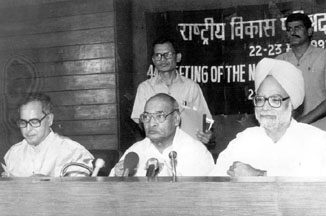
    Manmohan Singh, along with the then Prime Minster PV Narasimha Rao, made it possible. They unleashed policies that gave rise to a new affluent middle class.

    First, let me explain what I mean by the term middle class. It is nowhere in the middle when it comes to India’s population. In fact, it sits right at the top — between the 96th and 99th percentile in terms of income. Its ‘middle-ness’ comes from where it stands in the economic system — as an intermediary between owners of capital and blue-collar workers.

    Before liberalization gave the private sector control over the ‘commanding heights’ of the economy and set market forces to decide how resources would be allocated, it was largely controlled by the state and run by a bureaucratic-managerial-intellectual class. That was the old middle class, even smaller than it is now.

    The old pre-liberalization middle class was ideologically oriented towards state intervention — what we have come to know as ‘Nehruvian socialism’. This was because its job was to implement policy decisions that were taken by the government and other arms of the state. Salaries were low, but jobs were secure. The middle class in its own self-image was constructed as a group of ‘nation builders’.

    The Rao-Manmohan market reforms completely changed the ideological terrain. Now, the middle class became a facilitator of corporate profits. Its job was to maximize profits by increasing productivity in businesses. And, for that, it got a share of the returns to capital — much higher salaries than its previous ‘babu’ avatar could have got them. The post-liberalization middle class, therefore, imbibed the values of capitalism — pro-market and consumerist.

    By the time Manmohan Singh’s first tryst with government ended in 1996, white-collar salaries in the private sector compared favorably with corporate jobs in the developed West, especially when purchasing power parity was taken into account. Sons and daughters of government servants began earning more in a month than their parents did in an entire year.

    They bought cars, microwave ovens, washing machines and spring mattresses, retiled their bathrooms and took vacations to Phuket. They bought computers, invested in the stock markets and bought health insurance plans. Their kids now enrolled in schools with better infrastructure. When they fell sick, they went to new hospitals with private rooms that could put PSU-run hotels to shame.

    And, the rise of the corporate executive in the 1990s and its changed spending habits had a multiplier effect on the entire middle class. Bankers, stock brokers, tax advisers, doctors, architects, interior decorators, chefs, fashion designers, all flourished in the new economic environment.

    When Manmohan Singh became Prime Minister in 2004, the average income of those in the 96th-99th percentile had risen from roughly Rs 3,500 per month in 1991 to Rs Rs 16,000 per month.

    Even in real, inflation-adjusted terms, it had nearly doubled in 13 years. To understand what that means, compare it to the 13 years before liberalization, when the average real incomes of the ‘middle class’ had increased by just 17 per cent.

    This immense rise in middle class affluence was still nothing compared to what was to come in the UPA years. The average income of those in the 96th-to-99th percentile more than tripled in the 10 years that Manmohan Singh was PM. This was the golden period for

    the professional-managerial class in India and its standard of living rose manifold. Middle-class families bought premium cars and flatscreen TV sets, ate at five-star hotels, holidayed in Europe and gated themselves into the toniest parts of India’s metros.

    Manmohan Singh was only partly responsible for this. The first thrust of white-collar prosperity came from the credit-driven financial boom of the 2000s, which would ultimately end in the global financial crisis of 2008. Where the Manmohan-led UPA made a difference was in providing a massive fiscal stimulus to keep India out of a recession.

    Much of it came in the form of the Sixth Pay Commission, which was implemented in August 2008, with retrospective effect from July 2006. Government servants got a lumpsum of arrears at one go, which they spent on buying cars, renovating their homes and sustaining the overall consumption in the economy when the corporate sector had taken a beating.

    But corporate profits didn’t recover. The CMIE’s database shows that in the last five years of the Manmohan kaal, corporate earnings grew just six per cent annually, while inflation was 10 per cent. On the other hand, the corporate wage bill rose at 19 per cent per year.

    The result was that from the second half of the 2010s, the corporate sector began cutting white-collar jobs and asking people to take pay cuts, to expand its profit margins. The net result is a rise in corporate profits, while ‘middle-class’ incomes have stagnated. Between 2018-19 and 2022-23, corporate profits increased at a real, inflation-adjusted rate of 53 per cent while the real income of the professional-managerial class has increased at just three per cent per year.

    This is the inevitable result of the very market-friendly policies that created the affluent Indian middle class. It dramatically increased income and wealth inequality and, ultimately, created a shortage of demand for goods and services. That, in turn, caused corporate profits to fall, which made companies cut back on their wage bills, including what they paid their white-collar managerial staff. What would Dr Singh have done today to deal with the decimation of the middle class he helped create? We will no longer know.

  • India in history this Week- June 23, 2023, to june 29, 2023

    23 JUNE

    1980 Sanjay Gandhi, a member of the Nehru-Gandhi family, died in the plane crash.
    1985 An Air India passenger plane crashed into the air near the coast of Ireland. All 329 passengers aboard the plane were killed in this accident.
    1761 Death of Maratha ruler Peshwa Balaji Baji Rao.
    1810 Construction of Duncan Dock of Bombay completed.
    1953 Jana Sangh founder Shyama Prasad Mukherjee died in a hospital in Kashmir.
    2008 JK Tire India Limited, the country’s leading tire maker, acquired Mexico’s tire company Tornal and its subsidiaries for $ 270 million.
    2008 The selection committee recommended in 2008 to confer the Dadasaheb Phalke Award on famous Bengali actor Soumitra Chatterjee.
    2014 Gujarat’s ‘Rani Ki Vav’ and Himachal’s ‘Great Himalayan National Park’ were included in the 2014 World Heritage List.
    1934 Gandhian thinker and social worker Chandi Prasad Bhatt was born.
    24 JUNE
    1654 Rani Durgavati was martyred during the war with the Mughals.
    1961 India’s first indigenous HF24 supersonic fighter aircraft took off in 1961.

    1966 117 people died when an Air India aircraft going from Mumbai to New York crashed in Mount Blanc, Switzerland. Homi Jehangir Bhabha, an Indian nuclear physicist, founding director, and professor of physics at the Tata Institute of Fundamental Research, was among those killed.
    1974 The Indian team was reduced to 42 against England in the second innings of the 1974 Lord’s Test. This is India’s minimum score in the Test and it lost by innings and 285 runs.
    1986 The government announced that unmarried mothers will also get maternity leave under their employment scheme.
    1989 A majority of opposition members resigned from the Lok Sabha in 1989 over the issue of the CAG report on the Bofors gun deal.
    1990 Defense scientists successfully tested the country’s first third-generation anti-tank missile ‘NAG’ in 1990.
    1885 Famous politician and staunch Sikh leader Tara Singh was born.
    1869 Damodar Hari Chapekar, one of the revolutionary immortal martyrs of India, was born.
    1863 Vishwanath Kashinath Rajwade, the famous Indian writer, historian, best orator and scholar was born.
    1980 The fourth President of India, V.V. Giri died.

    25 JUNE

    1908 Sucheta Kripalani, the first female Chief Minister in the country, was born.
    1975 On the advice of Indira Gandhi-led Congress government, President Fakhruddin Ali Ahmed announced the imposition of Emergency in the country.
    1932 The Indian cricket team played its first Test match at the Lord’s ground in Britain.
    1983 India defeated the West Indies by 43 runs to win the Cricket World Cup title for the first time.
    2004 Russia decided to extend a strategic partnership with India.
    1903 Chandrashekhar Pandey – was born a litterateur.
    1950 Swami Sahajanand Saraswati social reformer and revolutionary died.
    1931 Vishwanath Pratap Singh, the eighth Prime Minister of India was born.
    1975 Captain Manoj Kumar Pandey, an Indian Army officer who was posthumously awarded India’s highest gallantry medal Paramveer Chakra for exceptional bravery in the 1999 Kargil War, was born

    26 JUNE
    2004 Famous filmmaker Yash Johar died on this day.

    1838 The birth of Bankim Chandra Chatterjee, Bengali novelist and creator of Vande Mataram.
    1873 Birth of Indian singer and dancer Gauhar Jaan.
    1888 Birth of Bal Gandharva, the great hero and famous singer of Marathi theater.
    1918 Birth of Indian Lieutenant Second Lieutenant Rama Raghoba Rane, awarded Paramveer Chakra.
    1961 Famous litterateur Govind Shastri Dugvekar passed away.
    1967 The birth of Tarun Sagar, the famous saint of the Indian Digambara sect of Jainism.
    1975 India’s first woman Prime Minister Indira Gandhi declared a state of emergency in the country.
    1982 Air India’s first Boeing Gourishankar crashed in Mumbai.
    27 JUNE


    1839 Maharaj Ranjit Singh, the founder of the Sikh Empire, died.
    1838 Nationalist author Bankim Chandra Chattopadhyay was born
    1939 Music composer RD Burman, who gave music in more than 300 films, was born.
    1964 PT Usha, who was known worldwide by the name of Udanpari, was born.
    1964 Teen Murti Bhawan was made Nehru Museum.
    2008 India and Pakistan have overcome bottlenecks in the commissioning of the Iranian gas pipeline project.

    2008 Former Army Chief Sam Manekshaw, who played a key role in the Indian Army’s victory against Pakistan in the 1971 war, died

    28 JUNE

    1921 Former Prime Minister PV Narasimha Rao, who had knowledge of 17 languages, was born.
    1975 In the backdrop of anti-government protests during the Emergency in India, the Center implemented the most rigorous press censorship since Independence.
    1986 Agreement with Mizo National Front, Lal Denga becomes Chief Minister of Mizoram.
    1986 The Central Government also enacted a law to provide maternity leave to unmarried girls.
    1996 India opened its mission in Palestinian-controlled Gaza City.

    29 JUNE
    1757 Mir Jafar succeeded the Nawab of Bengal, Bihar and Odisha.
    1888 The first (known) recording of classical music was made.
    2005 Composite 10-year agreement between India and the United States.
    1893 Indian scientist and statistician Prashant Chandra Mahalanobis was born.
