Tag: Quran

  • Muslim-majority nations express outrage and plan street protests over Quran desecration in Sweden

    Muslim-majority nations express outrage and plan street protests over Quran desecration in Sweden

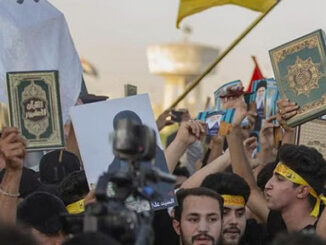
    BAGHDAD (TIP): Muslim-majority nations expressed outrage July 21 at the desecration of a copy of the Quran in Sweden. Some prepared for street demonstrations following midday prayers to show their anger.
    In Iran, Iraq and Lebanon, protesters planned demonstrations after Swedish police permitted a protest Thursday in which an Iraqi Christian living in Stockholm kicked and stood on a Quran, Islam’s holy book, outside of the Iraqi Embassy. Hours before that, demonstrators in Baghdad broke into the Swedish Embassy and lit a fire to show their anger at his threats to burn the book.
    Iraqi Prime Minister Shia al-Sudani has ordered the expulsion of the Swedish ambassador from Iraq and the withdrawal of the Iraqi charge d’affaires from Sweden. But that may not be enough to calm those angered, and another protest in Baghdad is planned for Friday afternoon.
    In neighboring Iran, demonstrators also planned to take to the streets. Iranian Foreign Minister Hossein Amirabdollahian has written a letter to the United Nations secretary-general over the Quran desecration and has summoned the Swedish ambassador.
    “We consider the Swedish government responsible for the outcome of provocation reactions from the world’s Muslims,” Iranian Foreign Ministry spokesman Nasser Kanaani said.
    The man in Stockholm also wiped his feet with a picture of Iran’s Supreme Leader Ayatollah Ali Khamenei during his demonstration and did similar to a photo of Iraqi Shiite cleric Muqtada al-Sadr, a powerful leader there.
    Lebanon’s Shiite militant group Hezbollah also called for a demonstration Friday afternoon. Khamenei and Iran’s theocracy serve as Hezbollah’s main sponsors.
    Hezbollah leader Hassan Nasrallah in a video address Thursday night called on Muslims to demand their governments expel Sweden’s ambassadors.
    “I invite brothers and sisters in all neighbourhoods and villages to attend all mosques, carrying their Qurans and sit in them, calling on the state to take a stance toward Sweden,” Nasrallah said in the address, according to Lebanon’s state-run National News Agency.
    On Friday “the whole world must see how we embrace our Quran, and the whole world must see how we protect our Quran with our blood.”
    Saudi Arabia and Qatar, two Sunni-ruled Gulf Arab nations, summoned Swedish diplomats to condemn the desecration. Turkey’s Foreign Ministry also criticized it.
    In Pakistan, Prime Minister Shehbaz Sharif strongly condemned the events in Sweden. He called on the 57-nation Organization of Islamic Cooperation to play a “historic role in expressing the sentiments of Muslims and stopping this demonization.” Meanwhile, Islamists in his country have been pushing Sharif, who faces an upcoming election, to cut diplomatic ties with Sweden.
    On Thursday morning, protesters in Baghdad occupied the Swedish Embassy for several hours and set a small fire. The embassy staff had been evacuated a day earlier. After protesters left the embassy, diplomats closed it to visitors without specifying when it would reopen.
    Prime Minister Sudani said in a statement that Iraqi authorities would prosecute those responsible for starting the fire and referred to an investigation of “negligent security officials.” Some demonstrators stayed at the site, ignored by police, after the attack. An Associated Press photographer and two Reuters staff members were arrested while covering the protest and released several hours later without charges. (AP)

  • Should Muslims sacrifice cattle on Eid-al-Adha?

    Should Muslims sacrifice cattle on Eid-al-Adha?

    Should Muslims sacrifice cattle on Eid-al-Adha?

                                                By  Dr. Mike Ghouse


    Special article on the occasion of Eid-al-adha which falls on July 31.

    We wish our Muslim readers a Happy Eid


    Rituals are the pathways to accomplish milestones of peace for oneself and with what surrounds one; life and environment. None of us can escape from the ceremonies. Each of us instinctively follows certain routines, from waking up to the time we go to sleep. Whether we shower, eat breakfast, go to the office, or gym, we follow the rituals.

    The essence of Islam is to create cohesive societies where every human feels secure about his/her faith, race, religion, region, or ethnicity. It is time for Muslims to consider the essence of sacrifice rather than the ritual itself.

    Real sacrifice requires us to give up some of what is dear to us. It is about parents going to sleep without food but feeding their kids; it is clothing their kids while waiting to get their own. In the case of extremities, we would instead get the bullet and save our loved ones, we are willing to rescue an individual from a freezing lake risking our own lives, and even strangers do that. 

    A thousand years ago, a man’s assets were made up of his goats, camels, and cattle. The ultimate sacrifice one would make was to give away his precious assets in gifts. Today, the most cherished possession is money, and people must be willing to part some of it to give the ability to the receiver to spend on his/her critical needs.

    One of the examples set up for guidance was the test of Abraham’s faith, love, and devotion to God, which humans do routinely, “If you love me, you would do this for me.” A simple assurance would suffice, be it your fiancé, spouse, kids, siblings, or parents.

     It was Abraham’s turn to face the command of God to sacrifice his son. Upon hearing this, he prepared to submit to God’s will and places his son on the block. Right at that moment, a lamb appears as an alternative. Then God revealed to Abraham that his “sacrifice” has already been fulfilled.

    Does God want animals to be sacrificed?  

    Not at all. Qur’an, Al-Hajj 22:37 (The Pilgrimage) is clear: “Never does their flesh reach God, and neither their blood. It is only your God-consciousness that reaches Him. It is to this end that we have made them subservient to your needs so that you might glorify God for all the guidance with which He has graced you. And give thou this glad tiding unto the doers of good.”

    The act symbolizes our willingness to give up a part of our bounties to strengthen and preserve the web of the universe and help those in need. We recognize that all blessings come from God, and we should open our hearts and share with others. 

    What would you sacrifice instead?

    It is customary for Muslims to sacrifice an animal on the day of the Hajj, a symbolic representation of Prophet Abraham’s act. What are our alternatives? 

    We can put that money to a different use that will do greater good like lending to a street hawker who can sell things from a cart and take care of his family or a single mom who can weave baskets or make sweaters to take care of her family. The beauty of this practice is you can make the same money repeatedly work for the common good. Muslims call it Sadaq-e-Jariah, which is continual giving.

     Dr. Nauman Anwar: “Sacrificing animals without making a public spectacle is still a good idea, as long as no wastage of the meat and hides occur. Many Muslim countries have a lot of poverty, and if the meat reaches the deserving population, it will help improve the nutritional status of the poor.

    Let your single sacrifice multiply rather than the one-time sacrifice of animals. Prophet Muhammad had emphasized service to fellow humans as the highest service to God. Quran (4:152) says, if you are kind to your fellow humans, which is my creation, you will earn my grace regardless of your faith.

    Honoring police, firemen, and soldiers

     Every day our police officers and firemen risk their own lives to protect ours, our freedom is protected by our men and women in the uniforms. I urge fellow Muslims to stop and salute every one of these men and women, honoring them for their love for humanity. Better yet, call the firemen, policemen, and let them know that as a Muslim you appreciate their sacrifice, and this festival is about appreciation for such sacrifice.

    I did that in Louisville; within minutes, the officer had emailed the article to his fellow officers, appreciating the Muslims.

    Prophet Muhammad (pbuh) had said the least you can do as a charity is to smile and appreciate the otherness of the others.

     You can wish your Muslim friends by saying, Eid Mubarak, Eid Saeed, Happy Eid, Happy Festivities, etc.

      ( Dr. Mike Ghouse is the founder and president of the Center for Pluralism. He is a speaker, thinker, author, community consultant, pluralist, activist, newsmaker, and an interfaith wedding officiant. More about him at www.TheGhousediary.com)