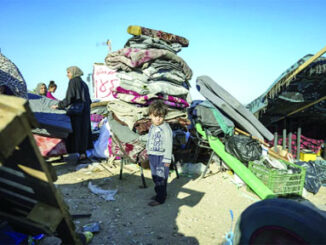
Gaza (TIP): Tens of thousands of Palestinians attempt to flee Rafah as Israel shells eastern area of city sheltering some 1.5 million people, Al Jazeera reports. Israel’s continued closure of the Rafah border crossing is “choking off the entry of life-saving aid into Gaza”, Al Jazeera said quoting the United Nations Office for the Coordination of Humanitarian Affairs. The Guardian, citing UN officials said that more than 100,000 people have fled Rafah after Israel intensified its bombardment.
The Guardian said that humanitarian officials are tracking the number of people fleeing Rafah where more than 1 million people displaced from elsewhere in the territory have been sheltering.
The numbers are expected to rise, with deep concern among aid officials on Thursday that the newly displaced people will end up in makeshift encampments without any services, living in the rubble of their former homes without “basic essentials necessary for life”, The Guardian said.
There are roughly 200 Palestinians that are being forcibly displaced from Rafah every hour, the UN Relief and Works Agency for Palestine Refugees (UNRWA) said on May 8.
According to The Associated Press, the past three days, streams of people on foot or in vehicles have jammed the roads out of Rafah in a confused evacuation, their belongings piled high in cars, trucks and donkey carts. All the while, Israeli bombardment has boomed and raised palls of smoke.
“The war has caught up with us even in schools. There is no safe place at all,” said Nuzhat Jarjer. Her family packed on Wednesday to leave a UN school-turned-shelter in Rafah that was rapidly emptying of the hundreds who had lived there for months, AP report said.
Professor John Maynard, a surgeon from the UK who has spent the last two weeks operating on Palestinians in Gaza, highlighted complications from a direct result of malnutrition, reports Middle East Eye.
“I had two patients, 16 and 18, both of whom had survivable injuries, [and] both of whom died last week as a direct result of malnutrition.”
His colleague Dr Kahler, according to Middle East eye, also spoke of a “tipping point” after six-eight months, “the immunological system breaks down”.
“It is at that time when infections and complications from malnutrition will start,” he added.
A famine, one aid worker explained, requires three thresholds: a sustained, severe lack of access to food, high levels of child malnutrition, and highly elevated mortality as a result of famine and disease.
All thresholds have been passed in the north.
“If there is a Rafah invasion, this will certainly push things past the tipping point, and we will see a skyrocketing mortality related to the famine,” he was quoted as saying by the report.
Israel on Monday issued evacuation orders for eastern parts of the city, home to some 100,000. It then sent tanks to seize the nearby Rafah crossing with Egypt, shutting it down.
At least 34,904 Palestinians have been killed and 78,514 injured in Israel’s military offensive in Gaza since October 7, Gaza’s Ministry of Health said on Thursday. (AP)
Tag: Rafah
-

Tens of thousands of Palestinians flee Rafah amid Israeli bombardment
-

US won’t supply weapons for Israel to attack Rafah: President Biden
Netanyahu says Israel ‘will stand alone’ if it has to; ‘If we need to, we will fight with our fingernail”
WASHINGTON, D.C. (TIP): President Joe Biden said Wednesday, May 8, that he would not supply offensive weapons that Israel could use to launch an all-out assault on Rafah — the last major Hamas stronghold in Gaza — over concern for the well-being of the more than 1 million civilians sheltering there.
Biden, in an interview with CNN, said the US was still committed to Israel’s defense and would supply Iron Dome rocket interceptors and other defensive arms, but that if Israel goes into Rafah, “we’re not going to supply the weapons and artillery shells used.”
The US has historically provided enormous amounts of military aid to Israel. That has only accelerated in the aftermath of Hamas’ October 7 attack that killed some 1,200 in Israel and led to about 250 being taken captive by militants. Biden’s comments and his decision last week to pause a shipment of heavy bombs to Israel are the most striking manifestations of the growing daylight between his administration and Israel Prime Minister Benjamin Netanyahu’s government. Biden said on Wednesday that Israel’s actions around Rafah had “not yet” crossed his red lines, but has repeated that Israel needs to do far more to protect the lives of civilians in Gaza.
The shipment was supposed to consist of 1,800 2,000-pound (900-kilogram) bombs and 1,700 500-pound (225-kilogram) bombs, according to a senior US administration official who spoke on the condition of anonymity to discuss the sensitive matter. The focus of US concern was the larger explosives and how they could be used in a dense urban area.
“Civilians have been killed in Gaza as a consequence of those bombs and other ways in which they go after population centers,” Biden told CNN. “I made it clear that if they go into Rafah — they haven’t gone in Rafah yet — if they go into Rafah, I’m not supplying the weapons that have been used historically to deal with Rafah, to deal with the cities, that deal with that problem.”
“We’re not walking away from Israel’s security,” Biden continued. “We’re walking away from Israel’s ability to wage war in those areas.”
Defense Secretary Lloyd Austin earlier Wednesday confirmed the weapons delay, telling the Senate Appropriations Subcommittee on Defense that the US paused “one shipment of high payload munitions.”
“We’re going to continue to do what’s necessary to ensure that Israel has the means to defend itself,” Austin said. “But that said, we are currently reviewing some near-term security assistance shipments in the context of unfolding events in Rafah.”
It also comes as the Biden administration is due to deliver a first-of-its-kind formal verdict this week on whether the airstrikes on Gaza and restrictions on delivery of aid have violated international and US laws designed to spare civilians from the worst horrors of war. A decision against Israel would further add to pressure on Biden to curb the flow of weapons and money to Israel’s military.
Biden signed off on the pause in an order conveyed last week to the Pentagon, according to US officials who were not authorized to comment on the matter. The White House National Security Council sought to keep the decision out of the public eye for several days until it had a better understanding of the scope of Israel’s intensified military operations in Rafah and until Biden could deliver a long-planned speech on Tuesday to mark Holocaust Remembrance Day.
Biden’s administration in April began reviewing future transfers of military assistance as Netanyahu’s government appeared to move closer toward an invasion of Rafah, despite months of opposition from the White House. The official said the decision to pause the shipment was made last week and no final decision had been made yet on whether to proceed with the shipment at a later date.
US officials had declined for days to comment on the halted transfer, word of which came as Biden on Tuesday described US support for Israel as “ironclad, even when we disagree.”
Israel’s ambassador to the United Nations, Gilad Erdan, in an interview with Israeli Channel 12 TV news, said the decision to pause the shipment was “a very disappointing decision, even frustrating.” He suggested the move stemmed from political pressure on Biden from Congress, the US campus protests and the upcoming election.
The decision also drew a sharp rebuke from House Speaker Mike Johnson and Senate Republican Leader Mitch McConnell, who said they only learned about the military aid holdup from press reports, despite assurances from the Biden administration that no such pauses were in the works. The Republicans called on Biden in a letter to swiftly end the blockage, saying it “risks emboldening Israel’s enemies,” and to brief lawmakers on the nature of the policy reviews.
Biden has faced pressure from some on the left — and condemnation from the critics on the right who say Biden has moderated his support for an essential Mideast ally.
“If we stop weapons necessary to destroy the enemies of the state of Israel at a time of great peril, we will pay a price,” said Sen. Lindsey Graham, R-S.C., his voice rising in anger during an exchange with Austin. “This is obscene. It is absurd. Give Israel what they need to fight the war they can’t afford to lose.”
Reacting to threatened US arms holdup, Israeli Prime Minister Netanyahu said Israel ‘will stand alone’ if it has to. ‘If we need to, we will fight with our fingernail”, he said.
His remarks in a statement issued Thursday, May 9, came after President Joe Biden said the United States would not provide offensive weapons for Israel’s long-promised assault on the southern Gaza city of Rafah.
(With inputs from agencies) -

U.S. support to Israel depends on protecting Gaza civilians; President Biden tells Netanyahu
WASHINGTON, D.C. (TIP): President Joe Biden warned Prime Minister Benjamin Netanyahu on April 4 that U.S. policy on Israel depends on the protection of civilians in Gaza, in his strongest hint yet of possible conditions on military aid after an Israeli strike killed seven aid workers.
In their first call since the deaths of the employees of the U.S.-based World Central Kitchen group on Monday, April 1, Mr. Biden also called for an “immediate ceasefire” after the “unacceptable” attack and wider humanitarian situation in Gaza.
Democrat Biden is facing growing pressure in an election year over his support for Israel’s Gaza war – with allies pressing him to consider making the billions of dollars in military aid sent by the United States to its key ally each year dependent on Mr. Netanyahu listening to calls for restraint.
Mr. Biden “made clear the need for Israel to announce and implement a series of specific, concrete, and measurable steps to address civilian harm, humanitarian suffering, and the safety of aid workers”, the White House said in a readout of the call.
“He made clear that U.S. policy with respect to Gaza will be determined by our assessment of Israel’s immediate action on these steps.”
A key Biden confidant had earlier urged him to use the leverage afforded by the huge military aid that Washington gives Israel – something Biden has resisted for the past six months. “I think we’re at that point,” Chris Coons, a Democratic senator from the president’s home state of Delaware, told CNN.
If Israel began its long-threatened full-scale offensive in the southern city of Rafah, without plans for some 1.5 million people sheltering there, “I would vote to condition aid to Israel,” Mr. Coons said.
“I’ve never said that before, I’ve never been there before,” he added.
Mr. Biden also reportedly faces pressure from even closer to home — from First Lady Jill Biden.
“Stop it, stop it now,” she told the president about the growing toll of civilian casualties in Gaza, according to comments by Mr. Biden himself to a guest during a meeting with members of the Muslim community at the White House, and reported by The New York Times. Mr. Biden has supported Israel’s six-month-old war sparked by Hamas’s October 7 attack but has increasingly voiced frustration with Israel’s right-wing premier over the soaring death toll and dire humanitarian situation in Gaza.
In his strongest statement since the war began, he said that he was “outraged and heartbroken” by Israel’s killing of the seven aid workers, who included a U.S.-Canadian citizen.
Israel has said the deaths were “unintentional”.
But Mr. Biden’s words have not been matched by any concrete steps to limit the billions of dollars in military aid that Washington supplies to its bedrock regional ally.In a sign of business as usual, Biden’s administration approved the transfer of thousands more bombs to Israel on the same day as the Israeli strikes that killed the seven aid workers, The Washington Post reported on Thursday, April 4.
Many Democrats fear the controversy could hurt Biden’s chances of re-election in November against Republican Donald Trump, as Muslim and younger voters express their anger over Gaza.
A former senior aide to Barack Obama – the president under whom Biden served as vice president – called for Biden’s actions to back his words.
“The U.S. government is still supplying 2-thousand-pound bombs and ammunition to support Israel’s policy,” Ben Rhodes, a former deputy national security advisor in Obama’s administration, wrote on X.
“Until there are substantive consequences, this outrage does nothing. Bibi (Netanyahu) obviously doesn’t care what the U.S. says, it’s about what the U.S. does.”
U.S. voters are also increasingly turning against Israel’s Gaza offensive.
A majority of 55% now disapprove of Israel’s actions, compared to 36% who approve, according to a Gallup poll released on March 27.
(Agencies)