Tag: Rajeev Kumar

  • The Indian American Medical Association, Illinois Commemorates 44th Anniversary with a Vibrant Gala

    The Indian American Medical Association, Illinois Commemorates 44th Anniversary with a Vibrant Gala

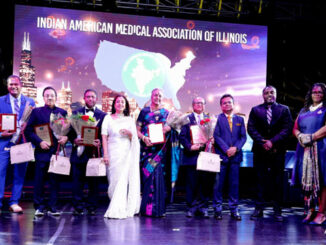
    CHICAGO, IL (TIP):  The Indian American Medical Association, Illinois (IAMA-IL) marked 44 years with a fundraising gala that featured a cocktail reception, a vendor expo, an awards presentation, a dinner, and musical performances on December 07,2024 at the Matrix Club in Naperville. The event was a grand success, bringing together leaders, influencers, and community members.

    IAMA-IL President Radhika Chimata, MD, organized a splendid gala that included speeches from Congressman Raja Krishnamoorthi, U.S. Representative for Illinois’s 8th Congressional District, and Indian Consul General Somnath Ghosh. She also shared her vision for the upcoming year as the Board of Directors chair. Her objectives include continuing significant fundraising initiatives, establishing a comprehensive database of physician mentors for medical trainees, and boosting IAMA-IL membership among second- and third-generation Americans.

    Honorees during the awards presentation included Ashok Fulambarker, MD, recipient of the Distinguished Physician Award; Samir Shah, MD, who received the Lifetime Achievement Award; and Archana Chatterjee, MD, honored with the Dr. Usha Rani Nimmagadda Woman Physician Leadership Award. Rajeev Kumar, MD, Terence Chiramel, MD, and Utpal Parekh, MD, were acknowledged for their contributions to IAMA-IL and our communities.

    Advocate Health CEO Dia Nichols provided the keynote speech and participated in a fireside discussion alongside President Chimata, Sreenivas Reddy, MD, and Shruti Nathan from Advocate Health. The conversation addressed contemporary challenges faced by physicians, including reimbursement rates.

    We express our gratitude to our Distinguished Guests, including Gerard Moorer, Deputy Chief of Staff to Congressman Danny Davis, U.S. Representative from Illinois’s 7th Congressional District, Tara Stamps, Cook County Board Commissioner for the 1st District, and Harry Benton, Illinois House Representative for District 97.

    The Ghungroo Bollywood dance troupe captivated the audience with their elegant performances and stunning attire. We appreciate the talent of director Sridevi Pandalai. Biju Zacharia’s artistic vision shone through the gorgeous audio-visual presentation, which complemented the eloquent emceeing by Shana Mohan perfectly. During dinner, Radhika delivered an incredible unplugged performance, accompanied by guitarist Vikas Deo, and concluded the event with an electrifying concert supported by Orchestra Saregama.

    Before the entertainment got everyone dancing the night away, IAMA welcomed their new President, Dr. Dilip Shah, and the 2025 executive committee as they assumed their roles for IAMA-IL’s 45th year.

    The celebration was made possible with the backing of the Grand Sponsor, Wealth Planning Network of Oak Brook, IL, and gold sponsors Orchard Corporation and Neelyx. All attendees received a lovely keepsake provided by Tanishq of Naperville.

    About Indian American Medical Association, Illinois

    The Indian American Medical Association, Illinois (IAMA-IL) is a non-profit organization comprised of Illinois physicians, fellows, residents, and medical students of Indian origin who are committed to professional excellence and quality patient care.

    (Photograph and Press release by Asian Media USA)

  • Preventing another NEET fiasco

    Preventing another NEET fiasco

    The stakes in NEET are incredibly high. Therefore, we need strong governance in the form of foolproof and complete Standard Operating Procedures and their compliance

    “Coaching and admission counselling centers, typically run by business tycoons, have realized that clients, the NEET aspirants, have failed to secure preferred seats despite their advice. However, despite this fiasco, the industry has found a way to enhance their brand value through media and social media coverage. The owners of this trillion-rupee industry, along with the 23 lakh NEET aspirants this year, are up in arms. Their hypothesis is that mapping scores to ranks cannot vary very widely from previous years. In this conundrum, various allegations of cheating and paper leakage, amongst others, have been raised. Despite numerous crackdowns and investigations, paper leakage in medical admission exams remains a persistent issue.”

    By Rajeev Kumar

    During the National Eligibility Cum Entrance Test (NEET) this year, scores and ranks were inflated. As a consequence, many candidates may not get admission to their desired college as predicted based on previous years’ scores.

    Coaching and admission counselling centers, typically run by business tycoons, have realized that clients, the NEET aspirants, have failed to secure preferred seats despite their advice. However, despite this fiasco, the industry has found a way to enhance their brand value through media and social media coverage. The owners of this trillion-rupee industry, along with the 23 lakh NEET aspirants this year, are up in arms. Their hypothesis is that mapping scores to ranks cannot vary very widely from previous years. In this conundrum, various allegations of cheating and paper leakage, amongst others, have been raised. Despite numerous crackdowns and investigations, paper leakage in medical admission exams remains a persistent issue.

    Since its inception, NEET has emerged as the largest exam in the ‘One Exam, One Nation’ model because of the number of candidates taking the exam, the number of languages the exam is conducted in, and the diversity of various other factors. The quality of education and the college fees payable are critical factors that vary widely. A seat in a top government college with good quality education could cost a few lakhs, whereas a seat in a private college could cost a few crores. Moreover, parents are willing to go beyond their means to secure higher ranks for their children in these competitive exams, as the family’s reputation is considered to hinge on this.

    Thus, the stakes in NEET are incredibly high, making it vulnerable to irregularities, accidental or intentional. Therefore, we need strong governance in the form of foolproof and complete Standard Operating Procedures (SOPs) and their compliance. There cannot be any weak link in the chain of operations from setting question papers to conducting the exam to admissions.

    However, there are many weak links, as seen from the distribution of the wrong question paper at some centers, for example. Reportedly, some centers distributed the back-up question paper instead of the primary paper. How were both sets — the primary and the secondary/back- up question papers — accessed almost simultaneously? Were they accessed from banks’ strongrooms or another reserve? How was the back-up question paper set taken from the banks’ strongrooms without any emergency circumstances or protocols? There are several unanswered questions about the authorization and attitude of the officials concerned. This seemingly inconsequential event is actually of enormous consequence and could give us an idea of how the exam was conducted this year.

    This one error led to a cascade of errors. A wrong question paper was distributed, subsequently taken back along with the Optical Mark Recognition (OMR) sheet, thus creating panic among the candidates. The correct question paper was then distributed, and no additional time was given for the time lost. Then, exceptionally huge grace marks were awarded for the time lost, which was later scrapped due to a public outcry.

    Each of the above demonstrates the need for critical SOPs for complete governance of the exam, which includes several stakeholders such as those who set the question paper, translators, reviewers, the printing press, officials at examination centers, banks’ strongrooms, and invigilators. Any loose links in this chain have the potential for malpractices. Only proper investigation may reveal any substantial wrongdoing.

    Despite all the above pitfalls, it is commendable that the National Testing Agency (NTA) voluntarily disclosed most of the information, as per Section 4 of the Right to Information (RTI) Act, 2005. Since the declaration of NEET 2024, the NTA has disclosed the most relevant information through its press releases. In addition, the NTA has followed SOPs for disclosure of answer keys, collecting feedback about wrong questions and answer keys, disclosure of the individual OMR sheet, and self-evaluation of one’s score, which seem to have worked with no issues at all.

    It is on record that these SOPs were developed and directed through a decade-long (2006-2015) protracted legal battle by the author of this article in the Supreme Court and High Courts to ensure transparency and develop well-defined rational SoPs for admissions to the prestigious Indian Institutes of Technology (IITs). In one such judgment, the Supreme Court observed in 2011, “In fact the action taken by the appellants in challenging the procedure for JEE 2006, their attempts to bring in transparency in the procedure by various RTI applications, and the debate generated by the several views of experts during the course of the writ proceedings, have helped in making the merit ranking process more transparent and accurate.”

    However, this alone is not enough for NEET. The NTA should devise SOPs to get stabilized cut-offs, as done by the IITs, avoid inflated scores and ranks, and achieve a long-tail distribution. It should work to replace ad-hocism with well-defined, sound, and secure SOPs. It should follow a professional war-room culture to facilitate quick and sound decision-making during the entire process. As the Supreme Court said in 2011, “The selection process requires to be upgraded and fine-tuned year after year with periodic changes…, so that the selection process and examination remain relevant and meaningful.”

    (Rajeev Kumar is a former Computer Science professor at IIT Kharagpur, IIT Kanpur, BITS Pilani, and JNU)