Among them, three were from Punjab, and the other seven were from Uttar Pradesh and Jammu
NEW YORK / NEW DELHI (TIP): Ten Indian youths who had gone abroad to earn a livelihood and later joined the Russian army have been confirmed dead. Among them, three were from Punjab, and the other seven were from Uttar Pradesh and Jammu. To search for these youths, Jagdeep Singh had gone to Russia and other places, but could not find any trace of them.
Returning to India, Jagdeep presented all the documents to Rajya Sabha member Sant Balbir Singh Seechewal’s office, which confirmed the deaths of these young men as per the Russian army. The parents of these deceased youths had been waiting for their children to return safely.
According to Jagdeep, the 10 Indians confirmed dead include Tejpal Singh from Amritsar, Arvind Kumar from Lucknow, Dhirendra Kumar from UP, Vinod Yadav, Yogendra Yadav, and five others. The four missing Indians are Deepak, Yogeshwar Prashad, Azharuddin Khan, and Ram Chandra.
He revealed that he first met Sant Seechewal on June 29, 2024, when he submitted a petition for the safe return of his brother Mandeep and other Indian youths trapped in Russia. Following this, Sant Seechewal met the Foreign Minister and wrote a letter requesting their safe return. Jagdeep mentioned that Sant Seechewal has been helping the affected families.
Jagdeep explained that when he could not find any information about his brother Mandeep, he decided to travel to Russia. Seechewal helped by arranging tickets and also provided him with a letter so that he wouldn’t face any problems in Russia.
He mentioned that he has visited Russia twice. During his first trip, he stayed there for 21 days, and on his second trip, he stayed for two months and gathered substantial information.
Rajya Sabha member Sant Balbir Singh Seechewal appealed to the Indian government to completely stop the recruitment of Indian youths in the Russian army. Referring to the letter he wrote to the Foreign Minister; he stated that he has requested that the bodies of the Indian youths who have died in the Russian army be sent to their families so they can perform the final rites according to their traditions. He also urged strict action against the travel agents who deceive people into joining the army.
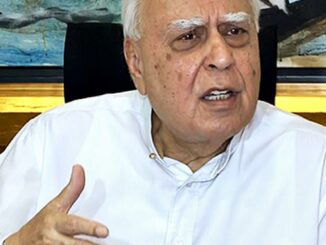
NEW DELHI (TIP): Senior advocate Kapil Sibal was elected president of the Supreme Court Bar Association (SCBA) on Thursday. He would be serving the SCBA for the fourth time as its president. He was previously elected the president of the lawyers’ body in 2001. He did two separate stints in the mid and the late 1990s.
Mr. Sibal would take over from the incumbent, senior advocate Adish C. Aggarwala. Senior advocate Pradeep Rai was the runner-up. Advocate Vikrant Yadav was elected SCBA secretary.
Mr. Sibal secured 1,066 votes and defeated Mr. Rai who polled 689 votes. Others who contested for the post include Priya Hingorani, Tripurari Ray, Neeraj Srivastava. Rajya Sabha member Jairam Ramesh posted on ‘X’ that “this is a big win for liberal, secular, democratic, and progressive forces”.
Both Houses put together functioned for just five minutes and 45 seconds on Thursday, March 16, as pandemonium breaks out over Rahul speech, Adani row
NEW DELHI / NEW YORK (TIP): India’s both Houses of Parliament put together functioned for 345 seconds on March 16, 2023, with the ruling BJP unrelenting in its demand for an apology from Congress leader Rahul Gandhi and the Opposition refusing to back down on the call for a joint parliamentary probe into the Adani Group controversy.
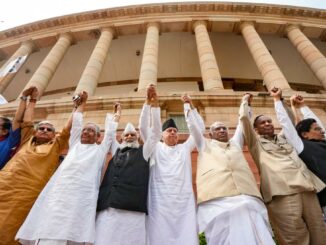
While Mr. Gandhi’s remarks abroad that democracy is under attack has drawn the BJP’s ire, the Opposition parties are insistent that the government breaks its silence on the Adani issue. To further press their point, several MPs from the Opposition organized a human chain in the Parliament premises. The Lok Sabha worked for two minutes and 20 seconds in the pre-lunch sitting and 50 seconds in the post lunch sitting. The Rajya Sabha functioned for one minute and 55 seconds in the morning and 40 seconds in the afternoon.
Pandemonium broke out in the Lok Sabha right from the moment the House convened for the day. MPs on both sides tried to outshout the other. Trinamool Congress MPs were already in the well with black cloth tied around their mouths, accusing the Treasury benches of stalling Parliament for four days in a row.
Asking the protesting MPs to return to their seats, Speaker Om Birla said: “I want to run the House, I want to give you enough opportunities and time to speak. You have to go to your seats. You come to the well and then go outside and say that you don’t get a chance to speak. This is not right.” The House was adjourned till 2 p.m. without even the procedural functions such as laying of the papers and standing committee reports. The post-lunch sitting was even shorter.
In the Rajya Sabha, Trinamool MPs sported black gags in the well and other Opposition members stood on their seats shouting slogans.
Chairman Jagdeep Dhankhar’s pleas to maintain order went in vain. In the afternoon, Deputy Chairman Harivansh faced a similar challenge. Even before the Upper House met at 2 p.m., the Trinamool MPs made a circle around the table of the House. Watch and Ward personnel were assigned near the Chair. Mr. Harivansh adjourned the House for the day without taking up any business.
Meanwhile, in the Parliament complex at 12:30 p.m., Opposition leaders formed a human chain questioning the government’s studied silence on the alleged stock manipulation by the Adani Group. Barring the Trinamool Congress, which did not participate in the protest, all major Opposition parties were represented, including the Congress, the DMK, the Samajwadi Party, the Aam Aadmi Party, the Rashtriya Janata Dal, the Shiv Sena (Uddhav Thackeray faction), the Jharkhand Mukti Morcha, the Communist Party of India, the Communist Party of India (Marxist), the Revolutionist Socialist Party, the Indian Union Muslim League and the Bharat Rashtra Samiti.
The decision to form a human chain demanding a JPC probe was taken at a joint meeting of Opposition leaders convened by Congress president Mallikarjun Kharge on Thursday morning. Speaking to reporters during the protest, Mr. Kharge said, “Our demand from day one is that there should be a probe by a joint parliamentary committee but the government is shying away from it. What we do not understand is, when they have the majority, why are they afraid of constituting a JPC?”
Among the major Opposition parties, the Trinamool Congress is alone in not supporting the demand for a JPC probe. The party, while demanding a debate specifically on the risk that SBI and LIC funds face because of investments in the Adani group, believes that a Supreme Court monitored probe — which is already under way — will be more effective.
At a press conference later in the day, the Trinamool’s Rajya Sabha leader Derek O’Brien said the Congress party needed to make up its mind. “In Tripura, you will be friends with the Left, that’s your choice, in Bengal you will fight us tooth and nail… then in Meghalaya, before the election, you will write a litany on how bad Trinamool is. In Kerala, your friends in Meghalaya and West Bengal will become your enemy.” The Trinamool also accused Prime Minister Narendra Modi and Home Minister Amit Shah of turning Parliament into a “deep dark chamber”. “They don’t want Parliament to run because they don’t want to be accountable to the people,” Mr. O’Brien added.
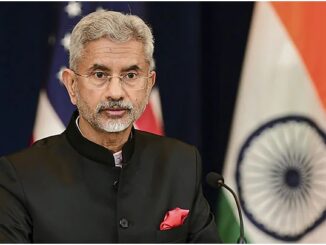
New Delhi (TIP)- Opposition leaders on Wednesday, February 22, lashed out at External Affairs Minister S Jaishankar for his remarks on China and the BBC documentary on Prime Minister Narendra Modi, with many of them pointing to his father’s reported comments against the then Gujarat dispensation following the 2002 riots.
The Congress called Jaishankar a “failed” minister and alleged that his remarks on the China issue have “demeaned” the valour of India’s armed forces. Congress spokesperson Supriya Shrinate also alleged that foreign policy has been reduced to photo-ops and a chest-thumping exercise and is being used to secure contracts for a businessman.
The opposition party’s attack came over the minister’s reported remarks urging people to not buy the narrative that somewhere the government is on the defensive or is being accommodative on the China issue. Jaishankar also reportedly hit out at the British Broadcasting Corporation (BBC) over its documentary on Modi and called it “politics by another means”.
Slamming Jaishankar, TMC’s Rajya Sabha MP Jawahar Sircar said, “Strange — that Jaishankar discovered his angst against the Gandhis — after serving them most loyally and taking the best of postings under them? Is it Amnesia or is he just cuddling up to BJP for his unprecedented promotion as Foreign Minister?” In another tweet, Sircar referred to Jaishankar’s “politics by another means” remark, saying the question is whether the facts shown in the documentary are true or false.
“Could thousands of lives be saved if Modi administration was less indulgent,” Sircar said. “S Jaishankar’s father, K Subramanyam said ‘Dharma was killed in Gujarat (2002 Riots). Those who failed to protect innocent citizens are guilty of adharma. Rama…would have used his bow against the ‘Asura’ rulers of Gujarat. Shame on son — serving Asura!” the TMC MP said in another tweet.
Shrinate also spoke of reported ‘Asura’ remarks of Jaishankar’s father K Subrahmanyam. “You may attack anyone, but you must listen to the words of the elderly who have wisdom and experience. You should listen to your father… He may be old but has the wisdom and experience and you should listen to him,” she said.
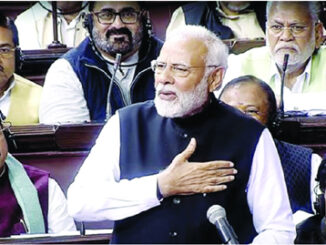
New Delhi (TIP)- Prime Minister Narendra Modi launched a fresh broadside against the opposition on Thursday, February 9, saying their “keechad” (dirt) of allegations will only help the lotus bloom more and asserting he alone outweighs all who had to take turns to shout slogans to oppose him.
Thumping his chest, Modi declared that he lives for the country and wants to do something for the country, which has rattled the opposition parties and they are playing political games just to save themselves.
“Desh dekh raha hai, ek akela kitno ko bhari padh raha hai (the country is watching how one person has outweighed so many),” he said as the opposition members kept shouting “Modi-Adani, bhai-bhai”.
Unperturbed by the jeering, Modi finished his 90-minute speech in reply to a debate on a motion thanking the President for her address to a joint sitting of Parliament, and listed various achievements of his government. With members of the treasury benches chanting “Modi-Modi”, he pointed at the opposition MPs who had gathered in the well of the House in a bid to shout him down and said, “Naare bolne ke liye bhi unko badal karna padhta hai (they have to take turns even to shout slogans).”
“Ek conviction ke karan chala hoon, desh ke liye jeeta hoon, desh ke liye kuch karne ke liye nikla hoon (I live for the country and have embarked with the conviction to serve the nation),” he said, adding that his political opponents are playing games as they do not have the courage to take him on.
The opposition, he said, is resorting to this means to save themselves. Replying to the Congress charge that the Bharatiya Janata Party was ignoring Jawaharlal Nehru’s efforts in nation-building after Independence, Modi retorted that if the first prime minister was so great, why have his scions never used his surname.
As he rose to speak, opposition MPs, some holding placards, rushed into the well shouting slogans against the prime minister and seeking a joint parliamentary committee probe into allegations levelled by the US short-seller Hindenburg Research against tycoon Gautam Adani.
Hitting back, Modi said, “Jitna keechad uchaloge, kamal utna hee zyada khilega (the more dirt you fling, the bigger the lotus – also the election symbol of the BJP -will bloom).”
“Keechad unke pass tha, mere pass gulal. Jo jis ke pass tha, usne diya uchal,” Modi quoted Manik Verma’s poem in response to the allegations opposition parties levelled on him and his government.
Roughly translated, it means they had dirt and I had gulal, whosoever had whatever they flung in the air.
Opposition parties used the debate on the motion to attack the government for the Adani group’s phenomenal rise during the last few years. In his reply, Modi accused the Congress of adopting only “tokenism” in solving problems the country faced and said it was bothered only about its political ambitions and not the welfare of the nation. “We don’t believe in tokenism. We have chosen the path of hardwork in taking the country forward,” he said, adding technology was being used as an aid in this mission.
He accused the Congress of trampling on the rights of states and regional parties by dismissing elected governments on 90 occasions by “misusing” Article 356 of the Constitution. “Who are the people?” he asked and responded that Indira Gandhi alone had used the article 50 times to dismiss governments.
“This country is not anyone’s fiefdom. Our policies reflect national and regional aspirations,” he said. “But these people who are now sitting (with the Congress), I want to expose them today.”
He then narrated how elected governments of the Left in Kerala, NT Rama Rao in Andhra Pradesh, Sharad Pawar in Maharashtra and M G Ramachandran in Tamil Nadu were dismissed by the Congress. And today these parties are sitting along with the Congress, he said.
“NT Rama Rao’s government was dismissed when he was in the US for medical treatment,” he said, adding M G Ramachandran must be turning in his grave seeing his DMK align with the Congress.
He also alleged that the Congress had committed sins in the past and is now trying to mislead the country.
The prime minister warned states against resorting to populist measures for political gains, saying it would be “anarth-niti” (disastrous policy). With many parties in states promising freebies and reverting to heavy cash outflow schemes like old pension in run-up to elections, he cited examples of near bankruptcy in neighbouring countries to say that they should not play with the financial health and economic policies. “Do not do any such sin which leaves the burden on the next generation.”
New Delhi (TIP)- A total of 225,620 Indians renounced their citizenship in 2022, the highest in the past 12 years, and more than 1.66 million people have given up their nationality since 2011, according to figures provided by the government in Rajya Sabha on Thursday, February 9.
The figures were given by external affairs minister S Jaishankar in a written reply to a question from Aam Aadmi Party (AAP) lawmaker Narain Dass Gupta, who sought the number of Indians who relinquished their citizenship during the last three years.
Jaishankar’s reply provided year-wise figures for Indians who had renounced their citizenship since 2011. For the period from 2011 to 2019, the annual figure ranged between 120,000 and 144,000, before falling to 85,256 in 2020 when the coronavirus pandemic broke out and led most countries to restrict the movement of people.
In 2021, the figure almost doubled to 163,370, and continued to rise to 225,620 in 2022, according to the written reply. Citing information available with the external affairs ministry, Jaishankar said 122,819 Indians renounced their citizenship in 2011, 120,923 in 2012, 131,405 in 2013, 129,328 in 2014, 131,489 in 2015, 141,603 in 2016, 133,049 in 2017, 134,561 in 2018, 144,017 in 2019, 85,256 in 2020, 163,370 in 2021 and 225,620 in 2022.
The written answer also included a list of 135 countries whose citizenship was acquired by Indians. The list, however, didn’t give specific numbers for each country or specify the period during which these nations granted citizenship to Indians. In reply to a specific query from Gupta, Jaishankar said five Indian nationals obtained citizenship of the United Arab Emirates (UAE) during the past three years.In a written response to a separate question from Gupta, minister of state for external affairs V Muraleedharan said specific data on the number of businessmen and professionals who have settled abroad during the past four years is not available. “There are no restrictions on Indian nationals regarding travelling to foreign countries for tourism or employment. Some of them settle down in their country of employment and acquire foreign nationality for personal reasons,” the reply said.
Muraleedharan said the government has brought about a “transformational change” in its engagement with the Indian diaspora around the world.
“A successful, prosperous, and influential diaspora is an asset for India. India stands to gain a lot from tapping its diaspora networks and productive utilisation of the soft power that comes from having such a flourishing diaspora,” he said. The government’s efforts are also aimed at harnessing the diaspora potential, including through the transfer of technology and expertise, he added.
To suggest that the basic structure doctrine is by itself unsanctioned is to place the Constitution at the legislature’s whim
“Since its judgment in Kesavananda, the Supreme Court has identified several features that are immutable. There is no doubt that on occasion, the Court’s interpretation of these features has suffered from incoherence. But to suggest that the basic structure doctrine is by itself unsanctioned is to place the Constitution at the legislature’s whim. When taken to its extreme, accepting the Vice-President’s claims would mean that, in theory, Parliament can abrogate its own powers and appoint a person of its choice as the country’s dictator. Consider the consequences.”
By Suhrith Parthasarathy
Come April and it will be 50 years since the Supreme Court of India delivered its verdict in Kesavananda Bharati vs State of Kerala. The judgment is widely recognized as a milestone in India’s history. In holding that Parliament’s power to amend the Constitution was not plenary, that any change that damages the document’s basic structure would be declared void, the Court, it was understood, had helped preserve the essence of our republic.
In the years since the verdict – if not in its immediate aftermath – its importance has been recognized by successive governments. During this time, most criticism of the doctrine has been confined to the manner of its application rather than its legitimacy. But last week, India’s Vice-President Jagdeep Dhankhar launched a salvo of attacks at the Supreme Court, by calling into question the ruling’s correctness. Faced as we are with far greater issues of civic concern, this debate might well be regarded as tedious, if only the arguments made against the judgment were not part of what appears to be a concerted effort at undermining the judiciary’s importance.
Collegium as target
Over the course of the last few months, not a day has gone by without one member or the other of the political executive excoriating the Court over its apparent excesses. Much of this criticism has been aimed at the functioning of the collegium — a body of senior judges that makes binding recommendations on appointments and the transfer of judges. The Union Minister of Law and Justice, Kiren Rijiju, and indeed Mr. Dhankhar, have repeatedly doubted the Court’s judgment in 2015, in which it struck down efforts to replace the collegium with a National Judicial Appointments Commission (NJAC). That criticism has now turned sharper, with the Vice-President’s diatribe against Kesavananda.
In his maiden address to the Rajya Sabha in December 2022, Mr. Dhankhar claimed that the striking down of the NJAC had no parallels in democratic history. A “duly legitimized constitutional prescription,” he claimed, “has been judicially undone.” Speaking on January 11 at the 83rd All India Presiding Officers (Assembly Speakers) Conference in Jaipur, Rajasthan, he said that “in a democratic society, the basic of any basic structure is supremacy of people, sovereignty of parliament…The ultimate power is with the legislature. Legislature also decides who will be there in other institutions. In such a situation, all institutions must confine to their domains. One must not make incursion in the domain of others.”
Mr. Dhankar then heightened his criticism by doubting the legitimacy of the basic structure doctrine. The correctness of the Court’s view, he said, “must be deliberated…Can Parliament allow that its verdict will be subject to any other authority? In my maiden address after I assumed the office of Chairman of Rajya Sabha, I said this. I am not in doubt about it. This cannot happen.”
To be sure, genuine criticism of both the Collegium’s functioning and the Court’s judgment upholding the body’s legality ought to be welcomed. But seeing as the Government, as Mr. Rijiju confirmed in Parliament last month, has no plans to implement any systemic change in the way we appoint judges, and given that the Government itself has done little to promote transparency in the process, the present reproach is, at its best, unprincipled, and, at its worst, an attempt at subverting the judiciary’s autonomy. That it is likely the latter is clear from the fact that the Vice-President has now carried his denunciation to a point where his admonishments are reserved not just for the collegium but also for the ruling in Kesavananda.
The foundation of the Constitution
Were we to begin with the elementary premise that India’s Constitution, as originally adopted, comprises a set of principles that together lend it an identity, we will see that the raison d’etre for the basic structure doctrine is not difficult to grasp. On any reasonable reading of constitutional history, one can see that the Constitution is a product of a collective vision. That vision was built on distinct, if interwoven, ideals: among others, that India would be governed by the rule of law, that our structure of governance would rest on Westminster parliamentarianism, that the powers of the legislature, the executive and the judiciary would be separate, that the courts would be independent of government, and that our States would have absolute power over defined spheres of governance.
Now, ask yourself the following questions: what happens when an amendment made to the Constitution harms one or more of these principles in a manner that alters the Constitution’s identity? Would the Constitution remain the same Constitution that was adopted in 1950? Should Parliament amend the Constitution to replace the Westminster system with a presidential style of governance, would the Constitution’s character be preserved? Or consider something rather more radical: can Parliament, through amendment, efface the right to life guaranteed in Article 21? Would this not result in the creation of a document of governance that is no longer “the Constitution of India?”
It is by pondering over questions of this nature that the majority in Kesavananda found that there was much that was correct in the German professor Dietrich Conrad’s address in February 1965 at the Banaras Hindu University, Varanasi. There, Conrad had pointed out, that “any amending body organized within the statutory scheme, howsoever verbally unlimited its power, cannot by its very structure change the fundamental pillars supporting its constitutional authority”.
On ‘amendments’
As the Court would later explained in Minerva Mills vs Union of India (1980) — and incidentally at stake there was the very survival of the idea that fundamental rights are inviolable — “Parliament too is a creature of the Constitution”. Therefore, it can only have such powers that are expressly vested on it. If those powers are seen as unlimited, Parliament, the Court found, “would cease to be an authority under the Constitution”; it would instead “become supreme over it, because it would have power to alter the entire Constitution including its basic structure”. In other words, the principle that Parliament is proscribed from changing the Constitution’s essential features is rooted in the knowledge that the Constitution, as originally adopted, was built on an intelligible moral foundation.
On this construction, it is possible to see the basic structure doctrine as implicit on a reading of the Constitution as a whole. But it is also deductible, as Justice H.R. Khanna wrote in his controlling opinion in Kesavananda, through an interpretation of the word “amendment”. The dictionary defines “amendment” to mean a “minor change or addition designed to improve a text”. As Justice Khanna saw it, when the Constitution that emerges out of a process of amendment as stipulated in Article 368 is not merely the Constitution in an altered form but a Constitution that is devoid of its basic structure, the procedure undertaken ceases to be a mere amendment.
Since its judgment in Kesavananda, the Supreme Court has identified several features that are immutable. There is no doubt that on occasion, the Court’s interpretation of these features has suffered from incoherence. But to suggest that the basic structure doctrine is by itself unsanctioned is to place the Constitution at the legislature’s whim. When taken to its extreme, accepting the Vice-President’s claims would mean that, in theory, Parliament can abrogate its own powers and appoint a person of its choice as the country’s dictator. Consider the consequences.
(Suhrith Parthasarathy is an advocate practising in the Madras High Court)
EDISON, NJ (TIP): India’s Minister of Commerce & Industry, Consumer Affairs, Food & Public Distribution, Textiles , and Leader of the Rajya Sabha, Piyush Goyal interacted here with the Indian American community on January 8.
The minister was gracious enough to apologize for arriving late. Referring to the cultural presentation by the young artists, he said : “It’s very heartening to see India’s culture and our traditions being kept alive by all of you and I’d like to thank you for, in some sense, instigating Indian value systems in the youth. The Indians who are born here, who are living here, were largely exposed to the American way of life, American lifestyle. That little bit of Indian tradition, value systems, family culture, I think will hold them in good stead as they grew up to be good citizens of the United States of America.” Praising Indians in the United States of America, he said they had performed exceedingly well in both the US and India Speaking of the strong linkages and bonds of friendship between India and the US, Mr. Goyal said, “We have very strong geopolitical ties, huge interests in business and trade, and in economic wellbeing of both countries. In fact, India is happy that the United States of America is our largest trading partner.”
“As we mark the contribution of all of the overseas Indians across the world, we feel proud that Indians have contributed to the rest of the world through our rich traditions and culture, and our acumen and managerial skills, our talent which is today helping Indians lead large corporations, helping Indians contribute to the economic wellbeing of almost all parts of the world. Indians have been blessed with a huge amount of wealth of knowledge. And I believe the positive impact that all of you are making to America is well recognized in the reception that we get when we come to America or we go to any country. It’s truly because we represent a country of 1.4 billion Indians that we are recognized and respected.
The minister made a long oration about the progress India had made under the prime ministership of Mr. Narendra Modi. One of the achievements among the many he proudly cited was that Mr. Modi ensured that not even a single person died of starvation during the Covid-19 period. His claim was met with a little disbelief by many in the gathering, as stories about starvation deaths during the Covid -19 period were doing the rounds in the media, even as the government of India reported no starvation deaths in India since 2016.
Earlier, in his welcome address, Consul General of India at New York, Randhir Kumar Jaiswal observed that “Indiais on a transformative path under the visionary leadership of the prime minister. There are three things that today happen to be part of global conversation. One, the Indian growth story. Two, the Indian startup ecosystem bursting and booming at its seams and three, the socio-economic initiatives that are transforming India from food distribution to digital goods, and so on so forth. Let me tell you in all these three areas that form part of global conversation today, our honorable Minister has a very critical role. He has played a very critical role in all these areas.” Mr. Vikas Nangia, well known TV Asia anchor excelled as the master of ceremonies. The cultural content was extremely rich, with a song each being sung by a young man and a young lady, and a group dance which was presented by a troupe from Sneh Arts.
New Delhi (TIP)- The Budget Session, 2022 of Parliament, which commenced on, 31 January 2022, has been adjourned sine die today i.e. Thursday, 07 April 2022. Speaking about the Budget Session, Union Minister for Parliamentary Affairs Pralhad Joshi stated that during the entire Budget Session, 2022 there were 27 sittings of Rajya Sabha and Lok Sabha. The Minister underlined that the Session, which was originally scheduled to have sittings till 8 April, 2022, was curtailed due to demand of Leaders of various political parties. The Minister of State for Parliamentary Affairs & Culture Arjun Ram Meghwal and Minister of State for Parliamentary Affairs & External Affairs V. Muraleedharan were also present in the press conference. The Budget Session, 2022 of Parliament which commenced on Monday, 31st January, 2022 has been adjourned sine die today i.e. Thursday, the 7th April, 2022. In between Rajya Sabha and Lok Sabha adjourned for recess on Friday, the 11th February, 2022 to reassemble on Monday, the 14th March, 2022 to enable Departmentally related Standing Committees to examine and report on the Demands for Grants relating to various Ministries/Departments.
The first part of the Budget Session yielded a total of 10 sittings of Lok Sabha and Rajya Sabha. In the second part of the Session, there were 17 sittings of both Houses. During the first part of the Session, keeping in mind Covid situation Lok Sabha has used Lok Sabha Chamber, Lok Sabha Public Gallery, Rajya Sabha Chamber and Rajya Sabha Public Gallery for its sittings while Rajya Sabha has used Rajya Sabha Chamber, Rajya Sabha Public Gallery and Lok Sabha Chamber for its sittings. Lok Sabha sat from 4 pm to 9 pm (with extended time, whenever required) daily except on 31.01.2022 and 1.02.2022 when they sat first. Rajya Sabha had its meetings from 9 am to 3 pm (with extended time, whenever required) daily except on 31.01.2022 and 1.02.2022 when they sat second. In the second part of the Session, the timing of the Houses was reverted back to the normal hours ie. from 11am to 6 pm (with extended time, whenever required) following all protocols.
This being the first Session of the year, the President addressed both Houses of Parliament assembled together in terms of Article 87(1) of the Constitution, on 31st January, 2022. Motion of Thanks on the President’s Address in Lok Sabha was moved by Harish Dwivedi and seconded by Shri Kamlesh Paswan. This item engaged the Lok Sabha for 15 Hours 13 minutes against allotted 12 Hours. In Rajya Sabha it was moved by Shrimati Geeta alias Chandraprabha and seconded by Shri Shwait Malik. This item engaged the Rajya Sabha for 12 Hours 56 minutes against allotted 12 Hours. The Motions of Thanks were discussed and adopted after reply from the Hon’ble Prime Minister by the two Houses during the first part of the Session.
The Union Budget for 2022- 23 was presented on Tuesday, the 1st of February, 2022. General Discussion on the Union Budget was held in both Houses in the first part of the Session. This engaged the Lok Sabha for 15 Hours 35 minutes against allotted 12 Hours and Rajya Sabha for 11 Hours 01 minute against allotted 11 Hours.
In the Rajya Sabha the working of the Ministries of Development of North Eastern Region, Tribal Affairs, Railways and Labour and Employment were discussed. The discussion of the working of Ministry of Labour and Employment, however, remained inconclusive. During this Session a total of 13 Bills (12 in Lok Sabha and 01 in Rajya Sabha) were introduced. 13 Bills were passed by Lok Sabha and 11 Bills were passed by Rajya Sabha. Total number of Bills passed by both Houses of Parliament is 11. Some of the major Bills passed by both Houses during the Session are as under :
The Criminal Procedure (Identification) Bill, 2022, to authorise for taking measurements of convicts and other persons for the purposes of identification and investigation in criminal matters and to preserve records and for matters connected therewith and incidental thereto.
The Delhi Municipal Corporation (Amendment) Bill, 2022 to (i) unify the three municipal corporations into a single, integrated and well equipped entity; (ii) ensure a robust mechanism for synergised and strategic planning and optimal utilisation of resources; (iii) bring about greater transparency, improved governance and more efficient delivery of civic service for the people of Delhi.
The Constitution (Scheduled Tribes) Order (Amendment) Bill, 2022, to amend Part XV.—Tripura of the Schedule to the Constitution (Scheduled Tribes) Order, 1950 to insert “Darlong” community as a sub-tribe of “Kuki” after sub-tribe “(iii) Chhalya” in entry 9 in the list of Scheduled Tribes.
The Constitution (Scheduled Castes and Scheduled Tribes) Orders (Amendment) Bill, 2022, to omit Bhogta community from the list of Scheduled Castes in relation to the State of Jharkhand and the Constitution (Scheduled Tribes) Order, 1950 for inclusion of certain communities in the lists of Scheduled Tribes in relation to the State of Jharkhand. Further, the Weapons of Mass Destruction and their Delivery Systems (Prohibition of Unlawful Activities) Amendment Bill, 2022 was also passed by Lok Sabha which seeks to— (a) prohibit financing of any activity in relation to weapons of mass destruction and their delivery systems; (b) empower the Central Government to— (i) freeze, seize or attach funds or other financial assets or economic resources for preventing such financing; (ii) prohibit making available funds, financial assets or economic resources for any prohibited activity in relation to weapons of mass destruction and their delivery systems.
The productivity of Lok Sabha during the Budget Session, 2022 was approx. 129% and that of Rajya Sabha was 98%.
“Expectations of people of Punjab who voted out the two earlier ruling parties – Congress and Shiromani Akali Dal – are high as they expect that instead of subsidies, the delivery systems in education and health care should be reliable and affordable. Similarly, civic issues, which the people have been fighting since Independence, need to be tackled in a more professional and competent manner. Corruption in public offices is another irritant that people want the new Government to handle with a firm hand.”
After a landslide triumph in the just concluded Punjab Assembly elections, the Aam Aadmi Party (AAP) has set upon itself the onerous task of reviving not only the tottering economy but also in establishing the Rule of Law in this border State. After an impressive oath ceremony, attended by hundreds of thousands of the party workers and well-wishers at the historic Khatkar Kalan, the birthplace of Shaheed-e-Azam Bhagat Singh, the Chief Minister, Bhagwant Singh Mann, is faced among other things , a difficult challenge of not only naming members of his Council of Ministers but also in deciding who seven will sit in the Upper House of Parliament, Rajya Sabha, as representatives of AAP. These are ticklish issues as some loyalists workers and leaders tend to feel offended if their loyalty and sincerity to the party is not recognized. While some of the second time MLAs, including Harpal Cheema, Aman Arora and Baljinder Kaur look certain choices for inclusion in the Council of Ministers, there may be pressures on the Chief Minister from other quarters and groups also. There will be similar pressures for nomination to Rajya Sabha.
Though these party level decisions will be taken in consultation with the national convener Arvind Kejriwal, Bhagwant Mann will have to put his head down to go about the task of restructuring the State Administration while following the legislative requirements in a time bound manner. He has to tone up the civil administration by making it responsive to public needs.
Convening of the session of the newly constituted Punjab Vidhan Sabha with a Pro-Tam Speaker administering oath of secrecy to all members, election of Speaker will follow. A date has also to be fixed for passing a vote on account as the new ruling party may need time to finalize its budget for the current financial year. The new excise policy that must become effective from April 1, too, needs to be drafted and approved by the Council of Ministers. While Vote on account must be done before March 31, the new Budget may take a couple of months and a special session of Vidhan Sabha. In between, the AAP government must take policy decisions on several issues of public interest, including implementation of promised 300 units of free power in the power tariff from April 1.
The AAP national convener Arvind Kejriwal had been talking about replicating the Delhi model in Punjab with certain promises, including free 300 electricity units to all. Punjab has almost 1 crore electricity consumers, including 73 lakh domestic consumers, 14 lakh agriculture consumers, 11.50 lakh commercial consumers and 1.5 lakh industrial consumers. The State spends Rs 10,000 crores as electricity subsidy of which a major chunk – Rs 7180 crores – goes to the farm sector alone.
The AAP government will also become cynosure of all eyes as it takes on the battle to fight mafias. The first step of the battle will get initiated with the announcement of the new Excise policy. How the State reins in those controlling the liquor trade, both in retail and wholesale, besides tightening control over the running of distilleries and breweries – major sources of evasion of excise duty – will be watched with bated interest. Simultaneously, it will face an uphill task of controlling deeply entrenched sand and gravel mafia not only to bring down these essential building raw materials but also to check the massive drain of State resources. Illicit mining has also been posing a serious threat to the ecology and environment of the State.
Expectations of people of Punjab who voted out the two earlier ruling parties – Congress and Shiromani Akali Dal – are high as they expect that instead of subsidies, the delivery systems in education and health care should be reliable and affordable. Similarly, civic issues, which the people have been fighting since Independence, need to be tackled in a more professional and competent manner. Corruption in public offices is another irritant that people want the new Government to handle with a firm hand.
Equally challenging will be handling the problem of unemployment and drain of youth to developed nations. Not only the able-bodied young men and women, especially those belonging to the 18-15 age group are heading for green pastures overseas, they are also adding to the debt of their aging and helpless parents and guardians by taking huge sums of money with them. The faith of the people in governance needs to be restored. It can be done only when the new Government with an unprecedented mandate starts delivering by keeping its pre-election promises. Fortunately, the coffers of the State are neither empty nor do they have any pending bills needing clearance. All the State needs is an honest government with a vision. Will Bhagwant Mann and his team deliver? Time will tell.
(The author is a veteran journalist with over three decades of experience covering a wide spectrum of subjects and stories. He has covered Punjab and Sikh affairs for more than three decades besides covering seven Olympics and several major sporting events and hosting TV shows. For more in-depth analysis please visit probingeye.com or follow him on Twitter.com/probingeye)
For Jatin
Categories: Breaking News, Front page, Politics, India, Punjab,
Rajya Sabha on Thursday, March 18, passed the Insurance (Amendment) Bill, 2021 that seeks to raise the FDI in insurance sector to 74 per cent from the current 49 per cent, despite opposition push to refer the Bill to a standing committee. “The FDI policy is brought in only to supplement domestic capital. This will only supplement what is available in the country because what is now available is not sufficient,” Finance Minister Nirmala Sitharaman told the House. Responding to the opposition’s criticism against the amendment, Sitharaman said the law has “enough safeguards” built in. “Under the new structure, the majority of directors on the board and key management persons would have to be resident Indians, which will make them accountable under the Indian law. At least half of directors are to be independent directors which also ensures accountability,” she said.
On the criticism that the move might dilute reservation in state insurance players, the minister said the Narendra Modi government is committed to the protection of the Scheduled Castes, Scheduled Tribes and Backward Classes.
“All the places connected with Dr BR Ambedkar have been protected by the Modi government. This shows that the government is committed to the SC community and that the reservation policy will not be changed,” she said.
During the discussion earlier, Leader of Opposition Mallikarjun Kharge said the Bill will put people in trouble.
Former Chief Justice of India (CJI) Ranjan Gogoi takes oath as Rajya Sabha MP during the ongoing Budget Session of Parliament, in New Delhi, Thursday, March 19, 2020. (RSTV/PTI Photo)(PTI19-03-2020_000012B)
“I am surprised as to how Justice Ranjan Gogoi, who once exhibited such courage of conviction to uphold the independence of the judiciary, has compromised the noble principles on the independence and impartiality of the judiciary,” said retired Justice Kurian Thomas.
He was reacting to the appointment of recently retired Chief Justice of the Supreme Court to the Rajya Sabha by the Modi Administration. “Mr. Gogoi’s decision to accept the nomination to Rajya Sabha has certainly shaken the confidence of the common man on the independence of the judiciary,” Mr. Joseph added.
It is to be noted that not so long ago, on January 12, 2018, to be exact, Mr. Gogoi was part of the four-member Supreme Court Justices along with Justice Kurian Joseph, who held an unprecedented news conference to warn about dangers of political interference in the judiciary. “The four of us are convinced that unless this institution is preserved and it maintains its equanimity, democracy will not survive in this country,” Justice Jasti Chelameswar said during the press conference held at his home.
Since independence, the Supreme Court remained a firewall against abuse of power by the Executive branch or the elites in the ruling class. The integrity of judges has been a critical component in rendering impartial decisions that have far-reaching effects on every segment of society. Judicial independence is vital in reassuring the public that judges would dispense cases with honesty and impartiality only in accordance with the law and evidence presented to them. The Supreme court must be free of fear and favor from the Executive, then only it would be trusted by the public.
If we look at the record of Gogoi as the Chief Justice, he has headed a five-member constitution bench that delivered a historical and unanimous judgment deciding the fate of the Babri Masjid land in Ayodhya in favor of Hindus and also headed the bench that put SC’s stamp of approval on the Rafale fighter jet deal between India and France clearing the BJP government of serious corruption charges from the Opposition. Moreover, Supreme Court headed by Gogoi appeared to have dragged its feet in setting up a quick hearing on the violations of the civil rights of Indian citizens in Kashmir after the abrogation of Article 370 by the Modi Administration.
Therefore, his nomination to the Rajya Sabha raises a serious question of quid pro quo that would have a diminishing effect on the judges who serve in the Court and debilitating impact on the Institution and its Independence the public have come to rely on for its final word. One may argue that Mr. Ranjan Gogoi’s nomination to Rajya Sabha is not unprecedented as it has happened under the rule of the Congress Party as well. When Justice Rangnath Mishra, the former Chief Justice of India, was nominated to Rajya Sabha in 1998, most observers also saw it as a case of quid pro quo. Two wrongs don’t make it right.
There are indeed widespread criticisms around this nomination, and some of the prominent citizens have spoken out loud. “What concerns me is that Justice Gogoi had relinquished charge as the CJI as recently as on November 17, 2019, exactly four months ago. In my view, offering the higher members of the judiciary nominated positions such as the Governor of a State or a Membership in the Rajya Sabha undoubtedly sets an unhealthy precedent, as it tends to weaken the institution of the judiciary,” wrote E.A.S Sarma, a former IAS officer of 1965 batch in a letter written to President Ram Nath Kovind.
Some others are also wondering about the evolution of Ranjan Gogoi from an independent justice who has spoken out against the tyranny of the executive interference in the judiciary to a vassal of a Machiavellian ruling hierarchy that is hellbent on controlling the judicial process promoting their political agenda. As soon as Mr. Gogoi was nominated to the position of CJI, a 35-year-old junior court assistant wrote to 22 Justices in the Supreme Court, accusing him of sexual harassment. Later, a three-member Supreme Court panel investigating the allegations gave a clean chit to Gogoi in the matter. The woman who filed the charges was fired, and her family was said to be harassed. In a statement, the complainant said, “Today, my worst fears have come true, and all hopes of justice and redress from the highest Court of the land have been shattered. “However, in a curious and shocking twist and turn to the whole story, the woman was magically reinstated after Gogoi has vacated his office. One indeed wonders who is behind this entire drama and how the justice may have been compromised!
When those four justices, including Gogoi, conducted that famous 2018 press conference, they were expressing their disapproval about how then Chief Justice Dipak Misra was assigning the cases, especially the one pertaining to a petition seeking an independent investigation into the mysterious circumstances surrounding the death of BH Loya in 2014. At the time of death, Loya was presiding over the Sohrabuddin encounter case, in which the current Home Minister was a prime accused. In November 2017, the caravan reported the shocking claims raised by the family of Judge Loya.
In Expressing their strong disapproval of the process, on behalf of the four Justices, Mr. Chelameswar said “they don’t want another twenty years later some very wise men in the country to say that Chelameswar, Ranjan Gogoi, Madan Lokur and Kurian Joseph sold their souls; they didn’t take care of their institution; they didn’t think of the interest of the nation. So, we place it before the people of the country,”
Only time will tell whether Mr. Ranjan Gogoi has sold his soul or compromised the noble principles. Still, his actions during his tenure as CJI and now his acceptance of Rajya Sabha seat from BJP has indeed cast a cloud suspicion around him and may have irreparably damaged the independence of the institution he was sworn to protect and proclaimed to defend. Moreover, for the people India, it is a steep and tragic fall of the ‘last citadel’ of justice and a threat to freedom itself!
(Writer is a former Chief Technology Officer of the United Nations and Vice-Chairman of the Indian Overseas Congress, USA)
Signup to our Newsletter!
Don’t miss out on all the happenings around the world