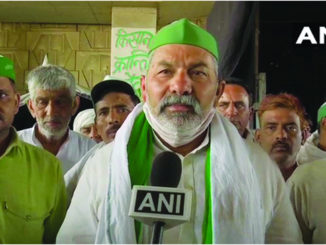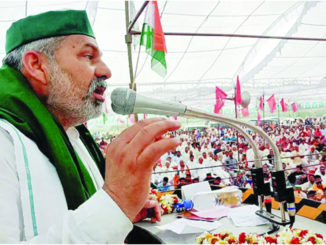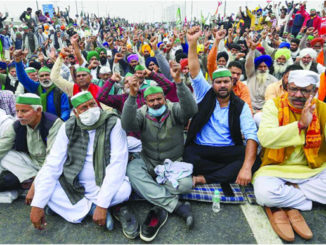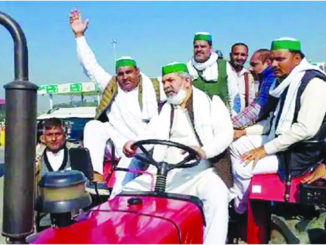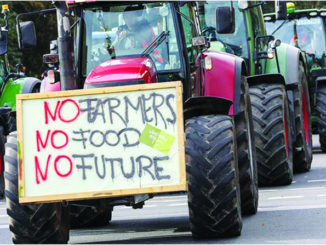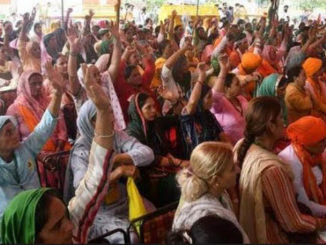
NEW DELHI (TIP): The Samyukt Kisan Morcha, a body of farmer unions leading protests around the national capital for the last eight months, on Monday, July 26 announced it would hold a “big panchayat” in Muzaffarnagar on September 5. Rakesh Tikait, spokesperson of the Bharatiya Kisan Union, made the announcement in Lucknow as part of the morcha’’ plans of intensifying the stir in States. The morcha termed it as the “mission U.P.” and “mission Uttarakhand”.
Mr. Tikait said the campaign would entail intensifying the stir and reaching out to farmers in Uttar Pradesh, Uttarakhand and Punjab which go to the polls early 2022.
“This movement will start from there,” Mr. Tikait said.
Issuing a threat to the U.P. government, Mr. Tikait said if it did not work in the interests of the farmers, the morcha would also blockade Lucknow.
“Lucknow ko bhi Dilli banaya jayega,” he said, adding that roads from all four sides to Lucknow would be sealed.
Farmers protesting the contentious new farm laws are ready to talk if the Centre invites them, BKU leader Rakesh Tikait said on Sunday, April 11, maintaining that the dialogue would resume where it had ended on January 22 and the demands remain unchanged.
He said for the talks to resume, the government should invite the Samyukta Kisan Morcha (SKM), an umbrella body representing the protestors who are camping at the three border points of Delhi at Singhu, Tikri and Ghazipur since November 2020.
“The talks with the government would resume from the same point where it had ended on January 22. The demands are also the same — all three ‘black’ farm laws should be repealed, a new law made to ensure MSP (minimum support price) for crops,” Tikait was quoted as saying in a statement issued by BKU media in-charge Dharmendra Malik.
The BKU national spokesperson’s remarks came in response to Haryana Home Minister Anil Vij urging Union Agriculture Minister Narendra Singh Tomar to resume talks with protesting farmers amid the coronavirus scare looming large.
Maintaining that a surge in the coronavirus cases is being seen across the country and the situation is turning bad in Haryana too, Vij said he is worried about the farmers protesting on the state borders with Delhi. The protesters and the government last had a formal dialogue over the contentious issue on January 22 but the impasse continued.
New Delhi (TIP): Bharatiya Kisan Union (BKU) spokesperson Rakesh Tikait said on Thursday the agitation against the Centre’s three new farm laws will have to go on for eight more months as it is a question of their rights and lands. The movement will pick up speed after May 10, as till then farmers will remain engaged in harvesting wheat crops, Tikait said. “Farmers can harvest their wheat crops till May 10 post which the agitation will pick up speed,” Tikait was quoted as saying by news agency ANI.
Farmers have been camping at several border points in Delhi for more than four months, seeking a repeal of the laws– Farmers’ Produce Trade and Commerce (Promotion and Facilitation) Act, 2020; the Farmers Empowerment and Protection) Agreement on Price Assurance and Farm Services Act 2020 and the Essential Commodities (Amendment) Act, 2020 — which were cleared by Parliament in September last year.
Despite several rounds of negotiation and repeated requests by the government, the farmers have remained determined that they would not stop protesting until the laws are completely rolled back and are also firm on their demand for a legal guarantee for the Minimum Support Price (MSP).
All India Kisan Sabha (AIKS) general secretary Hannan Mollah told ANI on Wednesday that lakhs of protesters would march to Parliament in May. “Modi Government and Parliament are not listening to the farmers then it is our right to go in front of Parliament and raise our demand and we will decide sometime between the middle in the month of May,” he said. Pointing out that the march would be peaceful, he added that they (farmers) will go to Parliament to express their pain and grief before the citizens.
Several strikes and marches have been staged by farmers across India since last year and the majority of them were peaceful. However, the farmers’ tractor rally on Republic Day (January 26) in Delhi took a violent turn as protesters deviated from the designated route and entered the national Capital after breaking barricades and were also involved in incidents of vandalism. A few protesters reached the iconic Red Fort and hoisted religious flags on it. The Delhi Police has made multiple arrests in the case.
In January, the Supreme Court suspended the implementation of the farm laws and appointed a committee on January 12 to examine these laws and further recommend changes. The committee on Wednesday submitted its report and the apex court will hear the matter on April 5. Speaking to Hindustan Times, one of the expert members in the committee Anil Ghanwat said that it is entirely up to the apex court to act on the recommendations given.
Farmers agitating against the Centre’s farm laws are prepared for a long haul, BKU leader Rakesh Tikait said on Thursday. Tikait, who is at the helm of the farmers’ protest in Ghazipur, was addressing a mahapanchayat at Assandh in Haryana’s Karnal district. Asserting that protesting farmers will not relent unless the laws are repealed, Rakesh Tikait said, “We have made preparations till November-December.” Spokesperson of the Bharatiya Kisan Union (BKU), Rakesh Tikait reiterated his demand for withdrawal of the agriculture reform laws and the provision of a legal guarantee on MSP. Referring to his late father Mahender Singh Tikait, Rakesh Tikait said, “Tikait sahib used to say that when Haryana stands in support of an agitation, government shivers.”
Farmer leader Tikait went on to say that the Centre’s farm laws will have an adverse impact not just on farmers but also on other sections. “This fight is not just of farmers but it is also for the poor, small traders,” he said.
During his speech in Karnal on Thursday, Rakesh Tikait also said that the central government tried to break the agitation by dividing it on the lines of Punjab and Haryana. That did not work, he said adding that the protesting farmers have shown that they can look after their crops and the agitation at the same time.
“There is the possibility that in the name of corona, restrictions may be imposed but our agitation will go on. We will follow all the guidelines, but we will not end our dharnas,” Rakesh Tikait said.
New Delhi (TIP): Farmers are ready to continue protests on the borders of Delhi, against the three agricultural laws, for the remaining three and half years of the Narendra Modi government’s second term, said farmer leader Narendra Tikait. The protests cannot be “culled” he said. The farmers’ protest has been continuing for more than 100 days. Narendra Tikait does not hold any official position in the Bharatiya Kisan Union (BKU), formed by his father, Mahendra Singh Tikait, in 1986. He mostly focuses on the family’s farming activities but is as vocal on farmers’ issues as his two elder brothers, Naresh and Rakesh Tikait, who are leading from the front.
Speaking to news agency PTI, at his home in Muzaffarnagar’s Sisauli, the 45-year-old farmer also said his two brothers and the entire Tikait family would leave the protest if any wrongdoing is proved against a single family member. Narendra Tikait rejected allegations of making money from the agitation.
The eldest brother, Naresh Tikait is the BKU president, while Rakesh Tikait holds the position of national spokesperson of the organisation. BKU under Mahendra Singh Tikait’s leadership in 1988 had laid a virtual siege of Meerut demanding higher prices for sugarcane, cancellation of loans and lowering of water and electricity rates. The same year, BKU held a week-long protest in Delhi’s Boat Club to focus on the plight of farmers.
After Mahendra Singh Tikait’s death in 2011, Naresh and Rakesh Tikait have been leading the BKU in various roles, though a number of factions have emerged in various parts of the country over the years.
Narendra Tikait said the Centre thinks that it can “cull” the farmers’ protest like it has “culled” other agitations in the past using various tactics. “I am here in Sisauli but my eyes are on the protest,” he said, adding that he keeps visiting Ghazipur border where hundreds of farmers and BKU supporters are camping since November 2020.
“This government has a misconception, probably because it never faced such kind of protest, but we have seen agitations and been part of those for 35 years. This government only has an experience of facing smaller protests and of getting those culled through various tactics,” Mr Tikait said. “They cannot crush this protest by any means. This will continue for as long as our demands are not met. This government has a tenure of three and a half years left, and we can continue the movement till the end of its term,” he said.
“If the government keeps saying again and again that crops would be bought at MSP, then why cannot they give this in writing? They keep harping about giving subsidies on LPG cylinders, but that subsidy is also gone,” he said. Mr Tikait alleged that the Centre has done the same to the school education sector where private institutes are thriving and minting money while the condition of government facilities are suffering.
New Delhi (TIP): If the tractors are stopped, the farmers should have the strength to break barricades, Bharatiya Kisan Union leader Rakesh Tikait told the cultivators marching to join the agitation in Delhi. “If you get information that there are barricades in the city then you should get enough strength to remove them,” Tikait said addressing Kisan Mahapanchayat in Nagaur district on Wednesday. “Tractor is the tank of the farmers and farmer movements are run on cars,” he added. Thousands of protesting farmers, mostly from Punjab, Haryana and Uttar Pradesh, have been waiting at Delhi’s borders for almost three months, demanding the repeal of the three central farm laws. The government claims that these are part of the long-pending reforms in the agriculture sector. The farmers, however, complain that it will put them at the mercy of corporates. Talks with the government broke down on January 22. During a tractor rally on January 26, a section of the farmers broke off from the rally route and engaged in violent clashes with the police. Tikait’s mantra for farmers included 1 village, 1 tractor, 15 men and 10 days, adding another 15 are to replace the first 15 on rotational basis.
“If these farm laws are enforced then the foodgrains will be locked in godowns of the traders and big companies and the price of foodgrains will be decided on the basis of hunger,” he said.
He said that the farmer movement has not ended. “There are 15,000 tractors at Tikri border and farmers have put up huts under trees,” he said.
The government has maintaiend that the offer for talks is still open. The farmers, however, are insistent on repeal of the farm laws and also a guarantee on minium support prices or MSP for their produce.
A subterranean tsunami is slowly building in the country and the power elite, the pampered middle class and wheeler dealers of the capital are blissfully unaware of it.
It’s a dismal picture, but not dismal enough for our politicians and wanna-be billionaires. The farm laws were intended to speed up this process, and the barricades are a statement that the government will enforce them, come hell, high water, Rihanna or Greta Thunberg.
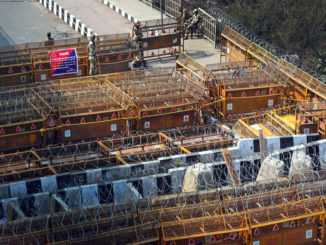
The irony of this is lost on a government drowning in its testosterone: with every nail studded barricade installed at Tikri, Ghazipur or Singhu, Delhi is making itself progressively redundant to the ongoing course of events, and perhaps even to the future shape of things in India. A subterranean tsunami is slowly building in the country and the power elite, the pampered middle class and wheeler dealers of the capital are blissfully unaware of it. The farmers do not need Delhi to survive or even to prosper, they are creatures of the soil and the elements and know how to live in harmony with them. They have been at our borders for almost three months now and have taken nothing from Delhi except perhaps water, the internet- and a lot of abuse. Now the rulers have stopped even the supply of these essentials, having practiced the art for a long time in Kashmir. But the farmers are unfazed- they now get them in abundance from their villages.
For me, in fact, Mr. Modi’s cat was let out of the bag by an economist friend who (indefense of the farm laws) informed me that rural unemployment on a huge scale was inevitable as a country progressed to ” developed nation” status. He sent me some charts to establish the correlation between GDP and rural unemployment: the higher the GDP, the higher the unemployment in agricultural communities!
This is the neo liberal, IMF-cum-World Bank formula which has ensured that 100 of the world’s richest billionaires have more wealth than half the world’s population. Mr. Modi’s farm laws will be the Indian version of this formula.
The invidious objective is to create cheap labor for industry and big Capital. This is already happening in India- 34 million farmers have left farming between 2004 and 2012 (Census figures), 50 million have been ” displaced” by capital projects and 500,000 more are uprooted every year, tribals are being evicted from forests, there are already 120 million migrant labor. It’s a dismal picture, but not dismal enough for our politicians and wanna-be billionaires. The farm laws were intended to speed up this process, and the barricades are a statement that the government will enforce them, come hell, high water, Rihanna or Greta Thunberg.
But our sturdy farmers, who are more intelligent than we Dilliwallahs give them credit for, have little interest in the barricades, the concertina wires, the-foot-long embedded nails blocking their way to Delhi, the product of the fear, paranoia, incompetence and malice of those who rule in Delhi. For the farmers have no reason to go to Delhi anymore, after leaving their visiting card there on the 26thof January. Every institution they appealed to for the last six months has let them down: Parliament, the Supreme Court, the Media, mainstream political parties, even the wealthy burghers of South Delhi. The lawyers are silent, the veterans are citing discipline as an excuse for their timidity, the celebrities have tucked their heads beneath their tails, the Embassies are ” watching the situation”, the IMF and World Bank are hopeful that Mr. Modi would carry the day. Delhi has let down the farmer, and he no longer has any need for India’s capital- the word ” capital” signifying many things.
And so, the farmer has decided to BYPASS Delhi and take it out of the equation: Rakesh Tikait went to Jind to attend a mahapanchayat on the 3rd of this month, he avoided Delhi and took the longer route via Haryana. The symbolism of this cannot be ignored. And at Jind he announced that he will now take the protests to other parts of India. This reminds me of two historical events. One: the Maginot line was built by France on its borders with Germany to deter any invasion by Hitler. It was so heavily fortified that it was considered impregnable. But when the time came the Germans simply bypassed it and rolled their Panzers through the Ardennes forest into France without any opposition. Two, and I am thankful to Punya Prasun Bajpai for pointing this out in a video, when Mahatma Gandhi saw that he was making no progress with the British in Delhi and Shimla, he decided to head in the opposite direction- to Dandi in Gujarat- to get a pinch of salt. That further helped to spread his message to the rest of India, to universalize it and give it more strength. By closing off Delhi, literally and figuratively, to the farmers Mr. Modi and Shah may have committed their biggest miscalculation. They have forced Mr. Tikait to change his strategy mid-way. He is doing three things now: one, he has made Western UP, not Punjab, the hub of the movement now. This is the region which enabled the BJP to come to power in the state in 2017, winning more than 100 Vidhan Sabha seats in just this belt. The BJP did so by creating a communal rift (remember the Muzaffarnagar riots?) between the dominant communities here, the Jats and the Muslims. Now, Tikait has healed the rift, united both against the government, and demolished the formula that won BJP western UP.
Two, as the de-facto Supremo of the farmers’ movement now, Tikait is more acceptable to the rest of the Hindi (or Hindu) heartland than the earlier Sikh leaders and he will be able to take the protests to the other states- MP, Rajasthan, Haryana, UP, Uttarakhand, Himachal, Bihar, Chhattisgarh, Jharkhand- more successfully. This is precisely the belt which allows BJP to win big in Parliamentary elections, and the spread of the agitation here does not augur well for it. It would have made more sense for the BJP to have limited the protests to Delhi and its vicinity.
Third, in India political parties have always won elections, not on the basis of their track records or manifestos, but on manipulation of identities- religion, caste, backwardness, region. The BJP has been particularly smart at this. But the farmers’ movement has now begun to erase these sub- identities in favor of a larger one- the farmer identity (which includes the landless laborer, the artisan, even the village shopkeeper). There will be only one identity now, one concern and one demand. With nothing to divide, the Great Divider will not be able to rule. it was a lesson the British had finally learnt, and the BJP will now learn it the hard way. The game has changed but the farmers have made it clear that the rules have not- winner takes all. This rule had been made by an arrogant and overreaching government and it may just come back to bite it. The pampered and indifferent upper middle classes of Delhi can now live in peace- the battle has been taken away from them, they no longer count.
(The author is retired from the Indian Administrative Service)
Chandigarh (TIP): Wary of the protracted farmers’ agitation in the capital and the Republic Day incident at Red Fort, the Punjab government has stepped up efforts to reach out to the Centre to work towards an early resolution, sources told The Indian Express. Some top state officials have been camping in Delhi and are in constant touch with both the protesting farmers and the Centre. There were concerns in the state government that after the Nishan Sahib was hoisted at Red Fort,the agitation would fizzle out and farmers would return empty-handed.
“Everybody here knows that if farmers come back without getting anything after these weeks and months of protests, anger will mount in the state. That would be a perfect breeding ground for resentment and we cannot afford that,” said a top state government functionary. That’s why, sources said, Chief Minister Amarinder Singh invoked Operation Blue Star at the all-party meeting this week and warned that Pakistan could “exploit” the situation to foment trouble. “Thanks to Rakesh Tikait, the agitation has got a new lease of life. If another Red Fort-like incident happens, it will be difficult for the leaders to sustain the agitation. Wisdom lies in taking it to a logical conclusion and save Punjab from any after-effects,” said a source who is aware of discussions between the state and the Centre.
He said the state is trying to impress upon the Centre to repeal the laws but the Centre is “willing to do anything other than repeal.” So one option the state has proposed is to put the laws on hold for three years instead of the earlier offer of 18 months. “The farmers leaders had not agreed then. But now we are working on both the farmers as well as the Centre to make sure that the agitation is called off soon. If we can get the laws on hold until 2024 — which means the next elections — we can then work on the farmers to back down. After the Republic Day incident,we all have learnt our lessons. We will have to agree on something,” said the source.
Ghaziabad (TIP): For all the global uproar the farmers’ movement against the new agri laws has caused, the man at its centre seems oblivious of the celebrity support he has been getting. Rakesh Tikait, the 51-year-old Bharatiya Kisan Union (BKU) leader from the hinterlands of Muzaffarnagar in western Uttar Pradesh, welcomed the support from international artistes and activists, including Rihanna and Greta Thunberg, but acknowledged that he did not know them. Talking to the media at Ghazipur on the Delhi-Uttar Pradesh border on Thursday, Tikait, who is credited with reviving the agitation that appeared to be flagging after the January 26 violence in Delhi, sought to know who these people were. “Who are these foreign artistes?” Tikait said showing unawareness when asked about the foreigners supporting the farmers’ movement.
When informed about American pop-singer Rihanna, adult star Mia Khalifa and Swedish teen climate activist Greta Thunberg, the Sisauli-born Tikait responded: “They may have supported us, but I don’t know them.”
“If some foreigner is supporting the movement, then what is the problem. They are not giving us or taking anything away from us,” he said. Commenting on the futile attempt by 15 members of Parliament to reach Ghazipur and meet protesters on Thursday, the BKU national spokesperson said the MPs should have sat on the ground on the other side of the barricades where they were stopped by Delhi Police.
“A barricading has been set up here. They had to come, but they should have sat down there itself. They would have been on the other side and we on this side (of the barricade),” he said.
Tikait said he did not have any talk with the 15 MPs who had tried to come to Ghazipur to meet the protesters. They were also not allowed to speak to the protesters, he added.
The 15 MPs from 10 Opposition parties, including the SAD, the DMK, the NCP and the Trinamool Congress, wanted to meet the protesters at Ghazipur. Members of the National Conference, the RSP and the IUML were also part of the delegation. MP and Shiromani Akali Dal leader Harsimrat Kaur Badal, who coordinated the visit, said the leaders were not allowed to cross the barricades and reach the protest site, where thousands of farmers are camping since November with a demand that the government repeal the new agri-marketing laws enacted last September.
The farmers’ protest at Ghazipur, Tikri and Singhu at Delhi borders has now attained global spotlight with prominent international celebrities and rights activists talking about the stir. In its pushback, the government said the facts on the issue must be ascertained before rushing to comment on it, and asserted that the “temptation” of sensationalist social media hashtags and views is “neither accurate nor responsible”.
Will not enter Delhi, say farmers as police prepare for Feb 6 chakka jam
Farm unions agitating against three agriculture laws announced on Thursday that no protester will enter Delhi during a three-hour nationwide highway blockade on February 6 in a bid to avoid a repeat of the clashes and violence witnesses on Republic Day. Farmers in Punjab and Haryana drummed up support for the chakka jam, scheduled between 12pm and 3pm on Saturday, held village-level meetings and deputed special security volunteers to avert any clashes with security forces.
In Delhi, Union home minister Amit Shah met national security adviser Ajit Doval and Delhi Police commissioner S N Shrivastava inside the Parliament complex to review the security situation. The Centre had already conveyed to Delhi Police that additional central paramilitary forces are on standby if required. Currently over 60 companies (6,000 personnel) of central paramilitary forces are assisting Delhi Police at the borders.
Farm leaders said cultivators camping at Singhu, Tikri, and Ghazipur borders, and those who will join them by Friday, will carry out the chakka jam at their respective venues.
New Delhi (TIP): Farm unions protesting three new agricultural laws have rejected the Union government’s offer to put the legislation in abeyance for at least one-and-a-half years — a decision that has deepened the crisis just when it appeared that a 56-day-long agitation by tens of thousands of farmers on the Capital’s borders could finally be resolved. In the 10th round of negotiations with a 41-member delegation representing farm unions on Wednesday, the Union government offered to suspend the three pieces of legislation in its most far-reaching proposal yet. But the farmers, instead of agreeing to meet the government midway, hardened their already rigid position on Thursday, saying they will not budge from their demand for a complete repeal of the laws. After several rounds of internal discussions over the government offer, the Samyukta Kisan Morcha, the platform of farm unions leading the agitation, said on Thursday evening that the farmers had unanimously rejected the proposal.
“The proposal to suspend the laws is not acceptable because our demand is a repeal of the laws,” said Darshan Pal, a senior leader of the agitation. A statement put out by the unions said a full general body meeting of the Samyukt Kisan Morcha was held on Thursday. “The proposal put forth by the government yesterday, was rejected. A full repeal of three central farm acts and enacting a legislation for remunerative MSP [minimum support price] for all farmers were reiterated as the pending demands of the movement,” the statement said.
In Wednesday’s (Jan 20 )talks, the government said that it would move an affidavit before the Supreme Court stating it’s decision to put the laws in abeyance till a solution to farmers’ demands was found. To discuss the issues raised by farmers, which includes a law guaranteeing assured prices for their produce, the government had also told farm unions that it proposed to set up a committee of representatives as well as experts who should be nominated both by farm unions and the government to examine “all agitation-related issues”.
The move was hailed by experts as a step back by the government, and they expected farmers to reciprocate. The farm unions, too, said they would discuss the government’s fresh offer, sparking hopes of a resolution. But Thursday’s inflexible position by the farmers now leaves few options to resolve the crisis.
Rakesh Tikait, the leader of Bharatiya Kisan Union (Tikait faction) said the full general body of the farm unions felt that accepting the government’s proposal would defeat the purpose of the agitation. “We will attend the talks with the Centre tomorrow where we will tell them that their proposal is not acceptable,” he said.
Joginder Singh Ugrahan, another senior farm leader, said the government’s proposal would “divert and delay” the farmers’ demands. The government has pushed a set of agricultural laws to ease restrictions in farm trade, allow traders to stockpile large quantities of food stocks for future sales and lay down a national framework for contract farming based on written agreements. Farmers staging a massive protest on several of Delhi’s border points say the laws will erode their bargaining power and leave them at the mercy of big corporations. They have demanded a full repeal of the three agricultural laws and have also sought a legal guarantee of assured prices for farm produce.
On January 12, after two days of deliberation, the Supreme Court suspended the pro-reforms farm laws until further order. The bench dealing with the case — headed by Chief Justice of India SA Bobde — also appointed a committee to look into farmers’ grievances over the laws. Agriculture minister Narendra Singh Tomar on Wednesday said the Supreme Court had put the laws in abeyance for a short time. “Our proposal is to put the laws on hold for a full year-and-a half or even more till a solution is found.”
Tomar added that if farmers were to accept the proposal in principle, then it would begin work on setting up the committee and its modalities, saying the laws would be suspended so that a committee could find a settlement.
“The farm unions have closed the option of any possibility of amendments. They want status quo. That is why they have showed no flexibility in dealing with the government,” said Abhinav Saikia, an agronomist with farm startup IndAgro.
There are some other farm unions that are in support of the new laws.
“The government seems to have conceded a lot of ground with several proposals it has made so far, from diluting the laws’ provisions to putting them on hold, but the latest stand of farmers have brought matters to a standstill. We don’t want a repeal,” said Anil Bijoria, the leader of Haryana Farmers’ Producer Association, a pro-reform farm organisation.
“The government has said that farmers can ask for anything other than repeal. The government now has to decide between repealing the laws or see a more intense agitation,” said RS Mani, a retired faculty at the Tamil Nadu Agricultural University.
Source: HT
Signup to our Newsletter!
Don’t miss out on all the happenings around the world