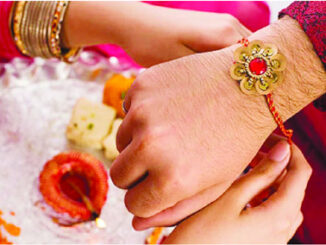
Raksha Bandhan is observed to acknowledge the sublime bond between siblings. Brothers promise to protect their sisters while sisters wish for their brothers’ immortality while tying a sacred thread ‘rakhi’ around the wrist of their brothers. The festival is celebrated on the day of the full moon in the month of Shravana, according to the Hindu calendar, which usually falls in August. According to the Hindu Panchang, on 19 August, from 03.04 am to 11.55 pm, along with the full moon date, Bhadra will start, which will last till 01.32 pm. The auspicious time for tying Rakhi on 19th August is from 01.33 pm to 11.55 pm.
Raksha Bandhan is observed on the last day of the Hindu lunar calendar month of Shravana, which typically falls in August. The expression “Raksha Bandhan” (Sanskrit, literally “the bond of protection, obligation, or care”) is now principally applied to this ritual. Until the mid-20th century, the expression was more commonly applied to a similar ritual, held on the same day, with precedence in ancient Hindu texts. In that ritual, a domestic priest ties amulets, charms, or threads on the wrists of his patrons, or changes their sacred thread, and receives gifts of money. This is still the case in some places. By contrast, the sister-brother festival, with origins in folk culture, had names which varied with location. Some were rendered as saluno, silono, and rakri. A ritual associated with saluno included the sisters placing shoots of barley behind the ears of their brothers.
Of special significance to married women, Raksha Bandhan is rooted in the practice of territorial or village exogamy. The bride marries out of her natal village or town, and her parents by custom do not visit her in her married home. In rural north India, where village exogamy is strongly prevalent, large numbers of married Hindu women travel back to their parents’ homes every year for the ceremony. Their brothers, who typically live with their parents or nearby, sometimes travel to their sisters’ married home to escort them back. Many younger married women arrive a few weeks earlier at their natal homes and stay until the ceremony. The brothers serve as lifelong intermediaries between their sisters’ married and parental homes, as well as potential stewards of their security. Let’s take a look at some of the interesting stories around Raksha Bandhan in Indian mythology.
Krishna and Draupadi
Amongst the better-known legends around the origin of Raksha Bandhan is the story of Krishna and Draupadi. According to one version of the Mahabharata, Krishna slit his index finger in battle, while hurling his divine weapon, the Sudarshan Chakra, at his nephew, Shishupala. Another version says he cut his finger while reaping sugarcane from the fields. Both stories conclude with Draupadi tearing a piece of her saree and wrapping it around his finger to stop the bleeding. Pleased by this loving gesture from Draupadi, Krishna took a divine oath to protect Draupadi’s honour in the future. This is also believed to be the reason why he came to her rescue during the infamous disrobing by the Kauravas.
King Bali and Goddess Lakshmi
Another legend about the festival revolves around the story of Goddess Lakshmi and King Bali. When Bali selflessly gave everything that Vishnu had asked for disguised as Vamana, Vishnu became very impressed by Bali’s devotion. He blessed Bali to be equal in status to Indra for as long as he lived. He also promised to protect Bali and his homestead and disguised himself as a gatekeeper guarding Bali’s palace. However, Vishnu’s wife, goddess Lakshmi, missed her husband in Vaikunth. Unable to bear her husband’s absence, she disguised herself as a poor Brahmin lady and went to Bali, and told him that she wanted a place to stay until her husband returned from the task he had set out to accomplish. Bali wholeheartedly welcomed her and protected her just like an elder brother.
With the arrival of the goddess, Bali’s palace was filled with happiness and wealth. On the day of Shravana Purnima, the poor Brahmin lady tied a coloured cotton thread around his wrist. Overwhelmed by the gesture, Bali granted her a wish. The Brahmin lady pointed at the gatekeeper and asked for her husband to be set free. In an instant, Vishnu and Lakshmi then returned to their true form. King Bali was touched by the love and care they had shown him and requested Vishnu to go back to his abode with Lakshmi. However, he requested Vishnu to visit him at least once every year. It is believed that lord Vishnu visits King Bali for four months every monsoon.
The legend in the Bhavishya Puran
The legend refers to a war between the Gods and the Demons. The demon King Brutra was advancing and the Gods lead by lord Indra, were on verge of defeat. The king of Gods, Indra approached Guru Brihaspati to find a solution to the situation. Brihaspati asked Indra to tie a sacred thread on his wrist, powered by the sacred mantras on the Shravan Purnima. Lord Indra’s Queen Sachi also called Indrani, empowered the thread and tied it on to his hand on the decided day. The power of the sacred thread called Raksha helped the Gods to victory. The tradition of thread tying still continues. It is a gesture of goodwill.
Yama and the Yamuna
It is said that the Raksha Bandhan was a ritual followed by Lord Yama (the Lord of Death) and his sister Yamuna. Yamuna tied rakhi to Yama and bestowed immortality. Yama was so moved by the serenity of the occasion that he declared thar whoever gets a rakhi tied from his sister and promised her protection will become immortal.
In the Epics
Raksha Bandhan finds a mention in Mahabharata when Lord Krishna advised Yudhishthir to perform the ceremony to protect himself and the army from the dangers of the war. It is said that Kunti, the mother of the Pandavas tied rakhi to her grandson Abhimanyu and Draupadi to lord Krishna.
Tag: Raksha Bandhan
-

Raksha Bandhan: Sublime bond between siblings
-

Raksha Bandhan
Raksha bandhan is the main festival of Hindus which is celebrated on the full moon day of Shravan and every year the festival comes in August. This festival is celebrated throughout India and Nepal. Raksha bandhan means ‘bondage of security’ and ‘Raksha Bandhan’ in Sanskrit literally means “the knot of security”. Rakhi can be made from cotton such as kalva, silk thread, and gold or silver item. The festival of Raksha Bandhan is the festival of brother and sister. This festival symbolizes the love of brother and sister. On the Raksha bandan, sister prays for her brother’s long life with her prosperity and happiness and binds Rakhi on her brother’s wrist. The brother gives the gift to his sister and promises to protect his sister and take care of him in all circumstances. This festival is celebrated by the Hindu communities including Jain and Sikh religion and other parts of the world. Raksha bandhan has also been an important tradition in the history of Sikhism, which is sometimes called Rakhdi or Rakhri.
Legends and tales of Raksha Bandhan
Draupadi tied Rakhi on Lord Krishna’s wrist
According to ancient scriptures, Lord Krishna was once fighting with the evil King Shishupal, to protect the people. The Lord bore an injury and was left with a bleeding finger. Draupadi tore her saree and tied a piece of cloth around Krishna’s wrist. He was very impressed by her gesture and promised to protect her if ever she needed help. When the Kauravas tried to strip her robes, Krishna appeared and saved her from honour.
The legend of Yama and Yamuna
It is believed that Yama, the deity of death, gained immortality when his sister, Yamuna tied rakhi on his wrist. Yama also affirmed that anyone, who stood by his promise to protect his sister, after the sister ties rakhi on his wrist, would be blessed with a healthy and everlasting life.
Goddess Lakshmi and King Bali
The Hindu mythology believes that King Mahabali was a devout worshiper of Lord Vishnu. The Lord, impressed by his deep devotion, took to caring for his kingdom. To look after his kingdom, Lord Vishnu had to leave his abode in Vaikuntam, leaving Goddess Lakshmi, behind. The Goddess was distraught by Lord’s Vishnu’s decision and she knew that she could not talk him out of his commitment. So, she decided to visit the kingdom, on Shravan Purnima, by concealing her identity. After tying rakhi on Mahabali’s wrist, she revealed her identity and shared her reservation with the king. The king was touched by her plea and in return, begged Lord Vishnu to go back to Vaikuntam. Raksha Bandhan is also referred to as the Baleva festival in some cultures.
Mughal Emperor Humayun and Rani Karnavati
Once when Mewar was attacked by the king of Gujarat, Bahadur Shah, Rani Karnavati, a widow herself, was very concerned about the honour of thousands of her women subjects. She sent a bejeweled Rakhi to Mughal emperor Humayun, who had already captured Delhi Throne, by then, seeking his assistance. Humayun felt honoured and obliged with her request, and moved his forces towards Chittorgarh. However, by the time the forces reached the fort, the womenfolk along with the queen, committed jauhar (self immolation) and chose death over dishonour.
King Porus and Alexander’s wife
Alexander the Great, invaded the Indian sub-continent by 300 B.C. Although he was never defeated in his conquests, this time he faced a formidable opponent, King Porus. Alexander’s wife, Roxana feared for his defeat and death. She came to know about the Raksha Bandhan festival of the region from her close aides. She sent a Rakhi to Porus, and asked him to ‘pull punches’ on Alexander and not to kill him, if they came face-to-face in the war. According to various folklores, this is one of the reasons Porus lost the war, as he was bound by the promise he made in return of the Rakhi.
The legend in the Bhavishya Puran
The legend refers to a war between the Gods and the Demons. The demon King Brutra was advancing and the Gods lead by lord Indra, were on verge of defeat. The king of Gods, Indra approached Guru Brihaspati to find a solution to the situation. Brihaspati asked Indra to tie a sacred thread on his wrist, powered by the sacred mantras on the Shravan Purnima. Lord Indra’s Queen Sachi also called Indrani, empowered the thread and tied it on to his hand on the decided day. The power of the sacred thread called Raksha helped the Gods to victory. The tradition of thread tying still continues. It is a gesture of goodwill.
The legend of King Bali and Goddess Laxmi According to another legend Demon King Bali was a great devotee of Lord Vishnu. Lord Vishnu had taken up the task to guard his kingdom leaving his own abode in Vaikunth. Goddess Laxmi wished to be with her lord back in her abode. She went to Bali disguised as a Brahmin woman to seek refuge till her husband came back. During the Shravan Purnima celebrations, Laxmiji tied the sacred thread to the King. Upon being asked she revealed who she was and why she was there. The king was touched by her goodwill for his family and her purpose and requested the Lord to accompany her. He sacrificed all he had for the Lord and his devoted wife.
Thus the festival is also called Baleva that is Bali Raja’s devotion to the Lord.It is said that since then it has been a tradition to invite sisters in Shravan Purnima for the thread tying ceremony or the Raksha Bandhan. -

Raksha Bandhan: The bond of security
Raksha bandhan is the main festival of Hindus which is celebrated on the full moon day of Shravan and every year the festival comes in August. This festival is celebrated throughout India and Nepal. Raksha bandhan means ‘bondage of security’ and ‘Raksha Bandhan’ in Sanskrit literally means “the knot of security”. Rakhi can be made from cotton such as kalva, silk thread, and gold or silver item. The festival of Raksha Bandhan is the festival of brother and sister. This festival symbolizes the love of brother Sister. On the Raksha bandan, sister prays for her brother’s long life with her prosperity and happiness and binds Rakhi on her brother’s wrist. The brother gives the gift to his sister and promises to protect his sister and take care of him in all circumstances. This festival is celebrated by the Hindu communities including Jain and Sikh religion and other parts of the world. Raksha bandhan has also been an important tradition in the history of Sikhism, which is sometimes called Rakhdi or Rakhri.
The Significance
Raksha Bandhan is now considered as a day to celebrate the sacred relation of a brother and a sister. Yet there have been examples in history where in rakhi has just been a raksha or protection. It could be tied by wife, a daughter or mother. The Rishis tied rakhi to the people who came seeking their blessings. The sages tied the sacred thread to themselves to safe guard them from the evil. It is by all means the ‘Papa Todak, Punya Pradayak Parva’ or the day that bestows boons and end all sins as it is mentioned in the scriptures.
Previously, Rakhi festival encompasses the warmth shared between the siblings but now it goes way beyond it. Some people tie Rakhi to neighbours and close friends signifying a peaceful co-existence of every individual. Rakhi Utsav was first popularized by Rabindranath Tagore to promote the feeling of unity and a commitment to all members of society to protect each other and encourage a harmonious Social life.
In today’s scenario, the day has a different perspective. The occasion involves a pledge of life-time practice of moral, cultural and spiritual values. The values and the sentiments attached to the rituals of this festival are worth inculcating by the whole human race, the sentiments of harmony and peaceful coexistence. The festival of Raksha Bandhan assumes all forms of Raksha or protection, of righteousness and destroyer of all sin. The ritual of Rakhi tying has become so important that come what may, brothers and sisters try to visit each other place on this particular day tin order to bring back the oneness of the family, binding the family together in an emotional bond of love. Around mid-August, Hindus all over the world celebrate Raksha bandhan. “Raksha” means protection, and “bandhan” means bound or binding. In North India, the occasion is popularly called Rakhi, Raksha Bandhan or Rakshaa Bandhan- the tying of an amulet.
In ancient times a woman tied a ‘rakshaa’ on her husband’s wrist to protect him from evil. Gradually this changed; she tied a ‘rakshaa’ on her brother’s right wrist, to protect him from evil influence and those factors which may taint his character, and to strengthen the bond of sibling love between them. On the occasion of Rakshaa Bandhan she visits her brother’s home and performs his ‘pujan’ by applying kumkum and rice grains on his forehead. In return the brother gives her a gift and vows to protect her too. The ‘rakhadi’ for rakshaa bandhan itself ranges from a coloured cotton string to exquisitely decorated balls of various sizes and materials such as fluffy cotton, ‘zari’ paper, tinsel, beads and so on. On Rakshaa Bandhan a second imortance relates to ‘Baleva’ and our devotion to the Lord. Just as Bali Raja offered devotion to Lord Narayan by sacrificing his kingdom and himself, devotees should endeavor to emulate him. That is the true spirit of Baleva.
Rakshaa bandhan day is important for the priests too, as they tie rakhis on their patrons wrist and in return receive offerings from them. In some parts of the country it is customary to draw figures on the walls of their home and worship them with offerings of vermilion and kheer. The imprints of palms are also put on either side of the entrance and rakhis are stuck on them as part of rakshaa bandhan rituals. Some parts of India also reserve Rakshaa Bandhan day importance for the sacred thread changing ceremony when the young brahmin boys discard the old one and don a new one ritualistically. However, on rakshaa bandhan it is the emotions which are important. The rakshaa bandhan ceremony performed is the symbolic everlasting bond between brothers and sisters that reinforces ties between them even across continents, and it is the one which has the most importance on this auspicious day.
Stories behind the festival
– The origin of Raksha Bandhan comes from the ancient times when Indrani tied a thread given to her by Lord Vishnu around her husband Lord Indra’s wrist to protect him from demons during the war between the Gods and demons.
– Another story believes that demons won the war and captured heaven. Lord Indra, who was unhappy about this, complained to Brihaspati (guru of the gods), who then prepared a raksha sutra and told him to wear it for protection.
– The promise of protection was seen in the Mahabharat too. It is believed that once Lord Krishna cut his finger and was bleeding profusely. Seeing this, Draupadi tore a part of her sari and tied it around his finger. This is believed to be the reason why he saved her during her cheerharan by Kaurava.
– Rakhi saved Alexander The Great’s life. When he had invaded India, his wife Roxana had sent a rakhi to the Katoch King Porus and he had vowed to protect her and her husband. So, on the battlefield when he was about to kill Alexander he saw the rakhi and refrained from killing him.
– The most significant story of the dedication of a brother’s promise if that of Emperor Humayun who went with his troops to Mewar when Rani Karnavati who ruled the region then asked for his help. Mewar had been attacked twice by Bahadur Shah and as a ray of hope she sent a letter to Humayun with a rakhi asking for his help. The emperor who was between a military campaign then left everything to go and protect her.
-

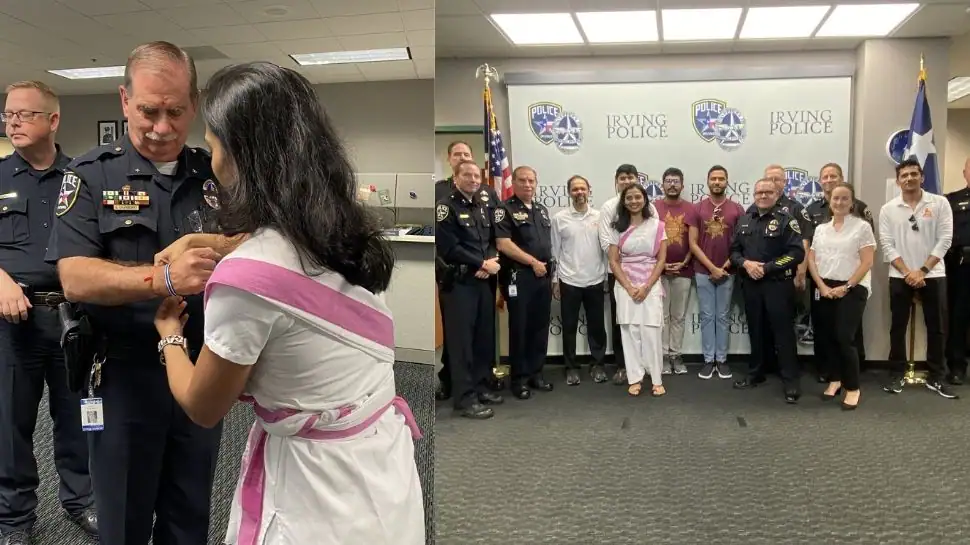
Hindu Swayamsevak Sangh USA celebrated Raksha Bandhan with the Irving Police Department in Texas
DALLAS, TX (TIP): Raksha Bandhan, a festival that cherishes the bond between brothers and sisters, is celebrated by the Hindus across the world. The festival was celebrated this year on August 22. However, it’snever too late to celebrate this bond,and ring in the festival as did members of Hindu Swayamsevak Sangh (HSS) in Dallas. Hindu Swayamsevak Sangh USA celebrated the festival of love and togetherness with the Irving Police Department here. Taking to Twitter, the official handle of Irving PDposted pictures of the celebration with HSS members. Hindu Swayamsevak Sangh (HSS) USA is a voluntary, non-profit, social and cultural organization. Sangh, as the organization is popularly known, aims to organize the Hindu community in order to preserve, practice and promote Hindu ideals and values. There is an HSS presence in North Irving.
-

Raksha Bandhan: The bond of love and protection
Raksha Bandhan celebrates the purity and sanctity of the bond that exists between siblings. Raksha means safety and Bandhan means bond. This festival is celebrated between siblings for their undying support and a vow of protection of each other under any dire circumstance. This year, Raksha Bandhan will be celebrated on 22nd August which falls on Sunday.
This festival is full of joy, merriment, exchange of gifts and sweets. Like all other festivals, even Raksha Bandhan has a deeply traditional and cultural significance.
History
The traditional Hindu festival ‘Raksha Bandhan’ (knot of protection) was came into origin about 6000 years back when Aryans created first civilization – The Indus Valley Civilization. With many languages and cultures, the traditional method to Rakhi festival celebration differs from place to place across India. Following are some historical evidences of Raksha Bandhan celebration from the Indian history.
Rani Karnawati and Emperor Humayun
The story of Rani Karnavati and Emperor Humayun is the most significant evidence in the history. During the medieval era, Rajputs were fighting Muslim invasions. Rakhi at that time meant a spiritual binding and protection of sisters was foremost. When Rani Karnawati the widowed queen of the king of Chittor realised that she could in no way defend the invasion of the Sultan of Gujarat, Bahadur Shah, she sent a rakhi to Emperor Humayun. The Emperor touched by the gesture started off with his troops without wasting any time.
Alexander The Great and King Puru
The oldest reference to the festival of rakhi goes back to 300 B.C. at the time when Alexander invaded India. It is said that the great conqueror, King Alexander of Macedonia was shaken by the fury of the Indian king Puru in his first attempt. Upset by this, Alexander’s wife, who had heard of the Rakhi festival, approached King Puru. King Puru accepted her as his sister and when the opportunity came during the war, he refrained from Alexander.
Lord Krishna and Draupathi
In order to protect the good people, Lord Krishna killed the evil King Shishupal. Krishna was hurt during the war and left with bleeding finger. Seeing this, Draupathi had torn a strip of cloth from her sari and tied around his wrist to stop the bleeding. Lord Krishna, realizing her affections and concern about him, declared himself bounded by her sisterly love. He promised her to repay this debt whenever she need in future. Many years later, when the pandavas lost Draupathi in the game of dice and Kauravas were removing her saari, Krishna helped her divinely elongating the saari so that they could not remove it.
King Bali and Goddess Lakshmi
The demon king Mahabali was a great devotee of lord Vishnu. Because of his immense devotion, Vishnu has taken the task of protecting bali’s Kingdom leaving his normal place in Vikundam. Goddess lakshmi – the wife of lord Vishnu – has became sad because of this as she wanted lord Vishnu along with her. So she went to Bali and discussed as a Brahmin woman and taken refuge in his palace. On Shravana purnima, she tied Rakhi on King Bali’s wrist. Goddess Lakshmi revealed who she is and why she is there. The king was touched by Her and Lord Vishnu’s good will and affection towards him and his family, Bali requested Lord Vishnu to accompany her to vaikuntam. Due to this festival is also called Baleva as Bali Raja’s devotion to the Lord vishnu. It is said that since that day it has become a tradition to invite sisters on sravan pournima to tie sacred thread of Rakhi or Raksha Bandan.
Traditions & Customs
Generally, the fancy Rakhis and delicious sweets are prepared long before the Shravana Purnima. According to the Indian tradition, the family members get ready for the rituals early in the morning. They take a bath to purify mind and body before starting any preparations. Sisters prepare the puja thali which consists of roli, tilak, Rakhi threads, rice grains, aggarbattis (incense sticks), diyas and sweets. After offering the rituals to the deities of the family, the sister perform aarti of their brothers and ties Rakhi on their wrist. Then, they put kumkum powder on the forehead of their brother and offer sweets.
Legends
For the siblings it is the eternal tie of love, for Brahmins the day to take the pledge of Brahmanik rites and for those who depend sea and monsoon, it is the beginning of the new season. Indian festivals are based on the weather changes and their significance in the lives of people but they do have a story to support the celebrations. The rich Indian Mythology provides a religious reason to celebrate the day in a specific way. Many epics are related to the day and the origin of Raksha Bandhan. The festival finds a mention in most of the epics and its origin can be traced back to the mythological Pouranik times.
The legend in the Bhavishya Puran
The legend refers to a war between the Gods and the Demons. The demon King Brutra was advancing and the Gods lead by lord Indra, were on verge of defeat. The king of Gods, Indra approached Guru Brihaspati to find a solution to the situation. Brihaspati asked Indra to tie a sacred thread on his wrist, powered by the sacred mantras on the Shravan Purnima. Lord Indra’s Queen Sachi also called Indrani, empowered the thread and tied it on to his hand on the decided day. The power of the sacred thread called Raksha helped the Gods to victory.
The tradition of thread tying still continues. It is a gesture of goodwill.
Yama and the Yamuna
It is said that the Raksha Bandhan was a ritual followed by Lord Yama (the Lord of Death) and his sister Yamuna. Yamuna tied rakhi to Yama and bestowed immortality. Yama was so moved by the serenity of the occasion that he declared thar whoever gets a rakhi tied from his sister and promised her protection will become immortal.
In the Epics
Raksha Bandhan finds a mention in Mahabharata when Lord Krishna advised Yudhishthir to perform the ceremony to protect himself and the army from the dangers of the war. It is said that Kunti, the mother of the Pandavas tied rakhi to her grandson Abhimanyu and Draupadi to lord Krishna.