Tag: Ram Nath Kovind

  • Former President Kovind praises the diaspora, apprising them of the progress made back home

    Former President Kovind praises the diaspora, apprising them of the progress made back home

    Shri Ram Nath Kovind and his wife were received at the airport on their arrival on September 27 by Consul General Randhir Kumar Jaiswal (extreme right), Maneesh Media Chairman Chandmal Kumawat, Rajasthani community stalwart Haridas Kotahwala and a few other members of the Indian Community.

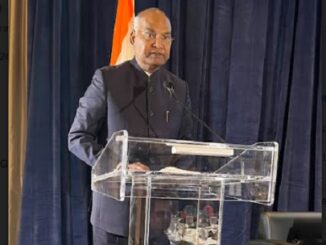
    NEW YORK CITY (TIP):  At a reception in his honor here, Ram Nath Kovind, the 14th President of India, praised the diaspora in the US, encouraging them to keep nurturing their roots and heritage.  The former President was speaking at a community reception on September 28 at The Pierre, a Taj hotel, organized by the Indian Consulate of New York and hosted by Maneesh Media.

    Kovind also released a coffee table book titled ‘Modi Hai to Mumkin Hai’ (Modi Makes it Possible) published by Maneesh Media, timed to belatedly celebrate  Prime Minister Narendra Modi’s 73rd birthday which fell on September 17. The book chronicles Modi’s foreign travels over the years.

    The former President said during his travels to foreign countries as President, he never felt satisfied unless he interacted with the Indian diaspora, “There is no substitute for the feeling you get on meeting your own”. He said the success of Indians settled abroad, particularly in the US, is a matter of pride. “In their success, Indian values and the Indian family system have stood them in good stead,” he added. Kovind exhorted the Indian diaspora to not only keep nurturing their roots and heritage but also pass on that legacy to the next generation.

    It is heartening to note, he said, that it is not just Diwali, but all Indian festivals from Ganesh Chaturthi to Jains’ Paryushan are now celebrated in America.

    He lauded the leaps of progress India has made under PM Modi, singling out the successful Chandrayaan-3 mission. He added that the consensus on various issues developed by the host India at the recent G20 conference was remarkable and yet another indicator that the country has emerged as a ‘Force for Global Good’ and PM Modi is a Global Statesman.

    Kovind said many smaller countries he traveled to post-Covid expressed to him their extreme gratitude for India for saving their countries by supplying vaccines.

    Doing a riff on the refrain ‘Modi Hai to Mumkin Hai’ and perhaps alluding to the 2024 general election, Kovind said next year the sequel will have to be titled, ‘Modi Hai to Pakka Hai’ (Modi Makes it a Certainty).

    Consul General Randhir Jaiswal, who had served in  President Kovind’s Secretariat before getting posted to New York, also spoke.

    TV Asia Chairman H.R. Shah, philanthropist Kiran Patel, who came down from Tampa, Florida, and Maneesh Media Chairman Chandmal Kumawat felicitated Kovind, praising him for rising from humble roots to become the President of India, and for his genial nature. In attendance at the chandeliered ballroom of the hotel adjacent to Central Park were many prominent members of the Indian community and media. Maneesh Media, based in Jaipur with a presence in  New York and Canada, specializes in publishing coffee table books, mainly profiling diaspora personalities with the motto of ‘Connecting Beyond Boundaries’.

    Shri Ramnath Kovind released a book-‘Modi Hai to Mumkin Hai’
  • The Indian Panorama Editor Indrajit S. Saluja among Top Indian Americans honored as Jewels of India

    The Indian Panorama Editor Indrajit S. Saluja among Top Indian Americans honored as Jewels of India

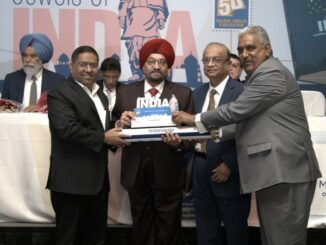
    Former President of India Shri Ram Nath Kovind released the  book  “Jewels of India” featuring 75 “Jewels”

    Parveen Chopra

    NEW YORK CITY (TIP):  It was a superb celebration of India and the Indian diaspora. In a glittering, power-packed event organized  by Maneesh Media here on January 28, 2023, none other than the former President of India, Shri Ram Nath Kovind, congratulated 75 leading Indian Americans as the Jewels of India and released the lavishly mounted coffee table book profiling them.

    Lauding the achievements and contributions to society of the Indian diaspora and of Indian Americans in particular, were Hon. Randhir Jaiswal, Consul General of India in New York, MR Rangaswami, founder of Indiaspora, Dr Bharat Barai, oncologist and co-author of Modi@20: Dreams Meet Delivery, and Dr Kiran C Patel, a top philanthropist.

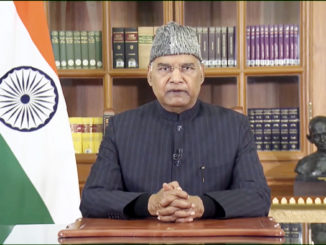
    Shri Ram Nath Kovind, former President of India addressed the gathering via satellite. He congratulated 75 leading Indian Americans as the Jewels of India and released the lavishly mounted coffee table book profiling them. (Photo / Maneesh Media)
    Dignitaries on the dais with the book “Jewels of India” (Photo/ Maneesh Media)

    Seated on the dais alongside those illustrious people were Chandmal Kumawat, Founder and Chairman of Maneesh Media; distinguished guests Dr Santosh Kulshrestha Kumar, Founder President, International University of Vedic Wellness; Haridas Kotahwala, Chairman of Navika Group of Companies; and Darshan Singh Bagga, real estate tycoon. At the standing room only event the massive coffee table book, Jewels of India in America, was released simultaneously in the ballroom as well as by Honorable Ram Nath Kovind in India, who spoke live via video link from Kochi. The book contains profusely illustrated profiles of 75 leading Indian American personalities, out of which about 25 were present in person to receive the honors from Consul General Jaiswal and other distinguished guests.

    Notable honorees included Naveen Shah, CEO of Navika group; Vijaydev Ratanjee Mistry,  first trustee of the charitable foundation of his family that made a fortune in the hat business; Dr Vivek Lall, CEO, General Atomics Global Corporation, CA; Raj Gopal Asava, Founder, Hunger Mitao, TX; Kailash N Jhalani, President, Prompt Gem Importers; Dr Manbir Singh, Medical Director, McFarland Singh Medical Clinic, CA; Mohamad Faroqui, Founder, Print Early & New York Banner Stands; Dr Samin K Sharma, Director, Cardiovascular Clinical Institute Mount Sinai Hospital, NYC; Prof Indrajit Singh Saluja, Editor-Publisher of The Indian Panorama; and Sparsh Shah, a child prodigy, rapper and motivational speaker.

    Patrons, Sponsors and Supporters included Foundation for Global Understanding, International University of Vedic Wellness, Indiaspora, Bulk Petroleum, Vijaydev Ratanjee Mistry Family Trust, Vardhamana Charitable Foundation and Print Early.

    With the Jewels of India in America Part 2 (part 1 was released 10 years ago) Maneesh Media also celebrated its 50th publication over a proud journey of 23 years. All of their publications have been often released and endorsed by top dignitaries such as US Presidents, Indian President, Vice President, Prime Ministers and have reached the Indian community across the world. With offices in New York, Toronto and Jaipur, Founder Chandmal Kumawat is ably supported by his 3 sons, Maneesh Media directors Manish, Abhishek and Siddharth. Manish and Siddharth were at hand managing the event on January 28 which also celebrated India’s Republic Day. Siddharth gave a vote of thanks.

    A group photo of awardees with dignitaries.
    Some awardees had left by the time the group photo was announced. . (Photo : Maneesh Media)

    Entertaining the 250+ guests in the overflowing ballroom at the Mandarin Oriental premier 5-star hotel in the heart of Manhattan were plumed showgirls, Arya Dance Academy’s Bollywood performances, and Sparsh Shah belting out a patriotic song and a rap-raga fusion number.

    (Parveen Chopra is founder of alotusinthemud.com, wellness and spirituality web magazine. He can be reached at editor@alotusinthemud.com)

  • Know how President of India is elected

    Know how President of India is elected

    On July 18, elected MLAs and MPs across the country will vote to elect India’s 15th President. Under Article 62(1) of the Constitution, “an election to fill a vacancy caused by the expiration of the term of office of President shall be completed before the expiration of the term”. President Ram Nath Kovind’s tenure ends on July 24. The counting of votes will take place on July 21 and the new president will take oath on July 25.

    The notification for the presidential election has been issued on June 15 and the last day of filing a nomination will be June 29. The papers will be scrutinised on June 30. The last day to withdraw the nomination papers will be July 2.

    “The Election Commission, in consultation with the Central Government, appoints the Secretary General of Lok Sabha and Rajya Sabha, by rotation, as the Returning Officer,” the EC said.

    “Accordingly, the Secretary General, Rajya Sabha will be appointed as the Returning Officer for the present election to the Office of the President,” it added.

    Here’s the process of electing a President

    According to Article 55 of the Constitution, the President of India is elected by members of the Electoral College consisting of elected Members of Parliament and that of all the state assemblies including the National Capital Territory of Delhi and the Union Territory of Puducherry. It follows the system of proportional representation utilising a single transferable vote system and secret ballots.

    Nominated members of Parliament, state assembly and members of legislative council are not eligible to vote.

    Importantly, the members who are nominated to either House of Parliament or the Legislative Assemblies of State including NCT of Delhi and UT of Puducherry are not eligible to be included in the Electoral College.

    This year, a total of 776 Members of Parliament and 4,033 MLAs will vote in the Presidential elections. The total value of votes is 10,86,431. The value of votes of MLAs is 5,43,231 and MPs are 5,43,200.

    Who is eligible?

    To be eligible for the election, the person: must be a citizen of India; have completed the age of 35 years; and is qualified for election as a member of the House of the People (Article 58).

    The person will not be eligible if he/she holds any office of profit under the Government of India or the Government of any State or under any local or other authority that is controlled by any of the state governments.

    What’s the process?

    The process starts with the nomination. The Presidential candidate should get his nomination paper subscribed by at least 50 electors as proposers and at least 50 electors as seconders. Importantly, the elector should not subscribe to more than one nomination paper either as a proposer or as a seconder. The candidate is required to deposit security, which is Rs 15,000. It is supposed to be made along with the nomination paper. More than four nomination papers can not be filed by or on behalf of a candidate or received by the Returning Officer.

    Where does the voting take place?

    Voting for the Presidential election will take place in Parliament and the premises of state assemblies, while Rajya Sabha Secretary-General will be the returning officer. MPs cast their vote in Parliament and MLAs in their respective state assemblies.

    Process of voting

    The election follows proportional voting which means that the value of each vote varies as it based on the post. The value of each vote based on the population is also predetermined for an MLA vote. This year, the total number of electors for the election will be 4,809 – 776 MPs and 4,033 MLAs.

    Who will be India’s next President?

    India’s President does not exercise executive powers, but all executive decisions are carried out in her name. She is required by the Constitution to act on the advice of the council of ministers led by the Prime Minister.

    But the President can ask the government to reconsider actions and offer advice. In matters of legislation, for example. So, it would be wrong to say that the role is only ceremonial or that the President is a mere figurehead or rubber stamp. Presidents like Pranab Mukherjee have been quite assertive, especially while dealing with mercy petitions from death row convicts. One of the most crucial roles of the President is seen when no party is able to get a parliamentary majority in a national election.

    So, the presidential election is crucial, and you should care about it. The election is indirect, but the result does indicate how much popular support both camps, the government and the opposition, have in the country.

    On your mind could be several key questions, from the poll process to front-runners to the numbers game, and to possible scenarios. But first let’s get some important dates out of our way.

    The President is elected by members of the Electoral College comprising elected members of both Houses of Parliament, and elected members of the Legislative Assemblies of all states and the National Capital Territory of Delhi and the Union Territory of Puducherry.

    This means nominated members of the Rajya Sabha and the Lok Sabha or Legislative Assemblies of states are not part of the Electoral College. Similarly, members of Legislative Councils also do not participate in the election process.

    The value of votes of MPs and MLAs varies based on the population of states they come from.

    It is mandatory for 50 MPs to propose the candidate, followed by another 50 seconding the candidature.

    Polling will be held in the Parliament House and on the premises of the State Legislative Assemblies.

    The election is held by secret ballot. A single transferable vote is used per the system of proportional representation.

    On the ballot paper, there are two columns. The names of candidates are listed in the first column, and the order of preference is listed in the second column.

    THE NUMBERS GAME

    The Electoral College has 4,809 electors, including 776 Members of Parliament (MPs) and 4,033 Members of Legislative Assemblies (MLAs).

    The total value of votes will be 10,86,431. To win, a candidate must get at least 5,43,216 votes.

    In the last election in 2017, Ram Nath Kovind of the NDA defeated joint Opposition candidate Meira Kumar. Kovind polled 7,02,000 votes compared with Kumar’s 3,67,000, out of a total of 10,69,358 votes.

    Roughly speaking, the ruling BJP-led National Democratic Alliance (NDA) has 48 per cent of the votes this time. It is 23 per cent for the Congress-led United Progressive Alliance (UPA).

    So, the NDA should not have any problem in getting its candidate elected. But the contest will become tight if all non-BJP parties unite (this explains hectic consultations on both sides). Then the opposition will have about 51 per cent of the votes.

    This is unlikely. Some reports say that “independents” such as Andhra Pradesh’s ruling YSRCP and Odisha’s ruling BJD may support the NDA. The BJP’s Tamil Nadu ally, the AIADMK, may also do so.

    The BJP has authorised its party president JP Nadda and Union minister Rajnath Singh to hold consultations with constituents of the NDA and the UPA, besides other political parties, as well as independent members. A consensus candidate is always preferable.

    PROBABLE CANDIDATES

    The general impression is that the BJP is unlikely to re-nominate Kovind. Rajendra Prasad was the only President to get two full terms. Both camps have not named their candidates yet. But that does not mean we’re short of suggestions. Former West Bengal Governor and Mahatma Gandhi’s grandson, Gopalkrishna Gandhi, has been approached by some leaders to be a joint Opposition candidate. He is the Left’s suggestion. There is talk about NCP chief Sharad Pawar exploring the possibility of pushing dissident Congress leader Ghulam Nabi Azad as the Opposition nominee. On the other hand, NDA probables may include Kerala Governor Mohammad Arif Khan, former Jharkhand Governor and tribal leader from Odisha Draupadi Murmu, Chhattisgarh Governor and tribal leader Anusuiya Uikey, Telangana Governor Tamilsai Soundararajan, Karnataka Governor and Dalit leader Thawar Chand Gehlot, former Lok Sabha Speaker Sumitra Mahajan, and Odisha’s tribal leader Jual Oram

    A disclaimer: The BJP remains capable of surprising everyone, like when it nominated APJ Abdul Kalam in 2002. The name of TMC leader Yashwant Sinha (though Bengal’s ruling party TMC has indicated none of its own members will be a candidate) is also being talked about. Earlier reports said that the Congress, the TMC, the AAP and the Shiv Sena wanted Pawar to be the opposition’s candidate, but he has declined the offer.

    JD(U) leader and Bihar minister Shravan Kumar has said party chief and Bihar CM Nitish Kumar could be a good candidate. Maharashtra minister and NCP spokesperson Nawab Malik has said Kumar’s candidature as an opposition choice can be considered if the latter snaps ties with the BJP/NDA in Bihar. On his part, Nitish Kumar has clarified that he never wanted to, and will not, contest the President’s election.

    CRACKS IN OPPOSITION

    Cracks have appeared in the opposition camp. The Congress is currently preoccupied with rallying support for its leader Rahul Gandhi, being questioned by the Enforcement Directorate in the National Herald money-laundering case.

    Actually, there is no one opposition camp. There is the Congress-led United Progressive Alliance (UPA). But that’s mostly the Congress with non-ruling allies like the RJD of Bihar. The Congress rules Rajasthan and Chhattisgarh and is a junior partner in states such as Maharashtra, Jharkhand and Tamil Nadu.

    West Bengal Chief Minister and TMC leader Mamata Banerjee has met Sharad Pawar, whose party NCP is part of Maharashtra’s ruling coalition MVA, led by the Shiv Sena and also comprising the Congress. Banerjee is trying to bring everyone on a single platform but Congress, while attending consultations driven by her, does not want to be overshadowed by a former Congresswoman. The grand old party is also holding its own meetings.

    The Left is not happy with Banerjee’s “unilaterally” organised deliberations. Delhi Chief Minister Arvind Kejriwal’s AAP (which is also ruling Punjab) has been a Congress critic and cautious of Banerjee in matters of national politics. On the other hand, Telangana Chief Minister K Chandrashekar Rao of TRS has his own ambitions.

    The Congress has asked its leader Mallikarjun Kharge to hold talks with all like-minded parties on the possibility of fielding a joint candidate. Kharge met NCP chief Sharad Pawar at the latter’s residence in Mumbai on June 9.

    Congress president Sonia Gandhi has herself reached out to Opposition leaders, including DMK chief MK Stalin, Pawar, CPM’s Sitaram Yechury. Banerjee and Telangana CM K Chandrashekar Rao, both non-UPA leaders, have also met leaders of the MVA. On June 15, Banerjee held a meeting with Opposition leaders in Delhi where no one from the AAP, the TRS and the BJD came despite invitations. Those who attended the meeting convened to prepare a joint strategy included Pawar, PDP’s Mehbooba Mufti, NC’s Omar Abdullah and SP’s Akhilesh Yadav, besides some Congress leaders including Kharge.

    Looks like a fractured opposition may again end up helping the BJP in an important election. Unless, of course, the mirage of oft-cited total opposition unity finally becomes a reality.

  • India better placed to meet challenges: Ram Nath Kovind, President

    India better placed to meet challenges: Ram Nath Kovind, President

    NEW DELHI (TIP): President Ram Nath Kovind on Tuesday , January 25, hailed the transformation of a Haryana village by its natives saying, “a new India, which is strong and sensitive, is emerging”.

    Urging all successful people to work for the development of their birthplaces, the President said rights and duties were two sides of the same coin and doing one’s duty well was the foremost contribution to the nation.

    In his address to the nation on the eve of the 73rd Republic Day, the President made a special mention of residents of Bhiwani’s Sui village who collaborated to transform the area under “Swa Prerit Adarsh Gram Yojana”. “I am sure other resourceful people will also contribute to the development of their villages and cities,” said the President, crediting his own native village Paraunkh in UP for his ascent to the Rashtrapati Bhavan,

    President Kovind said Indians had transformed the Covid vaccination drive into a mass movement. Noting that India is better placed to meet future challenges, he said, In the first year itself, we raised healthcare infrastructure and also reached out to help others. By the second year, we had developed indigenous vaccines and launched the world’s biggest vaccination drive.” He, however, cautioned against lowering the guard. “It has become a sacred duty to follow precautions suggested by experts,” he said. He said the economy was projected to grow at an impressive rate. He lauded the self-reliance in defense and also spoke of women breaking the glass ceiling in the armed forces.

  • Tribute to Pranab Mukherjee: A man of independent mind and steely resolve

    Tribute to Pranab Mukherjee: A man of independent mind and steely resolve


    Tribute to Pranab Mukherjee: A man of independent mind and steely resolve

                                              By George Abraham

    George Abraham

    Pranab Mukherjee at the Indian National Overseas Congress reception, September end, 2007, for Congress party president Sonia Gandhi and her delegation members who were in New York to attend the extraordinary General Assembly session to launch the International Day of Non-violence in commemoration of Mahatma Gandhi’s birthday , Oct. 2. Present at the reception on dais were  Dr. Karan Singh, Vayalar Ravi, Anand Sharma, Dr. Surinder S. Malhotra , Pranab Mukherji, Ambassador Ronen Sen , George Abraham , & Sonia Gandhi

    It was in the Fall of 2007; Smt. Sonia Gandhi led a delegation to the United Nations. The occasion was the extraordinary General Assembly session to launch the International day of non-violence on October 2,  Mahatma Gandhi’s birthday. The delegation included senior Congress leaders such as Dr. Karan Singh, Vayalar Ravi, Anand Sharma along with late Pranab Mukherjee. Prior to the U.N. General Assembly session, Indian National Overseas Congress (renamed in 2018 as Indian Overseas Congress, USA), gave a thumping reception to Sonia Gandhi and the delegation at the Marriott Hotel in Times Square, where a few thousand people attended.


    Before the meeting was called to order, at the reception room adjacent to the auditorium, prominent figures from the local Diaspora were rubbing shoulders and taking photographs and were busily engaged in chit-chats. However, one leader was sitting alone in the corner isolated from all the hoopla surrounding him. He was none other than Pranab Mukherjee, the Minister of External Affairs of India.  As the General Secretary of the organization, I wondered why he was not interacting with people and walked up to him to inquire how he was doing.  His security detail then told me that he would like to be left alone.

    I have no explanation for his reaction then. But the more I thought about it; I concluded that he was not your conventional politician but someone who has elevated the level of engagement with people to find tangible solutions to the pressing issues of the time. He appeared to be disinterested in meaningless conversation or insincere overtures. News reports have revealed that he disliked socializing in the Delhi circuit and listed that he had attended just one private dinner in Delhi – hosted by Sibal.   Mukherjee was never a mass leader but derived much of his political clout in his association with Indira Gandhi, Rajiv Gandhi, and P.V. Narasimha Rao.

    Addressing the Diaspora during that visit, Mukherjee said that ‘the future of India and that of the Indian community appear to be intrinsically intertwined”. He then paused for a few seconds and wondered out loud, “When I look at you and meet fellow Indians from different parts of the world, I often ask myself, what is it in us that we are able to adapt ourselves so easily to different societies, traditions, and cultures? Why is it possible for Indians to make different places their home and make themselves liked and admired?  Then he answered his own question by saying, “While I do not always look at antiquity to seek answers to the riddles of contemporary times, I am convinced that many of the answers to the success of Indians at home and abroad lie in our history and culture.”

    True to its creed, he was a Master of History and purveyor of our culture and traditions. All those who know him closely talk about history’s anecdotes he was fond of creating and retelling. From being an Assistant Professor in Vidyanagar college, Kolkata to the President of India, his remarkable journey was that of an intellectual and a scholar with a passion for politics and great loyalty to the Congress Party.

    During the UPA-1, Manmohan Singh Government signed the historic US-Indo Civil Nuclear Agreement with the United States. It soon became a contentious issue for Democrats, and the Bush Administration sought help from all avenues for its ratification. INOC, under the leadership of Dr. Surinder Malhotra at that time, joined the campaign engaging in advocacy and promotion to make the passage of the agreement in the Senate a reality. The deal was an important milestone in cementing the strategic relationship between the two democracies that would pave the way for closer cooperation in the areas of National Security and Trade.

    Pranab Mukherjee played a pivotal role in the agreement’s passing, but for the Left front, which was a coalition partner in the UPA-1, threatened to pull down the Government. A task force set up under the leadership of Mukherjee took charge of the situation, effectively troubleshooting the issues leading up to its passage in the Parliament. Mike Pompeo, the Secretary of State, in his message of condolences stated that “As Minister of External Affairs and Defense, he championed the landmark US-India Civil Nuclear agreement, a foundation of the US-India strategic partnership, and signed the Defense Framework agreement to enable the US-India security relationship we witness today. Few Indian statesmen played a more vital role in preparing India for the mantle of global leadership in the 21st century.”

    There is no doubt that Mukherjee’s acceptance of an invitation by RSS at their convention had stunned the Congress party and many in the leadership. Congress leaders, including his own daughter Sharmistha Mukherjee, expressed displeasure at the former President’s visiting the RSS headquarters in Nagpur. He went there anyway and called the RSS founder K.B. Hedgewar as a ‘great son of India’ to the anguish of millions who regard him as a polarizing figure in Indian history. It is quite difficult to fathom that the former President could not have been aware of the Hindutva ideologue’s views that contradicted the very ‘idea of India’ that was planted and nurtured by Mahatma Gandhi and Pandit Nehru.

    However, to his credit, Mukherjee has given a speech at the RSS meet that reiterated his faith in the country and its constitution. He said, “I want to share some truths I have internalized in 50 years of my political life. The soul of India resides in pluralism. We derive our strength from tolerance. We accept and respect our pluralism. We celebrate our diversity. Any attempt at defining our nationhood in terms of dogmas and identities of religion, region, hatred, and intolerance will only lead to dilution of our national identity. India’s nationhood is not one language, one religion, and it is perennial universalism of 1.3 billion people who use more than 122 languages and 1600 dialects, practice seven major religions and belong to three major ethnic groups, live under one system, one flag, and one identity of being Bhartiya.”


    President of India Ram Nath Kovind paying his last respects to Pranab Mukherjee

    Pranab Mukherjee was his own man with an independent mind and a steely resolve. Coming from a flicker of a lamp in a small Bengali village to chandeliers of Delhi, his immense contribution to modern India’s development will never be forgotten. Moreover, Mukherjee’s 5’3″ physical frame undoubtedly towered over most of his contemporaries, whether it is upholding timeless principles or proposing much-needed solutions to the nation’s serious Domestic and International problems.  In his last address to the nation as the President of India,  he said, “For the past fifty years of my public life, my sacred text has been the constitution of India, my temple has been the Parliament of India, my  passion  has been the service of the people of India.”

    That summarizes a great legacy at its best! Farewell, Pranab Da!.


    (The author is a former Chief technology officer of the United Nations and Vice-Chairman of the Indian Overseas Congress, USA)