Tag: RAMJAS COLLEGE ROW

  • Time for a frank debate on freedom of speech and nationalism

    Time for a frank debate on freedom of speech and nationalism

    Bundle of nerves: Are we getting paranoid about freedom of speech?

    KC Singh

    The rise of Modi and the continued Cabinet slots for those preaching sectarian hatred is not much different from President Trump listening to the whisperings of Rasputin-like Stephen Bannon, erstwhile publisher of Breitbart News – the mouthpiece of ‘alt-right’, who is White House chief strategist”, observes the author – KC Singh


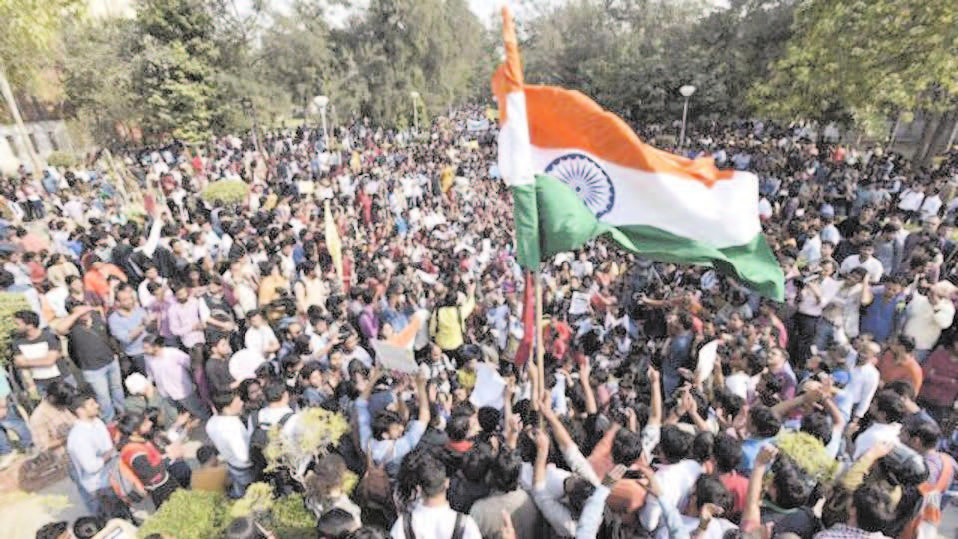
    Two events over the last few days, on opposite continents of the world, raise questions about the future of democracy in the US, the world’s most powerful, and India, the world’s most populous. On February 22, Srinivas Kunchibhotla was gunned down in Kansas, sharing a drink with a friend after work, by a white US navy veteran, in patently a hate crime. In India, at Ramjas College, New Delhi, a fracas broke out when BJP-aligned students’ union, ABVP, disrupted a function organized by campus students not aligned to them and invitees from JNU. The passively observant police intervened, more to rough-up the organizers than restrain ABVP disruptors. The allegation is that anti-national slogans were in the air.

    The attention got diverted from the melee when a young student, Gurmehar Kaur posted on social media placards denouncing the ABVP high-handedness, arguing that like her father – martyred fighting militants in Kashmir when she was little – she was unafraid to confront intolerance. The battle lines got promptly drawn, with intemperate remarks or tweets by an actor, a cricketer, a Union minister of state, and so on. In Gurmehar’s defense rose up senior journalists, retired soldiers, television anchors, etc. By nightfall, BJP spokesmen began distancing themselves from Gurmehar’s tormentors as their standard dubbing of any critic as anti-national did not work against a martyr’s daughter. The elections in UP also made it unwise to offend serving and retired servicemen.

    The distraction aside, the issues in the US and India are not that apart. The rise of Modi and the continued Cabinet slots for those preaching sectarian hatred is not much different from President Trump listening to the whisperings of Rasputin-like Stephen Bannon, erstwhile publisher of Breitbart News -the mouthpiece of ‘alt-right’, who is White House chief strategist. Both leaders prefer political rallies and one-way communication with chosen media outlets than transparent and frank interaction with the media. If Modi has never contradicted ministerial colleagues tarring the media with the abusive phrase ‘presstitutes’, Trump does one better by directly and almost daily referring to ‘The Fake News’. At a Florida rally, he confidently advocated -uncaring that independent media strengthens democracy – that media ‘is not my enemy, it is the enemy of the American people’. A former President, George Bush, has been constrained to contradict Trump’s condemnation of the media, despite both being Republicans.

    Both the racist killing of an Indian techie in Kansas and the ABVP use of violence to drown alternative views spring from identical philosophies and narrow visions. In case of India, it brings up the freedom of speech, while in the US it raises the spectra of nativism fed by a mix of xenophobia and fear of Islam. It is thus supremely ironical that while the Indian Government sends Foreign Secretary S Jaishankar to intervene with the US on the rising danger to Indian diaspora from white vigilantism, when under their noses similar intolerance is being happily marketed daily from election platforms in UP.

    Illustratively, RL Stevenson related the story about George Meredith, author of the 19th century novel, The Egoist, written to purge Victorian England of this evil, that when a young friend of the writer complained that the protagonist ‘Willoughby is me’, the writer replied: ‘No, my dear fellow, he is all of us.’

    The issues arising need a closer analysis. At stake in India is the definition of freedom of speech. Having inherited the common law-based criminal justice system from the British, India clings to antiquated laws on sedition. In the US too, immediately after their independence they enacted a sedition Act, which was allowed to lapse in 1801 as the nation matured and gained self-confidence. Following the Bolshevik Revolution in Russia, the fear of Communism made the US pass the Federal Espionage Act in 1917. Thus, while the British Common Law treats freedom of speech as ‘residual freedom’, circumscribed by societal needs of morality and public order, the US Supreme Court started treating it as a ‘fundamental right’ flowing from the First Amendment from 1925. In 1969, it upheld the right of students to wear black bands to protest Vietnam War. Justice OW Holmes ruled that while a nation is at war, many things that can be said in time of peace are taboo, but the test has to be whether there is ‘clear and present danger’ of sedition, not merely the expression of an opinion or a thought. What a person, in the exercise of his freedom of expression, is doing must be more than public inconvenience or annoyance, or even unrest.

    India, with a concept of ‘Fundamental Rights’ borrowed from the US practice has to assess if what happened at JNU earlier, or now at Ramjas College, passes the Holmes test. The definition of nationalism cannot be crafted in Nagpur and implemented by an evangelical lynch mob. Is that not the same question that the US is today required to answer, whether ordinary whites carrying guns can ask any non-white to prove their immigration status, or why they are in the US at all. So, the diaspora that came to Madison Square Garden to chant ‘Bharat Mata ki Jai’, in response to Modi’s incantations, are being put to the kind of test of loyalty that misguided flag-carriers of the BJP, or fringe organizations of the Sangh Parivar, have been putting to their own countrymen. How does India ask Trump to be more considerate when President Obama reminded the Modi government before emplaning for the US in 2015, in his speech at Siri Fort, that Article 25 ensured freedom of conscience and it was the government’s responsibility to uphold it.

    While it is true that the Indian geo-political environment does compel the government to be ever-alert to forces endangering Indian territorial integrity or sovereignty, but surely campus students holding placards, or sloganeering do not compose such a threat. As Voltaire, some say wrongly quoted, said: ‘I disapprove of what you say, but I will defend to the death your right to say it.’ Perhaps like the US Supreme Court, India’s highest court needs to re-balance the fundamental rights and the State’s obligations, and in the process, re-educate the lawyer-ministers of the BJP.

    (The author, KC Singh, is a former Secretary, Ministry of External Affairs, Government of India)

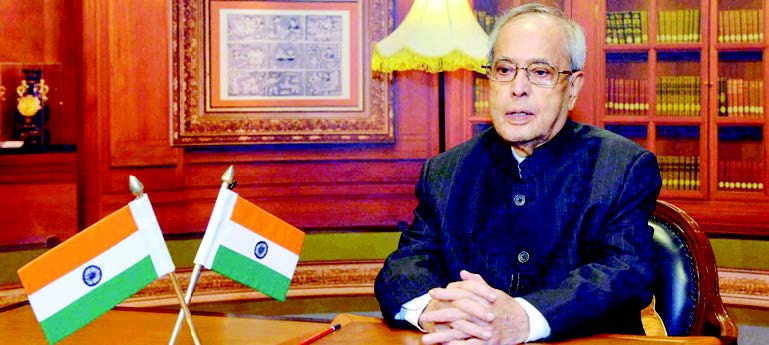
  • Engage in ‘reasoned discussion and debate’, not in violence, President Mukherjee advises students

    Engage in ‘reasoned discussion and debate’, not in violence, President Mukherjee advises students

    KOCHI (TIP): There is no room in this country for an intolerant Indian and students in India’s universities must engage in “reasoned discussion and debate” rather than “propagate a culture of unrest”, President Pranab Mukherjee said on March 2.

    “There should be no room in India for the intolerant Indian,” President Mukherjee said while delivering the 6th KS Rajamony Memorial Lecture on “India@70” today in Kerala’s Kochi district. “Those in universities must engage in reasoned discussion and debate rather than propagate a culture of unrest. It is tragic to see them caught in the vortex of violence and disquiet,” he said. Although Mukherjee did not mention the Ramjas College row, his comments came amid the Left and right-wing groups engaged in a bitter, and even violent, debate over whether free speech is unpatriotic.

    FREEDOM OF SPEECH GUARANTEED TO EVERY INDIAN:

    President Pranab Mukherjee asserted that freedom of speech and expression is guaranteed to every Indian by the Constitution. “There must be space for legitimate criticism and dissent,” he said.

    “India has been since ancient times a bastion of free thought, speech and expression. Our society has always been characterized by the open contestation of diverse schools of thought and debate or discussion. Freedom of speech and expression is one of the most important fundamental rights guaranteed by our Constitution,” he said.

    In an apparent reference to the hounding of Delhi University student Gurmehar Kaur for questioning the RSS-backed Akhil Bharatiya Vidyarthi Parishad (ABVP), Mukherjee said the acid test for any society is how it treats it women and children.

    “I do not consider a society or state to be civilized if its citizens’ behavior towards women is uncivilized. When we brutalize a woman, we wound the soul of our civilization. The acid test of any society is its attitude towards women and children,” he said.

    POLITICIANS MUST NOT TAKE PEOPLE FOR GRANTED:

    Addressing India’s politicians, Mukherjee said they should not take the people for granted. “The leaders or political activists must listen to people, engage with them, learn from them and respond to their needs and concerns. Our lawmakers must never take the people for granted. They must focus on the fundamental task of law making and raising of issues of concern to the people,” he said.

    Mukherjee, however, did not dismiss the virtues of patriotism. “The time has come for collective efforts to re-discover the sense of national purpose and patriotism. Sense of national purpose and patriotism alone can lift our nation on to the road of sustained progress and prosperity. The nation and the people must always come first,” he said.