Tag: Rashtriya Swayamsevak Sangh

  • A betrayal of the very idea of the Mahatma

    A betrayal of the very idea of the Mahatma

    The principles Gandhiji stood for represent an ideal that is being weakened every day by those in power who are pushing their agenda of bigotry

    “The contradiction is mirrored in the attitude of the Hindutva-inspired Bharatiya Janata Party (BJP) government of Prime Minister Narendra Modi. Mr. Modi was schooled, like other Rashtriya Swayamsevak Sangh (RSS) pracharaks, in an intense dislike of Mahatma Gandhi, whose message of tolerance and pluralism was emphatically rejected as minority appeasement by the Sangh Parivar, and whose credo of non-violence, or ahimsa, was seen as an admission of weakness unworthy of manly Hindus. Hindutva ideologue V.D. Savarkar, whom Mr. Modi has described as one of his heroes, had expressed contempt for Gandhiji’s ‘perverse doctrine of non-violence and truth’ and claimed it ‘was bound to destroy the power of the country’. But Prime Minister Modi, for all his Hindutva mindset, his admiration of Savarkar and his lifetime affiliation to the Sangh Parivar, has embraced Gandhiji, hailing the Mahatma and even using his glasses as a symbol of the Swachh Bharat campaign, linking it to a call to revive Gandhiji’s idea of seva through the recent ‘Swachhata Hi Seva’ campaign.”

    By Shashi Tharoor

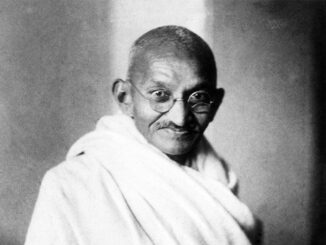
    This year marks the 75th anniversary of Mahatma Gandhi’s assassination (January 30, 1948) by a Hindu fanatic who thought the Mahatma was too soft on Muslims. The momentous anniversary comes at a time when his legacy, the very idea of Gandhi, stands challenged by the prevailing ideological currents. At a time when the standing of his historic detractors, whose descendants now form the ruling dispensation in the country, is at an all-time high, Gandhiji has been criticized for weakness, for having bent over too far to accommodate Muslim interests, and for his pacifism, which is seen by the jingoistic Hindutva movement as unmanly.

    The Mahatma was killed, with the name of Rama on his lips, for being too pro-Muslim; indeed, he had just come out of a fast he had conducted to coerce his own followers, the Ministers of the new Indian government, to transfer a larger share than they had intended of the assets of undivided India to the new state of Pakistan. Gandhiji had also announced his intention to spurn the country he had failed to keep united and to spend the rest of his years in Pakistan, a prospect that had made the government of Pakistan collectively choke.

    But that was the enigma of Gandhiji in a nutshell: idealistic, quirky, quixotic, and determined, a man who answered to the beat of no other drummer, but got everyone else to march to his tune. Someone once called him a cross between a saint and a Tammany Hall politician; like the best crossbreeds, he managed to distil all the qualities of both and yet transcend their contradictions.

    Explaining a contradiction now

    Hinduism and Hindutva, as I have argued in my book Why I Am a Hindu, represent two very distinct and contrasting ideas, with vitally different implications for nationalism and the role of the Hindu faith. The principles Gandhiji stood for and the way in which he asserted them are easier to admire than to follow. But they represented an ideal that is betrayed every day by those who distort Hinduism to promote a narrow, exclusionary bigotry.

    The contradiction is mirrored in the attitude of the Hindutva-inspired Bharatiya Janata Party (BJP) government of Prime Minister Narendra Modi. Mr. Modi was schooled, like other Rashtriya Swayamsevak Sangh (RSS) pracharaks, in an intense dislike of Mahatma Gandhi, whose message of tolerance and pluralism was emphatically rejected as minority appeasement by the Sangh Parivar, and whose credo of non-violence, or ahimsa, was seen as an admission of weakness unworthy of manly Hindus. Hindutva ideologue V.D. Savarkar, whom Mr. Modi has described as one of his heroes, had expressed contempt for Gandhiji’s ‘perverse doctrine of non-violence and truth’ and claimed it ‘was bound to destroy the power of the country’. But Prime Minister Modi, for all his Hindutva mindset, his admiration of Savarkar and his lifetime affiliation to the Sangh Parivar, has embraced Gandhiji, hailing the Mahatma and even using his glasses as a symbol of the Swachh Bharat campaign, linking it to a call to revive Gandhiji’s idea of seva through the recent ‘Swachhata Hi Seva’ campaign.

    This may, or may not, represent a sincere conversion to Gandhism. The Prime Minister is hardly unaware of the tremendous worldwide reputation that Mahatma Gandhi enjoys, and is too savvy a marketing genius not to recognize the soft-power opportunity evoking Gandhiji provides, not to mention the global public relations disaster that would ensue if he were to denounce an Indian so universally admired. There may, therefore, be an element of insincerity to his newfound love for the Mahatma, as well as a shrewd domestic political calculation.

    But the ambivalence speaks volumes: when many members of Mr. Modi’s BJP call for replacing Gandhiji’s statues across the country with those of his assassin, Nathuram Godse, the Prime Minister seeks to lay claim to the mantle of his fellow Gujarati for his own political benefit. At the same time, there is also a tangible dissonance between the official governmental embrace of Gandhiji and the unofficial ideological distaste for this icon, that is privately promoted by members and supporters of the present ruling dispensation, some of whose members have not hidden their view that his assassination was, in their eyes, a patriotic act.

    The vision of the Mahatma

    It is a well understood reality that the vision of Gandhiji, an openly practicing Hindu, differed greatly from that of Veer Savarkar and M.S. Golwalkar, the principal ideologues of the Hindu Mahasabha and its more militarized alter ego in the post-Independence era, the R SS and eventually, the BJP (formerly the Jana Sangh).

    Gandhiji embodied the central approach of Advait Vedanta, which preached an inclusive universal religion. Gandhiji saw Hinduism as a faith that respected and embraced all other faiths. He was profoundly influenced by the principles of ahimsa and satya and gave both a profound meaning when he applied them to the nationalist cause. He was a synthesizer of cultural belief systems: his signature bhajan of ‘Raghupati Raghava Raja Ram’ had another line, ‘Ishwara Allah Tero naam’. This practice emerged from his Vedantic belief in the oneness of all human beings, who share the same atman and, therefore, should be treated equally.

    Such behavior did not endear him to every Hindu. In his treatise on ‘Gandhi’s Hinduism and Savarkar’s Hindutva’, the social scientist Rudolf C. Heredia places his two protagonists within an ongoing debate between heterogeneity versus homogeneity in the Hindu faith, pointing out that while Gandhi’s response is inclusive and ethical, Savarkar politicizes Hinduism as a majoritarian creed.

    But Gandhiji’s own understanding of religion, in Heredia’s words, “transcended religiosity, Hindu as well as that of any other tradition. It is essentially a spiritual quest for moksha but one rooted in the reality of service to the last and least in the world”. Unlike Savarkar, who believed in conformity, Gandhiji was a synthesizer like no other who took care to include Indians of other faiths in his capacious and agglomerative understanding of religion. He took inspiration from not just Advaita Vedanta but also the Jain concept of ‘Anekantavada’ — the notion that truth and reality are perceived differently by different people from their own different points of view, and that, therefore, no single perception can constitute the complete truth. This led him to once declare that ‘I am a Hindu, a Muslim, a Christian, a Parsi, a Jew’.

    Hinduism and Hindutva, as I have argued in my book Why I Am a Hindu, represent two very distinct and contrasting ideas, with vitally different implications for nationalism and the role of the Hindu faith. The principles Gandhiji stood for and the way in which he asserted them are easier to admire than to follow. But they represented an ideal that is betrayed every day by those who distort Hinduism to promote a narrow, exclusionary bigotry.

    (The author is a  former senior UN official and a senior Congress leader)

  • AAP needs to restore democratic credentials

    AAP needs to restore democratic credentials

    “Experienced in public affairs, Kejriwal should know that as long as the party concentrates only on him it will never be able to spread its wings to the rest of the country. Democracy imposes responsibilities on political parties in many ways, but, above all, a party cannot be democratic unless it practices inner-party democracy. The results in Himachal Pradesh and Gujarat show up the limits of a one-man party. A party needs cadres. It also needs ideology so that its members know what they stand for and what they stand against. Before we vote for a political party, we must know what its worldview is. A democratic party has to be committed to human emancipation from domination and oppression.”

    Apart from service delivery, the AAP’s initiatives such as report cards and polls on who the CM should be, carry appeal. Untrammeled by any kind of ideology, the leadership adjusts its rhetoric according to the mood of the country — from publicly reciting Hanuman Chalisa to demonstrating patriotism through flags. The party should tell us unequivocally what it stands for or against.

    By Neera Chandhoke

    In the 1970s and 1980s, the reinvention of civil society in eastern Europe re-catalyzed a powerful debate on what was called the ‘crisis of representation’. Citizens turned their back on Stalinist states and began to connect with each other in civil society through organizations ranging from discussion groups to soup kitchens. The future belonged to citizen groups and social movements linked through coalitional politics and ideologies.

    In India, the crisis of representation took hold of the political imagination after the Emergency and escalated in the years that followed. Indians looked for an alternative to a moribund party system. Over time, political disenchantment led to the consolidation of two sorts of political formations. In the 1980s, the Hindutva movement extended the ideological commitment of its parent organization — the Rashtriya Swayamsevak Sangh — into every arena of collective life.

    In 2012, a new party was created out of the 2011 ‘India Against Corruption’ movement which took the country by storm. Interestingly, the campaign against corruption had a place for everyone — from the religious right to the left. Ideology was done away with.

    After spectacularly winning the Delhi elections in 2015 and 2020, Arvind Kejriwal set his sights on transforming the Aam Aadmi Party (AAP) into a national party. In the recent elections in Gujarat, the AAP secured 12 per cent of the votes — after having got the required vote share in the Assembly elections in Delhi, Punjab and Goa. It has become a national party in 10 years. This is remarkable considering that experienced regional leaders from Lalu Prasad Yadav to Chandrashekar Rao have not been able to secure this status for their parties.

    Apart from service delivery, the AAP’s initiatives such as report cards and polls on who the CM should be, carry appeal. Untrammeled by any kind of ideology, the leadership adjusts its rhetoric according to the mood of the country — from publicly reciting Hanuman Chalisa to demonstrating patriotism through flags.

    We are caught between a highly ideological party and a party that disdains ideology. The cadres of the BJP intend to rework every institution/practice in the country, from marriage to schools, to universities, to renaming and restructuring of spaces, to rewriting of history, and to refashioning of the nationalist imagination. The AAP prefers to concentrate on pragmatic solutions to issues such as education and healthcare, reduction of power bills and promotion of mohalla clinics. Has the AAP failed to transcend its original avatar as a civil society organization? Perhaps. Consider the implications of concentrating on issues that are civic, rather than wholly political, such as democracy. Citizens have the right to well-being for which quality education, healthcare, employment, housing and income are essential components. More significantly, citizens have the right to civil liberties, the right to not be imprisoned without due cause, the right to freedom of thought and expression, the right to protest, and the right to not be harmed.

    Whether it was the anti-CAA agitation in December 2019-January 2020, the assault on Jamia Millia Islamia and JNU faculty members and students in January 2020, communal violence in north-east Delhi in February 2020, protests at Shaheen Bagh or the indiscriminate arrests of journalists, academics, civil society activists and students, the AAP has preferred to sit on the fence. Presumably, the AAP does not support violation of rights, but acts of omission are as complicit with infringements of basic rights as acts of commission. As long as the AAP shies away from taking a stand on basic democratic rights, the party will remain a service provider which also fights elections.

    Experienced in public affairs, Kejriwal should know that as long as the party concentrates only on him it will never be able to spread its wings to the rest of the country. Democracy imposes responsibilities on political parties in many ways, but, above all, a party cannot be democratic unless it practices inner-party democracy. The results in Himachal Pradesh and Gujarat show up the limits of a one-man party. A party needs cadres. It also needs ideology so that its members know what they stand for and what they stand against. Before we vote for a political party, we must know what its worldview is. A democratic party has to be committed to human emancipation from domination and oppression.

    To argue that a political platform of a party intends to fix political predicaments through improving schools and hospitals — noble as these objectives might be — is to decontextualize the whole issue of what citizens want. We need healthcare and education, but we also need rights. Rights come in packages; they are indivisible. We also need freedom of thought, action and expression.

    The AAP is a party many of us have invested in, but it must not stop at limiting its notions of a good life to schools and clinics. These are components of a good life, but ultimately it is rights that defend the dignity of human beings. It is rights that mark out the agenda of a party from cynical power-grabbing platforms. The AAP should tell us unequivocally what it stands for or against. It should not be reduced to a service provider. The party should restore its democratic credentials to avoid this fate.

    (The author is a political scientist)