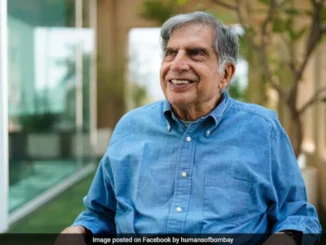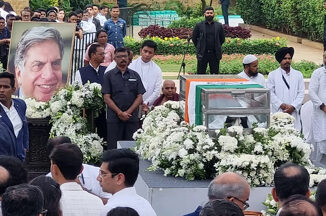
MUMBAI (TIP): The funeral of Ratan Tata, the former chairman of Tata Group, took place in Mumbai, marking the end of an era for one of India’s most influential business leaders. Thousands gathered at the National Centre for Performing Arts to pay their final respects. Union Ministers Amit Shah, and Piyush Goyal; Maharashtra Chief Minister Eknath Shinde and his deputies Devendra Fadnavis and Ajit Pawar; Opposition leaders Sharad Pawar, Supriya Sule, Uddhav Thackeray, and Raj Thackeray; industrialists Mukesh Ambani, Kumaramangalam Birla, and Harsh Goenka; Tata Group chairperson N. Chandrasekaran, and Reserve Bank of India Governor Shaktikanta Das were among those who paid tributes at the Worli crematorium and the National Centre for Performing Arts where his body was kept earlier in the day.
Maharashtra state declared a day of mourning, with a military salute accompanying the procession of his coffin to the cremation site. Ratan Tata, who passed away at the age of 86, is remembered for his philanthropic work in health, education, and animal welfare, as well as for transforming the Tata Group into a global powerhouse during his tenure as chairman from 1991 to 2012. Under Tata’s leadership, the conglomerate expanded its reach with high-profile acquisitions such as Jaguar Land Rover, Tetley Tea, and Corus Steel, positioning the company as a major player in industries from automotive to steel and telecommunications. While some ventures, like the Tata Nano car, faced challenges, Tata’s visionary leadership secured the company’s prominence on the world stage.
Born into a traditional Parsi family in 1937, Tata studied in the United States and joined the family business in 1962. He was mentored by JRD Tata, who saw in him the potential to lead the conglomerate. Tata’s contributions to Indian business were recognized with the prestigious Padma Vibhushan in 2008. Tributes poured in following his death, with Indian Prime Minister Narendra Modi describing him as “a visionary business leader, a compassionate soul, and an extraordinary human being.” Tata’s legacy will live on, not only through the vast business empire he shaped but also through his lasting impact on India’s social and economic fabric.
Ratan Naval Tata, one of India’s most cherished industrialists and philanthropists, passed away on October 9 at the age of 86, leaving behind a legacy that will be remembered for generations. Ratan Tata was not only a visionary leader who shaped modern India’s industrial landscape, but he was also a man with a golden heart, known for his deep-rooted values of integrity, humility, and compassion. As India mourns his loss, the world reflects on the profound impact of a life dedicated not just to business but to humanity at large.
Ratan Tata came from the illustrious Tata family, a lineage synonymous with the development of India’s industrial sector. His great-grandfather, Jamshedji Tata, laid the foundation of Tata Sons in 1868, and his granduncle, J.R.D. Tata, was instrumental in steering the group to new heights. The Tata family has always been a beacon of progress for India, pioneering several key industries, and Ratan Tata was a worthy torchbearer of this legacy.
The Tata story began in the late 19th century when Jamshedji Tata, with a vision of an industrialized and self-reliant India, established the first steel plant in Jamshedpur, then a remote area of Bengal (now Jharkhand). The Tata Steel plant, set up in 1907, was not just a milestone in India’s industrial history but a symbol of the country’s emergence on the global industrial map. The town of Jamshedpur, named after Jamshedji Tata, became a thriving industrial hub, a testament to the foresight of the Tata family. This commitment to nation-building continued through the generations, with each leader of the Tata Group contributing to India’s growth and modernization.
One of the significant milestones in India’s industrial history was the Tata family’s entry into the automobile sector. The Tata Motors division was set up with a vision to create vehicles made in India, for India. Under Ratan Tata’s leadership, this vision was realized with the launch of the Tata Indica, India’s first indigenously developed car, and the Tata Nano, the world’s most affordable car. His dream was to make car ownership accessible to millions of Indian families, and in doing so, Ratan Tata laid the groundwork for India to become a global hub for automobile manufacturing. Tata Motors grew to become not just a domestic leader but also a global player, acquiring prestigious brands like Jaguar Land Rover under Ratan Tata’s stewardship.
In the same pioneering spirit that drove the Tata family to set up India’s first steel plant, J.R.D. Tata ventured into the skies with the establishment of Air India, India’s first commercial airline. Founded in 1932 as Tata Airlines, it was J.R.D. Tata’s passion for aviation that led to the airline’s inception. Air India became the face of Indian civil aviation and a symbol of national pride. Though the Tata Group had to relinquish control of Air India after nationalization in the 1950s, Ratan Tata continued to hold a deep connection to the airline. His heart must have swelled with pride when, in 2021, Tata Sons successfully reacquired Air India, bringing the airline back into the Tata fold, a fitting tribute to the family’s enduring legacy in aviation.
But Ratan Tata was more than just an industrial titan. His leadership was characterized by a deep commitment to ethics, social responsibility, and philanthropy. A true heir to the Tata family’s philanthropic ethos, Ratan Tata was as passionate about giving back to society as he was about business success. Through the various charitable arms of the Tata Group, including the Tata Trusts, he worked tirelessly to uplift underprivileged communities, support education and healthcare initiatives, and fund scientific research. His focus on corporate social responsibility set new standards in the Indian business community, reminding the world that businesses are not just profit-driven entities but also instruments of social change.
One of the most defining moments in Ratan Tata’s career came in 2008 when India faced one of its darkest hours. On November 26, 2008, the iconic Taj Mahal Palace Hotel in Mumbai, owned by the Tata Group, was one of the prime targets of a series of devastating terrorist attacks. The image of the burning hotel became symbolic of the attack on Mumbai’s soul. Ratan Tata’s response to the crisis earned him widespread admiration. His first priority was not the losses incurred by the company but the well-being of his employees and the guests who had suffered during the attack. He personally reached out to each of the victims’ families and provided financial and emotional support to help them recover. Under his guidance, the Taj Hotel was restored to its former glory, standing as a symbol of resilience and hope in the face of adversity.
Even as he steered the Tata Group to unprecedented heights, Ratan Tata was always known for his humility. He was a man who led by example, never seeking the limelight but always ready to step up when the occasion demanded. Despite the many accolades he received over the years, including India’s highest civilian honors, the Padma Bhushan and the Padma Vibhushan, he remained grounded, always emphasizing that his achievements were the result of the collective efforts of the Tata family and the Tata Group.
One of the many remarkable aspects of Ratan Tata’s personality was his empathy and kindness. Known for his soft-spoken demeanor and unassuming nature, he always put people before profits. Whether it was standing by his employees during crises or funding critical healthcare projects, his focus was on improving the quality of life for those around him. He was also a staunch advocate for innovation and entrepreneurship, often personally mentoring young entrepreneurs and investing in startups. His vision for India was one where technology and innovation would drive progress, but not at the cost of human welfare.
Ratan Tata’s passing is a monumental loss, not just for the Tata Group or the Indian industrial sector, but for the entire nation. His departure marks the end of an era in Indian business—a time when industrialists were seen not just as captains of industry but as builders of the nation. The Tata Group under Ratan Tata’s leadership became a symbol of India’s industrial strength and global competitiveness. From steel to automobiles, from airlines to hospitality, his influence spanned across sectors, and his vision laid the foundation for India’s future as a global economic powerhouse.
However, it is perhaps his heart of gold that will be remembered the most. His quiet acts of charity, his deep empathy for those in need, and his unwavering commitment to ethical business practices set him apart in a world often dominated by cutthroat competition and corporate greed. Ratan Tata’s life was a testament to the idea that success is not measured by the wealth one accumulates but by the impact one has on others. His legacy will continue to inspire generations of leaders who will look up to him not just for his business acumen but for his kindness, compassion, and humility. As we bid farewell to this titan of industry, we also celebrate a life well-lived. Ratan Tata’s contributions to India are immeasurable, and his memory will forever be etched in the hearts of millions. His leadership, his vision, and his commitment to the greater good will continue to inspire and guide India’s journey toward a brighter future.
Rest in peace, Ratan Naval Tata. You will always be remembered as one of India’s finest gems—a man of steel, with a heart of gold.
India and the United States have agreed to work constructively to resolve key outstanding bilateral trade issues and to take a comprehensive look at ways to expand the trade relationship, the Biden administration has said.
United States Trade Representative Katherine Tai discussed the important trade and investment relationship between the two countries during her maiden phone call with her Indian counterpart Commerce and Industry Minister Piyush Goyal. “They committed to strengthening cooperation on shared objectives and to revitalise engagement through the US-India Trade Policy Forum. They also agreed to work constructively to resolve key outstanding bilateral trade issues and to take a comprehensive look at ways to expand the trade relationship,” the United States Trade Representative (USTR) said in a readout of the call on Thursday.
Tai, who was confirmed by the Senate only a few days ago, stressed the critical importance of cooperation on a broad set of issues, including digital trade, intellectual property, agriculture, labor, and climate and environment.
Tai and Goyal agreed to hold the next ministerial-level meeting of the Trade Policy Forum during 2021, the USTR said. Supreme Court upholds Tata Sons’ appeal in Mistry case
The Supreme Court on Friday set aside a 2019 order of the National Company Law Appellate Tribunal (NCLAT) which reinstated Cyrus Mistry as the executive chairman of the over $100 billion Tata Sons. It allowed Tata Sons’ appeal, holding that well-settled principles had been overturned by the NCLAT when it decided the dispute in the previous round.
“All the appeals filed by Tata Sons against Cyrus Mistry are allowed,” the bench headed by Chief Justice of India (CJI) SA Bobde added.
Mistry had succeeded Ratan Tata as chairman of Tata Sons in 2012 but was ousted four years later in a board meeti.
About the issues relating to valuation of shares and the Shapoorji Pallonji (SP) Group pledging its shares in Tata Sons to raise funds, the top court maintained that both parties were at liberty to raise these before appropriate forum and that the court would not pass any order.
Signup to our Newsletter!
Don’t miss out on all the happenings around the world