Tag: Republic of India

  • Ambassador Mohapatra Strengthens India–Romania Partnerships Through Engagements in Cluj-Napoca Across Industry, Academia, and Community

    Ambassador Mohapatra Strengthens India–Romania Partnerships Through Engagements in Cluj-Napoca Across Industry, Academia, and Community

    BUCHAREST (TIP): Dr. Manoj Kumar Mohapatra, Ambassador of the Republic of India to Romania, embarked on a dynamic series of engagements in Cluj-Napoca, Romania’s vibrant innovation hub, to further solidify bilateral cooperation. These interactions spanned industry, higher education, cultural exchange, and community building, reflecting India’s strategic vision for multifaceted partnerships with Romania amid shared goals of economic resilience, technological advancement, and people-to-people connectivity.

    Ambassador joins Indo-Romanian Forum at Babeș-Bolyai University.

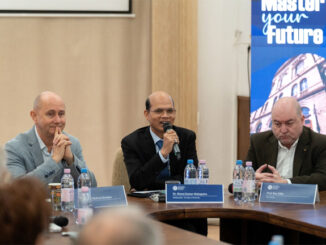
    A highlight was Ambassador Mohapatra’s participation in the Indo-Romanian Forum “Bridging Minds, Markets, and Innovation,” organized by Babeș-Bolyai University (UBB) via UBB Tech Transfer and the Indian Cultural Centre. The forum convened Indian business leaders thriving in Cluj-Napoca-spanning IT, pharma, and startups-with academics from diverse faculties. Participants brainstormed synergies in AI, innovation commercialization, and industry and university collaboration. paving the way for Romanian universities to partner with the industries for internships, job recruitment, and joint research etc, while catalyzing business-academia ecosystems.

    Ambassador visits Emerson Romania for supply chain discussions.

    Reinforcing academic bridges, the Ambassador visited the prestigious Technical University of Cluj-Napoca (UTCN), engaging with Rector Prof. Dr. Vasile Țopa and senior officials overseeing international affairs. Dialogues delved into expanding collaborative research, faculty exchanges, and dual-degree programs, with a focus on student mobility.

    Ambassador meets Brahma Kumaris representatives in Cluj-Napoca.

    Emphasis was placed on drawing Indian talent to UTCN’s acclaimed engineering and IT curricula, potentially through scholarships and joint workshops. This builds on existing ties, positioning Romania as a gateway for Indian students to Europe’s technical ecosystem.

    Ambassador meets UTCN leadership on academic cooperation.

    Ambassador Mohapatra toured Emerson’s state-of-the-art facilities in Romania, a key player in automation and engineering solutions. In productive discussions with company executives, he explored avenues for global supply chain integration, joint industrial ventures, and leveraging Romania’s skilled workforce alongside India’s manufacturing prowess. The facility tour illuminated cutting-edge production lines, underscoring operational excellence and the pivotal role of advanced engineering in fostering resilient, cross-border supply chains. Such collaborations hold immense potential for sectors like renewable energy and digital infrastructure, aligning with India’s “Make in India” initiative and Romania’s industrial ambitions.

    Ambassador celebrates India’s 77th Republic Day in Cluj with Mayor Emil Boc and Prefect Maria Forna.

    On the cultural front, the Ambassador met with Brahma Kumaris representatives, joined by Ms. Teodora Suhan and Ms. Ioana Goga. Conversations emphasized spiritual dialogue, ethical leadership, and grassroots initiatives to nurture values-based understanding, fortifying the human foundation of India–Romania relations. Culminating the visit, Ambassador Mohapatra celebrated India’s 77th Republic Day with the local Indian community, graced by Mayor Mr. Emil Boc and Prefect Ms. Maria Forna. Joyful performances of classical dance, music, and patriotic tributes celebrated India’s democratic ethos, strengthening diaspora integration and societal bonds.

    Ambassador celebrates India’s 77th Republic Day in Cluj with Indian community.

    These initiatives exemplify the accelerating trajectory of India–Romania relations, anchored in democratic solidarity, burgeoning trade (nearing €1 billion annually), academic excellence, and cultural vibrancy. They signal India’s resolve to forge sustainable frameworks that propel mutual prosperity, innovation, and a shared role in global affairs.

    (Based on a press release issued by the Embassy of India in Bucharest)

  • Making of the Republic of India

    Making of the Republic of India

    R-day special

    India celebrates Republic Day annually on 26 January, and this year the country will celebrate its 74th Republic Day to mark the day India became a sovereign republic. While India gained independence from the British in 1947, but it wasn’t until 26 January 1950 that the Indian Constitution came into effect and India became a sovereign state, declaring it a republic. This day is celebrated with much pomp and fervour all over India, and in India’s capital Delhi, parades, tableaus and spectacular displays by the defense forces are showcased at Rajpath. The Indian flag is also hoisted all over the country.

    The Indian Constitution was drafted by Dr BR Ambedkar who is known as the Architect of the Indian Constitution. 26 January was chosen as the day to announce India becoming a republic as in 1929 on the same day the Indian National Congress denounced colonial rule and proclaimed Purna Swaraj, “complete freedom from the British”. And while the Constitution came into force in 1950 under a democratic government system, it was adopted by the Indian Constituent Assembly on 26 November 1949. This completed the country’s transition into becoming a sovereign republic.

    India celebrates Republic Day to commemorate the day the Government of India Act (1935) set by the British Raj was replaced by the Indian Constitution as the governing document of India. Other than flag hoisting, reciting the national anthem and organising shows and events on this day, the defense forces including the Indian Army, Navy, Air Force, police and paramilitary forces showcase their skills and display India’s defence prowess at the parade on Rajpath which is broadcast on television . Other than performing stunts, air shows, stunts on motorbikes, tanks and other weapons systems are also showcased. Alongside these are the beautifully decorated tableaus that reflect the uniqueness and beauty of the various states of India.

    India became independent from the British Rule on 15th August, 1947. However, the country did not have its own constitution and wholly depended on the modified colonial Government of India Act, 1935. Also, India was headed by King George VI, until the adoption of the Indian Constitution in 1950. Prior to this, the seeds of a republican nation were sowed by Pt. Jawaharlal Nehru in the Lahore session at the Indian National Congress at the midnight of 31st December, 1929 – 1st January, 1930.

    The tricolor flag was unfurled by the nationalists present who took a pledge to celebrate “Purna Swaraj” (complete Independence) Day every year on 26th January, while continuing to fight for the establishment of a Sovereign Democratic Republic of India. The independence was achieved in 1947 while the professed pledge was redeemed on 26th January, 1950.

    The Indian Constituent Assembly was called together on 9th December, 1946, where a committee was formed. Dr. B.R. Ambedkar became the chairman of the committee, who along with the other members drafted the Constitution. The Indian Constitution included 395 Articles and 8 Schedules. The Constitution was adopted by the Constituent Assembly on 26th November, 1949. In the following year on 26th January, 1950, the Constitution of India came into force and became a sovereign democratic republic of India, 894 days after the withdrawal of British Rule in 1947, which is why, it is said that India achieved its true independence on this day. Next, elections were held and Dr. Rajendra Prasad was elected as the first President of free India. He took the oath at the Durban Hall in the Government House, which was followed by the Presidential drive along the five-mile route to the Irwin Stadium. He unfurled the National Flag at the stadium. This transition of India into a sovereign democratic republic nation is indeed a historical event. The two-decade long journey, right from the conceptualization of the dream in 1930 to its actual realization in 1950, is certainly worth a grand celebration. Today, the Indian Constitution is the longest in the world, consisting of 397 articles and 12 schedules, providing a single citizenship for the whole nation. The national holiday is celebrated with festivities and patriotic fervor across the whole nation.

    Republic Day Parade

    The grandeur of the Republic Day of India is visible in the grand parade that is held along Rajpath, beginning from Raisina Hill near the Rashtrapati Bhavan (President’s Palace) and moving on to Rajpath past India Gate and proceeding to the Red Fort.

    The occasion witnesses the presence of the President, the Prime Minister and several other high-ranking officials of the country. The parade starts with the arrival of the President of India, who is escorted by a group of bodyguards on horses. Next, the Prime Minister of India offers wreaths at the Amar Jawan Jyoti at the India Gate in memory of the martyrs of the Indian army. The national flag is unfurled by the President of India, who is also the Commander-in-Chief of the Indian Armed Forces. This is succeeded by the cheerful tune of the National Anthem and a 21-gun salute. Led by three different divisions of the armed forces viz: Navy, Army and Air Force; the Republic Day Parade has all of them displaying their might along the Rajpath, saluting the President. The Armed Forces staff performs motorcycle rides whereas the staff of the Indian Air Force performs flying parade in fighter planes. The rich and colorful culture of India is showcased in the parade of the Republic Day. Traditional as well as cultural performances are given by professionals belonging to different regions. School children in picturesque costumes also participate in the display of different aspects of the glorious history of the country on this big day.

    The real heroes of the nation are honored with the bravery awards and medals. National Awards are given to children for selfless sacrifice and bravery.

    A row of IAF jets marks the end of the grand celebration, leaving behind a trail of colored smoke. It bids goodbye to the gathered audience by lavishing rose petals on them.

    Beating the Retreat Ceremony

    The Republic Day celebration ends officially with the Beating the Retreat ceremony, which is held on the 29 January every year. The event symbolizes retreat after a day on the battlefield and features remarkable performances by the Indian Air Force, the India Navy, and the Indian Army. Held at the Raisina Hill, New Delhi, Beating the Retreat Ceremony has its tickets available at the same outlets as the Republic Day Parade.

    Why is Republic Day of India

    celebrated on 26 January?

    The Constitution of India, which was adopted by the Constituent Assembly on November 26, 1949, came into effect on January 26, 1950. This completed India’s movement towards becoming an independent republic with a democratic government system. January 26 was also selected as the day to mark Republic Day because it had been on this day that the Indian National Congress (INC) proclaimed the Declaration of Indian Independence in 1929. This was opposite to the ‘dominion’ status offered by the British.

    The independence came through the Indian Independence Act 1947, an Act of the Parliament of the United Kingdom that partitioned British India into the two new independent Dominions of the British Commonwealth, India obtained its independence on 15 August 1947 as a constitutional monarchy as head of state and Earl Mountbatten as governor-general. The country, though, did not yet have a permanent constitution; instead, its laws were based on the modified colonial Government of India Act 1935.

    On 29 August 1947, a resolution was moved for the appointment of Drafting Committee, which was appointed to draft a permanent constitution, with Dr B R Ambedkar as chairman. While India’s Independence Day celebrates its freedom from British Rule, the Republic Day celebrates the coming into force of its constitution. A draft constitution was prepared by the committee and submitted to the Constituent Assembly on 4 November 1947. The Assembly met, in sessions open to the public, for 166 days, spread over a period of two years, 11 months and 18 days before adopting the Constitution. After many contemplations and some moderation, the 308 members of the Assembly signed two hand-written copies of the document (one each in Hindi and English) on 24 January 1950. Two days later which was on 26 January 1950, it came into effect throughout the whole nation. On that day, Dr Rajendra Prasad’s became the first president of India. The Constituent Assembly became the Parliament of India under the transitional provisions of the new law.

    Who will be the chief guest at the Republic Day 2023 event?

    This year, Egypt’s President Abdel Fattah al-Sisi will be the chief guest at the Republic Day celebrations in January.

    Flag hoisting time on Republic Day 2023

    The Republic Day Parade 2023 live telecast is scheduled to start from Kartavya Path (Rajpath) at 9:30 AM sharp, as usual with Prime Minister Narendra Modi visiting the Amar Jawan Jyoti. Later, President Droupadi Murmu will unfurl the national flag.

    At what time does the Republic Day parade start?

    The Republic Day parade will start at the scheduled time of 10 am.

    Republic Day Parade starts from which place?

    Republic Day celebrations in India are nearly synonymous with the grand parade that marches down New Delhi’s Rajpath on January 26. The parade marches from the Rashtrapati Bhawan along the Rajpath, to India Gate and from there to Red Fort. Its route is more than five kilometres long and opens with the unfurling of the national flag by the president of India.

    What is the theme of Republic Day 2023?

    According to official source, The government has proposed three specific themes for 2023 Republic Day Parade tableaux — India@75, International Year of Millets and Nari Shakti.

    Sources said that in a letter from the Ministry of Defence, various state governments, central ministries and departments have been invited to participate in the Republic Day Parade on January 26 by creating a tableaux choosing any of these three themes or a combination of the three.

    The government which is celebrating 75 years of India’s independence has proposed that India@75 tableaux include India’s freedom struggle, its achievements, actions and resolves over the past seven decades.

    The theme to mark a day of millets has its roots in 2021 when India had proposed to the United Nations to declare 2023 as the International Year of Millets (IYOM). The proposal of India received support from 72 countries and the United Nations General Assembly (UNGA) declared 2023 as International Year of Millets.

    Who hoisted the national flag on the first Republic Day?

    On January 26, 1950, India declared itself a Sovereign, Democratic and Republic state with the adoption of the Constitution. The 21 guns salute and unfurling of the Indian national flag by the first President of India Dr Rajendra Prasad saw the historic birth of the Indian Republic.

    Who takes the national salute on R-Day?

    The President of India who is the Commander-in-Chief of the Indian Armed Forces, takes the salute. Different contingents of various para-military forces of India and other civil forces take part on the Republic Day parade.

    When does the R-Day celebration end?

    The Beating Retreat ceremony is held after officially denoting the end of Republic Day festivities. It is conducted on the evening of 29 January, the third day after Republic Day. It is performed by the bands of the three wings of the military, the Indian Army, Indian Navy and Indian Air Force. The venue is Raisina Hill and an adjacent square, Vijay Chowk, flanked by the North and South block of the Rashtrapati Bhavan (President’s Palace) towards the end of Rajpath

    Who was the chief guest at the first Republic Day event?

    Indonesian President Sukarno was the first chief guest at the very first Republic Day parade of India.

    What is the difference between hoisting the flag on Independence Day and R-Day?

    Every year, on Independence Day and Republic Day people, people celebrate it with the spirit of patriotism by participating in the different event by decorating schools, offices and public places in tricolours.

    However, there is a huge difference between hoisting the flag on Independence day and unfurling it on Republic Day. On Independence Day, the national flag is tied at the bottom and then pulled up. The prime minister then hoists the tricolor. The day is to mark the historic event of the Independence of the country from British Rule. However, on Republic Day, the flag is tied up on the top and is unfurled without pulling it up. This depicts that the country is already independent.The Constitution was adopted by the Indian Constituent Assembly on November 26, 1949, and came into effect on 26 January 1950 with a democratic government system, completing the country’s transition towards becoming an independent republic.

    And one of the major differences is that the prime minister of India hoists the tricolour on Independence Day as the head of the Indian government because at the time of Independence, the Constitution of India did not come into force and the president who is the constitutional head did not take office. But on Republic Day, the president who is the first citizen of the country attends the event and unfurls the flag.

    When was the Indian national flag adopted?

    The design of the Indian national flag was adopted by the Constituent Assembly of India on July 22, 1947.

    Who designed the Indian national flag?

    Pingali Venkayya designed the flag of India and presented it to Mahatma Gandhi in 1921 during the session of the All India Congress Committee in Vijaywada. The flag, at that time, was made of green and saffron colours, representing the Muslim and Hindu communities of India.

  • People involved in drafting of the Constitution of India

    People involved in drafting of the Constitution of India

    R-day special

    The constitution of India is the supreme law of India. The document lays down the framework determining the fundamental political code, structure, procedure, powers and duties of the governments institutions. It also states the fundamental rights, principals and the duties of the citizens. In fact, it is the longest constitution in the world.

    Who all were involved in the drafting committee of the Constitution of India?

    It had seven main members:

    Alladi Krishnaswami Ayyar

    Dewan Bahadur Sir Alladi Krishnaswani Lyer was one of the main members of the drafting committee of the Constitution of India – an important member of the Constituent Assembly of India. Ayyar also served as an Advocate General of Madras State from 1929 to 1944.

    Alladi Krishnaswami lyer was born in 1883 in the small village of Pudur in Madras State (now the Nellore district of Andhra Pradesh). He was born to Ekamra Sastry, who was a priest. He passed his matriculation examination in 1899 and entered the Madras Christian College to study History. Ayyar used his spare time to attend classes in law and passed the B.L exam and become one of the leading members of the bar. He was renowned as Dewan Bahadur in 1930.

    He played a major role in drafting the Constitution of India. The main architect of Indian constitution Dr. B. R Ambedkar, who also chaired the constitution’s drafting committee said about Ayyar’s contribution,“There were in the drafting committee men bigger, better  and more competent as my friend Sir Alladi Krishnaswami Iyer.”

    N. Gopalaswami Ayyanger:

    Dewan Bahadur Sir Narasimba Ayyangar Gopalaswami Ayyangar, a proficient Member of the Drafting Committee of the Constitution. He was chosen to be the leader of the Rajya Sabha and a cabinet minister in the Government of India. He was selected as the first minister without a portfolio but he was intensely looking after Kashmir Affairs, and later was appointed the Railway Minister.

    In his Kashmir Affairs role, he represented India at the United Nation Security Council and later drafted Article 370 of the Indian constitution that granted autonomy to Jammu and Kashmir.

    Gopalaswami was born on March 31, 1882 in Tanjore District Madras. He studied at Wesley School, and then Presidency and Law College in Madras. He was also an Assistant Professor in Pachaiyappa’s college in 1904.

    Dr. B.R. Ambedkar

    Dr. Bhimrao Ramji Ambedkar also known as Babasaheb Ambedkar was a Indian jurist, economist, politician and social reformer who inspired the Dalit-Buddist movement. He also campaigned against social discrimination towards the untouchables. Babasaheb was Independent India’s first Law and Justice Minister. He was the major architect of the Constitution of India.

    Ambekar was a brilliant student – he had a doctorate in Economics from both Columbia University and the London School of Economics, and gained a reputation as a scholar for his research in Law, Economics and Political Science. Ambedkar was involved in a lot of campaigning and negotiations done for the Independence of the country, publishing journals and advocating political rights and social freedom for Dalits, and contributing significantly to the establishment of the state of India.

    In 1990, he received the Bharat Ratna – India’s highest civilian award.

    K. M Munshi

    Kanhaiyalal Maneklal Munshi also known as K.M Munshi, or by his pen name, Ghanshyam Vyas, was an brilliant Indian independence movement activist, politician, writer and educationist from Gujarat. He was a lawyer by profession, he later became an author and politician. He was a well-known name in Gujarati literature. He founded Bharatiya Vidya Bhavan an educational trust in 1938. Before the independence of India he was a part of Indian National Congress and after independence, he joined the Swatantra Party and Bharatiya Jana Sangh.

    Munshi held different posts – he was the member of Constituent Assembly of India, Minister of Agriculture and Food of India, and he was also the Governor of Uttar Pradesh.

    Mohammad Saadulla

    Sir Syed Muhammad Saadulla, was the Prime Minister of Assam (British India). He was also a Chairman of Gauhati Municipality in 1919 and minister in charge of education and agriculture for Assam from 1924 to 1934.

    He got his education from the Cotton College, Guwahati and Presidency College, Calcutta. He was born on 21 May 1885 in Gawahati to an orthodox Assamese Muslim family.

    The Assam Legislative Assembly elected Syed Muhammad Saadulla to the Constituent Assembly of India in 1947 and later he was elected in the drafting committee as well. He was also an integral part in preparing the Constitution of the Republic of India. Saadulla was the only member from the North East to be elected into the Drafting Committee.

    B. L. Mitter:

    B. L. Mitter worked with the Dewan of Baroda. Mitter is said to have made significant contributions to integration of the Princely States with India. He was later replaced by Madhav Rao on the drafting committee, who was the legal advisor to the Maharaja of Vadodara.

    D. P. Khaitan

    D. P, Khaitan, also known as Debi Prasad Khaitan, was the owner of Khaitan & co – one of the oldest working law firms in India. It had 530 fee earners and consultants including 115 partners and directors. Debi found this company in 1911 with the assistance of his brothers. He was a proficient member of the drafting committee including 6 others.

    Who wrote the Constitution of India?

    Prem Behari Narain Raizada was the calligrapher of the Indian Constitution. The original constitution was written by him in a flowing italic style. The Calligraphy of the Hindi version of the Original Constitution was done by Vasant Krishan Vaidya.

    Enactment and enforcement of the Constitution

    The Constitution was adopted on November 26, 1949, containing a Preamble, 395 Articles, and 8 Schedules after three sets of reading of the Draft that was prepared by the Drafting Committee, and published in October 1948. The motion on Draft Constitution was declared to be passed on November 26, 1949, thereby receiving the signatures of the members along with the President. It is to be noted that the Preamble succeeded the Constitution in enactment. Among the 395 Articles, some of the Articles like Articles 5 to 9, Articles 379, 380, 388, 392, 393 came into force on 26th November, 1949 itself. The rest of the Articles were enforced on Republic Day, that is 26th January, 1950. As the Constitution of India commenced, the Indian Independence Act, 1947, and the Government of India Act, 1935 ceased to exist. At present, our Constitution is decorated with 448 Articles, 25 Parts, and 12 Schedules.