Tag: Rishi Sunak

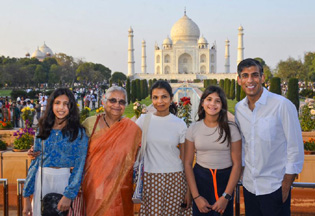
  • Indian Origin Former British PM Rishi Sunak visits Taj Mahal with family:  Sunak is on a two-day visit to Agra

    Indian Origin Former British PM Rishi Sunak visits Taj Mahal with family: Sunak is on a two-day visit to Agra

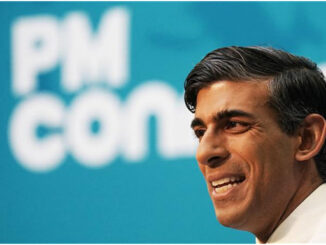
    NEW DELHI (TIP): Former British prime minister Rishi Sunak visited the Taj Mahal on Saturday, February 15, along with his daughters, wife and mother-in-law Sudha Murty. The family spent around one-and-a-half hour at the iconic monument. Sunak is on a two-day visit to Agra. The senior conservation assistant from the Archaeological Survey of India at the Taj Mahal confirmed that Rishi Sunak and his family enjoyed their visit. Both Sunak and his wife left a personal note of appreciation in the visitor’s book.

    ACP, Taj Security, Areeb Ahmed said, “Rishi Sunak and his family were provided top-tier security throughout their visit. The Taj Mahal was shown to them under strict security measures, in collaboration with the CISF.”
    (Source: PTI)

  • What Modi can learn from Sunak

    What Modi can learn from Sunak

    Former UK PM graciously accepted responsibility for the defeat of Conservative Party

    “Sunak is a practicing Hindu. It is obvious that he follows the essence of his religion. He was humble and penitent. He accepted responsibility for the defeat. The RSS should comment on this aspect of his personality and behavior like it commented on Modi’s without naming him. After all, the core teachings of the great religions in the world are similar. They all teach humility and reject arrogance. They disapprove of lies. They preach compassion and service without expectation of reward.”

    By Julio Ribeiro

    Rishi Sunak and his Conservative Party badly lost the parliamentary elections in the UK last week. He was gracious in defeat. “I can hear your anger. I take responsibility for the loss to the many good, hardworking candidates,” he said. He resigned as the Prime Minister immediately after the expected verdict was announced. The next day, he resigned as the leader of the Conservative Party, leaving the field open to ambitious politicians to vie for the top job in the party.

    Considering that only 36.56 per cent of the voters supported the BJP this time, he should listen to the voices of those who voted against his party.

    Sunak’s stature in my eyes, at least, and I am sure in the eyes of Indians who think and feel, went up by several notches. I compared his reaction to the defeat to that of our own popular Prime Minister when the BJP lost 60 seats in the Lok Sabha compared to its 2019 tally of 303.

    Narendra Modi had set his sights on winning 400 seats this time. He had launched several infrastructure projects, traversed the length and breadth of the country in his peripatetic fervor, and inaugurated the Ram Janmabhoomi temple in Ayodhya all by himself. All his efforts were in vain. His party lost ground in Uttar Pradesh and, wonder of wonders, the BJP lost the Ayodhya seat to Akhilesh Yadav’s Samajwadi Party.

    But our Prime Minister is made of sterner stuff than our former colonial master’s ex-PM. Modi did not mention ‘defeat’ even once. He claimed victory for the NDA. His pre-poll tie up with Chandrababu Naidu’s TDP and the mercurial Nitish Kumar’s JD(U) took the BJP-led alliance past the halfway mark.

    Modi began his cherished third term without batting an eyelid. For him, it was business as usual. He showed no discomfiture at the BJP’s below-par show in the Lok Sabha elections and did not think it necessary to offer any explanation to his party members for what can only be described as his personal failure as the BJP fought the elections in his name.

    Sunak is of Indian origin. His family has its roots in Punjab. His wife, Akshata Murthy, is the daughter of Narayan Murthy, the founder of Infosys. Her roots are in Karnataka. They hail from the same stock as Modi and millions of Indians. Yet, Sunak’s reaction to a setback in his career was diametrically opposite to that of Modi.

    Sunak is a practicing Hindu. It is obvious that he follows the essence of his religion. He was humble and penitent. He accepted responsibility for the defeat. The RSS should comment on this aspect of his personality and behavior like it commented on Modi’s without naming him. After all, the core teachings of the great religions in the world are similar. They all teach humility and reject arrogance. They disapprove of lies. They preach compassion and service without expectation of reward.

    Then, why do our desi politicians differ from our brethren who have migrated to other countries and achieved unbelievable recognition? Sunak became the Prime Minister of the country that ruled over us for two centuries or more. Kamala Harris, whose mother’s family migrated to the US from Tamil Nadu, is the Vice-President of the world’s most powerful country.

    Besides Indians seeking a better quality of life in the West, there are Indian-origin citizens of smaller countries in the world. Their ancestors had been recruited as indentured labor to work in the cotton and sugarcane fields in British-ruled colonies in the West Indies, Mauritius and Fiji. Starting with Sir Seewoosagar Ramgoolam, the Prime Ministers of Mauritius have been of Indian origin.

    Sir Vidiadhar Surajprasad Naipaul, whose origins are in a Dubey family from a village in Uttar Pradesh, is acknowledged as one of the greatest writers in the English language. His family was transshipped to the West Indies two or more centuries ago. He won the Nobel Prize for Literature for his writings, including A House for Mr Biswas, An Area of Darkness and India: A Wounded Civilisation. Indians are proud of his achievements like they are of many other PIOs (persons of Indian origin) whom our PM serenades whenever he travels to their adopted countries.

    Here in India, Modi is securely installed in power till 2029. Should he rule in the same manner as he did from 2014 to 2024? Considering that only 36.56 per cent of the voters supported his party this time, he should listen to the voices of the 63.44 per cent who voted against him. Should he not change course imperceptibly to begin with but with greater momentum in the third year onwards or even from the second year if his alliance loses Maharashtra, as seems likely at present?

    To begin with, he should discard Islamophobia, which is breeding disunity in the country, a sure recipe for disaster, especially if China bares its dragon teeth more often than it does at present. Of course, the US is now on our side, but even then a fifth column within the country may prove fatal.

    He should curb the enthusiasm of Central investigating agencies like the ED and the CBI to pursue only Opposition politicians and critics of his regime. The influx of Opposition legislators into the BJP will then become a trickle instead of a stream but it will recast his stature in men’s eyes in more positive terms. Presently, it has become a source of talk and banter. The preponderance of questionable politicians in his party with skeletons in their cupboards is alarming. Unless it is corrected quickly, Modi’s image will suffer, first nationally and then internationally.

    Thirdly, even if the laws he introduces are good and beneficial to the people at large, he should not announce them dramatically for effect but should share his thoughts with the stakeholders in a graded manner and prepare for the after-effects. He should ruminate at the blow he suffered with the farm laws, which many said were good but not properly explained to the farmers’ unions.

    If Modi wants to be remembered by posterity, he should at least listen to the voice of the RSS Sarsanghchalak, even if he deigns to discard the voices of ordinary Indians who did not vote for him.
    (The author is a former governor and a highly decorated retired Indian Police Service Officer)

  • UK Prime Minister Sunak announces election on July 4

    UK Prime Minister Sunak announces election on July 4

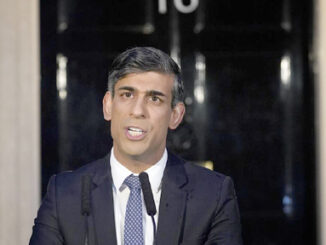
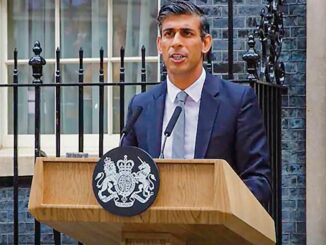
    LONDON (TIP): Prime Minister Rishi Sunak on Wednesday ended frenzied speculation by announcing that the UK’s general election will be held on July 4, saying it is time for Britain to choose its future. In an address from the lectern on the steps of 10 Downing Street on a rainy London evening, Britain’s first Prime Minister of Indian heritage confirmed a summer poll in six weeks’ time and that the Parliament would soon be dissolved after he formally informed King Charles III of the election timeline.

    The 44-year-old leader laid out his record dating back to his term as finance minister during the Covid lockdowns in his pitch to the British electorate, who will soon give their verdict at the ballot box.

    “Earlier today, I spoke with His Majesty the King to request the dissolution of Parliament and the King has granted this request and we will have a general election on the fourth of July,” said Sunak. In his pitch to the voters, he said: “As I did then, I will forever do everything in my power to provide you with the strongest possible protection I can. That is my promise to you.”

    (Source: PTI)

  • UK’s ruling Conservatives suffer big losses in local elections as Labour appears headed for power

    UK’s ruling Conservatives suffer big losses in local elections as Labour appears headed for power

    LONDON (TIP): In what appears to be a big setback to British Prime Minister Rishi Sunak, his ruling Conservative Party is suffering heavy losses as local election results pour in on Friday, May 3. It is an indication that the main opposition Labour Party appears increasingly likely to return to power after 14 years. Labour won control of councils in England it hasn’t held for decades and was successful in a special by-election for Parliament. Its only negative appears to have been in some areas with large Muslim populations where the party’s candidates suffered as a result of leader Keir Starmer ‘s strongly pro-Israel stance in the conflict in Gaza.

    Labour won Blackpool South, a long-time Labour seat in the northwest of England that went Conservative in the last general election in 2019, when then-Prime Minister Boris Johnson won a big victory.

    In the contest, triggered by the resignation of a Conservative lawmaker following a lobbying scandal, Labour’s Chris Webb secured 10,825 votes, 7,607 more than his second-placed Conservative opponent.

    “This seismic win in Blackpool South is the most important result today,” Starmer said. “This is the one contest where voters had the chance to send a message to Rishi Sunak’s Conservatives directly, and that message is an overwhelming vote for change.”

    Thursday’s elections were important in themselves, with voters deciding who will run many aspects of their daily lives, such as garbage collection, road maintenance and local crime prevention, in the coming years. But with a general election looming, they will be viewed through a national prism.

    The results so far provide more evidence that Labour is likely to form the next government — and by quite a margin — and that Starmer will become prime minister. As of early Friday, with barely a quarter of the 2,661 seats up for grabs counted, the Conservatives were down 115 while Labour was up 60.

    The results will roll in through Saturday. Sunak hopes he can point to successes, notably in several key mayoral races, to douse talk that the Conservative Party will change its leader again before the United Kingdom’s main election, which could take place as soon as next month.

    Key to his survival could be the results of mayoral elections in Tees Valley in the northeast of England and in the West Midlands. The former is due Friday lunchtime and the latter on Saturday. Should Conservative mayors Andy Street and Ben Houchen hold on, he may win some respite from restive lawmakers in his party. Should both lose, he may face trouble. Labour’s Sadiq Khan is expected to remain mayor of London when results are announced on Saturday.

    Sunak could preempt any challenge by threatening to call a general election that has to take place before January 2025. He has the power to decide on the date and has indicated that it will be in the second half of 2024.
    (Agencies)

  • Man with sword goes on stabbing spree in London, kills teen, injures 4

    Man with sword goes on stabbing spree in London, kills teen, injures 4

    London (TIP): A sword-wielding man on May 1 smashed a vehicle into a home and then went on a stabbing spree in a “serious incident” near an east London Tube station, killing a 13-year-old boy and wounding four people, before being arrested, the Metropolitan Police said.
    The police said the incident did not appear to be linked with “any act of terrorism” and that of the five people injured, a boy has died from his injuries and the others, including two police officers, remain in hospital after the attack in Hainault area of the city.
    “A 13-year-old boy was taken to hospital after being stabbed and sadly died a short while after. The child’s family are being supported by local officers and are now with some specialist officers,” said Met Police Chief Superintendent Stuart Bell in a statement. He confirmed the 36-year-old suspect was tasered within 22 minutes of the first call and remains in custody. British Prime Minister Rishi Sunak described it as a “shocking incident”, saying that such violence has no place on the country’s streets.
    “This is a shocking incident. My thoughts are with those affected and their families. I’d like to thank the emergency services for their response, and pay tribute to the extraordinary bravery shown by police on the scene,” said Sunak. “Such violence has no place on our streets,” he said. (PTI)


  • Senior U.K. jurists join calls to stop arms sales to Israel

    Senior U.K. jurists join calls to stop arms sales to Israel

    LONDON (TIP): More than 600 British jurists, including three retired judges from the U.K. Supreme Court, are calling on the government to suspend arms sales to Israel, piling pressure on Prime Minister Rishi Sunak after the deaths of three U.K. aid workers in an Israeli strike.

    In an open letter to Mr. Sunak published late Wednesday, April 3, the lawyers and judges said the U.K. could be complicit in “grave breaches of international law” if it continues to ship weapons.

    Signatories, including former Supreme Court President Brenda Hale, said Britain is legally obliged to heed the International Court of Justice’s conclusion that there is a “plausible risk of genocide” in Gaza.

    The letter said the “sale of weapons and weapons systems to Israel … falls significantly short of your government’s obligations under international law.”

    Britain is a staunch ally of Israel, but relations have been tested by the mounting death toll, largely civilian, from the war. Calls for an end to arms exports have escalated since an Israeli airstrike killed seven aid workers from the aid charity World Central Kitchen, three of them British.

    Israel says the attack on the aid workers was a mistake caused by “misidentification.”

    The U.K.’s main opposition parties have all said the Conservative government should halt weapons sales to Israel if the country has broken international law in Gaza.

    Several senior Conservatives have urged the same, including Alicia Kearns, who heads the House of Commons foreign affairs committee.

    Mr. Sunak has not committed to an arms export ban, but said Wednesday, April 3, that “while of course we defend Israel’s right to defend itself and its people against attacks from Hamas, they have to do that in accordance with international humanitarian law.”

    British firms sell a relatively small amount of weapons and components to Israel. Defiance Secretary Grant Shapps has said that military exports to Israel amounted to 42 million pounds ($53 million) in 2022.

    Other allies of Israel are also facing calls to cut off the supply of weapons and to push for a cease-fire in the conflict, which has killed more than 32,000 Palestinians, according to health authorities in Gaza.

    In February, Canada announced it would stop future shipments, and the same month a Dutch court ordered the Netherlands to stop the export of F-35 fighter jet parts to Israel. The Dutch government said it would appeal.

    Other countries, including Israel’s two biggest arms suppliers, the United States and Germany, continue to allow weapons sales.

    Peter Ricketts, a former U.K. National Security Advisor, said suspension of U.K. arms sales would not change the course of the war, but “would be a powerful political message.”

    “And it might just stimulate debate in the U.S. as well, which would be the real game-changer,” he told the BBC.

  • Europe loath to learn from past disasters

    Europe loath to learn from past disasters

    Europe’s combat cacophony is reaching a crescendo. No one is interested in ceasefire and peace talks

    “It seems that be it the US or the UK, France, Poland and Russia, all are bent on escalating the Russo-Ukraine ‘local’ war into an international conflict. Does Europe want to repeat its history and now kill 60 crore, 10 times more than the death toll in the 1939-45 war? Deplorably, the influential and powerful Europeans appear to be in a trance and, hence, unable to comprehend the mistakes of their predecessors, whose collective stupidity and arrogance arguably resulted in the most gory and bloodcurdling chapter in the history of Europe, which globalised the business of murder for money.”

    By Abhijit Bhattacharyya

    In the second half of the 19th century, seven aggressive European imperial states (Portugal, Spain, France, Italy, Britain, Germany and Belgium) divided Africa through ‘botanists, buccaneers, the Bible, bureaucrats, bankers and businessmen’. In 1875, less than one-tenth of Africa was colonised by Europeans; by 1895, one-tenth remained unappropriated. In 1916, Lenin termed it ‘imperialism, the highest stage of capitalism’.

    Before the 19th-century partition of Africa, 5 million sq km of Indian territory was usurped (through the 18th century and later) by the British. State power and responsibility were brazenly bequeathed to a band of businessmen, accompanied by machine-gunners, who forced South Asia to succumb to the lords of London. The operation was outsourced to a private corporation, which went on the rampage on behalf of the Crown through the state-backed ‘might is right’ policy, supplemented by the unabashed assertion of native panegyrists that the ‘King does no wrong’.

    Europe of yore also tried proving that whereas non-Europeans are always wrong, Europe is always right because the West is the king and the rest are subservient subjects. Thus, whereas the global expansion of Europe constituted the ‘white man’s burden’ to civilise the non-white, the opposite is strictly ‘no-no’ and a ‘no-go’ for ‘others’ without the pleasure of the King.

    Then came the 20th century, and Europe’s power started waning despite the fruits of the Industrial Revolution. The faultlines emerged fast and furious in the European mainland. With opportunities for overseas expansion drying up, colony-championing Western imperialists fought the bitter intra-Europe World War I of 1914-18 (like today’s Russia-Ukraine war and the divided Europe). Though World War I exhausted, crumbled and shrank Europe, it couldn’t stop another savage civil war, euphemistically referred to as World War II (1939-45), which dragged all continents into one continent’s issues. Thus, both wars proved to be a true precursor of globalisation, reflected in global violence because of interdependence and interconnection between the biggest and the smallest and the richest and the poorest nations.

    Ironically, despite being a conglomeration of a handful of small duchies and dukes and princes and principalities — possessing limited land with few feudal landlords, serfs, bourgeoisie and proletariat — Europe, with its bloody past, still mesmerises most Third-World rulers. Hence, whatever the economic, political or diplomatic proposals emanate from there, many non-Europeans are overawed, little realising that the imperial grandeur of the West has faded and it’s now in decay.

    Nevertheless, mainland Europe’s rulers also fear the East. Anything from there is looked upon with scepticism. This inexplicable psyche could be caused by the fear of the ethnically different and robust Mongols’ short-lived presence in the West. Hence, Russophobia exists in the official blue book of the West, and the mutual suspicion and hatred gave birth to war in eastern Europe in February 2022.

    Two years of intra-Slav manslaughter have already created multiple crises, ranging from economic to agricultural, military, industrial and political. The 27-member European Union (EU) is against Moscow, but perhaps no longer unanimously. There are differences between France and Germany. Besides, whereas farmers of EU nations are on the streets, fighters of non-EU Ukraine face bullets from the EU’s ‘common enemy’, Russia. Thus, amid the war between two belligerent non-EU Slav states, the business of firearm-makers prospers.

    Owing to the declining demography of virtually all 27 EU nations, none of them today can join Ukraine on the ground. Further, NATO’s ‘common security threat’ clause makes it well-nigh impossible for anyone to join the fight because that is bound to result in an all-out intra-Europe war — the fire will burn all, from Madrid to Moscow, Stockholm to Stalingrad, London to Leningrad. But still, the EU is yelling and itching for war from outside the battlefield.

    Surely, Europe hasn’t learnt any lesson from its past disasters and the colossal loss of around 6 crore people in six years (1939-45). Russia lost three crore soldiers, Germany 70 lakh, Poland 62 lakh, Yugoslavia 17 lakh, Hungary 8.5 lakh, France 8.2 lakh, Austria 4.8 lakh and the UK four lakh. Even distant India lost around one lakh soldiers fighting abroad under British masters, who created a man-made famine, conniving and conspiring with a section of native traders to kill lakhs of Indians at home through forced starvation.

    Today, Europe’s orchestrated cacophony for combat is reaching a crescendo. No one is interested in ceasefire and peace talks. The situation has reached such a sorry state that even United Nations Secretary-General Antonio Guterres deplored the deadlock over the Russia-Ukraine war and Israel’s pounding of Gaza since October 2023. He publicly concedes that the 194-member world arbitration organisation is now ‘fatally undermined’. Can it then be said that the two non-EU combatants are more powerful than the 194-member UN club? Let the UN then at least give its tacit approval to a European civil war to push the whole world into the jaws of a nuclear Armageddon. It seems that be it the US or the UK, France, Poland and Russia, all are bent on escalating the Russo-Ukraine ‘local’ war into an international conflict. Does Europe want to repeat its history and now kill 60 crore, 10 times more than the death toll in the 1939-45 war? Deplorably, the influential and powerful Europeans appear to be in a trance and, hence, unable to comprehend the mistakes of their predecessors, whose collective stupidity and arrogance arguably resulted in the most gory and bloodcurdling chapter in the history of Europe, which globalised the business of murder for money.
    (Abhijit Bhattacharyya is an author and columnist)

  • Rishi Sunak makes impassioned plea to protect British democracy

    Rishi Sunak makes impassioned plea to protect British democracy

    LONDON (TIP): Prime Minister Rishi Sunak has issued an impassioned plea for Britain to protect its democracy as he warned that extremist forces were out to tear the country apart and undermine its multi-faith identity.

    Referencing his own Hindu beliefs, the British-Indian leader on Friday , March 1, stressed that the enduring values of the UK are about embracing migrants of all faiths and ethnicities and urged protesters to ensure peaceful demonstrations are not hijacked by extremist forces.

    “Immigrants who have come here have integrated and contributed. They have helped write the latest chapter in our island story. They have done this without being required to give up their identity,” said Sunak in a speech outside 10 Downing Street. “You can be a practicing Hindu and a proud Briton as I am, or a devout Muslim and a patriotic citizen as so many are, or a committed Jewish person and the heart of your local community, and all underpinned by the tolerance of our established, Christian church,” he said.

    “But I fear that our great achievement in building the world’s most successful multi-ethnic, multi faith democracy is being deliberately undermined. There are forces here at home trying to tear us apart,” he added.

    He was speaking soon after what he characterized as the “beyond alarming” win in a byelection on Thursday of a controversial politician, George Galloway, in Greater Manchester following a campaign dominated by the divisions of the Israel-Hamas conflict. He said on too many occasions recently, the streets of Britain had been hijacked by small groups who are hostile to British values and have no respect for its democratic traditions.

    “Islamist extremists and the far right feed off and embolden each other. They are equally desperate to pretend that their violence is somehow justified when actually these groups are two sides of the same extremist coin… both loathe the pluralist, modern country we are,” he said.

    The British Prime Minister stressed that both these groups of extremists were spreading the poison of extremism with the aim of draining Britain’s confidence. He added: “No country is perfect, but I am enormously proud of the good that our country has done.”

    “I stand here as our country’s first non-white Prime Minister, leading the most diverse government in our country’s history to tell people of all races, all faiths and all backgrounds it is not the color of your skin, the God you believe in or where you were born, that will determine your success but just your own hard work and endeavor.” Sunak reiterated his support for a new protocol agreed with the police forces of the country earlier this week to take action against violent activities that threaten the personal security of members of Parliament and also any violence during serial protests taking place in response to the Israel-Hamas conflict. He said threats of violence and intimidation are alien to the British way of doing things and must be resisted at all times.

    “I love this country. My family and I owe it so much. The time has now come for us all to stand together to combat the forces of division and beat this poison. We must face down the extremists who would tear us apart,” he urged.
    (Source: PTI)

  • Rishi Sunak makes impassioned plea to protect British democracy

    Rishi Sunak makes impassioned plea to protect British democracy

    London (TIP): Prime Minister Rishi Sunak has issued an impassioned plea for Britain to protect its democracy as he warned that extremist forces were out to tear the country apart and undermine its multi-faith identity.
    Referencing his own Hindu beliefs, the British-Indian leader on March 1 stressed that the enduring values of the UK are about embracing migrants of all faiths and ethnicities and urged protesters to ensure peaceful demonstrations are not hijacked by extremist forces.
    “Immigrants who have come here have integrated and contributed. They have helped write the latest chapter in our island story. They have done this without being required to give up their identity,” said Sunak in a speech outside 10 Downing Street.
    “You can be a practising Hindu and a proud Briton as I am, or a devout Muslim and a patriotic citizen as so many are, or a committed Jewish person and the heart of your local community, and all underpinned by the tolerance of our established, Christian church,” he said.
    “But I fear that our great achievement in building the world’s most successful multi-ethnic, multi faith democracy is being deliberately undermined. There are forces here at home trying to tear us apart,” he added.
    He was speaking soon after what he characterised as the “beyond alarming” win in a byelection on Thursday of a controversial politician, George Galloway, in Greater Manchester following a campaign dominated by the divisions of the Israel-Hamas conflict.
    He said on too many occasions recently, the streets of Britain had been hijacked by small groups who are hostile to British values and have no respect for its democratic traditions.
    “Islamist extremists and the far right feed off and embolden each other. They are equally desperate to pretend that their violence is somehow justified when actually these groups are two sides of the same extremist coin… both loathe the pluralist, modern country we are,” he said.
    The British Prime Minister stressed that both these groups of extremists were spreading the poison of extremism with the aim of draining Britain’s confidence.
    He added: “No country is perfect, but I am enormously proud of the good that our country has done.” “I stand here as our country’s first non-white Prime Minister, leading the most diverse government in our country’s history to tell people of all races, all faiths and all backgrounds it is not the colour of your skin, the God you believe in or where you were born, that will determine your success but just your own hard work and endeavour.” Sunak reiterated his support for a new protocol agreed with the police forces of the country earlier this week to take action against violent activities that threaten the personal security of members of Parliament and also any violence during serial protests taking place in response to the Israel-Hamas conflict. He said threats of violence and intimidation are alien to the British way of doing things and must be resisted at all times.
    “I love this country. My family and I owe it so much. The time has now come for us all to stand together to combat the forces of division and beat this poison. We must face down the extremists who would tear us apart,” he urged. (PTI)

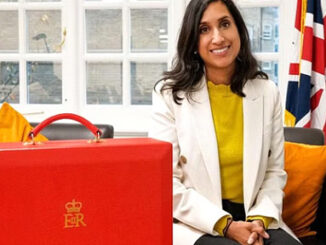
  • Claire Coutinho: Newest Indian-origin minister in Rishi Sunak Cabinet

    Claire Coutinho: Newest Indian-origin minister in Rishi Sunak Cabinet

    LONDON (TIP): Claire Coutinho, a close aide of British Prime Minister Rishi Sunak, got a big promotion as his new Energy Security and Net Zero Secretary in a mini reshuffle on August 31. Coutinho, 38, becomes the second Goan-origin minister after Home Secretary Suella Braverman in the Sunak Cabinet and has a tough brief ahead of her as energy costs have been soaring in the wake of the Russia-Ukraine conflict.
    She has committed herself to work on safeguarding energy security and reducing bills for families struggling with a cost-of-living crisis. In her first Cabinet role, Coutinho replaced Grant Shapps after he was promoted to the post of Defence Secretary following the resignation of Ben Wallace.
    “I am delighted to have been appointed Secretary of State for Energy Security and Net Zero. I will work with the Prime Minister to safeguard our energy security, reduce bills for families, and build cleaner, cheaper, homegrown energy,” she tweeted.
    Like Sunak, UK-born Coutinho grew up in a family connected with the National Health Service (NHS) and was in the field of investment banking before joining politics.
    The pro-Brexiter with a Master’s degree in Maths and Philosophy from Oxford University was elected member of Parliament for East Surrey, south-east England, in 2019 with a promise to serve people. “I was elected the Member of Parliament for East Surrey in 2019. Growing up, I watched my parents work as GPs (general practitioners) in the NHS, listening to people’s problems and solving them as best they could. It is in that spirit that I hope to serve the people of East Surrey,” reads the London-born politician’s mission statement as a Tory MP. Sunak’s decision to catapult her into the cabinet – as its youngest member in fact – marks her out instantly as a major figure in Conservative politics, present and future, the BBC reported. She says she started her career at Merrill Lynch, before leaving the City of London firm for a career in social justice policy.
    “I focused on a wide range of issues from education to financial inclusion, to the regeneration of deprived communities including at the Centre for Social Justice. I then spent two years within government as a Special Adviser, including at HM Treasury. My local priorities include fixing our roads, supporting the local economy, and protecting our environment,” she adds in her mission statement.
    Having worked as a special adviser in the UK Treasury department, Coutinho went on to become an aide to Sunak in his role as Chief Secretary to the Treasury and later Chancellor of the Exchequer. She backed the British Indian candidate for Prime Minister in his leadership bid last year and was later rewarded with a junior ministerial post in the Department for Education. “Big thank you to my stellar team who supported me as Minister for Children, Families and Wellbeing. I know my successor, David Johnston, will be champing at the bit to improve the lives of children and families up and down the country,” she tweeted after her promotion.
    “From the largest expansion of childcare in history to our new Freedom of Speech Act to driving forward reforms in SEND, for foster carers, in children’s social care and for childminders. It has been a privilege to work with so many talented people,” she said. (PTI)

  • 101-year-old Sikh World War II veteran honored by UK PM Rishi Sunak with Points of Light award

    101-year-old Sikh World War II veteran honored by UK PM Rishi Sunak with Points of Light award

    LONDON (TIP): British Prime Minister Rishi Sunak has honored Rajindar Singh Dhatt, one of the last surviving Sikh soldiers who fought in the Second World War with a Points of Light honor at a UK-India Week reception at 10 Downing Street. Dhatt, 101, was recognized on Wednesday for his service and his work running the “Undivided Indian Ex-Servicemen’s Association” to help bring together British Indian war veterans. Dhatt, based in Hounslow in southwest London since 1963, was born in pre-Partition India in 1921 and fought with the Allied forces during the British colonial period. “It is an immense honor to receive this recognition from the Prime Minister, to whom I would like to extend my deepest appreciation for acknowledging the importance and impact of the ‘Undivided Indian Ex-Servicemen’s Association’,” said Dhatt. “The journey of establishing this organization was driven by a deep sense of duty as an ex-serviceman and the vision of fostering unity, support, and camaraderie. This award serves as a testament to the tireless efforts of countless individuals who have contributed to the success and growth of the association over the years,” he said.

    “Their unwavering commitment and selfless service has played a pivotal role in bringing about positive change in the lives of our ex-servicemen and their families,” he added. Dhatt joined the British Indian Army during the Second World War and excelled up the ranks, being promoted to Havildar Major (Sergeant Major) in 1943. He was later drafted to the Far East campaign to fight in Kohima in northeast India to support the Allied Forces and help break through the Japanese defenses, Downing Street said. After the war, Dhatt returned to India before settling in London with his family.

    His association recently created an online community for veterans, sharing articles about personal stories and opportunities to connect. Dhatt also continues to speak at memorial events and work with war veteran charities, including the Royal British Legion and the Taxi Charity for Military Veterans, telling stories through teaching packs and online resources.

    Dhatt said the award is a “momentous occasion” that inspires him to continue making meaningful contributions to society, even as he nears his 102nd birthday. According to Downing Street, the Points of Light recognize outstanding people whose service is making a difference in their communities and whose stories can inspire others towards innovative solutions to social challenges in their own communities and beyond. Dhatt’s honor coincided with a Downing Street reception celebrating India Global Forum’s UK-India Week celebration of the bilateral relationship, where Prime Minister Sunak spoke of Dhatt as an “incredible man” and thanked him for his service as a member of the Indian diaspora “living bridge”.
    (Source: PTI)


  • British, French leaders seek migration deal; aim to beat Brexit tensions

    British, French leaders seek migration deal; aim to beat Brexit tensions

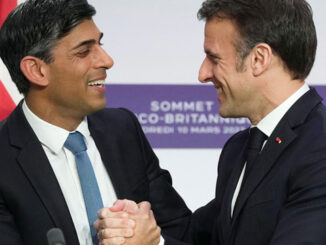
    PARIS (TIP): British Prime Minister Rishi Sunak and French President Emmanuel Macron agreed a new pact to stop illegal cross-Channel migration after a summit in Paris on March 10, 2023 aimed at overcoming years of Brexit tensions. Both leaders hailed a new start in relations between the two neighbors, after intense talks in Paris which were also marked by expressions of unity in their support for Ukraine in fighting the Russian invasion.
    British Prime Minister Rishi Sunak on Friday met French President Emmanuel Macron in Paris for a bridge-building summit, aimed at overcoming years of Brexit tensions and agreeing a new pact on cross-Channel migration.
    Mr. Sunak hailed as “essential” the relationship between the two neighbors ahead of talks, where the pair were also expected to vow more support for Ukraine and security in the Asia-Pacific region, Downing Street said.
    Mr. Macron welcomed Mr. Sunak at the Elysee Palace, after the premier travelled to Paris by train from London. A press conference was expected in the afternoon.
    It is the first U.K.-French summit in five years, after Mr. Sunak became prime minister in October, following the stormy tenures of Liz Truss and Boris Johnson.
    Mr. Macron’s distrust of Brexit figurehead Johnson was barely concealed, while Truss said she didn’t know whether the French leader was a “friend or foe” during her campaign to become prime minister.
    But both sides now see an opportunity to reset the “Entente Cordiale” between Western Europe’s two nuclear powers.
    “I hope it can be the start of a stronger relationship between us and it’s a privilege to be able to play a part in that,” Mr. Sunak told reporters as he travelled over.
    The new constructive mood is set to produce another deal to stem migration from France, with Mr. Sunak determined to thwart thousands of asylum seekers crossing the Channel and Mr. Macron pushing for extra resources to fund border controls.
    Britain has been paying France to help patrol the Channel, and a summit pact will focus on “increasing the resources deployed to manage this common border, with multi-year financing”, an aide to Mr. Macron said.
    The Times newspaper reported that the deal would be for around 200 million pounds (225 million euros, $240 million), spread out over three years.
    Mr. Sunak is under fierce pressure at home to reduce the number of asylum seekers arriving in Britain, and this week unveiled legislation that critics said would make Britain an international outlaw on refugee rights.
    “There is no one silver bullet to solve this problem. So the legislation we introduced this week is incredibly important, cooperation with the French is important, illegal migration enforcement at home is important,” Mr. Sunak explained.
    He also confirmed that the European Political Community — a Mr. Macron initiative formed after Russia invaded Ukraine a year ago — will be hosted by Britain following an October summit in Spain.
    Although Britain’s exit from the European Union still bedevils ties, recent developments, including an agreement to settle the EU trading status of Northern Ireland, have created goodwill.The two neighbors have also found common cause in supporting Ukraine against Russia.
    Mr. Sunak and Mr. Macron will agree to “further coordinate both the supply of weapons to Ukraine and the training of Ukrainian marines”, a Downing Street statement said.As well as Ukrainian soldiers and marines, Britain has undertaken to train Ukrainian pilots – although Western allies are wary of offering fighter jets to Kyiv.
    The leaders will further look at ensuring a “permanent presence of likeminded European partners” in the Asia-Pacific, where concerns about China’s growing assertiveness are shared in both capitals. Mr. Sunak and Mr. Macron were expected to agree on closer coordination of the deployment of France’s Charles de Gaulle aircraft carrier with the Royal Navy’s brand-new carriers — HMS Queen Elizabeth and HMS Prince of Wales.Both countries sent their carriers through the contested South China Sea in 2021.
    As part of the British government’s post-Brexit outreach, the summit paves the way for King Charles III to make France his first foreign destination when he heads there on a state visit at the end of March.
    While Johnson reveled in French-bashing, Mr. Sunak says he and Mr. Macron are “friends”, with their warm embrace during their first encounter in November sparking light-hearted speculation about a “bromance”.
    They are similar ages, 45 and 42, and are former investment bankers. Both were schooled privately, grew up in provincial towns and have fathers with medical backgrounds.
    “I would be careful to read too much into the ‘bromance’, but it’s true they come from a similar background and generation, which has an impact on how they see their countries’ roles in the world,” Alice Billon-Galland, a research fellow at the Chatham House think-tank in London, told AFP. “Both of them bring a new energy. Both sides really do want this (summit) to be a success.”

    (Agencies)

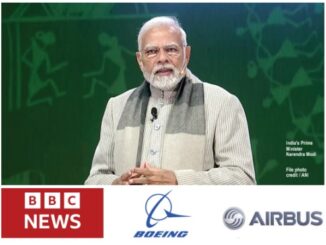
  • Between BBC, Boeing and Airbus, PM Modi sets terms of engagement with the West

    Between BBC, Boeing and Airbus, PM Modi sets terms of engagement with the West

    Modi has repeatedly referred to three Ds – Democracy, Demand, and Demography – as factors that make India an attractive place for the West to engage and do business with

    “Mr. Modi has repeatedly referred to three Ds – Democracy, Demand, and Demography – as factors that make India an attractive place for the West to engage and do business with. When Mr. Modi began talking about 3D in 2014, the U.S. was happily doing business with China. In the years that followed, U.S. relations with China nosedived, and Russia invaded Ukraine. The Biden administration now wants to frame international politics as a fundamental ideological cleft between democracy and autocracy.”

    By Varghese K George

    As it happened, on the same day the Tata Group-owned Air India announced orders for 470 aircraft from American manufacturer Boeing and French manufacturer Airbus, Indian Income Tax authorities dropped by at the offices of the BBC. Just as Prime Minister Narendra Modi spoke about deepening strategic partnerships with the U.S. and France, BJP functionaries, including Union ministers, accused the BBC of running an anti-India agenda with the support of Opposition parties. Mr. Modi had French President Emmanuel Macron on a video call, and U.S. President Joe Biden on an audio call to celebrate the aircraft deal, while U.K. Prime Minister Rishi Sunak, whose country is also a beneficiary of the deal in which Rolls-Royce will be making the engines for Airbus aircraft, tweeted out his ebullience. All this taken together reflects the terms of engagement that Mr. Modi wants to set with the West — a “Hindutva strategic doctrine” for India’s engagement with the world.

    Mr. Modi has repeatedly referred to three Ds – Democracy, Demand, and Demography – as factors that make India an attractive place for the West to engage and do business with. When Mr. Modi began talking about 3D in 2014, the U.S. was happily doing business with China. In the years that followed, U.S. relations with China nosedived, and Russia invaded Ukraine. The Biden administration now wants to frame international politics as a fundamental ideological cleft between democracy and autocracy.

    On Tuesday, Mr. Modi invited western companies to use the opportunities of India’s expanding civil aviation market. On the first D, western governments murmur occasional protests, but they cannot hide their excitement when it comes to the second D. The Air India order was Boeing’s third largest sale of all time, in dollar value, and it is second of all time in quantity.

    “This purchase will support over 1 million American jobs across 44 states, and many will not require a four-year college degree,” U.S. President Joe Biden said, according to a White House release.“ This announcement also reflects the strength of the U.S.-India economic partnership. Together with Prime Minister Modi, I look forward to deepening our partnership even further as we continue to confront shared global challenges.” According to Mr. Sunak, the aircraft order will create “better-paid jobs and new opportunities in manufacturing hubs from Derby to Wales,” which will help the U.K. to “grow the economy and support our agenda to level up”. Mr. Macron was described by Mr. Modi as a friend, and both hailed the “strategic partnership” between the two countries. The lure of the Indian market, powered by its demography, seems stronger than that of the second D – Democracy.

    While the British government has so far remained silent on IT action on BBC, U.S. State Department Spokesperson Ned Price did not want to make a judgment other than declaring the importance of free media in a democracy. On whether the action went against democratic values, Mr. Price said, “I couldn’t say. We’re aware of the facts of these searches, but I’m just not in a position to offer a judgment.” The BJP’s position is that the BBC is not free media, but a foreign agent that is working with an anti-India agenda. That is a familiar logic for western democracies actually. The U.S. and EU have imposed a range of restrictions on Russian media on the same grounds.

    The Modi government had reminded the Biden administration of the rioters at Capitol Hill when it was questioned about police action against protesting farmers running amok in New Delhi, in January 2021. There are many contradictions in the narrative about a global contest between democracies and autocracies, and the turmoil within democratic countries is significant, undermining any claims of western superiority on this front. The Hindutva strategic doctrine seeks western support and cooperation for its nationalist ambitions. Hence, western technology and investment are solicited, but there is stiff resistance to western prescriptions on domestic political questions. On the other side, when required to choose between a tangible commercial opportunity and an abstract moral objective, western governments have never been confused.

  • Rishi Sunak marks 100 days as UK PM with pledge to deliver change

    Rishi Sunak marks 100 days as UK PM with pledge to deliver change

    London (TIP): Rishi Sunak marked his 100th day in office as the first non-white British Prime Minister on February 2 with a slick new video for social media pledging to deliver change, amidst multiple challenges, including spiralling inflation.
    The UK’s first Indian-origin Prime Minister took charge at 10 Downing Street a day after Diwali last year on October 25 in the wake of intense political turmoil following the unceremonious exit of his predecessors – party-gate scandal-hit Boris Johnson and the country’s shortest-serving Prime Minister Liz Truss.
    Since then, Sunak has laid out his top priorities with a particular focus on cutting soaring inflation to tackle the crippling cost of living crisis in the aftermath of the Covid pandemic and the ongoing Russia-Ukraine conflict.
    “Others may talk about change. I will deliver it,” he wrote on Twitter on Thursday.
    The accompanying video captures a montage of his historic selection for the top job as the “youngest in modern history”, aged 42, and also the first non-white politician at No. 10 Downing Street. It goes on to reiterate his new year commitments of five key priorities: to halve inflation, grow the economy, reduce debt, cut National Health Service (NHS) waiting lists and stop the illegal migration via small boats crossing the English Channel.
    Among the scenes of his meetings with key world leaders, there is shot of him shaking hands with Prime Minister Narendra Modi at the G20 Summit in Bali, Indonesia, last November where the two leaders greenlit the UK-India Young Professionals Scheme – a reciprocal scheme offering 3,000 18-30-year-old degree-educated youth visas every year to live and work in either country for two years.
    “I know first-hand the incredible value of the deep cultural and historic ties we have with India. I am pleased that even more of India’s brightest young people will now have the opportunity to experience all that life in the UK has to offer – and vice-versa – making our economies and societies richer,” he said at the time.
    Sunak, who is married to Infosys co-founder Narayana Murthy’s daughter Akshata Murty, has also committed to working towards a free trade agreement (FTA) with India but reiterated that his government would not compromise “quality over speed” after the Diwali deadline set for the deal was missed due to the political turmoil in the UK.
    On the domestic front, Sunak faces multiple challenges and pressures, including having to recently sack Conservative Party chair Nadhim Zahawi as a minister without portfolio in his Cabinet after an investigation found he had breached the ministerial code over his tax affairs.
    He faced intense Opposition pressure over the issue and continues to be challenged over his decision to keep his deputy prime minister, Dominic Raab, in the post while he is being investigated over multiple bullying allegations by civil servants.
    “Integrity is really important to me,” he said recently, pledging to “take whatever steps are necessary to restore the integrity back into politics”.
    “The things that happened before I was prime minister, I can’t do anything about. What I think you can hold me to account for is how I deal with the things that arise on my watch,” he added.
    Besides, his government is facing some of the biggest strikes in British history as nurses, teachers, transport workers and civil servants take industrial action demanding better pay and working conditions.
    The spectre of Brexit, which also marked its third anniversary this week after Britain formally left the European Union (EU) on January 31, 2020, continues to loom large over his leadership as he works on signing off on a new deal over the Northern Ireland Protocol. The unresolved issue of goods traded between the UK region and EU member-state Ireland has continued to cause great discontent on all sides. (PTI)

  • British-Sikh engineer wins PM Rishi Sunak’s Points of Light Award for low-cost invention

    British-Sikh engineer wins PM Rishi Sunak’s Points of Light Award for low-cost invention

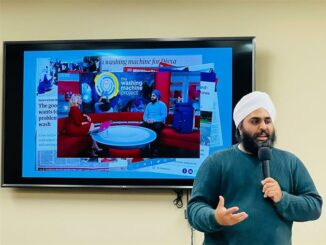
    LONDON (TIP): A British Sikh engineer behind an energy-efficient manual washing machine for low-income groups around the world, inspired by his volunteering work in India, has won Prime Minister Rishi Sunak’s Points of Light Award.

    Navjot Sawhney, who set up his Washing Machine Project around four years ago, was honored for his hand-cranked machine invention which can be operated in regions without electricity.

    Sawhney described the experience of winning the award from Sunak, announced earlier this month, as “surreal” after the British Indian leader praised his “ingenuity and compassion”.

    “You have used your professional skills as an engineer to help thousands of people around the world who don’t have access to electric washing machines,” Sunak wrote in a personal letter to Sawhney.

    “Your innovative, hand-cranked washing machines are giving families the dignity of clean clothes and the time you are saving them is empowering many women who have been held back from education and employment,” he said.

    “I know that your machines are also helping Ukrainian families who have been forced to flee their homes and are currently living in humanitarian aid centers. Your ingenuity, compassion and dedication to improving the lives of others is an inspiration to us all,” he added.

    Previously employed by Dyson, the technology firm well known for vacuum cleaners, Sawhney wanted to use his skills to improve the quality of life for disadvantaged communities.

    It was while volunteering in southern India with “Engineers Without Borders” that he saw the disproportionate burden placed on women to carry out handwashing, inspiring him to design a manual, off-grid and fully sustainable machine which saves 50 per cent on water compared to handwashing, and 75 per cent on time.

    He named his first machines after his neighbor Divya and the Washing Machine Project was created to manufacture the “Divya” devices on a wider scale, with over 300 machines so far distributed worldwide to places including refugee camps, schools and orphanages.

    “Winning the Points of Light award and getting recognized by the Prime Minister is a phenomenal privilege,” said London-born Sawhney.

    “The Washing Machine Project’s mission is to alleviate the burden of unpaid labor, mainly on women and children. I’m so proud that giving back the dignity of clean clothes to those who hand wash them is getting the recognition it deserves.

    “Thank you to our team, volunteers, partners and beneficiaries who work tirelessly daily to make our mission a success,” he said.

    According to Downing Street, his hand-cranked washing machines have benefitted over 1,000 families without access to an electric machine in underdeveloped countries or refugee camps, including humanitarian aid centers in Poland for Ukrainian refugees.

    The Washing Machine Project’s Go Fund Me crowdfunding campaign has raised over 91,000 pounds since July 2021.

    Points of Light are outstanding individual volunteers and people seen as making a change in their community and are regularly honored by the British Prime Minister to recognize their inspirational work.

    (Source: PTI)


  • UK PM Rishi Sunak defends PM Modi over BBC documentary on 2002 Gujarat riots

    UK PM Rishi Sunak defends PM Modi over BBC documentary on 2002 Gujarat riots

    London (TIP): Prime Minister Rishi Sunak has come out in defence of Prime Minister Narendra Modi after a controversial BBC documentary claimed that the British government was aware about the Indian leader having an alleged role in the 2002 Gujarat riots.

    Sunak said he does not agree with the characterisation of Prime Minister Modi by Pakistani-origin Imran Hussain, an Opposition Labour Party MP, when he asked if the British Premier agreed with claims in the BBC programme that some UK Foreign Office diplomats believed that “Modi was directly responsible”.

    During Prime Minister’s Questions (PMQs) in the House of Commons on January 18, Hussain raised the claims made in the first part of ‘India: The Modi Question’ that UK Foreign, Commonwealth and Development Office (FCDO) knew the “extent of Narendra Modi’s involvement”, then Gujarat Chief Minister, in the communal clashes that claimed hundreds of lives.

    “The UK government’s position on that is clear and long standing, and it has not changed,” Sunak responded.

    “Of course, we do not tolerate persecution anywhere, but I am not sure that I agree at all with the characterisation that the hon. gentleman has put forward,” the British Prime Minister said.

    The Indian government has, meanwhile, condemned the BBC Panorama programme, which has not been screened in India, as a “propaganda piece” with a questionable agenda behind it.

    “We think that this is a propaganda piece, designed to push a particular discredited narrative. The bias, lack of objectivity and continuing colonial mindset is blatantly visible,” MEA spokesperson Arindam Bagchi told reporters during a press briefing in New Delhi on Thursday when asked about the controversial series.

    The first part of the two-part ‘India: The Modi Question’ programme, which aired on BBC Two on Tuesday, was categorised by the UK taxpayer-funded broadcaster as “a look at the tensions between Indian PM Narendra Modi and India’s Muslim minority, investigating claims about his role in 2002 riots that left over a thousand dead”.

    The second part of the series, scheduled to be aired next Tuesday, is pegged as a “look at the troubled relationship between Indian PM Narendra Modi’s government and India’s Muslim minority following his re-election in 2019”.

    “We strongly condemn the BBC’s malicious documentary, ‘India: The Modi Question’, said Insight UK, among several diaspora groups who have taken to social media to condemn the documentary.

    “Riddled with antisemitism, anti-Hindu and anti-India biases, they have lost many viewers and yet continue spreading their hate without consequence or accountability,” it added. (PTI)

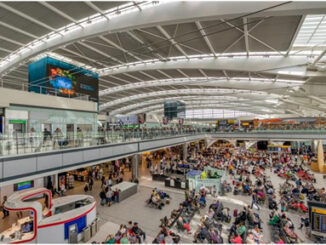
  • UK police investigating uranium-tainted cargo at London’s Heathrow Airport

    UK police investigating uranium-tainted cargo at London’s Heathrow Airport

    London (TIP): British counterterrorism police are investigating after border officers seized cargo contaminated with uranium at London’s Heathrow Airport. The Metropolitan Police force said January 11 that “a very small amount of contaminated material was identified after routine screening within a package incoming to the U.K.” on Dec. 29.

    It said the force’s Counterterrorism Command is investigating. There have been no arrests.

    The BBC reported that the uranium was in a shipment of scrap metal. The Sun, which first reported the story, said the shipment originated in Pakistan and arrived on a flight from Oman. Police Commander Richard Smith said the amount of contaminated material was “extremely small and has been assessed by experts as posing no threat to the public.” He said it “does not appear to be linked to any direct threat,” but the investigation continues.

    “We will of course, follow every avenue to see what the background to this was and satisfy ourselves that there’s no further threat,” he said. Prime Minister Rishi Sunak’s spokesman declined to comment on an ongoing police operation. AP

  • UK, Japan sign defence deal amid China concern

    London (TIP) : The leaders of Britain and Japan are signing a defence agreement on January 11 that could see troops deployed to each others’ countries. The two countries are strengthening military ties amid growing concern about China’s increasing military assertiveness and designs toward Taiwan, which it considers a renegade province. The British government said the defence agreement “cements our commitment to the Indo-Pacific” region. It is due to be signed by Japanese Prime Minister Fumio Kishida and UK leader Rishi Sunak during a meeting in the symbolic setting of the Tower of London fortress.

    The deal has been in the works for years, and was discussed when Kishida visited Sunak’s predecessor, Boris Johnson, in London in May.

    The deal, Reciprocal Access Agreement — Japan’s first with any European nation — allows the two countries to hold joint military exercises. — AP

  • British Prime Minister Rishi Sunak and 15 ministers at risk of losing seat in 2024

    London (TIP): British Prime Minister Rishi Sunak and 15 of his Cabinet ministers are at risk of losing their seats in a general election “wipeout” in 2024, according to a media report citing a new polling data.

    Senior Tory figures – including Prime Minister Sunak, Deputy prime minister Dominic Raab and health secretary Steve Barclay – are all at risk of defeat at the election expected in 2024, according to the polling data shared with The Independent newspapers. Foreign secretary James Cleverly, defence secretary Ben Wallace, business secretary Grant Shapps, Commons leader Penny Mordaunt and environment secretary Therese Coffey could also lose their seats, according to the Focaldata polling for Best for Britain. Only five Cabinet ministers – Jeremy Hunt, Indian-origin Suella Braverman, Michael Gove, Nadhim Zawawi and Kemi Badenoch – would cling on after the 2024 election, according to the poll. A new analysis shared with The Independent on 10 crucial “bellwether” seats – those who have voted consistently with the winning party in recent decades – shows that Labour is on course to take all 10. (PTI)

  • Making diaspora invest in India a challenge

    Making diaspora invest in India a challenge

    “The unresolved issue with the NRIs is that the Indian government just does not know what it can do with them. The government wants their money, no doubt, and they are indeed sending money home, which accounts for 3 per cent of India’s GDP, according to the World Bank. The BJP’s foreign policy notion that the NRIs are its soldiers abroad to spread national glory is at best a delusion. And it could become a dangerous one if Indians abroad are seen as ‘fifth columnists’. Most NRIs have no interest in Indian politics nor are they motivated to push India’s case across the world. A time has to come when Indians need not migrate to other countries for better opportunities.”

    The NRIs remittances are higher than the foreign direct investment (FDI) that India is able to attract. The NRI remittances to India were $89.4 billion in 2021 and $100 billion in 2022.

    By Parsa Venkateshwar Rao Jr.

    The Bharatiya Janata Party (BJP), in its pursuit of overzealous nationalism, has looked upon the Indian diaspora across the world as an extension of India, politically as well as culturally. During the tenure of the then Prime Minister Atal Bihari Vajpayee, an attempt was made to woo overseas Indians, with the PM making it a point to interact with the Indians abroad rather than with other citizens of the host country. It was in 2002 that the first Pravasi Bharatiya Divas event was held in New Delhi.

    Prime Minister Narendra Modi intensified the outreach to the NRIs by addressing rallies in Madison Square Garden (New York) and then in Sydney after his party’s historic win in the 2014 Lok Sabha elections. But despite the enthusiasm to cultivate the NRI constituency in the past two decades, there is uncertainty and confusion over how to tap the potential of the NRIs to strengthen India at the global level or even at home.

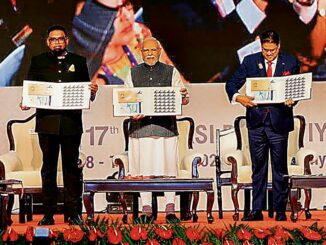
    The 17th Pravasi Bharatiya Divas event, held in Indore from January 8 to 10, reflected the confusion. The Indian government does not seem to be keen that the Indians living abroad should come back and help in the development of the country with the knowledge and expertise they have acquired abroad. It only wants that the NRIs invest in India. But it is in many ways a non sequitur.

    Indians settled abroad, whether in the Gulf countries, the UK, the US, Canada, Australia or Singapore, have been sending money home to their families. But they have not thought that it is profitable to do business in India or invest in India. Even today, the NRIs remittances are higher than the foreign direct investment (FDI) that India is able to attract. The NRI remittances to India were $89.4 billion in 2021 and $100 billion in 2022, higher than what the Chinese and Filipino emigrants send to their home countries.

    So, at successive conventions of the Pravasi Bharatiya Divas, the country’s leaders of the day give rhetorical messages to the few thousand delegates who attend the event. And this year seems to have been no different. PM Modi, Finance Minister Nirmala Sitharaman and Education and Entrepreneurship Minister Dharmendra Pradhan delivered homilies and the unintended ironies were there for all to see. PM Modi, in his inaugural speech on January 8, said, “In Pravasi Bhartiyas, we see myriad images of Vasudhaiva Kutumbakam and Ek Bharat Shreshtha Bharat,” and “Pravasi Bhartiyas echo the voice of a powerful and capable India.”

    Pradhan said, “We all agree that once upon a time India was a ‘Vishwaguru’, not in terms of military power but in terms of intellect.” And then he turned to the government’s programme of creating a skilled network in the country. He told the NRIs that India has a skilled workforce of 500 million. Sitharaman, echoing PM Modi’s statement of how cheap India’s Mars mission was, said, “The cost of the Chandrayaan, which goes to the moon, is far less than that of a Hollywood film.” And citing a NASSCOM (National Association of Software and Service Companies) report, she said Indian IT companies hired 2 lakh Americans at an average salary of $1,06,360 in 2021.

    These statements can only confuse NRIs. The government wants to woo them by telling them how good India has become since they left the country and what an attractive investment destination it is now. Surely, the NRIs would want to test the government’s claims on the ground and it will be reflected in the investment decisions they will make in the future.

    But there is also the fact that though Indians in the US are sending home more money than those in the Gulf countries, as was the case earlier, the Indian-Americans are less likely to return home and even start businesses in India. The Indians in Gulf countries will come back at some point of time because as yet there is no possibility of becoming citizens in those countries. In contrast, more Indians are getting the coveted Green Card in the US and they are more likely to become citizens there. Secondly, there are more billionaires in India than among the NRIs. Steel magnate Laxmi Narayan Mittal and metal magnate Anil Agarwal are among the exceptions. The NRIs in the US are prosperous but they are not super-rich yet. They do not have surplus capital to pump into India like Meta’s Mark Zuckerberg or Amazon’s Jeff Bezos.

    It is, however, true that more and more Indians in western countries are becoming part of the political mainstream of their adopted countries, and they are reaching positions of influence and power. Whether it is Indian-origin leaders such as US Vice-President Kamala Harris, British Prime Minister Rishi Sunak, President of Guyana Mohamed Irfaan Ali or President of Suriname Chandrikapersad Santokhi (the last two were special guests at the Pravasi Bharatiya Divas event in Indore), they owe nothing to India, and there is nothing that India can do to support or strengthen them. India is not the imperial power that the Modi government would imagine itself to be.

    The unresolved issue with the NRIs is that the Indian government just does not know what it can do with them. The government wants their money, no doubt, and they are indeed sending money home, which accounts for 3 per cent of India’s GDP, according to the World Bank. The BJP’s foreign policy notion that the NRIs are its soldiers abroad to spread national glory is at best a delusion. And it could become a dangerous one if Indians abroad are seen as ‘fifth columnists’. Most NRIs have no interest in Indian politics nor are they motivated to push India’s case across the world. A time has to come when Indians need not migrate to other countries for better opportunities.

    (The author is a senior journalist)

  • UK Prime Minister Sunak insists Britain is not a racist country

    UK Prime Minister Sunak insists Britain is not a racist country

    LONDON (TIP): Britain’s first Indian-origin Prime Minister Rishi Sunak has defended the UK’s record on race amid a brewing row over controversial remarks by a columnist attacking Prince Harry’s wife Meghan Markle, who is of African-American heritage.

    Sunak was addressing questions posed by reporters during a visit to the Latvian capital of Riga on Monday, December 19,  when he spoke out against racism and highlighted his own heritage as carrying some weight on the subject.

    “I absolutely don’t believe that Britain is a racist country. And I’d hope that as our nation’s first British Asian Prime Minister when I say that it carries some weight,” he told reporters.

    “You know, I’m really proud of our country, its culture, its resilience, its beauty. And actually, it’s an enormous privilege to champion Britain and indeed, its institutions like the monarchy when I’m out and about on the world stage as I am here today,” said the UK-born politician, who has his family roots in Punjab.

    Sunak was reacting to an ongoing row over former television presenter and columnist Jeremy Clarkson writing in ‘The Sun’ about loathing Meghan Markle, the Duchess of Sussex, “on a cellular level”, in the wake of the controversial ‘Harry and Meghan’ documentary being aired on Netflix recently.

    Clarkson’s column received over 6,000 complaints to the Independent Press Standards Organisation (IPSO), resulting in an apology from the writer and the newspaper removing the column from its website. “For everyone in public life, language matters,” said Sunak, when asked about the furor. Meanwhile, more than 60 cross-party British MPs have written to the editor of ‘The Sun’, Victoria Newton, to demand action be taken against Clarkson.

    In a letter, they said Meghan Markle had received credible threats to her life and that columns such as Clarkson’s contributed to an “unacceptable climate of hatred and violence”.

    The letter, coordinated by the Conservative Party Chair of the Women and Equalities Select Committee in the House of Commons, Caroline Nokes, was signed by fellow Tory MPs as well as Opposition MPs from Labour, Lib Dem, Green and SNP.

    “We cannot allow this type of behavior to go unchecked any longer. We welcome the Sun’s retraction of the article and we now demand action is taken against Mr. Clarkson and an unreserved apology to Ms Markle immediately,” they write.

    (Source: PTI )

  • UK minister quits amid bullying row, PM Rishi Sunak under pressure

    UK minister quits amid bullying row, PM Rishi Sunak under pressure

    London (TIP):  British PM Rishi Sunak was under pressure from the Opposition on November 8 as he expressed regret on appointing one of his close allies and embattled ministers who was forced to resign pending an investigation into allegations of bullying against him. Sir Gavin Williamson is accused of abusive behaviour towards Conservative Party colleagues and civil servants and denies any wrongdoing. However, after days of controversy over what Sunak knew about the allegations before appointing him as a minister without portfolio to his Cabinet, Williamson stepped down on Tuesday night.

    The Opposition has branded the episode as a sign of “poor judgement and leadership” by Sunak and Labour Party Leader Sir Keir Starmer used the weekly PM’s Questions (PMQs) in the House of Commons to pile on further pressure over the issue. “I obviously regret it… for the record, I did not know about any of the specific concerns,” Sunak said, when asked by Starmer if he regrets appointing Williamson. “The message that I clearly want to send is that integrity in public life matters,” he said, adding that it was right that the minister had resigned while he was being probed.

    In his resignation letter, Williamson said he refutes the “characterisation” of the claims about his “past conduct”, but felt they had become a “distraction from the good work the government is doing”. It referred to some expletive-laden text messages he reportedly sent to the former Tory party whip, Wendy Morton, over being overlooked during Queen Elizabeth II’s funeral.

    These were published in The Sunday Times and since then others have come forward to allege “intimidating” behaviour while Williamson was a Cabinet minister under previous PMs. He has since been reported to the parliamentary bullying watchdog, the Independent Complaints and Grievance Scheme, and says he has apologised to the recipient of the texts. — PTI

  • Not our man in London

    Not our man in London

    There is nothing in Rishi Sunak’s elevation to celebrate for Indians

    “The takeaway from the hullabaloo over the elevation of a beef-eating-yet-cow-worshipping opportunist as the new PM of Britain is that there is nothing to celebrate in it for Indians. In fact, if Sunak is a Churchill worshipper, like most other Tories, India has a lot to be worried about while dealing with a seemingly brown person on the other side of the table. The contempt of the British government — which included Sunak — for Indian territorial integrity was in full display last year when it hosted the Khalistan referendum in London.”

    “With the Kamala Harris example, it should have by now become clear to Indian politicians that a person of Indian origin gaining political office abroad is often more of a liability than an advantage to further India’s interests in that country. A politician by definition is at the mercy of his or her constituents, colleagues, co-conspirators and the media. So, even a hint of a lack of loyalty to the local mores can finish off a career. No wonder the US has still not elected a President or a Vice-President from a minority religious group or even an atheist; all of them since 1789 seem to have got sworn into office with a hand on the Bible.”

    By Rajesh Ramachandran

    At  closer inspection, all the panegyrics – mother of all parliaments, the womb of democracy, the Westminster Model – ring ridiculously hollow. Sure, no one ever told the British king that his democracy was showing. It was only when Rishi Sunak was appointed (or selected) to the Prime Minister’s office did it occur to the world that the mother of all parliaments had all along let only White children hold her hand. The celebrated Westminster Model was all about protecting White privilege, and yet, the knaves of the old colonies were copying it, again, to preserve White privilege, for this model afforded the old master the occasion to tinker with newly-freed slaves.

    An Indian-origin person gaining political office abroad is more of a liability than an advantage to further India’s interests. It is indeed a matter of great shame that an institution that traces its history back to the 13th century never allowed a person from a minority community to head the house. So, all the talk of diversity, often funded by British NGOs, should now start by addressing why it took Britain so long to have diversity at 10 Downing Street. And that question leads to another, more pertinent one: Why now? Why should a nation that prides itself on its customs, traditions, wigs and gowns suddenly abandon it all for a brown man professing a “beastly religion”? The answer could only be that it is in the British interest to have Sunak as Prime Minister. Only those who have a good ear to the London ground can tell us exactly what particular interests Sunak serves.

    But there is no doubt whatsoever that he has been chosen to serve the interests of the White privilege or the western consensus. After becoming the Prime Minister, Sunak has pressed all the right buttons. He pumped up Zelenskyy, snubbing Putin, promised to counter China’s ‘malign influence’ and appointed an anti-immigration Home Secretary. So, it remains a mystery why it should be Sunak and not another White MP. Does this appointment have anything to do with a course correction in the British or western perspective over their loosening grip over India?

    The fear of the rise of China has obviously restricted the movement of the instruments of global finance capital headquartered in London, and they would obviously have far fewer takers in an emasculated Europe, particularly after Brexit. In that context, the best possible market to make money is the poorly regulated yet bottomless Indian market. Despite demonetization devastating the informal sector and the Covid lockdown inflicting untold pain on the poor, the Indian market is bouncing back like a ping-pong ball. With almost every other slightly upper-middle-class Indian family sending its wards to the West for higher studies, it would seem as if middle India on an average has a disposable income of about half-a-crore rupees. So, it makes sense for a nation of shopkeepers to have a brown man to sell its wares.

    The takeaway from the hullabaloo over the elevation of a beef-eating-yet-cow-worshipping opportunist as the new PM of Britain is that there is nothing to celebrate in it for Indians. In fact, if Sunak is a Churchill worshipper, like most other Tories, India has a lot to be worried about while dealing with a seemingly brown person on the other side of the table. The contempt of the British government — which included Sunak — for Indian territorial integrity was in full display last year when it hosted the Khalistan referendum in London.

    Interestingly, even the grandsons of old colonial collaborators — like the one who gave a saropa to General Dyer or the false witness in the Bhagat Singh trial — are still feted by the British establishment. Till recently, a letter from one of these old collaborators’ grandsons could fetch an asylum visa for a regular immigrant to the UK or Canada.

    This week marks 75 years of the first war against India by Pakistan. According to Mountbatten’s ADC Narendra Sarila, it was predicted by General Leslie Hollis of Churchill’s war cabinet a good five months earlier, in May 1947. Well, it could not have been predicted without the idea having been conceived by the same group that wanted Kashmir to accede to Pakistan against the wishes of its people. The burden of history is so strong that it is difficult to expect anything dramatically positive from a government led by a party that unapologetically created circumstances for the Bengal famine that killed three million people — half the number of those dead in the Jewish holocaust. While dealing with the brown people on the other side of the table, Indian politicians must remind their counterparts that they should lock up and deport overstaying Indian visa violators, but at the same time they should understand that their asylum policy has been exposed as a means to strengthen religious secessionism in India. Also, Britain should stop being a safe haven for Indian fugitives. Let businessmen buy residencies in the UK, but not with the aim of finding a hiding place to enjoy the fruits of bank defaults and frauds.

    With the Kamala Harris example, it should have by now become clear to Indian politicians that a person of Indian origin gaining political office abroad is often more of a liability than an advantage to further India’s interests in that country. A politician by definition is at the mercy of his or her constituents, colleagues, co-conspirators and the media. So, even a hint of a lack of loyalty to the local mores can finish off a career. No wonder the US has still not elected a President or a Vice-President from a minority religious group or even an atheist; all of them since 1789 seem to have got sworn into office with a hand on the Bible.

    India, on the contrary, has been truly democratic and inclusive till, of course, the BJP decided not to have Muslim ministers in the Union Cabinet. Just 20 years after Partition, which created a separate nation for Muslims, India had a Muslim President. According to the Westminster model, this would be like asking King Charles to convert!

  • Rishi Sunak makes history, becomes 1st Indian-heritage UK PM

    Rishi Sunak makes history, becomes 1st Indian-heritage UK PM

    Rishi Sunak enters No 10 Downing Street today as the UK’s third prime minister in 2022, and its fifth in six years. Sunak’s investiture of Britain’s highest office may be part of the country’s revolving door political environment, but it is significant as the first time someone of Asian-heritage has made it to the top. The son of African-born Hindu parents of Indian Punjabi descent, Sunak is the first Indian-origin prime minister. That he enters the role the day after Diwali begins is just the cherry on top of the cake.

    It’s a significant step for a country that once ruled over India as a colony of the British Empire.

    Calling it a straight-up victory for meritocracy might be stepping a bit far, given that the privately-educated Sunak becomes prime minister without a single vote cast in his favour, and after replacing another unelected prime minister (Liz Truss) who beat him in the previous internal-party leadership vote. But it’s a form of a victory, sure.

    The rise of Rishi Sunak

    –              Rishi Sunak was born in the UK’s Southampton area to an Indian family. His grandparents hail from Punjab.

    –              The son of a pharmacist mother and doctor father, he was educated at one of England’s most renowned schools, Winchester, and then Oxford. He spent three years at Goldman Sachs Group Inc and later gained an MBA from Stanford in California, where he met his wife Akshata Murthy, the daughter of Infosys co-founder N.R. Narayana Murthy.

    –              The couple got married in 2009 and have two children — Krishna and Anoushka.

    –              Sunak became a Member of Parliament (MP) in 2015 after he got elected from Richmond, Yorkshire.

    –              In February 2020 he was designated as the Chancellor of the Exchequer, the most important UK Cabinet post.

    –              Sunak’s victory in the Tory leadership race came at the end of a dramatic few days in Westminster since Liz Truss resigned on October 20 in the wake of a disastrous tax-cutting mini-budget and several policy U-turns.

    –              Former PM Boris Johnson ruling himself out from the contest over the weekend and Leader of the Commons Penny Mordaunt conceding defeat just moments before the shortlisting deadline on October 24 paved the way for a remarkable political comeback for Sunak.

    –              He now faces the enormous challenge of steering the UK economy through massive inflationary turbulence and also uniting the different wings of a divided Conservative Party.

    Major challenges

    First, the UK’s economic crisis and currency that have particularly suffered ever since Liz Truss’s mini-budget, need to be fixed right away. But that also means there will be immediate tax increases and sharp spending cuts. Worries are that areas such as health care, education and pension funds may be affected the most. It is forecast that schools will run out of cash next year. The National Health Service (NHS) has been under severe pressure with lack of funds and workers, and this winter will be a challenging one.

    Sunak will have to address the country’s inflation, national debt, cost of living and energy crisis. He will have to help common people ensure they have food on the table and heating at home at the same time and don’t ever need to choose between either. It is going to be an incredibly difficult few months for Britons, and it is on Sunak and his cabinet to stabilise the economic issues. Second, he has the challenge of uniting the Conservative Party, which is widely divided at the moment. But MPs believe Sunak will be able to unite the party and get it ready to win the 2024 election against Labour. He is also most likely to swing the Asian votes in London and other parts of the UK from Labour to Conservative, provided he can have a balanced and sensible cabinet and useful and practical policies. Third, Sunak who voted to exit the EU will now have to deal with post-Brexit trade complications, especially in Northern Ireland.

    Fourth, the UK-India relations and the pending completion of FTA will also be under focus.

    Fifth, his foreign policy needs to look after Ukraine and its current situation. Former PM Boris Johnson was extremely passionate about Ukraine’s war against Russia, and Britain has provided military aid.

  • Indian-origin Suella Braverman brought back as British Home Secretary

    Indian-origin Suella Braverman brought back as British Home Secretary

    LONDON (TIP): British PM Rishi Sunak on Tuesday, October 25,  began putting his top team in place with key Cabinet appointments and decided to keep the new Chancellor, Jeremy Hunt, in place for economic stability and brought back Indian-origin Suella Braverman as Home Secretary.

    In another move aimed at continuity, James Cleverly will stay in his post as Foreign Secretary despite not being a Sunak loyalist. Braverman, whose scathing resignation letter precipitated Liz Truss’ exit from Downing Street last week, is a fellow Brexiteer like Sunak. It remains to be seen how her tough stance on immigration will square off in the new Cabinet after her remarks about Indian visa overstayers caused much damage to the ongoing India-UK FTA talks. Kemi Badenoch staying on in her role as Trade Secretary could provide some stability to the ongoing FTA negotiations. Hunt, who was parachuted in earlier this month by former PM Liz Truss and went on to reverse her tax-cutting mini-budget, has been an ally of Sunak and it was widely expected that he would keep his job. Another close ally, Dominic Raab, who served as Deputy Prime Minister and Justice Secretary in the Boris Johnson-led Cabinet, returns to the twin posts under Sunak. Raab, who had been the chief cheerleader for Sunak during his latest run for Tory leadership, was widely tipped for a Cabinet return. Ben Wallace stays in post as Defense Secretary and Nadhim Zahawi is appointed Tory party chairman and minister without portfolio. Braverman’s successor at the UK Home Office, Grant Shapps, is now the new Business Secretary. Former leadership rival, Penny Mordaunt, stays in her role as Leader of the Commons and Truss loyalist Therese Coffey moves from the health department to Secretary of State for Environment, Food and Rural Affairs.