Tag: Rodrigo Duterte

  • China’s Silk Road forum latest effort to boost Xi Jinping’s stature

    China’s Silk Road forum latest effort to boost Xi Jinping’s stature

    China’s Silk Road forum latest effort to boost Xi Jinping’s stature

    BEIJING (TIP): China will seek to burnish President Xi Jinping’s stature as a world-class statesman at an international gathering centered on his signature foreign policy effort envisioning a future world order in which all roads lead to Beijing.

    The “Belt and Road Forum” opening on Sunday is the latest in a series of high-profile appearances aimed at projecting Xi’s influence on the global stage ahead of a key congress of the ruling Communist Party later this year. All feed a fundamental yearning among ordinary Chinese: to see their country’s prestige and status rise.

    “Xi is now seen as a world leader with a lot of influence and respect internationally and that will definitely boost his domestic appeal,” said Joseph Cheng, a long-time observer of Chinese politics now retired from the City University of Hong Kong.

    Leaders from 28 countries are set to attend, including Presidents Vladimir Putin of Russia and Rodrigo Duterte of the Philippines. The most prominent attendee from the West will be Prime Minister Paolo Gentiloni of Italy.

    Other Western nations, including the United States, will be represented by officials of significantly lower standing. Washington is sending a delegation led by Eric Branstad, senior White House adviser in the Department of Commerce. Britain, Germany and France are to be represented by finance officials.

    That’s partly because of developments at home, but also is a reflection of concerns that China may be exporting its standards on human rights, the environment and government transparency, while leaving poor countries with unsustainable levels of debt.

    Yet the forum is as much about promoting Xi’s image at home as it is about pushing his vision abroad.

    Chinese state media outlets have linked Xi inextricably to the two-day gathering in Beijing, which will be centered around their president’s plan for a vast network of ports, railways and roads expanding China’s trade with Asia, Africa and Europe. Xi has even popped up in a series of English language promotional videos produced by the official China Daily called “Belt and Road Bedtime Stories.”

    “He’s showing vision. Leaders have to be visionary. He’s showing hope in their economic future by proposing a very significant economic plan,” former U.S. ambassador to China Max Baucus told The Associated Press. “I think it’s going to help him very much ahead of the next party congress.”

    The party will hold its twice-a-decade congress this fall at which Xi will oversee an infusion of fresh blood in leading bodies, most importantly the all powerful Politburo Standing Committee. Xi rose to the top of an intensely competitive system riven by factions and rivalries to take the reins of the party in 2012, and has steadily accrued powers well beyond those of his predecessors in areas such as defense, internal security and the economy.

    He’s also fallen back on the hallowed tradition of political campaigns and sloganeering, preaching the “Chinese Dream” of prosperity and national rejuvenation, pushing a sweeping anticorruption campaign and cracking down on the infiltration of “Western” democratic values that could threaten party control.

    In the international sphere, he’s presided over both the Asia-Pacific Economic Cooperation forum and the G- 20 meeting of industrialized states, both of which were attended by former President Barack Obama. In January, Xi sought to portray himself as a champion of globalization and free trade at the World Economic Forum in Davos, in contrast to President Donald Trump’s protectionist rhetoric. On an entirely different level though is his signature initiative formally known as “One Belt, One Road.”

    It aims to reassert China’s past prominence as the dominant power in Asia whose culture and economy deeply influenced its neighbors as far as Africa and Europe. It speaks deeply to Chinese pride in their country’s explosive economic growth and political clout after a century of humiliation at the hands of foreign powers that formally ended with Mao Zedong’s communist revolution in 1949.

    The initiative also furthers the Xi administration’s reputation for muscular foreign policy. Under Xi, China has strongly asserted its claim to virtually the entire strategic South China Sea and established the Asian Infrastructure Development Bank as a global institution alongside such bodies as the World Bank, Asian Development Bank and International Monetary Fund.

    And unlike APEC and Davos, it involves the disbursal of potentially trillions of dollars in contracts, expanding both China’s economic reach and Xi’s personal authority as holder of the purse strings. The Asian Development Bank says the region, home to 60 percent of the world’s people, needs more than $26 trillion of infrastructure investment by 2030 to keep economies growing. (AP)


  • Philippine ministry asks Rodrigo Duterte to clarify military’s role in drug war

    Philippine ministry asks Rodrigo Duterte to clarify military’s role in drug war

    MANILA (TIP): The Philippine defence ministry on Feb 1 asked President Rodrigo Duterte to issue an order for the military to play a role in his war on drugs, including granting troops powers to arrest “scalawag” police.

    The ministry asked Duterte to formalise remarks he made in a speech to army generals on Tuesday, when he said he needed their help in his drugs war, and to detain members of a police force he described as “corrupt to the core”. The ministry asked for “an official order regarding this presidential directive to serve as a legal basis for our troops to follow”.

    “By the same token, the president’s verbal directive to arrest ‘scalawag cops’ should also be covered by a formal order,” the ministry said in a statement.

    Duterte’s police chief ordered the Philippine National Police (PNP) on Monday to suspend their anti-drugs operations after the killing of a South Korean businessman by rogue drug-squad police. Duterte is infuriated and embarrassed by the incident, which he said had “international implications”.

    His suggestion that the military should fill the void left by police marks a stunning change of tack by the former city mayor, who had steadfastly backed the police amid allegations from human rights groups and some lawmakers they were operating with impunity.

    It was not clear why the ministry made public its request to Duterte. Any grant of powers of arrest to the Armed Forces of the Philippines (AFP) would require an executive order, or a declaration of martial law.

  • Philippines’ Duterte, in China, announces ‘separation’ from US

    Philippines’ Duterte, in China, announces ‘separation’ from US

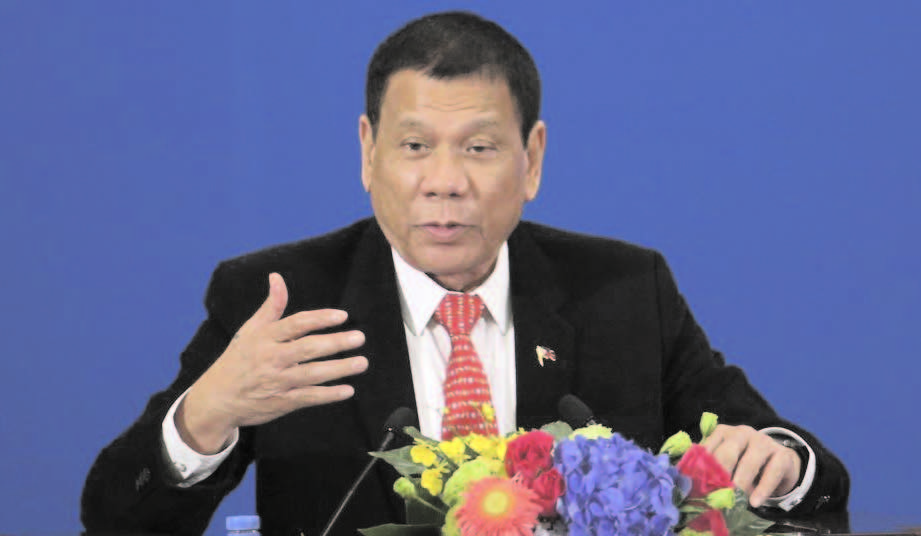
    BEIJING (TIP): Philippines’ President Rodrigo Duterte declared his “separation” from longstanding ally the United States in Beijing on Oct 20, as he rebalances his country’s diplomacy towards China.

    “I announce my separation from the United States,” he said to applause at a meeting in the Chinese capital.

    His comments came after he met his Chinese counterpart Xi Jinping at the Great Hall of the People on Tiananmen Square, with the two men pledging to enhance trust and friendship, while playing down a maritime dispute.

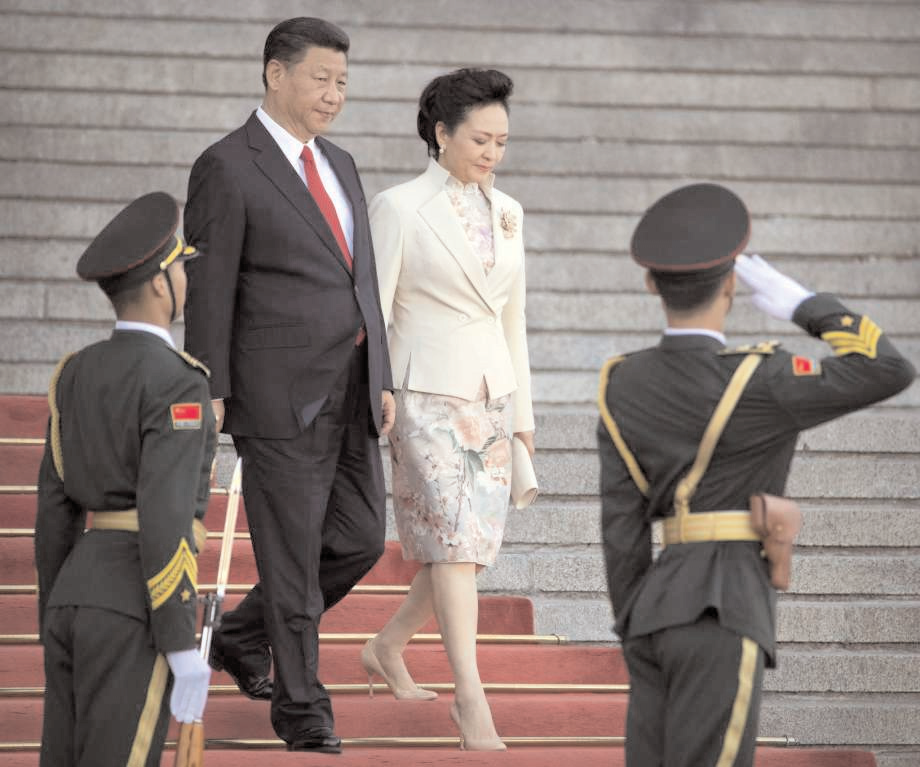
    The two leaders — Duterte donning a suit and tie for the occasion — strode side-by-side down the red carpet inspecting an honour guard, with children cheering.

    Xi called the two countries “neighbours across the sea” with “no reason for hostility or confrontation”, the official Xinhua news agency said.

    Duterte is in China for a four-day trip seen as confirming his tilt away from Washington and towards Beijing’s sphere of influence — and its deep pockets.

    Under Duterte’s predecessor Benigno Aquino the two countries were at loggerheads over the South China Sea –where Beijing has built a series of artificial islands — but since taking office in June the new head of state has changed course.

    The two leaders held “extensive” and “amicable” official talks and oversaw the signing of 13 bilateral cooperation documents on business, infrastructure, and agriculture, among other fields, Chinese foreign ministry spokesperson Hua Chunying said, without giving details.

    In a statement, the foreign ministry cited Xi as telling Duterte their emotional foundation of friendly good neighbourliness was unchanged, and difficult topics of discussion “could be shelved temporarily”.

    Duterte called the meeting “historic”, it added.

    Duterte’s visit to Beijing capped a series of recent declarations blasting the US and President Barack Obama.

    Addressing the Filipino community in Beijing on Wednesday, the firebrand leader said the Philippines had gained little from its long alliance with the US, its former colonial ruler.

    “Your stay in my country was for your own benefit. So time to say goodbye, my friend,” he said, as if addressing the US.

    He also repeated his denunciation of Obama as a “son of a whore”.

    China, he said earlier, was “good”. “It has never invaded a piece of my country all these generations.”

    Duterte has also suspended joint US-Philippine patrols in the strategically vital South China Sea, and has threatened an end to joint military exercises.

    The South China Sea is of intense interest to Washington and it has repeatedly spoken out on the various territorial disputes between China and its neighbours over the waters.

    Tensions have risen between the US and China over Washington’s so-called “pivot” to the Asia-Pacific, a move that Beijing says is intended to contain it.

    In 2012, China seized control of Scarborough Shoal, a fishing ground in the Philippines’ exclusive economic zone.

    In a case brought by Aquino, the Philippines won a resounding victory at an international tribunal earlier this year over Beijing’s extensive territorial maritime claims in the area, infuriating the Asian giant.

    But Duterte, who took office in June shortly before the tribunal ruling, has made a point of not flaunting the outcome.

    Asked whether the leaders had discussed the South China Sea, the foreign ministry’s Hua said they had a “candid and friendly exchange of views on how to resolve relevant disputes”.

    Their meeting represented a “return to the right track of dialogue and consultation” she said, adding China was willing to make “relevant arrangements” to cooperate on fishery issues. (AFP)