Tag: Romania

  • Ambassador Mohapatra Strengthens India–Romania Partnerships Through Engagements in Cluj-Napoca Across Industry, Academia, and Community

    Ambassador Mohapatra Strengthens India–Romania Partnerships Through Engagements in Cluj-Napoca Across Industry, Academia, and Community

    BUCHAREST (TIP): Dr. Manoj Kumar Mohapatra, Ambassador of the Republic of India to Romania, embarked on a dynamic series of engagements in Cluj-Napoca, Romania’s vibrant innovation hub, to further solidify bilateral cooperation. These interactions spanned industry, higher education, cultural exchange, and community building, reflecting India’s strategic vision for multifaceted partnerships with Romania amid shared goals of economic resilience, technological advancement, and people-to-people connectivity.

    Ambassador joins Indo-Romanian Forum at Babeș-Bolyai University.

    A highlight was Ambassador Mohapatra’s participation in the Indo-Romanian Forum “Bridging Minds, Markets, and Innovation,” organized by Babeș-Bolyai University (UBB) via UBB Tech Transfer and the Indian Cultural Centre. The forum convened Indian business leaders thriving in Cluj-Napoca-spanning IT, pharma, and startups-with academics from diverse faculties. Participants brainstormed synergies in AI, innovation commercialization, and industry and university collaboration. paving the way for Romanian universities to partner with the industries for internships, job recruitment, and joint research etc, while catalyzing business-academia ecosystems.

    Ambassador visits Emerson Romania for supply chain discussions.

    Reinforcing academic bridges, the Ambassador visited the prestigious Technical University of Cluj-Napoca (UTCN), engaging with Rector Prof. Dr. Vasile Țopa and senior officials overseeing international affairs. Dialogues delved into expanding collaborative research, faculty exchanges, and dual-degree programs, with a focus on student mobility.

    Ambassador meets Brahma Kumaris representatives in Cluj-Napoca.

    Emphasis was placed on drawing Indian talent to UTCN’s acclaimed engineering and IT curricula, potentially through scholarships and joint workshops. This builds on existing ties, positioning Romania as a gateway for Indian students to Europe’s technical ecosystem.

    Ambassador meets UTCN leadership on academic cooperation.

    Ambassador Mohapatra toured Emerson’s state-of-the-art facilities in Romania, a key player in automation and engineering solutions. In productive discussions with company executives, he explored avenues for global supply chain integration, joint industrial ventures, and leveraging Romania’s skilled workforce alongside India’s manufacturing prowess. The facility tour illuminated cutting-edge production lines, underscoring operational excellence and the pivotal role of advanced engineering in fostering resilient, cross-border supply chains. Such collaborations hold immense potential for sectors like renewable energy and digital infrastructure, aligning with India’s “Make in India” initiative and Romania’s industrial ambitions.

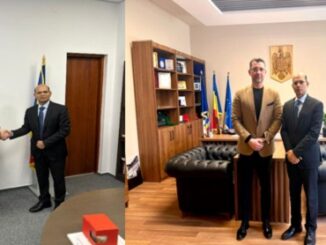
    Ambassador celebrates India’s 77th Republic Day in Cluj with Mayor Emil Boc and Prefect Maria Forna.

    On the cultural front, the Ambassador met with Brahma Kumaris representatives, joined by Ms. Teodora Suhan and Ms. Ioana Goga. Conversations emphasized spiritual dialogue, ethical leadership, and grassroots initiatives to nurture values-based understanding, fortifying the human foundation of India–Romania relations. Culminating the visit, Ambassador Mohapatra celebrated India’s 77th Republic Day with the local Indian community, graced by Mayor Mr. Emil Boc and Prefect Ms. Maria Forna. Joyful performances of classical dance, music, and patriotic tributes celebrated India’s democratic ethos, strengthening diaspora integration and societal bonds.

    Ambassador celebrates India’s 77th Republic Day in Cluj with Indian community.

    These initiatives exemplify the accelerating trajectory of India–Romania relations, anchored in democratic solidarity, burgeoning trade (nearing €1 billion annually), academic excellence, and cultural vibrancy. They signal India’s resolve to forge sustainable frameworks that propel mutual prosperity, innovation, and a shared role in global affairs.

    (Based on a press release issued by the Embassy of India in Bucharest)

  • India-Romania Economic Partnership Advances

    India-Romania Economic Partnership Advances

    Ambassador Mohapatra Engages Arad County Leaders on Investment Opportunities in Strategic Special Economic Zone

    BUCHAREST (TIP): Dr. Manoj Kumar Mohapatra, Ambassador of India to Romania, visited Arad County of Romania and met with key Arad County officials, including Mr. Iustin Cionca, President of Arad County Council, Mr. Glad Varga, Senator of Arad, and Mr. Ionescu Aurel, Vice President of Arad Chamber of Commerce. The dialogue underscored the mutual resolve to deepen economic cooperation, harnessing Arad’s unique advantages to attract Indian investments and foster bilateral trade growth.

    Ambassador Dr. Manoj Kumar Mohapatra and Mr. Iustin Cionca, President of Arad County Council.

    Arad occupies a pivotal geographical position in western Romania, bordering Hungary and serving as a critical node along Pan-European Transport Corridor IV, which links major European hubs from Germany through Hungary to Turkey. This connectivity, coupled with excellent rail and road infrastructure, including proximity to Timișoara International Airport and the Port of Constanța on the Black Sea, renders Arad an ideal logistics and manufacturing base for Indian companies seeking efficient entry into the European Union market. The Arad Special Economic Zone (SEZ), equipped with modern facilities, tax incentives, and streamlined regulations, further amplifies these benefits, positioning it as a prime destination for sectors like automotive components, electronics, textiles, and renewable energy equipment where Indian firms excel.

    President of Arad County Council presenting a reproduction of “The Burial of Christ” to Ambassador.

    India and Romania enjoy a multifaceted bilateral relationship rooted in shared democratic values, historical goodwill, and expanding economic synergy. Diplomatic ties, elevated through frequent high-level visits and the 19th India-Romania Joint Committee Meeting on Economic Cooperation, have propelled trade volumes beyond €1 billion annually, with robust growth in IT services, pharmaceuticals, infrastructure projects, and defense collaboration. Cultural exchanges, such as Diwali celebrations and Hindi language promotions in Romania, complement these efforts, while emerging domains like artificial intelligence, green hydrogen, and sustainable agriculture hold immense untapped potential. This partnership aligns with both India’s and Romania’s resolve for greater partnerships, creating win-win opportunities for mutual prosperity.

    In a key outcome, Ambassador Mohapatra extended an official invitation for a delegation led by President Cionca to visit India, enabling direct interactions with Indian business leaders and government stakeholders. The parties committed to hosting a targeted Business-to-Business (B2B) forum in the second half of January or early February 2026. During this event, Arad representatives will present tailored opportunities within the SEZ to Indian companies expressing keen interest in Romanian investments, emphasizing local supply chain integration, skilled workforce availability, and EU-compliant manufacturing capabilities.

    Ambassador met Dr. Nilima Rajpal Kundnani, a local community leader in Timisoara.

    This engagement exemplifies the dynamic momentum in India-Romania relations, promising job creation, technology transfer, and innovation-driven growth. It reinforces Arad’s role as a bridge for Indian enterprises into Europe, while advancing Romania’s appeal as a reliable partner for India’s global ambitions.
    Separately, the Ambassador visited injured Indian national Mr. Rakesh Kumar, who is undergoing treatment at Casa Austria Hospital, and interacted with both the patient and the attending doctors. The Ambassador conveyed his best wishes to Mr. Kumar and wished him a speedy recovery.
    The Ambassador also met with Dr. Nilima Rajpal Kundnani, a local Indian community leader, to discuss proposed plans and activities for 2026, with particular emphasis on the welfare of the Indian community in Timișoara. The discussions focused on strengthening community support mechanisms, promoting cultural and social initiatives, and enhancing engagement between the Embassy and the Indian diaspora. Views were exchanged on organizing cultural events, community programs, and collaborative activities in 2026 aimed at promoting Indian culture and supporting the well-being and integration of the Indian community in Timișoara.
    (Based on a Press Release by the Embassy of India in Bucharest, Romania)

  • Strengthening India-Romania Economic and Technology Partnerships

    Strengthening India-Romania Economic and Technology Partnerships

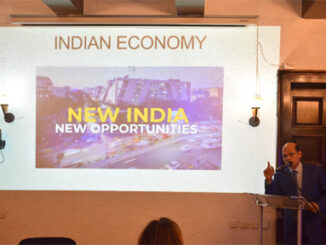
    BUCHAREST (TIP): In a key highlight last week, the Embassy hosted prominent Romanian business leaders for a special presentation on India’s rising economy, delivered by Mr. Bhuvnesh Kumar, Deputy Secretary, Department for Promotion of Industry and Internal Trade (DPIIT), Ministry of Commerce and Industry. Ambassador Manoj Kumar Mohapatra delivered the opening remarks, underscoring India’s dynamic growth trajectory, projected at over 7% GDP growth in 2025, followed by an interactive Q&A session. The event advanced discussions on trade, investment, and collaboration opportunities between the two nations.

    Mr. Bhuvnesh Kumar, Deputy Secretary, Department for Promotion of Industry and Internal Trade spoke about the GDP growth of India over the years

    ICC Country Head Mr. Gheorghe Dinu, Mr. Naimish Kumar Patel from Dimar Recruitment & Immigration Services, Mr. Morten Reimers of Falcon Defense, and Ms. Adriana Radu of RIZ highlighted emerging opportunities for Romanian companies to engage with the Indian market. These partners played a pivotal role in fostering stronger India-Romania business ties.

    Ambassador conducted an interactive question-and-answer session.

    Spotlight on IT & ITES Collaboration: A Strategic Pillar of Bilateral Growth

    Complementing this initiative, the Embassy, in collaboration with the Federation of Indian Chambers of Commerce & Industry (FICCI) and the Electronics and Computer Software Export Promotion Council, successfully organized a Business-to-Business (B2B) Meeting focused on Information Technology and Communications (IT&C), including IT Enabled Services (ITES). The event brought together over more than 100 leading Indian and Romanian companies, creating a dynamic platform for interaction, knowledge exchange, and the exploration of new partnership opportunities.

    ICC Country Head Mr. Gheorghe Dinu spoke about the opportunities for Romanian companies to engage with the Indian market.

    The India-Romania IT & ITES partnership has evolved naturally from shared strengths. India’s global leadership in software exports and its vast talent pool of over 5 million IT professionals complement Romania’s highly skilled workforce of 200,000+ IT specialists and its position as one of Europe’s fastest-growing technology hubs. This synergy has already delivered tangible results.

    Mr. Naimish Kumar Patel from Dimar Recruitment & Immigration Services spoke about opportunities for Romanian companies to engage with the Indian market.

    Indian companies operating in Romania, including Tata Consultancy Services (TCS), Infosys, Wipro, and HCL Technologies, have generated over 10,000 high-quality jobs for Romanian professionals as of 2025, primarily in cities such as Bucharest, Cluj-Napoca, and Timișoara. These roles span software development, cybersecurity, cloud computing, artificial intelligence, and BPO services, contributing significantly to Romania’s economy through direct employment, skill development, and technology transfer.

    Mr. Morten Reimers of Falcon Defense spoke about opportunities for Romanian companies to engage with the Indian market.

    The B2B meeting further amplified these achievements by facilitating targeted matchmaking sessions, enabling participants to identify immediate opportunities in AI-driven solutions, digital transformation projects, and nearshoring services for EU markets.

    Ms. Adriana Radu of RIZ spoke about opportunities for Romanian companies to engage with the Indian market.

    Future Horizons: Building Momentum Towards India’s AI Summit and Localized Initiatives

    These engagements serve as important lead-up activities to the Government of India’s landmark AI Summit, scheduled for February 2026. This flagship national event will bring together global leaders, innovators, and policymakers to shape ethical AI governance, promote inclusive deployment, and advance transformative applications across sectors, closely aligning with shared India-Romania priorities in IT and ITES.

    Attendees at the B2B Meeting.

    Building on this momentum, the Embassy of India plans to organize “AI for All” Conferences in key Romanian technology hubs: Brașov on January 14, 2026, and Timișoara in the first week of February 2026. Organized in association with leading Indian companies such as Global Logitech and Wipro, these events will focus on democratizing access to AI, fostering hands-on workshops, and exploring collaborative R&D in areas including AI ethics, healthcare applications, and smart cities.

    Ambassador Dr. Manoj Kumar Mohapatra at the IT&C event held at the embassy spoke about India’s development in the industry.

    By convening local startups, universities, and industry experts, these conferences aim to accelerate technology transfer, strengthen bilateral talent pipelines, and position Romania as a co-innovation partner within India’s expanding AI ecosystem.

    FICCI highlighted their reach on a global level.

    These initiatives underscore the shared commitment of India and Romania to deepening economic and technological cooperation, leveraging India’s growth momentum and Romania’s strategic position within Europe. The Embassy remains fully committed to nurturing these partnerships to ensure sustained and mutually beneficial prosperity.

    (Based on a Press Release issued by the Embassy of India in Bucharest)


  • India’s Ambassador to Romania Dr. Manoj Kumar Mohapatra visits Suceava to Promote Regional Level Cooperation

    India’s Ambassador to Romania Dr. Manoj Kumar Mohapatra visits Suceava to Promote Regional Level Cooperation

    BUCHAREST (TIP): Ambassador Dr. Manoj Kumar Mohapatra undertook an extensive visit to Suceava County from 10 to 12 December 2025, aimed at deepening India-Romania cooperation at the regional level across political, economic, academic, and people-to-people domains. The visit underscored India’s strong commitment to strengthening partnerships beyond capital cities and engaging meaningfully with Romanian regions of strategic importance.

    Engagement with Regional Authorities

    Ambassador Mohapatra met Mr. Gheorghe Șoldan, President of the County Council, and Mr. Traian Andronachi, Prefect of Suceava County, for constructive discussions on enhancing bilateral cooperation, with particular emphasis on regional engagement. The talks focused on expanding institutional linkages and economic collaboration. The Ambassador extended an invitation to the Council President to lead a delegation to India to explore concrete partnership opportunities.

    Ambassador Dr .Manoj Kumar Mohapatra meeting with Prof. Mihai Dimian, Rector of “Ștefan cel Mare” University of Suceava.

    In a separate meeting, Ambassador Mohapatra met Mr. Vasile Cărăre, Mayor of Milișăuți, and expressed India’s deep appreciation for the town’s exemplary humanitarian support during the early days of the Russia-Ukraine conflict. Milișăuți had provided shelter and assistance to thousands of Indian nationals, including students. This gesture of solidarity was warmly acknowledged as a lasting symbol of friendship between the peoples of India and Romania. The Ambassador extended an invitation to the Mayor to visit India. Ambassador also met Mr. Vasile Rîmbu, Mayor of Suceava, and Mr. Dan Ioan Cusnir, Deputy Mayor, to discuss avenues for strengthening ties between India and the Suceava region. The discussions highlighted opportunities in trade, investment, education, and cultural exchanges. 

    Academic and Educational Cooperation

    A key highlight was the Ambassador’s engagement with “Ștefan cel Mare” University of Suceava. He met Prof. Mihai Dimian, Rector of the University, for productive discussions on expanding academic cooperation, institutional partnerships, and student exchanges between Indian and Romanian universities. Both sides reaffirmed their shared commitment to strengthening educational ties as a cornerstone of long-term bilateral relations. Ambassador Mohapatra also visited the university campus and addressed students and faculty alongside Rector Prof. Mihai Dimian and Prefect Traian Andronachi. In his address, he spoke about India’s global outlook, rapid economic growth, innovation ecosystem, emerging opportunities for Romanian partners, and India’s leadership in new and emerging technologies, including the forthcoming AI Summit. The interaction generated keen interest among students in India’s education, technology, and research landscape.

    Ambassador Dr. Manoj Kumar Mohapatra visited Ștefan cel Mare University of Suceava and addressed students alongside Rector Prof. Mihai Dimian and Prefect Traian Andronachi.

    Economic and Business Outreach 

    As part of India’s economic diplomacy, Ambassador Mohapatra addressed members of the In-Business Club Suceava. He highlighted India’s robust economic performance, with projected GDP growth of over 7% in FY 2025–26, and outlined opportunities for Romanian companies to invest in, source from, and partner with India. He elaborated on priority sectors such as digital transformation, renewable energy, pharmaceuticals, infrastructure, electronics, and advanced manufacturing, while spotlighting flagship initiatives like Make in India, PLI schemes, and the India–EU Trade and Technology Council.

    Ambassador Dr. Manoj Kumar Mohapatra meeting with Mr. Vasile Rîmbu, Mayor of Suceava, and Mr. Dan Ioan Cusnir Deputy Mayor of Suceava.

    The meeting drew active participation from leading Romanian companies, including Carpatis & Fabrica Veche, Ecooptic, Avastar România, Spălătoria din Cartier, Fiziomed, Amis, Denis, Office Consulting, AGN, and Fusion, among others. These firms expressed strong interest in organizing business visits to India to scout investment prospects, participate in trade fairs, and engage with Indian counterparts. The event aligns with the upward trajectory of India-Romania relations, where bilateral trade has surged by over 20% in recent years, reaching new milestones. The Ambassador encouraged Romanian businesses to explore India’s dynamic, innovation-driven market and build long-term partnerships.

    Ambassador Dr. Manoj Kumar Mohapatra participating in an event held by In Business Club Suceava.

    In a separate engagement, Ambassador Mohapatra met Mr. Dumitru Mihalescu, Founder of Marelvi, Romania’s largest electronics distributor. The discussions focused on strengthening commercial ties and exploring new opportunities in electronics and technology sectors. The Ambassador also met Mr. Nicolae Troase, President, and Mr. Lucian Gheorghiu, Executive President, of the Chamber of Commerce and Industry of Suceava. He invited them to lead a business delegation to India and emphasized Suceava’s strategic location and its potential role in Ukraine’s future reconstruction, an area where Indian companies have expressed growing interest.

    Ambassador Dr. Manoj Kumar Mohapatra meeting with Mr. Dumitru Mihalescu, founder of Marelvi.
    Ambassador Dr. Manoj Kumar Mohapatra meeting with Mr. Vasile Cărăre, Mayor of Milișăuți.

    Ambassador’s visit to Suceava featured high-level political engagement, strong academic outreach, and focused economic diplomacy. It significantly reinforced India–Romania relations at the regional level and laid the groundwork for concrete follow-up in trade, education, technology, and humanitarian cooperation. Suceava’s strategic relevance and positive disposition toward India position it as an important partner in advancing bilateral and trilateral ties in the years ahead.

    (Based on a Press Release issued by the Indian Embassy in Bucharest)

    Ambassador Dr. Manoj Kumar Mohapatra meeting with Mr. Nicolae Troase, President, and Mr. Lucian Gheorghiu, Executive President of the Suceava Chamber of Commerce.
  • Embassy of India in Romania Hosts Interactive Session on “New India, New Opportunity” to Promote MSME Collaboration and Sectoral Partnerships with Romania

    Embassy of India in Romania Hosts Interactive Session on “New India, New Opportunity” to Promote MSME Collaboration and Sectoral Partnerships with Romania

    BUCHAREST (TIP): A belated news report says that the Embassy of India in Bucharest organized a focused interaction titled “New India, New Opportunity” for leading Romanian business journalists and key economic stakeholders on 26 November 2025. The event highlighted India’s dynamic economic transformation, its robust MSME ecosystem, and the expanding avenues for India-Romania collaboration across priority sectors.

    Ambassador Dr. Manoj Kumar Mohapatra delivered the keynote address and underscored the core pillars driving New India’s growth story, wide-ranging economic reforms, rapid digitalization, innovation-led development, strengthened manufacturing capabilities, and a strong commitment to inclusive and sustainable progress. He also highlighted the Government of India’s long-term vision of Viksit Bharat @2047, outlining India’s aspirations to become a developed nation empowered by technology, entrepreneurship, and global partnerships.

    The Ambassador also emphasized the far-reaching labor reforms undertaken by India recently, noting that a comprehensive modernization of labor laws has been implemented through the consolidation of 29 central labor legislations into four simplified and industry-friendly Labor Codes. These reforms aim to create a more predictable and transparent regulatory ecosystem, enhance worker welfare and social security, promote ease of doing business, and support the growth of MSMEs and manufacturing industries. By introducing provisions for flexible work arrangements, streamlined compliance, and stronger protections for gig and platform workers, India is building a labor environment that encourages investment, boosts productivity, and aligns with global best practices. The Ambassador underlined that these reforms open new opportunities for Romanian companies seeking stable, skilled, and future-ready human capital partnerships in India.

    The event was attended by the leading Romanian business journalists and key economic stakeholders.

    A central focus of the interaction was India’s MSME sector, one of the world’s largest and most vibrant networks of micro, small, and medium enterprises. The Ambassador spoke about the sector’s expanding role in manufacturing, exports, innovation, and employment generation. He invited Romanian businesses and investors to explore opportunities in co-production, technology partnerships, trade diversification, supply chain linkages, and digital MSME solutions. He noted that India’s business-friendly reforms, unified digital platforms, and sector-specific incentives under schemes like Make in India, Start-up India, and the Production-Linked Incentive (PLI) framework have made India an increasingly attractive destination for economic engagement.

    During the session, the Ambassador also briefed participants on India’s resilient macroeconomic performance, which continues to make it one of the world’s fastest-growing major economies. He outlined emerging opportunities for bilateral cooperation in areas such as renewable energy, IT & digital technologies, pharmaceuticals, manufacturing, film & creative industries, agriculture, and clean-tech solutions.

    As part of the engagement, he further highlighted two major global events hosted by India:

    (i) 56th International Film Festival of India (IFFI), Goa from 20–28 November 2025: A platform for global filmmakers, including from Romania, to collaborate in co-productions, film technology, content development, and creative partnerships, strengthening cultural and creative industry linkages.

    (ii) India–AI Impact Summit 2026 from 16–20 February 2026: A premier forum bringing together global experts, industry leaders, and innovators to deliberate on AI-driven opportunities in manufacturing, MSMEs, governance, and emerging technologies.

    Group photo : Interactive Session on “New India, New Opportunity” to Promote MSME Collaboration and Sectoral Partnerships with Romania.

    The interaction served as an important platform for forty plus Romanian media representatives and sectoral stakeholders to gain first-hand insights into India’s transformative governance, economic reforms, and rising opportunities for bilateral trade and investment. It reaffirmed India’s commitment to working closely with Romania to deepen cooperation in MSMEs, technology, innovation, culture, and people-to-people ties.

    The event concluded with a dynamic Q&A session featuring thoughtful questions from Romanian business journalists on India’s reform agenda, investment policies, digital economy, and global partnerships. The Embassy appreciates the active participation of all stakeholders and looks forward to continued engagement in advancing India–Romania economic and sectoral collaboration.

    (Based on a Press Release Issued by the Embassy of India in Bucharest)

  • Dr. Manoj Kumar Mohapatra designated India’s Ambassador to Romania

    Dr. Manoj Kumar Mohapatra designated India’s Ambassador to Romania

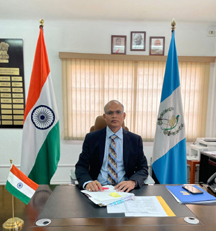
    NEW YORK (TIP): Ambassador Dr. Manoj Kumar Mohapatra, currently India’s Ambassador to Guatemala, El Salvador and Honduras, has been designated Ambassador to Romania. He is expected to take charge in mid-July.

    Dr. Mohapatra is a 2000 batch Indian Foreign Service (IFS) officer. He was posted as the Ambassador of India to Guatemala in December 2021. His earlier postings have been Minister (Commerce), Embassy of India, Washington, July 2019-2021; Joint Secretary, Ministry of External Affairs, New Delhi, 2017-2019; Deputy Consul General, Consulate General of India, New York, 2014-2017; Counsellor, Embassy of India, Dhaka, 2013-2014; First Secretary, Embassy of India, Dhaka, 2011-2013; First Secretary, Embassy of India, Budapest, 2007-2011; Under Secretary handling relations with Bangladesh in Ministry of External Affairs, 2006- 2007; Third Secretary / Second Secretary, Embassy of India, Berlin, 2002-2006. Dr. Mohapatra holds a master’s in veterinary science (M.V.Sc.) and a Post Graduate Diploma in Business Management (PGDIBM).

    He is married to Mrs. Jyotirmayee Mohapatra, and they have two Children, Ms. Suhani Mohapatra and Rohan Mohapatra. Ambassador Mohapatra likes reading and travelling.

  • Teenager Pranav Anand is India’s 76th Grandmaster

    Teenager Pranav Anand is India’s 76th Grandmaster

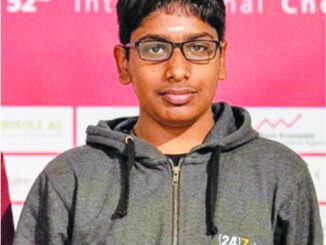
    Bengaluru teenager Pranav Anand became India’s 76th Grandmaster after he crossed the 2,500 Elo mark in the ongoing World Youth Chess Championship in Mamaia, Romania. The 15-year-old, having met the other requirements that are necessary for a GM title, achieved the honour late on Thursday, September 16. To become a GM, a player has to secure three GM norms and cross the live rating of 2,500 Elo points. Anand had scored the third and final GM norm at the 55th Biel Chess Festival in Switzerland in July.

    “He is passionate towards chess. Extremely interested and passionate towards the game. He can work for any number of hours,” Anand’s coach V Saravanan said. “He is especially good in calculation and end games…they are his two biggest strengths right now,” Saravanan said, while referring to his ward’s ninth-round win in the Under-16 section of the World Youth Chess Championship 2022. Anand had secured his third and final GM norm by drawing his game against GM Eduardo Iturrizaga Bonelli (2619) in the penultimate round.

                    Source: PTI

  • Quo Vadis, Mother Russia?

    Quo Vadis, Mother Russia?

    By Patrick J. Buchanan

    “During some of the coldest days of the Cold War, U.S. presidents like Dwight Eisenhower, Richard Nixon and Ronald Reagan sought to find common ground on which to stand with Russia to avoid conflict. Ike invited the “Butcher of Budapest,” Nikita Khrushchev, for a 12-day U.S. visit in 1959. Nixon initiated a “detente” with Leonid Brezhnev, who had ordered the Warsaw Pact to crush the “Prague Spring” in 1968. Reagan and Mikhail Gorbachev negotiated the dismantling of an entire class of nuclear weapons in the 1987 Intermediate-Range Nuclear Forces treaty.”

    Where does Mother Russia go from here?  Bitter at their losses in the Cold War and post-Cold War years, many Russian nationalists are urging the regime to align with today’s great power antagonist of the United States, Xi Jinping’s China.

    “The demise of the Soviet Union was the greatest geopolitical catastrophe of the century,” said Russia’s new ruler Vladimir Putin in his 2005 state of the nation address.

    “As for the Russian people,” Putin went on, “it became a genuine tragedy. Tens of millions of our fellow citizens and countrymen found themselves beyond the fringes of Russian territory.”

    From Putin’s standpoint, the statement was then and remains today understandable.

    Consider. When Putin entered his country’s secret service, Berlin was 110 miles deep inside a Soviet-occupied East Germany. Poland, Czechoslovakia, Hungary, Romania and Bulgaria were member states of the Warsaw Pact.

    Lithuania, Latvia and Estonia were republics of the USSR. Ukraine was the most populous and ethnically closest of the Soviet republics to Russia itself.

    And today? Berlin is the capital of a united, free and democratic Germany, a member of NATO, that is beginning a rearmament campaign triggered by Putin’s invasion of Ukraine.

    Poland, the Czech Republic, Slovakia, Hungary, Romania and Bulgaria are members of the U.S.-led North Atlantic Treaty Organization.

    Former Soviet republics Lithuania, Latvia and Estonia are also members of that Western alliance established to contain Russia.

    Sweden and Finland, neutral through the Cold War, are applying for membership in NATO.

    Ukraine, backed by the U.S. and NATO, is fighting a war to push the Russian army out of its territory, a war that has the support of almost every country on the continent of Europe.

    Even the falls of the British and French empires at the end of World War II do not match as geo-strategic disasters the collapse of the Soviet Empire and breakup of the Soviet Union since the end of the Cold War.

    How goes the Russian war in Ukraine launched on Feb. 24?

    Russia has enlarged the territory it controls in Crimea and its Luhansk and Donetsk enclaves in the Donbas. And now, with the fall of Mariupol, Moscow controls the entire Sea of Azov and has completed its land bridge from Russia to Crimea. But Russia has failed to capture and been forced by the Ukrainian army to retreat from Kyiv and Kharkiv, the largest cities in Ukraine, and Putin has seen his forces humiliated again and again. Yet, withal, Russia today remains a great power.

    The largest nation on earth with twice the territory of the U.S., Russia has the world’s largest nuclear arsenal and exceeds the U.S. and China in tactical nuclear weapons. It has vast tracks of land and sits on huge deposits of minerals, coal, oil and gas.

    But Russia also has glaring weaknesses and growing vulnerabilities.

    While Putin has built up impressive forces in the Arctic, the Baltic Sea, with Finland and Sweden joining the Western alliance, is becoming a NATO lake. Russian warships sailing out of St. Petersburg to the Atlantic have to traverse the coastal defenses of 11 present or future NATO nations: Finland, Estonia, Latvia, Lithuania, Sweden, Poland, Germany, Denmark, Norway, Britain and France.

    Among the questions that Russia, shrunken in so many ways from the great U.S. rival of the Cold War it once was, must answer is, “Quo Vadis?”

    Where does Mother Russia go from here?

    Bitter at their losses in the Cold War and post-Cold War years, many Russian nationalists are urging the regime to align with today’s great power antagonist of the United States, Xi Jinping’s China.

    This is a recipe for a Second Cold War, but how would that war avail the Russian nation and its people?

    In any Russia-China alliance, there is no doubt who will be senior partner. And it is not the U.S. that covets and wishes one day to control the resources of Russia from Novosibirsk to the Bering Sea. China’s population of 1.4 billion people is 10 times Russia’s. East of the Urals, China’s population is 50 to 100 times the size of Russia’s in Siberia and the Far East. What of a U.S.-Russia detente as Moscow’s future rather than Cold War II?

    During some of the coldest days of the Cold War, U.S. presidents like Dwight Eisenhower, Richard Nixon and Ronald Reagan sought to find common ground on which to stand with Russia to avoid conflict.

    Ike invited the “Butcher of Budapest,” Nikita Khrushchev, for a 12-day U.S. visit in 1959. Nixon initiated a “detente” with Leonid Brezhnev, who had ordered the Warsaw Pact to crush the “Prague Spring” in 1968. Reagan and Mikhail Gorbachev negotiated the dismantling of an entire class of nuclear weapons in the 1987 Intermediate-Range Nuclear Forces treaty. Given the hostility Putin has generated by his invasion of Ukraine, Western leaders may be unable to bring Russia in from the cold. But if we isolate Russia, push it out of the West, Moscow has only one direction in which to go — east, to China.

    In 230 years, the United States has never gone to war with Russia. Not with the Romanovs nor with the Stalinists, not with the Cold War Communists nor with the Putinists.

    U.S. vital interests dictate that we maintain that tradition.

     (Patrick Joseph Buchanan is a political commentator, columnist, politician and broadcaster)

  • Did We Provoke Putin’s War in Ukraine?

    Did We Provoke Putin’s War in Ukraine?

    By Patrick J. Buchanan

    “President Joe Biden almost hourly promises, “We are not going to war in Ukraine.” Why would he then not readily rule out NATO membership for Ukraine, which would require us to do something Biden himself says we Americans, for our own survival, should never do: go to war with Russia?”

    “Whatever we may think of Putin, he is no Stalin. He has not murdered millions or created a gulag archipelago. Nor is he “irrational,” as some pundits rail. He does not want a war with us, which would be worse than ruinous to us both. Putin is a Russian nationalist, patriot, traditionalist and a cold and ruthless realist looking out to preserve Russia as the great and respected power it once was and he believes it can be again.”

    When Russia’s Vladimir Putin demanded that the U.S. rule out Ukraine as a future member of the NATO alliance, the U.S. archly replied: NATO has an open-door policy. Any nation, including Ukraine, may apply for membership and be admitted. We’re not changing that. In the Bucharest declaration of 2008, NATO had put Ukraine and Georgia, ever farther east in the Caucasus, on a path to membership in NATO and coverage under Article 5 of the treaty, which declares that an attack on any one member is an attack on all. Unable to get a satisfactory answer to his demand, Putin invaded and settled the issue. Neither Ukraine nor Georgia will become members of NATO. To prevent that, Russia will go to war, as Russia did last night.

    Putin did exactly what he had warned us he would do. Whatever the character of the Russian president, now being hotly debated here in the USA, he has established his credibility. When Putin warns that he will do something, he does it. Thirty-six hours into this Russia-Ukraine war, potentially the worst in Europe since 1945, two questions need to be answered:

    How did we get here? And where do we go from here?

    How did we get to where Russia — believing its back is against a wall and the United States, by moving NATO ever closer, put it there — reached a point where it chose war with Ukraine rather than accepting the fate and future it believes the West has in store for Mother Russia?

    Consider. Between 1989 and 1991, Mikhail Gorbachev let the Berlin Wall be pulled down, Germany be reunited and all the “captive nations” of Eastern Europe go free. Having collapsed the Soviet empire, Gorbachev allowed the Soviet Union to dissolve itself into 15 independent nations. Communism was allowed to expire as the ruling ideology of Russia, the land where Leninism and Bolshevism first took root in 1917. Gorbachev called off the Cold War in Europe by removing all of the causes on Moscow’s side of the historic divide. Putin, a former KGB colonel, came to power in 1999 after the disastrous decadelong rule of Boris Yeltsin, who ran Russia into the ground. In that year, 1999, Putin watched as America conducted a 78-day bombing campaign on Serbia, the Balkan nation that had historically been a protectorate of Mother Russia.

    That year, also, three former Warsaw Pact nations, the Czech Republic, Hungary and Poland, were brought into NATO.

    Against whom were these countries to be protected by U.S. arms and the NATO alliance, the question was fairly asked.

    The question seemed to be answered fully in 2004, when Slovenia, Slovakia, Lithuania, Latvia, Estonia, Romania and Bulgaria were admitted into NATO, a grouping that included three former republics of the USSR itself, as well as three more former Warsaw Pact nations. Then, in 2008, came the Bucharest declaration that put Georgia and Ukraine, both bordering on Russia, on a path to NATO membership. Georgia, the same year, attacked its seceded province of South Ossetia, where Russian troops were acting as peacekeepers, killing some.

    This triggered a Putin counterattack through the Roki Tunnel in North Ossetia that liberated South Ossetia and moved into Georgia all the way to Gori, the birthplace of Stalin. George W. Bush, who had pledged “to end tyranny in our world,” did nothing. After briefly occupying part of Georgia, the Russians departed but stayed as protectors of the South Ossetians.

    The U.S. establishment has declared this to have been a Russian war of aggression, but an EU investigation blamed Georgian President Mikheil Saakashvili for starting the war.

    In 2014, a democratically elected pro-Russian president of Ukraine, Viktor Yanukovych, was overthrown in Kyiv and replaced by a pro-Western regime. Rather than lose Sevastopol, Russia’s historic naval base in Crimea, Putin seized the peninsula and declared it Russian territory. Teddy Roosevelt stole Panama with similar remorse.

    Which brings us to today.

    Whatever we may think of Putin, he is no Stalin. He has not murdered millions or created a gulag archipelago.

    Nor is he “irrational,” as some pundits rail. He does not want a war with us, which would be worse than ruinous to us both. Putin is a Russian nationalist, patriot, traditionalist and a cold and ruthless realist looking out to preserve Russia as the great and respected power it once was and he believes it can be again.

    But it cannot be that if NATO expansion does not stop or if its sister state of Ukraine becomes part of a military alliance whose proudest boast is that it won the Cold War against the nation Putin has served all his life.

    President Joe Biden almost hourly promises, “We are not going to war in Ukraine.” Why would he then not readily rule out NATO membership for Ukraine, which would require us to do something Biden himself says we Americans, for our own survival, should never do: go to war with Russia?

    (The author is a former White House Communications Director. Visit Buchanan.org to read his  articles and books)

  • Britain, US sending planes, troops to deter Russia in the east

    Britain, US sending planes, troops to deter Russia in the east

    BRUSSELS (TIP): Britain said on Oct 26 it will send fighter jets to Romania next year and the United States promised troops, tanks and artillery to Poland in Nato’s biggest military build-up on Russia’s borders since the Cold War.

    Germany, Canada and other Nato allies also pledged forces at a defense ministers meeting in Brussels on the same day two Russian warships armed with cruise missiles entered the Baltic Sea between Sweden and Denmark, underscoring East-West tensions.

    In Madrid, the foreign ministry said Russia had withdrawn a request to refuel three warships in Spain’s North African enclave of Ceuta after Nato allies said they could be used to target civilians in Syria.

    The ships were part of an eight-ship carrier battle group – including Russia’s sole aircraft carrier Admiral Kuznetsov -that is expected to join around 10 other Russian vessels already off the Syrian coast, diplomats said. Nato secretary general Jens Stoltenberg said the troop contributions to a new 4,000-strong force in the Baltics and eastern Europe were a measured response to what the alliance believes are some 330,000 Russian troops stationed on Russia’s western flank near Moscow.

    “This month alone, Russia has deployed nuclear-capable Iskander missiles to Kaliningrad and suspended a weapons-grade plutonium agreement with the United States,” Stoltenberg said, also accusing Russia of continued support for rebels in Ukraine.

    Those ballistic missiles can hit targets across Poland and the Baltics, although Nato officials declined to say if Russia had moved nuclear warheads to Kaliningrad.

    Nato’s aim is to make good on a July promise by Nato leaders to deter Russia in Europe’s ex-Soviet states, after Moscow orchestrated the annexation of the Crimea peninsula in 2014.

    Nato’s plan is to set up four battle groups with a total of some 4,000 troops from early next year, backed by a 40,000-strong rapid-reaction force, and if need be, follow-on forces.

    As part of that, US Secretary of Defense Ash Carter announced a “battle-ready battalion task force” of about 900 soldiers would be sent to eastern Poland, as well as another, separate force equipped with tanks and other heavy equipment to move across eastern Europe. “It’s a major sign of the US commitment to strengthening deterrence here,” Carter said.

    Britain’s Defence Secretary Michael Fallon said Britain would send an 800- strong battalion to Estonia, supported by French and Danish troops, starting from May. The United States wants its troops in position by June. London is also sending Typhoon fighter aircraft to Romania to patrol around the Black Sea, partly in support of Turkey. “Although we are leaving the European Union, we will be doing more to help secure the eastern and southern flanks of Nato,” Fallon said.

    Syrian shadow

    Others Nato allies joined the four battle groups led by the United States, Germany, Britain and Canada to go to Poland, Lithuania, Estonia and Latvia. Canada said it was sending 450 troops to Latvia, joined by 140 military personnel from Italy. Germany said it was sending between 400 and 600 troops to Lithuania, with additional forces from the Netherlands, Norway, Belgium, Croatia and Luxembourg.

  • E-tourist visa scheme extended to 37 more countries

    E-tourist visa scheme extended to 37 more countries

    NEW DELHI (TIP): The central government on Thursday announced the extension of e-Tourist Visa (e-TV) facility to 37 more countries from Friday, a home ministry statement said.

    With this the total count of countries under the scheme will reach 150.

    The 37 more countries included in the e-TV scheme are Albania, Austria, Bosnia & Herzegovina, Botswana, Brunei, Bulgaria, Cape Verde, Comoros, Cote d’lvoire, Croatia, Czech Republic, Denmark, Eritrea, Gabon, Gambia, Ghana, Greece, Guinea, Iceland, Lesotho, Liberia, Madagascar, Malawi, Moldova, Namibia, Romania, San Marino, Senegal, Serbia, Slovakia, South Africa, Swaziland, Switzerland, Tajikistan, Trinidad & Tobago, Zambia and Zimbabwe, the statement said. The facility was launched on November 27, 2014. Sixteen Indian airports have been designated for providing e-TV service. “Since the launch of the service more than 7.50 lakh visas have been issued under the scheme. At present on an average 3,500 e-TVs are being granted daily to foreign nationals,” the statement said.

    Source: IANS

  • Indian American Foundation Pledges $1 Million for Studio at Indiana University’s Jacobs School

    Indian American Foundation Pledges $1 Million for Studio at Indiana University’s Jacobs School

    An Indian American foundation, The Georgina Joshi Foundation Inc., has given a $1 million gift  to Indiana University’s Jacobs School of Music for a state-of-the-art audio recording studio.

    After her untimely death, the parents of Georgina Joshi (above) created a foundation, which recently gifted Indiana University $1 million to help build a state-of-the-art audio recording studio. (Indiana.edu photo)
    After her untimely death, the parents of Georgina Joshi (above) created a foundation, which recently gifted Indiana University $1 million to help build a state-of-the-art audio recording studio. (Indiana.edu photo)

    The new facility, to be named the Georgina Joshi Recording Arts Studio, will be in the extension of the Musical Arts Center, which is under construction on the Bloomington campus.

    “I speak for the entire Indiana University community when saying that we are tremendously grateful to the Joshi family for their continued, visionary support of the Jacobs School of Music,” IU President Michael A. McRobbie said. “Georgina’s incredible life and passion for music will live on through the countless students whose lives and careers will be enhanced as a result of learning made possible by the generous gift to establish the Georgina Joshi Recording Arts Studio.”

    The Georgina Joshi Foundation’s gift will do more than upgrade the school’s technology; it will foster collaborations among students and faculty across the Bloomington campus. The new studio will be a tremendous asset for music students, as well as for those pursuing careers in film production, game design and broadcast journalism, among other areas of study.

    The Georgina Joshi Recording Arts Studio will reside in the extension of the Musical Arts Center that was funded in part by a $44 million grant from Lilly Endowment Inc. as part of the Jacobs School of Music Centennial Project. Conferred in 2007, the MAC extension is the final phase of the grant.

    “Fluency in audio recording and media production are essential skills for today’s musicians,” said Gwyn Richards, dean of the Jacobs School of Music. “Successful musicians must not only master their talent; they must be able to share and promote that talent. Every skill gained and recording made will be a lasting tribute to Georgina Joshi and her passion. We are so very thankful to Louise and Yatish for making this new chapter in the Jacobs School’s history possible.”

    Louise Addicott-Joshi and Yatish Joshi have established an extraordinary philanthropic legacy supporting many causes, including musical education on Indiana University’s Bloomington and South Bend campuses. Louise was honored by the Indiana University Foundation with the Partners in Philanthropy Cornerstone Award in 2014. The couple gave a gift to renovate what was initially a recital hall at IU South Bend’s Ernestine M. Raclin School of the Arts, transforming the space into a performance hall with a state-of-the-art sound system. They also established an international study fellowship endowment and a domestic graduate fellowship fund, both named for their daughter, Georgina.

    “The Georgina Joshi Foundation is proud and honored to continue Louise’s vision of helping students achieve their potential,” said Yatish Joshi, chairman of the Georgina Joshi Foundation. “It was her intent to provide opportunities and experiences so students can carry their aspirations far beyond their years at Indiana University. Early in her days at the Jacobs School of Music, Georgina voiced a need for a recording studio so she and her fellow students could make quality recordings for auditions. Louise continued Georgina’s efforts. We are excited that the Georgina Joshi Recording Arts Studio will help so many people in so many different ways. That would bring joy to Louise and Georgina.”

    In addition to the fellowships, the Georgina Joshi Foundation provided underwriting for IU Opera Theater’s production of “Giulio Cesare” in 2009. In 2008, the Addicott/Joshi family donated two Hamburg Steinway concert grand pianos to the Jacobs School; they are used primarily in Auer Concert Hall. The Georgina Joshi Foundation has also provided support to establish the Georgina Joshi Composition Award, the Georgina Joshi Handelian Performance Series Fund and the Five Friends Master Class Series. The Georgina Joshi Foundation Inc. was established in 2007 to continue the vision of Georgina Joshi’s mother, Louise Addicott-Joshi, by providing educational and career development opportunities for young musicians and to encourage and support public performance of music.

    About Georgina Joshi: A native of Indiana, Georgina Joshi received her bachelor’s degree in music (with honors) from the Royal College of Music, London, where she studied with Eiddwen Harrhy. At the time of her death, she was pursuing a master’s degree in voice at the IU Jacobs School of Music, where she studied with Alan Bennett. While at IU, Joshi appeared as a soloist in Haydn’s “Creation, ” Handel’s “Solomon,” Bach’s  “B-Minor Mass,” Mozart’s “Requiem” and Brahms’ “Deutsches Requiem.” She also appeared in IU Opera Theater productions as Clorinda in “La Cenerentola” and Despina in “Cosi fan Tutte.” An enthusiastic performer, Joshi collaborated with other musicians and groups, including the Catacoustic Consort and The Bath Street Studio, and was a member of the Jacobs School’s ProArte Choir and the Carmel Bach Festival Chorale. Outside the United States, she appeared as a soloist in England, Wales, Romania and Greece.

    The Indiana University Bicentennial Campaign: This gift contributes to IU’s $2.5 billion campaign, For All: The Indiana University Bicentennial Campaign. During the bicentennial campaign, the Georgina Joshi Foundation has donated a total of $4.2 million: $1 million to establish the Five Friends Master Class Series, $1.2 million for the renovation of IU South Bend’s recital hall, $1 million to establish the Georgina Joshi Handelian Performance Fund and $1 million to equip the Georgina Joshi Recording Arts Studio.

    For All: The Indiana University Bicentennial Campaign is taking place on all IU-administered campuses: IU Bloomington, Indiana University-Purdue University Indianapolis, IU East, IU Kokomo, IU Northwest, IU South Bend and IU Southeast. The campaign will conclude in December 2019 to coincide with IU’s bicentennial year celebration in 2020. To learn more about the campaign, its impact and how to participate, visit the campaign’s website, forall.iu.edu.

  • Romania appoints Sorin Campeanu as new interim Prime Minister

    BUCHAREST (TIP): Romania’s President on Nov 5 appointed Education Minister Sorin Campeanu as interim Prime Minister to replace Victor Ponta, who quit following mass anti-government protests sparked by a deadly nightclub fire.

    Klaus Iohannis named Campeanu to lead a temporary administration ahead of talks with political parties on Thursday over forming a new government.

    Ponta quit on Wednesday after a horrific fire at a Bucharest nightclub left 32 people dead, prompting tens of thousands of people to take to the streets demanding a “profound change” in the government as a wave of grief and anger swept the country.

    The venue was not authorised to hold concerts or stage the pyrotechnic display that sparked the fire.

    Many protesters saw last Friday’s tragedy at the Colectiv club as a sign that nothing has changed in one of Europe’s poorest and most corruption-prone nations.

    Ponta himself has been under pressure for weeks over charges of fraud, tax evasion and money laundering that have made him the first Romanian head of government to go on trial.

    He said it was right for top officials to take responsibility over the fire, which sparked a stampede as panicked revellers desperately tried to get out, leaving nearly 200 people injured.

    Ponta’s resignation has failed to stop the protests and some 10,000 demonstrators, most of them young, took to the streets of Bucharest on Thursday, the third night running.

    They were protesting against corruption among the political classes they hold responsible for the nightclub deaths.

  • 2015 Rugby World Cup starts Sep 18

    2015 Rugby World Cup starts Sep 18

    The four-year wait is over for the Rugby Fans who will see the 2015 World Cup where New Zealand will try to defend their title against England, Australia, South Africa, Wales and more, with the 2015 Rugby World Cup lifting off, with an interesting first match.

    2015 Rugby World Cup Schedule – Fixture list, timings, venues and dates of all matches

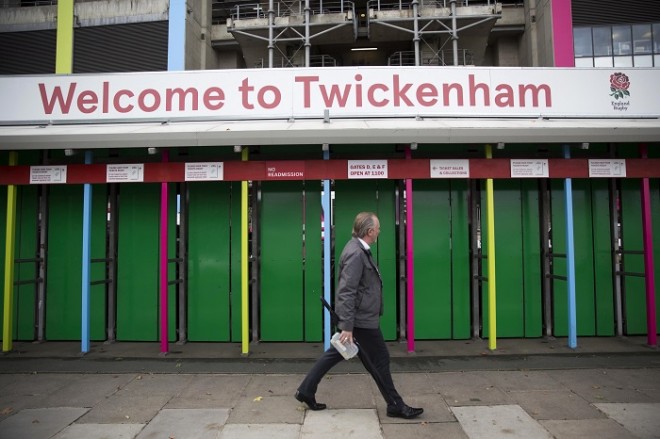
    Friday, September 18: Match 1: Pool A: England vs Fiji (8 pm BST, 12.30 am IST, 3 pm ET) at Twickenham, London.

    Saturday, September 19: Match 2: Pool C: Tonga vs Georgia (12 pm BST, 4.30 pm IST, 7 am ET) at Kingsholm, Gloucester.

    Match 3: Pool D: Ireland vs Canada (2.30 pm BST, 7 pm IST, 9.30 am ET) at Millennium Stadium, Cardiff.

    Match 4: Pool B: South Africa vs Japan (4.45 pm BST, 9.15 pm IST, 11.45 am ET) at Brighton Community Stadium, Brighton.

    Match 5: Pool D: France vs Italy (8 pm BST, 12.30 am IST, 3 pm ET) at Twickenham, London.

    Sunday, September 20: Match 6: Pool B: Samoa vs USA (12 pm BST, 4.30 pm IST, 7 am ET) at Brighton Community Stadium, Brighton.

    Match 7: Pool A: Wales vs Uruguay (2.30 pm BST, 7 pm IST, 9.30 am ET) at Millennium Stadium, Cardiff.

    Match 8: Pool C: New Zealand vs Argentina (4.45 pm BST, 9.15 pm IST, 11.45 am ET) at Wembley, London.

    Wednesday, September 23: Match 9: Pool B: Scotland vs Japan (2.30 pm BST, 7 pm IST, 9.30 am ET) at Kingsholm, Gloucester.

    Match 10: Pool A: Australia vs Fiji (4.45 pm BST, 9.15 pm IST, 11.45 am ET) at Millennium Stadium, Cardiff.

    Match 11: Pool D: France vs Romania (8 pm BST, 12.30 am IST, 3 pm ET) at Queen Elizabeth Olympic Park, London.

    Thursday, September 24: Match 12: Pool C: New Zealand vs Namibia (8 pm BST, 12.30 am IST, 3 pm ET) at Queen Elizabeth Olympic Park, London.

    Friday, September 25: Match 13: Pool C: Argentina vs Georgia (4.45 p BST, 9.15 pm IST, 11.45 am ET) at Kingsholm, Gloucester.

    Saturday, September 26: Match 14: Pool D: Italy vs Canada (2.30 pm BST, 7 pm IST, 9.30 am ET) at Elland Road, Leeds.

    Match 15: Pool B: South Africa vs Samoa (4.45 pm BST, 9.15 pm IST, 11.45 am ET) at Villa Park, Birmingham.

    Match 16: Pool A: England vs Wales (8 pm BST, 12.30 am IST, 3 pm ET) at Twickenham, London.

    Sunday, September 27: Match 17: Pool A: Australia vs Uruguay (12 pm BST, 4.30 pm IST, 7 am ET) at Villa Park, Birmingham.

    Match 18: Pool B: Scotland vs USA (2.30 pm BST, 7 pm IST, 9.30 am ET) at Elland Road, Leeds.

    Match 19: Pool D: Ireland vs Romania 4.45 pm BST, 9.15 pm IST, 11.45 am ET) at Wembley, London.

    Tuesday, September 29: Match 20: Pool C: Tonga vs Namibia (4.45 pm BST, 9.15 pm IST, 11.45 am ET) at Sandy Park, Exeter.

    Thursday, October 1: Match 21: Pool A: Wales vs Fiji (4.45 pm BST, 9.15 pm IST, 11.45 am ET) at Millennium Stadium, Cardiff.

    Match 22: Pool D: France vs Canada (8 pm BST, 12.30 am IST, 3 pm ET) at Stadiummk, Milton Keynes.

    Friday, October 2: Match 23: Pool C: New Zealand vs Georgia (8 pm BST, 12.30 am IST, 3 pm ET) at Millennium Stadium, Cardiff.

    Saturday, October 3: Match 24: Pool B: Samoa vs Japan (2.30 pm BST, 7 pm IST, 9.30 am ET) at Stadiummk, Milton Keynes.

    Match 25: Pool B: South Africa vs Scotland (4.45 pm BST, 9.15 pm IST, 11.45 am ET) at St James’ Park, Newcastle.

    Match 26: Pool A: England vs Australia (8 pm BST, 12.30 am IST, 3 pm ET) at Twickenham, London.

    Sunday, October 4: Match 27: Pool C: Argentina vs Tonga (2.30 pm BST, 7 pm IST, 9.30 am ET) at Leicester City Stadium, Leicester.

    Match 28: Pool D: Ireland vs Italy (4.45 pm BST, 9.15 pm IST, 11.45 am ET) at Queen Elizabeth Olympic Park.

    Tuesday, October 6: Match 29: Pool D: Canada vs Romania (4.45 pm BST, 9.15 pm IST, 11.45 am ET) at Leicester City Stadium, Leicester.

    Match 30: Pool A: Fiji vs Uruguay (8 pm BST, 12.30 am IST, 3 pm ET) at Stadiummk, Milton Keynes.

    Wednesday, October 7: Match 31: Pool B: South Africa vs USA (4.45 pm BST, 9.15 pm IST, 11.45 am ET) at Queen Elizabeth Olympic Park, London.

    Match 32: Pool C: Namibia vs Georgia (8 pm BST, 12.30 am IST, 3 pm ET) at Sandy Park, Exeter.

    Friday, October 9: Match 33: Pool C: New Zealand vs Tonga (8 pm BST, 12.30 am IST, 3 pm ET) at St James’ Park, Newcastle.

    Saturday, October 10: Match 34: Pool B: Samoa vs Scotland (2.30 pm BST, 7 pm IST, 9.30 am ET) at St James’ Park, Newcastle.

    Match 35: Pool A: Australia vs Wales (4.45 pm BST, 9.15 am IST, 11.45 am ET) at Twickenham, London.

    Match 36: Pool A: England vs Uruguay (8 pm BST, 12.30 am IST, 3 pm ET) at Manchester City Stadium, Manchester

    Sunday, October 11: Match 37: Pool C: Argentina vs Namibia (12 pm BST, 4.30 pm IST, 7 am ET) at Leicester City Stadium, Leicester.

    Match 38: Pool D: Italy vs Romania (2.30 pm BST, 7 pm IST, 9.30 am ET) at Sandy Park, Exeter.

    Match 39: Pool D: France vs Ireland (4.45 pm BST, 9.15 pm IST, 11.45 am ET) at Millennium Stadium, Cardiff.

    Match 40: Pool B: USA vs Japan (8 pm BST, 12.30 am IST, 3 pm ET) at Kingsholm, Gloucester.

    Quarterfinals: Saturday, October 17: Match 41: QF1: Winner Pool B vs Runner-up Pool A (4 pm BST, 8.30 pm IST, 11 am ET) at Twickenham, London.

    Match 42: QF2: Winner Pool C vs Runner-up Pool D (8 pm BST, 12.30 am IST, 3 pm ET) at Millennium Stadium, Cardiff.

    Sunday, October 18: Match 43: QF3: Winner Pool D vs Runner-up Pool C (1 pm BST, 5.30 pm IST, 8 am ET) at Millennium Stadium, Cardiff.

    Match 44: QF4: Winner Pool A vs Runner-up Pool B (4 pm BST, 8.30 pm IST, 11 am ET) at Twickenham, London.

    Semifinals: Saturday, October 24: Match 45: SF1: Winner QF1 vs Winner QF2 (4 pm BST, 8.30 pm IST, 11 am ET) at Twickenham, London.

    Sunday, October 25: Match 46: SF2: Winner QF3 vs Winner QF4 (4 pm BST, 8.30 pm IST, 11 am ET) at Twickenham, London.

    Friday, October 30: Third-place Playoff: Match 47: Loser SF1 vs Loser SF2 (8 pm BST, 12.30 am IST, 3 pm ET) at Queen Elizabeth Olympic Park, London.

    Saturday, October 31: Final: Match 48: Winner SF1 vs Winner SF2 (4 pm BST, 8.30 pm IST, 11 am ET) at Twickenham, London.

  • Rain delays Serena Williams’s quest for Grand Slam history

    Rain delays Serena Williams’s quest for Grand Slam history

    NEW YORK (TIP): Two triumphs from completing a calendar Grand Slam, top-ranked defending champion Serena Williams was confronted Thursday at the US Open by an opponent even she cannot defeat — rain.

    US Tennis Association officials postponed the two scheduled women’s semi-final matches to Friday due to forecasts of rain Thursday lasting through the night.

    Top-ranked defending champion Williams now will play Italy’s 43-ranked Roberta Vinci in Friday’s second semi-final after Romania’s second-ranked Simona Halep faces Italian 26th seed Flavia Pennetta in the opener at Arthur Ashe Stadium starting at 11 a.m. (1500 GMT).

    The winners will meet in Saturday’s final.

    Men’s semi-finals on Friday were delayed two hours to 5 p.m. (2100 GMT) to allow for the extra matches.

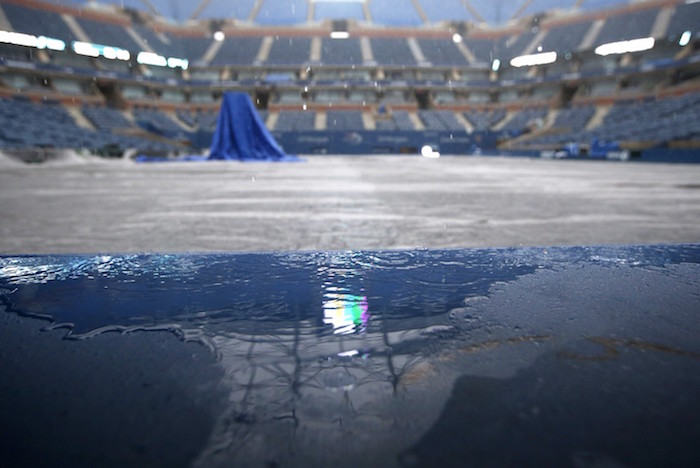
    The delays come in the final uncovered year for Arthur Ashe Stadium, which starting in 2016 will have a retractable roof to avoid any bad weather postponements.

    A supporting superstructure is in place around the venue now but there was not enough time to secure the roof in place before the tournament.

    Another day of tension only heightened the anticipation and drama around Williams and her quest for more tennis history.

    The 33-year-old American, who already holds all four major titles, is chasing the first calendar Grand Slam since Steffi Graf in 1988 and trying to match Graf’s Open Era career record of 22 Slam singles titles, two shy of Margaret Court’s all-time record.

    “I never really thought I would be in this position where I would even be talking about records, talking about passing Steffi Graf or even mentioning Margaret Court,” Williams said.

    “I just grew up trying to be the best that I could and do the best that I could. I worked really hard for everything, so to even be mentioned in that conversation is great.”

    Three-time defending champion Williams, who seeks an Open Era-record seventh US Open title, has won all four career meetings against Vinci without dropping a set.

    She also is 7-0 against Pennetta and 6-1 against Halep in their career rivalries.

    Only five players have completed the calendar-year sweep of the Australian, US and French Opens and Wimbledon –Americans Don Budge in 1938 and Maureen Connolly in 1953, Australians Rod Laver in 1962 and 1969 and Margaret Court in 1970 and Germany’s Graf in 1988.

    “It is important to me,” said Williams, who has kept talk of the calendar Slam at a bare minimum to help cope with the pressure.

  • Indian Americans Preet Bharara & Rakesh Khurana honored with Carnegie’s ‘Great Immigrant’ award

    Indian Americans Preet Bharara & Rakesh Khurana honored with Carnegie’s ‘Great Immigrant’ award

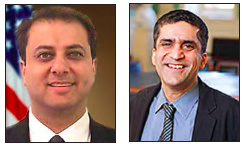
    NEW YORK (TIP): The Carnegie Corporation has announced the 2015 “Great Immigrant”: The Pride of America” awardees. These are the individuals who have helped advance and enlighten our society, culture, and economy. Preet Bharara, U.S. Attorney, Southern District of New York is among 38 eminent personalities selected as 2015 ‘Great Immigrant’ honorees, on the eve of the nation’s birthday on July 4th by Carnegie Corporation.

    The other Indian American awardee, Rakesh Khurana is the Marvin Bower Professor of Leadership Development at Harvard Business School (HBS), professor of sociology in the Faculty of Arts and Sciences (FAS), and co-master of Cabot House and dean of Harvard College.

    “Our founder, Andrew Carnegie, came to this country as the son of impoverished immigrants and grew up to become one of the greatest contributors to American industry and philanthropy,” said Vartan Gregorian, President of the Corporation. “His devotion to U.S. democracy stemmed from his conviction that the new infusion of talent that immigrants bring to our country keeps American society vibrant.”

    The 38 Great Immigrants honored this year come from more than 30 countries around the world and represent leadership in a wide range of professions.

    They include:

    • Preet Bharara S. Attorney, Southern District of New York (India)
    • Geraldine Brooks Pulitzer Prize-winning Author, Journalist (Australia)
    • Thomas Campbell Director and CEO, The Metropolitan Museum of Art (England)
    • Rabia Chaudry Attorney, Civil Rights Activist (Pakistan)
    • Mica Ertegun Interior Designer (Romania)
    • Stanley Fischer Economist; Vice Chair, Board of Governors, Federal Reserve System (Israel)
    • Jonathan Hunt Fox News, Chief Correspondent (Canada)
    • Malek Jandali Composer, Pianist (Syria)
    • Rakesh Khurana Professor, Dean, Harvard College (India)
    • Marie-Josée Kravis Economist, Philanthropist (Canada)
    • Nastia Liukin Olympic Medal-winning Gymnast (Russia)
    • Bette Bao Lord Author, Human Rights Advocate, Philanthropist (China)
    • Ali Malekzadeh President, Roosevelt University, Chicago (Iran)
    • Silvio Micali Turing Award-winning Professor of Computer Engineering (Italy)
    • Lorne Michaels Peabody Award-winning TV Producer (Canada)
    • Franziska Michor Vilcek Prize-winning Professor, Computational Biology (Austria)
    • Anchee Min Author (China)
    • Sharmin Mossavar-Rahmani Philanthropist; Chief Investment Officer, Private Wealth Management Group, Goldman Sachs (Iran)
    • Firouz Naderi Director, Solar System Exploration, NASA Jet Propulsion Laboratory (Iran)
    • Azar Nafisi Author, Scholar (Iran)
    • Craig Nevill-Manning Engineering Director, Google (New Zealand)
    • Maria Otero U.S. Under Secretary of State for Civilian Security, Democracy, and Human Rights (Bolivia)
    • Eddie Pérez Bullpen Coach, Atlanta Braves (Venezuela)
    • Ilana Rovner Judge, U.S. Court of Appeals, Seventh Circuit (Latvia)
    • Arturo Sandoval Grammy Award-winning Jazz Trumpeter (Cuba)
    • Madhulika Sikka Vice President, Executive Editor, .Mic (India)
    • Thomas C. Südhof Nobel Prize-winning Neuroscientist (Germany)
    • Antonio M. TagubaS. Army Major General, Retired (Philippines)
    • Ann Telnaes Pulitzer Prize-winning Political Cartoonist (Sweden)
    • Thalía Singer, Actress (Mexico)
    • Tuyen Tran Vilcek Prize-winning Fashion Designer (Vietnam)
    • Abraham Verghese Physician, Professor, Author (Ethiopia)
    • Eugene Volokh Professor, Legal Scholar, Blogger (Ukraine)
    • Arieh Warshel Nobel Prize-winning Biochemist (Israel)
    • Raffi Yessayan Judge, Massachusetts Superior Court (Lebanon)
  • Serena Williams advances to Madrid Open semifinals

    MADRID (TIP): Serena Williams advanced to the semifinals of the Madrid Open by beating Carla Suarez Navarro 6-1, 6-3 on May 7.

    The top-seeded Williams, who is a two-time champion in Madrid, broke the Spaniard’s serve four times and saved three break points.

    “Playing a really good clay-courter today is not easy,” Williams said.

    “I think she proved that she has an attacking game.”

    Williams is playing in her third tournament since clinching her sixth Australian Open title — and 19th Grand Slam singles title overall.

    The top-ranked American will next meet either fourth-seeded Petra Kvitova of the Czech Republic or Irina-Camelia Begu of Romania.

    “I love Petra. She’s a great girl and a great player on top of that. It’s always good to see those two combined,” Williams said.

  • Iran releases seized Maersk cargo ship

    Iran releases seized Maersk cargo ship

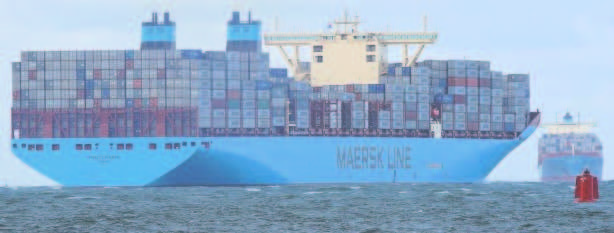
    TEHRAN (TIP): Iran has released the Maersk Tigris cargo vessel seized by its patrol boats in the Strait of Hormuz last week over a business dispute, Iranian authorities said May 7.

    They said the ship was given permission to leave after Denmark’s Maersk group, which chartered the Marshall Islands-flagged vessel, promised to abide by an Iranian court decision.

    “After obtaining judicial authorisation, the ship was released on May 7,” Iran’s Ports and Maritime Organisation said in a statement.

    The seizure was in connection with an Iranian court order for Maersk to pay $3.6 million (3.2 million euros) in damages to Iranian firm Pars Oil Products Talayieh over cargo that allegedly was not delivered.

    The move caused concern for the security of shipping lanes in the strategic strait and prompted the United States to send vessels to monitor the situation.

    In a sign of reduced tensions, the Pentagon said Wednesday that the US Navy had halted a mission to accompany American-flagged vessels passing through the Strait of Hormuz.

    US warships will however remain in the area to conduct “routine maritime security operations,” spokesman Colonel Steven Warren told reporters.

    On Wednesday, Tehran denied it had detained the ship’s 24 crew members, saying they were benefiting from diplomatic assistance.

    Iranian state TV reported that the crew members were from Bulgaria, Myanmar, Romania and Britain.

  • Serena Williams claws into 10th Miami Open final

    MIAMI (TIP): A frustrated Serena Williams clawed into her 10th Miami final on April 1, defeating Simona Halep 6- 2, 4-6, 7-5.

    Williams, apparently rattled by the Halep cheer squad who drowned out most of the chants for the home hope, saw her mighty forehand desert her in the second set, in which Halep converted the only break point of the set to force a third.

    World number one Williams, who captured her 19th Grand Slam title at the Australian Open this year, regrouped to seize a 5-2 lead in the third only for the world number three from Romania to battle back.

    Finally Williams found a way, and she will bid for an eighth Miami title against Carla Suarez Navarro.

    Spain’s Suarez Navarro earned her place in the biggest match of her career with a 6-3, 6-3 victory over Germany’s Andrea Petkovic.

    Williams has won all four of her matches against Suarez Navarro without dropping a set.

  • SPAIN FALLS FROM TOP 10 OF FIFA RANKINGS; GERMANY STILL 1ST

    ZURICH (TIP): European champion Spain have fallen out of the top 10 in FIFA’s rankings for the first time since 2007.

    World Cup winner Germany are still No. 1 ahead of Argentina, Colombia, Belgium and the Netherlands.

    The only change in the top 10 is that Italy have rose two places into 10th, while Spain drop one spot to 11th.

    None of the elite teams played in the last month, but games played earlier in the four-year cycle of results lost ranking value.

    Romania rose two places at No. 14 and could be seeded in July when European qualifying groups for the 2018 World Cup are drawn.

    Costa Rica remain No. 13 to lead CONCACAF nations. The United States fell one spot to No. 32.

    Algeria at No. 18 lead African nations. Iran are Asia’s best at No. 42.

  • 423 criminals from India living in Britain

    423 criminals from India living in Britain

    LONDON ()TIP): Around 423 criminals from India are presently living in Britain. Data revealed by Britain’s National Audit Office has shown that as of March 2014, 10,650 criminals from overseas have been living in UK. Shockingly, between January 2009 and March 2014, 151 foreign national offenders (FNOs) left prison without being considered for deportation. One in six FNOs in the community – 760 convicted criminals – had absconded with 400 of them had been missing since before 2010.

    Around 58 of them have been classed as “high harm” individuals including rapists, murderers and pedophiles. Poland dominated the list of top 10 nationalities of foreign offenders living in UK – 898 followed by Ireland 778, Jamaica 711, Romania 588, Pakistan 522, Lithuania 518 and Nigeria 468. India stands next with the number of offenders living in UK increasing from 402 to 423 between 2013 and 2014. Figures from the Home Office show that there are more than 700 murderers and 500 rapists among nearly 12,000 foreign offenders in UK. The full list, entitled the Foreign National Offender Caseload include 775 murderers, 587 rapists, 155 child rapists and 15 convicted terrorists.

    Also in the category of most serious offences are 99 other killers convicted of manslaughter and 228 paedophiles. The list also includes 88 criminals found guilty of attempted murder, 1,022 of serious violent assaults, 497 burglars, and 43 arsonists. NAO said “Removing FNOs from the UK continues to be inherently difficult and public bodies involved have been hampered in their efforts by a range of barriers, although poor administration has still played a part. The number and speed of removals can be restricted by law – typically the European Convention on Human Rights and EU law on the free movement of persons.” “Until recently, FNOs had 17 grounds for appeal that could delay removal.

    Administrative factors also form barriers with some FNOs exploiting legal and medical obstacles to removal. Many overseas countries are unwilling to receive FNOs back home. However, lack of joint working and administration errors have often led to missed opportunities for removal.” Just over half of the 2,710 persons arrested for terrorism-related offences since September 11, 2001 self-declared their nationality as British or of British dual nationality (1,420, or 52%). Of the remaining persons arrested and excluding those who declared a dual nationality, the most frequently selfdeclared nationalities were: Algeria (156 persons), Pakistan (135), Iraq (117), Afghanistan (75), Iran (63), India (59), Turkey (50) and Somalia (49). The most frequent principal offences for persons convicted since September 11, 2001 under terrorism legislation were preparation for terrorist acts (25% of persons convicted), collection of information useful for an act of terrorism (16%) and failing to comply with duty at a port or border controls (12%).

    In recent years the proportion of persons arrested who self-defined as either British or British dual nationality has been higher than the proportion since September 11, 2001. Of the 239 persons arrested for terrorismrelated offences in the year ending June 30, 2014, 181 (76%) self-defined as either British or British dual nationality.

  • Hyderabad ranked 2nd best place in world to see in 2015: Magazine

    Hyderabad ranked 2nd best place in world to see in 2015: Magazine

    HYDERABAD (TIP): Hyderabad is the second best place in the world that one should see in 2015, according to an international travel publication. The Presidio of San Francisco in the US ranked first on the “Best of the World – 20 Places You Should See in 2015” list, published in the annual guide of ‘Traveler’ magazine of National Geographic. In the December 2014-January 2015 issue, the periodical ranked Hyderabad at second position on the list, which included cities Zermatt in Switzerland, National Mall in Washington D C, Corsica, Choquequirao in Peru, Sark in Channel Islands, Koyasan in Japan, Oklahoma City, and Maramures in Romania.

    “Stories of Hyderabad’s poetic past weave amid strings of programming code in this South Eastern India city that was home to one of the richest men in the world, Mir Osman Ali Khan, the last ruling nizam of Hyderabad,” the periodical said. It goes on to talk about how Hyderabad has now become a seedbed for many global IT brands, the opulent Taj Falaknuma Palace, Irani cafes, fifth generation pearl merchants and other attractions. According to Andhra Pradesh Reorganisation Act, 2014, Hyderabad will remain common capital of Andhra Pradesh and Telangana for a period not exceeding ten years; thereafter it will be part and parcel of Telangana.

  • Bopanna to get Davis Cup Commitment Award

    Bopanna to get Davis Cup Commitment Award

    BANGALORE (TIP): Indian tennis player Rohan Bopanna will be presented the Davis Cup Commitment Award during the World Group play-off tie against Serbia which begins here tomorrow. The International Tennis Federation (ITF) will present the Awards through its national associations during the Davis Cup World Group and Zone Group matches on Saturday.

    Former Grand Slam champions Lleyton Hewitt of Australia and Gustavo Kuerten of Brazil will also be awarded after their respective games. “The Davis Cup Commitment Award reflects the dedication by players for more than a century to represent their country in this prestigious competition.

    These players have continued to rise to the unique challenge of competing in a team environment in front of their home fans, and we believe that it is fitting to recognise their efforts,” said ITF President Francesco Ricci Bitti.

    List of players to be awarded: Australia: Lleyton Hewitt, Brazil: Carlos Kirmayr, Gustavo Kuerten, Luiz Mattar, Cassio Motta, Jaime Oncins, Canada: Frank Dancevic, Chinese Taipei: Ti Chen, France: Pierre Darmon, India: Rohan Bopanna Romania: Victor Hanescu, Russia: Andrei Chesnokov, Andrei Olhovskiy, Thailand: Sanchai Ratiwatana, Sonchat Ratiwatana, Danai Udomchoke, Ukraine: Sergiy Stakhovsky.

  • US sending 200 troops for drills in Ukraine: Pentagon

    US sending 200 troops for drills in Ukraine: Pentagon

    WASHINGTON (TIP): The United States will send about 200 troops to take part in a US-led annual exercise in Ukraine later this month, the Pentagon said on Wednesday, in a show of solidarity with Kiev.

    The presence of 200 soldiers from the 173rd Airborne Brigade will mark the first deployment of US ground troops to Ukraine since the Kiev government’s conflict with pro-Russia separatists erupted earlier this year. Dubbed “Rapid Trident,” the yearly exercise was set for September 13-26 and will involve more than a dozen countries, including “approximately 200 personnel” from the US military, spokesman Colonel Steven Warren said.

    “It’s a peacekeeping exercise,” said Warren, and would focus in part on countering homemade bombs. The drill was due to be held in Yavoriv, about 40 miles (60 kilometers) from Lviv in western Ukraine. US naval forces also were due to take part in a separate maritime exercise starting next week in the Black Sea which will involve forces from Ukraine, Turkey, Georgia and Romania, officials said.

    Two vessels from a NATO maritime group will also participate. Washington is sending the USS Ross, a guided missile destroyer, to join the naval drill, dubbed “Sea Breeze,” which runs from Monday to Wednesday. About 280 US sailors were due to take part.

    The aim of the exercise was “to improve interoperability while promoting regional stability and security” among allies and partners, spokeswoman Lieutenant Colonel Vanessa Hillman said. With Russia’s intervention in Ukraine raising alarm in Eastern Europe and beyond, the United States has held a series of high-profile military exercises in the region in a bid to reassure anxious allies on NATO’s eastern border.

    Ukraine, facing a separatist rebellion and suspected Russian military operations in its east, has asked for US military aid but Washington has declined so far to provide weapons to the Kiev government.

  • To each superpower, its own near-abroad

    To each superpower, its own near-abroad

    The downing of MH17 puts the spotlight back on the Ukrainian crisis. It’s a warning to the West to eschew attempts to ‘contain’ Moscow and stop the provocative expansion of NATO across Russia’s borders.

    In the early hours of the morning of July 17, Malaysian Airlines Flight MH17 with 298 people on board was shot down over eastern Ukraine, now controlled by Russian separatists, engaged in a civil war against the Kiev Government. The Russian speaking minority has evidently been reinforced and equipped by their kinsmen from across the Russia-Ukraine border. They carry heavy firepower including tanks, armoured personnel carriers and a range of surface-to-air missiles.

    The shooting down of MH17 came alongside rebel missile attacks over the past four weeks, which have downed two military transport and three state-of-the-art Sukhoi attack aircraft, of the Ukrainian Air Force. It is evident that the missile attack on MH17 was based on the mistaken assumption that it was a Ukrainian Air Force aircraft. There have been seven incidents of such inadvertent shooting down of civilian aircraft in the past. In recent times, South Korean Airlines Flight 007 with 277 passengers and crew strayed into Soviet airspace. It was shot down by a missile fired from a Soviet MiG.

    After the usual rhetoric, Presidents Ronald Reagan and Mikhail Gorbachev returned to business as usual. Thereafter, on July 3, 1988, Iran Air Flight 655, flying from Tehran to Dubai with 290 passengers, mostly pilgrims headed for Mecca, was shot down over Iranian territorial waters, by two missiles fired from the US Navy missile cruiser, USS Vincennes. The US refused to accept responsibility for the action. It paid a sum of $61.8 million as compensation to the families of the victims, following the ruling of an international tribunal.

    What the US paid was less than three per cent of what it got from Libya, for the Lockerbie bombing of Pan Am 103. The Captain of the USS Vincennes was awarded Combat Action Ribbons, shortly after shooting down a civil airliner. Washington, DC’s displeasure, about Russian supply of surface-to-air missiles to the Russian resistance in Ukraine, is surprising. It was the US that started the practice of providing lethal weaponry to non-state actors. The Central Intelligence Agency liberally provided lethal Stinger surface-to-air missiles to the anti-Soviet Mujahideen in Afghanistan, through Pakistan’s Inter-Services Intelligence.

    Three Indian Air Force aircraft – a MiG 21, MiG 27 and a helicopter gunship – were shot down and a Canberra bomber damaged, during and just prior to the Kargil conflict. The IAF aircraft were fired on by Pakistan’s Northern Light Infantry, using, what were assessed to be, Stinger surface-to-air missiles. Given the relentless US policy of strategic ‘containment’ of Russia after the disintegration of the Soviet Union, it was inevitable that, pushed to a corner by American and NATO pressures, the Russians would reach a position of saying: “Thus far and no further”.

    The erratic nature of the policies of President Boris Yeltsin and his advisers like Yegor Gaidar and Mr Andrey Kozyrev, immediately after the disintegration of the Soviet Union, evidently encouraged the US and its NATO allies to erode Russian influence in the Balkans and undermine Russian credibility in Kosovo. Simultaneously, members of armed Chechen separatist groups were openly welcomed in western Europe. Yeltsin’s incompetence in Chechnya and his inability to deal with the expansion of American-led influence just across Russia’s borders, contributed to his being eased out of office and replaced by Mr Vladimir Putin.

    Even as the Russians tried to increasingly integrate former Soviet Republics economically and strategically, the US and its NATO allies held out lucrative offers for economic integration with the European Union and membership of the NATO military alliance. Russia faced a challenge of economic isolation and military encirclement. The Russians have responded by developing economic partnerships with former Soviet Republics and the establishment of the Collective Security Treaty Organisation.

    The economic and security inroads made by the EU and NATO have, however, significantly eroded traditional Russian influence in its immediate neighbourhood. These Western moves, which the Russians naturally regard as strategic encirclement, have resulted in former Warsaw Pact members – the Czech and Slovak Republics, Hungary, Bulgaria, Romania and Poland – joining NATO In the Balkans, Croatia and Slovenia are now NATO members. Moreover, the former Soviet Baltic Republics, Estonia, Latvia and Lithuania have joined NATO.

    There are also moves to consider EU and Nato membership for Ukraine, Azerbaijan, Armenia, Kazakhstan, Moldova and Georgia. Ukraine was ruled by Russian tsars for three centuries prior to the formation of the Soviet Union. It was regarded as part of the sphere of Russian influence. Its eastern region bordering Russia was increasingly populated by Russians. Ukraine’s Crimean region was transferred by Soviet leader Nikita Khrushchev from the Russian Federation to Ukraine in 1954, as a “gesture of goodwill”, marking the 300th anniversary of Ukraine being a part of Tsarist Russia.

    Sevastopol in Crimea is vital strategically to Russia, constituting Russia’s access to the warm waters of the Black Sea. Former President Viktor Yanukovych of Ukraine and other Ukrainian leaders inevitably played off the Russians, who promised plentiful supplies of energy, against the EU, which promised prosperity. Mr Yanukovych signed an agreement in 2010 extending the lease of Sevastopol till 2042. The quite evidently American-backed movement that resulted in the ouster of Mr Yanukovych, led to the takeover of Sevastopol and the Crimean region, with a Russian majority population, by Russia.

    The US-led attempts to contain Russia have been marked by inconsistencies. The dismemberment of Yugoslavia and the independence of Kosovo were justified by Western powers on the lofty grounds of respect for “human rights”. But, today these same powers are raving and ranting against the “separatists” of the Russian minority in Ukraine, who are seeking independence, or merger with Russia.

    There is little doubt that Russia today faces serious internal problems arising out of falling birth rates, alcoholism, drug addiction, declining life expectancy and corruption. But, it will be a historical error to underestimate Russian resilience in the face of adversity. Attempts to dominate and marginalise the Russian minority in Ukraine will be fiercely resisted and reinforced by support from across the Ukrainian-Russian border.

    What is needed is a realistic political solution involving a united, but federalised Ukraine. More importantly, attempts at ‘containment’ of Russia, will have to be eschewed and the expansion of NATO across Russia’s borders ended. Given the imperatives of stability and energy security, responsible European countries like Germany and France will recognise this. Will the Americans do likewise?