India’s President Droupadi Murmu will attend the Pontiff’s funeral
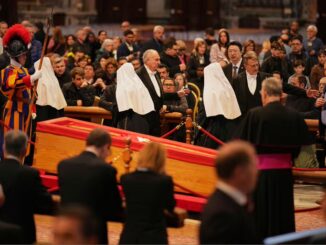
VATICAN (TIP): Pope Francis’s funeral will be held in St Peter’s Square in Rome at 10am local time on Saturday, April 26. The outdoor service, which will be led by Cardinal Giovanni Battista Re, the dean of the college of cardinals, is expected to be attended by dignitaries from 170 foreign delegations, as well as tens of thousands of ordinary people wanting to pay their respects.
President Trump, Prime Minister Keir Starmer of Britain, President Volodymyr Zelensky of Ukraine, President Javier Milei of Argentina and President Luiz Inácio Lula da Silva of Brazil, the world’s largest Catholic country.
India will be represented by the President Droupadi Murmu.
“President Droupadi Murmu will be visiting Vatican City on April 25 to 26 to attend the state funeral of Pope Francis and offer condolences on behalf of the government and people of India,” the MEA said.
Once the funeral mass has finished, Francis’s coffin will be taken, in procession, to Santa Maria Maggiore. The Vatican announced that people will be able to visit Francis’s tomb in the basilica from Sunday morning.
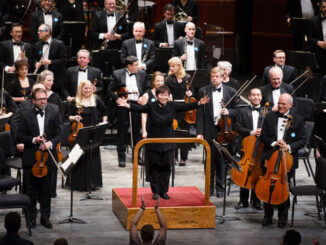
The New Jersey Symphony will present a special performance for the 2025 Lunar New Year Celebration ringing in the Year of the Snake. Music Director Xian Zhang will conduct the performance on Saturday, January 25, 2025, at 7:30 pm at the New Jersey Performing Arts Center.
The orchestral Celebration Concert will then feature a program that blends Eastern and Western musical traditions. Xian Zhang will conduct the New Jersey Symphony, who will be joined by pianist Min Kwon, tenor Michael Fabiano, the Peking University Alumni and Starry Arts Children’s Choruses and the Edison Chinese School Lion Dance Team.
First developed by Zhang in 2019, the Lunar New Year Celebration weaves together the best in classical music from the East and the West. Zhang leads a program that includes Li Huanzhi’s ‘Spring Festival Overture,’ selections from Mozart’s Piano Concerto No. 23, ‘Arirang,’ ‘Yuan Ri,’ ‘The Red Dragonfly’ arranged by Nicholas Hersh and Puccini’s ‘E Lucevan le stelle’ from ‘Tosca’ and selections from ‘Turandot.’
Min Kwon and Michael Fabiano are set to perform, with special appearances from Starry Arts Children’s Chorus and Peking University (PKU) Alumni Chorus, which consists of former members of PKU’s student choir alongside singers from the Chinese community in New York and New Jersey. The evening will also feature a performance by the Edison Chinese School Lion Dance Team.
Earlier this year, the Symphony held a composition competition and invited New Jersey-based composers of all backgrounds, ages and ability levels to submit their own solo piano arrangement of the Korean folk song ‘Arirang.’ Patricio Molina, the winner of the competition, will have his arrangement performed at the concert by pianist Min Kwon. Leading up to the performance, Molina will also participate in at least one workshop with Kwon.
PROGRAM
All ticket holders are invited to attend a pre-concert Cultural Exchange Festival in the Prudential Hall lobby that will feature artisans and performers from Prince Kung’s Palace Museum in Beijing. Gates will open at 6 pm.
2025 Lunar New Year Celebration with Xian Zhang
Celebration of the Year of the Snake
Xian Zhang conductor
Min Kwon piano
Michael Fabiano tenor
Peking University Alumni Chorus
Starry Arts Children’s Chorus | Rebecca Shen, director
Edison Chinese School Lion Dance Team
New Jersey Symphony
Newark – Saturday, January 25, 7:30 pm, New Jersey Performing Arts Center
Li Huanzhi Spring Festival Overture
Wolfgang Amadeus Mozart Selections from Piano Concerto No. 23
Traditional arr. Patricio Molina Arirang
Traditional ‘Yuan Ri’
Traditional arr. Nicholas Hersh ‘The Red Dragonfly’
Giacomo Puccini ‘E Lucevan le stelle’ from ‘Tosca’
Giacomo Puccini Selections from ‘Turandot’
For more information and updates on concerts and tickets, visit njsymphony.org/events.
TICKETS
To purchase tickets to the Concert, visit my.njsymphony.org.
Concert Tickets
Saturday, January 25 – Gates Open at 6 pm
Cultural Exchange Festival
Welcome the Year of the Snake with a cultural exchange.
The event commences with a Cultural Exchange Festival in a tradition that invites all audience members to a celebration of community and cultural exchange before the concert. This year’s event will feature artisans and performers from Prince Kung’s Palace Museum in Beijing.
7:30 pm: Celebration Concert in Prudential Hall
VIP tickets
5:30 pm: Cultural Exchange Festival & VIP Reception
VIP ticket holders will receive early access to the festival before it opens to the public.
VIPs will sip cocktails and savor a tasty dinner buffet at the VIP reception, which overlooks the lobby festival and performances.
To purchase VIP Tickets, visit njsymphony.org/events/detail/2025-lunar-new-year-celebration-vip-event
SPONSORSHIP
For sponsorship details, visit njsymphony.org/assets/doc/LNY25-Sponsorship-Brochure-121323-2-d6f122b47b.pdf
Xian Zhang
Zhang has an exceptional ear for balance, as well as the ability to draw the softest, most transparent tones imaginable from the orchestra….With such skills and obvious audience appeal, Zhang should prove a valuable addition to the Met’s conduction staff.” – New York Classical Review.
2024–25 marks the GRAMMY and Emmy Award-winning conductor Xian Zhang’s ninth season as music director of the New Jersey Symphony. Starting in 2025–26, Zhang will also hold the role of music director at Seattle Symphony. Zhang holds the position of conductor emeritus of Orchestra Sinfonica di Milano, having previously held the position of music director between 2009–2016.
The 2024–25 season sees Zhang return to the Metropolitan Opera in New York to conduct David McVicar’s acclaimed production of Puccini’s Tosca.
Zhang is in high demand as a guest conductor, appearing regularly with Philadelphia Orchestra and Los Angeles Philharmonic, returning to both in 2024–25. Her recording with Philadelphia Orchestra and Time for Three, Letters for The Future (released 2022 on Deutsche Grammophon), won multiple GRAMMY Awards in the Best Contemporary Classical Composition (Kevin Puts’ Contact) and Best Classical Instrumental Solo categories.
Zhang previously served as principal guest conductor of the BBC National Orchestra & Chorus of Wales, the first female conductor to hold a titled role with a BBC orchestra and principal guest conductor of Melbourne Symphony Orchestra. In 2002, she won first prize in the Maazel-Vilar Conductor’s Competition. She was appointed New York Philharmonic’s assistant conductor in 2002, subsequently becoming their associate conductor and the first holder of the Arturo Toscanini Chair. Learn more at xianzhangconductor.com.
Min Kwon (Credit : NJ Symphony)
Min Kwon
“To say the audience was thrilled with the performance would be an understatement of high order…..a truly grand performance. – The Daily Performance.”
Korean-born American pianist Min Kwon excels in a versatile career that encompasses concerti, solo recitals and chamber music appearances, while in high demand around the world as pedagogue, arts advocate and administrator. She has held professional engagements in over 60 countries on seven continents and all 50 US states.
Professor of piano at Mason Gross School of the Arts, Rutgers University since 2002, Dr. Kwon is also the founder and director of the Center for Musical Excellence (CME), a non-profit dedicated to mentoring and supporting gifted young musicians. As artistic director of ‘Music Made Here,’ a concert series inaugurated in 2018 and ‘CME in Harding Homes,’ Kwon brings world class talent to intimate venues.
As soloist, Kwon has performed extensively in Europe, North and South America and Asia, with such orchestras as Philadelphia, North Carolina, Atlanta, New Jersey and Fort Worth and more. Among the distinguished conductors with whom she has collaborated are James Conlon, Stanislaw Skrowaczewski, Alan Gilbert, Vaktang Jordania, Gerhardt Zimmerman and Xian Zhang.
As recitalist, Kwon has performed at Carnegie’s Weill Recital Hall, where she returns each year as artistic director of critically acclaimed, themed concerts featuring Rutgers pianists.
An avid chamber musician, she has performed in numerous duo and chamber recitals around the world including recent appearances in New York, Madrid, Rome, Curaçao, Malaysia, Vienna, Prague, Luxembourg and Serbia.
With her sister, violinist Yoon Kwon (first violin at the Metropolitan Opera Orchestra), she has given over 200 recitals on Community Concert Tours (CAMI).
In addition to her collaboration with Yoon Kwon on concert tours, the duo made a recording for RCA Red Seal/BMG in 1996 as the first Koreans to do so in the Company’s 100-year history.
A recent release, ‘CME Presents: Piano Celebration’—for which she was producer, artistic director and performer—celebrates composers and pianists from 17 countries.
Kwon holds Doctor of Musical Arts and Master of Music degrees from The Juilliard School and a Bachelor of Music degree from The Curtis Institute of Music, completing post-doctoral studies in Salzburg. From 2015–2018, she served on the Juilliard Council as the first and only alumnus/a to be invited. She counts among her teachers and mentors Eleanor Sokoloff, Martin Canin, Leon Fleisher, Hans Leygraf, Dorothy DeLay, Jerome Lowenthal and Leif Ove Andsnes. Kwon is a Steinway Artist.
Michael Fabiano
Born in Montclair, New Jersey, this tenor of Italian descent attended the University of Michigan and the Academy of Vocal Arts in Philadelphia. He was the recipient of the 2014 Beverly Sills Artist Award and the 2014 Richard Tucker Award, Fabiano is the first singer to win both awards in the same year. Learn more at michaelfabianotenor.com.
Peking University Alumni Chorus
Peking University (PKU) Alumni Chorus was founded in 2014. It consists of former members of PKU Student Choir and seasoned singers from the Chinese community in the Greater New York area. In the past nine years, the ensemble has performed at every Chinese New Year Concert organized by PKU Alumni Association of Greater New York, as well as made appearances at major stages in the New York area such as Carnegie Hall, Alice Tully Hall at Lincoln Center and Merkin Hall at Kaufman Music Center. In 2019, the chorus performed Beethoven’s Symphony No. 9 with other choruses at the Church of St. Paul the Apostle and Carnegie Hall. In February 2019, the chorus appeared in the New Jersey Symphony’s first Lunar New Year concert. This year marks the seventh consecutive year of collaboration between the chorus and the NJ Symphony.
Conductor and pianist Conrad Chu has served as the chorus’ conductor since 2016 being well-versed in opera, orchestral and choral repertoire, with a strong affinity for contemporary styles. Learn more at english.pku.edu.cn.
Starry Arts Children’s Chorus
In 2015, violin educator and experienced children’s choir conductor Rebecca Xiaoxing Shen founded the Starry Arts Group Children’s Chorus. The chorus regularly performs at a variety of community events, including at libraries, nursing homes, care centers and multicultural festivals, earning widespread praise. From 2019 to 2023, the chorus was invited to collaborate with the New Jersey Symphony for five consecutive years, performing at the Lunar New Year Celebration Concert at NJPAC, where it received enthusiastic applause at each performance. In September 2023, it was invited to perform as part of a thousand-person choir at the “World Culture Festival” in Washington, DC Most recently, the chorus won first place in the group competition at the Global Elite Talent Competition, which concluded in January 2024.
Edison Chinese School Lion Dance Team
Lunar New Year, Lion Dance Team (Credit : NJ Symphony)
The Edison Chinese School Lion Dance Team was founded in 2014 by Peter Shen with the goal of using lion dance as a cultural ambassador to share Chinese traditions with the community. Combining both dance and martial arts, the team regularly performs at significant events such as Chinese New Year celebrations, National Day, and other important occasions.
The team’s coach, David Shen, is a professional dancer and martial artist. He has choreographed many pieces for the young performers, tailoring each to fit the specific event and the needs of the group.
Over the years, the team has performed at a variety of venues, including libraries, parks, schools, senior centers and other locations, bringing the rich Chinese cultural heritage to diverse audiences.
The New Jersey Symphony
New Jersey Symphony is a GRAMMY and Emmy Award-winning orchestra. Under the direction of the Music Director Xian Zhang, the Symphony performs more than 60 concerts at mainstage venues across the state, including Newark, Princeton, New Brunswick, Red Bank and Morristown as well as schools and public spaces statewide.
Programming at the Symphony reflects an unwavering commitment to diversity, equity and inclusion while providing students across the state unparalleled opportunities to achieve musical excellence through its Youth Orchestra and other outreach programs.
In 2024, the Symphony announced it would continue to deliver its statewide activities from a new, permanent office, rehearsal and concert space in Jersey City, set to open in 2026. For more information about the New Jersey Symphony, visit the website at njsymphony.org or the newsroom for press releases and photos.
Connect with NJ Symphony
Follow NJ Symphony on Facebook, Instagram, TikTok, X and YouTube
(Mabel Pais writes on The Arts and Entertainment, Business, Social Issues, Spirituality, Cuisine, Health & Wellness, and Education)
Christmas is celebrated on December 25 and is both a sacred religious holiday and a worldwide cultural and commercial phenomenon. For two millennia, people around the world have been observing it with traditions and practices that are both religious and secular in nature. Christians celebrate Christmas Day as the anniversary of the birth of Jesus of Nazareth, a spiritual leader whose teachings form the basis of their religion. Popular customs include exchanging gifts, decorating Christmas trees, attending church, sharing meals with family and friends and, of course, waiting for Santa Claus to arrive. December 25—Christmas Day—has been a federal holiday in the United States since 1870.
How Did Christmas Start?
The middle of winter has long been a time of celebration around the world. Centuries before the arrival of the man called Jesus, early Europeans celebrated light and birth in the darkest days of winter. Many peoples rejoiced during the winter solstice, when the worst of the winter was behind them and they could look forward to longer days and extended hours of sunlight.
In Scandinavia, the Norse celebrated Yule from December 21, the winter solstice, through January. In recognition of the return of the sun, fathers and sons would bring home large logs, which they would set on fire. The people would feast until the log burned out, which could take as many as 12 days. The Norse believed that each spark from the fire represented a new pig or calf that would be born during the coming year.
The end of December was a perfect time for celebration in most areas of Europe. At that time of year, most cattle were slaughtered so they would not have to be fed during the winter. For many, it was the only time of year when they had a supply of fresh meat. In addition, most wine and beer made during the year was finally fermented and ready for drinking.
In Germany, people honored the pagan god Oden during the mid-winter holiday. Germans were terrified of Oden, as they believed he made nocturnal flights through the sky to observe his people, and then decide who would prosper or perish. Because of his presence, many people chose to stay inside.
Saturnalia and Christmas
In Rome, where winters were not as harsh as those in the far north, Saturnalia—a holiday in honor of Saturn, the god of agriculture—was celebrated. Beginning in the week leading up to the winter solstice and continuing for a full month, Saturnalia was a hedonistic time, when food and drink were plentiful and the normal Roman social order was turned upside down. For a month, enslaved people were given temporary freedom and treated as equals. Business and schools were closed so that everyone could participate in the holiday’s festivities.
Also around the time of the winter solstice, Romans observed Juvenalia, a feast honoring the children of Rome. In addition, members of the upper classes often celebrated the birthday of Mithra, the god of the unconquerable sun, on December 25. It was believed that Mithra, an infant god, was born of a rock. For some Romans, Mithra’s birthday was the most sacred day of the year.
Is Christmas Really the Day Jesus Was Born?
In the early years of Christianity, Easter was the main holiday; the birth of Jesus was not celebrated. In the fourth century, church officials decided to institute the birth of Jesus as a holiday. Unfortunately, the Bible does not mention date for his birth (a fact Puritans later pointed out in order to deny the legitimacy of the celebration).
Although some evidence suggests that Jesus’ birth may have occurred in the spring (why would shepherds be herding in the middle of winter?), Pope Julius I chose December 25. It is commonly believed that the church chose this date in an effort to adopt and absorb the traditions of the pagan Saturnalia festival. First called the Feast of the Nativity, the custom spread to Egypt by 432 and to England by the end of the sixth century.
By holding Christmas at the same time as traditional winter solstice festivals, church leaders increased the chances that Christmas would be popularly embraced, but gave up the ability to dictate how it was celebrated. By the Middle Ages, Christianity had, for the most part, replaced pagan religion.
On Christmas, believers attended church, then celebrated raucously in a drunken, carnival-like atmosphere similar to today’s Mardi Gras. Each year, a beggar or student would be crowned the “lord of misrule” and eager celebrants played the part of his subjects. The poor would go to the houses of the rich and demand their best food and drink. If owners failed to comply, their visitors would most likely terrorize them with mischief. Christmas became the time of year when the upper classes could repay their real or imagined “debt” to society by entertaining less fortunate citizens.
When Christmas Was Cancelled
In the early 17th century, a wave of religious reform changed the way Christmas was celebrated in Europe. When Oliver Cromwell and his Puritan forces took over England in 1645, they vowed to rid England of decadence and, as part of their effort, cancelled Christmas. By popular demand, Charles II was restored to the throne and, with him, came the return of the popular holiday.
The pilgrims, English separatists that came to America in 1620, were even more orthodox in their Puritan beliefs than Cromwell. As a result, Christmas was not a holiday in early America. From 1659 to 1681, the celebration of Christmas was actually outlawed in Boston. Anyone exhibiting the Christmas spirit was fined five shillings. By contrast, in the Jamestown settlement, Captain John Smith reported that Christmas was enjoyed by all and passed without incident.
After the American Revolution, English customs fell out of favor, including Christmas. In fact, Christmas wasn’t declared a federal holiday until June 26, 1870.
Washington Irving Reinvents Christmas in America
It wasn’t until the 19th century that Americans began to embrace Christmas. Americans re-invented Christmas, and changed it from a raucous carnival holiday into a family-centered day of peace and nostalgia. But what about the 1800s piqued American interest in the holiday?
The early 19th century was a period of class conflict and turmoil. During this time, unemployment was high and gang rioting by the disenchanted classes often occurred during the Christmas season. In 1828, the New York city council instituted the city’s first police force in response to a Christmas riot. This catalyzed certain members of the upper classes to begin to change the way Christmas was celebrated in America.
In 1819, best-selling author Washington Irving wrote The Sketchbook of Geoffrey Crayon, gent., a series of stories about the celebration of Christmas in an English manor house. The sketches feature a squire who invited the peasants into his home for the holiday. In contrast to the problems faced in American society, the two groups mingled effortlessly. In Irving’s mind, Christmas should be a peaceful, warm-hearted holiday bringing groups together across lines of wealth or social status. Irving’s fictitious celebrants enjoyed “ancient customs,” including the crowning of a Lord of Misrule. Irving’s book, however, was not based on any holiday celebration he had attended—in fact, many historians say that Irving’s account actually “invented” tradition by implying that it described the true customs of the season.
‘A Christmas Carol’
Also around this time, English author Charles Dickens created the classic holiday tale, A Christmas Carol. The story’s message-the importance of charity and good will towards all humankind-struck a powerful chord in the United States and England and showed members of Victorian society the benefits of celebrating the holiday.
The family was also becoming less disciplined and more sensitive to the emotional needs of children during the early 1800s. Christmas provided families with a day when they could lavish attention-and gifts-on their children without appearing to “spoil” them.
As Americans began to embrace Christmas as a perfect family holiday, old customs were unearthed. People looked toward recent immigrants and Catholic and Episcopalian churches to see how the day should be celebrated. In the next 100 years, Americans built a Christmas tradition all their own that included pieces of many other customs, including decorating trees, sending holiday cards and gift-giving.
Although most families quickly bought into the idea that they were celebrating Christmas how it had been done for centuries, Americans had really re-invented a holiday to fill the cultural needs of a growing nation.
Who Invented Santa Claus?
The legend of Santa Claus can be traced back to a monk named St. Nicholas who was born in Turkey around A. D. 280. St. Nicholas gave away all of his inherited wealth and traveled the countryside helping the poor and sick, becoming known as the protector of children and sailors. St. Nicholas first entered American popular culture in the late 18th century in New York, when Dutch families gathered to honor the anniversary of the death of “Sint Nikolaas” (Dutch for Saint Nicholas), or “Sinter Klaas” for short. “Santa Claus” draws his name from this abbreviation.
In 1822, Episcopal minister Clement Clarke Moore wrote a Christmas poem called “An Account of a Visit from St. Nicholas,” more popularly known today by it’s first line: “‘Twas The Night Before Christmas.” The poem depicted Santa Claus as a jolly man who flies from home to home on a sled driven by reindeer to deliver toys.
The iconic version of Santa Claus as a jolly man in red with a white beard and a sack of toys was immortalized in 1881, when political cartoonist Thomas Nast drew on Moore’s poem to create the image of Old Saint Nick we know today.
Christmas Facts
– Each year, 25-30 million real Christmas trees are sold in the United States alone. There are about 15,000 Christmas tree farms in the United States, and trees usually grow for between four and 15 years before they are sold.
– In the Middle Ages, Christmas celebrations were rowdy and raucous—a lot like today’s Mardi Gras parties.
– When Christmas was cancelled: From 1659 to 1681, the celebration of Christmas was outlawed in Boston, and law-breakers were fined five shillings.
– Christmas was declared a federal holiday in the United States on June 26, 1870.
– The first eggnog made in the United States was consumed in Captain John Smith’s 1607 Jamestown settlement.
– Poinsettia plants are named after Joel R. Poinsett, an American minister to Mexico, who brought the red-and-green plant from Mexico to America in 1828.
– The Salvation Army has been sending Santa Claus-clad donation collectors into the streets since the 1890s.
– Rudolph, “the most famous reindeer of all,” was the product of Robert L. May’s imagination in 1939. The copywriter wrote a poem about the reindeer to help lure customers into the Montgomery Ward department store.
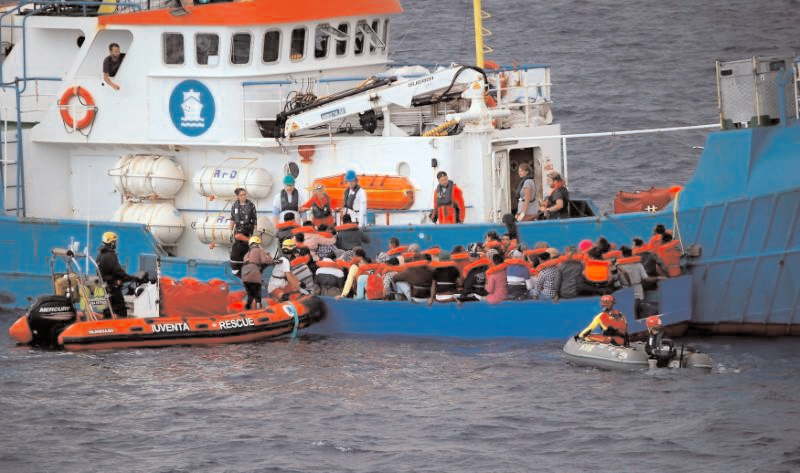
ROME (TIP): Italian authorities have ordered the Ocean Viking migrant rescue ship to remain in a port near Rome after it failed an inspection, the charity that owns it said on July 13.
The ship underwent a seven-hour inspection Tuesday by the coast guard in the port of Civitavecchia, north of the Italian capital, after disembarking 57 migrants it had rescued in the Mediterranean.
It was then placed under administrative detention for “an indefinite period” after “a few small technical and administrative problems” were discovered, SOS Mediterranee said in a statement.
The coast guard did not respond to an AFP request for information.
SOS Mediterranee press officer Francesco Creazzo said the problem raised by the Italian coast guard related to the number of lifeboats and specialised operators on board.
The Ocean Viking has undergone seven inspections by the coast guard in the past three years, Creazzo said.
Italy’s hard-right government, which came to power in October 2022, has taken numerous measures to restrict the activities of ships operated by non-governmental organisations that rescue migrants in trouble on the crossing from North Africa.
In February, parliament approved a government decree that limited charity ships to one sea rescue at a time, requiring them to dock at a port assigned by authorities following each rescue.
The NGOs say this amounts to forcing the ships to ignore other emergencies on the water following rescue and sending them to distant ports instead of closer ones. (AFP)
Rome (TIP): Italian police on Saturday arrested 19 suspects, dismantling what authorities say was a criminal organization that moved migrants from Afghanistan, Iran, Iraq and Pakistan to Italy and then into northern Europe.
The investigation, led by prosecutors in Catania, Sicily, unveiled a network that involved hired or stolen sailboats transporting migrants via Turkey and Greece to Italy. Some then traveled north to the French border and were smuggled by vehicle into France, thanks to human smugglers based in border towns, police said in a statement.
The arrested suspects included Iraqi Kurds, Afghans and Italians, police said.
One of the alleged ring’s bases was in Bari, southern Italy, where false documents were issued indicating the migrants had housing, a requirement for residency permits. Other bases were in Milan and Turin in northern Italy as well as in the town of Ventimiglia, near the French border.
Others allegedly involved in the scheme falsified work contracts so the migrants could successfully apply for permission to reside in Italy, authorities said.
The investigation began in 2018, triggered by the arrival of 10 boats near the eastern Sicilian city of Syracuse. The boats had sailed from Turkey and Greece in the Eastern Mediterranean, and not from Libya, from where for years the majority of the hundreds of thousands of migrants had set out for Italy in traffickers’ unseaworthy vessels.
The investigation ascertained the activities of a network of Italians and foreigners, most of the latter holding residency permits issued on grounds of international protection, the police said.
The ring was “dedicated to facilitating the entrance, stay and transit toward northern Europe of migrants coming from Iran, Iraq, Afghanistan and Pakistan.”
One suspect, police said, was about to transport migrants from the railroad station at Ventimiglia into France, one of the preferred destination countries for those being smuggled.
Skippers who were engaged to sail the boats to Sicily were paid about USD 1,000 (800 euros) per crossing, while migrants each paid about 6,000 euros (USD 7,200) to be smuggled from Asia, via Turkey and Greece, into Italy, the police said. The smuggling ring cracked by Italian authorities was an “essential link of connection with criminal groups active in Turkey and Greece,” police said. — AP
ROME / NEW YORK(TIP): Colors of Peace is the world’s largest exhibition of children’s peace-drawings from the most countries. This international event began three years ago in response to a call from the United Nations for communities worldwide to celebrate the UN International Day of Peace on September 21st (United Nations Resolution A/RES/36/67). Organised by the non-profit organisation Sri Chinmoy Oneness-Home Peace Run this exhibit represents children’s dreams for a better world. Children from Goa participated in this event by sending some inspiring paintings.
The artwork has been collected from school children who have participated in the Sri Chinmoy Oneness-Home Peace Run as well as from partner non-profit organisations. Peace visionary Sri Chinmoy founded the Peace Run in New York in 1987.
Colors of Peace 2019 opened officially on 20th September with a special ceremony inside the Colosseum Arena. School children, state officials, ambassadors and diplomats from 27 countries, representatives of diverse religious faiths, and personalities from the world of culture and sport participated.
Special awards were presented to the winners of the Peace Movie Award 2019, an international competition launched by the Peace Run under the patronage of the Italian Ministries of Education, Universities and Research; and Cultural Heritage and Activities. This award seeks to promote a culture of peace by challenging children and young people in schools around the world to define and celebrate peace in video clips of no longer than thirty seconds. This year’s awards went to a school in Bosnia and Herzegovina and one in Indonesia.
Since its inception Colors of Peace has received the patronage of the President of the Italian Senate, the Chamber of Deputies of the Italian Republic, the Presidency of the Council of Ministries for Equal Opportunities, Italian Ministries of Education, Universities and Research; and Cultural Heritage.
30 sec US TV broadcast: https://vimeo.com/342960320
Password: Rome2708!
Srichinmoy.org
Contact: Ashok Parulekar Mob +1 917 815 2887 (New York, USA)
ROME (TIP): Italy began a limited naval mission on August 2 to help Libya’s coastguard curb migrant flows, which have become a source of political friction before national elections expected early next year.
An Italian patrol boat entered Libyan waters and headed towards the port of Tripoli within minutes of a vote in Italy’s parliament authorising the deployment. A second vessel was expected to join it in the coming days.
Italy announced the operation last week, saying it had been requested by Libya’s UN-backed government. It initially hoped to send six ships into Libyan territorial waters, but the plans had to be scaled back following protests from Tripoli.
“(We will) provide logistical, technical and operational support for Libyan naval vessels, helping them and supporting them in shared and coordinated actions,” Defence Minister Roberta Pinotti said ahead of Wednesday’s vote.
“There will be no harm done or slight given to Libyan sovereignty, because, if anything, our aim is to strengthen Libyan sovereignty,” she told parliament, stressing that Italy had no intention of imposing a blockade on Libya’s coast.
In Tripoli, a poster of resistance hero Omar al-Mukhtar, who battled Italian rule in Libya in the 1920s, was hung near the capital’s main square with the inscription “No to a return to colonization”. The Italian move also triggered irate statements from factions in eastern Libya that oppose the UN backed government. An eastern-based parliament warned against “attempts by Italy … to return tens of thousands of illegal immigrants to Libya”. Khalifa Haftar, a military commander aligned with the chamber, ordered his forces to repel “any naval vessel that enters national waters without permission from the army”, according to the Facebook page of Haftar’s Libyan National Army.
Italy’s lower house voted by 328 to 113 in favour of the mission, while the upper house voted by 191 to 47. After a surge in migrant arrivals from Libya at the start of the year, the number of newcomers has slowed. The Interior Ministry said on Wednesday that 95,215 people had reached Italy so far in 2017, down 2.7 percent from the same period in 2016.
Some 2,230 migrants, most of them Africans fleeing poverty and violence at home, died in the first seven months of 2017 trying to make the sea crossing. The Human Rights Watch group said Italy’s move may endanger migrants. “After years of saving lives at sea, Italy is preparing to help Libyan forces who are known to detain people in conditions that expose them to a real risk of torture, sexual violence, and forced labour,” HRW said in a statement.
Elections Ahead Almost 600,000 migrants have arrived in Italy over the past four years, putting Italy’s network of reception centres under huge strain and causing increasing political tensions.
Italy is due to hold national elections by next May, with voting widely expected in early 2018, and the migrant issue is expected to top the political agenda. Rightist parties accuse the centre-left government of doing nothing to halt the influx.
“The (migrant boats) will not be being pushed back to the Libyan shore, so we don’t understand what we are going to be doing there,” Giancarlo Giorgetti, deputy head of the opposition Northern League party, told reporters in parliament.
Italy hopes the Libyan coastguard can help prevent flimsy migrant boats from putting to sea and has been at the forefront of efforts to make the small force more effective, training its members and upgrading its fleet.
Rome has also put pressure on nongovernmental organisations that have played an increasingly important role in picking up migrants off the Libyan coast and bringing them to Italy.
The government has introduced a code of conduct for the NGOs and has demanded that armed police travel on their boats to help root out people smugglers. Only three of eight humanitarian groups operating in the southern Mediterranean agreed this week to the Italian terms.
A boat operated by German NGO Jugend Rettet, one of the five groups that did not sign up, was seized by the Italian coastguard on Wednesday on the order of Sicilian magistrates on suspicion it had aided illegal immigration. There was no immediate comment from Jugend Rettet. (Reuters)
VATICAN CITY (TIP): Pope Francis will wash the feet of inmates at a prison known for housing mafia turncoats in an Easter week ritual meant to show his willingness to serve.
The Paliano prison, located in a huge fortress outside Rome, houses many of Italy’s “collaborators of justice,” who can shave time off their sentences by cooperating with anti-mafia investigators.
Given the security concerns involved, the Vatican said today the April 13 Mass at the maximum-security facility would be “strictly private.”
Francis has spoken out frequently to denounce the mafia, declaring mobsters “excommunicated” and urging them to change their ways. Many mafia turncoats have done just that, risking their own lives and those of their families to help authorities fight the mob.
Francis has used the Holy Thursday foot-washing ceremony as a deeply symbolic gesture of inclusion that has at times riled conservatives, such as when he washed the feet of women and Muslims. Last year he performed the ritual on would-be refugees.
Even before he became pope, the Argentine Jesuit paid particular attention to prison ministry and still stays in touch with a group of inmates in Buenos Aires. Francis has denounced the death penalty and solitary confinement and says inmates must be given hope and chances for rehabilitation. (AP)
Signup to our Newsletter!
Don’t miss out on all the happenings around the world