Tag: Ruby Sahota

  • Will Canadian woes end by the year 2024?

    Will Canadian woes end by the year 2024?

    By Prabhjot Singh

    2024 turned out to be a tumultuous year for Canada. Nothing went right. Acknowledged as one of the best countries to live in, Canada slid into one of the worst years in recent history. Its bilateral relations with India touched a new low. Before the end of the year, its long-time ally and biggest trade partner and neighbor, the USA, threatened a 25 per cent import tariff on anything Canadian.

    To top it all, the minority Liberal government was rocked by internal strife and external pressure to quit and pave the way for an advanced federal election.

    Who could better describe the country’s situation than its own Prime Minister?

    In his Christmas message Justin Trudeau gave vent to his spleen saying “For you, the holidays may be a time of big family gatherings and feasts, of gifts and celebrations. But maybe it is a very hard time. If you are grieving, worried, or alone, this can be the toughest time of the year. It can be the loneliest. So let us all check in on the people in our lives who have not had an easy time this year, and who may need us more than we know.

    “As we reflect on the past year and look to the future, let us continue to show love and kindness – to ourselves and to those in need. Let us also take a moment to thank those who give so much of themselves to make Canada the place we are proud to call home, including the brave members of our Canadian Armed Forces, the dedicated first responders and essential workers, and the countless volunteers. Thank you, to all of you.”

    How true? How precisely did he put his inner feelings in a message that normally is delivered to join festivities on the sacred occasion as he said at the beginning of his message “This is such a special time of year. It is a time to gather with loved ones, to celebrate the spirit of the season, and to give thanks for all that is good in the world.

    “For Christians, it’s a time to celebrate the birth of Jesus Christ and think about his story of kindness, forgiveness, and faith. The lessons of his life are universal, and they inspire and comfort people every time they’re told – and retold.”

    It was not at the far end of the year. Troubles for Justin Trudeau and his minority Liberal government started much earlier. He survived three no-confidence motions, thanks to unrelenting support from the fourth-largest party in the House of Commons, the New Democrats.

    Chaos in immigration, growing inflation, unemployment, rising bank rates, homelessness, longer queues outside foodbanks, an alarming increase in gun violence and continuous loss in popularity as revealed by by-elections held during the year virtually cornered Justin Trudeau and his government midway in the year. The situation was further aggravated by the accompanying political turmoil, more so after ally New Democrats Party led by Jagmeet Singh tore down its Supply and Confidence Agreement (SACA) putting the minority government in limbo.

    Things started turning sour for Justin Trudeau after the killing of a Sikh leader Hardeep Singh Nijjar outside a Gurdwara in Surrey. Since the Liberals led by Justin Trudeau never had good times with India ever since coming to power in 2015, the killing of Hardeep Singh Nijjar, which saw Justin Trudeau raising accusation fingers at India, brought to thaw the bilateral relations.

    India and Canada have enjoyed for more than a century strong people-to-people relations. These relations did not match the bilateral relations the two countries always aspired to have over the years, including good times. Instead, this unfortunate development, the killing of a Canadian on Canadian soil, suspected at the instance of a foreign hand, led to a diplomatic spat. Sizes of the diplomatic corps were shrunk leading to the temporary suspension of the counsellor and other services. Accusations and counter-accusations flew high.

    Though Prime Ministers of Canada and India met on the sidelines during various international summits, their conduct was more remorse than friendly sending wrong signals to people back home. As the issue snowballed into a controversy, Canada’s Royal Canadian Mounted Police (RCMP) came out with startling revelations suggesting the involvement of the government of India agents in the assassination of Hardeep Singh Nijjar. Better sense prevailed after an initial flare-up as both sides took to caution than aggression to gradually push the issue to the side-lines.

    As relations with India receded to the background, Canada had yet another nightmare unfold. The election of the US President, which was watched with considerable interest the world over, put the Canadians under stress. President-elect Donald Trump got into offensive mode, and his first promulgations made Canadians scurry under cover. Donald Trump accused Canada as a source of both Fentanyl and human smuggling. How serious are these problems?

    Donald Trump spared no opportunity to bash Canada for its porous borders that paved the way for the smuggling of synthetic Fentanyl. He wanted his immediate neighbors – Mexico and Canada – to act fast and stop smuggling, both Fentanyl and illegal aliens.

    Gauging the gravity of the Fentanyl accusations by the US, the leader of the Opposition in the Canadian House of Commons, Pierre Poilievre, moved a resolution urging Prime Minister Justin Trudeau to “protect our people from dangers of drugs”. Though the motion was defeated 210-121, it did evoke an animated debate before it was put to vote. The Conservative Leader held that after nine years, the NDP-Liberal Government’s radical hard drug liberalization has spread death and disorder across Canada. Since Justin Trudeau became Prime Minister, 47,000 Canadians have died of drug overdoses, representing a 200 per cent increase since 2016.

    The Common Sense Conservatives had put forward a motion in the House of Commons, calling on Trudeau to protect people from dangerous drugs. The motion also wanted to reverse the catch-and-release Bill C-5, which eliminated mandatory jail time for certain violent offenders. It also advocated for longer jail sentences for drug kingpins, besides demanding a ban on the importation of fentanyl precursors. The government should stop buying dangerous opioids which were diverted to teenagers and other vulnerable Canadians, the motion said, demanding that Canadian ports be secured against fentanyl by buying high-powered scanners and putting more boots on the ground there to stop fentanyl and its ingredients from coming into our country.

    In the 12 months ending September this year, Pierre Poilievre said, US border agents seized about 11,600 pounds of drugs entering the United States from Canada. Seizures of fentanyl doses more than tripled between 2023 and 2024, rising from 239,000 doses to 839,000. A year ago, CSIS told Trudeau that they had identified more than 350 organized crime groups actively involved in the domestic illegal fentanyl market. And just last month, the RCMP uncovered a “super lab” operating in rural British Columbia that was capable of producing 95 million lethal doses of fentanyl. Incidentally, the kingpin of this lab has been a person of South Asian descent.

    The tirade of opposition campaigns apart, attacks from within the Liberal party started mounting on the Prime Minister. A section of the Liberal caucus revolted against him asking him to go. Trudeau, however, managed to put aside the dissensions on the plea that in spite of tough resistance from the Opposition that wanted cuts on all programs, including dental care for seniors, saying he and his party were committed to working for Canadians.

    His pleas did not cut ice with many of the party dissenters. Some announced that they would not contest the ensuing election to the House of Commons, and a few others quit even their Cabinet positions to express their resentment.

    Internal strife climaxed when the Deputy Prime Minister and Finance Minister Chrystia Freeland, in her stunning resignation letter hours before she was to present her Fall Financial Report, shook the shaky Trudeau Government to its bones. The report was tabled. Left with no choice, the Prime Minister named a new Finance Minister and ordered a reshuffle of his Cabinet.

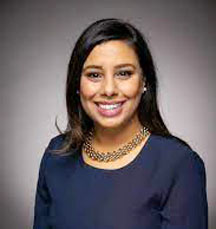
    Since Liberal MPs of South Asian descent stood by Justin Trudeau throughout his tough times, he inducted Brampton MP Ruby Sahota, to raise the number of South Asians in the 38-member Cabinet to six. She was named Minister for Democratic Institutions and Minister Responsible for the Federal Economic Development Agency for Southern Ontario.

    Within a few hours of the reshuffling of the federal Cabinet, Chandra Arya, Liberal MP from Nepean, fired a salvo asking Prime Minister Justin Trudeau to quit. He is the first Liberal MP of South Asian descent to express his dissent in the leadership of Justin Trudeau.

    Besides, four Conservative MPs of Indian descent, including Tim Uppal, Jasraj Singh Hallan, Arpan Khanna, and Shuvaloy Majumdar, who have been part of three non-confidence motions, Jagmeet Singh, Leader of the New Democrats, became the first MP of South Asian descent to ask Justin Trudeau to quit. And for the ruling Liberals, Chandra Arya is the first South Asian from the Liberal caucus to revolt against Trudeau’s leadership.

    While time and fate will decide the future of Justin Trudeau and his Liberal Government in 2025, it is the 2-million-strong South Asian community continues to await difficult and uncertain times ahead.

    Will the turn of the year bring back cheers to members of the community who proudly acclaim themselves to be “Canadians”? only time will tell.

    Meanwhile, I wish all Canadians a Happy New Year.

    (Prabhjot Singh, is a Toronto-based award-winning independent journalist, He was celebrated by AIPS, the international body of sports journalists, for covering ten Olympics at its centennial celebrations held at UNESCO Centre in Paris during the 2024 Olympic Games. Besides, he has written extensively about business and the financial markets, the health industry, the public and private sectors, and aviation. He has worked as a political reporter besides covering Sikh and Punjab politics. He is particularly interested in Indian Diaspora and Sikh Diaspora in particular. His work has also appeared in various international and national newspapers, magazines and journals.)

  • Brampton MP Ruby Sahota joins Cabinet as Justin Trudeau inducts eight new faces

    Brampton MP Ruby Sahota joins Cabinet as Justin Trudeau inducts eight new faces

    By Prabhjot Singh

    OTTAWA (TIP): With the induction of Brampton MP Ruby Sahota, the number of South Asians in the 38-member Cabinet of Justin Trudeau has gone up to six. She will be the Minister for Democratic Institutions and Minister Responsible for the Federal Economic Development Agency for Southern Ontario.

    Never before have MPs of South Asian descent had such a good representation in the federal Cabinet. Questions were being asked about the longevity of the reshuffled Cabinet as all the three Opposition parties – Conservatives, Bloc Quebecois and New Democrats – are out baring their knives to kill the government at the first possible opportunity.

    The American threat of a 25 per cent tariff looms large in the air as President-elect Donald Trump is scheduled to assume office on January 20.

    After Ruby Sahota’s inclusion, other MPs of South Asian descent on the Canadian Cabinet are Anita Anand, Minister of Transport and Internal Trade, as she sheds the portfolio of President of the Treasury (that goes to Ginette Petitpas Taylor), Jaffna-born Gary Anandasangaree, Minister of Crown-Indigenous Relations and Northern Affairs and Minister responsible for the Canadian Northern Economic Development Agency, Kamal Khera, Minister of Diversity, Inclusion and Persons with Disabilities, Harjit S. Sajjan, President of the King’s Privy Council for Canada and Minister of Emergency Preparedness and Minister responsible for the Pacific Economic Development Agency of Canada, and Arif Virani, Minister of Justice and Attorney General of Canada.

    While the Prime Minister, Justin Trudeau,  announced changes to the Ministry, in his declared intent to continue till the next federal election in October of next year, both the Leader of Opposition, Pierre Poilievre, and the Liberals ally,  Jagmeet Singh of New Democrats, made clear their stands to bring down the minority Liberal government at the early possible opportunity to force an early election.

    Pierre Poilievre, who earlier in the day taunted the NDP leader Jagmeet Singh for his open letter to the Canadians, took to X to say that he has written to the Governor-General “confirming that the Prime Minister has lost the confidence of the House and that Parliament must be recalled to hold a vote before the end of the year on triggering an Axe The Tax election. I am asking the NDP leader to match his actions to his word and send a letter to Her Excellency asking for the same.”

    In an earlier post on X, Pierre Poilievre said: “Ha! Now that Parliament is closed there is no chance to introduce any motion for months—until after you get your pension. You did the same stunt in September, claiming you would no longer prop Trudeau up. Then you went back on your word and voted 8 times against an election and for your boss Trudeau. Just 11 days ago you voted against a non-confidence motion filled with your own words. Had you voted the other way, we would be almost halfway through the election now. Only common-sense Conservatives can and will replace this costly NDP-Liberal clown show.

    Hours before the swearing-in ceremony at Rideau Hall, Jagmeet Singh took to X and announced that “Justin Trudeau failed in the biggest job a Prime Minister has: to work for people, not the powerful. The NDP will vote to bring this government down, and give Canadians a chance to vote for a government who will work for them.”

    In an open letter to Canadians that he shared on X, Jagmeet Singh said that he “called Justin Trudeau to resign and he should. He cannot fix health care. He cannot build homes you can afford. He cannot lower your bills.

    “I have always fought like hell to get dental care, free birth control and diabetes medication. I did not give up when Justin Trudeau said no. And I won’t let Pierre Poilievre take it all away.

    “The next fight is a big one. Pierre Poilievre and the Conservatives will give CEOs and big businesses anything they want, and make callous cuts to pay for it. They will cut health care, childcare, housing and people’s pensions.”

    Meanwhile, the Prime Minister’s office released a statement saying that the new Ministry will deliver on what matters most.

    It said “Building on the work done since 2015 to invest in Canadians, the team will continue to move forward on housing, childcare, and school food while working to put more money back in people’s pockets.

    “The changes to the Ministry are as follows:

    • Anita Anand becomes Minister of Transport and Internal Trade, Gary Anandasangaree becomes Minister of Crown-Indigenous Relations and Northern Affairs and Minister responsible for the Canadian Northern Economic Development Agency, Steven MacKinnon becomes Minister of Employment, Workforce Development and Labour, and Ginette Petitpas Taylor becomes President of the Treasury Board

    “The Prime Minister also welcomed the following new members to the Ministry: 

    Rachel Bendayan becomes Minister of Official Languages and Associate Minister of Public Safety,  Élisabeth Brière becomes Minister of National Revenue, Terry Duguid becomes Minister of Sport and Minister responsible for Prairies Economic Development Canada, Nate Erskine-Smith becomes Minister of Housing, Infrastructure and Communities, Darren Fisher becomes Minister of Veterans Affairs and Associate Minister of National Defence,   David J. McGuinty becomes Minister of Public Safety,· Ruby Sahota becomes Minister of Democratic Institutions and Minister responsible for the Federal Economic Development Agency for Southern Ontario, and Joanne Thompson becomes Minister of Seniors. 

    “These new ministers will work with all members of Cabinet to deliver real, positive change for Canadians. They join the following ministers remaining in their portfolio:

    • Terry Beech, Minister of Citizens’ Services
    • Bill Blair, Minister of National Defence
    • François-Philippe Champagne, Minister of Innovation, Science and Industry
    • Jean-Yves Duclos, Minister of Public Services and Procurement and Quebec Lieutenant
    • Karina Gould, Leader of the Government in the House of Commons
    • Steven Guilbeault, Minister of Environment and Climate Change
    • Patty Hajdu, Minister of Indigenous Services and Minister responsible for the Federal Economic Development Agency for Northern Ontario
    • Mark Holland, Minister of Health
    • Ahmed Hussen, Minister of International Development
    • Gudie Hutchings, Minister of Rural Economic Development and Minister responsible for the Atlantic Canada Opportunities Agency
    • Marci Ien, Minister for Women and Gender Equality and Youth
    • Mélanie Joly, Minister of Foreign Affairs
    • Kamal Khera, Minister of Diversity, Inclusion and Persons with Disabilities
    • Dominic LeBlanc, Minister of Finance and Intergovernmental Affairs
    • Diane Lebouthillier, Minister of Fisheries, Oceans and the Canadian Coast Guard
    • Lawrence MacAulay, Minister of Agriculture and Agri-Food
    • Soraya Martinez Ferrada, Minister of Tourism and Minister responsible for the Economic Development Agency of Canada for the Regions of Quebec
    • Marc Miller, Minister of Immigration, Refugees and Citizenship
    • Mary Ng, Minister of Export Promotion, International Trade and Economic Development
    • Harjit S. Sajjan, President of the King’s Privy Council for Canada and Minister of Emergency Preparedness and Minister responsible for the Pacific Economic Development Agency of Canada
    • Ya’ara Saks, Minister of Mental Health and Addictions and Associate Minister of Health
    • Pascale St-Onge, Minister of Canadian Heritage
    • Jenna Sudds, Minister of Families, Children and Social Development
    • Rechie Valdez, Minister of Small Business
    • Arif Virani, Minister of Justice and Attorney General of Canada
    • Jonathan Wilkinson, Minister of Energy and Natural Resources,” the statement said.

    (Prabhjot Singh is a Toronto-based  award-winning independent journalist, He was celebrated by AIPS, the international body of sports journalists, for covering ten Olympics at its centennial celebrations held at UNESCO Centre in Paris  during the 2024 Olympic Games. Besides, he has  written extensively about  business and the financial markets, the health industry, the public and private sectors, and aviation. He has worked as a political reporter besides covering Sikh and Punjab politics. He is particularly interested in Indian Diaspora and Sikh Diaspora in particular. His work has also appeared in various international and national  newspapers, magazines and journals)

  • Violence at Hindu Temple: Brampton Mayor wants a Bill to prohibit protests outside places of worship as Ruby Sahota MP raises it in the House of Commons

    Violence at Hindu Temple: Brampton Mayor wants a Bill to prohibit protests outside places of worship as Ruby Sahota MP raises it in the House of Commons

    By Prabhjot Singh

    BRAMPTON (TIP): Echo of the violent incidents outside Brampton Hindu Temple and Malton Singh Sabha Gurdwara was heard in the House of Commons when it resumed its sitting on Monday, November 4, as Mayor of Brampton Patrick Brown announced to bring in a Bill in his City Council to prohibit protests outside places of worship.

    Liberal MP Ruby Sahota, who raised the issue in the House of Commons, expressed her deep concern at the incidents and held that “everyone in our community deserves to feel safe and respected in his or her place of worship.” She took to “X” and said: ”I am troubled to hear about the recent acts of violence outside the Hindu Sabha temple in Brampton. Everyone in our community deserves to feel safe and respected in their places of worship. There is no room for such actions in our society and I strongly denounce this violence.

    “I have spoken with Police Chief Nishan and have confidence that Peel Regional Police will act swiftly to protect our community and hold those responsible to account.”

    Speaking in the House of Commons, she said that she went to Hindu temples and Sikh gurdwaras to join members of the Indo-Canadian community in celebrating Diwali. But incidents of violence, first outside the Hindu Temple, and then outside Malton Gurdwara, had shaken her.

    She also assailed the official Opposition Party, the Conservatives, for cancelling the Diwali event on Parliament Hill. She complimented the ruling Liberal party caucus for holding the Diwali celebrations on the Hill on Monday. The event, she said, was largely attended. Chandra Arya, also of the ruling Liberal, the main organizer of the Diwali celebrations on Parliament Hill, was also on X and wrote: “I was pleased to host Diwali on Parliament Hill. We also used the opportunity to raise the flag of the Hindu sacred symbol Aum on Parliament Hill. Great turnout with participants from Ottawa, the Greater Toronto Area, Montreal and many other places. The event was supported by 67 Hindu and Indo-Canadian organizations across Canada. The added pleasure this year was Diwali is also part of the Hindu Heritage Month across Canada. My sincere thanks to all those who attended, volunteers and artists of excellent cultural performances at the event.”

    Meanwhile, Mayor of Brampton Patrick Brown said that he plans to bring a bill before Brampton Council to prohibit protests at places of worship. “I would also request Mississauga Council to enact a similar law,” he said.

    Patrick Brown was on “X” saying “I will be bringing a motion to our Brampton City Council which would look at prohibiting protests at places of worship. Places of worship should be safe spaces that are free of violence and intimidation. I have asked our City solicitor to look into the legality of such a by-law for our next scheduled meeting of the City Council.”

    Meanwhile, the Hindu Maha Sabha had given a call for holding a peaceful protest outside the Brampton temple to condemn the incidents of violence that took place on Sunday, November 3.

  • Mission politics started from Mission in BC

    Mission politics started from Mission in BC

    By Prabhjot Singh

    It was not easy. The early migrants from South Asia were not welcome to Canada. They not only suffered numerous hardships but were also denied the right for a decent living. They had no voting rights. In fact, the concept of the Nagar Kirtan processions, or the Sikh Parades, proved to be an effective tool for the overseas Sikh community to introduce itself as a peaceful and hard-working group that had no qualms of making countries of their present abode as their homes. The first ever-Sikh Parade or Nagar Kirtan procession was organized on January 19, 1908, along Second Avenue in Vancouver.

    It has been this commitment that has helped them to script an unprecedented success story the world over. Though the Punjabis – initially described as Hindus – started reaching Canada in early 1900, they were denied voting rights in British Columbia from 1907 onwards. They had to wait for 40 long years to win back the right to vote. In 1947, the requirement to be a voter was changed to Canadian citizenship in addition to being a British subject. It was in 1950 that the first Sikh – Naranjan Singh Grewall – was elected to the City Council of Mission in British Columbia.

    He became the first “Hindu” (the colloquial term for South Asians at the time) elected to any political position in Canada. Later, he became the first South Asian migrant to become Mayor of the Mission City Council in 1954. Grewall’s run for a seat in the BC Legislature as a member of the CCF surprised no one. He was first and foremost a man of the people. He lost the assembly election in a close battle.

    The Indo-Canadian community was waiting for the break Naranjan Singh Grewall had provided. Once the process of its assimilation in mainstream politics started, the Punjabi migrant community set its goals high. And before the turn of the century, it had three of its nominees – Gurbax Malhi, Herb Dhaliwal, and Jag Bhaduria – sitting in the House of Commons in Ottawa.

    And long before their journey to Ottawa started, the beginning, though unsuccessful, was made in late 60s and early 70s. In 1970, a new party was born. It was headed by an Indo-Canadian. Called Communist Party of Canada (Marxist-Leninist), it was founded by Hardial Singh Bains, a trained Bacteriologist. Born in Mahilpur in Hoshiarpur, Hardial moved to Vancouver when he was 19. Much before Jagmeet Singh became the President of the NDP, Hardial Singh Bains had earned the distinction of leading a national political party in Canada.

    After studying in Canada, England, and Ireland, Hardial Singh Bains returned to Canada and spearheaded the workers movement. Since Elections Canada does not allow the use of the word “communist” in the name of any party, Hardial Singh Bains got his party registered as Marxist-Leninist Party of Canada in 1974. Before his death in 1997, the Marxist-Leninist Party contested the 1974, 1979, 1980, 1993 and 1997 federal elections. Though the party has never succeeded in sending any of its members to the House of Commons, it fielded its largest number of candidates,177, in 1980. Many of these candidates were migrants, including those from India. Amarjit Dhillon, who was the party candidate from Vancouver South, both in 1979 and 1980, polled only 91 and 63 votes. Overall, though the party never aggregated 0.20 per cent of total votes polled, still it never gave up its fight and contested the last federal elections in 2021 by fielding 36 candidates.

    It was in 1974 when Hari Singh, a teacher, contested on Liberal ticket from Okanagan-Kootenay. Though it was a Liberal stronghold, but Hari Singh lost. After his defeat, he accused the majority community of Liberals of voting against him. Subsequently, the Liberals retained the seat.

    Ten years later in 1984, another teacher, Harkirpal Singh Sora, contested from Vancouver South. He too was unsuccessful. Deepak Obhrai was the longest serving MP from Calgary East. Long before he emerged on the scene, in 1988 this riding had tried to elect Anil Giga, a Liberal, to the House of Commons. He, however, was defeated by Alex Kindy by 18,227 votes. The Bramalea-Gore-Malton Riding has always remained a stronghold of the Punjabi migrants. The first attempt by the community to get into the House of Commons was in 1988, when the Liberals put up Gurjit Grewal, who lost by 2,185 votes to Harry Chadwik of the CP.

    Palbinder Shergill, a young amritdhari Sikh and a practicing lawyer, was one of the first Punjabi women to contest federal elections. She was unsuccessful  along with another Punjabi Indo-Canadian candidate from the Surrey Central Riding. The other  candidate was Charan Gill who had earlier made an attempt to get into the House of Commons in 1988 but was defeated by Benno Friesen of the PC. He represented the NDP.

    Sikh Turban has become an integral part of Canadian Parliament

    Two turbaned Sikh politicians – one from yesteryear, and another from now – Gurbax Singh Malhi and Jagmeet SinghJagmeet Singh

    October 25, 1993 would go down in the annals of history of the Canadian House of Commons as a golden letter day. It was on this day that Canada earned the distinction of electing the first turbaned Sikh MP to any Parliament outside India. The honor went to Gurbax Singh Malhi as he was declared successful from Bramalea-Gore-Malton riding. Though two more MPs of Indian origin – Harbance (Herb) Singh Dhaliwal and Jagdish Bhaduria – also made their debut in the Canadian House of Commons simultaneously, the spotlight was on Gurbax Singh Malhi. Since then, no Canadian Parliament has been complete without a turbaned Sikh represented on it.

    Starting with three MPs in 1993, now the Indo-Canadian community has grown six times in its strength in the House of Commons. It represents all three major parties – the ruling Liberals, the main Opposition party the Conservatives, and the third major party NDP headed by an Indo-Canadian Jagmeet Singh. Incidentally, Jagmeet Singh is the lone Indo-Canadian NDP in the current House of Commons.

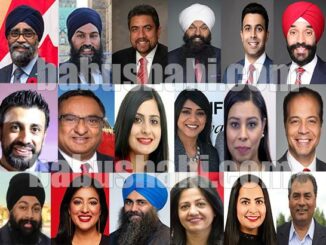
    Of 42 MPs of Indian origin elected to House of Commons since 1993, Navdeep Singh Bains, Tim Uppal, Jagmeet Singh, Randeep Sarai, Harjit Singh Sajjan, Darshan Singh Kang, Raj Grewal, Jasraj Singh Hallan and Iqwinder Singh Gaheer, are among those who earned special limelight because of their colorful turbans.

    Incidentally, Gurbax Singh Malhi has till date remained the longest serving Sikh MP representing the Liberals. He was elected five times starting in 1993 till he lost the 2011 elections. Otherwise, Deepak Obhrai, who was born in Tanzania, earned the distinction of longest serving Canadian MP of Indian origin. He retained his House of Commons seat for seven consecutive terms mostly as a nominee of Conservatives.

    While Gurbax Singh Malhi, Jag Bhaduria and Herb Dhaliwal were the first representatives of Liberals in Canadian Parliament, the honor for giving representation to Indo-Canadians in the House of Commons on behalf of Conservatives went to Deepak Obhrai and Gurmant Grewal. Subsequently, Jasbir Singh Sandhu and Jinny Jogindera Sims were the first Indo Canadians to represent NDP in the Canadian Parliament.

    Women of Indo-Canadian descent did not take along to reach Ottawa’s Parliament Hill. Ruby Dhalla (Liberal from Ontario) and Nina Grewal (Conservative from British Columbia) became the torch bearers. They were followed by Jinny Jogindera Sims (NDP).

    Sonia Sidhu, Ruby Sahota, Kamal Khera, Bardish Chagger and Anju Dhillon created ripples when they all made their entry into the 42nd Parliament and are all continuing in the current 44th Parliament. In the 43rd Parliament they were joined by Anita Anand, the first Indo-Canadian woman politician to hold the important portfolio of Defense. Also, a new entrant was Jag Sahota, the ninth woman of Indian origin to enter Canadian Parliament.

    These Canadian MPs of Indian origins have several other firsts to their credit. For example, Gurmant Singh Grewal and Nina Grewal were the first couple to sit in the same House. Herb Dhaliwal was the first from the group to be inducted in the Canadian Cabinet as a Minister for Oceans. Many of them have remained Parliamentary Secretaries attached with important ministries.

    In the previous Liberal Government, Harjit Singh Sajjan, became the toast of not only the Indo-Canadian community but also of the rapidly growing Indian Diaspora after he was named the Defense Minister of Canada.

    Bardish Chagger hawked media headlines on becoming the first woman leader of the House of Commons. And late last year, Anita Anand stole the limelight as the first Indo-Canadian woman to hold the portfolio of Defense Minister. Incidentally, the last two Liberal Governments had an Indo-Canadian as Defense Minister.

    There have been Indo-Canadians who created history both in provincial and federal politics. The shining example has been of Ujjal Dosanjh who after his phenomenal rise as the first Indo-Canadian Premier of British Columbia  later held the portfolio of the Canadian Health Minister. A couple of MPs, including Jinny Jogendra Sims and Parm Gill, later made their debut in provincial politics and held positions as Cabinet Ministers in British Columbia and Ontario, respectively. Amarjit Sohi, who held an important cabinet portfolio in the previous Justin Trudeau government is now a Mayor of Edmonton in Alberta since last year.

    MPs of Indian origin

    Gurbax Singh Malhi

    Harbance (Herb) Singh Dhaliwal

    Jag Bhaduria

    Deepak Obhrai

    Gurmant Grewal

    Rahim Jaffer

    Nina Grewal

    Ruby Dhalla

    Ujjal Dosanjh

    Navdeep Bains

    Sukh Dhaliwal

    Tim Uppal

    Jinny Jogindera Sims

    Devinder Shory

    Jasbir Sandhu

    Bal Gosal

    Parm Gill

    Joe Daniel

    Amarjit Sohi

    Jagmeet Singh

    Gagan Sikand

    Sonia Sidhu

    Jati Sidhu

    Bob Saroya

    Randeep Singh Sarai

    Ramesh Sangha

    Harjit Singh Sajjan

    Raj Saini

    Ruby Sahota

    Kamal Khera

    Darshan Singh Kang

    Raj Grewal

    Anju Dhillon

    Bardish Chagger

    Chandra Arya

    Maninder Sidhu

    Jag Sahota

    Jasraj Sigh Hallan

    Anita Anand

    Iqwinder Singh Gaheer

    George Chahal

    Parm Bains

    -To be concluded

    (Prabhjot Singh is a veteran journalist with over three decades of experience covering a wide spectrum of subjects and stories. He has covered  Punjab and Sikh affairs for more than three decades besides covering seven Olympics and several major sporting events and hosting TV shows. For more in-depth analysis please visit probingeye.com  or follow him on Twitter.com/probingeye. He can be reached at prabhjot416@gmail.com)

  • 16 Indian-origin candidates win federal polls in Canada elections

    16 Indian-origin candidates win federal polls in Canada elections

    OTTAWA (TIP):  16 of the 17 Indian-origin politicians who have made it to the Canadian House of Commons in the recent general elections are Punjabis. The number of Indian-origin candidates who were reelected is marginally down from 20 in 2019. All prominent Punjabi-Canadian faces were reelected—including Defense Minister Harjit Sajjan from Vancouver South, Minister Bardish Chaggar from Waterloo, Minister Anita Anand from Oakvilla and Jagmeet Singh, who heads New Democratic Party, from Burnaby South seat. Liberal Member of Parliament Chanderkanth Arya, who has his roots in Karnataka, was elected from Napean in Ontario yet again—the lone non-Punjabi Indian-origin MP.

    Many of these seats were from Ontario, Canada’s largest province and a hub for Indian immigrants. Punjab-origin MPs won four of five seats in Brampton: Ruby Sahota from Brampton North, Maninder Sidhu from Brampton East, Sonia Sidhu from Brampton South, and Kamal Khera from Brampton West. Five of those who won are women: Anju Dhillon, a lawyer and a Liberal Party from Dorval-Lachine-La-Salle who became the first Indian-Canadian to win a seat twice in the French-speaking province of Quebec; her fellow Liberal candidate Ruby Sahota; Sonia Sidhu; Anita Anand; and Bardish Chaggar. Other prominent winners are Jasraj Singh; George Chahal; Tim Uppal; Sukh Dhaliwal; and Randeep Singh Sarai. Nineteen of 20 Indian origin MPs who’d been elected in 2019 were of Punjabi-origin.