Tag: Russia

  • A US-Pak nuclear deal would be a threat to India’s security

    A US-Pak nuclear deal would be a threat to India’s security

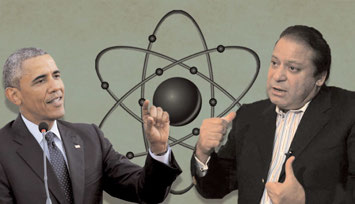
    If a report in a US newspaper is to be believed, a US-Pakistan nuclear deal might be on the cards. The report says that such a deal is being considered around Prime Minister Nawaz Sharif’s visit to Washington this month.

    The report would not have appeared credible but for the evasive comment of the State Department on the subject and the official reaction of the spokesperson of our Ministry of External Affairs cautioning the US authorities against any such decision.

    Ever since the India-US nuclear deal was signed, the Pakistanis, obsessed with the idea of parity with India, have been seeking a similar deal.

    Besides calling the India-US nuclear deal discriminatory, Pakistan has condemned it as threat to its security and warned that it would take all necessary steps to safeguard its interests. Pakistan’s Foreign Affairs Adviser Sartaj Aziz aggressively reiterated this on the occasion of President Barack Obama’s visit to India in January this year.

    By remaining silent, the US has only encouraged this absurd posturing by Pakistan.

    US soft on Pakistan

    Some western nonproliferation specialists have been advocating for some time a nuclear deal with Pakistan in order to remove its sense of grievance. They feel it would give Pakistan an incentive to limit the expansion of its nuclear arsenal and stabilize the nuclear situation in the sub-continent.

    Such advocacy is largely prompted by negative attitudes towards India which, with its historical opposition to the NPT, is seen as the one responsible for nuclearizing South Asia. In their eyes, this is one way of denying India any one-sided advantage in nuclear status.

    Until now, the US Administration has been differentiating India’s case from that of Pakistan and disclaiming any move to offer the latter a similar deal, thought the tenor of its statements has not been sufficiently convincing.

    In fact, both the US and China, to different degrees, have aided Pakistan in achieving its nuclear and missile ambitions.

    A US-Pak nuclear deal will erode the strategic importance of the Indo-US nuclear deal

    In the past, knowing the China-Pakistan nuclear and missile nexus, the US has waived the application of its laws for larger geopolitical reasons linked to the combat against the Soviets in Afghanistan. The Afghanistan factor has, unfortunately, continued to condition US thinking on Pakistan’s nuclear and other errant behavior.

    The US was remarkably soft with Pakistan on the AQ Khan case. It has tolerated Pakistan’s tactics to obstruct discussions on the FMCT at Geneva at a time when fissile material control was still on the US agenda.

    It has overlooked supplies of additional Chinese nuclear reactors to Pakistan in violation of China’s NSG commitments.

    One could speculate that having settled the nuclear question with India, this was one way for the US to allow Pakistan to be a beneficiary of external cooperation in its nuclear sector, as part of the traditional policy of “hyphenation”.

    US agencies and think tanks have been propagating information about the frenetic pace at which Pakistan has been expanding its nuclear arsenal, without any visible reaction from the US government.

    At one time, worried about the rise of radicalism in the country, the US was expressing concern about the security of Pakistan’s nuclear arsenal. But such fears are no longer being expressed.

    US conduct over the years suggests that it has favored the idea of a Pakistani nuclear capability to balance India’s. Remarkably, its complaisance towards the Pakistani nuclear program has continued long after the end of the Cold War.

    Adding to all this, US treatment of Iran’s nuclear ambitions contrasts strikingly with its handling of Pakistan’s nuclear transgressions. While draconian sanctions have been applied on Iran, in Pakistan’s case the US has argued that sanctions might hasten its slide towards failure as a state and increase the risk of its nuclear assets falling into the hands of religious extremists.

    This is specious logic as the US has not taken any precautionary step to curb the development of Pakistan’s nuclear assets, including its decision to introduce tactical nuclear weapons in the subcontinent. An expanded Pakistani nuclear arsenal is even more likely to fall into the wrong hands.

    US reaction to Pakistan’s loose talk about using nuclear weapons against India has been, moreover, notably mild. It could and should have been much stronger.

    The hesitation to impose sanctions on Pakistan contrasts also with the willingness to impose sanctions even on a powerful country like Russia, including its most senior leaders and functionaries.

    What inhibits the US to strong arm Pakistan despite its provocations remains unclear.

    The argument that for dealing with the situation in Afghanistan the US needs Pakistan’s assistance is not convincing. The US needs Russia even more for dealing with yet more complex and fraught problems as Iran and West Asia in general, including the rise of the Islamic State, not to mention the fall-out of mounting tensions in Russia-West relations.

    China-Pakistan axis

    It is mystifying why the US should want to politically legitimize Pakistan’s nuclear conduct through an India-like nuclear deal.

    In India’s case, the US wanted to make a geopolitical shift with the rise of China in mind. It saw India as a counterweight to China in Asia, but for this the nonproliferation issue which inhibited India’s international role had to be resolved.

    Pakistan is in fact China’s closest ally. The geopolitical purpose of a nuclear deal with Pakistan will only legitimize the China-Pakistan nuclear and security relationships and undermine India’s strategic interests vis-a-vis both these adversaries.

    The US has wanted to build a strategic relationship with India largely around shared interests in the Indian Ocean and Asia-Pacific regions in view of mounting signs of Chinese political and military assertiveness and its ambitious naval expansion program.

    Through the China-Pakistan Economic Corridor and the development of Gwadar, Pakistan is facilitating an increased Chinese strategic presence in the Indian Ocean, which contradicts this US strategy.

    Shocking rationale

    According to reports, the underlying reasoning offered by the US, if correctly reported, is almost shocking. In return for an NSG waiver, Pakistan will be asked to restrict its nuclear program to weapons and delivery systems that are appropriate to its actual defense needs against India’s nuclear threat, and not to deploy missiles beyond a certain range.

    This implies that the US accepts that India’s nuclear program is Pakistan-centric and that it poses a threat to Pakistan.

    The Chinese threat to India is being overlooked and the fact that India faces a double Pakistan-China nuclear threat – in view of the close nuclear collaboration between the two countries- is being ignored.

    The US, it appears, would be comfortable if only India would be exposed to the Pakistani nuclear threat, not others.

    US has been consistently soft on Pakistan’s errant behavior in matters like nuclear weapons

    But then, Pakistan’s nuclear arsenal, according to its own leaders, is India-centric. Pakistan is not threatening China, Iran or Saudi Arabia with its nuclear weapons. Which are the countries that the US wants to protect against the use of nuclear weapons by Pakistan?

    Pakistan is developing delivery systems to reach any point in India. The US would apparently be comfortable with that, but not if it developed missiles of longer range. But whose security is US worried about if Pakistan did that? US itself, Japan, Australia, Singapore, China, Iran, Saudi Arabia, Israel?

    China, we know, opposes India’s NSG entry without Pakistan. It would seem the US would be willing to accommodate both China and Pakistan if the latter limited its nuclear threat to India.

    By implication then, the US has no stakes in India’s security from an unstable and adventurous Pakistan, despite our so-called strategic partnership.

    A reward for Pakistan’s military

    The timing of a nuclear deal would be odd too. It is now universally recognized that it is General Raheel Sharif and not Nawaz Sharif who really hold the reins of power in the country. A nuclear deal will be a reward for the Pakistan military and not the civilian power, as Pakistan’s nuclear program is under military control.

    Does the US want to reward the Pakistan military for its operations in North Waziristan against the Pakistani Taliban and is this considered meritorious contribution to the fight against Al Qaeda and terrorism?

    One would have thought far more important for the US and the West is the rise of the Islamic State and its ideology. Compared to which North Waziristan is a side-show. In any case, the Pakistani military is not fighting the Haqqani group.

    Worse, while Pakistani is being accepted as an honest mediator in the Afghan reconciliation process, the Taliban showed its mounting force by occupying Kunduz.

    One hopes that the US report does not accurately reflect President Obama’s thinking.

    If it does, it will show how hollow is the strategic relationship between India and the US, and why it would not be wise to trust the US.

    The India-US nuclear deal will be eroded of much of its strategic importance bilaterally, as result. The US would have, in addition, administered a big political blow to Prime Minister Narendra Modi who has gone out of his way to improve strategic understanding with the US.

    But then, news reports are news reports, and they could merely be political kite-flying. In which case, the India-US relationship will not receive a big jolt for all the reasons mentioned in this article.

    (The author is a former foreign secretary of India. He has also served as India’s ambassador to Turkey, Egypt, France and Russia. He can be reached at sibalk@gmail.com)

  • Does India’s nuclear doctrine need a revision?

    Does India’s nuclear doctrine need a revision?

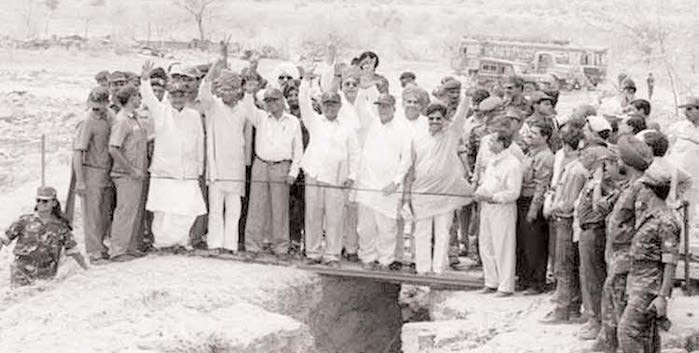
    India’s first nuclear test in 1974 called smiling Buddha in Pokhran desert was, for tactical reasons, characterized as “Peaceful Nuclear Explosion”. The second series of five nuclear tests in 1998 (Pokhran II) was again accompanied by a statement from the then PM Vajpayee attesting to lack of aggressive intent. The 2003 Indian nuclear doctrine went a step forward and made a written unilateral concession about India’s adherence to “No First Use” Doctrine. Since then a lot of debate has gone into the rationale, the need and the necessity for India to revise her Nuclear Doctrine and posture. Some foreign policy mandarins have tried to argue that India does not need to make any changes in the 2003 version of the doctrine. Though the election manifesto of the BJP prior to May 2014 Lok Sabha election noted the need to take a relook at India’s nuclear doctrine, subsequent statements by the PM nipped it in the bud.

    Site of India's first nuclear test in 1974 called smiling Buddha in Pokhran desert
    Site of India’s first nuclear test in 1974 called smiling Buddha in Pokhran desert

    While looking at the nuclear scenario, India has to take the contemporary threat perception and other geo-political factors into account while revising her strategic nuclear policy. It will be a good idea for India to periodically revise her nuclear doctrine every 10-15 years based on the geo-political situation. A lot has already changed since 2003. There is nothing sacrosanct about revising a document that was essentially tactical in nature. Newer nuclear threats have emerged from both the nuclear neighbors, China and Pakistan that mandate that India revise her nuclear doctrine and posture in order to avoid future nuclear blackmail.

    China has significantly diluted its “No first use” nuclear doctrine over the years. China has no intention of exercising restraint in the growth of its nuclear weapons program till the other two nuclear weapons superpowers (US and Russia) have brought down their number of nuclear weapons to China’s level. China has started deploying its nuclear powered submarines in the Indian Ocean region.

    Pakistani Nuclear program was initiated in 1970s by ZA Bhutto after Pakistan’s defeat in Bangladesh war of independence in 1971. His famous statement in 1965 in UNSC was about waging a thousand years war against India. Later on he talked about eating grass and obtaining Nuclear weapons. Pakistan’s nuclear weapons program has been, is and will remain an India-centric nuclear toy in the hands of ISI/GHQ/Pakistani military as the civilians do not control the program. From the beginning Pakistani nuclear program has had Chinese footprints all over.

    While Pakistan’s economy goes south, it remains a rentier state having extorted $31 billion from the US since 9/11. Pakistan keeps on getting tranches of money from the Kingdom of Saudi Arabia under an all-weather Sunni Alliance. Pakistan and ZA Bhutto had proudly proclaimed Pakistan’s nuclear weapons as “Islamic bomb” having been financed by Islamic money from KSA. Last year, Pakistani PM was able to obtain $ one billion from Saudi Arabia at a time when Pakistan’s economy took a hit. Money will never be a problem for Pakistani nuclear establishment as it grows at a disproportionate rate.

    Pakistani ballistic missile program has also heavily borrowed from China and North Korea since the 1990s. Hate IX (Vengeance-IV) Nasr was purpose built to carry tactical nuclear weapons (sub kiloton yield) over short range of 60-90 kilometers. On March 9 2015, Pakistan successfully tested the Shaheen-III surface-to-surface ballistic missile, capable of carrying nuclear warheads to a range of 2,750 km. Shaheen III nuclear capable missiles increase the range of Pakistani nuclear missiles to include the entire Indian land mass and the Indian Eastern naval command based in Andaman & Nicobar Islands. Pakistani has recently become the beneficiary of Chinese nuclear powered submarines that definitely pose a threat to India for her second strike capabilities.

    General Khalid Kidwai who was the director of Pakistani Army’s Strategic Planning Division (SPD) for a period of 15 years, in an open meeting in March 2015 at the Carnegie Endowment for International Peace, in Washington DC aggressively articulated Pakistan’s new offensive nuclear doctrine and posture. He brazenly threatened India with the first use nuclear attack threats painting a new picture. From the initial posture of credible minimum deterrence, Pakistan has moved to the concept of “Full Spectrum Deterrence” which envisages aggressive and offensive use of nuclear weapons by Pakistan against India in a number of scenarios. Not only Pakistan has linked its full spectrum nuclear deterrence doctrine with resolution of J&K dispute in its favor, Pakistan has threatened to use nuclear weapons against India if its tentacles in Afghanistan are cut off. Extra-territorial linkage with loss of its assets in Afghanistan widens the role for nuclear weapons under the new Pakistani doctrine.

    Pakistan has already developed tactical nuclear weapons to be used in the war theater on the mechanized divisions of Indian armed forces. Ostensibly, Pakistan has justified use of tactical nuclear weapons as a policy against Indian Army’s imaginary “Cold start doctrine” which was never officially promulgated.

    Pakistan is the only country that has single-handedly blocked an international agreement on FMCT while feverishly increasing its fissile material production. While traditionally cited figure is Pakistan has 90-110 nuclear weapons, reality has changed during last few years. The Pakistani nuclear armada is the fasted growing in the entire world with production of 10-20 new nuclear weapons every year.

    Pakistani state has brazenly and repeatedly indulged in nuclear blackmail and rent collection over the last several decades. This Pakistani behavior will NOT change only the sponsors and the rent-payers will change over time.

    There is NO reason for India to remain complacent while the nuclear threat perception changes. The PM will do a yeoman’s service to long-term strategic security of Indian nation if he revisits the Indian nuclear doctrine and allows it to grow some teeth. A number of remedial steps can be taken including discarding the meaningless no-first use doctrine to safe-guard nation’s security. Victors always write the history and India has lost repeatedly in history making.

  • India to Declassify Netaji Files in January, 2016

    India to Declassify Netaji Files in January, 2016

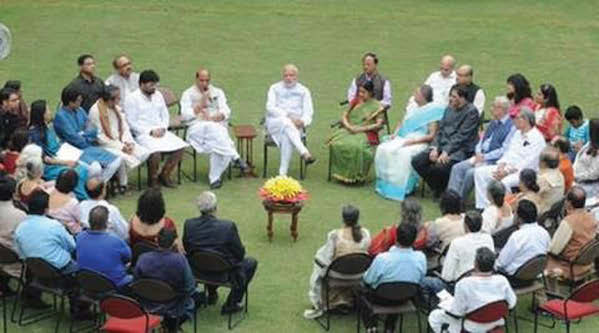
    NEW DELHI (TIP): The process to declassify files relating to Netaji Subhas Chandra Bose will begin on his birth anniversary, January 23, Prime Minister Narendra Modi said on Wednesday, October 14, after meeting 35 members of Netaji’s extended family at his 7, Race Course Road residence. While making the announcement, the PM also said that he sees no reason to “strangle history”.

    Modi said this in a series of tweets after meeting members of Bose’s extended family at his residence here. The prime minister said the government would also request foreign governments to declassify their files on Bose, whose reported death in a plane crash in 1945 in present-day Taiwan is widely disputed.

    Modi said he will begin the process involving other countries with Russia in December when he visits Moscow. Bose, a leading light of India’s freedom movement, was said to be fleeing to Russia when his plane reportedly crashed and caught fire.

    This version has been challenged for decades by innumerable Bose followers who have held varying versions of what happened to him after 1945. Bose’s family members met Modi on Wednesday in the light of the West Bengal government’s declassification of official files related to the last days of Bose, founder of the Indian National Army.

    “It was a privilege to welcome family members of Subhas Babu to 7RCR. We had a remarkable and extensive interaction,” Modi said.

    The PM said that those nations who forget history also lose the power to create it. “Consider me a part of your family,” the PM said to the family members of Netaji. Union Ministers Rajnath Singh, Sushma Swaraj, and Minister of State Babul Supriyo were present on the occasion

    Modi said: “There is no need to strangle history. Nations that forget their history lack the power to create it.”

    The prime minister had said in September that he would meet over 50 members of Bose’s extended family living in India and abroad.

  • Russia denies US claim that four Syria-bound missiles crashed in Iran

    Russia denies US claim that four Syria-bound missiles crashed in Iran

    MOSCOW (TIP): Russia’s defence ministry denied a claim by a US official October 8 that four Syria-bound Russian cruise missiles fired from the Caspian Sea had crashed in Iran. “Any professional knows that during these operations we always fix the target before and after impact. All our cruise missiles hit their target,” ministry spokesman General Igor Konashenkov said in a statement.

    The US official, who spoke on condition of anonymity, said the missiles landed in Iran on Wednesday, confirming a story first reported by CNN. But he did not provide details about where they might have landed or whether they caused any damage.

    Nor would the official say exactly what type of cruise missiles went down, except to say that they were among a salvo fired from Russian warships in the Caspian. “In contrast to CNN we do not refer to anonymous sources but we show the path of our missiles and their targets practically in real time,” Konashenkov said.

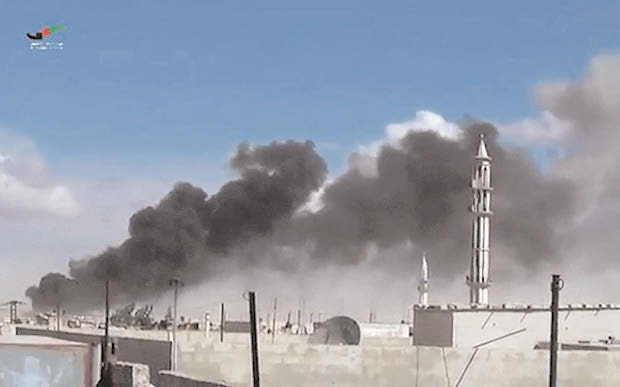
    The Russian defence ministry posted a graphic on its website on October 7 showing 26 missiles overflying Iran and Iraq before striking inside Syria. Russia has been conducting air strikes in Syria in defence of the embattled regime of President Bashar al-Assad since September 30. The missile launches were in support of a major ground offensive by the Syrian army on several fronts in the war-torn country’s west.

  • US-Pakistan Nuclear Deal | India is the check to Pakistan, Donald Trump declares

    US-Pakistan Nuclear Deal | India is the check to Pakistan, Donald Trump declares

    WASHINGTON: The Obama administration is exploring a possible civilian nuclear deal with Pakistan ahead of Prime Minister Nawaz Sharif’s visit to Washington later this month, if media reports are to be believed.

    One of Washington’s well-briefed columnists, David Ignatius, has revealed this week the outlines of a nuclear agreement that the US is said to be negotiating with Pakistan. These talks could be at the top of US President Barack Obama’s agenda with Pakistan.

    In a Washington Post column on Wednesday, Ignatius says the US is ready to lift international restrictions against civilian nuclear commerce with Pakistan in return for significant voluntary restraints on its nuclear weapons programme.

    According to the report, the deal centers around a civilian nuclear agreement similar to the one the United States arrived at with India, in exchange for a Pakistani commitment that would “restrict its nuclear program to weapons and delivery systems that are appropriate to its actual defense needs against India’s nuclear threat.”

    Pakistan might, for example, agree not to deploy missiles capable of reaching beyond a certain range, the report said, citing the source, who indicated that the US might support an eventual waiver for Pakistan by the 48-nation Nuclear Suppliers Group (NSG), the same way it has done for India.

    The Obama administration said it was in “regular contact” with the Government of Pakistan on “a range of issues” as it prepared for the visit on October 22 of Prime Minister Sharif, but declined comment on the specifics of the discussions.

    “The United States urges all nuclear-capable states, including Pakistan, to exercise restraint regarding nuclear weapons and missile capabilities. We encourage efforts to strengthen safety and security measures and continue to hold regular discussions with Pakistan on a range of global issues, including nuclear security, counterterrorism, and international norms,” an administration spokesperson said in a tacit acknowledgement that some sort of dialogue is taking place on the nuclear issue.

    Successive US administrations both under Presidents Bush and President Obama, have knocked down the idea of a deal for Pakistan like the one Washington arrived at with India, saying the background and circumstances surrounding the US-India civilian nuclear agreement was entirely different, and pointing to Pakistan’s record of nuclear proliferation.

    In 10 years, Pakistan will have largest N-stockpile after US and Russia, report suggests

    However, President Obama’s recent track record vis-a-vis Iran and Cuba, both regarded for a long time as outlaw nations, suggests there may be some substance to a nuclear outreach towards Pakistan. There is also less pathology about Pakistan in Washington’s official circles, where many veterans have a romanticized recall of Islamabad’s role in the Cold War when it offered its services to Washington, for a price. The strategy helped Pakistan circumvent nuclear non-proliferation roadblocks that the US all too readily winked at.

    In recent months, Pakistan has tried to project itself as a responsible nuclear power, although some of its politicians and generals reflexively brandish the country’s nuclear weapons to assure themselves and their constituents about security against India. “We are a nuclear-armed country and we know how to defend ourselves,” Pakistan’s National Security Advisor Sartaj Aziz boasted recently in a suo motu assertion although no one had talked of a nuclear war.

    While a few regional experts have floated the idea of a nuclear deal for Pakistan in the past, most analysts are aghast at the prospect. It will be “sheer madness wrapped in folly,” said Sumit Ganguly, a South Asia scholar at Indiana University, among several experts who have critiqued Washington frequent free passes to a country that has a reckless history of nuclear proliferation and home-grown terrorism.

    The WaPo report however conceded that inasmuch as Pakistan prizes its nuclear program, “negotiations would be slow and difficult, and it’s not clear that Islamabad would be willing to accept the limitations that would be required.” But, it said, the issue is being discussed quietly in the run-up to Prime Minister Nawaz Sharif’s visit to Washington on October 22.


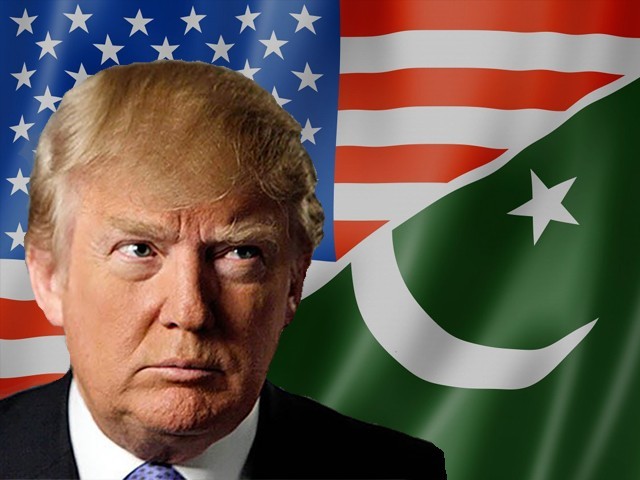
    On an American radio show, Republican presidential hopeful Donald Trump called Pakistan “probably the most dangerous” country in the world today, adding that the only country that can “check” Pakistan is India.

    Pakistan is “a serious problem” because they have nuclear weapons that work and “a lot of them”, just like North Korea and its “mad man”, Trump explained.

    It wasn’t enough that he clubbed Pakistan with North Korea. “India is the check to Pakistan,” continued Trump, adding insult to Pakistan’s injury. “You have to get India involved … They have their own nukes and have a very powerful army. They seem to be the real check … I think we have to deal very closely with India to deal with it (Pakistan),” said Trump, about his foreign policy goals.

  • India Responds in UN | Sushma to Pakistan: Give up terrorism and then let’s talk

    India Responds in UN | Sushma to Pakistan: Give up terrorism and then let’s talk

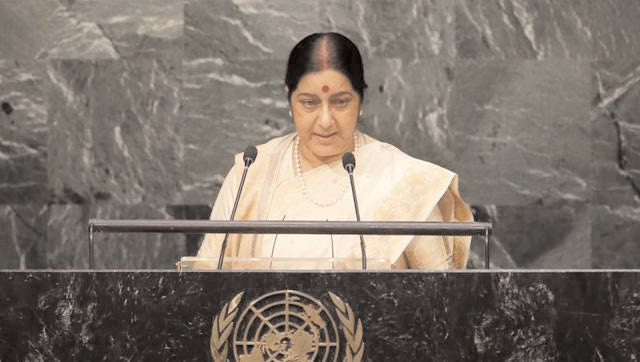
    WASHINGTON (TIP): India on October 1 countered Pakistan Prime Minister Nawaz Sharif ’s four-point peace initiative with a one-point offer. “We don’t need four points, just one — give up terrorism and let’s sit down and talk,” external affairs minister Sushma Swaraj said in an address to the UN general assembly.

    In his UN speech on Wednesday, Sharif had proposed a four-point initiative: demilitarization of Kashmir, ceasefire along the Line of Control, affirmation to not use force and withdrawal from Siachen.

    Reaction from India was sharp and swift. It rubbished elements of the initiative and attempts by Sharif to portray Pakistan as a victim of terrorism, and blame India for its troubles.

    Swaraj rejected his initiative in toto, saying there was just one issue that needed to be taken care of. “Talks and terror cannot go together,” she said, adding that this was what was discussed and decided by Prime Minister Narendra Modi and Sharif in Ufa, Russia, in July.

    The national security advisers of the two countries can meet and discuss all issues connected to terrorism and the directors general of military operations can meet to tackle the border situation, she said.

    “If the response is serious and credible,” the minister said, “India is prepared to address all outstanding issues (which includes Kashmir in diplomacy-speak) through a bilateral dialogue.”

    “None of us can accept that terrorism is a legitimate instrument of statecraft,” she said, drawing attention to India’s frustration with continued cross-border terrorism despite assurances.

    She said these attacks are “meant to destabilize India and legitimize Pakistan’s illegal occupation of parts of the Indian state of Jammu and Kashmir”.

    The mastermind of the Mumbai 2008 attacks walks free, she said, calling it an “affront to the entire international community”.

    In an earlier response to Sharif ’s offer, foreign ministry spokesperson Vikas Swarup tweeted, “To demilitarize Kashmir is not the answer, to de-terrorize Pakistan is.”

    On Sharif ’s claim that Pakistan was a victim of terrorism, India said in a right-to-reply statement in the UN, “In truth, it is actually a victim of its own policies of breeding and sponsoring terrorists.”

    “Pak PM gets foreign occupation right, occupier wrong,” Swarup said about Sharif ’s charge of “foreign occupation” in Kashmir. “We urge early vacation of Pak-occupied Kashmir”.

    Relations between the neighbours have plummeted in recent days and weeks amid tension and firing along the border and cancellation of high-level talks. Both have withdrawn into their respective corners, saying it’s for the other side to make the next move; a long way from the optimism following talks in Ufa. Also, the August 24 NSA-level talks between Sartaj Aziz and his Indian counterpart Ajit Doval were cancelled after Pakistani high commissioner Abdul Basit invited Kashmiri separatists to a tea reception.

    In his speech, Sharif had sought to portray Pakistan, and himself, as more keen on peace than India. He had said after taking office in June 2013 that normalization of ties was one of his first priorities.

    He had reached out to the Indian leadership, he said, yet “today ceasefire violations along the LoC and working boundary are intensifying, causing civilian deaths”.

    “Wisdom dictates our immediate neighbour refrain from fomenting instability in Pakistan,” he said, concluding his attempt to take the moral high ground.

    India’s response was sharp and unsparing. “Pakistan’s instability arises from its breeding of terrorists. Blaming neighbours is not a solution,” Swarup said.

    Harping on Prime Minister Narendra Modi’s demand for the expansion of the UN security council, Swaraj said “if security, development and international peace is to be maintained, then security council needs to be reformed”.

    “We have to include more developing nations in the decision making structures of the security council,” Swaraj said.

  • Russia carries out airstrike near Homs in Syria: US

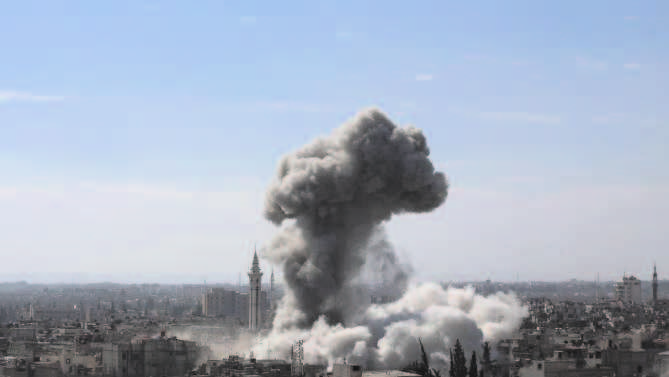
    WASHINGTON (TIP): Russia on Wednesday carried out its first airstrike in Syria, near the city of Homs, a US defense official said, marking the formal start of Moscow’s military intervention in the 4.5-year-old conflict.

    Speaking on condition of anonymity, the defense official said a Russian general working out of an intelligence center in Baghdad had walked over to the US embassy and given a verbal communique of the impending strike.

    “They gave us a heads-up they were going to start striking in Syria,” the official said, noting that the Russians gave about one hour’s advance warning. “It was in the vicinity of Homs.”

    The strike came shortly after Russian President Vladimir Putin won unanimous support from parliament to carry out strikes in Syria.

    The defense official said he was not aware of the impact of the strike or who was targeted.

    Pentagon officials have described Russia’s buildup of military hardware in the Latakia region in northwestern Syria and said Russia is making a forward operating base there.

    So far, at least 500 troops as well as 28 fighter jets and several bombers and artillery units have been deployed to the base, US officials say.

    The defense official said no action was necessary for coalition planes to avoid being in the same air space as Russian jets.

    The Pentagon has repeatedly warned of the need for “deconfliction” to ensure coalition and Russian planes don’t inadvertently cross paths.

  • INDIA BRIGHT SPOT IN SLOWING GLOBAL ECONOMY: IMF CHIEF

    NEW DELHI (TIP): Global growth will be likely weaker this year than last with only a modest acceleration expected in 2016, International Monetary Fund chief Christine Lagarde said on Wednesday, and reiterated that India remains a bright spot.

    “The good news is that we are seeing a modest pickup in advanced economies. The moderate recovery is strengthening in the euro area, Japan is returning to positive growth, and activity remains robust in the US and the UK as well. The not-so-good news is that emerging economies are likely to see their fifth consecutive year of declining rates of growth,” Lagarde said in a speech ahead of October 9-11 IMF-World Bank annual meetings.

    “India remains a bright spot. China is slowing down as it rebalances away from export-led growth. Countries such as Russia and Brazil are facing serious economic difficulties. Growth in Latin American countries, in general, continues to slow sharply. We are also seeing weaker activity in low-income countries – which will be increasingly affected by the worsening external environment,” she said.

    The IMF will release its World Economic Outlook next week. She said policy makers will need to strengthen policies to address current challenges and help lead the world economy to recovery.

    “I am calling on policy makers to make a policy upgrade to address the current challenges,” Lagarde said, adding that the world is at a “difficult and complex juncture”.

    The prospect of rising US interest rates, China’s slowdown, a sharp deceleration in the growth of global trade, and the rapid drop in commodity prices are contributing to global uncertainty, she noted.

    With conflict and forced migration, Lagarde said there is the “human toll” from economic dislocation and low activity. More than 200 million people remain unemployed worldwide, income inequality is rising, and women continue to be disadvantaged both in pay and labour market opportunities.

    “My key message today, however, is this: With the right policies, strong leadership, and global cooperation, it can be managed,” Lagarde stressed. “The bottom line is that proactive policy management by everyone…is now more important than ever.”

  • A Story of Courage and Determination | Arunima Sinha, the First Indian Amputee to Climb Mount Everest

    Ms Arunima Sinha of Lucknow (Uttar Pradesh) is the first Female Amputee of the world to climb Mount Everest. She is also the first Indian Amputee to climb Mount Everest. She reached the summit of Mount Everest on 21st May, 2013 at 10.55 hours after a hard toil of 17 hours, as a part of the Tata Group sponsored Eco Everest Expedition. She took 52 days to reach the summit.

    She was formerly a national level volleyball player. While traveling by train from Lucknow to New Delhi on 11th April, 2011, she was pushed out of the running train by the thieves wanting to snatch her bag and gold chain at about midnight. Her left leg below the knee was crushed. There were multiple injuries in her body. About 50 trains passed over her as she was lying between the two tracks in helpless condition. Next day morning she was rushed to Bareilley civil hospital with serious injuries. The doctors amputated her infected left leg below the knee to save her life. Then she was shifted to All India Institute of Medical Science, New Delhi. While she was undergoing treatment there for four months, she resolved to climb Mount Everest.

    When she was about one thousand feet away from the summit, her oxygen cylinder got almost empty. She was told to come back but she decided to take the risk of her life and marched forward and reached the summit. She placed the Indian flag on the top of the summit along with the flag of Tata Steel (sponsoring agency). Then she worshiped the photograph of Holy Trio (Swami Vivekananda, Bhagwan Shri Ramakrishna and the Holy Mother Sri Sarada Devi) and left it there for good. After the worship, she unexpectedly found an oxygen cylinder left by an Englishman, who had dropped one of the two cylinders as it was too heavy. This is how she survived and came back. She feels that she survived because of the grace of Holy Trio, therefore she has resolved to place the photos of Holy Trio on remaining six summits of the world, she has already placed the photographs on Mount Killmanaro of Africa (11 May, 2014 And Mt. Elbrus of Russia (24th July, 2014).

    She was felicitated by Dr. APJ Abdul Kalam, former President of India at Vadodra on August 10, 2013 during the international youth conference organized by Ramakrishna Mission, Vadodra. She was felicitated by Shri Narendra Modi, the then Chief Minister of Gujarat on January 11, 2014 at Mahatma Mandir, Gandhinagar in the presence of a large number of youths of India and abroad and a large number of dignitaries. She has received many prestigious awards from many reputed organizations — Salam India Award by India TV, Bharatiya Nari Shakti Award by India Today etc. The Vice-President of India Shri M. Hamid Ansari presented an ‘Amazing India Award’ instituted by Times Now channel on 6 Feb. 2014. The Governor of Rajasthan Mrs. Margret Alva presented International Vaish Federation Award .

    She has now dedicated herself to the social cause. She actively participated in Uttarakhand Relief Work. She is planning to start a Sports Academy for poor and differently abled people and is motivating thousands of youths throughout the country with her inspiring life story and the message of Swami Vivekananda. She has delivered many Motivational talks in educational institutions like IIM, Kolkata, IIM Ahmedabad, IIT, Kanpur and in international, national and regional level youth conventions organized by Ramakrishna Mission in various parts of India, and in many reputed companies. Both print media and electronic media have covered her life story in various ways and on various occasions which has inspired thousands of people throughout the country. A book on her life will be soon published by Penguin.

    She is now preparing herself for participating in Para Olympics, 2016 as a Blade Runner.

    Because of her extraordinary courage and self-confidence and inspiring speeches, she is now becoming a role model for modern youth. She is a living example of women Empowerment & Development. Her life story is at once thrilling and inspiring and practical demonstration of the power of faith.

  • ‘US MUST TREAT CHINA AS AN EQUALLY STRONG NATION’

    BEIJING (TIP): Visiting Chinese president Xi Jinping on Tuesday asked the US to treat China as an equally strong nation in what he called “a new model of major country relationship”.

    He demonstrated China’s economic strength by placing an order for 300 Boeing aircraft, something closely related with employment in the US.

    Xi contradicted some experts, who have talked about a Thucydides trap where an emerging power like China causes fears for an established power like the US leading to a war like situation.

    “There is no such things as the so-called Thucydides trap in the world. But should major countries time and again make the mistakes of strategic miscalculation, they might create such traps for themselves,” he warned while speaking at a banquet hosted by the local government of Washington State and local groups.

    Xi’s visit comes soon after China organized a massive military parade exhibiting sophisticated weapons in Beijing.

    Many American senators have complained about China’s recent devaluation of Yuan, which might hit US exports.

    “We want to see more understanding and trust, less estrangement and suspicion, in order to forestall misunderstanding and miscalculation,” the president said.

    “The two countries should unswervingly boost win-win cooperation and foster friendship between the two peoples in an extensive manner.”

    China has been developing its idea of “major country relationship” as it has emerged as an economic power while Russia has gradually lost its superpower status resulting in a vacuum

    Xi will visit Boeing’s main plane factory in Washington State on Wednesday. Besides placing the new order, the State-owned Commercial Aircraft Corporation of China signed an agreement with Boeing to establish a completion centre for 737 airliners in China.

    A Chinese company recently placed another order for 50 aircraft with Boeing.

    Xi has scheduled his meeting with US President Barack Obama at the White House in the later part of the trip.

    “We want to deepen mutual understanding with the US on each other’s strategic orientation and development path,” Xi said.

    He suggested the two countries should respect each other, seek common ground while reserving their differences and spare no effort to turn differences into areas of cooperation.

    China will stay committed to steady economic growth, reform, opening-up, rule of law, anti-corruption endeavors and the path of peaceful development, Xi said.

    “China’s economy will stay on a steady course with fairly fast growth … The key to China’s development lies in reform … China will never close its open door to the outside world,” the president pledged.

  • Russian prankster claims he called Elton John as Putin

    LOS ANGELES (TIP): Legendary musician Elton John’s phone call with Russian President Vladimir Putin has turned out to be a hoax by two TV presenters. Komsomolskaya Pravda, a Russian celebrity prankster known as “Vovan” -whose real name is Vladimir Krasnov – along with his partner, made the prank call to the British singer, playing the roles of Putin and a press secretary, after John said he wanted to meet the Russian President to discuss gay rights in his country.

    “We thought Putin wouldn’t want to meet him or call him at least in the nearest future, but it turned out Elton John’s been waiting for such a call. “That’s why he immediately believed we were exactly those whom we introduced ourselves as,” Krasnov said. John thanked the Russian President in his Instagram post that led to a denial from Kremlin.

  • Jihadists put squeeze on Syria’s Assad as Russia defends aid

    Jihadists put squeeze on Syria’s Assad as Russia defends aid

    BEIRUT (TIP): Jihadists advanced on a regime airbase in eastern Syria on Sept 10 after the fall of one in the north, as staunch ally Russia defended its military aid to embattled President Bashar al-Assad.

    Moscow dismissed criticism of its intervention by Western states, which are carrying out air strikes on jihadists in both Syria and neighbouring Iraq but also seek Assad’s ouster.

    “We helped, are continuing to help and will help the Syrian government when it comes to supplying the Syrian army with everything it needs,” said Russian Foreign Minister Sergei Lavrov.

    Islamic State group jihadists edged closer to a strategic airbase outside the eastern city of Deir Ezzor in heavy clashes that left 54 combatants dead, said the Syrian Observatory for Human Rights.

    The Sunni Muslim group, which has captured large chunks of Syria and Iraq, seized control of an army post near the base on Wednesday night.

    Jihadists put squeeze on Syria's Assad1Observatory director Rami Abdel Rahman said 36 IS fighters and 18 regime soldiers were killed.

    IS fought its way to barely one kilometre (less than a mile) from the airport with the seizure of the army post used by a rocket battalion.

    Two suicide bombers were used by the jihadists in the assault, one of them a child, driving cars laden with explosives, said Abdel Rahman.

    IS already controls most of oil-rich Deir Ezzor province, including about half of its capital, and has fought for more than a year to capture the airport and the rest of the city.

    The Deir Ezzor assault came as rival jihadists from Al-Qaeda’s Syrian affiliate and their allies on Wednesday seized the last regime-held military base in the northwestern province of Idlib.

    According to the Observatory, the regime is now left with just three airbases in the east and north — Deir Ezzor, and Neirab and Kweyris in Aleppo province.

    At least 56 soldiers were killed, some execution-style, as rebels captured Idlib’s Abu Duhur military airport under the cover of an intense sandstorm following a two-year battle, the Observatory said.

    Abdel Rahman, whose Britain-based group relies on a network of sources on the ground in Syria, said at least 40 soldiers were taken prisoner and dozens more were missing.

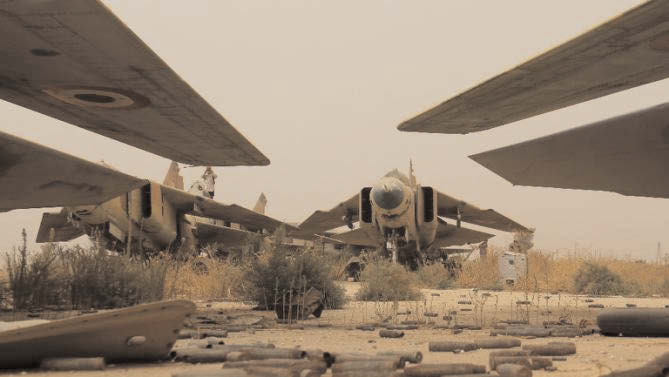
    Rebels tweeted images of helicopters and planes abandoned on the tarmac.

    Abdel Rahman said the entire province of Idlib was now under the control of Al-Nusra Front and other rebel groups.

    Assad’s regime appeared to admit the loss, with state television saying troops had left the base.

    It has been at war with different rebel groups since March 2011, in a conflict that has killed at least 240,000 people and forced millions to flee abroad.

    Russia denied it was ramping up its military presence in Syria, saying it was supplying its ally with humanitarian aid and military equipment under existing contracts.

    “Russian planes are sending to Syria both military equipment in accordance with current contracts and humanitarian aid,” Lavrov told reporters in Moscow.

    “We have never made our military presence (in Syria) a secret,” he said. “Russia is not taking any additional steps.”

  • Iran’s Khamenei backs parliamentary vote on nuclear deal with powers – state TV

    Iran’s Khamenei backs parliamentary vote on nuclear deal with powers – state TV

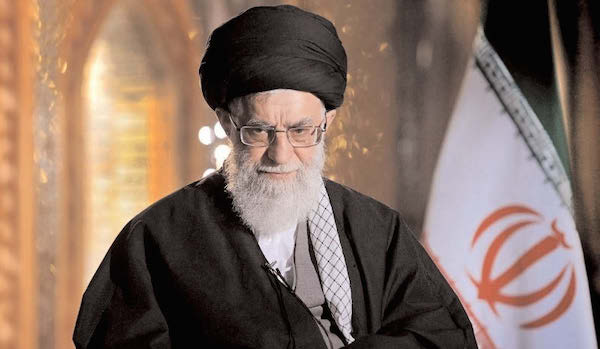
    ANKARA (TIP): Iran’s supreme leader said on September 3 he favoured a parliamentary vote on its nuclear deal reached with world powers and called for sanctions against Tehran to be lifted completely rather than suspended, state television reported.

    President Hassan Rouhani, a pragmatist whose 2013 election paved the way to a diplomatic thaw with the West, and his allies have opposed such a parliamentary vote, arguing this would create legal obligations hampering the deal’s implementation.

    “Parliament should not be sidelined on the nuclear deal issue … I am not saying lawmakers should approve the deal or reject it. It is up to them to decide,” said Ayatollah Ali Khamenei, who has the final say on all state policy in Iran.

    “I have told the president that it is not in our interest to not let our lawmakers review the deal,” he said in remarks broadcast live on state television.

    Khamenei himself has not publicly endorsed or voiced opposition to the Vienna accord, having only praised the work of the Islamic Republic’s negotiating team.

    A special committee of parliament, where conservative hardliners close to Khamenei are predominant, have begun reviewing the deal before putting it to a vote. But Rouhani’s government has not prepared a bill for parliament to vote on.

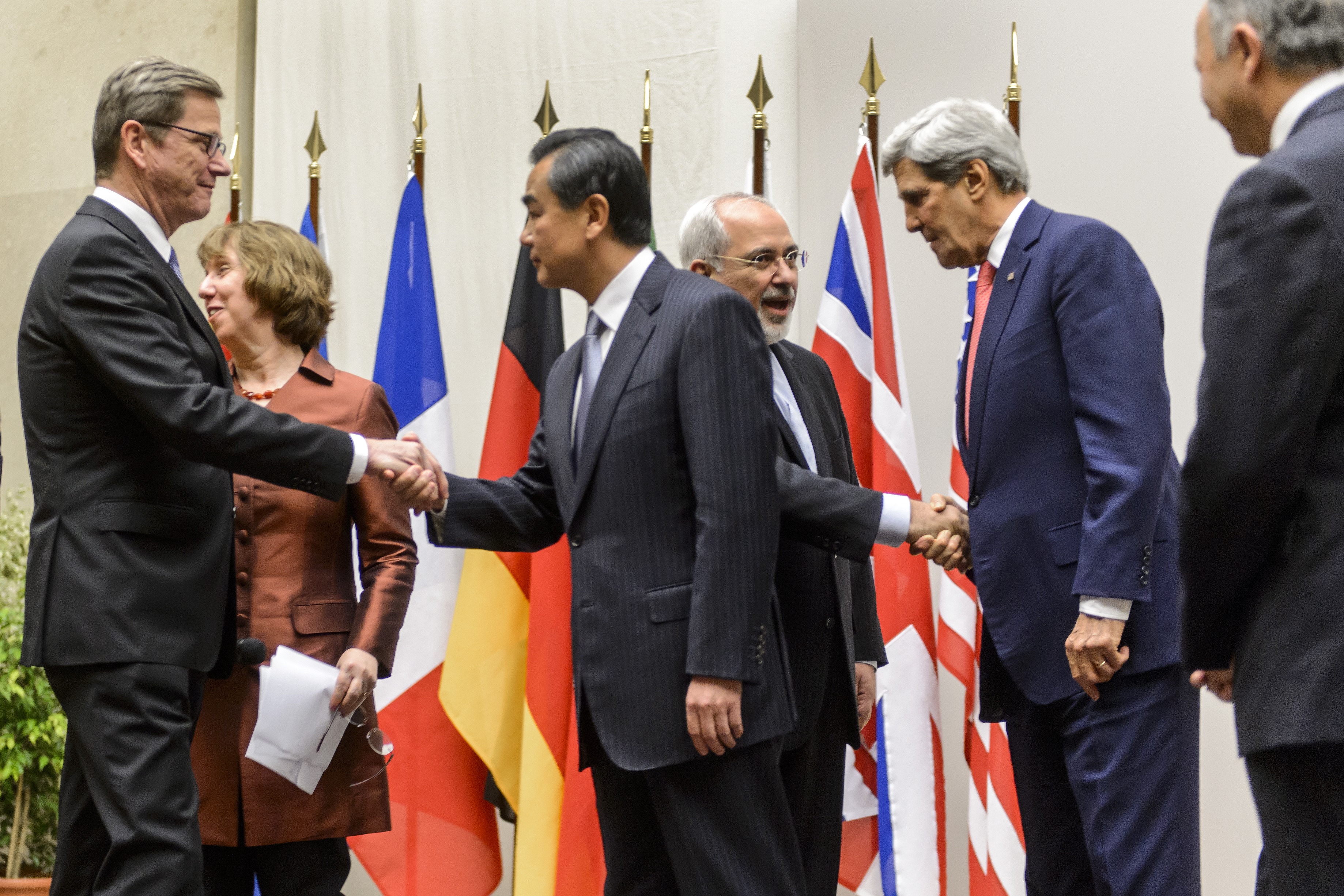
    The landmark deal, clinched on July 14 between Iran and the United States, Germany, France, Russia, China and Britain in July, curbs Iran’s nuclear activities to help ensure they remain peaceful in exchange for a removal of economic sanctions.

    US president Barack Obama appeared to secure enough Senate votes on Wednesday to see the nuclear deal through Congress, but hardline Republicans pledged to pursue their fight to scuttle it by passing new sanctions on Tehran.

    Khamenei said that without a lifting of sanctions that have hobbled Iran’s economy, the deal would be jeopardised.

    “Sanctions …. should be lifted and not only suspended … If not, then we will only suspend our nuclear activities … and there would be no deal if the sanctions are only suspended.”

    Khamenei also criticised the United States’ Middle East policy, ruling out normalisation of ties with Iran’s arch-foe. “Our officials held only nuclear (negotiations) with America. We will never support America’s policies on Syria and Iraq.”

  • US ‘That Kissed the Moon’ Has to Pay Russia for Space Flights

    US ‘That Kissed the Moon’ Has to Pay Russia for Space Flights

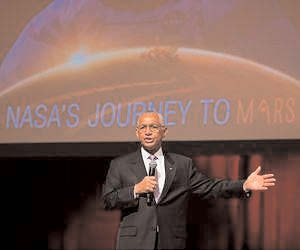
    WASHINGTON (TIP): A retired NASA astronaut has written an article lamenting that the US, “the country that kissed the moon and is roving Mars” has to pay Russia to be able to get to the International Space Station due to the systematic underfunding of the Commercial Crew space program by Congress.

    Maj. General and retired NASA astronaut Charles Bolden has scolded his country’s Congress for the systematic underfunding of the US Commercial Crew space program.

    “Congress has consistently underfunded the amount requested by the President for NASA’s program to return launches of American astronauts to the Kennedy Space Center.

    “Since 2010, the President has received approximately $1 billion less than he requested for NASA’s Commercial Crew initiative,” he wrote in his article, which was published by the technology magazine Wired. “During this time we’ve sent $1 billion to Russia,” he added.

    “Just recently, NASA was left with no other choice but to write a $490 million check to our Russian counterparts so that we can get our own astronauts to the Space Station,” he lamented.

    This dilemma first arose in the summer of 2011, when NASA’s aging fleet of space shuttles was retired; the 30-year program ended right after the final shuttle landed on Earth. Since then, NASA has been dependent on Russia’s Soyuz spacecraft to ferry its astronauts to and from space.

    However, the agency has been encouraging American private spaceflight firms to develop their own astronaut taxis under its Commercial Crew Program.

    “In addition to the considerable economic benefits of Commercial Crew, there is also a strong fiscal case to be made. On a per-seat basis, it costs approximately $81 million to send an American astronaut to the Space Station on the Russian Soyuz spacecraft.

    “By comparison, it will cost $58 million per seat to send our astronauts to the Space Station on Boeing’s and SpaceX’s spacecrafts, once they are certified,” Bolden explained.

    NASA had hoped that at least one homegrown crew-carrying spaceship would be up and running by 2015, but Congress’ failure to fully fund Commercial Crew has made that impossible. NASA is also looking to the private sector to fill the space shuttle’s shoes in terms of sending cargo into orbit.

  • A Free Concert in Tribute to Sri Chinmoy

    A Free Concert in Tribute to Sri Chinmoy

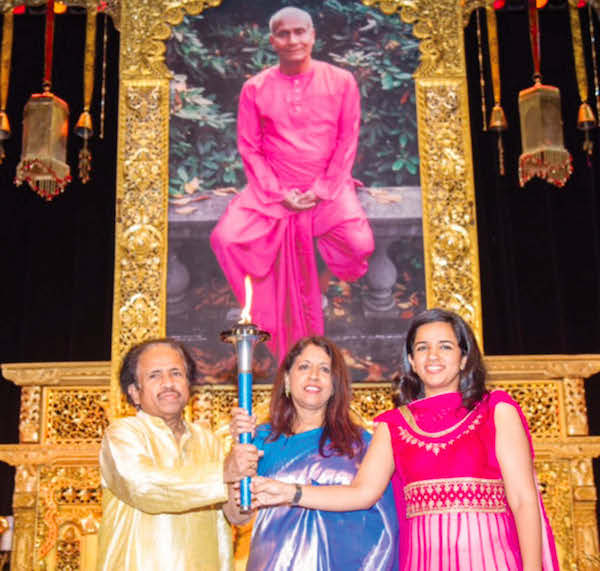
    NEW YORK CITY (TIP): Dr. L. Subramaniam, India’s acclaimed violinist, composer and conductor and Sri Chinmoy Centre International together offered a free Manhattan concert in tribute to Sri Chinmoy on August 29 at the Baruch Performing Arts Center. Performing with Dr. Subramaniam was his wife Kavita Krishnamurthy Subramaniam.

    Kavita is a much recorded, platinum playback artist, often referred to as the “Melody Queen” of India. She said, “a few years ago I met Sri Chinmoy in New York and the happiest moment in my life is when Sri Chinmoy blessed me”. Their daughter Bindu Subramaniam and son Ambi Subramaniam also performed.

    L. Subramaniam has earned international respect and acclaim for his virtuosic techniques and distinctive style. Dr. Subramaniam met with and performed for Sri Chinmoy on a number of occasions, and the two greatly admired and respected one another.

    Sri Chinmoy prolifically expressed his spiritual life through music, poetry and the visual arts. Born in Bengal, India in 1931, he made his home in New York in 1964. During his frequent travels worldwide, Sri Chinmoy emphasized the importance of meditation, music and inner peace.

    Upon hearing about an exhibition of Sri Chinmoy’s “Paintings for World-Harmony” at the United Nations in 2008, L. Subramaniam commented,

    “I am delighted to know that Sri Chinmoy’s paintings are being exhibited at the UN. Sri Chinmoy himself was an embodiment of peace and harmony and it is a fitting tribute to such a realized soul.”

    The previous day on August 28 another free concert took place at the same location. Russia’s popular and leading star Boris (Purushottama) Grebenshikov was outstanding. He offered a special song to honor Sri Chinmoy. Audience not only enjoyed Krishna Das’s Kirtan but participated and sang with him. Sri Chinmoy Bhajan singers brought with them heavenly joy. Other Sri Chinmoy International groups brought peace and happiness through their meditative music.

    Additional information can be found at www.Songsofthesoul.com

  • U.S., Russia: The Case for Bilateral Talks

    U.S., Russia: The Case for Bilateral Talks

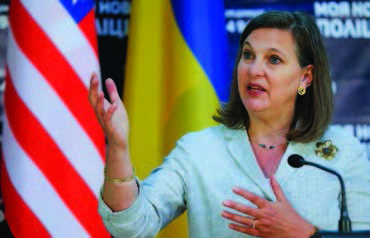
    Phone calls between relatively low-level diplomats are normally not newsworthy. But Monday’s conversation between U.S. Undersecretary of State Victoria Nuland and Russian Deputy Foreign Minister Grigory Karasin on the simmering conflict in Ukraine is an exception. The bilateral nature of the conversation and its timing amid mounting claims of cease-fire violations from the Ukrainian government and separatist forces makes it uniquely significant. Moreover, it reaffirms that the evolution of the Ukrainian conflict – whether toward a settlement or toward escalation – will be most strongly shaped not by Kiev but by the actions of and relationship between Moscow and Washington.

    Since the Ukrainian crisis started nearly 18 months ago, two negotiation formats in particular stand out among numerous talks and meetings. The first is the Minsk talks between representatives from the Ukrainian government, the pro-Russia separatists and the Organization for Security and Co-operation in Europe, which address the conflict on a tactical level. The other is the Normandy talks between representatives from Ukraine, Russia, Germany and France, which consider the conflict on a broader, political level. Notably absent from both talks, despite being a major political, economic and security player in Ukraine and the broader standoff between Russia and the West, is the United States. Washington has been diplomatically active in the conflict, but U.S. and Russian officials have met at various times only on an ad hoc basis.

    However, this practice may have changed over the weekend, when Russian Presidential Chief of Staff Sergei Ivanov said in an interview that Russia and the United States had come to an agreement to set up a “special bilateral format” of talks between the two countries – talks that would involve Nuland and Karasin. In explaining the formal announcement, Ivanov said that expanding the Normandy format to include the United States would simply be too “risky,” adding that the two countries would coordinate talks on Ukraine bilaterally “for the time being.” Thus the phone call between Nuland and Karasin took place to discuss the implementation of the Minsk agreement and the constitutional reform process in Ukraine, with further discussions likely to follow.

    The Ukraine conflict is at its core a conflict between two geopolitical imperatives. Russia wants to protect its interior by using its surrounding territories to establish a buffer. The United States wants to prevent the rise of regional powers that could potentially challenge U.S. hegemony. These imperatives collided in Ukraine, which of all the countries in the former Soviet periphery has the most strategic importance for modern Russia. If Ukraine supports Moscow, Russia becomes a regional power on the rise. If Ukraine supports the West, Russia becomes vulnerable from without and within. The Euromaidan movement of February 2014reversed Russia’s position from the former to the latter. Moscow responded by annexing Crimea and supporting the separatist insurgency in eastern Ukraine in a bid to undermine or neutralize Kiev’s pro-Western government.

    So far Russia’s plan has been unsuccessful. Ukraine aligned itself even more closely with the West by pursuing greater economic and political integration with the European Union and greater security and military cooperation with NATO. Ukraine’s close relationship with NATO is particularly worrisome for Russia, which has long feared the military alliance pushing up against its borders. Moscow has made multiple efforts to keep NATO’s influence at bay, putting diplomatic pressure on Georgia in 2008 when Georgia declared its alliance with NATO, for example. It showed its concern about NATO even more dramatically in the conflict in eastern Ukraine. And of all the NATO countries, the United States has the strongest military and the most assertive policies challenging Russia throughout the former Soviet periphery.

    Russia’s long-held suspicion of U.S. influence in its periphery makes the decision to start regular bilateral talks a significant step. In some ways, these two countries wield more power to shape the political and military outcome in Ukraine than the Ukrainians and separatists themselves. But holding such talks does not necessarily indicate that a resolution or even a de-escalation of the conflict is imminent. Issues still divide the two sides, particularly what kind of autonomy Ukraine’s central government should give the rebel regions.

    All the major parties in the Ukrainian conflict support some level of decentralization, or the granting of greater powers to regional governments. The disagreement is over the timing and extent of the process. Russia sees decentralization as a way to maintain a buffer zone in the east outside of Ukraine’s direct control, while Ukraine sees it as a way to compromise but still effectively retain control over the entire country. Ukraine wants to see separatists implement the Minsk agreement and lay down their arms before officials amend the national constitution to grant the eastern territories more regional autonomy. But separatists want the constitutional changes first, and they want a role in determining those changes. Only then, they say, can they fully implement the cease-fire.

    Broadly speaking, the United States supports the Ukrainian position; Russia supports the separatists. However, during a recent visit to Ukraine and preceding her phone conversation with Karasin, Nuland weighed in on the Ukrainian legislature’s debate over the constitutional amendment. Nuland urged Ukraine to give the country’s eastern regions a controversial and highly debated “special status” under the law. Officials had not included the term in the constitutional amendment draft, but U.S. pressure to deliver more on the sensitive issue could be seen as a nod to Russia.

    But Nuland’s actions could also be a more nuanced effort to help Ukraine: The more substantial and unimpeachable Ukraine’s constitutional reforms, the less room Moscow and the separatists have to criticize the changes and justify their own cease-fire violations. Washington has echoed Kiev in demanding that the separatists abide by the cease-fire, threatening Russia with more sanctions and -according to some leaked reports – restrictions on Moscow’s access to credit, if separatists continue to violate the Minsk agreement.

    Russia’s reactions have also been mixed. The Kremlin has spoken somewhat positively of the reform process, but Russia is still influencing the Ukrainian battlefield while demanding more political concessions for the separatist territories. Russia is also seeking U.S. concessions on Ukraine for its help in facilitating the Iran nuclear agreement. Moscow and Washington are trying to reach an accommodation while keeping their threat options open as well. With more talks between Nuland and Karasin set to take place, the evolution of Ukraine’s conflict and the political reform process will be the true test of the effectiveness of this new bilateral dialogue between the United States and Russia.

  • Chechen girls swindle $3000 from IS jihadis

    Chechen girls swindle $3000 from IS jihadis

    MOSCOW (TIP): Turning the tables on Islamic State online recruiters, three Chechen girls allegedly swindled over $3,000 by conning them into giving money on the pretence that they would use it to travel to Syria from their homeland.

    Chechen police have detained the three female con artists who talked fighters of the IS terrorist group into sending them money for travelling to Syria. The young women turned the tables on IS by using their primary recruitment tool, social media, against them. Russia’s predominantly Muslim Chechen Republic is a prime target for IS propagandists, who call on young men and women to join their cause and travel to the Middle East to join their jihadist campaign.

    However, the Chechen girls made a business of meeting recruiters online and pretending to be eager to go to Syria. The only obstacle, they said, was the lack of travel money, which the recruiters were often willing to provide, RT

    News reported. Once the money was sent via anonymous electronic transfers, the swindlers would simply cash the money and delete the social media account used in the con, it said. The three-girl operation managed to swindle some $3,300 from IS representatives before being caught by a Chechen police E-unit specializing in monitoring online activities for evidence of crimes, Russian daily Moskovsky Komsomolets reported.

    “I don’t recall any precedent like this one in Chechnya, probably because nobody digs deep enough in that direction,” Valery Zolotaryov of the E-unit told the newspaper. “Anyhow, I don’t advise anyone to communicate with criminals, especially for grabbing quick money,” she said.

  • Pakistan to include ‘India’s role’ in school attack in dossier

    ISLAMABAD (TIP): Pakistan would include proof of alleged Indian involvement in the Taliban attack on a Peshawar army school last year, which killed 152 people mostly kids, in a dossier that it would handover to India.

    A top Pakistani government source told media this on Thursday and added Pakistan’s national security advisor (NSA), Sartaj Aziz, would hand over the dossier to his Indian counterpart, Ajit Doval.

    He said the dossier would include evidences of alleged Indian involvement “in sponsoring and promoting terrorism” in Karachi and Baluchistan as well.

    The source said the interior ministry was working on the dossier and gathering evidences from various departments and agencies.

    “The ministry after completion of its work will forward the document to foreign affairs ministry for its inputs,” the source said on the condition of anonymity.

    “The record to be shared with New Delhi will include proof of R&AW’s involvement in sowing seeds of separatism in Baluchistan. R&AW provides logistics, travel facilities and platforms to separatist Baluch elements.”

    Sources told media Pakistan has shared proof about India’s alleged involvement in Baluchistan earlier as well.

    “The evidences shared with India include a copy of Indian passport issued to exiled Baluch separatist leader Brahamdagh Bugti.”

    Brahamdagh, a grandson of slain Baluch nationalist Nawab Akbar Bugti, had earlier welcomed Indian support saying they consider any country that supports their cause as their friend.

    Pakistan’s foreign office spokesman, Qazi Khalilullah, told TOI the meeting of NSAs has not yet been finalized and it would be premature to talk about the issues Pakistan would raise.

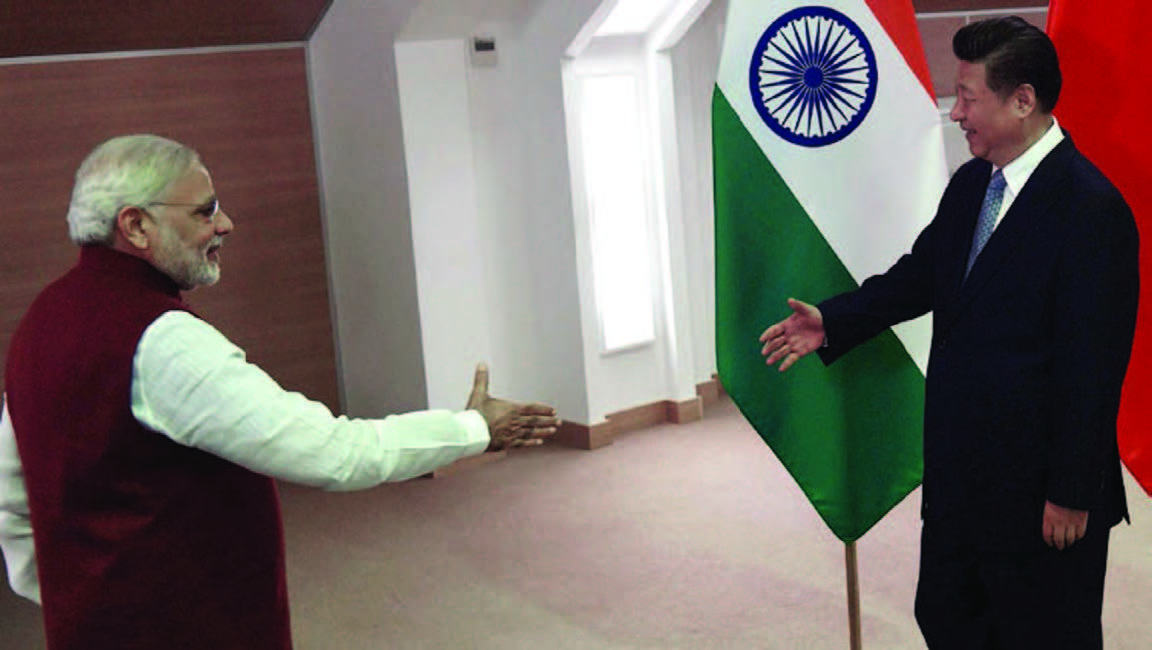
    The two countries decided to hold NSA-level talks after Prime Minister Narendra Modi met his Pakistani counterpart, Nawaz Sharif, in Russia recently.

    Sharif was criticized for not raising Kashmir, Samjautha blast case, water dispute and India’s alleged role in sponsoring terrorism in Pakistan at the meeting.

  • Transnationals | Tax Havens | Terrorism

    Transnationals | Tax Havens | Terrorism

    “Westphalian sovereignty is the principle of international law that each nation state has sovereignty over its territory and domestic affairs, to the exclusion of all external powers. The principle of non-interference in another country’s domestic affairs, and that each state (no matter how large or small) is equal in international law is recognized. This doctrine is named after the Peace of Westphalia, signed in 1648, which ended the Thirty Years’ War.” 

    “It is ironical that Terror organizations on one side and Tax havens on the other have completely undermined Westphalia consensus. In that context countries like India have every right to exercise its freedom to pursue terrorists who are undermining its existence whether sponsored by foreign countries or home grown. The concept of territorial jurisdictions and sovereignty are no more valid in the context of terror organizations since they damage both India and its own host countries over period of time. India must protect its national interests and institutions by challenging inimical forces wherever they are located without worrying about Westphalia consensus”.


    In the context of the strikes made against terror camps on the border of Manipur/Nagaland by the Indian Army; there has been number of discussions about national sovereignty and the role of individual States. Actually in the last few decades the activities of transnational corporations aided by tax havens on one side and terrorists on the other side have destroyed the concept of nation state and its sovereignty evolved after the 30 years’ war in 1648 in Westphalia. Westphalian sovereignty is the principle of international law that each nation state has sovereignty over its territory and domestic affairs, to the exclusion of all external powers. The principle of non-interference in another country’s domestic affairs, and that each state (no matter how large or small) is equal in international law is recognized. This doctrine is named after the Peace of Westphalia, signed in 1648, which ended the Thirty Years’ War .After that war major continental European states – the Holy Roman Empire, Spain, France, Sweden and the Dutch Republic – agreed to respect one another’s territorial integrity. As European influence spread across the globe, the Westphalian principles, especially the concept of sovereign states, became central to international law and to the prevailing world order.

    Scholars of international relations have identified the modern, Western-originated, international system of states, multinational corporations, and organizations, as having begun at the Peace of Westphalia. Henry Kissinger in his important book on “world Order” says:

    “No truly global “world order’ has ever existed. What passes for order in our time was devised in Western Europe nearly four centuries ago, at a peace conference in the German region of Westphalia, conducted without the involvement or even the awareness of most other continents or civilizations. A century of sectarian conflict and political upheaval across Central Europe had culminated in the Thirty Years’ war of 1618-48- a conflagration in which political and religious disputes commingled, combatants resorted to “total war” against population centers, and nearly a quarter of the population of Central Europe died from combat, disease, or starvation. The exhausted participants met to define a set of arrangements that world stanch the bloodletting. Religious unity had fractured with the survival and spread of Protestantism; Political diversity was inherent in the number of autonomous political units that had fought to a draw. So it was that in Europe the conditions of the contemporary world were approximated: a multiplicity of political units, none powerful enough to defeat all others, many adhering to contradictory philosophies and internal practices, in search of neutral rules to regulate their conduct and mitigate conflict.

    “The Westphalian peace reflected a practical accommodation to reality, not a unique moral insight. It relied on a system of independent states refraining from interference in each other’s domestic affairs and checking each other’s ambitions through a general equilibrium of power. No single claim to truth or universal rule had prevailed in Europe’s contests. Instead, each state was assigned the attribute of sovereign power over its territory. Each would acknowledge the domestic structures and religious vocations of its fellow states as realities and refrain from challenging their existence. With a balance of power now perceived as natural and desirable, the ambitions of rules would be set in counterpoise against each other, at least in theory curtailing the scope of conflicts. Division and multiplicity, an accident of Europe’s history, became the hallmarks of a new system of international order with its own distinct philosophical outlook. In this sense the European effort to end its conflagration shaped and prefigured the modern sensibility: it reserved judgment on the absolute in favor of the practical and ecumenical; it sought to distill order from multiplicity and restraint.

    “The seventeenth-century negotiators who crafted the peace of Westphalia did not think they were laying the foundation for a globally applicable system. They made no attempt to include neighboring Russia, which was then reconsolidating its own order after the nightmarish “Time of Troubles” by enshrining principles distinctly at odds with Westphalian balance; a single absolute ruler, a unified religious orthodoxy, and a program of territorial expansion in all directions. Nor did the other major power centers regard the Westphalian settlement (to the extent they learned of it at all) as relevant to their own regions.1

    The three core principles on which the consensus rested are:

    1. The principle of the sovereignty of states and the fundamental right of political self determination
    2. The principle of legal equality between states
    3. The principle of non-intervention of one state in the internal affairs of another state

    Interestingly, all three are questioned by contemporary leaders of West and radical Islam.

    Tony Blair the then Prime Minister of UK in his famous Chicago Address -1999-suggests

    “The most pressing foreign policy problem we face is to identify the circumstances in which we should get actively involved in other people’s conflicts. Non -interference has long been considered an important principle of international order….

    “But the principle of non-interference must be qualified in important respects. Acts of genocide can never be a purely internal matter. When oppression produces massive flows of refugees which unsettle neighboring countries then they can properly be described as “threats to international peace and security”.2

    The NATO intervention in Kosovo and Afghanistan as well as US intervention in Iraq provide recent examples of breakdown of idea of Westphalia. Similar is the humanitarian crisis faced by India regarding refugees from East Pakistan.

    Interestingly Radical Islam also considered that the world order based on Westphalian consensus will collapse. “In the aftermath of the 11 March 2004 Madrid attacks, Lewis ‘Atiyyatullah, who claims to represent the terrorist network al-Qaeda, declared that “the international system built up by the West since the Treaty of Westphalia will collapse; and a new international system will rise under the leadership of a mighty Islamic state.”3

    The spread of ISIS across countries and activities of Boko Haram based in Nigeria in Kenya and Chad re-emphasis this point. Radical Islam do not accept territorial boundaries since it works for a global regime for global Ummah.

    The recruitment by these terror organizations is also across continents and countries which does not respect territorial sovereignty. The talk about Caliphate indicates that they are trans-border organizations.

    On the other side we find global corporations transcending sovereignty in search of global profits. For this they use tax havens as a tool.

    Tax havens–numbering more than 70 jurisdictions–facilitate bank facilities with zero taxes and no-disclosure of the names and in many cases anonymous trusts holding accounts on behalf of beneficiary. Basically lawyers and Chartered accountants will deal with mattes. Sometimes a post box alone will be operative system. In the case of Bahamas one building seems to have had tens of thousands of companies registered there.

    Luxemburg (population half a million!) registered companies of various countries have evaded taxes significantly from their legal jurisdiction. The key findings of the activities of transnational companies cutting across territorial jurisdiction is given below.

    • Pepsi, IKEA, AIG, Coach, Deutsche Bank, Abbott Laboratories and nearly 340 other companies have secured secret deals from Luxembourg that allowed many of them to slash their global tax bills.
    • PricewaterhouseCoopers has helped multinational companies obtain at least 548 tax rulings in Luxembourg from 2002 to 2010. These legal secret deals feature complex financial structures designed to create drastic tax reductions. The rulings provide written assurance that companies’ tax-saving plans will be viewed favorably by Luxembourg authorities.
    • Companies have channeled hundreds of billions of dollars through Luxembourg and saved billions of dollars in taxes. Some firms have enjoyed effective tax rates of less than 1 percent on the profits they’ve shuffled into Luxembourg.
    • Many of the tax deals exploited international tax mismatches that allowed companies to avoid taxes both in Luxembourg and elsewhere through the use of so-called hybrid loans.
    • In many cases Luxembourg subsidiaries handling hundreds of millions of dollars in business maintain little presence and conduct little economic activity in Luxembourg. One popular address – 5, rue Guillaume Kroll – is home to more than 1,600 companies.
    • A separate set of documents reported on by ICIJ on Dec. 9 expanded the list of companies seeking tax rulings from Luxembourg to include American entertainment icon The Walt Disney Co., politically controversial Koch industries and 33 other firms. The new files revealed that alongside PwC tax rulings were also brokered by Ernst & Young, Deloitte and KPMG, among other accounting firms.4

    The big four accounting firms namely KPMG/E&Y/Deloitte and PwC have facilitated the movement of funds of clients across borders and territories to make tax “planning” easier for these companies. USA is literally waging war with major Giants like Amazon/Google/Microsoft etc. for not paying adequate taxes in USA in spite of being US based companies. Most of these companies have moved their profits to other Tax Havens.

    Global firms such as Starbucks, Google and Amazon have come under fire for avoiding paying tax on their British sales. There seems to be a growing culture of naming and shaming companies. But what impact does it have?5

    Royal Commission into tax loopholes a must—says a report in Australia.6

    There is an increasing clamor in USA about Congress Should Pass the Stop Tax Haven Abuse Act to Combat International Tax Avoidance. This has been highlighted by both TAX justice network as well as Global Financial Integrity.

    A simple method of trade mis-invoicing by global companies using tax-havens have impacted developing countries nearly 730Billion USD in 2012 says Global Financial integrity. Another interesting finding by GFI is about terror financing using Tax haven route.

    Because of the increasing wariness of MNCs using Tax havens for avoidance of taxes and the opaque ways of functioning of these off-shore structures, demands are growing about their activities and even closing down of these tax havens by European parliament etc.

    Due to relentless pressure from OECD as well as G20 many of these secretive jurisdictions are becoming more transparent.

    But the fact of the matter is these Trans National Companies and Tax Havens together have significantly undermined the concept of sovereignty and territorial jurisdictions.

    It is ironical that Terror organizations on one side and Tax havens on the other have completely undermined Westphalia consensus. In that context countries like India have every right to exercise its freedom to pursue terrorists who are undermining its existence whether sponsored by foreign countries or home grown. The concept of territorial jurisdictions and sovereignty are no more valid in the context of terror organizations since they damage both India and its own host countries over period of time. India must protect its national interests and institutions by challenging inimical forces wherever they are located without worrying about Westphalia consensus.

    (The author is Professor of Finance at IIM-Bangalore)

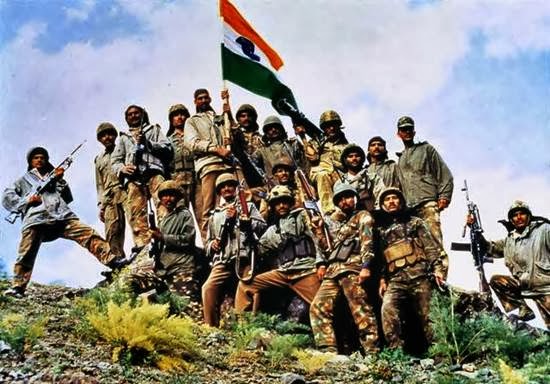
  • Lessons from Kargil war: Can another Kargil happen again?

    Lessons from Kargil war: Can another Kargil happen again?

    It took over two months for the Indian forces to push back the intruders and reclaim the posts under an operation code named Op Vijay. India lost 527 officers and soldiers in the operation and hundreds of others were injured. Pakistan never officially admitted that its soldiers were involved, despite the fact that official documents recovered from bodies had confirmed that they were regular soldiers of Pakistan Army in civilian clothes.

    On the eve of the 16th anniversary of the battle, its chief strategist and former Pakistan President Parvez Musharraf, who was then his country’s army chief, has raked up a controversy and has openly admitted the role of Pakistan armed forces.

    Addressing a convention of the youth wing of his party, the All Pakistan Muslim League (APML) earlier this week, Musharraf said that the Pakistani armed forces had caught their Indian counterparts by surprise in Kargil. He claimed that the Pakistani armed forces had won the Kargil battle in 1999 but the then Nawaz Sharif-led government had converted the success into a political defeat.

    “I don’t think India would ever be able to forget the three-month-long battle (Kargil war) when our gallant armed forces caught them by the throat,” Musharraf said.

    Musharraf, 71, who is facing several court cases and is presently based in Karachi, said the Pakistan Army along with the second-line force had entered Kargil district of Kashmir Valley and seized strategic positions at five locations, four of which were not even known to the Indian forces.

    “I can say it was our greatest military victory over India as they couldn’t even claim back half of one strategic location in one area but regrettably our politicians wasted this opportunity,” he said according to agency reports.

    Musharraf, who later seized power in Pakistan after overthrowing Sharif government in a bloodless coup, had been working on the plan to infiltrate in to Kargil even as the then Indian Prime Minister Atal Behari Vajpayee had visited Pakistan on a bus through the Wagah border at the invitation of Sharif. As it turned out later, even Sharif had no inkling of the plan being hatched by his Army chief.

    Ironically, even as Vajpayee was visiting Pakistan on a goodwill tour in February 1999, the Operation Kargil had already been put in force by Musharraf. About 200 Pakistan soldiers disguised as mujahideen had moved in to hold some of the posts vacated by Indian soldiers before the onset of winters in late 1998. The vacation of such posts during winters was a yearly exercise which was also very well known to the Pakistan Army. This time, however, they occupied the posts and Indians got a whiff of it only after the winters somewhere in May 1999 when some cattle grazers informed the authorities about the occupation of the posts.

    The most important factor behind the daring act by Musharraf and his men was the fact that Pakistan had developed a nuclear deterrent and was confident that India would dare not attack it or wage a full fledged war fearing a nuclear attack from Pakistan. If ever such an eventuality was to take place, Pakistan could have inflicted huge losses on India, particularly at its strategic and vulnerable locations, though in the bargain, India had the reserves to wipe out Pakistan from the face of the earth.

    Musharraf was, however, confident that other world powers would intervene before India could flex its nuclear muscles. That actually happened and even as India made veiled references, besides mounting a major operation including strafing by the Air Force, backdoor diplomacy ensured that such an eventuality did not take place. India claimed a comprehensive victory while Pakistan claimed that the Mujahideen had themselves withdrawn from some of the posts.

    The question now if whether such a battle can take place again given the fact that nuclear deterrent is very much in place and so is the hostility off and on displayed by Pakistan armed forces and militants sponsored by it.

    Despite the meetings between Indian Prime Minister Narendera Modi and his Pakistan counterpart, the two sides have been blowing hot and cold over the past year. In fact merely a couple of days after their last meeting in Ufa in Russia, the two sides exchanged firing along the international border and skirmishes were reported from several points along the Line of Control. The situation cooled off so quickly after the Ufa meeting that Pakistan Rangers did not even accept the traditional mithai offered by the Border Security Force personnel on the occasion of Eid.

    Senior Army officers, and those who are in the know of things, do not rule out skirmishes along the border but tend to rule out any largescale battle between the two nations. Kargil has taught a major lesson to India and it no longer allows its posts to be vacated during the winters. There has been a significant upgrade in the vigilance and surveillance equipment and strength along the border, particularly at vulnerable posts. They also hold the opinion that India is better prepared to ward off any such attempt and Pakistan can no longer expect to spring a surprise. Besides the nuclear deterrence, the two countries can ill afford to go in for a prolonged war with other nations, particularly the US, keeping a close watch so that the situation does not get out of control in the sensitive region despite provocations such as the latest one by Musharraf’s statement.

  • India and Russia sign customs pact and aim to boost trade three times over the next decade

    Moscow: India and Russia seek to increase trade to US$ 30 billion by 2025 from US$ 9.5 billion last year, by overcoming challenges of inadequate connectivity, language barriers, visa barriers and regulations. Both countries recently reached an agreement on customs to provide rapid clearances of imported goods at ports, on both sea and land. Further, both India and Russia recently concluded an agreement to set up a Joint Study Group which will recommend the framework of a Free Trade Agreement (FTA) between India and the Eurasian Economic Union comprising Russia, Kazakhstan, Belarus and Armenia. To improve transportation of goods easily, both countries are working on a North South corridor that will facilitate trade between India and Russia. Similarly, an agreement on exports of dairy products from India to Russia is expected soon. Indian companies are interested to invest in fertiliser, coal and pharmaceutical sectors in Russia. On the other hand, Russian Railways and Russia’s Investment Fund are looking forward to work with Indian companies.

  • Civilian deaths and ‘spy drone’ put chill back in India-Pakistan tie

    Civilian deaths and ‘spy drone’ put chill back in India-Pakistan tie

    NEW DELHI (TIP): Amid heightened tension along their border resulting in casualties on both sides, India on July 16 warned Pakistan of “effective and forceful” response to unprovoked firing and cross-border terrorism.

    India’s blunt message followed a series of ceasefire violations along the LoC in Jammu and Kashmir by Pakistan which resorted to mortar shelling of Indian areas over the past two days. India responded in kind and both sides said they had suffered casualties.

    Pakistan on july 16 accused Indian troops of killing five civilians along the Line of Control.

    “Five Pakistani civilians were killed due to Indian unprovoked firing, the Pakistani military said in statements on the clashes along the international border.

    The escalating hostilities have chilled a brief thaw in ties after Prime Ministers Nawaz Sharif and Narendra Modi met in Russia, but appeared unlikely to thwart a planned meeting of national security advisers.

    “We remain committed to steps that contribute to peace and tranquility on the border,” Indian foreign secretary Subrahmanyam Jaishankar said after a meeting of top ministers in New Delhi on Thursday.

    “However, there should be no doubt that any unprovoked firing from the Pakistani side would meet with an effective and forceful response from our forces,” Jaishankar said.

    Hopes for warmer ties were raised last week when Modi and Sharif met on the sidelines of a summit in Ufa, Russia and agreed that their national security advisers would hold talks.

    Modi also agreed to visit Pakistan in 2016.

    On Wednesday, the Pakistani military said it had shot down an Indian surveillance drone. A photograph released by the military appeared to show a small, unarmed model.

    The Indians denied the drone was theirs, with Jaishankar saying it appeared to be “commercially available” Chinese design.

    “It appears to be a Chinese design which is available off the shelf,” the foreign secretary said.

    Jaishankar also countered Pakistan government’s charge over Heli manoeuvres by India near LoC on July 11, 2015 as an “offensive and threatening posture”.

    “In so far as the allegation of the helicopter manoeuvres is concerned, this has already been taken up and settled through an exchange of hotline messages between local formation commanders at Teetwal on July 12-13.

    “The helicopter flight was in connection with the counter-terrorism operation in which three terrorists were neutralised. The Pakistani side raised the issue of our helicopter flight and we had clarified that it was well within the mutually accepted distances from the LoC in India. That the Pakistani government four days later is raising a controversy on a settled issue speaks for itself,” he said.

    (With inputs from agencies)

  • Iran’s Nuclear Deal

    Iran’s Nuclear Deal

    Iran and six world powers sealed a historic accord to curb the Islamic Republic’s nuclear programme in return for ending sanctions, capping two years of tough diplomacy with the biggest breakthrough in decades.

    Diplomats reached the deal in Vienna on Tuesday, July 14, their 18th day of talks.

    US President Barack Obama said it blocks “every path to a nuclear weapon” for Iran, while Iranian foreign minister Mohammad Javad Zarif called it a “win-win”.

    Banks including Goldman Sachs Group Inc. and Barclays Plc say it would take 6-12 months for the holder of the world’s fourth largest crude reserves to revive production by about 500,000 barrels a day. Sanctions cut the country’s crude exports by more than half from a peak of more than six million barrels a day in the 1970s.

    With new oil flows expected to hit an oversupplied market, Brent, the global benchmark, fell as much as 2.1% to $56.63 a barrel in London and was trading $57.87 at 9.02pm India time. Iran’s benchmark TEDPIX Index, led by oil and gas companies, advanced 0.3% at the close, the highest since April.

    In China, Europe and Russia, the agreement will be welcomed by companies eager to access an untapped market of 77 million people. With an economy bigger than Thailand’s and oil reserves rivalling Canada’s, Iran is the most important market still closed to major equity investors, according to investment bank Renaissance Capital.

    Ending economic penalties could open Iran’s stock market to investors in early 2016, Renaissance’s Charles Robertson and Daniel Salter wrote in a report on Monday. Inflows could total $1 billion in the first year, they said.

    Oil-importing countries such as India should use the period of subdued oil prices to strengthen their monetary policy framework along with fuel pricing and taxation reforms, the International Monetary Fund (IMF) recommended in a report released, coincidentally, on Tuesday.

    Low oil prices could boost India’s gross domestic product (GDP) by 0.4-0.6 percentage point over this year and next.

    Boon for oil importers

    India follows the US, China and Russia in energy use, accounting for 4.4% of global energy consumption. Petroleum product consumption in India has been growing. According to the oil ministry, it grew 3.14% to around 163.17 million tonnes in 2014-15.

    In its report tiled Global Implications of Lower Oil Prices, IMF said: “Oil importers, in deciding how much of the windfall to save, should balance rebuilding policy space with managing domestic cyclical risks. Those with significant vulnerabilities should save much of the windfall, while those facing large output gaps should spend it.”

    It added that “countries should use this period as an opportunity to strengthen their monetary policy frameworks; evidence of second-round disinflationary effects could open space for reducing policy rates in some countries”.

    The fund said countries such as India will reap modest benefits from lower global oil prices as it does not fully pass on the benefits to consumers. While lower oil prices are expected to boost global growth by one percentage point in 2015 and 2016, the IMF said India’s GDP is expected to get a boost of between 0.4 and 0.6 percentage point in the same period.

    The multilateral agency is right to point out that governments like India may be absorbing the benefits of lower oil prices to meet their budget deficit targets and are not passing on the benefits to consumers, which could be less growth-inducing, said Madan Sabnavis, chief economist at CARE Ratings. “There is nothing wrong or correct about it. The Indian government has a huge subsidy burden and it is using the opportunity to correct it,” he said.

    Low international crude prices have helped the National Democratic Alliance (NDA) government bring retail inflation below 5%, better its fiscal deficit target of 4.1% of GDP for 2014-15, and bring the current account deficit to 1.6% of GDP in the January-March quarter, against 2% in the preceding three months.

    “Low oil prices provide a window of opportunity to undertake serious fuel pricing and taxation reform in both oil-importing and oil-exporting countries,” the report said.

    In October, the government freed diesel prices. When crude oil prices fell, it cut fuel prices but simultaneously raised excise duties. This way, the government garnered additional revenue, while resisting the temptation to fully pass on the benefit of lower crude oil prices.

    Crude oil prices in the Indian energy basket averaged at $61.75 per barrel in June, against $84.16, $105.52, $107.97 and $111.89 in 2014-15, 2013-14, 2012-13 and 2011-12, respectively.

    The fall in prices has also presented countries such as India an opportunity to revise terms of imports. India has made a pitch for price and terms correction with the Organization of the Petroleum Exporting Countries (Opec) and has asked for a concession rather than having to pay the so-called Asian premium.

    “India alone is not going to benefit. Japan, China, Korea are also going to benefit. We are talking together at many forums and will be raising it together as well. We are the largest buyers for the Opec, so we need a favourable treatment and things are on right track. There is a positive signal from the seller side also,” said oil minister Dharmendra Pradhan in a 16 June interview.

    India is one of the major consumers of Opec’s production, with the group accounting for 85% and 94% of India’s crude oil and gas imports, respectively.

    “This is a very good time to review this practice and to provide more fair conditions for all parties,” Fatih Birol, chief economist at Paris-based International Energy Agency (IEA), said in an interview published on 2 July.

    Bouyed by the subdued crude oil prices, the 2015-16 budget has estimated India’s subsidy bill at Rs.2.43 trillion, around 9% less than the revised estimate of Rs.2.66 trillion for 2014-15.

    The petroleum subsidy is estimated at Rs.30,000 crore for 2015-16, 50% less than the revised estimate of Rs.60,270 crore. The difference between market prices and retail fuel rates—to be borne by oil marketing firms this fiscal year—is estimated at Rs.42,500 crore.

    The budget has earmarked Rs.22,000 crore for subsidy on domestic cooking gas and Rs.8,000 crore for kerosene. While petrol and diesel prices are deregulated, the prices of domestic cooking gas and kerosene continue to be set by the government.

    The Iran deal

    Full implementation depends on Iran meeting obligations to curb its nuclear programme and address concerns about possible military dimensions of its work. Iran has until 15 December to answer 12-year-old questions about its weapons capabilities. Once inspectors verify compliance, the oil-rich nation will be allowed to ramp up energy exports, re-enter the global financial system, and access as much as $150 billion in frozen assets.

    “This is probably going to go down in history as one of the biggest diplomatic successes of the century,” Ellie Geranmayeh, a policy fellow at the European Council of Foreign Relations, said by phone from London.

    Congress has 60 days to review the document in Washington, where it will meet resistance from lawmakers who oppose making any nuclear compromises with Iran.

    Israel, which has threatened military action to prevent Iran from getting a nuclear bomb, said it will use “every means” possible to persuade Congress to reject it, though Obama vowed to veto such a move. The House and Senate would each need a two-thirds majority to override a veto.

    Israeli Prime Minister Benjamin Netanyahu denounced the deal as a “historic mistake”, saying in a statement that “sweeping concessions were made in all areas meant to block Iran from the ability to arm itself with nuclear weapons”.

    Should the agreement survive review, it would become one of the biggest foreign policy achievements for Obama, who kicked off the initiative with a call to Iranian President Hassan Rouhani nearly two years ago. The US cut diplomatic ties with Iran in 1980, after revolutionaries seized the American embassy in Tehran and held hostages for more than a year.

    Iran agreed to cut 98% of its stockpile of enriched uranium and eliminate two-thirds of its centrifuges, according to a copy of the accord obtained by Bloomberg.

    “This is a sign of hope for the entire world,” European Union (EU) foreign policy chief Federica Mogherini said in Vienna. “And we all know this is very much needed in these times.”

    Relief, including sales of aircraft by companies including Boeing Co., would be phased in after 15 December if Iran complies. The United Nation’s (UN) International Atomic Energy Agency will negotiate access to all suspect sites, including military bases such as Parchin.

    Once UN monitors verify Iran has taken all steps to curb its nuclear activities, the US and the EU will also lift restrictions on most of its financial institutions except those sanctioned for terrorism or human rights abuses. Iranian banks, including the central bank, will be able to process transactions once again through SWIFT, the leading global financial messaging system, US officials said.

    The US and the EU will also allow any nation to buy Iranian oil and ease curbs on trading refined products, chemicals and natural gas. Iran holds the second largest gas reserves in the world, after Russia.

    “If Iran violates the deal, all these sanctions will snap back into place,” Obama said at the White House.

    The UN ban on conventional weapons imports and exports by Iran will remain in place for five years, while the UN embargo on ballistic missiles will hold for eight years, according to the draft. The unilateral US arms embargo will stay in place.

    Utpal Bhaskar is with Mint. Bloomberg’s Stepan Kravchenko in Vienna, Nafeesa Syeed in Dubai, Gregory Viscusi in Vienna, Kambiz Foroohar in New York and Angela Greiling Keane in Washington and Mint’s Asit Ranjan Mishra in New Delhi contributed to this story.

  • PM MODI MEETS XI, PUTIN IN RUSSIA

    PM MODI MEETS XI, PUTIN IN RUSSIA

    UFA (TIP): Prime Minister Narendra Modi Wednesday took up with President Xi Jinping the issue of China putting on “technical hold” India’s move in the United Nations to question Pakistan on the release of 26/11 attack mastermind Zaki-ur Rehman Lakhvi.

    During the course of their 95-minute meeting ahead of the BRICS and SCO summit in the Russian city of Ufa, the two leaders also discussed border issues and the need to accelerate the boundary talks process.

    Modi also conveyed to Xi concerns in India over the economic corridor China is building through Pakistan-occupied Kashmir (PoK).

    PM MODI MEETS PUTINIndia and Russia reviewed their bilateral relations as Prime Minister Narendra Modi met Russian President Vladimir Putin late Wednesday evening. Foreign secretary S Jaishankar said in a briefing after the 90-minute interaction between the two leaders that energy sector cooperation was a key area for rebooting the engagement, including nuclear engagement and hydrocarbons. The nuclear cooperation includes building on negotiations to sign advance contract for the design of the third and fourth reactor units to come up at the Kudankulam site in Tamil Nadu. A contract for the design (of the third and fourth power units) has been under negotiation. The central banks of the BRICS countries have signed an operating agreement on a $100 billion foreign exchange reserve pool that is being set up by the grouping’s five member nations to help each other “in case of any problems with dollar liquidity”. The $100 billion pool aims to protect BRICS member states from currency volatility shocks. India will chip in with $18 billion. The agreement was signed Tuesday in Moscow after the meeting of the finance ministers and heads of the central banks of BRICS, the Central Bank of Russia (CBR) said in a statement. The document contains a detailed description of the procedures that are carried out by the central banks of BRICS nations — Brazil, Russia, India, China and South Africa — within the currency reserve pool, defines their rights and duties. Russian President Vladimir Putin on Wednesday conveyed to PM Narendra Modi that the process of India’s accession to the strategically-important Shanghai Cooperation Organisation has been set into motion. Putin, during the course of his bilateral talks with PM Modi ahead of the BRICS and SCO summits being held in this Russian city, said: “We are beginning the process of full-fledged inclusion of India into the Shanghai Cooperation Organisation.” Putin said it was “a very important event,” as Modi expressed his thanks.

    The PM with Uzbekistan's President Islam Karimov The PM being welcomed on his arrival at Tashkent

  • Russia vetoes UN resolution calling Srebrenica a genocide

    Russia vetoes UN resolution calling Srebrenica a genocide

    UNITED NATIONS (TIP): Russia vetoed a U.N. resolution July 8 that would have condemned the 1995 massacre of Muslims at Srebrenica during the Bosnian war as a “crime of genocide,” saying that singling out the Bosnian Serbs for a war crime would create greater division in the Balkans.

    Two international courts have called the slaughter by Bosnian Serbs of some 8,000 Muslim men and boys who had sought refuge at what was supposed to be a U.N.-protected site genocide.

    But Russia’s U.N. Ambassador Vitaly Churkin objected to focusing only on Srebrenica, calling the resolution “confrontational and politically motivated” and stressing that Bosnian Serbs and Croats had also suffered during the 1992- 95 war that killed at least 100,000 people.

    Britain drafted the resolution to mark the 20th anniversary of the Srebrenica massacre on Tuesday, but the vote was delayed to address Russian concerns.

    The defeated resolution states that acceptance of “the tragic events at Srebrenica as genocide is a prerequisite for reconciliation” and “condemns denial of this genocide as hindering efforts towards reconciliation.”

    Britain’s U.N. deputy ambassador Peter Wilson stressed that the resolution “did not point fingers of blame, score political points nor seek to reopen political divisions.” It also didn’t link the crimes at Srebrenica to the Serb people and recognized there were victims on all sides, he said.

    The vote was 10 countries in favor, Russia casting a veto, and four abstentions _ China, Nigeria, Angola and Venezuela.

    Leaders of the Bosnian Serbs and Serbia, who have close religious and cultural ties to Russia, have lobbied President Vladimir Putin to vote “no.’

    Serbia’s pro-Russian President Tomislav Nikolic said Russia’s veto “not only prevented the throwing of guilt against the whole Serbian nation, trying to show it as genocidal, but it also proved that Russia is a real and sincere friend.” Wilson said Britain was “outraged” by Russia’s veto.

    “Russia’s actions tarnish the memory of all those who died in the Srebrenica genocide,” he said. “Russia will have to justify its behavior to the families of over 8,000 people murdered in the worst atrocity in Europe since the Second World War.”

    Bosnians reacted bitterly to the veto.

    “This is a defeat of justice,” said Camil Durakovic, the mayor of Srebrenica. “The world has lost. The world _ and especially Serbia _ will have to face the truth sooner or later,” he said.