Tag: Russia

  • Russia’s Northern Fleet on ‘full alert’ – NATO exercises near Russian Border

    Russia’s Northern Fleet on ‘full alert’ – NATO exercises near Russian Border

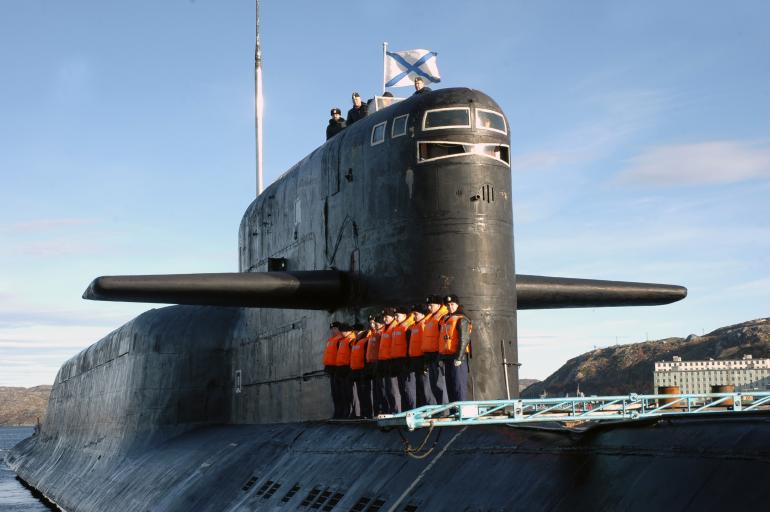
    U.S. and several Eastern European NATO countries conduct a series of military exercises near Russia’s border while Russian President Vladimir Putin has ordered his Northern Fleet “to full alert in a snap combat readiness exercise” in the Arctic, state-run media reported Monday.

    The Northern Fleet on snap readiness includes land, sea and air drill that will involve 38,000 troops, 41 ships, 15 submarines and 110 aircraft.

    “The main task of the (combat readiness drill) is to assess the armed forces from the Northern Fleet’s capabilities in fulfilling tasks in providing military security of the Russian Federation in the Arctic region,” Russian Defense Minister Gen. Sergey Shoigu told the media outlet. “New challenges and threats of military security demand the further heightening of military capabilities of the armed forces and special attention will be paid to the state of the newly formed strategic merging (of forces) in the North.”

    Despite a number of countries participating in various military drills in Eastern Europe, a Kremlin spokesman described the Northern Fleet inspection as routine practice aimed at improving military capabilities. 

    “The practice of snap checks will become regular, as it is beneficial for improving the mechanisms of control and operation of the armed forces. This is an absolutely regular process of the armed forces’ operation, of preparation and development of Russia’s armed forces,” Dmitry Peskov told Tass on Monday.

    “It is especially surprising that this is happening in Northeastern Europe, which is the most stable region not only on our continent, but also maybe in the whole world,” Russian Deputy Foreign Minister Alexey Meshkov said. “Such NATO actions lead to destabilization of the situation and increasing tensions in Northeastern Europe.”

    Among the recent drills in Eastern Europe:

    • In its largest military operation in decades, Norway sent 5,000 troops to conduct military exercises between Alta and Lakselv in Finnmark county, which borders Russia, according to the Barents Observer. 

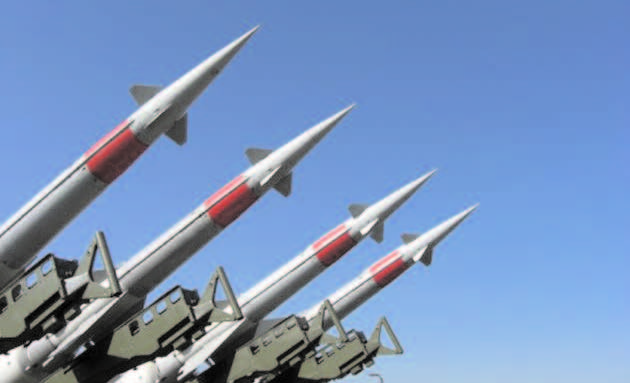
    • About 100 U.S. soldiers are expected to conduct an exercise this month using a Patriot missile battery and a Polish air defense brigade “at a location on Polish territory,” Pentagon spokesman Col. Steve Warren said. The exercise is part of Operation Atlantic Resolve, which began in response to Russia’s involvement in Ukraine and its annexation of Crimea last year, the U.S. Defense Department said. 

    • Also as part of Operation Atlantic Resolve, the U.S. Army will soon send armored Stryker vehicles on a 1,100-mile convoy through six European countries to show solidarity with its allies. The “highly visible” convoy will travel through Estonia, Lithuania, Poland, Latvia and the Czech Republic en route to Vilseck, Germany, a U.S. Army Europe spokesman told the military newspaper, Stars and Stripes.

    • In a “regularly scheduled” exercise aimed at demonstrating NATO’s commitment to “collective defense” in the Black Sea, the Standing NATO Maritime Group Two — a collection of warships — will train with the Bulgarian, Romanian and Turkish navies and visit Varna, Bulgaria, to meet with local authorities and navy officials, NATO said. 

    • The U.S. Air Force moved a dozen A-10 Thunderbolt “tankbuster” attack jets to an air base in Germany and the U.S. military placed hundreds of tanks and military vehicles in Latvia, where they’ll be matched up with 3,000 troops from Fort Stewart, Georgia.

  • India spank Singapore 10-0, to face Thailand in HWL R2 semis

    NEW DELHI (TIP): Vandana Katariya scored four goals, including a hat-trick as India continued its impressive run and spanked lowly Singapore 10-0 to storm into the semifinals of the Hero FIH Women’s World League Round 2 on March 12.

    Vandana (17th minute, 48th, 56th, 57th) scored four field goals, while Poonam Rani (4th), Navjot Kaur (6th), Anupa Barla (19th), Deepika (32nd), Rani Rampal (35th) and Jaspreet Kaur (51st) also registered their names in the scoresheet to steamroll the hapless Singapore girls in the one-sided quarterfinal encounter at the floodlit Major Dhyan Chand National Stadium.

    In other quarterfinals of the day, Malaysia defeated Ghana 2-0, Thailand got the better of Kazakhstan 4-3 in a thrilling encounter, while Poland thrashed Russia 4-2.

    In the first quarterfinal of the day, Malaysia scored two goals through a penalty corner conversion by Norazlin Sumantri (3rd minute) and Hanis Onn (25th) to progress to the last four round.

    Later in the day, the Thai girls put up a spirited show to eke out a narrow win over Kazakhstan.

    For Thailand, Boonta Duangurai (10th), Kanyanut Nakpolkrung (21st), Tikhamporn Sakunpithak (41st) and Sirikwan Wongkeaw (47th) were the goal scorers while Kazakhstan’s goals came from the sticks of Natalya Sazontova (22nd), Vera Domashneva (26th) and Irina Dobrioglo (50th).

    In the third last eight match between Poland and Russia, the Polish girls raced to a 4-0 lead through goals from Oriana Walasek (6th), Natalia Wisniewska (27th), Marlena Rybacha (40th) and Magdalena Zagajska (49th) before Russia pulled two back from the sticks of Marina Fedorova (55th) and Kristina Shumilina (59th).

    While India will face Thailand in the first semifinal on Saturday, Poland will be up against Malaysia in the other last four round match.

  • Poor health? Putin is OK, says Kremlin

    MOSCOW (TIP): Russian President Vladimir Putin is in good health, the Kremlin said on March 12, dismissing rumours that the leader was suffering from an illness after a foreign trip was cancelled. A Kazakh governmental source said Putin’s trip to Astana scheduled for this week was cancelled because Putin had fallen ill, stirring speculation on social media that something had happened to the 62-year-old leader.

    Putin spokesman Dmitry Peskov, asked by Reuters if the president was in good health, replied “yes”. “He has meetings all the time,” Peskov said by telephone. “He has meetings today, tomorrow. I don’t know which ones we will make public.”  The daily RBK said Putin had not been seen live on television since a March 5 meeting with Italian Prime Minister Matteo Renzi. Photographs on the Kremlin website showed him at meetings dated March 10 and March 11.

    Markets shrug off reports 

    Markets had shrugged off the rumours about Putin, and the rouble was trading slightly stronger on Thursday. The last time Putin’s health was in the spotlight was in 2012. Three sources told Reuters that Putin, who was seen limping in public, was suffering from back pain. The Kremlin denied that Putin had back problems. Putin was not the only subject of rumour. The editor in chief of Nezavisimaya newspaper tweeted late on Wednesday that he had been told that Putin’s ally Igor Sechin, the chief executive officer of Rosneft Russia’s largest oil producer, would be fired on March 12. A Rosneft spokesman described the remark as wrong.

    Russian politics, through the Soviet era and beyond, has traditionally been fertile ground for rumour because of the secrecy surrounding leaders. Peskov, asked by Ekho Moskvy if the president’s handshake remained firm, answered:”handbreakingly so.” 

  • Talks under way on ending UN sanctions on Iran

    Talks under way on ending UN sanctions on Iran

    UNITED NATIONS (TIP) : Major world powers have begun talks about a United Nations Security Council resolution to lift UN sanctions on Iran if a nuclear agreement is struck with Tehran, a step that could make it harder for the US Congress to undo a deal, Western officials said.

    The talks between Britain, China, France, Russia and the United States -the five permanent members of the Security Council – plus Germany and Iran, are taking place ahead of difficult negotiations that resume next week over constricting Iran’s nuclear ability.

    Some eight UN resolutions – four of them imposing sanctions – ban Iran from uranium enrichment and other sensitive atomic work and bar it from buying and selling atomic technology and anything linked to ballistic missiles. There is also a UN arms embargo.

    Iran sees their removal as crucial as UN measures are a legal basis for more stringent US and European Union measures to be enforced. The US and EU often cite violations of the UN ban on enrichment and other sensitive nuclear work as justification for imposing additional penalties on Iran.

    US Secretary of State John Kerry told Congress on Wednesday that an Iran nuclear deal would not be legally binding, meaning future US presidents could decide not to implement it. That point was emphasized in an open letter by 47 Republican senators sent on Monday to Iran’s leaders asserting any deal could be discarded once President Barack Obama leaves office in January 2017.

    But a Security Council resolution on a nuclear deal with Iran could be legally binding, say Western diplomatic officials. That could complicate and possibly undercut future attempts by Republicans in Washington to unravel an agreement.

    Iran and the six powers are aiming to complete the framework of a nuclear deal by the end of March, and achieve a full agreement by June 30, to curb Iran’s most sensitive nuclear activities for at least 10 years in exchange for a gradual end to all sanctions on the Islamic Republic.

    So far, those talks have focused on separate US and European Union sanctions on Iran’s energy and financial sectors, which Tehran desperately wants removed. The sanctions question is a sticking point in the talks that resume next week in Lausanne, Switzerland, between Iran and the six powers.

    But Western officials involved in the negotiations said they are also discussing elements to include in a draft resolution for the 15-nation Security Council to begin easing UN nuclear-related sanctions that have been in place since December 2006.

  • Defense Alert – Pakistan has more nukes than India

    Defense Alert – Pakistan has more nukes than India

    WASHINGTON: Pakistan had about 120 atomic weapons, 10 more than India, in its nuclear arsenal last year, according to a new interactive infographic unveiled by the Bulletin of the Atomic Scientists.

    Designed by the Bulletin, founded in 1945 by University of Chicago scientists who had helped develop the first atomic weapons in the Manhattan Project, the infographic tracks the number and history of nuclear weapons in the nine nuclear weapon states.

    The Nuclear Notebook Interactive Infographic provides a visual representation of the Bulletin’s famed Nuclear Notebook, which since 1987 has tracked the number and type of the world’s nuclear arsenals.


    According to the infographic, the United States and Russia both have about 5,000 weapons each.

    France has 300, China 250, the United Kingdom 225 and Israel 80. North Korea has only conducted nuclear tests in 2006, 2009 and 2013.

    “I don’t think people truly understand just how many of these weapons there are in the world,” said Rachel Bronson, executive director of the Bulletin.

    “The Interactive is a way to see, immediately, who has nuclear weapons and when they got them, and how those numbers relate to each other. It is a startling experience, looking at those comparisons.”

    The authors of the Nuclear Notebook are Hans M. Kristensen and Robert S. Norris, both with the Federation of American Scientists.

    In the most recent edition of the Nuclear Notebook, the authors discuss the Notebook’s 28 year history and describe how sometimes host countries learned of foreign nuclear weapons on their soil from the Nuclear Notebook.

    Over 28 years of weapons analysis, the Nuclear Notebook column has revealed surprise nuclear activity and spot-on arsenal estimates while becoming a daily resource for scholars, activists and journalists.

    “We wanted a way to communicate those numbers visually, because the world we live may be data-driven, it’s also visual,” said John Mecklin, editor of the Bulletin.

    “The new infographic makes this vital information even more accessible.”


  • China Responds to US Concern Over Counterterrorism Law

    China Responds to US Concern Over Counterterrorism Law

    China’s drafting of its first counterterrorism law is a domestic issue, China’s foreign ministry said on Tuesday in response to comments made by the US.

    US President Barack Obama on Monday said he was concerned that the law would require technology firms to hand over encryption keys, the passwords that protect data.

    The formulation of a counterterrorism law is an important step of rule of law and combating terrorism. The content of the draft law is based on real experiences in the fight against terrorism and has taken into account lessons learned by other countries, state-run Xinhua news agency cited foreign ministry spokesperson Hua Chunying as saying at a daily news briefing.

    “The formulation of the counterterrorism law is China’s internal affair. We hope the United States can calmly and objectively handle it,” she said.

    “Every country is taking measures to ensure their information is secure,” Hua said.

    She said China had always opposed network monitoring and supported the drawing up of cyberspace rules within the UN’s framework.

    In September 2011, China, together with Russia, Tajikistan and Uzbekistan, submitted an “International Code of Conduct for Information Security” to the 66th session of the UN General Assembly, which promoted such norms and rules.

    An updated draft was proposed to the UN in January 2015, to promote peace and stability in cyberspace and governance without interference in the domestic affairs of other countries.

  • Oil up in Asia trade despite US inventories rise

    Oil up in Asia trade despite US inventories rise

    SINGAPORE (TIP): Oil prices climbed in Asian trade as signs that a refineries strike in the United States is weakening overshadowed a rise in US crude stocks, analysts said.

    US benchmark West Texas Intermediate added 21 cents to $51.74 a barrel and Brent gained four cents to$60.59 in afternoon trade.

    Daniel Ang, an investment analyst with Phillip Futures in Singapore, said despite the rise in US inventories, traders focussed on signs that a refineries strike the the US could be settled, allowing more crude oil to be processed.

    “Although they have not come to a conclusion (on ending the strike) it seems that workers are coming back to work, which shows weakness in the strike and suggests that the strike is coming to an end soon,” he said.

    Workers and management are trying to end the strike at three major US refineries operated by Royal Dutch Shell following a stalemate on February 20.

    More than 5,000 workers spread across around a dozen installations have been on strike since February 1 demanding improved wages and safety conditions.

    The US Department of Energy (DoE) on Wednesday said commercial crude inventories jumped by 10.3 million barrels in the week February 27, higher than analyst forecasts.

    Inventories have set new records for five straight weeks, and US oil production is already high at 9.3 million barrels per day.

    Sanjeev Gupta, who heads the Asia-Pacific Oil and Gas practice at professional services firm EY, said the oil market is also closely watching developments in the talks between Iran and the US on Tehran’s nuclear ambitions.

    “Any positive news about likelihood of lifting of sanctions will lead to downward pressure on the price of Brent,” Gupta said.

    US Secretary of State John Kerry and his Iranian counterpart Mohammad Javad Zarif wrapped up three days of “intense” nuclear negotiations in the Swiss lakeside town of Montreux on Wednesday with still no deal, as a March 31 deadline for a framework agreement looms.

    Iran and the so-called P5+1 – Britain, China, France, Russia, the United States and Germany – are trying to strike a deal that would prevent Tehran from developing a nuclear bomb, a goal it denies having.

    In return, Iran is seeking an easing of punishing economic sanctions.

  • WHO WILL BELL THE NUCLEAR CAT? – Perspective on Nuclear India

    WHO WILL BELL THE NUCLEAR CAT? – Perspective on Nuclear India

    The world faces two existential threats: Climate change and nuclear Armageddon – and the bomb can kill us all a lot sooner and faster. The nuclear peace has held thus far as much because of good luck as sound stewardship, with an alarmingly large number of near accidents and false alarms by the nuclear rivals. Having learnt to live with nuclear weapons for 70 years, we have become desensitised to the gravity and immediacy of the threat. The tyranny of complacency could yet exact a fearful price with nuclear Armageddon. It really is long past time to lift the shroud of the mushroom cloud from the international body politic.

    Keeping nuclear nightmare at bay

    India’s propensity to let the best become the enemy of the good notwithstanding (the nuclear liability law is a good recent example), the Nuclear Nonproliferation Treaty (NPT) has kept the nuclear nightmare at bay for over four decades. The number of countries to sign it embraces virtually the entire family of nations. The number of countries with nuclear weapons is still -if only just – in single figures. Yet at the same time, the nuclear arsenals of the five NPT-defined nuclear weapons states expanded enormously under the NPT umbrella. The global total number of nuclear warheads climbed steadily after 1945, peaked in the mid-1980s at more than 70,000, and has fallen since then to a current total of almost 16,400 stockpiled by the world’s nine nuclear-armed states.

    Paradox of deterrence

    The central paradox of nuclear deterrence may be bluntly stated: Nuclear weapons are useful only if the threat to use them is credible but, if deterrence fails, they must never be used for fear of destroying the planet. Second, they are useful for some, but must be stopped from spreading to anyone else. Third, the most substantial progress so far on dismantlement and destruction of nuclear weapons has occurred as a result of bilateral US and Soviet/Russian treaties, agreements and measures, most recently a new Strategic Arms Reduction Treaty (New START). But a nuclear-weapon-free world will have to rest on a legally binding multilateral international instrument such as a nuclear weapons convention.

    Reluctant possessor

    India is the most firmly committed of the nuclear nine to such a goal that would be fully consistent with its policy as the most reluctant nuclear weapons possessor of them all. No other country paused for 24 years between the first test and eventual weaponisation. Successive governments, even since the 1998 tests, have declared with conviction that a nuclear-weapon-free world would enhance India’s national and global security, and also contribute to the attainment of India’s development goals.

    Optimism in 2009 to pessimism in 2015

    Five years ago hopes were high that the world was at last seriously headed towards nuclear disarmament. In April 2009 the (then) exciting new US President Barack Obama gave a stirring and inspiring speech in Prague outlining his dream of a world free of the existence and threat of nuclear weapons. The US and Russia negotiated New START that will cut their deployed strategic nuclear warheads by one-third to 1,550 each. The inaugural Nuclear Security Summit in Washington attracted broad international buy-in to an ambitious new agenda. In contrast to the total and scandalous failure of its 2005 predecessor, the Eighth NPT Review Conference of 2010 was a modest success.

    By the end of 2012, however, as reported in my Centre’s inaugural “Nuclear Weapons: The State of Play” report, much of this sense of optimism had evaporated. By the end of 2014, as our follow-up report “Nuclear Weapons: The State of Play 2015” documents, the fading optimism has given way to pessimism.

    A few silver linings

    To be sure, as always, there are a few silver linings. One has been the modest success of the Washington (2010), Seoul (2012) and The Hague (2014) Nuclear Security Summits in generating some consensus about the need to ensure that nuclear weapons and fissile material do not get into terrorist hands. Even here, however, much remains to be done to implement a fully effective international nuclear security system, setting global standards, including military materials within the nuclear security efforts, and with an accountability mechanism – and Russia has declined to participate further in the summit process.

    Another positive development has been the emergence of the humanitarian consequences movement. Successive conferences in Norway, Mexico and Austria have mobilised governments as well as civil society to focus on the reality that any use of nuclear weapons, the most indiscriminately inhumane ever devised, would have a catastrophic human and environmental impact, beyond the capacity of any one state’s, or all acting together through international organisations, emergency systems to address.

    Even so, levels of public engagement on nuclear weapons issues remain low and the nuclear-armed states are under little pressure to justify the claimed security benefits of nuclear deterrence, or to rigorously defend their vast expenditure on nuclear weapons and modernisation as an effective use of public money.

    The gathering nuclear storm

    Nuclear-armed states pay lip-service to the ultimate elimination of nuclear weapons, but none has committed to any “minimisation objective,” nor to any specific timetable for their major reduction – let alone abolition. On the evidence of the size of their weapons arsenals, fissile material stocks, force modernisation plans, stated doctrine and known deployment practices, all nine foresee indefinite retention of nuclear weapons and a continuing role for them in their security policies.

    North Korea conducted its third nuclear test in 2013 and the Comprehensive Nuclear-Test-Ban Treaty (CTBT) is yet to enter into force. We are no closer to resolving the challenge posed by North Korea and a comprehensive agreement on Iran eluded negotiators by the extended deadline of November 24. The push for NPT-mandated talks on a nuclear-weapon-free zone in the Middle East has stalled and the region remains highly volatile.

    New START was signed and ratified, but the treaty left stockpiles intact and disagreements about missile defence and conventional-arms imbalances unresolved. Nuclear weapons numbers have decreased overall but are increasing in Asia
    (India, Pakistan, China and North Korea); and fissile material production to make still more warheads is not yet banned. Cyber-threats to nuclear weapons systems have intensified, outer space remains at risk of nuclearisation, and the upsurge of geopolitical tensions over the crisis in Ukraine produced flawed conclusions about the folly of giving up nuclear weapons on the one hand, and open reminders about Russia’s substantial nuclear arsenal, on the other.

    The peoples of the world recognise the risks and dangers of nuclear arsenals. Curiously, however, their concerns and fears find little reflection in the media coverage or in governments’ policy priorities. In a recent survey conducted by the US Pew Research Center, nuclear weapons was chosen as the top threat in 10 of the 44 countries polled (including nuclear-armed states Russia and Pakistan), and as the second gravest threat in another 16 (including China). They were rated the top threat by 20 per cent of the people in the Middle East, 19 per cent in Europe, 21per in Asia, 26 per cent in Latin America, 22 per cent in Africa, and 23 per cent in the US.

    Latin America’s anti-nuclear commitment was reinforced by the negotiation of the regional nuclear-weapon-free zone in 1967 under the Treaty of Tlatelolco which consolidates and deepens the NPT prohibitions on getting the bomb. Since then virtually the entire southern hemisphere has embraced additional comparable zones in the South Pacific, Southeast Asia and Africa (plus Central Asia and Mongolia).

    Mitigating & eliminating nuclear risks

    Consequently, looking out at the world from our vantage point, we see no security upsides by way of benefits from nuclear weapons; only risks. Indeed it helps to conceptualise the nuclear weapons challenge in the language of risks. Originally, many countries acquired the bomb in order to help manage national security risks. As the four famous strategic heavyweights of Henry Kissinger, Sam Nunn, William Perry and George Shultz – all card-carrying realists – have argued in a series of five influential articles in The Wall Street Journal between 2007 and 2013, today the risks of nuclear proliferation and terrorism posed by nuclear weapons far outweigh their modest contributions to security.

    Viewed through this lens, the nuclear risks agenda has four components.

    First, risk management. We must ensure that existing weapons stockpiles are not used; that all nuclear weapons and materials are secured against theft and leakage to rogue actors like terrorist groups; and that all nuclear reactors and plants have fail-safe safety measures in place with respect to designs, controls, disposal and accident response systems.

    Second, risk reduction, for example by strengthening the stability-enhancing features of deterrence, such as robust command and control systems and deployment on submarines. Russia and the US could help by taking their 1,800 nuclear warheads off high-alert, ready to launch within minutes of threats being supposedly detected.

    Other countries, including Pakistan, could abandon interest in things like tactical nuclear weapons that have to be deployed on the forward edges of potential battlefields and require some pre-delegation of authority to use to battlefield commanders. Because any use of nuclear weapons could be catastrophic for planet Earth, the decision to do so must be restricted to the highest political and military authorities.

    Third, risk minimisation. There is no national security objectives that Russia and the US could not meet with a total arsenal of under 500 nuclear warheads each deployed across air, land and sea-borne platforms. If all others froze their arsenals at current levels, this would give us a global stockpile of 2,000 bombs or one-eighth the current total.

    Bringing the CTBT into force either by completing the required ratifications or changing the entry formula, concluding a new fissile material cut-off treaty, banning the nuclear weaponisation of outer space, respecting one another’s sensitivities on missile defence programs and conventional military imbalances etc. would all contribute to minimising risks of reversals and setbacks.

    None of these steps would jeopardise the national security of any nuclear-armed state; each would enhance regional and international security modestly; all in combination would greatly strengthen global security.

    Finally, risk elimination. Successive international commissions – the Canberra Commission, Tokyo Forum, Blix Commission, Evans -Kawaguchi Commission – have emphatically reaffirmed three core propositions. As long as any state has nuclear weapons, others will want them. As long as they exist, they will be used again some day, if not by design and intent, then through miscalculation, accident, rogue launch or system malfunction. Any such use anywhere could spell catastrophe for the planet.

    The only guarantee of zero nuclear weapons risk, therefore, is to move to zero nuclear weapons possession by a carefully managed process.

  • PUTIN COULD TARGET BALTICS NEXT: BRITISH DEFENCE SECRETARY

    LONDON (TIP): British defence secretary Michael Fallon on February 19 said the Baltic states of Latvia, Lithuania and Estonia could be Russian President Vladimir Putin’s next targets. He feared Russia would use covert tactics like those it used to annex Crimea and in the current Ukraine conflict.

    “I’m worried about Putin,” Fallon said. “I’m worried about his pressure on the Baltics, the way he’s testing Nato. You’ve tanks and armour rolling across the Ukrainian border and you’ve an Estonian border guard being captured and not yet still returned. When you’ve jets being flown up the English Channel, when you’ve submarines in the North Sea, it looks to me like it’s warming up.” 

    Warning “there is a real and present danger” of Russia trying to destabilise the Baltics, he asked Nato to be ready for aggression from Russia “in whatever form it takes”. Britain has decided to contribute up to 1,000 troops to a high-readiness force and deploy four RAF Typhoon jets for air policing in the Baltic States to boost Nato’s collective security.

    The comments came after Kiev called for UN peacekeepers to help implement a ceasefire between Ukrainian forces and pro-Russian rebels in the east of the country.

    Fallon confirmed the UK would be the lead nation for Nato’s Very High Readiness Joint Task Force (VJTF) in 2017 and then on rotation thereafter. The VJTF is a high-readiness, multinational force which will act as a
    ‘Spearhead force’, forming Nato’s first response in the face of aggression.

    Anders Fogh Rasmussen, the former secretary-general of Nato, said Putin had dangerous ambitions beyond Ukraine and aimed to test Western resolve in the Baltic states.

  • Moscow’s Reacts plays hardball to EU’s ‘India Should Persuade Russia’ Comment

    Moscow’s Reacts plays hardball to EU’s ‘India Should Persuade Russia’ Comment

    Russia reacted to EU’s comments that India should “persuade” Moscow over events in Ukraine, saying it is “sly distortion” of the core reasons which led to the intra-Ukrainian conflict and alleged that with tacit support of the US and EU a violent coup took place in Kiev in February 2014.

    “The reported call of the European Union’s envoy to India to ‘persuade’ Russia over events in Eastern regions of the Ukraine is a case of sheer duplicity and sly distortion of the core reasons which led to the intra-Ukrainian conflict,” Russian embassy here said in a strongly-worded statement.

    “The EU should retrospect on its own policy of appeasement instead of trying to seek India’s services in persuading Russia to do something. Such kind of ‘persuasion’ is alien to Russia-India relations.

    “Our special and privileged strategic partnership has no relation to the West’s blunders in their policies towards the Ukraine and Kiev’s self-induced crisis. We highly value India’s balanced and independent approach to this issue,” it further added.

    It alleged that “With tacit support of the US and EU a violent coup d’état took place in Kiev in February 2014.”

    Taking a dig at the EU, Russia said it should better think how to pay that country’s bills for natural gas and bail out its economy from falling into the abyss.

    “And, lastly, a piece of friendly advice – do not try to meddle in Russia-India relations. They are immune to such kind of unsolicited and impolite interventions from outside,” the statement said.

    Russia’s strong reaction came a day after EU Ambassador Joao Cravinho said, “India’s privileged relations with Russia and longstanding relationship with it should build the basis for promotion of a greater understanding (on the issue). We hope that India, in its interactions with Russia, should express concerns with regard to territorial integrity (of Ukraine), with regard to maintenance of ceasefire agreements that was agreed upon.”

    The necessity of an inclusive Ukrainian dialogue, peaceful resolution of the conflict, through talks, and non-acceptance of the notorious and counterproductive sanctions -are not these components of India’s position consonant with the stand taken by Russia, and, partly, by the EU itself?, the Russian embassy statement said.


  • Russian bombers spotted near UK airspace again – UK RAF scrambles jets again

    Russian bombers spotted near UK airspace again – UK RAF scrambles jets again

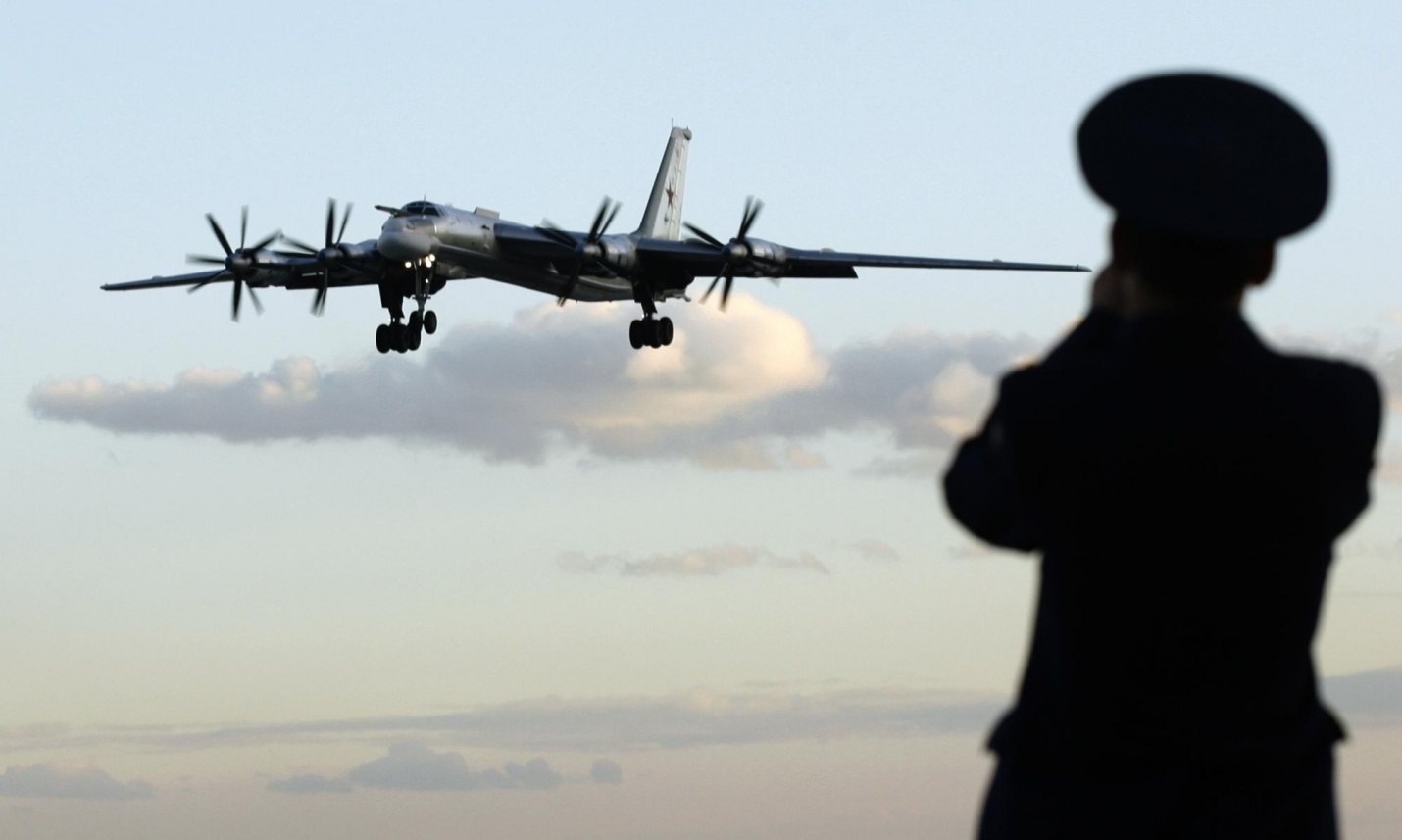
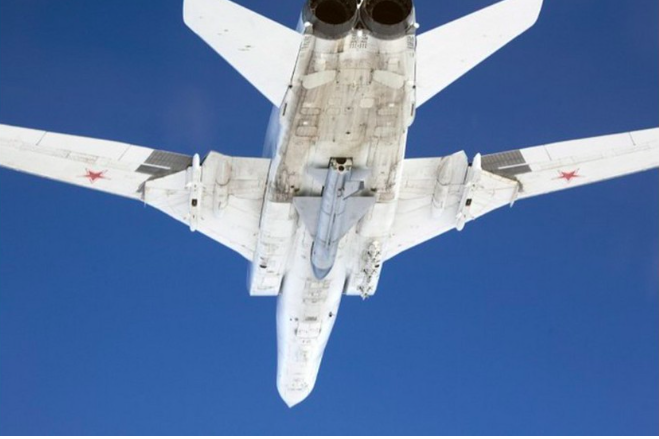
    Two Russian Bear bombers were again sighted off the coast of Cornwall in another manoeuvring close to the British Air Space.

    British RAF fighters were scrambled to escort the unwelcome guests away by RAF Typhoon class fighters. Ministry of Defence spokeswoman stated: “RAF quick reaction alert Typhoon fighter aircraft were launched yesterday after Russian aircraft were identified flying close to UK air space. The Russian planes were escorted by the RAF until they were out of the UK area of interest. At no time did the Russian military aircraft cross into UK sovereign air space.”

    Tensions are high between the UK and Russia and such incidents have now become once a month routine for the Russians. Last month as well a flight by two Russian bombers over the Channel had triggered a summon for Moscow’s ambassador by the British Foreign Office. UK foreign office said flights pose a potential danger to civilian flights.

    Russian warships too have passed through the English channel on a number of occasions in recent months. On Tuesday, the Yaroslav Mudry was tracked by the Royal Navy as it sailed back to Russia after a deployment in the Mediterranean with its accompanying tanker, the Kola. British warships were deployed and used their Lynx helicopter and sensors to locate and monitor the movement of the Russian ships off the coast of France and through the English Channel.

    Flights close to other Nato members’ air space have also become more frequent as tensions have increased between Moscow and the west.

    Nato said it flew 400 intercepts last year, four times more than in 2013.

     
  • Next stage of cease-fire – Ukraine Truce on Verge of Collapse

    Next stage of cease-fire – Ukraine Truce on Verge of Collapse

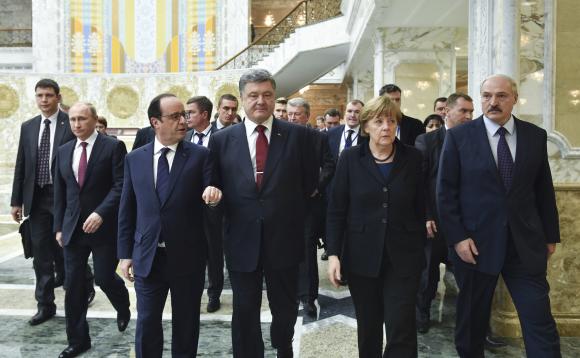
    Withdrawal of heavy weapons from the frontlines in Ukraine is set to begin at midnight Monday under the terms of the cease-fire, negotiated late last week in Minsk, Belarus, by the the leaders of Germany, France, Ukraine and Russia.

    But a Ukrainian military spokesman said such a move would be unlikely.

    “One hundred and twelve attacks are not an indicator of a cease-fire. At the moment we are not ready to withdraw heavy weapons,” Andriy Lysenko told a news briefing in Kyiv.

    In another development, the European Union included two Russian deputy defense ministers on its latest Ukraine sanctions list Monday, hitting them with travel bans and asset freezes for their role in the conflict.

    They are among 19 new people and nine entities the EU has sanctioned due to the Ukraine crisis.

    Russia said that it would respond “appropriately” to the latest EU measures.

    Ukraine and a host of Western governments accuse Moscow of stoking the rebellion in Ukraine’s Russian-speaking east with arms and fighters. The Kremlin has repeatedly denied providing direct support, and claims that Russian troops seen fighting alongside rebels are volunteers.

  • Ukraine ceasefire deal reached after Minsk talks

    Ukraine ceasefire deal reached after Minsk talks

    Leaders of Russia, Ukraine, Germany and France have agreed to a ceasefire 

  • Reset of a policy of equidistance

    Reset of a policy of equidistance

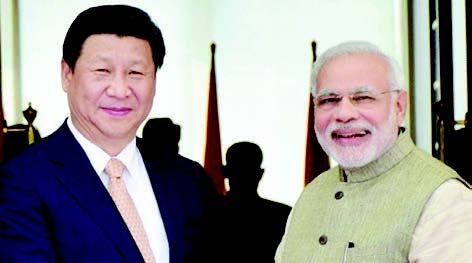
    Soon after Prime Minister Narendra Modi took office, an Indian TV channel held a discussion on likely foreign policy reorientation. When the doyen of South Asian Studies, Stephen Cohen, was asked in which direction Mr. Modi would tilt -the U.S. or China – without hesitation he replied, “China,” adding, “because it is the Asian century.” Mr. Modi hosted Chinese President Xi Jinping last year but despite the fanfare preceding the visit, there was little to suggest any strategic overlap. Alas, Mr. Cohen was proved wrong after the Modi-Obama Joint Vision Statement reflected a sharp, strategic congruence. Mr. Modi has reset the United Progressive Alliance (UPA) government’s policy of equidistance between the U.S. and China and dropped the political refrain that India will not contain China.


    Choosing friends and allies

    In New Delhi last year, at a seminar, the former U.S. Ambassador to India, Robert D. Blackwill, posed the question: “How can New Delhi claim strategic autonomy when it has strategic partnerships with 29 countries?” After the latest Modi-Obama vision statement, even less so. Strategic autonomy and no military alliances are two tenets of India’s foreign policy. Quietly, India has converted strategic autonomy to strategic interconnectedness or multi-vectored engagement. When the Indo-Soviet Treaty of Peace, Friendship and Cooperation 1971 was signed, Mrs Indira Gandhi had requested the Soviet Union to endorse India’s Non-Aligned status, so dear was the policy at the time. That multifaceted treaty made India a virtual ally of the Soviet Union. Russia inherited that strategic trust and has leased a nuclear submarine, provided high-tech weapons to all three Services including technology for nuclear submarines and aircraft carriers. At the BRICS meeting in Brazil last year, when asked a question, Mr. Modi said as much: “If you ask anyone among the more than one billion people living in India who is our country’s greatest friend, every person, every child knows that it is Russia.” 

    On the other hand, differences over foreign policy with the U.S. are many including over Syria, Iran, Russia, BRICS and the Shanghai Cooperation Organisation (SCO). These policy irritants will not go away. The vision statement highlights (at the U.S.’s insistence) that both countries were on the same page in ensuring that Iran did not acquire nuclear weapons. The tongue-lashing by Mr. Obama to Mr. Putin over his bullying small countries has certainly embarrassed Mr. Modi who was himself disingenuous by inviting the leader of Crimea as a part of the Putin delegation in 2014, which deeply offended the Americans.

    What Mr. Obama and Mr. Modi easily agreed on was China’s “not-peaceful rise” which could undermine the rule-based foundations of the existing international order. So, Mr. Modi became a willing ally to stand up to China. The synergisation of India’s Act East Policy and U.S. rebalancing to Asia is intended to ensure that China does not cross red lines including the code of conduct at sea. The two theatres of action where freedom of navigation and overflight have to be ensured were identified as Asia-Pacific especially the South China Sea and, for the first time, the Indian Ocean Region.

    This is a veiled riposte to Chinese assertiveness in the South China Sea. Mr. Modi had earlier mooted the revival of the Quad, an enlarged format for naval exercises between India, the U.S., Japan and Australia. When it was mooted earlier in 2006, it was shot down by China. Underlying the strategic centrality of the Indian Ocean Region is the realisation that the existing India-China military imbalance across the high Himalayas can be offset only in the maritime domain where India has the initiative. Beijing realises that teaching India a lesson in 1962 was only a tactical success because territorial claims on Arunachal Pradesh got delegitimised after the unilateral withdrawal and worse, pushed India into the U.S.’s arms.


    Defence ties

    The rise of India which will punch to its weight under a new self-confident leadership pursuing a policy of multi-engagement is a manifest U.S. strategic goal. Defence has been the pivot around which India-U.S. relations were rebuilt, starting in 1991 with the Kicklighter Plan (Lt.Gen. Kicklighter of the U.S. Pacific Command) who initiated the multilayered defence relations which fructified in 1995 into the first Defence Framework Agreement. It was renewed in 2005 and now for the second time this year, the difference though is that for the first time, the vision statement has provided political and strategic underpinnings to the agreement. What had also been lacking until now was trust and the extent to which India was prepared to be seen in the American camp. Just a decade ago, while contracting for the Hawk trainer aircraft with the U.K., India inserted a clause that “there will be no US parts in it.” This followed the Navy’s sad experience of the U.S. withholding spare parts for its Westland helicopters. Such misgivings have held up for a decade the signing of the three “alphabet- surfeit” foundational defence agreements of force-multiplication. But we have moved on and purchased $10 billion of U.S. high-tech military equipment and another $10 billion worth will soon be contracted. The most elaborate defence cooperation programme after Russia is with the U.S.


    Dealing with China

    What made Mr. Modi, who visited China four times as Chief Minister, change his mind on the choice of the country for primary orientation was the jolt he received while welcoming President Xi Jinping to Gujarat last year. Mr. Xi’s delegation was mysteriously accompanied by a People’s Liberation Army (PLA) intrusion in Ladakh which did not yield ground till well after he had left. A similar affront preceded the 2013 visit of Premier Li Keqiang, making routine the PLA’s bad habits. While the UPA government had made peace and tranquillity on the Line of Actual Control (LAC) a prerequisite for consolidation of bilateral relations, border management rather than border settlement had become the norm. Seventeen rounds of Special Representative talks on the border yielded little on the agreed three-stage border settlement mechanism. It was therefore path-breaking when Mr. Modi during the Joint Statement asked Mr. Xi for a clarification on the LAC -the process of exchanging maps that had failed in the past and led to the ongoing attempt at a political solution skipping marking the LAC. Clearly, we have moved full circle in calling for a return to that process. Foreign Minister Sushma Swaraj, who was in Beijing this month, sought an out-of-the-box solution for the border, in which category LAC clarification will not figure. Mr. Modi is determined not to leave resolution of the border question to future generations as Chinese leaders have persistently counselled. 

    Mr. Modi, in Japan last year, expressed concerns over “expansionist tendencies.” 

    Chinese scholars I met in Beijing last year said that conditions for settling the territorial dispute were not favourable because the border is a very complicated issue, entailed compromise and had to take public opinion along. And most importantly, strong governments and strong leaders were needed for its resolution.

    While Mr. Xi did promise last year investments worth $20 billion, the fact is that, so far, Chinese investments in India do not exceed $1.1 billion. Mr. Xi’s dream of constructing continental and maritime Silk Roads are intended to complement the String of Pearls in the Indian Ocean Region, bypassing choke points like the Malacca Straits as well as neutralising the U.S. rebalancing to Asia.


    Risks and opportunities

    How will India walk the tightrope between the U.S. and China, given that the U.S. is about 13,000 kilometres away and Beijing exists cheek by jowl, peering over a disputed border and with a whopping $40 billion in trade surplus? China’s reaction to the vision statement has been to warn India against U.S. entrapment. Operationalising the strategic-security portions of the vision statement will not be easy, especially as India has no independent role in the South China Sea. Once the euphoria over the Obama-Modi statement dissipates, ground reality will emerge. Instigating Beijing, especially in the South China Sea will have costs like having to deal with the full frenzy of the PLA on the LAC with most likely ally, Pakistan lighting up the Line of Control (LoC) – the worst case two-front scenario.

    Given Mr. Modi’s growth and development agenda, for which he requires the U.S., China, Japan and others, he cannot afford to antagonise Beijing. The U.S. is vital for India’s rise and a hedge to China. So, New Delhi will necessarily be on a razor edge. In any realisation of the Asian century, while China and India are likely key players, Washington will be large and looming, making a geostrategic ménage à trois.

  • China backs bigger role for India, Brazil at UNSC

    China backs bigger role for India, Brazil at UNSC

    BEIJING (TIP): China said it respects the aspirations of India and Brazil to play bigger roles at the UN Security Council, while keeping mum on Japan’s candidature.

    About the Indian and Brazilian applications to become permanent members, China respects the willingness of the two countries to play a bigger role in the UN body, Foreign Ministry spokesperson Hua Chunying said.

    Hua, however, told reporters that Beijing would like to reach a “broadest consensus through diplomatic means” on UNSC reform.

    She was replying to a question whether Beijing backs Brazil to become a permanent member of the UNSC in the backdrop of China and Russia supporting India’s candidature at a recent Russia, India, China (RIC) foreign ministers meeting here.

    The joint statement after the meeting attended by External Affairs Minister Sushma Swaraj said: “Foreign Ministers of China and Russia reiterated the importance they attached to the status of India in international affairs and supported its aspiration to play a greater role in the United Nations.”

    Hua said China pays high attention to the desire of Brazil to play bigger role in the UNSC.

    India along with Brazil, Germany and Japan together staked their claims for permanent membership of the UNSC as part of a larger reform of the United Nations.

    While China has backed India for a bigger role at the UN, it has expressed reservations in the past over Japan becoming a permanent member in view of the political and historical issues between the two countries.

    China-Japan ties have deteriorated following a row over the Senkaku Islands in the East China Sea, and also over some history-related issues.

    In December 2013, Japanese Prime Minister Shinzo Abe visited the Yasukuni Shrine — which honours not only the nation’s 2.5 million war dead but also 14 Class-A war criminals from World War II.

  • US WELCOMES IMF DEAL ON AID TO UKRAINE

    WASHINGTON (TIP): The United States welcomed on Thursday the International Monetary Fund’s announcement of a new $17.5 billion bailout deal for Ukraine, urging the crisis-torn country to undertake the reforms required by the programme.

    “Fully implemented, this ambitious IMF program will play an important role in helping to unleash Ukraine’s considerable untapped economic potential,” said Treasury Secretary Jacob Lew in a statement.

    The IMF on Thursday gave preliminary approval of a $17.5 billion four-year loan in exchange for economic reforms.

    The new loan replaces a previous two-year, $17 billion program announced in April that has proven inadequate to stabilize Ukraine’s finances as the country fights a pro-Russia insurgency in the industrialized east.

    In total, Kiev is expected to receive$40 billion in aid from the international community. A cease-fire agreement between Ukraine and the rebels was announced Thursday, with the truce to take effect Sunday.

    “The United States, along with its international partners, remains committed to ensuring that Ukraine has the financial and technical assistance it needs as it undertakes its far-reaching reform program,” Lew said.

    In mid-January, the United States pledged a new loan guarantee of $2 billion on condition that Ukraine remained on track with its IMF program.

    Two IMF programs for Ukraine, in 2008 and 2010, had been abandoned after the Ukrainian authorities refused to implement unpopular reforms, including ending subsidies for the gas sector.

  • GUEST COMMENT – BUILDING BRIDGES

    GUEST COMMENT – BUILDING BRIDGES

    External Affairs Minister Sushma Swaraj’s visit to China has created a positive atmosphere. President Xi Jinping met her in an unusual departure from protocol. China joined Russia in recommending India’s membership to the Asia-Pacific Economic Cooperation. On its part, India endorsed the launch of the China-led Free Trade Area of the Asia-Pacific initiative. Swaraj’s high-level delegation included the new Foreign Secretary, S Jaishankar, an old China hand, who was also intimately involved with US President Barack Obama’s successful visit to New Delhi. He evidently tackled some of the misgivings that Beijing had. Swaraj and her Chinese counterpart Wang Yi have sorted out certain issues, including the modalities for opening a second route for the Kailash-Manasarovar Yatra in Tibet and India’s conditional support to China’s Maritime Silk Route initiative. Beijing, however, must be sensitive to Indian sensibilities about its increasing military presence in the Indian Ocean. Swaraj also raised the issue of resolving the long-standing border dispute, instead of “bequeathing” it to future generations. The National Security Adviser Ajit Doval, who is India’s Special Representative on the issue, is expected to go to China later and take the matter further.


    Prime Minister Narendra Modi is expected to visit China in a few months, and the Foreign Minister’s visit is a preparatory one, to settle issues and manage agendas. The setting up of the “contact group” that will discuss pending issues and find solutions is a positive move, which may yield results, just as it did before President Obama’s trip. President Xi Jinping’s visit to India soon after the Modi government was sworn in was seen as underwhelming, but now there is fresh impetus for China to build better relations with India. President Obama’s visit and the joint statement issued thereafter caused some concern in Beijing. Indian diplomats are well positioned to ask for an expeditious resolution of the various issues. The mood is right, and the Prime Minister’s forthcoming visit to Beijing may well become an occasion for both the countries to pragmatically build alliances. The engagement between high-level delegations bodes well for the future.

  • FOUR INDIANS FIGURE IN THE TOP 100 GLOBAL RICH LIST

    FOUR INDIANS FIGURE IN THE TOP 100 GLOBAL RICH LIST

    LONDON (TIP): Four Indians have made it to the top 100 global rich list, as the country records for the first time more billionaires than Britain and Russia.


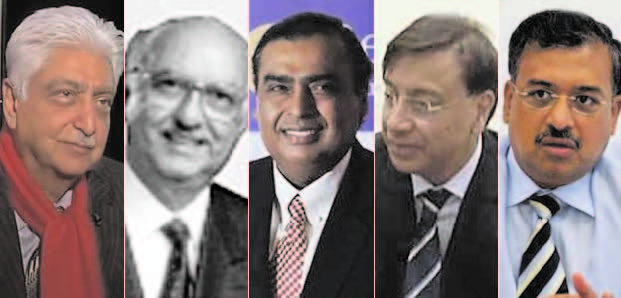
    The world now has a record 2,089 billionaires with Mukesh Ambani being the richest Indian in the list.


    The Reliance chief however ranks 41 in the top 100 global rich list.


    The other Indians to figure in the top 100 are Dilip Sanghvi of Sun Pharma who is ranked 53, Pallonji Mistry & family who own Tata Sons ranked 60 and Wipro’s Azim Premzi who is ranked 74.


    India has leapfrogged Russia and the UK to third place with 97 billionaires, 27 more than 2014. Manufacturing and Pharma are the preferred sectors with 23 and 14 billionaires respectively. Combined wealth of the Indian billionaires comes to $266 billion. Mumbai is headquarters to most of the Indian billionaires.


    The latest Harun Global Rich List 2015 shows an additional 222 billionaires were created last year, almost a third of whom were in China. Bill Gates remains the world’s wealthiest individual increasing his wealth to $85 billion. Mexican tycoon Carlos Slim is second with $83bn, while Facebook founder Mark Zuckerburg breaks into the global top 10 for the first time.


    The US still holds the crown for most mega-wealthy residents, at 537. But China is not far behind with 430, having acquired 72 new billionaires in 2014.


    Russia has 93 billionaires and UK has 80.


    New York remains the favourite city of the super-rich, with 91 billionaires while London is still fifth with 49.


    But six cities in Asia now make the top 10: Mumbai, Hong Kong, Beijing, Shenzhen, Taipei and Shanghai.


    The List ranked 2089 billionaires from 68 countries, up 222 from last year.


    Mark Zuckerberg at 30 is the youngest member of the Top 10. His wealth soared 42%, moving him up 11 places to number 7.


    The ‘Big Two’ in the list are the USA and China with 537 and 430 billionaires respectively, amounting to almost half of the billionaires on the planet. Russia had a bad year, losing 10 billionaires.

  • India asks Japan if it’s interested in Rs 50,000 crore submarine project

    India asks Japan if it’s interested in Rs 50,000 crore submarine project

    NEW DELHI (TIP): Russia, France, Germany and Spain, all better watch out. They may have to contend with Japan in the race to supply submarines to India. In keeping with their expanding strategic partnership, the Modi government has asked the Shinzo Abe administration whether it would be interested in the over Rs 50,000 crore project to build six stealth submarines in India.


    With Japan recently ending its decades old self-imposed arms export embargo, New Delhi has forwarded “a proposal” to Tokyo to “consider the possibility” of making its latest diesel-electric Soryu-class submarines in India, say sources.


    This “feeler” dovetails into PM Narendra Modi’s strategic outreach to Japan, as well as Australia and the US, since he took over last year. The possible sale of Japanese US-2i ShinMayva amphibious aircraft to the Indian Navy is already being discussed. Australia, too, is considering the Soryu submarines to replace its ageing Collins-class vessels.


    The US, on its part, has been pushing for greater defence cooperation among India, Japan and Australia to counter China’s assertiveness in the Asia-Pacific region. The recent Obama-Modi summit led to the “joint strategic vision for Asia-Pacific and Indian Ocean Region” with a direct reference to South China Sea, where China is locked in territorial disputes with its neighbours. Both Japan and Australia are also keen to participate in the annual Indo-US Malabar naval exercise on a regular basis, which has riled China in the past.


    But the 4,200-tonne Soryu submarines, manufactured by Mitsubishi Heavy Industries and Kawasaki Heavy Industries, may not meet Indian requirements. Japan will also be just one of the contenders for the mega programme, called Project- 75-India, if it agrees to throw its hat into the ring.


    Countries like France (ship-builder DCNS), Germany (HDW), Russia
    (Rosoboronexport) and Spain
    (Navantia) are already girding up, with the first three having the experience of building submarines for India.

  • EU expands Russia sanctions as new Ukraine talks loom

    EU expands Russia sanctions as new Ukraine talks loom

    BRUSSELS (TIP): The EU agreed on Thursday to expand its sanctions against Russia as Ukraine’s warring parties announced fresh truce talks to end a surge in fighting between Kiev and Kremlin-backed rebels.


    Former Soviet leader Mikhail Gorbachev warned meanwhile that the threat of further sanctions risked turning the new Cold War atmosphere into a globally destabilising “hot” armed conflict between Moscow and the West.


    During emergency talks called after dozens died in fighting in the east Ukrainian port of Mariupol, EU foreign ministers overcame reluctance from Greece’s radical new government to reach a deal to tighten sanctions.


    “I cannot say I am happy that we have taken this decision because the situation on the ground is nothing to be happy about,” EU foreign policy chief Federica Mogherini told a press conference in Brussels.


    “But the one thing I can be happy about is that we have kept our unity.” 


    The United States welcomed the EU move, and warned Russia that it is mulling fresh sanctions of its own.


    State Department spokeswoman Jen Psaki said the EU agreement was “a further sign that the actions of the last several days and weeks are absolutely unacceptable and that there will be new consequences put in place.” 


    Kiev and local officials said six civilians and five Ukrainian soldiers were killed over the previous 24 hours, adding to the UN’s confirmed death toll of 5,100 for the conflict in the former Soviet state.


    The EU ministers agreed to extend, by six months until September, a series of targeted sanctions hitting more than 100 Russian and Ukrainian figures, which were introduced after the annexation of Crimea in March 2014, according to a statement after the talks.


    They also agreed to come up with more names to be hit with the travel bans and asset freezes within a week.

  • US warns cost of Russian actions in Ukraine will ‘rise’

    US warns cost of Russian actions in Ukraine will ‘rise’

    WASHINGTON (TIP): The United States gave a clear signal January 28 that Russia will face further sanctions for what the White House says is Moscow’s role in fueling violence in eastern Ukraine.


    Following a telephone call between US Vice President Joe Biden and Ukrainian President Petro Poroshenko, the White House condemned “Russian-backed separatists” and the “heavy toll that the Russian-backed offensive in the east was having on Ukraine’s civilian population.” 


    “As long as Russia continues its blatant disregard of its obligations… the costs for Russia will continue to rise,” Biden was reported to have told the Ukrainian leader.


    Late Tuesday President Barack Obama and German Chancellor Angela Merkel discussed the “significant increase” in violence in Ukraine and warned Russia would be held accountable.


    “The two leaders expressed concern about the significant increase in violence in eastern Ukraine and Russia’s material support for the separatists,” a White House statement said.


    “They agreed on the need to hold Russia accountable for its actions.” Western sanctions and a slide in oil prices have plunged Russia into recession and seen Standard and Poor’s slap a “junk” rating on Moscow’s foreign currency debt.


    Pro-Russian rebels in Ukraine last week defiantly pulled out of peace talks and promised an offensive on a strategic government-held port city that provides a direct land bridge to Ukraine’s Russian-occupied Crimea peninsula.


    Russia denies backing the eastern insurgents and says that measures against it are designed to undermine President Vladimir Putin’s 15-year rule. Obama has issued an executive order prohibiting trade with Crimea, the Black Sea peninsula that Moscow annexed from Ukraine in March.


    Two dozen people — including Russians and separatists — have also been added to a US blacklist, subjecting them to travel bans and assets freezes.

  • Moscow blasts US spy arrest as part of  ‘anti-Russian campaign’

    Moscow blasts US spy arrest as part of ‘anti-Russian campaign’

    MOSCOW (TIP): Moscow on Jnauary 28 blasted the United States over the arrest of an alleged Russian spy, condemning the move as a “provocation” that would further damage already tattered ties.


    “The US has decided to launch the latest stage of its anti-Russian campaign,” the foreign ministry said in a statement, accusing Washington of “stoking spy mania”.


    “We demand an end to this series of provocations by the US security services against representatives of Russia,” said the statement from ministry spokesman Alexander Lukashevich.


    Lukashevich lashed out at US authorities for providing “no evidence” to back up their claims that the arrested man, banker Evgeny Buryakov, 39, is a spy and demanded his immediate release.


    The top human rights official at the foreign ministry, Konstantin Dolgov, said that Russian consular representatives were trying to get access to the detainee and would “defend all his rights.” 


    “The hunt for Russian citizens by the American authorities is continuing,” Dolgov told TV channel Rossiya 24.


    “We are going to demand at a high level that the Americans halt actions that breach the rights of our citizens,” Dolgov said.


    Russia’s deputy foreign minister Sergei Ryabkov on Tuesday held a meeting with US ambassador to Moscow John Tefft to discuss “bilateral” issues, the ministry said.


    Buryakov — an employee at a Manhattan branch of a Russian state-run bank — was arrested by federal agents in New York on Monday and appeared in court over allegations he was trying to recruit sources and collect economic intelligence.


    US prosecutors said he was assisted in espionage by Russian spies Igor Sporyshev, 40, and Victor Podobnyy, 27, who had been attached to the Russian trade and UN missions in New York.


    Sporyshev and Podobnyy were protected by diplomatic immunity and have since left the United States, so have not been arrested. They are charged in absentia, officials said.


    Buryakov’s detention has rocked already deeply strained relations between Moscow and Washington, which are at their lowest ebb in years over the crisis in Ukraine and war in Syria. US Attorney General Eric Holder said America was committed “to combating attempts by covert agents to illegally gather intelligence and recruit spies within the United States.” 


    Manhattan federal prosecutor Preet Bharara said it showed that “more than two decades” after the Cold War, “Russian spies continue to seek to operate in our midst under cover of secrecy.”


    It is the first such case since 10 deep-cover agents including flame-haired Anna Chapman, were arrested in the New York area in 2010. They pleaded guilty and were part of a prisoner swap with Moscow.

  • India-US strategic partnership

    India-US strategic partnership

    In future, India may be willing to conduct joint military operations with the US in its area of strategic interest in a contingency in which India’s vital national interests are threatened, preferably as a Chapter 7 intervention under the UN flag and failing that, as part of a “coalition of the willing”, says the author.


    President Barack Obama’s forthcoming visit as the chief guest on Republic Day is likely to give a fresh impetus to the Indo-US strategic partnership. While the relationship is substantive and broad based, the impressive achievements of the strategic partnership are to a large extent attributable to the successful implementation of the 10-year Defence Framework Agreement signed in June 2005. The renewal of this agreement will be a major item on the bilateral agenda during the summit meeting.


    During the Obama-Narendra Modi meeting in September 2014, the two leaders had stated their intention to expand defence cooperation to bolster national, regional, and global security. It was agreed that the two countries would build an enduring partnership in which both sides treat each other at the same level as their closest partners, including defence technology transfers, trade, research, co-production, and co-development.


    Prime Minister Modi and President Obama welcomed the first meeting under the framework of the Defence Trade and Technology Initiative in September 2014 and endorsed the decision to establish a task force to expeditiously evaluate and decide on unique projects and technologies which would have a transformative impact on bilateral defence relations and enhance India’s defence industry and military capabilities.


    For several decades, India’s procurement of weapons platforms and other defence equipment had remained mired in disadvantageous buyer-seller, patron-client relationships like that with the erstwhile Soviet Union and Russia. While India has been manufacturing Russian fighter aircraft and tanks under licence, the Russians never actually transferred weapons technology to India.


    The country has now diversified its acquisition sources beyond Russia to Western countries and Israel. From the US, India has purchased weapons platforms and other items of defence equipment worth around US $10 billion over the last five years. However, none of the recent deals with the US have included the transfer of technology clauses. There is now a growing realisation in India that future defence acquisitions must simultaneously lead to a transformative change in the country’s defence technology base and manufacturing prowess. Hence, it is imperative that whatever India procures now must be procured with a transfer of technology clause being built into the contract even though it means having to pay a higher price. The aim should be to make India a design, development, manufacturing and export hub for defence equipment in two to three decades.


    In September 2013, Deputy Secretary of Defence Ashton Carter, now the US Defence Secretary designate, had offered India a “Defence Trade and Technology Initiative” under which the US will share sensitive cutting-edge defence technology and permit US companies to enter into joint production and co-development ventures in India. Carter had then said, “We changed our mindset around technology transfer to India in the Department of Defence from a culture of presumptive no to one of presumptive yes.” 


    The Javelin anti-tank guided missile is another key candidate for joint production, though so far the US has been hesitant to offer its seeker and warhead technology. India is also looking for high-end counter-IED technologies. In future, the two countries will conduct joint research and development for new weapons systems and the US may offer even nuclear power packs for submarines and aircraft carriers and fighter aircraft engines. Cooperation of such a high order will raise India’s technology base by an order of magnitude and help the country move several notches higher in its quest for self-reliance in defence production. stepping down as Secretary of Defence, Chuck Hagel had nominated Frank Kendall, the Department’s Undersecretary for Acquisition, Technology and Logistics, as the defence initiative’s American lead. With Ashton Carter soon to become Secretary of Defence, the initiative will get a fresh boost. The biggest boost will come from a show-piece joint development project like the BrahMos supersonic cruise missile jointly developed with Russia.


    The extended Defence Framework Agreement should take stock of the goals of the 2005 agreement that have not been fully achieved. For example, there has been no progress in cooperation on BMD technology. This needs to be rectified. Intelligence sharing is limited to ongoing counter-terrorism operations at present. It should be extended to the sharing of data bases as well, particularly the terrorism data base maintained by the US NCTC and India’s NATGRID.


    Prime Minister Modi’s government has raised the FDI limit for defence joint ventures to 49 per cent equity participation. It is likely to be open to modifying the offsets policy and amending export laws, which are considered a stumbling block. The agreement should take into account the Indian PM’s exhortation to industry to “Make in India”. The two governments should act as facilitators for their public and private sector companies to form joint ventures for the design and development, co-production and export of future weapons platforms.


    There is a mutual recognition of the adverse implications of China’s increasing assertiveness in the South China Sea and in dealing with the dispute over the Senkaku (Diaoyu) islands with Japan. This has undermined international and regional confidence in China’s desire to resolve disputes peacefully. There is need to work in unison with the international community to uphold the unfettered use of the global commons. India is building robust military intervention capabilities and the armed forces are engaged in the process of formulating a doctrine to give effect to these capabilities.


    Though India values its strategic autonomy and recognises that each bilateral relationship is important in its own way, the policymakers realise that the geo-political contours of the 21st century and peace and stability, particularly in the India-Pacific region, will be shaped through cooperative security. In future, India may be willing to conduct joint military operations with the US in its area of strategic interest in a contingency in which India’s vital national interests are threatened, preferably as a Chapter 7 intervention under the UN flag and failing that, as part of a “coalition of the willing”.

  • IMF cuts global growth outlook, calls for accommodative policy

    IMF cuts global growth outlook, calls for accommodative policy

    BEIJING (TIP): The International Monetary Fund lowered its forecast for global economic growth in 2015, and called on Tuesday for governments and central banks to pursue accommodative monetary policies and structural reforms to support growth.

    Global growth is projected at 3.5 per cent for 2015 and 3.7 per cent for 2016, the IMF said in its latest World Economic Outlook report, lowering its forecast by 0.3 per centage points for both years.

    “New factors supporting growth – lower oil prices, but also depreciation of euro and yen – are more than offset by persistent negative forces, including the lingering legacies of the crisis and lower potential growth in many countries,” Olivier Blanchard, the IMF’s chief economist, said in a statement released by the Washington-based lender.
    The IMF advised advanced economies to maintain accommodative monetary policies to avoid increases in real interest rates as cheaper oil increases the risk of deflation.
    If policy rates could not be reduced further, the IMF recommended pursuing an accommodative policy “through other means”.

    The United States was the lone bright spot in an otherwise gloomy report for major economies, with projected growth raised to 3.6 per cent from 3.1 per cent for 2015. The United States largely offset prospects of more weakness in the euroarea, where only Spain’s growth was adjusted upward.

    Projections for emerging economies were also broadly cut back, with the outlook for oil exporters Russia, Nigeria and Saudi Arabia worsening the most.

    The IMF predicts that a slowdown in China will draw a more limited policy response as authorities in Beijing will be more concerned with the risks of rapid credit and investment growth.

    The IMF also cut projections for Brazil and India.

    Lower oil prices will give central banks in emerging economies leeway to delay raising benchmark interest rates, although “macroeconomic policy space to support growth remains limited,” the report said.

    Falling prices will also give countries a chance to reform energy subsidies and taxes, the IMF said.

    The prospects of commodity importers and exporters will further diverge.

    Oil exporters can draw on funds they amassed when prices were high and can further allow for substantial depreciation in their currencies to dull the economic shock of plunging prices.

    The report is largely in line with remarks by IMF Managing Director Christine Lagarde last week, in which she said falling oil prices and strong U.S. growth were unlikely to make the IMF more upbeat.

  • Ukraine separatists claim victory in battle for airport

    Ukraine separatists claim victory in battle for airport

    DONETSK, UKRAINE (TIP): Russian-backed separatists announced on January 15that they had captured the shattered remains of the Donetsk airport terminal in eastern Ukraine and plan to claw back more territory, further dashing hopes for a lasting peace agreement.

    The airport, on the fringes of the rebel stronghold of Donetsk, has been at the center of bitter battles since May. Control over it was split between the separatists and Ukrainian forces who had held onto the main civilian terminal. Reduced to little more than a shell-littered wreck, the building is of limited strategic importance but has great symbolic value.

    An AP reporter saw a rebel flag hoisted over that building on Thursday, although fighting still appeared to be ongoing. Ukraine insisted government troops were holding their positions at the airport.

    Alexander Hug, deputy head of an Organization for Security and Cooperation in Europe monitoring mission to Ukraine, said rebel forces carried out artillery attacks from within residential areas.

    “These attacks … attract counter-fire from positions opposite and other directions, which leads unfortunately to repeated civilian casualties and damage to infrastructure,” Hug said.

    The rebel leader in Donetsk, Alexander Zakharchenko, said the separatist offensive would continue and its goal was to recapture all territory lost to government forces last year.

    “Let our countrymen hear this: We will not just give up our land. We will either take it back peacefully, or like that,” Zakharchenko said, nodding his head toward the sound of explosions coming from the direction of the airport.

    If the separatists do advance further, that would undermine the chances of resurrecting a September cease-fire that laid out specific demarcation lines between the opposing sides.

    The rebels’ disregard of that agreement appears to defy Moscow’s public backing of the peace deal.

    The likelihood of any further negotiations looks compromised against the backdrop of continued unrest.

    Separatist leaders in the regions of Donetsk and Luhansk have declined to attend talks with Ukraine and Russia expected to take place on Friday in the capital of Belarus, Minsk. They have instead dispatched envoys and said they refuse to take part in more talks unless specific results are achieved.

    The battle for Donetsk airport took place as Ukraine held a day of mourning for 13 people killed on Tuesday when their bus was hit by what the government says was a rebel shell.

    President Petro Poroshenko said respects would be paid for all people killed by rebel offensives.

    The separatists deny responsibility for the deaths and accuse Ukrainian forces of staging an attack in a bid to smear them. OSCE observers said the bus showed “damage consistent with a nearby rocket impact.”

    In Kiev, the Ukrainian parliament on Thursday approved a presidential decree for three waves of military mobilization this year. Poroshenko said that was motivated by the worsening security situation.