Tag: Russia

  • IMPLICATIONS OF AMERICAN WITHDRAWAL FROM AFGHANISTAN

    IMPLICATIONS OF AMERICAN WITHDRAWAL FROM AFGHANISTAN

    “The Taliban attacks within Afghanistan reached unprecedented levels in 2014. Moreover, while Washington proclaims that any process of “reconciliation” between the Taliban and the Afghan Government will be “Afghan led and Afghan driven,” the reality is that Rawalpindi will ensure that the entire “reconciliation” process will be controlled and driven by the ISI”, says the author.

    American military interventions in recent times – be these in Vietnam, Somalia, Lebanon, Libya, or Iraq -have undermined regional stability and left deep scars on the body politic of these countries. The society and the body politic of America have felt the tremors of these misadventures. The American military intervention in Afghanistan, code-named
    “Operation Enduring Freedom”, commenced in the aftermath of 9/11. Its combat role ended 13 years later on December 31, 2014. The Americans tried to win “Operation Enduring Freedom” cheaply, outsourcing many operations to the erstwhile Northern Alliance. Adversaries comprising the Mullah Omar-led Afghan Taliban, Al-Qaida, thousands of Islamic radicals from the Arab world, Chechnya, Uzbekistan, Tajikistan, China’s Xinjiang province and ISI-linked Pakistani terrorist groups escaped across the Durand Line, to safe havens under ISI protection, in Pakistan.

    The US has paid a heavy price for this folly. Some 2,200 of its soldiers were killed in combat, suffering heavy losses in the last four years after it became evident that it was pulling out. As the US was winding down its military presence and transferring combat responsibilities to the Afghan National Army (ANA), an emboldened Taliban and its Chechen, Uzbek, Uighur and Turkmen allies have emerged from their Pakistani safe havens and moved northwards. In subsequent fighting 4,600 Afghan soldiers were killed in combat in 2014 alone. The Afghan army cannot obviously afford such heavy casualties continuously, if morale is to be sustained. Its available tactical air support and air transport infrastructure are woefully inadequate. The Afghans do not have air assets which were available to the NATO forces.

    Apart from what is happening in southern Afghanistan, Taliban-affiliated groups are now increasing their activities in northern Afghanistan, along its borders with Turkmenistan, Uzbekistan, Tajikistan and China’s Xinjiang province. Afghanistan’s northern provinces like Kunduz, Faryab and Takhar have seen increased attacks by the Taliban allies, from Tajikistan, Turkmenistan and Uzbekistan. These Central Asian countries are getting increasingly concerned about the security situation along their borders. American forces are scheduled to be halved in 2015 and reduced to a token presence, just sufficient to protect American diplomatic missions by the end of 2016. Not surprisingly, President Ashraf Ghani has asked the US to review its withdrawal schedule.

    Afghanistan’s southern provinces, bordering the disputed Durand Line with Pakistan, are increasingly ungovernable. Following Gen Raheel Sharif’s assault on the Pashtuns in Pakistan’s tribal areas, over one million Pashtun tribals have fled their homes in Pakistan, with an estimated 2, 50,000 fleeing into neighboring Afghanistan. If Mullah Omar, his Taliban associates and Sirajuddin Haqqani’s terrorist outfit are finding safe havens in Pakistan, Mullah Fazlullah and his followers in the Pakistani Taliban (TTP) appear to have disappeared into the wilderness, in Afghanistan. Senator Kerry will likely secure a waiver on legislative requirements that Pakistan has stopped assistance to terrorist groups operating against Afghanistan and India, to enable the flow of American aid to Pakistan. The reality, however, is that even after the Peshawar massacre of schoolchildren, terrorist groups like the Haqqani network, Jaish e Mohammed and Lashkar e taiba receive safe haven and support in Pakistan.

    Despite professed American understanding of a “change of heart” in Islamabad and Rawalpindi, the reality remains that Mullah Omar is still leading the Afghan Taliban from a safe house in Karachi. The day-to-day conduct of operations in Afghanistan has reportedly been transferred by the ISI to one of his deputies, Mullah Akhtar Muhammad Mansour. The Taliban attacks within Afghanistan reached unprecedented levels in 2014. Moreover, while Washington proclaims that any process of
    “reconciliation” between the Taliban and the Afghan Government will be “Afghan led and Afghan driven,” the reality is that Rawalpindi will ensure that the entire
    “reconciliation” process will be controlled and driven by the ISI. China, now endorsed by the US as the new “Good Samaritan” to facilitate Afghan “reconciliation,” has maintained ISI-facilitated links with Mullah Omar’s Quetta Shura. Beijing will naturally endorse the wishes of its “all-weather friend,” Pakistan.

    Afghanistan’s Central Asian neighbors, which are members of the Shanghai Cooperation Organization (SCO), to which India was recently admitted, can expect little from this organization to deal effectively with their concerns, given the fact that China has been now joined by Pakistan as a member of the SCO. Given its growing economic woes and sanctions imposed by the US and its allies, Russia will have little choice, but to fall in line with China, though its special envoy Zamir Kabulov has expressed Moscow’s readiness to supply weapons to Kabul “when it will be necessary to supply them”. Past Russian policy has been to supply weapons to Kabul on strictly commercial terms.

    Adding to the prevailing uncertainty is the fact that Afghanistan is today ruled not by the provisions of its Constitution, but by a patchwork coalition of two formerly implacable political foes, President Ashraf Ghani and Chief Executive Abdullah Abdullah. The political gridlock in Kabul is tight. After the presidential elections, which were internationally regarded as neither free nor fair, the ruling duo, stitched together by Senator John Kerry, took months just to agree on the names of new ministers.

    India can obviously not countenance the return of an ISI-backed Taliban order in Afghanistan. The US-Afghanistan Bilateral Security Agreement envisages the possibility of a US military presence “until the end of 2024 and beyond.” Will it be realistic to expect a war-weary US and its NATO partners, now heavily focused on combating ISIL and radical groups across the Islamic world ranging from Iraq, Syria, Libya and Lebanon, to Somalia and Nigeria, to continue to bail out a politically unstable Afghanistan? Will the Americans and their allies continue providing Afghanistan adequate air support, weapons and financial assistance amounting to $5-10 billion annually?

    These are realities we cannot gloss over. A thorough review of issues like safety and security of Indian nationals and our missions in Afghanistan, access and connectivity through Iran and completion of assistance projects like Salma Dam and Afghan Parliament, has to be undertaken.

    By G Parthasarathy (The author is a career diplomat and author. He remained envoy of India to many countries, including Pakistan and was spokesperson of the Ministry of External Affairs and the Prime Minister’s Office)

  • World Economy Past and future tense

    World Economy Past and future tense

    A Financial crash in Russia; falling oil prices and a strong dollar; a new gold rush in Silicon Valley and a resurgent American economy; weakness in Germany and Japan; tumbling currencies in emerging markets from Brazil to Indonesia; an embattled Democrat in the White House. Is that a forecast of the world in 2015 or a portrait of the late 1990s?

    Recent economic history has been so dominated by the credit crunch of 2008-09 that it is easy to forget what happened in the decades before. But looking back 15 years or so is instructive-in terms of both what to do and what to avoid.

    Then, as now, the United States was in the vanguard of a disruptive digital revolution. The advent of the internet spawned a burst of innovation and euphoria about America’s prospects. By 1999 GDP was rising by more than 4% a year, almost twice the rich-country average. Unemployment fell to 4%, a 30-year low. Foreign investors piled in, boosting both the dollar and share prices. The S&P 500 index rose to almost 30 times earnings; tech stocks went wild.

    The optimism in America stood in stark contrast to gloom elsewhere, as it does today. Japan’s economy had slipped into deflation in 1997. Germany was “the sick man of Europe”, its firms held back by rigid labor markets and other high costs. Emerging markets, having soared ahead, were in crisis: between 1997 and 1999 countries from Thailand to Brazil saw their currencies crash as foreign capital fled and dollar-denominated debts proved unpayable.

    Eventually, America ran into trouble too. The tech-stock bubble burst in early 2000, prompting a broader share price slump. Business investment, particularly in technology, sank; and as share prices fell, consumers cut back. By early 2001 America, along with most of the rich world, had slipped into recession, albeit a mild one.

    America the powerful

    Inevitably the parallels are not perfect. The biggest difference is China, a bit-part player in 1999 and now the world’s second-biggest economy, contributing disproportionately to global growth. But there are three trends at work that destabilized the world economy then and could do the same now.

    The first is the gap between America, where growth is accelerating, and almost everywhere else, where it is slowing. In the late 1990s Larry Summers, then the US deputy treasury secretary, warned that the world economy was “flying on one engine”. For 2015 The Economist’s panel of forecasters expects 3% growth in America, compared with 1.1% in Japan and the euro area. China’s growth rate may fall to around 7%.

    Americans can comfort themselves that, as in the late 1990s, the optimism gap is partially warranted. Jobs are being created in their country faster than at any time since 1999, cheap petrol has buoyed consumer spending and business investment has picked up. But the news is not all good: cheaper oil could tip plenty of America’s shale producers into bankruptcy in 2015, while a stronger dollar and weakness abroad will hurt exporters-just as they did 15 years ago. Britain, the other Anglosphere champion, may also be clobbered by the euro zone’s woes.

    The second worrying parallel with the late 1990s is the dismal outlook for the rich world’s two other big economies. Germany’s growth rate has tumbled to around 1% and there is a deeper malaise caused by years of underinvestment, a disastrous energy policy and a government that is too obsessed by its fiscal targets to spend money and too frightened of its voters to push through the sort of structural reforms that Gerhard Schröder implemented in 2003. Meanwhile Japan has repeated the error it made in 1997-thwarting its escape from stagnation with a premature rise in consumption tax.

    The third echo of the 1990s is the danger in emerging markets. Back then the problem was fixed exchange rates and hefty foreign debt. Now the debts are lower, the exchange rates float and most governments have built up reserves. Still, there are growing signs of trouble, especially in Russia. But other commodity exporters also look vulnerable, especially in Africa. Oil accounts for 95% of Nigeria’s exports and 75% of its government revenue. Ghana has already gone to the IMF for support. In other countries the danger lies in the corporate sector. Many Brazilian firms are heavily indebted in dollars. A rash of corporate defaults may prove less spectacular than Asia’s sovereign-debt crises in the 1990s, but they will make investors nervous and push up the dollar.

    Fear the hangover

    Add all this up and 2015 seems likely to be bumpy. Bears will bet that a surging dollar coupled with euro-zone torpor and a few emerging-market crises will eventually prompt a downturn in America. On the plus side, stock markets do not look as frothy as they did in the 1990s: the price/earnings ratio of the S&P 500 is 18, not far above its historical average. Although many big tech firms are investing recklessly, most have decent balance-sheets . And the global financial system is less leveraged and hence less vulnerable to contagion. In 1998 Russia’s default felled LTCM, a big American hedge fund. Such knock-on effects are less likely today.

    But if the world economy does stumble, restoring stability will be harder this time round because policymakers have so little room for maneuver. Back in 1999 the Federal Reserve’s policy rate was around 5%, leaving plenty of scope for cutting when the economy slowed. Nowadays interest rates all over the rich world are close to zero.

    The political scene is also different, and not in a good way. At the end of the 1990s most people in the rich world had enjoyed the fruits of the boom: median American wages rose by 7.7%in real terms in 1995-2000. Since 2007, by contrast, they have been flat in America, and have fallen in Britain and much of the euro zone. All over the rich world voters are already grumpy with their governments, as polling numbers and their willingness to vote for protest parties show. If they are squeezed next year discontent will turn to anger. The economics of 2015 may look similar to the late 1990s, but the politics will probably be rather worse.

    By James G Rickards

    The world economy in 2015 will carry troubling echoes of the late 1990s
    Economist, Jim Rickards explains the coming economic crisis in 2015.
    (The author is an American lawyer. He is a regular commentator on finance, and is the author of The New York Times bestseller Currency Wars: The Making of the Next Global Crisis, published in 2011, and The Death of Money: The Coming Collapse of the International Monetary System, published in 2014)

    (Source: The Economist)

  • Russia to impose wheat export duty from February

    Russia to impose wheat export duty from February

    MOSCOW (TIP): Russia has said it will from February apply a duty of at least 35 euros ($43) per tonne of wheat sent for export as it tries to lower prices on its domestic market, hit by the ruble’s fall. The duty, announced in a government decree published late Thursday, aims to narrow a price difference that has emerged as Russia’s ruble has slumped by 40 per cent against the dollar this year. Despite a near-record wheat harvest this year, prices on the Russian market have been rising as growers prefer to export where prices, linked to foreign currencies, are now considerably higher. Deputy Prime Minister Arkady Dvorkovich said on Thursday that farmers were getting around 225 euros ($275) per tonne if they export and 160 euros ($195) if they sold on the domestic market. The duty in force from February 1 to June 30 will be 15 per cent of the price per tonne plus 7.5 euros, with a minimum rate of 35 euros per tonne. At a price of 225 euros per tonne, the duty of 41.25 euros would still leave a price difference of over 20 euros. Even before it announced plans to introduce the duty in order to protect the country’s “food security”, market participants said the government had taken other measures to slow exports as it suddenly became difficult to book rail transportation and obtain food safety export certificates. Dvorkovich said on national television on Thursday that food safety inspections would remain “strict” as Russia “can’t afford any longer to close its eyes to violations”. Russia has long been accused by its trade partners of using food safety inspections as a trade weapon, but usually to block imports. Wheat prices have risen on international markets over the past week as traders were anxious that Russia, usually the world’s number 3 exporter, may ban exports as it did in 2010 when it had a poor harvest due to a drought.

  • 80 per cent back Putin even as Russian ruble falls

    80 per cent back Putin even as Russian ruble falls

    MOSCOW (TIP): From a Western perspective, Vladimir Putin’s days as president of Russia should be numbered: The ruble has lost more than half its value, the economy is in crisis and his aggression in Ukraine has turned the country into an international pariah.

    And yet most Russians see Putin not as the cause, but as the solution.

    The situation as seen from a Russian point of view is starkly different from that painted in the West, and it is driven largely by state television’s carefully constructed version of reality and the Kremlin’s methodical dismantling of every credible political alternative.

    An Associated Press-NORC Center for Public Affairs Research poll released Thursday found that about 80 per cent of Russians still support him, hours before Putin vowed in a live news conference to fix Russia’s economic woes within two years, voiced confidence the plummeting ruble will recover soon and promised to diversify Russia’s economy.

    But the poll also showed that confidence in the economy is slipping. This is particularly true in Moscow, where people have become accustomed to imported goods and foreign travel, now once again off-limits for many because of the fall of the ruble and Western sanctions over Ukraine.

    The poll was conducted between November 22 and December 7, when the ruble was steadily declining. But this week’s catastrophic collapse is likely to have a much greater effect on consumer prices and the standard of living.

    For Putin, the question is whether he will be able to convince Russians to tighten their belts, and not just for a few months but possibly for years to come.

    “The Russian people have a sense that they are under sanctions, they are a fortress under siege,” said Maria Lipman, an independent analyst. “This kind of mentality is disseminated consistently and steadily by Russian television: Who else is there to rely on except Putin? Putin is seen as the savior of the nation, and I think he sees himself in this fashion.” Putin addressed his countrymen’s concerns over three hours at Thursday’s news conference, sending a message that he’s in charge and all will be fine.


    An advertisement before the news conference showed Putin surrounded by Sochi Olympic athletes, petting a baby tiger and greeting cosmonauts. “We are absolutely capable of doing everything ourselves,” he promises the audience.

    How Russians view Putin is associated with how they get their news, the poll showed. Those who identified state television as their main source of news are more likely to approve of Putin (84 per cent) than those who have other sources (73 per cent), while those who tune into the news often also have a more favorable opinion of him.

    After becoming president in 2000, Putin benefited from high prices for oil, the mainstay of Russia’s economy. In the past decade, Russians saw their living standards rise faster than at any other point in modern history, transforming many average citizens into car owners and globe-trotters for the first time ever.

    “I very much support Putin — who else is there to support?” said Valentina Roshupkina, a 79-year-old resident of Gryaz, a town several hours’ drive south of Moscow. “The country is moving in the right direction, I believe, because he lifted up the army, he made the government stronger. People started to be a little bit afraid of us.”

    Poll respondents were asked whether they would be willing to speak with an AP reporter, and Roshupkina was among the many who agreed.

  • ‘ALIBABA FOUNDER JACK MA BIGGEST BILLIONAIRE GAINER OF 2014’

    ‘ALIBABA FOUNDER JACK MA BIGGEST BILLIONAIRE GAINER OF 2014’

    NEW DELHI (TIP): Alibaba founder and executive chairman Jack Ma is this year’s biggest financial gainer as the billionaire entrepreneur’s fortune has swelled by a whopping USD 18.5 billion this year to USD 29.2 billion, a report says.

    According to private wealth consultancy, Wealth-X, the former English teacher-turned billionaire entrepreneur is the biggest gainer of this year as his fortune increased 173 per cent, largely due to Alibaba’s blockbuster IPO in September and the subsequent strong performance of the company’s
    stock.Legendary investor Warren Buffett stood at second place on the Wealth-X list of this year’s top gainers.

    The Berkshire Hathaway chairman raked in USD 13.5 billion in 2014, a 23 per cent increase from last year, to push his fortune to USD 72.6 billion.

    Meanwhile, the world’s richest man, Bill Gates, saw his net worth grow by USD 10.5 billion in 2014 to reach USD 83.1 billion, earning him third place on the Wealth-X ranking of this year’s biggest gainers.

    The top five biggest gainers of this year also include, Mark Zuckerberg, ranked fourth on the list as his fortune rose by USD 8.4 billion to USD 33.1 billion, followed by telecommunications company Altice’s founder Patrick Drahi whose fortune increased by USD 5.1 billion to USD 12.9 billion.The individual who lost the most money this year is Russian energy tycoon Leonid Mikhelson. Mikhelson’s fortune now stands at USD 10 billion, Wealth-X said. The biggest shareholder of natural gas producer Novatek lost USD 7 billion, or 41 per cent of his wealth, in 2014, due to the plummeting Russian currency, weak oil prices and economic sanctions imposed by the West over the Russia-Ukraine conflict.

    The top five losers of 2014 include Masayoshi Son (CEO, Softbank) whose net worth eroded by USD 5.9 billion to USD 13.2 billion this year, followed by Lui Chee Woo who suffered a loss of USD 5.5 billion in his fortune which stood at USD 14.1 billion in 2014. Amazon’s Jeff Bezos’ fortune eroded by USD 5.5 billion to USD 28.9 billion in 2014, while Sheldon Adelson lost USD 5.2 billion of his wealth which now stands at USD 30.1 billion, Wealth-X said. Wealth-X is the world’s leading ultra high net worth (UHNW) intelligence and prospecting firm with the largest collection of curated research on UHNW individuals, defined as those with net assets of USD 30 million and above.

  • Political shadow boxing, threat & reality

    Political shadow boxing, threat & reality

    “The American invasion of Iraq cost the lives of millions of children. Whatever the changing definitions of terror, it is children that are so often the forgotten victims of conflict – regardless of the perpetrator”, says the author.

    Well, heaven preserve us: the most useless “peacemaker” on earth has just used an Arabic acronym for the greatest threat to civilisation since the last greatest threat. Yup, ol’ John Kerry called it “Daesh”, which is what the Arabs call it. It stands for the “Islamic State in Iraq and the Levant”. We prefer Isis or Isil or the Islamic State or Islamic Caliphate. Most journos prefer Isis because – I suspect – it’s easier to remember. It’s the name of an Egyptian goddess, after all.

    It’s the name of a university city’s river. Many an American scribe has questioned why Kerry should be using this goddam Arabic lingo – although we use Fatah for the PLO. It, too, is an acronym which, translated, means “the Party for Palestinian Liberation”. And in 2011, we called Tahrir Square in Cairo “Tahrir”, only occasionally reminding readers and viewers that it, too, meant “liberation”. None explained why the place was important: because this was the square mile of Cairo in which was based the largest British barracks and into which the Brits – during their much-loved occupation of Egypt – refused to allow any Egyptian to walk without permission. That’s why it was called Tahrir – liberation – when the Brits left.

    That’s why Hosni Mubarak’s attempt to prevent the protesters entering the square in 2011 placed him firmly in the shadow of Egypt’s former colonial masters. But why do we care what the great leaders of the West (or the East for that matter) actually say, when we all know it’s the kind of material that comes out of the rear end of a bull? Let me give you an example from Canada. Two years ago, the country’s Foreign Affairs Minister, John Baird, closed Canada’s embassy in Tehran because he feared his diplomats might be harmed. “Canada views the government of Iran as the most significant threat to global peace and security in the world today,” he quoth then – although CBC broadcasters have dug up a Foreign Ministry report which reported the biggest threat to the Tehran embassy was an geophysical earthquake.

    Since then, as the Toronto Star’s pesky columnist Thomas Walkom has pointed out, the Canadian Prime Minister Stephen Harper – whose pro-Israeli policies might earn him a seat in the Israeli Knesset -has discovered more threats. Russia under Vladimir Putin, Harper says, “represents a significant threat to the peace and security of the world”. The aforesaid Baird, taking his cue, no doubt from our own beloved Prince Charles, compared Putin’s Russia to Hitler’s Third Reich. More recently, Canada’s defence minister, Rob Nicholson, described the men of Isis (or Isil, or the Islamic State, or the Islamic Caliphate, or Daesh) as “a real and growing threat to civilisation itself”.

    The war against Isis/ Isil/ IS/ IC/ Daesh, he informed the people of Abu Dhabi, was “the greatest struggle of our generation”. Well, blow me down.Wasn’t Iran the greatest threat, ever since 1979? Wasn’t Abu Nidal, the Palestinian gun-for-hire? Wasn’t that British prime minister chappie, with the habit of saying “absolutely” and “completely” over and over again, convinced that Saddam was the greatest threat to our civilisation or generation, what with all his WMDs and links to Al-Qaida and tubes from Niger, and so on? For that matter, wasn’t Osama bin Laden’s Al-Qaida – the very bunch which morphed into Isis/ Isil/ IS/ IC/ Daesh in Iraq – the greatest threat to our civilisation/generation? Yet now, when the Iranian air force has joined the battle against Isis/ Isil/ IS/ IC/ Daesh alongside the US, Britain, Canada, Australia, old Uncle Tom Cobley and all, Kerry, in “Daesh” mode, tells us that the Iranian military action in Iraq (in any other circumstances, a ruthless assault on Iraq’s sovereignty) is “positive”. And Kerry, remember, was the fellow who told us last year that America was going to attack the regime of Bashar al-Assad, the greatest enemy of Isis/ Isil/ IS/ IC /Daesh – whom Obama reprieved in favour of bashing Isis/ Isil/ IS/ IC/ Daesh itself – with its ally Iran described by Canada’s Baird only two years ago as “the most significant threat to global peace and security in the world”.

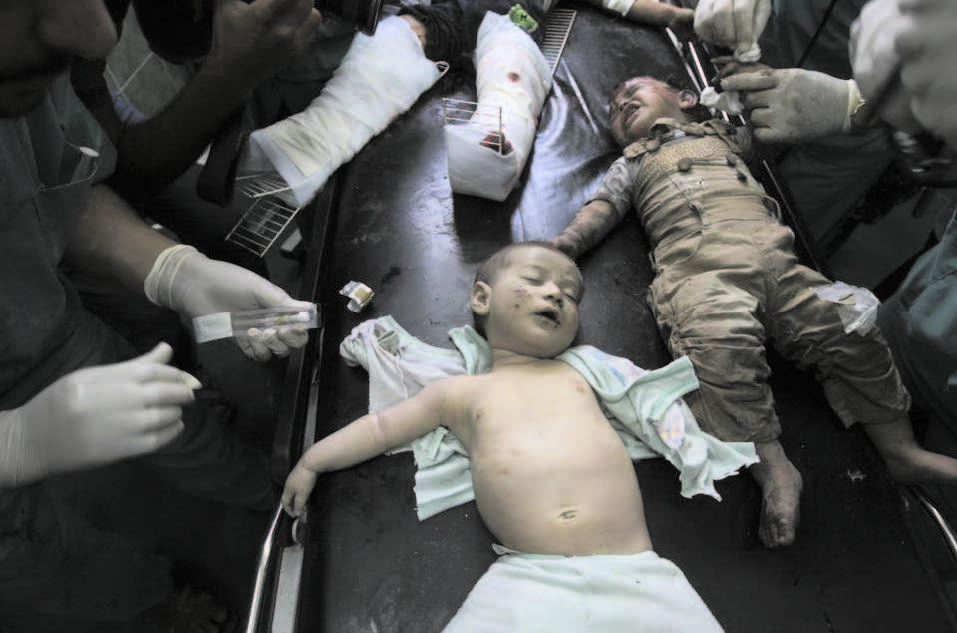
    But what the hell … Don’t we live in a world where Save the Children (American branch only, you understand) gave an award to the same former British prime minister quoted above? Having given a prize to the man who encouraged George W Bush to embark on an Iraqi invasion which cost the lives of tens of thousands of children, surely this fine charity (again, the American branch only) must reinvent and re-name itself “Abandon the Children”. And by the way, one of the ex-PM’s supporters blandly told Channel 4 not long ago that our British “peace envoy” had travelled to the Middle East more than 160 times.Which means, doesn’t it, that our Middle East envoy had left his station in the Middle East more than 160 times! But again, what is a child’s life worth? In 2002, a Israeli missile attack on a Gaza apartment block killed a Palestinian militants but also 14 civilians, including several children.

    The Bush administration, draw in your breath here, folks, and grit your teeth, said that this “heavy-handed action” did not “contribute to peace”. Wow, now that was telling them. Killing kids is a bit heavy-handed, isn’t it? And I can see what the Bush lads and lassies meant when they said that eviscerating, crushing and tearing to bits a bunch of children didn’t really, well, “contribute” towards peace. It’s important, you see, to realise who our enemies are. Muslims, Iranians, Iraqis, Syrians, Russians, you name it. Not Israel, of course. Nor Americans. Think generational. Think civilisation. Think the most significant threat to global peace. Daesh. Isn’t that the name?

    (The author is an English writer and journalist from Maidstone, Kent. He has been Middle East correspondent of The Independent for more than twenty years, primarily based in Beirut) British English. (Source: The Independent)

  • Russian magnate buys, then returns Nobel prize

    Russian magnate buys, then returns Nobel prize

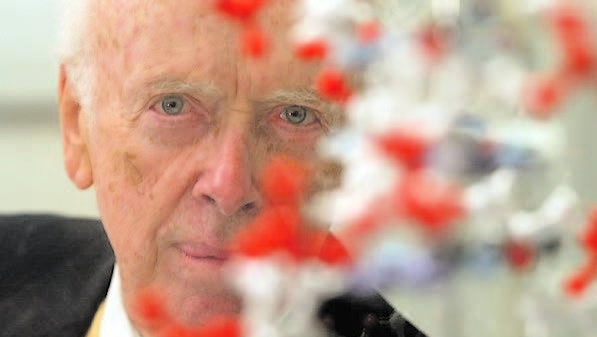
    MOSCOW (TIP): Russia’s richest man says he is returning a Nobel prize he bought at auction for $4.7 million just days ago to the man who put it on the block: controversial American geneticist James Watson. Mining, steel and telecom magnate Alisher Usmanov revealed on December 9 he was the anonymous buyer of the 1962 Nobel Prize for Psychology or Medicine that Christie’s auctioned at Watson’s request on December 4 in New York. But in the same statement, Usmanov’s USM holding company said the oligarch — whose net worth is estimated by Forbes at $17.6 billion — will be returning the award to Watson.

    Christie’s said it was the first Nobel award to be sold by a living laureate. “In my opinion, a situation in which an outstanding scientist sells a medal recognizing his achievements is unacceptable,” Usmanov said, voicing his satisfaction that “the medal will stay with the person who deserved it.” Usmanov said his largesse was justified by the contributions that the groundbreaking work on genetics by Watson and 1962 Nobel co-winners Francis Crick and Maurice Wilkins have continued to make to science.


    23
    Russian tycoon Alisher Usmanov, buyer of James Watson’s Nobel Prize, giving it back to him


    “James Watson is one of the greatest biologists in the history of mankind and his award for the discovery of DNA structure must belong to him.” Watson has been a controversial figure since a 2007 interview with London’s Sunday Times newspaper in which he suggested the intelligence of Africans was lower than that of other people. In resulting global uproar, Watson was shunned by many of his colleagues, and forced to resign from the Cold Spring Harbor laboratory in Long Island, New York.

    Usmanov’s respect for the researcher has clearly not been dimmed by the flap. “Dr Watson’s work contributed to cancer research, the illness from which my father died,” Usmanov, 61, said of one of the many areas to which the 1953 discovery of the double-helix structure of DNA has been applied.The New York Times reported Watson saying the sale sought to restore his tarnished reputation. USM said Watson planned to donate proceeds from the sale of his Nobel to research institutions he’d worked with at the University of Chicago, Indiana University, Cambridge, and the Cold Spring Harbor Laboratory.

    Usmanov described the outcome of his purchase as win-win all around. “It is important for me that the money that I spent on this medal will go to supporting scientific research, and the medal will stay with the person who deserved it. “I wouldn’t like the medal of the distinguished scientist to be an object on sale.”

  • Russia provides a leg up to Modi’s ‘Make in India’ campaign

    Russia provides a leg up to Modi’s ‘Make in India’ campaign

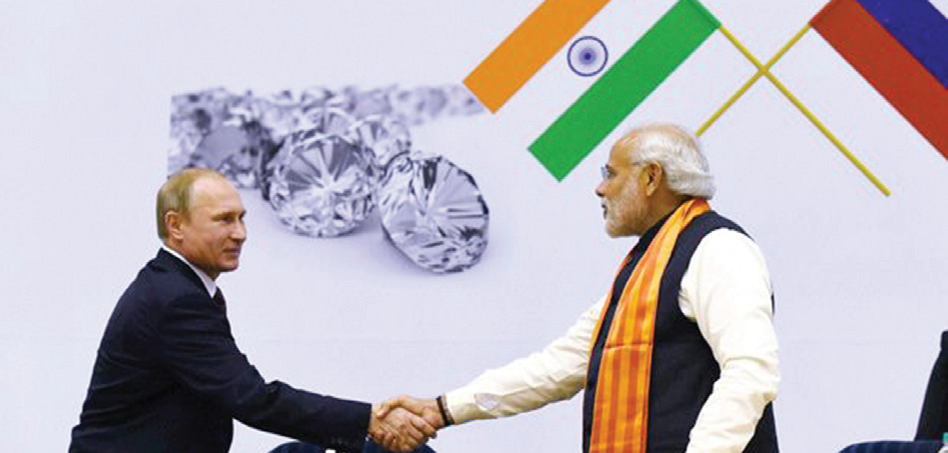
    NEW DELHI (TIP): In what may appear to be a reaffirmation of sound friendly ties with Russia, notwithstanding Russia’s recent military cooperation agreement with Pakistan, Prime Minister Narendra Modi on Thursday, December 11, underlined the primacy of Moscow in New Delhi’s strategic calculus when he said Russia was and would remain India’s most important defense partner.

    This, he said, was despite the fact that India now had more options, in what was seen as an oblique reference to its growing military and defense ties with the US. Modi’s remark came after his summit meet here with President Vladimir Putin, who offered India lucrative energy deals and sought to provide a leg-up to Modi’s “Make in India” campaign.

    Pacts on 20 nuclear reactors, oil and gas among 20 pacts inked

    After the talks, the two countries signed as many as 20 agreements – seven intergovernmental and 13 commercial – including a strategic vision for cooperation in peaceful uses of atomic energy. Another agreement was signed for partnership in oil and natural gas.. One of the agreements signed will facilitate training of Indian armed forces personnel in the military establishment of Russia’s defense ministry. Modi, who addressed the media in English, said apart from the 4 reactors at Kudankulam, the two countries outlined an “ambitious vision for nuclear energy of at least 10 more reactors” and would look at exporting it to third countries. Putin, in fact, said in his statement that Russia would help build 20 reactors in India. In a boost for Modi’s “Make in India” initiative, Putin also offered to build one of Russia’s most advanced helicopters in India. Putin said the joint initiative could consider exporting the helicopters to other countries.

    Modi thanked Putin for the offer, saying Indian authorities would follow up on it quickly. Modi described Putin as a leader of a great nation with which “we have a friendship of unmatched mutual confidence, trust and goodwill”. “We have a strategic partnership that is incomparable in content. The steadfast support of the people of Russia for India has been there even at difficult moments in our history. It has been a pillar of strength for India’s development, security and international relations,” said Modi.

    While it is not clear if the Indian side took up the issue of Russia’s agreement with Pakistan which could facilitate supply of arms to India’s neighbor, Modi suggested in his statement that he expected both sides to be sensitive to their concerns. “President Putin and I agreed that this is a challenging moment in the world. Our partnership and the strong sensitivity that we have always had for each other’s interests will be a source of strength to both countries,” he said.

    Putin also mentioned the joint fifthgeneration fighter jet project which has failed to make much headway in the recent past. “I would also like to note that projects to jointly develop multi-purpose fighter aircraft and multirole transport planes is another step in our joint work,” he said. Modi also proposed that Russia locate manufacturing facilities in India for spares and components for Russian defense equipment. A joint statement titled “Druzhba-Dosti” said the two countries will study the possibilities of building a hydrocarbon pipeline system, connecting the Russian Federation with India.

    Modi said cooperation between the two nations in the hydrocarbon sector had been disappointing until now and that they will pursue an ambitious agenda for partnership in oil and natural gas. Putin also said Russia is ready to cooperate in peaceful space exploration, specifically in the development of close-orbit satellites and use of the GLONASS satellite navigation system. The leaders condoled the loss of lives in “senseless terrorist acts” in recent days in Jammu & Kashmir and Chechnya (Russia).

  • Kalashnikov rebrands AK- 47s as ‘weapons of peace’

    Kalashnikov rebrands AK- 47s as ‘weapons of peace’

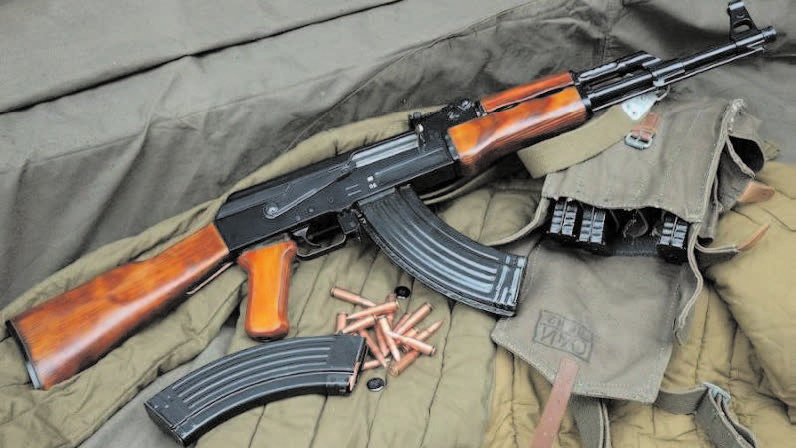
    MOSCOW (TIP): Kalashnikov assault rifles, popular with terrorists and national armies in Asia and Africa, have been given a makeover and a new logo by its Russian manufacturer that has dubbed them as “weapons of peace”. Equipped with a shiny new logo, the Russian weapons manufacturer Kalashnikov launched a major rebranding drive here on Tuesday. The Siberian weapons maker paid more than $380,000 for the re-branding campaign, the Russia Today reported.

    The new Kalashnikov logo is a “CK” written in black and red and melded into a single block. The abbreviation stands for Kalashnikov Concern, as the producer now calls itself. The colours were borrowed from the flag of Udmurtia in western Siberia, the region hosting Kalashnikov’s main facilities, the company said in a statement. The logo is accompanied by the company’s name written in Russian. The firearms producer also has a new slogan, or rather two different slogans. In English, it is “Protecting Peace” but in Russian it translates as “Weapons of Peace” or “Weapons of the World,” depending on which meaning of the Russian word “mir” is used.

    The company is also branching out into fashion, launching a line of branded survival gear. The firm, which relies heavily on the export market, is among the targets of Western sanctions imposed over Russia’s role in the Ukraine conflict. The Kalashnikov, or AK-47, is one of the world’s most recognisable weapons. The gun is relatively cheap as well as easy to manufacture and maintain, contributing to its popularity with terrorists and national armies in Asia and Africa.

    The company unveiled new logos across its these three product lines — Kalashnikov for the Russian and foreign militaries; Baikal for civilian hunters; and Izhmash for sportsmen — and promised to target new markets, including South America, Asia-Pacific and Africa.

  • Putin speech offers few reforms for economic woes

    Putin speech offers few reforms for economic woes

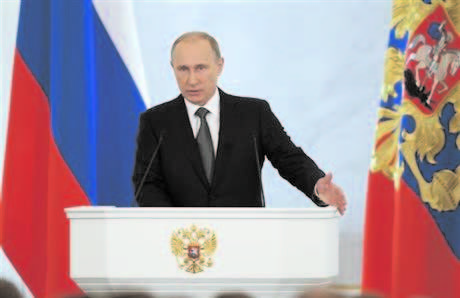
    MOSCOW (TIP): Russia will defend its geopolitical interests, President Vladimir Putin warned on December 4 as he promised economic reforms to pull his country back from the brink of recession. But Putin’s patriotic bluster and vague promises did little to assuage real fears that Western sanctions, plummeting oil prices and a collapsing ruble are crippling Russia’s economy. In his annual state-of-the-nation address at the Grand Kremlin Palace, Putin announced measures to spur the country’s flagging economy, which is set to enter recession in 2015 for the first time in six years.

    “The quality and size of the Russian economy must correspond to our geopolitical and historical role,” Putin said. “We must get out of this zero-growth trap and in the next three or four years raise our growth to aboveaverage global levels.” Putin proposed a three-year freeze on tax inspections for companies as well as a tax amnesty for money brought back to Russia from abroad. But in a disappointment to investors, he offered no broader plan for pulling Russia out of its economic downturn.

    “His freedom of maneuver is limited now and many important economic factors no longer depend on him: the ruble rate, the price of oil, inflation,” said Moscow-based analyst Maria Lipman. “No matter what Putin says, whether he sounds conciliatory and reassuring or bellicose and threatening, this would not affect those basic factors.” Putin spent much of his speech blaming his country’s economic woes on the West, which he accused of wanting to dismember Russia like Yugoslavia, which broke up amid wars in the 1990s. Putin said the United States and Europe would have imposed sanctions and found other pretexts for holding Russia back even if tensions had not erupted in Ukraine this year.

    “The politics of containment were not invented yesterday … The more we retreat and justify ourselves, the more brazen our opponents become and the more cynically and aggressively they behave,” Putin said, adding that “no one will succeed in defeating Russia militarily.” He blamed the volatility of the ruble, which has lost about 40 percent of its value against the dollar this year, on speculators, and praised the Russian central bank’s decision to allow the currency to float freely. The ruble fell further as he spoke.

    He skimmed over more concrete issues affecting Russian consumers, such as the rapid rise in prices and an expected decline in living standards, instead portraying the difficulties as a necessary part of Russia’s patriotic struggle. “This year, as in many fateful historical moments, our people clearly displayed national revival, firm resistance and patriotism,” Putin said. “And the difficulties we encountered will create new opportunities for us. We are ready to accept any challenge of our time and be victorious.”

  • Russia expresses interest in aircraft production in India

    Russia expresses interest in aircraft production in India

    NEW DELHI (TIP): Russia has expressed interest in production of civil and light transport aircraft in India with their technology, Parliament was informed on November 28. The Indian government has welcomed the Russian interest and is committed to enhancing bilateral investment and trade cooperation, commerce and industry minister Nirmala Sitharaman said in a written reply to the Lok Sabha.

    “The Russian side expressed their interest in production of civil aircraft, light transport aircraft and helicopter in India with Russian technology,” she said. The eighth session of the Indian- Russia Forum on trade and investment was held here on November 5. Replying to a separate question on coffee industry, she said that stem borer pest is amongst major constraints affecting cultivation of Arabica variety of coffee. “The combined effects of higher temperatures, reduction of shade for increasing the yield of pepper grown as intercrop and lack of timely control measures by the growers have led to increase in the incidence of the pest,” she said.

    About 3,200 hectares of productive area in Karnatka are reported to have been affected by stem borer due to long dry spell from November 2013 to May 2014 and resultant high temperatures. She added that several steps have been initiated to address the problem of pest in coffee cultivation. “The government has approved a two year action plan (2014-15 and 2015-16) for combating the stem borer in affected areas,” the minister said.

  • US increasing non-lethal military aid to Ukraine

    US increasing non-lethal military aid to Ukraine

    WASHINGTON (TIP): The United States plans to increase non-lethal military assistance to Ukraine, including deliveries of the first Humvee vehicles, having decided for now not to provide weapons, US officials said. The increase in non-lethal aid to Ukraine, which is grappling with a Russian-backed separatist movement in its east, is expected to be announced on Thursday during a visit to Kiev by vice president Joe Biden.

    The officials, who spoke to Reuters on condition of anonymity, described it as an expansion of US support for Ukraine’s armed forces, but one that was unlikely to significantly alter the conflict. The aid falls short of what Ukrainian President Petro Poroshenko requested during a visit to Washington in September when he appealed for lethal aid — a request echoed by some US lawmakers in response to what Nato allies say is Russia’s movement of tanks and troops into eastern Ukraine. Officials in the Obama administration had said Washington believed Ukraine had enough lethal aid and the types of weaponry requested for Ukraine would be of only marginal value.

    They had also emphasized the need for a diplomatic outcome. The United States and its European allies have imposed several rounds of economic sanctions on Russia for its seizure of Crimea and incursion into eastern Ukraine. The new non-lethal aid Biden will present in Kiev includes Humvees from excess supplies in the Pentagon’s inventory, as well as the delivery of previously promised radars that can detect the location of enemy mortars, officials said. They did not specify a dollar value for the assistance. Previous non-lethal aid to Ukraine includes $53 million announced in September for military equipment such as counter-mortar detection units, body armor, binoculars, small boats and other gear for Ukraine’s security forces and border guards in the east.

    Long debate

    President Barack Obama’s administration has long debated providing weapons to the Kiev government, but has so far concluded that it might only prompt Russia to escalate its aid to the separatist rebels. Lethal assistance “remains on the table. It’s something that we’re looking at,” Obama’s deputy national security adviser and nominee for deputy secretary of state, Tony Blinken, said at his Senate confirmation hearing on Wednesday.

    In response to Blinken’s comment, Russia warned the United States on Thursday against supplying arms to Ukrainian forces. Hours before Biden was due to arrive in Kiev, Russian Foreign Ministry spokesman Alexander Lukashevich cautioned against “a major change in policy of the (US) administration in regard to the conflict” in Ukraine. US Senator John McCain, an Arizona Republican, said he had not been briefed on the new non-lethal aid but called it “a continuation of the ridiculous.” “They are fighting against people with lethal weapons. They need lethal weapons to fight back. It is disgraceful and shameful that we won’t give them lethal weapons,” McCain told Mediapersons.

  • ‘Graduate’ director Nichols dies at 83

    ‘Graduate’ director Nichols dies at 83

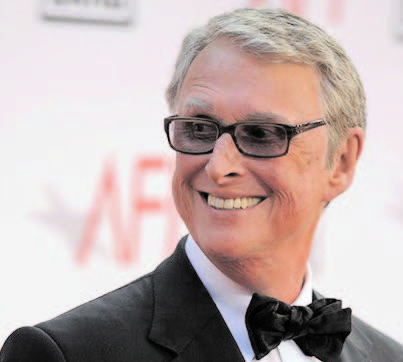
    WASHINGTON (TIP): Mike Nichols, a nine-time Tony Award winner on Broadway and the Oscar-winning director of influential films such as “Who’s Afraid of Virginia Woolf,” “The Graduate,” and “Carnal Knowledge,” died on November 19 at age 83. The prolific director passed away at his home of cardiac arrest, his spokeswoman said. A private service for the family will be held this week, followed by a memorial at a future date. No director had ever moved between Broadway and Hollywood as easily as Nichols, one of the few people to win the Oscar, Tony, Emmy and Grammy Awards.

    Nichols, whose career first blossomed with a comedy partnership with Elaine May in the late 1950s, was married to Diane Sawyer, former anchorwoman of ABC’s “World News Tonight” broadcast. ABC News President James Goldston announced Nichols’ death in a memo to staff, saying he “passed away suddenly on Wednesday evening.” “In a triumphant career that spanned over six decades, Mike created some of the most iconic works of American film, television and theater,” Goldston said. “He was a true visionary.” In memory of Nichols, marquees on Broadway theaters in New York will be dimmed on Friday evening for one minute.

    “An inspiration and joy to know, a director who cried when he laughed, a friend without whom, well, we can’t imagine our world, an indelible irreplaceable man,” actress Meryl Streep said in a statement. Playwright Tom Stoppard described Nichols as his hero. “Everyone who was close to Mike has suffered a loss which cannot be repaired, ever. To have been his friend was a blessing. To have worked with him was both a privilege and the best of times,” he added. Actor Tom Hanks said Nichols “changed the lives of those who knew him, who loved him, who will miss him so …” Nichols was born Michael Igor Peschkowsky in Berlin, where his parents had settled after leaving Russia.

    He came to the United States at age 7 when his family fled the Nazis in 1939. He grew up in New York feeling like an outsider because of his limited English and odd appearance – a reaction to a whooping-cough vaccine had caused permanent hair loss. As a University of Chicago student, he fought depression, but found like-minded friends such as May. In the late 1950s, Nichols and May formed a stand-up team at the forefront of a comedy movement that included Lenny Bruce, Jonathan Winters and Woody Allen in satirizing contemporary American life. They won a Grammy in 1961 for best comedy album before splitting.

    In the mid-1960s, Nichols became a directing powerhouse on Broadway with “Barefoot in the Park,” the first of what would be a successful relationship with playwright Neil Simon. Later he would stage Simon’s “The Odd Couple,” “Plaza Suite” and “The Prisoner of Second Avenue.” In all, he won best-director Tonys for his four collaborations with Simon, as well as for “Luv” in 1965, “The Real Thing” in 1984, “Spamalot” in 2005 and a revival of “Death of a Salesman” in 2012, and best musical award as a producer of “Annie” in 1977.

  • IRAN STILL STALLING AS NUCLEAR DEADLINE LOOMS: UN AGENCY

    IRAN STILL STALLING AS NUCLEAR DEADLINE LOOMS: UN AGENCY

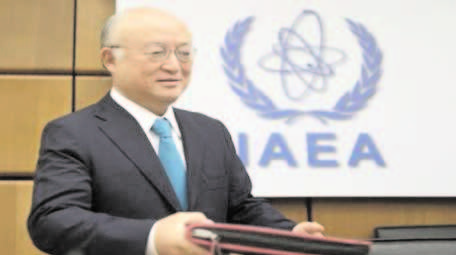
    VIENNA (TIP): Tehran has yet to explain away allegations it conducted atomic bomb research, the head of the UN nuclear agency said on Thursday, four days before a deadline for Iran and six world powers to reach a deal on the Iranian nuclear programme. As US secretary of state John Kerry flies to Vienna for what are meant to be final talks to clinch a deal with Iran, International Atomic Energy Agency (IAEA) chief Yukiya Amano said he was still unable to provide “credible assurance” Iran had no undeclared nuclear material and activities.

    The talks — which have dragged on for more a year — are aimed at setting limits on Iran’s nuclear programme in return for an end to sanctions that have seriously hurt its economy. As one of the conditions, Western officials say Iran must stop stonewalling the IAEA investigation into concerns Iran may have worked on designing a nuclear-armed missile, although some experts feel this should not be a dealbreaker. “Iran has not provided any explanations that enable the agency to clarify the outstanding practical measures,” Amano told the UN agency’s 35-nation board of governors, also meeting in the Austrian capital.

    He was referring to information Iran was supposed to have given the IAEA by late August concerning allegations of explosives tests and other activity that could indicate preparations for developing nuclear bombs. Those allegations were set out in an IAEA report in 2011 based on intelligence from some 10 IAEA member states as well as the agency’s own investigation. It did not identify the countries but they are widely believed to include the United States, Israel and some of Washington’s Western allies.

    Iran denies any intention of seeking atomic weapons, saying its nuclear programme is aimed at generating electricity. “I call upon Iran to increase its cooperation with the agency and to provide timely access to all relevant information, documentation, sites, material and personnel,” Amano said. ‘Tactics of delay’ Iran’s IAEA envoy, Reza Najafi, said the allegations were based on “wrong and fabricated” information. To prove this, he told the IAEA board, Iran would be ready to give the UN agency “one managed access” to a western region, where, according to the allegations, explosives experiments took place.

    The IAEA’s priority for its inquiry has been to visit another site, the Parchin military facility, refused by Iran. While the countries in talks with Iran — the United States, France, Germany, Britain, Russia and China — want Tehran to scale back its uranium enrichment programme to lengthen the timeline for any covert bid to assemble nuclear arms, the IAEA is investigating possible research on designing an actual bomb. Even though it has long been clear that the inquiry would not be completed before the target date for a deal with the powers, Western diplomats had hoped for more progress by now.

    Israel and hawkish US lawmakers are likely to condemn any accord that they feel does not fully resolve the issue. Israel’s envoy, Merav Zafary-Odiz, said the IAEA investigation was “simply stuck because Iran has never abandoned its longstanding tactics of delay, concealment and reluctance to cooperate” with the UN agency. Iran says it is Israel’s assumed atomic arsenal that threatens peace and stability in the Middle East.

  • Russia to sell Mi-35 helicopters to Pakistan

    Russia to sell Mi-35 helicopters to Pakistan

    ISLAMABAD (TIP): Russia will sell Mi-35 helicopters to Pakistan to strengthen its counter-terrorism efforts, media reported November 14. Russia’s Ambassador Alexey Dedov said the deal between Pakistan and Russia would help combat terrorism, The Nation reported. He said politically the deal has been approved, however, further negotiations on details of political-commercial contract are in progress.

    Dedov also said that Russian Defence Minister Sergey Shoygu would soon visit Islamabad and his agenda of talks with his counterparts includes the sale of defence equipments to Pakistan. He said that Russia was also interested in various energy-related projects, including the development of Gwadar Liquefying Facility and construction of a pipeline between Gwadar and Nawabshah. The Russian ambassador said that the Pakistan-Russia Intergovernmental Commission’s meeting would take place in Moscow Nov 26, which would give new impetus to the bilateral economic cooperation. He said bilateral trade volume of the two countries did not coincide with the actual potential and plenty of room existed which needed to be tapped.

  • Bangladesh turns to Russia for submarines

    Bangladesh turns to Russia for submarines

    KOLKATA (TIP): When it became known to India that Bangladesh is on the hunt for two submarines for its navy, there was some consternation. More so when it came to be known that Bangladesh is negotiating with China for the Ming-class submarines. Something that India can do without at the moment is a spurt in military ties between China and Bangladesh. The level of anxiety has come down somewhat in recent times after information was received that Bangladesh is planning to procure the submarines from Russia.

    “From reliable sources, we have come to know that Bangladesh is making efforts to move away from the Chinacentric approach where it comes to defence procurement. Nearly half of Bangladesh’s military hardware is sourced from either China or Pakistan. This provided an excuse for Chinese and Pakistani military presence along India’s east coast. Russia is different. India enjoys good relations with Russia and also uses military hardware built there. Better ties between Russia and Bangladesh are encouraging. We don’t believe that Russia will not do anything to harm India’s interests,” a highly placed source in Delhi said. For years now, India has been attempting to keep the ‘dragon’s presence’ away from Bangladesh and other neighbouring countries.

    In certain cases, India has even offered products and services at rates that would be convenient for these countries. By the end of this year, India hopes to deliver the ‘Barracuda’, a Naval Offshore Patrol Vessel for the Mauritian Navy. The ‘Barracuda’, being fitted-out at Kolkata’s Garden Reach Shipbuilders and Engineers (GRSE) will be India’s first such export. “This is more of a diplomatic move rather than a financial deal. One can also call this a confidence building measure. Once Mauritius is satisfied with the NOPV, India may get more orders from this region. This is good diplomacy,” the source added.

    According to sources in Dhaka, Bangladesh proposes to purchase two diesel-electric submarines from Russia. Plans are also afoot to procure aircraft for the navy. Bangladesh already uses Russian hardware in the form of Mig-29 fighters and military helicopters. In 2013, Russia allegedly offered a $1.5 billion loan to Bangladesh that would be used to purchase military hardware. The Bangladesh government wants the submarines to join its navy by 2019. Bangaldesh air force’s fleet of eight MiG-29s is due for upgradation. So is its fleet of Russian made Mi-17 helicopters. HAL has maintenance facilities in India for both aircraft as they are used by the IAF as well. India has offered to upgrade and maintain the Mig-29s and helicopters at HAL facilities to bolster ties with Bangladesh.

  • EYE ON CHINA, INDIA AND US SET TO RAMP UP JOINT NAVAL DRILLS

    EYE ON CHINA, INDIA AND US SET TO RAMP UP JOINT NAVAL DRILLS

    NEW DELHI: India and the US are set to deepen and broaden their bilateral military exercises to include more warfare components involving nuclear submarines and aircraft carriers. They would also invite more countries to join the Malabar exercises as the two nations share concerns about the growing Chinese naval presence in the Indian Ocean. Both the Indian and US navies have been warily watching the growing Chinese naval presence in the Indian Ocean, especially its submarine manoeuvres.

    In the recent weeks, India conveyed its displeasure to the Sri Lankan government at least twice over its decision to permit Chinese submarines to dock in its ports. According to dependable sources, India and US officials have had detailed discussions, including at the Defence Policy Group meeting in Washington DC, on stepping up the bilateral naval exercises. The decision involves a series of steps, starting with increasing the nuclear submarine and aircraft carrier warfare components. The two sides are also looking at adding both army and air force components to the traditionally naval exercise. Sources said the two sides are looking at inviting more countries, thus expanding them mostly into trilateral exercises.

    In July 2014, India and the US invited Japan to the exercises held in north-western Pacific. Malabar has featured Australia and Singapore, besides Japan, in 2007. Through most of the UPA tenure, especially under defence minister AK Antony, Malabar exercises off Indian coast have mostly been bilateral affairs, in an effort not to raises Chinese hackles. However, under the new regime in New Delhi there is a noticeable shift in the strategic posturing, especially vis-a-vis China. In Washington DC in October, the joint statement issued by Narendra Modi and Barack Obama had referred to the situation in South China Sea. It was the first time that the two sides had so explicitly referred to the issue in an Indo-US joint statement.

    The move to deepen and broaden the Malabar exercises flow from Modi’s declared strategic vision, especially reflected in the joint statement. The move comes even as the government is warily looking at the growing Chinese submarine activities in the region. It has for sometimes been uncomfortable about Chinese sending its submarines as part of their anti-piracy patrols.When INS Vikramaditya was sailing from Russia starting November 2013, a Chinese submarine was in Indian Ocean observing the carrier.

  • EU, Russia, Ukraine sign gas supply deal

    EU, Russia, Ukraine sign gas supply deal

    BRUSSELS (TIP): Ukraine, Russia and the European Union signed a deal on October 30 on the resumption of Russian natural gas supplies to Ukraine for winter after several months of delay during the conflict in Ukraine. European Commission president Jose Manuel Barroso, who witnessed the three-way signing ceremony in Brussels as he prepares to leave office on Friday, said: “There is now no reason for people in Europe to stay cold this winter.” Talks had been broken off in the early hours as Moscow sought more guarantees from the EU that it would help Ukraine pay for its natural gas.

    They resumed on Thursday evening. EU officials said both Russia and Ukraine had bargained hard for commitments from the Western bloc, with Moscow looking for EU cash to help Ukraine pay off debts to Gazprom and the Kiev authorities anxious to get a deal that they could present to domestic voters as not overpaying for vital Russian supplies. Ukrainian Prime Minister Arseny Yatseniuk said in Kiev that the EU had agreed to serve as guarantor for Kiev in holding Russia to an agreement, notably on the price Ukraine would pay. Yatseniuk, in figures later confirmed by Moscow, said Ukraine would pay $378 per 1,000 cubic metres to the end of 2014 and $365 in the first quarter of 2015.

    He said Kiev was ready to pay off debts for gas immediately after any deal was signed. A total of $1.45 billion would be paid immediately and a further $1.65 billion paid by the end of the year, he said. Russian energy minister Alexander Novak insisted that Ukraine would still have to pay up front for new deliveries to see its 45 million people through winter. Moscow expects some $1.6 billion for gas to be supplied. Some critics of Russia question whether its motivation is financial or whether prolonging the wrangling with ex-Soviet Ukraine and its Western allies suits Moscow’s diplomatic agenda. Ukraine is in discussions with existing creditors the EU and the IMF.

    The gas cut-off has had little impact for months. But pressure is mounting for a deal as temperatures start to drop below freezing. European energy commissioner Guenther Oettinger, who has been mediating, also leaves office on Friday, making way for a new European commission. “We can say to the citizens of Europe that we can guarantee security of supply over the winter,” he said of what he called the $4.6-billion deal to supply Russian natural gas to Ukraine. EU member states west of Ukraine would also, he said, have stable supplies, passing through Ukrainian pipelines, while Russia would gain the benefit of payment for its energy.

    The two sides came close to an agreement in September, but last week differences were wide. Weekend elections returned a pro- Western parliament in Kiev, potentially stoking tensions with Moscow, although Russia’s EU envoy, Vladimir Chizhov, said on Thursday the mood could be more relaxed now the vote had taken place. Ukraine’s Naftogaz company has set aside $3.1 billion in a special escrow account to pay the debt. Kiev says it is working to raise more money from all possible sources of financing, including the EU. The commission is considering Ukraine’s request, made last week, for a further loan of 2 billion euros.

    Russia provides around a third of the European Union’s natural gas, roughly half of which is pumped via Ukraine. Ukraine in turn relies on Russia for around 50 percent of its own natural gas and despite storage has a winter shortfall of around 3 billion to 4 billion cubic metres, depending on the weather. For Russia, the natural gas sector contributes approximately a fifth of the national budget.

  • THE BIRTH AND GROWTH OF AN IDEA

    THE BIRTH AND GROWTH OF AN IDEA

    Every big idea has a small beginning. Gift of Life has been no exception.

    In 1974, Rotary District 7250 brought a little 5-year old named Grace Agwaru on an intercontinental voyage from Uganda to New York. Grace suffered from a hole between the two lower chambers of her young but strong heart. On November 15, 1974 surgeons at Saint Francis Hospital in Roslyn, New York successfully operated on little Grace. A big idea was born that day. The Gift of Life now includes Rotarians from all over the world, with independent chapters in countries as far away as Korea and India.

    Today, the Gift of Life is a worldwide Rotary International Service Program responsible for approximately 5000 heart surgeries for children from over 30 countries. The Gift of Life has gone global. Every good idea grows exponentially. In 2001, PDG of District 7250 Eileen Gentlecore had a simple conversation with a friend of hers and related the altruistic vision of the Gift of Life. Her friend, Past District Governor Ravishankar Bhooplapur, with the assistance of Past RI Director Sushil Gupta – Trustee of Rotary Foundation , Dr. Rajan Deshpande and many other devoted Rotarians, AC Peter, PDG Rajendra Rai, Rtn OP Khanna, DGE Kamlesh Raheja, took up the challenge to provide critical heart surgeries for the children of India.

    PDG Ravishankar Bhooplapur still serves as Honorary Chairman of Gift of Life, India today. Is it not amazing what can come of a conversation? The sole purpose of the Gift of Life, India is to secure life saving heart surgery for children in desperate need regardless of race, creed, color or country of origin. The Gift of Life, India is a not-for-profit, tax-exempt corporation with no administrative costs. All of our team members work voluntarily; all of the monies are generously donated by caring donors and through the numerous matching grants disbursed by the Rotary Foundation.

    Gift of Life program in New York has the unique distinction of bringing children from all over the world to the New York Metro Area and providing free heart Surgeries to them. These children are housed in Ronald McDonald house which is specifically given to us for this purpose. Rotarians have significantly contributed to build the Ronald McDonald house and continue to give financial support on the local level in exchange our children are accommodated pre & post-operative their surgeries. The Gift of Life still grows. We reach more children in more countries than ever before. We would like to reach more. There is no limit to this idea as long as we remain committed to saving children’s lives.

    Mission:

    To further the cause of world peace and understanding by facilitating free medical services to children suffering from heart disease regardless of race, creed, sex or national origin and who otherwise lack access to such services.

    “A Crusade of the Heart”

    The Gift of Life is a crusade of the heart, touching children in peril. An idea born in 1975 to a group of Rotarians from Manhasset, Long Island, NY, is today a global effort. We reach out to many children, who would otherwise die, and heal their failing hearts with the miracle of cardiac surgery. Our outreach spans the world, nurtured by compassion for young victims we alone can cure. Each child whose future we restore is a tribute to humanity and love, helping build bridges of friendship and peace among people everywhere.

    History

    The lives of more than 10,000 children from countries throughout the world have been saved through the miracle of open-heart surgery, in medical centers throughout the U.S. and in participating Gift of Life hospitals in Russia, Israel, Malaysia, China, Ukraine, India, Dominican Republic and the Philippines. Dedicated surgeons and nurses donate their skill to the cause. American families assist Rotarians as hosts and interpreters, bringing warmth and comfort to children and their escorts.

    Board of Directors and Officers

    Gift of Life is a dynamic program of Rotarians of Brooklyn, Queens and Nassau in partnership with the Rotary members and physicians worldwide who evaluate children for treatment in our country. Foreign doctors may also receive technical training on these shores and return to help children in their own lands. We have since opened pathways to Korea, Poland, the Russian Republics, China, Caribbean Nations and to places as distant as Mongolia, medically screening many thousands of children for lifesaving surgery.

    The spirit of the Gift of Life ignores borders. Medically advanced countries are being encouraged to do as we do – to open their own hospital doors to imperiled youngsters from developing nations. With the Gift of Life as an international model, cardiac medicine will extend its power to save many who were unreachable before. The Gift of Life has also become more of a public presence through our fund raising program Save-A-Child. In addition we hold four annual fundraisers: the Crusade of the Heart Kick-Off Dinner and black tie Gala, the Agnes T. Funk Kids for Kids Memorial 5K Walk, and our new skydiving event Jump for Life.

    Partnering Hospitals

    The following hospitals support the Gift of Life program:

    ● Loma Linda University Medical Center, Loma Linda, California

    ● Maria Fareri Children’s Hospital at Westchester Medical Center Valhalla, New York

    ● St. Francis Hospital, The Heart Center Roslyn, New York

    ● The Children’s Hospital at Montefiiore Medical Center Bronx, New York

    ● The Hospital for Sick Children Toronto, Canada

    ● The Steven and Alexandra Cohen Children’s Medical Center of New York New Hyde Park, New York

  • New Afghan president’s first foreign visit is to China

    New Afghan president’s first foreign visit is to China

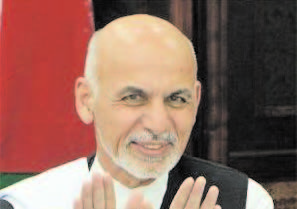
    BEIJING (TIP): Afghanistan’s newly-elected President Ashraf Ghani has chosen China as his first destination abroad after taking over office, signifying Beijing’s influence in the war-torn country where the US troops are battling to control Taliban resurgence. “The visit by President Ghani to China is the first official visit since he took office. “It is also the first high-level visit between the two countries since the establishment of the new government of Afghanistan. The Chinese side attaches great importance to that,” Chinese foreign ministry spokesperson Hua Chuying said on October 19.


    Former world bank economist Ghani, who succeeded Hamid Karzai, will come to Beijing on a four-day visit starting October 28. Observers said that it is significant that Ghani chose the communist giant to be his first choice even as the US has significant military presence in the warravaged country, which shared a border with China’s restive Xinjiang province where the Islamic militants , stated to be trained in Afghanistan and Pakistan’s tribal areas, have been staging violent attacks for the past a few years. Ghani, 65, became president after clinching a power sharing deal with his poll rival Abdullah Abdullah who took over as Afghanistan’s chief executive. China, which is holding talks with neighboring countries India, Pakistan and Russia over the future course of action in the event of US troops leaving Afghanistan, is looking to expand its diplomatic engagement with Kabul by appointing a special envoy for Afghanistan.

  • A commendable effort

    A commendable effort

    India’s Polar Satellite Launch Vehicle (PSLV), with the consummate ease that has become the rocket’s hallmark, placed the third Indian Regional Navigation Satellite System (IRNSS) spacecraft into orbit in the early hours of Thursday. Over the years, the Indian Space Research Organisation (ISRO) has steadily enhanced the capabilities of this rocket, which was originally developed to put remote sensing satellites into orbits so that it could carry heavier satellites than before, inject them into orbit with greater accuracy and take on a range of missions including launching the lunar probe, Chandrayaan-1, as well as the Mars Orbiter Mission.

    Its record of 27 consecutive successful flights is a tribute to the meticulous preparations and attention to every tiny detail that goes on behind the scenes before each launch. Indeed, the latest launch was postponed by almost a week in order to attend to a technical glitch that had cropped up. The IRNSS constellation will give India guaranteed access to what has become a critical service in the present day – navigation satellite signals.

    America’s Global Positioning System (GPS), with worldwide coverage, is the leader in the field. Russia, for its part, established a similar capability with the Global Navigation Satellite System (GLONASS). But others worry about becoming wholly dependent on them for a service that is vital for military operations as well as in many civilian sectors. Europe is therefore in the process of putting its own constellation of Galileo navigation satellites in place.

    China is likewise creating the BeiDou Navigation Satellite System; a regional service has already been launched and it intends to achieve global coverage by around 2020. Using its seven satellites, the IRNSS system will beam accurate navigation signals over India and up to 1,500 km from its borders. Three of those satellites have already been launched and ISRO plans to have the remaining satellites in place by the middle of next year. By adding four more satellites, India has the option to extend the area covered by its navigation system.

    Meanwhile, ISRO’s Space Applications Centre in Ahmedabad has undertaken the development of receivers that can utilize the IRNSS signals and is also helping industry do the same. Early trials using these receivers are going to get under way. Efforts are also going into chipsets for portable devices that will utilize those signals. A market assessment carried out by a well-known consultancy company indicates that there is potentially a huge market available in the subcontinent. Turning this potential into reality is going to be a challenge, and ISRO will necessarily have to play a leadership role here

  • INDIGENOUSLY DEVELOPED CRUISE MISSILE ‘NIRBHAY’ TEST-FIRED

    INDIGENOUSLY DEVELOPED CRUISE MISSILE ‘NIRBHAY’ TEST-FIRED

    BALASORE (TIP): India’s indigenously developed nuclear capable sub-sonic cruise missile ‘Nirbhay’, which can strike targets more than 700km away, was on October 17 test-fired from a test range at Chandipur in Odisha. “The missile was test-fired from a mobile launcher positioned at launch pad 3 of the Integrated Test Range at about 10.03am,” said an official soon after the flight took off from the launch ground. “Flight details will be available after data retrieved from radars and telemetry points, monitoring the trajectories, are analysed,” the official said.

    It is the second test of the sub-sonic long range cruise missile ‘Nirbhay’ from the ITR. The maiden flight, conducted on March 12, 2013 could not achieve all the desired parameters as “the flight had to be terminated mid-way when deviations were observed from its intended course”, sources said. India has in its arsenal the 290km range supersonic “BrahMos” cruise missile which is jointly developed by India and Russia. But ‘Nirbhay’ with long range capability is a different kind of missile being developed by the Defence Research and Development Organisation (DRDO). Nirbhay has good loitering capability, good control and guidance, high degree of accuracy in terms of impact and very good stealth features.

  • Venezuela, New Zealand win UN security council seats but Turkey rebuffed

    Venezuela, New Zealand win UN security council seats but Turkey rebuffed

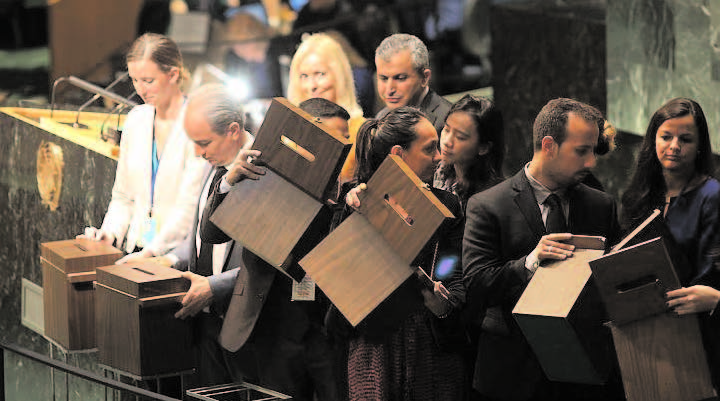
    UNITED NATIONS (TIP): Angola, Malaysia, New Zealand, Spain and Venezuela won coveted seats at the UN security council on October 16, but Turkey suffered a humbling defeat in its bid to join the world’s “top table.” The five countries garnered the required two-thirds support from the 193 countries of the UN General Assembly during three rounds of voting that ended with Turkey picking up only 60 votes.

    Turkey had been competing against New Zealand and Spain for two seats and had dispatched Foreign Minister Mevlut Cavusoglu on a high-profile mission to New York this week to lobby for votes. Angola, Malaysia and Venezuela were virtually assured to win election as their candidacies had been put forward by their region and they ran unopposed on their slates. After New Zealand’s resounding victory in the first ballot, Foreign Minister Murray McCully called the outcome a “strong vote of confidence” in his country, capping a 10-year campaign for the ultimate diplomatic prize.

    “To receive the success that we have had this morning means a lot to us and we will work very hard to make sure we give good service on the council,” McCully told reporters at UN headquarters. Venezuela won 181 votes despite criticism from rights groups and the United States over its support for Iran, Syria and other hardline regimes that are at loggerheads with the West. Venezuela’s President Nicolas Maduro called the vote “a victory, a world record of support, love and confidence. One hundred eight-one countries have said here we are, we support you.””We should feel happiness and joy in our hearts that Venezuela is beloved country in the world,” he added, speaking in Caracas. “To those birds of ill omen who say Venezuela is isolated in the world — who is isolated? The country that received 181 votes?” US Ambassador Samantha Power urged Venezuela to work cooperatively on the council.

    “Unfortunately, Venezuela’s conduct at the UN has run counter to the spirit of the UN Charter and its violations of human rights at home are at odds with the Charter’s letter,” she said. Rights groups have pointed to Venezuela’s record on the UN Human Rights Council as a cause for worry and diplomats have also expressed concern about its stance on the war in Syria. Over the three rounds of voting, Turkey saw its support dwindle from 109 votes to 73 and finally 60, surprising many who saw the regional player as a strong contender.

    Angola won 190 votes, Malaysia picked up 187, New Zealand 145 and Spain 132. The elections came at a busy time for the council, which is grappling with crises on many fronts, from the jihadist offensive in Iraq and Syria, to the Ebola outbreak in West Africa. Russia’s actions in eastern Ukraine, conflicts in Syria, South Sudan and Central African Republic and the faltering Israeli-Palestinian peace process are also at the top of the council’s agenda. A seat at the Security Council raises a country’s profile several notches, boosts influence and provides knockoff benefits in bilateral ties.

    The five elected countries to the 15- member council will join the five permanent powers — Britain, China, France, Russia and the United States — for a two-year term. Five other countries elected last year are mid-way into their term. These are Chad, Chile, Jordan, Lithuania and Nigeria. As the most powerful body of the United Nations, the security council can impose sanctions on countries and individuals, refer suspects for war crimes prosecution, endorse peace accords and authorize the use of force. It also oversees 16 peacekeeping missions in the world, with a budget of close to $8 billion. The five elected countries will replace Argentina, Australia, Luxembourg, Rwanda and South Korea, and begin their stint on January 1.

  • 4 Indian shuttlers, including Saina, advance in Denmark Open

    4 Indian shuttlers, including Saina, advance in Denmark Open

    ODENSE (TIP): On a fruitful day for the Indian shuttlers, Saina Nehwal and P V Sindhu stormed into the women’s singles quarterfinals while two men’s players also secured places in the last-eight stage of the Denmark Open Super Series Badminton event, here on October 16. London Olympics bronze medallist Saina made short work of Minatsu Mitani 21-12 21-10 in her second round contest, which lasted just 38 minutes.

    Before Saina’s win, two-time World Championships bronze medallist Sindhu took just 31 minutes to get the better of Ksenia Polikarpova of Russia 21-17 21-19 at the Odense Sports Park. Since the top two women shuttlers from India are in either half of the draw, they could clash for the title if they win two more matches.

    In the men’s singles, Srikanth defeated Chinese Taipei’s Jen Hao Hsu 21-12 21-15 in 45 minutes while Kashyap fought hard before prevailing over Dionysius Hayom Rumbaka of Indonesia 21-17 17-21 22-20 in a contest that lasted 69 minutes. World No. 10 Sindhu opened up a 4-0 lead in the first game and continued to widen the gap, eventually winning it 20-17. In the second game, Sindhu quickly broke away from a 2-2 tie to take a slight edge and then she kept on extending it to make it 19-15 at one stage. But a brief fight back from the Russian saw her closing the gap to 19-20 before Sindhu used all her experience to wrap it up in her favour.

    In men’s singles second round matches, Srikanth had a rather comfortable outing today, but Glasgow Commonwealth Games gold medallist Kashyap faced a stiff challenge from his Indonesian rival. After a neck and neck battle till 13-13 in the opening game, Kashyap bagged four consecutive points to make it 17-13 and then there was no looking back for the Indian. But the Indonesian shuttler came back strongly in the second game as he opened up a huge 7-1 lead.

    Although Kashyap managed to reel off six points on a trot to catch his opponent, the Indonesian showed a lot of determination to keep the Indian at bay and take the match to the decider. Third game was a closely-fought affair with both players refusing to spare an inch. The game swung from one end to other before the Indian held his nerves to earn two points from 20-20 to advance to the next stage.

  • After-effects of the US drawdown on India

    After-effects of the US drawdown on India

    New Delhi cannot remain sanguine. A priority of the Obama Administration will be to smoothly take out its military equipment from Afghanistan, through Pakistan. The Taliban will then be viewed more benignly

    By G Parthasarathy

    Even as Prime Minister Narendra Modi was cautioning Americans in New York against any precipitate withdrawal, Afghanistan was preparing for a momentous change in Kabul. Mr Ashraf Ghani Ahmadzai was taking over as Afghanistan’s President from Mr Hamid Karzai, who had ruled Afghanistan for 12 turbulent years. Despite efforts to malign him and destabilise his Government by worthy Americans like Peter Galbraith and Richard Holbrooke and a vicious propaganda barrage from Pakistan, President Karzai succeeded in establishing a measure of effective governance in Afghanistan. He also skilfully brought together the country’s fractious ethnic groups, to deal with the challenge posed by the Pakistani-backed Afghan Taliban and the Haqqani network, together with their Islamist allies, including the Al Qaeda. The change of guard from Mr Karzai to Mr Ghani has been anything but smooth. The first round of elections in April produced no clear winner. The second round in June, which was expected to be close, produced a stunning result. It gave an unexpectedly large victory margin to Mr Ghani, over his rival, Mr Abdullah Abdullah, a former Foreign Minister and close aide of the legendary Ahmed Shah Masood. Mr Abdullah had a substantial lead in the first round of elections, securing 46 per cent of the votes, against 32 per cent for Mr Ghani. A Report by the European Union declared the second round of voting as “massively rigged”. A US report held that it was mathematically impossible for Mr Ghani to have secured the margin of victory that he did. With controversy over the electoral result spiralling out of control and assuming volatile ethnic dimensions, the Americans stepped in to broker and virtually impose an uneasy and tenuous compromise between Mr Ghani and Mr Abdullah.

    Following the agreement between the rival candidates, Mr Ashraf Ghani was sworn in as President and Mr Abdullah as ‘Chief Executive’, a post which has no constitutional sanctity. The roadmap for this transition includes the convening of a Loya Jirga to convert the post of ‘Chief Executive’ into that of an ‘Executive Prime Minister’. It remains to be seen whether the contemplated changes, with two separate centres of executive authority, can provide stable and effective governance, in a country beset with the ethnic rivalries and tensions, which have long characterised its politics. Within 24 hours of the assumption of power by President Ashraf Ghani and Chief Executive Abdullah, Afghanistan and the US inked a security agreement, which will result in the US stationing 9,800 troops in a training and counter-insurgency role in Afghanistan, beyond 2014. A ‘status of forces agreement’, giving immunity to foreign forces against prosecution in Afghan courts, was also inked. The agreements will also allow the Americans to retain air bases across Afghanistan. Pakistan has welcomed these developments. Apart from formal statements by National Security Advisor Sartaj Aziz and the Foreign Office, a meeting of the top brass of the Pakistan Army also welcomed this development as a “good move for peace in Afghanistan”. This is an astonishing turnaround for the Pakistani establishment, which has all along made its unease with the American presence in Afghanistan known. It comes at a time when an estimated 80,000 Pakistani troops and paramilitary, backed by air power, are pounding positions of the Tehreek-e-Taliban in North Waziristan – an operation resulting in an estimated one million tribal Pashtuns fleeing their homes. At the same time, the Mullah Omar-led Afghan Taliban have been on the rampage this year across Afghanistan, prompting the soft-spoken President Ghani to say, “We ask the opponents of the Government, especially the Taliban and the Hizb-e-Islami, to enter political talks”. Pakistan’s massive military offensive in the tribal areas bordering Afghanistan has been selectively undertaken. Long-term ISI assets including the Haqqani Network, the Mullah Omar-led Afghan Taliban and even the Al Zawahiri-led Al Qaeda have been spared and obviously accommodated in ISI safe houses. They will be kept in readiness to move into Afghanistan at a time of Pakistan’s choosing. Afghanistan is going to remain dependent on Nato for military and economic funding, for the foreseeable future. Nato funding of Afghanistan’s military of $5.1 billion annually till 2017 has been agreed upon. A similar amount of external funding would be required for Afghanistan’s administrative and developmental needs. The Joint Declaration issued after the Obama-Modi Summit spoke of “dismantling of safe havens for terrorist and criminal networks, to disrupt all financial and tactical support for terrorist and criminal networks such as Al Qaeda, Lashkar-e-Tayyeba, Jaish-e- Mohammed, the D-Company, and the Haqqanis”. Significantly, there is no mention in the Joint Declaration of the Mullah Omarled Taliban, which has been primarily responsible for the killing of 2,229 American soldiers in Afghanistan, the training of terrorists for jihad in Jammu & Kashmir and for colluding with the hijackers of IC 814. It has been obvious for some time that the Americans are keen to do a deal with the Taliban. They may pay lip service to statements that any internal reconciliation process has to be ‘Afghan-led’. But, the reality is different, ever since the US encouraged Qatar to host a Taliban office in Doha. An enraged Mr Karzai had torpedoed that American effort (with obvious Pakistani support), to grant international legitimacy to the Taliban. President Ghani will, however, have to reluctantly accept Pakistan-brokered American-Taliban ‘contacts’, as a prelude to giving Taliban control in parts of southern Afghanistan. India cannot be sanguine about these developments. A priority of the Obama Administration will be to smoothly take out its military equipment from Afghanistan, through Pakistan. The Taliban will be looked at rather more benignly than in the past. Militarily, the ISI/Taliban effort will be to seize control of large swathes of territory in southern Afghanistan, compelling a reduction of India’s assistance in that part of the country. Differences in the priorities and compulsions of President Ghani and ‘Chief Executive Abdullah in Kabul appear inevitable. Our membership of the Shanghai Cooperation Organisation will have to be utilised to fashion a more coordinated approach with its members – Russia, China, Iran and the Central Asian Republics. A more intensive approach on developing the port in Chah Bahar in Iran and on meeting Afghan requirements of defence equipment will be imperative. The post-9/11 ‘end game’ for the Americans in Afghanistan is just beginning. The Americans will continue to predominantly and very significantly shape the course of developments in Afghanistan.