By S Nihal Singh
America’s Receding Ability to Bring Peace
“The major power in the region, the United States, is increasingly compromised by its total support of Israel, largely due to domestic factors, and its desire to reduce its footprint in the region. In hindsight as, many at that time suggested, the US was foolish to invade Iraq under false pretences. And on the Israel-Palestinian conflict, it is on the wrong side of history”, says the author.
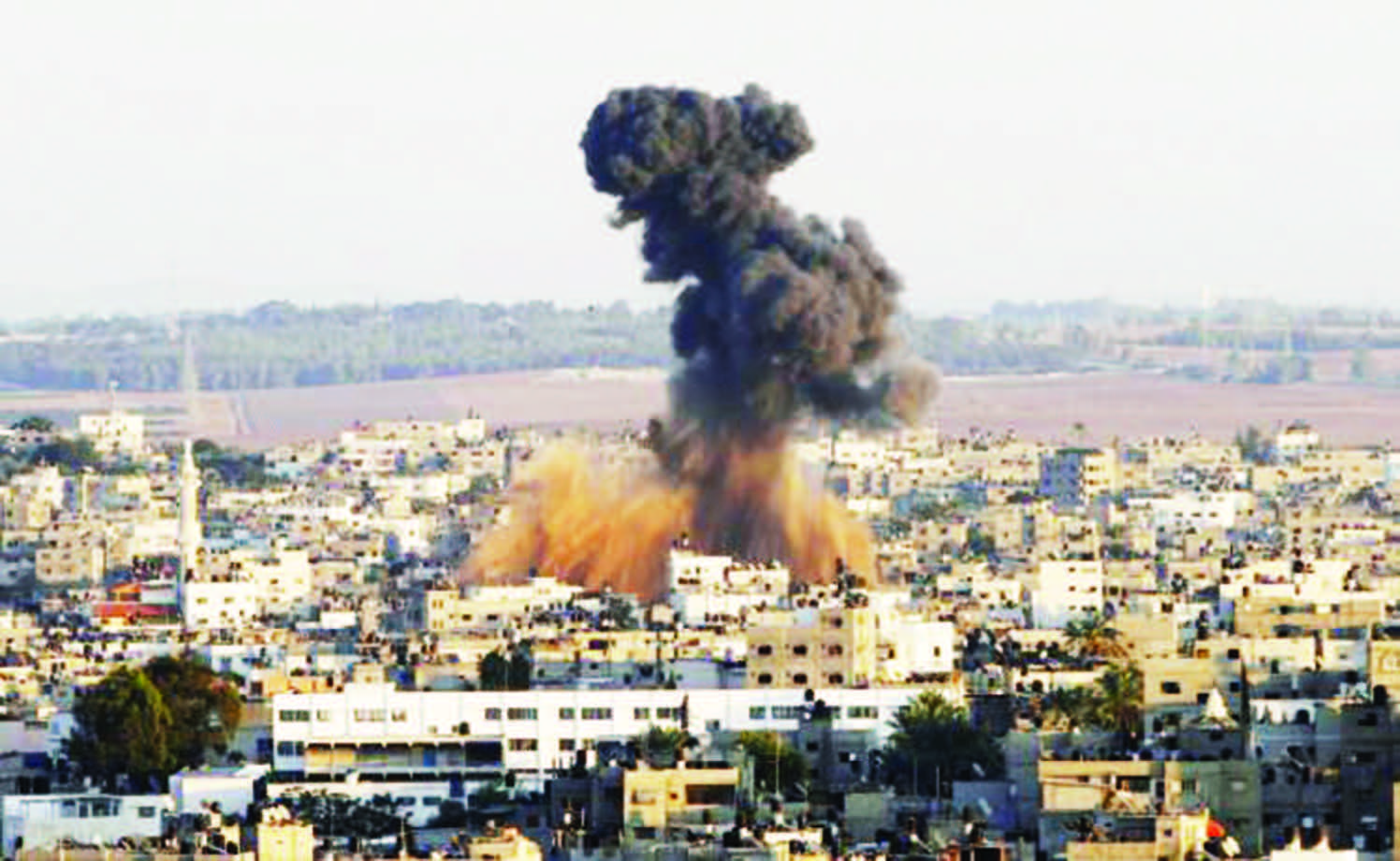
That the Middle East (West Asia of our description) is in a state of flux is crystal clear. We have a three-yearold civil war in Syria, an Iraq wracked by tribal and Shia-Sunni strife, Libya still fighting the post-Gaddafi dispensation and Israelis launching a disproportionate war on Palestinians, not for the first time. The common thread in these crises is the role of outside powers, both in creating crises in the first instance and in muddying the waters and the inability of local actors to make peace.
In Syria, a minority Alwaite regime is seeking to retain its throne in a Sunni-majority country, with opponents of a bewildering variety of moderates and militants ranged on the other side. In Iraq, after all American troops left, Prime Minister Nouri al-Maliki, belonging to the majority Shia, has been interpreting his role primarily in terms of advancing the interests of his community.
The Kurds are asserting their rights while the Sunni, dethroned from their ruling perch, have combined with Islamic militants to challenge the state. Both in Syria and Iraq the Islamists of the extreme variety, first under the rubric of the ISIS and later under the name of the Islamic State, have carved out an area in Syria and Iraq they rule, with President Bashar Assad’s regime in Syria and the Iraqi authorities unable to dislodge them. Superimposed on these dramatic events is the old Israel-Palestinian conflict, essentially caused by Israeli actions in occupying and colonising vast Palestinian lands and East Jerusalem on the strength of total American support extending to unprecedented military supplies and a generous annual financial subsidy.
These actions nullify attempts at finding a twostate solution and the prospect is of one state with a growing Palestinian population living as second-class citizens. Regional powers belonging to the Sunni and Shia faiths have taken up positions determined in the first category by supporting the anti-Assad forces in Syria, more of them supporting the cause of the newly disenfranchised Sunni of Iraq. On the other side is Iran, the minority Assad regime in Syria and the Hezbollah movement of Lebanon.
After the proclamation of the Islamic Caliphate in Syria and Iraq, the Sunni states led by Saudi Arabia have moderated their somewhat indiscriminate financial and military support for the Islamic militants fighting the Assad regime. Iran has been consistent in its support of President Assad and the Hezbollah. Turkey’s position has evolved over time, initially the leader of the regime change lobby for Syria, together with neighbours hosting large numbers of Syrian refugees.
It is taking time to reconsider its options while deeply disappointed with US inaction in Syria while supporting the cause of the Muslim Brotherhood in Egypt and sympathetic to the plight of the Palestinians. One big change in the regional picture is the anti-Morsi coup that has eventually brought the Army under the guise of a civilian President Abdel Fatah el-Sisi to power. The Brotherhood is classed as a terrorist organisation, its leaders and hundreds of its followers are in prison. The new regime has closed the Rafah border with the Gaza Strip, a lifeline for besieged Palestinians and shut down most of their tunnels.
Speculation is rife in this churning process, with extravagant scenarios of the break-up of Syria and Iraq and other countries essentially carved out by France and Britain out of the end of the Ottoman Empire. Two trends seem clear. The first is a sharpening Shia-Sunni conflict which is taking many forms. Second, the spreading cancer of 21st century Israeli colonization which lies at the heart of the historic Middle East conflict. There are no easy solutions to either of these problems. Any Shia-Sunni reconciliation assumes a measure of tolerance on the two sides. There are many actors inflaming passions, not least of all Iraqi Prime Minister Maliki.
On the other side, proponents of the Islamic Caliphate are keeping the fires of intolerance burning. The major power in the region, the United States, is increasingly compromised by its total support of Israel, largely due to domestic factors, and its desire to reduce its footprint in the region. In hindsight as, many at that time suggested, the US was foolish to invade Iraq under false pretences.
And on the Israel-Palestinian conflict, it is on the wrong side of history. What then can we expect from the devil’s brew, which is the Middle East in the coming days and months? There will no doubt be a ceasefire between Israelis and Palestinians even as Israel’s isolation in the world increases because of the scale of the carnage it has been inflicting on Palestinians, highlighted by the Human Rights Convention. But the problem will continue to fester because domestic factors compel US administrations to remain captive to the urges of Israeli colonialism.
The other regional crises will run their course, with little prospect of millions of Syrian refugees in neighbouring countries and the internally displaced able to return home soon. In many instances, there is no home to go to. In Iraq, the virtual partition of the state into Shia, Sunni and Kurdish regions will take firmer shape. The new Egyptian regime, in terms of the Palestinian cause, is a tacit ally of Israel and will pose problems for Gazans.
In this tangled mess, one crisis feeds on the other and the resulting picture is far from following a common pattern. The tragedy is that the sole mediator remains the United States and it is hamstrung by its own compulsions. In immediate terms, the future remains bleak. For the present, there is no countervailing force to take matters in hand.
The East-West conflict represented by the growing antagonisms between Russia and the United States over Ukraine make a complementary Moscow initiative impossible. The only bright spot is that since things cannot get worse, they will take a turn for the better.
Tag: Russia
-

US SAYS RUSSIA HAS ‘HOURS’ TO EASE UKRAINE CRISIS
PARIS (TIP): The United States warned Russia on june 26it had only “hours” to prove it was helping disarm Ukrainian insurgents whose separatist drive has reopened a Cold War-style chasm in East-West ties. US Secretary of State John Kerry’s warning came a day before Ukraine’s President Petro Poroshenko signs the final chapters of an historic EU accord that nudges his country toward eventual membership and pulls it firmly out of Russia’s reach.
Poroshenko also intends to get German Chancellor Angela Merkel and French President Francois Hollande to join him for a second round of telephone diplomacy with Russian President Vladimir Putin in two days. Putin came under intense pressure from both European leaders and US President Barack Obama on Wednesday to rein in separatist fighters over whom he denies exerting control.
Obama said sweeping economic sanctions were imminent unless the Kremlin stopped “the flow of weapons and militants across the border”. US Secretary of State John Kerry was even more explicit in Paris on Thursday following talks with French counterpart Laurent Fabius.
“We are in full agreement that it is critical for Russia to show in the next hours, literally, that they’re moving to help disarm the separatists, to encourage them to disarm, to call on them to lay down their weapons and to begin to become part of a legitimate process,” Kerry said. The State Department added that sanctions would be also discussed by EU leaders on Friday when they sign the full Association Agreement with Ukraine that was ditched by the ousted pro-Russian president in November and now lies at the heart of the raging crisis.
The punitive steps under deliberation would target Russia’s financial and defence sectors at a time when its export-dependent economy is on the verge of slipping into another recession. US media reports said one particularly painful step under consideration would prohibit the export of technology that could help Russia explore for oil and gas in the Arctic — a major ambition of powerful stateheld energy firms.
But 11 weeks of fighting that has already claimed more than 435 lives and brought factories in Ukraine’s economically vital eastern rustbelt to a virtual standstill continued today despite the ceasefire agreement. A spokesman for Ukraine’s “antiterrorist operation” said 10 paratroopers were wounded in rebel attacks on government roadblocks on Thursday. Ukrainian media reports said gunmen had also attacked a small airport overnight in the flashpoint village of Kramatorsk.
-

India opposes Russian decision to sell arms to Pak
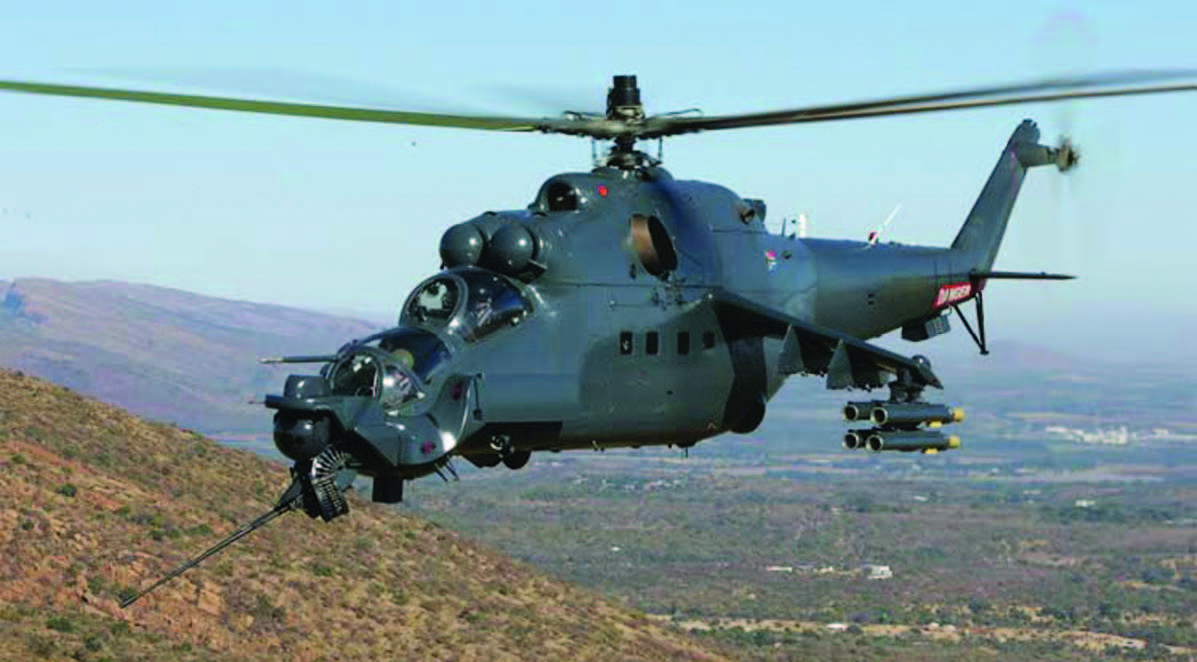
NEW DELHI (TIP): India conveyed to Russia, June 18, its concern over Moscow’s decision to lift embargo on the supply of Mi-35 attack helicopters and defense equipment to Pakistan. External Affairs Minister Sushma Swaraj told visiting Russian Deputy Prime Minister Dmitry Rogozin that Moscow must keep in mind India’s sensitivities while dealing with its neighbors on defense-related matters.
Rogozin also held talks with Defense Minister Arun Jaitley. MEA spokesperson Syed Akbaruddin confirmed that the issue did figure during Swaraj’s four-hour meeting with Rogozin in the context of defense cooperation between India and Russia. Official sources said New Delhi had unambiguously told Moscow in recent days that it could not be business-asusual on the defense front between the two countries until Moscow reconsidered its decision. India imports nearly 60 per cent of its defense equipment from Russia.
The meeting between Swaraj and Rogozin was the first high-level contact between the two countries after the Narendra Modi government assumed office. The two ministers also discussed the possible dates for the annual summit between Prime Minister Modi and Russian President Vladimir Putin in Delhi towards the end of the year.
The two leaders are also scheduled to meet next month in Brazil on the margins of the BRICS Summit. The spokesperson said the principal focus of the talks was on how to harness the “untapped potential” of their economic ties and raise it from the $10 billion at present, of which Russian exports amount to $6.5 billion.
Both sides have decided to set up a joint feasibility study on a free trade agreement between India and Russia, Belarus and Kazakhstan, which have formed the Eurasian Economic Union bloc. Swaraj informed the Russian minister that the first unit of the Kudankulam Nuclear Power plant attained full capacity on June 7. The second unit was to attain criticality at the end of the year. In April this year, India and Russia signed an agreement to build units 3 and 4 of the power plant.
-

Will sign EU pact this month: Ukraine President
KIEV (TIP): Ukraine’s new pro-Western President Petro Poroshenko said on June 19 he would sign the crucial trade and economic relations portion of an historic EU pact in Brussels on June 27. The old Kremlin-backed leadership’s rejection of the EU Association Agreement in November sparked months of deadly protests that led to the February ouster of president Viktor Yanukovych.
The interim government headed by Prime Minister Arseniy Yatsenyuk signed the political relations portion of the deal in Brussels on March 21. But Kiev delayed signing the economic section because it demanded that Ukraine lift import barriers aimed at protecting its farmers and steel mills in the east from direct EU competition.
The Wall Street Journal had earlier reported that Poroshenko was considering pushing back the trade agreement’s signature until he stabilised the recession-hit economy and resolved the pro-Russian separatist insurgency gripping the industrial east.
The complete pact’s signing will effectively cut Ukraine off from a Moscow-led economic alliance of a few former Soviet nations championed by Russian President Vladimir Putin. Russia on Thursday once again threatened to impose trade restrictions against Ukraine should it sign the full EU deal.
-

US supports Ukraine- Russia peace talks: Joe Biden
WASHINGTON (TIP): Vice President Joe Biden has said the United States strongly supports negotiations among Ukraine, Russia and international diplomats to resolve the crisis in Ukraine. The White House said that Biden spoke by phone on Wednesday with Ukraine’s new president, Petro Poroshenko. It was their second conversation in two days. The White House also said that Poroshenko told Biden that he’s still committed to his offer to grant amnesty to insurgents who lay down their arms or allow them to return to Russia.
Biden told Poroshenko that the US applauds the peace plan he presented on Saturday during his inauguration. Biden has said that Moscow must recognize Poroshenko as Ukraine’s legitimate leader, stop supporting pro-Russian separatists and prevent arms from flowing over the border. The White House added that the leaders also conferred on the security situation in eastern Ukraine.
-

Russia wants UN action to stop violence in Ukraine
UNITED NATIONS (TIP): Russia introduced a UN Security Council resolution on June 12 that strongly urges an immediate end to all violence in Ukraine and the launching of a national dialogue involving all political forces and regions. The draft resolution, circulated to council members and obtained by The Associated Press, calls on all parties to immediately implement a “road map” to peace put forward by the Organization for Security and Cooperation in Europe on May 12.
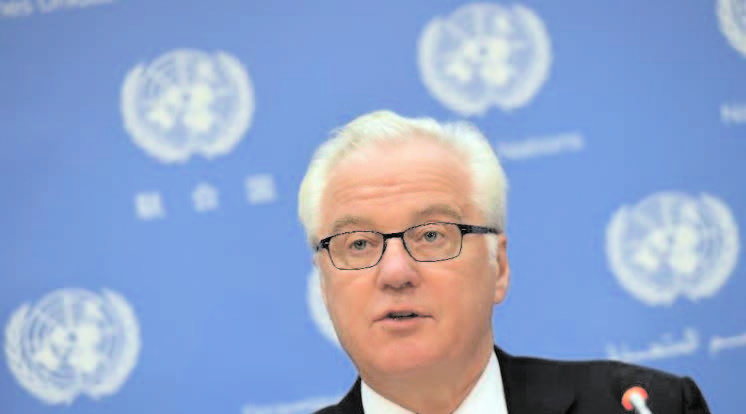
Russia’s UN ambassador Vitaly Churkin said the draft supersedes a text he circulated June 2 demanding an immediate halt to deadly clashes in eastern Ukraine, which has languished. Western diplomats have insisted that any UN resolution reaffirm Ukraine’s sovereignty and territorial integrity, a critical issue following Russia’s invasion and annexation of Ukraine’s Crimean Peninsula which the United States and the European Union refuse to recognize.
Like the June 2 draft, the newly proposed Russian resolution does not mention Ukraine’s sovereignty or territorial integrity, which makes its approval by the Security Council highly unlikely. Churkin said there was only a brief discussion of the text, with support from some council members and suggestions from others. He said council experts would meet Friday to go over the text “to try to accomplish this very quickly.” Lithuania’s UN Ambassador Raimonda Murmokaite called the resolution “another surprise … like a rabbit out of the box.”
Any resolution on Ukraine has to “insist on territorial integrity, sovereignty and inviolability of Ukraine’s borders and we have to clearly name insurgents and militant separatists and what they’re doing,” she said. Lithuania and some others will also express concern “that there’s military movement across Russia’s border including recent information on three tanks which have crossed into (Ukraine’s) territory,” Murmokaite said.
“For Russia not to be able to take care of its own borders and not to prevent the flow of arms, insurgents and military capabilities is a highly troubling situation.” The draft expresses deep concern at the intensification of hostilities and killing of civilians in eastern Ukraine, where government forces have battled pro-Russian rebels for two months. Churkin noted reports of the use of white phosphorous munitions, which are banned, by the Ukrainian side.
-

It’s a new era in India’s foreign policy as countries compete to woo Modi
“The new majority government in power in New Delhi, freed from debilitating coalition politics and attaching priority to economic development, has aroused external interest”, says the author.
In foreign policy, Prime Minister Modi has hit the ground running, taking unexpected initiatives. He reached out to our neighbors, taking the unprecedented step of inviting their leaders to his swearing-in ceremony. While invitations to Bangladesh, Nepal, Bhutan, Maldives and Afghanistan carried only positive connotations, those to Prime Minister Nawaz Sharif and President Rajapakse carried mixed political implications. It was felt that the plus points in extending invitations to Pakistan and Sri Lanka outweighed the negatives.
Engagement
In Pakistan’s case the dilemma is whether we should engage it at the highest level without any ground-clearing move by Nawaz Sharif on terrorism, the Mumbai trial and trade. The Pakistani premier has been, on the contrary, aggressive over Kashmir, invoking the UN resolutions and self-determination as a solution, seeking third party intervention, permitting tirades by Hafiz Saeed against India, maintaining the pitch on water issues and reneging on granting MFN status even under a modified nomenclature.
In these circumstances, the move to invite him risked suggesting that, like the previous government, the new government too was willing to open the doors of a dialogue in the hope of creating a dynamics that would yield some satisfaction on the terrorism issue. In other words, practically delinking dialogue from terrorism, despite having taken a position to the contrary while in opposition.
In Sri Lanka’s case, the whipped-up sentiments in Tamil Nadu against President Rajapakse for his triumphalist rather than reconciliatory policies on the Tamilian issue have upset the overall balance of India’s foreign policy towards Sri Lanka that requires that we adequately weigh the need to counter powerful adversarial external forces are at play there against our interests. Inviting President Rajapakse to New Delhi obviously risked provoking a strong reaction in Tamil Nadu, but the new government had to decide whether, like its predecessor, it would get cowed down by such regional opposition, or it would act in the greater interest of the country even when according importance to the sentiments of a section of our population.
This dramatic outreach to the neighbors has elicited praise internally and externally, primarily focused on the invitation to the Pakistan president and its implication for the resumption of the Indo-Pak dialogue. Internally, those pro-dialogue lobbies that have espoused the previous government’s placative policies towards Pakistan have naturally welcomed the surprise move by Modi. Externally, India has always been counseled to have a dialogue with Pakistan irrespective of its conduct and its terrorist links, the argument being that these two South Asian nuclear armed neighbors with unresolved territorial conflicts risked sliding into a nuclear conflict unless they found a way to settle their differences for which a dialogue was an inescapable necessity. Such praise from within and without from predictable quarters should neither be surprising nor worth much attention.
Outreach
The new majority government in power in New Delhi, freed from debilitating coalition politics and attaching priority to economic development, has aroused external interest. The sentiment outside the country- as well as inside it – has been that the previous government lost its way, leading India into the quagmire of high fiscal deficits and tumbling growth, belying international expectations about its economic rise paralleling that of China.
If India can be steered back into a high growth trajectory with stronger leadership and improved governance, more economic opportunities will open up for our foreign partners. This would also draw renewed attention to India’s geo-political importance which, though an accepted reality now, has receded from the foreground lately.
Reassurance
Modi is seen as the man of the moment. This would explain the telephone calls from world leaders to Modi and the invitations given and received. India is being courted, and Modi’s choice of the countries he first visits or foreign leaders he first receives, is drawing external attention as an indication of his diplomatic priorities.
On this broader front too, Modi is following an unanticipated script of his own. He is being generous to the US despite its reprehensible conduct in denying him a visa, by prioritizing national interest over his individual feelings. He has not waited for the stigma of visa refusal to be erased by a US executive order removing his name from the State Department black-list. He is planning to meet President Obama in Washington in September – the first external visit to be announced – quickly relieving the Americans of fears that the visa issue could become a hurdle in engaging him.
In another remarkable gesture that the State Department would have noted for its political import, he has agreed to a book launch by an American think-tank at Race Course Road. China wants to complicate moves by Japan to strengthen strategic ties with India. Its decision to send its Foreign Minister to India after the swearing-in seems to have been motivated by this rivalry, apart from seeking to build on the personal contacts established by China with Modi when he was Chief Minister. If the Chinese FM was allowed to be the first consequential foreign leader to meet Modi, it appears Japan may be the first foreign country – barring Bhutan – the latter may visit en route to the BRICS meeting in July in Brazil.
The Bhutan visit underscores the importance Modi intends attaching to neighbors. Russia’s Deputy Prime Minister is visiting Delhi on June 18. It would seem that Modi’s immediate priority is to reassure all his important interlocutors, friends or adversaries, that they should have no misgivings about him and the direction of his policies, and that he seeks to engage with all power centers in a balanced manner.
-

G7 threatens Russia with more curbs
BRUSSELS (TIP): World leaders urged Vladimir Putin on June 4 to stop destabilizing Ukraine or face further sanctions as they met without a Russian president for the first time since the 1990s. Putin reached out a hand despite being banned from the Group of Seven summit following Russia’s annexation of Crimea in March, saying that he was ready to meet Ukraine’s president-elect. But G7 leaders said that while they still hoped for “constructive” talks with Putin on the sidelines of D-Day commemorations in France on Friday, Moscow could face further punitive measures.
In a joint communique they said Putin must recognize the results of Ukraine’s May 25 presidential election, won by Petro Poroshenko, stem destabilization in the east of the country, and pull Russian troops back from the border. “Actions to destabilize eastern Ukraine are unacceptable and must stop,” the group said. “We stand ready to intensify targeted sanctions and to implement significant additional restrictive measures to impose further costs on Russia should events so require.”
The leaders have warned Russia that manipulating energy supplies to intimidate one’s neighbours is unacceptable and that they need to diversify their energy systems to avoid getting blackmailed. “The use of energy supplies as a means of political coercion or as a threat to security is unacceptable,” a draft G7 summit statement seen by AFP said. Russia supplies about 30% of Europe’s gas, with about half of that transiting Ukraine. Obama has shown no signs of wanting a meeting with Putin despite the fact that both will be in Normandy to mark the 70th anniversary of the World War II D-Day landings in Europe.
Other G7 leaders whose economies are more exposed to Russia than Washington took a softer tone. German Chancellor Angela Merkel said that European leaders would “take stock” of Russian actions at a summit end June and “reflect which further sanctions are necessary”. But Merkel, who is due to meet Putin in France, said that “the main thing is to be constructive” and that further sanctions would take effect only if there had been “no progress whatsoever”.
French President Francois Hollande – who is scheduled to have separate dinners with both Putin and Obama in Paris on Thursday – agreed that “dialogue and deescalation must be encouraged”. British PM David Cameron said he would be taking a similar message to Putin when he meets him also on Thursday. Putin hinted that he could meet both Poroshenko and even Obama, saying “I don’t plan to avoid anyone”.
But he taunted the United States and waved away allegations of Russian military meddling in eastern Ukraine. “Proof ? Let’s see it!” he said. “The entire world remembers the US secretary of state demonstrating the evidence of Iraq’s weapons of mass destruction, waving around some test tube with washing powder in the UN Security Council,” Putin said.
-

China under-reported defence by 20%: Pentagon
WASHINGTON (TIP): China underestimated its growing defence budget by nearly 20% with its spending likely nearing $145 billion last year, the Pentagon has said. In an annual report required by Congress, the Pentagon said yesterday that China’s defence budget for 2013 was higher than the officially announced $119.5 billion. “We think that if you start factoring in other considerations, other funding streams that go into the military, other investments that are not included in the defence budget, that it could be up to $145 billion,” a Pentagon official said of the report.
The United States and its allies, especially Japan, have repeatedly voiced concern about the Chinese military’s lack of transparency amid growing tensions between Beijing and neighbouring countries over maritime disputes. In its previous annual report on China, the Pentagon said that Beijing’s military spending was anywhere between $135- 215 billion. The $145 billion estimate “reflects an improvement in our understanding of how China develops its defence budget,” the official said. “But I would say there’s a lot that we still don’t know about China’s defence spending and that’s an area where we encourage China to be more transparent,” he said.
In March, China announced a new hike of 12.2% in its defence budget to an official 808.23 billion yuan ($132 billion) for 2014. China dismissed foreign criticism, with the staterun China Daily saying, “World peace needs a militarily stronger China.” China’s military budget — either the official figure or Pentagon estimate — is significantly higher than the amount spent by its neighbours.
In 2013, Russia’s defence budget was $69.5 billion, Japan’s was $56.9 billion, with India at $39.2 billion and South Korea at $31 billion. But China’s budget is much lower than that of the United States, by far the world’s largest military power, which has a $495.5 billion defence budget in 2013 along with another $82 billion allocated for the Afghanistan war.
-

Russia negotiates MI-35 helicopter supplies to Pakistan
Russia and Pakistan cooperate in resisting new challenges and threats as active participants in the international anti-terrorist coalition
MOSCOW (TIP): Russia is negotiating MI-35 helicopter supplies to Pakistan, the Russian Foreign Ministry said on Wednesday, June 4. Russia and Pakistan cooperate in resisting new challenges and threats as active participants in the international anti-terrorist coalition, the Foreign Ministry said.
Contrary to some media reports, Russia had never introduced embargo on weapon supplies to Pakistan, it added. Helicopter supplies are part of the Russian assistance in strengthening Islamabad’s anti-terrorist and anti-drug potential. Similar equipment was supplied earlier, as military cooperation with Pakistan started back in the 1960s. Russia-Pakistan contacts in this field posed no threat to the existing strategic military balance in the region and were not aimed against the third countries, the Foreign Ministry said.
-

Somasundaran appointed by US/ EPA to its Board of Scientific Conselors
NEW YORK (TIP): Professor P. Somasundaran has been appointed by the U.S. Environmental Protection Agency. to serve as a member of its Board of Scientific Counselors and to chair the ‘combined BOSC Subcommittees for Chemical Safety for Sustainability and Human Health Risk Assessment research program” and as such to the Board’s Executive Committee effective April l 28, 2014.
Board members of this committee must have shown extraordinary accomplishments in the field to be invited to serve The committee’s mission is to provide advice and recommendations on science and engineering research programs, plans, labs, and research management practices; the use of peer review to promote sound science; the development and progress of plans of the EPA’s R&D office; the quality of technical products; and human resources planning. Somasundaran is an expert in surface and colloid science, enhanced oil and coal recovery, nanoparticles, biosurfaces, and biosensors.
He is the author of 15 books and more than 700 scientific publications and patents.. Somasundaran, La von Duddleson Krumb Professor at Columbia University, is the founding Director of Langmuir Center for Colloids & Interfaces, and director of the National Science Foundation Industry/University Cooperative Research Center for Particulate and Surfactant Systems.
His work strives toward designing greener surfactant systems for an environmentally conscious market. Author and editor of 22 books and 700 scientific publications, Somasundaran is a 1985 inductee of the National Academy of Engineering, highest honor for an engineer at that time, and subsequently of the corresponding academies of China, India, Russia, and the Balkan Academy of Sciences/MT and the sole 2012 foreign member of the Royal Society of Canada,.
Somasundaran has been honored with many awards, including the Ellis Island Medal of Honor (1990), Gaudin Award (1982), Mill Man of Distinction Award (1983), Publication Board Award (l980), Richards Award(l987), Taggart Award for best paper (1987), Henry Krumb Lecturer of the Year (1989), Distinguished Member of SME (1983), “Most Distinguished Achievement in Engineering” award from AINA (1980), Distinguished Alumnus (1989 sole award) and the first Brahm Prakash Chair from the Indian Institute of Science (1990), Engineering Foundation’s Aplan award (1992), AIME Mineral Industry Education Award (2006), Columbia Alumni Association and the ACAA Distinguished Achievement Award (2007), MEANA Engineer of the Year Award (2007), Fellowship of theAmerican Institute of Chemical Engineers (2009), the Leadership Citation from the New Jersey Senate in 1991, and the title of Pan American Advisor for Mines, Metallurgy and Materials.
He was awarded Padma Shri(among the highest civil award by the Government of India) by the President of India 2010. He is the author/editor of 15 books and close to 700 scientific publications and patents the Honorary Editor-inchief of the international journal “Colloids and Surfaces,” the Editor-in- Chief of “The Encyclopedia of Surface and Colloid Science” and has served on many international, national and professional committees and National Research Council Panels, NSF research and advisory panels, DOI Advisory Panel and university research advisory panels.
He served in the Congress’ 28th Environmental Advisory Committee. He was the Chairman of the Board of the Engineering Foundation (1993-95) and has served on the board of the SME/AIME (1982-85). In the community, he served as member of the Piermont Planning Board and Citizen Advisory Committee and currently as a member of the Zoning Board of Appeals and Board of the Volunteers in Service to Education in India.
-

Ukraine military helicopter shot down, 14 dead
SLOVYANSK (UKRAINE) (TIP): Rebels in eastern Ukraine shot down a government military helicopter on May 29 amid heavy fighting around the eastern city of Slovyansk, killing 14 soldiers including a general, Ukraine’s leader said. Acting President Oleksandr Turchynov told the parliament in Kiev that rebels used a portable air defense missile on Thursday to down the helicopter and said Gen.
Volodymyr Kulchitsky was among the dead. Slovyansk has become the epicenter of fighting between pro-Russia insurgents and government forces in recent weeks. Located 100 miles (160 kilometers) from the Russian border, it has seen constant clashes and its residential areas have regularly come under mortar shelling from government forces, causing civilian casualties and prompting some residents to flee. An Associated Press reporter saw the helicopter’s go down and the trail of black smoke it left before crashing.
Gunshots were heard around Slovyansk near the crash site and a Ukrainian air force jet was seen circling above. It was too dangerous to visit the site itself. The city of 120,000 is in the Donetsk region, one of the two sprawling provinces in eastern Ukraine that have declared independence from the government in Kiev. The Kiev government condemns the insurgency roiling the east as the work of “terrorists” bent on destroying the country and blames Russia for fomenting it. Russia denies the accusations, saying it has no influence over rebels, who insist they are only protecting the interests of Russianspeakers in the east.
Still, fighters from Russia, including from the battled-hardened region of Chechnya, have been appearing recently in the ranks of the separatists. Also on May 29, an insurgent leader confirmed that his fighters were holding four missing observers from the Organization for Security and Cooperation in Europe and promised that they would be released shortly. Vyacheslav Ponomarev, the selfproclaimed “people’s mayor” of Slovyansk, told the AP that the monitors — who are from Turkey, Switzerland, Estonia and Denmark — were safe.
“I addressed the OSCE mission to warn them that their people should not over the coming week travel in areas under our control. And they decided to show up anyway,” Ponomarev said. “We will deal with this and then release them,” he said, without setting a specific timeframe. The OSCE had lost contact with the team in Donetsk on Monday evening. Their teams have been deployed to Ukraine to monitor security situation following Russia’s annexation of Crimea and the rise of the pro-Russia separatist insurgency in eastern Ukraine.
They also observed Sunday’s presidential vote, won by billionaire candy magnate Petro Poroshenko. Poroshenko has promised to negotiate with people in the east but also vowed to uproot the armed rebels. In the most ferocious battle yet, rebels in Donetsk tried to take control of its airport Monday but were repelled by Ukrainian forces using combat jets and helicopter gunships. Dozens of men were killed — some insurgent leaders said up to 100 fighters may have been killed. The mood in Donetsk was calm Thursday, although many businesses have stopped opening due to fears of renewed fighting.
The separatists in Ukraine have pleaded to join Russia, but President Vladimir Putin has ignored their appeal in an apparent bid to de-escalate tensions with the West and avoid a new round of Western sanctions. Putin has supported an OSCE peace plan that calls for ending hostilities and launching a political dialogue and has said Russia would work with new leader Poroshenko. But Russia has repeatedly urged the Ukrainian government to end its military operation against the separatists. Russian foreign minister Sergey Lavrov on Thursday called for quick international mediation to persuade Kiev to halt what he described as a “punitive operation” in the east.
-

Russia seeks explanation from Britain over Prince Charles’ Putin remark
LONDON (TIP): Russia will seek an explanation from British officials on May 22 after reports that Prince Charles, the heir to the British throne, likened Russian President Vladimir Putin to Nazi leader Adolf Hitler for annexing part of Ukraine. During a tour of Canada, the 65-year-old prince told a Jewish woman who fled from Poland during World War Two that “Putin is doing just about the same as Hitler”, according to a report in the Daily Mail newspaper.
Charles’s remarks, described by a royal source as “well-intentioned” and not meant to be public, stunned political leaders and diplomats in Britain because the royal family does not traditionally voice political views in public. Queen Elizabeth, Charles’s mother, has never aired any such emotive sentiments in public. A spokeswoman for Charles’s office said they did not comment on his private conversations. The Soviet Union lost more than 20 million people in World War Two and the victory over Nazi Germany is celebrated across Russia as a national triumph.
A senior Russian diplomat from its London embassy is expected to meet a senior officer from Britain’s foreign office on Thursday, according to a source with knowledge of the situation. The source, who spoke on condition of anonymity, gave no further details about the meeting or whether Russia had yet complained about the reported remarks. Prime Minister David Cameron, who has scolded the Kremlin for annexing Crimea and supporting pro- Russian rebels in eastern Ukraine, declined to comment on Charles’s reported remarks. The Russian embassy in London could not be reached for immediate comment.
-

11 Ukrainian troops dead, 33 wounded by rebels
BLAHODATNE, UKRAINE (TIP): Three days before Ukraine holds a presidential vote, pro-Russia insurgents attacked a military checkpoint on Thursday in eastern Ukraine, killing at least 11 troops and wounding at least 33 others in the deadliest raid yet in weeks of fighting. A rebel group who claimed responsibility for the attack said one of their own was also killed.
AP journalists saw 11 dead Ukrainian soldiers scattered around a checkpoint near the village of Blahodatne, 30 kilometers (20 miles) south of the major city of Donetsk. Witnesses including a medical worker said 33 Ukrainian troops were wounded in the attack and that some of them were in grave condition. All the wounded were being treated at nearby medical facilities. The Ukrainian defense ministry confirmed the attack but wouldn’t comment on casualties. Ukraine’s acting Prime Minister Arseniy Yatsenyuk in televised comments blamed Russia for backing the rebels in the Donetsk and Luhansk regions, which have declared independence from the government in Kiev.
Thursday’s carnage cast a shadow over Ukraine’s upcoming presidential vote on Sunday, which separatists in the east have pledged to derail. Authorities in Kiev see the vote as a chance to defuse tensions and stabilize the country. Even so, they have admitted it will be impossible to stage the vote in some eastern areas where election officials and voters have faced intimidation and sometimes death threats from the rebels.
Three charred Ukrainian armored infantry vehicles, their turrets blown away, and several burned trucks were seen at the site in the Donetsk region. A military helicopter landed, carrying officials who inspected the area. Residents said attackers used an armored bank truck, which the unsuspecting Ukrainian soldiers waved through, and then mowed them down at point-blank range. Their account couldn’t be independently confirmed.
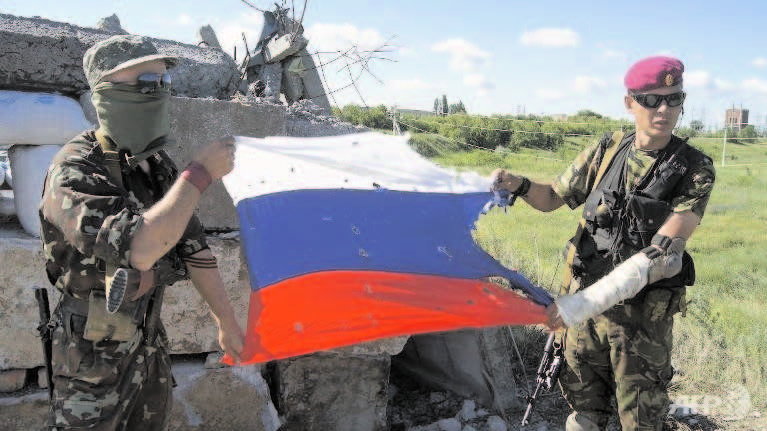
In the town of Horlivka, a masked rebel commander claimed responsibility for the raid and showed an array of seized Ukrainian weapons. “We destroyed a checkpoint of the fascist Ukrainian army deployed on the land the Donetsk Republic,” said the commander, who wore a balaclava and identified himself by his nom de guerre, “Bes,” Russian for “demon.” He said one of his men also was killed.
“The weapons you see here have been taken from the dead, they are trophies,” the rebel commander said, showing automatic and sniper rifles, rocket grenade launchers and bulletproof vests in the courtyard of the occupied Horlivka police headquarters. “People living in western Ukraine: Think about where you are sending your brothers, fathers and sons, and why you need any of this,” he added. Many in the east resent the government in Kiev, which came to power after a pro-Russian president fled in February following months of protests, seeing it as nationalists bent on repressing Russian-speakers.
But many locals also have grown increasingly exasperated with the rebels, whom they blame for putting civilians in the crossfire. In the village of Semenovka on the outskirts of Slovyansk, artillery shelling badly damaged several houses on Thursday. Zinaida Patskan, 80, had her roof torn away by an explosion that also shattered a wall. She said she was hiding under a kitchen table with her cat, Timofey, when the shelling came.
“Why they are hitting us?” she said, bursting into tears. “We are peaceful people!” About 100 Semenovka residents later vented their anger against the central government, demanding that Ukrainian forces cease their offensive against the separatists and withdraw from the region. Speakers at the rally also urged residents to boycott the presidential vote. While fighting raged in Ukraine, Russia’s Defense Ministry said Thursday its forces were leaving the regions near Ukraine as part of a massive military pullout ordered by President Vladimir Putin.
It said four trainloads of weapons and 15 Il-76 heavy-lift transport planes had already left the Belgorod, Bryansk and Rostov regions. Nato had estimated Russia has 40,000 troops along the border with Ukraine. Gen. Philip Breedlove, Nato’s supreme commander in Europe, told reporters in Brussels that some Russian military movements had been detected but it was too early to assess their size or importance. He said a very large and capable Russian force still remained close to Ukraine.
-

Fear and loathing in Washington
The known unknowns about Modi are perfect catalysts for a reset of India-US relations
Over the past three years, Washington has also come to believe it did India too big a favor with the nuclear deal and received little payback. This premise conveniently ignores the many tangibles (Indian purchases of US defense platforms to the tune of $10 billion in less than a decade) and intangibles (India’s decision not to criticize wholesale spying by NSA). A strong government in New Delhi is unlikely to be as patient or as yielding
The American establishment is registering a measure of fear while the liberal academic-NGO community a sense of loathing at the prospect of Narendra Modi becoming India’s next PM. They are full of questions with no real answers. If elected, how would a state CM play the national and international game? How would he deal with a US administration whose policy lately has been to hit India on multiple fronts to extract concessions? More importantly, how would he look at a country that denied him a visa and had no contact with him for seven years?
The anti-Modi coalition of Christian evangelists, left-leaning Indian Americans and Muslim activists is gearing up to mount pressure through the US Congress. They will keep the heat on even though the old fervor is gone, especially among Republicans. The uncertainties, the ambiguities and the “known unknowns” about Modi are actually perfect catalysts for a “reset” of India-US relations currently running at a low. They can create the new chemistry necessary for a more balanced equation better suited to the times.
It cannot be the responsibility of one partner to create equilibrium, constantly ignore provocations and appease. A good relationship bears traffic in both directions. Actually the reset has already begun. Ironically, the button was pushed by the Khobragade affair. Needless provocation sparked a strong Indian response and washed the fuzziness off the relationship. Dialogue has gained in clarity since. The defensive tone has been replaced by a confident articulation of Indian expectations from the relationship. It is neither arrogant nor whiney. Terms of engagement will change further if Indian voters give a clear mandate.
Unfortunately, the last phase of the UPA government left the impression that India will reverse its policies in the face of pressure and noise from Washington. It did so on preferential market access and transfer pricing. This has emboldened US lobbies out to draw more blood. After all who wouldn’t use a tactic that works? Over the past three years, Washington has also come to believe it did India too big a favor with the nuclear deal and received little payback. This premise conveniently ignores the many tangibles (Indian purchases of US defense platforms to the tune of $10 billion in less than a decade) and intangibles (India’s decision not to criticize wholesale spying by NSA). A strong government in New Delhi is unlikely to be as patient or as yielding. Piling on public pressure is bad strategy for the general health of the relationship.
It reduces the Indo-US story to one of trade and investment disputes and blurs the original idea for coming together – a geostrategic convergence of interests. The new government will realize soon enough that an inward-looking Obama administration has had only fitful engagement with the world. That it has paid no special homage to strategic vision, and instead allowed a disaggregation of the India-US relationship. Then it has come after New Delhi issue by issue. It has attacked India at the behest of big pharma and other business interests whose maximalist agenda has been repeatedly exposed.
Their game is to scotch any serious attempt to keep medicine affordable while discrediting India’s generic drugs industry through means both fair and foul. In their calculation, if India bends, it would scare smaller, weaker countries from ever contemplating a compulsory license US pharma’s brutal overreach has even put the much-touted Trans-Pacific Partnership under a cloud as negotiating countries discover the traps set for them under the guise of protecting intellectual property and copyrights. If the US Trade Representative reviewing India’s intellectual property regime downgrades it and puts it on the list of ‘Special 301’ countries, this will add another twist to an already twisting relationship. Such naming and shaming could lead to sanctions.
Pushing the business agenda of demands drafted by the US Chamber of Commerce at a time when the US is losing international partners faster than it is acquiring them is unwise. Especially when Obama’s signature foreign policy effort – the pivot to Asia – keeps reincarnating in lesser and lesser avatars. Obama had also pledged to strengthen bonds with emerging economies but today all Brics are piled up against America for various reasons. India, Brazil, China and South Africa abstained on a UN resolution condemning the fifth partner Russia’s annexation of Crimea. India also abstained on a US-sponsored resolution against Sri Lanka’s human rights situation.
This reflects a post-Khobragade realism, a push-back, even a new equilibrium. India will give but also take. For every US demand to open the Indian economy, there would be an equal and opposite demand on completing a “tantalization agreement”. India may find it useful to cross-link and leverage defense contracts for something tangible. Surely $10 billion worth of arms can buy relief on H-1B visas or a more honest policy towards a certain neighbor that remains the hub of terrorism. The truth is if Washington can be transactional, so can others. But this new phase should not obscure the larger logic behind India and the US coming together because the many reasons for convergence remain. Those with a wider window than a four-year election cycle understand that. Equally importantly, those who make national security policy in India know what balance of power is more beneficial.
-

INDIA TURNS TO RUSSIA TO HELP SUPPLY ARMS TO AFGHAN FORCES
NEW DELHI (TIP):
India has signed an agreement under which it will pay Russia to supply arms and equipment to the Afghan military as foreign combat troops prepare to leave the country, in a move that risks infuriating Pakistan, says a Reuters report. Under the deal, smaller arms such as light artillery and mortars will be sourced from Russia and moved to Afghanistan. But it could eventually involve the transfer of heavy artillery, tanks and even combat helicopters that the Afghans have been asking India for since last year.India has already been training military officers from Afghanistan, hosted a 60-member Special Forces group last year in the deserts of Rajasthan and supplied equipment such as combat vehicles and field medical support facilities. But the decision to meet some of Afghanistan’s military hardware demands – albeit sourcing them from Russia – points to a deepening role in Afghanistan aimed at preventing it from slipping back into the hands of the Taliban and other Islamist groups that are hostile to India.
It comes as China, another big player in the region which borders Afghanistan via a small, remote strip of land, is preparing for a more robust role in Afghanistan, also concerned that the withdrawal of NATO troops will leave a hotbed of militancy on its doorstep. Like China, India is unlikely to put boots on the ground to reinforce its strategy in Afghanistan.
“We can’t commit troops on the ground,we can’t give them the military equipment that they have been asking us for, for all sorts of reasons including the lack of surplus stocks,” said an Indian foreign ministry official, declining to be named because of the sensitivity of the issue.
“Involving a third party is the next best option,” the official said, referring to plans to source military supplies from Russia for Afghan forces. The lack of direct access to Afghanistan poses additional hurdles to arms transfers. An Indian team visited Moscow in February to firm up the deal, the official said. The two countries will also help Afghanistan restart an old armaments factory near Kabul and prepare an inventory of Russian military equipment in Afghanistan that could be refitted for use.
That dates back to the Soviet invasion of 1979-89, although much of the hardware is beyond repair. “We’ll work with India directly as well as trilaterally involving Russia,” said an Afghan official in New Delhi. “Most of India’s weapons are made in Russia or co-produced with Russia, so it makes sense.
Also the three-way arrangement is cost-effective.” Indian officials said they had held talks with China, Japan and Iran to find ways to fund Afghan security demands that outgoing President Hamid Karzai told his Indian hosts during a visit last year would touch $4 billion a year.
PAKISTAN WARY
India’s neighbor and rival Pakistan is likely to be angered by any move to help arm Afghan forces, even if indirectly. Pakistan shares a long border with Afghanistan and has traditionally exerted considerable influence on Kabul. But under Karzai, and since the ouster of the Islamist Taliban movement in 2001, relations have deteriorated amid accusations that Pakistan has failed to stop militants crossing into Afghanistan and launching frequent, deadly attacks.
Asked about India’s plans to supply Russian arms to Afghanistan, Pakistani foreign ministry spokeswoman Tasnim Aslam said: “I don’t have any confirmation, so it would be premature to comment on it.” A military spokesman did not return calls seeking comment. Ahmed Rashid, an author and expert on the region, said the deal could aggravate relations between India and Pakistan – nuclear-armed neighbors who have fought three wars – if the arms supplied were heavy enough to be deemed “offensive”.
“Diplomacy and political dialogue are what will bring peace to Afghanistan,” he said. “What is not going to bring peace is more weapons.” Russia’s Federal Service for Military-Technical Cooperation, the state agency responsible for arms and military cooperation deals, declined comment on the agreement. But Alexander Golts, an independent Moscowbased defense expert, said Russia had a similar arrangement with the United States under which it had delivered Mi-17 helicopters to Afghanistan.
The program is now threatened by U.S. sanctions on Russian government officials and firms linked to President Vladimir Putin as punishment for intervention in Ukraine, he said. Golts said India and Russia were likely to play a significant role in Afghanistan as coalition troops withdraw.
“At the end of the day, and despite all the contradictions, it’s very important for Washington to keep Russia engaged in Afghanistan.” Karzai’s “shopping list” submitted to New Delhi last year comprised 66 items ranging from tanks to spares for Afghanistan’s small fleet of helicopters. Karzai also wanted Indian instructors at the British-funded “Sandhurst in the Sand” military academy built outside Kabul to train Afghan military officers.
New Delhi remains opposed to deploying troops, including trainers, but has increased the number of Afghan officers training in India to nearly 1,100 this year from last year’s 574. “It is very clear that the Afghan government has been pushing for this, especially Karzai, to make sure that the ANSF (Afghan National Security Forces) is stocked and has options post-withdrawal,” said Rudra Chaudhuri, a South Asia specialist at King’s College London, referring to India’s decision to arrange for supplies from Russia.
-

Russian jets cross into Ukraine airspace
WASHINGTON (TIP): US officials on Saturday said that Russian fighter jets flew into Ukrainian airspace a handful of times over the last 24 hours, in what one called a continued provocation of the heightened tensions in the region.
The officials said it’s not clear what the intent was, but the aircraft could have been testing Ukrainian radar or making a show of force. The officials spoke on condition of anonymity because they were not authorized to talk publicly about the issue. The flights come as Russia increases military exercises along the Ukraine border, including moving a broad array of fixed wing and rotary aircraft, infantry and armored troops.
The exercises inflame worries about a potential Russian military incursion into Ukraine. The west has threatened additional sanctions against Russia over its annexation of Ukraine’s Crimean region in March and the ongoing escalation of military operations along the border. Army Gen Martin Dempsey, the chairman of the joint chiefs of staff, spoke with his Russian counterpart, Gen.
Valery Gerasimov, yesterday, but officials were not able to provide details of the conversation. Col. Steve Warren, a Pentagon spokesman, said US officials have let Russian defense ministry officials know that Defense Secretary Chuck Hagel would like to speak to his counterpart, Russia Defense Minister Sergei Shoigu. There has been no response yet, Warren said.
This is the second set of military exercises conducted by the Russians along the border region. The latest exercises were quickly denounced by Hagel, who called them “dangerously destabilizing” and “very provocative.” If such activities escalate, they will make it more difficult to find a diplomatic solution to the situation in Ukraine, Hagel said, speaking in Mexico City.
-

G7 to ‘move swiftly’ on more Russia sanctions
WASHINGTON (TIP): The United States and other nations in the Group of Seven said that they have agreed to “move swiftly” to impose additional economic sanctions on Russia in response to its actions in Ukraine.
In a joint statement released on Friday night by the White House, the G7 nations say they will act urgently to intensify “targeted sanctions”. The statement said that the G7 will also continue to prepare broader sanctions on key Russian economic sectors if Moscow takes more aggressive action.
The White House said that US sanctions could be levied as early as Monday. The G7 nations have also said that they are moving forward on the targeted sanctions now, because of the urgency of securing plans for Ukraine to hold presidential elections next month.
-

US unwilling to give up Middle East peace process yet
WASHINGTON (TIP): The suspension of peace talks between Israel and Palestinians delivered the harshest blow yet to secretary of state John Kerry’s ambitious, if perhaps quixotic, hope of ending the decades-long impasse at the cost of focusing on other crises around the world.
But Kerry refused to accept defeat, saying “we will never give up our hope or our commitment for the possibilities” of Mideast peace. On Thursday, Kerry sought to portray the latest setback with as much optimism as the dismal development would allow. “There is always a way forward,” he told reporters at the state department, just a few hours after Israeli Prime Minister Benjamin Netanyahu in Tel Aviv bluntly said the peace process had taken “a giant leap backward”.
Even diplomats and experts sympathetic to Kerry’s desire to soldier on with the talks declared the Mideast peace process on life support. Others, impatient with what they described as the Obama administration’s rudderless foreign policy, said the US needed to move on and refocus on other pressing priorities. Kerry acknowledged the bleakness of the situation, and said Israeli and Palestinian leaders needed to be willing to make compromises to keep the nine months of negotiations alive beyond an April 29 deadline.
“We may see a way forward, but if they’re not willing to make the compromises necessary, it becomes very elusive,” he said. Kerry has struggled to hold together the talks after a series of tit-for-tat diplomatic manoeuvres between the two sides over the last month that have eroded any trust or progress built since last summer. The worst blow came on Thursday when Israel’s security cabinet agreed to shelve the negotiations as the result of a new deal struck by the Palestinian Authority to create a reconciliation government with the militant group Hamas. Hamas has called for the destruction of the state of Israel, and is considered a terrorist organization by the US, European Union and other counties worldwide.
However, among Palestinians, the new agreement was hailed as a potentially historic step toward mending the rift that has split their people between two sets of rulers for seven years. Similar deals have been struck before between Hamas and the Fatah political party that Palestinian President Mahmoud Abbas represents. All have failed, and US experts said all sides should wait and see if the new agreement, reached on Wednesday, also fizzles out before declaring an end to the peace process with Israel. Former US diplomat and Mideast peace negotiator Dennis Ross said the Obama administration should wait to see whether Hamas and Fatah are able to form an interim government within five weeks, as they have pledged.
If the cannot, Ross said, the process might yet survive. Until then, “I don’t think you can say for sure that this is over with,” said Ross, who helped cobble together talks between Netanyahu and Abbas at the White House in 2010 and served as President Bill Clinton’s Mideast adviser. “It’s fair to say it’s on life support. I wouldn’t say this thing is done and can’t be resurrected.” Time is not on Kerry’s side, nor has it been throughout the negotiations. Originally, Kerry had envisioned a full agreement within nine months. When it became clear earlier this year that was not possible, given a glaring lack of meaningful progress, the state department adjusted its ambitions and set an April 29 deadline for producing a framework plan to keep the talks going for months longer.
It was not immediately clear how long the US is now prepared to let the latest impasse continue. US negotiators will remain in the region for the time being, said state department spokeswoman Jen Psaki. Throughout the year, Kerry has been forced to brush off snide accusations from critics that he is doggedly pursuing a peace deal in order to nab a Nobel Prize or make the Mideast his legacy issue after decades of statesmanship. During that time, the civil war in Syria has turned bloodier, with as many as 150,000 people killed and President Bashar Assad showing no signs of leaving.
Russia, meanwhile, has begun to flex its muscle in neighbouring former Soviet states, annexing the Crimea region in Ukraine and threatening to take over even more territory across that nation or others. No one accuses Kerry of ignoring other diplomatic crises, and he has spent at least as much time travelling to hotspots for negotiations on various problems during his first year at the State Department as he has spent in Washington. But Elliott Abrams, another longtime diplomat and top Mideast adviser to President George W Bush, described the peace process as a “forced march” fuelled by Kerry’s eagerness for a quick deal.
He predicted the peace process will live on in some form — largely because it fills a political need for the US, Israel and Palestinian leaders, and “because the two-state solution is still ultimately the right outcome”. “The pipe dream was Kerry’s belief that he could quickly reach a final status agreement; that was a vision based almost entirely on vanity,” Abrams said. “The administration should seriously be asking itself how it screwed things up so badly