Tag: Russia

  • Tensions mount in Ukraine: NATO expansion fuels Russian Nationalism

    Tensions mount in Ukraine: NATO expansion fuels Russian Nationalism

    In January 1954 the seemingly whimsical Soviet leader Nikita Khrushchev, who was born on Russia’s border with Ukraine and married to a Ukrainian, transferred Russia’s Crimean region located along the Russian- Ukrainian border to the then Ukrainian Soviet Republic. This was ostensibly to mark the occasion of 300th anniversary of its unification with Russia.

    Having been Party Secretary in Ukraine for a long time, Khrushchev felt that the Crimean region would benefit economically from the hydroelectric potential of the Dnieper river by becoming part of the Ukrainian Socialist Republic. Khrushchev obviously did not foresee the collapse of the “indestructible” Soviet Union, which had only two major Southern ports – Sevastopol and Odessa – for continuous access to the sea.

    When the Soviet Union did fall apart, the Supreme Council of the Russian Republic decided in 1992 that the Crimean region would be renamed as the autonomous Republic of Crimea. Both Sevastopol and Odessa became part of Ukraine. Not content with the breakup of the Soviet Union, the US and its NATO allies decided that Russian power had to be contained. The expectation was that Russia’s far-flung Muslim-dominated Caucasian Republics would wear out the Russians with armed struggle, and that its western, southern and Baltic neighbors would be gradually weaned and integrated with the European Union and NATO.

    The ultimate aim was clearly to “contain” a resource-rich and militarily capable Russia. This plan was seemingly proceeding successfully during the rule of the occasionally sober Boris Yeltsin, who oddly chose to treat a Chechen leader like a Head of State. The Muslim separatist armed rebellion was liberally funded by Saudi Arabia and Qatar, its leaders like Shamil Basayev and Zelmikhan Yandarbiyev were regarded “Kosher” in western capitals and operated periodically from bases as far away as Talibanruled Afghanistan. The hard-nosed Vladimir Putin soon emerged as the greatest obstacle to these grandiose western plans. Putin ruthlessly crushed the uprising in Chechnya, though sporadic unrest in the Caucasian region from Islamist insurgents and suicide bombings continue.

    This was evident from the bomb blasts in Volgograd on the eve of the winter Olympics in Sochi. The Saudi intelligence chief, Prince Bandar bin Sultan, is reported to have offered Saudi support in quelling the uprisings in the Caucasian region in return for Russia ending support to the Assad regime in Syria last year — a proposal reportedly rejected outright by Putin. Moreover, the West appears to have learnt no lessons from the swift Russian military intervention in South Ossetia and Georgia in 2008, following illadvised efforts to persuade an ever-willing Georgian President Mikheil Sakashvili to join NATO, thereby making Russia’s southern frontiers vulnerable. The present crisis in Ukraine has also arisen from efforts by the US and the EU to undermine a constitutionally elected government.

    The constitutionally elected Ukrainian President Viktor Yanukovich had been offered a partnership agreement with the EU to precede full membership. Support for a closer association was strong in the western parts of Ukraine. Those in Eastern Ukraine, where there is a huge Russian-speaking population, have had a much closer relationship with Russia and benefited from extensive trade, energy and commercial ties across the eastern borders of the country. More importantly, Yanukovich signed an agreement with Russia extending the lease of the Sevastopol Port for use by Russia’s Black Sea Fleet from 2017 to 2042, with the option of further extension till 2047. This could not have pleased those in Washington keen on “strategic containment” of Russia. When Yanukovich preferred Russian economic support to an association with the EU, a virtual siege was mounted on the Ukrainian capital Kiev by crowds largely drawn from western Ukraine with the muscle power being provided by extreme right-wing elements.

    The strident demand was for immediate resignation of the President. Eastern Ukraine, from where Yanukovich drew his political support, was largely quiet, or even hostile to what was happening in the capital. But the President’s ostentatious lifestyle and maladministration had not exactly endeared him to his countrymen. While European representatives were endeavoring to negotiate the establishment of a wider coalition in the government, it appears that the hawks in the State Department were prepared to settle for nothing less than the ouster of President Yanukovich. The recorded telephone conversation between Assistant Secretary of State Victoria Nuland and the US Ambassador in Kiev, Geoffrey Pyatt, clearly indicated that the State Department was not interested in constitutional niceties. It was bent on effecting an immediate regime change by more violence in Kiev and elsewhere.

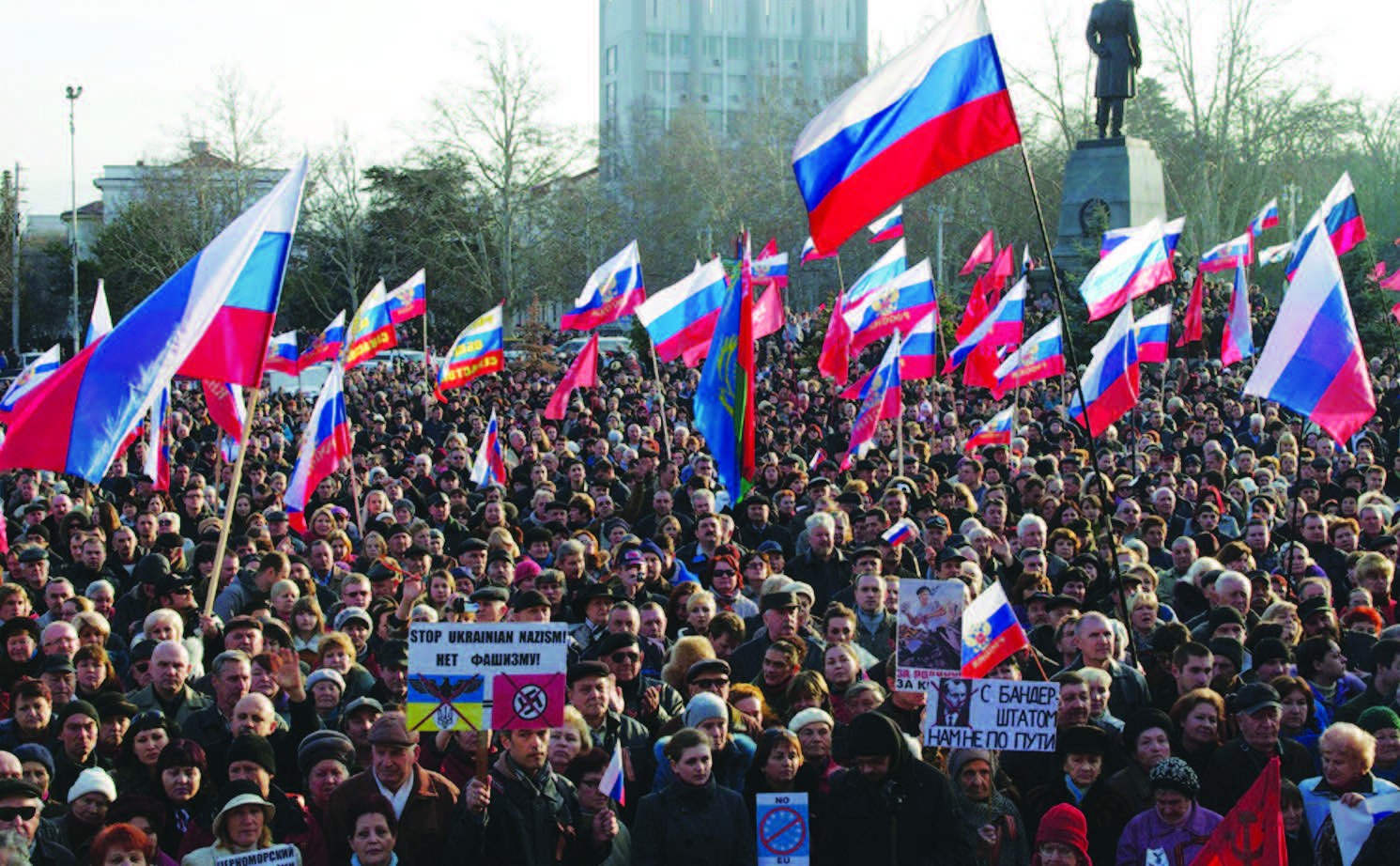
    Moreover, the violence escalated despite an agreement being reached on February 21 for establishing a transitional set-up and early Presidential elections. Sensing that his life was in danger, Yanukovich fled to Russia. The Russian reaction to these developments was immediate and predictable. An already concerned Russian population in Eastern Ukraine was motivated to seize control of the headquarters of the Russian Black Sea Fleet in Sevastopol. The entire Crimean region, which Khrushchev handed over to Ukraine in 1954, came under the control of the Russianspeaking demonstrators backed by armed personnel, quite evidently from across the Russia-Ukraine border.

    The elected Regional Assembly voted 78 to 1 to hold a referendum on the future of the Crimean Autonomous Region on April 16. The people of the Crimean autonomous region will vote overwhelmingly for merger with Russia.While the Americans, the British and the smaller EU countries call for sanctions against Moscow, mature leaders like Germany’s Chancellor Angela Merkel realistically believe that, given the need for Moscow’s cooperation in energy supplies and its position as a Permanent Member of the Security Council, the only way forward is through a realistic dialogue. Not surprisingly, China has signaled that its interests lie in backing the Russians on these developments, averring: “Russian resistance to the West has global significance.

    Supporting Russia consolidates China’s major strategy”. Russian scholar Sergey Raraganov from the National Research University in Moscow recently noted: “The outlines of a compromise (on Ukraine) are clear. A federal structure for Ukrainian institutions — and a switch to a parliamentary system in place of a Presidential one — would enable the people of each region to make their own choices over language and cultural allegiance. The ownership and control of the gas transportation system should be shared between Ukraine and its neighbors. The country should be allowed to participate both in Russia’s Customs Union and the EU association deal”. As a federal parliamentary democracy, India will find this proposal reasonable and realistic.

  • Nato and Russia agree to meet as Ukraine tension eases

    Nato and Russia agree to meet as Ukraine tension eases

    WASHINGTON (TIP):
    Representatives of US-led Nato and Russia have agreed to meet to discuss the Ukraine issue in signs that the Cold War opponents are stepping back after drawing red lines on how far the other will tolerate intrusion into a rival’s sphere of influence. The Obama administration rolled out a raft of punitive measures, including suspending Pentagon’s military engagements and trade talks with Russia, but it stopped short of any provocative diplomatic or military response after Moscow signalled that it was only interested in protecting its people and equity, and reasserting its primacy in the region. Washington was appeared mollified if not relieved to a degree by Moscow indicating its forces, having taken control of the Crimean peninsula, will not advance further into the Ukraine, although President Putin asserted that Russia reserves the right to use all means to protect Russian in Ukraine.

    There were also signs that Russia may withdraw from Crimea once its mission of restoring its proxies in Kiev is accomplished. Secretary of State John Kerry arrived in Ukraine’s capital to show support to the troubled nation and announce a $ 1 billion aid to a country heavily dependent on Russia. But it was clear that Washington and Moscow will now have to engage on the “sphere of influence” issue once the heat over the Russian invasion cools off. Here;s how former U.S National Security Advisor Tom Donilon explained the crisis from the U.S perspective: “This is about Putin reacting to the loss of a sphere of influence, a loss of a proxy in Ukraine, the real blow to his plan to have some sort of counter organization to the European Union,” Donilon said. “… The loss of Ukraine in his view…is really a traumatic event.” But Moscow sees the US, some 7000 miles from Ukraine, increasingly pushing into its backyard.

    Many analysts reckon that Moscow has recovered both it spunk and tis economy nearly two decades after it was worsted and weakened by the Cold War. The Russian leadership evidently saw an opportunity to reassert itself at a time when the U.S itself has been debilitated by two wars and a slowing economy. If the U.S and its allies back off from their growing clout — or growing their clout — in Kiev that resulted in the ouster of Russia-backed President Yanikovich, then Moscow has indicated that it will have no problem withdrawing from Crimea, which houses Russian military assets including a naval base.

    The situation is complicated only by hardliners in both countries — those in Russia who want a not just a reassertive Russia protecting its interests in the region, but also regaining its lost pride and glory as a counterforce to the USA, and those in Washington thirsting for continued American dominance that has been unchallenged for the last two decades. There are many sober voices in Washington counseling the Obama administration not to push the envelope, but the the crisis is godsend for hardline conservatives and militarists intent on painting President Obama as a weak leader who is selling out U.S interests and presiding over the diminution of its power.

  • Caught between Russia and the EU

    Caught between Russia and the EU

    Ukraine threatens to become the Syria of Eastern Europe. And like Syria, civil war could ultimately decimate a vibrant and ethnically diverse society, and a rich civilisational legacy”, says the author.

    Ukraine threatens to become the Syria of Eastern Europe. And like Syria, civil war could ultimately decimate a vibrant and ethnically diverse society, and a rich civilisational legacy The political crisis in Ukraine, that has now entered its fourth month, is rapidly reaching a point of no return.

    Territorial fissures in the country along political, linguistic and ethnic lines, the real possibility of civil war, and the emergence of the southern (autonomous) Ukrainian republic of Crimea as a potential, international military flashpoint, are among the different aspects of the current situation in the country, which is the second largest state in Europe. The focus has shifted from Kiev to the southern province of Crimea where the interim government that deposed former President Viktor Yanukovych has not been recognized. With its complex ethnic mix and historical past, the region has traditionally had strong ties with Russia.

    Russia has stepped up its military presence in Crimea – it already has a treaty with Ukraine that allows it to station its Black Sea Fleet in Sevastopol, and its Parliament recently passed a resolution reserving the right for limited military intervention to defend the rights of 1.5 million Russians in Crimea. The western bloc has accused Russia of the “armed seizure” of Crimea, and Washington is putting together legislation for a package of sanctions against Russia that could include trade restrictions, visa bans and asset freezes. These countries have withdrawn from preparations for the G8 Summit that is to be held in Sochi, the venue of the Winter Olympics.

    Euromaidan and agreement
    The background to the crisis goes back to the three month occupation of the Euromaidan in Kiev which grew out of opposition to President Yanukovych’s decision to postpone signing an Association Agreement with the European Union (EU). The protests and sit-ins rapidly spiraled into pitched battles between protesters and police. Police reprisals against protesters – of whom a large section were armed with deadly weapons including Molotov cocktails to force entry into government buildings – resulted in 85 deaths. In the face of escalating street clashes, and increasing pressure from the EU and the United States to accommodate the opposition’s demands, Mr. Yanukovych was forced to sign an EU-brokered agreement with his Maidan opponents on February 21.

    The agreement represented the first real breakthrough in the deadlock, as it had the support of all the players in the conflict – including the western bloc and Russia. Mr. Yanukovych promised a return to the 2004 Constitution within 48 hours, the setting up of a government of national unity, and presidential elections between September and December of this year. The opposition parties and their backers, however, clearly had a bigger agenda. A day later they broke the agreement and seized power in Kiev. This sent the deposed President, who now faces charges of mass murder, into refuge in southern Russia.

    Ukraine is now facing an acute economic crisis as well. It is close to bankruptcy with a debt of nearly $73 billion. In December, President Yanukovych had secured a bailout deal with Russia, which offered to buy $15 billion of Ukrainian debt in two-year bonds, plus a $3.5 billion discount on natural gas purchases. The offer stands withdrawn in the light of the recent political changes. With elections announced for May, the new government is seeking a $35 billion aid package from the International Monetary Fund, which, if it does come, will have unpopular strings attached in the form of harsh austerity measures. The U.S. government has also offered $1 billion in immediate aid.

    Two perspectives
    History shows how swiftly the root causes of international conflict often get buried under the layers of subsequent events. This seems to be fast happening in the Ukrainian crisis with the ground now shifting to the Crimean crisis, and the Russian military threat there. Nevertheless, the two perspectives on the conflict remain unchanged. Europe and the U.S. view regime change in Kiev as the outcome of a democratic revolution and President Yanukovych as a corrupt and tyrannical surrogate for Russian President Vladimir Putin. This view permeates most sections of the western media.

    The Euromaidan reportage continued to see the protest as popular and spontaneous long after its leadership had been infiltrated by avowedly right wing and neo-Nazi nationalist groups. The overt western support for the protests was at best glossed over and at worst justified. The resistance to the new Kiev government in the Crimea and eastern regions, which derives from a complex play of factors, is still presented as Russia-sponsored dissent. The other perspective sees regime change in Kiev as a coup, funded by the West, with right-wing forces firmly in the driving seat.

    The regime of President Yanukovych was undoubtedly authoritarian and corrupt but he was not only a democratically elected President, but had also agreed to an interim government ahead of an advanced schedule of elections. A stream of high-profile figures from the EU and the U.S. visited the Maidan actively stoking dissent, actions that would not be tolerated in any western capital where antigovernment protests are taking place. The visitors included Special Representative of the EU, Baroness Ashton; former U.S. presidential candidate John McCain; and the U.S. Assistant Secretary General for Europe and Eurasian Affairs, Victoria Nuland. In fact, the substantial part of Ms Nuland’s infamous leaked conversation with U.S. Ambassador Geoffrey Pratt – which the western media swooped on for her abusive dismissal of the EU – has only lent credence to the allegation of U.S. micromanagement of regime change in Kiev.

    Western-backed coup
    “Without doubt a western-backed coup,” is how Marcus Papadopoulos, London-based Editor of Politics First magazine, described the political change in Ukraine. “Ukraine is an independent country. How has the U.S. and the EU respected its independence? By joining the protests that they called a prodemocracy movement,” he told The Hindu. “Ukraine has a huge industry-military complex. Forty per cent of south and east Ukraine are Russian-speaking, and Russia will seek to protect them. It has a right to make sure its economic interests are protected. It does not want a country on its borders that is illegitimate.

    “In 1997, Russia and Ukraine signed an agreement on the division of the Black Sea Fleet, with 81 per cent going to Russia along with Sevastopol and other military installations in the Crimea. In return, Moscow compensated Kiev with a large sum of money as well as writing off a large amount of Ukrainian debt. Russia also pays Ukraine an annual fee.” After its independence in 1991 from the former Soviet Union, Ukraine has swung between its desire for integration into the European Union and keeping friendly ties with Russia, which continues to be its largest single trading partner that it depends on for cheap energy resources. According to Mr. Yanukovych, integration into the EU through a Deep and Comprehensive Free Trade Agreement (DCFTA) would have cost the Ukrainian economy 20 billion.

    Restrictive trade policy
    “This is a highly restrictive and bullying trade policy by the EU,” said Robert Oulds, Director of the Bruges Group, a Londonbased think-tank. “When President Yanukovych postponed signing an Association Agreement in late 2011 it did not create a political issue. This time the EU and the U.S. whipped up opposition to him,” he said. According to Mr. Oulds, Mr. Yanukovych had strong reasons for caution as 75 per cent of the United Kingdom’s industrial exports go to Russia, and a major part of Ukraine’s export is to the Commonwealth of Independent States (CIS).

    “Ukraine cannot be part of an EU Free Trade Association and also be part of the Russian[-led] Custom’s union. An EU agreement will put quotas on Ukraine, the highest being on agricultural goods like sugar and wheat. The quota for wheat is limited to 20,000 ton [subsequently negotiated to two million ton], whereas globally, Ukraine exports 10-15 million ton. European integration will result in huge job losses owing to the closure of many businesses because of higher EU regulations. For Ukraine it is a very bad deal,” he said. Clearly, the EU’s vision for the integration of Ukraine has ramifications beyond the economic as it seeks to draw Ukraine into a defense, security and political framework that would give it strategic importance as a pro- NATO state on the very borders of Russia.

    A policy paper prepared by the Razumkov Centre, a pro-EU think-tank located in Kiev, set this framework out clearly. “The EU’s interests (that condition its actions and influence with respect to Ukraine) ensue from the ideology of the European Neighborhood Policy and priorities of the Eastern Partnership,” it states. “They involve creating around the EU a belt of democratic, prosperous and stable states sharing common values … forming a security area around it and expanding its sphere of influence to the South and East. The EU is interested in ‘Europeanizing’ Ukraine, introducing the European norms and standards to its domestic and foreign policy.”

    Meanwhile, the interim government in Kiev has announced elections on May 25, an exercise that Crimea has already said it will boycott and replace by a referendum on whether to stay within Ukraine. In the Kiev ministry, 10 key posts have gone to the Fatherland Party of former Prime Minister Yulia Tymoshenko, including President Olexander Turchyonov and Prime Minister in the interim government Arseniy Yatsenyuk. Of significance however is the presence of the far-right parties, who acted as the steel fists of the Euromaidan movement.

    The neo-Nazi and Russo-phobic Svoboda Party is not far behind with major portfolios including defense, economic affairs, education, ecology and agriculture. Also represented are members of the Right Sector party, another far-right outfit. Tetyana Chornovol, portrayed as a crusading journalist, but who has also been involved with the ultra-right Ukrainian National Assembly, was named chair of the government’s anti-corruption committee. Ukraine threatens to become the Syria of Eastern Europe. And like Syria, civil war could ultimately decimate a vibrant and ethnically diverse society, and a rich civilisational legacy.

  • Gold, oil prices rise as tensions build in Ukraine

    Gold, oil prices rise as tensions build in Ukraine

    London (TIP):
    The price of gold is the highest it’s been in four months as tensions escalate over Russia sending troops into Ukraine. Traders often consider gold a safer investment in times of political or financial turmoil. Crude oil prices also rose sharply over worries that Russia’s oil exports could be disrupted if the situation gets worse and Western governments impose economic sanctions on Moscow.

    The actively traded April contract for gold rose $28.70, or 2.2 percent, to $1,350.30 an ounce Monday, the highest price since October. Silver also rose. Crude oil rose $2.33, or 2.3 percent, to $104.92 a barrel. Wheat futures also rose sharply. The May contract rose 29.25 cents, or 4.9 percent, to $6.315 a bushel. Corn futures rose as well, while soybean futures edged lower.

  • US issues warning to Russia over military drills near Ukrainian border

    US issues warning to Russia over military drills near Ukrainian border

    White House calls on Russia to refrain from ‘provocative actions’ amid concern Putin could be planning military intervention

    WASHINGTON (TIP): The United States on February 27 warned Russia that military exercises planned near the border of Ukraine could “lead to miscalculation”, hours after pro-Moscow gunmen seized government offices in the region of Crimea and raised a Russian flag. The secretary of state, John Kerry, said he had been reassured by his Russian counterpart, Sergei Lavrov, that Moscow was not behind the storming of Crimean government buildings and would “respect the territorial integrity of Ukraine”.

    In a brief appearance before reporters in Washington, Kerry said he had discussed the situation in Ukraine over the phone with Lavrov. “We believe that everybody now needs to step back and avoid any kind of provocations,” Kerry said. Late on Thursday the US vice-president, Joe Biden, spoke with Ukraine’s interim prime minister, Arseniy Yatsenyuk. Biden promised Ukraine’s new leadership the full support of the US, a White House statement said.

    Earlier, the White House called on Moscow to “avoid provocative actions” and said it would be closely monitoring four days of Russian military drills that are due to begin on Friday, amid concern that Russian president Vladimir Putin could be contemplating military intervention in Ukraine. “We strongly support Ukraine’s territorial integrity and sovereignty,” White House spokesman Jay Carney said. “We expect other nations to do the same.

    And so we are closely watching Russia’s military exercises along the Ukrainian border … We urge them not to take any steps that could be misinterpreted or lead to miscalculation during a very delicate time.” The remarks echoed the message delivered earlier in Brussels by the defence secretary, Chuck Hagel, who urged Russia to tread cautiously during what he said was “a time of great tension”. “We expect other nations to respect Ukraine’s sovereignty and avoid provocative actions,” Hagel told a press conference at a Nato defence meeting in Brussels. Pressure is mounting on Washington to do more to shore up Ukraine’s embryonic leadership, which has taken over from the former president Viktor Yanukovych, who has fled the country.

    The country is facing a potential financial crisis and nascent rebellion in the largely pro-Russian east and south. Earlier on Thursday heavily armed men, some holding rocket-propelled grenade launchers and sniper rifles, reportedly took over the local parliament in Crimea’s regional capital, Simferopol. A Russian flag was hoisted at the site, where previously there had been clashes between pro- and anti- Russian protesters, as well as a sign saying “Crimea is Russia”.

    The Obama administration has committed financial support to Ukraine and is working with the International Monetary Fund and European Union to draw up a package of loans and other financial support. It also strongly backed the protest movement which brought about the departure of Yanukovych. However, the administration is seeking high-level contact with Moscow over the crisis, and has been downplaying suggestions of a cold-war style confrontation with Russia. Carney emphasised the importance of Ukraine’s new government protecting Russian minorities in the country, and said that a desire to move Ukraine closer to Europe should not exclude the maintenance of “cultural and economic” ties to Moscow.

    Ukraine’s interim president, Oleksandr Turchynov, said on Thursday “all necessary measures” would be taken to seize back government buildings in Simferopol, according to the Interfax news agency. He also warned Russia against moving military personnel in a naval base in Crimea. “Any movements of troops, especially with troops outside that territory will be considered military aggression,” Turchynov said. Putin ordered the urgent four-day drill of armed forces in western Russia, which borders some parts of Ukraine – though not the Crimea region, to the south – on February 26. Moscow is insisting the exercises are routine drills, but they have been widely interpreted as sabre-rattling by Putin.

    Russia also reportedly put fighter jets near the border on alert as it warned of “a tough and uncompromised response to violations of compatriots’ rights”. Kerry said on Wednesday that a Russian intervention would be a “grave mistake”. “For a country that has spoken out so frequently … against foreign intervention in Libya, in Syria, and elsewhere, it would be important for them to heed those warnings as they think about options in the sovereign nation of Ukraine,” he said.

    Hagel adopted adopted a more conciliatory tone on Thursday, telling reporters the US wanted Moscow to be “transparent” about its intentions. Nato head Anders Fogh Rasmussen said he had no indication that Russia planned military intervention in Ukraine. “The Russians informed us about this and made clear that this exercise has nothing to do with events in Ukraine,” he said. Also on Thursday, the Crimean regional parliament voted to hold a referendum over independence from Kiev on 25 May. Ukraine’s presidential elections, when the country will elect a replacement for Yanukovych, are scheduled for the same day. Yanukovych is insisting he remains president of Ukraine, despite being in exiled in Russia. He will give a press conference in southern Russia on Friday. The White House dismissed Yanukovych’s claims to be the legitimate leader of Ukraine. “It is hard to claim you’re leading a country when you’ve abdicated responsibility and disappeared,” Carney said.

  • Dragnet Nation’, by Pulitzer Prize Winner Julia Angwin – Be Warned About Dangers of PCs / Mobile Phones Being Hacked

    Dragnet Nation’, by Pulitzer Prize Winner Julia Angwin – Be Warned About Dangers of PCs / Mobile Phones Being Hacked

    While driving back from Long Island on Monday, February 24, I listened to an absolutely fascinating interview of Pulitzer Prize winning journalist Julia Angwin, author of Dragnet Nation, on the issue of privacy and cyber crime.

    I was amazed at how easy it is for your personal financial information to stolen if you use mobile phones for your banking transactions – in particular if you use the Android operating system. There was a program on TV recently which showed how your laptop or mobile phone could be hacked within 15 seconds of your activating it in Sochi for the Olympic Games.

    Certain hi-tech global firms (and I worked for one such) instruct their consultants / executives going to China / Hong Kong / Russia / Eastern Europe to only carry essential information on a separate PC. Once back in the US these are to be trashed or the drives completely reformatted – the danger of worms and viruses is so great that the danger of contamination is not worth it. BTW those in the US need not be ‘holier than thou either’.

    When the People’s Republic of China ordered a Boeing transport for their President, Boeing based in the good old US of A sent the order with so many bugs pre-installed that the Chinese trashed the plane after discovering hundreds of them. Now we in India buying defense hardware from either the US or the Soviet bloc should be fully aware that it is possible that in the era of cyber warfare the sellers can render them non-functional anytime, if they want to.

    I hope our Italian barmaid’s Congress Party government in India is doing something about it. When Narendra Modi becomes Prime Minister, let us hope that he brings in some top flight IT cyber crime expert ‘ethical hacker’ types to assist him. The BJP is largely known (ahem!) for good solid Hindutva bhaiyya types of limited education and not for techno nerds of Silicon Valley.

  • US issues warning to Russia over military drills near Ukrainian border

    US issues warning to Russia over military drills near Ukrainian border

    White House calls on Russia to refrain from ‘provocative actions’ amid concern Putin could be planning military intervention

    WASHINGTON (TIP): The United States on February 27 warned Russia that military exercises planned near the border of Ukraine could “lead to miscalculation”, hours after pro-Moscow gunmen seized government offices in the region of Crimea and raised a Russian flag.

    The secretary of state, John Kerry, said he had been reassured by his Russian counterpart, Sergei Lavrov, that Moscow was not behind the storming of Crimean government buildings and would “respect the territorial integrity of Ukraine”. In a brief appearance before reporters in Washington, Kerry said he had discussed the situation in Ukraine over the phone with Lavrov.

    “We believe that everybody now needs to step back and avoid any kind of provocations,” Kerry said. Late on Thursday the US vice-president, Joe Biden, spoke with Ukraine’s interim prime minister, Arseniy Yatsenyuk. Biden promised Ukraine’s new leadership the full support of the US, a White House statement said. Earlier, the White House called on Moscow to “avoid provocative actions” and said it would be closely monitoring four days of Russian military drills that are due to begin on Friday, amid concern that Russian president Vladimir Putin could be contemplating military intervention in Ukraine.

    “We strongly support Ukraine’s territorial integrity and sovereignty,” White House spokesman Jay Carney said. “We expect other nations to do the same. And so we are closely watching Russia’s military exercises along the Ukrainian border … We urge them not to take any steps that could be misinterpreted or lead to miscalculation during a very delicate time.” The remarks echoed the message delivered earlier in Brussels by the defence secretary, Chuck Hagel, who urged Russia to tread cautiously during what he said was “a time of great tension”.

    “We expect other nations to respect Ukraine’s sovereignty and avoid provocative actions,” Hagel told a press conference at a Nato defence meeting in Brussels. Pressure is mounting on Washington to do more to shore up Ukraine’s embryonic leadership, which has taken over from the former president Viktor Yanukovych, who has fled the country. The country is facing a potential financial crisis and nascent rebellion in the largely pro-Russian east and south. Earlier on Thursday heavily armed men, some holding rocket-propelled grenade launchers and sniper rifles, reportedly took over the local parliament in Crimea’s regional capital, Simferopol.

    A Russian flag was hoisted at the site, where previously there had been clashes between pro- and anti- Russian protesters, as well as a sign saying “Crimea is Russia”. The Obama administration has committed financial support to Ukraine and is working with the International Monetary Fund and European Union to draw up a package of loans and other financial support. It also strongly backed the protest movement which brought about the departure of Yanukovych.

    However, the administration is seeking high-level contact with Moscow over the crisis, and has been downplaying suggestions of a cold-war style confrontation with Russia. Carney emphasised the importance of Ukraine’s new government protecting Russian minorities in the country, and said that a desire to move Ukraine closer to Europe should not exclude the maintenance of “cultural and economic” ties to Moscow. Ukraine’s interim president, Oleksandr Turchynov, said on Thursday “all necessary measures” would be taken to seize back government buildings in Simferopol, according to the Interfax news agency.

    He also warned Russia against moving military personnel in a naval base in Crimea. “Any movements of troops, especially with troops outside that territory will be considered military aggression,” Turchynov said. Putin ordered the urgent four-day drill of armed forces in western Russia, which borders some parts of Ukraine – though not the Crimea region, to the south – on February 26. Moscow is insisting the exercises are routine drills, but they have been widely interpreted as sabre-rattling by Putin. Russia also reportedly put fighter jets near the border on alert as it warned of “a tough and uncompromised response to violations of compatriots’ rights”.

    Kerry said on Wednesday that a Russian intervention would be a “grave mistake”. “For a country that has spoken out so frequently … against foreign intervention in Libya, in Syria, and elsewhere, it would be important for them to heed those warnings as they think about options in the sovereign nation of Ukraine,” he said. Hagel adopted adopted a more conciliatory tone on Thursday, telling reporters the US wanted Moscow to be “transparent” about its intentions. Nato head Anders Fogh Rasmussen said he had no indication that Russia planned military intervention in Ukraine.

    “The Russians informed us about this and made clear that this exercise has nothing to do with events in Ukraine,” he said. Also on Thursday, the Crimean regional parliament voted to hold a referendum over independence from Kiev on 25 May. Ukraine’s presidential elections, when the country will elect a replacement for Yanukovych, are scheduled for the same day. Yanukovych is insisting he remains president of Ukraine, despite being in exiled in Russia. He will give a press conference in southern Russia on Friday. The White House dismissed Yanukovych’s claims to be the legitimate leader of Ukraine. “It is hard to claim you’re leading a country when you’ve abdicated responsibility and disappeared,” Carney said.

  • US issues warning about shoebombs on airplanes bound for US

    US issues warning about shoebombs on airplanes bound for US

    WASHINGTON (TIP): The Homeland Security Department has warned airlines that terrorists could try to hide explosives in shoes. It’s the second time in less than three weeks that the government has issued a warning about possible attempts to smuggle explosives on a commercial jetliner.

    Homeland Security said on Wednesday it regularly shares relevant information with domestic and international partners, but it declined to discuss specifics of a warning sent to airlines. “Our security apparatus includes a number of measures, both seen and unseen, informed by the latest intelligence and as always DHS continues to adjust security measures to fit an ever evolving threat environment,” the department said in a statement.

    A US intelligence official told the Associated Press that DHS released a notice to airlines reiterating that liquids, shoes and certain cosmetics were of concern, all of which are covered under existing Transportation Security Administration security policies. The latest warning was focused on flights headed to the United States from abroad. The official said “something caused DHS concern, but it’s a very low threshold to trigger a warning like this.”

    The official spoke on condition of anonymity because he was not authorized to discuss the issue publicly. Earlier this month Homeland Security warned airlines with flights to Russia to be on the lookout for explosive devices possibly hidden inside toothpaste. The Transportation Security Administration then banned passengers from bringing any liquids in their carry-on luggage on nonstop flights from the US to Russia. That warning became public just days before the opening ceremonies of the Winter Olympics in Sochi.

    It is unclear if the latest warning, first reported Wednesday by NBC News, is related to the earlier threats to Russia-bound flights. Air passengers in the United States have had to take off their shoes at airport security checkpoints since shortly after Richard Reid tried to ignite explosives hidden in his shoes on a Miami-bound flight in late 2001. Reid pleaded guilty to terrorism charges and is serving a life sentence.

  • Iran, six big powers seek to agree on basis for final nuclear deal

    Iran, six big powers seek to agree on basis for final nuclear deal

    VIENNA (TIP): Six world powers and Iran appeared to make some progress at a second day of talks in Vienna on Wednesday to hammer out an agenda for reaching an ambitious final settlement to the decade-old standoff over Tehran’s nuclear programme. The United States, Russia, China, Britain, France and Germany want a long-term agreement on the permissible scope of Iran’s nuclear activities to lay to rest concerns that they could be put to developing atomic bombs.

    Tehran’s priority is a complete removal of damaging economic sanctions against it. The negotiations will probably extend at least over several months, and could help defuse many years of hostility between energy-exporting Iran and the West, ease the danger of a new war in the Middle East, transform the regional power balance and open up major business opportunities for Western firms. Both sides were relatively upbeat about the first meeting. “The talks are going surprisingly well. There haven’t been any real problems so far,” a senior Western diplomat said.

    A European diplomat said Iran and the world powers were “committed to negotiating in good faith” and that they had discussed the schedule for future meetings and other issues. had detailed discussions on some of the key issues which would have to be part of a comprehensive settlement,” the diplomat added. A senior Iranian official, Hamid Baidinejad, told Reuters: “Talks were positive and generally (were about) the framework for the agenda for further talks.” The talks had originally been expected to run for as long as three full days but might be adjourned as early as Thursday morning due to the crisis in Ukraine, according to Western diplomats.

    European Union foreign policy chief Catherine Ashton, who coordinates official contacts with Iran on behalf of the six, was due to attend an extraordinary meeting of EU foreign ministers in Brussels on Ukraine on Thursday afternoon. Ashton’s deputy Helga Schmid chaired the Vienna talks during the day with Iranian Deputy Foreign Minister Abbas Araqchi, flanked by senior diplomats from the six powers. Separately, Ashton met Iranian Foreign Minister Mohammad Javad Zarif. The powers have yet to spell out their precise demands of Iran. But Western officials have signalled they want Tehran to cap enrichment of uranium at a low fissile concentration, limit research and development of new nuclear equipment, decommission a substantial portion of its centrifuges used to refine uranium, and allow more intrusive U.N. nuclear inspections.

    Such steps, they believe, would help extend the time Iran would need to make enough fissile material for a bomb and make such a move easier to detect before it became a fait accompli. Tehran says its programme is peaceful and has no military aims. Graham Allison, director of Harvard University’s Belfer Center, said the aim should be to deny Iran an “exercisable nuclear weapons option”. “Our essential requirement is that the timeline between an Iranian decision to seek a bomb and success in building it is long enough, and an Iranian move in that direction is clear enough, that the United States or Israel have sufficient time to intervene to prevent Iran’s succeeding,” he said.

    COMPLEX PROCESS AHEAD
    Highlighting wide differences over expectations in the talks, Araqchi was cited by Iran’s English-language Press TV state television on Tuesday as saying that any dismantling of Iranian nuclear installations would not be up for negotiation. The talks could also stumble over the future of Iran’s facilities in Arak, an unfinished heavy-water reactor that Western states worry could yield plutonium for bombs, and the Fordow uranium enrichment plant, which was built deep underground to ward off any threat of air strikes. “Iran’s nuclear sites will continue their activities like before,” the official IRNA news agency quoted Iranian Atomic Energy Organisation spokesman Behrouz Kamalvandi saying.

    During a decade of on-and-off dialogue with world powers, Iran has rejected Western allegations that it has been seeking the means to build nuclear weapons. It says it is enriching uranium only for electricity generation and medical purposes. As part of a final deal, Iran expects the United States, the European Union and the United Nations to lift painful economic sanctions on the oil-dependent economy. But Western governments will be wary of giving up their leverage too soon. Ahead of the talks, a senior US official said getting to a deal would be a “complicated, difficult and lengthy process”.

    On the eve of the Vienna round, both sides played down anticipation of early progress, with Iran’s clerical supreme leader, Ayatollah Ali Khamenei, saying he was not optimistic – but also not opposed to negotiations. The six powers hope to get a deal done by late July, when an interim accord struck in November expires. That agreement, made possible by the election of relative moderate President Hassan Rouhani on a platform of relieving Iran’s international isolation by engaging constructively with its adversaries, obliged Tehran to suspend higher-level enrichment in return for some relief from economic sanctions. Zarif, also quoted by Press TV on Tuesday, sounded an optimistic note. “It is really possible to make an agreement because of a simple overriding fact and that is that we have no other option.”

  • Pieces from the Afghan puzzle are still missing

    Pieces from the Afghan puzzle are still missing

    One major problem is fitting Afghanistan into an effective regional framework. Neither the SAARC nor the SCO nor the Istanbul Process is willing to assume a leadership role

    At last count, there were some 1,365 policy papers on Afghanistan produced worldwide by recognized think-tanks and NGOs in the past five years. Here is one more, but substantially different paper, called Envisioning Afghanistan post- 2014: Joint Declaration on Regional Peace and Stability, produced by Friedrich-Ebert- Stiftung.

    Why is it different? It is truly regional, emanating from policy groups and 60 experts from the neighborhood who reconcile their national interests, through compromise, in seeking consensus to arrive at a common minimum interest paper, scripted, owned and driven by the Afghans. It took 18 months to produce. It was launched in Kabul, Istanbul, Islamabad, Brussels, Berlin, New York and Washington, DC – and will be launched in Central Asia and New Delhi later this year.

    The Regional Declaration seeks to make Afghanistan an asset for all, through actions at national, regional and international levels, encompassing the period of transition and transformation ending in 2025. The ultimate goal is to secure enduring neutrality for Afghanistan which it enjoyed for a 100 years, especially in the period between 1929 to 1978 which was the most prosperous. The paper on neutrality is a work-in-progress.

    If neutrality is accepted by the Pakistani Army, a grand bargain could follow. Pakistan agreeing to end its support for the Afghan Taliban in return for Afghanistan accepting the Durand Line as its international border. For Pakistan and the region there are a number of other benefits including reducing security concerns from two hostile fronts to one. The Regional Declaration recognizes a serious trust deficit between Afghanistan and Pakistan, and therefore, anoints Pakistan as the pivotal player – both as a spoiler and an enabler. The recommendations call for inclusive, transparent and democratic presidential and parliamentary polls, which are the conditions set by the international community for keeping their financial commitments.

    A National Transition Strategy coupled with a National Development Strategy constitutes Afghanistan’s national agenda. This agenda also includes capacity-building of Afghan National Security Forces to prevent civil war, the return of Al Qaeda and effectively combat the Afghan Taliban and other armed opposition. To put it mildly, the Declaration encourages all entities in Pakistan to genuinely cooperate in fighting cross-border threats and pursue its legitimate interests through peaceful means. It calls for the establishing of an Afghanistan-Pakistan Joint Experts’ Working Group to overcome historic bottlenecks and improve bilateral relations. Pakistan’s help is also sought for reconciliation with the Afghan Taliban in a dialogue with the High Peace Council. What emerges are two reconciliation processes: One with Pakistan, and the other with Afghan Taliban entities in Pakistan.

    The importance of Pakistan implementing the Afghanistan-Pakistan Trade and Transit Agreement is emphasized, as also its extension to India. Recognizing that India and Pakistan seem to be working at crosspurposes in Afghanistan, the Declaration encourages the two to end differences and tensions, and commence dialogue on Afghanistan. It also advocates a trilateral dialogue between Afghanistan, Pakistan and India. A bigger role is suggested for the UN Secretary General’s Special Representative in Afghanistan, and also the appointment of a dedicated UN Special Coordinator to assist in the peace dialogues. The Regional Declaration reminds the international community, the US and NATO in particular, of their commitment towards a responsible drawdown and to keep their pledges on funding the process of transformation.

    A key pillar of the Declaration is a noninterference mechanism which includes codification of ‘interference’ – what neighbors should and should not do. This has been pledged by regional players at Bonn I and II, the Istanbul Process and Geneva but never been implemented in letter and spirit. The UN Special Envoy, with endorsement of P5 countries, is recommended to observe, monitor and investigate any breach of the Code of Conduct (most recently the UN brokered a similar ‘Good Neighborliness’ code for neighbors of the Democratic Republic of Congo). However, noninterference is not about intent, but conduct. The Regional Declaration is thin on the vital aspect of transferring responsibility from international powers to a regional compact for the purpose of preserving the gains in Afghanistan.

    One of the key problems is fitting Afghanistan to an effective regional organization. Between the South Asian Association for Regional Cooperation, the Shanghai Cooperation Organization and the Istanbul Process (which is not an organization), none is willing or able to take charge since there is no one to assume leadership. Neither China, nor Russia, nor even India is willing to bell the cat. Instead, the region has sought collective leadership based on the Istanbul Process which has Track I institutions. At the very least, Afghanistan requires an active regional coordinator to channels the regional compact.

    With the US and West fast losing interest in Afghanistan, and India and Afghanistan both being in election mode, Pakistan appears to have assumed the role of a regional coordinator, at least to monitor inflow of funds and financial commitments made at Chicago, Tokyo, Brussels and by other international monetary institutions. The World Bank office in Islamabad is setting up a team, mainly of economists, to study the fallout of a shortfall in funds and drawdown of the economy in Afghanistan. Frequently, Afghans remind you of the fate suffered by President Mohammad Najibullah, after the Soviet Union switched off the money tap.

    Pakistan has rightly prioritized Afghanistan as its most important foreign policy issue, and also identified ‘a peaceful neighborhood for revival of its economic agenda’. The big concern is the likely increase in the burden of refugees (already three million) inside Pakistan, in the event of anarchy and civil war. In the last six months, Afghan President Hamid Karzai and Pakistani Prime Minister Nawaz Sharif have held three meetings. President Karzai has had meetings with former Pakistani Army chief General Ashfaq Parvez Kayani and his Director-General at the ISI on bringing the Afghan Taliban for talks to the table. Pakistan is seen as the most decisive player in the Afghan imbroglio.

    How is it that 30 million Afghans with the help of 2,00,000 US and ISAF troops, 3,50,000 ANSF personnel, supported by US air and drone power as well as Indian assistance, have not been able to disarm 20,000 Afghan Taliban? The reason is that instead of Pakistan acquiring strategic depth in Afghanistan, the Taliban have secured it inside Pakistan. Only Pakistan can rein in the Afghan Taliban but it says this is beyond its means. Pakistan has to make the right choice. Returning to the Regional Declaration, prospects of regionalization do not appear bright. Finding a regional political mechanism to address reconciliation among stakeholders in Afghanistan is also not bright, in the absence of any regional leadership. The Declaration has offered some ideas like neutrality and non-interference which are do-able. But let the Afghans decide.

  • Tunisia shines amid gloom

    Tunisia shines amid gloom

    Arab Spring protests not in vain
    After three years of turmoil and bloodshed in the Middle East and North Africa, where is the Arab Spring? Apart from the relatively tiny state of Tunisia, where it all started, the picture in the rest of the region that had been swept away by the storm looks bleak today. Egypt, the largest of the Arab world, seems to be retracing its steps to three decades of the Mubarak era, with the Army flexing its muscles.

    Libya, which never had recognized governing institutions during the long Gaddafi era, is seeking to emancipate itself from the unofficial rule of militias armed to the teeth. Nor is there encouraging news from elsewhere. Yemen has still a long way to go to achieve stability. Although the former ruler Saleh was pushed aside by a group of neighbors, he retains influence. And in Syria, in the throes of civil war, negotiations of a sort seem to be going nowhere. President Basher al-Assad is disinclined to give up power as his country is literally being destroyed.

    It is clear that he cannot remain the ruler of a united country, yet it is uncertain when circumstances will compel him to go. Obviously, he does not accept the agenda of Geneva I leading to an inauspicious start to Geneva II requiring an effective transitional authority to govern Syria by replacing the present leader. Amidst this deep gloom, it is instructive to examine the causes of the Tunisian success, tentative as it is. A key to the reconciliation in the country was the sagacity of the major Islamic party Ennahda and its leader Rached Ghannouchi, in recognizing the fact that although it was the dominant political force, it would have to meet the aspirations of others, particularly the secularists.

    In fact, it took the murder of two Socialist leaders to bring to the Islamists the truth that their philosophy must be brought into the national consensus. Going for Tunisia were its secular traditions and the freedoms women enjoyed. Significantly, the new constitution passed by Parliament as a technocratic government was formed is the most gender liberal in the Arab world. No wonder France’s President Francois Hollande graced the ceremony marking the birth of new Tunisia while the European Union gave its own blessings. Much work remains to be done, but Tunisia is showing the way to the future in the entire region. The starkly different picture in Egypt is more representative of the region.

    For a time after the Arab Spring, it seemed that the country was trying to break away from its military-dominated past. A president was freely elected for the first time in the country’s history, with the military allowing him to take office. But the task for Mohamed Morsi and his Muslim Brotherhood proved too arduous to manage. In short, he botched it, and as political dissent against Morsi and the Brotherhood mounted, a relieved Army under then General el-Sisi dethroned him. Although Sisi, now elevated to the rank of Field Marshal, is being coy in announcing his decision to contest the presidency, it is a matter of time before the announcement is made.

    The administration has taken draconian steps to try to crush the Brotherhood, calling it a terrorist organization and trying Mr. Morsi. The Brotherhood is no stranger to suppression in its 85-year history, but it has survived by its grassroots support through its long tradition of charity work in feeding and caring for the poor. And Egypt is in dire economic straits, thanks to the three years of political turmoil despite the attractive aid package the Gulf monarchies have given the military dispensation to express their relief at the end of the Brotherhood experiment.

    The Egyptian story is very much in the making because although the military will bask for a time in the popularity of Field Marshal Sisi, who is being presented as something of a new Nasser, the modern Arab hero, disillusionment will set in as he is crowned. Bred on military rule for more than half a century after the dethronement of Kung Farouq, there are few genuine democratic institutions for people to bank upon. Fattened on generous American military aid to further its own reasons and to protect Israel, the military has a vast economic empire. It is interesting that even during the yearlong Morsi presidency, the defense portfolio was given to Sisi and the defense budget was beyond prying civilian eyes.

    In short, the region of the Middle East and North Africa will remain turbulent for years and decades because the Arab Spring has broken the somnolence of at least half a century. It seems a matter of time before popular revolts will break out again. As it is, the continuing civil war in Syria is roiling the whole neighborhood as its neighbors and others are seeking to cope with more than two millions of Syrian refugees, and that weathervane of the Arab world, Lebanon, is increasingly being subjected to the storms raging all around it. The time frame for future events will be determined in part by how long it will take to douse the flames of war in Syria. The Basher al-Assad regime shows no inclination of leaving office, having bought time to accept the Russian-sponsored deal to divest itself of its deadly chemical arms.

    Russia has an obvious stake in retaining its foothold in Syria but there will come a time when Russian support for the Assad regime will prove too expensive. For the Tunisian street fruit seller who set off the Arab Spring by protesting against his suppression by the authorities through publicly ending his own life, it was a tragedy. But the larger tragedy has been the havoc and changes brought about by protestors leading thus far to a reassertion of the military in Egypt, thanks to the Muslim Brotherhood’s fumbling in seeking to buttress its own position, instead of giving good governance. But for the bright spot represented by Tunisia, the Middle East and North Africa will continue to roil until the US and Russia and the regional powers will make a genuine attempt to seek peace, instead of merely feathering their own nests.

    The Middle East and North Africa will remain turbulent for years and decades because the Arab Spring has broken the somnolence of at least half a century. It seems a matter of time before popular revolts will break out again. As it is, the continuing civil war in Syria is roiling the whole neighborhood as its neighbors and others are seeking to cope with more than two millions of Syrian refugees, and that weathervane of the Arab world, Lebanon, is increasingly being subjected to the storms raging all around it”, warns the author.

  • AMERICAN MEN SWEEP SKI SLOPESTYLE MEDALS

    AMERICAN MEN SWEEP SKI SLOPESTYLE MEDALS

    KRASNAYA POLYANA, Russia (TIP):
    Joss Christensen was the last men’s slopestyle skier selected for the U.S. Olympic team, and even after winning the final qualifying event in Park City last month, his inclusion on the team was a controversial one as he was selected over several worthy American skiers. Yet all Christensen did when he arrived in Sochi was become the most dominant skier from the time practices began last week through his victory lap second run in Thursday’s finals of the inaugural ski slopestyle competition.

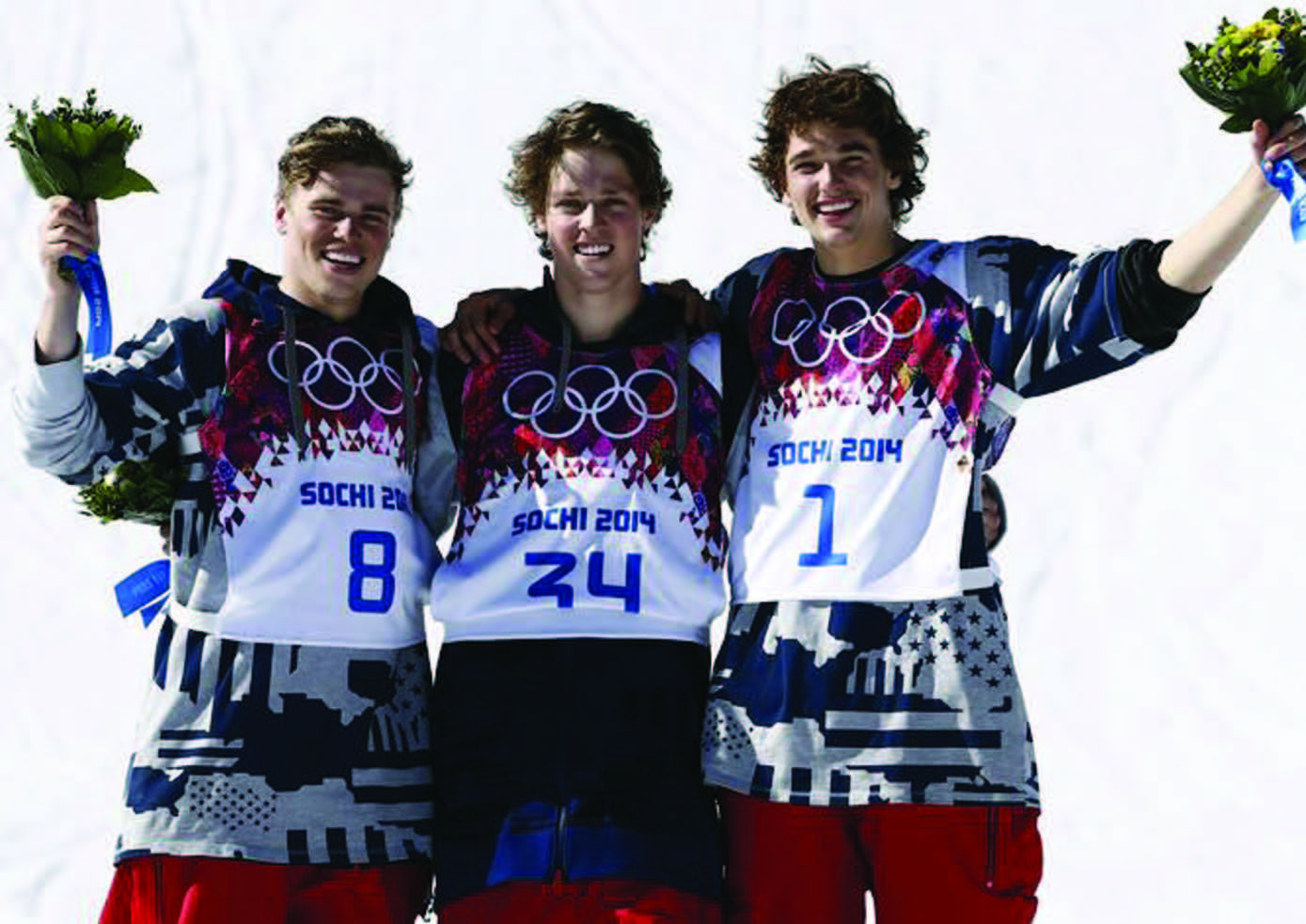
    Christensen posted three of the top four scores of the day to lead an American sweep of the medals. Christensen, a 22-year-old from Park City, scored 95.80 to win gold. Teammates Gus Kenworthy (93.6) and Nick Goepper (92.4) took silver and bronze respectively at Rosa Khutor Extreme Park. It was the first American sweep at a Winter Games since the U.S. won three medals in men’s snowboard halfpipe at the 2002 Games in Salt Lake City. Christensen, a discretionary pick on the U.S. team, posted the highest score on his first run in finals, landing a switch triple 1440 jump, a trick he only learned and then decided to insert into his run two days ago during practice.

    “I knew once I learned it I had to put it in my run if I wanted a chance to make it on the podium,” Christensen said. Christensen’s dominant day culminates what has been a difficult season for the skier, whose father, J.D., died in August. Christensen learned of his father’s death after landing in New Zealand, where he was supposed to start his season. “I hope I made my father proud,” Christensen said. “He had been supporting me since day one, through all the injuries I had, which I know scare parents a lot. He always supported me and never said stop.

    I wish he was here, but I hope he’s looking down and smiling.” Christensen was overshadowed in the leadup to the Olympics by teammates Goepper and Kenworthy, each of whom landed that elusive triple jump at the X Games in Aspen last month. But within the U.S. team once here in Sochi, the skiers and coaches considered Christensen to be the favorite, based on the way he was performing in practice. After watching Christensen’s two qualifying runs Thursday morning, teammate Bobby Brown predicted that Christensen would be “unbeatable” in the final. Brown was right, as Christensen was basically competing to top his own previous high score in each progressive round, even as Kenworthy and Goepper each landed the triple corks in their medal-winning runs.

    What made Christensen stand apart was the creativity on the upper rail section of the course, a variety of grabs during his jumps and spins to go along with the fancy new triple – a jump in which he takes off backwards, flips three times while completing four full rotations. “He’s pretty much landed it every time, and he’s got really good rotation and style,” U.S. freeskiing coach Skogen Sprang said. “I think he was kind of the rider’s favorite today, just based on the practices.” Skiers shed layers of clothing throughout the day as temperatures on the mountain were close to 50 degrees.

    Many said the course was ideal despite the warm weather, with the softer snow easing falls but not hampering speed. American skiers opted for long hoodies instead of parkas, and by the finals, Brown had even ditched that, opting to compete in just a T-shirt – the first time he’s done that in a major competition. Many of the other American skiers and snowboarders crowded the finish area to watch Team USA’s first sweep of this Games, including snowboarding slopestyle gold medalist Jamie Anderson and ski halfpipe competitors Aaron Blunck and Torrin Yater- Wallace, as well as a surprisingly pro- American crowd.

    “I mean it’s been incredible to showcase our sport to the world,” Kenworthy said. “We have an awesome course, beautiful weather and it was one of the best slopestyle competitions we’ve ever had. I really couldn’t be prouder.” Besides the three medalists, Brown also made the final and finished ninth. That Christensen, whom Sprang admitted was right on the bubble to make the team until just a few weeks ago, wound up winning was validation not just for the decision to bring him, but also an emphatic statement for the health of the freeski program. “I mean, it’s freaking amazing. I’m still kind of in shock.

    You don’t really talk about that before. The chance was there, but you don’t really expect it to happen. You can’t expect it to happen,” Sprang said. “I knew they all had a chance to medal, whether it was one of them, or two of them, or three of them, you just do what you can to get them all ready. They did their jobs, stomped their runs, and crushed it. I’m stoked for all of them.” Slopestyle skiing and snowboarding made their Winter Games debut here. American Devin Logan won silver in the women’s event Tuesday. The U.S. also won the gold medals in the snowboard slopestyle events.

  • US HAMMERS SLOVAKIA USING SIX-GOAL BARRAGE

    US HAMMERS SLOVAKIA USING SIX-GOAL BARRAGE

    SOCHI, Russia (TIP):
    With just one game to prepare for its Olympic showdown with Russia, the United States men’s hockey team decided to cram an entire tournament’s worth of hard work and highlights into one spectacular opener. Paul Stastny scored twice during a six-goal barrage in the second period, and the Americans got off to a roaring start in Sochi with a 7-1 victory over Slovakia in preliminaryround play. Ryan Kesler, David Backes, Phil Kessel and Dustin Brown also scored as the U.S. battered Slovakia for six consecutive goals in a 13:51 span, turning what was expected to be a tough matchup into a laugher with their relentless offense.

    “I guess you never really expect to beat a team like that 7-1, and you never do it in a tournament like this,” captain Zach Parise said. “We just capitalized on the chances we had, moved the puck well and used our speed.” Although their goal celebrations declined from elation to excitement to sheepishness while the score skyrocketed, the Americans answered any lingering questions about their offensive abilities and their aptitude on the big Olympic ice by decimating a Slovak roster studded with NHL players.

    “You have to do a lot of skating out there on the big ice, but I think we handled it all right,” said Kessel, who led the U.S. with two goals and an assist. Jonathan Quick made 22 saves in his Olympic debut for the U.S., which hopes to improve on its silver-medal finish in Vancouver despite a roster that isn’t thought to have the offensive power of Canada, Russia or Sweden. In their only warmup for Saturday’s game against Alex Ovechkin and the host Russians, the Americans had more than enough potency to leave Slovakia’s two goalies battered. “For the first time on the big ice for most of us, I thought we did pretty well,” Stastny said.

    “Our strengths are our puck possession and our speed, and we were really able to use both of them. All four lines just kind of clicked, and so did our D-men.” Jaroslav Halak stopped 20 shots before getting pulled when Stastny tipped home Kevin Shattenkirk’s pass to put the Americans up 5-1 with their fourth goal in 12:04. Peter Budaj replaced Halak, but Kessel and Brown piled on goals in the next 1:47. Tomas Tatar scored for Slovakia, which traveled to Sochi without high-scoring Marian Gaborik and veteran defenseman Lubomir Visnovsky due to injury.

    Nobody anticipated such a defensive collapse by a talented roster anchored by Stanley Cup-winning defenseman Zdeno Chara. Slovakia’s last two Olympic appearances have been humiliations: The Slovaks blew a third-period lead and lost to Finland in the bronze medal game in Vancouver, depriving them of their nation’s first Olympic hockey medals. “We’re going to be better,” said Tatar, the Detroit Red Wings’ young forward. “We had a solid first period and then tied it.We’ve just got to play way better in our defensive zone. I think we’re going to be ready to play the next game.

    We have a lot of talent in our locker room, and we’re going to sort it out.” John Carlson opened the scoring for the U.S. in the first period, and Tatar tied it with a nasty wrist shot in the opening minute of the second. Kesler put the Americans back ahead 1:02 later with a one-timer through Brown’s screen, and Stastny scored 1:06 later on a fat rebound of Max Pacioretty’s shot. The hits just kept coming, and the U.S. didn’t let up until Brown redirected Carlson’s pass to make it 7-1, sending the once-boisterous Slovak crowd into frustrated silence at Shayba Arena.

    Patrick Kane, T.J. Oshie and James van Riemsdyk added two assists apiece, with the speedy Kane looking particularly comfortable on the wide Olympic ice. The U.S. had lost to Slovakia in each of the teams’ two previous Olympic meetings, giving the game special meaning to Stastny. The twotime U.S. Olympian has a famous Slovak father: Hall of Famer Peter Stastny played extensively for the Czechoslovakian and Slovak national teams alongside his lengthy NHL career.

    “It was good to finally get it on the third try,” Stastny said. The Americans’ scoring outburst made their goaltending situation seem secondary for a day, but Quick still handled the Slovaks’ chances well. U.S. coach Dan Bylsma waited until Wednesday to choose Quick for the first start over Ryan Miller, who backstopped the Americans to silver medals in Vancouver while winning the tournament MVP award.

  • Top US diplomat for Europe says sorry for cursing the EU

    Top US diplomat for Europe says sorry for cursing the EU

    WASHINGTON (TIP): Washington’s new top diplomat for Europe, Victoria Nuland, apologized on February 6 to EU counterparts after she was caught cursing about the European response to the crisis in Ukraine in a bugged phone call.

    *** the EU,” Nuland allegedly says in what appeared to be a recent phone call with US ambassador to Kiev, Geoff Pyatt, which was somehow intercepted and uploaded onto YouTube accompanied by Russian captions. US officials, while not denying such a conversation took place, refused to go into details, and pointed the finger at Russia for allegedly bugging the diplomats’ phones.

    “Let me convey that she has been in contact with her EU counterparts, and of course has apologized,” State Department spokeswoman Jen Psaki said. While Psaki said she had no independent details of how the conversation was captured and uploaded onto the social networking site, she added: “Certainly we think this is a new low in Russian tradecraft.”

    White House spokesman Jay Carney alleged that the fact that it had been “tweeted out by the Russian government, it says something about Russia’s role.” Nuland, who took over late last year as assistant secretary for European affairs, and Pyatt appear to discuss President Viktor Yanukovych’s offer last month to make opposition leader Arseniy Yatsenyuk the new prime minister and Vitaly Klitschko, deputy prime minister. Both men turned the offer down.

    Nuland, who in December went down to Independence Square in Kiev in a show of support for the demonstrators, adds she has also been told that the UN chief Ban Ki-moon is about to appoint a former Dutch ambassador to Kiev, Robert Serry, as his representative to Ukraine. “That would be great I think to help glue this thing and have the UN glue it and you know, f*** the EU,” she says, in apparent frustration at policy differences.

    “We’ve got to do something to make it stick together, because you can be pretty sure that if it does start to gain altitude the Russians will be working behind the scenes to try to torpedo it,” Pyatt replies. Psaki sought to downplay any tensions with the European Union over Ukraine, which has been rocked by weeks of protests by pro-democracy protestors.

    Demonstrators were angered by Yanukovych’s sudden decision last year to abandon moves to sign an association accord with the EU, and instead solicit a financial aid package from former Soviet master, Russia. Psaki said the United States, which is mulling possible sanctions on Ukraine if it cracks down on the protests, has “been working closely” with the EU.

  • US spied on Merke’s predecessor after he opposed the Iraq war, says report

    US spied on Merke’s predecessor after he opposed the Iraq war, says report

    Snowden’s leaked documents reveal that the US spied on Schroeder for his opposition to the Iraq war.

    WASHINGTON (TIP): American intelligence services had not only spied on German Chancellor Angela Merkel, but also monitored her predecessor Gerhard Schroeder after he opposed the US plans to go to war in Iraq, suggest media reports.

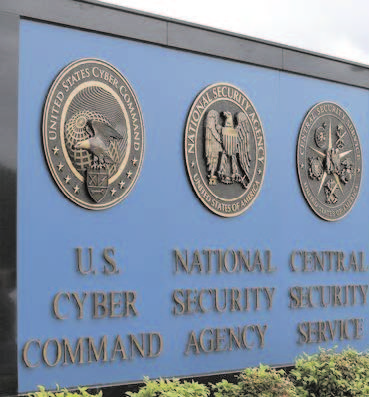
    The Sueddeutsche Zeitung newspaper and the TV channel NDR reported that their investigations based on documents leaked by former National Security Agency (NSA) contractor Edward Snowden showed that Social Democrat (SPD) Chancellor Schroeder was spied on by the NSA at least from 2002. Schroeder, who headed a coalition government with the Green party between 2001 and 2005, was listed under the number 388 in the “National Sigint Requirements List” of the NSA.

    The list contained the names of persons and institutions to be monitored by the spy agency, the reports said. Since a document leaked by Snowden in October revealed that the NSA had eavesdropped on Chancellor Merkel’s mobile phone for several years, there have been speculations that she may not be the only German leader spied on by the NSA.

    The Sueddeutsche Zeitung and NDR said their investigations showed that Schroeder’s phone may have been bugged by the NSA from 2002 and Merkel was spied on by the agency since she began her first term in 2005. US President Barack Obama assured the German chancellor recently that spying on her would not happen again during his presidency and he would not allow US intelligence operations to damage the close friendship and cooperation between the two countries.

    Schroeder’s strong opposition to the Iraq war in 2003 could have made him a target of surveillance by the US intelligence agencies as the US feared a split in the North Atlantic Alliance (NATO), the reports said. Commenting on the revelations, Schroeder said in a statement that when he was in power he “would not have thought about being monitored by American intelligence agencies; now I will not be surprised,” according to the reports.

    Green party parliament member Hans-Christian Stroebele, the only western politician to meet Snowden in Moscow since he was granted a one-year asylum by Russia in August, said he firmly believed that Schroeder and possibly other members of the SPD-Green government were spied on by the NSA. In a TV interview, Stroebele demanded a thorough clarification of the NSA surveillance operations at least since 2002 and an investigation by a German parliamentary inquiry committee, which he expects will be constituted shortly.

  • INCREDIBLE COMPLEXITY

    INCREDIBLE COMPLEXITY

    India’s politics is in disarray at a time when Delhi needs to connect the various dots and come up with a policy matrix of incredible complexity involving several interlocking templates – security situation within Afghanistan; evolving US regional priorities toward Afghanistan, Pakistan and India to optimize its ‘pivot to Asia’; rising tensions in the US’ equations with both China and Russia; US-Iranian engagement; India- Pakistan dialogue,” says the author

    The US-Pakistan Strategic Dialogue took place early last week in Washington after an interruption of three years following the American raid on Osama bin Laden’s secretive residence in Abbottabad in May 2011. These three years have been marked by much US-Pakistan discord and public acrimony.

    A brave attempt was made by both sides during Prime Minister Nawaz Sharif’s visit to the White House last October to put behind the bitterness of betrayal and get on with the relationship. But such deep wounds as Abbottabad take time to heal. At best, they could be cauterized for temporary relief. Indeed, bin Laden’s ghost was present at this week’s cogitation in Washington, as is apparent from the recent US legislation to make financial aid to Pakistan $33 million conditional on Islamabad pardoning and releasing the Pakistani doctor Shakil Afridi (who secretly helped the CIA to track down the elusive al-Qaeda leader’s hideout).

    Whereas Pakistan sees Afridi’s collaboration with the CIA as an “act of treason”, Americans hail him as a hero. In turn, Pakistan seeks the release of lady doctor Aafia Siddiqui whom the US locked up for an 80-year jail term for allegedly firing at US soldiers. While Washington regards her as a cold-blooded murderer, she is the stuff heroism in the Pakistani folklore. Clearly, this is much more than a war of words between two estranged partners.

    There is a crisis of confidence in their “spirit of cooperation”, to borrow the expression from the Pakistani foreign ministry statement condemning the US decision to link Afridi’s case to American aid. Meanwhile, hovering above is also the CIA-controlled drone mission haunting the US-Pakistan ties with President Barack Obama vaguely promising that he’d exercise greater “prudence” when Pakistani air space is violated in future and its citizens killed in missile attacks. The cup of Pakistani anger is overflowing. The testiness in the US-Pakistani ties was apparent at the strategic dialogue.

    Washington tried to inject some romance in the run-up to the strategic dialogue with the US special representative for AfPak James Dobbins even penning an article in the Pakistani media affirming that the meet would be an “important opportunity to advance a comprehensive agenda of mutually beneficial initiatives” and a sign of the “firm US commitment to advancing our relationship with Pakistan.” But in the event, the strategic dialogue ended without a compass to navigate the journey ahead. Sharif has since unilaterally ordered talks with Pakistani Taliban. For the Obama administration, the key agenda item was the post- 2014 Afghan scenario. Pakistan’s foreign and security policy advisor Sartaj Aziz said in his opening statement at the strategic dialogue meeting that the Afghan endgame provided “the overbearing and sobering background in which we are meeting to explore ways and means for transforming the post- 2014 US-Pakistan transactional relationship into a strategic partnership.”

    Strategic relationship
    Pakistan needs to know what is there in it for its interests. To quote Aziz, “At what stage does a normal transactional relationship become strategic? Are there one or more thresholds that must be crossed before a relationship can qualify as a strategic partnership?” Interestingly, Aziz proceeded to spell out the three “important prerequisites” of a US-Pakistan strategic partnership. One, “mutual trust at all levels and among all key institutions”; two, respect for each other’s security concerns; and, three, US willingness to “convey” to India Pakistan’s “legitimate concerns” with the “same intensity” with which Washington exerts “a lot of pressure” on Pakistan over “issues of concern to India”.

    Aziz dwelt on the Afghan scenario at some length to underscore that Pakistan is willing to cooperate with a “responsible and smooth drawdown” in Afghanistan and to facilitate “a continued flow of the lines of communication” as well as to “help in every possible way” the stabilization of Afghanistan “including through a comprehensive reconciliation process” – provided, of course, Islamabad could “at the same time hope that our security concerns are comprehensively addressed.” He then summed up that a resolution of the Kashmir issue would have an all-round salutary effect on the range of issues. To be sure, major security challenges lie ahead for India in the period ahead in its region.

    The USPakistani tango is a high-stakes game for both sides and it has commenced in right earnest at a juncture when the Indian government is in limbo and during the next 3-4 months at the very least, a new political order will be struggling to be born on the Raisina Hills. India’s politics is in disarray at a time when Delhi needs to connect the various dots and come up with a policy matrix of incredible complexity involving several interlocking templates – security situation within Afghanistan; evolving US regional priorities toward Afghanistan, Pakistan and India to optimize its ‘pivot to Asia’; rising tensions in the US’ equations with both China and Russia; USIranian engagement; India-Pakistan dialogue.

    The last point becomes crucial since much time has been lost in engaging Pakistan in a meaningful dialogue due to our competitive domestic politics leading to the April poll. Maybe, the Bharatiya Janata Party estimates that a new government dominated by it can always pick up the threads of Atal Behari Vajpayee’s dalliance with Sharif and, therefore, what is the hurry today about. But, as the USPakistan strategic dialogue forewarns, it will be first-rate naivety to imagine things are as simple as that. Lost time is never found again.

  • Ukraine opposition sets 24-hour deadline

    Ukraine opposition sets 24-hour deadline

    KIEV (UKRAINE) (TIP): Ukrainian opposition leaders issued a stark ultimatum to President Viktor Yanukovych on January 22 to call early elections within 24 hours or face more popular rage, after at least two protesters were killed in confrontations with police in a grim escalation of a two-monthlong political crisis. The protesters’ deaths, the first since the largely peaceful protests started in November, fueled fears that the daily demonstrations aimed at bringing down the government over its decision to shun the European Union for closer ties to Moscow and over human rights violations could turn more violent.

    With a central Kiev street ablaze and covered with thick black smoke from burning tires and several thousand protesters continuing to clash with riot police, opposition leaders urged tens of thousands of demonstrators in a nearby square to refrain from violence and remain in the main protest camp for the next 24 hours. They demanded that Yanukovych dismiss the government, call early elections and scrap harsh anti-protest legislation. It was last week’s passage of the laws cracking down on protests that set off the violent clashes.

    “You, Mr. President, have the opportunity to resolve this issue. Early elections will change the situation without bloodshed and we will do everything to achieve that,” opposition leader Vitali Klitschko told some 40,000 people who braved freezing temperatures on Kiev’s Independence Square late Wednesday. If Yanukovych does not concede, “tomorrow we will go forward together. And if it’s a bullet in the forehead, then it’s a bullet in the forehead, but in an honest, fair and brave way,” declared another opposition leader, Arseniy Yatsenyuk Yanukovych has showed little willingness to compromise, however.

    A three-hour meeting with opposition leaders accomplished “nothing,” said Oleh Tyahbnybok, who attended the session. Meanwhile, the government handed security forces extra powers, including closing off streets and firing water cannon against protesters despite the freezing temperatures. Police have already used water cannon but insisted it was only to put out fires. The government also deployed an armored personnel carrier at the site of the clashes. During Wednesday’s confrontations, riot police violently beat and shot at protesters, volunteer medics and journalists. The Interior Ministry announced that 70 protesters had been arrested.

    Prime Minister Mykola Azarov said the police did not have live ammunition and that opposition leaders should be held responsible for the deaths. City health officials and police said that two people died of gunshot wounds during the clashes Wednesday morning, while the opposition contended as many as five people died. Oleh Musiy, coordinator of the protesters’ medical corps, told the Associated Press that four people died of gunshot wounds and the fifth died after falling from a colonnaded gate at a sports arena near the site of the clashes.

    Health officials contend that man survived and is in the hospital. Hundreds of others were injured in the clashes, Musiy said. Meanwhile, another protester, Yuri Verbitsky, was found dead in a forest outside Kiev on Wednesday, according to his niece Oksana Verbitska. His friends and supporters believe he was kidnapped. The United States responded by revoking the visas of Ukrainian officials linked to violence and threatened more sanctions. But it also condemned the extreme-right radical protesters for their aggressive actions.

    The EU condemned the violence and said it was also considering action against the Ukrainian government. One of the victims was identified as Sergei Nigoyan, a 20-year-old ethnic Armenian who joined the protests in December after traveling from his home in the eastern city of Dnipropetrovsk. A video shows Nigoyan reciting poetry in the protest camp in Kiev’s Independence Square, also known as the Maidan. He then clenched his fist in a victory sign as a yellow-and-blue Ukrainian flag flapped in the background. A Ukrainian journalist, Kristina Berdinskikh, who has been profiling protesters for several weeks, interviewed Nigoyan in early January.

    “I saw on TV what is happening on the Maidan, I didn’t sleep at night, I was following the news,” Nagoyan said, according to a transcript of the interview posted online. “Then I decided to come. This is also my future.” The mass protests erupted after Yanukovych spurned a pact with the European Union in favor of close ties with Russia, which offered him a $15 billion bailout. They swelled to hundreds of thousands after a small peaceful rally on Nov. 30 was violently broken up by police.

    Seeing the government ignore their demands and opposition leaders unable to present a coherent plan or select a single
    leader, radical protesters have clashed with riot police since Sunday, hurling fire bombs and stones as police fired back with tear gas, stun grenades and rubber bullets. The two victims’ bodies were found before police moved to tear down protesters’ barricades near official buildings in central Kiev and chase demonstrators away.

    Helmeted riot police moved in on hundreds of protesters, dismantling barricades, beating many with truncheons and firing shots at some. One man was attacked by over a dozen policemen, then forced to take off his winter jacket before being dragged away, where he was beaten again. The police drove demonstrators down a hill toward the main protest site on Independence Square, where protesters have set up an extensive tent camp and rallied around the clock since Nov. 21. But the protesters soon returned, building barricades from giant sacks of snow and hurling rocks and firebombs at police lines.

    There was no immediate police move on the main camp. Oleksandr Turchynov, one of the opposition leaders, called on Ukrainians to rush to the center of Kiev to defend their country. “Ukraine will not be a dictatorship, it will be an independent, European country,” he said. “Let us defend Ukraine!” The protests were the biggest since the peaceful 2004 Orange Revolution, which annulled Yanukovych’s fraud-tinged victory in a presidential election and forced a new vote that brought his pro-Western rival to power.

    Largely peaceful, the rallies turned violent after Yanukovych, elected in 2010, pushed through sweeping anti-protest legislation and ignored all the protesters’ demands. The deaths mark a turning point in the standoff that could lead to more violence. “Look, the deaths and the injuries speak to the actions of those in power. They’ve crossed the line,” said Andriy Kolosovich, a 20-yearold protester who was injured in the legs by a stun grenade and was being treated in a medical unit set up by the protesters.

  • FOREIGN RELATIONS OF INDIA

    FOREIGN RELATIONS OF INDIA

    India has formal diplomatic relations with most nations; it is the world’s second most populous country, the world’s mostpopulous democracy and one of the fastest growing major economies. With the world’s seventh largest military expenditure, ninth largest economy by nominal rates and third largest by purchasing power parity, India is a regional power, a nascent great power and a potential superpower.

    India’s growing international influence gives it a prominent voice in global affairs. The Economist magazine argues, however, that underinvestment in diplomacy and a lack of strategic vision have minimised India’s influence in the world. India is a newly industrialised country, it has a long history of collaboration with several countries and is considered one of the leaders of the developing world along with China, Brazil, Russia and South Africa (the BRICS countries). India was one of the founding members of several international organisations, most notably the United Nations, the Asian Development Bank, G20 industrial nations and the founder of the Non-aligned movement.


    32
    India has often represented the interests of developing countries at various international platforms. Shown here is Prime Minister Manmohan Singh with Dmitry Medvedev, Hu Jintao and Luiz Inácio Lula da Silva during BRIC summit

    India has also played an important and influential role in other international organisations like East Asia Summit, World Trade Organisation, International Monetary Fund (IMF), G8+5 and IBSA Dialogue Forum. Regionally, India is a part of SAARC and BIMSTEC. India has taken part in several UN peacekeeping missions and in 2007, it was the secondlargest troop contributor to the United Nations.[12] India is currently seeking a permanent seat in the UN Security Council, along with the G4 nations. India’s relations with the world have evolved since the British Raj (1857–1947), when the British Empire monopolised external and defence relations. When India gained independence in 1947, few Indians had experience in making or conducting foreign policy. However, the country’s oldest political party, the Indian National Congress, had established a small foreign department in 1925 to make overseas contacts and to publicise its freedom struggle.

    From the late 1920s on, Jawaharlal Nehru, who had a longstanding interest in world affairs among independence leaders, formulated the Congress stance on international issues. As a member of the interim government in 1946, Nehru articulated India’s approach to the world. India’s international influence varied over the years after independence. Indian prestige and moral authority were high in the 1950s and facilitated the acquisition of developmental assistance from both East and West. Although the prestige stemmed from India’s nonaligned stance, the nation was unable to prevent Cold War politics from becoming intertwined with interstate relations in South Asia.


    33

    In the 1960s and 1970s India’s international position among developed and developing countries faded in the course of wars with China and Pakistan, disputes with other countries in South Asia, and India’s attempt to balance Pakistan’s support from the United States and China by signing the Indo- Soviet Treaty of Friendship and Cooperation in August 1971. Although India obtained substantial Soviet military and economic aid, which helped to strengthen the nation, India’s influence was undercut regionally and internationally by the perception that its friendship with the Soviet Union prevented a more forthright condemnation of the Soviet presence in Afghanistan. In the late 1980s, India improved relations with the United States, other developed countries, and China while continuing close ties with the Soviet Union. Relations with its South Asian neighbours, especially Pakistan, Sri Lanka, and Nepal, occupied much of the energies of the Ministry of External Affairs.

    In the 1990s, India’s economic problems and the demise of the bipolar world political system forced India to reassess its foreign policy and adjust its foreign relations. Previous policies proved inadequate to cope with the serious domestic and international problems facing India. The end of the Cold War gutted the core meaning of nonalignment and left Indian foreign policy without significant direction. The hard, pragmatic considerations of the early 1990s were still viewed within the nonaligned framework of the past, but the disintegration of the Soviet Union removed much of India’s international leverage, for which relations with Russia and the other post-Soviet states could not compensate. After the dissolution of the Soviet Union, India improved its relations with the United States, Canada, France, Japan and Germany. In 1992, India established formal diplomatic relations with Israel and this relationship grew during the tenures of the Bharatiya Janata Party (BJP) government and the subsequent UPA (United Progressive Alliance) governments.

    In the mid-1990s, India attracted the world attention towards the Pakistan-backed terrorism in Kashmir. The Kargil War resulted in a major diplomatic victory for India. The United States and European Union recognised the fact that Pakistani military had illegally infiltrated into Indian territory and pressured Pakistan to withdraw from Kargil. Several anti-India militant groups based in Pakistan were labeled as terrorist groups by the United States and European Union. India has often represented the interests of developing countries at various international platforms. Shown here are Prime Minister Manmohan Singh with Dmitry Medvedev, Hu Jintao and Luiz Inácio Lula da Silva during BRIC summit in June, 2009. In 1998, India tested nuclear weapons for the second time which resulted in several US, Japanese and European sanctions on India.

    India’s then-defence minister, George Fernandes, said that India’s nuclear programme was necessary as it provided a deterrence to potential Chinese nuclear threat. Most of the sanctions imposed on India were removed by 2001. After the 11 September attacks in 2001, Indian intelligence agencies provided the U.S. with significant information on Al-Qaeda and related groups’ activities in Pakistan and Afghanistan. India’s extensive contribution to the War on Terror, coupled with a surge in its economy, has helped India’s diplomatic relations with several countries. Over the past three years, India has held numerous joint military exercises with U.S. and European nations that have resulted in a strengthened U.S.-India and E.U.-India bilateral relationship. India’s bilateral trade with Europe and United States has more than doubled in the last five years.

    India has been pushing for reforms in the UN and WTO with mixed results. India’s candidature for a permanent seat at the UN Security Council is currently backed by several countries including France, Russia,[50] the United Germany, Japan, Brazil, Australia and UAE. In 2004, the United States signed a nuclear co-operation agreement with India even though the latter is not a part of the Nuclear Non- Proliferation Treaty. The US argued that India’s strong nuclear non-proliferation record made it an exception, however this has not persuaded other Nuclear Suppliers Group members to sign similar deals with India. During a state visit to India in November 2010, US president Barack Obama announced US support for India’s bid for permanent membership to UN Security Council as well as India’s entry to Nuclear Suppliers Group, Wassenaar Arrangement, Australia Group and Missile Technology Control Regime.

  • ENHANCING CAPABILITIES

    ENHANCING CAPABILITIES

    DEFENSE
    With personnel strength of 1.1 million soldiers (6 regional commands, a training command, 13 corps, and 38 divisions), the Indian Army has kept the nation together through various crises, including four wars since Independence, Pakistan’s “proxy war” in J&K since 1989–90, and insurgencies in many of the northeastern states.

    Given its large-scale operational commitments on border management and counterinsurgency, the army cannot afford to reduce its manpower numbers until these challenges are overcome. Many of its weapons and equipment are bordering on obsolescence and need to be replaced. The next step would be to move gradually toward acquiring network-centric capabilities for effects-based operations so as to optimize the army’s full combat potential for defensive and offensive operations.

    The army is also preparing to join the navy and the air force in launching intervention operations in India’s area of strategic interest when called on to do so in the future. Lieutenant General J.P. Singh (retired), former deputy chief of the army staff (planning and systems), stated in an interview with the CLAWS Journal that “the critical capabilities that are being enhanced to meet challenges across the spectrum include battlefield transparency, battlefield management systems, nightfighting capability, enhanced firepower, including terminally guided munitions, integrated maneuver capability to include self-propelled artillery, quick reaction surface-to-air missiles, the latest assault engineer equipment, tactical control systems, integral combat aviation support and network centricity.” [6] The army’s mechanized forces are still mostly “night blind.”

    Its artillery lacks towed and self-propelled 155- mm howitzers for the plains and the mountains and has little capability by way of multi-barrel rocket launchers and surface-to-surface missiles. Infantry battalions urgently need to acquire modern weapons and equipment for counterinsurgency and counterterrorism operations to increase operational effectiveness and lower casualties. Main battle tanks (MBT) and infantry combat vehicles (ICV) are the driving forces of India’s conventional deterrence in the plains. This fleet is being modernized gradually by inducting two regiments of the indigenously developed Arjun MBT and importing 310 T-90S MBTs from Russia. A contract has also been signed for 347 additional T-90S tanks to be assembled in India. The BMP-1 and BMP-2 Russian ICVs, which have long been the mainstay of the mechanized infantry battalions, need to be replaced as well.

    The new ICVs must be capable of performing internal security duties and counterinsurgency operations in addition to their primary role in conventional conflicts. Artillery modernization plans include the acquisition of towed, wheeled, and self-propelled 155- mm guns and howitzers for the plains and the mountains through import as well as indigenous development. The Corps of Army Air Defence is also faced with problems of obsolescence. The vintage L-70 40-mm air defense (AD) gun system, the four-barreled ZSU-23-4 Schilka (SP) AD gun system, the SAM-6 (Kvadrat), and the SAM-8 OSA-AK, among others, need to be replaced by more responsive modern AD systems that are capable of defeating current and future threats.

    The modernization of India’s infantry battalions is moving forward but at a similarly slow pace. This initiative is aimed at enhancing the battalions’ capability for surveillance and target acquisition at night and boosting their firepower for precise retaliation against infiltrating columns and terrorists hiding in built-up areas. These plans include the acquisition of shoulder-fired missiles, hand-held battlefield surveillance radars, and hand-held thermal imaging devices for observation at night. A system called F-INSAS (future infantry soldier as a system) is also under development. One infantry division has been designated as a rapid reaction force for employment on land or in intervention operations and will have one amphibious brigade and two air assault brigades. Similarly, the

    Indian Army proposes to substantially enhance the operational capabilities of army aviation, engineers, signal communications, reconnaissance, surveillance, and target acquisition branches in order to improve the army’s overall combat potential by an order of magnitude. Modern strategic and tactical level command and control systems need to be acquired on priority for better synergies during conventional and sub-conventional conflict. Plans for the acquisition of a mobile corps-to-battalion tactical communications system and a battalion-level battlefield management system likewise need to be hastened. Despite being the largest user of space, the army does not yet have a dedicated military satellite for its space surveillance needs. Cyberwarfare capabilities are also at a nascent stage. The emphasis thus far has been on developing protective capabilities to safeguard Indian networks and C4I2SR (command, control, communications, computers, intelligence, information, surveillance, and reconnaissance) from cyberattack. Offensive capabilities have yet to be adequately developed. All these capabilities will make it easier for the army to undertake joint operations with multinational forces when the need arises and the government approves such a policy option.

    INDIAN DEFENSE POWER AND MISSILE SYSTEMS


    26

    • Indian Army is the 3rd biggest military contingent in the World after USA and China.
    • India’s indigenous nuclear-powered ICBM (Inter-Continental Ballistic Missile) AGNI-V puts India into the Elite Club consisting of USA, China, France and Russia.
    • India claims AGNI-V to have a reach of 5,000 kms to which Chinese and Australian delegates and experts suspect to have a range of 8,000 kms. and that India is hiding these facts just to avoid any concern from foreign countries.
    • AGNI-VI(being built) will have a range of 10,000 kms. which would give India the power to strike in any part of the world barring South America and very small parts of North America.
    • India’s cruise missile (being tested) NIRBHAYA is a cruise nuclearwarhead missile which when blasted, takes the form of a plane and when the target is in nearby range, attacks it with a random procedure thus eliminating the probability of it getting stopped by any anti-missile system as its process is itself not defined. In other words-unstoppable.

    • In the hilly terrains, it gives an advantage as the missile goes from the side of the mountains and attacks the target from the rear side.
    • The missile BrahMos-2 (built under collaboration with Russia)(under testing)(Named after its rivers Brahmaputra+Moscow) is the fastest hypersonic missile in the world travelling at a speed of Mach-7 (7 times the speed of sound in air).
    • India’s INS-Vikrant (bought from the UK) is the first nuclear-powered aircraft carrier of India.
    • The HMS Harriers(airplanes on INS VIRAAT) are one of its kind which has the ability of vertical landing and take-off.
    • INS Viraat: Centaur class carrier (ex-HMS Hermes) in service since 1987.
    • INS Vikramaditya : Modified Kiev class carrier (ex-Admiral Gorshkov) due in service October 2013.
    • INS Vikrant: 40,000 ton Vikrant class carrier. It is being built at Cochin Shipyard and is expected to enter service in 2017.
    • INS Vishal: 65,000 ton Vikrant-class carrier. Expected to enter service in 2022.
    • India’s INS-ARIHANT is the first indigenous(built completely in India, by India) nuclear powered submarine in India. It has a capability to shoot missiles with nuclear war-heads even after being at some tens of kilometers beneath the water-level.
    • The Sukhoi Su-30MKI, Dassault Mirage 2000, and MiG-29 serve in the Indian Air Force and are also seen as a means to deliver nuclear weapons.
    • In addition India maintains SEPECAT Jaguar and MiG-27M which can be used to drop gravity bombs.
    • The new in queue for the indigenous aircraft of India is HAL-Tejas
    • It integrates technologies such as relaxed static stability, fly-by-wire flight control system, multi-mode radar, integrated digital avionics system, composite material structures, and a flat rated engine.
    • It is a tailless, compound delta-wing design powered by a single engine.
    • Indian Army is the 3rd biggest military contingent in the World after USA and China.
    • India’s indigenous nuclear-powered ICBM (Inter-Continental Ballistic Missile) AGNI-V puts India into the Elite Club consisting of USA, China, France and Russia.
    • India claims AGNI-V to have a reach of 5,000 kms to which Chinese and Australian delegates and experts suspect to have a range of 8,000 kms. and that India is hiding these facts just to avoid any concern from foreign countries.
    • AGNI-VI(being built) will have a range of 10,000 kms. which would give India the power to strike in any part of the world barring South America and very small parts of North America.
    • India’s cruise missile (being tested) NIRBHAYA is a cruise nuclearwarhead missile which when blasted, takes the form of a plane and when the target is in nearby range, attacks it with a random procedure thus eliminating the probability of it getting stopped by any anti-missile system as its process is itself not defined. In other words-unstoppable.
    • In the hilly terrains, it gives an advantage as the missile goes from the side of the mountains and attacks the target from the rear side.
    • The missile BrahMos-2 (built under collaboration with Russia)(under testing)(Named after its rivers Brahmaputra+Moscow) is the fastest hypersonic missile in the world travelling at a speed of Mach-7 (7 times the speed of sound in air).
    • India’s INS-Vikrant (bought from the UK) is the first nuclear-powered aircraft carrier of India.
    • The HMS Harriers(airplanes on INS VIRAAT) are one of its kind which has the ability of vertical landing and take-off.
    • INS Viraat: Centaur class carrier (ex-HMS Hermes) in service since 1987.
    • INS Vikramaditya : Modified Kiev class carrier (ex-Admiral Gorshkov) due in service October 2013.
    • INS Vikrant: 40,000 ton Vikrant class carrier. It is being built at Cochin Shipyard and is expected to enter service in 2017.
    • INS Vishal: 65,000 ton Vikrant-class carrier. Expected to enter service in 2022.
    • India’s INS-ARIHANT is the first indigenous(built completely in India, by India) nuclear powered submarine in India. It has a capability to shoot missiles with nuclear war-heads even after being at some tens of kilometers beneath the water-level.
    • The Sukhoi Su-30MKI, Dassault Mirage 2000, and MiG-29 serve in the Indian Air Force and are also seen as a means to deliver nuclear weapons.
    • In addition India maintains SEPECAT Jaguar and MiG-27M which can be used to drop gravity bombs.
    • The new in queue for the indigenous aircraft of India is HAL-Tejas
    • It integrates technologies such as relaxed static stability, fly-by-wire flight control system, multi-mode radar, integrated digital avionics system, composite material structures, and a flat rated engine.
    • It is a tailless, compound delta-wing design powered by a single engine.


    27

  • ‘Russian spy’ tag absurd, I acted alone, Snowden says

    ‘Russian spy’ tag absurd, I acted alone, Snowden says

    WASHINGTON (TIP): Edward Snowden has rejected suggestions he was a Russian spy, saying in remarks published on January 22 that he acted alone in exposing US surveillance programmes.

    “This ‘Russian spy’ push is absurd,” the US fugitive told The New Yorker. In an interview, the magazine said was carried out by “encrypted means” from Moscow, Snowden said he “clearly and unambiguously acted alone, with no assistance from anyone, much less a government.”

    On Sunday two Republican lawmakers had hinted Snowden may’ve acted in concert with a foreign power, possibly Moscow. House Intelligence Committee chairman Mike Rogers, for one, said at a talk show that he didn’t think “it was a gee-whiz luck event that (Snowden) ended up in Moscow under the handling of the FSB” (Russian state security agency).

    Michael McCaul, chairman of House Homeland Security Committee, said he could not say “definitively” that Russia was involved, “but I believe he was cultivated.” Meanwhile, Snowden is standing as a candidate for rector of Glasgow University in Scotland after students nominated him for exposing US intelligence secrets, the university said. agencies

  • On February 16,

    On February 16,

    On February 16, a meteorite exploded over Chelyabinsk in Russia and rained fireballs over a vast area that damaged property and injured over 1,000 people.

  • 5 bullet-riddled bodies found near Sochi, Russia on high alert

    5 bullet-riddled bodies found near Sochi, Russia on high alert

    MOSCOW (TIP): Russia on Thursday launched a counterterrorism operation after five bullet-riddled bodies were found in a region bordering the Winter Olympic host Sochi, just weeks before the Games’ start. Two districts in the southern Stavropol region were placed on high alert after the bodies were discovered in parked cars, at least one of them apparently booby-trapped, the regional authorities said.

    “A counterterrorism operation has been launched from January 9 in the Predgorny and Kirov districts of the Stavropol region,” the regional administration said. The authorities launched the most sweeping security operation in Olympic history, a month before Russia’s first post-Soviet Games kick off on February 7. Russia particularly fears attacks by Islamist militants from the North Caucasus during the prestigious event, after two suicide bombings at a rail station and in a trolleybus last month in the southern city of Volgograd killed 34.

    As police examined a car in Stavropol which had the body of a local resident, an explosive device went off around 65 feet away. Officers then defused another device nearby. Two other bodies were identified as local cabbies and were found in the car’s back seat and in the boot. The remaining two bodies were found in a parked car, Interfax cited the FSB as saying.

  • US charges 49 Russian diplomats with healthcare fraud

    US charges 49 Russian diplomats with healthcare fraud

    NEW YORK (TIP): US prosecutors have charged 49 current and former Russian diplomats and their family members with participating in a scheme to get health benefits intended for the poor by lying about their income. The charges come against a backdrop of tense exchanges between Russia and the United States over law enforcement actions in both countries. According to the charges, filed in November and unsealed on Thursday, the diplomats’ families got around $1.5 million in benefits from the Medicaid program for families with low monthly incomes – in many cases around $3,000 or less. The benefits covered costs related to pregnancies, births and infant care, the charges say. Meanwhile, according to the charges, the family members had their housing costs paid for by the Russian government and spent “tens of thousands of dollars” on vacations, jewelry and luxury goods from stores like Swarovski and Jimmy Choo.

    Each of the 49 people was charged with one count of conspiracy to commit healthcare fraud and one count of conspiracy to steal government funds and make false statements relating to healthcare matters, according to the charges. “We are puzzled by the stovepiping of information to the media about accusations against Russian diplomatic mission officials in the US,” Russian Deputy Foreign Minister Sergei Ryabkov told Interfax news agency. “One does not understand why the (US) institutions involved considered it possible to make these accusations public without discussing (them) through diplomatic channels.” A spokesman for the Federal Bureau of Investigation, Peter Donald, said no one was arrested. US attorney Preet Bharara said at a Manhattan press conference that the US State Department would have had to request a waiver of immunity from Russia in order for US authorities to arrest the defendants.

    If no waiver is granted, Bharara said the State Department can insist that the defendants leave the country. “Diplomacy should be about extending hands, not picking pockets in the host country,” he said. Bharara declined to say how the charges might affect US-Russia relations. He said his office has not been in contact with the White House. A spokeswoman for the State Department did not immediately respond to a request for comment. The Russian mission to the United Nations was not immediately available for comment on the case. The charges say the defendants obtained letters to prove their false incomes from officials at the Russian UN mission, including a former counselor and a former second secretary, as well as from former top officials at the Consulate General of the Russian Federation in New York and the Trade Representation of the Russian Federation in the USA.

  • NO ONE CAN FEEL SECURE IN CHINA: TOP US OFFICIAL

    NO ONE CAN FEEL SECURE IN CHINA: TOP US OFFICIAL

    WASHINGTON (TIP): A top Obama administration official has said that no one can feel secure in China as the country impose strict restrictions on the fundamental rights of its people. “The Chinese people are facing increasing restrictions, on their freedoms of expression, assembly and association. When people in China cannot hold public officials to account for corruption, environmental abuses, problems that affect China as well as the world go unaddressed,” US National Security Advisor Susan Rice said in her major policy speech on human rights. “When courts imprison political dissidents who merely urge respect for China’s own laws, no one in China – including Americans doing business there – can feel secure.

    “When ethnic and religious minorities, such as Tibetans and Uyghurs, are denied their fundamental freedoms, the trust that holds diverse societies together is undermined. Such abuses diminish China’s potential from the inside,” Rice said. Rice said in this new century, there are few relationships more complex or important than the one between the United States and China. Building a constructive relationship with China is crucial to the future security and prosperity of the world as a whole.

    “We value China’s cooperation on certain pressing security challenges, from North Korea to Iran. Our trade relationship, one of the largest in the world, supports countless American jobs. And that is precisely why we have a stake in what kind of power China will become, and that is why human rights are integral to our engagement with China,” she said. “So the United States speaks clearly and consistently about our human rights concerns with the Chinese government at every level, including at this year’s summit between President Obama and President Xi at Sunnylands,” she said.

    US officials engage their Chinese counterparts directly on specific cases of concern, like that of Liu Xiaobo, as well as about broader patterns of restrictive behaviour. “We voice our condemnation publicly when violations occur,” Rice said. In her speech, Rice said China is not the only country where human rights of people are being violated. She castigated Russia for its anti human rights deeds. “The same is true of Russia … we don’t remain silent about the Russia government’s systematic efforts to curtail the actions of Russian civil society, to stigmatise the LGBT community, to coerce neighbours like Ukraine who seek closer integration with Europe, or to stifle human rights in the North Caucasus,” she said.

  • The Geopolitics of Nuclear Proliferation

    The Geopolitics of Nuclear Proliferation

    AS I SEE IT

    It is not easy for Iran and the US to end mutual hostility

    The author sees no end to three decades of mutual hostility and suspicion between Iran and the US.

    Just after the foreign ministers of the self-styled “international community” (comprising the EU members and the US) together with their Russian and Chinese counterparts met the Iranian Foreign Minister in Geneva, the Foreign Ministers of India, China and Russia issued a statement which recognized “the right of Iran to peaceful uses of nuclear energy, including for uranium enrichment, under strict IAEA safeguards and consistent with its international obligations”.

    This was an important declaration as the Republican right wing in the US, egged on by a predictable alliance of Israel and Saudi Arabia, would like to scuttle any possibility of an agreement that ends sanctions against Iran in return for Iran accepting safeguards mandated by the IAEA on all its nuclear facilities. Israel wants a termination of uranium enrichment and plutonium production in Iran, together with an end to Iran’s implacable hostility to its very existence. American policies on clandestine nuclear enrichment have been remarkably inconsistent. The country responsible for triggering the proliferation of centrifugebased uranium enrichment technology was the Netherlands.

    It was the Dutch who carelessly granted A.Q. Khan access to sensitive design documents on centrifuge enrichment technology when he worked at the Holland-based Physical Dynamic Research Laboratory, a sub-contractor of the “Ultra Centrifuge Nederland”. Former Dutch Prime Minister Ruud Lubbers has revealed that after Khan’s activities came to light, he was prepared to arrest Khan in Holland, but was prevented from doing so in 1975 and 1986 by the CIA. It is well known that the Reagan Administration had tacitly assured Pakistan that it would look the other way at Pakistani efforts to build the bomb.

    If President Reagan looked the other way at Pakistani proliferation, President Clinton winked at Chinese proliferation involving the transfer of more modern centrifuges, nuclear weapon designs and ring magnets apart from unsafeguarded plutonium facilities to Pakistan. The A.Q. Khan-Iranian nexus goes back to the days of Gen Zia-ul-Haq when the Iranians received the knowhow for uranium enrichment from Khan. Iran is now known to possess an estimated 19,000 centrifuges, predominantly at its enrichment facilities in Natanz.

    It has an old plutonium reactor used for medical isotopes which, it says, is to be replaced by a larger reactor together with reprocessing facilities being built at Arak. Given the clandestine nature of its nuclear program, its activist role in the Islamic world and its virulent anti-Semitism, Iran’s nuclear program has invited international attention. This has resulted in seven UN Security Council Resolutions since 2006, which called on Iran to halt enrichment and even led to the freezing of assets of persons linked to its nuclear and missile programs.

    There have also been cyber attacks (Stuxnet) by the Americans and the killing of some of Iran’s key scientists, believed by the Iranians to have been engineered by the Israelis. While Iran’s nuclear program enjoys widespread domestic support,what have really hurt the Iranians are the crippling economic sanctions by the US and its European allies. These sanctions have led to the shrinking of its oil exports and spiraling of inflation. They have been crucial factors compelling Iran to seek a negotiated end to sanctions, without giving up its inherent right to enrich uranium that it enjoys under the NPT.

    Crucially, the US can now afford to review its policies in the Middle East. Its dependence on oil imports from the Persian Gulf has ended, its oil production will exceed that of Saudi Arabia in the next five years and it is set to become a significant exporter of natural gas. The emergence of Saudi backing for al Qaeda-linked Salafi extremists in Iraq and Syria is not exactly comforting as the Americans prepare to pull out of Afghanistan. While the Obama Administration may make soothing noises to placate the ruffled feathers in Riyadh and Jerusalem, rapprochement with Iran does widen its options in the Muslim world at a time when Iranian Foreign Minister Mohammad Javad Sharif proclaims that Shia-Sunni tensions are “the most serious threat not only to the region but to the world at large”.

    But it would be unrealistic to expect that negotiations between the P 5 and Germany on the one hand and the Iranians on the other will produce any immediate end to the Iranian nuclear impasse. The Israelis and the Saudis, who wield immense clout in the Republican right wing, the US Congress and in many European capitals will spare no effort to secure support for conditions that the Iranians would not agree to. Iran already has one nuclear power plant built by the Russians at Bushehr, with another 360 MW plant under construction at Darkhovin. It currently has stockpiles of uranium enriched to either 3.5%, which can be used in power reactors, or to 20%, which can be relatively easily further enriched and made weapons grade.

    The Iranians are reported to have agreed that the highly enriched uranium will be converted into fuel rods or plates. Iran has an old plutonium reactor for medical isotopes, which it requires to shut down. It is constructing a larger plutonium research reactor at the city of Arak. The Iranians claim that the reactor at Arak is set to replace the existing plutonium reactor, which is being shut down. This is not an explanation that skeptics readily buy. In the negotiations at Geneva, France reportedly took a hard-line position, demanding that the construction of the Arak plutonium reactor should stop and that there should be no reference to Iran’s “right” to enrich uranium.

    This is not surprising. France has recently concluded a $1.8 billion arms deal with Saudi Arabia and is the recipient of large Saudi investments in its sagging agricultural sector. The Iranians are hard bargainers and will not unilaterally give any concessions unless these are matched by a corresponding and simultaneous lifting of economic sanctions. Having already concluded an agreement with the IAEA, granting the IAEA access to its uranium mine and heavy water plant, Iran is unlikely to agree to yield to demands to stop the construction of its new plutonium reactor.

    More importantly, given the continuing gridlock in Washington between the Obama Administration and the Republican-dominated Senate, the Obama Administration will not find it easy to secure Congressional approval for easing sanctions against Iran, especially in the face of Israeli and Saudi opposition. It is not going to be easy for Iran and the US to end over three decades of mutual hostility and suspicion.