Tag: Russia

  • As Ukraine war drags on, US arms firms make a killing

    As Ukraine war drags on, US arms firms make a killing

    The US sold military hardware, services and technical data to its clients worth $153.7 bn in 2022, up from $103.4 bn the year before.

    “With the deterioration of global security, particularly after the commencement of the Ukraine war, US arms sales have been on the rise. Last year, US defense companies reaped huge dividends selling their weapons and defense platforms to their clients in Asia, Europe and Africa. Latest data shows that 2022 saw an increase of $51.9 billion in the sale of weapons. Most of it is largely due to the Russia-Ukraine war, where the US is backing Ukraine.”

    By Maroof Raza

    Russian President Vladimir Putin made a candid admission at Sochi in June. He acknowledged that Moscow’s troops were experiencing a shortage of modern weapons and expressed hope that the country’s military industry would soon be able to meet their growing demand amid the Ukraine war. One of the critical reasons for the shortage is the global sanctions that have imposed curbs on the acquisition of sophisticated parts used in the production of a variety of weapons and their auxiliary systems. This has led to a shortfall of main battle tanks and ballistic missiles. Besides, using cruise missiles is a costly affair. Thus, the recent visit by North Korean leader Kim Jong Un to Russia attracted much attention. Apart from North Korea, Russia is getting help from Belarus, China and Iran in maintaining its ammunition stocks.

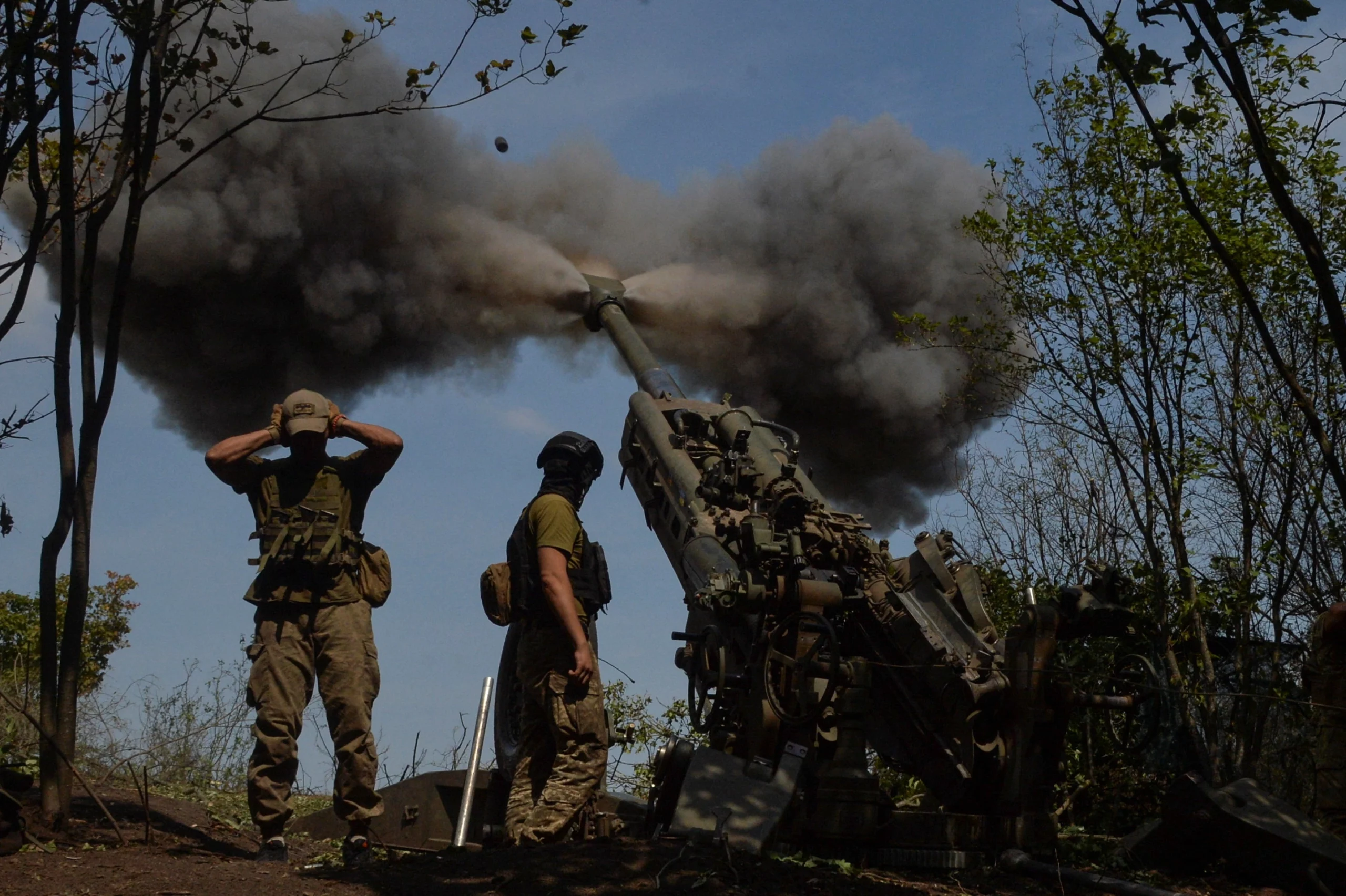
    Manned and unmanned aircraft, missiles and electronic warfare equipment require modern, high-tech components such as microchips and ball bearings. Russia faces challenges in sourcing these components adequately from domestic suppliers and importing them — as it did before the present conflict — from North America and Europe due to the sanctions. Now, Russia is forced to replace imports of critical components with supplies from China or Malaysia, which do not match the quality standards of those from the West. Another significant reason for Moscow’s urgent need to go shopping for ammunition from sources other than the usual ones is the extensive and disproportionate use of artillery by the Russian military.

    Swarms of Shahed 136 drones have been supplied to Moscow from Iran, and these have wreaked havoc on Ukrainian cities. China has repeatedly denied sending military equipment to Russia since Moscow’s all-out invasion of its neighboring country, even though the two nations signed a ‘no-limits’ partnership in February 2022. The US Secretary of State, Antony Blinken, warned China earlier this year that there would be ‘consequences’ if Beijing were to provide materiel support to Russia for its conflict in Ukraine.

    Russia can also fall back on its ammunition stocks and older weapon systems from the Cold War era. Battlefield losses and Western sanctions have left the Russian military in a state of decline, but Moscow will still have enough firepower to extend the war in Ukraine, according to the Centre for Strategic and International Studies (CSIS). It gives stark numbers of Russian military losses — almost 10,000 units of key equipment, such as tanks, trucks, artillery pieces and aerial drones, according to one estimate.

    But it also says that Russia can utilize Cold War-era and older stocks on the frontlines to make up in numbers what it may have lost in terms of technology. “The quality of the Russian military in terms of advanced equipment will likely decline, at least over the near term,” the CSIS report says. “Moscow is under pressure to adapt, often turning to less-reliable and costlier suppliers and supply routes, lower-quality imports, or trying to reproduce Western components internally. This is likely hampering the rate and quality of Russian defense production,” the report says.

    It cautions that Ukraine and its Western supporters should not expect a swift resolution to the hostilities due to these supply issues. Russia still retains numerical advantages over Ukraine, the report adds, because it has large inventories in reserve. “Russia’s military capabilities still greatly outnumber those of Ukraine on most indicators of air, land and naval power,” the report says.

    “While an accurate count of Moscow’s current military stocks is not available publicly, it has been roughly estimated that, as of February 2023, the total number of aircraft at the Kremlin’s disposal has been 13-15 times more than Kyiv’s. Russia has nearly seven to eight times more tanks and four times more armored fighting vehicles, while its naval fleet is 12-16 times larger than Ukraine’s,” it says. These numerical advantages will enable Moscow to run a war of attrition over the next year, throwing numbers on the battlefield until Ukraine, even with fewer losses, runs out of hardware, the report observes.

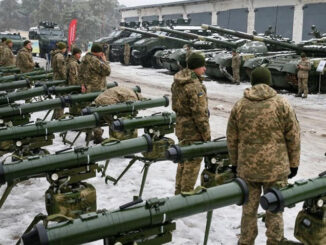
    While Russia’s military-industrial complex is struggling, its US counterpart is reaping the benefits. This can be ascertained by a recent report published by the Congressional Research Service (CRS) titled, ‘US Security Assistance to Ukraine’. The United States has been a leading provider of security assistance to Ukraine, particularly since Russia launched its renewed and expanded invasion of Ukraine on February 24, 2022. From 2014, when Russia first invaded Ukraine, to August 22, 2023, the US has committed more than $46 billion in security assistance “to help Ukraine preserve its territorial integrity, secure its borders and improve interoperability with NATO”, according to the State Department.

    With the deterioration of global security, particularly after the commencement of the Ukraine war, US arms sales have been on the rise. Last year, US defense companies reaped huge dividends selling their weapons and defense platforms to their clients in Asia, Europe and Africa. Latest data shows that 2022 saw an increase of $51.9 billion in the sale of weapons. Most of it is largely due to the Russia-Ukraine war, where the US is backing Ukraine.

    Several European countries have started arming themselves as they perceive a threat from Russia. American defense companies are on a high. They have received new orders for military equipment as these nations strengthen their defenses. As the data shows, the US sold military hardware, services and technical data to its clients worth $153.7 billion in 2022, up from $103.4 billion the year before. The State Department data claims that the increase in the sale of defense products is attributed to the crisis in Ukraine, where the US government has authorized massive supplies. The Ukraine war has also caused huge insecurity among European nations like Germany, Poland and Spain, which have started arming their defense forces, fearing the unintended consequences of this long-drawn-out war could very well spill over to their borders.
    (The author is a Strategic Affairs Analyst)

  • Oil prices extend rapid descent on demand worries

    Oil prices extend rapid descent on demand worries

    HOUSTON (TIP)- Oil prices fell about 2% on Thursday, October 5, extending the previous session’s nearly 6% losses, as an uncertain demand outlook overshadowed an OPEC+ decision to maintain oil output cuts, keeping supply tight.
    Global benchmark Brent crude futures have declined about $10 a barrel in less than 10 days after edging close to $100 in late September. The combined percentage drop over the last two days was the steepest since May for both crude benchmarks.
    Brent futures fell $1.38, or 1.6%, to $84.43 by 1:41 p.m. ET (1741 GMT). U.S. West Texas Intermediate crude futures were $1.38 cents, or 1.6%, lower at $82.83.
    “This is typical speculative trading activity – trying to make the best out of a bad situation after the bloodbath on Wednesday, and they (market participants) are trying to pick the bottom,” said Bob Yawger, director of energy futures at Mizuho.
    Oil settled more than $5 lower on Wednesday – its biggest daily drop in over a year, even after a meeting of a ministerial panel of OPEC+, the Organization of the Petroleum Exporting Countries and allies led by Russia.
    It made no changes to the group’s oil output policy, and Saudi Arabia said it would maintain a voluntary cut of 1 million barrels per day (bpd) until the end of 2023, while Russia would keep a 300,000 bpd voluntary export curb until the end of December.
    However, investors are worried that peak demand for fuel consumption is behind us, said Dennis Kissler, senior vice president of trading at BOK Financial, adding that hedge funds liquidated heavily on fears that higher interest rates with inflation would sap fuel demand. “The market is searching for an equilibrium,” Kissler said.
    Close-to-close volatility on Brent was at its highest since May, while that on WTI was its highest since June. The market will be in deficit through the fourth quarter and the softer prices reduce the probability OPEC will ease supply constraints, National Australia Bank analysts said. Government data on Wednesday also showed a sharp decline in U.S. gasoline demand. Finished motor gasoline supplied, a proxy for demand, fell last week to its lowest since the start of this year.
    “I don’t see gasoline demand getting much above 8.5 million barrels a day until the holiday shopping season kicks in and that’s going to be a problem for the market,” said John Kilduff, partner at Again Capital LLC in New York.
    Other data on Wednesday showed the U.S. services sector slowed while the euro zone economy probably shrank last quThe U.S. dollar eased, but continued to remain near 11-month highs, making crude more expensive for foreign buyers. On Thursday, the Turkish energy minister said a crude oil pipeline from Iraq through Turkey, which has been suspended for about six months, was ready for operations. Source: Reuters

  • At least 385 deported Ukraine children returned from Russia: NGO

    VIENNA (TIP): At least 385 Ukrainian children deported to Russia have been returned home, an Austria-based international charity involved in some of the repatriations confirmed on August 11.
    According to Kyiv, more than 19,000 Ukrainian children have been deported to Russia since the February 2022 invasion, with many allegedly placed in institutions and foster homes.
    Russia denies the allegations.
    “SOS Children’s Villages supports the parents, by making financial resources available or by helping them plan the route,” charity spokeswoman Anna Radl told AFP on aug 11.
    “A total of 385 deported children have been returned to Ukraine so far, 84 of them by SOS Children’s Villages and its partner organisations,” the NGO said in a press release on august 10.
    The total is based on official Ukrainian governmental statistics, Radl said.
    “Often it is the children themselves, who seek help for example via social networks, in other cases (their) families, sometimes residents from occupied territories give indications,” it added.
    SOS Children’s Villages says it is one of three players active in the repatriations.
    It also trains social workers and psychologists to assist the children and their families after their return.
    In March, the International Criminal Court in The Hague announced an arrest warrant for Russian President Vladimir Putin over the war crime accusation of unlawfully deporting Ukrainian children.
    SOS Children’s Villages International supports about 2.5 million people, mostly children, in over 130 countries through its centres and programmes, helping orphans and others in need.
    Financial flows to its Russian branch have been suspended until further notice, after German media revealed accusations that Moscow had taken in Ukrainian children who had allegedly been deported. (AFP)

  • Modi to travel for Brics Summit in Johannesburg

    PM Narendra Modi will be heading for the BRICS summit after host and South African President Cyril Ramaphosa invited him for the meet in a phone call on Thursday, Aug 3.
    During a phone call with Modi on Thursday evening, South African President Cyril Ramaphosa invited the prime minister to the Brics Summit and briefed him on preparations for the meeting.
    “PM accepted the invitation and conveyed that he looked forward to his visit to Johannesburg to participate in the summit,” the external affairs ministry said in a readout of the conversation.
    The ministry had earlier described as “speculative” media reports that Modi might skip the summit of the leaders of Brazil, Russia, India, China and South Africa.
    Russia has said Putin will join the summit virtually while foreign minister Sergey Lavrov will lead a delegation to Johannesburg.

  • Russia targets Ukraine’s farm storage sites after days of hitting Black Sea port facilities

    Russia targets Ukraine’s farm storage sites after days of hitting Black Sea port facilities

    KYIV (TIP): Russia followed its withdrawal from a grain export deal by expanding its attacks from port infrastructure to farm storage buildings in Ukraine’s Odesa region on July 21, while also practising a Black Sea blockade. Other Russian missiles damaged what officials described only as an ‘important infrastructure facility’ southwest of the port city of Odesa, in what appeared to be an effort to cripple Ukraine’s food exports.
    Attacks in recent days have put Odesa in Russia’s crosshairs after Moscow abandoned a wartime deal that allowed Ukraine to send grain through the key Black Sea port.
    In the attack on the storage site, two low-flying cruise missiles started a blaze, then another struck during firefighting efforts, regional Gov. Oleh Kiper said.
    The barrage injured two people, damaged equipment and destroyed 100 metric tons (110 tons) of peas and 20 metric tons (22 tons) of barley, Kiper said.
    Russia targeted Ukrainian critical grain export infrastructure after vowing to retaliate for what it said was a Ukrainian attack that damaged a crucial bridge between Russia and the Moscow-annexed Crimean Peninsula.
    “The enemy is continuing terror, and it’s undoubtedly related to the grain deal,” said Natalia Humeniuk, a spokesperson for the Ukrainian military’s Operational Command South.
    Both Russia and Ukraine have announced they will treat ships travelling to each other’s Black Sea ports as potential military targets.
    Russia’s Deputy Foreign Minister Sergei Vershinin clarified the Defense Ministry’s announcement earlier this week that Moscow has declared wide areas in the Black Sea dangerous for shipping.
    The ministry said it would consider incoming vessels as laden with weapons and treat the country of its flag as a participant in the conflict on the Ukrainian side.
    Vershinin said the Russian navy will inspect the vessels to make sure they aren’t carrying military cargo before taking any other action.
    “There is no longer a sea humanitarian corridor, there is a zone of increased military danger,” he told a news briefing.
    Vershinin added that Russia will fulfil the needs of African countries despite the deal’s termination.
    President Vladimir Putin has promised to provide poor countries in Africa with free grain.
    The Institute for the Study of War, a Washington-based think tank, said the recent strikes against port and grain infrastructure and threats of escalation at sea “are likely part of a Kremlin effort to leverage Russia’s exit from the Black Sea Grain Initiative and exact extensive concessions from the West.”
    In Turkey, President Recep Tayyip Erdogan said Western countries should address Russia’s demands to restore the Black Sea grain corridor.
    “Russia has some expectations. If these are overcome, Russia is in favour of the active work of this grain corridor,” said Erdogan, who helped negotiate the deal.
    “We know that (Putin) has some expectations from Western countries. Western countries need to take action on this issue.”
    He reiterated he would talk to Putin by phone and hoped to meet him in Turkey next month.
    In comments reported by state-run news agency Anadolu and other media, Erdogan warned that the end of the grain initiative would raise global food prices, increase famine and unleash new waves of migration.
    Ukrainian President Volodymyr Zelenskyy said he spoke with Erdogan by phone Friday, and they “coordinated efforts to restore the operation of the Black Sea Grain Initiative.”
    “Unlocking the grain corridor is an absolute priority,” Zelenskyy said on the Telegram messaging app.
    The Russian Defense Ministry said the navy conducted drills that simulated action to seal off a section of the Black Sea.
    In the manoeuvres, a missile boat fired anti-ship cruise missiles at a mock target.
    The ministry also said it fired long-range sea-launched weapons on facilities “used for the preparation of terror attacks against the Russian Federation involving drones,” adding that “all the designated targets have been hit.”
    It didn’t elaborate. (AP)

  • Oil prices jump 3% on bigger-than-expected decline in US crude storage

    NEW YORK (TIP)- Oil prices climbed about 3% as the second straight weekly draw from U.S. crude stockpiles was bigger than expected, offsetting worries that further interest rate hikes could slow economic growth and reduce global oil demand.
    Brent futures rose $1.77, or 2.5%, to settle at $74.03 a barrel. U.S. West Texas Intermediate (WTI) crude rose $1.86, or 2.8%, to settle at $69.56, narrowing Brent’s premium over WTI to its lowest since June 9.
    The U.S. Energy Information Administration (EIA) said crude inventories dropped by 9.6 million barrels in the week ended June 23, far exceeding the 1.8-million barrel draw analysts forecast in a Reuters poll and also much bigger than the 2.8 million barrel draw a year earlier. It also exceeded the average draw in the five years from 2018-2022.
    “Overall, very solid numbers that kind of fly in the face of people who have been saying that the market is oversupplied. This report could be a bottom (for oil prices),” said Phil Flynn, an analyst at Price Futures Group. Investors remained cautious that interest rate hikes could slow economic growth and reduce oil demand. “If anybody is going to rain on the bull market it will be (U.S. Federal Reserve Chair) Jerome Powell,” Flynn said.
    Leaders of the world’s top central banks reaffirmed that they see further policy tightening needed to tame inflation. Powell did not rule out further hikes at consecutive Fed meetings while European Central Bank President Christine Lagarde confirmed expectations the bank will raise rates in July, calling such a move “likely”.
    The 12-month backwardation for Brent and WTI – a pricing dynamic indicating higher demand for immediate delivery – both at their lowest levels since December 2022. Analysts at energy consulting firm Gelber and Associates said that suggested “diminishing worries over potential supply shortages.”
    Some analysts expect the market to tighten in the second half, citing ongoing supply cuts by OPEC+, the Organization of the Petroleum Exporting Countries (OPEC) and allies like Russia, and Saudi Arabia’s voluntary reduction for July.
    In China, the world’s second-biggest oil consumer, annual profits at industrial firms extended a double-digit decline in the first five months as softening demand squeezed margins, reinforcing hopes of more policy support for a stuttering post-COVID economic recovery.
    Fed chair Powell hints at 2 more rate hikes to cool US inflation
    Federal Reserve Chairman Jerome Powell talked tough on inflation saying at a forum that he expects multiple interest rate increases ahead and possibly at an aggressive pace.
    “We believe there’s more restriction coming,” Powell said during a monetary policy session in Sintra, Portugal. “What’s really driving it … is a very strong labor market.”
    The comments reiterate a position taken by Powell’s fellow policymakers at their June meeting, during which they indicated the likelihood of another half percentage point of increases through the end of 2023.
    Assuming a quarter point per meeting, that would mean two more hikes.

  • After dam breach, Russia shells Ukraine’s Kherson

    Kherson (TIP) : Russian forces on June 8 shelled a southern Ukrainian city, Kherson, that was inundated in a catastrophic dam collapse, Ukrainian officials said, forcing a suspension of some rescue work hours after President Volodymyr Zelenskyy travelled to the area to assess the damage.
    At least five people have died, many are homeless, and tens of thousands are without potable water after the Kakhovka dam’s destruction. Ukraine accused Russia of blowing of the facility, which Moscow’s forces controlled, while Russia said Ukraine bombarded it. Hundreds of Ukrainians were rescued from rooftops.
    Meanwhile, Ukraine dismissed reports about its counteroffensive.
    Media reports suggested the offensive by Ukraine had begun, but a spokesperson for the General Staff of the Ukrainian Armed Forces said, “We have no such information.” Ukraine’s military said the flooding in Kherson had forced Russian troops to retreat by a few kilometres. – Agencies

  • Rahul Gandhi speaks his mind on his visit to the US

    Rahul Gandhi in US

    Rahul Gandhi gets a warm reception on arrival at the San Francisco airport on May 30, 2023. Seen among others is IOC USA President Mohinder Gilzian in white turban (Photo / PTI

    I.S. Saluja

    NEW YORK (TIP): On his first visit abroad after being disqualified from the Lok Sabha, Rahul Gandhi spoke candidly on a number of national and international issues at a number of events which included a National Press Club appearance in Washington, D.C. , meetings with students at universities, and with the public in California and Washington D.C.
    On a six-day visit to the US, Rahul Gandhi was in California on May 30 and 31 on the first leg of his tour where he spoke at the ‘Mohabbat Ki Dukaan’ event organized by Indian Overseas Congress USA in Santa Clara on Tuesday, May 30.
    On May 31, he held interactions with Silicon Valley AI experts and startup entrepreneurs.
    Rahul Gandhi was in Washington, D.C. on June 1 and 2 where he appeared at a number of events including the National Press Club appearance , held meetings with students, business and trade representatives, the Indian Diaspora organizations and with US lawmakers.
    He would arrive in New York on June 3 on the last leg of his tour where the Indian Overseas Congress USA has planned a huge public meeting at the Javits Center in Manhattan on Sunday, June 4, and before that, on June 3, a dinner has been organized where Rahul Gandhi will meet people in an informal setting.
    During his stay in New York, he will be meeting with representatives of various organizations and have interactions with a number of delegations . He will also speak to students.

    Indian Overseas Congress chairperson Sam Pitroda said Gandhi’s visit is aimed at promoting shared values and a vision of “real democracy”.

    “The purpose of his (Gandhi’s) trip is to connect, interact and begin a new conversation with various individuals, institutions and media, including the Indian diaspora that is growing in numbers in the United States and abroad to promote the shared values and vision of the real democracy with a focus on freedom, inclusion, sustainability, justice, peace and opportunities world over,” Pitroda said in a statement on Sunday, May 28. The Indian Panorama brings you below the media coverage of Rahul Gandhi’s visit to the US from May 30 to June 2, 2023.

    BJP can be defeated if Opposition is ‘aligned properly’: Rahul Gandhi

    @RahulGandhi Interacts with activists, academics and civil society at University of California, Santa Cruz (Twitter photo)

    SANTA CLARA, CA (TIP): The ruling BJP can be defeated if the Opposition is “aligned properly” and the Congress party is working towards it and it is “coming along very nicely”, Rahul Gandhi has told Indian Americans here, citing his party’s emphatic victory in the recent assembly elections in Karnataka.

    Responding to questions from the moderator and the audiences at an event at the Silicon Valley Campus of the University of California in Santa Cruz on Tuesday, Gandhi said he can clearly see “vulnerabilities” in the BJP.

    “As a political entrepreneur, I can clearly see vulnerabilities in the BJP… The BJP can be defeated if the Opposition is aligned properly,” he said.

    “If you look at the Karnataka elections, the general sense is that the Congress Party fought the BJP and defeated the BJP. But what is not well understood is the mechanics that we used,” he said.

    The Congress party used a completely different approach to fighting an election and building a narrative, Gandhi said, adding that elements of what happened in Karnataka came out of the ‘Bharat Jodo Yatra’.

    In the May 10 elections to the 224-member Karnataka Assembly, the Congress won 135 seats, while incumbent BJP and the former prime minister H D Deve Gowda-led Janata Dal (Secular) got 66 and 19, respectively.

    Gandhi said in the Karnataka elections, the BJP spent 10 times more money than the Congress party.

    He said the country needed an alternative vision to defeat the ruling Bharatiya Janata Party (BJP), in addition to having a united Opposition in the 2024 general elections.

    “On the matter of opposition unity, we are working towards it and it is coming along very nicely. But I think in order to defeat the BJP, you need more than just opposition unity. Just opposition unity, in my opinion, is not going to be enough to do the job. I think you need an alternative vision to the BJP,” he said.

    “Part of Bharat Jodo Yatra was the first step in proposing such a vision. It’s the vision that all opposition parties are aligned with. No opposition party would disagree with the idea of the Bharat Jodo Yatra,” he said.

    Bharat Jodo Yatra (Unite India March) was a Gandhi-led mass movement aimed at uniting India. The yatra began on September 7 from Kanyakumari, passed through 12 states and culminated in Jammu and Kashmir on January 31. During the course of the yatra, Gandhi, 52, addressed 12 public meetings, over 100 corner meetings and 13 press conferences. He had over 275 planned walking interactions and more than 100 sitting interactions.

    “So, I think bringing the opposition together is important, but also aligning the opposition and making the people of India understand that there is not just a group of opposition parties that have combined but a proposed way forward for the country. And we’re working on those things,” Gandhi said.

    The ex-Wayanad MP said it is the president of the Congress party who will decide the prime ministerial candidate.

    “We believe that everybody in India, regardless of who they are, whichever part of the society they come from, they should have a voice that voice should be respected, to be listened to be appreciated. And I think that voice is an asset,” he said.

    In his address, Gandhi also took a dig at the ruling BJP government, saying it is “threatening” the people and “misusing” the country’s agencies.

    “The BJP is threatening people and misusing government agencies. The Bharat Jodo Yatra started because all the instruments that we needed to connect with the people were controlled by the BJP-RSS,” he said.

    “We were also finding that in some way, it had become quite difficult to act politically. And that’s why we decided to walk from the southernmost tip of India to Srinagar,” he said.

    Gandhi said the yatra carried the spirit of affection, respect and humility.

    “If one studies history, it can be seen that all spiritual leaders — including Guru Nanak Dev ji, Guru Basavanna ji, Narayana Guru ji — united the nation in a similar way,” he said.

    Gandhi said India is not what is being shown in the media which likes to promote a political narrative that is far from reality, asserting that there is a “huge distortion”.

    “It was very clear to me in the Yatra that it’s in the media’s interest to project these things, it helps the BJP. So, don’t think that everything you see in the media is the truth,” he said.

    “India is not what the media shows. The media likes to show a particular narrative. It likes to promote a political narrative that is actually not what is going on in India,” he said.

    The Congress leader arrived here on Tuesday, May 30 on a three-city US tour during which he will interact with the Indian diaspora and meet American lawmakers.

    He had a first-hand experience of the American immigration system as he had to wait for about two hours along with his other co-passengers on the Air India flight because of the common shortage of staff at the US airports.

    People were seen taking selfies with him and asking him questions. He was seen interacting and mingling with other traveler’s at the San Francisco airport.
    (Source: PTI)

    Rahul Gandhi says PM Modi thinks he knows more than God, calls him ‘specimen’

    SANTA CLARA, CA (TIP): There are people in India who think they know more than God and Prime Minister Narendra Modi is “one such specimen”, Congress leader Rahul Gandhi has said.

    Speaking at the ‘Mohabbat Ki Dukaan’ event organized by Indian Overseas Congress USA in Santa Clara in the US state of California on Tuesday, May 30, Gandhi said these people are “absolutely convinced” that they know everything and can explain history to historians, science to scientists and warfare to the army.

    “The world is too big and complicated for any person to know everything. That is the disease…There is a group of people in India who are absolutely convinced they know everything. They think they know even more than God.

    “They can sit with God and explain to him what’s going on. And of course, our prime minister is one such specimen. If you sat Modiji with God, he would explain to God how the universe works and God will get confused about what have I created,” he said, evoking peals of laughter from hundreds of his Indian American supporters.

    “They think they can explain history to historians, science to scientists and warfare to the army. But at the core of it is mediocrity. They’re not ready to listen!” he said.

    Gandhi’s event was attended by community members not only in Silicon Valley but also from Los Angeles and Canada. Gandhi told the Indian Americans that the idea of India was under attack and is being challenged.

    He applauded the Indian Americans for holding up the Indian flag in America, showing the American people what it means to be an Indian by respecting their culture and learning from them while also allowing the Americans to learn from them.

    “You make us all proud. When we think of our country, you are all our ambassadors. When America says Indian people are extremely intelligent. Indian people are masters of IT, Indian people are respectful. All these ideas that have come, they’ve come because of you and because of your actions and your behaviors,” he said.
    (Source: PTI)

    Rahul Gandhi says his disqualification from Lok Sabha has given him huge opportunity

    Congress @INCIndia
    Scenes from @RahulGandhi ji’s interaction with the Indian diaspora in San Francisco, California, in the United States.
    Twitter photo

    SAN FRANCISCO (TIP): Congress leader Rahul Gandhi has said that he did not imagine his disqualification from Lok Sabha was possible when he joined politics but asserted that it has given him a “huge opportunity” to serve the people.

    Gandhi, who is in the US for a three-city US tour, made the remarks on Wednesday, June 31 night in response to a series of questions from Indian students at the prestigious Stanford University Campus in California.

    The Wayanad (Kerala) Member of Parliament was disqualified from Lok Sabha earlier this year after he was convicted by a Surat court in a 2019 criminal defamation case over his “Modi surname” remark.

    In his remarks, Gandhi said that when he joined politics in 2000, he never imagined this is what he would go through. What he sees is going on now is way outside anything that he had thought when he joined politics.

    Referring to his disqualification from Lok Sabha as a Member of Parliament, Gandhi, 52, said he didn’t imagine that something like this was possible.

    “But then I think it’s actually given me a huge opportunity. Probably much bigger than the opportunity I would have. That’s just the way politics works,” he said.

    “I think the drama started really, about six months ago. We were struggling. The entire opposition is struggling in India. Huge financial dominance. Institutional capture. We’re struggling to fight the democratic fight in our country,” he said, adding that at this point in time, he decided to go for the ‘Bharat Jodo Yatra’.

    “I am very clear, our fight is ours fight,” he said. “But there is a group of young students from India here. I want to have a relationship with them and want to talk to them. It’s my right to do it,” he said during his interaction with Indian students and academicians of Indian origin at the University here.

    He also emphasized in his frequent foreign trips like this, he is not seeking support from anybody.

    “I don’t understand why the prime minister doesn’t come here and do it,” Gandhi asked amidst applause from the audience who had packed the entire auditorium at Stanford.

    The moderator said that the Prime Minister is welcome to come to Stanford anytime and interact with the students and academicians.

    Some of the students were denied entry as the auditorium was packed. Students started queuing up two hours before the event started. In the last one and a half years, several Indian ministers have interacted with Indian students.
    (Source: PTI)

    Rahul Gandhi holds interactions with Silicon Valley AI experts, startup entrepreneurs

    SUNNYWALE, CA (TIP): Congress leader Rahul Gandhi Wednesday, May 31 spent the first half of his day with Silicon Valley-based startup entrepreneurs, known for doing path-breaking work in the field of Artificial Intelligence and cutting-edge technologies.Sitting in the front row of the Plug and Play auditorium along with Indian Overseas Congress chairperson Sam Pitroda and some other key aides who have been travelling with him from India, Gandhi was seen engrossed in the panel discussion of experts on various aspects of artificial intelligence, big data, machine learning and their implications on mankind in general and on issues like governance, social welfare measures and also disinformation and misinformation.

    Based out of Sunnyvale in California, the Plug and Play Tech Centre is one of the largest incubators of startups. According to its CEO and Founder Saeed Amidi, more than 50 per cent of the startups founder at Plug and Play have been Indians or Indian Americans. Amidi told PTI after the event that Gandhi has shown a deep understanding of the IT sector and his knowledge of the latest and cutting edge technologies are quite impressive.

    Participating in a fireside chat with Amidi and Shaun Shankaran, founder of FixNix Startup, Gandhi tried to link all the technologies with the impact this would have on the common man in the remote villages of India.

    “If you want to spread any technology in India, you have to have a system where power is relatively decentralized,” he said in response to a question and then went on to share with the select group of invited entrepreneurs about his personal experience of drone technology and its regulation, which, according to him, “faced massive bureaucratic hurdles”.

    Data, Gandhi said, is the new gold and countries like India have realized the real potential of it. “There is need to have appropriate regulations on data safety and security”. However, on the issue of Pegasus spyware and similar technologies, Gandhi told the audience he is not worried about it. At one point of time he said he knows his phone is being tapped. And jokingly said, “Hello! Mr Modi” on his iPhone.

    “I presume my iPhone is being tapped. You need establish rules with regard to privacy of data information as a nation and also as an individual,” he said.

    “If a nation state decides that they want to tap your phone, no one can stop you. This is my sense,” he said. “If the nation is interested in tapping phone, then this is not a battle worth fighting. I think whatever I do and work, is available to the government,” he claimed.

    Shankaran, who hosted Gandhi for the AI event at Plug and Play, said he is very much impressed about the knowledge he has shown about the latest developments in technology.
    (Source: PTI)

    India, China relationship is going to be ‘tough’, says Rahul Gandhi

    Rahul Gandhi speaks at a gathering during his US visit (Photo / ANI)

    SAN FRANCISCO (TIP): Congress leader Rahul Gandhi has asserted that India cannot be pushed around by China as he underlined that the relationship between the two neighbors is going to be “tough” and not an easy one.

    Gandhi, who is in the US for a three-city US tour, made the remarks on Wednesday, May 31 night in response to a question from Indian students at the Stanford University Campus in California.

    “How do you see the India-China relationship evolving in the next 5-10 years?” he was asked.

    Gandhi replied, “It’s tough right now. I mean, they’ve occupied some of our territory. It’s rough. It’s not too easy (a relationship).” “India cannot be pushed around. That something is not going to happen,” Gandhi said.

    India and China are also locked in a lingering border standoff in eastern Ladakh for three years.

    The bilateral relationship came under severe strain following the deadly clash in Galwan Valley in eastern Ladakh in June 2020.

    India has maintained that the bilateral relationship cannot be normal unless there is peace in the border area.

    During his interaction at Stanford University, Gandhi supported New Delhi’s policy of having its relationship with Russia in the context of the Ukrainian war, despite the pressure it feels from the West.

    “We have a relationship with Russia, we have certain dependencies on Russia. So, I would have a similar stance as the Government of India,” Gandhi said in response to a question when asked does he supports India’s neutral stance on Russia. At the end of the day, India has to look for its own interest. India, he said, is a big enough country whereby it generally will have relationships with other countries.

    It’s not so small and dependent that it will have a relationship with one and nobody else, he added.

    “We will always have these types of relationships. We will have better relationships with some people, evolving relationships with other people. So that balance is there,” the former Congress president said.

    Supporting a strong relationship between India and the United States, Gandhi underscored the importance of manufacturing and both countries collaborating in emerging fields like data and artificial intelligence. Simply focusing on the security and defense aspect of this bilateral relationship is not enough he said.
    (Source: PTI)

    BJP will be ‘decimated’ in the next three-four assembly elections: Rahul Gandhi

    WASHINGTON, D.C. (TIP): Rahul Gandhi has said that the BJP will be “decimated” in the next three-four assembly elections by the Congress, emphasizing that they have the basic requirements that are needed to defeat the ruling party which do not have the support of the vast majority of the Indian population.

    These remarks were made by Gandhi, who is in the US for a three-city US tour, on Thursday, June 1, at a reception hosted for him by eminent Indian American Frank Islam.

    “There is a tendency of people to believe that this sort of juggernaut of the RSS and the BJP is unstoppable. This is not the case. I’ll make a little prediction here. You will see that the next three or four elections that we fight directly with the BJP will be decimated,” Gandhi said in response to a question at the reception.

    “I can give it to you right now, that they’re gonna have a really tough time in these assembly elections. We’ll do to them the very similar stuff that we’ve done in Karnataka. But if you ask the Indian media that’s not going to happen,” he said.

    The Congress secured a comfortable majority and ousted the BJP from power in Karnataka in the May 10 assembly elections. The visiting leader told the invited group of Indian Americans, members of the think-tank community and lawmakers that the Indian press is currently giving a highly favorable version of the BJP.

    “Please realize that 60 per cent of India does not vote for the BJP, does not vote for Narendra Modi. That’s something you have to remember. The BJP has the instruments of noise in their hand, so they can shout, they can scream, they can distort, they can yell, and they are much better at doing that. But they do not have the vast majority of the Indian population (supporting them),” he said.

    Responding to another question, Gandhi said that he is convinced that the Congress will be able to defeat the BJP.

    Assembly elections will be held in five states — Madhya Pradesh, Chhattisgarh, Rajasthan, Telangana and Mizoram — later this year, setting the stage for the crucial general elections in 2024.

    “Rebuilding the democratic architecture is not gonna be easy. It’s gonna be difficult. It’s gonna take time. But we are absolutely convinced that we have the basic requirements that are needed to defeat the BJP,” the 52-year-old former Congress party President said.

    “You will hear from the media that Modi is impossible to defeat. A lot of it is exaggerated. Modi is actually quite vulnerable. There’s huge unemployment in the country, a massive increase in prices in the country, and these things in India, pinch people, very, very quickly and very hard,” he said.

    “But it’s been a very interesting time for me to see how this process plays out. I would’ve never imagined that this is how democracy is attacked. This is the method of attacking a democracy. It has been very good for me,” he said responding to a question on his disqualification as an MP.

    The Wayanad (Kerala) Member of Parliament was disqualified from Lok Sabha earlier this year after he was convicted by a Surat court in a 2019 criminal defamation case over his “Modi surname” remark.

    “These are good things for me because they teach me and they crystallize exactly what I’m supposed to do and how I’m supposed to do it. I thank all of you for your support, your love and affection. It means a lot to me, especially coming to the United States and seeing that there are many, many people who are ready to fight for Indian democracy and protection,” he said.
    (Source: PTI )

    Indian democracy is a ‘global public good’; its ‘collapse’ will have an impact on world says Rahul Gandhi

    Rahul Gandhi at the National Press Club in Washington D.C. Photo / PTI

    WASHINGTON, D.C. (TIP): Asserting that Indian democracy is a “global public good”, Congress leader Rahul Gandhi has said that its “collapse” will have an impact on the world and is not in America’s national interest.

    At the same time, Gandhi, who is currently on a six-day tour of the United States, said in multiple settings that the issue of democracy is an internal matter of the country, and he is committed to fighting against it.

    “It’s our job, it’s our business, and it’s our work to fight the battle for democracy in India. “And it’s something that we understand, we accept, and we do,” he told reporters at a news conference here at the National Press Club on Thursday, June 1.

    “But the thing to remember is that Indian democracy is a global public good. Because India is large enough that a collapse in democracy in India will affect…will have an impact on the world. So that is for you to think about how much you have to value Indian democracy. But for us, it’s an internal matter, and it’s a fight that we are committed to, and we are going to, we are going to win,” Gandhi said. He gave a similar answer to questions on democracy at a reception hosted for him by eminent Indian American Frank Islam.

    Responding to a question, Gandhi said that there is a need to broaden the India-US relationship and it should not be restricted to just defense relationships alone. “India has to do what’s in its interest. And that’s what will guide us… So, I am not entirely convinced about the sort of autocratic vision that is being promoted. I think that it’s very important that democracy is protected on the planet. So, India has a role there. India, of course, has its view on things, and I think that that view should be put on the table, but I don’t think one should think about these things as the center of things. I think that’s, that would be arrogant,” he said.

    “We understand the strengths that we bring to the table: democratic values, data, these are some of the things that technology, a highly educated, technically educated population. These are our strengths. I think we have to chart our course based on these strengths,” he said in response to a question on the India-US relationship.

    During an interaction with the media at the National Press Club, Gandhi said that “the US and India have synergies, that if they come together can be very powerful. What we are facing is a particular vision of the world, the Chinese vision of the world that offers productivity, and prosperity, but under a non-Democratic field.”

    “That’s not acceptable to us, because we simply cannot thrive under non-democratic. So, we have to think about productive production and prosperity in a Democratic field. And I think that’s where the bridge between India and the United States can play a very important role for us and for you,” he said.

    Responding to a question on China, at a dinner reception, Gandhi said the Chinese system offers prosperity, but under a non-democratic system. “I feel that an alternative vision needs to be put on the table. I think that’s the real challenge facing the United States and India and other democracies. What exactly does a countervailing vision look like and what are the core elements of that vision?” he said.

    “I think we are in the midst of a number of transitions. We are in the midst of a transition in mobility, a transition in energy, a transition in communication. How do we, how do we think about those transitions? I think those are really the big questions. Of course, uh, with regards to the United States, we have cooperation on defense, and that’s very important, but I think it’s equally important to widen the relationship and make it broader so it’s more secure,” Gandhi said.
    China is occupying Indian territory, the former Congress party chief claimed.

    “It’s an accepted fact. I think 1,500 square kilometers of land the size of Delhi is occupied by them. It’s absolutely unacceptable. The Prime Minister seems to believe otherwise. Maybe he knows something that we don’t know,” he said at the National Press Club.
    (Source: PTI)

  • G7 countries call for world without nuclear weapons

    G7 countries call for world without nuclear weapons

    • G7 favors stiffening sanctions against Russia

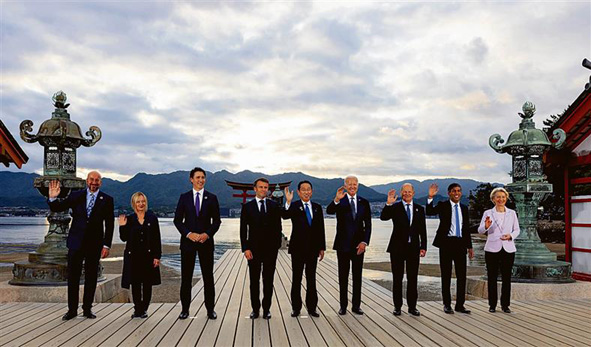
    HIROSHIMA (TIP): Leaders of the Group of Seven rich nations called on Friday, May 19, for a “world without nuclear weapons”, urging Russia, Iran, China and North Korea to cease nuclear escalation and embrace non-proliferation, a statement released by the White House showed.

    Russia’s nuclear rhetoric and stated intent to deploy nuclear weapons in Belarus “are dangerous and unacceptable,” and Russia should return to full implementation of New START treaty, the leaders said in the statement. The leaders also agreed on Friday to stiffen sanctions against Russia, while a draft communique to be issued after their talks in the Japanese city of Hiroshima stressed the need to reduce reliance on trade with China.

    G7 leaders said they had ensured that Ukraine had the budget support it needs for this year and early 2024. “Today we are taking new steps to ensure that Russia’s illegal aggression against the sovereign state of Ukraine fails,” they said in a statement. A French government plane took Zelenskyy to the Arab League Summit in Saudi Arabia and will later take him to the G7 summit in Hiroshima, a source familiar with the matter said.

    Ukraine wants its allies to be bolder in imposing sanctions on Russia, including by targeting banks that provide financial services to serving soldiers, a senior adviser said.

    German Chancellor Olaf Scholz said his government wanted pragmatic measures to prevent the circumvention of sanctions imposed on Russia. G7 members are prepared to build “constructive and stable relations” with China while acting in their national interests, according to a draft version of their communique.

  • Russia ends visa regime for Georgia, lifts flight ban

    Moscow (TIP) : Russian President Vladimir Putin on May 10 abolished visas for Georgian nationals and lifted a 2019 ban on direct flights to the South Caucasus nation, a move that comes amid rocky relations between the two countries and that was quickly denounced by Georgia’s President as a “provocation”.
    Putin signed, starting from May 15, Georgian nationals will be allowed to enter Russia without visas — unless they’re coming to Russia to work or to stay for longer than 90 days.
    Another decree lifts a ban on direct flights by Russian airlines to Georgia. Following Putin’s decrees, Russia’s Foreign Ministry issued a statement lifting its 2019 recommendation for Russian citizens to avoid travelling to Georgia.
    Russia-Georgia relations have been complicated since the Soviet Union’s collapse in the early 1990s. — AP

  • Chinese foreign minister Qin Gang to visit Pakistan after attending SCO meet in India

    Chinese foreign minister Qin Gang to visit Pakistan after attending SCO meet in India

    BEIJING (TIP): China’s Foreign Minister Qin Gang will travel to Pakistan on May 5 on a two-day visit after attending the meeting of the SCO Foreign Ministers hosted by India in Goa, it was announced here on Thursday.
    Qin is attending the SCO (Shanghai Cooperation Organisation) Foreign Ministers meeting being held on May 4 and 5 at Panaji in Goa where his Pakistan counterpart Bilawal Bhutto Zardari too is taking part.
    Besides being the Foreign Minister, Qin is also the State Councillor, a higher rank associated with the ruling Communist Party of China (CPC). SCO bloc consists of China, India, Kazakhstan, Kyrgyzstan, Russia, Pakistan, Tajikistan and Uzbekistan. India holds the presidency of the grouping for this year.
    Significantly the Chinese Foreign Ministry while announcing the visit of Qin to Myanmar and India on May 2 did not include his visit to Islamabad though Pakistan media reported about it.
    Instead, the ministry announced his visit to Pakistan separately on Thursday during which he is due to take part in China-Afghanistan-Pakistan Foreign Ministers’ meeting.
    The trilateral is being held less than a month after the Neighbouring Countries of Afghanistan Plus Afghanistan Foreign Ministers meeting of China, Russia, Pakistan and Iran in Samarkand, in which Qin presided.
    Announcing Qin’s visit to Pakistan, the Chinese foreign ministry spokesperson said that this will be his first visit to Pakistan after taking charge and an important part of the recent close and frequent interactions between the high levels of China and Pakistan. The reference apparently was the just concluded maiden visit of Pakistan’s new Army Chief Asim Munir, here during which he held a series of meetings with top Chinese Generals and top diplomat Wang Yi who is the Director of the Office of the Foreign Affairs Commission of the CPC Central Committee.
    During Gen.Munir’s visit, China’s new Premier Li Qiang also held his first phone call with Pakistan Prime Minister Shehbaz Sharif and promised continued financial help for Pakistan which is facing a serious political and economic crisis. “In Pakistan Qin will meet with the leader of Pakistan and co-chair the fourth round of China-Pakistan Foreign Ministers’ Strategic Dialogue with Pakistani Foreign Minister Bilawal Bhutto Zardari”, the foreign ministry statement which included a Q&A posted on the website on Friday said.
    “The two sides will have in-person and in-depth communication on bilateral relations and the international and regional situation,” it said. “China and Pakistan are all-weather strategic cooperative partners and ironclad friends. The friendship is time honoured”, it further said recalling Sharif’s successful visit to China last November and Li’s April 27 phone call with him. The foreign ministry also hoped that the ties between the two nations would further deepen with the visit of the Chinese foreign minister.
    “China hopes that this visit will follow through on the important common understandings between the leaders of the two countries, further, deepen strategic communication and practical cooperation, promote the building of an ever-closer China-Pakistan community with a shared future in the new era, and contribute positive energy to the region and the wider world,” it said.
    About why the fifth China-Afghanistan-Pakistan Foreign Ministers’ Dialogue in less than a month of Samarkand meeting, it said, although the people of Afghanistan have tided over the most difficult time, they still face severe challenges at the moment and are in dire need of more support and help from the rest of the world.
    The international community need to step up contact and dialogue with the Afghan interim government, support its effort of reconstruction and development, and encourage it to build an inclusive government, exercise moderate governance, develop friendly relations with its neighbours and firmly fight terrorism, it said.
    The Foreign Ministers’ Meeting among the Neighbouring Countries of Afghanistan and the China-Afghanistan-Pakistan Foreign Ministers’ Dialogue are both important platforms for exchanges and cooperation on issues related to Afghanistan and conducive to more consensus among regional countries on the Afghan issue, it said.
    “China hopes to exchange views with Afghanistan and Pakistan on the situation in Afghanistan and tri-party cooperation at the Dialogue, so as to build up consensus, consolidate mutual trust, and jointly contribute to peace, stability, development and prosperity in the region,” it said. (PTI)

  • Russia, Ukraine report drone attacks as Zelensky visits International Criminal Court

    KYIV (TIP): Kyiv and Moscow reported drone attacks on May 4 including two that sparked fires in Russian oil refineries, as Ukrainian President Volodymyr Zelensky visited The Hague to lobby for more support.
    Zelensky’s surprise visit to meet top officials of the International Criminal Court, which has issued an arrest warrant for Russian leader Vladimir Putin, came a day after Moscow accused Kyiv of a drone attack on the Kremlin.
    Russia has accused Ukraine of trying to kill Putin, but Zelensky denied his country was behind the Kremlin strike. (AFP)

  • Pakistan yet to confirm India’s invitation to SCO meet

    NEW DELHI (TIP): With the ongoing Shanghai Cooperation Organisation (SCO) presidency, India has been hosting various meetings and also inviting all members, including Pakistan. However, Pakistan has skipped these meetings, barring once which it attended virtually last week (the Chief Justice meeting) but only after Pakistan downgraded its participation.
    India has sent an invite to Pakistan for the Foreign Ministers meet that would be held on May 4 in Goa but hasn’t got a response yet. Invites have also been sent to them to attend the Home Ministers’ meet and National Security Adviser (NSA) meetings on March 29 and Defence Ministers’ meeting on March 27.
    Pakistan’s foreign ministry spokesperson, regarding their participation in the foreign ministers meet, had earlier said that the country would revert to the invitation in time before the event.
    Earlier in January, Pakistan was the only country among the eight Shanghai Cooperation Organisation members that had not sent any entry for the SCO film festival that took place in Mumbai. Other members had sent 57 entries. The eight-member SCO includes India, Russia, China, Kazakhstan, Kyrgyzstan, Tajikistan, Uzbekistan and Pakistan. While Afghanistan, Belarus, Iran and Mongolia are SCO observers and Armenia, Azerbaijan, Cambodia and Nepal are SCO dialogue partners.
    From the outset, the SCO presented itself as a bulwark against “terrorism, separatism and extremism”, a language that sought to capitalise on the global counter-terrorist consensus of the 9/11 era, as well as reflecting real concerns in Beijing about threats to Chinese Communist Party power.
    However, India is part of the four-nation security Quad that includes the US, Australia, Japan and India. (ENS)

  • India abstains in U.N. vote underscoring need for just, lasting peace in Ukraine

    India abstains in U.N. vote underscoring need for just, lasting peace in Ukraine

    • The resolution got 141 votes in favor and seven against; India was among the 32 countries that abstained

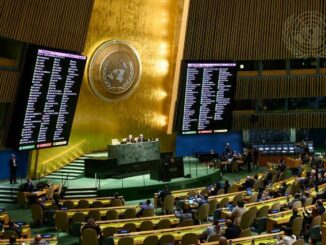
    UNITED NATIONS (TIP): India abstained in the U.N. General Assembly on February 23 on a resolution that underscored the need to reach as soon as possible a “comprehensive, just and lasting peace” in Ukraine in line with the principles of the U.N. Charter.

    The 193-member General Assembly adopted the draft resolution, put forward by Ukraine and its supporters, titled Principles of the Charter of the United Nations underlying a comprehensive, just and lasting peace in Ukraine. The resolution, which got 141 votes in favor and seven against, “underscores the need to reach, as soon as possible, a comprehensive, just and lasting peace in Ukraine in line with the principles of the Charter of the United Nations.” India was among the 32 countries that abstained.

    The resolution called upon member states and international organizations to redouble support for diplomatic efforts to achieve a comprehensive, just and lasting peace in Ukraine, consistent with the Charter.

    It reaffirmed its commitment to the sovereignty, independence, unity and territorial integrity of Ukraine within its internationally recognized borders, extending to its territorial waters and reiterated its demand that Russia immediately, completely and unconditionally withdraw all of its military forces from the territory of Ukraine within its internationally recognized borders, and calls for a cessation of hostilities. In the year since Russia’s February 24, 2022 invasion of Ukraine, several U.N. resolutions — in the General Assembly, Security Council and Human Rights Council, have condemned the invasion and underlined the commitment to the sovereignty, independence, unity and territorial integrity of Ukraine.

    India has abstained on the U.N. resolutions on Ukraine and consistently underlined the need to respect the U.N. Charter, international law and the sovereignty and territorial integrity of states.

    New Delhi has also urged that all efforts be made for an immediate cessation of hostilities and an urgent return to the path of dialogue and diplomacy.

    In September 2022, External Affairs Minister S. Jaishankar said in his address to the high-level U.N. General Assembly session that in this conflict, India is on the side of peace and dialogue and diplomacy.

    “As the Ukraine conflict continues to rage, we are often asked whose side are we on. And our answer, each time, is straight and honest. India is on the side of peace and will remain firmly there. We are on the side that respects the UN Charter and its founding principles. We are on the side that calls for dialogue and diplomacy as the only way out,” Jaishankar had said, adding that it is in the collective interest to work constructively, both within the United Nations and outside, in finding an early resolution to this conflict.

    India has also consistently underlined that in the conflict, the entire global South has suffered “substantial collateral damage” and developing countries are facing the brunt of the conflict’s consequences on food, fuel and fertilizer supplies.

    Jaishankar had said that India is on the side of those that are “struggling to make ends meet, even as they stare at the escalating costs of food, of fuel and fertilizers.” The UNGA resolution called for an immediate cessation of the attacks on the critical infrastructure of Ukraine and any deliberate attacks on civilian objects, including those that are residences, schools and hospitals.

    It urged all member states to cooperate in the spirit of solidarity to address the global impacts of the war on food security, energy, finance, the environment and nuclear security and safety and underscored that arrangements for a comprehensive, just and lasting peace in Ukraine should take into account these factors.


    U.N. Secretary-General Antonio Guterres told the emergency special session of the General Assembly that resumed on February 22 that Russia’s invasion of Ukraine is “an affront to our collective conscience” and said it is “high time” to step back from the brink.


    “The one-year mark of Russia’s invasion of Ukraine stands as a grim milestone — for the people of Ukraine and for the international community. That invasion is an affront to our collective conscience. It is a violation of the United Nations Charter and international law,” Mr. Guterres said adding that the invasion is having dramatic humanitarian and human rights consequences.

    In a strong message, Mr. Guterres said the war is fanning regional instability and fueling global tensions and divisions while diverting attention and resources from other crises and pressing global issues. “Meanwhile, we have heard implicit threats to use nuclear weapons. The so-called tactical use of nuclear weapons is utterly unacceptable. It is high time to step back from the brink,” he said.

    (Source: PTI)


  • Russia offers partnership in hi-tech arms

    New Delhi (TIP)- Russia on February 9 said it was offering new points of cooperation for the joint manufacturing of high-tech products under the “Make in India” programme in compliance with all localisation and technology-transfer requirements. This was conveyed in a statement by Rosoboronexport, the Russian state-run arms exporting agency, which will be participating in the Aero India air show at Bengaluru from February 13-17. The agency plans to hold substantive meetings and negotiations with representatives of the Ministry of Defence and other security agencies of India and other countries of the Asia-Pacific region. In addition, the company expects to work extensively with state-owned and private enterprises of the Indian defence industry to expand the scope of industrial partnership between Russia and India in accordance with the requirements of “Make in India” thrust.

    Russia’s collective display at Aero India will include 200 samples of advanced armaments and military hardware, including the fifth-generation Sukhoi-57E multifunctional fighter jet, Checkmate light tactical aircraft, IL-76 military transport plane, Sukhoi-35, Sukhoi-30S and MiG-35D fighter jets.

    Russia will also feature the Orlan-30 reconnaissance drone for the first time abroad. The Orlan-30 is intended for conducting aerial reconnaissance and detecting objects in the visible or infrared range.

  • As fighting intensifies, Kyiv seeks more arms

    Kyiv (TIP): Ukraine on January 27 battled Russian troops trying to pierce its lines in the east and northeast before Kyiv takes delivery of tanks from its Western allies, saying the fighting showed it needed more weapons to repel the invaders. Kyiv said fierce battles were under way, a day after at least 11 people were killed in missile and drone strikes which were widely seen in Ukraine as a response to the promises by important allies to send it tanks. After weeks of wrangling, Germany and the US this week said they would send Ukraine dozens of modern tanks to help push back Russian forces, opening the way for others to follow suit.

    Poland gave Ukraine a further boost on Friday by promising an additional 60 tanks on top of 14 German-made Leopard 2 tanks it had already pledged. Both sides in the war are widely expected to launch spring offensives though Washington has advised Ukraine against doing so until the latest weapons are in place and training has been provided – a process expected to take several months. Russia said the US was “pumping weapons into Ukraine”, which Moscow says does Washington’s bidding, and chided President Joe Biden, saying he held the key to ending the conflict but had not used it. Ukrainian President Volodymyr Zelenskiy thanked allies for their support but renewed calls for tougher sanctions on Moscow and more weapons in the twelfth month of the war. Millions of Ukrainians faced electricity shortages after missile and drone strikes. Russia said the strikes focused on “facilities that operate Ukraine’s defence industrial complex and transport system,” and limited Ukraine’s ability to repair hardware and transport arms provided by its allies. — Reuters

  • Russia replaces Ukraine war commander; Soledar battle on

    Russia replaces Ukraine war commander; Soledar battle on

    Kyiv (TIP): Moscow has named Chief of the General Staff Valery Gerasimov as new commander for its invasion of Ukraine. At the same time, Ukraine said its troops were holding out despite heavy fighting on a battlefield littered with bodies in a salt mining town in eastern Ukraine, where Russian private military firm Wagner Group had claimed Moscow’s first significant gain in half a year.

    Russian Defence Minister Sergei Shoigu on January 11 appointed Valery Gerasimov as the overall commander for what Moscow calls its “special military operation” in Ukraine, now in its 11th month.

    The change effectively demoted General Sergei Surovikin, who was appointed in October to lead the invasion and oversaw heavy attacks on Ukraine’s energy infrastructure. The ultra-nationalist contract militia Wagner, run by an ally of President Vladimir Putin outside the main chain of military command, claims to have taken Soledar after intense fighting that it said had left the town strewn with Ukrainian dead. But Moscow has held off officially proclaiming victory. “There are still some small pockets of resistance in Soledar,” Andrei Bayevsky, a Russian-installed politician, said in an online broadcast.

    Ukraine has acknowledged Russian advances but Deputy Defence Minister Hanna Malyar told a briefing on Thursday that fighting was still fierce. Malyar said Russia had increased the number of units in Ukraine to 280 from 250 in the past week as it seeks to regain the initiative. Kremlin-watchers were poring over Russia’s latest switch of battlefield leadership, a day after Valery Gerasimov, chief of the military’s general staff, was unexpectedly given direct command of the invasion. The previous commander of three months’ standing, Army General Sergei Surovikin, was effectively demoted to become one of Gerasimov’s three deputies. Russia explained the decision, third abrupt change of commander in the 11-month conflict, as a response to campaign’s growing importance. — Reuters

  • Ukraine pleads with allies to send tanks as fighting grinds on in east

    Kyiv (TIP): Ukrainian and Russian troops battled in eastern regions on January 5 as Kyiv tried to push back occupying forces, while President Volodymyr Zelenskyy urged the West to provide his army with heavy tanks to boost their firepower.

    The Ukrainian military said the Russians were focused on an offensive in the Bakhmut sector of the Donetsk region, but their attacks in the Avdiivka and Kupiansk sectors were unsuccessful.

    The governor of neighbouring Luhansk region, meanwhile, said Ukrainian troops were recapturing areas there “step-by-step” but cautioned it was “not happening fast”. Luhansk and Donetsk make up the Donbas region, Ukraine’s industrial heartland, parts of which were seized by Russian-backed proxies in 2014.

    Russia declared Donetsk, Luhansk, Kherson and Zaporizhzhia regions as part of its territory in September after referendums condemned by Ukraine and Western countries. Russia does not fully control any of the four regions.

    Bakhmut, which is now largely in ruins after months of battering by Russian artillery, is important because the Russian leadership wants to have a success to hold up to the Russian public after a series of setbacks in the war. It is located on a strategic supply line between the Donetsk and Luhansk regions. Gaining control of the city, with a pre-war population of 70,000-80,000 that has shrunk to close to 10,000, could give Russia a stepping stone to advance on two bigger cities – Kramatorsk and Sloviansk.

    Fighting has been particularly tough there, with commanders on both sides describing it as a “meat grinder”. (Reuters)

  • Europe’s wars inseparable from profiteering

    Europe’s wars inseparable from profiteering

    As the demand for guns surges, profit too skyrockets with the sale of every weapon or machine. Thus, the enterprise of military hardware production and sale becomes too tempting and lucrative to be eschewed, as after a long gap a ‘real’ war has come to European soil, where big-buck investments and astronomical profits are being made. Shortage of food facilitates profiteering too.

    “The prolonged Russia-Ukraine war lays bare the stark reality that even an immoral war is good for the moral and ethical health of the West because through wreckage, blood, sweat and tears of widows, destitute and orphans emerge countless opportunities for wealth creation and open plunder by merchants and middlemen. Shortage of food facilitates profiteering too, the way it happened in the 1943 Great Bengal famine, killing 3 million people amid the World War II inflicted by Europe on the world.”

    By Abhijit Bhattacharyya

    On  the eve of the Russian invasion of Ukraine in February last year, UK Defense Secretary Ben Wallace had exclaimed, “The Scots Guards kicked the backside of Tsar Nicholas I in the 1853 Crimea War and we can always do it again,” comparing the 21st-century Russia-Ukraine conflict with the 19th-century war. The Tsar had been pitted against the combined might of England, France and the Ottoman Empire. The Russian defeat of yore and the lack of an international ally were sarcastically invoked to draw a parallel and warn Moscow to watch out for history repeating itself.

    What the British Defense Secretary said was neither unsurprising nor unique. War has always had a macabre fascination for Europe. The gory combats and their inglorious consequences have been used to portray the grandeur of the warring West. Most of Europe’s eminent and enlightened scholars, intellectuals and philosophers have been fascinated with, and have spoken eloquently on, the importance of power, war and violence.

    Machiavelli pointedly stated, “All armed prophets have conquered and unarmed ones failed.” To him, war, power and hypocrisy are connected. For Thomas Hobbes, conflict emerges from the impulse of self-preservation, thereby making life a “war of all against all” and resulting in it being “solitary, poor, nasty, brutish and short”. The views of Jean-Jacques Rousseau on the power of the state influenced global politics. His ‘Discourse on Inequality’, according to Voltaire, was “against the human race”. Georg Wilhelm Friedrich Hegel unabashedly admired Napoleonic wars and thought that it was a good thing to have wars from time to time. In all these expressions of the European mindset, one thing is clear. There is an element of axiomatic intellectual honesty about justifying, propounding or defending political dishonesty which appears preferable to the hypocrisy of depicting political polemics as an honest and noble enterprise. In this context, the prolonged Russia-Ukraine war lays bare the stark reality that even an immoral war is good for the moral and ethical health of the West because through wreckage, blood, sweat and tears of widows, destitute and orphans emerge countless opportunities for wealth creation and open plunder by merchants and middlemen. Shortage of food facilitates profiteering too, the way it happened in the 1943 Great Bengal famine, killing 3 million people amid the World War II inflicted by Europe on the world.

    As the demand for guns surges, profit too skyrockets with the sale of every weapon or machine. Thus, the enterprise of military hardware production and sale becomes too tempting and lucrative to be eschewed, as after a long gap a ‘real’ war has come to European soil, where big-buck investments and astronomical profits are being made.

    Further, if the war is between powerful belligerents, soaring profit is guaranteed because both possess the wherewithal to sustain a protracted conflict. In contrast, smaller wars in Third World countries reduce profitability as they are less destructive. Thus, the end of the 20-year-old Afghan war in August 2021 inflicted huge losses on arms and ammunition manufacturers. Undoubtedly, Russia is in the wrong. And the criticism thereof is justified. Nevertheless, Russian wrongs also raise a question. Why is Moscow pursuing this seemingly irreversible, hostile path? Although one-third of the answer was given by the British Defense Secretary with his comment on the 1853 Crimea War, it nevertheless leaves two-thirds unanswered, which lies in what happened in the 1810s and the 1940s.

    Russia saved the entire West from being annihilated by two European scourges of mankind (Napoleon and Hitler) in successive centuries. Indeed, it crushed the bloodthirsty Napoleon’s ‘Grand Armee’ in the battles of Borodino (September 1812) and Leipzig (October 1813) much before the Duke of Wellington’s victory over a weakened French army at Waterloo in June 1815. From the Napoleonic wars to the two World Wars and from the Balkanization of the 1990s to the present Ukraine war — all constitute intra-Europe conflicts, like ceaseless continental civil wars. And yet, the non-European world was inexorably dragged into these internecine disputes, thereby giving Europe pole position in world affairs.

    So, what’s next for the Russia-Ukraine war? Is a solution possible? Or will it again drag the entire Europe and the rest of the world into another Armageddon? Just hear the Europeans themselves on the “war within”, because “Europe is united” and yet “Europe is not united”. Europe is distressed because war fatigue and economic downturn have already gripped virtually every nook and corner of it. Hence, Deutsch Bank warns of the peril in borrowing from US banks and former German Chancellor Angela Merkel admits that the Cold War never ended. French President Emmanuel Macron is being berated for repeatedly calling for considering Russia’s legitimate security guarantee owing to NATO expansion in Russia’s neighborhood.


    The French certainly know best, owing to the post-World War I Versailles Treaty’s monumental folly of humiliating the defeated Germany, thereby sowing the seeds of World War II. Criticism of the US came from top EU diplomat Josep Borrell: “Americans, our friend, take decisions which have economic impact on us.” The EU has also accused Washington of profiting/profiteering from the Ukraine war. A more serious matter, however, is the growing intra-Europe conflict between Serbia and Kosovo. Serbia (former Yugoslavia) was attacked by the NATO and broken into seven pieces in the 1990s. Hence, Serbia, like Russia, is smarting and eyeing revenge.

    Indeed, there’s a real possibility of two simultaneous Balkan wars as the region is the ‘tinderbox’ of Europe where issues related to ethnic minorities have repeatedly triggered conflicts. Altogether, the possibility of the Russia-Ukraine conflict raising the stakes higher will only smoothen matters further for the profiteering brigade to make mega bucks from the sale of military merchandise.

    ( Abhijit Bhattacharya is an author and columnist)

  • Ukraine War, Chinese Protest, Imran Khan’s Ouster; top global Events in 2022

    The year 2022 has been a tumultuous one, with many uprisings, new faces coming to prominence and dictators losing hold of power. It has been a year of economic shockers, from the West to the East. Needless to say, it has been a year of clashes and of new alliances.

    This year saw a significant rise of leaders like Ukraine President Zelensky, French President Macron and Chinese leader Xi Jinping. On the other hand, prominent international leaders, considered to have clout, including former US President Trump and Brazilian President Bolsonaro lost their power.

    There were several prominent events which shaped 2022 in their own ways. To name a few, the Ukraine War, Sri Lankan Economic crisis and the unprecedented protests in China defined the year in their unusual ways.

    UKRAINE WAR

    The Russian invasion of Ukraine, which began earlier this year in February, has entered its 300th day this month, proving to be a tough challenge for both Russia and Ukraine. Russian President Vladimir Putin, who began a blitzkrieg assault on Kyiv taking over the eastern and southern part of the country, is now facing challenge to keep the war going amid reports of ailing health and internal strife.

    So far, over 100,000 Russian and 100,000 Ukrainian soldiers have been killed or injured in the war in Ukraine. For the Ukrainians, this winter is going to be tough with Russian attacks on Ukrainian power plans and consecutive Russian missile attacks. However, the war has shaped the hero out of Ukraine’s President Zelensky, who not only stood against the Russian aggression, but also managed to forge a western unity.

    SRI LANKAN CRISIS

    The Sri Lanka protests which started in April had led to the ouster of President Gotabaya Rajapaksa and two-time President and former Prime Minister Mahinda Rajapaksa. The Sri Lankan crisis, which started as a protest in Colombo, spread across the country with the people demanding reforms in the government.

    Ranil Wickremesinghe was elected President through a parliamentary vote, in which the Rajapaksas’ party backed him in July. The government blamed the Covid pandemic, which badly affected Sri Lanka’s tourist trade, and later led to a shortage of fuel and foreign dollars. However, many experts blame President Rajapaksa’s poor economic mismanagement.

    The country continues to remain under crisis with Colombo anticipating the IMF loan to secure the country’s economy.

    OUSTER OF IMRAN KHAN

    Former Pakistan Prime Minister Imran Khan, who came to power in 2018, is the only Pakistani Prime Minister to be ousted in a no-confidence vote in Parliament earlier this year.

    Khan was ousted from power in April after losing a no-confidence vote in his leadership, which he alleged was part of a US-led conspiracy targeting him because of his independent foreign policy decisions on Russia, China, and Afghanistan.

    Since he lost the vote in Parliament, Khan has mobilized mass rallies across the country, whipping up crowds with claims that he was a victim of a conspiracy by his successor, Prime Minister Shahbaz Sharif, and the United States.

    IRAN PROTESTS

    Iran has been rattled by protests over opposition to the mandatory hijab law as thousands of common citizens have taken to the streets.

    Iran has been rocked by protests since September 16, with the death of 22-year-old Mahsa Amini, who died after being detained by the morality police. The protests have since morphed into one of the most serious challenges to Iran’s theocracy installed by the 1979 Islamic Revolution.

    So far, the country’s police have arrested renowned actresses, footballers, actors and influencers for supporting the protests. It has also executed two protestors for participation in the protests.

    RARE PROTEST IN CHINA

    China saw two major developments this year- Xi Jinping becoming President for the third time and rare protests weeks after against tough anti-Covid restrictions.

    In November, thousands of people took to the streets in several major cities across China, including Beijing and Shanghai, to call for an end to lockdowns and greater political freedoms, in a wave of protests not seen since pro-democracy rallies in 1989 were crushed.

    Despite heavy crackdown, surveillance and censorship, the protests expanded into calls for broader political freedom and left a major negative impact on the reputation of Xi and the Party.

    US MIDTERM ELECTIONS

    The midterm elections in the US, which is usually seen as a mandate against the ruling government, failed to make a Republican sweep as the Democrats gained razor-thin control of the Senate, while the Republicans got a narrow margin against the dems in the House of Representatives.

    However, the misterms was special in the sense that it rained down on the ambitions of former President Donald Trump, who was looking forward to run for the second term, his “Make America Great Again” movement and the broader Republican agenda.

    A silver lining which came out of the midterm elections for the Republicans has been the victory of Florida Governor Ron DeSantis. DeSantis is seen as the possible challenger to Trump and a possible source of revival for the GOP.

    Surging inflation, ongoing strikes, economic crisis and war in Europe: the new UK Prime Minister Rishi Sunak faces these major challenges. Sunak came to Power after his predecessor Truss resigned after just 44 days in power.

    After 12 years in power, the Conservative party is more divided than ever. Earlier this year, Boris Johnson had resigned as PM in July after losing the confidence of some 60 ministers.

    Sunak has become the fifth Tory prime minister since 2016 — following David Cameron, Theresa May, Johnson and Truss. The challenges continue to mount for Sunak, who hopes to get his country out of the economic and political mess.

    BOLSONARO’S EXIT

    Brazilian President Jair Bolsonaro, lost election in October in a nail-biting presidential vote count against Luiz Inacio Lula da Silva.

    Almost from the start of his controversial mandate in 2019, Bolsonaro racked up accusations and investigations for everything from spreading disinformation to crimes against humanity. He survived more than 150 impeachment bids — a record.

    Most of these were over his flawed management of the coronavirus pandemic, which claimed the lives of more than 685,000 people in Brazil — the world’s second-highest toll after the United States.

    On January 1, 2023, Bolsonaro’s arch-rival, leftist ex-president Luiz Inacio Lula da Silva will take over the reins once more and Bolsonaro loses his presidential immunity.

    COP27 SUMMIT

    The UN COP27 climate summit in Egypt had some success and some failures. While the summit achieved a landmark deal on funding to help vulnerable countries cope with devastating climate impacts, the talks stalled on key issues and failed to secure commitments to stop greenhouse gas emissions.

    Though the participating nations agreed to contribute to the cost of the harm an overheated planet causes to developing nations, but they concluded the talks without doing anything more to address the burning of fossil fuels, which is the primary cause of these catastrophes.

  • Ashok Vyas

    Year to Year : Optimistic and Hopeful

    Impressions of any person, place or period are made of two parts. One relates to external circumstances, as we come to know of through media, another part is the internal response mechanism to any development or event.

    Looking at 2022, I would begin on an optimistic note, overall, we saw the world coming out of the clutches of the threat of Covid 19. We still have lingering effects of the epidemic and more apprehensions about its possible return with reports from China.

    This year also showed how quick our collective memories function in terms of forgetting the lessons of an unprecedented challenge faced by us as human race in recent times.

    The war between Russia and Ukraine captured our attention more intensely, gradually, less news but the challenge of war and destruction of a beautiful country as well as loss of innocent lives continues. The world order seems to be changing, the perception that USA’s support has helped Ukraine put on a brave fight against mighty Russia is gaining more ground with the recent visit of Ukraine president to the Whitehouse.

    India played a key role on the world scene in terms of successfully establishing its stand on several issues, including the stand adopted regarding its dealings with Russia. The Indian foreign minister showed on several forums that with calm mannerism and simple words, the strength of a nation can be expressed. Indian Prime Minister Narendra Modi continued to be the central figure in Indian politics as well as Global diplomacy. The only  leader, who openly and directly conveyed to Russian President Putin, that this is not the age of war. India didn’t stop buying Oil from Russia and while cornered, made it clear that Indian purchase is much less that the European nations. While the world economy has taken a hit after covid, the financial situation of the UK resulted in quick change of its prime minister. As we move towards 2023, Britisher with Indian roots Rishi Sunak, the first Hindu is leading the Great Britain.

    My expectations in 2023 are empowered by my hope and prayers. I believe we learn lessons but take time in implementing them, I look forward to the new year with greater awareness of taking care of the environment, leading a healthy life, building harmony and realizing the glory of being human. In addition to International day of Yoga, India gets the credit of drawing the attention of the world towards the significance of ‘Millet’ . Welcome to ‘The international year of Millet 2023 as declared by the United Nations in support of India’s initiative. We will have impactful impressions of India with creative and constructive insight under India leadsG20 as president. While saw massive layoffs, especially in the tech sector in the last few months of 2022 and the big news of twitter takeover by Elon Musk. I hope things would settle down and we will have a healthy, wealthy and growth oriented peaceful new year.

    Ashok Vyas


    (Poet, Hindu priest, author, program director with ITVGold for 25 years, founder of Heramba Art and Culture center with youtube channel ‘HerambaStudio’. President of Insight for Creativity LLC. Ashok has been working on three books for a few years, all are due to be published in 2023. (insightashok@Yahoo.com)

  • Luis Enrique out as Spain coach after World Cup elimination

    Luis Enrique out as Spain coach after World Cup elimination

    The Spanish soccer federation said on Thursday that Luis Enrique will not continue as coach of the men’s national team following its elimination in the round of 16 of the World Cup. The announcement comes two days after Spain lost to Morocco 3-0 in a penalty shootout after a scoreless draw in regular and extra time. The federation thanked Luis Enrique but said it was time to “start a new project” to keep the growth achieved by the coach in recent years.

    Spain got off to a good start in Qatar, routing Costa Rica 7-0, but La Roja couldn’t win again in its last three matches. It drew Germany 1-1 and lost 2-1 to Japan before being held by Morocco. Luis Enrique took over the national team in 2018 to start revamping the squad after its elimination in the round of 16 of the World Cup in Russia. He temporarily left because of the illness and eventual death of his young daughter, but returned in 2019.

    He helped Spain reach the last four of the Nations League twice, including this season and last year, when it lost the final to France. He also led Spain to the semifinals of the European Championship in 2020, losing to Italy in a penalty shootout.

    Source: AP

  • 22 children among 37 killed by ex-cop at Thailand daycare centre

    Bangkok (TIP): A former policeman killed 37 persons, including 22 children, in a knife-and-gun rampage at a daycare centre in Thailand on October 6. He later shot dead his wife and child at their home before turning his weapon on himself, the police said, identifying the suspect as 34-year-old PanyaKamrap. In one of the world’s worst child death tolls in a massacre by a single killer in recent history, most of the children who died in UthaiSawan, a town 500 km northeast of Bangkok, were stabbed to death, the police said. The age range of children was from two to five years, a local official said.

    The police said the attacker was a former member of the force who was dismissed from his post last year over drug allegations and he was facing trial. The man had been in court earlier in the day and had then gone to the daycare centre to collect his child, said police spokesperson PaisalLuesomboon. When he did not find his child there, he began the killing spree, Paisal said. “He started shooting, slashing, killing children.” Videos posted on social media showed sheets covering what appeared to be the bodies of children lying in pools of blood in the garden of the daycare centre. When the attacker arrived, about 30 children were at the facility, fewer than usual, as heavy rain had kept many of them away, district official JidapaBoonsom said. “The shooter came in around lunch time and shot four or five officials at the centre first,” Jidapa said. The attacker forced his way into a locked room where the children were sleeping, Jidapa said, adding that a teacher who was eight months pregnant was also stabbed to death. The massacre is among the worst involving children killed by one person. In Norway, Anders Brevik killed 69 persons, mostly teenagers, at a summer camp in 2011, while the child death toll in other cases include 16 at Dunblane in Scotland in 1996 and 19 at a school in Uvalde, Texas, this year. The Beslan school hostage crisis in Russia in 2004 saw 186 children killed by a group of hostage takers. Prime Minister Prayuth Chan-Ocha, in a statement on Facebook, called Thursday’s shooting a “shocking incident”. Gun laws are strict in Thailand, where possession of an illegal firearm carries a prison sentence of up to 10 years. But ownership is high compared with some other countries in Southeast Asia. The police, however said the gun used in the shooting had been obtained legally. Mass shootings in Thailand remain rare, although in 2020, a soldier angry over a property deal gone sour killed at least 29 persons and wounded 57 in a rampage that spanned four locations. — Reuters

  • Russia-Ukraine war unlikely to end soon

    Russia-Ukraine war unlikely to end soon

    The rise in Russia’s industrial output in recent months has foxed western analysts. As long as the conflict continues, Russia can continue to sell its massive gas reserves — on which there are no sanctions yet — and make tidy profits. Besides, the US is in no hurry to end the conflict for its own strategic reasons. Its aim is to deplete Russia’s military capabilities.

    The ongoing war has given the American arms industry a new market.

    Russian President Vladimir Putin is an old master of the strategy of “escalating to de-escalate.” It means that by threatening a nuclear retaliation, he plans to continue fighting a long war of attrition to serve his strategic agenda. These could be: First, prolong the conflict to wear down the Ukrainian resistance, as he steadily absorbs the border regions of Donetsk, Luhansk, Mariupol and Kherson, with a referendum followed by annexations. These territories give Russia the land buffer against a NATO-EU-led expansion towards Russia’s borders. Secondly, it shows the impotency of the US and NATO, whatever the sanctions.

    In fact, the rise in Russia’s industrial output in recent months has foxed western analysts. Thirdly, as long as this conflict continues, Russia can continue to sell its massive gas reserves — on which there are no sanctions yet, for EU’s sake — and make tidy profits over it. Finally, the US in particular also is in no hurry to end the conflict for its own strategic reasons. And it is for these reasons, the conflict in Ukraine isn’t likely to end soon, even as the expectations rose that Russia would sue for peace after the recent Ukrainian counter-offensive and its success around Kharkiv.

    Few, if at all, had explained why the Russians allowed their forces to be pushed back or did they pull back as part of a bigger battle plan of Moscow? One cannot rule out that the Russians had pulled back to regroup their forces for another fight elsewhere on another day. It is for this reason that President Putin has ordered the largest ever post-war mobilization of three hundred thousand reservists. From the early days of Russia’s offensives in Ukraine, its approach smacked of hubris, an excessive confidence in their ability to steamroll over Ukraine. However, Ukraine’s defenses were strengthened by its ability to quickly mobilize its population and its reservists, that more than matched the numbers of Russian troops on its land, and additional US and NATO troops — over 1,00,000 — deployed in various forms in Ukraine and on Russia’s borders with the NATO. But it is the reported deployment of an estimated 100 nuclear gravity bombs in NATO bases that Russia has had eyes on, and, hence, the threat of using nuclear arsenal by Putin, when he renews his offensive next month before Europe’s harsh winter sets in.

    Here, it is important to understand the essentials of the nuclear strategy. First, the history of nuclear threats is based on non-use of nuclear weapons. And the only occasion nuclear weapons were used, as was the case in August 1945, was done with the devastating effect on Hiroshima and Nagasaki in Japan. It led to Japan’s surrender and checked Soviet plans to capture Japan in World War-II. Moscow hasn’t forgotten that. Secondly, the use of nuclear weapons is not the first option of a nuclear-weapon state. It’s in fact their last option, when their survival — as a nation-state — is at stake. And even then, as massive nuclear bombings would lead to a simultaneous counter-force response from the other side, the fear of mutually assured destruction is enough to withhold even a deranged dictator from using his nukes.But finally, there is still the possibility that ‘tactical nukes’ — small bombs to be used in battles — could be used to prevent major reverses in battles. Here the warnings by the US may not stop the Russians, because the Americans hadn’t in the past enforced their threats if their ‘red line’ was crossed, as was done with the use of chemical weapons in Syria during Obama’s days.

    So, Russia isn’t likely to buckle down that easily. For one, a superpower of the size of Russia with the scale of resources it has — being the largest producer of oil and gas — outside the Organisation of the Petroleum Exporting Countries, can last out much longer than the US expects.

    Remember, the US was stuck in Afghanistan for two decades and is still raring to go. The immediate impact of the US-led sanctions was mitigated by the Russian Central Bank with capital control measures and hikes in interest rates. It is estimated that the Russian state controls more than 60 per cent of the large businesses that influence the GDP and 25 per cent of its MSMEs. This imbalance does restrict growth, but it also insulates the economy in a crisis. And as the Russians have faced financial challenges in the past — this is their fifth since 1991 — they could tide over this one for longer than the West assumes. Most importantly, President Putin still holds the keys to the “gas supplies” to Europe and gives them the taste of a freezing winter, regardless of the claims of the EU that they’ll be prepared for a gas supply crunch by early December. In reality, the Europeans are buying gas from wherever they can, even China, as China doesn’t come under the sanctions initiated by the US. So, Beijing buys Russian gas and is selling it with a tidy profit in containers to the Europeans, since the Chinese economy has currently slowed down, and China has surplus of gas for now. By knowledgeable accounts, Russia has made over $175 billion with the sales of oil and gas since the sanctions were announced.

    Finally, what is less talked about is why the US wants to let the conflict in Ukraine continue. For one, its aim is to deplete Russia’s military capabilities, and thus decrease the threat to Europe, since the leadership of Europe has given the US a new purpose in geopolitics after its humiliation in Afghanistan.

    The other is that the conflict in Ukraine (being fought by proxy) unites the Americans and spares them the return of body bags, as they witnessed in the past two decades of wars in Asia. And finally, it gives the US’s arms industry new market — in Ukraine and Europe — to arm and test their new weapon systems, with sales and lend-lease debt agreements.In short, the US has turned the Cold War strategy on its head: earlier, the purpose was to exhaust the Soviet Union economically with an arms race; and now, it is to exhaust the Russians by getting them to pour their man-machine mix into the quagmire that is Ukraine.

    (The author is a Strategic Affairs Analyst)

  • Need for UN Security Council reform cannot be denied forever: Jaishankar

    Need for UN Security Council reform cannot be denied forever: Jaishankar

    WASHINGTON, D.C. (TIP): The need to reform the UN Security Council cannot be denied forever, External Affairs Minister S Jaishankar has said even as he noted that India never believed that revamping the top organ of the world body will be an easy process. India has been at the forefront of the years-long efforts to reform the Security Council, saying it rightly deserved a place as a permanent member in the United Nations.

    Currently, the UN Security Council has five permanent members—China, France, Russia, the UK and the US. Only a permanent member has the power to veto any substantive resolution.

    India, currently a non-permanent member of the 15-nation UN Security Council, will complete its two-year tenure in December this year. In the month of December, India will preside over the Security Council.

    “We have, we have never thought that it was an easy process. But we do believe that the need for reform cannot be denied forever,” Jaishankar told a group of Indian journalists here on Wednesday, September 28 while responding to a question on the seriousness on the part of the US on reforming the Security Council.

    “My understanding is that the position that President (Joe) Biden put forward, is the most explicit and specific articulation of the US support for reform of the UN, including the Security Council,” he said on the last day of his visit to the US.

    “So, I don’t think it’s a reiteration of something, I don’t think in that sense, it’s kind of business as usual. Now, how this advances, where it goes, I think, depends on all of us: the members of the UN, and where we take it,” he said.

    “It is not the responsibility of a single country, however powerful. I think it’s a collective effort that the members of the UN have to make. We have been pressing the reform effort, including through the Intergovernmental Negotiations (IGN). And you also know where the reluctance comes from and let’s stay focused on it,” Jaishankar said.

    Jaishankar said on Saturday that negotiations for the much-needed UN Security Council reforms should not be blocked by procedural tactics and naysayers cannot hold the process “hostage in perpetuity.” “India is prepared to take up greater responsibilities. But it seeks at the same time to ensure that the injustice faced by the Global South is decisively addressed,” Jaishankar said in his address to the General Debate of the 77th session of the UN General Assembly.

    “In our term, we have acted as a bridge on some serious but divisive issues confronting the Council. We have also focused on concerns such as maritime security, peacekeeping and counterterrorism,” he said.

    He also said that India believes that multipolarity, rebalancing, fair globalization and reformed multilateralism cannot be kept in abeyance. The call for reformed multilateralism – with reforms of the Security Council at its core – enjoys considerable support among UN members, he said in his UNGA address.

    Jaishankar and UN Secretary-General Antonio Guterres discussed reform of the Security Council as well as the situation in Ukraine and Myanmar during their meeting in New York.

    Jaishankar met Guterres at the United Nations headquarters on Saturday after he addressed the high-level UN General Assembly. “An extensive discussion on pressing global challenges with UN Secretary General @antonioguterres. Agenda included the Ukraine conflict, UN reform, G20, climate action, food security and data for development,” Jaishankar tweeted.

    (Source: PTI)