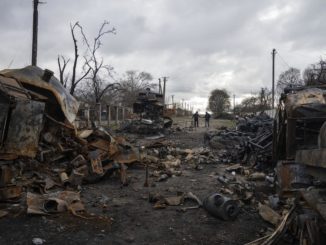
Kyiv (TIP): Western defence officials and analysts on September 18 said they believed the Russian forces were setting up a new defensive line in Ukraine’s northeast after Kyiv’s troops broke through the previous one and tried to press their advances further into the east.
The British Defence Ministry said in a daily intelligence briefing that the line likely is between the Oskil River and Svatove, some 150 kilometres southeast of Kharkiv, Ukraine’s second-largest city.
The new line comes after a Ukrainian counteroffensive punched a hole through the previous front line in the war and recaptured large swaths of land in the northeastern Kharkiv region that borders Russia.
Moscow “likely sees maintaining control of this zone as important because it is transited by one of the few main resupply routes Russia still controls from the Belgorod region of Russia”, the British military said, adding that ”a stubborn defence of this area” was likely, but that it remained unclear whether the Russians would be able to withstand another concerted Ukrainian assault. Ukrainian forces, in the meantime, continue to cross the key Oskil River in the Kharkiv region as they try to press on in a counteroffensive targeting Russian-occupied territory, according to the Washington-based Institute for the Study of War.
The Institute said in its Saturday report that satellite imagery it examined suggest that Ukrainian forces have crossed over to the east bank of the Oskil in Kupiansk, placing artillery there.
The river, which flows south from Russia into Ukraine, had been a natural break in the newly emerged front lines since Ukraine launched its push about a week ago. “Russian forces are likely too weak to prevent further Ukrainian advances along the entire Oskil River if Ukrainian forces choose to resume offensive operations,” the institute said. After the Russian troops retreated from the city of Izium, Ukrainian authorities discovered a mass grave site, one of the largest so far discovered.
President VolodymyrZelenskyy said on Friday that more than 440 graves have been found at the site but that the number of victims is not yet known.
Zelenskyy said the graves contained the bodies of hundreds of civilian adults and children, as well as soldiers, and some had been tortured, shot or killed by artillery shelling.
He cited evidence of atrocities, such as a body with a rope around its neck and broken arms. Videos circulating online on Saturday indicated that Ukrainian forces are also continuing to take land in the country’s embattled east.
One video showed a Ukrainian soldier walking past a building, its roof destroyed, then pointing up over his shoulder at a colleague hanging the blue-and-yellow Ukrainian flag over a mobile phone tower.
The soldier in the video identified the seized village as Dibrova, just northeast of the city of Sloviansk and southeast of the embattled city of Lyman in Ukraine’s Donetsk region.
Another online video showed two Ukrainian soldiers in what appeared to be a bell tower. A Ukrainian flag hung as a soldier said they had taken the village of Shchurove, just northeast of Sloviansk.
The Ukrainian military and the Russians did not immediately acknowledge the change of hands of the two villages.
Elsewhere in Ukraine, Russian forces continued to pound cities and villages with missile strikes and shelling.
A Russian missile attack early Saturday started a fire in Kharkiv’s industrial area, said OlehSyniehubov, the regional governor. Firefighters extinguished the blaze.
Syniehubov said remnants of the missiles suggest the Russians fired S-300 surface-to-air missiles at the city. The S-300 is designed for striking missiles or aircraft in the sky, not targets on the ground. (AP)
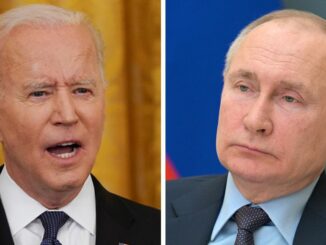
WASHINGTON,D.C. (TIP): Ukraine has recaptured swaths of territory in the east from occupying Russian forces in recent weeks, boosted by heavy weapons supplied by Western allies. U.S. President Joe Biden is warning his Russian counterpart Vladimir Putin against using chemical or tactical nuclear weapons in the wake of serious losses in his war in Ukraine. “Don’t. Don’t. Don’t,” Mr. Biden said, in an excerpt from an interview with CBS’ “60 Minutes” aired on Friday evening. Mr. Biden was responding to an interviewer’s question about the possibility of Mr. Putin, whose army is incurring heavy losses in the Ukraine counteroffensive this month, resorting to chemical or tactical nuclear weapons. “You would change the face of war unlike anything since World War II,” Mr. Biden said. “They will become more of a pariah in the world, more than they have ever been,” the U.S. leader added. Ukraine has recaptured swaths of territory in the east from occupying Russian forces in recent weeks, boosted by heavy weapons supplied by Western allies. And Moscow is facing fresh outrage from the West after the discovery of a mass grave outside the formerly Russian-occupied city of Izyum, where, Kyiv officials say, almost all of the exhumed bodies showed signs of torture.But Mr. Putin remained steadfast, saying his war against Russia’s Western-leaning neighbor was proceeding according to plan. “The plan is not subject to adjustment,” Mr. Putin said on Friday. “Our offensive operations in Donbas itself do not stop. They are going at a slow pace… The Russian army is occupying newer and newer territories.”
GEETA GANDBHIR & SAM POLLARD’S Lowndes County And The Road To Black Power
NEHAL VYAS’S Dapaan
SOHIL VAIDYA’S Murmurs Of The Jungle
SHRUTIMAN DEORI’S My Courtyard (Ne Sotal)
KAVITA PILLAI’s Weckuwapok (The Approaching Dawn)
The Camden International Film Festival (CIFF) for its 18th edition presents feature and short films and documentaries. The festival takes place in person from September 15-18 at venues in Camden and Rockland, Maine, and online from September 15-25 for audiences across North America.
A program of the Points North Institute, CIFF remains widely recognized as a major platform championing the next generation of nonfiction storytellers and one of the hottest documentary and industry festivals on the festival and awards calendars. This year’s edition is the most international and formally adventurous to date and includes 34 features and 37 short films from over 41 countries. Over 60% of the entire program is directed or co-directed by BIPOC filmmakers and this is the 6th consecutive program the festival has reached gender parity within the program and across all competitions. Nearly half of the feature program will be US or North American premieres, including several new titles fresh from Venice, Locarno, and TIFF premieres, alongside award-winning films from Sundance, Rotterdam, Cannes, and Visions du Reel.
This year’s program celebrates the diversity of voices and forms in documentary and cinematic nonfiction,” says Ben Fowlie, Executive and Artistic Director of the Points North Institute, and Founder of the Camden International Film Festival. “These films help us make sense of an ever-changing world, and do everything we expect from great art – they ask provocative questions and interrogate the form. This year’s program emphasizes the international that represents the ‘I’ in CIFF, and reminds us time and again of the limitless creative potential and potency of the documentary form. Just as we have been for each of the past seventeen years, we are grateful to the filmmakers who have made these works of art and shared these stories.”
Kyiv (TIP): Orthodox chants of mourning resounded in a packed central Kyiv cathedral on August 5 as Ukraine buried an agricultural tycoon with his wife after they were killed in a missile strike that hit his home last weekend. OleksiyVadaturskyi, co-founder and director of one of Ukraine’s largest agricultural holdings, was killed with his wife in his southern hometown of Mykolaiv by what Kyiv says was an S-300 missile fired by Russia. The sudden death of the 74-year-old, described as a “titan of Ukraine’s agricultural sector” by one national farmers association, sent shockwaves through a domestic grain industry that has been devastated by Russia’s Feb. 24 invasion.
His export-focused firm Nibulon is a household name in Ukraine, where exports have been crippled by a wartime port blockade that is easing slightly under a grain deal.
The tycoon was well-known in Ukraine for driving a revival of cargo transportation on rivers, including the vast Dnieper that carves south from northernmost Ukraine to the Black Sea. “It’s hard to accept this news when you work with someone for 12 years, see them almost every day, and then one morning you understand they’re gone, and what’s more, so cruelly,” said DmytroForda, a longtimeNibulon employee, at the funeral.
Several hundred people came to pay their respects. Old women in headscarves rubbed shoulders with forlorn-looking executives in suits and men in military uniforms.
His son, AndriyVadaturskyi, an ex-lawmaker and chairman of Nibulon’s supervisory board, said he believed his father had been killed deliberately. Russia denies targeting civilians.
“I have every suspicion that this was not an accident … I don’t want to discuss details yet, but I simply do not believe it was a coincidence,” he told reporters.
‘HERO OF UKRAINE’
Pictures of Vadaturskiy and his wife lined the entrance to the cathedral. In several of the photos, he was wearing a Hero of Ukraine medal, which he was awarded in 2007.
Mykolaiv Mayor OleksandrSenkevych praised Vadaturskyi for staying to help the city as Russian troops approached at the start of their Feb. 24 invasion, although he did not elaborate.
Two-thirds of Vadaturskyi’s assets are now on Russian-held territory, he said.
Traders told Reuters his death was unlikely to have a major impact on the day-to-day business of Ukraine’s grain industry. Vadaturskyi was ranked Ukraine’s 24th richest man by Forbes in 2021 with an estimated fortune of $430 million.
His son said he would work with the Nibulon team to keep the company running. “Today the main task is to preserve the company. Further on, we will look at investment projects, because the company today is ready for investment projects,” he said after the funeral. The company, which exported more than 4.5 million tonnes of agricultural commodities in the 2020/21 season, emerged from the turbulent 1990s after the Soviet breakup as a key Ukrainian market player. Nibulon says it has transported 24 million tonnes of cargo by river since its existence, which it says is equivalent to taking one million trucks off the road.
The most famous of these voyages was the revival of a Soviet-era tradition of yearly barges running watermelons from Ukraine’s south to Kyiv, an event that always got publicity in Ukraine.
The death of 50 people, believed to be illegal immigrants, in San Antonio in the USA is the latest in a string of migration tragedies that have left humanity badly shaken. At least 46 bodies were found in an abandoned tractor-trailer in a remote back road in San Antonio, Texas, some 240 km from the border with Mexico. They faced a horrible death, confined into a non-cooled tractor-trailer without water for an unspecified period of time, in temperatures nearing 38°C. Though the nationalities of the victims and the survivors were not officially confirmed, reactions from Mexico suggest that they were Mexicans. Indeed, over the past few months, there has been a spurt in migrant crossings at the US-Mexico border. As the mayor of San Antonio said, the people who died “were likely trying to find a better life” — migrants are driven towards the USA or Europe due to conflict or lack of opportunities in their home countries. Hope and desperation make them disregard the very real risks they undertake, the least of which is being arrested by the US Customs and Border Protection (CBP) force. The arrests have been surging, with 2,39,416 individuals nabbed along the Mexico border in May. Among those arrested were 2,438 persons from India, a rise of 55 per cent since April. The CBP also arrested 2,310 individuals from Turkey and 3,394 from Russia — it’s obvious that the relatively porous US-Mexico border attracts a high number of illegal immigrants, who are at the mercy of ruthless human smugglers. Often, migrants must hike miles of difficult desert terrain, in extreme summer heat, endangering their lives.
Human beings have migrated from place to place for thousands of years, trying to ‘find a better life’. In the modern context, overpopulation and greater pressure on the natural resources have led to stricter border controls — yet, desperation will make people gamble their very lives. There are no easy solutions to the vexed issue of illegal immigration — except justice, stability and more equitable distribution of global wealth. These ideas could be termed utopian — yet these are the very ideas that are worth working and hoping for.
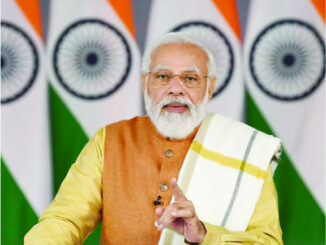
New Delhi (TIP)- Prime Minister Narendra Modi on Friday said members nations of the BRICS (Brazil, Russia, India, China and South Africa) grouping had managed to undertake structural changes over the last few years that increased the influence of the institution. In his opening remarks at the 14th BRICS summit hosted by China, the PM said cooperation among the member nations in several sectors has benefited our citizens. Among other leaders present at annual were Chinese President Xi Jinping, Russian President Vladimir Putin and top leaders of Brazil and South Africa.
“BRICS members have a similar approach regarding the governance of the global economy. Our mutual cooperation can make a useful contribution to the global post-Covid recovery,” he said, adding, “Confident that our deliberations today will produce suggestions to further strengthen our ties.” “There’re multiple areas wherein through cooperation between BRICS nations, the citizens have benefitted. By increasing connectivity between BRICS Youth Summits, BRICS Sports, civil society organisations and think-tanks, we have strengthened our people-to-people connect.”
It is a matter of happiness that membership of the New Development Bank (NDB) has increased, Modi said adding cooperation among the member countries has benefitted their citizens.
“During some of the coldest days of the Cold War, U.S. presidents like Dwight Eisenhower, Richard Nixon and Ronald Reagan sought to find common ground on which to stand with Russia to avoid conflict. Ike invited the “Butcher of Budapest,” Nikita Khrushchev, for a 12-day U.S. visit in 1959. Nixon initiated a “detente” with Leonid Brezhnev, who had ordered the Warsaw Pact to crush the “Prague Spring” in 1968. Reagan and Mikhail Gorbachev negotiated the dismantling of an entire class of nuclear weapons in the 1987 Intermediate-Range Nuclear Forces treaty.”
Where does Mother Russia go from here? Bitter at their losses in the Cold War and post-Cold War years, many Russian nationalists are urging the regime to align with today’s great power antagonist of the United States, Xi Jinping’s China.
“The demise of the Soviet Union was the greatest geopolitical catastrophe of the century,” said Russia’s new ruler Vladimir Putin in his 2005 state of the nation address.
“As for the Russian people,” Putin went on, “it became a genuine tragedy. Tens of millions of our fellow citizens and countrymen found themselves beyond the fringes of Russian territory.”
From Putin’s standpoint, the statement was then and remains today understandable.
Consider. When Putin entered his country’s secret service, Berlin was 110 miles deep inside a Soviet-occupied East Germany. Poland, Czechoslovakia, Hungary, Romania and Bulgaria were member states of the Warsaw Pact.
Lithuania, Latvia and Estonia were republics of the USSR. Ukraine was the most populous and ethnically closest of the Soviet republics to Russia itself.
And today? Berlin is the capital of a united, free and democratic Germany, a member of NATO, that is beginning a rearmament campaign triggered by Putin’s invasion of Ukraine.
Poland, the Czech Republic, Slovakia, Hungary, Romania and Bulgaria are members of the U.S.-led North Atlantic Treaty Organization.
Former Soviet republics Lithuania, Latvia and Estonia are also members of that Western alliance established to contain Russia.
Sweden and Finland, neutral through the Cold War, are applying for membership in NATO.
Ukraine, backed by the U.S. and NATO, is fighting a war to push the Russian army out of its territory, a war that has the support of almost every country on the continent of Europe.
Even the falls of the British and French empires at the end of World War II do not match as geo-strategic disasters the collapse of the Soviet Empire and breakup of the Soviet Union since the end of the Cold War.
How goes the Russian war in Ukraine launched on Feb. 24?
Russia has enlarged the territory it controls in Crimea and its Luhansk and Donetsk enclaves in the Donbas. And now, with the fall of Mariupol, Moscow controls the entire Sea of Azov and has completed its land bridge from Russia to Crimea. But Russia has failed to capture and been forced by the Ukrainian army to retreat from Kyiv and Kharkiv, the largest cities in Ukraine, and Putin has seen his forces humiliated again and again. Yet, withal, Russia today remains a great power.
The largest nation on earth with twice the territory of the U.S., Russia has the world’s largest nuclear arsenal and exceeds the U.S. and China in tactical nuclear weapons. It has vast tracks of land and sits on huge deposits of minerals, coal, oil and gas.
But Russia also has glaring weaknesses and growing vulnerabilities.
While Putin has built up impressive forces in the Arctic, the Baltic Sea, with Finland and Sweden joining the Western alliance, is becoming a NATO lake. Russian warships sailing out of St. Petersburg to the Atlantic have to traverse the coastal defenses of 11 present or future NATO nations: Finland, Estonia, Latvia, Lithuania, Sweden, Poland, Germany, Denmark, Norway, Britain and France.
Among the questions that Russia, shrunken in so many ways from the great U.S. rival of the Cold War it once was, must answer is, “Quo Vadis?”
Where does Mother Russia go from here?
Bitter at their losses in the Cold War and post-Cold War years, many Russian nationalists are urging the regime to align with today’s great power antagonist of the United States, Xi Jinping’s China.
This is a recipe for a Second Cold War, but how would that war avail the Russian nation and its people?
In any Russia-China alliance, there is no doubt who will be senior partner. And it is not the U.S. that covets and wishes one day to control the resources of Russia from Novosibirsk to the Bering Sea. China’s population of 1.4 billion people is 10 times Russia’s. East of the Urals, China’s population is 50 to 100 times the size of Russia’s in Siberia and the Far East. What of a U.S.-Russia detente as Moscow’s future rather than Cold War II?
During some of the coldest days of the Cold War, U.S. presidents like Dwight Eisenhower, Richard Nixon and Ronald Reagan sought to find common ground on which to stand with Russia to avoid conflict.
Ike invited the “Butcher of Budapest,” Nikita Khrushchev, for a 12-day U.S. visit in 1959. Nixon initiated a “detente” with Leonid Brezhnev, who had ordered the Warsaw Pact to crush the “Prague Spring” in 1968. Reagan and Mikhail Gorbachev negotiated the dismantling of an entire class of nuclear weapons in the 1987 Intermediate-Range Nuclear Forces treaty. Given the hostility Putin has generated by his invasion of Ukraine, Western leaders may be unable to bring Russia in from the cold. But if we isolate Russia, push it out of the West, Moscow has only one direction in which to go — east, to China.
In 230 years, the United States has never gone to war with Russia. Not with the Romanovs nor with the Stalinists, not with the Cold War Communists nor with the Putinists.
U.S. vital interests dictate that we maintain that tradition.
(Patrick Joseph Buchanan is a political commentator, columnist, politician and broadcaster)
The Human Rights Watch Film Festival (HRWFF), now in its 33rd year, will present a hybrid full edition of 10 groundbreaking new films, available both in-person and online nationwide in the U.S., from May 20 to 26, 2022.
For the first time in two years, the New York festival will be back with a full program of in-person screenings at Film at Lincoln Center and IFC Center, with in-depth discussions with filmmakers, film participants, activists and Human Rights Watch researchers. The festival will continue to offer the opportunity to watch all 10 new films online across the U.S. with a full digital edition of the film festival.
This year’s edition highlights activism and features courageous individuals around the world standing up to powerful forces and demanding change. John Biaggi, Director of the Human Rights Watch Film Festival, said, “We are thrilled to be back in theaters after two years away, bringing our audience a full slate of powerful films tackling urgent human rights issues including China, Russia, the climate crisis and reproductive rights.” Lesli Klainberg, President of Film at Lincoln Center said, “History has shown that film not only empowers understanding, but also ignites urgent public dialogues about how to help the most vulnerable.” John Vanco, Senior Vice President and General Manager at IFC Center said, “IFC Center is proud to continue our partnership with the Human Rights Watch Film Festival and support their mission to use cinema to shine a light on important issues.”
FILM LINEUP
REBELLION – OPENING NIGHT
U.S. Premiere
Dirs: Maia Kenworthy & Elena Sanchez Bellot l 2021 l UK, Poland l Eng l Doc l 1h 22m
Opening Film (Photo / www.ff.hrw.org, 2022.)
“Rebellion” brings viewers behind-the-scenes with Extinction Rebellion (XR), as the group confronts the climate emergency – reminding the world there is no time to wait. Emerging as action on climate change dangerously slipped from the political agenda, XR took bold steps to break through the deadlock: mass civil disobedience. It worked. “Rebellion” reminds viewers to question white Western environmentalism and push back against a fight that ignores structural racism and oppression.
In-person screening:
Friday, May 20, 7:00pm, Film at Lincoln Center, Walter Reade Theater
THE JANES – CLOSING NIGHT
Dirs: Tia Lessin & Emma Pildes l 2022 l USA l Eng l Doc l 1h 41m
Grand Jury Prize Documentary Nominee, Sundance Festival, 2022
Closing Film. (Photo / www.ff.hrw.org, 2022.)
Seven women were part of a clandestine network that built an underground service for women seeking safe, affordable abortions in the pre-Roe v. Wade era. They called themselves “The Janes.” This galvanizing documentary tells the story of the past and, potentially, the future.
In-person screening:
Thursday, May 26, 7:00pm, IFC Center
CLARISSA’S BATTLE
World Premiere
Dir: Tamara Perkins l 2022 l USA l Eng l Doc l 1h 30m
Single mother and organizer Clarissa Doutherd is building a powerful coalition of parents fighting for childcare and early education funds, from her own experience of losing childcare and becoming unhoused, desperately needed by low-and middle-income parents and children across the United States. “Clarissa’s Battle” offers an insight into an erupting movement, as communities across the country follow Clarissa’s successes, setbacks and indomitable resilience.
In-person screenings:
Saturday, May 21, 8:00pm, Film at Lincoln Center, Elinor Bunin Munroe Film Center
Sunday, May 22, 5:15pm, Film at Lincoln Center, Elinor Bunin Munroe Film Center
DELIKADO
New York Premiere
Dir: Karl Malakunas l 2022 l Philippines, Hong Kong, Australia, USA, UK l Eng, Filipino l Doc l 1h 34m
Official Selection, Hot Docs 2022
A small network of environmental crusaders, Bobby, Tata and Nieves – a charismatic lawyer, a former illegal logger and a fearless politician – are three magnetic leaders fighting to stop corporations and governments seeking to plunder increasingly valuable natural resources in Palawan in the Philippines.
In-person screenings:
Sunday, May 22, 8:00pm, Film at Lincoln Center, Elinor Bunin Munroe Film Center
Tuesday, May 24, 9:00pm, IFC Center
ETERNAL SPRING
U.S. Premiere
Dir: Jason Loftus l 2022 l Canada l Eng, Mandarin Chinese l Doc l 1h 26m
In March 2002, members of the outlawed spiritual group Falun Gong hijacked a state TV station in China. Their goal was to counter the government narrative about their practice. In the aftermath, police raids sweep Changchun City, and comic book illustrator, Daxiong (Justice League, Star Wars), a Falun Gong practitioner, is forced to flee.
In-person screenings:
Monday, May 23, 6:15pm, Film at Lincoln Center, Elinor Bunin Munroe Film Center
Tuesday, May 24, 6:30pm, IFC Center
MIDWIVES
New York Premiere
Dir: Snow Hnin Ei Hlaing l 2022 l Myanmar, Germany, Canada l Rohingya, Rakhine, Burmese l Doc l 1h 31m
Winner, World Cinema Documentary Special Jury Award: Excellence in Verité Filmmaking, Sundance 2022
Hla is a Buddhist and the owner of an under-resourced medical clinic in western Myanmar, where the Rohingya (a Muslim minority community) are persecuted and denied basic rights. Nyo is a Rohingya and an apprentice midwife who acts as assistant and translator at the clinic. Risking her own safety daily by helping Muslim patients, she is determined to become a steady healthcare provider and resource for the families who desperately need her.
In-person screenings:
Saturday, May 21, 5:15pm, Film at Lincoln Center, Elinor Bunin Munroe Film Center
Monday, May 23, 6:30pm, IFC Center
THE NEW GREATNESS CASE
World Premiere
Dir: Anna Shishova l 2022 l Finland, Croatia, Norway l Russian l Doc l 1h 32m
In “The New Greatness Case” with hidden camera footage, and an intimate relationship with the protagonists, the director, Anna Shishova, shows the complete repression of present-day Russia, and how young, free-thinking people are seen as a threat to the government.
In-person screenings:
Tuesday, May 24, 9:00pm, Film at Lincoln Center, Elinor Bunin Munroe Film Center
Wednesday, May 25, 6:30pm, IFC Center
NO U-TURN
New York Premiere
Dir: Ike Nnaebue l 2022 l France, Nigeria, South Africa, Germany l Eng, Igbo, French, Nigerian Pidgin l Doc l 1h 34m
Special Mention, Documentary Award, Berlinale 2022
In his first documentary, “No U-Turn,” Nigerian director Ike Nnaebue retraces the life-changing journey he made over 20 years ago. Overlaid with a powerful poetic commentary, this self-reflective travelog hints at the deep longing of an entire generation for a better life.
In-person screenings:
Tuesday, May 24, 6:15pm, Film at Lincoln Center, Elinor Bunin Munroe Film Center
Wednesday, May 25, 9:00pm, IFC Center
UP TO G-CUP
World Premiere
Dir: Jacqueline van Vugt l 2022 l Netherlands l Kurdish, Arabic l Doc l 1h 20m
Northern Iraq’s first lingerie store not only sells underwear, but also acts as a meeting place where women connect to their bodies and sensuality after overcoming the traumas of oppression, war, and conservative morality. Director Jacqueline van Vugt captures intimate stories about love, sex, shame, and war.
In-person screenings:
Monday, May 23, 9:00pm, IFC Center
Wednesday, May 25, 9:00pm, Film at Lincoln Center, Elinor Bunin Munroe Film Center
YOU RESEMBLE ME
New York Premiere
Dir: Dina Amer l 2021 l France,Egypt,USA l Arabic, French l Drama l 1h 31m
Who was Hasna Aït Boulahcen? After the November 2015 Paris bombings, she was labelled “Europe’s first female suicide bomber.” Director Dina Amer, in this nuanced drama shows what happens when society fails to protect a child, and how discrimination, poverty, and abuse facing young people can allow radicalization to plant roots and grow, with devastating impact on the wider community.
Digital Screenings:
DIGITAL SCREENINGS for each film are available to watch at your own pace, any time between May 20-26, 2022 on the festival’s digital streaming platform.
TICKETS
TICKETS can be purchased at the IFC Center, Film at Lincoln Center and Human Rights Watch. In-Theater tickets are available online or at the Film at Lincoln Center (FLC) and the IFC box offices. For individual film tickets or a Festival Pass at a discounted price, visit ff.hrw.org/newyork, filmlinc.org or ifccenter.com. The entire Festival can be rented on the festival streaming site May 20, 9 a.m. EDT until May 26, 11:59 PST. For more information and accessibility options for each digital presentation, visit ff.hrw.org.
HUMAN RIGHTS WATCH FILM FESTIVAL
For Details and Program updates, visit ff.hrw.org. For more information and accessibility options for each digital presentation, visit ff.hrw.org.
FESTIVAL IN-PERSON SAFETY PROTOCOLS
For Festival disclaimers, and other Safety Protocols, visit ff.hrw.org
(Mabel Pais writes on Social Issues, The Arts and Entertainment, Cuisine, Health & Wellness and Spirituality)
London (TIP): Britain on April 21 added 26 new designations to its list of sanctions against Russia over the Ukrainian war, including on military figures and defence companies. Britain, which has sought to play a key role in the West’s response to Moscow’s invasion of Ukraine, has already set out hundreds of sanctions, such as asset freezes and travel bans on prominent Russian billionaires and politicians including President Vladimir Putin.
Among those on the updated sanctions list, published on the government website, were Colonel General NikolayBogdanovsky of the Russian army who holds the position of First Deputy Chief of the General Staff, manufacturer Military Industrial Company, and industrial group Promtech-Dubna. Reuters
WASHINGTON,D.C. (TIP): It is the United States, and not Russia, which is and will be India’s “reliable” partner post the war in Ukraine, the Biden Administration pitched on Thursday, April22, asserting that it is ready to go the extra mile to meet New Delhi’s defense and national security needs.
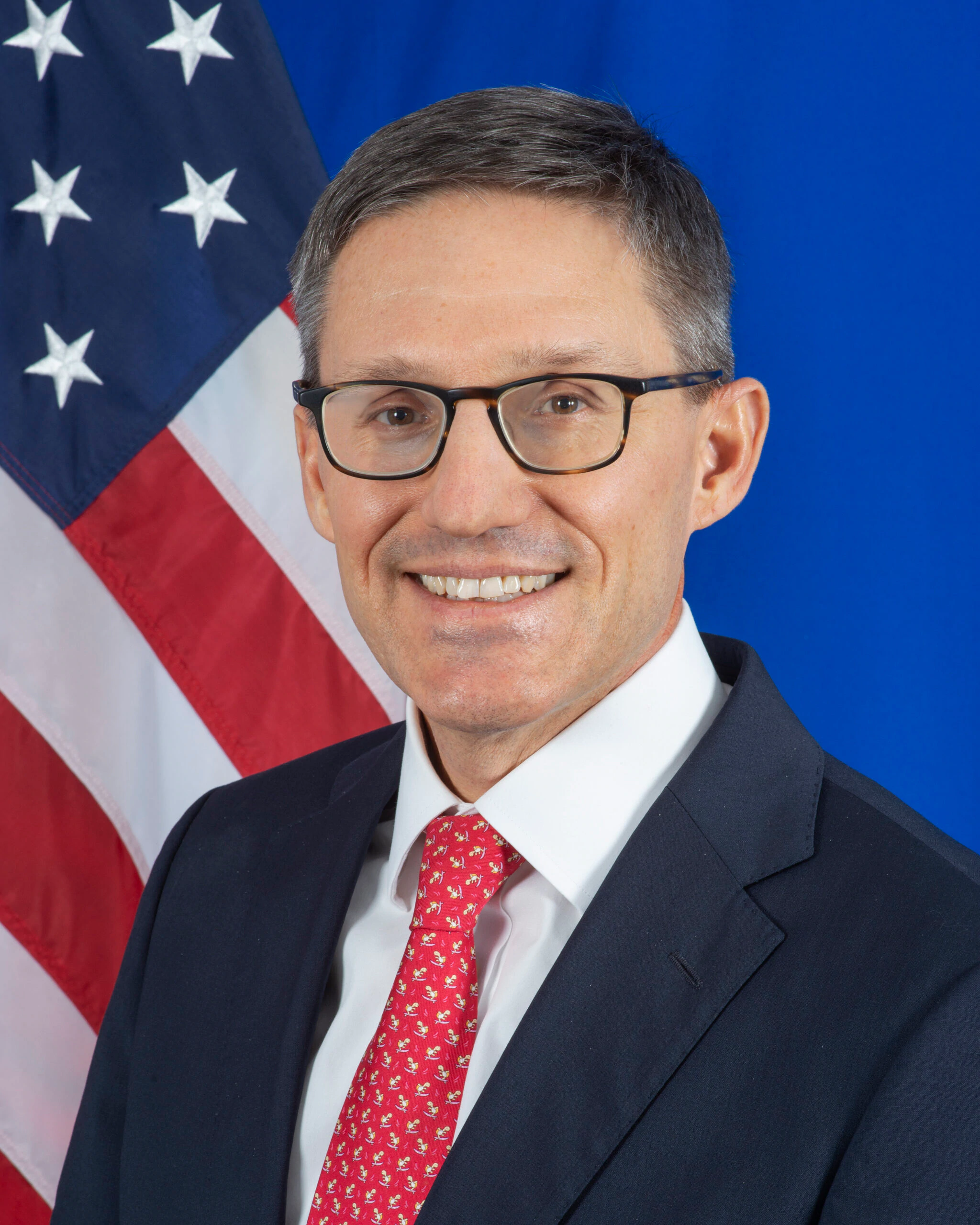
“I think there are real doubts about Russia’s ability to be a reliable partner for the foreseeable future. Because Russia is burning through a tremendous amount of its own military equipment. So, it faces urgent resupply needs of its own,” US State Department Counsellor Derek Chollet told PTI in an interview. Of the rank of Under Secretary of State and a senior policy advisor to US Secretary of State Antony Blinken, Chollet said the Biden administration is very much eager to work with India as it diversifies its defense capabilities and defense suppliers.
“We very much want to be part of that. We’re doing much more than we’ve ever done in the history of our relationship together in terms of defense. And so, as India’s seeking to acquire new capabilities, the United States very much wants to be a partner with India in that effort,” he said.
Chollet argued that the military equipment being supplied by Russia has shown it is lacking in capability. “The difficulty of doing business with Russia is only going to grow over time. It’s become much harder given all the sanctions placed on Russia in the last 12 weeks,” he said.
“Also, the export control against Russia… Russia’s inability to import key technologies to be able to make certain products, including some of its military hardware, are going to mean that it’s going to have a hard time even getting the capability to replace or to produce this kind of material. So, any way you look at it in terms of actual capability, in terms of the difficulty of doing business with Russia, in terms of the reputation costs associated, Russia is just a far less attractive partner,” he said.
However, Chollet evaded a direct answer to the question on the US deploying its Seventh Fleet to the Bay of Bengal in December 1971 during the India-Pakistan War, which many in India say is a symbol of the US also not being a reliable partner when needed.
“The US has shown throughout the course of this conflict, something we believe deeply, that we are a very reliable partner. If you think back…the United States made the decision to start sharing some of the most sensitive intelligence that we had about Russia’s planning and intentions when it came to Ukraine, our effort to share as much information as we possibly could with our friends and allies around the world in the spirit of being a reliable partner and in trying to bring the world and make them together and to make them aware of what we were seeing and try to create a unified effort,” he said.Chollet asserted that the India-US relationship has not been impacted by the Ukrainian war. “Russia’s invasion of Ukraine has not impacted the relationship between the US and India. The US-India relationship is deep, it’s strong,” he said, adding that it has bipartisan support in Washington.
“Obviously, we have talked with our Indian friends about everything from votes in the UN to the defense relationship with Russia. It was a topic of conversation at 2+2 (ministerial meeting) recently, but we fully understand the position that India is in given its long-standing defense relationship with Russia,” he said.
“It’s important to note that from our perspective we see that the defense relationship (between India and Russia) in a way started and flourished at a time when the United States was not available as a partner to India. Obviously, we are in a much different moment right now,” he said. The US-India defense relationship is in a much different and more positive place than it was even 10 years ago. “One of the significant outgrowths of the 2+2 process is the potential and the continued growth of the US-India defense relationship,” he said.
The agenda of the 2+2 meeting was just a further example of the breadth and depth of the strategic relationship between the US and India.
Earlier this month, External Affairs Minister S Jaishankar and Defense Minister Rajnath Singh held the 2-2 ministerial dialogue in Washington with US Secretary of State Antony Blinken and Defense Secretary Lloyd Austin. The 2+2 ministerial meeting was preceded by a virtual meeting between Prime Minister Narendra Modi and President Joe Biden. Chollet said that the Biden administration as of now has not taken any decision on CAATSA sanctions now that India has started receiving S-400 missile equipments from Russia.
“We have made no decision on that (CAATSA sanctions). Obviously, we are getting back to the overall theme of our desire to strengthen our defense partnership with India. We are very much eager to work with India…,” he said.
Referring to the progress in the India-US relationship since the Clinton administration irrespective of which party is in power, Chollet said it is like a rocket shooting into space with different stages.
“We are building on the work of our predecessors. It is important — it’s both Republicans and Democrats and there has been a very steady trajectory of closer cooperation and closer partnership. We are led by the people-to-people ties between our two countries,” he said. “In many ways, when it comes to the US-India relationship our governments are having to catch up to where our people are and our societies are,” he said.
In 2003, despite a growing partnership with the U.S. that was finally turning a corner after the nuclear tests, the Indian government brought a resolution to Parliament that “deplored” the actions of the coalition led by the U.S. for its war on a sovereign Iraq, calling the invasion “unacceptable”. But then External Affairs Minister Yashwant Sinha stood up to speak during the debate on the resolution passed unanimously, and noted that despite India’s differences with the U.S. on the war, the Government would continue to develop bilateral relations. It should have been possible for the government of the day to express its opposition to Russian actions in Ukraine similarly, while maintaining an independent position on unilateral sanctions.
It is possible for the Government to express its criticism while maintaining an independent stand on unilateral sanctions. Just four years ago, in June 2018, then United States President Donald Trump sent his Ambassador to the United Nations, Nikki Haley, on a sensitive mission to New Delhi. Ms. Haley, who was to meet Prime Minister Narendra Modi to convince the Government to drop its oil imports from Iran or face U.S. sanctions, and said that India must “rethink its ties”, was probably chosen because she was a diplomat and also an Indian-American which had a certain appeal in India. A day later, India’s petroleum ministry asked refiners to cut imports from Iran. Within a few months, when the American deadline expired, the Government announced that it had “zeroed out” its imports of oil from Iran, once India’s preferred choice and its third biggest supplier of crude.
‘Appeals’ and India’s reaction
Now, in 2022, the U.S. pressure on India to cut its oil imports from Russia has been much less subtle. The appeal to “zero out” oil purchases from Russia, and not accelerate them, has come from the highest quarters: these include U.S. President Joe Biden to Mr. Modi during a virtual summit;U.S. Secretary of State Antony Blinken during the “2+2” ministerial meeting in Washington last week, and from another Indian-American emissary, Deputy National Security Adviser for International Economics Daleep Singh, who, while he was on a visit to Delhi, spoke of “consequences” for creating payment mechanisms around sanctions against Russia. The pressure is likely to increase in the coming weeks, with more engagements planned by Mr. Modi with European leaders — the British Prime Minister Boris Johnson will arrive in India this week, and Mr. Modi is expected to travel to Germany and France for bilateral meetings and to Denmark for a summit with Nordic countries.
Thus far, nearly two months into Russia’s war with Ukraine, New Delhi’s position has been to push back: External Affairs Minister S. Jaishankar said in February that India does not recognize unilateral sanctions (only the ones mandated by the United Nations), followed by some tough talking in Washington last week. This includes the fact that after 12 occasions of votes at the UN, India continues to abstain on resolutions critical of Russia’s invasion and the daily bombardment of civilians. Despite talks with leaders from the U.S., Japan and Australia, each of whom criticized Russia in their summit remarks, India’s Ministry of External Affairs has not allowed any direct mention of Russia in the respective joint statements. In March and April, India has bought more Russian oil, at a discount, than it did in all of 2021, and is now accelerating coal imports as well. While deliveries of the Russian S-400 missile defense system may be delayed by the war, New Delhi is not putting its defense deals with Moscow on hold. Russian bank officials have held meetings with the Reserve Bank of India in Mumbai for technical talks on the rupee-rouble payment mechanism to be used for purchases that circumvent sanctions.
Sustainability of stand
So, what explains the Government’s refusal to bow to combined western pressure on the issue of India’s Russian engagement so far, when it gave in to far less pressure on dealing with Iran? And can New Delhi’s position be sustained much longer? While most analysis of India’s stance deals with its past relationship with Russia, (this includes the Soviet Union), the truth may lie in the Modi government’s perceptions of its future challenges: from its defense and energy procurements to global economic trends, to its continental border challenges, especially with China, and the growing focus by western countries on human rights issues in India. For example, India’s defense hardware dependency on Russia ranges around 60%, while dependency on spare parts is close to 85%. These could be offset with more purchases from the U.S. and the procurement of spares from the Commonwealth of Independent State countries that produced Soviet weapons. What will be harder to replace are defense purchases involving the transfer of technology, and export capabilities such as the BrahMos missile (short for Brahmaputra-Moskva), as the Government seeks more domestic production.
Similarly, while India’s energy dependence on Russia has been pegged at less than 2%, and it is unlikely to substantially increase its intake on the “heavy” Ural variety due to its high sulphur content, it is worth remembering that Indian oil public sector units have invested $16 billion in Russian oil and gas fields in eastern Russia, with stakes in Sakhalin-1, Vankor and Taas-Yuryakh . In 2017, Russia fulfilled a long-held dream dating back to Tsarist times to buy a warm water port, when Rosneft acquired a stake in the Vadinar refinery situated strategically on the Gujarat coast as part of a deal for a 49% stake in Essar Oil (this was a deal that Mr. Modi and Russian President Vladimir Putin had themselves promoted at a summit). In renewable energy too, while India has signed civil nuclear deals with a number of countries, including the U.S. and France, the only foreign nuclear power plants that actually exist are those built by Russia (Kudankulam in Tamil Nadu).
Above all, any serious future analysis of the conflict would question the long-term sustainability of the sanctions imposed by the western bloc, their effect on the Russian economy, and whether a sizeable number of important global economies will join the sanctions regime. If only about 30 to 40 countries have joined the sanctions trail, while India, China and much of South America and Africa stay out (as is the situation now), then it stands to reason that India does not benefit by restricting itself to only one side of the “dollar vs non-dollar” economic system and will seek to straddle both.
Comfort in groupings
India’s strategic future is also inextricably linked with Russia. The Napoleonic adage, “If you know a country’s geography, you can understand and predict its foreign policy”, could not hold truer for India’s continental predicament with its primary threats on its northern frontier from China and Pakistan, and a resultant need to have Russia onside. In the past two years, as Chinese troops have transgressed and occupied Indian territory, it is Moscow that has stepped in to provide venues and facilitate talks that have resulted in partial disengagement. Russian Foreign Minister Sergei Lavrov’s visit to Delhi this month — he arrived directly from China, and one that closely followed the trip by Chinese Foreign Minister Wang Yi to India (and also where both officials stressed the importance of regional cooperation) on the one hand and last week’s meeting of the Brazil-Russia-India-China-South Africa Sherpas on the other, are pointers. They indicate that the Modi government still finds comfort in groupings such as BRICS, RIC (Russia-India-China) and Shanghai Cooperation Organisation (SCO), despite all the developments so far.
As has been oft-repeated, Russia’s consistent support as a P-5 member of the UN Security Council is important, albeit not irreplaceable, but its support at other multilateral institutions such as the Financial Action Task Force (FATF) and the Nuclear Suppliers Group makes it that much more valuable. These factors are reinforced by the Modi-Putin bonhomie. Apart from visits to Brussels to meet Mr. Biden and Beijing to meet Chinese President Xi Jinping, Mr. Putin has made an exception only for Delhi, meeting Mr. Modi last December. The two leaders are in regular telephonic contact, and unlike the West, Mr. Putin has not (even once) raised concerns over the “backsliding of democracy” or “human rights violations” in the manner the European Union and the U.S. have — these include the Citizenship (Amendment) Act, the Jammu and Kashmir reorganization, or the treatment of minorities, the media and non-governmental organizations.
If these are the “pull factors” that keep New Delhi firmly anchored to Moscow, the absence of any “push factors” is another reason for this situation. While in 2017, Mr. Trump may have seemed irrational enough to sanction a strategic partner such as India over Iran, a Biden administration as well as European countries seem far less likely to do so. As a result, South Block’s expectation is that riding out this current period will be easier, apart from a few awkward conversations at the leadership levels.
In refusing to entertain western sanctions, and even building payment structures to circumvent them, the Government has invoked India’s firmly held principles of non-alignment and strategic autonomy. They mirror decisions of the past like when the A.B. Vajpayee government decided to conduct nuclear tests and face sanctions in 1998, and the Manmohan Singh government refused to bend to U.S. pressure on Iran oil sanctions, despite a visit by the U.S. Secretary of State, Hillary Clinton, in 2012.
Expression without fear
What the Government fails to explain, however, is why any of these reasons prevent it from criticizing Russia for what is quite obviously a brutal invasion by one country on another. In 2003, despite a growing partnership with the U.S. that was finally turning a corner after the nuclear tests, the Indian government brought a resolution to Parliament that “deplored” the actions of the coalition led by the U.S. for its war on a sovereign Iraq, calling the invasion “unacceptable”. But then External Affairs Minister Yashwant Sinha stood up to speak during the debate on the resolution passed unanimously and noted that despite India’s differences with the U.S. on the war, the Government would continue to develop bilateral relations.
It should have been possible for the government of the day to express its opposition to Russian actions in Ukraine similarly, while maintaining an independent position on unilateral sanctions. The Government could look no further at the explanation on neutrality that Prime Minister Jawaharlal Nehru gave during a speech in the U.S. in 1949, a few years before the Bandung Conference that led India to the Non-aligned Movement — “We are neither blind to reality nor do we propose to acquiesce in any challenge to man’s freedom from whatever quarter it may come. Where freedom is menaced or justice threatened or where aggression takes place, we cannot and shall not be neutral.” The assertion of strategic autonomy cannot carry credibility unless it is expressed without fear or favor of the consequences.
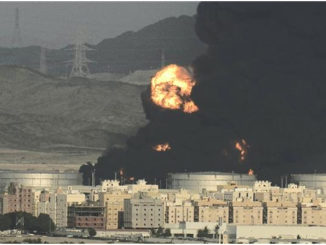
RIYADH (TIP): Yemen’s Houthis said they launched attacks on Saudi energy facilities on March 25 and the Saudi-led coalition said oil giant Aramco’s petroleum products distribution station in Jeddah was hit, causing a fire in two tanks but no casualties. A huge plume of black smoke could be seen rising over the Red Sea city where the Saudi Arabian Grand Prix is taking place this weekend, an eyewitness said. Unverified videos shared on social media showed fire raging in oil tanks in an Aramco facility on the outskirts of Jeddah. There was no immediate comment from Aramco or the energy ministry when contacted by Reuters. The Iran-aligned Houthi movement that has been battling a coalition led by Saudi Arabia for seven years launched missiles on Aramco’s facilities in Jeddah and drones at RasTanura and Rabigh refineries, the group’s military spokesman said. He said they also targeted “vital facilities” in the capital Riyadh. Saudi state media had earlier reported that a string of drone and rocket attacks by the Houthis was foiled by the coalition. Saudi air defences also intercepted and destroyed a ballistic rocket launched towards the port city of Jazan, which caused a “limited” fire to break out at an electricity distribution plant, state media reported. Saudi Arabia, the world’s largest oil exporter, said earlier this week it would not bear responsibility for any oil supply disruptions to global markets as a result of Houthi attacks that have intensified in the past three weeks. – Reuters
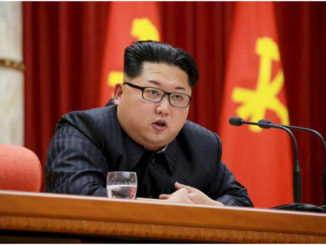
Seoul (TIP): North Korea fired at least one suspected ballistic missile towards the sea on March 24, its neighbours’ militaries said, apparently extending its barrage of weapons tests that may culminate with a flight of its biggest-yet intercontinental ballistic missile. South Korea’s Joint Chiefs of Staff didn’t immediately say whether the weapon involved in the launch was ballistic or how far it flew. Japan’s Prime Minister’s Office Defence Ministry said the North fired a possible ballistic missile. It was North Korea’s 12th round of weapon launches this year and came after it fired suspected artillery pieces into the sea on Sunday. Experts say the North’s unusually fast pace in testing activity underscore its dual goal of advancing its weaponry and applying pressure on Washington, over a deepening freeze in nuclear negotiations. The North has also tested a variety of new missiles, including a purported hypersonic weapon and its first launch since 2017 of an intermediate range missile potentially capable of reaching Guam, a key US military hub in the Pacific.
It also conducted two medium-range tests from near its capital area in recent weeks that the US and South Korean militaries later assessed as involving components of the North’s largest ICBM, the Hwasong-17, which they said could be tested at full range soon.
North Korea’s official media insisted that those two tests were aimed at developing cameras and other systems for a spy satellite. Analysts say the North is clearly attempting to simultaneously resume ICBM testing and acquire some level of space-based reconnaissance capability under the pretence of a space launch, to reduce international backlash to those moves. The launch may possibly come around as a major political anniversary in April, the birthday of state founder Kim II Sung, the late grandfather of current leader Kim Jong-Un. The North’s previous ICBMs demonstrated potential range to reach the American homeland during the three flight tests in 2017.
Its development of the larger Hwasong-17, which was first revealed in a military parade in October 2020, possibly indicates an aim to arm it with multiple warheads to overwhelm missile defences, experts say. (AP)
Lviv (TIP): Ukraine’s president has pleaded with NATO to provide his embattled nation with military assistance. In a video address to the NATO summit March 24, VolodymyrZelenskyy said Ukraine needs “military assistance without limitations”, as Russia is “using its entire arsenal” against the country. Zelenskyy urged NATO to provide Ukraine with “1% of all your planes, 1% of all your tanks”. “We can’t just buy those,” Zelenskyy said. “When we will have all this, it will give us, just like you, 100% security.” Ukraine is also in dire need of multiple launch rocket systems, anti-ship weapons and air defense systems, Zelenskyy said. “Is it possible to survive in such a war without this?,” he asked.
Zelenskyy said Russia used phosphorous bombs on Thursday morning, killing both adults and children. He reminded NATO leaders that thousands of Ukrainians have died in the past month, 10 million people have left their homes, and urged NATO to give “clear answers”.
“It feels like we’re in a gray area, between the West and Russia, defending our common values,” Zelenskyy said emotionally. “This is the scariest thing during a war—not to have clear answers to requests for help.” Zelenskyy did not reiterate his request for a no-fly zone or ask to join NATO, according to a senior Biden administration official.
Germany says it has sent about 10,000 metric tons of essential aid to Ukraine using a recently created “rail bridge” of trains shuttling back and forth between the two countries.
Transport minister Volker Wissing told the Funke media group in an interview published Thursday that the rail link was established two weeks ago to bring much-needed food, drink and hygiene products from Germany to Ukraine. Speaking at a Berlin cargo terminal Thursday, Wissing said many of the goods being sent to Ukraine by train had been donated.
“We hope this war is over soon and will do everything to ease the suffering,” he said.
German rail company Deutsche Bahn has separately organised additional trains to bring refugees from the Polish-Ukrainian border to Germany.
The Czech Republic’s Parliament has approved a plan to deploy up to 650 Czech service members to Slovakia as part of an multinational NATO force set up in response to Russia’s invasion of Ukraine.
Parliament’s lower house approved the deployment Thursday after the upper house gave the green light last week.
The United States, Germany, the Netherlands, Poland and Slovenia will also contribute troops to the unit, expected to include up to 2,100 soldiers.
The plan is part of the NATO initiative to reassure member countries on the alliance’s eastern flank.
The alliance stationed troops in the Baltic countries – Estonia, Latvia and Lithuania – and Poland after the 2014 annexation of Ukraine’s Crimean Peninsula by Russia. After Russia attacked Ukraine, NATO decided to boost its presence along the entire eastern flank by deploying forces in Bulgaria, Romania, Hungary and Slovakia. AP
Kyiv (TIP): Ukraine President VolodymyrZelenskyy called on people worldwide to gather in public on March 24 to show support for his embattled country on the one-month anniversary of the Russian invasion that he said breaks the heart of “every free person on the planet.”Zelenskyy — whose video messages have repeatedly riveted the world’s attention — also said he would speak to NATO members by video to ask the alliance to provide “effective and unrestricted” support to Ukraine, including any weapons the country needs to fend off the Russian onslaught.
“Come to your squares, your streets. Make yourselves visible and heard,” Zelenskyy said in English during an emotional video address late on Wednesday that was recorded in the dark near the presidential offices in Kyiv. “Say that people matter. Freedom matters. Peace matters. Ukraine matters.”
When Russia unleashed its invasion on February 24 in Europe’s biggest offensive since World War II, a swift toppling of Ukraine’s government seemed likely. But with Wednesday marking four full weeks of fighting, Moscow is bogged down in a grinding military campaign.
NATO estimated that 7,000 to 15,000 Russian soldiers have been killed in four weeks of war in Ukraine, where fierce resistance has denied Moscow the lightning victory it sought. By way of comparison, Russia lost about 15,000 troops over 10 years in Afghanistan. A senior NATO military official said the alliance’s estimate was based on information from Ukrainian authorities, what Russia has released — intentionally or not — and intelligence gathered from open sources. The official spoke on condition of anonymity under ground rules set by NATO.
In its last update, Russia said on March 2 that nearly 500 soldiers had been killed and almost 1,600 wounded.
Ukraine has released little information about its own military losses, and the West has not given an estimate, but Zelenskyy said nearly two weeks ago that about 1,300 Ukrainian servicemen had been killed. Ukraine also claims to have killed six Russian generals. However, Russia acknowledges just one dead general. Putin has warned the West that an attempt to introduce a no-fly zone over Ukraine would draw it into a conflict with Russia. Western nations have said they would not create a no-fly zone to protect Ukraine.
Zelenskyy appealed to Western countries to stay united in the face of Russia’s efforts to “lobby its interests” with “some partners” to bring them over to its side, and noted during his national address that Ukraine has not received the fighter jets or modern air-defence systems it requested. He said Ukraine also needs tanks and anti-ship systems.
“It has been a month of defending ourselves from attempts to destroy us, wipe us off the face of the earth,” he said.
In Kyiv, where near-constant shelling and gunfire shook the city on Wednesday as the two sides battled for control of multiple suburbs, Mayor VitaliKlitschko said at least 264 civilians have been killed since the war broke out. The independent Russian news outlet The Insider said Russian journalist Oksana Baulina had been killed by shelling in a Kyiv neighbourhood on Wednesday. (AP)
Kiev (TIP): The Centre for Counteracting Disinformation of the National Security and Defence Council of Ukraine has warned of possible chemical attacks being prepared by the Russian forces. “Russian channels tell their audience daily about mythical laboratories that allegedly create chemical weapons in Ukraine.” “This is how the enemy ‘grooms’ the population of the Russian Federation regarding the use of chemical weapons by ‘nationalists against the civilian population’. We emphasise that there are no such laboratories in Ukraine,” the Council said, Ukrayinska Pravda reported. Earlier, experts from the Russian Armed Forces have revealed new evidence of the involvement of the US Department of Defense in the development of biological weapons in Ukraine.
This was stated at a briefing by the official representative of the Russian Defense Ministry Igor Konashenkov.
Experts from the Russian troops of radiation, chemical and biological protection, in the course of studying documents, revealed new facts proving the direct involvement of the US Department of Defense in the development of biological weapons components in Ukraine, he said, RT reported.
According to Konashenkov, in the near future the Ministry of Defense will publish original documents that demonstrate that the Pentagon developed and approved the U-Pi-2 biological project.
It is noted that the main goal of this project was to conduct a molecular analysis of especially dangerous infections that are endemic to Ukraine.
“This work involved sampling the pathogen in old cattle burial grounds in order to obtain new strains of anthrax,” a Russian defence official said. –IANS
Kyiv (TIP): NATO estimated on March24 that 7,000 to 15,000 Russian soldiers have been killed in four weeks of war in Ukraine, where fierce resistance from the country’s defenders has denied Moscow the lightning victory it sought. By way of comparison, Russia lost about 15,000 troops over 10 years in Afghanistan. A senior NATO military official said the alliance’s estimate was based on information from Ukrainian authorities, what Russia has released — intentionally or not — and intelligence gathered from open sources. The official spoke on condition of anonymity under ground rules set by NATO. (AP)
NEW YORK (TIP): A March 25 Newsweek report has quoted the Turkish President Recep Tayyip Erdoğan as saying that Ukraine and Russia have reached an understanding on four of the six main topics of disagreement, including NATO, partial disarmament, collective security and Russian language, bringing the two warring countries a step closer to resolving the conflict.
Ragıp Soylu, Turkey bureau chief of Middle East Eye, reported the news in a tweet on Friday. However, there is still no agreement on Crimea and Donbas, two eastern areas of Ukraine that Russia sees as its own territory. In 2014, Russian troops annexed Crimea before claiming it as Russian land. Newsweek said it has contacted the ministries of foreign affairs of both Russia and Ukraine for comment on the peace talks. Turkey has been in contact with the negotiating teams from the two countries. The NATO member shares a maritime border with Ukraine and Russia in the Black Sea and has a strong relationship with both states. Although it has imposed some sanctions on Moscow since the war started on February 24, it has also offered to mediate the conflict. Erdogan was speaking at a press conference following the extraordinary summit of NATO leaders on Thursday and Friday.
“We will continue our talks with both Mr. Putin and Mr. Zelensky from now on as well,” Erdoğan said, according to a statement from his office. “All our efforts aim to create an atmosphere of peace by bringing together the two leaders.”
“As is known, there is almost a consensus regarding such issues as NATO, disarmament, collective security and using Russian as official language in the technical infrastructure works during the ongoing process in Belarus,” Erdogan added. “However, there is the issue of Crimea and Donbas, which is impossible for Ukraine to consent to.”
The Turkish leader called Ukrainian leader Volodymyr Zelensky’s move on Monday to declare that Ukrainian compromises with Russia will be decided on by a referendum was “wise leadership.”
“Turkey’s strong support for Ukraine’s territorial integrity and sovereignty since 2014 is known by everyone. We have stated at every opportunity that we never have and never will recognize Crimea’s annexation, and we continue to do so,” Erdogan said.
“The destruction and humanitarian tragedy caused by the war are evident. The war-torn cities, hospitals, schools and houses that have nearly turned into wrecks, and weeping refugees, who packed all their assets in one suitcase, have all reminded us once again of the bitter face of wars.” Erdogan is due to tell Russian President Vladimir Putin: “Make an honorable exit in Ukraine and become an architect of peace,” Soylu reported. The Turkish president met with U.S. counterpart Joe Biden and other NATO leaders in Brussels on Thursday to discuss further sanctions on Russia and bolstering the alliance’s eastern flank. Biden will travel to a Polish town near the border of Ukraine later on Friday to show solidarity and show Western resolve against the Russian invasion.
Berlin (TIP): Invoking the fall of the Berlin Wall, Ukrainian President Volodymyr Zelenskyy on March 17 urged German Chancellor Olaf Scholz to tear down what he called a wall between “free and unfree” Europe and stop the war in Ukraine. Speaking to the Bundestag by video link, Zelenskyy appealed to Scholz to restore freedom to Ukraine, tapping Germany’s collective memory with reference to the historic 1948-1949 Berlin Airlift and the fall of the Berlin Wall in 1989.
Zelenskyy described a new wall “in the middle of Europe between freedom and unfreedom”, which he said Germany had helped build, isolating Ukraine with its business ties to Russia and its previous support for the Nord Stream 2 gas pipeline.
“And this wall is getting bigger with every bomb that falls on Ukraine, with every decision that is not taken,” he added. Germany last month halted the Nord Stream 2 Baltic Sea gas pipeline project, designed to double the flow of Russian gas directly to Germany. Recalling former U.S. president Ronald Reagan’s appeal to Mikhail Gorbachev, the last Soviet leader, to tear down the Berlin Wall, Zelenskyy told German lawmakers: “That’s what I say to you dear Chancellor Scholz: destroy this wall.” “Give Germany the leadership role that it has earned so that your descendants are proud of you. Support freedom, support Ukraine, stop this war, help us to stop this war,” he added.
Lawmakers in the Bundestag welcomed Zelenskyy with a standing ovation and the chamber’s vice president, Katrin Goering-Eckardt, told him: “Your country has chosen democracy, and that’s what (Russian President) Vladimir Putin fears.” She said Putin was trying to deny Ukraine’s right to exist, adding: “But he has already failed with that.” (Reuters)
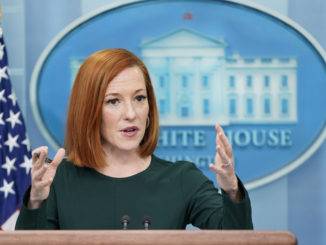
WASHINGTON, D.C. (TIP): The United States remains in touch with Indian leaders and continues to encourage them to work closely with it to stand up against the Russian invasion of Ukraine, the White House said Wednesday, March 16. “As you know, we remain in touch through a range of channels from our national security team with leaders in India and continue to encourage leaders to work closely with us to stand up against President Putin’s invasion of Ukraine,” White House Press Secretary Jen Psaki told reporters at her daily news conference. Over the past two weeks, the Biden administration has shown an understanding of India’s position on Russia given the complexity of its ties with Russia and over-dependence on Moscow for military and security needs.
During a Congressional hearing last week, Admiral John Christopher Aquilino, Commander of US Indo-Pacific Command, described India as a tremendous partner and said that the mil-to-mil relationship is probably at its highest point.
“From the US perspective, I think India is an absolutely essential partner as we think about our strategy in the Indo-Pacific, and both in terms of how we’re building coalition partners as well as dealing with potential adversaries.
“We recognize that India has a complicated history and relationship with Russia,” Ely Ratner, Assistant Secretary of Defense for Indo-Pacific Security Affairs, told members of the House Armed Services Committee during a separate hearing.
Formula One will no longer race in Russia after the sport terminated its contract with the promoter of the Russian Grand Prix, it said on Thursday, in response to the country’s invasion of neighbouring Ukraine. The event, which was set to move to a new track outside St Petersburg next year from its current Sochi Olympic park venue, had a contract until 2025. The sport announced the cancellation of the 2022 race, originally scheduled for Sept 25, last week. “Formula One can confirm it has terminated its contract with the Russian Grand Prix promoter meaning Russia will not have a race in the future,” a statement from the sport’s commercial rights holder, which decides the calendar, said. Formula One’s move to effectively pull out of Russia comes after the sport’s governing body, the FIA, on Tuesday condemned the country’s invasion of Ukraine but said Russian and Belarusian drivers could still take part in its competitions in a neutral capacity. British federation Motorsport UK on Wednesday banned Russian and Belarusian license holders from racing in the country.
New Delhi (TIP)-Although several countries have banned cryptocurrency, the decentralised money has become a mainstream component of the global financial system. This means that it will inevitably become a part of international conflict, for better or worse and as Russian armies enter Ukraine, this is on full show.As the war with Russia rages on, Ukrainian officials urged netizens on Twitter to send cryptocurrency. Since then, according to reports, cryptocurrency investors have given the Ukrainian government and a foundation backing the country’s military, more than $22 million in digital assets.
The turmoil in Ukraine has brought the burgeoning industry under increased attention, with politicians and regulators concerned that the cryptocurrencies could be used by Russian firms and government officials to circumvent sanctions. However, as more traditional crowdfunding techniques face challenges, cryptocurrency has created a way for investors all across the world to quickly shift funds to Ukrainian soldiers. In the case of crypto donations, Ukraine’s Vice Prime Minister Mykhailo Fedorov on February 26 shared wallet addresses on Twitter, urging people to “Stand with the people of Ukraine”, while adding that “now accepting cryptocurrency donations. Bitcoin, Ethereum and USDT”. Later, in the same Twitter thread, he wrote: “The people of Ukraine fighting for our freedom are forever grateful to Gavin Wood @gavofyork for the generous donation of $5M of @Polkadot $DOT as promised publicly. Thank you from all of us here in Ukraine working for a peaceful future.”
As of now, some reports have claimed that Ukraine has received at least $11 million through anonymous Bitcoin donations.
Separately, Come Back Alive, a Kyiv-based organisation that raises funds to arm and train Ukrainian military men, had a page taken down by the crowdfunding platform Patreon, which stated that the page had broken its rules prohibiting support of military activities. But now the organisation is getting funds from a crypto collective called UkraineDAO, which was formed last week by some crypto enthusiasts.
According to a report it was said Come Back Alive had pledged to use the funds to provide medical assistance to war victims rather than armed soldiers.
Additionally, it was also reported that Since Kremlin launched its attacks on the neighbouring country, cryptocurrency donations to Ukrainian volunteer and hacktivists groups have increased dramatically.
Sam Bankman-Fried, the billionaire CEO of crypto exchange FTX US, revealed in a tweet that they had given $25 to each Ukrainian on their platform.
These activities highlight the fact that at this time of crisis, donors who might have otherwise given their money to huge charities have turned to cryptocurrencies as an alternative.
But in a separate scenario, cryptocurrency exchanges have refused Ukraine’s request to suspend all Russian accounts.
As reported recently, major cryptocurrency exchanges such as Coinbase and Binance have refused to comply with Ukraine’s request to freeze all Russian accounts, claiming that doing so would damage people and go against their values. Source: News18
The resolution was adopted with 32 votes in favor, two against (Russia and Eritrea) and 13 abstentions, including India, China, Pakistan, Sudan and Venezuela
GENEVA/ UNITED NATIONS (TIP): India on Friday, March 4, abstained in the UN Human Rights Council on a vote to urgently establish an independent international commission of inquiry to investigate alleged human rights violations and related crimes following Russia’s military operation in Ukraine. The 47-member Council voted on a draft resolution on the ‘Situation of human rights in Ukraine stemming from the Russian aggression.’ The resolution was adopted with 32 votes in favor, two against (Russia and Eritrea) and 13 abstentions, including India, China, Pakistan, Sudan and Venezuela.
The countries voting in favor included France, Germany, Japan, Nepal, UAE, UK and the US.
The resolution, which strongly condemned Russia’s aggression against Ukraine, decides to “urgently establish an independent international commission of inquiry” to “investigate all alleged violations and abuses of human rights and violations of international humanitarian law, and related crimes, in the context of the Russian Federation’s aggression against Ukraine, and to establish the facts, circumstances, and root causes of any such violations and abuses.”
A day before the resolution was adopted, India said at the Urgent Debate Thursday regarding the human rights situation in Ukraine at the 49th Human Rights Council Session in Geneva that it is greatly concerned over the steadily worsening humanitarian situation in Ukraine.
India urged for an immediate cessation of violence and an end to hostilities. “No solution can ever be arrived at the cost of human lives. Dialogue and diplomacy are the only solution for settling differences and disputes,” India said.
India called for respect and protection of human rights of people in Ukraine and safe humanitarian access to conflict zones.
“We are also deeply concerned over the safety and security of thousands of Indian nationals, including young Indian students, who are still stranded in Ukraine. We are working together with neighboring States for their evacuation,” it said.Three human rights experts will be appointed to the Commission of Inquiry by the President of the Human Rights Council for an initial duration of one year. The Commission will be mandated to “identify, where possible, those individuals and entities responsible for violations or abuses of human rights or violations of international humanitarian law, or other related crimes, in Ukraine, with a view to ensuring that those responsible are held accountable.’ The resolution expressed grave concern at the ongoing human rights and humanitarian crisis in Ukraine and calls on Russia to “immediately end its human rights violations and abuses and violations of international humanitarian law in Ukraine”.
It also calls for the “swift and verifiable” withdrawal of Russian troops and Russian-backed armed groups from the entire territory of Ukraine, within its internationally recognized borders. India has abstained on two resolutions on Ukraine in the 15-nation Security Council and one in the 193-member General Assembly in the last one week. The UN General Assembly this week overwhelmingly voted to condemn Russian aggression against Ukraine and demanded that Moscow “completely and unconditionally” withdraw all of its military forces from the territory of Ukraine. India abstained on the resolution, which received 141 votes in favor, five against and a total of 35 abstentions.
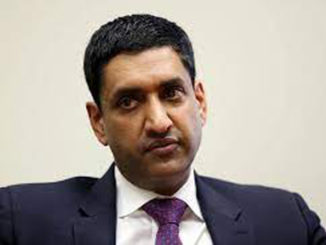
WASHINGTON, D.C. (TIP): Prominent Indian-American Congressman Ro Khanna has expressed disappointment over India’s decision to abstain from the UN Security Council resolution on Russia’s aggression against Ukraine, saying it is the US and not Russia that will stand with New Delhi against China’s current expansionist plans. India, China and the United Arab Emirates on Friday, February 25, abstained from the US-sponsored resolution against the Russian aggression which was vetoed by Moscow. As many as 11 of the 15 members of the UN Security Council voted in favor. Five countries—the US, the UK, Russia, China and France—are permanent members of the council and have veto powers. India is a non-permanent member and its current two-year term expires this year.
“In 1962, President (John F) Kennedy stood with India against China’s invasion. It is the US, not Russia, that will stand with India against China’s current expansionist plans,” Khanna tweeted on Friday, February 25. “This is the time for India to stand with the free word against Putin. Abstention is not acceptable,” said the three-term Democratic Congressman from California.
Echoing Khanna, Congressman Eric Swalwell also termed India’s move as “disappointing”.
“Rep Ro Khanna and I represent the largest Indian-American districts and this vote is contrary to what we hear from our constituents. Indian-Americans believe in territorial integrity and human rights,” said Swalwell, who is serving as representative for California’s 15th congressional district that covers most of eastern Alameda County and part of central Contra Costa County.
Abstaining from the UNSC resolution that “deplores in the strongest terms” Russia’s “aggression” against Ukraine, India on Friday said dialogue is the only answer to settle differences and disputes. In the country’s explanation of vote in the Council, India’s Permanent Representative to the UN Ambassador T S Tirumurti said New Delhi is “deeply disturbed by the recent turn of developments in Ukraine and urge that all efforts are made for the immediate cessation of violence and hostilities”.
He said that no solution can ever be arrived at, at the cost of human lives. “Dialogue is the only answer to settling differences and disputes, however daunting that may appear at this moment. It is a matter of regret that the path of diplomacy was given up. We must return to it. For all these reasons, India has chosen to abstain on this resolution,” Tirumurti said.
Family members of Indians trapped in Ukraine wait for their arrival at Delhi airport. (Photo: [Bilal Kuchay/Al Jazeera])
As soon as Chahat Yadav walked out of the airport and saw her family, she tossed away her luggage and ran towards them, crying inconsolably. Yadav’s father Narendra Kumar and other relatives had reached Delhi’s Indira Gandhi International Airport on Wednesday, March 2, to receive the second-year medical student studying in Ukraine’s Ternopil city. The relieved family could not hold back their emotions as they saw Yadav and huddled around her, hugging, kissing and in tears. Yadav was among nearly 200 Indian students who had just landed in New Delhi from Poland on Wednesday after trying for days to escape the Russian invasion of Ukraine that began last Thursday, forcing nearly 20,000 Indian students to flee the former Soviet nation. “The Ukraine military was only letting the Ukrainians and Europeans across the border,” Chahat told Al Jazeera as she held a bouquet of red flowers handed to those returning from Ukraine by Indian authorities at the airport. “But I don’t know why Indians were being stopped and pushed back,” the young student said, alleging many Indians were beaten by the Ukrainian forces as they tried to cross the border.
‘Sleepless nights’
When a Russian attack on Ukraine became imminent, Yadav’s father Kumar tried to book a ticket for her. But it was not easy with high demand and few flights. Kumar, who lives with his extended family in Gurugram on the outskirts of the Indian capital, bought an online ticket for Yadav for February 20 but the airline did not confirm the ticket. He later booked a transit flight to India via Qatar for February 23 at a steep cost of 50,000 rupees ($660). Yadav, who was double-vaccinated against coronavirus and was carrying her RT-PCR report along with her, was not allowed to board the flight to Qatar, Kumar said.
The problem: Yadav had taken an Indian-made Covaxin shot, which, Kumar said, was only “partially approved [by Qatar]”. “They refused to consider her RT-PCR report… A serology antibody test [was required] to board the flight,” he said.
When Russia invaded Ukraine the next day on February 24, Kumar said the thought of losing her daughter “gave him sleepless nights”.
“I would be lying if I said the thought of losing my daughter in Ukraine did not cross my mind. It happened several times and took away my sleep,” Kumar told Al Jazeera. “When I saw my daughter today, I couldn’t believe that she was finally back.”
Getting home was not easy for Yadav and other Indian students. On the evening of February 25, a day after Russian troops entered Ukraine, Chahat and her friends left Ternopil for Poland on a private bus they had hired for the trip.
They reached the Poland border around midnight, only to find a 35km line of vehicles desperate to leave the country. They had no choice but to cover the remaining distance on foot. Many students threw away some of their luggage to be able to make the journey.
They walked all night in bone-chilling cold and reached the border the next morning. But crossing into Poland was not easy, with thousands camped there. Yadav spent two nights at the border in sub-zero temperatures before she was allowed to cross.
‘Near-death experience’
Another medical student, Rajarshi Shyam, 21, reached Delhi on Wednesday. He had travelled from Ukraine’s Vinnytsia to Romania. “We faced problems at the border. It was very crowded. It was a near-death experience,” he told Al Jazeera.
Like Chahat, Rajarshi also had to walk for several kilometres on foot to reach the Romania border. He was also forced to dump some of his luggage, including his clothes, on the road.
Still, says Rajarshi, he was lucky to have crossed the border in his first attempt, unlike many of his friends who were either turned back or forced to spend days at the border.
Many Indian and African students have alleged facing racial discrimination and violence from Ukrainian officials at the borders.
Meanwhile, thousands of Indians remain stranded in Ukraine as Russia escalates its attack on cities such as Kharkiv, Ukraine’s second-largest, where many Indian students study medicine. -Source: Al Jazeera
No food, water: Over 600 students stranded in Ukraine city cry for help
Even as the Indian government has successfully evacuated thousands of citizens from war-torn Ukraine, over 600 students from the country stuck in the northeastern city of Sumy are crying for help. A student asserted that hope they will soon be evacuated as “continuous firing and bombing” by the Russian forces has left them completely terrified. They also complain of an acute shortage of food and water. Considering Sumy lies in the northeastern peninsula of Ukraine, it is difficult for the students to travel to the western border, from where they can reach neighbouring Poland, Hungary, Romania, Slovakia and Moldova, under the current circumstances.
Not a single Indian student has been evacuated from the Sumy State University, located close to the Russian border has been evacuated. “More than 600 Indian students are stuck here in Sumy university. The embassy has neither evacuated us nor given any assurance to that effect. Since the last five days, there has been continuous firing, shelling and bombing in the city,” Viraj Walde, who hails from Nagpur in Maharashtra, told news agency PTI.
“Before Russia’s invasion of Ukratine, temporary advisories were given to the students and the university informed us that those having exams can wait. Hence, we waited for the exams to start,” Walde added.
“But now, the students are terrified and their mental state is deteriorating. Food and drinking water supplies are depleting. Even the banks and ATMs are running out of cash,” he said.
Meanwhile, the Indian embassy has sent advisories asking them to use only the western border of Ukraine and reach the neighbouring countries of Poland, Hungary, Romania, Slovakia and Moldova. Since Sumy city is located in the north-eastern part of Ukraine, it is impossible for them to travel all the way to the western part of the country amidst the current situation.
“The border in Ukraine’s western part is located almost 1,500 kms away from Sumy, whereas the Russian border is just 50 kms away. The railway station in Sumy has also been closed due to bombing, and traveling via road is like committing suicide since Russian and Ukrainian forces are fighting against each other at such places,” he told PTI.
Signup to our Newsletter!
Don’t miss out on all the happenings around the world