Moscow (TIP): Russia has sentenced a man to 13 years in prison for trying to pass military secrets about Russia’s Northern Fleet to the US Central Intelligence Agency, the Federal Security Service (FSB) said on Nov 20. The FSB said in a statement that a court in Bryansk, southwest of Moscow, had found Yuri Eschenko guilty of state treason on November 17 and sentenced him to 13 years in a high-security facility. Eschenko pleaded guilty and said he regretted what he had done, the FSB said. Reuters could not immediately reach a lawyer for him. Eschenko, working in the town of Severomorsk, had a job servicing radio-electronic systems used by the Northern Fleet’s ships. The FSB said he had copied secret documents related to weapons systems used by the Northern Fleet. He had done the copying from 2015 to 2017 with a view to selling the information on to a third party, it said. In 2019, the FSB said he had made contact with the CIA. He was arrested in July by the FSB in the Bryansk region trying to hand over the state secrets, it said. Reuters
Tag: Russia
-

Global Covid-19 cases top 52.6mn: Johns Hopkins
The overall number of global coronavirus cases has topped 52.6 million, while the deaths have surged to 1,291,920, according to the Johns Hopkins University.As of Friday (Nov 13) morning, the total caseload and death toll stood at 52,643,939 and 1,291,921, respectively, the University’s Center for Systems Science and Engineering (CSSE) revealed in its latest update. The US is the worst-hit country with the world’s highest number of cases and deaths at 10,535,828 and 242,654, respectively, according to the CSSE.
India comes in second place in terms of cases at 8,683,916, while the country’s death toll soared to 128,121.
The other countries with more than a million confirmed cases are Brazil (5,747,660), France (1,914,918), Russia (1,822,345), Spain (1,417,709), Argentina (1,273,356), the UK (1,260,198), Colombia (1,165,326) and Italy (1,028,424), the CSSE figures showed. Brazil currently accounts for the second highest number of fatalities at 163,368. The countries with a death toll above 20,000 are Mexico (96,430), the UK (50,457), Italy (42,953), France (42,599), Spain (40,105), Iran (39,664), Peru (34,992), Argentina (34,531), Colombia (33,312) and Russia (31,326).
US reports record daily increase of
over 140,000 Covid-19 cases
The US reported 143,408 new Covid-19 cases on Wednesday, Nov 11, a record daily increase since the onset of the pandemic in the country, the US Centers for Disease Control and Prevention (CDC) said Thursday.
The new number refreshed the previous nationwide record of 134,383 cases set in previous day, pushing the seven-day average daily increase to a record high of 121,496 cases, according to latest CDC data. -
Russia says its Sputnik V COVID vaccine is 92% effective
Russia’s Sputnik V vaccine is 92% effective at protecting people from COVID-19 according to interim trial results, the country’s sovereign wealth fund said on Wednesday, as Moscow rushes to keep pace with Western drugmakers in the race for a shot.
The initial results are only the second to be published from a late-stage human trial in the global effort to produce vaccines that could halt a pandemic that has killed more than 1.2 million people and ravaged the world economy.
The results are based on data from the first 16,000 trial participants to receive both shots of the two-dose vaccine, the Russian Direct Investment Fund (RDIF), which has been backing its development and marketing it globally, said.
“We are showing, based on the data, that we have a very effective vaccine,” said RDIF head Kirill Dmitriev, adding that it was the sort of news that the vaccine’s developers would talk about one day with their grandchildren.
The analysis was conducted after 20 participants in the trial developed COVID-19 and examined how many had received the vaccine versus placebo.
That is significantly lower than the 94 infections in the trial of a vaccine being developed by Pfizer Inc and BioNTech. To confirm the efficacy rate, Pfizer said it would continue its trial until there were 164 COVID-19 cases.
-
Rare purple-pink diamond sold for $26.6 million Swiss francs
Geneva (TIP): An extremely rare, purple-pink diamond mined in Russia, which Sotheby’s described as “a true wonder of nature”, sold for $26.6 million Swiss francs on Wednesday, the auction house said.
Sotheby’s had estimated that the flawless oval gem, “The Spirit of the Rose,” could fetch $23 millon-$38 million at the Geneva sale.Bidding opened at $16 million and climbed to the final hammer price of $21 million, plus commission. It was bought by a telephone bidder who chose to remain anonymous, Sotheby’s said.
Jewellery expert Benoit Repellin, who led the sale, said it set a record for a diamond graded fancy vivid purple pink sold at auction. The stone weighing 14.83 carats was the largest pink diamond with that colour grading to go on the block. The diamond was named after a ballet performed by the Ballets Russes and its legendary dancer Vaslav Nijinsky in 1911.Mined by Russian diamond producer Alrosa in July 2017, it was cut from the largest pink crystal ever found in the country, Sotheby’s said.The diamond was shown in Hong Kong, Singapore and Taipei.Coloured stones have been greatly valued as an asset class by the super-rich in recent years with top-quality pink diamonds especially prized.The Argyle mine in western Australian, which produced the world’s largest supply of pink diamonds, halted production last week due to depletion. Reuters
-

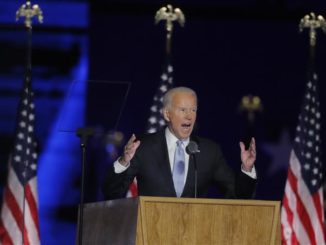
Biden reassures US allies in calls with leaders of Japan, South Korea, Australia
NEW YORK (TIP): In their first calls with Joe Biden since the U.S. election, the leaders of Japan, South Korea and Australia on Thursday reaffirmed plans to form close ties with the president-elect to tackle issues including climate change and regional security.
The three key Asian allies – Japanese Prime Minister Yoshihide Suga, South Korean President Moon Jae-in and Australian Prime Minister Scott Morrison – join other global leaders in recognizing the Democratic challenger’s Nov. 3 victory over incumbent Donald Trump, who has so far refused to concede.
Biden’s projected win comes against a backdrop of China’s growing military and economic assertiveness in the region, and after years of sometimes tumultuous relations between Asian allies and the United States under Trump over issues including trade, defense and the environment.
All sides expressed their determination to strengthen bilateral ties as well as tackle global issues such as the coronavirus pandemic and climate change, Biden’s office said.Japan’s Suga said he spoke with Biden by telephone and confirmed the importance of bilateral ties. “President-elect Biden said that he looks forward to strengthening the U.S.-Japan alliance and working together on achieving a free and open Indo-Pacific,” Suga said to reporters, in separate comments made at the Prime Minister’s Office.
Many world leaders including United Kingdom, France and Germany as well as others have already congratulated Biden for his win, while China and Russia have so far held off.
SECURITY AND PROSPERITY
Biden on Wednesday named Ron Klain as his White House chief of staff, his first major appointment as he builds his administration. Anthony Blinken, a diplomat and longtime confidant of Biden is seen as a likely pick for Secretary of State or National Security Adviser, both key roles for Asian allies.
Speaking to South Korea’s Moon, Biden reaffirmed the U.S. commitment to defend South Korea, highlighting the Asian ally as a “lynchpin of the security and prosperity of the Indo-Pacific region,” Moon’s spokesman Kang Min-seok said.
“President Moon asked for close cooperation for the forward-looking development of the bilateral alliance, and the denuclearization and peace on the Korean peninsula,” Kang told a briefing. “President-elect Biden said he would closely cooperate to resolve the North Korean nuclear issue.” Trump and North Korean leader Kim Jong Un vowed to work towards denuclearization at their unprecedented summit in 2018, but little progress has been made since their second summit and working-level talks collapsed last year.
While Biden has said he would not meet with Kim without preconditions, he has also said he would embrace “principled diplomacy” with North Korea.
South Korean officials are also hopeful that Biden will quickly resolve a drawn-out, multi-billion-dollar dispute with Washington over the cost of thousands of U.S. troops on the peninsula. Tackling the global coronavirus pandemic and climate change were key themes in Biden’s calls with all three leaders, readouts from Biden’s office showed.
Australia’s Morrison said he spoke with Biden about emission reduction technology, though a target for zero net emissions by 2050 was not discussed.
“I raised with the president-elect the similarity between the president-elect’s comments and policies regarding emissions reduction technologies that we needed to achieve that, and we look forward to working on those issues,” Morrison told reporters in Canberra. Both Moon and Suga said they agreed to arrange summits with the new president shortly after his inauguration in January.
Biden will also face the challenge of managing unresolved political and economic disputes between South Korea and Japan, which have threatened a military intelligence-sharing arrangement and complicated U.S. efforts to counter China.
(Agencies)
-

Clash of Civilizations
Islam, more than any other religion, smells apostasy in rejection of its beliefs

By Julio Ribeiro More than any other religion in our universe, Islam smells apostasy and insult in any rejection of its beliefs, however casual the intent of the culprit. In Muslim nations, the apostate would be put to the sword. In non-Muslim countries like France, the violent reactions of true believers would send out messages of dire consequences. The beheadings in Paris and Nice and the stabbings in the latter city were the responses of extremists who really believe that violent revenge would win them grace in heaven!
The French have always been irreverent about anything to do with religion. Perhaps this almost national attitude to God and God’s attributes was a fallout of the French Revolution. It is not surprising, therefore, that French President Emmanuel Macron made an off-the-cuff statement that conveyed to the Islamic world that the French government would uphold the right of its citizens to dabble in cartoons of the Prophet.
The issue arose because of the beheading of a Paris schoolteacher who had shown the cartoons drawn in a popular French magazine, Charlie Hebdo, a publication that specializes in political satire, to his pupils in a classroom. Ordinary Muslims take umbrage to the depiction of their Prophet in picture form. Cartoons, of course, are the worst form of picture depictions since the artist intends to draw wry humor which fragile minds cannot stomach. More than any other religion in our universe, Islam smells apostasy and insult in any rejection of its beliefs, however casual the intent of the culprit. In Muslim nations, the apostate would be put to the sword. In non-Muslim countries like France, the violent reactions of true believers would send out messages of dire consequences. The beheadings in Paris and Nice and the stabbings in the latter city were the responses of extremists who really believe that violent revenge would win them grace in heaven!
What brought me cause for joy and hope was a body of local believers calling themselves ‘Muslims for Secular Democracy’, led by my friend Javed Anand, husband of an even bigger friend, Teesta Setalvad, who in castigating the beheading of the teacher, Samuel Paty, made secular liberals exult. Here, at last, was a group of moderate and sensible Muslims that knows that no religion and no God will condone the brutality of murder and mayhem.
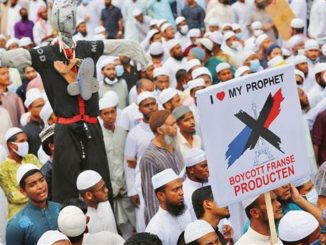
The very next day, to the consternation of the same secular liberals, thousands of Muslim protesters took to the streets of our cities, condemning France and its President for standing up to the legal rights of its citizens! Cinema houses in France and other countries of Europe have often screened films debunking some core beliefs of Christians regarding Jesus Christ, while hardcore Christians protested peacefully outside. Peaceful protests are par for the course in mature democracies.
France enforces strict segregation of the Church from the State. In its schools, religious symbols like crucifixes are not displayed. They are, in fact, not permitted. In many Christian lands, the crucifix is prominently displayed above hospital beds — but not in France or the Nordic countries which pride themselves on their secularism.
In his seminal work, The Clash of Civilizations, political scientist-cum-writer Samuel Huntington had predicted that the North-South divide between democracy and communism would be replaced by the East-West divide between the more populous but economically backward Muslim countries of the East and the established Christian-led economies of the West. The Islamic concept of a caliphate led to the establishment of the ISIS which tried to conquer lands and cities with economies based on oil revenues in Syria and Iraq and actually controlled vast territories in those lands for a decade. It established its capital in the Syrian city of Rakka, then under its control.
A French journalist named Anna Erelle went undercover to befriend an Algerian-descended ISIS emir or captain of French nationality. Her book Undercover Jihadi Bride gives a fair account of the murders and beheadings ordered by ISIS forces in and around Rakka in the decade before the organization was ousted from the Middle East and its caliph killed by the joint forces of Syria, Russia and the US.
The depredations linked to the ISIS should caution like-minded Islamic jihadist adventurers from dreaming of the unattainable! But they continue to dream and to feed on promises of rewards in the after-life made to them by semi-literate mullahs. Lacking secular education and skills to compete in a secular environment, they fall back on antiquated religious practices that can only lead them to despair and from despair to crime and from crime to destruction. Candidates to avenge perceived wrongs are never wanting. I have seen this in the Khalistani terrorist scene in Punjab. The emotional chord is one that is easily touched. It leads soldiers of terror to self-destruct sooner or later. The problem with jihadi terrorism is that it transcends boundaries and even geographies. The ISIS and the Al-Qaida attracted recruits from all over the Islamic world. The ‘ummah’, the brotherhood, provided the cannon fodder from among the gullible who were fired by visions of Islamic rule in the world, with the Sharia law dictating how men must pray and dress and eat and how women should be treated.
In India, extreme elements of the Hindu right were disgusted with the terror strikes by jihadists in a land that had been populated from times immemorial by the Indo-Aryans and the people they had conquered but later assimilated into Aryan society at lower graded levels. These disgruntled elements decided to take matters in their own hands and give a befitting reply to their tormentors. But they went about the riposte in a very amateurish manner, with the result that they were soon discovered and put out of commission. The moral of the story is that the call to arms by extremist elements of any religious persuasion will be answered by disgruntled young men who have smelt insult to their religion and its culture. But those who answer the call will soon repent because those who want to live peaceful and conventional lives outnumber them by wide and convincing margins.
(The author is a former Indian Police Services Officer)
(Source: The Tribune, India)
-

Biden vows to rejoin Paris Climate Agreement
NEW YORK (TIP): On November 4, the US formally withdrew from the 2015 Paris Agreement on Climate Change. Democratic presidential candidate Joe Biden has pledged that his administration would rejoin the historic Paris Agreement on climate change.
Mr. Biden, 77, has not won the presidential elections yet, but is inching closer to be declared the winner by garnering 253 electoral votes out of the required 270. His Republican rival and incumbent US President Donald Trump has got 213 electoral votes, according to latest projections released by the US media. On November 4, the US formally withdrew from the 2015 Paris Agreement on Climate Change, a decision originally announced three years ago.
“Today, the Trump Administration officially left the Paris Climate Agreement. And in exactly 77 days, a Biden Administration will rejoin it,” Mr. Biden tweeted on Wednesday night, reflecting his decision to reverse one of the key policies of the Trump administration on day one.
The US, under the Obama administration, had acceded to the Paris Agreement in 2016. It was a signature achievement of the Obama administration.
The Paris accord committed the US and 187 other countries to keeping rising global temperatures below 2C above pre-industrial levels and attempting to limit them even more, to a 1.5C rise.
Mr. Trump argues that the agreement is disadvantageous for the US, while it gives benefits to countries like China, Russia and India. According to him, it could be economically detrimental and cost 2.5 million Americans their jobs by 2025. The decision by the US – one of the world’s biggest emitters of greenhouse gases – to quit the agreement has led to condemnation from environmentalists and expressions of regret from world leaders.
Mr. Biden has proposed a USD 5 trillion plan to combat climate change.
The US is the second leading producer of all carbon dioxide emissions globally, behind China.
President Trump originally announced his intention to withdraw from the agreement in 2017 and formally notified the United Nations last year. The US exited the pact after a mandatory year-long waiting period that ended on Wednesday.
The US is the only country to withdraw from the global pact. It can still attend negotiations and give opinions, but is relegated to observer status. Mr. Trump had stated that he intended to renegotiate the details of the US’ membership within the Paris Agreement that can better protect US workers in industries like coal, paper, and steel.
(Agencies)
-

Global Covid-19 Cases top 48.5mn: Johns Hopkins
The overall number of global coronavirus cases has topped the 48.5 million mark, while the deaths have surged to more than 1,231,610, according to the Johns Hopkins University.
As of Friday (Nov 6) morning, the total caseload and death toll stood at 48,590,825 and 1,231,616, respectively, the University’s Center for Systems Science and Engineering (CSSE) revealed in its latest update. The US is the worst-hit country with the world’s highest number of cases and deaths at 9,604,077 and 234,904, respectively, according to the CSSE. India comes in second place in terms of cases at 8,364,086, while the country’s death toll soared to 124,315.
The other top 15 countries with the maximum amount of cases are Brazil (5,590,025), Russia (1,699,695), France (1,648,989), Spain (1,306,316), Argentina (1,217,028), the UK (1,126,469), Colombia (1,117,983), Mexico (943,630), Peru (911,787), Italy (824,879), South Africa (732,414), Iran (654,936), Germany (619,186), Chile (516,582), and Iraq (489,571), the CSSE figures showed.
Brazil currently accounts for the second highest number of fatalities at 161,106.
The countries with a death toll above 10,000 are Mexico (93,228), the UK (48,210), Italy (40,192), France (39,088), Spain (38,486), Iran (36,985), Peru (34,671), Argentina (32,766), Colombia (32,209), Russia (29,285), South Africa (19,677), Chile (14,404), Indonesia (14,348), Ecuador (12,730), Belgium (12,331), Iraq (11,175), Germany (11,006), Turkey (10,639) and Canada (10,432).
-

Indian Americans believe Joe Biden, Kamala Harris have best Understanding of Community
WASHINGTON (TIP): Joe Biden and his running mate Senator Kamala Harris have the best understanding of the Indian-American community, the leaders supporting the two Democratic candidates have said, describing US President Donald Trump as a “foe” who criticizes India on the world stage.
With less than four to go for the November 3 presidential election, Indian Americans on Friday asserted that Biden, first as a US Senator and thereafter as the vice president, has a strong track record of helping the community.
Trump, a Republican, is being challenged by Biden in the US presidential election.
“After four years of the Trump administration, we know our children and grandchildren will not have the same opportunities as we had. We need a leader who understands our community, our values, our pride and appreciates our hard work and gives equal opportunity and say in his administration,” said Ajay Jain Bhutoria, a Silicon Valley-based entrepreneur.
Mr Bhutoria said that Biden and Harris are the leaders who will lead the country out of this mess and restore its soul, revive the middle-class economy and re-establish America’s leadership on the world stage and best relationship with India.
Referring to the final presidential debate between Trump and Biden on Friday, Mr Bhutoria said that the president criticized India on the world stage. “The community understands who the real friend of India is, who the foe. Trump is a foe. Most recently on the debate stage saying- you cannot trust India’s COVID-19 numbers and India is filthy. He has suspended the H1 Visa Programme, put trade deals with India in jeopardy, and has used (Indian Prime Minister Narendra) Modi’s friendship for photo opportunities only,” he alleged.
During the final presidential debate, Trump accused China, India and Russia of not taking care of their “filthy air” as he justified America’s withdrawal from the landmark Paris climate agreement.
“Biden celebrated Diwali with (former) President Obama in the White House and at his residence. The former vice president has a deep connection with Indo-American community and India. Biden understands the values of Indo Americans. In his recent Op-ed he shares how he felt deeply connected to the Indian community and the values of the Indian community,” he said.
Indian-Americans share deep connections with Biden and Kamala Harris, he said. According to a recent survey, 80 per cent of Indian-American community is strongly behind Biden and Harris.
“Indo Americans understand that the way they share their values with Biden and Harris, (they) think that (US President Donald) Trump does not share their values and has failed and is leading America on the wrong path,” Mr Bhutoria said.
California State Assembly member Ash Kalra said that he has known Senator Harris and her sister Maya for over two decades.
“Kamala’s pride of her Indian heritage runs as deep as her love for her late mother, Shyamala Gopalan Harris. Kamala speaks fondly of her trips to India as a child and connects many of the ideals she fights for as an elected leader to the Indian values of her upbringing,” he said.
“With Joe Biden, a leader who during the course of his long career has proven his deep understanding of the needs of the Indian community, Kamala Harris will reaffirm the commitment our future president will have to our needs. The entire Indian community will be well represented with her as our next vice president,” Kalra said.
Aditi Pal with Desi Blue said that the community has always known Biden as a friend of India.“Seven years ago, as vice president, he told business leaders in Mumbai that the US-India partnership was the defining relationship of the 21st Century. As a Senator, he was instrumental in the passing of India’s Civil Nuclear Deal. And it was during Obama-Biden administration that the two countries saw their best years for the Indo-US relationship. Joe’s choice of Kamala Harris also gave us immigrants from India a sense of pride,” she said.
“Joel’s humility & inclusiveness is evident when he tells immigrants ”thank you for choosing America”,” she added.
According to Ashok Bhatt, businessman and former California Water commissioner, Obama-Biden administration Democrats gave India priority. When Narendra Modi became Prime Minister, Obama-Biden welcomed him and opened up economic areas and visas to students and tourists. H1 visas became so liberal and India benefitted the most from it.
“I believe the Biden-Kamala team will be great for Indo-American relationships and the economy of both countries will be flourishing,” Mr Bhatt said.
Biden is deeply connected to the Indian American community. As vice president, Biden strengthened relations with India and Indian Americans, said Neha Dewan from South Asians for Biden.
“The Obama-Biden administration appointed Indian Americans to serve in high level cabinet and ambassador positions, and as judges. Biden has consistently recognized Indian Americans,” she said.
-
Russia Poses Greater Election Threat Than Iran, Many U.S. Officials Say
WASHINGTON (TIP): While senior Trump administration officials said this week that Iran has been actively interfering in the presidential election, many intelligence officials said they remained far more concerned about Russia, which in recent days has hacked into state and local computer networks in breaches that could allow Moscow broader access to American voting infrastructure, a report in New York Times says. The discovery of the hacks came as American intelligence agencies, infiltrating Russian networks themselves, have pieced together details of what they believe are Russia’s plans to interfere in the presidential race in its final days or immediately after the election on Nov. 3. Officials did not make clear what Russia planned to do, but they said its operations would be intended to help President Trump, potentially by exacerbating disputes around the results, especially if the race is too close to call.
-

India, Russia begin ‘new era’ of cooperation in Indo-Pacific region: Modi
VLADIVOSTOK(TIP): India and Russia are beginning a new era of cooperation in the Indo-Pacific region to make it “open, free and inclusive”, Prime Minister Narendra Modi said on Thursday ,September 5, amidst China flexing its military muscles in the strategic region.
Addressing the plenary session of the 5th Eastern Economic Forum here, Prime Minister Modi said, “When ships will start plying between Vladivostok and Chennai with the opening of the maritime routes between the two cities, the Russian port city will become the springboard of northeast Asia market in India. This will further deepen the Indo-Russia partnership.”
A Memorandum of Intent was signed on Wednesday, September 4 between India and Russia for the development of maritime communications between the ports of Chennai and Vladivostok in Russia’s Far East Region.
“We are starting a new era of cooperation in the Indo-Pacific region,” Modi said, adding that the partnership between India and Russian in the development of the Far East will make it a “confluence of open, free and inclusive Indo-Pacific”.
The Far East, Modi said, will become the bedrock of strong Indo-Russia ties, which is based on the principles of “rules-based order, sovereignty, respect for territorial integrity and is against engaging in the internal matters of other countries”.
India, the US and several other world powers have been talking about the need to ensure a free, open and thriving Indo-Pacific in the backdrop of China’s rising military maneuvering in the region.
China has been trying to expand its military presence in the Indo-Pacific, a biogeographic region comprising the Indian Ocean and the western and central Pacific Ocean, including the South China Sea.
China claims almost all of the South China Sea. Vietnam, the Philippines, Malaysia, Brunei and Taiwan have counter claims over the sea.
Earlier in the day, Modi met his Japanese counterpart Shinzo Abe on the sidelines of the Eastern Economic Forum. Both the countries agreed to further deepen cooperation in the Indo-Pacific region.
In November last year, India, the US, Australia and Japan had given shape to the long-pending Quadrilateral coalition to develop a new strategy to keep the critical sea routes in the Indo-Pacific free of Chinese influence.
China is engaged in hotly contested territorial disputes in the East China Sea too with Japan. Beijing has built up and militarized many of the islands and reefs it controls in the region.
Both areas are stated to be rich in minerals, oil and other natural resources. They are also vital to global trade
(Source: PTI)
-

India and U.S. resolve to work through their trade differences
NEW DELHI (TIP): India and the U.S. resolved to “work through” their differences which have led to an impasse on trade issues as External Affairs Minister S. Jaishankar hosted U.S. Secretary of State Mike Pompeo in Delhi ahead of a meeting between Prime Minister Narendra Modi and U.S. President Donald Trump in Osaka this week.
“If you trade with somebody, and particularly if they are your biggest trading partners, it’s impossible that you don’t have trade issues. But I think the sign of a mature relationship is that ability to negotiate your way through that and find common ground,” Mr. Jaishankar said at the end of their meeting on Wednesday, although neither side announced any positive outcomes from the discussions. Mr. Pompeo and Mr. Jaishankar are understood to have thrashed out issues, including tariffs and counter-tariffs imposed by New Delhi and Washington on each other in the past year, as well as the U.S.’s specific concerns with India’s proposed laws on e-commerce and data localization, on price caps and market access.
“The U.S. is clear that it seeks greater market access and the removal of trade barriers in our economic relationship, and today I addressed these differences in the spirit of friendship and I think we will be able to resolve these issues in the interests of our two countries,” said Mr. Pompeo.
He clarified that the U.S. decision to withdraw India’s GSP preferential trade status this month had not come up for discussion.
Mr. Jaishankar said both sides had come away with a “better understanding” of each other’s concerns on a wide variety of issues besides trade, including energy, defense, investment concerns and people-to-people contacts, as well as the growing conflict in the Gulf with Iran and the peace process in Afghanistan.
Rejecting calls by the United States and the threat of sanctions under its CAATSA law, Mr. Jaishankar said that India will take its decision on the purchase of the Russian S-400 Triumf anti-missile system in its own “national interest”, and conveyed this to his American counterpart during talks here on Wednesday.
“On the CAATSA ( Countering America’s Adversaries through Sanctions Act)issue) I explained to Secretary Pompeo in some detail that we have many relationships with many countries, and many of them have some standing and they have a history,” said Mr. Jaishankar, referring to India’s traditional relationship with Russia.
Mr. Jaishankar also raised India’s concerns over growing U.S.-Iran tensions and their impact on India’s energy security.
While India has zeroed out all oil imports from Iran since the U.S. sanctions deadline ran out on May 2, it has maintained a cordial and close relationship with the Iranian government. In response, Mr. Pompeo lashed out at the Iranian government, which he called a “terrorist regime”, adding that India and the U.S. had a “shared understanding” of the terrorist threat emanating from Iran.
“We know that Iran is the world’s largest state sponsor of terror, and the Indian people have suffered from terror around the world. So I think there is a shared understanding of the threat and a common purpose to ensuring that we keep energy at the right prices and deter this threat,” Mr. Pompeo said.
The MEA declined to comment on whether it supported Mr. Pompeo’s remarks, which were made in Mr. Jaishankar’s presence. Mr. Pompeo also met with PM Modi and National Security Adviser Ajit Doval on Wednesday, June 26.
-

China, Russia to Open up Markets for Indian Trade
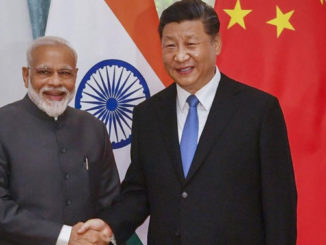
NEW YORK / NEW DELHI / BISHKEK (TIP): Prime Minister Narendra Modi on Thursday, June 13, received assurances of significant trade and investment opportunities in bilateral meetings with Chinese President Xi Jinping and Russian President Vladimir Putin.
Modi and several other world leaders are in Bishkek to participate in a summit meeting of the Shanghai Cooperation Organisation on Friday, June 14.
In a brief discussion on Pakistan with Xi, Prime Minister Modi said India’s position was to peacefully utilize bilateral mechanisms to settle disputes. He had personally invested in the relationship but his efforts had been derailed.
“The PM informed Xi that Pakistan needs to create an atmosphere free of terrorism but India did not see it as happening,’’ said Foreign Secretary Vijay while briefing newspersons.
While Kremlin offered India scope for investment in Russia’s Far East and Arctic regions, China said it had dismantled regulatory procedures that would lead to an “uptick” in Indian exports of non-Basmati rice, sugar and pharmaceuticals.
Xi assured Modi that China was in the process of dismantling even more regulatory barriers. Xi had made a similar promise at the Second Belt and Road summit in April this year.
In the meeting with Putin, PM Modi promised to visit the Russian Far East in September where he will interact at a greater length with the Russian President.
Modi’s visit to Vladivostok will be preceded by tours of the Far East by delegations from Indian states who will scout for business opportunities.
India also accepted Russia’s offer for investing in major oil exploration projects. Modi said skilled Indian manpower could be used to develop the region.
Foreign Secretary Vijay Gokhale said the two leaders did not discuss any specific military equipment nor could regional issues be aired due to paucity of time.
Prime Minister Modi’s meeting with the Chinese President was relatively brief. The discussions mostly revolved around speeding up of border talks and smoothening bilateral trade.
(Source: Agencies)
-

Trump’s ex-lawyer gets 3-yr prison term for financial crimes
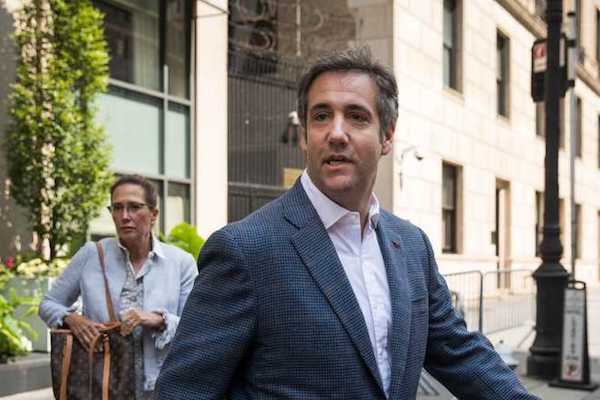
NEW YORK (TIP): President Donald Trump’s former personal lawyer Michael Cohen was sentenced to three years in prison on Wednesday, December 12, for financial crimes and orchestrating hush payments to women before the 2016 election, telling the judge his “blind loyalty” led him to cover up for Trump.
The sentencing by US District Judge William Pauley in Manhattan capped a stunning about-face by a lawyer who once said he would “take a bullet” for Trump but has now implicated the Republican President in criminal conduct. Cohen said in his guilty plea in August he was directed by Trump to make hush money payments to two women who said they had sexual affairs with Trump in the past.
Trump has denied the affairs and any involvement in the payments.
The three-year sentence was a modest reduction from the four to five years recommended under federal guidelines, but still underscored the seriousness of the charges of violating campaign finance laws and seeking to influence the outcome of an election.
Pauley sentenced Cohen to 36 months for the payments and to two months for Cohen’s lies to Congress about a proposed Trump Tower project in Russia. The two terms will run simultaneously.
The judge set March 6 for Cohen’s voluntary surrender.
As part of the sentence, the judge ordered Cohen to forfeit $500,000 and pay restitution of nearly $1.4 million.
Cohen pleaded guilty in August to charges including tax evasion, bank fraud and campaign finance violations in a case brought by federal prosecutors in New York.
Cohen was sentenced on a separate charge of lying to Congress brought by Special Counsel Robert Mueller, who is investigating Russia’s role in the 2016 election and possible coordination between Trump’s campaign and Moscow.
(Source: Reuters)
-

India, Russia set to sign three major deals, ignoring U.S. threats
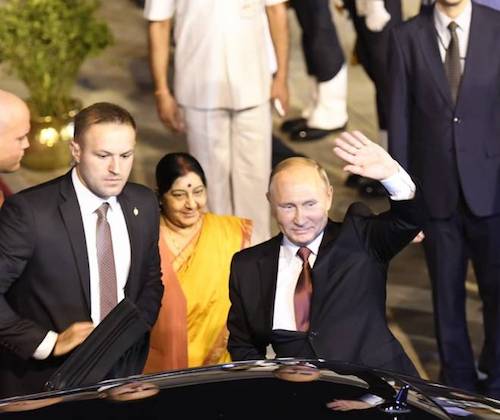
NEW DELHI(TIP): Russian President Vladimir Putin landed in Delhi on Thursday, October 4, for the annual India-Russia summit which could see the signing of military deals totaling close to $10 billion; a 24-hour visit that could have lasting implications for the India-U.S. relationship as well.
On Friday, India and Russia are expected to conclude three major military deals: for five S-400 missile systems estimated to cost about ₹39,000 crore (more than $5 billion), four stealth frigates and a deal for Ak-103 assault rifles to be manufactured in India. The U.S. has warned that the deals could attract sanctions under the Countering America’s Adversaries Through Sanctions Act (CAATSA) law that restricts defense purchases from Russia, Iran and North Korea.
India has been in negotiations with the U.S. administration for a “sanctions waiver”, but American officials have given no clear signal they will provide one. Last month, President Donald Trump’s administration-imposed sanctions on China as it started taking delivery of Su-35 fighter jets and S-400 systems.
The breadth of agreements, including the S-400 deal, during Mr. Putin’s visit is seen as a reiteration of India’s desire for “strategic autonomy” that was highlighted by Prime Minister Narendra Modi in a speech this year. It comes a month after the inaugural 2+2 dialogue with the U.S., in which India signed the third foundational agreement — Communications Compatibility and Security Agreement (COMCASA) — in addition to announcing several measures to operationalize the Major Defense Partner status, indicative of the difficult balance India hopes to maintain amid deepening U.S.-Russia tensions.
On Wednesday Air Chief Marshal B.S. Dhanoa said that once the Defence Ministry signs the contract, deliveries of the S-400 systems would begin in 24 months. In October 2016, the two countries concluded Inter-Governmental Agreements (IGA) for S-400 systems and four stealth frigates after which the negotiations began to conclude a commercial contract.
Mr. Putin and Mr. Modi will meet on Friday for a “working breakfast” followed by delegation-level talks. They are expected to witness the signing of at least 23 agreements, an official said, including Memoranda of Understanding for investment deals, a major agreement on space cooperation where Russia will assist India with its ‘Gaganyaan’ program to put a human in space, an MoU for Road Transport and the Road Industry, as well as one for cooperation on Micro, Small and Medium Enterprises.
Officials say that nuclear power cooperation, one of the cornerstones of India-Russia ties, will be discussed, but the announcement of new sites for the next phase of Kudankulam reactors is yet to be finalized due to “land acquisition issues.”
Both leaders will also meet with young Indian and Russian student “geniuses” who have excelled in studies, as part of an educational exchange program.
Officials said a discussion on the way forward in Afghanistan, including Moscow’s push for talks with the Taliban is likely to come up for discussions as well. Mr. Putin and Mr. Modi will address a business summit in the capital before the Russian President departs on Friday evening.
(Source: PTI)
-

FIFA was Russia’s coming out party

By Prabhjot Singh Moscow splurged over $11 bn to make the FIFA World Cup an event to make the ‘planet’ change its outlook about Russia. It worked, leading the FIFA chief to say, “ the whole world fell in love with Russia.’’
FIFA World Cup 2018 was an all-European show. If France won the Cup, Russia, the hosts, won the hearts. The Americas — north, south and central — were all cut to size not only on the playfields of Russia but also in politics. It turned out to be a wonderful carnival of fun, sport and politics that witnessed many upheavals, besides showcasing Russia as a modern, dynamic and “normal” nation, ready for inclusion in the global economic, political, and sporting landscapes.
Not only did all 32 nations that qualified laud the event as the “best ever”, a certificate of appreciation also came from FIFA president Gianni Infantino when he commented “the whole world fell in love with Russia” for hosting the best World Cup ever.
FIFA World Cup 2018 was no different from the 2008 Beijing Olympic Games and 2016 Rio Olympic Games for grabbing criticism on corruption, organizational lapses and failure to provide “clean, healthy and sporting environs for free and fair competitions”. Intriguingly, at the end of these events, this criticism was changed to praise.
The allotment of FIFA World Cup 2018 to Russia was not without a controversy. FIFA itself was dogged by allegations of corruption and impropriety. Sepp Blatter, the infamous suspended FIFA chief, was a special guest of Russian President Vladimir Putin.
Allotment was made in 2011 and Putin had promised that the event would change the way the planet saw his “nation”. He had put in place a mechanism to keep the showcase event of FIFA free from threats of hooliganism, terrorist attacks or disruptions by political activists.
Russia, an offshoot of the erstwhile Soviet Union, got the World Cup at a time when its relationship with both Europe and the US had touched the lowest ebb in decades. Its recent actions in Syria and Ukraine fractured further these ties.
But unlike the 1980 Moscow Olympic Games held a year after the invasion of Afghanistan, this FIFA World Cup witnessed no boycotts. It was all the more credible to have a full FIFA house in Russia, especially when the hosts remain on the “suspension list” of the International Olympic Committee. In the last Olympic Winter Games in PyeongChang, Russia was not allowed, though its athletes participated under the banner of Olympic Athletes Russia. The World Cup provided a pleasant change. Between June 14 and July 15, the 64 games played in 11 cities not only saw Iceland making an impressive debut, but also defending champions Germany making an exit after the group matches.
For Asia, it was Japan that carried the flag to the pre-quarterfinals, as other Asian contenders — Iran, Saudi Arabia and Korea —could not cross the group matches hurdle.
Though India has seldom qualified for the prestigious FIFA event, it had its nominal representation through Rishi Tej (10) and John K Nathania (11) who were chosen to carry the ball for the games on June 18 and 23 in the Russia World Cup. Besides there were 100-odd football fans from India, including Amitabh Bachchan. There were also some volunteers from India.
The FIFA World Cup is an event that is as prestigious, if not more, as the summer Olympic Games are. Russia spent more than $11.6 billion on infrastructure for the FIFA World Cup. Four years earlier, it had put in a huge amount for the Winter Olympic Games, an event that at the end soiled its credibility for conspiring to “drug” the games, with critics calling the 2014 Sochi Winter Olympics as “chemist” games.
Besides the Russian Government’s expenditure on making the World Cup an event to make the “planet” change its outlook about Russia, FIFA’s budget for the just-concluded World Cup was a whopping $1,943 million.
Compared to it, when Bhubaneswar holds the World Cup Hockey Tournament later this year, the total cost is estimated at about $19 million. The event will be spread over 19 days and feature 16 teams and 36 matches. FIFA World Cup, a 35-day event, witnessed 64 games played in 11 different cities.
There were nearly half a million football fans, including several thousand from Peru alone, drinking on the streets of Russia, through the World Cup days.
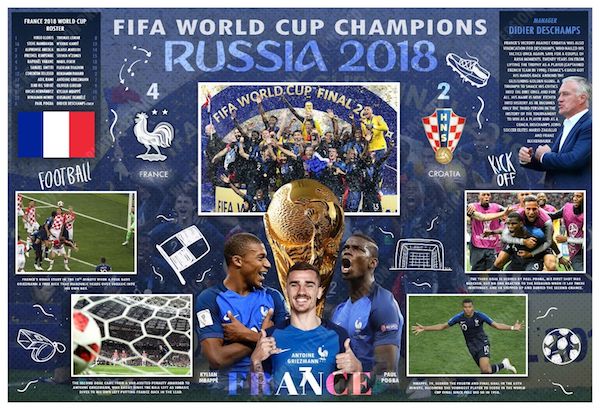
As the event progressed to its knockout rounds, some icons like Argentina, Spain, Portugal, Brazil and Uruguay made unceremonious exits, losing by results facilitated either by late goals, penalties, own goals or penalty shootouts. There were 29 penalties awarded in the tournament besides “own” goals, including the first goal of the final between France and Croatia. And then, the second goal came from a penalty.
By the time the tournament reached the semi-final stage, the challenge of Asia, Africa and the Americas had ended. The semi-finals and final were an all-European affair. Though Croatia made it to its first final of a World Cup, it could not stand up to the experience of the French, who won their second World Cup title in 20 years, and thus became only the sixth nation to win the elite soccer tournament two or more times.
Harry Kane (England), Luka Modric (Croatia), Kylian Mbappe (France) and Thibaut Courtois (Belgium) were adjudged among the best players of this World Cup that also saw the fading away of Lionel Messi (Argentina), even as Cristiano Ronaldo (Portugal) and Neymar (Brazil) may continue to hawk headlines for some more time.
And who can forget the Croatian President, Kolinda Grabbar-Kitarovic, who spent her own money to travel to Russia, sported the team jersey to watch the “silver team” play the final, from the stands, and greeted and consoled each member of the losing finalist team with a warm hug?
(The author is a senior journalist. He is executive editor with the PTC TV Channel)
-

Trump, Putin to hold summit in Helsinki on July 16
Will discuss Syria, Ukraine and “many other subjects”: Trump
WASHINGTON/MOSCOW(TIP): US President Donald Trump and Russian President Vladimir Putin will hold a summit in Helsinki on July 16, the White House and the Kremlin announced Thursday, June 28.
The brief statement issued in Moscow said the two presidents will discuss bilateral issues and international relations.
The announcement comes a day after Trump’s National Security Adviser John Bolton held talks with Russian officials in Moscow to lay the groundwork for the summit.
“I’ve said it from day one, getting along with Russia and with China and with everybody is a very good thing,” Trump said Wednesday. “It’s good for the world. It’s good for us. It’s good for everybody.”
He said they would discuss Syria, Ukraine and “many other subjects.”
-

Trump’s Iran walk-back: Double whammy for India after CATSA
Just when Indian diplomats were figuring out how to mitigate the impact of Countering America’s Adversaries Through Sanctions Act (CATSA) on its arms and oil trade with Russia, South Block has another reason to burn the midnight oil. US President Donald Trump’s intention to exit the Iran deal, and reimpose sanctions if Tehran declines to renegotiate, could send India’s plans for the region in smoke. The sanctions will pretty much cover all areas of interest to India vis-a-vis Iran: petroleum, ports, shipping and banking. The bright side is that except for Saudi Arabia and Israel, pretty much the rest of the world has not taken kindly to Trump’s attempt to redefine the Joint Comprehensive Plan of Action (JCPOA) to cover “responsible” behavior by Iran both externally and domestically.
The world can be grateful that Tehran doesn’t have an impetuous leader like Trump. Javed Zarif, Iran’s chief negotiator for the deal, has resolved to diplomatically lobby with the other parties to the agreement. Yet, Trump’s explanation that Iran could emulate North Korea by negotiating denuclearization will find few takers for it is widely realized that Tehran would have to be suicidal if it were to show signs of weakness. On the contrary, the US may have lost North Korea’s trust by going back on the Iran deal just as it lost Palestinian support after Trump announced the shifting of the US embassy to East Jerusalem.
India needs to work with countries with a shared interest in the JCPOA to ensure that Trump’s exit from the Iran deal does not harm its investments and plans for the region. India and other countries on the same page must also engage with Iran to discourage it from retaliatory malign behavior that may further muddy the waters. PM Modi will get the opportunity to discuss the issue with like-minded leaders when he meets them for two multilateral summits later this year. The problem for India is it has no company like the Chinese Sinopec which has no business interests with a US company and can thus escape sanctions. India will first have to make common cause with countries in the same Iranian boat.
(Tribune, India)
-

UK snaps diplomatic ties with Russia: 23 Russian officials told to leave in a week
British PM May says Moscow behind murderous bid
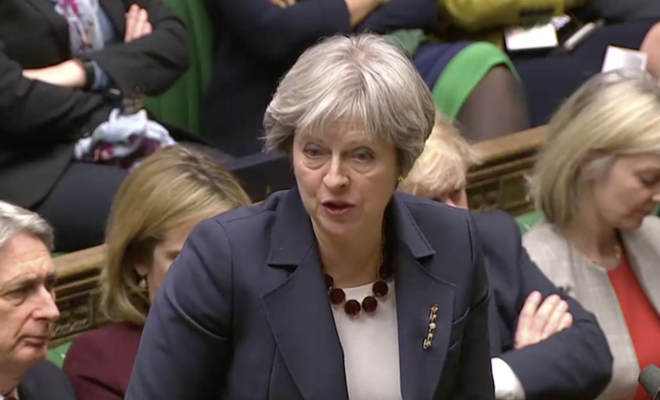
LONDON (TIP): British Prime Minister Theresa May, on March 14, held Russia responsible for the nerve agent attack against a former Russian spy and his daughter as she expelled 23 Russian diplomats and suspended high-level bilateral contact.
Former Russian spy Sergei Skripal, 66, and his daughter Yulia, 33, were found collapsed after being poisoned last week. Both remain in a serious condition along with a police officer who came in contact with the same substance.
Russia denies being involved in the attempted murder of the former spy and his daughter. “The Russian state was culpable of the attempted murder” of spy Sergei Skripal and his daughter, May told lawmakers. She said Britain will suspend high-level bilateral contact with Russia and revoke an invitation to Russian Foreign Minister Sergei Lavrov to visit the UK.
The Prime Minister announced that Britain will expel 23 Russian diplomats, saying they have one week to leave the UK. She identified those diplomats as “undeclared intelligence officers”, BBC reported.
Moscow, which had been given an ultimatum to provide a “credible response” over how a Russian-made nerve agent came to be used on British soil, had warned of “an equal and opposite reaction” against any UK reprisals.
The reprisals follow days of diplomacy since May first informed Parliament that there was enough evidence to conclude that it is “highly likely” that Russia is behind the poisoning ofSkripal and his daughter in Salisbury on March 4.
“Russia’s record of conducting state-sponsored assassinations; and our assessment that Russia views some defectors as legitimate targets for assassinations; the government has concluded that it is highly likely that Russia was responsible for the act against Sergei and Yulia Skripal,” she had said.
“It was an indiscriminate and reckless act against the United Kingdom, putting the lives of innocent civilians at risk. And we will not tolerate such a brazen attempt to murder innocent civilians on our soil,” she added, giving Moscow a Tuesday midnight deadline to respond on the circumstances surrounding the attack.
Downing Street said the British prime minister received the backing of Trump, who agreed in a phone call that Moscow “must provide unambiguous answers as to how this nerve agent came to be used”. Skripal was convicted of treason in 2006 and jailed for 13 years for selling secrets to MI6, which had recruited him in the 1990s.
Meanwhile, France and Germany have also held Russia responsible for the murderous attempt in London.
-

Russian passenger plane crashes outside Moscow
Saratov Airlines flight carrying 71 people crashes after take off from Domodedovo airport
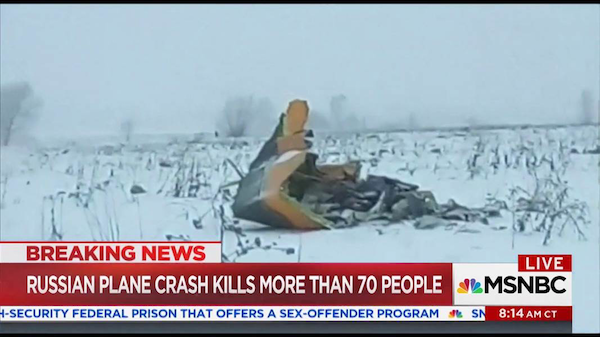
Moscow (TIP): More than 70 people died when a Russian passenger plane crashed shortly after take-off from Moscow’s Domodedovo airport on Sunday, the 11th of Feb, officials say.
Saratov Airlines flight 6W703 was heading to Orsk, a city near Russia’s border with Kazakhstan, when it went down near the town of Argunovo, about 50 miles south-east of Moscow. Witnesses said the plane, an Antonov An-148 aircraft, was in flames as it fell from the sky.
The plane was carrying 71 people – 65 passengers and six crew members. Emergency services officials told the Tass news agency there were no survivors. Wreckage from the plane was reported to be spread over a large area. It was unclear if there were any casualties among people on the ground at the crash site.
Russia’s gazeta.ru website cited unnamed investigators as saying the pilot had reported a technical malfunction on board the plane and asked for clearance for an emergency landing at the nearby Zhukovsky International Airport. Officials have not confirmed the report. Other reports said one of the plane’s engines may have exploded before the crash.
The flight-tracking site Flightradar24 tweeted that the seven-year-old passenger jet had gone into a steep descent of 1,000 metres (3,300ft) a minute five minutes after take-off, after which it had vanished from radars.
The Russian president, Vladimir Putin, expressed his condolences to the families and friends of those who had died in the crash and tasked the government with setting up a special commission to investigate.
A source from Russia’s emergency services told Interfax the 71 people on board had no chance of survival.
Russian state television aired a video of the crash site, showing parts of the wreckage in the snow. Russia has experienced record snowfalls in recent days and visibility was reportedly poor.
The Russian-made plane had been bought by Saratov from another Russian airline a year ago.
Russian media reported that the emergency services had been unable to reach the crash site by road and rescue workers had walked to the scene on foot. Emergency services said in a statement that more than 150 rescue workers had been deployed.
The Russian transport minister was on his way to the crash site, agencies reported. The transport ministry said several causes for the crash were being considered, including weather conditions and human error.
The governor of the Orenburg region, which the plane was flying to, told Russian media more than 60 people on the plane were from the region.
Local media website Ural56.ru in the Orenburg region showed footage of distressed relatives at Orsk airport, where the plane was due to land. Andrei Odintsov, the mayor of the city of Orsk, near Russia’s border with Kazakhstan, told Russian state television that six psychologists and four ambulances with medics are working with the relatives in the small airport.
-

Putin says Russia’s spy agencies prevented 60 terror attacks
MOSCOW (TIP): President Vladimir Putin says Russian security agencies have thwarted 60 terror attacks in the country this year.
Russia marked its Day of Employees of State Security Agencies on Wednesday. Speaking to intelligence officers on their professional holiday, Putin said Russia would continue working to “destroy hotbeds of international terrorism” following its campaign in Syria.
The Russian leader called US President Donald Trump on Sunday to thank him for a CIA tip that the Kremlin said helped prevent a series of bombings in St. Petersburg last weekend.
The Kremlin’s account of the call was Russia’s first public assertion that information from the U.S. has helped prevent an attack.
In his comments Wednesday, Putin nonetheless emphasized the need to counter foreign spies and block foreign attempts to meddle in Russia’s domestic politics.
(AP)
-

Russia’s Putin to seek new presidential term in 2018
NIZHNY NOVGOROD (TIP): President Vladimir Putin announced on Wednesday he would seek re-election in March 2018, a contest opinion polls show he will win comfortably, setting the stage for him to extend his dominance of Russia’s political landscape into a third decade.
Putin, 65, has been in power, either as president or prime minister, since 2000. If he wins what would be a fourth presidential term in March, he would be eligible to serve another six years until 2024, when he turns 72.
“I will put forward my candidacy for the post of president of the Russian Federation,” Putin told an audience of workers at a car-making factory in the Volga river city of Nizhny Novgorod. “There’s no better place or opportunity to put my candidacy forward. I’m sure that everything will work out for us.” Putin is lauded by allies as a father of the nation figure who has restored national pride and expanded Moscow’s global clout with interventions in Syria and Ukraine. His critics accuse him of overseeing a corrupt authoritarian system and of illegally annexing Ukraine’s Crimea, a move that has isolated Russia.
The challenge for Putin is not other candidates — nobody looks capable of unseating him. Instead, his toughest task will be to mobilise an electorate showing signs of apathy to ensure a high turnout which in the tightly-controlled limits of the Russian political system is seen to confer legitimacy.
Whilst next year’s election in March is devoid of real suspense about who will win, what follows is more unpredictable as attention will turn to what happens after Putin’s final term — under the current constitution — ends.
There is no obvious successor, and many investors say the lack of a clear succession plan, and likely jockeying for position among Russian elites for dominance in the post-Putin era, is becoming the biggest political risk.
If re-elected next year, Putin will have to choose whether to leave Dmitry Medvedev as prime minister, or appoint someone else. That decision will trigger a round of intrigue over the succession, as whoever holds the prime minister’s post is often viewed as the president’s heir apparent. (Reuters)