Tag: Russia

  • The Russian Angle in US Elections – What we know so far…

    The Russian Angle in US Elections – What we know so far…

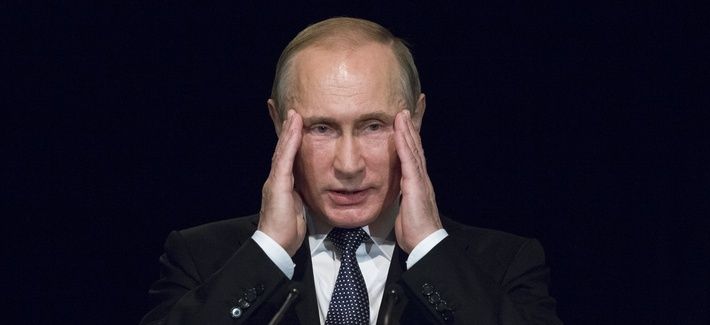
    The intrusion into the Democratic National Committee’s computers, allegedly by Russian hackers, has put a renewed spotlight on Donald Trump’s connections to Russia and its leader, Vladimir Putin.

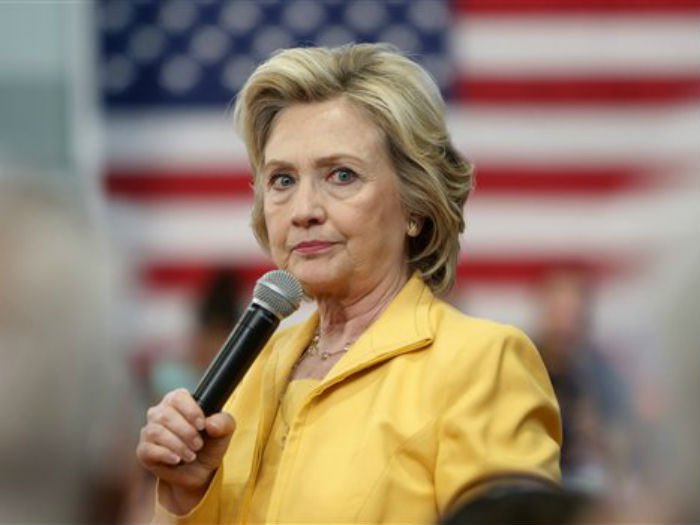
    Democratic presidential candidate Hillary Clinton has slammed Donald Trump for his “absolute allegiance” to Russia that raises “national security” concerns, prompting her Republican rival to deny having any “relationship” with Russian President Vladimir Putin.

    “We know that Donald Trump has shown a very troubling willingness to back up Putin, to support Putin, whether it’s saying that NATO wouldn’t come to the rescue of allies if they were invaded, talking about removing sanctions from Russian officials after they were imposed by the US and Europe together, because of Russia’s aggressiveness in Crimea and Ukraine, his praise for Putin which is I think quite remarkable,” she said.

    “And for Trump to both encourage that and to praise Putin despite what appears to be a deliberate effort to try to affect the election I think raises national security issues,” the Democratic presidential nominee alleged.

    She also said that Trump has absolute allegiance to Russia.

    Last week, Trump during a news conference had appeared to have asked Russia to find out the missing 30,000 emails of Clinton and release them.

    Trump later said he was just kidding and being sarcastic. Clinton, however, did not appear to be convinced by that clarification.

    “I think if you take his encouragement that the Russians hack into American e-mail accounts, if you take his quite excessive praise for Putin, his absolute allegiance to a lot of Russian wish-list foreign policy position, his effort then to try to distance himself from that backlash which rightly came not just from Democrats, but Republicans, independents and national security and intelligence experts leads us once again to include he is not temperamentally fit to be president and commander in chief,” Clinton said.

    I have no relationship with Putin: Donald Trump

    Republican presidential candidate Donald Trump said he has no relationship with Russian President Vladimir Putin as being alleged by his opponents.

    “I have no relationship with him (Putin),” Trump said, adding that he had praised him the in the past because he had said some nice things about him.

    “He said very nice things about me, but I have no relationship with him. I don’t — I’ve never met him,” Trump said.

    “I mean he treats me … with great respect. I have no relationship with Putin. I don’t think I’ve ever met him. I never met him. I don’t think I’ve ever met him,” Trump reiterated.

    The real estate mogul said he has never spoken to Putin on the phone.

    “When we had the Miss Universe contest a number of years ago, we had Miss Universe in Moscow, in the Moscow area, he was invited. He wanted to come. He wasn’t able to come. That would have been a time when I would have met him,” he said.

    However, Trump insisted that there is nothing wrong in having a good relationship with Russia.

    “If our country got along with Russia, that would be a great thing … But if we can have a good relationship with Russia and if Russia would help us get rid of ISIS, frankly, as far as I’m concerned, you’re talking about tremendous amounts of money and lives and everything else, that would be a positive thing, not a negative thing,” Trump said.

    He also attacked his Democratic rival Hillary Clinton, calling her a dishonest person with a bad temperament.

    “She’s a very dishonest person. I have one of the great temperaments. I have a winning temperament. She has a bad temperament. She’s weak. We need a strong temperament and that’s all it is, I have a strong temperament,” Trump told ABC News in an interview.

    Appearing on a Sunday talk show, Trump claimed that he is leading in polls and is headed to win general elections in November.

    “I think I have a great temperament. I beat 16 very talented people in and I’ve never done this before. You don’t do that with a bad temperament. I’m leading her in the polls,” he said and alleged that Clinton She doesn’t know how to win.

    “She’s not a winner. She doesn’t know how to win … I had a flawless campaign … She could barely beat Bernie,” he said.

    Trump’s earlier comments suggesting a relationship with Putin

    Here are four occasions between 2013 and 2015 when Trump touted his ties to Putin.

    • When Thomas Roberts of MSNBC asked Trump, “Do you have a relationship with Vladimir Putin? A conversational relationship or anything that you feel you have sway or influence over his government?” Trump responded, “I do have a relationship, and I can tell you that he’s very interested in what we’re doing here today. He’s probably very interested in what you and I am saying today, and I’m sure he’s going to be seeing it in some form.” — interview, November, 2013
    • “You know, I was in Moscow a couple of months ago. I own the Miss Universe Pageant and they treated me so great. Putin even sent me a present, a beautiful present.” — address at the CPAC conference, March 2014
    • “Russia does not respect our country any longer. They see we’ve been greatly weakened, both militarily and otherwise, and he certainly does not respect President Obama. So what I would do—as an example, I own Miss Universe, I was in Russia, I was in Moscow recently and I spoke, indirectly and directly, with President Putin, who could not have been nicer, and we had a tremendous success. The show was live from Moscow, and we had tremendous success there and it was amazing, but to do well, you have to get the other side to respect you, and he does not respect our president, which is very sad.” — address at the National Press Club, May 2014
    • “As far as the Ukraine is concerned … if Putin wants to go in — and I got to know him very well because we were both on 60 Minutes. We were stablemates, and we did very well that night.” — portion of an answer at the Fox Business News debate, Nov. 2015. (The notion that the two men appeared together on 60 Minutes has been debunked. As Time magazine put it succinctly, “In fact, they weren’t even on the same continent.”)
  • Russian Spies answer Trumps call ~ Hack Hillary Clinton’s Presidential Campaign

    Russian Spies answer Trumps call ~ Hack Hillary Clinton’s Presidential Campaign

    Hillary Clinton’s presidential campaign along with other Democratic Party organisations has been hacked as part of a larger cyber attack, law enforcement officials said on Friday night.

    The Federal Bureau of Investigation (FBI) and the Justice Department has launched a probe against the latest hack that follows two data breaches involving the Democratic National Committee (DNC) and the Democratic Congressional Campaign Committee (DNCC), CNN reported.

    “An analytics data programme maintained by the DNC, and used by our campaign and a number of other entities, was accessed as part of the DNC hack,” said Clinton campaign spokesman Nick Merrill.

    “Our campaign computer system has been under review by outside cyber security experts. To date, they have found no evidence that our internal systems have been compromised,” CNN quoted Merrill as saying

    The intrusion was discovered by private investigators hired by the campaign, according to the law enforcement officials.

    The private investigators believed that it was similar to the DNC hack, but federal investigators were still working to determine the scope and nature of the intrusion, the officials said.

    The Justice Department’s national security division, which was already investigating the DNC intrusion, is handling the probe because of the believed similarities, CNN reported citing the officials as saying.

    The DCCC, which is the political arm for House Democrats, confirmed on Friday it had been the subject of a cyberhack, raising the possibility that alleged Russian hackers might have breached a much broader swath of Democratic records than originally thought.

    The revelation comes just days after the leak of thousands of Democratic National Committee emails — US officials allege Russian hackers — prompted major turmoil within the party, causing the abrupt resignation of its chairwoman, Representative Debbie Wasserman Schultz, reports CNN.

    The FBI’s chief of cyber investigations James Trainor told CNN in an interview recently that hackers have targeted political party entities and think tanks in Washington.

    The official said there is a long list of intrusions that the FBI and other agencies were also investigating.

    Hacking has become a major flashpoint in the presidential race. Revelations about targeting the Clinton campaign come as the two nominees — Republican party’s Donald Trump) are set to begin receiving national security briefings, CNN noted.

    Trump earlier in the week drew criticism for appearing to suggest that Russia should use espionage to find Hillary Clinton’s deleted emails.

    The Republican nominee later tried to walk back the comments by saying that he was only being sarcastic.

  • AMID INDIA-PAK TENSION, RAJNATH SINGH TO VISIT ISLAMABAD NEXT WEEK

    AMID INDIA-PAK TENSION, RAJNATH SINGH TO VISIT ISLAMABAD NEXT WEEK

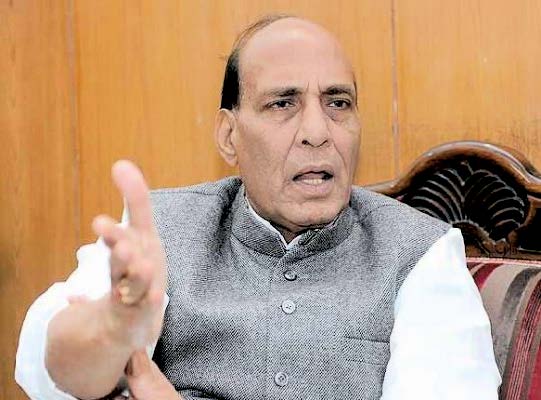
    NEW DELHI (TIP): Home minister Rajnath Singh will visit Islamabad on August 3 and 4 to attend the meeting of home ministers and interior ministers of South Asian Association for Regional Cooperation (Saarc)?nations.

    This will be the first visit by a top Indian political functionary to Pakistan after the January 2 Pathankot airbase attack carried out by militants believed to be from across the border.

    It also comes at a time ties between the two nuclear-armed neighbours are seeing a chill in the aftermath of the killing of Hizbul Mujahideen commander Burhan Wani.

    Kashmir has been on the boil since the death of 22-year-old Wani on July 8 in an encounter in southern Kashmir. His death sparked violent protests in the Valley that killed more than 40 people and wounded hundreds.

    Pakistani leaders have criticised India over the Kashmir unrest, and the country observed on July 20 a “black day” to protest against the killings. The move drew angry reaction from India, which accused Islamabad of interfering in New Delhi’s internal affairs and backing terrorism.

    Sources said the home minister may have bilateral meetings with Pakistani politicians during the visit.

    At the 13th Saarc Summit held in Dhaka in November 2005, the heads of states decided that Saarc interior/home ministers will meet annually preceded by a meeting of the interior/home secretaries to strengthen counter-terrorism cooperation.

    “As far as the home minister’s visit to Islamabad is concerned, he will leave on August 3 and come back the next day,” said a home ministry official.

    Singh is likely to take up with the Pakistani leadership the issue of a reciprocal visit of the National Investigation Agency (NIA) to Islamabad for the Pathankot probe. A Pakistani joint investigation team visited India earlier this year, and the NIA shared the details of its investigation with it.

    A week before the Pathankot attack that killed seven securitymen, Prime Minister Narendra Modi made a brief stopover in Lahore while returning to India from Afghanistan and Russia. Three weeks before Modi’s visit, external affairs minister Sushma Swaraj visited Pakistan for a conference. Source: HT

  • INDIA’S FOREIGN DEBT-GDP RATIO LOWEST AMONG 83 EMS

    INDIA’S FOREIGN DEBT-GDP RATIO LOWEST AMONG 83 EMS

    MUMBAI (TIP): At 23% in 2015, India had one of the lowest foreign debt-to-GDP ratios among 83 emerging market (EM) countries, although it had risen from 17% in 2005. Even among the Asian countries covered in an analysis by global ratings major Moody’s Investors Service, compared to an average debt-to-GDP ratio of 47%, India’s was less than half that number.

    China’s external debt-to-GDP ratio is still the second-lowest globally at 13% of GDP in 2015. The lowest is Nigeria with 3.3%.

    According to the report, India experienced the second largest increase in external debt between 2010 and 2015. “India had $474 billion in external debt as of 2015, representing 16% of the Asia-Pacific region’s total debt. India’s external debt has grown two to three times slower than China’s, at a five-year annual average rate of 8.4% and a 10-year annual average rate of 13.4%.

    As a result, the external debt-to-GDP ratio in India has risen from 17% in 2005 to 23%in 2015, but is still one of the lowest globally,” it noted. The analysis also found that the BRIC nations block owns 37% of all emerging market external debt. In dollar terms, as of end-2015, China represented 17% of total emerging market external debt, Brazil 8%, Russia 6%, and India another 6%.

  • Twitter Blocks ‘HafizSaeedLive’ Account

    Twitter Blocks ‘HafizSaeedLive’ Account

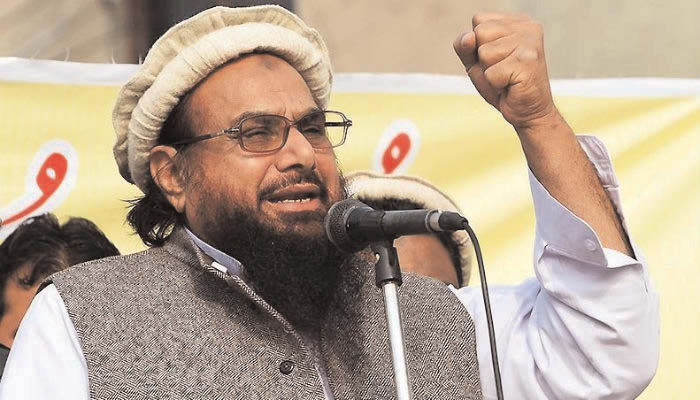
    Twitter on Thursday, July 14, has blocked the account of Jamaat-ud-Dawa (JuD) chief and 2008 Mumbai terror attacks mastermind Hafiz Saeed.

    The micro-blogging site apparently on its own took the action against the JuD chief.

    The Twitter handle ‘HafizSaeedLive’ had frequent updates from the JuD chief.

    The Twitter account had Saeed’s picture and claims to be a philanthropic organization also tweeted in Hindi on the JNU backlash back in February.

    However, there is another Twitter account @HSaeedOfficial which has a similar picture and claims to be the same organization.

    The United Nations declared JuD a terrorist organization in December 2008 as also Saeed who was also individually designated by the United Nations under UNSCR 1267 in December 2008.

    Pakistan has said that there is no case against Saeed and that he is free to move in the country as a Pakistani national.

    India has repeatedly demanded Pakistan to hand over Saeed for questioning over his role in the 2008 Mumbai attacks that claimed 166 lives.

    JuD was banned in 2002 by Pakistan but later a court lifted the ban due to lack of evidence on the group’s involvement in militancy.

    The group is banned by the US, the EU, India and Russia as a terror organisation.

    In June 2014, the US declared JuD a subsidiary of terror group Lashkar-e-Toiba.

  • Euro 2016 quarter-final: Portugal beat Poland in shootout to reach semis

    Euro 2016 quarter-final: Portugal beat Poland in shootout to reach semis

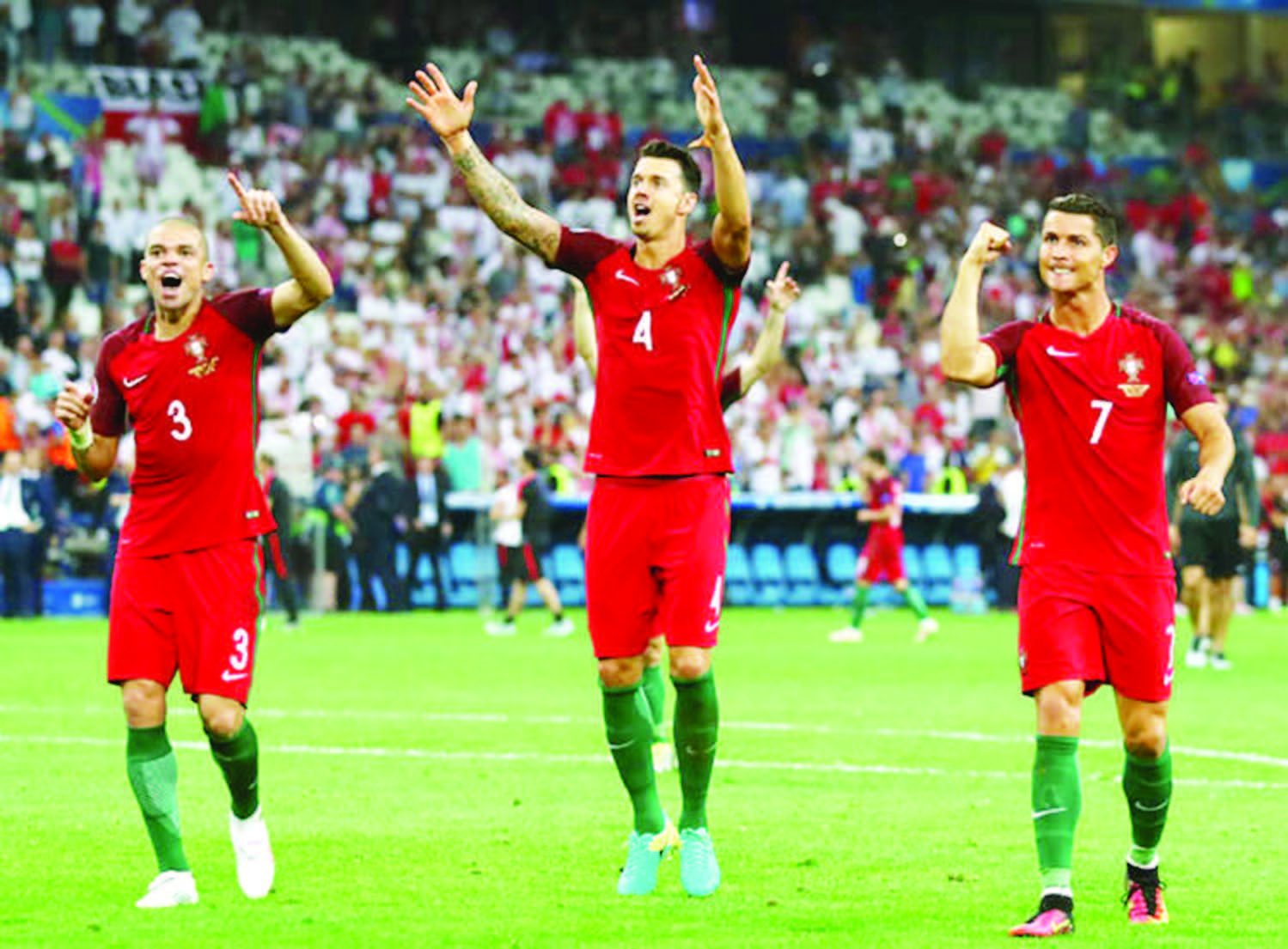
    MARSEILLE (TIP): A superb shootout save by Portugal’s Rui Patricio allowed Ricardo Quaresma to be the hero again as his spot kick against Poland sent them into the Euro 2016 semi-finals 5-3 on penalties after a 1-1 finish following extra time on June 30.

    Patricio dived full length to block Jakub Blaszczykowski’s penalty, Poland’s fourth, allowing substitute Quaresma, whose goal late in extra-time beat Croatia in the round of 16, to bang in Portugal’s fifth from the spot.

    Two hours earlier striker Robert Lewandowski had put Poland ahead in the second minute only for 18-year-old Renato Sanches to equalise with a superb shot 33 minutes into his first international start for Portugal.

    Precious little happened from then on but Portugal, beaten on penalties by Spain in the semi-finals four years ago, will not care as they advance to the last four at the Euros for the fourth time in five tournaments to face either Belgium or Wales.

    Poland, who had never won a European Championship match before this tournament and finished bottom of their group on home soil four years ago, will bemoan their early missed opportunities and probably backed themselves in the shootout having got past Switzerland that way in the last round.

    Defensive misjudgement
    They went ahead almost from kickoff when Portugal defender Cedric’s misjudgement allowed a long ball to bounce over his head to Kamil Grosicki. He drove on down the left and squared for Lewandowski to guide the ball in.

    It was the striker’s first goal of the tournament and, at one minute, 40 seconds, the second-fastest in European Championship history after Dmitri Kirichenko’s for Russia against Greece after 65 seconds in 2004.

    Poland looked the more confident team for the next 20 minutes but Portugal settled and began to make inroads. Sanches, on his first international start, played a neat 1-2 with Nani and found time to shift the ball onto his left foot at the edge of the box and smash it past Lukasz Fabianski, with the aid of a deflection.

    Both sides came out for the second half seemingly under instruction to slow things down and the life bled from the game. The only really clear chance of the half came in the 85th minute when substitute Joao Moutinho lobbed a clever pass over the top only for Cristiano Ronaldo who, having taken the time to glance at the keeper’s positioning, failed to make any contact on the dropping ball with the goal gaping.

    Little changed in the additional 30 minutes, with the near-64,000 crowd drugged into a drowsy-near silence, knowing what was afoot almost from the restart.

    Poland had followed the same routine in their last-16 clash with Switzerland and won the shootout and, looking very weary on June 30, clearly had another in their sights.

    This time, however, the gamble backfired as Ronaldo, Sanches, Moutinho and Nani all scored before Quaresma’s coup de grace. (Reuters)

  • India Formally Joins Missile Technology Control Regime #MTCR

    India Formally Joins Missile Technology Control Regime #MTCR

    India on Monday formally joined the Missile Technology Control Regime (MTCR).

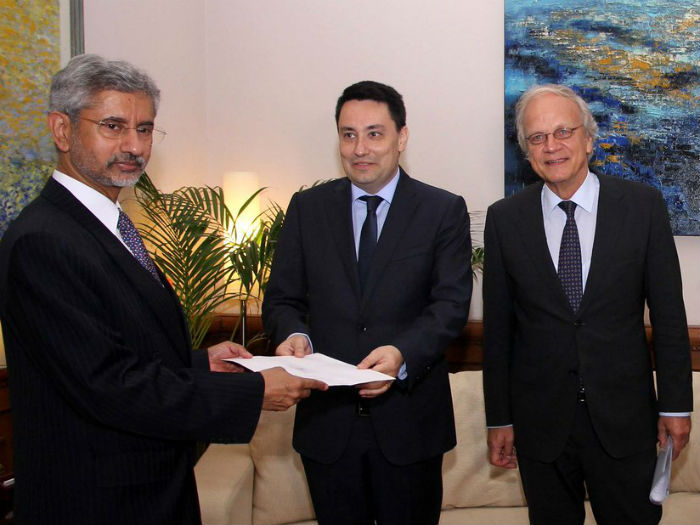
    Foreign Secretary S Jaishankar received the MTCR membership papers from Envoys of France, Netherlands and Luxembourg in a small ceremony in Delhi.

    “Bolstering the non-proliferation agenda! In a signal move, India joins the Missile Technology Control Regime today,” Ministry of External Affairs spokesperson Vikas Swarup tweeted.

    “Foreign Secretary Jaishankar receives MTCR membership papers from Envoys of France, Netherlands and Luxembourg,” he wrote in another tweet.

    India’s efforts to get into the MTCR also got a boost after it agreed to join the Hague Code of Conduct, dealing with the ballistic missile non-proliferation arrangement, earlier this month.

    MTCR membership will enable India to buy high-end missile technology and also enhance its joint ventures with Russia.

    The aim of the MTCR is to restrict the proliferation of missiles, complete rocket systems, unmanned air vehicles and related technology for those systems capable of carrying a 500 kilogramme payload for at least 300 kilometres, as well as systems intended for the delivery of weapons of mass destruction (WMD).

  • Supporting India’s Entry to the Nuclear Suppliers Group

    Supporting India’s Entry to the Nuclear Suppliers Group

    The Nuclear Suppliers Group (NSG) is a 48-nation exclusive export control regime dedicated to curbing nuclear arms proliferation while promoting safe international nuclear commerce for civil nuclear energy. After receiving a country-specific waiver for the India-United States Civil Nuclear Agreement from the NSG in 2008, most western nations advocated for India’s inclusion into the NSG, even Russia has expressed unconditional support for India. The sole outlier for the major powers remains China, though China could benefit from supporting India’s membership.

    Instead, China has spearheaded a diplomatic campaign to thwart India’s entry into the NSG. Doubling down on efforts to link India with China’s all-weather friend Pakistan, China has grasped at rationales to prevent India’s NSG membership.

    China has articulated three main pseudo-arguments against India’s entry into the NSG. The first is that India is not a signatory to the Treaty on the Non-Proliferation of Nuclear Weapons (Non-Proliferation Treaty, or NPT) of 1968 and allowing India to join does not comport with the greater non-proliferation agenda. Also, India’s entry might disturb the strategic balance in the Indian sub-continent, further encouraging Pakistan to take more desperate measures to seek strategic parity with India. Lastly, China argues that the NSG should be based on specific criteria, rather than selectively choosing suitable nations for entry.

    On all three counts, China is using clever sophistry to block India’s long overdue entry into the NSG. Whereas the roots of China’s obstructionist view stems from China’s strategic insecurity and fears of another rising Asian nation in the international geo-political theatre.

    Let us discuss China’s pseudo-arguments point by point. France’s NSG membership, in 1975, despite not being a signatory of the NPT until 1992, thus creating precedence for a non-signatory of NPT becoming a member of the NSG. China’s second argument, again fallacious, attempting to adjoin Pakistan’s nuclear program with that of India. Pakistan’s aggressive assertions regarding the potential use of tactical nuclear weapons against India, is a vast departure from India’s peaceful and defensive nuclear posture. Particularly considering India’s need for nuclear energy to support a burgeoning economy and population, and to minimize the use of fossil fuels to support current climate change initiatives.

    In addition to France, there are only four countries that are non-signatories to the NPT: India, Israel, Pakistan and South Sudan. North Korea, having withdrawn from NPT is obviously not a candidate for NSG. Israel and South Sudan are not seeking NSG membership, leaving just India and Pakistan. India and Pakistan have starkly contrasting non-proliferation records. Pakistan and China’s nuclear cooperation lacks a great deal of transparency, and is obviously a mix of civilian AND military applications, which should be cause for alarm.

    China worried about growing India-U.S. strategic cooperation, sees Pakistan as a mechanism to contain India in a perpetual regional conflict. China provided Pakistan with 50 kg of free weapons grade HEU and allowed Pakistan to test its first nuclear weapon of Chinese design in 1990 at China’s own Lop Nor nuclear test range.

    Essentially, China is a rising hegemon that can not countenance a rising India, systematically placing roadblocks to India’s entry into the diplomatic world, commensurate with India’s size and economic maturity. The time has come for the 5th generation leadership of communist to do the prudent thing by diplomatically supporting India’s entry into the NSG. China should remember that India had supported communist China’s entry into the UNSC as a permanent member in 1971 despite having bilateral border issues. Diplomatic hegemony by China cannot arrest a rising India’s entry to NSG, UNSC, APEC or any other international body. Continued attempts to limit India’s participation in the international community will actually cause China harm rather than goodwill

    China was a brotherly country to India until the occupation, and eventual annexation, of Tibet. The following attack on India in 1962 is still ingrained in the minds of the international community. India’s industrial base and growing economy is on pace to rival that of both the United States and China. If China wants the 21st century to be remembered as an Asian century, China must learn to recognize and accept India’s vital role.

    China as a nation must do some self-introspection regarding its hegemonic behavior and expansionist policies since 1949. China has no allies worth naming on the twin issues of its imperialistic behavior in the East and South China Seas. Peoples’ Republic of China can gain immense goodwill from a peaceful and rising India if it stops obstructing India’s entry into the NSG on June 24th 2016 in Seoul, South Korea.

    (The author is the President of the Council for Strategic Affairs, New Delhi, India)

  • AT A STROKE, PSLV C-34 LOBS 20 SATELLITES INTO ORBIT

    AT A STROKE, PSLV C-34 LOBS 20 SATELLITES INTO ORBIT

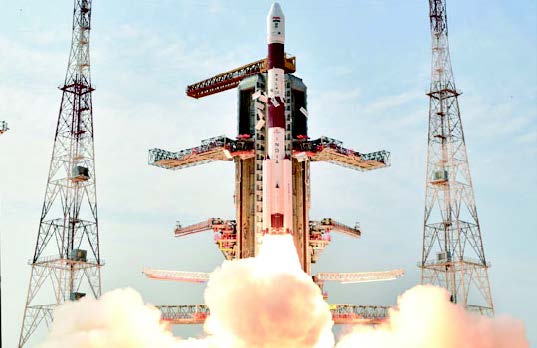
    CHENNAI (TIP): India took a big leap in space technology on June 22 when Indian Space Research Organization (ISRO) used its workhorse PSLV-C34 to inject 20 satellites including 17 foreign satellites into orbit in a single mission and set a new record on Wednesday.

    The 320-tonne Polar Satellite Launch Vehicle (PSLV-C34) took off on its 36th flight at 9.26am from the Satish Dhawan Space Centre with 20 satellites including its primary payload Cartosat-2 series, which provides remote sensing services, and earth observation and imaging satellites from US, Canada, Germany and Indonesia. It was also 14th flight of PSLV in ‘XL’configuration with the use of solid strap-on motors.

    Cartosat-2 was placed in orbit at 9.44am. With Cartosat-2 weighing 727.5kg, PSLV lifted off a total of 1,288kg in to space and began placing the satellites into orbit about 17minutes later.

    In the final stages of the mission, ISRO also demonstrated the vehicle’s capability to place satellites in different orbits. In the demonstration, the vehicle reignited twice after its fourth and final stage and moved further a few kilometres into another orbit.

    ISRO scientists said the demonstration is for their next mission when they are planning to inject satellites in different orbits using a single rocket.

    ISRO set a world record for the highest number of satellites launched in a single mission when it placed 10 satellites in a PSLV on April 28, 2008. Nasa in 2013 placed 29 satellites in a single mission and Russia in 2014 launched 33 satellites in one launch.

    In December 2015, when PSLV-C29 injected six Singapore satellites in to orbit, ISRO conducted a major experiment where the fourth stage was reignited and switched off after the satellites were placed in orbit.

    ISRO scientists said, the vehicle had been pre-programmed for today’s launch to perform tiny manoeuvring to place the 20 satellites into polar sun-synchronous orbits with different inclinations and velocities. It ensured that the satellites were placed with enough distance to prevent collision.

    ISRO began launching foreign satellites on board PSLV in May 1999. Since then, it has gained popularity, as it launched foreign satellites successfully using PSLV by charging only 60% of the fee charged by foreign space agencies. It has so far launched 57 foreign satellites.

  • LINDSAY LOHAN GOES PUBLIC WITH NEW RUSSIAN FIANCE

    LINDSAY LOHAN GOES PUBLIC WITH NEW RUSSIAN FIANCE

    Actress Lindsay Lohan has made her first public appearance since she reportedly became engaged to Russian boyfriend Egor Tarabasov .

    The 29-year-old actress attended a private screening of Disney sequel ‘Alice Through the Looking  Glass’ at London’s Bulgari Hotel with the shipping heir, reported Contactmusic.

    The ‘Mean Girls’ star wore a black and white Temperley London dress with black platform sneakers, while Egor rocked the casual look with a white T-shirt and denim jacket.

    Lohan also posed for photos with her boyfriend, alongside fashion designer Alice Temperley, who designed her outfit.

  • India successfully test-fires nuclear capable Supersonic Prithvi II missile

    India successfully test-fires nuclear capable Supersonic Prithvi II missile

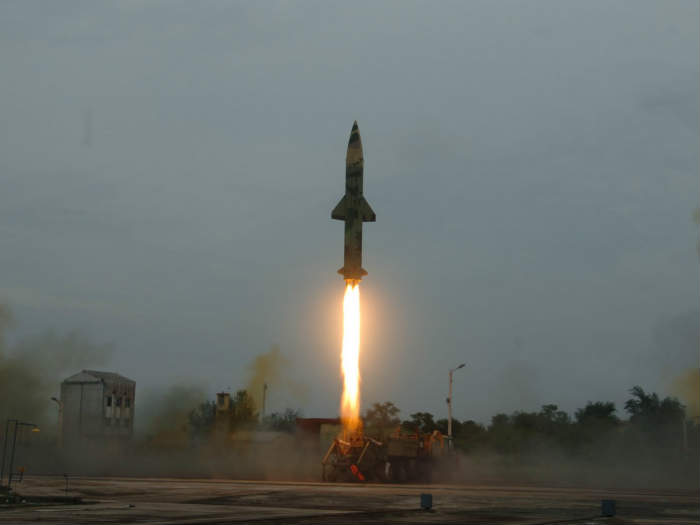
    In its effort to have a full-fledged multi-layer Ballistic Missile Defence system, India on Wednesday successfully test-fired its indigenously developed supersonic interceptor missile, capable of destroying any incoming hostile ballistic missile, from a test range off Odisha coast.

    Notably, Prithvi is India’s first indigenously-built ballistic missile. It is one of the five missiles being developed under the country’s Integrated Guided Missile Development Programme.

    With a strike range of 350 km, the surface-to-surface Prithvi-II is capable of carrying 500 kg to 1,000 kg of warheads and is thrusted by liquid propulsion twin engines.

    The success of Advanced Air Defence interceptor missile test now strengthens India’s position in the very exclusive Ballistic Missile Defence club of the US, Russia and Israel.

  • Indian Professor Appointed 56th President Of International Studies Association

    Indian Professor Appointed 56th President Of International Studies Association

    WASHINGTON:  An Indian Professor has become the president of a scholarly group in the US dedicated to international studies.

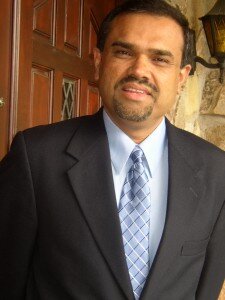
    Professor TV Paul took over as the 56th president of International Studies Association (ISA), at its annual convention at Atlanta, Georgia this week.

    In his address, which among others was attended by former Canadian Prime Minister, Joe Clarke, Mr Paul called on international relations scholars to explicitly deal with grand strategies of peaceful change more effectively, especially in the context of the rise of new powers such as China and India.

    Born in Kerala, Mr Paul in his speech encouraged scholars with historical understanding to offer ideas for policy makers about which strategy produced conflict and which strategy generated unnecessary violence.

    The James McGill Professor of International Relations at McGill University, Montreal, Canada he is a leading scholar of international security, nuclear proliferation, and South Asia.

    In his speech he called upon the International Relations discipline to become the lead source of ideas for peaceful change and not to leave strategy to a narrow group of politicians, their advisors and diplomats who sometimes lack deep vision or historical understanding.

    “The need for strategies for peaceful change is growing in a complex, globalised world, and with the rise of China, India and the resurgent Russia along with several other pivotal centers of power and transnational forces challenging peace,” Mr Paul said.

    He was ISA’s vice president during 2013-14, founding Director of the McGill/-University of Montreal Center for international Peace and Security Studies (CIPSS) and founding Editor of the Georgetown University Press book series: South Asia in World Affairs.

  • Russia begins withdrawing Forces from Syria

    Russia begins withdrawing Forces from Syria

    MOSCOW (TIP): Russia began withdrawing its forces from Syria in a move that will leave the Syrian government to fend for itself to a much greater extent — but with a greatly strengthened hand in negotiations over the country’s future.

    The first group of Russian planes left Hmeymim air base in Syria on Tuesday, March 15 morning, the Russian Defense Ministry said.

    Russia’s surprise announcement Monday that it would begin withdrawing its forces from the conflict came as suddenly as its devastating airstrike campaign that started in September.

    But Syria’s government was not caught unawares by the move, a senior official said.

    “We were not surprised because the decision was made in coordination and consultation with us,” Bouthaina Shaaban, senior adviser to Syrian President Bashar al-Assad, said.

    “We knew beforehand that this is what was going to be announced because the Russians came here to achieve certain jobs, and we and they agreed that most of the jobs have been achieved.”

    In terms of “fighting terrorism,” she said, “they’ve done a great job and they will continue in fighting terrorism, but there are some tasks which have been completed, and therefore the Russian and Syrian leadership agreed that it is appropriate now to withdraw some of the planes or forces.”

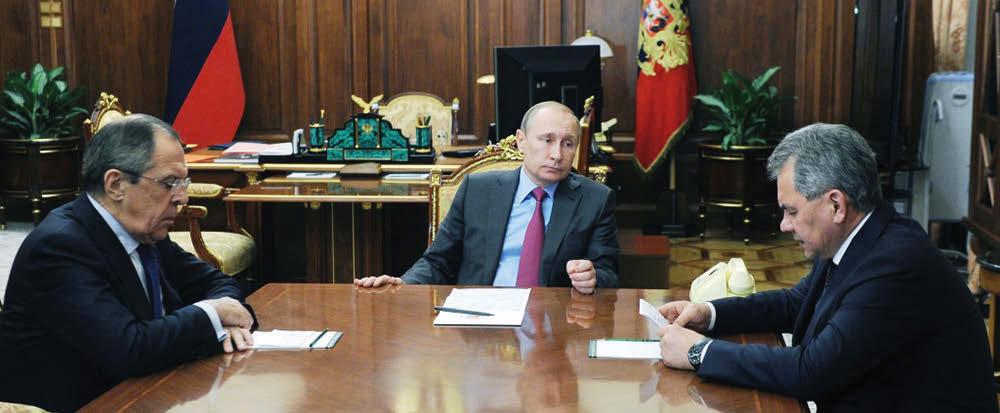
    Russian President Vladimir Putin announced the withdrawal Monday, saying that “the task that was assigned to the Ministry of Defense and the armed forces as a whole has achieved its goal.”

    But critics said that Moscow’s stated goal of fighting terrorist groups such as ISIS in Syria did not accurately reflect the reality of its military actions in the war-ravaged nation.

    They point to the bombings of civilian areas as evidence that Russia has been more interested in helping Assad eliminate his opposition.

    Syrian opposition welcomes Russian drawdown

    Asked whether the Russian withdrawal signaled a case of “mission accomplished,” Shaaban replied, “Hundreds of villages have been liberated, many towns have been liberated from armed gangs, huge parts of Syria have been liberated.”

    She said Russia’s Defense Ministry had said the “war against terrorism will continue. And we are happy also to see Russian-American coordination in fighting terrorism.”

    Russia’s steps were “the right steps toward a political settlement and also toward a continuation of fighting terrorism,” she continued.

    Putin’s announcement came as Syrian peace talks resumed Monday in Geneva, Switzerland, in which members of the Syrian regime and opposition are meeting indirectly through a mediator to try to forge a path to peace.

    Speaking on the sideline of the talks Tuesday, Syria’s main opposition group, the High Negotiations Committee, said it welcomed the Russian drawdown.

    “What really keep(s) Assad in power now, what keep(s) crimes until this moment, is the presence of the Russian forces there,” opposition group spokesman Salim al-Muslet told reporters.

    “I believe if they (are) serious about pulling out … it will be an end to crimes in Syria and will help us to put an end to terrorism there in Syria.”

    Putin “should put pressure on Assad to accept (the) outcome” of the Geneva talks, he said.

  • US Senate kills bid to block F16 sale to Pakistan

    US Senate kills bid to block F16 sale to Pakistan

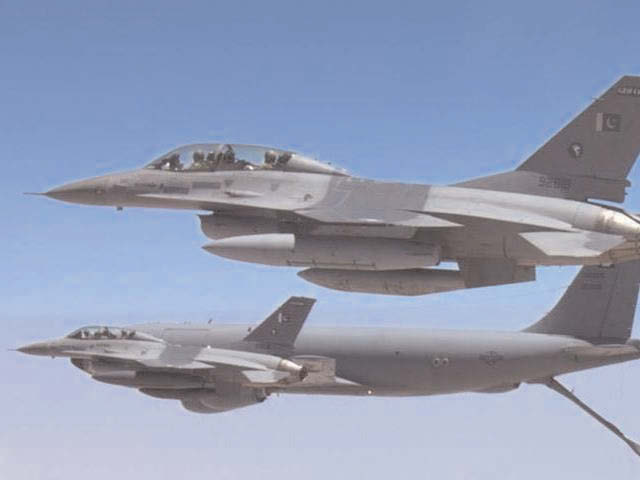
    WASHINGTON (TIP): Eight US-made F16s have not exactly flown out to Islamabad yet, but well may the engines be fired up and the planes ready to taxi.

    The US Senate on Thursday rejected by a 71-24 margin efforts by some lawmakers to block the sale of eight F- 16 fighter jets to Pakistan, although the debate that accompanied the vote showed how ragged Washington-Islamabad ties have become.

    Full court press from an Obama administration guided by tactical considerations and an arms lobby driven by jobs and money was always going to win the day. But the fact that 24 Senators (12 Democrats; 12 Republicans) went against the Democratic executive and the Republican legislative leadership showed the extent of bipartisan distrust in a country one lawmaker described during the debate as a “Frenemy…part friend and a lot of enemy.”

    Indian and American diplomats keenly watched the legislative dogfight engineered by Kentucky Senator Rand Paul (Republican), who employed a rarely-used provision in the Arms Export Control Act to force a vote – after an hour of debate — in the full Senate to block the sale of the F-16s.

    “We’ve got a lot of things going on in our country that need to be taken care of, and we don’t have enough money to be sending it to Pakistan,” Paul argued on the Senate floor, citing everything from Pakistan’s nurturing of terrorists to its persecution of Christians to stop the sale. “I can’t in good conscience look away as American crumbles at home and politicians tax us to send the money to corrupt and duplicitous regimes abroad,” he added, pointing to some $ 15 billion Washington has given Pakistan post 9/11.

    But the Senate’s foreign relations committee leadership maintained that it was better to dangle the planes before Pakistan so that Washington could have leverage over Islamabad, lest it gravitate towards China and Russia for such purchases. The debate essentially answered the question: why eight jets, and why now.

    “They are just throwing out some bones to Pakistan to keep them in line for the next few months,” one legislative observer explained.

    Republican Senator Bob Corker, who has said he supports the sale but will not allow US taxpayer to subsidize it, explained it more tactfully.

    “It’s about whether we as a country would prefer for Pakistan to buy American made fighter jets or whether we would prefer them to buy Russian jets or French jets,” he observed, adding that he and Senator Cardin, his Democratic counterpart, have called for a hold on financing “to assure there are behavior changes that take place in Pakistan before any US dollars go towards this sale.

  • US man shoots himself dead while taking selfie with gun

    US man shoots himself dead while taking selfie with gun

    SAN FRANCISCO (TIP): In a bizarre incident, a 43-year-old man in the US shot and killed himself accidentally while taking a selfie with a gun in hand.

    The man from Concrete, Washington, who has not been named, accidentally shot himself in the face with what he thought was an unloaded gun.

    The man and his girlfriend were at home taking photos of themselves with the gun when the incident occurred on Sunday, Skagit County Sheriff’s Office Chief of Patrol Chad Clark was quoted as saying by the Skagit Valley Herald.

    The girlfriend reported that the pair had done this several times during the day, with the man apparently removing the bullets and then reloading the gun multiple times.

    After the last time, however, a bullet apparently remained in the gun, Clark said.

    The death is being investigated as accidental, Clark said.

    The Washington man is not the first to accidentally shoot himself while taking a selfie, or even the first to die doing so. Last year, a 19-year-old from Houston died while taking pictures of himself with a gun and posting them on Instagram. He too thought the gun was unloaded when he held it to his head for a photo.

    It has been reported that more people die while attempting to take selfies than in shark attacks.

    At least 27 people reportedly died in “selfie-related” incidents around the world last year.

    In Russia, where a woman almost died after inadvertently shooting herself while posing for a photo with a gun she had found, the ministry of internal affairs published a brochure instructing citizens on safe selfie habits.

    (PTI)

  • OIL PRICES CLIMB AS IRAN ENDORSES OIL OUTPUT CAP

    OIL PRICES CLIMB AS IRAN ENDORSES OIL OUTPUT CAP

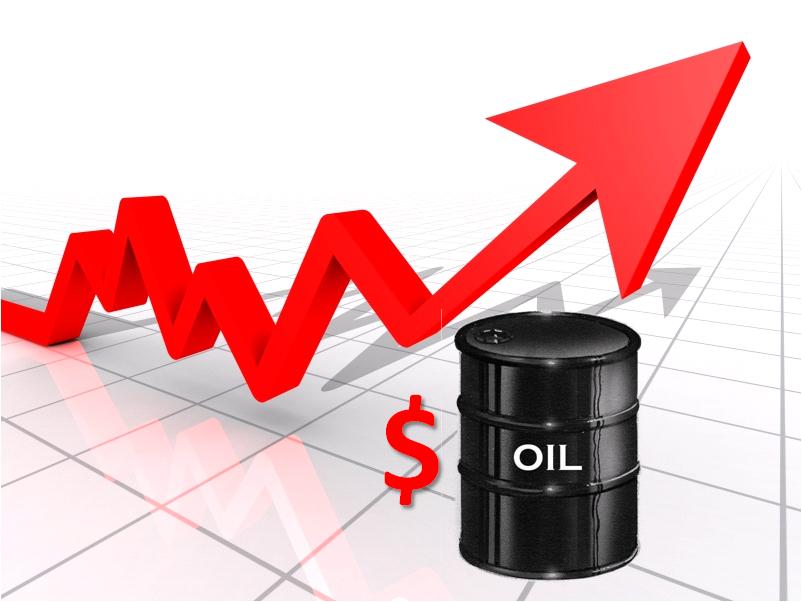
    SINGAPORE(TIP) : Crude futures rose in Asian trade on Thursday after Iran welcomed plans by Russia and Saudi Arabia to cap production, although analysts said the move would not lead to any output cuts and Tehran offered no action of its own.

    After oil prices rose in the previous session as much 8 percent, commentators suggested markets had overreacted to Iran’s support for the caps and said the Russian-Saudi move would not likely reduce the global surplus.

    “I share the consensus view that producers are unlikely to reach an agreement (on cuts), the rationale being the need to satisfy two conditions,” said Ric Spooner, chief market analyst with Sydney’s CMC Markets.

    “First, any price gains must offset losses achieved from volume cuts – production cuts must be meaningful -sufficiently large to achieve a substantial price increase. And they will have to involve everybody – all the major (producer) players. That will be difficult to achieve,” he said.

    Brent futures rose 42 cents to $34.92 a barrel by 0555 GMT, having closed 7.2% higher in the previous session after hitting an intraday high of $34.99.

    US crude gained 50 cents to $31.16 a barrel, having finished 5.6% higher in the previous session after touching a high of $31.49.

    Oil prices would likely remain volatile, Spooner said, as traders and investors reacted to news and rumours about curbs on output growth and possible cuts in production.

    Iranian Oil Minister Bijan Zanganeh met counterparts from Venezuela, Iraq and Qatar on Wednesday but did not say if Iran would cap its output in keeping with the move by Russia, Saudi Arabia and Iraq.

    Source: Reuters

  • History made as Catholic Pope Francis and Russian Orthodox Patriarch Kirill embrace to bridge the ‘Great Schism’

    History made as Catholic Pope Francis and Russian Orthodox Patriarch Kirill embrace to bridge the ‘Great Schism’

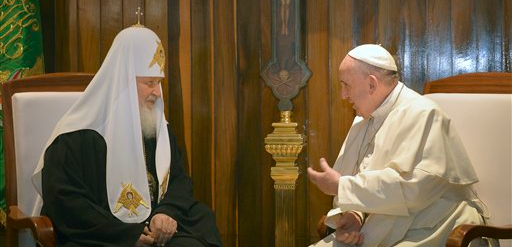
    With a hug and an exclamation of “Finally,” Pope Francis met Friday with Patriarch Kirill in the first ever meeting between a pontiff and the head of the Russian Orthodox Church, a historic development in the 1,000-year schism that has divided Christianity.

    “We are brothers,” Francis said as he embraced Kirill in the small, wood-paneled VIP room of Havana’s airport, where the three-hour encounter took place.

    “Now things are easier,” Kirill agreed as he and the pope exchanged three kisses on the cheek. “This is the will of God,” the pope said.

    Francis was having the brief talks in Cuba before heading off on a five-day visit to Mexico, where the pontiff will bring a message of solidarity with the victims of drug violence, human trafficking and discrimination to some of that country’s most violent and poverty-stricken regions.

    The meeting and signing of a joint declaration was decades in the making and cemented Francis’ reputation as a risk-taking statesman who values dialogue, bridge-building and rapprochement at almost any cost.

    Pope Francis, left, head of the Russian Orthodox Church Patriarch Kirill, center, and Cuba's President Raul Castro stand together during a ceremony where the two religious leaders signed a joint declaration on religious unity at the Jose Marti International airport in Havana, Cuba, Friday, Feb. 12, 2016. The two religious leaders met for the first-ever papal meeting, a historic development in the 1,000-year schism within Christianity.  (Alejandro Ernesto/Pool via AP)
    Pope Francis, left, head of the Russian Orthodox Church Patriarch Kirill, center, and Cuba’s President Raul Castro stand together during a ceremony where the two religious leaders signed a joint declaration on religious unity at the Jose Marti International airport in Havana, Cuba, Friday, Feb. 12, 2016. The two religious leaders met for the first-ever papal meeting, a historic development in the 1,000-year schism within Christianity. (Alejandro Ernesto/Pool via AP)

    In the 30-point statement, the two leaders declared themselves ready to take all necessary measures to overcome their historical differences, saying “we are not competitors, but brothers.”

    Francis and Kirill also called for political leaders to act on the single most important issue of shared concern between the Catholic and Orthodox churches today: the plight of Christians in Iraq and Syria who are being killed and driven from their homes by the Islamic State group.

    “In many countries of the Middle East and North Africa, entire families of our brothers and sisters in Christ are being exterminated, entire villages and cities,” the declaration said.

    While the meeting has been hailed by many as an important ecumenical breakthrough, Francis has also come under criticism for essentially allowing himself to be used by a Russia eager to assert itself among Orthodox Christians and on the world stage at a time when the country is increasingly isolated from the West.

    The declaration was signed in the uniquely ideal location of Cuba: far removed from the Catholic-Orthodox turf battles in Europe, a country that is Catholic and familiar to Latin America’s first pope, but equally familiar to the Russian church given its anti-American and Soviet legacy. The pope helped mediate the declaration of detente between the U.S. and Cuba in 2014.

    “If this continues, Cuba will become the capital of unity,” the pope said.

    Calling the talks “very substantive,” Kirill said: “The results make it possible to say that today the two churches can actively work together to protect Christians around the world.”

    The Vatican is hoping the meeting will improve relations with other Orthodox churches and spur progress in dialogue over theological differences that have divided East from West ever since the Great Schism of 1054 split Christianity.

    – AP

  • Oil Prices may rise as Top oil producers agree to freeze output

    Oil Prices may rise as Top oil producers agree to freeze output

    Russia, Saudi Arabia, Qatar and Venezuela are ready to freeze oil production at January’s level if other producers do the same.

    The agreement came after a meeting in Doha on Tuesday.

    Oil prices have dropped below $30 a barrel in recent months, a fall of 70 percent since 2014.

    The challenge would be to get other producing countries, including Iran, to freeze production as well.

    Iran’s IRNA news agency said on Sunday the country had exported its first crude shipment to Europe since it reached a landmark deal last year with world powers.

    IRNA quoted Rokneddin Javadi, Iran’s deputy oil minister, as saying the shipment, the first in five years, marked “a new chapter” in Iran’s oil industry.

    Javadi said Iran had already reached an agreement to export oil to France, Russia and Spain.

    Iran said in January that it planned to add to its production, which stands at 3.1 million barrels per day (bpd) despite the drop in price, and should not be blamed for further price falls.

    Saadallah al Fathi, a former adviser to Iraq’s Ministry of Oil and former head of the Energy Studies Department, OPEC Secretariat, told Al Jazeera that freezing output at January’s levels was not going to immediately cut supplies.

    “There is already too much oil on the market,” Fathi said.

    “I don’t think freezing production is going to mean anything, unless other producers come into the picture. Within the next few weeks or few months I think there will be a flurry of activity to get other producers on board.”

    Source: Al Jazeera and agencies

  • Russian forces ‘could take eastern European capitals in three days’

    Russian forces ‘could take eastern European capitals in three days’

    RIGA  (TIP): Russian forces could reach the outskirts of the Baltic capitals in less than 60 hours because Nato lacks the forces to defend its eastern-most members, new analysis has shown.

    Russian forcesAccording to several war games scenarios conducted by a US think-tank, it would take between 36 and 60 hours for Russian battalions to occupy the Estonian and Latvian capitals of Tallinn and Riga.

    It highlights, the report says, how ineffective Nato’s forces have become, as they would be entirely under-prepared for any potential attack launched by Moscow.

    The report comes amid rapidly declining relations between Putin and the West.

    This week, it emerged Sweden has re-militarised an old Cold War frontier base on the island of Gotland, in response to what it believes to be a rising threat from Russia, the BBC reports.

    Sweden’s Supreme Commander, General Micael Byden, said: “This is one of the great challenges right now: What are they up to, and why do they do it?”

    The analysis by the army research division of the Rand Corporation predicted Russia would most likely launch a two-pronged assault across the Latvian border, sending heavily-armed battalions in a pincer movement towards Riga, fighting Latvian and Nato battalions along the way.

    Once Latvia was secured, the remainder of Russia’s 27 manoeuvre battalions would cross into Estonia to take the ethnic Russian north-East, before heading to Tallinn.

    The 16-page analysis, carried out between 2014 and 2015, warns even a combination of US and Baltic troops with US air support would do little to stop Russia advancing – as Nato’s ground forces are no match for Russia’s battalions.

    It notes Nato’s 12 battalions have no battle tanks, with only one heavily armoured Stryker battalion, while all of Russia’s 27 maneuver battalions have heavily-armoured battle tanks.

    The report concludes: “The games’ findings are unambiguous: As currently postured, Nato cannot successfully defend the territory of its most exposed members.”

    In such a scenario, Nato would be left with the options of either choosing defeat – with “predictably disastrous consequences for the Alliance and, not incidentally, the people of the Baltics” -or launching a costly counter attack, which could lead to nuclear escalation.

    To defend against the Russian threat, the report suggests Nato would have to increase its deterrent force in the region.

    It argues artillery and air forces supported by seven brigades, three of them heavily armoured, would be enough to deter Russia. Such a force would cost around $2.7 billion (£1.85 billion) a year.

    Russia’s annexation of Crimea in 2014 caused the US to start the European Reassurance Initiative, with President Obama warning Russia had taken an “aggressive posture” near Nato countries.

    The Initiative commits “a persistent US air, land and sea presence in the region, especially in Central and Eastern Europe” for allies “now deeply concerned by Russia’s occupation an dattempted annexation of Crimea and other provocative actions in Ukraine”.

    Last year, a London think-tank warned war games conducted by Russia and Nato in Europe were making conflict more likely, by “contributing to a climate of mistrust” and leading to “dangerous close encounters” between Russian and Nato forces.

    (REUTERS)

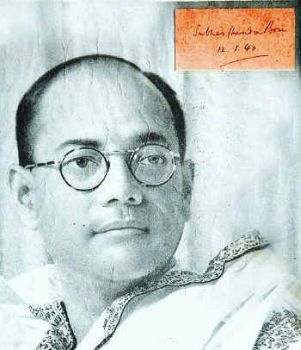
  • NETAJI SC BOSE FILES: HERE IS WHAT WE KNOW SO FAR

    NETAJI SC BOSE FILES: HERE IS WHAT WE KNOW SO FAR

    NEW DELHI (TIP): Prime Minister Narendra Modi on January 23 unveiled 100 declassified documents on Netaji Subhash Chandra Bose at the National Archives of India. The documents are still not available in the public domain, but the NAI is expected to release around 25 digitised copies every month. The timing of the release assumes political significance as West Bengal goes to polls later this year. The Mamata Banerjee government has already made 64 documents public last year and requested the Centre to do the same. These 64 documents, running into more than 12,000 pages, revealed that Subhash Chandra Bose’s family was snooped for nearly a decade by the Nehru government after his disappearance. The documents also show that the British suspected Bose was still alive after his plane crashed in Taipei.

    Netaji Bose’s cremation records appear online

    A UK website has released the evidence given by a Taiwanese official who claimed to have prepared Netaji’s body for cremation after his death in a plane crash in 1945. The testimony, contained in UK Foreign Office file No FC1852/6 and dating back to 1956, is among the last few documents to be released by http://www.bosefiles.info set up to establish that the Indian freedom fighter died in the crash on the outskirts of an airfield in Taipei on August 18, 1945.

    British believed Netaji was alive 

    The British intelligence were skeptical over reports of Netaji’s death in Taipei. They believed that he was still alive and living in either China or Russia. The British arrived at this conclusion after no strong evidence had emerged of his death after his plane had crashed.

    West Bengal probed if Subhas Chandra Bose missed the flight In 1969, Member of Parliament Samar Guha wrote to the then West Bengal chief secretary M M Basu about a “sensational report” of Netaji’s survival. Based on the letter, Basu had directed the state government’s home secretary to conduct a probe into the claims. The report Guha refers to an article that appeared in Jugantar which claims that a police officer had seen Netaji board a submarine in Singapore, not a plane, along with two Japanese officers. The officer went on to say that Netaji left his sword with him before leaving Singapore.

    Netaji files reveal snooping on Subhas Chandra Bose’s family, doubts over death 

    The West Bengal state intelligence has regularly intercepted letters reaching members of Netaji’s family after he went missing in 1945. Documents released last year show the contents of a letter from a Swiss journalist Dr Lilly Abegg to Netaji’s brother Sarat Chandra Bose. Abegg wrote: “I heard in 1946 from Japanese sources that your brother is still living.”

    Netaji’s wife kept in touch with his family even after disappearance 

    Netaji Subhas Chandra Bose saw his daughter Anita only once, when she was four weeks old. He was about to pay another visit to her in Vienna in 1943, but his “sudden departure” prevented this. The 64 files made public by the West Bengal government on Friday showed that while Bose never returned to Europe to his daughter and wife Emilie Schenkl, they continued to write to Netaji’s family after his disappearance.


  • Pentagon defends use of Russian engines

    Pentagon defends use of Russian engines

    WASHINGTON: Senior Pentagon officials have sought to defend the use of Russian-made rocket engines to send US military satellites into space, telling exasperated lawmakers they are moving quickly to end the practice and rely on American-made rockets for the launches.

    But Air Force secretary Deborah James and Pentagon acquisition chief Frank Kendall failed to stem sharp criticism from several members of the Senate Armed Services Committee who view Russia as the chief geopolitical threat to the United States.

    Led by the committee chairman, Republican Senator John McCain, they said using the Russian engines enriches President Vladimir Putin’s inner circle and puts US national security in jeopardy.

    McCain, his voice rising at times, asked James and Kendall if they knew the names Sergey Chemezov and Dmitry Rogozin. Both are Russians targeted by US sanctions, he said, yet their positions in Russia’s space and defense industry allows them to personally profit from the sales of the Russian RD-180 engines. Each engine costs roughly USD 30 million.

    “So we now have senior Russian politicians, friends of Vladimir Putin, that are making tens of millions dollars in the pass-through money that is paid for the Russian rocket engines,” McCain said. He asked James whether she found that disturbing.

    “Yes,” James responded, although she said she couldn’t be certain whether any Russian officials were directly benefiting from the sales.

    Disengaging from use of the Russian engines is a priority but also far more complicated than it appears, James said. She recommended a stockpile of 18 of the RD- 180s until an equally capable American-made space launch vehicle can be tested and fielded.

    James also said she asked senior Pentagon officials yesterday to work with other federal agencies to ensure that purchase of the engines does not conflict with US sanctions.

    The Pentagon has actively tried to undermine the committee’s direction to limit that risk and end the use of the Russian RD- 180 engines by the end of this decade, McCain said. He also blamed the US contractor that acquires the engines, United Launch Alliance, and two senators who support the company, Richard Shelby, a Republican, and Dick Durbin, the No 2 Senate Democrat, for thwarting the committee’s instructions.

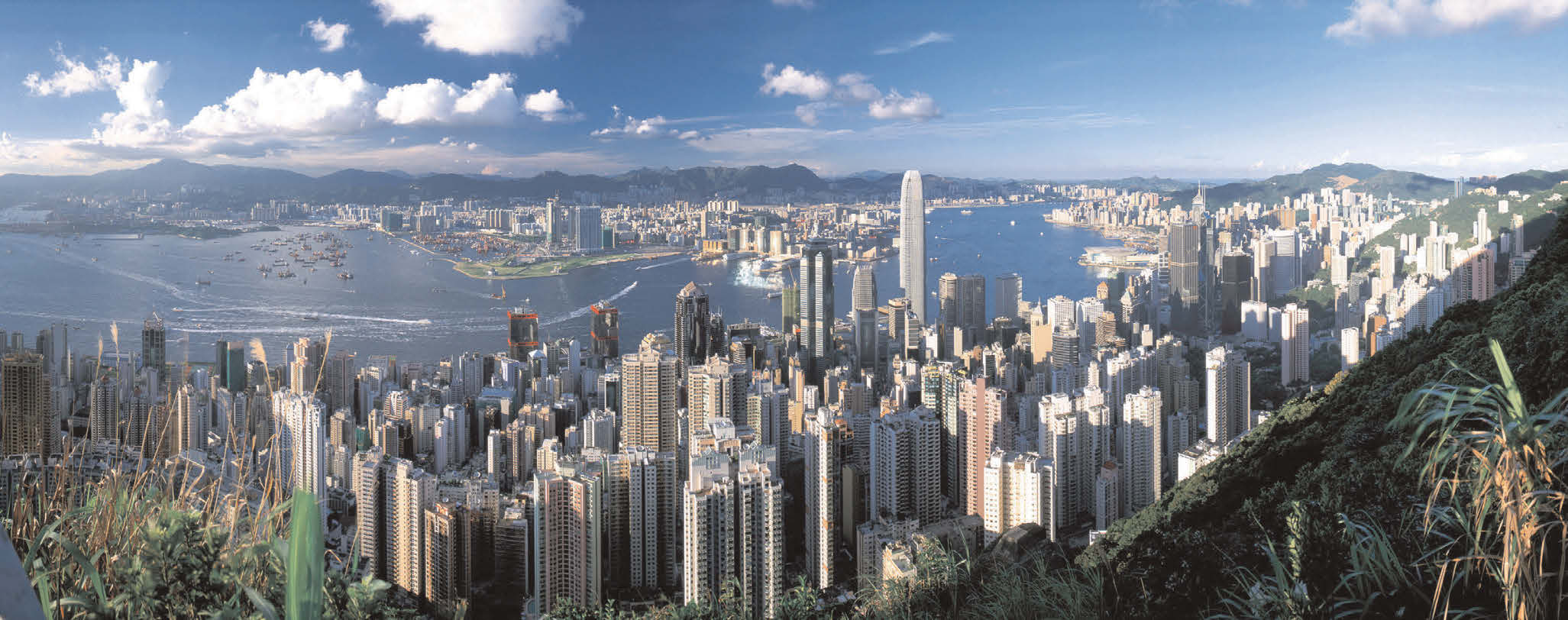
  • Hong Kong top, London second, Rio climbs but Kiev falls

    Hong Kong top, London second, Rio climbs but Kiev falls

    LONDON (TIP): London has leap-frogged Bangkok and Singapore to be named the second most visited city in the world.

    Nearly 17.4 million foreigners visited the UK capital in 2014, an increase of 3.6 per cent on the previous year, according to research by travel analysts Euromonito.

    Hong Kong however, which hosted 27.7 million visitors in 2014, representing an increase of 8.2 per cent, retained top spot in the 100-strong list for the sixth consecutive year.

    Euromonito travel analyst Wouter Geerts said: “London is one of the most iconic cities in the world. The resounding success of the London Olympics in 2012 has boosted visibility and popularity even further.

    “However, with London airports nearing capacity, the capital risks losing out to European rivals. To remain competitive in the international city destinations landscape, ensuring connectivity and innovation is key.”

    Rio de Janeiro was the biggest climber among the top 100 by shifting 12 places to 80th, attracting 47 per cent more travellers, and largely thanks to the FIFA World Cup – according to Euromonito.

    Cancun in Mexico follows not far behind, with a rise of 42.1 per cent thanks to four million visitors, as jetsetters flocked to its famous white sands. Kiev meanwhile dropped off the list amid a deadly conflict in Ukraine, while St Petersburg and Russia each saw a double-digit decline.

    (The Independent)

  • Economic crisis is not far away

    Economic crisis is not far away

    The next financial crisis is coming. It’s just a matter of time – and we haven’t finished fixing the flaws in the global system that were so brutally exposed by the last one.

    Massive monetary policy stimulus has rekindled growth in developed economies since the deep recession that followed the collapse of Lehman Brothers in 2008; but what the IMF calls the “handover” to a more sustainable recovery – without the extra prop of ultra-low borrowing costs – has so far failed to materialize.

    Meanwhile, the cheap money created to rescue the developed economies has flooded out into emerging markets, inflating asset bubbles, and encouraging companies and governments to take advantage of unusually low borrowing costs and load up on debt.

    “Balance sheets have become stretched thinner in many emerging market companies and banks. These firms have become more susceptible to financial stress,” the IMF says.

    Meanwhile, the failure to patch up the international financial system after the last crash, by ensuring that banks in emerging markets hold enough capital, and constraining risky borrowing, for example, means that a new Lehman Brothers-type shock could spark another global panic.

    VOLATILITY IN STOCKS AROUND THE WORLD

    Jan 13, 2016: Asian shares have tumbled after a heavy sell-off on Wall Street added to nervousness among investors.

    Japan’s Nikkei 225 was down more than 4% at one point – dropping below 17,000 for the first time since September – before closing down 2.7% at 17,240.95.

    US shares had fallen by more than 2% as oil prices continued to decline and worries grew over prospects for US company earnings.

    Weak economic data from Japan also dented investors’ confidence.

    Government data showed that core machinery orders fell 14.4% in November from the previous month.

    The orders were down for the first time in three months in the world’s third largest economy.

    Plunging oil prices

    Brent crude prices, meanwhile, fell 0.9% to $30.05 a barrel after earlier hitting a fresh 12-year low of $29.73.

    Bernard Aw, market strategist at trading firm IG, said oil prices would not see much recovery this year amid a supply glut.

    “Oil prices should continue to remain low, where a sustained pick-up is expected only in the third quarter of 2017,” he said in a note on Thursday.

    Australia’s S&P/ASX 200 share index ended 1.6% lower at 4,909.40, despite the release of better-than-expected employment data.

    The unemployment rate in the country was 5.8% in December, with fewer jobs lost than economists were expecting.

    The country lost 1,000 new jobs, as against expectations of 10,000.

    In South Korea, the benchmark Kospi index closed down 0.9% at 1,900.01 after its central bank kept interest rates unchanged for the seventh consecutive month.

    Hong Kong’s Hang Seng index ended the day down 0.6% at 19,817.41.

    Investors were spooked by Wednesday, Jan 13, sharp falls on Wall Street, when the Dow Jones and S&P 500 fell 2.2% and 2.5% respectively.

    There are fears that the continuing low crude price reflects a slowdown in some economies and could weigh on growth in emerging markets, many of which rely on oil revenues.

    Jan 13, Russia’s Prime Minister, Dmitry Medvedev, warned tumbling oil prices could force his country to revise its 2016 budget.

    He said that the country must be prepared for a “worst-case” economic scenario if the price continued to fall.

    Oil and gas projects worth $380bn have been postponed or cancelled since 2014 as companies slash costs to survive the oil price crash, including $170bn of projects planned between 2016 and 2020, according to a report from energy consultancy Wood Mackenzie.

    Mainland shares recover

    The Shanghai Composite index was the only bright spot in the region, reversing early losses to close up nearly 2% at 3,007.65.

    Regulators had announced late on Wednesday that they had stepped up monitoring share-selling by listed companies’ major shareholders.

    The securities commission also said that its transition to a US-style registration system for listings would be a gradual process and not lead to a surge in initial public offerings (IPOs).

    The announcement was the latest in a series of measures to support the market after heavy losses since last week.

    Elsewhere in the region, Indonesia’s Jakarta composite index closed down 0.5% at 4,513.18 points. The index had fallen more 1.7% earlier as multiple bomb blasts rocked the capital city on Thursday.

    Indonesia’s central bank continued its meeting throughout the attacks and cut its benchmark interest rate to 7.25%from 7.5%. The bank’s move is in an attempt to give its struggling economy a boost and comes despite a weakening currency.

    Jan 14, 2015: US stocks have closed higher, but European markets have continued to suffer from worries over oil prices and economic growth.

    The three main US indexes all gained between 1.4% and 2%, lifted in part by a 2% rise in the US oil price.

    Earlier in London, the FTSE 100 closed 0.7% down, while the main Frankfurt and Paris indexes fell 1.7%and 1.8% respectively.

    Those falls followed a heavy sell-off in some Asian markets.

    The pound hovered close to five-and-half-year lows against the dollar.

    Alongside the rise in the price of US West Texas Intermediate crude, Brent oil also rose in afternoon trading. The price was up 2.5% to $31.03 a barrel, having briefly drifted below $30 on Wednesday.

    The falls in European shares followed overnight losses in Asia. Japan’s Nikkeiindex closed down 2.7%, having dropped more than 4% at one point.

    Hong Kong’s Hang Seng eased off two-and-a-half-year lows to finish down 0.6%. The Shanghai Composite, which has endured torrid trading in recent months, was one of the few bright spots, rebounding nearly 2%.

  • Britain colder than South Pole this weekend with snow and ice forecast by met office

    Britain colder than South Pole this weekend with snow and ice forecast by met office

    LONDON (TIP): Parts of the UK are expected to be colder than the South Pole this weekend, forecasters say.

    Warnings of snow and ice have been issued for some areas, with temperatures set to plunge as low as – 15C in northern England and Scotland.

    Temperatures at the South Pole’s Rothera Point are currently hovering around -1C.

    A spokesperson for the Met Office told the Independent: “Temperatures could fall to as low as -15C in northern England and Scotland.”

    The forecaster predicted a risk of severe frost across the UK and issued a yellow weather warning. A mean temperature of below 2C has been issued for the UK

    The cold snap is predicted to last for longer than 48 hours and forecasters say there is a serious risk of ice and snow across the country.

    “The coldest night in the UK will be on Saturday night when the temperature is predicted to drop to a freezing -7C in the south of England and between -7C and -15C in the north,” said the Met Office spokesperson.

    On Saturday night, the UK is likely to be even colder than Moscow, in Russia, which is expecting temperatures of -5C.

    Public Health England has urged people, especially the elderly, to stay inside and keep warm, and advised that house temperatures be kept to a minimum of 18C. Heavy rainfall is also expected across the south of England.

    (IANS)

  • Battle vs ISIS, battle for the Middle East

    Battle vs ISIS, battle for the Middle East

    ISIS or the Islamic State, also known as IS, ISIL or its Arab acronym, Da’esch, dominated the headlines for 2015. The year saw the terror group spread its hateful and vitriolic ideology beyond the borders of its “caliphate,” which encompasses large swathes of Iraq and Syria, as well as “provinces” in several Mideast and African countries.

    With millions of dollars in their pockets, and the Internet as their main channel to propagate evil, ISIS went “global” – with trained militants as well as radicalized individuals and groups carrying out the group’s mission to spread terror. Their targets ranged from a newspaper office, to a museum, from a concert hall to mosques, from military convoys to civilian planes. The toll: nearly a thousand people, from Paris to Beirut to San Bernardino.

    The spread of ISIS has further complicated the already twisted state of affairs in strife-torn Syria, already entering its fifth year in a civil war. World powers, in their attempt to untangle the mess and to gain influence in the region, bicker over which to tackle first: Bashar al-Assad, the iron-fisted dictator whose violent regime in many ways ignited the current conflict, or the terror group. Assad’s allies (namely Russia and Iran) are trying to have him stay put, while the US-led coalition wants him out.

    The year saw military movements from every side, with airstrikes targeting ISIS strongholds – and some say legitimate Syrian opposition groups. Countries around Syria and Iraq are also on their toes, with some nations such as Turkey serving as launch areas for military operations.

    Amid the mess, the peace process is still in the cards, despite several attempts to convene all sides in the past few months that yielded little results. Thanks to a landmark 18-month plan endorsed by the United Nations Security Council, the UN is preparing for another round of talks starting January 25, 2016.