Tag: Russian

  • Officials report at least 13 dead in shelling of a market in Russian-occupied Ukraine

    KYIV (TIP): At least 13 people were killed January 21 by shelling at a market on the outskirts of the city of Donetsk in Russian-occupied Ukraine, local officials reported Sunday.
    A further 10 people were injured in the strike on the suburb of Tekstilshchik, said Denis Pushilin, head of the Russian-installed authorities in Donetsk. He said that the shells had been fired by the Ukrainian military.
    In a preliminary toll the Donetsk mayor Alexei Kulemzin had earlier reported eight dead in the shelling on the northeast of the city.
    The Ukrainian city fell under the control of pro-Moscow separatists in 2014 and is regularly targeted by Kyiv’s forces.
    During the night of January 1 four people died and 13 were wounded, including journalists, in strikes on Donetsk, the Russian-controlled authorities said.
    Kyiv has not commented on the event and the claims could not be independently verified by The Associated Press.
    Emergency services continue to work on the scene, Pushilin said. (AFP)

  • Russian man whose teen daughter drew anti-war picture flees house arrest

    Russian man whose teen daughter drew anti-war picture flees house arrest

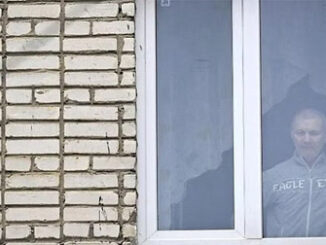
    MOSCOW (TIP): A single father, who was separated from his daughter and sentenced on March 28 to two years in prison over “discrediting” the Russian army, has fled house arrest, officials said. Alexei Moskalyov, 54, first came to the authorities’ attention last year after his daughter Maria drew a picture at school showing missiles next to a Russian flag heading towards a woman and child standing by a Ukrainian flag.
    A criminal case was later opened against him for allegedly criticising Russia’s assault on Ukraine and on Tuesday he was handed a two-year jail sentence over comments on social media.
    But in a dramatic turn of events, court officials said Moskalyov had fled house arrest.
    Moskalyov has been separated from his 13-year-old daughter as punishment for his criticism of Kremlin policies, a first in Russia, experts say.
    “The verdict was read out in the absence of the defendant, because he disappeared and did not appear at the hearing,” Elena Mikhailovskaya, a spokeswoman for the Yefremov district court south of Moscow, told AFP.
    Moskalyov’s lawyer Vladimir Biliyenko said he was in a “state of shock”.
    “His disappearance is a total surprise for me. This has happened for the first time in my career,” he told AFP.
    He said that Moskalyov’s daughter Maria could be sent to an orphanage “within a month”.
    School drawing : Russia’s top human rights organisation Memorial, which has been shuttered by Russian authorities, said on Facebook it considered Moskalyov a “political prisoner”.
    It added that separation from his daughter was a “repressive act and an attempt to intimidate all opponents of the war not only with prison terms but also the destruction of their families and pressure on children”.
    The Moskalyovs’ case has garnered national attention and led to an online petition calling for the girl to be re-united with her father.
    The pair hail from Yefremov, a small town of around 37,000 people some 300 kilometres (180 miles) south of Moscow. The case against Moskalyov was opened after Maria’s headmistress contacted the police about her picture with the flags and the missiles. Police said an online search uncovered comments criticising Moscow’s action in Ukraine on the social media profiles of the girl’s father.
    In early March, authorities placed Maria in a “rehabilitation centre” for minors, while Moskalyov was put under house arrest.
    On Monday, prosecutors demanded a two-year prison term for the father.
    Since President Vladimir Putin sent troops to Ukraine over a year ago public criticism of Moscow’s offensive in the pro-Western country has been outlawed.
    During the height of Stalin-era purges in the late 1930s thousands of children were taken away from their parents.
    In modern Russia, the first recorded attempts to strip activists of parental rights were in Moscow in 2019. Prosecutors’ attempts to punish two families for taking their children to political protests were not successful at the time, however.
    Even Yevgeny Prigozhin, head of the Wagner paramilitary force spearheading Russia’s assault in eastern Ukraine, has voiced support for Maria and criticised the local authorities. (AFP)

  • Ukrainian Nobel winner calls for world to ‘hold Russian war criminals accountable’

    Ukrainian Nobel winner calls for world to ‘hold Russian war criminals accountable’

    Kyiv (TIP): Oleksandra Matviichuk, a Ukrainian rights activist whose NGO was co-winner of last year’s Nobel Peace Prize, called February 16 for the world to “hold Russian war criminals accountable,” in an interview with AFP.
    “We must break the circle of impunity,” she said, urging the United Nations and the European Union to back Kyiv’s call for a special tribunal able to judge top Russian officials all the way up to President Vladimir Putin.
    While acknowledging that getting a majority of UN member countries behind that goal was a “hard task,” Matviichuk said it was indispensable for any post-war peace that might follow the end of the conflict in her country.
    “There will not be sustainable peace without justice,” she noted.
    Her demand came nearly a year after Russia’s February 24, 2022 invasion of Ukraine, which followed its 2014 annexation of Crimea and support for pro-Russian separatists in Ukraine’s east.
    She was speaking at Belgium’s University of Louvain just ahead of receiving an honorary doctorate there, alongside Palestinian filmmaker Elia Suleiman and Adelle Blackett, a law professor at Canada’s McGill University.
    The trio were being recognised for the fight for civil rights and a fairer society.
    ‘Everyone’s rights protected’
    The Ukrainian NGO that Matviichuk runs, the Center for Civil Liberties, last year shared the Nobel Peace Prize with the Russian rights organisation Memorial and an imprisoned Belarusian pro-democracy activist, Ales Bialiatski.
    Matviichuk’s Center for Civil Liberties, founded in 2007, has campaigned for rule of law and democracy in Ukraine.
    That struggle has only become harder with Russia’s military offensive, but it has not been forgotten, she said — to the contrary, the values the NGO campaigns on are central to Ukraine’s efforts to one day join the European Union. “We have two main tasks: to survive and to resist, and to continue our democratic path,” Matviichuk said.
    “We’re still a nation in transit, and we can’t concentrate energy only on this reforming path — we have in parallel the war with Russia.
    “But after the large-scale invasion started, we still have no luxury to concentrate only on one goal, we have to fight for our survival. And we have to move on to join to European Union,” she said.
    Ukraine’s ambition to become an EU member state could take many years, EU officials say, though some EU neighbours of Ukraine are lobbying for a faster timeline.
    Becoming part of the European Union means becoming part of the “European civilisation space,” Matviichuk said.
    Joining the EU would mean “we will have a chance to build our country where the rights of everybody are protected,” she said. (AFP)

  • Willing  to talk directly to Vladimir Putin and not via intermediators, says Zelensky

    Willing to talk directly to Vladimir Putin and not via intermediators, says Zelensky

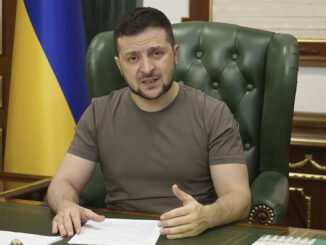
    DAVOS (TIP) : Ukrainian President Volodymyr Zelenskyy said on Wednesday, May 25,  that he was only willing to talk directly to Vladimir Putin and not via intermediators, according to AP. He said if the Russian President “understands reality, there is the possibility of finding a diplomatic way out of the conflict”. Speaking to an audience at the World Economic Forum in Davos, he also said Ukraine would fight until it recovered all of its territory. “Moscow should withdraw its troops back to the lines in place before Russia began its invasion on February 24. That might be a first step towards talks,” he said, adding Russia had been playing for time in its talks with Ukraine.

  • Red Cross visits prisoners of war from Ukraine, Russia

    Red Cross visits prisoners of war from Ukraine, Russia

    Geneva (TIP): The international Red Cross says it has been visiting prisoners of war on “all sides” since the start of the war between Russia and Ukraine almost three months ago. The International Committee of the Red Cross didn’t specify what “all sides” meant, but it is believed to mean Russian and Ukrainian government forces, as well as pro-Russian separatists who have been waging an armed struggle in eastern Ukraine against the Kyiv government since 2014. It could also include foreign fighters who might have been captured. A Red Cross statement Friday said the POW visits had enabled it to pass on information to hundreds of families about their loved ones.

    The ICRC did not specify how many families had been informed about their relatives, or where the visits took place. It said only that the visits had taken place “in recent months.” The statement came a day after the humanitarian agency broke its silence about prisoners of war in the nearly three-month-long conflict, announcing it has registered “hundreds” of Ukrainian prisoners of war this week from the Azovstal steel plant in Mariupol who ended their defense against a weeks-long siege by Russian forces.

    “Many more families need answers; the ICRC must have full access to POWs and civilian internees, wherever they are held, in order to provide those answers,” the Geneva-based organisation said. Some humanitarian law experts have questioned why the ICRC took so long to announce its POW visits, a key part of its mandate.

    The ICRC often operates confidentially in its role to help protect civilians, prisoners of war and other noncombatants in conflicts, and ensure the respect of the rules of war. AP

  • Ukraine accuses Russiaof forcibly deporting over 2 lakh children

    Ukraine accuses Russiaof forcibly deporting over 2 lakh children

    Kyiv (TIP): Ukraine said on May 13 Russia had forcibly deported more than 210,000 children since its invasion on Feb. 24 and accused Moscow of wanting to make them Russian citizens. Human rights ombudswoman LyudmylaDenisova said the children were among 1.2 million Ukrainians who Kyiv says have been deported against their will.

    Reuters could not independently verify the figure given by Denisova or her allegations, for which she did not provide supporting evidence. The Kremlin did not immediately respond to a Reuters request for comment on Denisova’s allegations concerning the deportation of large numbers of children and other Ukrainian nationals.

    Moscow has denied intentionally targeting civilians since launching what it calls a special military operation in Ukraine and says it is offering humanitarian aid to those who want to leave Russia. “When our children are taken out, they destroy the national identity, deprive our country of the future,” Denisova said on national television.

    “They teach our children there, in Russian, the history that (Russian President Vladimir) Putin has told everyone.” Russia has referred to “refugees” coming to Russia to escape fighting, particularly from the southern Ukrainian city of Mariupol, which is in Russian hands after weeks of siege and bombardment. The 1949 Geneva Conventions, which define international legal standards for humanitarian treatment in conflict, prohibit mass forcible transfers of civilians during a conflict to the territory of the occupying power, classifying it as a war crime. Reuters

  • Ukraine pushes Russian forces back, restricts gas flow to Europe

    Ukraine pushes Russian forces back, restricts gas flow to Europe

    Kyiv/Vilhivka (TIP): Ukrainian forces reported battlefield gains on May 11 in a counterattack that could signal a shift in the momentum of the war, while Kyiv shut gas flows on a route through Russian-held territory, raising the spectre of an energy crisis in Europe. Following days of advances north and east of the second largest city Kharkiv, Ukrainian forces were within just several kilometres of the Russian border on Wednesday morning, one Ukrainian military source said on condition on anonymity. Before the advance, Russian forces had been on the outskirts of Kharkiv, 40 km (25 miles) from the border.

    The gains appear to be the fastest that Ukraine has achieved since it drove Russian troops away from Kyiv and out of the country’s north at the beginning of April. If sustained, it could let Ukrainian forces threaten supply lines for Russia’s main attack force, and even put rear logistics targets within Russia itself within striking range of Ukrainian artillery.

    In Vilhivka, a village east of Kharkiv held by Ukrainian forces, the thump of near constant artillery and swoosh of multiple rocket launchers could be heard from fighting at the front, now pushed substantially further east, where Ukraine has been trying to capture villages on the banks of the Donets river and threaten Russian supply lines on the far side.

    Further east, Ukrainian forces seemed to be in control of the village of Rubizhne, on the banks of the Donets.

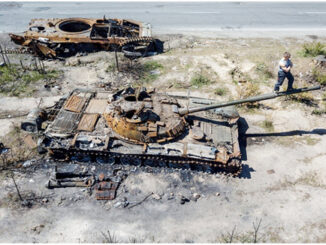
    “It is burned out, just like all Russian tanks,” a Ukrainian soldier told Reuters near Rubizhne next to the ruins of one Russian tank. “The weapons are helping a lot, the anti-tank ones.”

    KHARKIV ADVANCE

    Kyiv has so far confirmed few details about its advance through the Kharkiv region, maintaining secrecy about the positions of its own forces near the frontline while speaking in general terms about overall gains.

    “We are having successes in the Kharkiv direction, where we are steadily pushing back the enemy and liberating population centres,” Brigadier General OleksiyHromov, Deputy Chief of the Main Operations Directorate of Ukraine’s General Staff told a briefing, providing no specifics.

    President VolodymyrZelenskiy said successes were putting Ukraine’s second largest city – under constant bombardment since the war’s early days – beyond the range of Russian artillery.  (Reuters)

  • Russian spy boss compares US to German Nazi propaganda machine

    Mariupol, Ukraine (TIP): A Russian spy chief on May 11 compared the US State Department to the World War II Nazi propaganda machine constructed by Joseph Goebbels, saying Washington had launched an anti-Russia messaging campaign across social media.

    Sergei Naryshkin, head of Russia’s foreign intelligence agency (SVR), said the United States was encouraging the spreading of fake information on the popular Telegram messaging service in an attempt to “discredit” and “dehumanise Russia’s political and military leadership in the eyes of the Russian people”.

    “Their actions have a lot in common with the traditions of the Third Reich’s ministry of public education and propaganda and its head Joseph Goebbels,” Naryshkin said in a statement published on the SVR website.

    Naryshkin provided no evidence to support the claims of a US-backed information campaign. Russia regularly accuses the West of funding and supporting anti-Kremlin movements and has labelled dozens of independent human rights groups and media outlets in Russia “foreign agents” over recent years. (Reuters)

  • Russia-Ukraine War: Indian embassy to resume operations in Kyiv from May 17

    Kyiv (TIP): India on May 13 announced that its embassy in Ukraine would resume its operation from the Ukrainian capital Kyiv from May 17. The embassy was temporarily operating from Warsaw in Poland since mid-March.

    “The Indian Embassy in Ukraine, which was temporarily operating out of Warsaw (Poland), would be resuming its operation in Kyiv with effect from May 17,” the Ministry of External Affairs said.

    It said the embassy was temporarily relocated to Warsaw on March 13. The decision to resume operation of the embassy from Kyiv came amid decisions by several Western powers to reopen their missions in the Ukrainian capital.

    India had decided to temporarily relocate the embassy to Poland in view of the rapidly deteriorating security situation in the war-torn country, including the Russian military offensive around Kyiv.

    India relocated the embassy after bringing back over 20,000 of its nationals from across Ukraine under its evacuation mission ‘Operation Ganga’ that was launched on February 26 in the wake of the war in Ukraine. (PTI)

  • Ukraine can attack Russian logistics, unlikely to use its weapons: UK

    Ukraine can attack Russian logistics, unlikely to use its weapons: UK

    London (TIP): British Defence Secretary Ben Wallace said on April 28 it would be legitimate for Ukrainian forces to target Russian logistics to cripple their supply of food, fuel and munitions but they were unlikely to use British weapons to do so. Tensions between Britain and Russia increased this week when Moscow accused London of provoking Ukraine to strike targets inside Russia, saying there would be an immediate “proportional response” if it continued.

    Wallace said under international law Ukraine had every right to defend itself.

    “Part of defending itself in this type of invasion is obviously where Ukraine will go after the supply lines of the Russian army because without fuel and food and ammunition, the Russian army grinds to a halt and can no longer continue its invasion,” he told BBC TV.

    Britain has been a vocal supporter of Ukraine since it came under attack in late February, sending aid and arms to help it repel its larger neighbour.

    Wallace said Britain had sent artillery to Ukraine that was being used within Ukraine on Russian forces, but he added that it had not, and was unlikely, to send weapons that could be used for longer-range attacks.

    He said that it was not clear if attacks seen in Russia in recent weeks had come from the Ukrainian state. He added that Ukraine did not have British weapons that could do that.

    Ukrainian forces, he said, tend to use mobile launchers while the British army would deliver them from the air or sea.

    “They currently don’t have British weapons that could do that, so it’s unlikely that it is our weapons,” he said. “We’re very unlikely to supply that to anyone simply because of the technology and also the scarcity we have of those capabilities.

    So it is very unlikely.”

    Wallace also denied that NATO was locked in a proxy war with Russia but said the West would provide increasing support to Ukraine if the Russian attacks continued. “Sometimes that will include planes and tanks,” he told Times Radio.

    Russia on Wednesday reported a series of blasts in the south of the country and a fire at an ammunition depot.

    Russia has repeatedly criticised Britain’s military support for Ukraine, accusing it of wanting to prolong the conflict to weaken Moscow.

    Responding to a similar British statement on Tuesday which said Russian military targets inside Russia were fair game for Ukraine, Russian Foreign Ministry spokesperson Maria Zakharova suggested that British logic meant Russia was also theoretically entitled to strike targets in NATO countries like Britain if they were related to arms deliveries for Ukraine. Reuters

  • USCIRF recommends to designate India, 14 others as ‘Country of Particular Concern’

    USCIRF recommends to designate India, 14 others as ‘Country of Particular Concern’

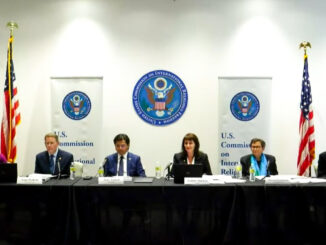
    WASHINGTON, D.C. (TIP): A US Congress-constituted quasi-judicial body on Monday, April 25,  recommended to the Biden Administration to designate India, China, Pakistan, Afghanistan and 11 other nations as “Country of Particular Concern” in the context of status of religious freedom. India has in the past said that the American body on international religious freedom has chosen to be guided only by its biases on a matter on which it has no locus standi.The recommendations of the US Commission for International Religious Freedom (USCIRF) are not binding on the US Government. Other countries recommended for this designation by the USCIRF in its annual report are Burma, Eritrea, Iran, Nigeria, North Korea, Russia, Saudi Arabia, Syria, Tajikistan, Turkmenistan, and Vietnam.

    The USCRF had made a similar recommendation to the US government last year which was not accepted by the Biden Administration.India has previously rejected the reports by USCIRF.

    “Our principled position remains that we see no locus standi for a foreign entity to pronounce on the state of our citizens’ constitutionally protected rights,” the ministry of external affairs had said in the past.

    “We have a robust public discourse in India and constitutionally mandated institutions that guarantee protection of religious freedom and rule of law,” the MEA had said.

    Among its recommendations last year, five countries — Afghanistan, India, Nigeria, Syria, and Vietnam – are not designated as Country of Particular Concern by the US Government.

    “In 2021, religious freedom conditions in India significantly worsened. During the year, the Indian government escalated its promotion and enforcement of policies—including those promoting a Hindu-nationalist agenda—that negatively affect Muslims, Christians, Sikhs, Dalits, and other religious minorities,” USCIRF said.”The government continued to systemize its ideological vision of a Hindu state at both the national and state levels through the use of both existing and new laws and structural changes hostile to the country’s religious minorities,” it said.

    Established by the US government in 1998 after the inaction of the International Religious Freedom Act, recommendations of USCIRF are non-binding on the state department. Traditionally, India does not recognize the view of USCIRF. For more than a decade, it has denied visas to members of the USCIRF.

  • Block off…so that not even a fly comes through, Putin after Mariupol takeover

    Block off…so that not even a fly comes through, Putin after Mariupol takeover

    Kyiv (TIP): Russian President Vladimir Putin ordered his forces not to storm the last remaining Ukrainian stronghold in the besieged city of Mariupol on April 21 but instead to block it “so that not even a fly comes through”. His defence minister, Sergei Shoigu, said the rest of the city beyond the sprawling Azovstal steel plant where Ukrainian forces were holed has been “liberated” – as Russian officials refer to areas of Ukraine they have seized. Putin hailed that as a “success”. But leaving the plant in Ukrainian hands robs the Russians of the ability to declare complete victory in Mariupol, which has seen some of the most dramatic fighting of the war and whose capture has both strategic and symbolic importance. The scale of suffering there has made it a worldwide focal point, and its definitive fall would deprive Ukraine of a vital port, complete a land bridge between Russia and the Crimean Peninsula, and free up Russian troops to move elsewhere in the Donbas.

    Shoigu said the plant was “securely blocked”. Putin and Shoigu’s comments appeared to reflect a change in strategy in Mariupol, where the Russians previously seemed determined to take every last inch of the city. But it was not clear what it would mean in practical terms.

    Ukrainian officials did not comment on the latest remarks, but earlier said four buses with civilians managed to escape from the city after several unsuccessful attempts. Thousands more remain the city, much of which has been reduced to a smoking ruin in a nearly two-month siege, with over 20,000 people feared dead.

    Ukraine’s Deputy Prime Minister IrynaVereshchuk said another attempt to evacuate civilians from Mariupol would be made on Thursday – though it was not clear how the latest comments would affect that.

    In Kyiv, Spain’s Prime Minister Pedro Sánchez and Denmark’s MetteFrederiksen became the latest European leaders to show support with a visit to the capital.

    They were due to meet with President VolodymyrZelenskyy, who warned in a video address overnight that the Russians were not “abandoning their attempts to score at least some victory by launching a new, large-scale offensive”.

    “The West stands together to support the Ukrainian people,” Frederiksen, the Danish prime minister, said in a statement. Meanwhile, the Kremlin said it submitted a draft of its demands for ending the war, and the West raced to supply Ukraine with heavier weapons to counter the Russians’ new drive to seize the industrial east.  (AP)

  • We await Kyiv response on peace talks: Russia

    Moscow (TIP): The Kremlin’s spokesman says Russia has presented Ukraine with a draft document outlining its demands as part of peace talks and is now awaiting a response from Kyiv. Dmitry Peskov told a conference call with reporters Wednesday that Russia has passed on a draft document containing “absolutely clear, elaborate wording” to Ukraine and now “the ball is in their court, we’re waiting for a response”.

    Peskov didn’t give further details. He blamed Ukraine for the slow progress in negotiations, and claimed that Kyiv constantly deviates from previously confirmed agreements. “The dynamic of work on the Ukrainian side leaves much to be desired, the Ukrainians do not show a great inclination to intensify the negotiation process,” he said.

    Ukraine presented Russia with its own draft last month in Istanbul, where the two sides held talks aimed at ending the conflict. It has been unclear how regularly the two sides have spoken to each other since then. The German government and military are rejecting an assertion by Ukraine’s ambassador that the country could spare armoured fighting vehicles and deliver them to Kyiv. Ambassador AndriyMelnyk, who has frequently criticized perceived German slowness on weapons deliveries and other issues, argued that Germany’s Bundeswehr uses about 100 Marder vehicles for training and they could be handed over to Ukraine immediately. (AP)

  • Russia tests nuclear-capable ballistic missile that President Putin says has no peer

    Russia tests nuclear-capable ballistic missile that President Putin says has no peer

    Moscow (TIP): Russia on April 20 said it had test-launched its Sarmat intercontinental ballistic missile, a new addition to its nuclear arsenal which President Vladimir Putin said would give Moscow’s enemies something to think about. Putin was shown on television being told by the military that the missile had been launched from Plesetsk in the country’s northwest and hit targets in the Kamchatka peninsula in the far-east. “The new complex has the highest tactical and technical characteristics and is capable of overcoming all modern means of anti-missile defence. It has no analogues in the world and won’t have for a long time to come,” Putin said.

    “This truly unique weapon will strengthen the combat potential of our armed forces, reliably ensure Russia’s security from external threats and provide food for thought for those who, in the heat of frenzied aggressive rhetoric, try to threaten our country.”

    The Sarmat is a new heavy Intercontinental Ballistic Missile which Russia is expected to deploy with 10 or more warheads on each missile, according to the US Congressional Research Service.

    It has been under development for years and so its test-launch is not a surprise for the West, but it comes at a moment of extreme geopolitical tension due to Russia’s war in Ukraine. (Reuters)

    Russia tests ‘peerless’ N-missile : Russia said on April 20 it had conducted the first test launch of its Sarmat intercontinental ballistic missile, a new addition to its nuclear arsenal which President Vladimir Putin said would give Moscow’s enemies something to think about.

    Putin was shown on television being told by the military that the missile had been launched from Plesetsk and hit targets in the Kamchatka peninsula in the far east.

    The Sarmat has been under development for years and so its test-launch is not a surprise for the West, but it comes at a moment of extreme geopolitical tension due to Russia’s eight-week-old war in Ukraine. “The new complex has the highest tactical and technical characteristics and is capable of overcoming all modern means of anti-missile defence. It has no analogues in the world and won’t have for a long time to come,” Putin said.

    – Reuters

  • UK sets out 26 new sanctions against Russia

    London (TIP): Britain on April 21 added 26 new designations to its list of sanctions against Russia over the Ukrainian war, including on military figures and defence companies. Britain, which has sought to play a key role in the West’s response to Moscow’s invasion of Ukraine, has already set out hundreds of sanctions, such as asset freezes and travel bans on prominent Russian billionaires and politicians including President Vladimir Putin.

    Among those on the updated sanctions list, published on the government website, were Colonel General NikolayBogdanovsky of the Russian army who holds the position of First Deputy Chief of the General Staff, manufacturer Military Industrial Company, and industrial group Promtech-Dubna. Reuters

  • US, not Russia, is and will be India’s reliable partner post Ukrainian war: State Dept Counsellor

    US, not Russia, is and will be India’s reliable partner post Ukrainian war: State Dept Counsellor

    WASHINGTON,D.C. (TIP): It is the United States, and not Russia, which is and will be India’s “reliable” partner post the war in Ukraine, the Biden Administration pitched on Thursday, April22, asserting that it is ready to go the extra mile to meet New Delhi’s defense and national security needs.

    “I think there are real doubts about Russia’s ability to be a reliable partner for the foreseeable future. Because Russia is burning through a tremendous amount of its own military equipment. So, it faces urgent resupply needs of its own,” US State Department Counsellor Derek Chollet told PTI in an interview. Of the rank of Under Secretary of State and a senior policy advisor to US Secretary of State Antony Blinken, Chollet said the Biden administration is very much eager to work with India as it diversifies its defense capabilities and defense suppliers.

    “We very much want to be part of that. We’re doing much more than we’ve ever done in the history of our relationship together in terms of defense. And so, as India’s seeking to acquire new capabilities, the United States very much wants to be a partner with India in that effort,” he said.

    Chollet argued that the military equipment being supplied by Russia has shown it is lacking in capability. “The difficulty of doing business with Russia is only going to grow over time. It’s become much harder given all the sanctions placed on Russia in the last 12 weeks,” he said.

    “Also, the export control against Russia… Russia’s inability to import key technologies to be able to make certain products, including some of its military hardware, are going to mean that it’s going to have a hard time even getting the capability to replace or to produce this kind of material. So, any way you look at it in terms of actual capability, in terms of the difficulty of doing business with Russia, in terms of the reputation costs associated, Russia is just a far less attractive partner,” he said.

    However, Chollet evaded a direct answer to the question on the US deploying its Seventh Fleet to the Bay of Bengal in December 1971 during the India-Pakistan War, which many in India say is a symbol of the US also not being a reliable partner when needed.

    “The US has shown throughout the course of this conflict, something we believe deeply, that we are a very reliable partner. If you think back…the United States made the decision to start sharing some of the most sensitive intelligence that we had about Russia’s planning and intentions when it came to Ukraine, our effort to share as much information as we possibly could with our friends and allies around the world in the spirit of being a reliable partner and in trying to bring the world and make them together and to make them aware of what we were seeing and try to create a unified effort,” he said.Chollet asserted that the India-US relationship has not been impacted by the Ukrainian war. “Russia’s invasion of Ukraine has not impacted the relationship between the US and India. The US-India relationship is deep, it’s strong,” he said, adding that it has bipartisan support in Washington.

    “Obviously, we have talked with our Indian friends about everything from votes in the UN to the defense relationship with Russia. It was a topic of conversation at 2+2 (ministerial meeting) recently, but we fully understand the position that India is in given its long-standing defense relationship with Russia,” he said.

    “It’s important to note that from our perspective we see that the defense relationship (between India and Russia) in a way started and flourished at a time when the United States was not available as a partner to India. Obviously, we are in a much different moment right now,” he said. The US-India defense relationship is in a much different and more positive place than it was even 10 years ago. “One of the significant outgrowths of the 2+2 process is the potential and the continued growth of the US-India defense relationship,” he said.

    The agenda of the 2+2 meeting was just a further example of the breadth and depth of the strategic relationship between the US and India.

    Earlier this month, External Affairs Minister S Jaishankar and Defense Minister Rajnath Singh held the 2-2 ministerial dialogue in Washington with US Secretary of State Antony Blinken and Defense Secretary Lloyd Austin. The 2+2 ministerial meeting was preceded by a virtual meeting between Prime Minister Narendra Modi and President Joe Biden. Chollet said that the Biden administration as of now has not taken any decision on CAATSA sanctions now that India has started receiving S-400 missile equipments from Russia.

    “We have made no decision on that (CAATSA sanctions). Obviously, we are getting back to the overall theme of our desire to strengthen our defense partnership with India. We are very much eager to work with India…,” he said.

    Referring to the progress in the India-US relationship since the Clinton administration irrespective of which party is in power, Chollet said it is like a rocket shooting into space with different stages.

    “We are building on the work of our predecessors. It is important — it’s both Republicans and Democrats and there has been a very steady trajectory of closer cooperation and closer partnership. We are led by the people-to-people ties between our two countries,” he said. “In many ways, when it comes to the US-India relationship our governments are having to catch up to where our people are and our societies are,” he said.

    (Source: PTI)

  • India can criticize Russia’s Ukraine invasion

    India can criticize Russia’s Ukraine invasion

    By Suhasini Haidar

    In 2003, despite a growing partnership with the U.S. that was finally turning a corner after the nuclear tests, the Indian government brought a resolution to Parliament that “deplored” the actions of the coalition led by the U.S. for its war on a sovereign Iraq, calling the invasion “unacceptable”. But then External Affairs Minister Yashwant Sinha stood up to speak during the debate on the resolution passed unanimously, and noted that despite India’s differences with the U.S. on the war, the Government would continue to develop bilateral relations. It should have been possible for the government of the day to express its opposition to Russian actions in Ukraine similarly, while maintaining an independent position on unilateral sanctions.

    It is possible for the Government to express its criticism while maintaining an independent stand on unilateral sanctions. Just four years ago, in June 2018, then United States President Donald Trump sent his Ambassador to the United Nations, Nikki Haley, on a sensitive mission to New Delhi. Ms. Haley, who was to meet Prime Minister Narendra Modi to convince the Government to drop its oil imports from Iran or face U.S. sanctions, and said that India must “rethink its ties”, was probably chosen because she was a diplomat and also an Indian-American which had a certain appeal in India. A day later, India’s petroleum ministry asked refiners to cut imports from Iran. Within a few months, when the American deadline expired, the Government announced that it had “zeroed out” its imports of oil from Iran, once India’s preferred choice and its third biggest supplier of crude.

    ‘Appeals’ and India’s reaction

    Now, in 2022, the U.S. pressure on India to cut its oil imports from Russia has been much less subtle. The appeal to “zero out” oil purchases from Russia, and not accelerate them, has come from the highest quarters: these include U.S. President Joe Biden to Mr. Modi during a virtual summit;U.S. Secretary of State Antony Blinken during the “2+2” ministerial meeting in Washington last week, and from another Indian-American emissary, Deputy National Security Adviser for International Economics Daleep Singh, who, while he was on a visit to Delhi, spoke of “consequences” for creating payment mechanisms around sanctions against Russia. The pressure is likely to increase in the coming weeks, with more engagements planned by Mr. Modi with European leaders — the British Prime Minister Boris Johnson will arrive in India this week, and Mr. Modi is expected to travel to Germany and France for bilateral meetings and to Denmark for a summit with Nordic countries.

    Thus far, nearly two months into Russia’s war with Ukraine, New Delhi’s position has been to push back: External Affairs Minister S. Jaishankar said in February that India does not recognize unilateral sanctions (only the ones mandated by the United Nations), followed by some tough talking in Washington last week. This includes the fact that after 12 occasions of votes at the UN, India continues to abstain on resolutions critical of Russia’s invasion and the daily bombardment of civilians. Despite talks with leaders from the U.S., Japan and Australia, each of whom criticized Russia in their summit remarks, India’s Ministry of External Affairs has not allowed any direct mention of Russia in the respective joint statements. In March and April, India has bought more Russian oil, at a discount, than it did in all of 2021, and is now accelerating coal imports as well. While deliveries of the Russian S-400 missile defense system may be delayed by the war, New Delhi is not putting its defense deals with Moscow on hold. Russian bank officials have held meetings with the Reserve Bank of India in Mumbai for technical talks on the rupee-rouble payment mechanism to be used for purchases that circumvent sanctions.

    Sustainability of stand

    So, what explains the Government’s refusal to bow to combined western pressure on the issue of India’s Russian engagement so far, when it gave in to far less pressure on dealing with Iran? And can New Delhi’s position be sustained much longer? While most analysis of India’s stance deals with its past relationship with Russia, (this includes the Soviet Union), the truth may lie in the Modi government’s perceptions of its future challenges: from its defense and energy procurements to global economic trends, to its continental border challenges, especially with China, and the growing focus by western countries on human rights issues in India. For example, India’s defense hardware dependency on Russia ranges around 60%, while dependency on spare parts is close to 85%. These could be offset with more purchases from the U.S. and the procurement of spares from the Commonwealth of Independent State countries that produced Soviet weapons. What will be harder to replace are defense purchases involving the transfer of technology, and export capabilities such as the BrahMos missile (short for Brahmaputra-Moskva), as the Government seeks more domestic production.

    Similarly, while India’s energy dependence on Russia has been pegged at less than 2%, and it is unlikely to substantially increase its intake on the “heavy” Ural variety due to its high sulphur content, it is worth remembering that Indian oil public sector units have invested $16 billion in Russian oil and gas fields in eastern Russia, with stakes in Sakhalin-1, Vankor and Taas-Yuryakh . In 2017, Russia fulfilled a long-held dream dating back to Tsarist times to buy a warm water port, when Rosneft acquired a stake in the Vadinar refinery situated strategically on the Gujarat coast as part of a deal for a 49% stake in Essar Oil (this was a deal that Mr. Modi and Russian President Vladimir Putin had themselves promoted at a summit). In renewable energy too, while India has signed civil nuclear deals with a number of countries, including the U.S. and France, the only foreign nuclear power plants that actually exist are those built by Russia (Kudankulam in Tamil Nadu).

    Above all, any serious future analysis of the conflict would question the long-term sustainability of the sanctions imposed by the western bloc, their effect on the Russian economy, and whether a sizeable number of important global economies will join the sanctions regime. If only about 30 to 40 countries have joined the sanctions trail, while India, China and much of South America and Africa stay out (as is the situation now), then it stands to reason that India does not benefit by restricting itself to only one side of the “dollar vs non-dollar” economic system and will seek to straddle both.

    Comfort in groupings

    India’s strategic future is also inextricably linked with Russia. The Napoleonic adage, “If you know a country’s geography, you can understand and predict its foreign policy”, could not hold truer for India’s continental predicament with its primary threats on its northern frontier from China and Pakistan, and a resultant need to have Russia onside. In the past two years, as Chinese troops have transgressed and occupied Indian territory, it is Moscow that has stepped in to provide venues and facilitate talks that have resulted in partial disengagement. Russian Foreign Minister Sergei Lavrov’s visit to Delhi this month — he arrived directly from China, and one that closely followed the trip by Chinese Foreign Minister Wang Yi to India (and also where both officials stressed the importance of regional cooperation) on the one hand and last week’s meeting of the Brazil-Russia-India-China-South Africa Sherpas on the other, are pointers. They indicate that the Modi government still finds comfort in groupings such as BRICS, RIC (Russia-India-China) and Shanghai Cooperation Organisation (SCO), despite all the developments so far.

    As has been oft-repeated, Russia’s consistent support as a P-5 member of the UN Security Council is important, albeit not irreplaceable, but its support at other multilateral institutions such as the Financial Action Task Force (FATF) and the Nuclear Suppliers Group makes it that much more valuable. These factors are reinforced by the Modi-Putin bonhomie. Apart from visits to Brussels to meet Mr. Biden and Beijing to meet Chinese President Xi Jinping, Mr. Putin has made an exception only for Delhi, meeting Mr. Modi last December. The two leaders are in regular telephonic contact, and unlike the West, Mr. Putin has not (even once) raised concerns over the “backsliding of democracy” or “human rights violations” in the manner the European Union and the U.S. have — these include the Citizenship (Amendment) Act, the Jammu and Kashmir reorganization, or the treatment of minorities, the media and non-governmental organizations.

    If these are the “pull factors” that keep New Delhi firmly anchored to Moscow, the absence of any “push factors” is another reason for this situation. While in 2017, Mr. Trump may have seemed irrational enough to sanction a strategic partner such as India over Iran, a Biden administration as well as European countries seem far less likely to do so. As a result, South Block’s expectation is that riding out this current period will be easier, apart from a few awkward conversations at the leadership levels.

    In refusing to entertain western sanctions, and even building payment structures to circumvent them, the Government has invoked India’s firmly held principles of non-alignment and strategic autonomy. They mirror decisions of the past like when the A.B. Vajpayee government decided to conduct nuclear tests and face sanctions in 1998, and the Manmohan Singh government refused to bend to U.S. pressure on Iran oil sanctions, despite a visit by the U.S. Secretary of State, Hillary Clinton, in 2012.

    Expression without fear

    What the Government fails to explain, however, is why any of these reasons prevent it from criticizing Russia for what is quite obviously a brutal invasion by one country on another. In 2003, despite a growing partnership with the U.S. that was finally turning a corner after the nuclear tests, the Indian government brought a resolution to Parliament that “deplored” the actions of the coalition led by the U.S. for its war on a sovereign Iraq, calling the invasion “unacceptable”. But then External Affairs Minister Yashwant Sinha stood up to speak during the debate on the resolution passed unanimously and noted that despite India’s differences with the U.S. on the war, the Government would continue to develop bilateral relations.

    It should have been possible for the government of the day to express its opposition to Russian actions in Ukraine similarly, while maintaining an independent position on unilateral sanctions. The Government could look no further at the explanation on neutrality that Prime Minister Jawaharlal Nehru gave during a speech in the U.S. in 1949, a few years before the Bandung Conference that led India to the Non-aligned Movement — “We are neither blind to reality nor do we propose to acquiesce in any challenge to man’s freedom from whatever quarter it may come. Where freedom is menaced or justice threatened or where aggression takes place, we cannot and shall not be neutral.” The assertion of strategic autonomy cannot carry credibility unless it is expressed without fear or favor of the consequences.

    (Source: The Hindu. The author can be reached at suhasini.h@thehindu.co.in)

  • Russia warns of nuclear deployment if Sweden and Finland join NATO

    Russia warns of nuclear deployment if Sweden and Finland join NATO

    London (TIP): One of Russian President Vladimir Putin’s closest allies warned NATO on April 14 that if Sweden and Finland joined the U.S.-led military alliance then Russia would have to bolster its defences in the region, including by deploying nuclear weapons. Finland, which shares a 1,300-km (810-mile) border with Russia, and Sweden are considering joining the NATO alliance.

    Finland will make a decision in the next few weeks, Prime Minister Sanna Marin said on Wednesday.

    Dmitry Medvedev, deputy chairman of Russia’s Security Council, said that should Sweden and Finland join NATO then Russia would have to strengthen its land, naval and air forces in the Baltic Sea.

    Medvedev also explicitly raised the nuclear threat by saying that there could be no more talk of a “nuclear free” Baltic – where Russia has its Kaliningrad exclave sandwiched between Poland and Lithuania.

    “There can be no more talk of any nuclear–free status for the Baltic – the balance must be restored,” said Medvedev, who was president from 2008 to 2012.

    “Until today, Russia has not taken such measures and was not going to,” Medvedev said. “If our hand is forced well… take note it wasn’t us who proposed this,” he added.

    Lithuania said Russia’s threats were nothing new and that Moscow had deployed nuclear weapons to Kaliningrad long before the war in Ukraine.

    The possible accession of Finland and Sweden into NATO – founded in 1949 to provide collective Western security against the Soviet Union – would be one of the biggest European strategic consequences of the war in Ukraine.

    Finland gained independence from Russia in 1917 and fought two wars against it during World War Two during which it lost some territory to Moscow. On Thursday, Finland announced a military exercise in Western Finland with the participation of forces from Britain, the United States, Latvia and Estonia.

    Sweden has not fought a war for 200 years and post-war foreign policy has focused on supporting democracy internationally, multilateral dialogue and nuclear disarmament.

    Kaliningrad is of particular importance in the northern European theatre. Formerly the Prussian port of Koenigsberg, capital of East Prussia, it lies less than 1400 km from London and Paris and 500 km from Berlin.

    Russia said in 2018 it had deployed Iskander missiles to Kaliningrad, which was captured by the Red Army in April 1945 and ceded to the Soviet Union at the Potsdam conference.

    The Iskander, known as SS-26 Stone by NATO, is a short-range tactical ballistic missile system that can carry both conventional and nuclear warheads.

    Its official range is 500 km but some Western military sources suspect its range may be much greater.

    “No sane person wants higher prices and higher taxes, increased tensions along borders, Iskanders, hypersonics and ships with nuclear weapons literally at arm’s length from their own home,” Medvedev said. “Let’s hope that the common sense of our northern neighbors will win,” said Medvedev. (Reuters)

  • Putin vows Russia will press Ukraine invasion till goals met

    Putin vows Russia will press Ukraine invasion till goals met

    Kyiv (TIP) : President Vladimir Putin vowed on April 12 that Russia’s bloody offensive in Ukraine would continue until its goals are fulfilled, and insisted the campaign was going as planned, despite a major withdrawal in the face of stiff Ukrainian opposition and significant losses.

    Russian troops, thwarted in their push toward Ukraine’s capital, are now focusing on the eastern Donbas region, where Ukraine said Tuesday it was investigating a claim that a poisonous substance had been dropped on its troops. It was not clear what the substance might be, but Western officials warned that any use of chemical weapons by Russia would be a serious escalation of the already devastating war. Russia invaded on February 24, with the goal, according to Western officials, of taking Kyiv, toppling the government and installing a Moscow-friendly one.

    In the six weeks since, Russia’s ground campaign stalled, its forces suffered losses that may number in the thousands and it stands accused of killing civilians and other atrocities.

    Putin insisted Tuesday that his military action aimed to protect people in areas in eastern Ukraine controlled by Moscow-backed rebels and to “ensure Russia’s own security.”

    He said Russia “had no other choice” but to launch what he calls a “special military operation,” and vowed it would “continue until its full completion and the fulfillment of the tasks that have been set.” For now, Putin’s forces are gearing up for a major offensive in the Donbas. which has been torn by fighting between Russian-allied separatists and Ukrainian forces since 2014, and where Russia has recognized the separatists’ claims of independence.

    Military strategists say Russian leaders appear to hope local support, logistics and terrain in the region favor Russia’s larger and better-armed military, potentially allowing its troops to finally turn the tide in their favour.

    In Mariupol, a strategic port city in the Donbas, a Ukrainian regiment defending a steel mill claimed a drone had dropped a poisonous substance on the city.

    It indicated there were no serious injuries. The assertion by the Azov Regiment, a far-right group now part of the Ukrainian military, could not be independently verified.

    It came after a Russia-allied separatist official appeared to urge the use of chemical weapons, telling Russian state TV on Monday that separatist forces should seize the plant by first blocking all the exits.

    “And then we’ll use chemical troops to smoke them out of there,” the official, Eduard Basurin, said.  (AP)

  • Russia destroys 4 S-300 missile launchers in Ukraine, says defence ministry

    Keiv (TIP): Russia has destroyed S-300 anti-aircraft missile systems which had been supplied to Ukraine by a European country, Russia’s defence ministry said on April 12. The ministry said that Russian sea-launched Kalibr missiles on Sunday destroyed four S-300 launchers which were concealed in a hangar on the outskirts of the Ukrainian city of Dnipro. Russia said 25 Ukrainian troops were hit in the attack. It did not say which European country had supplied the S-300 systems. (Reuters)

  • Boris set to visit India next week, focus on trade pact

    A bilateral free trade agreement, cooperation in areas ranging from security to education and the Ukraine crisis are expected to be on the agenda for UK Prime Minister Boris Johnson’s visit to India next week. With the free trade agreement dominating recent engagements between the two sides, Johnson and his Indian counterpart Narendra Modi will review the discussions held so far and issue guidelines for the officials involved in the negotiations, people familiar with the matter said on Thursday. India will host the third round of negotiations for the trade pact in a hybrid format in New Delhi in the last week of this month. A team of British officials is set to visit India for these discussions. The UK has been keen on forging new trade pacts with leading economies since its exit from the European Union and the British government is focused on the speedy conclusion of a deal with India.

  • President Biden approves $800 million in new military assistance for Ukraine

    President Biden approves $800 million in new military assistance for Ukraine

    WASHINGTON, D.C. (TIP) : In anticipation of a new Russian offensive in eastern Ukraine, President Joe Biden has approved an $800 million package of military assistance, including additional helicopters and the first provision of American artillery, according to an Associated Press report. The Ukrainians also will receive armored personnel carriers, armored Humvees, naval drone vessels used in coastal defense, and gear and equipment used to protect soldiers in chemical, biological, nuclear and radiological attacks. “This new package of assistance will contain many of the highly effective weapons systems we have already provided and new capabilities tailored to the wider assault we expect Russia to launch in eastern Ukraine,” Mr. Biden said in a statement on April 13.

    “The steady supply of weapons the United States and its allies and partners have provided to Ukraine has been critical in sustaining its fight against the Russian invasion,” Mr. Biden added. “It has helped ensure that [Russia President Vladimir] Putin failed in his initial war aims to conquer and control Ukraine. We cannot rest now.” Mr. Biden announced the aid after a call with Ukrainian President Volodymyr Zelenskyy. It is the latest in a series of U.S. security assistance packages valued at a combined $2.6 billion that has been committed to Ukraine since Russia invaded on Feb. 24. The weaponry and support material has played an important role in Ukraine’s successful defense thus far. Mr. Biden is under pressure from members of both parties in Congress to expand and accelerate U.S. aid. Robert Gates, a former CIA Director and Defense Secretary, said on Wednesday he believes the administration needs to push hard for weapon donations by NATO members in Eastern Europe, whose arsenals include Soviet-era tanks and other weaponry and equipment that could help Ukraine immediately. “The United States ought to be acting, 24/7 — how do we mobilize the equipment and how do we get it into Ukraine and into the hands of the Ukrainians,” Mr. Gates said in an online forum sponsored by the Carnegie Endowment for International Peace.

    “It’s critically important and critically urgent, and we ought to be sort of ransacking the arsenals of those states, and I think they would be cooperative, particularly” if they are given assurances that the Pentagon will provide American replacements for the donated weapons. The Pentagon said the $800 million package announced by Mr. Biden includes weapons and equipment that will require some training for a Ukrainian military not fully accustomed to American military technology. U.S. and allied forces had been present inside Ukraine to provide training for eight years before pulling out in advance of the Russia’s latest invasion.

    The new arms package includes 18 of the U.S. Army’s 155mm howitzers and 40,000 artillery rounds, two air surveillance radars, 300 Switchblade “kamikaze” armed drones, and 500 Javelin missiles designed to knock out tanks and other armor. Also included are 10 counter-artillery radars used to track incoming artillery and other projectiles to determine their point of origin for counter attacks. Pentagon press secretary John Kirby said delivery of the material will be expedited, but he offered no specific timetable.

    “This list came directly out of multiple conversations with Ukrainians in the last few days as we began to see the Russians now start to reprioritize the Donbas fight,” he said, referring to Russia’s shift from a failed offensive in Ukraine’s north aimed at Kyiv, the capital, to a force buildup in the country’s eastern Donbas region, where Russian-backed separatists have been fighting since 2014.

    Ukrainian military personnel will need training on the radars as well as the howitzers and the Switchblade drones, Mr. Kirby said. He said the training may be done by U.S. soldiers in Europe and the arrangements are being worked out.

    “These are not highly complex systems,” Mr. Kirby said, and so extensive training will not likely be required. Among the other items in the package are 11 Soviet-era Mi-17 helicopters that the United States had planned to provide to Afghanistan before Mr. Biden last year decided to fully withdraw from the country. They are transport helicopters that also can function in an attack role. The Pentagon previously had sent five Mi-17s to Ukraine, Mr. Kirby said.

  • Russia-Ukraine war: Three ways this war could escalate and drag NATO in

    Russia-Ukraine war: Three ways this war could escalate and drag NATO in

    By Frank Gardner

    ”But while Western nations have displayed a rare degree of unity in the strength of their reaction to Russia’s invasion, there are suggestions that they are being merely reactive and not thinking through what the endgame should be. “The bigger strategic question,” says one of Britain’s most experienced military officers who asks not to be named, “is whether our government is engaged in crisis management or actual strategy.” That would require thinking this through to the finish, he adds. “What we are trying to achieve here is to give Ukraine every bit of help we can, short of World War Three. The problem is, Putin is a better poker player than we are.”

    NATO ministers have been meeting in Brussels this past week to discuss how far they should go in providing military equipment to Ukraine.

    The challenge for NATO  throughout this war has been how to give its ally Ukraine enough military support to defend itself without getting drawn into the conflict and finding itself at war with Russia.

    The Ukrainian government has been explicit in its calls for help. If it is to have any chance of fending off the coming Russian assault on the Donbas region in the east of the country, it says, then it urgently needs a resupply of the West’s Javelin, NLAW (next-generation light anti-tank weapon), Stinger and Starstreak anti-tank and anti-aircraft missiles that its forces have already been using to such effect in this war.

    That much is coming. But Ukraine wants more.

    It wants tanks, warplanes, drones and advanced missile air defense systems to counter Russia’s increasing use of air strikes and long-range missiles that are steadily depleting Ukraine’s strategic stores of fuel and other essentials.

    So,  what exactly, many people may ask, is holding NATO back?

    The answer is escalation. The risk of Russia resorting to using tactical (i.e., short range) nuclear weapons or of the conflict spreading beyond Ukraine’s borders into a wider European war is constantly in the backs of western leaders’ minds and here the stakes are dangerously high.

    What West has given so far

    • over 30 countries have provided military aid to Ukraine including €1bn (£800m) from EU and $1.7bn (£1.3bn) from USsupplies so far limited to arms, ammunition, and defensive equipment like anti-tank and anti-aircraft missile systemsthey include Javelins which are shoulder-held anti-tank weapons that shoot heat-seeking rocketsand Stingers which are man-portable anti-aircraft weapons most famously used in Afghanistan against Soviet aircraftthe Starstreak is a UK-made portable air defense system

    NATO members fear supplying heavier offensive equipment like tanks and fighter jets could lead to direct open conflict with Russia

    That hasn’t prevented the Czechs from giving T72 tanks. President Putin reminded the world early on in this war that Russia is a nuclear weapons power and that he was moving its strategic nuclear deterrent up to a higher degree of readiness. The US did not follow suit as it detected no movement of Russian nuclear warheads out of their secure storage bunkers. But Putin’s point was made. He was effectively saying: “Russia has a massive nuclear arsenal so don’t think you can push us around.”

    Russian military doctrine allows for the early use of low-yield, tactical nuclear warheads on the battlefield, knowing that the West has an abhorrence for nuclear weapons that have not been used in anger for 77 years.

    NATO strategic planners worry that once the nuclear taboo is broken, even if the damage is limited to a localized target on the Ukrainian battlefield, then the risk of escalation to a catastrophic nuclear exchange between Russia and the West inevitably goes up a notch.

    The  US is sending Ukraine: $800min new military assistance, including800 Stinger anti-aircraft systems that can shoot down planes, 2,000Javelins, shoulder-held anti-tank weapons that shoot heat-seeking rockets, 6,000AT-4 anti-armor systems, a Swedish-produced, single-use, unguided anti-tank weapon.

    And yet, with every atrocity apparently committed by Russian soldiers, NATO’s resolve stiffens and its inhibitions melt away. The Czech Republic has already sent tanks, admittedly outdated Soviet-era T72s, but they are the first NATO country to do so. Slovakia is sending its S300 air defense missile systems. Both such moves would have seemed improbably risky when this war began.

    Tobias Ellwood MP, who chairs Parliament’s Defense Committee, is one of those who believes Putin is bluffing when he raises the specter of nuclear weapons and that NATO should be doing more.

    ‘We have been over-cautious in the weapons systems we have been willing to provide,” he says. “We need a more robust attitude. We’re giving the Ukrainians enough to survive but not to win and that must change.”

    So how exactly could this Russia-Ukraine war escalate into a wider pan-European conflict that drags in NATO?

    There are a number of potential scenarios which will doubtless be occupying minds in Western defense ministries.

    Here are just three of them:

    1. A NATO-supplied anti-ship missile fired by Ukrainian forces in Odesa hits and sinks a Russian warship offshore in the Black Sea with the loss of nearly 100 sailors and dozens of marines. A death toll of this magnitude in a single strike would be unprecedented and Putin would be under pressure to respond in some form.
    2. A Russian strategic missile strike targets a supply convoy of military hardware crossing from a NATO country, like Poland or Slovakia, into Ukraine. If casualties were sustained on NATO’s side of the border that could potentially trigger Article 5 of NATO’s constitution, bringing the entire alliance to the defense of the country attacked.
    3. Amidst fierce fighting in the Donbas an explosion occurs at an industrial facility resulting in the release of toxic chemical gases. While this has already occurred, there were no deaths reported. But were it to result in the sort of mass casualties seen in Syria’s use of poison gas at Ghouta and if it were found to have been deliberately caused by Russian forces, then NATO would be obliged to respond.

    It is perfectly possible that none of these scenarios will materialize.

    But while Western nations have displayed a rare degree of unity in the strength of their reaction to Russia’s invasion, there are suggestions that they are being merely reactive and not thinking through what the endgame should be. “The bigger strategic question,” says one of Britain’s most experienced military officers who asks not to be named, “is whether our government is engaged in crisis management or actual strategy.” That would require thinking this through to the finish, he adds.

    “What we are trying to achieve here is to give Ukraine every bit of help we can, short of World War Three. The problem is, Putin is a better poker player than we are.”

    Tobias Ellwood MP agrees.

    “Russia does this [the threat of escalation] very effectively. And we are spooked. We have lost the ability to control the escalatory ladder.”

    (The author is a British journalist.  He is currently the BBC’s Security Correspondent)

    (Source: BBC)

  • 210 children in over 5,000 people killed in Ukraine’s Mariupol since Russian invasion, claims Mayor

    210 children in over 5,000 people killed in Ukraine’s Mariupol since Russian invasion, claims Mayor

    Andriivka (Ukraine) (TIP): The mayor of the besieged port city of Mariupol put the number of civilians killed there at more than 5,000 on April 6, as Ukraine collected evidence of Russian atrocities on the ruined outskirts of Kyiv and braced for what could become a climactic battle for control of the country’s industrial east. Ukrainian authorities continued gathering up the dead in shattered towns outside the capital amid telltale signs Moscow’s troops killed civilians indiscriminately before retreating over the past several days. In other developments, the US and its Western allies moved to impose new sanctions against the Kremlin over what they branded war crimes.

    And Russia completed the pullout of all of its estimated 24,000 or more troops from the Kyiv and Chernihiv areas in the north, sending them into Belarus or Russia to resupply and reorganize, probably to return to the fight in the east, a US defense official speaking on condition of anonymity said.

    In his nightly address, Ukrainian President VolodymyrZelenskyy warned that the Russian military continues to build up its forces in preparation for the new offensive in the east, where the Kremlin has said its goal is to “liberate” the Donbas, Ukraine’s mostly Russian-speaking industrial heartland. He said Ukraine, too, was preparing for battle.

    “We will fight and we will not retreat,” he said.

    “We will seek all possible options to defend ourselves until Russia begins to seriously seek peace. This is our land. This is our future. And we won’t give them up.” Ukrainian authorities urged people living in the Donbas to evacuate now, ahead of an impending Russian offensive, while there is still time.

    “Later, people will come under fire,” Deputy Prime Minister IrynaVereshchuk said, “and we won’t be able to do anything to help them.”  A Western official, speaking on condition of anonymity to discuss intelligence estimates, said it will take Russia’s battle-damaged forces as much as a month to regroup for a major push on eastern Ukraine. Mariupol Mayor VadymBoichenko said that of the more than 5,000 civilians killed during weeks of Russian bombardment and street fighting, 210 were children. He said Russian forces bombed hospitals, including one where 50 people burned to death. Boichenko said more than 90 per cent of the city’s infrastructure has been destroyed. The attacks on the strategic southern city on the Sea of Azov have cut off food, water, fuel and medicine and pulverized homes and businesses. British defence officials said 160,000 people remained trapped in the city, which had a pre-war population of 430,000. A humanitarian relief convoy accompanied by the Red Cross has been trying for days without success to get into the city. (AP)

  • Germany has satellite image indication of Russian involvement in Bucha killings: Security source

    Germany has satellite image indication of Russian involvement in Bucha killings: Security source

    Berlin (TIP): The German government has indications that Russia was involved in the killing of civilians in the Ukrainian town of Bucha based on satellite images, a security source said on April 7. German news magazine Der Spiegel reported that the intelligence agency had intercepted radio messages from Russian military sources discussing the killing of civilians in Bucha.

    “It’s true that the federal government has indications of Russian perpetration in Bucha,” said the source. “However, these findings on Bucha refer to satellite images. The radio transmissions cannot be clearly assigned to Bucha.” The source did not elaborate. He said there was no indication of an order from the Russian armed forces’ general staff regarding Bucha.

    Bucha, 37 km (23 miles) northwest of Kyiv, was occupied by Russian troops for more than a month following their Feb. 24 invasion of Ukraine. Local officials say more than 300 people were killed by Russian forces in Bucha alone, and around 50 of them were executed. Moscow denies the accusations.

    Spiegel said the German intelligence office had intercepted the radio messages and presented the findings in parliament on Wednesday, without giving a source for the information.

    Spiegel also said there were additional sound recordings whose physical origin was harder to pinpoint, which it said suggested similar events had occurred in other Ukrainian cities. The BND foreign intelligence office declined to comment on the matter. A German government spokesperson declined to comment on the Spiegel report. Ukraine has accused Russia of genocide and war crimes. The Kremlin said on Tuesday that Western allegations Russian forces executed civilians in Bucha are a “monstrous forgery” meant to discredit the Russian army and justify new Western sanctions. Russia casts the evidence of civilian executions as a cynical ploy by Ukraine and its Western backers, who Moscow says are gripped by discriminatory anti-Russian paranoia.  Reuters