Tag: S Jaishankar

  • When US executed a ‘bold contingency plan’ to ensure Jaishankar’s security during government shutdown

    When US executed a ‘bold contingency plan’ to ensure Jaishankar’s security during government shutdown

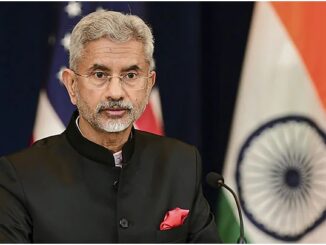
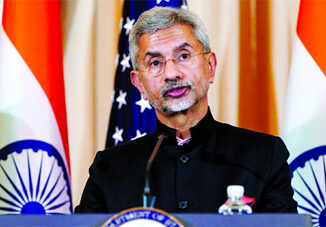
    New York (TIP)- The US Department of State has highlighted a “mission-defining challenge” during External Affairs Minister S Jaishankar’s visit here in November amid the US government shutdown, saying it put in a “bold contingency plan” to ensure his protection and security.
    An article dated December 30, 2025, by Supervisory Special Agent Gabriel Macias said that when thousands of commercial flights were grounded due to the US government shutdown last year, Diplomatic Security Service (DSS) special agents from the Dignitary Protection Division (DP), New York Field Office (NYFO), and Buffalo Resident Office (BFRO) faced a “mission-defining challenge.” Jaishankar, who was in Canada for the G7 Foreign Ministers’ Meeting on November 11-12, 2025, had then travelled to New York, where he held a bilateral meeting with UN Secretary-General Antonio Guterres at the UN headquarters. “The successful execution of the mission ensured the foreign minister’s diplomatic agenda proceeded without disruption, advancing strategic US foreign policy interests fully aligned with the administration’s ‘America First’ policy priorities.
    “It also reflected the ethos emphasised by incoming DS leadership: disciplined execution, mission focus, technical proficiency, and unwavering readiness in support of American diplomacy,” the article said. The article, released Thursday, said that during Jaishankar’s visit to New York, DSS needed to adapt quickly amid restrictions due to the government shutdown to ensure his timely arrival and “uphold the bureau’s core mission: protection.”
    Given that flights were cancelled nationwide due to the shutdown but diplomatic meetings were imminent, “DSS crafted a bold contingency plan” that involved a seven-hour road journey, one that commenced when agents received Jaishankar at the Lewiston–Queenston Bridge in Niagara in upstate New York and executed a “416-mile interstate motorcade to Manhattan”.
    The article said that to execute the contingency plan, the mission mobilised 27 agents, including three from DP, who drove to Buffalo and New York to join BFRO and NYFO teams for a “rare long-distance” motorcade movement. “From the first mile to the last, the detail showcased hallmark DSS tradecraft — adaptability, resilience, technical proficiency, and disciplined execution,” the article said.
    It outlined that the journey began with BFRO agents coordinating with officials from the Permanent Mission of India to the UN, Royal Canadian Mounted Police officers who protected Jaishankar while he was in Canada, and US Customs and Border Protection personnel at the international bridge between the US and Canada to expedite a smooth transition at the border.
    Agents “meticulously” planned routes through portions of upstate New York, “managed fatigue through structured driver rotations, and ensured seamless continuity of protection while maintaining the foreign minister’s comfort across the seven-hour journey.”
    “Despite freezing temperatures, limited visibility, and shutdown-related constraints, DSS agents executed with calm professionalism and unwavering focus,” it said.It further said during the entire operation, a K9 “alerted on the foreign minister’s armoured vehicle. Agents quickly secured the area, coordinated with local explosive ordinance disposal technicians, and, after a thorough inspection, cleared the vehicle, which served as an example of the team’s poise and adherence to DSS standards under pressure.”

  • No water for sponsor of terror: India’s EAM slams ‘bad neighbor’  Pak

    No water for sponsor of terror: India’s EAM slams ‘bad neighbor’ Pak

    NEW DELHI (TIP): External Affairs Minister S Jaishankar on Friday asserted that India “has every right to defend its people against neighbors that persist with terrorism”, underlining that no country can expect the benefits of cooperation, including water-sharing, while simultaneously pursuing violence against India.

    Speaking at an interaction with students at IIT Madras, Jaishankar, without naming Pakistan, said India’s neighborhood challenges were aggravated by the “deliberate, sustained and unrepentant” use of terrorism as state policy by one of its western neighbors.

    “India’s growth is a lifting tide for the region, and most of our neighbors recognize that if India grows, they grow with us. But when it comes to bad neighbors who persist with terrorism, India has every right to defend its people and will do whatever is necessary. You cannot ask us to share our water with you and also spread terrorism in our country,” he said.

    Referring obliquely to the Indus Waters Treaty, Jaishankar said good neighborliness could not exist in the presence of decades of cross-border terrorism. “Many years ago, we agreed to a water-sharing arrangement, but if you have decades of terrorism, there is no good neighborliness. If there is no good neighborliness, you don’t get the benefits of that good neighborliness. You can’t say, ‘Please share water with me, but I will continue terrorism with you.’ That’s not reconcilable,” he said.

    The minister said while countries could have difficult neighbors, India’s case was unique because terrorism had been weaponized as a conscious policy choice. “If a country decides that it will deliberately, persistently and unrepentantly continue with terrorism, we have a right to defend our people against terrorism. We will exercise that right,” he said.

    At the same time, Jaishankar drew a sharp contrast between India’s approach to “bad neighbors” and its engagement with cooperative ones. With “good neighbors”, he said, India had consistently invested, helped and shared resources — citing vaccine supplies during the Covid pandemic, fuel and food support amid the Ukraine conflict, and nearly $4 billion in assistance extended to Sri Lanka during its recent financial crisis.

    Jaishankar said he had been in Bangladesh earlier this week to represent India at the funeral of former PM Khaleda Zia, underscoring India’s continued diplomatic engagement in the region.“More broadly, our approach to the neighborhood is guided by common sense. With good neighbors, India invests, helps and shares,” he said.

    The External Affairs Minister also emphasized the importance of clear communication in foreign policy to prevent India’s intentions from being misread. “How to prevent people from misreading you is to communicate — clearly and honestly. If you do that, other countries respect it and accept it,” he said.
    (Source: ANI)

  • Anita, Jaishankar discuss further Canada-India road map

    Anita, Jaishankar discuss further Canada-India road map

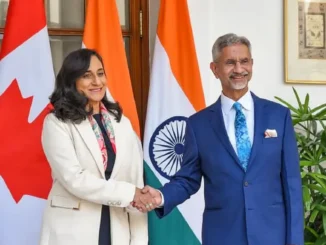
    NIAGARA, CANADA (TIP): Recognizing India as the world’s fourth largest economy and with a relationship built on more than 75 years of diplomatic relations, says Anita Anand, Foreign Affairs Minister of Canada, maintaining that India remains an important partner for us.

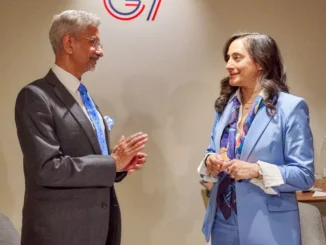
    After holding a meeting with her Indian counterpart, Subrahmanyam Jaishankar on the sidelines of the G7 Foreign Ministers conclave at Niagara, Anita Anand, appreciated India’s participation in G7 discussions this year.

    This meeting was their third this year—a reflection of momentum in the bilateral relationship.

    As continuation of the Ministerial visits and meetings between the two foreign ministers, decks have been cleared for the Canadian Prime Minister, Mark Carney, to visit India early next year.

    Other than Anita Anand, Canadian Minister, Maninder Sidhu, is currently visiting India to further trade relations between the two nations.

    A group of pro-Khalistan supporters continued their protest outside White Oaks resort, the venue of the conclave, by shouting anti-India slogans. They carried Khalistani flags and banners. Tight security arrangements have been made in and around the venue. Some members of the security agencies even checked the belongings of the pro-Khalistan protesters making sure that nothing dangerous or explosive was carried by them.

    Meanwhile, the meet has continued with its agenda as scheduled. Anita Anand, being the host, has been holding one-to-one meetings with all visiting Foreign Ministers.

    Anita Anand expressed her deepest condolences to Jaishankar for those who were killed in the explosion in New Delhi, India, yesterday and reiterated that Canada stands with the people of India during this tragic time.

    The ministers exchanged views on the ongoing law-enforcement dialogue between Canadian and Indian authorities. They also discussed the progress being made on the Canada-India joint road map, which sets out a plan to enhance cooperation in key areas, including energy, trade and people-to-people ties.

    Minister Anand reiterated Canada’s appreciation of India’s participation in G7 discussions this year, recognizing that as the world’s fourth largest economy and with a relationship built on more than 75 years of diplomatic relations, India is an important partner for Canada.

    The two Ministers agreed to remain in touch as the two countries continue to implement the Canada-India road map.

    Meanwhile Anita Anand also announced that Canada is imposing additional sanctions under the Special Economic Measures (Russia) Regulations. Canada’s new measures further increase the economic costs on Russia for its unprovoked and unjustified invasion of Ukraine by targeting its energy revenues and financial enablers, while also degrading its conventional and hybrid military capabilities.

    The sanctions list 13 individuals and 11 entities, including several involved in the development and deployment of Russia’s drone program. Canada remains a leader in targeting the military technologies Russia is relying on in its efforts to gain a battlefield advantage against Ukraine.

    For the first time, Canada has also sanctioned entities that supply the cyber infrastructure used in Russian hybrid strategies against Ukraine. Several Russian liquified natural gas entities were also sanctioned as Russia continues to rely on energy revenues to fund its war of aggression against Ukraine. These sanctions also list 100 vessels from Russia’s shadow fleet.

    The measures are a direct response to Ukraine’s priorities and support ongoing efforts by the G7 to ramp-up economic pressure on Russia to end its war and are in broad alignment with sanctions recently announced by the United States, the European Union and the United Kingdom.

    Anita Anand said: “Canada remains unwavering in its commitment to Ukraine’s sovereignty and its people, who are forcefully defending their rights in the face of Putin’s corrosive and aggressive actions. Canada will continue to intensify pressure through sanctions in coordination with allies and partners until Russia puts an end to its unjustified invasion of Ukraine.”

    Since 2014, Canada has imposed sanctions on more than 3,300 individuals and entities that are complicit in the violation of Ukraine’s sovereignty and territorial integrity and in gross and systematic human rights violations.

    Canada has taken action against Russia’s shadow fleet by sanctioning over 400 vessels based on their involvement in transporting property and goods for the benefit of Russia or persons in Russia. Many of these sanctions have been implemented in coordination with Canada’s allies and partners, including G7 members.

    The measures announced today complement similar measures taken by Canada’s closest allies, including those announced by the European Union, the United Kingdom and the United States in October. Canada will continue to work with its like-minded partners to coordinate additional measures that increase the economic costs of Russia’s war of aggression against Ukraine on the Russian regime.

    As a host of the last G7 event of Canada’s Presidency, Anita Anand, met Motegi Toshimitsu, Japan’s Minister for Foreign Affairs. This was the ministers’ first in-person meeting since Minister Motegi took office and served to deepen Canada’s bilateral relations with this trusted Indo-Pacific partner.

    Anita Anand emphasized the importance of strengthening the Canada-Japan security, defense and economic partnership, highlighting Canada as a stable and reliable partner in bolstering Japan’s economic and energy security. The ministers also discussed ways to advance shared security and prosperity interests under the Canada-Japan Action Plan. Anita Anand reaffirmed Canada’s commitment to the Indo-Pacific and to working with Japan as a strategic partner in the region, in line with the three pillars of Canada’s foreign policy: defense and security, economic resilience and core values.

    As Canada and Japan approach 100 years of diplomatic relations in 2028, Minister Anand and Minister Motegi agreed to continue building on the long-standing partnership and people-to-people ties between Canada and Japan.

    Anita Anand also met Yvette Cooper, the United Kingdom’s Secretary of State for Foreign, Commonwealth and Development Affairs, in Oakville, Ontario, ahead of the G7 Foreign Ministers’ Meeting held on November 11 and 12, 2025. She welcomed recent progress made under Canada and the United Kingdom’s bilateral economic and trade working group and discussed the need to increase trade and investment. To recognize Remembrance Day, the Minister and the Secretary of State reaffirmed the enduring partnership between Canada and the United Kingdom, forged through shared sacrifice and strengthened by our common values and deep historic ties.

    Throughout the discussion, Minister Anand underscored the importance of strengthening transatlantic security and outlined Canada’s priorities with respect to NATO defense spending.

  • A Boost to Canada-India Relations: S. Jaishankar to participate in G7 Foreign Ministers Conference in Niagara

    A Boost to Canada-India Relations: S. Jaishankar to participate in G7 Foreign Ministers Conference in Niagara

    By Prabhjot Singh

    OTTAWA (TIP): By taking yet another step, India and Canada are on the threshold of restoring normal cordial diplomatic relations after a gap of a little more than two years.

    The first step was taken when the new Canadian Prime Minister, Mark Carney, invited his Indian counterpart, Narendra Modi, as a special guest to the G7 leaders’ summit in Alberta.

    A subsequent telephonic conversation between Canadian Foreign Minister Anita Anand and her Indian counterpart, S. Jaishankar, broke the ice for the restoration of bilateral visits.

    After meeting S. Jaishankar on the sidelines of the United Nations, she undertook a bilateral visit to India, during which she met Indian Prime Minister Narendra Modi.

    After her visit, the new Indian High Commissioner to Canada, Dinesh Patnaik, extended an invitation on behalf of Narendra Modi to Canadian Prime Minister Mark Carney for early next year. India wants Mark Carney to be in New Delhi for an AI international conference in February.

    Next week, when Canada, during its presidency of the G7, is holding its second G7 Foreign Ministers conclave on November 11 and 12 at Niagara, Anita Anand has extended a special invitation to S. Jaishankar to participate. The Indian Foreign Minister’s participation has been confirmed.

    The G7 is an informal forum of seven countries with advanced economies and the European Union. Its leaders meet annually at the G7 Summit to address global economic and geopolitical issues. Canada and its G7 partners are celebrating 50 years of partnership and cooperation in 2025. Since France hosted the first meeting in 1975, the G7 has been a driving force for international peace, economic prosperity, and sustainable development.

    From June 15 to 17, 2025, G7 leaders gathered in Kananaskis, Alberta, for the G7 Summit. As host, Canada led discussions on shared priorities, including international trade, peace and security, and global economic stability. It was here that Narendra Modi was invited to end the thaw in diplomatic relations between India and Canada.

    Meanwhile, Anita Anand has confirmed the participants for the upcoming G7 Foreign Ministers’ Meeting, which will take place in Niagara.

    Minister Anand will welcome the foreign ministers of the G7 members—France, Germany, Italy, Japan, the United Kingdom, the United States of America, and the European Union.

    Canada is also pleased to host ministers from several outreach countries, reflecting shared global priorities and partnerships. These include Australia, Brazil, India, the Kingdom of Saudi Arabia, Mexico, the Republic of Korea, South Africa, and Ukraine. This important gathering will provide an opportunity to advance Canada’s G7 agenda on pressing global economic and security challenges, including maritime security and prosperity, economic resilience, energy security, and critical minerals.

    Following the March 2025 G7 Foreign Ministers’ Meeting, hosted by Minister Mélanie Joly in Charlevoix, Quebec, this upcoming meeting marks the second time Canada will host the foreign ministers this year under the G7 Presidency.

    This meeting will bring together G7 ministers to discuss global challenges and strengthen international collaboration. The agenda will cover thematic issues, including security and prosperity, as well as important work on economic resilience, following discussions held at the G7 Leaders’ Summit in Kananaskis. Minister Anand and her counterparts will work toward coordinated G7 responses to pressing international challenges, emphasizing cooperation with partners across regions and sectors.

  • PM Modi to skip UNGA session in  September; Jaishankar to address the world body

    PM Modi to skip UNGA session in September; Jaishankar to address the world body

    NEW DELHI / NEW YORK (TIP): Prime Minister Narendra Modi will not address the General Debate at the annual high-level session of the United Nations General Assembly later this month, according to a revised provisional list of speakers issued in United Nations. The 80th session of the U.N. General Assembly will open on September 9. The high-level General Debate will run from September 23-29, with Brazil as the traditional first speaker of the session, followed by the U.S.

    U.S. President Donald Trump will address world leaders from the iconic UNGA podium on September 23, his first address to the UN session in his second term in the White House.

    According to a revised provisional list of speakers for the high-level General Debate of the 80th session of the General Assembly released on Friday, September 5, 2025, India will be represented by a ‘Minister’.

    External Affairs Minister S Jaishankar will address the session on September 27.

    According to a previous provisional list of speakers issued in July, Mr. Modi was scheduled to address the General Debate on September 26. The heads of government of Israel, China, Pakistan and Bangladesh are scheduled to address the UNGA General Debate on September 26.

    The UNGA list of speakers for the General Debate is provisional and there is always possibility of changes in schedules and speakers ahead of the commencement of the high-level week. Considered the “busiest diplomatic season” of the year at the United Nations Headquarters, the high-level session opens in September annually.

    The session this year comes amid the continued Israel-Hamas war as well as the Ukraine conflict. The theme for the 80th session is ‘Better together: 80 years and more for peace, development and human rights’.

    The session will open with a meeting to ‘Commemorate the 80th Anniversary of the United Nations’ on September 22.

    Marking the 30th anniversary of the Fourth World Conference on Women, the UN General Assembly will convene a high-level meeting centered on the theme “Recommitting to, resourcing and accelerating the implementation of the Beijing Declaration and Platform for Action to achieve gender equality and the empowerment of women and girls”.

    The meeting will reflect on progress since the landmark 1995 conference in Beijing and highlight achievements, best practices, gaps, and ongoing challenges in advancing gender equality worldwide, the UN said.

    U.N. Secretary-General Antonio Guterres will convene a Climate Summit on September 24 to serve as a platform for world leaders to present their new national climate action plans and seize the benefits of the new clean energy era.

    Other high-level meetings to be held during the week include Summit for a Sustainable, Inclusive and Resilient Global Economy; Noncommunicable Diseases and Mental Health and Well-being; 30th Anniversary of the World Programme of Action for Youth; Launch of the Global Dialogue on AI Governance; International Day for the Total Elimination of Nuclear Weapons; and Situation of Rohingya Muslims and other minorities in Myanmar.

    (Source: PTI)

  • Has India been blindsided by Donald Trump?

    Has India been blindsided by Donald Trump?

    External Affairs Minister S Jaishankar is currently facing the greatest test of his career

    Why did India go so wrong in assessing that Trump 2.0 would be so inflexible on trade issues? After all, the Ministry of External Affairs and the External Affairs Minister would have had the opportunity of early feedback of what Trump and his key aides thought on trade and foreign policy, including when Jaishankar attended Trump’s inaugural in January and was a key member of Prime Minister Modi’s visit to Washington in February.”

    By Vivek Katju

    At a question-and-answer session that followed the delivery of the Ramnath Goenka lecture on November 17, 2019, External Affairs Minister S Jaishankar was asked about the problems in India-US trade relations, amidst ties that were moving forward. The Minister observed that India alone was not facing challenges in dealing with the US, and went on to add, “I think frankly in our case that is vastly overstated.”

    The Minister was right. Many countries, indeed, were facing difficulties in dealing with Trump, even at the time in his earlier avatar. In the current context, his comment is vastly ironic.

    Certainly, Jaishankar occupies a special place in the history of India-US relations. Not just because he is India’s External Affairs Minister, but also because in the annals of the Indian Foreign Service, few have had his kind of experience dealing with the subject. Today, though, as the application of 50 per cent US tariffs kicks in, the question is, ‘Could India have foreseen what was going to happen?’

    As a person given to reflection, and in light of his vast experience as a former ambassador to the US as well as to China, besides having served in Russia as a junior diplomat, many expect a clear-eyed response from my former colleague, Jaishankar. At a difficult time like the present in India’s foreign policy, would it be fair to ask, “Why has India been blindsided by Trump 2.0?”

    At the time in 2019, as part of his aforesaid Q & A following the Ramnath Goenka lecture, Jaishankar had observed that “trade frictions” often took place between trading partners. Surprisingly, he went on to claim that, in India, problems are sometimes exaggerated “beyond belief”, because people want to show how bad things are. He went on to express “reasonable confidence” that difficulties in trade would not impact other areas of India-US ties. As we all know, the situation is vastly different today. As of now, however, Jaishankar has only said that lines of communication between India and the US have not been cut. This is neither here nor there.

    The 2019 Q & A begs the question: Why did India go so wrong in assessing that Trump 2.0 would be so inflexible on trade issues? After all, the Ministry of External Affairs and the External Affairs Minister would have had the opportunity of early feedback of what Trump and his key aides thought on trade and foreign policy, including when Jaishankar attended Trump’s inaugural in January and was a key member of Prime Minister Modi’s visit to Washington in February.

    Did he and India not gauge the Trump administration’s mood at the time? The larger question is when the Modi government saw the clash coming and what it has done so far to assuage the most powerful leader in the world, Donald Trump.

    There is no question of India succumbing to the US President’s pressures on matters of vital economic and commercial significance. Clearly, agriculture and dairy come in these categories. That Trump is applying double standards on the purchase of Russian oil by exempting China is true, but the question that remains is, how does India propose to deal with this matter.

    There is bipartisan support for India in the US Congress. In the past, US industry was invoked at crucial moments to overcome obstacles in India-US ties. Moreover, no Indian ruling dispensation has put so much store on the Indian diaspora as this one has. How is the Modi government planning to invoke the three ‘brahmastras’ in its quiver?

    Trump seems obsessed with claiming that he had mediated a ceasefire between India-Pakistani armed hostilities in May and had even, potentially, averted a nuclear catastrophe. He is certainly not the first US leader to have intervened in India-Pakistan armed action, although the others were discreet because of Indian sensitivities. India has correctly taken the position that the pause in Operation Sindoor was its own decision, taken after the Pakistani DGMO approached his Indian counterpart. While maintaining this position, did the Modi government attempt to find a formulation, which while preserving India’s position would have, at least, partially satisfied Trump?

    The essence of diplomacy lies in finding such formulations. This is especially when conversations were going on between India and the US (as well as among other countries) during Operation Sindoor, as Jaishankar has himself said. It is not contradictory to firmly don the cloak of nationalism and yet find diplomatic ways to assuage even an obsessed leader like Trump.

    One can only hope that Jaishankar with his vast experience of handling the US will be able to close the chasm that has developed. Certainly, he is currently facing the greatest test of his career; crisp one-liners or long-winded clarifications about the justness of India’s position (which, of course, it is) will not do!

    (Vivek Katju is a former Secretary, Ministry of External Affairs)

  • Hand over wanted terrorists, EAM tells Pak

    Hand over wanted terrorists, EAM tells Pak

    NEW DELHI (TIP): India on Thursday called on Pakistan to hand over terrorists named in the list previously shared with Islamabad even as External Affairs Minister S Jaishankar, during his Europe tour, accused the Pakistani government and its army of actively supporting terrorism. MEA spokesperson Randhir Jaiswal rejected Opposition’s charge that the External Affairs Minister Dr. Jaishankar had informed Pakistan at the start of Operation Sindoor. “We told them that we had exercised our right to respond after the retaliatory strikes were carried out,” he said.

    In an interview with Dutch publication “De Volkskrant”, Jaishankar reiterated India’s demand for a permanent end to terrorism, warning that while the ceasefire has halted military action for now, there would be consequences if terror attacks from Pakistan continued.

    The minister said it was erroneous to go along with the narrative that Pakistan “doesn’t know what is going on”. “The most notorious terrorists on the UN sanctions list are all in Pakistan. Let’s not pretend Pakistan is not involved. The state is involved. The army is up to its neck in it.” His remarks came ahead of an all-party Indian delegation’s visit to Europe from May 25. The delegation will travel to France, Italy, Denmark, the UK, Belgium and Germany where the leaders will reinforce India’s stance that all terror links, direct and indirect, trace back to Pakistan.

    The minister rejected any justification for terrorism, calling it an “unacceptable international crime”. On Kashmir, he reiterated India’s position that Pakistan must vacate illegally occupied territories and said, “Our position is clear. The illegal occupiers (Pakistan) must return what belongs to India. No third-party intervention is acceptable. This is a bilateral issue.”

    In New Delhi, Ministry of External Affairs (MEA) spokesperson Randhir Jaiswal echoed Jaishankar’s message. “Talks and terror cannot go together. We remain open to discussing the extradition of wanted terrorists whose list was provided to Pakistan some years ago,” he said. Regarding any future dialogue on J&K, Jaiswal said, “Discussions will only proceed if Pakistan vacates illegally occupied Indian territory.”

    On the Indus Waters Treaty, Jaiswal said it would remain suspended until Pakistan “credibly and irrevocably” ended cross-border terrorism. He quoted PM Narendra Modi’s warning that “water and blood cannot flow together”.

    On Opposition’s allegations that Jaishankar admitted that India informed Pakistan about the retaliatory strikes “at the start”, Jaiswal said, “We informed Pakistan after the May 7 action.”
    (Source: TNS)

  • Nowhere people of a nowhere world

    Nowhere people of a nowhere world

    THE GREAT GAME: The message from New Delhi is that those who break the law deserve the punishment they get

    “Former Foreign Secretary Shyam Saran calls it “uncivilized behavior on the part of the US.” Except, civility and good manners are already casualties of Naya America’s foreign policy. The manner in which Trump is overhauling the Middle East — Gaza, Palestine, Jordan — is unprecedented. India is keeping quiet because the hyper-realist policies that it has been propagating for some time now you only get involved when you are directly affected. And you are not directly affected in Gaza, Palestine and Jordan.”

    By Jyoti Malhotra

    February is fast turning out to be the cruelest month, with apologies to TS Eliot, on India’s foreign policy calendar.

    In the east, Bangladeshi lumpen youth, with no connection to either memory or even a desire for history, danced to the Bollywood song, “munni badnam hui,” as they participated in the burning of Bangabandhu Sheikh Mujibur Rahman’s home in Dhaka. Indians watched, horror-struck, at the hammer blow to what was once a glorious chapter in the lives of both countries — and couldn’t help asking, What now?

    And in the West, questions abound as PM Narendra Modi prepares to fly to the US to meet President Trump, barely days after 104 Indian nationals, shackled and cuffed, were deported back home. Another 487 are on their way. A sense of disquiet persists on whether the PM’s decision to go to the US in these circumstances is the right one.

    Many would say, yes of course. The India-US relationship remains the most important foreign policy relationship, notwithstanding Russia’s help with slashing the price of oil these recent post-Covid years. In support of this argument, a trade roadmap is on the cards when the PM visits, as is the likely announcement of India opening up the civil nuclear sector (after 17 years), while talk of Delhi buying more US defense equipment is gaining ground.

    Which is why External Affairs Minister S Jaishankar has travelled to the US thrice in the last four months, in September, December and January, so as to make the Modi-Trump meeting count. He has put out that the PM will be only one of the three leaders to have met Trump in his first month in power — Israel’s Netanyahu, Japan’s Ishiba and India’s Modi.

    Unfortunately, barely a week before Modi lands in DC, the news has not been very complimentary. Pictures of young Indian men in second-hand jeans and cheap Chinese shoes shuffling towards a US military plane because they have chains on their feet has sent waves of shock and awe across Punjab, if not the rest of the country.

    This, of course, is exactly what Trump wants. He wants to send the message to the world that he’s not interested in the great unwashed landing up at America’s doors — talented, skilled and accomplished brigades on H1-B visas are just fine.

    Nor does he seem to have time for saving face. If the Indian PM is coming to see you in a week, you should no longer expect that the news is good on the eve of your visit. Trump has already rewritten the rules of the world order in the few weeks he’s been around.

    Former Foreign Secretary Shyam Saran calls it “uncivilized behavior on the part of the US.” Except, civility and good manners are already casualties of Naya America’s foreign policy. The manner in which Trump is overhauling the Middle East — Gaza, Palestine, Jordan — is unprecedented. India is keeping quiet because the hyper-realist policies that it has been propagating for some time now you only get involved when you are directly affected. And you are not directly affected in Gaza, Palestine and Jordan.

    As for the 104 deportees, including women, who were shackled during their flight home earlier this week, the message from New Delhi is that those who break the law deserve the punishment they get. The US Border Patrol described them as “aliens,” and so they are.

    And yet, as Jaishankar spoke in Parliament on the deported Indians, admitting on record that he was “being bureaucratically correct,” one couldn’t help wondering what his predecessor, the late Sushma Swaraj, would have said when confronted with India’s present predicament — witnessing the humiliation of its poor and unskilled masses being rightfully punished for doing a very stupid thing.

    Sushma Aunty had so stirred the bureaucratic consciousness of the toughened bureaucrats of the Ministry of External Affairs (MEA) that they were forced to be kinder to the bluest-collar workers across the world. Reforms were ordered for the protection of emigrants, laws were toughened for those wanting to work abroad, immigration agents were forced to fall in line. Not that she cleaned up the entire system, but she certainly tried. She knew her fellow citizens were more often than not on the wrong side of the foreign law in question, but she demonstrated compassion. She offered them a hanky to cry when they got caught after knowingly breaking the rules.

    The current Modi government, instead, is throwing the rule book at these people. Moreover, the MEA is pointing out, these Punjabi folk who can spend Rs 45 lakh chasing the American dream are not exactly poor. Of course, the MEA is right. These 104 men and women knowingly bought that one-way ticket to Amreeka, well aware that the “dunki route” is what it was. And still they went. Problem is, they will still go if they get a chance, if only because they need to pay the loan their families took to send them to the US.

    But back to Modi and Trump and the importance of the India-US relationship. Apart from the fact that the PM seems keen on making that early connection with the President, the fact remains that both countries are increasingly invested in each other. From intelligence-sharing to defense and technology partnerships, via military foundational agreements that have been signed over the last 25 years — an alphabet soup called GSOMIA, LEMOA, COMCASA, BECA — India is so closely integrated with the US that it would not be far wrong to describe it as an “informal ally.”

    Some would say, why not? There are as many as 5 million US citizens of Indian origin, a hugely influential group. We celebrate them all. We wallow in the appreciation of Sundar Pichai and Satya Nadella and Indra Nooyi and Ajay Banga, as if they were part of our immediate family.

    The problem arises when the Punjabis from Doaba, the Haryanvis from Kaithal and the Gujaratis from Gandhinagar bomb this pretty picture — wearing handcuffs and all. What is worse is that no one, except their immediate families, want to own these Indians. The nowhere men and women of a nowhere world.
    (Jyoti Malhotra is Editor-in-Chief of The Tribune group of newspapers. She has been a journalist for 40 years, working in print, TV and digital, both in English and Hindi media, besides being a regular contributor on BBC Radio. She is deeply interested in the conflation between politics and foreign policy. Her X handle is @jomalhotra Insta handle @jomalhotra Email: jyoti.malhotra@tribunemail.com)

  • Why G7 needs allies like India

    Why G7 needs allies like India

    New Delhi occupies a unique place as an oasis of political and economic stability

    The G7 meeting has brought out just how fragile the world order is these days. India occupies a unique position here as an oasis of political and economic stability, but it cannot but take into account the turbulent waters that are washing its shores.

    By Manoj Joshi

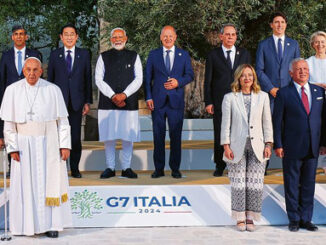
    Prime Minister Narendra Modi’s presence as an outreach guest at the G7 summit in Italy is a useful backdrop for the launch of the new government’s foreign and security policy.

    India is not yet the world power it wants to be. What we need to guard against are hubris and overreach. The G7 meeting has brought out just how fragile the world order is these days. India occupies a unique position here as an oasis of political and economic stability, but it cannot but take into account the turbulent waters that are washing its shores.

    The political situation in four of the G7 nations appears brittle — the US and the UK are going to the polls amid uncertainty, while Germany and France are witnessing the rise of right-wing forces. Two of the big world powers are, of course, entirely out of the G7 process, which purports to promote democracy. But those two, China and Russia, are making major efforts separately and collectively to challenge the G7’s purported global hegemony.

    The presence of India, Turkey, Brazil and some other countries is an acknowledgement that the G7 needs allies to manage issues relating to migration, climate change, economic competition with China and the wars in Ukraine and Gaza. In turn, these countries are seeking to persuade the G7 nations, which are increasingly economically and demographically challenged, on the need for more equity and balance in global decision-making.

    In all this, Modi’s central challenge and opportunities are in India’s neighborhoods and beyond. While continuity has been the central message that the BJP-led NDA government has sent out, there will be inevitable changes arising from the very fact that the General Election has shifted the national political paradigm.

    The presence of leaders from Bangladesh, Bhutan, Nepal, Sri Lanka, Maldives, Mauritius and Seychelles at the swearing-in of the new government speaks for itself, as does the fact that the leaders of Myanmar, Pakistan and Afghanistan were not invited. India’s relations with those invited are fairly even, even though we face challenges in Nepal, Sri Lanka and the Maldives. The participation of Maldives President Mohamed Muizzu was significant because of our strained relations with the island republic.

    The Indian strategy of riding out the Chinese challenge in the neighborhood was most visible last year when Sri Lanka faced a financial crisis. China played hard to get, but New Delhi immediately provided humanitarian and financial assistance of $4 billion, surpassing even the International Monetary Fund’s (IMF’s) 48-month bailout package of $3 billion. By providing financial assurances, New Delhi also shored up Sri Lanka’s IMF process.

    The absence of Pakistan, whose then Prime Minister Nawaz Sharif had attended PM Modi’s 2014 swearing-in, has its own story of just how sharply India-Pakistan relations have deteriorated, even though the government in power is that of the Pakistan Muslim League (Nawaz), albeit in a coalition.

    India says it emphasizes its Neighborhood First policy as well as SAGAR (Security and Growth for all in the Region) for the Indian Ocean Region (IOR). It has China very much on its mind. Whatever may be the military challenge India confronts along the disputed border, the one it faces from China in South Asia and the IOR is equally significant and has implications for the geopolitical future of the region.

    China, too, is a neighbor and, it too, was not present. In an interview to Newsweek on the eve of the General Election, Prime Minister Modi had noted that there was a need to “urgently address the prolonged situation on our borders so that the abnormality in our bilateral interactions can be put behind us.” Last week, speaking in Mumbai after taking charge of the Ministry of External Affairs for a second term, S Jaishankar said India would focus on finding solutions to the border issues that had bedeviled their relationship.

    American ties with New Delhi are on a high after Modi’s Washington visit last June. While US elections could disrupt some of the bonhomie, they are unlikely to lead to any major change. But managing ties in a potential Trump presidency will definitely be a strain, though the Gurpatwant Singh Pannun issue is unlikely to create major problems. The American focus, regardless of who wins, is likely to be China, though there is a danger that another US-China tariff war could affect us in the form of collateral damage.

    India’s ties with Russia are definitely being tested by the Ukraine war. India may be gaining from its oil purchases, but it is alienating its Western allies. As the situation in Ukraine remains serious, pressure on the West to step up its support to Ukraine brings pressure on India indirectly. Having told Putin that this was not the era of war in 2022, Modi is now hard put to come up with some initiative which will lend credibility to India’s proposition that the issue could be settled through dialogue and diplomacy. In the meantime, New Delhi continues to walk a tightrope — it attended the Swiss peace conference, but not at the Prime Ministerial level.

    Another area which may require attention is West Asia, where Modi deserves credit for building solid ties with the UAE, Israel, Saudi Arabia, Qatar and Egypt. These were not just about the nine million-strong diaspora or energy security but also aimed at tapping the region for investment and buying into their plans for a post-oil future. At present, however, new initiatives like the Israel-India-US-UAE grouping and the India-Middle East-Europe Economic Corridor (IMEC) have sought to link Indian ports to Europe via the Israeli port of Haifa. Significantly, the G-7 communique pledged support to the IMEC.

    India is not yet the world power it wants to be. As a leading power, however, there are opportunities for taking initiatives and shaping policies both in the neighborhood and beyond. What we need to guard against are hubris and overreach.

    (The author is a Distinguished Fellow, Observer Research Foundation, New Delhi)

  • ‘Narrow’: EAM S Jaishankar reacts to US’ sanction warning after Chabahar Port deal

    ‘Narrow’: EAM S Jaishankar reacts to US’ sanction warning after Chabahar Port deal

    New Delhi (TIP)- A day after the US warned of a “potential risk of sanctions” following India’s 10-year agreement to operate the Chabahar Port in Iran, External Affairs Minister S. Jaishankar highlighted that the project will “benefit the entire region”. Jaishankar added that people should not take a “narrow view” of the initiative. The EAM spoke at an interaction on Tuesday after the launch of the Bangla edition of his book ‘Why Bharat Matters’ in Kolkata. When asked about the US remarks, Jaishankar said, “I did see some of the remarks that were made, but I think it’s a question of communicating, convincing, and getting people to understand that this is actually for everyone’s benefit. I don’t think people should take a narrow view of it.” “They (US) have not done so in the past. So, if you look at the US’ own attitude towards the port in Chabahar, the US has been appreciative of the fact that Chabahar has a larger relevance…we will work at it,” he added.
    Earlier on May 14, the United States warned that “anyone” considering business deals with Tehran must be aware of the “potential risk of sanctions.” “I would just say…US sanctions on Iran remain in place and we will continue to enforce them,” the US State Department Principal Deputy Spokesperson, Vedant Patel said at the press briefing, adding, “Any entity, anyone considering business deals with Iran, they need to be aware of the potential risk they are opening themselves up to, potential risk of sanctions.”
    The Long-Term Bilateral Contract on Chabahar Port Operation was signed between Indian Ports Global Limited (IPGL) of India and Iran’s Port & Maritime Organisation (PMO) on Monday. This agreement allows for the operation of the Shahid-Behesti port as part of the Chabahar Port Development Project for the next 10 years.

  • US Deputy Secretary of State Richard Verma meets Indian officials to advance global strategic partnership

    US Deputy Secretary of State Richard Verma meets Indian officials to advance global strategic partnership

    WASHINGTON, D.C. (TIP): The US Deputy Secretary of State Richard Verma has met with senior Indian ministers and officials in New Delhi to advance the US-India global strategic partnership and ensure a free and open Indo-Pacific region, according to his spokesperson.

    Verma, the Deputy Secretary of State for Management and Resources, is the highest-ranking Indian American in the State Department. The former US Ambassador to India was on an official visit to India from February 19 to 21.

    He met External Affairs Minister S Jaishankar, Foreign Secretary Vinay Mohan Kwatra, Defense Secretary Giridhar Aramane, and Deputy National Security Advisor Vikram Misri in New Delhi, State Department Spokesperson Matthew Miller said here on Thursday.

    Verma’s meetings explored opportunities to strengthen US-India cooperation and people-to-people ties to ensure a free, open, secure, and prosperous Indo-Pacific region, Miller said.

    He also met with Minister of Commerce and Industry Piyush Goyal to discuss further expanding trade and economic ties between the US and India. “The Deputy Secretary and Indian officials further emphasized the benefits of close partnership on addressing global issues,” Miller said.

    Verma is on a six-day official visit to India, Sri Lanka and Maldives till Friday to strengthen bilateral ties with the nations, reaffirming America’s enduring commitment to a free, open, secure, and prosperous region.

  • Ambassador Sandhu has been one of the leading architects of India-US relationship: USISPF head

    Ambassador Sandhu has been one of the leading architects of India-US relationship: USISPF head

    WASHINGTON, D.C. (TIP): In his remarks at a farewell reception hosted in honor of the outgoing Indian envoy here on Thursday, January 25, Mukesh Aghi, the president and CEO of US-India Strategic and Partnership Forum (USISPF), said Sandhu’s resume of achievements remains long and impressive.

    “Ambassador Sandhu has been one of the leading architects of this relationship, which stands at its apex from the deep synergy in clean energy, education partnership, space collaboration, defense, and technology ties,” said at the farewell organized by the USISPF.

    Sandhu, 61, retires from the foreign service after 35 years of diplomatic career this month.

    However, when Ambassador Sandhu took the helm in Washington in February 2020, ominous times were about to upend the economies and suspend daily lives, Aghi said, adding that a cataclysmic pandemic meant new challenges even for a veteran diplomat.

    Sandhu steered through COVID-19, helping Indian students return home, working through visa backlogs for the diaspora, and strengthening vaccine diplomacy between the two countries.

    “A post-Covid-era saw the onset of Ambassador Sandhu helping lead the first in-principal Quad Summit in Washington, the restart of the Trade Policy Forum, and then the onset of the I2U2, IPEF, consolidating bilateral ties in multilateral settings,” he said.

    The I2U2 is a grouping of Israel, India, the United Arab Emirates and the United States to deepen technological and private sector collaboration in the region and tackle transnational challenges in six focus areas: water, energy, transportation, space, health and food security.

    The United States launched the Indo-Pacific Economic Framework for Prosperity (IPEF) along with countries like India, Australia, Indonesia, Japan, the Philippines, Singapore, Thailand, and Vietnam to advance resilience, sustainability, inclusiveness, economic growth, fairness, and competitiveness for participant economies.

    “Today, the Indo-Pacific is a priority as Ambassador Sandhu has overseen new defense partnerships, from iCET to INDUS-X, to drone transfers to jet engine manufacturing deals, from semiconductors to supply chains, ushering in a new chapter in critical technology,” Aghi said.

    The highlights of Sandhu’s tenure, he said, would be the historic state visit of Prime Minister Narendra Modi and President Joe Biden’s first visit to India as Commander-in-chief for a momentous G20 summit, and also organizing former president Donald Trump’s maiden visit to the country.

    However, one must remember that the relationship was not always smooth sailing, he noted.

    “Sandhu’s perspicacity was evinced early on, during his first Washington stint as the First Secretary (Political) as he formed crucial relations on Capitol Hill, with both Democrat and Republican lawmakers, during a time of sanctions from the Clinton Administration,” he said. “Today, the relationship is truly bipartisan, and the India Caucus and the Samosa Caucus, are in deep admiration of Ambassador Sandhu’s diplomatic efforts to steer the relationship from choppy waters then to the pristine seas now,” Aghi said.

    His second stint in Washington was as second in command to S Jaishankar, as then DCM Sandhu and Ambassador Jaishankar, wrote the beginning chapters of Prime Minister Modi’s engagement with the United States, he noted.

    “But more important than the dossiers, visits, and agreements, have been the intangible bonds of friendship that Ambassador Sandhu has forged with the diaspora. From young students to veteran business leaders, from entrepreneurs to titans, from cultural communities and caucuses, the diaspora across the US has at least one Ambassador Sandhu story,” he said.

    “Historians will note that he changed the nature of the relationship, forged new connections, strengthened the strategic partnership, and above all remained affable and humble in challenging and celebratory times,” Aghi said.

    Ashley Tellis, a top American expert on India, in his remarks, said that Sandhu has been an insidious contributor to this relationship because he understood right from the beginning how important this partnership is for the future of both countries.

    “In his last tenure here in Washington, he had to deal with a very complex environment in terms of our bilateral relationship. But the fact that we have still managed to stay the course and move this relationship ever upward is a great tribute to you, Taranjit,” Tellis said. Eminent Indian American defense expert Vikram Singh said Sandhu has been a steward of this relationship for an entire generation. “For those of us who have been involved, it’s been one of the best parts of our jobs trying to advance this relationship to have you as our partner. You are sought, kind of irreplaceable because you have this long span of history of the period of growth, dynamism, and transformation of the US-India partnership,” Singh said.

    In his remarks, Sandhu recollected the words of Prime Minister Modi at an event hosted by USISPF in the city in which he said that the US-India partnership is not just for convenience, but for conviction, compassion and of shared commitment for a better future. “So, our relationship touches the people. It is for development,” Sandhu said.
    (Source: PTI)

  • Indian American legal scholar Ved Prakash Nanda dies

    Indian American legal scholar Ved Prakash Nanda dies

    DENVER (TIP) : Noted Indian American legal scholar, Professor Ved Prakash Nanda passed away on January 1. Indian Prime Minister Narendra Modi, Home Minister Amit Shah and External Affairs Minister S Jaishankar among others condoled his death.
    Nanda, who was awarded Padma Bhushan, India’s third highest civilian honor in 2018 for his contributions to literature and education was a Distinguished University Professor and Thompson G. Marsh Professor of Law at the University of Denver, Colorado.
    He founded the International Legal Studies Program there in 1972 and directed the Ved Nanda Center for International and Comparative Law established in his honor by alumni and friends, who have also endowed a professorship in his name.
    He received Honorary Doctor of Law from Soka University, Tokyo, Japan, and Bundelkhand University, Jhansi, India, and has taught and lectured at several universities in the US and abroad, according to his official profile.
    Nanda was also an Honorary Professor of Law at the University of Delhi, India. He held many leadership positions in the global international law community, including the World Jurist Association, American Society of International Law, International Law Association, American Law Institute, and the American Bar Associations Human Rights Center and Section of International Law.
    He also served as a US delegate to the World Federation of the United Nations Associations in Geneva and on the governing council of the United Nations Association of the USA.
    Nanda was an officer and board member in several international and national NGOs. He was the Chair of the Uberoi Foundation for Religious Studies.
    Nanda received numerous national and international awards and authored or co-authored 24 books and over 225 chapters and law review articles in international and comparative law, writes a column for the Denver Post, and is a regular commentator in both the electronic and print media.
    The American Bar Association International Law Section conferred on him the Louis B Sohn Award, for distinguished, longstanding contributions to the field of public international law in 2018.
    Expressing his grief over Nanda’s demise, Modi said Nanda’s work highlighted his commitment to legal education. “Deeply saddened by the passing away of Professor Ved Prakash Nanda Ji, a distinguished academic whose contributions to the legal field are invaluable. His work highlights his strong commitment to legal education,” Modi posted on X.
    “He was also a prominent member of the Indian diaspora in USA and was passionate about strong India-USA relations. Condolences to his family and friends. Om Shanti,” the PM added.
    “Deeply anguished by the demise of Prof. Ved Prakash Nanda Ji, an internationally acclaimed legal scholar. The illustrious career of Nanda Ji was shaped by his academic rigor and profound commitment to legal education,” Shah wrote.
    “A prominent member of our diaspora in the US, Prof Nanda Ji left an indelible mark in fortifying the Indo-US relationship. My heartfelt condolences to his family, friends and admirers. Om Shanti,” he added.
    “Grieved to learn of the passing away of Professor Ved Prakash Nanda ji,” wrote Jaishankar. “Had the privilege of knowing him over many years. His contribution to the India-US relationship will always be remembered.”

  • Indian-origin student drowns while swimming in Canada’s Silver Falls

    Indian-origin student drowns while swimming in Canada’s Silver Falls

    THUNDER BAY, ONT (TIP): A 23-year-old student hailing from Andhra Pradesh drowned while swimming in Silver Falls in Canada, said a family member on Wednesday, July 5.
    Polukonda Lenin Naga Kumar (23) of Chintaguntapalem near Machilipatnam, lived in Thunder Bay in Ontario. He went for swimming to Silver Falls with his three roommates and drowned around 1 am on Tuesday according to Indian time.
    “Silver Falls is about 40 km from where he lives. One of his roommates said that he managed to come out safely, but my nephew could not come out of the water as it was deep there,” Naga Kumar’s uncle Nutan Kumar told media.
    According to Kumar, his nephew went to Canada in August 2021, to study MS in the University of Lakehead. He completed his studies and was searching for a job now. For the time being, Naga Kumar was working part time as a supervisor at a restaurant, he said.
    Meanwhile, Machilipatnam Lok Sabha member V Balashowry wrote a letter to External Affairs Minister S Jaishankar, requesting him to facilitate the return of the student’s mortal remains to India. “Kindly instruct the Indian Embassy in Canada and ask them to make necessary arrangements for transportation of his body to India,” wrote Balashowry, furnishing Naga Kumar’s details.

  • Unfinished work along LAC; military, diplomacy at work: Jaishankar

    Unfinished work along LAC; military, diplomacy at work: Jaishankar

    New Delhi (TIP)- External Affairs Minister S Jaishankar on Wednesday, March 29, said there was “unfinished work” along the Line of Actual Control (LAC) with China and that the militaries and diplomats on both sides were working to find a solution to the issue.
    Jaishankar, speaking at Network18’s ‘Rising India Summit’, deplored attempts by Rahul Gandhi to draw parallels between the situation along the LAC with China and the Ukraine conflict.
    “What is today happening in Ukraine, if you follow the two sides, is one would say that they are threatened by the expansion of NATO and the character of the regime in Ukraine,” he said.
    “The West would say that Russians have expansionist designs. What is the analogy between that and India-China? There is no NATO in play here, there is no regime character in play here. I just don’t see the comparison,” he said.
    Jaishankar also said “canards” were floated about buffer zones being created in India’s patrolling areas.
    He said since the Galwan clash of 2020, the combination of military and diplomacy has made progress, but admitted that the two sides have not been able to “sort everything out”.
    “Whatever has been done is mutual and negotiated. But this is still unfinished work,” Jaishankar said about the present situation along the LAC.
    He said to understand the relationship with China, one has to understand the nature of the problem between the two countries.
    “The nature of the problem between India and China is that two militaries, which were not deployed at or on or very near the LAC, have done so to a great degree after May 2020. Pre-May 2020, both militaries were primarily located in the depth areas where they had permanent bases and then they would patrol out into the LAC,” he said.
    “In 2020, the Chinese breached that in violation of the 1993-96 agreement and brought forces to the LAC. Obviously we countered it. As a result, you have a very, very intricate situation of very multiple close deployments which, by military assessments, is a very dangerous situation to be in,” Jaishankar said. Source: PTI

  • Oppn slams Jaishankar for remarks on China, BBC docu; point to his father’s comments on Gujarat riots

    Oppn slams Jaishankar for remarks on China, BBC docu; point to his father’s comments on Gujarat riots

    New Delhi (TIP)- Opposition leaders on Wednesday, February 22,  lashed out at External Affairs Minister S Jaishankar for his remarks on China and the BBC documentary on Prime Minister Narendra Modi, with many of them pointing to his father’s reported comments against the then Gujarat dispensation following the 2002 riots.

    The Congress called Jaishankar a “failed” minister and alleged that his remarks on the China issue have “demeaned” the valour of India’s armed forces. Congress spokesperson Supriya Shrinate also alleged that foreign policy has been reduced to photo-ops and a chest-thumping exercise and is being used to secure contracts for a businessman.

    The opposition party’s attack came over the minister’s reported remarks urging people to not buy the narrative that somewhere the government is on the defensive or is being accommodative on the China issue. Jaishankar also reportedly hit out at the British Broadcasting Corporation (BBC) over its documentary on Modi and called it “politics by another means”.

    Slamming Jaishankar, TMC’s Rajya Sabha MP Jawahar Sircar said, “Strange — that Jaishankar discovered his angst against the Gandhis — after serving them most loyally and taking the best of postings under them? Is it Amnesia or is he just cuddling up to BJP for his unprecedented promotion as Foreign Minister?” In another tweet, Sircar referred to Jaishankar’s “politics by another means” remark, saying the question is whether the facts shown in the documentary are true or false.

    “Could thousands of lives be saved if Modi administration was less indulgent,” Sircar said. “S Jaishankar’s father, K Subramanyam said ‘Dharma was killed in Gujarat (2002 Riots). Those who failed to protect innocent citizens are guilty of adharma. Rama…would have used his bow against the ‘Asura’ rulers of Gujarat. Shame on son — serving Asura!” the TMC MP said in another tweet.

    Shrinate also spoke of reported ‘Asura’ remarks of Jaishankar’s father K Subrahmanyam. “You may attack anyone, but you must listen to the words of the elderly who have wisdom and experience. You should listen to your father… He may be old but has the wisdom and experience and you should listen to him,” she said.

    Source: PTI

  • In final stages of negotiations with IMF on bailout package: Sri Lanka President

    COLOMBO (TIP): President Ranil Wickremesinghe on February 9 said Sri Lanka was in the final stages of negotiations with the IMF on the much-awaited USD 2.9 billion bailout package that could help the debt-trapped island nation recover from the unprecedented economic crisis. Wickremesinghe also said that his government was having “direct discussions” with Beijing to restructure the country’s debts with China.

    The International Monetary Fund (IMF) in September last year approved Sri Lanka the USD 2.9 billion bailout package for over 4 years pending the island nation’s ability to restructure its debt with creditors — both bilateral and sovereign bond holders.

    By the end of June 2022, Sri Lanka owed nearly USD 40 billion to bilateral, multilateral and commercial loans, according to the figures released by the Sri Lankan Treasury.

    With assurances from creditors, the USD 2.9 billion facility could get the IMF board approval in March, officials said.

    The IMF facility would enable Sri Lanka to obtain bridging finance from markets and other lending institutions such as the ADB and the World Bank.

    “We are in the final stages of negotiations with the IMF. India has agreed to debt restructuring & extended financial assurance. We are in direct discussions with China. The Paris Club announced its support. The international support is a sign that we are on the right track,” Wickremesinghe tweeted on Thursday.

    Last month, India’s finance ministry issued a letter to the IMF confirming its support to Sri Lanka on the issue of debt restructuring.

    Subsequently, External Affairs Minister S Jaishankar, during his visit to Sri Lanka, also announced India’s assurances to Sri Lanka for the bailout package. Sri Lanka has also completed its debt restructuring talks with Japan, its other big creditor, last month.

    Wickremesinghe, who is also Sri Lanka’s finance minister, said inflation levels, which was 70 per cent when he took over as the president in July last year, had now been reduced to 54 per cent as of January 2023.

    “When I first addressed parliament as President, inflation stood at 70%. It’s now down to 54%. Exports have risen to $13b; imports are down to $18b; remittances are up to $4b. Foreign reserves are up to $500m,” he tweeted, a day after making a policy statement in Parliament. Sri Lanka was hit by an unprecedented financial crisis in 2022, the worst since its independence from Britain in 1948, due to a severe paucity of foreign exchange reserves.

    (PTI)

  • 225,620 Indians gave up citizenship in 2022: Govt tells Rajya Sabha

    225,620 Indians gave up citizenship in 2022: Govt tells Rajya Sabha

    New Delhi (TIP)- A total of 225,620 Indians renounced their citizenship in 2022, the highest in the past 12 years, and more than 1.66 million people have given up their nationality since 2011, according to figures provided by the government in Rajya Sabha on Thursday, February 9.

    The figures were given by external affairs minister S Jaishankar in a written reply to a question from Aam Aadmi Party (AAP) lawmaker Narain Dass Gupta, who sought the number of Indians who relinquished their citizenship during the last three years.

    Jaishankar’s reply provided year-wise figures for Indians who had renounced their citizenship since 2011. For the period from 2011 to 2019, the annual figure ranged between 120,000 and 144,000, before falling to 85,256 in 2020 when the coronavirus pandemic broke out and led most countries to restrict the movement of people.

    In 2021, the figure almost doubled to 163,370, and continued to rise to 225,620 in 2022, according to the written reply. Citing information available with the external affairs ministry, Jaishankar said 122,819 Indians renounced their citizenship in 2011, 120,923 in 2012, 131,405 in 2013, 129,328 in 2014, 131,489 in 2015, 141,603 in 2016, 133,049 in 2017, 134,561 in 2018, 144,017 in 2019, 85,256 in 2020, 163,370 in 2021 and 225,620 in 2022.

    The written answer also included a list of 135 countries whose citizenship was acquired by Indians. The list, however, didn’t give specific numbers for each country or specify the period during which these nations granted citizenship to Indians. In reply to a specific query from Gupta, Jaishankar said five Indian nationals obtained citizenship of the United Arab Emirates (UAE) during the past three years.In a written response to a separate question from Gupta, minister of state for external affairs V Muraleedharan said specific data on the number of businessmen and professionals who have settled abroad during the past four years is not available. “There are no restrictions on Indian nationals regarding travelling to foreign countries for tourism or employment. Some of them settle down in their country of employment and acquire foreign nationality for personal reasons,” the reply said.

    Muraleedharan said the government has brought about a “transformational change” in its engagement with the Indian diaspora around the world.

    “A successful, prosperous, and influential diaspora is an asset for India. India stands to gain a lot from tapping its diaspora networks and productive utilisation of the soft power that comes from having such a flourishing diaspora,” he said. The government’s efforts are also aimed at harnessing the diaspora potential, including through the transfer of technology and expertise, he added.

    Source: HT

  • Africa in focus during G20 presidency: EAM

    Africa in focus during G20 presidency: EAM

    New Delhi (TIP)- India’s priorities for its G20 presidency are to ensure inclusive and resilient growth with a focus on challenges being faced by the countries of the Global South, said External Affairs Minister (EAM) S Jaishankar in the Rajya Sabha on Thursday, February 2.
    “India’s G20 presidency priorities are inclusive and pragmatic progress on Sustainable Development Goals, green development and lifestyle for environment, technological transformation and public digital infrastructure, reforming multilateral institutions, women-led development, and international peace and harmony,” said the minister in reply to a question. “It is our endeavour that inputs generated from the ‘Voice of Global South Summit’ receive cognisance globally, including in G20 deliberations,” he added, while pointing out that India’s G20 presidency had the largest-ever representation from Africa with six participants. In addition to South Africa, other African countries invited to G20 meetings and the summit are Egypt, the Mauritius, Nigeria, the Chair of African Union and the Chair of AUDA-NEPAD.
    He said India had always been a voice of the Global South, including for “African friends”. On January 12-13, India had hosted the “Voice of Global South Summit” in the virtual format with a focus on charting a new path of greater collaboration towards realisation of the priorities of developing countries. Source: TNS

  • World looking up to India: PM Modi

    Prime minister Narendra Modi on January 9 addressed the 17th edition of the Pravasi Bharatiya Divas convention – this time in Madhya Pradesh’s Indore – and declared himself happy to see it organised in ‘the heart of India’. This year’s Pravasi Bharatitya Divyas theme is ‘Diaspora: Reliable partners for India’s progress in Amrit Kaal’.

    Chandrikapersad Santokhi, the president of the Republic of Suriname, and Dr Mohamed Irfaan Ali, the president of the Cooperative Republic of Guyana, were among the special guests, as was Madhya Pradesh chief minister Shivraj Singh Chouhan. More than 3,500 diaspora members – from 70 countries – registered for the event, news agency ANI said.

    Here are prime minister Modi’s top quotes from his address at the Pravasi Bharatiya Divas:

    1. This Pravasi Bharatiya Divas is special in many ways. The nation has entered ‘Amrit Kaal’ for the next 25 years and our Pravasi Bhartiya community has a significant role to play in further elevating India’s role on global levels.
    2. Each and every Pravasi Bhartiya present here has achieved unprecedented success in their respective fields. I’m happy that the Pravasi Bhartiya Divas is being organised in Madhya Pradesh, which also is called the ‘Heart of India’.
    3. I would like you all to relish food in Indore – a city which is known for its delicacies from namkeen to poha; everything here has an unforgettable taste. Chappan dukan is highly famous and the Sarafa market is a world-renowned venue.
    4. The digital exhibition displaying our freedom struggle has been organised here and it brings the glorious era in front of you all again.
    5. ‘Swadesho Bhuvantrayam’ means ‘for us, the whole world is our country, only human beings are our brothers and sisters’. It was on this ideological foundation that our forefathers shaped the cultural expansion of India.

    About the Pravasi Bharatiya Samman

    The Pravasi Bharatiya Samman (Overseas Indian Honour/Award) is the highest Indian award for Non-resident Indian and Overseas Citizen of India or an organisation or institution established and run by Non-Resident Indians or Persons of Indian Origin, constituted by the Ministry of Overseas Indian Affairs, Government of India in conjunction with the Pravasi Bharatiya Divas (Non-Resident Indian Day), to honour exceptional and meritorious contribution in their chosen field/profession. The award is given by the President of India. Since 2016, the Government of India has doubled the number of awardees each year to 30 after a decision to grant the award once every two years.

    “A jury-cum-awards committee, with (the) Vice President as the chairman and External Affairs Minister as the vice-chair and other distinguished members from various walks of life considered the nominations…and unanimously selected the awardees,” the Ministry of External Affairs stated in a release.

    When Pravasi Bharatiya Divas started?

    A High-Level Committee on Indian Diaspora, headed by jurist and Parliamentarian LM Singhvi, had recommended in January 2002 that the government must renew and strengthen linkages of overseas Indians to their place of origin, and with each other.

    The committee recommended that a Pravasi Bharatiya Bhavan should be set up to emerge as the focal point for networking between India and its overseas Indian community; and as a suitable place which to commemorate the stories of the Indian Diaspora. The idea of a day to have the government recognise the community flowed from this, and was held in 2003.

    January 9 was selected as it was the date when Mahatma Gandhi returned to India from South Africa in 1915. Over the years, he has often been described as the first non-resident Indian of the most famous NRI by various politicians, including PM Modi and Congress leader Rahul Gandhi. Since 2015, the centenary year of Gandhi’s return, the format was revised for the meeting to be held once every two years. Since the pandemic, this will be the first in-person meeting.

    List of Overseas Indians given the honor

    Sr. No.                        Person                                                Country                                 Field

    1                      Jagadish Chennupati                           Australia                    Science & Tech/ Education

    2                      Sanjeev Mehta                                   Bhutan                        Education

    3                      Dilip Loundo                                       Brazil                         Art & Culture/Education

    4                      Alexander Maliakel John                   Brunei                         Medicine

    5                      Vaikuntam Iyer Lakshmanan              Canada                       Community Welfare

    6                      Joginder Singh Nijjar                          Croatia                       Art & Culture/Education

    7                      Ramjee Prasad                                    Denmark                    Information Technology

    8                      Kannan Ambalam                               Ethiopia                      Community Welfare

    9                      Amal Kumar Mukhopadhyay             Germany                     Community Welfare

    10                    Mohamed Irfaan Ali                           Guyana                        Community Welfare

    11                    Reena Vinod Pushkarna                     Israel                           Business

    12                    Maqsooda Sarfi Shiotani                    Japan                          Education

    13                    Rajagopal                                            Mexico                       Education

    14                    Amit Kailash Chandra Lath                Poland                          Business

    15                    Parmanand Sukhumal Daswani          Congo                         Community Welfare

    16                    Piyush Gupta                                      Singapore                   Business

    17                    Mohanlal Hira                                     South Africa               Community Welfare

    18                    Sanjaykumar Shivabhai Patel              South Sudan              Business

    19                    Sivakumar Nadesan                            Sri Lanka                     Community Welfare

    20                    Dewanchandrebhose Sharman            Suriname                   Community Welfare

    21                    Archana Sharma                                  Switzerland                 Science & Technology

    22                    Frank Arthur Seepersad                      Trinidad                      Education

    23                    Siddharth Balachandran                     UAE                            Business

    24                    Chandrakant Babubhai Patel              UK                              Media

    25                    Darshan Singh Dhaliwal                     USA                            Community Welfare

    26                    Rajesh Subramaniam                           USA                           Business

    27                    Ashok Kumar Tiwary                         Uzbekistan                   Business

  • 2022 a remarkable and historic year for India-US relations

    2022 a remarkable and historic year for India-US relations

    WASHINGTON, D.C. (TIP): The year 2022 has been a remarkable and historic year for the India-US relationship, top diplomats and experts from both sides feel and are confident that 2023 would be a momentous year for the ties between the world’s largest and oldest democracies that will determine the future of technology and innovation. During the year, President Joe Biden met Prime Minister Narendra Modi twice – first on the sidelines of the Quad summit in Tokyo in May and second on the margins of the G-20 summit in Bali, Indonesia. External Affairs Minister S Jaishankar also met US Secretary of State Antony Blinken here in September and held productive discussions on the entire gamut of Indo-US relations and the way forward. “2022 saw further consolidation of the India–US bilateral partnership in the direction and vision set by Prime Minister Modi and President Biden,” India’s Ambassador to the US, Taranjit Singh Sandhu, told PTI as the year comes to an end.

    The intensity of high-level engagements continued in the form of Quad and Bilateral Summits in Tokyo, the 2+2 Ministerial Meeting in Washington DC, and visits by senior members of the Cabinet in both directions, he said.

    The year also saw tangible outcomes – resolution of some old market access issues, the first-ever maintenance of a US Naval Ship in India, the Quad focus on STEM, signing of an Investment Incentive Agreement, the launch of Technology Innovation Hubs as a collaboration of the respective science agencies, record level of trade and investments, etc, said Sandhu. “Our strategic convergences deepened, new initiatives like the Indo-Pacific Economic Framework (IPEF) were launched while others such as I2U2 were strengthened,” Sandhu said in response to a question. Assistant Secretary of State for South and Central Asia Donald Lu, concurred with Ambassador Sandhu’s take on the bilateral ties, saying that he believes that the India-US relationship is one of the most consequential relationships in the world. This relationship, he asserted, will determine whether Asia remains free and democratic. “It will determine the future of technology and innovation. And increasingly, it will determine whether we will be successful in combating climate change,” he said.

    “This has been a remarkable and historic year for our relations,” Lu told PTI in response to a question. “We have successfully worked in both countries to move beyond the acute phase of COVID-19 and supported millions of people around the world with innovative vaccines,” he said.

    “We have worked together in the Quad to launch the Indo-Pacific Partnership for Maritime Domain Awareness and the Partnership for Humanitarian Assistance and Disaster Relief. We launched the US-India Alliance for Women’s Economic Empowerment which is working to support entrepreneurship and mentoring of women business leaders,” he said. Observing that the bedrock of this relationship has always been the people-to-people relationship, the senior American diplomat said more than 1 million people travel back and forth each year between the two nations.

    “This year we had a record number of Indian students studying in the United States, nearly 200,000. Our bilateral trade this year is on track to exceed last year’s record of USD 157 billion. This has been a very good year indeed,” Lu said. According to Mukesh Aghi, president, and CEO of US-India Strategic and Partnership, 2022 was “a momentous year” for US-India relations, as the two nations celebrated 75 years of diplomatic relations. These 75 years symbolized a long journey that had humble beginnings from the Cold War era, long before India’s own economic growth story, he noted. Today, the relationship, which has been dubbed as the most important strategic partner of the 21st century, has moved long beyond symbolic platitudes between the world’s oldest and largest democracy to robust engagements across trade, defense, climate, and technology, Aghi said.

    Despite the pandemic, the bilateral trade between India and the US crossed the USD 100 billion mark in 2021, and in 2022, official figures state that the overall US-India bilateral trade in goods and services reached a record USD 157 billion, a drastic increase from the 2020 trade figures, he said.

    “The year 2022 has seen deep collaboration between various ministries and not just between the key principals and the Foreign Minister and Secretary of State. On the finance side, Treasury Secretary Janet Yellen’s recent visit to India and meeting with her counterpart Nirmala Sitharaman. On the energy front, Minister for Petroleum and Natural Gas, Hardeep Singh Puri recently worked with his counterpart, Secretary of Energy, Jennifer Granholm on the Strategic Clean Energy Partnership, and of course Minister Piyush Goyal and USTR Katherine Tai are in regular conversations on trade,” Aghi told PTI. Next year is going to take the relationship to a new level.

    “As we usher in 2023, I am confident that the bilateral relationship would cement even further to address the challenges of tomorrow, continuing to be a partnership for global good. India’s G-20 Presidency and the commonalities that India’s priorities as President have with the US will also be a significant factor in this,” Sandhu told PTI when asked about the India-US relationship in 2023.

    Excited about what lies ahead in 2023, Lu said India has the G20 presidency for the first time, and the United States looks forward to working closely with India at all levels of government in support of this important position.

    “This year we plan to move forward on intensive collaboration in the defense and clean energy fields. We have committed ourselves to support Prime Minister Modi’s Make in India efforts through more co-production of cutting-edge defense technologies in India,” Lu told PTI.

    “We are also working to provide the technology and financing to support the Prime Minister’s vision of 500 gigawatts of installed non-fossil fuel energy by 2030. We are collaborating in solar, wind, civilian nuclear, green hydrogen, and thermal energy projects. Together we can change the planet,” he said.

    “I am bullish about prospects for cooperation in the year ahead,” Lu said.

    In the year 2023, Aghi said the Russia-Ukraine conflict will continue to dominate global affairs as both Washington and New Delhi along with their G20 partners work to secure and prevent escalating energy prices and the shortage arising from food grains.

    There is also room for synergy not just in tech but space collaboration, as India and the US both have scientific prowess and with increased privatization and a growing list of unicorns in India, space tech startups will be a new engine of economic growth and scientific synergy, he said.

    “Most importantly, in 2023, India will be the President for the G20 summit. India’s G20 Presidency propels its role as an emerging leader in the global scenario. The leadership also gives a stronger voice to the challenges faced by the developing world as New Delhi leads the way with its increasingly growing economy,” he said.

    “India has already outlined priorities for G20 2023 pertaining to climate action, critical and emerging technologies, resilient supply chains, and vaccines. New Delhi can strive towards building an inclusive ecosystem with holistic mechanisms to address key global issues for the private sector,” Aghi said.

    (Source: PTI)

  • Countering terror: On action against groups targeting civilians

    All nations must come together against groups targeting civilians

    External Affairs Minister S. Jaishankar’s listing of four hurdles to better counterterrorism cooperation, i.e., state support for financing terror; multilateral mechanisms that are opaque and agenda driven; double standards and politicization of countering terrorism according to where terror groups belong, and the “next frontier” (the use of emerging technologies such as drones and virtual currency by terrorists), needs attention. The focus of the UNSC special briefing on Thursday, ‘Global Counterterrorism Approach’, that was convened by India, is well-timed given that the “Global War on Terrorism” and the sanctions regimes launched after 9/11 are in disarray. In their haste to exit Afghanistan in 2021, for example, the UNSC’s permanent members, the U.S. and the U.K. struck the biggest blow to the sanctions regime by holding talks with the Taliban, easing their path to power in Kabul and letting their handlers in Pakistan off the hook. Second, as Mr. Jaishankar has pointed out, a P-5 country (China) continues to block the designations of Pakistan-based terrorists, including five named this year, from the LeT and the JeM. Finally, instead of uniting to accept India’s proposal, of 1996, of a Comprehensive Convention on International Terror to institute global practices on countering terror, the P-5 countries are hopelessly polarized, and irrevocably so, over Russia’s war in Ukraine. Given the scenario, New Delhi’s attempt at highlighting the issues during the last few weeks of its two-year UNSC tenure was apt, as it built up to the briefing with conferences in India including a UN Counter-Terrorism Committee meeting, the No Money For Terror conference, and an Interpol conference.

    It is unfortunate, however, that the briefing appears to have been overshadowed by heated words outside the Council between Mr. Jaishankar and his Pakistani counterpart Bilawal Bhutto Zardari. In response to Mr. Jaishankar’s comments on Pakistan being the “epicenter of terrorism”, Mr. Bhutto chose to launch a personal tirade against Prime Minister Narendra Modi and the 2002 Gujarat riots. That Pakistan’s “dossier” on what it claims is an Indian hand behind a blast in Lahore essentially pertains to an attack on the 26/11 terrorist strikes mastermind and LeT chief Hafiz Saeed is equally telling about the Pakistan government’s regard for him, as well as its desire to muddy the global narrative on terrorism. The Government would be better served by not taking the bait, and focusing instead on the task at hand: “re-invigorating” the global agenda and counter-terrorism architecture by emphasizing the need for unity on the issue, and for all countries to provide resources to the battle against those driven by a radical ideology who continue to threaten civilian populations worldwide.

    (The Hindu)

  • ‘Vote politics’: MEA slams US report on religious freedom in India

    ‘Vote politics’: MEA slams US report on religious freedom in India

    NEW DELHI / NEW YORK (TIP): India has strongly pushed back at criticism from the West that it is not doing enough to promote religious freedom and for failing to condemn the Russian aggression in Ukraine. The Ministry of External Affairs, on June 3, accused Washington of playing “vote bank politics” after US Secretary of State Antony Blinken said, “in India we’ve seen rising attacks on people and places of worship”. The “vote bank politics” phrase was used in December last year by 22 retired Indian diplomats when they attacked Canadian PM Justine Trudeau for backing the farmers’ stir.
    “We would urge that assessments based on motivated inputs and biased views be avoided,” said MEA spokesperson Arindam Bagchi on the annual US report on international religious freedom released by Blinken. Trying to turn the tables on the US, he said: “In our discussions with the US, we have regularly highlighted issues of concern there, including racially and ethnically motivated attacks, hate crimes and gun violence.”

    Meanwhile, External Affairs Minister S Jaishankar exhorted Europe to grow out of the mindset that its problems alone are the world’s problems and countered criticism on India buying Russian oil and banning wheat exports. Accused at the Bratislava Forum in Slovakia for funding the war by buying Russian oil, Jaishankar countered by asking, “Is it only Indian money that funds and not gas coming to Europe?’’ He pointed out that the West had squeezed alternative sources of oil from Iran and Venezuela, leaving countries with no option but to hunt for the best available deal in the market. The sixth round of western sanctions against Russia, he noted, had timelines and carve-outs in order not to unduly inconvenience its people. “If you are considerate to yourself, surely you can be considerate to other people,” he observed. He also said India did not need help in countering Chinese aggression. On banning wheat exports, Jaishankar said the government discovered the grain was being cornered by deep-pocket traders from Singapore and Dubai. “Our goodwill was used for speculation and we had to do something. What we saw happen with vaccines, we don’t want to see happen with wheat. The rich were vaccinated and the poor were left to God,” he said.

  • Babasaheb Ambedkar’s birth anniversary celebrated at the Indian Consulate

    Babasaheb Ambedkar’s birth anniversary celebrated at the Indian Consulate

    EAM Jaishankar paid rich tribute to the architect of the Indian Constitution

    NEW YORK CITY (TIP): Rich tributes were paid to Babasaheb Ambedkar on his 131stbirth anniversary at a special function at the Indian Consulate. India’s External Affairs Minister S Jaishankar   recalled the stellar contribution of Dr. BR Ambedkar. Consul General Randhir Kumar Jaiswal also addressed the gathering. Born on 14 April 1891, Ambedkarwas an Indian jurist, economist, politician and social reformer whocampaigned against socialdiscrimination and supported therights of women and workers.He died on 6 December 1956. In 1990,Ambedkar was conferred with theBharat Ratna, India’s highest civilian award.

  • Battle within US panel on religious freedom on putting India on Red List

    Battle within US panel on religious freedom on putting India on Red List

    WASHINGTON, D.C. (TIP): Behind the exchange of words on the state of human rights in each other’s countries between External Affair Minister S Jaishankar and US Secretary of State Antony Blinken is a more intense battle being fought in the corridors of United States Commission on International Religious Freedom (USCIRF) as it prepares a report to be submitted to the US State Department on April 25. Twice in past successive years, the USCIRF wanted the US State Department to treat India as a ‘Country of Particular Concern (CPC)’ which would bracket it with egregious human rights abusers such as China, Pakistan and Saudi Arabia. And, both times two different US administrations have rejected its recommendation and kept India a rung below the Red List. This time, the battle within USCIRF on the India chapter is more intense than in the past amidst insider accounts that one Commissioner has “been turned” and is understood to be insisting on several changes in the draft under preparation.

    In a letter to USCIRF, several US-based civil rights and faith groups have asked it to withstand the pressure. “It is clear that those seeking to obfuscate the reality of India’s persecution of its religious minorities are now using intense lobbying and combative communication with the goal of preventing USCIRF from recommending India’s designation as a CPC for the third straight year,” said the letter. “We have also learned that such pressure includes attempts to influence USCIRF Commissioners and officials to exclude even a mention of Prime Minister Narendra Modi,” it added. On Wednesday, April 13, Jaishankar held a press conference in Washington to rebut Blinken’s comments a day earlier. Nationalist Congress Party has criticized the Government for the two Indian Ministers present at the press conference – Jaishankar and Defense Minister Rajnath Singh – not giving an on-the-spot rebuttal. Stating that human rights issue was not a topic of discussion during the India-US 2+2 ministerial meeting, Jaishankar said people are entitled to have views about India but “we also take our views on other people’s human rights situation, including that of the US”. Blinken had said a day earlier that the US is monitoring some recent “concerning developments” in India, including a rise in human rights abuses by some government, police and prison officials.