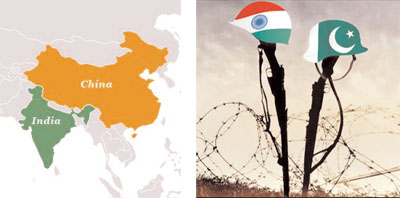
Tag: SAARC

  • Fifty Shades of Saffron

    Fifty Shades of Saffron

    On December 11, 2014, when the U.N. General Assembly adopted June 21 as the International Day of Yoga, as recommended by Prime Minister Narendra Modi, India rejoiced. Never mind that the day before was the first Human Rights Day under his watch; this crept by unnoticed.

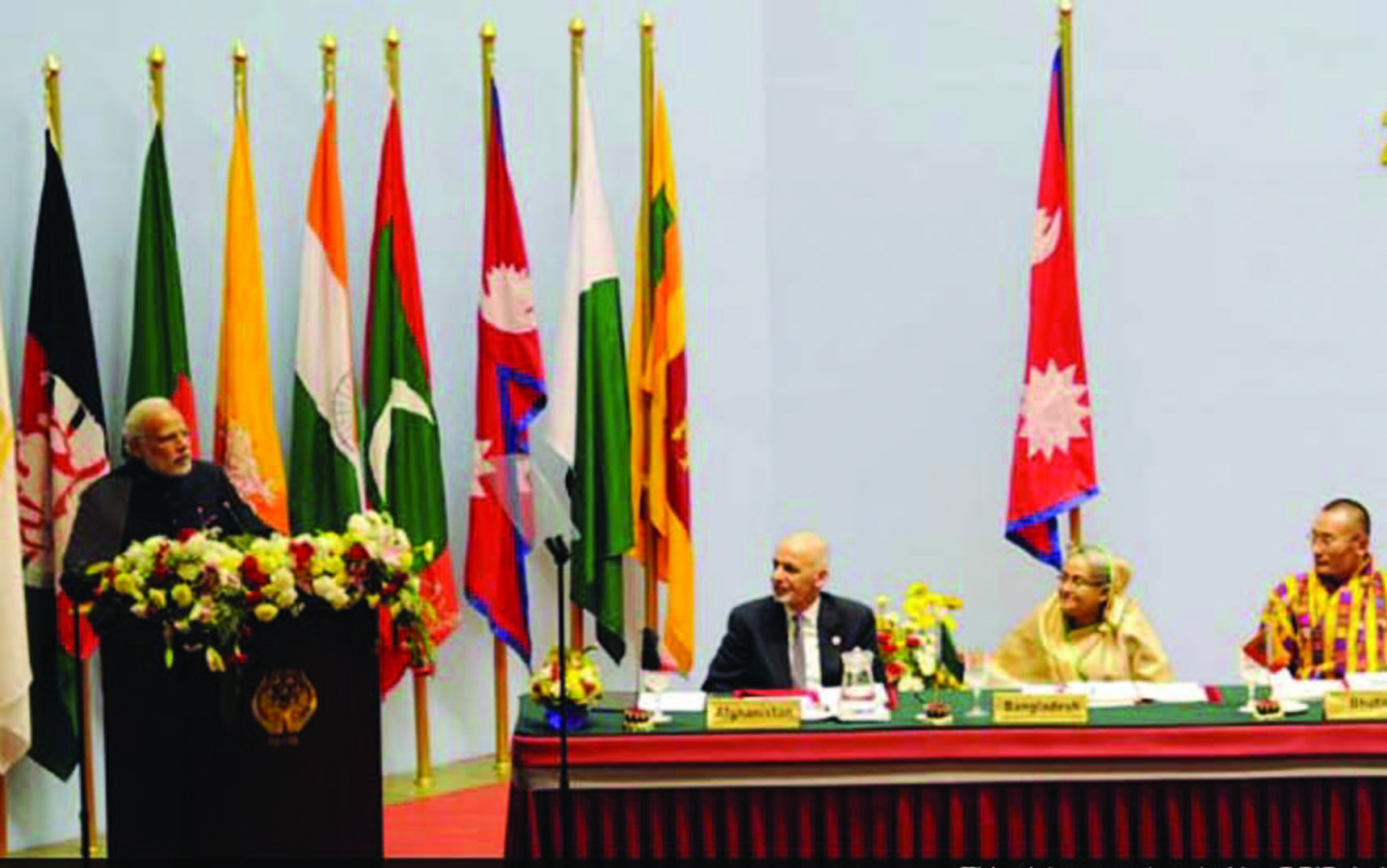
    At the SAARC Summit, Mr. Modi declaimed, “As we seek to build bridges to prosperity, we must not lose sight of our responsibility to the millions living without hope.” He was, as always, matchless as a kathakar, an artiste whose fabulous retelling of fables reinforces them in the minds of the faithful as fact. But while his performances have zero defects, on the lives of the multitudes hanging on to his words, believing in them and daring to hope, they have had zero effect so far, because the responsibility of which the Prime Minister spoke is usually ignored.

    In 1990, the U.N. launched the Human Development Report based on the challenging predicate that “people are the real wealth of a nation.” How wealthy are we really? After two decades of rapid GDP growth, we bestride SAARC like a colossus doing the splits, one foot splayed eastward to keep China out, the other westward to keep Pakistan down. We loom like a giant among midgets, but on every parameter that measures equity in development, there is little to choose between us and our neighbors.

    The Human Development Index (HDI) for 2014 ranks us at 135 among 187 countries; Sri Lanka at 73 did way better than us, and we were shadowed by Bhutan at 136, Bangladesh at 142, Nepal at 145 and Pakistan at 146. The fact that India was a stable democracy, as the others were not, that our economy had galloped along, as theirs had not, had made very little difference to the lives of our citizens.

    Within the HDI, the Gender Inequality Index which measures three critical parameters – reproductive health, women’s empowerment and their participation in the labor market – is particularly important because it shows how a society treats its more vulnerable half. Sri Lanka at 75 is well ahead of us, but so is Nepal at 98, Bhutan at 102 and Bangladesh at 115. India is in lock-step with Pakistan, both ranked at 127. The Criminal Law Amendment Act, which brought in far-reaching measures to protect women, is now almost two years old; sadly, it has made little difference.

    Depth of deprivation

    My five years on the National Human Rights Commission were a humbling experience. In 2009, we had 82,000 complaints, in 2013, a lakh. A five-member Commission could not possibly do justice to more than a fraction of these. We dismissed 60 per cent of complaints in limine, or at the outset, 11 per cent with directions to officials to act (but never had the time to check if they did) and transferred 6 per cent to the State Human Rights Commissions, which were mostly ramshackle.

    Our investigative visits to rural India were dives into the darkness that contained the mass of the iceberg of which the complaints coming to us were only the tip. In a country still largely illiterate, a terrible violation of human rights in itself, very few knew the NHRC existed. Those who did wondered if it would be able to help; many thought it would not. For every complaint that came to us, a hundred did not, but since so many were on systemic problems affecting entire communities, they brought home to us the range, depth and persistence of discrimination and deprivation in India. The two are often linked, and that is the real cause of worry with our new dispensation. The poorest and the most vulnerable – women, Scheduled Tribes, Scheduled Castes and Muslims – suffer because the social bias against them is rooted in Hindu belief and practice, and still so strong that the laws meant to protect them are impotent. Even under a secular government, public servants would plead with the NHRC that there would be law and order problems if they tried to implement these. The danger now is that under a government so overtly Hindu, these practices will flourish even more. The hate speeches of Cabinet members signal where this could lead us.

    “Discrimination and deprivation are often linked to one another, and that is the real cause of worry with our new dispensation”

    Mr. Modi wants his party to be careful with their words, but there are fifty shades of saffron around, most of it strident. He wants civil servants to be sensitive, but they always are, to the wishes of the powers that be. He wants the police to be SMART, but they already are, reporting to the National Crime Records Bureau that in 2013 there were only two incidents of human rights violations by their personnel. The same year, 33,753 complaints to the NHRC, a third of the total received, were against the police, detailing how they preyed on those they should protect.

    In Mr. Modi’s defense, these are national problems he has inherited, not created, but Gujarat is the template he holds up to the rest of India, and there are a range of impartial reports that show how cavalier it has been about the lives of the State’s people. A 2013 Lancet study found that among the 11 rich States, Gujarat had done the worst in bringing down the mortality rate of children under five, one of the Millennium Development Goals. The Census established that the sex ratio in Gujarat has declined from 934 in 1991 to 920 in 2001 to 918 in 2011. Not surprisingly, the NCRB data shows a high incidence of crimes against women. So too, the data shows, are crimes against Scheduled Castes, at levels higher than in the other developed States: Maharashtra, Punjab and Tamil Nadu. The ASER/Pratham Reports on Education show low percentages of students in Standard V who could read a Standard II text, and could do divisions. That is not a model to copy.

    Dreadful cost

    Despite what he said in Kathmandu, Mr. Modi’s record as Gujarat Chief Minister shows that his sights are set on prosperity, not on “the millions living without hope.” ‘Make in India’ is his priority, and there the signs are ominous. A few weeks back, ASSOCHAM issued an advertisement which announced, “Repeal of archaic laws is the need of modern times…ASSOCHAM has identified 105 laws for review, which can promote a better regulatory framework for successfully actualizing Mr. Modi’s vision of ‘Make in India’.” These include 43 laws that protect human rights and safeguard labor welfare, including the Bonded Labor System (Abolition) Act, Protection of Forest Rights Act, Inter-State Migrant Workers Act, Child Labor (Prohibition and Regulation) Act, and the Minimum Wages Act. If these are the voices he listens to, development will come at a dreadful cost.

    India’s governments have so far pursued development with a human face. Vast social welfare programs protect those whom the market forces savage, but these are riddled with huge problems. For instance, hardly any materials go into the rural employment guarantee projects, but each year material costs claimed are well over 20 per cent of its budget. A survey done for the NHRC showed that 60 per cent of the allocation for the Integrated Child Development Services was being stolen. The list goes on. The answer does not lie in jettisoning these programs, but in making them work better. Without them, rural India will empty out.

    Our Prime Minister’s many admirers believe that Sardar Patel’s mantle has descended on him. Vallabhbhai Patel made India, Narendra Modi can unmake it. But with his extraordinary talents, integrity and ability, our Prime Minister can also be the making of India, and make India, all of India, proud. That should be his tribute to his idol, not the monstrous statue of the Sardar now rising in Gujarat like a prelapsarian Ozymandias.

    By Satyabrata Pal

  • Eternal Vigilance is the Price of Liberty

    Eternal Vigilance is the Price of Liberty

    I.S. Saluja

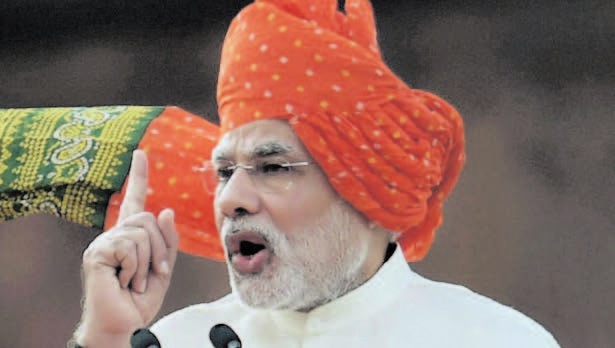
    Prime Minister Narendra Modi addressed the nation from the ramparts of the Red Fort on the 68th Independence Day of India on 15th August, 2014. It has been almost 4 months since he spoke of his vision of India in his first address to the nation as Prime Minister. In his long speech, inter alia, he reminded the people of India that “Eternal vigilance is the price of liberty”.

    I must agree with him as would the whole world. A people need to be vigilant and constantly evaluate their leaders. Hence, we are giving below the full text of Prime Minister Narendra Modi’s address to the nation and would like our readers to evaluate India’s Prime Minister. Please send in your comments to editor@theindianpanorama.news or to salujaindra@gmail.com. We will be happy to publish your valuable evaluation and comments.

    Following is the English rendering of the Prime Minister’s address on the occasion. My dear countrymen,

    Today, all Indians in the country and also abroad are celebrating the festival of independence. On this day of sacred festival of independence, the prime servant of India extends greetings to all dear countrymen. I am present amidst you not as the Prime Minister, but as the Prime Servant. The freedom struggle was fought for so many years, so many generations laid down their lives, innumerable people sacrificed their lives and youth, spent their entire lives behind bars.

    Today, I pay my respect, greetings and homage to all those who laid their lives for the country`s independence. I also pay my respects to the crores of citizens of this country on the pious occasion of India`s independence, and recall all those martyrs who had laid down their lives in India`s struggle for freedom. The day of independence is a festival when we take a solemn pledge of working for the welfare of mother India, and also for the welfare of the poor, oppressed, dalits, the exploited & the backward people of our country.

    What he stressed on during the speech My dear countrymen, a national festival is an occasion to refine and rebuild the national character. This National festival inspires us to resolve ourselves to lead a life where our character gets refined further, to dedicate ourselves to the nation and our every activity is linked to the interest of the nation and only then this festival of freedom can be a festival of inspiration to take India to newer heights. My dear countrymen, this nation has neither been built by political leaders nor by rulers nor by governments. This nation has been built by our farmers, our workers, our mothers and sisters, our youth.

    The country has reached here today because of generation to generation rigours undertaken by our sages, our saints, our maestros, our teachers, our scientists and social workers. These great people and these great generations, who had worked for the country throughout their lives, deserve our deepest respect. This is the beauty of India’s Constitution, this is its capability which has made it possible that today a boy from small town, a poor family has got the opportunity to pay homage to the tri-colour of India at the ramparts of Lal Quila(Red Fort). This is the strength of India’s democracy. This is an invaluable legacy which we have inherited from our architects of the constitution.

    I pay my respects to those architects of the constitution of India today. Brothers and sisters, today if we have reached here after independence, it is because of the contribution of all the PrimeMinisters, all the governments and even the governments of all the States. I want to express my feelings of respect and gratitude to all those previous governments and ex-Prime Ministers who have endeavoured to take our present day India to such heights and who have added to the country’s glory. This country has been built on such foundation of ancient cultural heritage, where we were told of only onemantra during Vedic period, which is indicative of our work culture, which we have learnt, we have memorized – “Sangachchhdhvam Samvadadhvam sam wo manansi jaanataam.” We walk together, we move together, we think together, we resolve together and together we take this country forward. Having imbibed this basic mantra, 125 crores of countrymen have taken the nation forward.

    Yesterday only the first Parliamentary Session of the new Government had concluded. Today, I can proudly say that the Session of Parliament reflects our thinking and it is a reflection of our intentions. We are not for moving forward on the basis of majority, we are not interested to move forward by virtue of majority. We want to move ahead on the basis of strong consensus. “Sangachhadhwam” and, therefore, the nation has witnessed the entire Session of Parliament. Having taken all the Parties and Opposition along while working shoulder to shoulder, we achieved an unprecedented success and the credit for this does not go to the Prime Minister alone, the credit does not go to the people sitting in the Government, the credit for this goes to the Opposition also, the credit goes to all the leaders of Opposition too and also all the Members from Opposition.

    From the ramparts of Red Fort, quite proudly I salute all the Members of Parliament, I also salute all the Political Parties and by virtue of their strong support, we could take some important decisions intended to take the nation forward and yesterday the Session of Parliament had concluded. Brothers and sisters, I am an outsider for Delhi, I am not a native of Delhi. I have no idea about the administration and working of this place. I have been quite isolated from the elite class of this place but during the last two months while being an outsider, I had an insider view and I was astonished.

    It is not a political platform, rather it is a platform of a national policy and, therefore, my views should not be evaluated from a political perspective. I have already said, I salute all the ex-Prime Ministers and earlier governments who have brought the country thus far. But I am going to say something else and it may not be seen from political point of view. When I came to Delhi and noticed an insider view, I felt what it was and I was surprised to see it. It seemed as if dozens of separate governments are running at the same time in one main government.

    It appeared that everyone has its own fiefdom. I could observe disunity and conflict among them. One department is taking on the other department and taking on to the extent that two departments of the same government are fighting against each other by approaching Supreme Court.This disunity, this conflict among people of the same country! How come we can take the country forward? And that is why I have started making efforts for razing those walls; I have started making efforts at making the Government, not an assembled entity, but an organic unity, an organic entity, a harmonious whole- with one aim, one mind, one direction, one energy. Let`s resolve to steer the country to one destination. We have it in us to move in that direction. A few days back…Nowadays newspapers are full of news that Modiji`s Government has come, officers are reaching office on time, offices open in time, and people get there in time. I observed that India`s National newspapers, TV media were carrying these news items prominently.

    As the Head of the Government I could have derived pleasure in the fact that everything started going on time, cleanliness got the attention, but I was not taking pleasure, I was feeling pained. That thing, I want to tell today in public. And why, because if government officers arrive office in time, does that make a news? And if that makes news, it shows how low we have fallen. It becomes a proof of that, and that`s how, brothers and sisters, the governments have run? Today in the face of global competition, when we have to realize the dreams of millions of Indians, the country cannot run on the lines of ” it happens”, ” it goes”. In order to fulfil the aspirations of masses, we have to sharpen the tool called the Government machinery, we have to make it keen, more dynamic, and it is in this direction that we are working.

    My countrymen, it`s not long since I have come from outside Delhi, but I give you an assurance that the people in the Government are very capable – from the peon to the Cabinet Secretary, everybody is capable, everybody has a power, they have experience. I want to awaken that power, I want to unite that power and want to accelerate the pace of the welfare of nation through that power and I shall definitely do it. I want to assure the countrymen that we will achieve that, we will definitely do that. I could not say this on 16th May, but today after my experience of twotwo and half months, keeping the tricolor as witness, I am saying on 15th of August that it is possible, it will be achieved.

    Brothers and sisters, time has come to give a serious thought to the fact that whether we have a duty to create India of the dreams of those great people who gave us freedom, whether we have a national character? Brothers and sisters, can someone please tell me as to whether he or she has ever introspected in the evening after a full day`s work as to whether his or her acts have helped the poor of the country or not, whether his or her actions have resulted in safeguarding the interest of the country or not, whether the actions have been directed in country`s welfare or not? Whether it should not be the motto of one and a quarter billion countrymen that every step in life should be in the country`s interests? Unfortunately, we have an environment today wherein if you approach anyone with some work, he begins by saying “what does it mean for me?” He begins by saying “what does it involve for me?” and when he come to know that it does not entail any benefit for him, immediately he says “why should I bother?” we have to rise above the feelings of “what does it mean for me” and “why should I bother”. Everything is not for self interest only.

    There are certain things which are meant for the country and we have to refine this national character. We have to rise above the feelings of “why should I bother” and “what does it mean for me” and instead we have to think that “I am for nation`s interest and in this field, I am going to lead”. We have to inculcate this sentiment. Brothers and sisters, when we hear about the incidents of rape, we hang our heads in shame. People come out with different arguments, someone indulges in psycho analysis, but brothers and sisters, today from this platform, I want to ask those parents, I want to ask every parent that you have a daughter of 10 or 12 years age, you are always on the alert, every now and then you keep on asking where are you going, when would you come back, inform immediately after you reach.

    Parents ask their daughters hundreds of questions, but have any parents ever dared to ask their son as to where he is going, why he is going out, who his friends are. After all, a rapist is also somebody`s son. He also has parents. As parents, have we ever asked our son as to what he is doing and where he is going. If every parent decides to impose as many restrictions on the sons as have been imposed on our daughters, try to do this with your sons, try to ask such questions of them. \My dear brothers and sisters, the law will take its own course, strict action will be taken, but as a member of the society, as parents, we also have some responsibilities. If somebody tells me that those who have taken guns on their shoulders and kill innocent people are Maoists, are terrorists, but they are also somebody`s children.

    I would like to ask of such parents if they had ever asked their children as to why they were taking a wrong path. Every parent must take this responsibility, he must know that his misguided son is bent on killing innocent people. He is not able to serve himself nor his family nor the country. I want to say to those youngsters who have chosen the path of violence that whatever they are and wherever they are, it is all because of mother India only that they have got it. Whoever you are it is all because of your parents. I want to ask you to think how green, how beautiful and how beneficial this earth can become if you shoulder the plough instead of the gun which spills blood on this land.

    How long shall we have bloodshed on this land, how long shall we take the lives of the innocent people and what have we got after all this? The path of violence has not yielded anything to us. Brothers and sisters, I had gone to Nepal recently. There I said something publicly to draw the attention of the whole world. There was a time when the Emperor Ashoka who had chosen the path of wars, got converted to the path of Buddha at the sight of violence. There was a time in Nepal when their youngsters had opted for the path of violence but today I witness that the same youngsters are waiting for their constitution. The same people associated with them are framing the constitution.

    And I further said that if Nepal could present the best example of moving from the weapons to the books then it could provide inspiration to the youngsters in the world to abandon the path of violence. Brothers and sisters, If Nepal, land of Budha, can give message to the world then why can`t India too do the same? So it`s the call of the hour that we renounce the path of violence and take the path of brotherhood. Brothers and sisters, for one reason or the other, we have had communal tensions for ages. This led to the division of the country. Even after Independence, we have had to face the poison of casteism and communalism. How long these evils will continue? Whom does it benefit? We have had enough of fights, many have been killed. Friends, look behind and you will find that nobody has benefited from it.

    Except casting a slur on Mother India, we have done nothing. Therefore, I appeal to all those people that whether it is the poison of casteism, communalism, regionalism, discrimination on social and economic basis, all these are obstacles in our way forward. Let`s resolve for once in our hearts, let`s put a moratorium on all such activities for ten years, we shall march ahead to a society which will be free from all such tensions. And you will see that how much strength we get from peace, unity, goodwill and brotherhood. Let`s experiment it for once. My dear countrymen, believe in my words, I do assure you. Shun all the sins committed so far, give up that way, follow the way of goodwill and brotherhood, and let`s resolve to take the country forward.

    I believe we can do that. With advancement of science, brothers and sisters, we have a rising feeling of modernity in our mind, but what do we do? Have we ever thought what the sex ratio in the country is like? 940 girls are born against per thousand boys. Who is causing this imbalance in the society? Certainly not God. I request the doctors not to kill the girl growing in the womb of a mother just to line their own pockets. I advise mothers and sisters not to sacrifice daughters in the hope of son. Sometimes mother-father feel tempted to have son in the hope of supporting them in old age.

    I am a person who has worked in public life. I have come across families with five sons, each having bungalows, access to fleet of cars, but parents are forced to live in old-age homes, Vriddhashrams. I have seen such families. I have also seen families with only daughter as progeny, that daughter sacrifices her dreams, doesn`t get married, and spends entire life in taking care of old parents. This disparity points to female foeticide and the polluted and tainted mind the 21st century has.

    We will have to liberate from it, and that is message to us of this Freedom festival. Recently Commonwealth Games were organized. Indian sportspersons brought glory to the country. Nearly 64 of our sportspersons won. Our sportspersons brought 64 medals. But of them 29 are girls. Let`s feel proud and clap for them. Girls also contribute to India`s fame and glory. Let`s recognise it. Let`s take them along, shoulder to shoulder. This way we can get over the evils that have crept in social life. Therefore, brothers and sisters, we have to proceed in that direction as a social and national character.

    Brothers and Sisters, Development is the only way forward for the country. Good governance is the only way. There are only these two tracks to take the country forward – good governance and development, we can move forward only by taking them with us. We wish to move forward with the intent of taking them with us. When I talk of good governance, you tell me, when I ask a person in private job, he tells that he does the job; when you ask the same from a person in government job, he says that I do the service. Both earn, but for one it is job while for the other it is service. I ask a question from all brothers and sisters in government service, whether the word “Service” has not lost its strength, its identity? Persons in government service are not doing “job”, they are doing “service”. We have to revive this feeling, we have to take this feeling forward as a national character, we have to move forward in this direction.

    Brothers and Sisters, whether the citizens of the country should take steps for the welfare of the nation or not? You imagine, ifthis 125 crores of countrymen move one step forward, then the country moves 125 crore steps forward. The meaning of democracy is not just limited to electing a government, but its meaning is that 125 crore of citizens work together joining shoulder with the government to fulfill hopes and aspirations of the country, this is the meaning of democracy. We have to create partnership with the people. We have to proceed under Public-Private Partnership. We have to proceed along with the participation of the people. But, please tell me why our farmers commit suicide? A farmer takes loan from the moneylender, but fails to repay his loans. He takes loan for the wedding of his daughter, but fails to repay.

    He will have to suffer hardships during his whole life. He chooses to commit suicide. Who will save the poor families of such farmers? Brothers and sisters, I have come here with a pledge to launch a scheme on this festival of Freedom. It will be called`Pradhanmantri Jan-Dhan Yojana`. I wish to connect the poorest citizens of the country with the facility of bank accounts through this yojana. There are millions of families who have mobile phones but no bank accounts. We have to change this scenario. Economic resources of the country should be utilized for the well-being of the poor.

    The change will commence from this point. This yojana will open the window. Therefore, an account holder under `Pradhanmantri Jan-Dhan Yojana` will be given a debit card. An insurance of One Lakh Rupees will be guaranteed with that debit card for each poor family, so that such families are covered with the insurance of One Lakh Rupees in case of any crisis in their lives. My brothers and sisters, it is a country of young people. The 65 percent population of the country happens to be under the age of 35 years. Our country has the largest number of youths in the world. Have we ever thought of deriving an advantage out of it? Today, the world needs a skilled workforce. Today, India also needs a skilled workforce. At times, we look for a good driver but he is not available, we look for a plumber, but he is not available.

    If we need a good cook, he is not available. We have young people, they are unemployed but the kind of young people we seek for are not available. If we have to promote the development of our country then our mission has to be `skill development` and `skilled India`. Millions and Millions of Indian youth should go for acquisition of skills and there should be a network across the country for this and not the archaic systems. They should acquire the skills which could contribute towards making India a modern country. Whenever they go to any country in the world, their skills must be appreciated and we want to go for a two pronged development.

    I also want to create a pool of young people who are able to create jobs and the ones who are not capable of creating jobs and do not have the opportunities, they must be in a position to face their counterparts in any corner of the world while keeping their heads high by virtue of their hard work and their dexterity of hands and win the hearts of people around the world through their skills. We want to go for the capacity building of such young people. My brothers and sisters, having taken a resolve to enhance the skill development at a highly rapid pace, I want to accomplish this.

    Brothers and sisters, the world has undergone a change. My dear countrymen, the world has changed. Now India can not decide its future by remaining isolated and sitting alone in a corner. The economics of the world have changed and, therefore, we will have to act accordingly. Government have taken many decisions recently, made some announcements in the budget and I call upon the world and call upon the Indians spread world over that if we have to provide more and more employment to the youth, we will have to promote manufacturing sector. If we have to develop a balance between imports and exports, we will have to strengthen manufacturing sector. If we have to put in use the education, the capability of the youth, we will have to go for manufacturing sector and for this Hindustan also will have to lend its full strength, but we also invite world powers.

    Therefore I want to appeal all the people world over, from the ramparts of the Red Fort, “Come, make in India”, “Come, manufacture in India”. Sell in any country of the world but manufacture here. We have got skill, talent, discipline, and determination to do something. We want to give the world an favourable opportunity that come here, “Come, Make in India” and we will say to the world, from electrical to electronics, “Come, Make in India”, from automobiles to agro value addition “Come, Make in India”, paper or plastic, “Come, Make in India”, satellite or submarine “Come, Make in India”. Our country is powerful. Come, I am giving you an invitation.

    Brothers and sisters, I want to call upon the youth of the country, particularly the small people engaged in the industrial sector. I want to call upon the youth working in the field of technical education in the country. As I say to the world “Come, Make in India”, I say to the youth of the country – it should be our dream that this message reaches every corner of the world, “Made in India”. This should be our dream. Whether, to serve the country, is it necessary for the youth of the country to be hanged like Bhagat Singh? Brothers and sisters, Lal Bahadur Shastri had given the slogan “Jai Jawan, Jai Kisan”.

    A soldier sacrifices himself at the border and protects Mother India. Similarly, a farmer serves Mother India by filling the godowns with grains. This is also nation`s service. Filling the granary is the biggest nation`s service that a farmer provides. That is why Lal Bahadur Shashtri had given the slogan of “Jai Jawan, Jai Kisan”. Brothers and Sisters, I would like to pose a question to my youngsters as to why despite them, we are forced to import even the smallest of things? My country`s youth can resolve it, they should conduct research, try to find out as to what type of items are imported by India and then each one should resolve that, through may be micro or small industries only, he would manufacture atleast one such item so that we need not import the same in future. We should even advance to a situation wherein we are able to export such items.

    If each one of our millions of youngsters resolves to manufacture atleast one such item, India can become a net exporter of goods. I, therefore, urge upon the youth, in particular our small entrepreneurs that they would never compromise, atleast on two counts. First, zero defect and, second again zero effect. We should manufacture goods in such a way that they carry zero defect, that our exported goods are never returned to us. We should manufacture goods with zero effect that they should not have a negative impact on the environment. If we march ahead with the dream of zero defect in the manufacturing sector then, my brothers and sisters, I am confident that we would be able to achieve our goals.

    Brothers and sisters, the youth of India has completely transformed the identity of India in the world. Earlier, in what manner did the world know our country? Till only 25-30 years back, if not more, there were many people in the world who thought that India was a country of snake charmers, it was a country which practiced in black magic. The real identity of India had not reached the world, but my dear brothers and sisters, our youngsters, 20-22-23 years old youngsters have mesmerized the whole world with their skills in computers. Our young I.T. professionals have given a new path of making a new identity of India. If our country has this strength, can we think something about the country? Our dream is, therefore, of “Digital India”. When I talk of “Digital India”, I don`t speak of the elite, it is for the poor people. You can imagine what a quality education the children in villages will get, if all the villages of India are connected with Broadband Connectivity and if we are able to give long distance education to the schools in every remote corner of the villages.

    If we create a network oftelemedicine in the places where there is a shortage of doctors, we can have a clear guideline of the way in which health facilities have to be provided to the poor people living in those areas. The citizens of India have mobile phones in their hands, they have mobile connectivity, but can we walk in the direction of mobile governance? We have to move in a direction where every poor person is able to operate his bank account from his mobile, is able to demand various things from the government, can submit applications, can conduct all his business, while on the move, through mobile governance and if this has to be done, we have to move towards `digital India` and if we have to move towards `digital India` then we have a dream. Today we are importing electronic goods on a large scale. Friends, you will be surprised that we are bringing in these televisions, mobile phones, ipads and all these electronic goods.

    It is a necessity to import petroleum products, oil, diesel and petrol. Second to this is the import of our electronic goods. If we move ahead with the dream of `digital India` to manufacture electronic goods and become self reliant at least there, how big can be the benefit for the treasury! Therefore, e-governance is what we need to take this idea of `digital India` forward. E-governance is easy governance, effective governance and also economic governance. Egovernance paves the way for good governance. There was a time when we used to say that the railways provided connectivity to the country.

    That was it. I say that today it is IT that has the potential to connect each and every citizen of the country and that is why we want to realise the mantra of unity with the help of `digital India`. Brothers and sisters, if we move ahead with all this then I believe that a `digital India` will have the potential to stand with the world on equal footing. Our youth have that capability, it is an opportunity for them. Brothers and sisters, we want to promote tourism. Tourism provides employment to the poorest of the poor. Gram seller earns something, auto-rickshaw driver earns something, pakoda seller earns something and tea seller also earns something. When there is talk of tea seller, I feel a sense of belongingness.

    Tourism provide employment to the poorest of the poor. But there is a big obstacle in promoting tourism and in our national character and that is – the filthiness all around us. Whether after independence, after so many years of independence, when we stand at the threshold of one and half decade of 21stcentury, we still want to live in filthiness? The first work I started here after formation of Government is of cleanliness. People wondered whether it is a work of a Prime Minister? People may feel that it is a trivial work for a Prime Minister but for me this a big work. Cleanliness is very big work.

    Whether our country can not be clean? If one hundred and twenty five crore countrymen decide that they will never spread filthiness, which power in the world has ability to spread filthiness in our cities and villages? Can`t we resolve this much? Brothers and sisters it will be 150th birth anniversary of Mahatma Gandhi in 2019. How do we celebrate 150th birth anniversary of Mahatma Gandhi? Mahatma Gandhi, who gave us freedom, who brought so much honour to such a big country in the world, what do we give to Mahatma Gandhi? Brothers and Sisters, Mahatma Gandhi had cleanliness and sanitation closest to his heart.

    Whether we resolve not to leave a speck of dirt in our village, city, street, area, school, temple, hospital, and what have you, by 2019 when we celebrate 150th anniversary of Mahatma Gandhi? This happens not just with the Government, but with public participation. That`s why we have to do it together. Brother and Sisters, we are living in 21st century. Has it ever pained us that our mothers and sisters have to defecate in open? Whether dignity of women is not our collective responsibility? The poor womenfolk of the village wait for the night; until darkness descends, they can`t go out to defecate.What bodily torture they must be feeling, how many diseases that act might engender.

    Can`t we just make arrangements for toilets for the dignity of our mothers and sisters? Brothers and Sisters, somebody might feel that a big festival like 15th August is an occasion to talk big. Brothers and Sisters, talking big has its importance,making announcements too has importance, but sometimes announcements raise hopes and when the hopes are not fulfilled, the society sinks into a state of despondency. That`s why are in favour of telling those things, which we can fulfil just within our sight. Brothers and sisters, you must be getting shocked to hear the Prime Minister speaking of cleanliness and the need to build toilets from the ramparts of the Red Fort. Brothers and sisters, I do not know how my speech is going to be criticised and how will people take it. But this is my heartfelt conviction.

    I come from a poor family, I have seen poverty. The poor need respect and it begins with cleanliness. I, therefore, have to launch a `clean India` campaign from 2nd October this year and carry it forward in 4 years. I want to make a beginning today itself and that is – all schools in the country should have toilets with separate toilets for girls. Only then our daughters will not be compelled to leave schools midway. Our parliamentarians utilizing MPLAD fund are there. I appeal to them to spend it for constructing toilets in schools for a year. The government should utilise its budget on providing toilets.

    I call upon the corporate sector also to give priority to the provision of toilets in schools with your expenditure under Corporate Social Responsibility. This target should be finished within one year with the help of state governments and on the next 15th August, we should be in a firm position to announce that there is no school in India without separate toilets for boys and girls. Brothers and sisters, if we proceed with the dreams, we are in a position to realise them. Today, I wish to tell one more specific thing. It has its own importance to discuss the matters and express the views of nation`s interest. However, our Members of Parliament do not get opportunity though they are willing to do something.

    They can express themselves, write to the government, agitate, give memoranda. Still they do not get opportunity to do something on their own. Today I have come to you with a new idea. We are running so many schemes in the name of the Prime Minister in our country, there are numerous schemes in the name of various leaders. However, today I am going to announce a scheme on behalf of the Member of Parliament- `Sansad Aadarsh Gram Yojana`. We shall fix some parameters. I urge upon the Members of Parliament to select any one of the villages having population of three to five thousand in your constituency. The parameters will be according to the time, space and situation of that locality.

    It will include the conditions of health, cleanliness, atmosphere, greenery, cordiality etc. On the basis of those parameters, each of our MPs should make one village of his or her constituency a Model Village by 2016. Can`t we do at least this? Shouldn`t we do this? If we have to build a nation, we should start from the village. Make a Model Village. The reason of fixing this target for 2016 is that it is a new scheme. It takes time to formulate a scheme and then to implement it. After 2016, select two more villages for this purpose, before we go for the General Elections in 2019. And after 2019, each Member of Parliament, during his/her tenure of 5 years must establish atleast five model villages in his/her area. I also call upon the Members of Parliament from urban areas to adopt one village of their choice. I also urge upon the Members of Parliament from Rajya Sabha to adopt one of the villages. If we provide one model village in each district of India then the surrounding villages shall be automatically inspired to follow that model.

    Let us establish a model village, let us establish a village well equipped with all systems and facilities. The birth anniversary of Jai Prakash Narayan Ji happens to be on 11th October. On 11th October, the occasion of birth anniversary of Jai Prakash Narayan Ji, I will present a complete blueprint of “S?nsad Adharsh Gr?m Yojana” (Members of Parliament Model Village Scheme) before all Members of Parliament and State Governments, and I urge upon State Governments also that as per the feasibility in their respective states, all the Members of Legislative Assembly resolve to establish a model villageYou can imagine all the Members of Legislative Assembly and all the Members of Parliament in the country establishing a model village.

    All of a sudden, there would be a model village in each block of India which could inspire us to transform the amenities in rural areas and could give us a new direction and, therefore, we want to move ahead under this”S?nsad Adarsh Gr?m Yojana”. My dear brothers and sisters, ever since our government has taken charge, there has been a discussion in the newspapers, on T.V. channels as to what would happen to Planning Commission. I believe that when Planning Commission was constituted, it was done on the basis of the circumstances and the needs of those times. In recent years, Planning Commission has contributed to the growth of the country in its own way. I respect that, I am proud of that, but the prevalent situation in the country is different, global scenario has also changed, governments are no longer the centre of economic activities, the scope of such activities has broadened. State governments have been at the center of development and I consider this a good indication.

    If we have to take India forward, it can happen only by taking the states forward. India`s federal structure is more important today than in the last 60 years. To strengthen our federal structure, to make our federal structure vibrant, to take our federal structure as a heritage of development, a team of Chief Minister and Prime Minister should be there, a joint team of the Centre and the states should move forward, then to do this job, we will have to think about giving the Planning Commission a look. So, I am saying from the rampart of the Red Fort that it is a very old system and it will have to be rejuvenated, it will have to be changed a lot. Sometimes it costs more to repair the old house, but, it gives us no satisfaction.

    Thereafter, we have a feeling that it would be better to construct a new house altogether and therefore within a short period, we will replace the planning commission with a new institution having a new design and structure, a new body, a new soul, a new thinking, a new direction, a new faith towards forging a new direction to lead the country based on creative thinking, public-private partnership, optimum utilization of resources, utilization of youth power of the nation, to promote the aspirations of state governments seeking development, to empower the state governments and to empower the federal structure.

    Very shortly, we are about to move in a direction when this institute would be functioning in place of Planning Commission. Brothers and sisters, today, on 15th August, we also have the birth anniversary of Maharishi Aurobindo. Maharishi Aurobindo, being a rebel, moved on to achieve the status of a Yoga Guru. With regard to the destiny of India, he remarked, “I have a faith that the divine power and spiritual heritage of India will play an important role towards the welfare of the world.” Such sentiments were echoed by Maharishi Arvind. I strongly believe in the words of legends. I have great faith in the statements made by ascetics, sages & saints and that’s why today at the ramparts of Lal Quila I am reminded of the words of Swami Viveknanda. He had said – “I can see before my eyes Mother India awakening once again.

    My Mother India would be seated as the World Guru. Every Indian would render service towards welfare of humanity. This legacy of India would be useful for the welfare of the world”. These words were spoken by Swami Viveknanda ji in his own style. Friends, the words of Viveknanda ji can never be untrue. The words of Viveknanda ji, his dream of seeing India ensconced as World Guru, his vision, it is incumbent upon us to realize that dream. This capable country, blessed with natural bounty, this country of youth can do much for the world in the coming days. Brothers and sisters, our foreign policy is a much talked about issue. I clearly believe that India`s foreign policy can be multidimensional.

    But there is an important issue to which I want to draw your attention that the way we fought for freedom, we fought together, we were not separate at that time. We were together. Which was the government with us? What were the weapons available to us? There was a Gandhi, a Sardar and lakhs of freedom fighters and such a huge empire. Didn`t we win in the struggle of freedom against that empire? Did we not defeat the foreign powers? Did we not force them to leave India? We were the ones, they were our ancestors only who showed this might. If the people of India could remove such a big empire without the power of the government, without weapons and even without resources, then friends, it is the need of the hour to eradicate poverty, can we not overcome poverty? Can we not defeat poverty? My 125 crore dear countrymen, let us resolve to eradicate poverty, to win against it.

    Let us move with the dream of poverty eradication from India. Our neighbouring countries are also faced with the same problem. Why not get together with all the SAARC nations to plan out the fight against poverty? Let`s fight together and defeat poverty. Let us see at-least for once as to how wonderful is the feeling of being alive instead of killing and getting killed. This is the land where incidents from Siddharth`s life happened. One bird was shot with an arrow by one brother and the other took out that arrow to save it. They went to mother- whose bird, whose swan? Whether killer`s or saviour`s, they asked of mother. The mother replied, saviour`s. The saviour has more power than the killer and that makes him Buddha in future. And that`s why I seek cooperation from neighbouring countries for fighting against povertyin concert and cooperate with them, so that together with SAARC countries we can create our importance and emerge as a power in the world.

    It is imperative that we work together with a dream to win a fight against poverty, shoulder to shoulder. I went to Bhutan, Nepal, all the dignitaries from SAARC countries took part in oath-taking ceremony; this marked a good beginning. This will definitely yield good results, it is my belief and this thinking of India, in the country and the world, that we want to do well to the countrymen and be useful for the welfare of the world, India wants such a hand to be extended. We are trying to move forward with these dreams to achieve them. Brothers and Sisters, today on 15th August we will resolve to do something for the country.

    Let`s be useful for the country, we will move ahead with a resolve to take the country forward, and I assure you, Brothers and Sisters, as well as my colleagues in the Government, that if you work for 12 hours, I will do so for 13 hours. If you work for 14 hours, I will do for 15 hours. Why? Because I`m amidst you not as a Prime Minister, but as the first servant. I have formed the Government not as a ruler, but as a servant. Brothers and sisters, I assure that this country has a destiny. It is destined to work for the welfare of the world, it was said by Vivekanand ji. India is born, this Hindustan is born in order to achieve this destiny. One hundred and twenty five crore countrymen have to move forward wholeheartedly for the welfare of the nation. Once again I feel proud of the devotion, the sacrifices of the security forces of the country, para-military forces of the country, all the security forces of the country to protect Mother India. I say to the countrymen, jk”Vª;ke] tkxz;ke~ o;e~ Eternal vigilance is the price of liberty”. The army is vigilant, we should also be vigilant and the country scales new heights, we have to move forward with this resolution. Speak loudly with me with full force –

    Bharat mata ki jai, bharat mata ki jai, bharat mata ki jai. Jai Hind, Jai Hind, Jai Hind. Vande Mataram, Vande Mataram, Vande Mataram!

  • Citing trade, Beijing seeks bigger role

    Citing trade, Beijing seeks bigger role

    KATHMANDU (TIP): The shadow of China seeking a greater role in the South Asian Association for Regional Cooperation (SAARC) and its presence in the eight-member grouping could not be missed here as the 18th Summit got underway. Over the past few days, reports emerged about Beijing pushing the envelope on the issue and today leaders from Bangladesh, Maldives, Pakistan and Sri Lanka advocating a greater role for observers in the regional grouping. SAARC has Australia, China, European Union, Japan, South Korea, Mauritius, Mynamar and the USA as observers and since 2007 have been invited to attend the summit meeting.

    Today as the summit opened, Pakistan Prime Minister Nawaz Sharif emphasised the importance of SAARC observers and the benefit the grouping can draw from its interactions with them. “We should build on convergences and minimise divergences and most of all seek to augment complimentaries for the greater good of the people of the region”, he said. Similar sentiments were expressed by leaders of Bangladesh, Maldives and Sri Lanka. While none of them mentioned China, on his part Deputy Foreign Minister of China Liu Zhenmin, who participated, underscored the role Beijing was playing in the region and prepared for a larger role.

    He mentioned that while China’s trade in the countries of the region stood at $150 billion, the country has $ 30 billion investments in the pipeline, clearly underscoring the economic muscle of Beijing. While New Delhi has not made any move to counter it, India maintained that the priority among member-countries of SAARC should be to ensure cooperation among the eight countries instead of seeking to expand the grouping in a horizontal direction.

  • SAARC SUMMIT: ENERGY PACT SEALED, ROAD AND RAIL PACTS ON ANVIL

    SAARC SUMMIT: ENERGY PACT SEALED, ROAD AND RAIL PACTS ON ANVIL

    KATHMANDU (TIP): The 18th SAARC Summit concluded on November 27 in this scenic Nepalese capital with the eight South Asian nations signing a pact on energy cooperation and adoption of the Kathmandu Declaration that called for deeper regional cooperation in core areas of trade, investment, finance, energy, infrastructure and connectivity.

    The two-day South Asian Association for Regional Cooperation summit started on a discordant note on November 26 with Pakistan blocking three proposed agreements. But it ended on a bright and positive note on Thursday with the eight countries signing the Saarc Framework Agreement on Energy Cooperation and promising to sign two other deals — the SAARC Motor Vehicles Agreement for the Regulation of Passenger and Cargo Vehicular Traffic, and the SAARC Regional Agreement on Railways — within three months. The energy agreement will enable greater cooperation in the power sector among South Asian countries.

    It is expected to improve power availability in the entire SAARC region and would facilitate integrated operation of the regional power grid. According to the Kathmandu Declaration adopted at the closing ceremony Thursday, the summit decided to accelerate the process of creating free trade in the region and formulation and implementation of projects, programmes and activities of SAARC in a prioritised, focused and result-oriented manner. Similarly, the summit also agreed to launch regional and sub-regional projects in the agreed areas of cooperation, especially in the area of poverty alleviation, infrastructure building, connectivity and energy.

    Strengthening the SAARC Development Fund, effective implementation of the SAARC Action Plan on Poverty Alleviation with a view to making South Asian free from poverty and hunger and enhancing regional connectivity through building and upgrading roads, railways, waterways infrastructure, energy grids, communications and air links, was also agreed on. The declaration called for combating terrorism in all its forms and manifestations and having effective cooperation among the member states for preventing the trafficking of people, arms and drugs and exploitation of children for forced labour.

    Increasing agricultural productivity and ensuring food and nutritional security is also the part of the Kathmandu Declaration. Providing quality education, eliminating illiteracy, providing vocational education and training, and making South Asia an attractive common tourist destination by promoting public-private partnership, are also mentioned in the declaration. In the opening ceremony on Wednesday, Indian Prime Minister Narendra Modi, who was the cynosure of all eyes, exhorted the eight SAARC member states nations to “walk in step” as he proposed a slew of measures, including ease for business travel, a level playing field in trade, and initiatives in healthcare and tourism.

    He referred to terrorism, especially the 26/11 Mumbai terror attack, in which 10 Pakistani terrorists unleashed mayhem in India’s commercial capital in 2008. “Today, as we remember the horror of the terror attack in Mumbai in 2008, we feel the endless pain of lost lives. Let us work together to fulfill the pledge we have taken to combat terrorism and trans-national crimes,” he said, without naming Pakistan. Urging for seamless connectivity in the region, Modi said “for India, our vision for the region rests on five pillars — trade, investment, assistance, cooperation in every area, and contacts between our people”. “There is a new awakening in South Asia; a new recognition of inter-linked destinies; and a new belief in shared opportunities,” he said. Host of the summit, Nepal Prime Minister Sushil Koirala, said that SAARC would focus on connectivity, security and eradicating extreme poverty.

    While Bangladesh Prime Minister Sheikh Hasina sought implementation of the SAARC free trade agreement (FTA) that was signed nearly a decade ago, Pakistan’s Nawaz Sharif called for a dispute-free South Asia. Afghan President Ashraf Ghani asserted that his country would not endanger regional security. While Maldivian President Abdulla Yameen sought a common SAARC platform on climate change, Bhutan’s Prime Minister Tshering Tobgay called for greater integration among South Asian countries to bolster growth. Sri Lanka President Mahinda Rajapaksa called for a common voice among South Asian nations on international issues and cooperation on eradicating terrorism. The heads of state and government also held bilateral meetings on the sidelines of the summit.

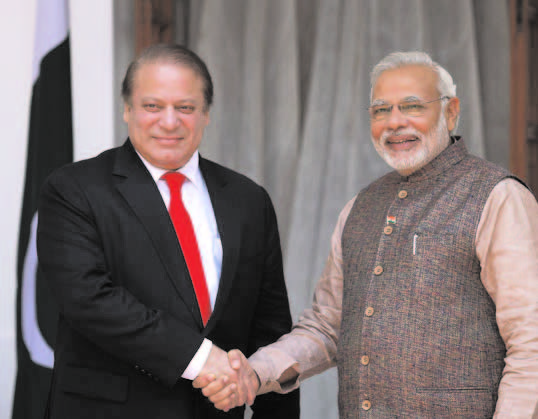
    After having met Nepal Prime Minister Koirala soon after his arrival here on Tuesday, Prime Minister Modi met his Bangladeshi and Bhutanese counterparts Hasina and Tobgay, and later the presidents of Afghanistan, Sri Lanka and Maldives — Ghani, Rajapaksa and Yameen. Though there was no meeting scheduled between the Indian Prime Minister and Pakistan’s Sharif, the two eventually greeted and informally spoke with each other at the retreat organised for the delegates at the Dhulikhel hill resort near Kathmandu on Thursday. Modi and Sharif shaking hands on the podium in the closing ceremony was the lasting image of the summit.

  • Escalating tension is not good for either country

    Escalating tension is not good for either country

    While there will be no open war between India and Pakistan in the normally understood sense, this does not prevent Pakistan from activating its tools of terror

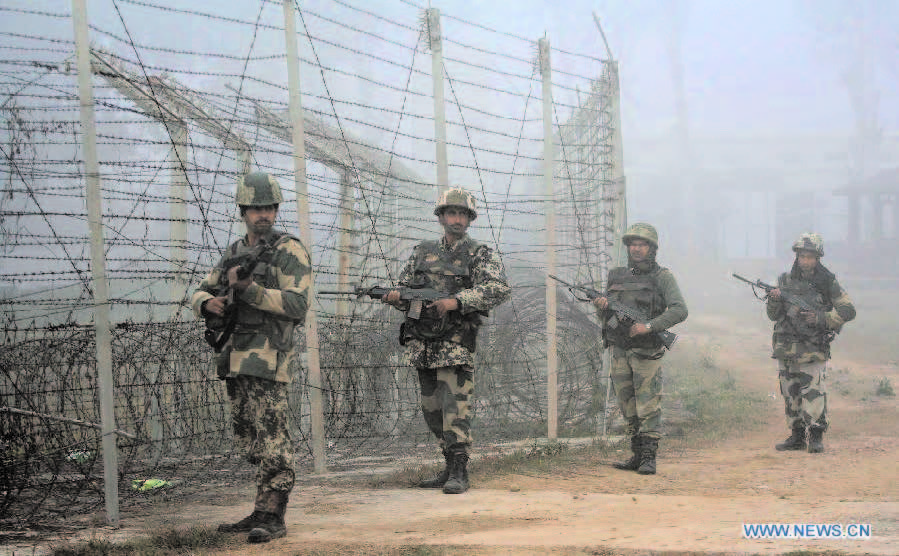
    There has been an escalation of tension between India and Pakistan in the recent few days. The Line of Control (LoC) has witnessed serious exchange of fire at the border for nearly a fortnight. Prime Minister Narendra Modi referred to the border firing in one of his election rallies in Maharashtra. Modi said that Pakistan was getting the befitting lesson and it would not dare to open fire on the border.

    It may be recalled that the cease-fire agreement between India and Pakistan came into effect in November 2003. Thereafter there had been periodic fire from Pakistan side, which had to be routinely returned by the Indian forces posted at the LoC. Union Home Minister, Rajnath Singh made a statement that Pakistan should understand that times have changed in India, an obvious reference to Bharatiya Janata Party under Narendra Modi coming to power at the centre with majority of its own.

    Reverting to the situation on the LoC, the Border Security Force (BSF) was handling the situation on the international border and it was BSF which was doing the firing across the LoC in Poonch, R.S. Pura and Arnia sectors. Reports say that instructions to Director General BSF, D.K. Pathak went out from the National Security Adviser Ajit Doval, who was in direct touch with DG, BSF over the period of 5 days in the first half of October 2014. The BSF reportedly fired more than 10,000 mortar shells, not to speak of countless ammunition, leading to an unprecedented situation in the border.

    Pakistan reported that 2 civilians were killed and about 100 injured on their side and also that scores of villages witnessed vacating of houses by the civilians moving away from the border. The former Chief of BSF E.N. Rammohan commented that earlier the exchange of fire was confined to LMGs and MMGs and now, mortars are being used which spelt danger to civilian lives who lived within 5000 meters range. He went on to comment, “civilians dying like this is absolutely absurd”.

    An analyst had written that the flare up on the border came at the height of campaigning for Assembly elections in Maharashtra and Haryana when Modi referred to Pakistan being taught lesson at a public rally in Maharashtra on October 9. A BSF Commandant said, “I am very proud, nobody, not even Indian Army has fired as much as we have into Pakistan since 1971 war. There were no restrictions this time and we kept on firing. Even the Army cannot boast of so much. At least no Army infantry battalion had fired mortars.”

    In Pakistan, Prime Minister, Nawaz Sharif was a worried man and he summoned all the senior army officers for taking stock of the situation. Nawaz Sharif also dispatched his trusted adviser Shahryar Khan to Delhi for back channel work and to bring out normalcy on the border. Khan is the President of the Pakistan Cricket Control Board and his visit to India was ostensibly to discuss cricket fixtures with India, did not go much beyond that level, since no senior Indian back channel representative met him during his stay in Delhi.

    Prime Minister Narendra Modi, meanwhile held a meeting attended by all senior Army commanders. Prime Minister Modi said that India had to be prepared for a changing world which demanded new thinking on economic, diplomatic and security policies. He asked them to be fully prepared for any eventuality. He also said that security challenges would be more unpredictable and invisible. On the Pakistan side, the Army Chief Gen. Raheel Sharif said at the Military Academy on October 18, that Pakistani forces are fully capable of meeting any external threat and that any aggression against Pakistan would get a befitting response.

    The Pakistani Army chief also digressed to the subject of Kashmir and said that the people of Kashmir should be allowed to decide their fate in the light of UN Resolutions. The growing tension between India and Pakistan had not escaped the attention of foreign observers. The Australian scholar Christopher Snedden, who has specialized on the subject of Kashmir and teaches at the Asia Pacific Centre for Security Studies, Honolulu, has commented that India’s new belligerence towards Pakistan is unhelpful and cited the cancellation of talks by the Indian Foreign Secretary with her counterpart in Pakistan over the Pakistan Ambassador’s meeting with Kashmiri separatists. Snedden went on to say that such meetings had routinely taken place in the past.

    Pakistan Prime Minister, Nawaz Sharif had attended Modi’s oath taking ceremony as the Prime Minister of India in New Delhi, on May 16, 2014, which he did ignoring the advice of the armed forces and hardliners, who were against his visiting India for the occasion. The border tensions and the disproportionate level of Indian reaction would lead to Pakistan analyzing and reviewing various options to retaliate against India. While there would not be any serious flare up between Indian and Pakistani forces in any sector. Pakistan Army Chief and the ISI Chief of Pakistan would be seriously exploring multiple ways of hurting India.

    At the diplomatic level, Pakistan had activated its diplomatic representative to brief UN members on the unfulfilled UN resolution for holding plebiscite in Kashmir for ascertaining views of the Kashmiri people regarding their options between India and Pakistan.

    While there will be no open war between India and Pakistan in the normally understood sense, that does not prevent Pakistan from activating its tools of terror like Lashkar-e-Toiba and Jaish-e-Mohammed in carrying out serious attacks within India. The National Security Guard (NSG) Chief J.N. Choudhury had warned on October 16 that the Al Qaeda and the ISIS may join hands with terror groups like Indian Mujahideen and carry out multicity multiple attacks in the country at the time of their choosing. Terror organizations like Lashkar-e- Toiba and Jaish-e- Muhammed will also be carried along in their dastardly scheme.

    The tensions between the two countries have to be seriously examined and ways and means to bring back normalcy should be worked out and implemented. India stands to lose much more if terrorist organizations are deployed in various cities in the country at a time of Pakistan’s choice. As this possibility is strong, this needs to be given serious consideration. Now that Prime Minister Narendra Modi has demonstrated his strength once again by decisively winning the elections in Maharashtra and Haryana, it is time for him to turn to the important issue of easing tensions between India and Pakistan.

    There was no meeting between Prime Ministers of India and Pakistan during the UN session in October as Modi was not interested in meeting with his Pakistani counterpart. The next opportunity comes up in November during the SAARC meeting in Nepal. It is hoped that the two Prime Ministers will have one to one meeting, with or without officials and work out a road map for future course of action.

  • Rajnath to Koirala: Border areas now ISI, jihadi hubs

    Rajnath to Koirala: Border areas now ISI, jihadi hubs

    NEW DELHI (TIP): Home minister Rajnath Singh on September 18 raised the issue of growing radicalization among Muslims in Nepal settled near Indo-Nepal border with Nepal PM Sushil Koirala and Home Minister Bam Dev Gautam. Certain pockets in these areas are learnt to have become fishing pools for Pakistan’s ISI and is suspected of being used against India. Singh is on a visit to Kathmandu for SAARC summit in Nepal. An official statement released by his office said, “The Indian HM (home minister) expressed his concern on the growth of religious fundamentalism in the border areas.” Intelligence agencies have been warning for the past few years that a string of madrasas coupled with large-scale settling of Muslims has been systematically taking place in Nepal along its border with India. These colonies, says security establishment sources, are being tapped by ISI fopr anti-India activities.

  • Basics very much in Indian economy’s favor

    Basics very much in Indian economy’s favor

    INDIA’S JOURNEY TO DEVELOPMENT AND CHALLENGES

    The economy of India is the tenthlargest in the world by nominal GDP and the third-largest by purchasing power parity (PPP).The country is one of the G-20 major economies, a member of BRICS and a developing economy that is among the top 20 global traders according to the WTO.

    India was the 19th-largest merchandise and the 6th largest services exporter in the world in 2013. India’s economic growth slowed to 4.7% for the 2013-14 fiscal year, in contrast to higher economic growth rates in 2000s. However, India’s decisive election outcome has created the potential for further structural reform that could result in a near 7 per cent GDP growth rate over the coming decade, and bank capital injections could enable banks to facilitate funding for that growth.


    32


    This would have meaningful implications for India’s fixed income markets. It is believed that the next decade for India’s foreign exchange (FX) and fixed income markets will be marked by policy-driven reforms driving accelerated growth with increasing market liberalization. Recent figures already appear more encouraging than the dynamics that have been supporting stagflationary recession conditions: The country’s balance of payments has improved, spurred by FX depreciation and the Reserve Bank of India’s (RBI’s) non-conventional measures. The growth outlook has turned moderately positive, helped by a global recovery; and bad loan formation, even at state-owned banks, may now be moderating.


    33


    The narrative for Indian markets began to brighten even before the elections. Following the second stage of India’s economic liberalization and the foreign direct investment (FDI) reforms initiated in September 2012, foreign investment will likely be a major contributor to a jump in private investment. However, despite liberal FDI limits, it has remained moderate, constrained, in part, by administrative hurdles. As the obstacles are reduced, we expect FDI to lead an investment boom over the next decade, similar to China’s mid-1990s experience. We project FDI will rise to an average of 2.5 per cent of GDP (FY2014-24) from an average of 1.5 per cent of GDP (FY2008-14). We believe such foreign capital flow will lend significant support to India’s balance of payments trajectory.

    Improving public health

    Health care services in India have undergone a vast change over the past few decades and encompass the entire nation. The industry is expected to supersede China by 2030 in terms of population expansion. Hence, it becomes one of the essential duties of the state to raise the nutrition level, the standard of living of the people together with improving public health.

    Health care Industry of India The rapidly increasing health care industry of India is one of country’s largest sectors, both in terms of revenue and employment. It has been estimated that the healthcare industry of India is will grow by & 40 billion. The continuous increase in the population of India is considered one of the principal reasons for the growth in the healthcare industry of India. The rise in the infectious as well as chronic degenerative diseases has contributed to the rise in the healthcare sector of India. Additionally, because of diseases like AIDS and several lifestyle diseases of India, the healthcare sector of India will have a constant growth.

    In spite of the fact that the Indian healthcare industry is rapidly expanding, healthcare infrastructure in India is very poor. A noticeable percentage of India suffers from poor standard of healthcare services. Most of the healthcare facilities of India provided by the various healthcare services are limited and of low standard. In order to understand the current status of the healthcare services in India, it is important to know about the different healthcare services found in the country.

    Public health services, essential public health services, preventive health services, mental healthcare services, home health services, magellen health service and school health services are some of the healthcare services found in India. Companies providing Health Insurance in India The various companies providing health insurance policies in India can also be put under the healthcare services of India. Some of the companies that provide health insurance coverage in India are Appollo DKV Insurance Company Ltd., Bajaj Alliance General Insurance Co. Ltd., Birla Sun Life Insurance, Aviva Life Insurance and the like.

    Points to note

    1).It has been found out that while the private health services have been rising for meet the needs of the rich citizens and foreigners, public health services in India are lagging behind and suffering in a major way.

    2).It has also been found out that less than 1% of the GDP is spent on the public health care services in India.

    3).Surveys made throughout India points out that 65% of the Indian population cannot access to modern medicines.

    4).In addition, a number of drugs and even many diagnostic tests are still unavailable in the public health care sector of India.

    5).Most of the hospitals, one of the prime healthcare services in India, are located in the urban areas, thereby making it almost impossible for the rural people to access.

    Indian industry sees green shoots of manufacturing growth
    A green shoots of revival have started to appear in the manufacturing sector, which is critical for job creation, with a majority of segments likely to post higher output, according to industry bodies. The survey conducted by CII-Ascon for the April-June quarter indicates positive growth in important sectors like consumer durables including the vehicle industry and white goods industry, which recorded a growth of 5- 10 per cent, leading to improvement in the overall industry growth.

    The FICCI survey found that eleven out of fourteen sectors are likely to show improvement in production during the second quarter (Jul-Sept) of the current fiscal. Over 64 per cent respondents are not likely to hire additional workforce in the next three months, though this proportion is less than that of the previous quarter (75 per cent), indicating improvement in hiring outlook in coming months.

    The survey gauges the expectations of manufacturers for Q2 for fourteen major sectors namely textiles, capital goods, metals, chemicals, cement, electronics, automotive, leather and footwear, machine tools, FMCG, tyre, textile machinery and more. Responses have been drawn from 392 manufacturing units from both large and small and medium (SME) segments with a combined annual turnover of over Rs 4 lakh crore.

    An upturn in demand condition is also reflected in the improved order books of the manufacturers, said Ficci survey. While only 36 per cent respondents reported higher order books for the April-June quarter in the last survey, 43 per cent respondents reported higher order books for July-September quarter.

    Foreign relations
    Soon after the 2014 Lok Sabha election results declared a thumping victory for the BJP-led NDA government, Prime Minister Narendra Modi invited the heads of all the SAARC countries including Pakistan, Bangladesh, Sri Lanka, Nepal, Maldives, Bhutan and Afghanistan, for his oath-taking ceremony, sending a major diplomatic signal to the global community.

    Credited with being a focused administrator, Modi signalled that his decisive win would reshape India’s foreign relations and leverage the diaspora to increase investments, business opportunities and better relations. Modi went on to choose neighbouring country Bhutan over others for his first foreign visit.

    “I will follow the (foreign) policies of the Vajpayee-led NDA government, and that also applies to the relationship with the United States. I don’t think a decision taken by any individual or one event should impact the overall policy,” Modi said in an interview. The winds of change were clearly being felt at home and abroad.


    29


    SAARC: A refocus on the neighbourhood
    For the first time, leaders of all South Asian Association Regional Corporation (SAARC) countries were invited for the swearing-in ceremony of an Indian Prime Minister. The presence of all seven countries, Pakistan Prime Minister Nawaz Sharif, Afghanistan President Hamid Karzai, Sri Lanka President Mahinda Rajapaksa, Bhutan Prime Minister Tshering Tobgay, Maldives President Abdulla Yameen Abdul Gayoom, Nepal Prime Minister Sushil Koirala, Speaker of Jatiyo Sangshad in Bangladesh Shirin Sharmin Chaudhury, was a welcome step towards strengthening India’s relations with the SAARC countries. However, political parties in Tamil Nadu voiced their displeasure at Sri Lanka’s president Mahinda Rajapaksa attending the ceremony and held demonstrations against him.


    30


    Bhutan visit: Asserting influence in South Asia
    PM Narendra Modi’s maiden foreign trip to Bhutan was intended to show that in the new scheme of things, the neighbourhood enjoys high priority. Inaugurating Bhutan’s Supreme Court building that was built with India’s assistance, Modi also laid the foundation stone of the 600MW Kholongchu Hydro-electric project, a joint venture between the two countries.

    He also proposed to hold a joint sports festival between Bhutan and north-eastern states of India, doubling scholarships for Bhutanese students in India and establishing e-libraries in 20 districts in Bhutan Though his faux pas of referring to Bhutan as Nepal while addressing the Bhutan Parliament caused some embarrassment, Modi went ahead to say that “when Bhutan calculates its happiness quotient, having a friend in India is also a major factor.”

    Meet with Pakistan Prime Minister Nawaz Sharif: Picking up the threads
    Relations between India and Pakistan have always been tense, but differences between the two countries had escalated after the 26/11 Mumbai terror attack. Modi’s invitation to Pakistan’s Prime minister Nawaz Sharif for his oath ceremony was seen as an attempt at cooperation rather than confrontation, which was reciprocated by his Pakistani counterpart.

    In their first meeting, Modi pressed for confidence-building measures, peace and security as well as enhancing bilateral trade, sending a positive message among the people of both the countries. Modi struck a pragmatic note with Sharif, underlining India’s concerns on terrorism and urging his Pakistani counterpart to crack down on militants and speed up trial of the 2008 Mumbai attack suspects.

    Sharif also responded to the meeting positively, accepting the fact that the two countries must strive for better cooperation. In the interaction which was widely seen as an “icebreaker”, the leaders also decided that their foreign secretaries would be in touch and discuss a way forward on talks that had been suspended since January 2013.

    BRICS Summit: New inroads
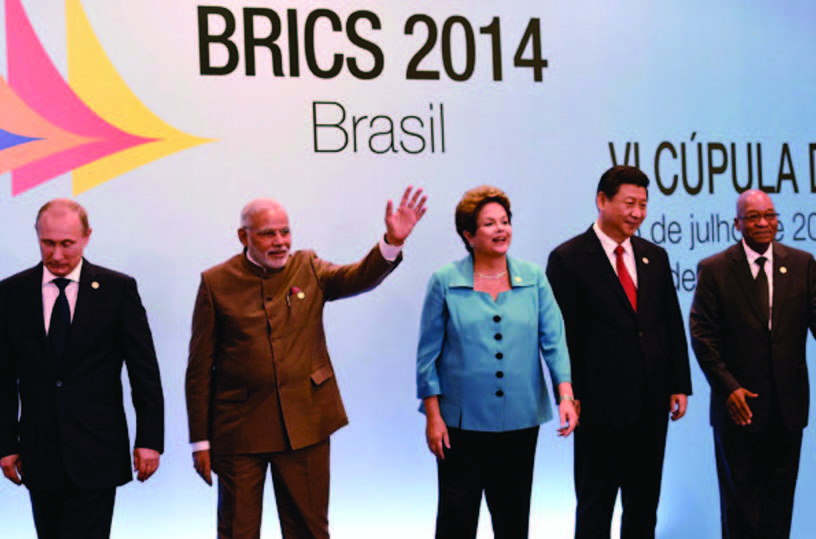
    Pushing for better international governance, Narendra Modi said he favoured an open, rule-based, international trading regime which is critical for global economic growth. Modi’s first BRICS summit saw significant inroads towards the establishment of the New Development Bank and though the headquarters of the bank is slated to be in China, its first President will be from India.

    Addressing the BRICS leaders, Modi also pressed for zero tolerance towards terrorism. He also met Chinese President Xi Jinping and both addressed the need for a solution to the boundary question. Further, Modi also favoured broadening the strategic partnership with Russia in nuclear, defence and energy sectors and invited President Vladimir Putin to visit the Kudankulam atomic power project during his trip in December.

    India poised to make further progress on UN’s development goals
    India has made progress on different indicators such as health and nutrition under the UN’s Millennium Development Goals and is expected to improve further upon them. “There has been progress in all the indicators and further progress is expected to be made in the remaining period up to 2015,” Planning Minister Rao Inderjit Singh had said recently.

    Challenges
    As far as India is concerned, 8 MDGs with 12 targets are relevant which are sought to be achieved during the period 1990 to 2015, the minister said. MDGs are international development goals that UN member states and numerous international organizations, including India, have agreed to achieve by the year 2015.

    Eradicating poverty
    These include eradicating extreme poverty and hunger; achieving universal primary education; promoting gender equality; reducing the child mortality rate and ensuring environmental sustainability. The minister’s said India had achieved the MDG target regarding poverty eradication. India had to halve the proportion of people whose income is less than one dollar a day between 1990 and 2015.

    In 1990, India had 47.8 per cent such poor people and thus the proportion of this population is to be reduced to 23.9 per cent. However, India’s poverty ratio was 21.92 per cent for 2011-12. Similarly, India has to half the proportion of people who suffer from hunger by 2015 to 26 per cent. However, the latest figure for 2004-05 reveal that the percentage of such population was 40 per cent.

    Education: Improving enrolment ratio
    In the education sector, India has to improve the net enrolment ratio in primary schools to 100 per cent by 2015. The country achieved 99.89 per cent enrolment in primary education in 2011-12. The proportion of pupils starting grade 1 who reach grade 5 was 86.05 per cent in 2011- 12 against the target of 100 per cent. The literacy rate in India was 61 per cent in 1990. It went up to 86 per cent in 2017-08.

    The ratio of girls to boys in primary education was 0.73 in 1990 which went up to 1.01 in 2011-12. Similarly the ratio of literate women to men (15-25 years) was 0.67 in 1990, which was 0.88 in 2007-08. MDGs target for both ratios is 1. The mortality ratio among children under the five-year age was 126 per 1,000 live births in 1990 which was brought down to 52 in 2012. The MDGs target is 42 for that.

    Infant mortality ratio
    The infant mortality ratio was 80 per 1,000 live births in 1990 which was brought down to 42 in 2012 against the MDGs target of 27. The proportion of one year old children immunized against measles was 42.2 per cent in 1990 which was improved to 74.1 per cent against targeted 100 per cent coverage.

    Similarly, the maternal mortality ration per 1,00,000 live births was 437 in 1990 which was brought down to 178 by 2011-12 against targeted 109 by 2015.

  • NAMO VICTORY CELEBRATIONS GALORE IN NEW YORK

    NAMO VICTORY CELEBRATIONS GALORE IN NEW YORK

    NEW YORK (TIP): Namo victory virus seems to have gripped a large number of Indian Americans in New York. Various groups claiming political affinity with BJP or a personal relationship with Narendra Modi , as also those who have had no truck with either BJP or Narendra Modi are found to be celebrating Modi’s victory.

    There is a widespread feeling bordering belief that India will get a facelift under Modi. Having said that, let us see how Namo’s victory has been celebrated in New York. Of the many celebrations, one is particularly noteworthy.

    It was held by the community at Hindu Temple in Flushing where a large number of people, around 1000 by liberal estimates, gathered on invitation from the Gujarat Foundation, India First Alliance, Friends of Namo New York, Gujarat Samaj of New York and the Jackson Heights Merchants’ Association.

    Purshottam Rupala, BJP National Vice President and Member of Rajya Sabha, and Rameshwar Prasad Chaurasia, one of the national secretaries of the BJP, were the star speakers In their address, both Rupala and Chaurasia lauded Modi for his abilities and noted that India is moving forward in a positive direction under his leadership.

    Organizers recognized prominent members of the community. Many community speakers were also invited to address the audience briefly. Chaurasia said Modi showed how a strong leader projects strength of a nation when he invited all SAARC heads to his swearing in and they fell over each other to attend. Other highlights included dance performances by Prashant Shah and a dinner.

    Guests were also given a packet of Modi Magic, a special snack prepared by Rajbhog Sweets to celebrate Modi’s epic win, an organizer said.

  • Pitfalls on growth path

    Pitfalls on growth path

    India losing out to China in competitiveness

    Mr. Modi is dealing now with a hugely diverse country in which too much centralisation of power may not work. To achieve higher growth and employment, the entire nation has to cooperate so that the most important problems of slippage on the human development and infrastructural fronts are addressed first. The Prime Minister will, however, have to show leadership within the given parameters”, says the author.

    The World Bank has revised its forecast about India’s GDP growth rate for 2014-15 and pegged it at a realistic level of 5.5 per cent. Recently there has been some good news that may go to indicate that 5.5 per cent is indeed achievable.

    Industrial revival is on the cards because after declining for two consecutive months, industrial growth was at 3.4 per cent in May. Whether it is a real reversal of the sluggish trend of 2013-14 (IIP grew at 0.4 per) or just a temporary blip is hard to say. Maybe industrial growth has risen due to the huge amount of election expenditure in April, 2014. Some of it went towards buying electricity generation equipment used in electioneering. Manufacturing growth is important for job creation.

    The young job-seekers (around 10 million a year) expect jobs from the Modi government. Mr. Modi has already promised that there will be labour-intensive manufacturing growth. But we have to wait and see what policy changes are introduced to promote it and how much impetus is given to the SME sector.

    The capital goods sector shrank by 14 per cent in 2013-14 which means that increasing domestic investment will be imperative for raising manufacturing growth. For rapid industrial growth, the productivity growth (total factor productivity) of industries has to rise. Unfortunately, the productivity growth has been declining in the last few years (since 2007) and that is why India is losing out to China in competitiveness.

    It is measured by the incremental capital output ratio which shows the amount of extra capital that is needed to produce one extra unit of output. Productivity growth depends on many things and if any of these is missing, it declines. Productivity growth depends not only on capital but also on human capital like the level of education/ skills and health of the labour force, work culture, technology, infrastructure, specially transportation, property rights and legal framework.

    If any of these is not growing in a steady manner, productivity growth can reach its limit and start to decline. Thus while factor inputs like labour, land and capital are important for productivity growth, it also depends on management and good governance. Productivity increases at the firm level reflect better management and organisation of people.

    Thus for higher GDP growth, not only is it important to spur domestic and foreign investment but also promote health, education and skills of the labour force and have efficient infrastructure. Less administrative hassles, quick policy decision-making and corruption-free governance are also equally important. Thus when the government makes big promises, it has to keep in mind what it has to do to increase productivity growth. To be able to achieve it in a short time is a formidable task for the Prime Minister.

    Another good sign for better GDP prospects is that export growth increased to double digits (12 per cent) in May 2014. It indicates better prospects for industrial revival through export growth. For export growth, a rise in demand coming from the Western countries is important, though India has now diversified its exports widely and the number one destination of India’s exports is the Middle East.

    Greater trade among SAARC countries will also open up new vistas for our export growth. Even with high export growth, trade deficit is likely to widen in the near future because of the uncertainty in the political scene in Iraq and the possible adverse impact on oil prices. If there is a spurt in oil prices, then the import bill would be much higher for India than before. There may be a widening of the current account deficit on account of problems in Iraq and there is already a visible weakening of the rupee.

    The biggest dampener of GDP growth will be the possibility of a weak monsoon and the drought effect of El Nino on agricultural production. Agricultural growth though it contributes only 17 per cent of the GDP will be the affected and deficient monsoons may result in higher rate of unemployment in the countryside because 52 per cent of the population is dependent on agriculture.

    An increase in non-farm jobs will be most important. The rise in the price of food grains may be cushioned by the enormous stocks held by the government’s FCI godowns. But higher vegetable, fruits, eggs, fish and meat prices will contribute to food inflation as they have done in the past. It may not be easy to control inflation (CPI) which has already shown resilience and has refused to climb down steeply.

    In May the WPI rose to 6.01 per cent and the CPI, though it has come down a bit, is still at 8.3 per cent. Inflation control has been the aim of the Reserve Bank of India for a long time now, yet it has not been able to tame it completely. To garner money for funding the budget deficit, which is bound to increase with the various big-ticket expenditures planned, some subsidies will no doubt be reduced.

    The Modi government may turn out to be more ruthless in cutting subsidies than the UPA government because it will be armed with the excuse that these did not reach the real poor in the past. Unless all states are taken on board and each state collaborates in the effort of increasing growth, slow progress may be expected. Even for cleaning up the Ganga, the various states through which the Ganga flows will have to join the effort. Similarly, in controlling crimes against women, the states will have to cooperate in punishing severely the guilty.

    Mr. Modi is dealing now with a hugely diverse country in which too much centralisation of power may not work. To achieve higher growth and employment, the entire nation has to cooperate so that the most important problems of slippage on the human development and infrastructural fronts are addressed first. The Prime Minister will, however, have to show leadership within the given parameters.

  • A new beginning to the peace chapter

    A new beginning to the peace chapter

    Despite reservations in some circles, most Pakistanis welcomed Prime Minister (PM) Nawaz Sharif’s decision to attend Mr Narendra Modi’s swearing-in as the new PM of India at the latter’s invitation.

    Although similar invitations were extended to the heads of state and government of all the SAARC countries, all eyes were focused on the interaction between the PMs of traditional rivals Pakistan and India. And the warm welcome PM Modi extended to Nawaz Sharif raised the hopes of the hopeful, comprising most Pakistanis, while the sceptics, including the Kashmiris, seemed unconvinced. The body language and atmospherics at the first meeting between the two PMs seemed excellent. It could be claimed with confidence therefore, that a good beginning had been made.

    At the glittering swearing-in ceremony at Rashtrapati Bhavan (President’s House) in New Delhi, the SAARC leaders in attendance were joined by a large invited crowd, including political and business leaders and celebrities from all segments of Indian society, including Bollywood’s well known figures.

    Mr Modi’s vigorous welcoming handshake with Nawaz Sharif underlined the mutual desire of the two leaders to nudge their bilateral relationship towards normalisation. Apprehensions accompanying Modi’s rise to the apex office include the fears of the minorities in India, particularly Muslims, about the dark past of Mr Modi, especially in the Gujarat massacre of Muslims in 2002 when he was the chief minister.

    Perhaps aware of his polarising and divisive past, Mr Modi’s message after taking oath of office was to build an ‘inclusive’ India with a relatively lean cabinet, the latter reflecting his slogan: “Minimum Government, Maximum Governance”.

    This is intended to reinforce the election platform on which Mr Modi ran, emphasising good governance and economic development rather than the Hindutva agenda of the Bharatiya Janata Party (BJP) or the even more extreme stance of the BJP’s ‘mother’ movement, the Rashtriya Swayamsevak Sangh (RSS), which on the eve of the swearing-in ceremony and meeting with Nawaz Sharif, belligerently threatened that if Pakistan did not correct course vis-à-vis India, Mr Modi would be forced to press the nuclear button against it.

    On his part, PM Nawaz Sharif opened his innings in New Delhi with the statement that there existed a great chance to open a new chapter, starting from where he and former BJP PM Atal Bihari Vajpayee left off in 1999. He offered attractive investment opportunities to Indian businessmen, which no doubt went down well with the proven business-friendly Modi.

    It goes without saying that enhanced trade and business opportunities between Pakistan and India are to the mutual benefit of both despite the naysayers and sceptics in Pakistan. Trade between the two countries is officially at around $ 2.5 billion, with the balance heavily tilted towards India, whose exports account for $ 1.75 billion of the total.

    Around $ 3 billion trade is believed to be routed through Dubai, again tilted heavily in India’s favour and which deprives both countries of tax revenues. The issue of Most Favoured Nation (MFN) status, which India has long ago extended to Pakistan but has not been reciprocated, may now be revived under the new title of Non- Discriminatory Market Access (NDMA).

    While the positives of the warm welcome to PM Nawaz Sharif and the overwhelming run of opinion in Pakistan that it was the right decision to accept the invitation from Mr Modi are welcome, there are still many issues that remain to trouble relations between the two South Asian neighbours.

    Memories of 1999, when General Musharraf’s adventure in Kargil effectively sealed the fate of the Sharif- Vajpayee rapprochement, haunt the renewed process of normalisation. However, 2014 is a very changed scenario from 1999. Pakistan is beset with trouble on its western border, including a homegrown Taliban insurgency that has been described as an existential threat to Pakistan’s security rather than any external enemy.

    The military therefore appears, contrary to conspiracy theorists, to be on board regarding the critical need to normalise relations with India on the eastern border. That of course does not mean that long standing issues such as Kashmir and the Pakistan-India rivalry for influence in Afghanistan are about to disappear.

    They can cause tensions between Islamabad and New Delhi again as in the past. However, internally the fears of the minorities in India, particularly Muslims, at the rise to power of Modi have been underlined by a communal clash in his home province Gujarat on the very day he took oath. The underlying communal tensions lingering from 2002 burst forth into clashes between the Hindu and Muslim communities after an innocuous traffic accident.

    Reportedly, the first one-to-one meeting between PMs Nawaz Sharif and Narendra Modi yielded the expected positions of both sides. India raised the issue of terrorism and closure of the Mumbai attacks case. Pakistan seemed to agree on cooperation to overcome terrorism while emphasising the economic side of bilateral relations. Naturally, such summits are always followed up by experts and officials’ working out of the details of the vision of their leaders.

    Let us hope that that process will now proceed with dispatch, in contrast with the virtual halt during the Congress government’s later tenure. – The Daily Times

  • BJP leaders greet SAARC Presidents and Prime Ministers

    BJP leaders greet SAARC Presidents and Prime Ministers

    NEW DELHI (TIP): OFBJP Global Convener Vijay Jolly stated, May 28, that the visiting SAARC Presidents & Prime Ministers at the Indian Prime Minister Narendra Modi’s oath taking ceremony, were separately welcomed & greeted with courtesy calls by senior Bharatiya Janata Party leaders in New Delhi.

    BJP General Secretary (Organization) Ram Lal, BJP MP Vijay Goel, BJP Spokeswomen Meenakshi Lekhi (MP) & Nirmala Seetharaman (now Union State Minister), senior RSS Pracharak Indresh Kumar, OFBJP Co- Conveners Dr. Rajni Sarin & Amit Thakar accompanied by Vijay Jolly called on the visiting SAARC leaders in New Delhi recently.

    SAARC leaders President of Maldives Abdulla Yameen Abdul Gayoom, Prime Minister of Bhutan Tshering Tobgay, Prime Minister of Nepal Sushil Koirala, Speaker of Bangladesh Parliament Shirin Sharmin Chowdhury, Prime Minister of Pakistan Nawaz Sharif, Prime Minister of Mauritius Dr. Navin Ramgoolam, President of Sri Lanka Mahindra Rajapaksa & President of Afghanistan Hamid Karzai attended the oath taking ceremony of BJP & Prime Minister Mr. Narendra Modi govt.

    The BJP leaders conveyed to the visiting SAARC leaders the strong resolve of the party to strengthen ties with India’s neighboring friendly nations. The historic decision to invite all the SAARC leaders by Prime Minister Modi will promote friendship, understanding, businesscommerce & enhance regional ties in the region, stated OFBJP Convener.

    OFBJP leaders from 35 nations of the world attended the oath taking ceremony. Nearly 95 overseas delegates attended a specially convened meeting at the BJP headquarters to honor them. They were presented with “Ganesh statues” & “safron lotus scarfs”. BJP leaders Ram Lal and Vijay Jolly addressed & greeted them for their special efforts to visit India and witness the historic event of BJP govt. formation in New Delhi.

  • Kerry speaks with the new Indian External Affairs Minister Sushma Swaraj

    Kerry speaks with the new Indian External Affairs Minister Sushma Swaraj

    WASHINGTON (TIP): US secretary of State John Kerry, May 29, connected with his Indian counterpart, the new external affairs minister Sushma Swaraj, after the two were reportedly finding it hard to zero in on a mutually convenient time to converse.

    When the conversation did take place, there was no read-out of the engagement in Washington but New Delhi said the two leaders discussed reenergizing ties and getting back on track towards enhancing trade and economic ties to the $500 billion target from its current $100 million.

    Swaraj also briefed Kerry on India’s engagement with the SAARC countries including Pakistan, and both are looking forward to meeting each other, Indian officials were quoted as saying. There was no word on dates for Kerry’s visit to New Delhi or Swaraj’s trip to Washington DC although the two sides are slated to hold a “strategic dialogue” in summer.

  • Pieces from the Afghan puzzle are still missing

    Pieces from the Afghan puzzle are still missing

    One major problem is fitting Afghanistan into an effective regional framework. Neither the SAARC nor the SCO nor the Istanbul Process is willing to assume a leadership role

    At last count, there were some 1,365 policy papers on Afghanistan produced worldwide by recognized think-tanks and NGOs in the past five years. Here is one more, but substantially different paper, called Envisioning Afghanistan post- 2014: Joint Declaration on Regional Peace and Stability, produced by Friedrich-Ebert- Stiftung.

    Why is it different? It is truly regional, emanating from policy groups and 60 experts from the neighborhood who reconcile their national interests, through compromise, in seeking consensus to arrive at a common minimum interest paper, scripted, owned and driven by the Afghans. It took 18 months to produce. It was launched in Kabul, Istanbul, Islamabad, Brussels, Berlin, New York and Washington, DC – and will be launched in Central Asia and New Delhi later this year.

    The Regional Declaration seeks to make Afghanistan an asset for all, through actions at national, regional and international levels, encompassing the period of transition and transformation ending in 2025. The ultimate goal is to secure enduring neutrality for Afghanistan which it enjoyed for a 100 years, especially in the period between 1929 to 1978 which was the most prosperous. The paper on neutrality is a work-in-progress.

    If neutrality is accepted by the Pakistani Army, a grand bargain could follow. Pakistan agreeing to end its support for the Afghan Taliban in return for Afghanistan accepting the Durand Line as its international border. For Pakistan and the region there are a number of other benefits including reducing security concerns from two hostile fronts to one. The Regional Declaration recognizes a serious trust deficit between Afghanistan and Pakistan, and therefore, anoints Pakistan as the pivotal player – both as a spoiler and an enabler. The recommendations call for inclusive, transparent and democratic presidential and parliamentary polls, which are the conditions set by the international community for keeping their financial commitments.

    A National Transition Strategy coupled with a National Development Strategy constitutes Afghanistan’s national agenda. This agenda also includes capacity-building of Afghan National Security Forces to prevent civil war, the return of Al Qaeda and effectively combat the Afghan Taliban and other armed opposition. To put it mildly, the Declaration encourages all entities in Pakistan to genuinely cooperate in fighting cross-border threats and pursue its legitimate interests through peaceful means. It calls for the establishing of an Afghanistan-Pakistan Joint Experts’ Working Group to overcome historic bottlenecks and improve bilateral relations. Pakistan’s help is also sought for reconciliation with the Afghan Taliban in a dialogue with the High Peace Council. What emerges are two reconciliation processes: One with Pakistan, and the other with Afghan Taliban entities in Pakistan.

    The importance of Pakistan implementing the Afghanistan-Pakistan Trade and Transit Agreement is emphasized, as also its extension to India. Recognizing that India and Pakistan seem to be working at crosspurposes in Afghanistan, the Declaration encourages the two to end differences and tensions, and commence dialogue on Afghanistan. It also advocates a trilateral dialogue between Afghanistan, Pakistan and India. A bigger role is suggested for the UN Secretary General’s Special Representative in Afghanistan, and also the appointment of a dedicated UN Special Coordinator to assist in the peace dialogues. The Regional Declaration reminds the international community, the US and NATO in particular, of their commitment towards a responsible drawdown and to keep their pledges on funding the process of transformation.

    A key pillar of the Declaration is a noninterference mechanism which includes codification of ‘interference’ – what neighbors should and should not do. This has been pledged by regional players at Bonn I and II, the Istanbul Process and Geneva but never been implemented in letter and spirit. The UN Special Envoy, with endorsement of P5 countries, is recommended to observe, monitor and investigate any breach of the Code of Conduct (most recently the UN brokered a similar ‘Good Neighborliness’ code for neighbors of the Democratic Republic of Congo). However, noninterference is not about intent, but conduct. The Regional Declaration is thin on the vital aspect of transferring responsibility from international powers to a regional compact for the purpose of preserving the gains in Afghanistan.

    One of the key problems is fitting Afghanistan to an effective regional organization. Between the South Asian Association for Regional Cooperation, the Shanghai Cooperation Organization and the Istanbul Process (which is not an organization), none is willing or able to take charge since there is no one to assume leadership. Neither China, nor Russia, nor even India is willing to bell the cat. Instead, the region has sought collective leadership based on the Istanbul Process which has Track I institutions. At the very least, Afghanistan requires an active regional coordinator to channels the regional compact.

    With the US and West fast losing interest in Afghanistan, and India and Afghanistan both being in election mode, Pakistan appears to have assumed the role of a regional coordinator, at least to monitor inflow of funds and financial commitments made at Chicago, Tokyo, Brussels and by other international monetary institutions. The World Bank office in Islamabad is setting up a team, mainly of economists, to study the fallout of a shortfall in funds and drawdown of the economy in Afghanistan. Frequently, Afghans remind you of the fate suffered by President Mohammad Najibullah, after the Soviet Union switched off the money tap.

    Pakistan has rightly prioritized Afghanistan as its most important foreign policy issue, and also identified ‘a peaceful neighborhood for revival of its economic agenda’. The big concern is the likely increase in the burden of refugees (already three million) inside Pakistan, in the event of anarchy and civil war. In the last six months, Afghan President Hamid Karzai and Pakistani Prime Minister Nawaz Sharif have held three meetings. President Karzai has had meetings with former Pakistani Army chief General Ashfaq Parvez Kayani and his Director-General at the ISI on bringing the Afghan Taliban for talks to the table. Pakistan is seen as the most decisive player in the Afghan imbroglio.

    How is it that 30 million Afghans with the help of 2,00,000 US and ISAF troops, 3,50,000 ANSF personnel, supported by US air and drone power as well as Indian assistance, have not been able to disarm 20,000 Afghan Taliban? The reason is that instead of Pakistan acquiring strategic depth in Afghanistan, the Taliban have secured it inside Pakistan. Only Pakistan can rein in the Afghan Taliban but it says this is beyond its means. Pakistan has to make the right choice. Returning to the Regional Declaration, prospects of regionalization do not appear bright. Finding a regional political mechanism to address reconciliation among stakeholders in Afghanistan is also not bright, in the absence of any regional leadership. The Declaration has offered some ideas like neutrality and non-interference which are do-able. But let the Afghans decide.

  • FOREIGN RELATIONS OF INDIA

    FOREIGN RELATIONS OF INDIA

    India has formal diplomatic relations with most nations; it is the world’s second most populous country, the world’s mostpopulous democracy and one of the fastest growing major economies. With the world’s seventh largest military expenditure, ninth largest economy by nominal rates and third largest by purchasing power parity, India is a regional power, a nascent great power and a potential superpower.

    India’s growing international influence gives it a prominent voice in global affairs. The Economist magazine argues, however, that underinvestment in diplomacy and a lack of strategic vision have minimised India’s influence in the world. India is a newly industrialised country, it has a long history of collaboration with several countries and is considered one of the leaders of the developing world along with China, Brazil, Russia and South Africa (the BRICS countries). India was one of the founding members of several international organisations, most notably the United Nations, the Asian Development Bank, G20 industrial nations and the founder of the Non-aligned movement.


    32
    India has often represented the interests of developing countries at various international platforms. Shown here is Prime Minister Manmohan Singh with Dmitry Medvedev, Hu Jintao and Luiz Inácio Lula da Silva during BRIC summit

    India has also played an important and influential role in other international organisations like East Asia Summit, World Trade Organisation, International Monetary Fund (IMF), G8+5 and IBSA Dialogue Forum. Regionally, India is a part of SAARC and BIMSTEC. India has taken part in several UN peacekeeping missions and in 2007, it was the secondlargest troop contributor to the United Nations.[12] India is currently seeking a permanent seat in the UN Security Council, along with the G4 nations. India’s relations with the world have evolved since the British Raj (1857–1947), when the British Empire monopolised external and defence relations. When India gained independence in 1947, few Indians had experience in making or conducting foreign policy. However, the country’s oldest political party, the Indian National Congress, had established a small foreign department in 1925 to make overseas contacts and to publicise its freedom struggle.

    From the late 1920s on, Jawaharlal Nehru, who had a longstanding interest in world affairs among independence leaders, formulated the Congress stance on international issues. As a member of the interim government in 1946, Nehru articulated India’s approach to the world. India’s international influence varied over the years after independence. Indian prestige and moral authority were high in the 1950s and facilitated the acquisition of developmental assistance from both East and West. Although the prestige stemmed from India’s nonaligned stance, the nation was unable to prevent Cold War politics from becoming intertwined with interstate relations in South Asia.


    33

    In the 1960s and 1970s India’s international position among developed and developing countries faded in the course of wars with China and Pakistan, disputes with other countries in South Asia, and India’s attempt to balance Pakistan’s support from the United States and China by signing the Indo- Soviet Treaty of Friendship and Cooperation in August 1971. Although India obtained substantial Soviet military and economic aid, which helped to strengthen the nation, India’s influence was undercut regionally and internationally by the perception that its friendship with the Soviet Union prevented a more forthright condemnation of the Soviet presence in Afghanistan. In the late 1980s, India improved relations with the United States, other developed countries, and China while continuing close ties with the Soviet Union. Relations with its South Asian neighbours, especially Pakistan, Sri Lanka, and Nepal, occupied much of the energies of the Ministry of External Affairs.

    In the 1990s, India’s economic problems and the demise of the bipolar world political system forced India to reassess its foreign policy and adjust its foreign relations. Previous policies proved inadequate to cope with the serious domestic and international problems facing India. The end of the Cold War gutted the core meaning of nonalignment and left Indian foreign policy without significant direction. The hard, pragmatic considerations of the early 1990s were still viewed within the nonaligned framework of the past, but the disintegration of the Soviet Union removed much of India’s international leverage, for which relations with Russia and the other post-Soviet states could not compensate. After the dissolution of the Soviet Union, India improved its relations with the United States, Canada, France, Japan and Germany. In 1992, India established formal diplomatic relations with Israel and this relationship grew during the tenures of the Bharatiya Janata Party (BJP) government and the subsequent UPA (United Progressive Alliance) governments.

    In the mid-1990s, India attracted the world attention towards the Pakistan-backed terrorism in Kashmir. The Kargil War resulted in a major diplomatic victory for India. The United States and European Union recognised the fact that Pakistani military had illegally infiltrated into Indian territory and pressured Pakistan to withdraw from Kargil. Several anti-India militant groups based in Pakistan were labeled as terrorist groups by the United States and European Union. India has often represented the interests of developing countries at various international platforms. Shown here are Prime Minister Manmohan Singh with Dmitry Medvedev, Hu Jintao and Luiz Inácio Lula da Silva during BRIC summit in June, 2009. In 1998, India tested nuclear weapons for the second time which resulted in several US, Japanese and European sanctions on India.

    India’s then-defence minister, George Fernandes, said that India’s nuclear programme was necessary as it provided a deterrence to potential Chinese nuclear threat. Most of the sanctions imposed on India were removed by 2001. After the 11 September attacks in 2001, Indian intelligence agencies provided the U.S. with significant information on Al-Qaeda and related groups’ activities in Pakistan and Afghanistan. India’s extensive contribution to the War on Terror, coupled with a surge in its economy, has helped India’s diplomatic relations with several countries. Over the past three years, India has held numerous joint military exercises with U.S. and European nations that have resulted in a strengthened U.S.-India and E.U.-India bilateral relationship. India’s bilateral trade with Europe and United States has more than doubled in the last five years.

    India has been pushing for reforms in the UN and WTO with mixed results. India’s candidature for a permanent seat at the UN Security Council is currently backed by several countries including France, Russia,[50] the United Germany, Japan, Brazil, Australia and UAE. In 2004, the United States signed a nuclear co-operation agreement with India even though the latter is not a part of the Nuclear Non- Proliferation Treaty. The US argued that India’s strong nuclear non-proliferation record made it an exception, however this has not persuaded other Nuclear Suppliers Group members to sign similar deals with India. During a state visit to India in November 2010, US president Barack Obama announced US support for India’s bid for permanent membership to UN Security Council as well as India’s entry to Nuclear Suppliers Group, Wassenaar Arrangement, Australia Group and Missile Technology Control Regime.

  • Medical Tourism to India: The Next Services Industry Revolution

    Medical Tourism to India: The Next Services Industry Revolution

    India ranked third in the world in medical tourism in 2012, with Thailand leading and Hungary in the second position. The hallmark of medical tourism in India is care. The author underscores this aspect: “India is still a caring society – though this is fast going.

    As many patients, both American and European have noted, this adds a subtle and intangible value added factor to the quality of medical care in India.” “Man does not live by bread alone. We have had in recent years super specialty hospitals rise where cutting-edge care is given at a pittance to the indigent. These are largely staffed by disciples of the leading gurus of India with a strong spiritual bent. For them medicine is now more a calling rather than a vocation”, says the author.


    img6

    Starting sometime in the early 1990s the IT revolution took off in India which has revolutionized many aspects of Indian industry. It led to the rise of Indian global IT giants and world class firms Infosys, Tata Consultants,Wipro and a host of others. Now in the 21st century it is the turn of the global medical industry to take advantage of world class quality and ultra-competitiveness of Indian medical services. There are estimates of 20% to 25% compounded annual growth in medical tourism to India for at least the foreseeable future.


    img7

    The first wave from SAARC (South Asian Association for Regional Cooperation) commenced some time ago. The second wave from the advanced European countries began not too long ago. With the rise of Obamacare it will now be the turn of the medical tourism rush from the US and Canada. In some ways it should be easier for the medical tourism industry to draw clients from the US since many of India’s leading doctors of today trained in the US and are intimately familiar with the culture, procedures and standards in the US. They dominate in several medical fields in the US at the leading research institutions. That apart there is a subtle factor.

    India is still a caring society – though this is fast going. As many patients, both American and European, have noted this adds a subtle and intangible value added factor to the quality of medical care in India. Plus there is the image of Indians in the US as being the most advanced and affluent immigrant community. In math, science, medicine, R&D and the teaching professions the reputation of Indians is unrivalled. More important Indians are not viewed as a hegemonistic / imperialistic threat anywhere in the world – our excessive non-violence (ahimsa) fetish has some use after all, vis a vis for example the Chinese.


    img8

    The other great civilization out of Asia is viewed with deep suspicion as monolithic, mercantilistic, hegemonistic all over the world. Now to speak in a larger context. Whether this medical tourism boom and the resulting affluence of the medical sector will lead to the improvement of general medical care for the vast impoverished masses of India is the real issue. One hopes that it will. The second factor is whether it will lead to the growth of cutting edge medical R&D establishments in India which will advance the frontiers of medical care. Once some 2000+ years ago in the time of Charaka and Susruta, c.f. Charaka Samhita and Ashtanga Hridayam, India nee Bharatavarsha led the world in the sophistication of its medical AND SURGICAL care theory and practice.

    With the wholesale destruction of the native culture through the millennia of Islamic conquest, rapine and genocide much of this vanished. Then it was the turn of the English for about 200 years. There has to be pride in one’s cultural heritage and a resolve / samkalpa to bring about a cultural renaissance where such services and arts will rise to the top again. We have been successful in the IT industry; it is true. But some 25 years after the boom began we have still not advanced as far as we could / should have to rise above the cyber coolie image.

    There is not as much real cutting edge IT innovation and research taking place in India as would have been possible. The cutting edge work is still being done in the US and Israel. As someone who worked in the consulting industry in a senior capacity, I have seen that the level of professionalism and training in even the best Indian IT firms is far below what it is at the elite global consulting firms out of the US / UK / France. The low level work was taken up by India / Indians.

    Now that India is being priced out the work is moving to Vietnam, Laos, Bangladesh and elsewhere. One hopes there will be more thoughtful and professional planning and assistance at the central government level for the medical services industry. There is an inherent advantage here which was not there in the case of the IT industry. Many of the medical professionals involved are wealthy to start with having been for decades in the US. They have the top level socio-political contacts. The issue is how much of a pro bono orientation will guide their actions. Man does not live by bread alone.

    We have had in recent years super specialty hospitals rise where cutting-edge care is given at a pittance to the indigent. These are largely staffed by disciples of the leading gurus of India with a strong spiritual bent. For them medicine is now more a calling rather than a vocation. With the rampant growth of materialism and conspicuous consumption aping the West, will much / any of the old values which made Indian Hindu society a survivor for some 5,000 years continue? That is the real question. Let us hope and pray and all do our bit to ensure that the age old values flourish in the India of today and the future. (The author is based in New York and can be reached at nagendrasrao@gmail.com)

  • INDIA’S RELATIONS WITH NEIGHBOURING COUNTRIES

    INDIA’S RELATIONS WITH NEIGHBOURING COUNTRIES

    India has formal diplomatic relations with most nations; it is the world’s second most populous country, the world’s most-populous democracy and one of the fastest growing major economies. With the world’s seventh largest military expenditure, ninth largest economy by nominal rates and third largest by purchasing power parity, India is a regional power, a nascent great power and a potential superpower. India’s growing international influence gives it a prominent voice in global affairs.

    The Economist magazine argues, however, that underinvestment in diplomacy and a lack of strategic vision have minimised India’s influence in the world. India is a newly industrialised country, it has a long history of collaboration with several countries and is considered one of the leaders of the developing world along with China, Brazil, Russia and South Africa (the BRICS countries). India was one of the founding members of several international organisations, most notably the United Nations, the Asian Development Bank, G20 industrial nations and the founder of the Nonaligned movement.

    India has also played an important and influential role in other international organisations like East Asia Summit, World Trade Organisation, International Monetary Fund (IMF), G8+5 and IBSA Dialogue Forum. Regionally, India is a part of SAARC and BIMSTEC. India has taken part in several UN peacekeeping missions and in 2007, it was the secondlargest troop contributor to the United Nations. India is currently seeking a permanent seat in the UN Security Council, along with the G4 nations.

    Relations with PakistanDespite historical, cultural and ethnic links between them, relations between India and Pakistan have been plagued by years of mistrust and suspicion ever since the partition of India in 1947. The principal source of contention between India and its western neighbor has been the Kashmir conflict. After an invasion by Pashtun tribesmen and Pakistani paramilitary forces, the Hindu Maharaja of the Dogra Kingdom of Jammu and Kashmir, Hari Singh, and its Muslim Prime Minister, Sheikh Abdullah, signed an Instrument of Accession with New Delhi.

    The First Kashmir War started after the Indian Army entered Srinagar, the capital of the state, to secure the area from the invading forces. The war ended in December 1948 with the Line of Control dividing the erstwhile princely state into territories administered by Pakistan (northern and western areas) and India (southern, central and northeastern areas). Pakistan contested the legality of the Instrument of Accession since the Dogra Kingdom has signed a standstill agreement with it.

    The Indo-Pakistani War of 1965 started following the failure of Pakistan’s Operation Gibraltar, which was designed to infiltrate forces into Jammu and Kashmir to precipitate an insurgency against rule by India. The five-week war caused thousands of casualties on both sides. It ended in a United Nations (UN) mandated ceasefire and the subsequent issuance of the Tashkent Declaration. India and Pakistan went to war again in 1971, this time the conflict being over East Pakistan.

    The large-scale atrocities committed there by the Pakistan army led to millions of Bengali refugees pouring over into India. India, along with the Mukti Bahini, defeated Pakistan and the Pakistani forces surrendered on the eastern front. The war resulted in the creation of Bangladesh. In 1998, India carried out the Pokhran-II nuclear tests which was followed by Pakistan’s Chagai-I tests. Following the Lahore Declaration in February 1999, relations briefly improved. A few months later however,Pakistani paramilitary forces and Pakistani Army, infiltrated in large numbers into the Kargil district of Indian Kashmir.

    This initiated the Kargil conflict after India moved in thousands of troops to successfully flush out the infiltrators. Although the conflict did not result in a full-scale war between India and Pakistan, relations between the two reached all-time low which worsened even further following the involvement of Pakistan-based terrorists in the hijacking of the Indian Airlines IC814 plane in December 1999. Attempts to normalise relations, such as the Agra summit held in July 2001, failed.

    An attack on the Indian Parliament in December 2001, which was blamed on Pakistan, which had condemned the attack[105] caused a military standoff between the two countries which lasted for nearly a year raising fears of a nuclear conflict. However, a peace process, initiated in 2003, led to improved relations in the following years. Since the initiation of the peace process, several confidence-buildingmeasures (CBMs) between India and Pakistan have taken shape. The Samjhauta Express and Delhi–Lahore Bus service are two of these successful measures which have played a crucial role in expanding people-to-people contact between the two countries.

    [106] The initiation of Srinagar–Muzaffarabad Bus service in 2005 and opening of a historic trade route across the Line of Control in 2008 further reflects increasing eagerness between the two sides to improve relations. Although bilateral trade between India and Pakistan was a modest US$1.7 billion in March 2007, it is expected to cross US$10 billion by 2010. After the Kashmir earthquake in 2005, India sent aid to affected areas in Pakistani Kashmir & Punjab as well as Indian Kashmir.

    The 2008 Mumbai attacks seriously undermined the relations between the two countries. India alleged Pakistan of harboring militants on their soil, while Pakistan vehemently denies such claims. Relations are currently hampered since India has sent a list of 40 alleged fugitive in various terror strikes to Pakistan, expecting them to be handed over to India. Pakistan, on the other hand, has declared that it has no intentions whatsoever of carrying out their extradition. The August 2013 attack by the Pak army on the LoC killed five Indian army men,which further strained the relations between the two nations.

    China Despite lingering suspicions remaining from the 1962 Sino-Indian War and continuing boundary disputes over Aksai Chin and Arunachal Pradesh, Sino-Indian relations have improved gradually since 1988. Both countries have sought to reduce tensions along the frontier, expand trade and cultural ties, and normalise relations. A series of high-level visits between the two nations have helped improve relations. In December 1996, PRC President Jiang Zemin visited India during a tour of South Asia.

    While in New Delhi, he signed with the Indian Prime Minister a series of confidence-building measures for the disputed borders. Sino-Indian relations suffered a brief setback in May 1998 when the Indian Defence minister justified the country’s nuclear tests by citing potential threats from the PRC. However, in June 1999, during the Kargil crisis, then-External Affairs Minister Jaswant Singh visited Beijing and stated that India did not consider China a threat. By 2001, relations between India and the PRC were on the mend, and the two sides handled the move from Tibet to India of the 17th Karmapa in January 2000 with delicacy and tact.

    In 2003, India formally recognised Tibet as a part of China, and China recognised Sikkim as a formal part of India in 2004. Since 2004, the economic rise of both China and India has also helped forge closer relations between the two. Sino-Indian trade reached US$36 billion in 2007, making China the single largest trading partner of India. The increasing economic reliance between India and China has also bought the two nations closer politically, with both India and China eager to resolve their boundary dispute.

    They have also collaborated on several issues ranging from WTO’s Doha round in 2008 to regional free trade agreement. Similar to Indo-US nuclear deal, India and China have also agreed to cooperate in the field of civilian nuclear energy. However, China’s economic interests have clashed with those of India. Both the countries are the largest Asian investors in Africa and have competed for control over its large natural resources. India and China agreed to take bilateral trade up to US$100 billion on a recent visit by Wen Jiabao to India.

  • India: the warped history and geography of Non Alignment 2.0

    India: the warped history and geography of Non Alignment 2.0

    In the aftermath of the disintegration of the Soviet Union, the Narasimha Rao government reworked India’s dysfunctional economic and foreign policies to improve India’s abysmal terms of trade with the rest of the world. The latest global financial crisis seems to have shaken the United States’ global dominance and is forcing India to revisit its post-Soviet foreign policy.

    Choices Asian countries like India make in the near future will affect the chances of the emergence of an ‘Asian Concert’ that, in turn, will influence the United States’ ability to sustain its dominance by ‘rebalancing’ toward Asia. A second term for President Obama means that Asian countries may be compelled to respond to ‘rebalancing’ sooner rather than later. Obama’s first foreign tour since his re-election is a case in point. But as usual India is struggling to discover the right balance between strategic independence and alignment, and soft and hard powers. NonAlignment 2.0: A Foreign and Strategic Policy for India in the Twenty First Century, a document released in February 2012, is of interest in this context, as it is one of the most comprehensive contributions to the ongoing debate within India.

    It discusses India’s strategic opportunities and attempts to outline India’s foreign and strategic policy over the next decade. While the authors, including well-known academics, retired government officials, journalists and industry representatives, ‘were administratively supported by the National Defence College and Centre for Policy Research’, the usual disclaimers apply. Written over a year, the document’s release coincided with the Chinese foreign minister’s visit to India and was attended by the current and past National Security Advisors, who mostly disagreed with the document. The document indeed does not throw much light on India’s foreign policy conundrum – ‘to enhance India’s strategic space and capacity for independent agency’. It largely restricts itself to presenting a bulleted list of what ought to be done. The authors were ‘driven by a sense of urgency… that we have a limited window of opportunity in which to seize our chances’ and the belief that ‘internal development will depend decisively on how effectively we manage our global opportunities’.

    But they seem to be torn between nostalgia for India’s earlier non-alignment policy and the belief in India as a quintessentially nonaggressive country, and the reality of an emerging multipolar world, where hard choices are unavoidable and hard power counts. NonAlignment 2.0 then appears to be a convenient, if not ad hoc, solution to India’s foreign policy conundrum in the midst of the growing chances of confrontation between the US and China, as well as between Israel and Iran. Three aspects of this document – which limit its usefulness – are striking. First, the document is devoid of idealism, which, irrespective of its impracticality, could have helped build overarching structures to reconcile the otherwise irreconcilable claims upon foreign policy. Second, the discussion is not built upon any theoretical and strategic framework, given the ad hoc nature of the solutions presented in the document. Third, the document does not empirically substantiate the assumptions that inform the solutions.

    The discussion essentially happens in a vacuum without engaging in parallel or preceding debates. The document does not even refer to the Non-Alignment Movement. Unsurprisingly, the authors neither explain why and in what ways the earlier non-alignment policy needs to be changed, nor do they explain in what respects NonAlignment 2.0 is different. Moreover, the authors think in largely non-institutional terms, which is surprising given their commitment to nonalignment that ideally entails multilateralism. This is evident from the absence of references to key organizations and blocs such as ASEAN, the EU and SAARC. With the exception of the IMF, UN and the G20, other international organizations are rarely, if ever, mentioned. And there is hardly any discussion on potential alternatives to the existing international organizations. A narrow geographical focus compounds the historical and institutional vacuum at the heart of NonAlignment 2.0. Global pretensions notwithstanding, the document largely focuses on China and Pakistan – the only countries that have sub-chapters devoted to them. Most references to the US are related to Pakistan, Afghanistan and China. Even Pakistan is thought of ‘as a subset of the larger strategic challenges posed by China’. SAARC members, excluding Pakistan and Afghanistan, are referred to merely seven times, of which five references are to Bangladesh.

    And Indonesia, another important neighbor, and Japan, an important partner, attract less attention than Iran. In fact, Iran completely overshadows the Middle East in the document. Viewed alongside the lack of engagement with international institutions and India’s history, the skewed geographical focus of NonAlignment 2.0 suggests two things that should disturb those who, for some reasons, hope that India will step up and play a larger role in the emerging international order in Asia. Firstly, a significant section of the Indian strategic community continues to be obsessed with Pakistan and, increasingly, China and, hence, is oriented toward India’s northern land borders. Such an orientation is obsolete given India’s ever increasing marine footprint and growing economic and strategic engagement with countries across the world. Secondly, they also continue to be unable to imagine international institutional solutions to perennial regional military and diplomatic concerns.

    For instance, NonAlignment 2.0 informs us that in future, Chinese attempts to escalate the China-India border conflict ought to be countered through ‘effective insurgency in the areas occupied by Chinese forces’. This is a solution from another age. But as veteran journalist BG Verghese pointed out, this document is important insofar as it challenges others to think aloud.

  • Eye on policy changes, PMO gets new faces

    Eye on policy changes, PMO gets new faces

    NEW DELHI (TIP): Fresh faces and new thinking has been infused into the Prime Minister’s Office. Manmohan Singh has rejiged his office to bring in some of the brightest bureaucrats from the MEA as part of an administrative shake-up, which promises more policy changes. Vikram Misri has taken over from Jaideep Sarkar as private secretary to the PM, a key job, held by Sarkar for over seven years. Sarkar, a PM;s favourite, will become the new ambassador to Israel that is considered a prized posting. Misri was brought in from Munich, where he was India’s consul-general to become joint secretary, PMO, after his predecessor, Pankaj Saran went on to become High Commissioner to Bangladesh.

    Javed Ashraf has taken Misri’s place as joint secretary in the PMO, after serving for almost two years as joint secretary Americas, where he was the custodian of India’s US relationship. His move to the PMO is considered significant, because he would be the linchpin of a lot of policy work cutting across sectors. In the MEA, Vikram Doraiswamy has been given charge of the Americas division, which is generally believed to be one of the key assignments. Doraiswamy, who is proficient in Mandarin, was in charge of SAARC countries after returning from South Africa.

    Although the IFS is a fairly small service, certainly in the past few months, both the President and the PM have picked them up for key jobs. Pranab Mukherjee selected Gayatri Kumar, who was posted in Paris and was in charge of Americas division earlier, as his social secretary, and Venu Rajamony, also from the IFS and on deputation to the finance ministry, as his press secretary a few months ago.