Tag: Satya Nadella

  • Indian-origin billionaire Jayshree Ullal outshines tech giants like Nadella, Pichai

    Indian-origin billionaire Jayshree Ullal outshines tech giants like Nadella, Pichai

    NEW YORK (TIP): Jayshree Ullal, the president and CEO of Arista Networks, has made history by becoming the world’s richest Indian-origin woman entrepreneur, topping the Hurun Rich List 2025 with a staggering net worth of USD 5.7 billion. This impressive feat surpasses tech giants like Satya Nadella and Sundar Pichai, with Ullal’s wealth being more than five times that of Pichai’s USD 1.1 billion.

    Ullal’s journey is nothing short of inspiring. Born in London and raised in New Delhi, she pursued her passion for engineering, earning a Bachelor’s degree in Electrical Engineering from San Francisco State University and a Master’s in Engineering Management from Santa Clara University. Her impressive career spans over three decades, with stints at AMD, Fairchild Semiconductor, and Cisco Systems, before joining Arista Networks in 2008.

    Under Ullal’s leadership, Arista Networks has transformed into a cloud networking powerhouse, competing with industry giants. The company’s revenue soared to USD 7 billion in 2024, a 20 per cent increase from the previous year.

    Ullal’s achievements have earned her numerous accolades, including Ernst & Young’s “Entrepreneur of the Year” award in 2015, Barron’s “World’s Best CEOs” list in 2018, and Fortune’s “Top 20 Business Persons” worldwide in 2019. She also received an Honorary Doctorate in Engineering in 2025.

    Ullal’s remarkable success sets a powerful example for women entrepreneurs, especially in male-dominated fields like networking and hardware technology.

  • Nowhere people of a nowhere world

    Nowhere people of a nowhere world

    THE GREAT GAME: The message from New Delhi is that those who break the law deserve the punishment they get

    “Former Foreign Secretary Shyam Saran calls it “uncivilized behavior on the part of the US.” Except, civility and good manners are already casualties of Naya America’s foreign policy. The manner in which Trump is overhauling the Middle East — Gaza, Palestine, Jordan — is unprecedented. India is keeping quiet because the hyper-realist policies that it has been propagating for some time now you only get involved when you are directly affected. And you are not directly affected in Gaza, Palestine and Jordan.”

    By Jyoti Malhotra

    February is fast turning out to be the cruelest month, with apologies to TS Eliot, on India’s foreign policy calendar.

    In the east, Bangladeshi lumpen youth, with no connection to either memory or even a desire for history, danced to the Bollywood song, “munni badnam hui,” as they participated in the burning of Bangabandhu Sheikh Mujibur Rahman’s home in Dhaka. Indians watched, horror-struck, at the hammer blow to what was once a glorious chapter in the lives of both countries — and couldn’t help asking, What now?

    And in the West, questions abound as PM Narendra Modi prepares to fly to the US to meet President Trump, barely days after 104 Indian nationals, shackled and cuffed, were deported back home. Another 487 are on their way. A sense of disquiet persists on whether the PM’s decision to go to the US in these circumstances is the right one.

    Many would say, yes of course. The India-US relationship remains the most important foreign policy relationship, notwithstanding Russia’s help with slashing the price of oil these recent post-Covid years. In support of this argument, a trade roadmap is on the cards when the PM visits, as is the likely announcement of India opening up the civil nuclear sector (after 17 years), while talk of Delhi buying more US defense equipment is gaining ground.

    Which is why External Affairs Minister S Jaishankar has travelled to the US thrice in the last four months, in September, December and January, so as to make the Modi-Trump meeting count. He has put out that the PM will be only one of the three leaders to have met Trump in his first month in power — Israel’s Netanyahu, Japan’s Ishiba and India’s Modi.

    Unfortunately, barely a week before Modi lands in DC, the news has not been very complimentary. Pictures of young Indian men in second-hand jeans and cheap Chinese shoes shuffling towards a US military plane because they have chains on their feet has sent waves of shock and awe across Punjab, if not the rest of the country.

    This, of course, is exactly what Trump wants. He wants to send the message to the world that he’s not interested in the great unwashed landing up at America’s doors — talented, skilled and accomplished brigades on H1-B visas are just fine.

    Nor does he seem to have time for saving face. If the Indian PM is coming to see you in a week, you should no longer expect that the news is good on the eve of your visit. Trump has already rewritten the rules of the world order in the few weeks he’s been around.

    Former Foreign Secretary Shyam Saran calls it “uncivilized behavior on the part of the US.” Except, civility and good manners are already casualties of Naya America’s foreign policy. The manner in which Trump is overhauling the Middle East — Gaza, Palestine, Jordan — is unprecedented. India is keeping quiet because the hyper-realist policies that it has been propagating for some time now you only get involved when you are directly affected. And you are not directly affected in Gaza, Palestine and Jordan.

    As for the 104 deportees, including women, who were shackled during their flight home earlier this week, the message from New Delhi is that those who break the law deserve the punishment they get. The US Border Patrol described them as “aliens,” and so they are.

    And yet, as Jaishankar spoke in Parliament on the deported Indians, admitting on record that he was “being bureaucratically correct,” one couldn’t help wondering what his predecessor, the late Sushma Swaraj, would have said when confronted with India’s present predicament — witnessing the humiliation of its poor and unskilled masses being rightfully punished for doing a very stupid thing.

    Sushma Aunty had so stirred the bureaucratic consciousness of the toughened bureaucrats of the Ministry of External Affairs (MEA) that they were forced to be kinder to the bluest-collar workers across the world. Reforms were ordered for the protection of emigrants, laws were toughened for those wanting to work abroad, immigration agents were forced to fall in line. Not that she cleaned up the entire system, but she certainly tried. She knew her fellow citizens were more often than not on the wrong side of the foreign law in question, but she demonstrated compassion. She offered them a hanky to cry when they got caught after knowingly breaking the rules.

    The current Modi government, instead, is throwing the rule book at these people. Moreover, the MEA is pointing out, these Punjabi folk who can spend Rs 45 lakh chasing the American dream are not exactly poor. Of course, the MEA is right. These 104 men and women knowingly bought that one-way ticket to Amreeka, well aware that the “dunki route” is what it was. And still they went. Problem is, they will still go if they get a chance, if only because they need to pay the loan their families took to send them to the US.

    But back to Modi and Trump and the importance of the India-US relationship. Apart from the fact that the PM seems keen on making that early connection with the President, the fact remains that both countries are increasingly invested in each other. From intelligence-sharing to defense and technology partnerships, via military foundational agreements that have been signed over the last 25 years — an alphabet soup called GSOMIA, LEMOA, COMCASA, BECA — India is so closely integrated with the US that it would not be far wrong to describe it as an “informal ally.”

    Some would say, why not? There are as many as 5 million US citizens of Indian origin, a hugely influential group. We celebrate them all. We wallow in the appreciation of Sundar Pichai and Satya Nadella and Indra Nooyi and Ajay Banga, as if they were part of our immediate family.

    The problem arises when the Punjabis from Doaba, the Haryanvis from Kaithal and the Gujaratis from Gandhinagar bomb this pretty picture — wearing handcuffs and all. What is worse is that no one, except their immediate families, want to own these Indians. The nowhere men and women of a nowhere world.
    (Jyoti Malhotra is Editor-in-Chief of The Tribune group of newspapers. She has been a journalist for 40 years, working in print, TV and digital, both in English and Hindi media, besides being a regular contributor on BBC Radio. She is deeply interested in the conflation between politics and foreign policy. Her X handle is @jomalhotra Insta handle @jomalhotra Email: jyoti.malhotra@tribunemail.com)

  • Indian American Jay Parikh joins senior leadership team at Microsoft

    Indian American Jay Parikh joins senior leadership team at Microsoft

    SEATTLE, WA (TIP): Microsoft CEO Satya Nadella announced on Oct. 31, 2024, that Jay Parikh would be the latest addition to Microsoft’s Senior Leadership Team (SLT), where he will be reporting directly to Nadella. Parikh was formerly the Global Head of Engineering at Facebook and before his transition to Microsoft, he served as the CEO of Lacework, a cloud security services provider.
    Parikh boasts impressive knowledge about cloud infrastructure and security for DevOps. The tech leader has had a long and storied career over several verticals in the software, startup and VC ecosystems that make him a remarkable value add to the senior leadership at the software giant. His unique perspective and experience when it comes to scaling and building technical teams that serve commercial consumers, made him an appealing candidate for Microsoft’s senior leadership.
    “Welcome to Microsoft, Jay! Your expertise as both a technology leader and builder of scale systems will be an invaluable addition to our company. Looking forward to the impact you will have here as we increase our depth and capability across our business priorities,” Nadella commented on Parikh’s LinkedIn post announcing his latest role.
    However, Parikh is more than just an engineer, or a tech guy, Nadella addressed Microsoft employees and shared via the company’s blog; Nadella said Parikh is passionate about people, specifically in developing them and building world-class talent all in an effort to take Microsoft to the next level in customer satisfaction and business growth.
    Parikh said that he was excited to join the “awesome team at Microsoft” and highlighted Microsoft’s commitment to leading the AI platform shift in his post.
    “This shift not only is a tremendous opportunity, but it is incomprehensibly complex – both of these aspects are the perfect combinations for what I’m drawn to,” he noted.
    Parikh joined Facebook (now Meta) in 2009 and was responsible for working on technical infrastructure for the social media giant. With an impressive resume at Facebook, Parikh has led several technical projects for the company, including the Aquila drone project, which is an experimental solar-powered drone developed by Facebook to be used as an atmospheric satellite. He was also involved in the company’s initiative in subsea cables. The subsea cables project invests in fiber optic cables that connect points on an ocean floor.
    Apart from Meta, Parikh’s leadership roles in Akamai, and Ning, make him qualified to tackle both cloud computing as well as the challenges of social media development and engineering, Nadella said.
    While Microsoft is yet to share more on Parikh’s role and focus in the “next few months,” the newest team member has set his LinkedIn title to “Executive Vice President at Microsoft.”
    Both Nadella and Parikh seem excited for the future of Microsoft, according to their interaction on LinkedIn and Nadella’s welcome address.

  • Five Indian Americans named to AI Safety and Security inaugural Board 

    Five Indian Americans named to AI Safety and Security inaugural Board 

    WASHINGTON, D.C. (TIP): Five Indian American CEOs are among 22 inaugural members of the AI Safety and Security Board formed to ensure safe and secure development and deployment of AI technology in the nation’s critical infrastructure.
    The board will advise the Secretary of Homeland Security, the critical infrastructure community, other private sector stakeholders, and the broader public on these issues, according to a DHS news release.
    The Board’s 22 inaugural members include representatives from a range of sectors, including software and hardware company executives, critical infrastructure operators, public officials, the civil rights community, and academia.
    The Board will develop recommendations to help critical infrastructure stakeholders, such as transportation service providers, pipeline and power grid operators, and internet service providers, more responsibly leverage AI technologies.
    It will also develop recommendations to prevent and prepare for AI-related disruptions to critical services that impact national or economic security, public health, or safety.
    Indian American members of the Board are: Arvind Krishna, Chairman and CEO of IBM; Satya Nadella, Chairman and CEO of Microsoft; Shantanu Narayen, Chair and CEO of Adobe, Sundar Pichai, CEO of Alphabet; and Arati Prabhakar, Assistant to the President for Science and Technology; Director, the White House Office of Science and Technology Policy.
    DHS is responsible for the overall security and resilience of the nation’s critical infrastructure, which hundreds of millions of Americans rely on every day to light their homes, conduct business, exchange information, and put food on the table, according to the release.
    Critical infrastructure encompasses 16 sectors of American industry, including our defense, energy, agriculture, transportation, and internet technology sectors. The Board will advise DHS on ensuring the safe and responsible deployment of AI technology in these sectors in the years to come, and it will look to address threats posed by this technology to these vital services.
    “Artificial Intelligence is a transformative technology that can advance our national interests in unprecedented ways. At the same time, it presents real risks— risks that we can mitigate by adopting best practices and taking other studied, concrete actions,” said Secretary of Homeland Security Alejandro Mayorkas.
    The Board will help DHS stay ahead of evolving threats posed by hostile nation-state actors and reinforce our national security by helping to deter and prevent those threats.
    The DHS Homeland Threat Assessment of 2024 warns the public of the threat AI-assisted tools pose to our economic security and critical infrastructure, including how these technologies “have the potential to enable larger scale, faster, efficient, and more evasive cyber attacks—against targets, including pipelines, railways, and other US critical infrastructure.”
    It also concludes that nation-states, including the People’s Republic of China, are developing “other AI technologies that could undermine US cyber defenses, including generative AI programs that support malicious activity such as malware attacks.”
    Shantanu Narayen, Chair & CEO, Adobe: “Adobe is honored to be a part of the Artificial Intelligence Safety and Security Board to share learnings and recommendations with Secretary Mayorkas and key stakeholders across the public and private sectors. This Board holds enormous potential to advance AI technology, establishing guidelines that will help AI enhance and secure our nation’s critical infrastructure while mitigating any risks it could pose.”
    Arvind Krishna, Chairman and CEO, IBM: “Artificial intelligence is a game-changing technology that is making businesses smarter, stronger, and safer. AI’s ability to analyze threat information at scale can help protect the nation’s critical infrastructure from cyberattacks, an imperative that I look forward to advancing as a member of the AI Safety and Security Board.”
    Satya Nadella, Chairman and CEO, Microsoft: “Artificial Intelligence is the most transformative technology of our time, and we must ensure it is deployed safely and responsibly. Microsoft is honored to participate in this important effort and looks forward to sharing both our learnings to date, and our plans going forward. We thank Secretary Mayorkas for including us in this important endeavor and look forward to the continued partnership.”
    Arati Prabhakar, Assistant to the President for Science and Technology; Director, the White House Office of Science and Technology Policy: “AI is one of the most powerful technologies of our time. President Biden has made clear that we must manage AI’s risks so that we can seize its benefits. Thanks to Secretary Mayorkas for taking action to protect America’s critical infrastructure—our energy system, banking, health care, and communications—from AI risks and harms.”

  • Indian -origin Ajay Banga, Satya Nadella, Alia Bhat, Sakshi Malik on TIME Magazine’s 100 Most Influential People list

    Indian -origin Ajay Banga, Satya Nadella, Alia Bhat, Sakshi Malik on TIME Magazine’s 100 Most Influential People list

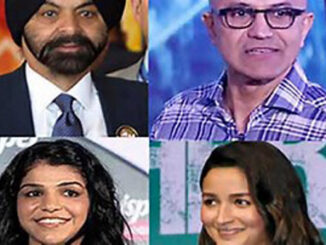
    NEW YORK (TIP): Bollywood star Alia Bhatt, World Bank President Ajay Banga, Microsoft CEO Satya Nadella, and British actor with Indian roots, Dev Patel, have made it to Time magazine’s ‘100 Most Influential People’ list for 2024. Another prominent Indian who features in the list is wrestler Sakshi Malik, India’s only female Olympic medalist who led the protest against the alleged sexual harassment of female grapplers by former Wrestling Federation of India (WFI) chief Brij Bhushan Sharan Singh.
    “Proud to be included in the 2024 #TIME100 list,” Sakshi wrote on X.
    Tom Harper, the director of the streaming film ‘Heart of Stone’, Alia’s first Hollywood project, heaped praises on the actress, calling her a “truly international star”.
    “Despite her fame, Alia is self-effacing and funny on sets. There is a grace to the way she goes about her work: focused, open to ideas, and willing to take creative risks. One of my favorite moments in the film came from an improvisation at the end of a take where she took the emotional thread and ran with it.
    “Alia’s superpower is her ability to mix movie-star magnetism with authenticity and sensitivity. As an actor, she is luminous, and as a person, she brings the grounded assurance and creativity that make a truly international star.”
    Alia is the only Bollywood actor to feature in the Time magazine list.
    The other names with an India connect featured in the list include astronomer Priyamvada Natarajan, senior US Department of Energy official Jigar Shah, and chef and rights activist Asma Khan.
    The also features singer-songwriter Dua Lipa, Oscar-awardee American actress Da’Vine Joy Randolph, and Oscar-nominated actors Jeffrey Wright and Colman Domingo.
    Also featured in the list are film personalities Taraji P Henson, Elliot Page, Michael J. Fox, Sofia Coppola, and Hayao Miyazaki.
    (Source: IANS)

  • Indian-origin CEOs who made headlines in 2023

    Indian-origin CEOs who made headlines in 2023

    Microsoft CEO Satya Nadella’s much-talked-about coup by hiring OpenAI’s Sam Altman shone the spotlight on how a good leader can make the best out of a difficult situation. The lesson in leadership was admired by global business leaders. Like Nadella, other Indian-origin CEOs made headlines in 2023, here’s a breakdown of some of them.
    Satya Nadella, Microsoft
    After OpenAI CEO Sam Altman was abruptly fired by the company board, Microsoft CEO Satya Nadella pounced on the opportunity to bring him aboard. He announced that Altman and OpenAI co-founder Greg Brockman will be joining Microsoft to head a new advanced AI research team. Later, as events unfolded, Sam Altman was reinstated as the CEO of OpenAI. Responding to the development, Nadella told Bloomberg TV it doesn’t matter where Altman ends up working — because “irrespective of where Sam is, he’s working with Microsoft.” The tech giant is an investor in OpenAI, pouring $10 billion into the AI startup.
    Sundar Pichai, Alphabet

    Alphabet and Google CEO Sundar Pichai made headlines for the layoffs in the company and for the antitrust trial between Google and Fortnite developer Epic Games, which has accused the internet search giant of abusive, monopolistic practices via its app store. Pichai asserted that Google does not intentionally stifle competition when it came to the multiple rounds of layoffs in the company, Pichai stated, “Clearly it’s not the right way to do it. I think it’s something we could have done differently for sure.”
    Vishal Garg, Better.com
    The Better.com CEO made headlines in 2021 by laying off 900 employees over a Zoom call. In 2022, the company gave its employees in India the option to quit voluntarily and accepted over 900 resignations. Continuing the trend, in 2023, Vishal Garg laid off its entire real estate team and shut down the unit, according to a report by TechCrunch. In an interview with the publication, Garg said he underwent a lot of leadership training to rebuild the trust within and outside the company.
    Shantanu Narayen, Adobe
    The Adobe CEO recently made headlines after the company shelved its $20 billion cash-and-stock deal for cloud-based designer platform Figma, stating that there was “no clear path” for approvals from antitrust regulators in the European Union and the UK. Shantanu Narayen also made news when he did not agree with Infosys founder Narayan Murthy that young Indians should work 70 hours a week for the sake of the country’s development. “People should do what they want without taking the victim mentality –that I am being told what to do,” he said.
    Ajay Pal Banga, World Bank

    Indian-origin Ajay Banga made headlines earlier this year after being announced as the World Bank president. In May, the World Bank’s 25-member executive board elected Banga to a five-year term as president. Earlier in his career, Banga also led Mastercard as its COO and CEO. In 2016, he was also conferred with the Padma Shri for his contribution to trade and industry.
    Arvind Krishna, IBM
    As employers and employees tussle with the return to office mandate, IBM CEO Arvind Krishna made news after he issued a warning to his employees that remote work can hurt their career prospects, especially for managerial roles. The IIT Kanpur alumnus said he is not asking anyone to come back to the office now, but “We encourage you to come in, we expect you to come in, we want you to come in.”
    Parag Agrawal
    The former CEO of Twitter, now X, made headlines after Elon Musk released his autobiography. In it, Parag Agrawal’s ex-boss said that he lacked leadership qualities. Musk revealed that he met Agrawal over dinner before he bought Twitter and concluded that he did not have “leadership quality”. “He’s a really nice guy. What Twitter needs is a fire-breathing dragon and Parag is not that,” Musk reportedly said after meeting with Agrawal.

  • Google, Meta, Amazon hiring low-paid H1B workers after US layoffs: report

    Google, Meta, Amazon hiring low-paid H1B workers after US layoffs: report

    According to a report, Google swiftly filed H1B visa applications for international H1B hires, including software engineers, consultants, researchers, and various other roles, just a month after Sundar Pichai’s announcement of the company’s plan to cut 12,000 jobs.

    SAN FRANCISCO (TIP): Even as global tech giants are carrying out mass layoffs, several top Silicon Valley companies are reportedly looking to hire lower-paid tech workers from foreign countries. Google, Meta, Amazon, Microsoft, Zoom, Salesforce and Palantir have applied for thousands of H1B worker visas this year, according to a US Department of Labor data, reported independent investigative journalist Lee Fang.

    Ironically, thousands of workers on H1B visa, including Indians, have been affected by the layoffs in the United States, with many taking to social media to share the news and seek new opportunities.

    Just a month after Sundar Pichai announced Google’s plan to cut 12,000 jobs around the world in January, the company filed applications for H1B visas to hire software engineers, analytical consultants, user experience researchers and other roles from outside the United States, with several requests aimed for new Google employees to join in August, the report states. Google parent Alphabet owned Waymo too has reportedly filed similar H1B applications to hire engineers. Meta has laid off nearly 25 per cent of its estimated workforce in just a few months in what CEO Mark Zuckerberg has called the company’s “year of efficiency” as the US tech sector continues to downsize. Amazon CEO Andy Jassy in March laid out a plan to cut 9,000 more jobs from the online retail giant’s workforce, following the 18,000 that were axed in January.

    The layoffs account for a smaller percentage of Amazon’s total workforce, which ran up to 1.5 million people in December 2022, than the cuts seen at some other tech giants.
    Jassy told workers that the extra layoffs were necessary as the company seeks to downsize after years of hiring, particularly during the coronavirus pandemic when people turned to the internet for shopping.

    In January, Microsoft said it would eliminate 10,000 jobs, almost 5 per cent of the global workforce, as it braces for a potential recession. In an email to employees, CEO Satya Nadella said, “While we are eliminating roles in some areas, we will continue to hire in key strategic areas.

    (Source: Money Control)

  • Microsoft attempts to cut costs; to lay off 10,000 workers

    Microsoft attempts to cut costs; to lay off 10,000 workers

    The job cuts, which amount to less than 5 percent of the company’s work force, are its largest in roughly eight years

    REDMOND, WA (TIP): Microsoft plans to lay off 10,000 workers, the company said Wednesday, as it looks to trim costs amid economic uncertainty and to refocus on strategic priorities, such as artificial intelligence, a Jan 18 New York Times report says.

    The company employed about 221,000 workers as of the end of June, and the cuts amount to less than 5 percent of its global work force. “These are the kinds the staffrd choices we have made throughout our 47-year history to remain a consequential company in this industry that is unforgiving to anyone who doesn’t adapt to platform shifts,” Satya Nadella, Microsoft’s chief executive, said in a message to staff. The layoffs, which will begin on Wednesday, are the company’s largest in roughly eight years. Mr. Nadella cut about 25,000 jobs over the course of 2014 and 2015 as Microsoft abandoned its ill-fated acquisition of the mobile phone maker Nokia.

    Like other tech companies, Microsoft expanded rapidly during the pandemic. It has hired more than 75,000 people since 2019, seizing on the surge in online services and the expansion of cloud computing.

    Microsoft’s annual revenue grew 58 percent over three years but rising interest rates and the prospect of a recession have tempered the company’s outlook. In the quarter that ended in October, it reported its slowest growth in five years and warned that more tepid results could follow. The changes, including severance and other restructuring expenses, will cost $1.2 billion, Mr. Nadella said. Microsoft is scheduled to report its quarterly earnings on Tuesday.

    The company has been pursuing several expensive bets, including potentially putting another $10 billion into its investment in OpenAI, which makes the explosively popular ChatGPT artificial intelligence system, and a $69 billion acquisition of the video game maker Activision that is facing challenges globally by antitrust regulators.

    Other tech giants have also been reducing costs after several years of breakneck expansion. Amazon is expected to begin a huge round of layoffs on Wednesday as part of its plans to reduce its corporate work force by about 18,000 jobs.

    The business software company Salesforce said this month that it planned to lay off 10 percent of its work force, or about 8,000 employees; and Meta, the parent company of Facebook, announced at the end of last year that it was cutting more than 11,000 jobs.

    (Source: NY Times)

  • Indian AmericanSatya Nadella, CEO of Microsoft, wins C.K. Prahalad Award

    Indian AmericanSatya Nadella, CEO of Microsoft, wins C.K. Prahalad Award

    AUSTIN, TX (TIP): Four of Microsoft’s top leaders have received the 2021 C.K. Prahalad Award for their collaborative leadership to transform it into a carbon negative company by 2030 and remove all its historical emissions by 2050.

    Besides the software giant’s Indian American CEO Satya Nadella, its President and Vice Chair Brad Smith, Chief Financial Officer Amy Hood, and Chief Environmental Officer Lucas Joppa have shared the award for Global Business Sustainability Leadership.

    The award for leadership by an individual executive went to Ecolab Chairman and former CEO, Douglas M. Baker, Jr. for his efforts to educate the business community about corporate responsibility and the business risks of global water scarcity and the need to account for the true value of water in financial decision making.

    The awards in the two categories were announced October 12 at the 2021 CEF Annual Leadership Retreat in Austin, Texas, attended by senior executives representing CEF members from Fortune and Global 500 companies with combined revenues of $4 trillion driving sustainability strategy and innovation worldwide. The Award created in 2010 to honor founding CEF Advisory Board member C.K. Prahalad recognizes winners for exemplifying the fundamental connection between sustainability, innovation and long-term business success in a globalizing world.

    CEF Founder MR Rangaswami explained what set the Microsoft team’s approach apart.

    “Nadella, Hood, Smith and Joppa have exhibited a remarkable level of joint ownership of this moonshot initiative,” he said. “This is the first time we’ve seen a CEO/President/CFO/Environmental Sustainability coalition like this.”

    “They’ve defined a new model for what corporate-wide climate leadership looks like while sending a clear message that sustainability is core to Microsoft’s business strategy for the decades ahead.”

    With this team at the helm, Microsoft is moving aggressively to advance its vision to make a positive impact globally on the climate, while proving that such steps can also be good for business, the citation noted.

    By 2025, the company will shift to 100% renewable energy for its data centers, buildings, and campuses, and it will protect more land than its operations use. By 2030, it will match 100% of its electricity consumption, 100% of the time, with zero-carbon energy purchases – and will push beyond that to actually become carbon negative: to remove more carbon from the environment than the company emits.

    “Their approach is holistic, connecting the dots to other aspects of planetary health – including a commitment to replenish more water than the company uses – a goal known as ‘water positive’ – and a pledge to achieve zero waste for its direct operations, products and packaging,” CEF noted. The team has led Microsoft to look beyond the company’s own walls to create the enabling environment for change at scale.

    The company has set up a $1 billion Climate Innovation Fund to help accelerate the global development of carbon reduction, capture, and removal technologies.

    It is also building a Planetary Computer platform to help monitor, model, and manage Earth’s natural systems.

    Beyond that, Microsoft has co-founded a new Green Software Foundation to help reduce emissions within the software industry by 45% by 2030, working with co-founders Accenture, GitHub, and ThoughtWorks to develop new standards, tools, and leading practices.

    Celebrating Baker’s leadership during his tenure as CEO from 2004 to 2021, CEF noted he believed business had an imperative to act to ensure the world’s future prosperity through sustainable innovation and collaboration.

    Under his leadership, Ecolab became one of the largest water management companies in the world and more than tripled its net sales, while focused on sustainability, water management and carbon reduction.

    Under Baker’s leadership, Ecolab joined the Business Ambition for 1.5⁰C, pledging to reduce its emissions by 50% by 2030 and to net-zero by 2050, and led the way in the formation of the Water Resilience Coalition, an initiative of the UN Global Compact CEO Water Mandate.

    Baker proved that foresight about water and climate risks was critical to business success. The company helped its customers in more than 170 countries conserve 206 billion gallons of water in 2020, equivalent to the annual drinking water needs of 712 million people.

    And Ecolab is on track to achieve its goal of saving 300 billion gallons of water—enough for one billion people—by 2030, CEF said.

    In 2020, Ecolab also helped customers avoid 3.5 million metric tons of GHG emissions, provide safe food for 1.3 billion people and prevent 1.8 million infections.

    Baker has received several awards for his leadership: In 2019, he was named one of the 100 best-performing CEOs by Harvard Business Review for the fifth year in a row.

    In 2018, he received the Deming Cup for Operational Excellence and accepted The World Environment Center’s Gold Medal for International Corporate Achievement in Sustainable Development on behalf of Ecolab. In 2014, Baker was named Responsible CEO of the Year by Corporate Responsibility Magazine.

    CEF’s Chair and Co-Founder P.J. Simmons expressed his appreciation for Baker: “Doug has always been a visionary leader, putting sustainability at the heart of his company’s growth strategy. He truly exemplifies the principles C.K. Prahalad espoused and offers an inspiring example of how to lead a company during these tumultuous times.”

    “Water is one of the world’s most precious resources and vital to the health of society and industry,” said Baker. “I am honored to receive this award from CEF, and I accept it on behalf of the entire Ecolab team and their vision and motivation to promote responsible water use.”

  • Microsoft names CEO Satya Nadella as chairman

    Microsoft names CEO Satya Nadella as chairman

    Microsoft Corp on Wednesday, June 16, named Chief Executive Officer Satya Nadella as its new chairman, in place of John Thompson.

    Nadella, who took over as CEO in 2014 from Steve Ballmer, has been instrumental in scaling up its business including billion-dollar acquisitions like LinkedIn, Nuance Communications and ZeniMax.

    The company said Thompson, who took over as chairman from the software giant’s co-founder Bill Gates in 2014, will serve as lead independent director.

    The top-level executive change comes just over a year after Gates stepped down from the board, saying he would focus on philanthropic works of the Bill and Melinda Gates Foundation, one of the world’s biggest charities.

    The company had last month said it conducted a probe into Gates’ involvement with an employee almost 20 years ago after it was told in 2019 that he had tried to start a romantic relationship with the person.

    Microsoft had declined to comment on whether its board had decided Gates should go.

    The company also declared a quarterly dividend of 56 cents per share payable September 9.

  • “India deserves our attention right now”: Sundar Pichai

    “India deserves our attention right now”: Sundar Pichai

    SAN JOSE (TIP): Witnessing the “heartbreaking” Covid-19 crisis in India amid a deadly second wave, Google’s Indian American CEO Sundar Pichai would like other US companies to also come forward to help in a coordinated way.

    “India deserves our attention right now,” Pichai told media Wednesday, April 28 discussing how his company is responding and what others can similarly do to lend support.

    Pichai, who became head of Google’s parent company Alphabet in 2019, and Microsoft’s Indian American CEO Satya Nadella publicly pledged Monday, April 26 to help battle the surge of coronavirus cases.

    “The situation there is dire, and it’s been heartbreaking to see. I think the worst is yet to come,” he said on witnessing the unfolding crisis in India from afar.”

    “Being here, seeing the attention here, I realize at the highest levels from President (Joe) Biden, Secretary (of State Antony) Blinken — there’s been focus on seeing how we can help India and the other countries being affected.”

    “From our side, we really focused on providing the most helpful information,” he said noting there are 600 million people connected to the internet and they’re looking for information about vaccine and testing.

    “So, working with the Ministry of Health in India, making sure we can get the right information on the ground has been a big focus for us.”

    “As for us partnering with NGOs and public health organizations to get the messaging out,” Pichai said, “It’s important that people are able to stay home and mask and stay safe. So, we’re helping get the message out in partnership.”

    Other companies can similarly take their expertise where they “can and being ready to help in a coordinated way is going to be helpful,” he said. “The second, it’s very possible to provide cash and other resources to organizations on the ground I think can make a big difference.”

    Asked about vaccine supply and a possible intellectual property waiver, Pichai said he was more involved in the conversations around providing raw materials, supply access so India can begin manufacturing its vaccines.

    “I’m not familiar enough around the issues around IP to weigh in on them” he said. “I was encouraged by the AstraZeneca doses to India.

    “This pandemic will involve us tackling it globally. The US, we’re very fortunate. We need to work hard to make sure we can get access to vaccine supply around the world as soon as possible,” Pichai said.

    On Indian Prime Minister Narendra Modi’s handling of the pandemic, Pichai said, “If you look around the world, Covid has been humbling in the sense that, when you think you’re on top of it, there can be a surge back.”

    “I think encouraging good public safety measures and paying attention to crisis is the only thing you can do in the short term. That’s the effort I’m seeing,” he said adding, “As a company, we stand by ready to help.”

    Commenting on recent take-down requests from the Modi government over critical pandemic posts on Twitter, Facebook, Pichai said, “Normally we do comply with local laws, particularly in democratic countries which through their norms and processes have passed laws.”

    “I think one of India’s strengths is a deeply rooted democratic tradition, based in freedom of expression and allowing for diversity of viewpoints,” he said. “That’s a strength.”

    “We haven’t had any requests,” Pichai said, In the past we’ve been able to work constructively with governments around the world, and we’ll continue that approach here.”