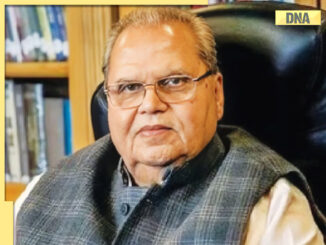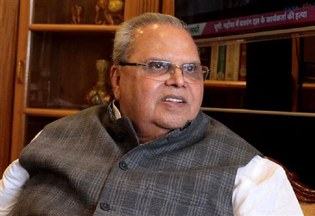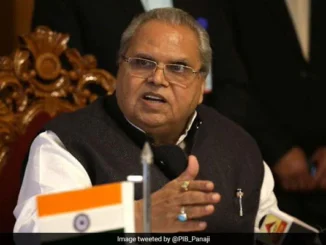
A well-known politician and former Governor, Satya Pal Malik, has died. He was sick for some time. I had known him from Meerut College, Meerut where in 1967 I was teaching English to postgraduate students and Satya Pal Malik was studying law. He was a students’ union leader. We met as adversaries , he representing a students’ issue and I representing the college as a Proctor under principal Puri who a year later became the first vice chancellor of Meerut University. We soon became friends.
A few months later, English was made optional by the Sanyukta Vidhayak Dal ( SVD) government headed by Chaudhari Charan Singh . The then Jan Sangh ( now BJP) was a part of the government. The party was in favor of doing away with English as a compulsory subject in the colleges. And it was a SVD manifesto promise that English will be made an optional subject if the SVD came to power. Jan Sangh got the education portfolio and its Minister Ram Prakash lost no time to make English an optional subject. As a result, thousands of students dropped English as a subject. And overnight hundreds of teachers of English in the colleges of the State of Uttar Pradesh were retrenched. I was one of them. So, at the end of the year 1967 I moved out of Meerut. For some time, I had occasional contact with Mr. Malik. But when in 1973 I moved to Ludhiana in Punjab I lost touch with him.
I have known him as a fearless champion of students’ rights. He was a popular students leader because of his determined stand in favor of students. And it was decades later evident in his stand for the farmers. He risked his political career but stood for what he felt was right . Even when the BJP government harassed him he stood his ground.
I admired the man for what he was- a courageous person who never hesitated to call a spade a spade. There are very few like him to be found in the self-interest- driven world of politicians today. Hats off to Mr. Satya Pal Malik. He will always be an inspiration to the young people who want to follow the path of righteousness and defend the weak and the oppressed against tyranny of the system and the rulers.
Mr. Malik’s body is gone but he lives on in his ideals which all right-thinking people will continue to cherish.
Satya Pal Malik was born on 24 July 1946 in Hisawada village, Meerut district (now Baghpat), Uttar Pradesh—into a modest Jat family led by father Budh Singh.
From an early age, Malik was drawn to the socialist ideals espoused by Dr. Ram Manohar Lohia, a connection that shaped his worldview and political aspirations.
As a student at Meerut University, Malik emerged as a vocal leader, serving as President of the Meerut College Students Union (1966–67) and President of the Meerut University Students Union (1968–69)
These formative years solidified his commitment to activism and drove him toward public life.
Entry into Electoral Politics
Malik’s first electoral victory came in 1974, when he won as MLA from Baghpat on a Bharatiya Kranti Dal ticket, affiliated with Chaudhary Charan Singh. With 42.4% of the vote, he led over his CPI rival.
He soon became the Chief Whip of his party in the Assembly and later rose to be the General Secretary of the Lok Dal.
“Whether I survive or not, I want to tell the truth to my fellow countrymen.”
At the national level, Malik served in the Rajya Sabha from 1980–89, across two terms.
He then transitioned to the Lok Sabha, representing Aligarh (1989–91) under the Janata Dal banner. During this time, he held the post of Union Minister of State for Parliamentary Affairs and Tourism (Apr–Nov 1990)
A later attempt in 1996 on an SP ticket resulted in defeat, where he was placed fourth with around 40,789 votes.
In 1984, amidst political unrest triggered by the Bofors scandal, Malik joined the Indian National Congress, taking charge as General Secretary of the UP Congress.
He departed the party in 1987, disillusioned by political developments, and helped launch Jan Morcha, eventually merging with Janata Dal
A pivotal shift came in 2004, when Malik entered the Bharatiya Janata Party, later rising to be its national vice-president by 2012. He notably led the BJP Kisan Morcha, cementing his reputation as a champion of farmers.
Governor of Five States: Bihar to Meghalaya
“If there is no MSP (Minimum Support Price), farmers will be ruined.”
From 2017 to 2022, Malik held the constitutional charge of Governor in five Indian states:
Bihar (Sep 2017–Mar 2018)
Odisha (Mar–May 2018; additional charge)
Jammu & Kashmir (Aug 2018–Oct 2019)
Goa (Nov 2019–Aug 2020)
Meghalaya (Aug 2020–Oct 2022)
His most defining—and controversial—assignment was as the 10th and final Governor of Jammu & Kashmir. His term coincided with the abrogation of Article 370 in August 2019, which revoked the region’s special status and bifurcated it into two Union Territories
That day—5 August 2019—remained a political watershed, making Malik a central figure in modern Indian constitutional history.
Voice of Dissent and Controversy
Post-governorship, Malik did not fade into silence. Rather, he became a vocal critic of government policy on several fronts.
Farmers’ protests. He supported farmers against the Modi government’s policies, which he termed as anti-farmers, and urged farmers not to return “humiliated”.
Pulwama attack (2023).
In a revealing interview, he asserted that PM Modi and NSA Ajit Doval discouraged him from raising security concerns—specifically that air transport denial contributed to the tragedy. He also cited how a vehicle laden with 300 kg of RDX went undetected—alleging a security lapse.
These statements intensified his public image as an outspoken critic, willing to confront uncomfortable truths.
Legal Troubles
The final chapter of Malik’s career was marred by legal controversy. On 25 May 2025, the Central Bureau of Investigation (CBI) filed a chargesheet implicating him and others in alleged corruption related to the ₹2,200-crore Kiru Hydroelectric Project in J&K. The matter cast a shadow over his legacy, blending the narratives of public service and suspicion.Malik’s health deteriorated over several years, impacted by diabetic kidney disease, hypertension, morbid obesity, and sleep apnea.
“A section of the rich in India do not contribute to charity, so they are like rotten potatoes for me.”
He was admitted to Delhi’s Ram Manohar Lohia Hospital on 11 May 2025, where he developed urinary tract infection, septic shock, hospital-acquired pneumonia, and multi-organ dysfunction. Despite ventilator support, antibiotics, dialysis, and other interventions—including battling disseminated intravascular coagulation (DIC) and acute-on-chronic kidney failure—his condition worsened, and he passed away at 1:10 pm on 5 August 2025—coinciding poignantly with the sixth anniversary of the abrogation of Article 370
Tributes flowed in from across the political spectrum. Mamata Banerjee praised him for speaking “unpleasant truths” and saluted his courage. Others recognized his advocacy, especially for farmers and transparency.
Legacy of Satya Pal Malik
Satya Pal Malik’s nearly eight-decade life was anything but ordinary. His journey—from a village in western Uttar Pradesh to the corridors of Janata Dal, Congress, and BJP—mirrored India’s shifting political terrain. As a student leader, parliamentarian, governor, and outspoken elder statesman, he left indelible marks on the political and constitutional anatomy of the nation.
While his tenure in Jammu & Kashmir will be remembered for constitutional upheaval, it also exposed his willingness to confront statecraft’s most fraught challenges. His later years, characterized by dissent and a measure of public rebellion, showcased a figure both respected and contentious.
Malik’s legacy remains complex: a tapestry of grassroots commitment, constitutional authority, personal controversy, and ideological candor. His life illuminates the possibilities—and pitfalls—of long-term public engagement. And as India reflects on his passing, his multifaceted story underscores the enduring tensions between power, principle, and the relentless evolution of political life.
NEW DELHI (TIP): The Central Bureau of Investigation (CBI) has filed a chargesheet against former Jammu and Kashmir Governor Satya Pal Malik and seven others in connection with alleged irregularities in the award of civil works contracts worth over Rs 2,200 crore for the Kiru Hydroelectric Power Project in Kishtwar.
The case, which dates back to Malik’s tenure as Governor between August 2018 and October 2019, centers on the suspected manipulation of the tendering process by top officials and private entities involved in the project.
The CBI had registered an FIR and launched an investigation in April 2022 following public statements made by Malik claiming that he was offered Rs 300 crore in bribe to clear two controversial files — one of which was linked to the project.
In February 2024, the CBI had carried out raids on more than 30 locations, including Malik’s residences in Delhi and Jammu and Kashmir as well as the premises of his close aides and officials associated with the project.
In the FIR, the CBI had claimed that the protocol of opting for transparent re-tendering through e-procurement and reverse auction was not followed despite a resolution at the 47th board meeting of Chenab Valley Power Projects Pvt Ltd. (CVPPPL) — the agency overseeing the project. Instead, the contract was directly awarded to Patel Engineering Ltd, raising serious questions about procedural violations and favoritism.
During investigation, several individuals, including former CVPPPL chairman Navin Kumar Chaudhary and former officials MS Babu, MK Mittal and Arun Kumar Mishra, came under scrutiny.
After three years of probe, the central agency submitted its findings in the chargesheet before a special court in Jammu. Patel Engineering Ltd, the company that ultimately secured the lucrative contract, has also been named in it.
Meanwhile, Malik in a message on X said he was admitted to the hospital and not in a condition to talk to anyone. The former governor said he was getting calls from many well-wishers which he was unable to take.
(Source: TNS)
On Prime Minister Narendra’s Announcement of repeal of farm laws
Prof Indrajit S Saluja
After remaining adamant for more than a year on not repealing the farm laws, Prime Minister Narendra Modi acknowledged in his address to the nation on November 19th, the 552nd birth anniversary of the First Master of the Sikhs Shri Guru Nanak Dev Ji, that there was widespread resentment among the farmers over the farm laws , and announced the laws will be repealed. Hopefully, the announcement will end a painful period in the lives of the farmers of India who lost 700 of their brethren during a year and a half of protest against the farm laws, besides untold suffering the protesters and their families went through.
One man who with his plain-speak has endeared himself to farmers and all right thinking people across the world is Satya Pal Malik, Governor of Meghalaya who despite being a Modi appointee, warned Modi government of consequences of having a confrontation with the farmers, and always asserted that he would prefer to stand with the farmers rather than stay glued to his cushy job.
The farmers’ protest has united the farmers over a large part of north India. A number of leaders, including Rakesh Tikait, have emerged as potential power centers and have all the opportunity to lead farmers to political power. It is well to recall the well-known and strong leaders like Chaudhary Charan Singh in Uttar Pradesh and Devi Lal in Haryana who wielded political power on the strength of the farming community that they belonged to.
Indians abroad must be feeling vindicated for their support to the protesting farmers in India. Some of them including Darshan Singh Dhaliwal in the US had their OCI cards revoked and they were not allowed to enter India for their support to protesting farmers. Government of India should now restore their OCI cards and visas and welcome them to India. And this decision should be taken now.
Good to see sanity prevail.
Happy Guru Nanak Jayanti!
Signup to our Newsletter!
Don’t miss out on all the happenings around the world