
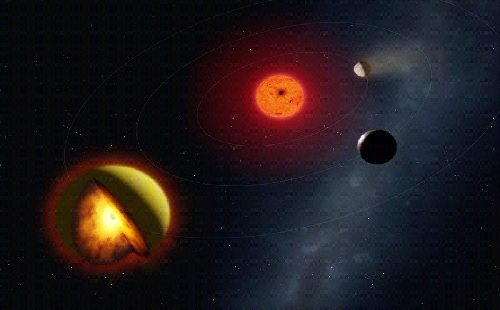

Astronomers have spotted a planet orbiting a star in our neighbourhood of the Milky Way galaxy that presents a unique hellscape — covered with a perpetual ocean of magma and enveloped by a noxious and fiercely hot sulfur-rich atmosphere.
The molten planet’s diameter is more than 60 per cent greater than Earth, though its density is only about 40 per cent that of our planet.
It orbits a star smaller and dimmer than the sun located about 34 light-years from Earth in the constellation Volans. A light-year is the distance light travels in a year, 5.9 trillion miles (9.5 trillion km).
“The planet lacks distinct structure within its magma ocean, so there is no crust, upper mantle and lower mantle. The magma ocean is a single deep, mushy layer,” said Harrison Nicholls, a postdoctoral researcher at the University of Cambridge Institute of Astronomy and lead author of the research published in the journal Nature Astronomy.
Small crystals of solid rock may be trapped within the turbulent fluid magma comprising the mantle, Nicholls said.
The planet’s metallic core appears to be relatively small, with the magma ocean comprising 70-90 per cent of the planetary interior radius — reaching a depth between 2,775 and 3,565 miles (4,465-5,740 km).
Its thick atmosphere is composed primarily of hydrogen, but has a very high sulfur content. About 10 per cent of the atmosphere is the toxic gas hydrogen sulfide, which gives off the stench of rotten eggs. The atmosphere has caused a runaway greenhouse effect, trapping heat from the star, that keeps the planet’s surface so hot that it remains molten.
“Your nose can smell hydrogen sulfide at concentrations of something like one part per billion, so this would be overwhelmingly stinky. But you wouldn’t survive long enough in this hot atmosphere to notice,” said planetary scientist and study co-author Raymond Pierrehumbert of the University of Oxford and Massachusetts Institute of Technology. The atmosphere’s composition suggests a high sulfur content in the planetary interior, the researchers said.


6 Trackbacks / Pingbacks