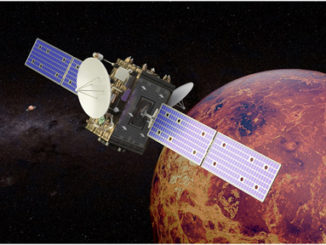
Telecommunications tycoon Sunil Mittal said the satellite startup he rescued from bankruptcy with the U.K. government will be offering global broadband services within 18 months.
The new target for OneWeb heats up a space race against two other billionaire entrepreneurs who are rushing to offer internet from low-earth orbit satellites — Space Exploration Technologies Corp. founder Elon Musk and Amazon.com Inc. founder Jeff Bezos.
”By May-June of 2022, which is less than 18 months, OneWeb’s constellation will cover the entire globe, every square inch of this world,” the founder and chairman of Bharti Enterprises said Wednesday at a conference hosted by the United Nations’ International Telecommunication Union and Saudi Arabian communication regulator CITC.
The much-awaited Halo Infinite will officially be launching in the fall of 2021. The announcement about the game was made by developers 343 Industries via a blog post.
Halo Infinite was initially supposed to launch alongside the Xbox Series X and the Xbox Series S in November this year, but was delayed to 2021 August party because of the “challenges created by Covid-19 pandemic”.
However, since Microsoft has not specified which month it is launching, the fall 2021 window pretty much means that Halo Infinite is delayed by almost an entire year from its original release date.
Keeping a track of all your liked (heart) or favorite photos on both Google Photos and Apple Photos apps can be a task. So, Google is making it better and easier. Now, when you favourite or ‘Like’ a pic in Google Photos, it does the same to the pic that is saved in Apple Photos. You can do this by navigating to your profile photo on the top right > Photos Settings > Apple Photos > Sync favourites. Once the toggle is enabled, all those images that are favourited (heart) in Apple Photos camera roll, will be favorited in Google Photos and vice versa.
LONDON (TIP): Indian – Origin Alok Sharma, UK Secretary of State for Business, Energy and Industrial Strategy, on Wednesday, September 16, confirmed a GBP 1-million government investment to be divided between seven companies to tackle the dangers presented by space debris to satellites of everyday importance.
The seven projects will develop new sensor technology or artificial intelligence (AI) to monitor hazardous space debris.
As part of a wider strategy, the UK Space Agency has signed a formal agreement with the Ministry of Defense (MoD) to work together on monitoring threats and hazards in orbit and track so-called “space junk” which could also pose a threat to the International Space Station (ISS) and its crew.
“Millions of pieces of space junk orbiting the earth present a significant threat to UK satellite systems which provide the vital services that we all take for granted – from mobile communications to weather forecasting,” said Mr Sharma.
“By developing new AI and sensor technology, the seven pioneering space projects we are backing today will significantly strengthen the UK’s capabilities to monitor these hazardous space objects, helping to create new jobs and protect the services we rely on in our everyday lives,” the India-born minister said.
Estimates of the amount of space debris in orbit vary, from around 900,000 pieces of space junk larger than 1 cm to over 160 million orbital objects in total.
Only a fraction of this debris can currently be tracked and avoided by working satellites. The UK government says it has a significant opportunity to benefit from the new age of satellite mega constellations — vast networks made up of hundreds or even thousands of spacecrafts — so it is more important than ever to effectively track this debris.
“People probably do not realize just how cluttered space is. You would never let a car drive down a motorway full of broken glass and wreckages, and yet this is what satellites and the space station have to navigate every day in their orbital lanes,” said Graham Turnock, Chief Executive of the UK Space Agency.
“In this new age of space mega constellations the UK has an unmissable opportunity to lead the way in monitoring and tackling this space junk. This funding will help us grasp this opportunity and in doing so create sought after expertise and new high skill jobs across the country,” he said.
The projects being offered the new funding include Lift Me Off, who will develop and test machine learning algorithms to distinguish between satellites and space debris, and Fujitsu who are combining machine learning and quantum inspired processing to improve mission planning to remove debris.
Two companies, Deimos and Northern Space and Security, will develop new optical sensors to track space objects from the UK whilst Andor, based in Northern Ireland, will enhance their astronomy camera to track and map ever smaller sized debris.
D-Orbit UK will use a space-based sensor on their recently launched satellite platform to capture images of space objects and couple this with Passive Bistatic radar techniques developed by the University of Strathclyde.
And, new satellite laser ranging technologies will be researched by Lumi Space to precisely track smaller space objects.
The UK Space Agency revealed that last year there was a close call in which a GBP 100 million spacecraft operated by the European Space Agency (ESA) had to light up its thrusters to dodge a satellite.
A clash between the spacecraft was far from certain, but the trajectories posed enough of a threat that ESA concluded that they needed to maneuver the spacecraft out of harm’s way.
The new civil and military collaboration between the UK Space Agency and MoD to work together on space domain awareness aims to bring together data and analysis from defense, civil and commercial space users to better understand what is happening in orbit to ensure the safety and security of UK licensed satellites.
Space surveillance and tracking (SST) is a growing international market, which consultants Euroconsult and London Economics forecast could potentially reach over GBP 100 million.
The UK Space Agency believes that as a world-leader in small satellite technology, telecommunications, robotics and Earth observation, the UK could work alongside global allies, such as the US, to support continued work to enhance space sustainability.
NEW DELHI /NEW YORK(TIP): On July 22 India created history when India’s Geosynchronous Satellite Launch Vehicle GSLV MkIII-M1, successfully launched the 3840 kgChandrayaan-2 spacecraftinto an earth orbit. Launch of Chandrayaan-2 was originally scheduled for 14 July 2019 at 21:21 UTC (15 July 2019 2:51 IST) but was called off due to a technical snag noticed while filling the cryogenic engine of the rocket with helium. Developed by the Indian Space Research Organisation(ISRO), the mission was launched from the second launch pad at Satish Dhawan Space Centreon 22 July 2019 at 2.43 PM IST (09:13 UTC) to the Moon.
Chandrayaan 2 Indian lunar mission will boldly go where no country has ever gone before — the Moon’s south polar region. Through this effort, the aim is to improve our understanding of the Moon — discoveries that will benefit India and humanity as a whole. These insights and experiences aim at a paradigm shift in how lunar expeditions are approached for years to come — propelling further voyages into the farthest frontiers.
Chandrayaan 2 is:
1stspace mission to conduct a soft landing on the Moon’s south polar region
1stIndian expedition to attempt a soft landing on the lunar surface with home-grown technology
1stIndian mission to explore the lunar terrain with home-grown technology
A successful landing would make India 4thcountry ever to soft land on the lunar surface after the space agencies of the USSR, US and China
Prime Minister Narendra Modi congratulated Team ISRO for the successful launch of Chandrayaan-2.
ISRO Chairman Dr K Sivan congratulated the launch vehicle and satellite teams involved in this challenging mission. “Today is a historical day for Space Science and Technology in India. I am extremely happy to announce that GSLV MkIII-M1 successfully injected Chandrayaan-2 into an orbit of 6000 Km more than the intended orbit and is better.”
“Today is the beginning of the historical journey of India towards Moon and to land at a place near south pole to carry out scientific experiments to explore the unexplored. On July 15, 2019 ISRO intelligently observed a technical snag, Team ISRO worked out, fixed and corrected the snag within 24 hours. For the next one and a half day, the required tests were conducted to ensure that corrections made were proper and in right direction. Today ISRO bounced back with flying colours.” Dr. Sivan said.
The Moon is the closest cosmic body at which space discovery can be attempted and documented. It is also a promising test bed to demonstrate technologies required for deep-space missions. Chandrayaan 2 attempts to foster a new age of discovery, increase our understanding of space, stimulate the advancement of technology, promote global alliances, and inspire a future generation of explorers and scientists.
Moon provides the best linkage to Earth’s early history. It offers an undisturbed historical record of the inner Solar system environment. Though there are a few mature models, the origin of Moon still needs further explanations. Extensive mapping of lunar surface to study variations in lunar surface composition is essential to trace back the origin and evolution of the Moon. Evidence for water molecules discovered by Chandrayaan-1, requires further studies on the extent of water molecule distribution on the surface, below the surface and in the tenuous lunar exosphere to address the origin of water on Moon.
The lunar South Pole is especially interesting because of the lunar surface area here that remains in shadow is much larger than that at the North Pole. There is a possibility of the presence of water in permanently shadowed areas around it. In addition, South Pole region has craters that are cold traps and contain a fossil record of the early Solar System.
Chandrayaan-2 will attempt to soft land the lander -Vikram and rover- Pragyan in a high plain between two craters, Manzinus C and Simpelius N, at a latitude of about 70° south. Chandrayaan-2 is India’s second mission to the moon. It comprises a fully indigenous Orbiter, Lander (Vikram) and Rover (Pragyan). The Rover Pragyan is housed inside Vikram lander.
Former Prime minister Atal Behari Vajpayeeannounced the Chandrayaanproject on course in his Independence Day speech on 15 August 2008. The mission was a major boost to India’s space program. The idea of an Indian scientific mission to the Moon was first mooted in 1999 during a meeting of the Indian Academy of Sciences. The Astronautical Society of India (AeSI) carried forward the idea in 2000. Soon after, the Indian Space Research Organization (ISRO) set up the National Lunar Mission Task Force, which concluded that ISRO has the technical expertise to carry out an Indian mission to the Moon. In April 2003 over 100 eminent Indian scientists in the fields of planetary and space sciences, Earth sciences,physics, chemistry, astronomy, astrophysics and engineering and communication sciences discussed and approved the Task Force recommendation to launch an Indian probe to the Moon. Six months later, in November, the Indian government gave the nod for the mission.
A look at major differences between Chandrayaan-1 which was launched by ISRO in October 2008 and Chandrayaan 2 launched on 22 July 2019
Chandrayaan-1was launched by ISRO in October 2008 and operated until August 2009. The mission included a lunar orbiter and an impactor.India launched the spacecraft using a PSLV-XLrocket, serial number C11, on 22 October 2008 The mission was a major boost to India’s space program,as India researched and developed its own technology in order to explore the Moon. The vehicle was inserted into lunar orbit on 8 November 2008.
Now the whole world is waiting for September 7 – a successful landing of Chandrayaan-2would make India 4thcountry ever to soft land on the lunar surface and will boldly go where no country has ever gone before.
NEW YORK(TIP): An Indian-origin scientist is one amongst others to develop an experimental drug that could successfully reverse hair loss, hair whitening and skin inflammation — all previously linked to diets heavy in fat and cholesterol (in mice).
Treatment with D-threo-1-phenyl-2-decanoylamino-3-morpholino-1-propanol (D-PDMP) halts the production of certain fats called glycosphingolipids, or GSLs.
GSLs are major components of skin and other cell membranes and could reverse hair discoloration, extensive hair loss and inflammation of skin exhibited by multiple wounds which result due to high fat diets, the researchers explained.
“Our findings show promise for someday using the drug we developed for skin diseases such as psoriasis, and wounds resulting from diabetes or plastic surgery,” said Subroto Chatterjee from the Johns Hopkins University in Maryland, US.
In the study, published in the journal Scientific Reports, the team fed Western diet high in fat and cholesterol, and standard chow to two groups of mice who had atherosclerosis — a disease in which arteries are clogged by fat deposits.
The analysis said that mice who had Western diet had lost hair, formed skin lesions and suffered from hair whitening as compared to those who ate standard chow.
These results became more severe when the mice continued eating a Western diet for 36 weeks, with 75 per cent of the mice having skin, hair loss and multiple skin lesions.
But, mice who also received 1 mg and 10 mg of D-PDMP in a capsule per kilogram of body weight started regaining hair and hair color, and their skin inflammation reduced.
The drug also significantly reduced the number of neutrophils, implying reduced skin inflammation and wounding.
However, the researchers cautioned that the results in mice do not mean that the same effects would occur in people. But the findings do shed light on possible pathways for addressing hair loss and skin wounds in humans with oral or topical medications, they noted.
Roadmap for Equitable Job Growth in NYC’s Future Tech Hub
QUEENS, NY(TIP): Borough President Melinda Katz, the Western Queens Tech Task Force, Coalition for Queens and HR&A Advisors unveiled the long-anticipated Western Queens Tech Zone Strategic Plan (“Tech Plan”) – entitled Live, Work, Create: A Roadmap for Equitable Growth of the Western Queens Tech Ecosystem – during an event held today at WeWork Queens Plaza in Long Island City. The Tech Plan offers a roadmap for equitable job growth within the tech economy of Western Queens along the East River waterfront. Borough President Katz also announced the formation of the Western Queens Tech Council, charged with implementing the Tech Plan, identifying a tech-driven brand for the area and promoting a coordinated strategy for the tech district.
The Tech Plan identifies strategic opportunities to build upon the area’s burgeoning tech ecosystem and proposes six initiatives to support its future growth as New York City’s future tech hub. The creation of the Tech Plan was first initiated by the Western Queens Tech Task Force in 2011 and funded by the New York State Department of State under Title 11 of the Environmental Protection Fund. The Tech Plan can be viewed in its entirety here.
“Tech jobs, on average, pay more and are growing at a faster clip than jobs citywide,” said Borough President KATZ. “Western Queens offers a coveted, dynamic mixed-use community where workers can live, ideas can synergize, and businesses can thrive. We commissioned the Tech Plan to facilitate a more equitable growth of this emerging global innovation hub and the City’s next leading tech ecosystem. By leveraging its inherent assets, as well as training locally and hiring locally, we will steer our borough into a more competitive lane of the digital age.”
“Through smart development and innovative planning, Western Queens is on the verge of something great,” said ROSSANA ROSADO, New York Secretary of State. “The New York Department of State is proud to have put forth $150,000 toward these important projects that will embrace the growing tech market and promote economic growth across the Borough.”
“As we enter the phases of implementation, our success in reaching the Tech Plan milestones will hinge upon continued engagement from all stakeholders vested in Western Queens’ growth, including those entrusted on the Tech Council,” Borough President KATZ said.
The 21 individuals appointed to the Western Queens Tech Council are: Tristan Bel, NYDesigns; Karen Bhatia, NYC Economic Development; Seth Bornstein, Queens Economic Development Corporation; Tracy Capune, Kaufman Astoria Studios; Carol Conslato, ConEd; Samuel Cooper, Mayor’s Office of Chief Technology Officer; Samantha Dolgoff, NYC Department of Transportation; Commissioner Nicole Garcia, NYC Department of Transportation; Thomas J. Grech, Queens Chamber of Commerce; Jukay Hsu, C4Q; Michael Hulbert, Estee Lauder; Saeed Jabbar, Inclusion; Bill Keller, Queens College; Paula C. Kirby, Plaxall; Debbie Markell Kleinert, Queens Community Board 2; Tara Lannen-Stanton, Queens Library; Elizabeth Lusskin, Long Island City Partnership; Gail Mellow, LaGuardia Community College; Brian Shoicket, Uncubed; Jane Swanson, Cornell NYC Tech; John Young, NYC Department of City Planning.
The Tech Plan’s six initiatives are grouped into three focal points and laid out in immediate, intermediate-term and long-term steps aimed at creating equitable access to tech jobs:
People-Focused Initiatives (supporting talent pool growth and development of robust and stable workforce pipeline):
Prepare disadvantaged residents to succeed in existing tech training programs. Secure federal and state funding to leverage and expand pre-training programs designed to help close gaps between existing tech training programs and Western Queens residents, with an emphasis on supporting people underrepresented in the area’s tech ecosystem.
Strengthen the tech workforce pipeline to better align with job placement opportunities. Build stronger partnerships between City and tech employers to develop a shared understanding of their needs and expand opportunities for on-the-job practical training.
Place-Based Initiatives (fostering the creation of new tech-supportive physical spaces):
Define 300 acres of strategic nodes to focus investment. Create a density of activity to attract and link residents, students and tech firms, boosting the Western Queens tech ecosystem and encouraging informal connections.
Develop a 40,000 – 60,000 square feet physical hub for tech and innovation open to the entire community. Build a central tech hub to expand access to tools, training and affordable office space and increase connections between the tech ecosystem and the broader community.
Programmatic Initiatives (incentivizing tech growth in Western Queens and on clearly articulating the value of the area):
Expand marketing of Western Queens tech opportunities. Create a recognizable brand for Western Queens that leverages its growing tech ecosystem, as well as the many opportunities that the area offers to grow tech businesses, through targeted outreach campaigns for residents and developers.
Customize regulatory tools and incentives to attract more tech firms. Create new economic development tools to incentivize private sector investments and job creation, such as increasing the existent 10-20 percent State tax credit for investments into qualified firms, as well tapping into the NYC Entrepreneurial Investment Fund.
The partners on the Western Queens Tech Task Force who made the Tech Plan possible were: 500 Startups; Association for a Better New York (ABNY); Center for an Urban Future; Citigroup; Coalition for Queens; Con Edison; Cornell Tech; Flux Factory; Google; IBM; Inclusion; JetBlue; Kaufmann Astoria Studios; LaGuardia Community College; Local Data; Long Island City Partnership; Mayor’s Office of Tech and Innovation; Noguchi Museum; NYC Department of Buildings; NYC Department of City Planning; NYC Department of Education; NYC Department of Transportation; NYC Digital; NYC Economic Development Corporation; NYCHA; NYDesigns; NY Tech Meetup; Office of Councilman Jimmy Van Bramer; Ontodia; Open Tech Institute; Partnership for New York City; Plaxall; Queens Chamber of Commerce; Queens College; Queens Community Board 1; Queens Community Board 2; Queens Economic Development Corporation; Queens Public Library System; Queens Vocational & Technical High School; Queensbridge Residents Association; REES Neighborhood Zone (NYCHA); Roosevelt Island; Shapeways; Tech:NYC; TF Cornerstone; Uber; Uncubed; Urban Upbound (ERDA); Verizon.
Follow Borough President Katz via @melindakatz or www.facebook.com/queensbpkatz
Trump has offered India 100% access to all US Technologies and treat India as the closest ally
By Ven Parameswaran
“Close alignment with the US will strengthen India’s national security and protect its sovereignty. China will think twice before threatening to attack India. Future wars will be won by whoever has superior technology”, says the author
The US spends half a trillion dollars a year on scientific research—more than any other nation on Earth—but China has pulled into second place, with the European Union, third and Japan, a distant fourth. China is on track to surpass the US by the end of this year, according to the National Science Board. In 2016, annual scientific publications from China outnumbered those from the US for the first time.
“There seems to be a sea change in how people are talking about Chinese science,” said Alanna Krolikowski, a Chinese science expert at Missouri University of Science and Technology. Foreign observers, many of whom were once condescending, now “are rather in awe at what the Chinese policies have accomplished.”
The scientific advances are a small piece of China’s larger ambitions. President Xi Jinping aims to supplant the USA as the world’s economic superpower within three decades. In October Xi vowed to produce “a world-class army by 2050.” Meanwhile, China is spending more on infrastructure than the US or Europe, and the middle class has ballooned – making relocation more attractive.
India was ahead of China in nuclear development and could have tested before 1964, when China tested. India was foolish to wait for China to test first; and tested only in 1974. The US punished India with severe sanctions. Indian scientists were shut off from all international scientific conventions. India further tested in 1998 and the US punished with more sanctions. Thanks to George W Bush for offering India civil nuclear agreement that lifted the sanctions of 3 decades. India was shut off for 30 years. Nehru may be held responsible for enabling China to advance ahead of India.
There is something dangerously wrong with Indian policies. After 71 years of independence, India is unable to deliver water and electricity 24/7 to all Indians. Why? The Indian Institute of Technology is branded No.1 in the world. At least 50,000 of IIT alumni have settled in the US. As citizens of the USA many of them have performed par excellence in different fields.
Prime Minister Modi must take aggressive steps to transform India from backwardness to modernization. He should liberalize policies to encourage the USA to invest and participate in the Indian economy. Modi physically embraced Trump at the White House. He must follow up by India embracing the US and seek full alignment with the USA. Chester Bowles, American Ambassador to India during Truman’s and Kennedy’s era fell in love with India and recommended a strong partnership with the USA. But Nehru turned down the offer. India pretended nonalignment, but it was aligned with the Soviet Union.
Prime Minister Modi must capitalize on the opportunity President Trump has offered to India in technology, defense, and economic development. If India gives carte blanche to the USA, India will be modernized within the shortest possible time enabling the US to import consumer and industrial products from India instead of from China.Full access to the latest U.S. technology and investing in research and development can make India compete with China. India is the youngest country in the world. India is also the largest English speaking country in the world, second being the USA. India should be able to create huge employment opportunities for its large supply of engineers, scientists and management professionals.
Close alignment with the US will strengthen India’s national security and protect its sovereignty. China will think twice before threatening to attack India. Future wars will be won by whoever has superior technology. In this context, India should continue to align with Israel, besides, of course, its close alignment with the US.
(The author, 64 year resident of USA; MBA, Columbia Business School, is a Diplomat-in-Residence and Senior Adviser to Imagindia Institute. a think tank in New Delhi. He can be reached at vpwaren@gmail.com)
NEW YORK CITY, NY(TIP): The New York City Department of Citywide Administrative Services (DCAS) will today announce a planned major expansion of the City’s network of electric vehicle (EV) chargers. The City currently operates 500 EV chargers, which are used to charge City government vehicles. It is the largest network of EV chargers for any vehicle fleet in the country, and the City expects to add 100 new chargers. The new chargers will also be the City’s first ‘fast electric vehicle chargers,’ which will keep electric vehicles in continuous use by reducing lengthy charging periods that can take vehicles out of commission. The new chargers can charge vehicles in as little as 15 minutes. Most of these new chargers will be located at existing City-managed fueling locations. This project is expected to be funded by $10 million from the City’s proposed capital budget with construction to begin early next year. The EV expansion is part of a series of announcements to be made today at the City’s 30th Annual Truck and Equipment Show presented by the NYC Parks Department and DCAS at Flushing Meadows Corona Park.
“New York City government has the cleanest and greenest vehicle fleet in the country, and we’re building upon our success by installing 100 new electric vehicle chargers that will significantly decrease charging times,” said Lisette Camilo, Commissioner of the NYC Department of Citywide Administrative Services. “In as little as 15 minutes, we’ll be able to charge environmentally-friendly electric vehicles and get them back on the streets serving the people of New York City.”
Construction of 50 new solar carports. Solar carports capture solar energy to fully charge EVs without any connection to the electric grid. In addition to environmental benefits, the solar carports offer an important resiliency measure if the City were to lose power and need to charge EVs. The City currently operates 37 carports that were put into operation over the last six months.
The City of New York has installed over 12,000 new safety features on City vehicles in the first year of the Vision Zero Safe Fleet Transition Plan. The plan, part of Mayor de Blasio’s Vision Zero initiative to protect the public by reducing injuries and fatalities stemming from traffic collisions, formalized best practices to integrate vehicle safety technologies into City vehicles. Installed safety features include automatic braking systems, rear-view cameras, sideguards that prevent pedestrians and bicyclists from going under large trucks during side-impact collisions, and adaptive headlights, among other technologies.
These advances in greener and safer vehicle technologies are part of record investments in the specialized emergency and heavy fleet units that support NYC government operations. In FY18, over $380 million has been invested in new City fleet vehicles, including 662 sanitation trucks for the City of New York Department of Sanitation. This is the third consecutive year of record investments in the fleet that supports City government agencies. This includes $1.1 billion invested in the last three years alone.
“NYC is one of the nation’s largest procurers of safe and sustainable fleet technology,” said DCAS Deputy Commissioner and NYC Chief Fleet Officer Keith Kerman. “At today’s 30th Fleet Show, we celebrate our latest milestones including 1,500 electric vehicles, our first contract for hybrid police vehicles, expanding electric charging, and the safest fleet we have ever ordered. We thank our partner agencies and our vendors at the show.”
The Department of Citywide Administrative Services (DCAS) ensures that all City agencies have the critical resources and support needed to provide the best possible services to the public. It does this in part by working with City agencies on recruiting, hiring, and training; providing facilities management for 55 public buildings; purchasing, selling, and leasing City property; purchasing more than $1 billion in supplies and equipment annually; and implementing conservation and safety programs throughout they City’s facilities and fleet.
LONDON(TIP): An Indian origin scientist in the UK, Professor Vik Dhillon, is leading a new high-speed space camera project that is expected to revolutionize our understanding of stars and black holes.
Professor Dhillon and his team at University of Sheffield in the UK were joined by experts from around the world on the HiPERCAM project, which involves the creation of a new camera that can take more than 1,000 images per second.
The camera went live on the world’s largest optical telescope, Gran Telescopio Canarias (GTC), this week.
It will take high-speed images of objects in the universe, allowing their rapid brightness variations due to phenomena such as eclipses and explosions to be studied in unprecedented detail.
“The combination of HiPERCAM and the world’s largest telescope provides us with a unique, new view of the universe, which history tells us is when major new discoveries are made. Astronomers are excited to use HiPERCAM on the GTC to start exploring the Universe at high speed,” said Vik Dhillon, Professor of Astrophysics at the University of Sheffield and Affiliated Researcher at the Instituto de Astrofisica de Canarias (IAC).
“Normal cameras installed on large telescopes usually capture only one picture every few minutes. HiPERCAM can take one picture every millisecond. The high speed essentially provides a slow-motion view of rapidly varying celestial objects,” he added.
“The high-speed images are also captured in five different colors simultaneously, which means we can instantly tell the difference between hot stars which are burning at tens of thousands of degrees Celsius and are blue in color – and cooler stars, which appear red and are burning at only a few thousand degrees.”
The pioneering five-year project was funded by a 3.5-million-euro grant from the European Research Council (ERC) and is being conducted in partnership with the Science and Technology Facilities Council’s Astronomy Technology Centre (ATC) and the IAC, along with researchers from the University of Warwick and Durham University in Britain.
The GTC is based on the island of La Palma, situated 2,500 meters above sea level, which is considered one of the best places in the world to study the night sky.
Data captured by the camera, taken in five different colors simultaneously, will let scientists study the remnants of dead stars such as white dwarfs, neutron stars and black holes.
These are key objects within astrophysics as their extreme gravities, densities and pressures allow researchers to test theories of fundamental physics, such as general relativity and quantum mechanics.
By observing objects in the Solar System pass in front of background stars, HiPERCAM will also teach scientists about the sizes and shapes of the minor planets beyond Pluto’s orbit, and whether or not they possess atmospheres, rings and satellites.
“The vital role that STFC and UK universities played in developing HiPERCAM is a testament to the work of our world class scientists,” Britain’s Science and Universities Minister, Sam Gyimah, said.
This game-changing camera that will be installed on the world’s largest telescope will not only deepen our understanding of white dwarfs, neutron stars and black holes in our universe, but it will help maintain our reputation as being a global-leader in research and development.
“It is projects such as these, and collaboration with partners and universities from across the world, which underpins our ambitious modern Industrial Strategy to boost innovation and help create a Britain fit for the future.”
“HiPERCAM was a challenging project that pushed the design team to fit a lot of scientific potential into a small space,” Martin Black, an optical engineer from the Science and Technology Facilities Council’s UK Astronomy Technology Centre (UK ATC) and part of the HiPERCAM team, said.
“The team had to work closely together to ensure everything fit together and to correctly position the cameras to around 30 microns, about the width of a human hair.”
Perhaps by now, Stephen Hawking, who spent a lifetime studying physics and cosmology, has already unlocked the mysteries of the universe. That is, if we go by the theory of God’s existence and the common belief that we get to meet the Creator after death. Or, perhaps, he’s nothing now, after having lived for 76 years. That is, if we go by Stephen Hawking’s conviction that the brain is akin to a computer and you just cease to exist when its parts fail. There is no heaven or afterlife. So, how did the universe come into being? Professor Hawking believed: “Spontaneous creation is the reason there is something.” Both points of view are unsubstantiated. The curiosity to fathom the depth of the universe has been eternal: where do we come from?
It is this quest to know why the universe is as it is and why it exists that had led Hawking to trailblazing breakthroughs in the deep dark world of the cosmos. He earned a name for himself in the scientific community that often regarded him in the same league as Newton and Einstein. This distinction came from the British professor’s theoretical prediction that black holes are not so dense that things cannot escape their gravity, thus debunking the earlier theory on these objects. Scientists christened the thermal radiations theoretically emanating from the black holes as “Hawking radiation”. To explain the origins of the world, the physicist worked on uniting two theories: theory of relativity (the nature of space and time) and quantum theory (how the smallest particles in the universe behave). The common man connected with Hawking’s book, A Brief History of Time (1988), that delves into the ways of the space without jargon. It is an enduring bestseller.
Hawking became a star, with the brilliance of his mind that dazzled, more so because it incredibly overcame a debilitating progressing disease; one that left him wheelchair-bound and paralyzed for most of his life. A true tribute to the genius who pushed the limits of widely accepted truths about our universe as also the daunting diagnosis would be to follow his advocacy: use technology towards a more equitable world order. Meanwhile, the eternal question remains: Where do we come from?
“The only way the U.S. can expand its lead in Science and Technology is by working together with the scientists in India. According to a recent report in the Times of India, India is all set to produce the world’s largest number of engineers. While 85% Indian men have shown interest in engineering, the number stands at a close 79% among women in India”, says the author.
“Science & Engineering Indicators”, a voluminous document, describing the state of American technology was just released by the National Science Foundation and National Science Board. This contains facts and figures on research and development, innovation and engineers. But the report’s startling conclusion lies elsewhere: China has become—or is on the verge of becoming—a scientific and technological superpower.
After all, science and technology constitute the knowledge base for economically advanced societies and military powers, and China aspires to become the world leader in both. Still, the actual numbers are breathtaking for the speed with which they have been realized.
25 years ago, China’s economy was tiny, and its high-tech sector barely existed. Since then, here is what has happened.
China has become the second largest R&D spender, accounting for 21 per cent of the world total of nearly $2 trillion in 2015. Only the U.S., at 26% ranks higher, but if present growth rates continue, China will soon become the biggest spender. From 2000 to 2015, Chinese R&D outlays grew an average of 18% annually, more than 4 times faster than the U.S. rate of 4%.
There has been an explosion of papers on technology by Chinese teams. Although the U.S. and the EU each produce more studies on biomedical subjects, China leads in engineering studies. American papers tend to be cited more often than the Chinese papers, suggesting that they involve more fundamental research questions, but China is catching up.
China has dramatically expanded its technology workforce. From 2000 to 2014, the annual number of bachelor’s degree graduates went from about 359,000 to 1.65 million. Over the same period, the comparable number of U.S. graduates went from 483,000 to 742,000. This includes graduates of Chinese and Indian origin, may be 50%.
Much of China’s high-tech production once consisted of assembling sophisticated components made elsewhere. Now, says the report, it is venturing into demanding areas such as “supercomputers and smaller jetliners.”
China still lags in patents received. Over the past decade, American firms and inventors account for about half the US patents annually. I should point out that there are so many eminent Indian American scientists and technologists who have accumulated large number of patents. 40% of start-ups in the Silicon Valley are started by Indians.
Zero and mathematics were invented in India. Algebra, Trigonometry, and Decimal /Fraction systems were invented in India. Albert Einstein said that without zero there is no computer or internet. The Indian Institute of Technology is the topnotch in the world. A degree from IIT is equal to combined degrees from Harvard, M.I.T. and Princeton stated Leslie Stahl, CBS 60 Minutes anchor after she visited the IIT’s in India. Sir C.V. Raman of Bangalore won a Nobel prize in Physics several centuries ago. So many other Indians have also won the Nobel prize in Science. Professor Ramanujan of Cambridge University, U.K. has made original contributions to advanced mathematics. Laser Technologist, Bhowmik of Los Angeles had 100 patents.
The only way the U.S. can expand its lead in Science and Technology is by working together with the scientists in India. According to a recent report in the Times of India, India is all set to produce the world’s largest number of engineers. While 85% Indian men have shown interest in engineering, the number stands at a close 79% among women in India.
In India, the Software services industry alone recruits about 300,000 people every year. Engineering tops the list of professions seen as most vital for economic growth.
TRUMP OFFERS TO SHARE 100% of U.S. TECHNOLOGY
President Trump has made a huge policy change benefitting India. Trump stated that the US will share 100 per cent of all its technology with India and treat India as its closest ally. This will enable American companies to set up shops in India and allow them to transfer technology to Indians. Because of comparative advantage and availability of large supply of engineers, these American companies in joint venture with Indian companies could contribute to scientific and technological revolution, especially R&D.
I recall that after India first tested nuclear bomb the US imposed heavy sanctions against India. This prevented Indian scientists from attending international conventions. This sanction continued for long and never lifted. Only after President George W Bush’s offer of nuclear civil agreement, such sanctions were removed.
If the U.S. and India work hand in hand, China will find difficult to compete for global leadership in Science and Technology.
(The author, a resident of Scarsdale, NY is a former President & CEO, First Asian Securities Corp, NY. An MBA from Columbia Business School, he is the Chairman, India, National Republican Asian Assembly, Washington D.C, and Senior Vice Chairman, Indian American Republican Committee)
SRIHARIKOTA (TIP): India on Friday, January 12, successfully launched weather observation satellite Cartosat 2 Series and 29 other spacecraft onboard its dependable Polar rocket from here.
The successful orbiting of the satellites by the Polar Satellite Launch Vehicle PSLV C-40 comes four months after the Indian space Research Organisation’s mission to launch backup navigation spacecraft IRNSS-1H onboard PSLV-39 ended in a rare failure.
My heartiest congratulations to @isro and its scientists on the successful launch of PSLV today. This success in the New Year will bring benefits of the country’s rapid strides in space technology to our citizens, farmers, fishermen etc. — Narendra Modi (@narendramodi) January 12, 2018
A jubilant ISRO Chairman A S Kiran Kumar announced that the Cartosat 2 Series satellite, the seventh in the series, a nano satellite and 28 commercial payloads were successfully injected into the orbit one by one by the PSLV C-40, in the space of about 17.33 minutes since lift-off.
A micro satellite of India would be orbited after about 90 minutes following the re-ignition of the fourth stage, Kumar said.
International customer satellites are three micro and 25 nano-satellites from six countries — Canada, Finland, France, Korea, the United Kingdom and the United States of America.
Earlier, at the end of the 28-hours countdown, the 44.4-meter-tall PSLV-C40 in its 42nd flight, lifted off at 9.29 am and soared into a cloudy sky from the first launch pad.
The opening mission of 2018 was considered crucial for ISRO as the previous PSLV launch came as a setback to scientists as the backup navigation satellite IRNSS-1H could not be placed in orbit following a snag in the final leg of the PSLV-C39 mission in August last year.
The heat shield of the rocket did not separate in the final leg of the launch sequence, trapping the satellite in the fourth stage of the rocket.
A visibly relieved Kiran Kumar, on his final mission as the chief of the space agency, said he was happy to provide Cartosat 2 Series as a New Year gift for the country.
“ISRO is starting 2018 with the successful launch… all customer satellites (besides Cartosat and nanosat) released and the microast after one hour. So far Cartosat performance is satisfactory,” he said at the mission control room.
Referring to the previous launch, he said it had heat shield problem and an ISRO committee had addressed it and taken steps to ensure the vehicle was ‘robust’.
NEW DELHI (TIP): India is all set to take a big stride in exports of arms and equipment with the defence ministry in the process of tying up with Saudi Arabia, Jordan, the United Arab Emirates (UAE), Myanmar and Armenia for supply of radars, helicopters and missiles, and tank upgradation by 2018.
South Block sources confirmed deepening of military ties with these countries with high-level delegations interacting with defence ministry and Defence Research and Development Organisation (DRDO) units in Bengaluru this month. For the first time, Saudi Arabia is sending 10 of its nationals for training to become officers at the National Defence Academy (NDA) next year.
The proposed tie-ups assume significance as India is the largest importer of arms in the world but figures nowhere in the list of global arms exporters.
Government sources confirmed that two joint committee meetings have already taken place with Riyadh as the latter is interested in a joint venture to manufacture weapons and equipment in Saudi Arabia.
Facebook-owned WhatsApp has rolled out a new update for its Android app. Bearing version number 2.17.146, the update introduces some user interface changes to the app.
After the update, WhatsApp’s Android app has a separate button for video calling. The placement of the attachment button has also been changed. A new video calling button is placed next to the voice calling button, on the top left corner of the upper bar.
The attachment button now sits next to the camera icon in the text bar. Moreover, the shape of the text input field has been tweaked. It now has rounded corners instead of being rectangular in shape.
Recently, an online report suggested that WhatsApp will soon introduce a new feature that’ll enable users to pin individual or group chats. The chat-pinning feature is available in WhatsApp for Android’s beta version 2.17.162 or 2.17.163.
The feature allows users to select up to three chats (including individual or group chats) on top of the list, so that they don’t get lost. To pin a chat, users can long press on it and tap on the pin icon seen on the top bar. The icon is accompanied by other icons which can be used to access other options such as delete, mute or archive.
The same method can also be used to unpin chats. Users will need to long press on the chat once again and tap the pin icon on the top to unpin it.
BEIJING (TIP): Chinese scientists have built the world’s first quantum computing machine that goes beyond the early conventional or classical computers, paving way to the realisation of quantum computing.
Scientists announced their achievement at the Shanghai Institute for Advanced Studies of University of Science and Technology of China on Wednesday, Xinhua news agency reported.
They believe quantum computing could in some ways dwarf the processing power of supercomputers. One analogy to explain the concept of quantum computing is that it is like being able to read all the books in a library at the same time, whereas conventional computing is like having to read them one after another.
Pan Jianwei, an academician of the Chinese Academy of Sciences and a leading quantum physicist, said quantum computing exploits the fundamental quantum superposition principle to enable ultra-fast parallel calculation and simulation capabilities.
In normal silicon computer chips, data is rendered in one of two states: 0 or 1. However, in quantum computers, data could exist in both states simultaneously, holding exponentially more information.
The computing power of a quantum computer grows exponentially with the number of quantum bits that can be manipulated. This could effectively solve large-scale computation problems that are beyond the ability of current classical computers, Pan said.
Due to the enormous potential of quantum computing, Europe and the US are actively collaborating in their research. High-tech companies, such as Google, Microsoft and IBM, also have massive interests in quantum computing research.
The research team is exploring three technical routes: systems based on single photons, ultra-cold atoms and superconducting circuits.
Pan explained that manipulation of multi-particle entanglement is the core of quantum computing technology and has been the focus of international competition in quantum computing research. In the photonic system, his team has achieved the first 5, 6, 8 and 10 entangled photons in the world and is at the forefront of developments. Pan said quantum computers could, in principle, solve certain problems faster than classical computers.
WASHINGTON (TIP): A new computer-driven robotic drill that can make a type of complex cranial surgery 50 times faster than standard procedures has been developed by scientists including one of Indian origin.
The automated drill, similar to those used in machine auto parts, produces fast, clean and safe cuts, reducing the time the wound is open and the patient is anaesthetised.
This can decrease the incidence of infection, human error, and surgical cost, according to the findings published in the journal Neurosurgical Focus.
To perform complex surgeries, especially cranial surgeries, surgeons typically use hand drills to make intricate openings, adding hours to a procedure. The automated drill reduces the time for bone removal from two hours using a hand drill to 2.5 minutes. “It was like doing archaeology. We had to slowly take away the bone to avoid sensitive structures,” said William Couldwell, a neurosurgeon at University of Utah in the US.
“I was interested in developing a low-cost drill that could do a lot of the grunt work to reduce surgeon fatigue,” said A K Balaji, associate professor at University of Utah.
The patient is first is imaged using a CT scan to gather bone data and identify the exact location of sensitive structures, such as nerves and major veins and arteries that must be avoided.
Surgeons use this information to programme the cutting path of the drill.
“The software lets the surgeon choose the optimum path from point A to point B, like Google Maps,” said Balaji.
In addition, the surgeon can programme safety barriers along the cutting path within one millimetre of sensitive structures.
The drill does the heavy lifting by removing most of the bone, similar to a mill, accurately and rapidly.
The translabyrinthine surgery is performed thousands of times a year to expose slow-growing, benign tumours that form around the auditory nerves, researchers said.
This cut is not only difficult, the cutting path also must avoid several sensitive features, including facial nerves and the venous sinus, a large vein that drains blood from the brain. Risks of this surgery include loss of facial movement.
The device also has an automatic emergency shut-off switch. During surgery, the facial nerve is monitored for any signs of irritation.
Samsung’s latest phones feature big wraparound screens and lots of glass. They also appear to break more easily, according to tests run by SquareTrade, a company that sells gadget-repair plans.
The nearly all-glass design of Samsung’s Galaxy S8 and S8 Plus makes them beautiful, SquareTrade said, but also “extremely susceptible to cracking when dropped from any angle.” Samsung had no comment.
The new phones have received positive reviews from The Associated Press and other outlets. Samsung says advanced orders for the S8 were 30 percent higher than that for the Galaxy S7 phones. The company didn’t release specific figures. The S8 starts at $750, which is about $100 higher than the S7.
SquareTrade said Monday that cracks appeared on screens of both the S8 and S8 Plus after just one face-down drop onto a sidewalk from six feet. The phones had similar problems when dropped on the backs and sides.
Unsurprisingly, both models did well in water-drop tests. The phones had some audio distortion, but that is typical and temporary. The S8 has water-resistance features.
SquareTrade didn’t test the phones’ battery, the source of problems that led to a recall of Samsung’s Galaxy Note 7 phone.
LOS ANGELES (TIP): Facebook is working on a new ‘silent speech’ technology that will allow people to type directly with their brains, drastically reducing the time it takes to convert our thoughts into written words.
The silent speech system will be capable of typing 100 words per minute straight from the brain – five times faster than one can type on a smartphone today, Facebook said.
At the annual two-day event F8, where developers come together to explore the future of technology – Facebook announced two projects focused on silent speech communications.
“We shared a project we’re working on that will one day allow us to choose to share a thought, just like we do with photos and videos,” Facebook founder and CEO Mark Zuckerberg, said in a post.
“Our brains produce enough data to stream 4 HD movies every second. The problem is that the best way we have to get information out into the world -speech – can only transmit about the same amount of data as a 1980s modem,” Zuckerberg said.
“We’re working on a system that will let you type straight from your brain about 5x faster than you can type on your phone today,” he said.
“Eventually, we want to turn it into a wearable technology that can be manufactured at scale. Even a simple yes/no “brain click” would help make things like augmented reality feel much more natural,” he added.
“This isn’t about decoding your random thoughts. You take many photos and choose to share only some of them. Similarly, you have many thoughts and choose to share only some of them,” said Regina Dugan, head of Building 8.
“This is about decoding those words you’ve already decided to share by sending them to the speech centre of your brain. It’s a way to communicate with the speed and flexibility of your voice and the privacy of text,” said Dugan.
“We want to do this with non-invasive, wearable sensors that can be manufactured at scale,” she said.
Building 8 is the product development and research team at Facebook focused on creating and shipping new, category-defining consumer products that are social first, and that advance Facebook’s mission.
Products from Building 8 will be powered by a breakthrough innovation engine modelled after DARPA and shipped at scale.
“We also have a project directed at allowing people to hear with their skin. We are building the hardware and software necessary to deliver language through the skin,” Facebook said.
WASHINGTON (TIP): Scientists have developed the first global Internet Atlas — including a detailed map of the internet’s physical structure in India —an advance that could help guard the infrastucture from terrorism or extreme weather events.
Despite the internet-dependent nature of our world, a thorough understanding of the internet’s physical makeup has only recently emerged through Internet Atlas developed by researchers from University of Wisconsin-Madison in the US and their collaborators.
“Internet is in a constant state of flux and mapping is really important to understand the evolution of the Internet,” Ramakrishnan Durairajan, a PhD candidate at the University of Wisconsin-Madison said.
“No single service provider can offer an authoritative perspective on the structure of the Internet,” Durairajan said. While average users rarely think of these elements, things like submarine cables – buried below the ocean floor —run between continents to enable communication. Data centres in buildings all over the world are packed with servers storing many types of data. Traffic exchange occurs between different service providers at internet exchange points.
Though these and other elements may be out of sight for the average user, they are crucial pieces of the physical infrastructure that billions of people rely on.
“We have over 1,200 maps worldwide including India. All the data are connected using web search,” said Durairajan.
“From maps that we have in our repository I’d say we have fibre running across almost all the states in India. However, connectivity could be improved in the north-western and north-eastern regions,” he added.
Mapping the physical internet helps stakeholders boost performance and guard against a number of threats, from terrorism to extreme weather events like hurricanes. Source: PTI
WASHINGTON (TIP): Forgot your ATM pin? A next-generation biometric card that lets you authenticate your payments with your fingerprints could soon come to your aid.
US-based company Mastercard today unveiled the new biometric card that combines chip technology with fingerprints to conveniently and safely verify the cardholder’s identity for in-store purchases.
The technology was recently tested in South Africa in two separate trials.
The card builds on fingerprint scanning technology used for mobile payments today and can be employed at EMV terminals worldwide.
“Consumers are increasingly experiencing the convenience and security of biometrics,” said Ajay Bhalla, President of enterprise risk and security at Mastercard.
“Whether unlocking a smartphone or shopping online, the fingerprint is helping to deliver additional convenience and security,” said Bhalla, an Indian-origin senior executive of the company.
“It’s not something that can be taken or replicated and will help our cardholders get on with their lives knowing their payments are protected,” he said.
A cardholder enrolls their card by simply registering with their financial institution. Upon registration, their fingerprint is converted into an encrypted digital template that is stored on the card. The card is now ready to be used at any EMV card terminal globally.
When shopping and paying in-store, the biometric card works like any other chip card. The cardholder dips the card into a retailer’s terminal while placing their finger on the embedded sensor.
The fingerprint is verified against the template and – if the biometrics match – the cardholder is successfully authenticated and the transaction can then be approved with the card never leaving the consumer’s hand.
Authenticating a payment transaction biometrically – in this instance via a fingerprint – confirms that the person using the card is the genuine cardholder.
The card works with existing EMV card terminal infrastructure and does not require any new hardware or software upgrades.
It can detect and prevent fraud, increase approval rates and reduce operational costs.
The recent South African trials tested the potential ways convenience and security could contribute to the checkout process.
Over the next few months, additional trials will be conducted with the biometric card. A full roll out is expected later this year, the company said.
Additional trials are being planned in Europe and Asia Pacific in the coming months. Source: PTI
WASHINGTON (TIP): Scientists have developed a new tumbler dryer that can dry clothes twice as fast, while consuming 70 per cent less energy than conventional dryers.
Researchers, including those from Oak Ridge National Laboratory in the US, used high-frequency sound waves instead of heat to dry laundry.
They have developed the prototype model which is expected to use up to 70 per cent less energy than conventional dryers.
The inner lining of the drum of the machine is fitted with small sheets that convert an electric signal into vibrations, researchers said.
These are at a high enough frequency that they can shake the water out of clothes, in the form of a cold mist. The water is driven into the outer part of the drum, where it flows down to a collection tank, ‘BBC News’ reported.
The prototype will take about 20 minutes to dry a medium-sized load that would take a standard clothes dryers an average of 50 minutes, according to the US Department of Energy.
Another advantage of the ultrasonic technology is that it appears to generate far less lint, researchers said.
Most of the lint created in conventional tumble dryers is the result of tiny fibres being dislodged from clothes by the hot air stream, they said.
Whilst originally designed as a way for people to buy secret presents for their partners or to Google things they were too embarrassed for anyone to know, incognito windows are used by a vast array of people to watch porn.
Yes, Google Chrome’s incognito mode allows you to browse porn to your heart’s content and your laptop or phone will store no evidence of it. And it appears the brains behind Google are well aware of the function’s main use.
When you open 100 incognito windows, a smiley or winky face appears. Instead of the normal tab counter in the top right-hand corner, users will see the cheeky face. A winky face -;) – appears on Android devices, whereas iOS users see a normal smiley -:).
Google seem to be poking fun at prolific users of incognito windows but it’s unclear why the faces appear.
According to Mashable, it could be that the app wasn’t designed to have more than two characters in the number of tabs field so rather than displaying three digits, they use a face instead. This is just one of many hidden features -known as Easter Eggs -in Google Chrome. For example, if you search `google in 1998′ in your browser, you’ll be transported back to the original version of the search engine.
NEW YORK (TIP): Samsung on March 29 (Wednesday) launched its flagship smartphones – the Galaxy S8 and S8+ – alongside some new products at a event in New York.
The Galaxy S8 smartphones, that Samsung hopes will help it woo more customers after the Note 7 fiasco, will come with newer technologies such as Infinity display, iris scanner and face recognition, a virtual home button and a UHD bezel-less curved display.
The phone, which will be available globally from April 21 (expectedly at a price of $720) along with Harman AKG earbuds priced at $99, will come with top of the line Qualcomm Snapdragon 835 processor in the US and Samsung Exynos processor in other countries.
The smaller 5.8-inch Galaxy S8 will come with a QuadHD Infinity display with 570 pixels per inch (ppi) along with 4GB RAM. The S8 will have an internal memory of 64GB with microSD support upto 256GB. The phone, which will draw power from a 3,000 mAh battery, will run on Android Nougat. In terms of optics, the S8 will sport a 12-megapixel rear camera and a 8-megapixel front shooter.
The larger 6.2-inch S8+ will come with an OLED display with 529 ppi support. The S8+ will come with a higher battery capacity of 3,500 mAh due to the bigger display. Other features of the S8+ are same as the S8. Both the phones, which are IP68 (dust and water resistant) will come with USB-C, 3.5mm headphone jack, NFC and MST for Samsung Pay, wireless charging, fingerprint sensor, LTE Cat.16, Bluetooth 5.0 that supports streaming to two devices and Wi-Fi.
Additionally, both the phones will come with digital assistant Bixby that will help the user in interacting with the device. According to Samsung, Bixby also shows contextual info. This means it learns about app usages and throws back info in the form of cards. It simply adapts to the user based on usage, time and date. It also has a basic reminders tool that lets you set geo-location alerts. Bixby is also compatible with Google Play Music.
Samsung has designed a button on the side of the S8 that’s entirely dedicated to launching Bixby. The S8 and S8+’s camera is enhanced with Bixby for visual search. This means that it can search for similar images, identify landmarks, and of course let users buy things from Amazon.
Other striking features of the phone is the iris scanner and face recognition just like Windows Hello. An user can unlock the phone using iris scans. Samsung also has upgraded a few services like Samsung Health to woo the user to the ecosystem. Users can now directly connect with a doctor to get diagnosis and prescriptions without having to leave your house via video calls. The company also launched a new productivity tool like Windows Continuum called DeX that allows the user to turn the phone into a PC with the help of a keyboard, screen and mouse. The price of the DeX was not revealed.
Other product launches included the new motion sensing Bluetooth remote for the Gear VR, a new 360 Gear camera and a smart WiFi mesh called Connect Home.
While the new remote will help Samsung put in more immersive content on its VR platform, the new 360-degree camera will help users create content for VR. The Connect Home also comes with an app to manage other Samsung products just like Apple Home.
Scientists have developed a new brain-computer interface that can read a person’s thoughts in real time to correct a robot’s errors, an advance that may lead to safer self driving cars. Most existing brain-computer interface (BCI) require people to train with it and even learn to modulate their thoughts to help the machine understand, researchers said.
By relying on brain signals called “error-related potentials” (ErrPs) that occur automatically when humans make a mistake or spot someone else making one, the new approach allows even complete novices to control a robot with their minds.
This technology developed by researchers at the Boston University and the Massachusetts Institute of Technology (MIT) may offer intuitive and instantaneous ways of communicating with machines, for applications as diverse as supervising factory robots to controlling robotic prostheses.
“When humans and robots work together, you basically have to learn the language of the robot, learn a new way to communicate with it, adapt to its interface,” said Joseph DelPreto, a PhD candidate at MIT’s Computer Science and Artificial Intelligence Laboratory (CSAIL).
“In this work, we were interested in seeing how you can have the robot adapt to us rather than the other way around,” he told ‘Live Science’. Researchers collected electroencephalography (EEG) data from volunteers as those individuals watched a humanoid robot decide which of two objects to pick up.
This data was analysed using machine-learning algorithms that can detect ErrPs in just 10 to 30 milliseconds. This means results could be fed back to the robot in real time, allowing it to correct its course midway, researchers said. Source: Reuters
Signup to our Newsletter!
Don’t miss out on all the happenings around the world