Tag: Sheed Udham Singh

  • Bloodbath on Vaisakhi: The Jallianwala Bagh Massacre

    Bloodbath on Vaisakhi: The Jallianwala Bagh Massacre

    April 13, 1919, marked a turning point in the Indian freedom struggle. It was Vaisakhi that day, a harvest festival popular in Punjab and parts of north India. Residents of Amritsar decided to assemble at Jallianwalla Bagh on the day to discuss the confinement of Satya Pal and Saifuddin Kitchlew, two leaders fighting for Independence and scrapping of the Rowlatt Act, which armed the British government with powers to detain any person without trial.
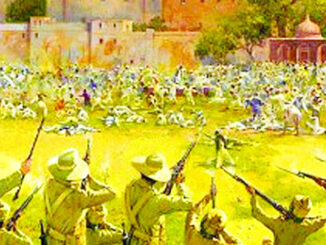
    The crowd had a mix of men, women and children and the protest was a peaceful one. The gathering included pilgrims visiting the Golden Temple who were merely passing through the park, and some who had not come to protest. Suddenly, as many as 90 British Indian Army soldiers, commanded by Colonel Reginald Dyer, appeared and without any warning to the people, ordered firing on the completely peaceful and defenceless crowd. The fusillade continued till Dyer’s ammunition ran out.
    This cold-blooded carnage, Dyer admitted later, was perpetrated “to strike terror not only in the city of Amritsar, but throughout the Punjab”. The official inquiry ordered by the British government said there were 379 deaths but the Congress claimed that more than 1,000 people died in the massacre.
    A well, located inside the premises of the Jallianwala Bagh, stands testimony to the brutal killings of the innocent who jumped into it in panic to save themselves from the firing. 120 dead bodies were later recovered from the well. The last known survivor of the Jallianwala Bagh Massacre, Shingara Singh, died in Amritsar on June 29, 2009, at the age of 113.
    The massacre marks one of the most heinous political crimes committed by the Britishers during the twentieth century. It became a turning point in the history of India’s struggle for freedom. The Jallianwala Bagh site in Amritsar is now a national monument. It houses a museum, a gallery, and a number of memorial structures.
    Popular resentment had been accumulating in Punjab since the beginning of the War (World War I), mainly due to the ruthless drive – by the British — for recruiting soldiers and forced contribution to the war fund. Gandhiji’s call for a country-wide hartal to protest against the Black Acts received a tremendous response from Punjab on March 30 and again on April 6.
    Gandhiji’s call for a country-wide hartal to protest against the Black Acts received a tremendous response from Punjab on March 30 and again on April 6.
    The agitated mood of the people and Hindu-Muslim solidarity demonstrated on the hartal (strike) days and on April 9 celebration of the Ramnavami festival made the Lt Governor Michael O’Dwyer’s administration panicky.
    Gandhiji’s entry into Punjab was banned: two popular leaders of Amritsar, Kitchlew and Satya Pal, were arrested. These provocations led to hartals and mass demonstrations in Lahore, Kasur, Gujranwala and Amritsar.
    In Amritsar, the police firing on demonstrators provoked some of them to commit acts of violence. The next day the city was handed over to Brigadier-General Dyer. Dyer began his regime through indiscriminate arrests and ban on meeting and gatherings.
    On April 13 – the day of Vaisakhi festival – a meeting was called in the afternoon at the Jallianwala Bagh a ground enclosed on all sides. Thousands of people, many of whom had come from surrounding villages to the fairs in Amritsar and were unaware of the ban order, gathered in the meeting.
    Suddenly Dyer appeared there with troops and without any warning to the people, ordered firing on the completely peaceful and defenceless crowd. The fusillade continued till Dyer’s ammunition ran out. Atleast about a thousand people, if not more, are estimated to have been killed. This cold-blooded carnage, Dyer admitted later, was perpetrated “to strike terror not only in the city of Amritsar, but throughout the Punjab?”
    The massacre stunned the people and became a turning point in the history of India’s struggle for freedom. Rabindranath Tagore wrote a strong letter of protest to the Viceroy, dated May 31, 1919, renouncing his Knighthood
    “….The disproportionate severity of the punishments inflicted upon the unfortunate people and the methods of carrying them out, we are convinced, are without parallel in the history of civilised governments…. The accounts of insults and sufferings undergone by our brothers in the Punjab have trickled through the gagged silence, reaching every corner of India and the universal agony of indignation roused in the hearts of our people has been ignored by our rulers,-possibly congratulating themselves for what they imagine as salutary lessons….the very least that I can do for my country is to take all consequences upon myself in giving voice to the protest of the millions of my countrymen, surprised into a dumb anguish of terror. The time has come when the badges of honour make our shame glaring in their incongruous context of humiliation, and I for my part wish to stand shorn of all special distinctions, by the side of those of my countrymen, who, for their so called insignificance, are liable to suffer a degradation not fit for human beings….”

    The Hunter Committee
    The Hunter Committee was appointed by the British government. Halfway through its proceedings, the Hunter Committee suffered the setback of being boycotted by Indian nationalists, represented by the Congress, because of the government’s refusal to release Punjab leaders on bail.
    Of the eight members in all, the Committee had three Indian members. The conduct of the Indian members is a study in principled independence and courage.
    The following erudite exchange on the pointed killings ordered by Dyer on April 13, 1919 took place during the hearings of the Hunter Committee that took place in Lahore on November 19, 1919.
    The excerpt that follows was part of a detailed and rigorous cross examination of General Dyer. Sir Chimanlal Setalvad, a lawyer from Bharuch, Gujarat, who lived in Bombay conducted this particular part of the cross-examination.
    Chimanlal Setalvad: “You took two armoured cars with you?”
    Dyer: “Yes.”
    Chimanlal Setalvad: “Those cars had machine guns?”
    Dyer: “Yes.”
    Chimanlal Setalvad: “And when you took them you meant to use the machine guns against the crowd, did you?”
    Dyer: “If necessary. If the necessity arose, and I was attacked, or anything else like that, I presume I would have used them.”
    Chimanlal Setalvad: “When you arrived there you were not able to take the armoured cars in because the passage was too narrow?”
    Dyer: “Yes.”
    Chimanlal Setalvad: “Supposing the passage was sufficient to allow the armoured cars to go in, would you have opened fire with the machine guns?”
    Dyer: “I think, probably, yes.”
    Chimanlal Setalvad: “In that case the casualties would have been very much higher?”
    Dyer: “Yes.”
    Chimanlal Setalvad: “And you did not open fire with the machine guns simply by the accident of the armoured cars not being able to get in?”
    Dyer: “I have answered you. I have said that if they had been there the probability is that I would have opened fire with them.”
    Chimanlal Setalvad: “With the machine guns straight?”
    Dyer: “With the machine guns.”
    Chimanlal Setalvad: “I take it that your idea in taking that action was to strike terror?”
    Dyer: “Call it what you like. I was going to punish them. My idea from the military point of view was to make a wide impression.”
    Chimanlal Setalvad: “To strike terror not only in the city of Amritsar, but throughout the Punjab?”
    Dyer: “Yes, throughout the Punjab. I wanted to reduce their morale; the morale of the rebels.”
    Chimanlal Setalvad: “Did it occur to you that by adopting this method of ‘frightfulness’ – excuse the term – you were really doing a great disservice to the British Raj by driving discontent deep?”
    Dyer: “I did not like the idea of doing it, but I also realised that it was the only means of saving life and that any reasonable man with justice in his mind would realise that I had done the right thing; it was a merciful though horrible act and they ought to be thankful to me for doing it. I thought I would be doing a jolly lot of good and they would realise that they were not to be wicked.”
    Setalvad’s cross examination followed Lord Hunter’s and that of one more British member. Dyer had already admitted to Lord Hunter that although “a good many” in the crowd might not have heard of his ban on the public meeting, he had ordered the firing at Jallianwala Bagh without giving any warning. He went further when he said before the Committee that, although he could have “dispersed them perhaps even without firing”. He felt it was his “duty to go on firing until (the crowd) dispersed”.
    An eight-member committee headed by Lord William Hunter, former solicitor general in Scotland constituted the Inquiry Committee. Apart from Setalvad, then Vice Chancellor, Bombay University, two other Indians were part of the Committee. Sir Chimanlal Setalvad, Pandit Jagat Narain, Member of the Legislative Council of the Lt. Governor of U.P. and Sultan Ahmed Khan, Member for Appeals, Gwalior State.
    Lord Hunter, Justice Rankin and WF Rice, Add. Secretary to the Government of India, Home Department, Major-General Sir George Barrow, Commanding the Peshawar Dn and Smith, Member of the Legislative Council of the Lt. Governor of UP were the members. The questioning was done, in turn, by eight members.
    Following up on the admissions by Dyer to the two British members before him, Setalvad probed Dyer on the two armoured cars that he had been forced to leave out. Dyer’s callousness stood exposed: even after the firing had left almost 400 dead and many more injured, when asked by Setalvad if he had taken any measures for the relief of the wounded, Dyer replied, ‘‘No, certainly not. It was not my job. But the hospitals were open and the medical officers were there. The wounded only had to apply for help.” All three Indian members of the Hunter Committee displayed a remarkable degree of independence faced with sharp differences with the British members. The differences arose over the recording of conclusions.
    The Hunter Committee ended up giving two reports – the majority report by the five British members and the minority report by three Indian members.
    Both reports indicted Dyer, in no uncertain terms. The differences were in in the degree of condemnation, in so far as Jallianwala Bagh was concerned.
    The report by the British members’ report condemned the action by Dyer on two counts: that he opened fire without warning and that he went on firing after the crowd had ‘begun to disperse’. Though his intention to create a moral effect throughout Punjab was ‘a mistaken conception of duty’, the British members thought it was “distinctly improbable that the crowd would have dispersed without being fired on”. Even the British members of the Hunter Committee, rejected the official stand that Dyer’s action had ‘saved the situation in the Punjab and averted a rebellion on a scale similar to the (1857) mutiny’.
    The minority report, drafted by Chimanlal Setalvad, on behalf of all the Indian members was not only more severe in general. It specifically condemned Dyer for “suggesting that he would have made use of machine guns if they could have been brought into action.” Members expressed strong anguish at the fact that even after the crowd had begun to disperse, Dyer had continued the firing “until his ammunition was spent.”
    Citing Dyer’s own admission in cross examination, the Indians disagreed with the opinion expressed by the British members of the Committee that the crowd was unlikely to have dispersed without the firing. In conclusion, the Indian members of the Hunter Committee described Dyer’s conduct ‘as inhuman and un-British and as having caused great disservice to British rule in India’.
    Faced with both reports, the then Viceroy of India, Chelmsford conceded that Dyer “acted beyond the necessity of the case, beyond what any reasonable man could have thought to be necessary, and that he did not act with as much humanity as the case permitted”. Dyer had no option but to resign and return to England in disgrace.
    Apologists for the Raj in Britain however, bought into Dyer’s claim that it was this bloody firing by Dyer that had saved the Raj in India. This not only reduced the punishment meted out to Dyer, he was also treated as some sort of a hero on his return. In fact, the inquiry itself could only be instituted only after an indemnity law had been passed protecting Dyer and other recalcitrant officers from criminal liability.
    Setalvad had been knighted by the British monarch, just a few months before the Jallianwala Bagh inquiry. He was then vice-chancellor of Bombay University. In his memoirs published in 1946, Recollections and Reflections, Setalvad disclosed that within the British and Indian members of the Hunter Committee had developed “a sharp cleavage of opinion”.

  • Remembering the martyrs of the Jallianwala Bagh Massacre

    Remembering the martyrs of the Jallianwala Bagh Massacre

    On Jallianwala Bagh Massacre anniversary

    • 102 years ago, on April 13, the Vaisakhi Day, General Dyer of the British Government opened fire on peaceful protestors in Jallianwala Bagh in Amritsar, India. Killing 379 Indians, according to official sources.
    • Rabindranath Tagore renounced his knighthood as “a symbolic act of protest”.
    The Jallianwala Bagh in 1919, months after the massacre.
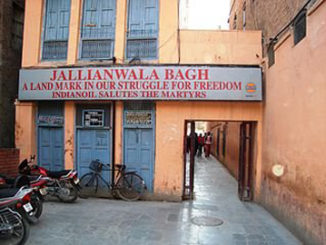
    Jallianwala Bagh well into which people jumped to save themselves from bullets
    British Genocide and Terrorism against unarmed civilians, including women and children.
    Bullet marked wall at Jallianwala Bagh.

    The Jallianwala Bagh massacre, also known as the Amritsar massacre, was a seminal event in the British rule of India. On 13 April 1919, a crowd of non-violent protesters, along with Vaisakhi pilgrims, had gathered in the Jallianwala Bagh garden in Amritsar, P unjab to protest the arrest of two leaders despite a curfew which had been recently declared.

    An hour after the meeting began as scheduled at 16:30, Dyer arrived with a group of sixty-five Gurkha and twenty-five Baluchi soldiers into the Bagh. Fifty of them were armed with .303 Lee-Enfield bolt-action rifles. Dyer had also brought two armored cars armed with machine guns; however, the vehicles were left outside, as they were unable to enter the Bagh through the narrow entrance. The Jallianwala Bagh was surrounded on all sides by houses and buildings and had few narrow entrances. Most of them were kept permanently locked. The main entrance was relatively wide but was guarded heavily by the troops backed by the armored vehicles. The people had no-where to go and were boxed in like caged animals.

    Dyer (without warning the crowd to disperse) blocked the main exits. He explained later that this act “was not to disperse the meeting but to punish the Indians for disobedience.” Dyer ordered his troops to begin shooting toward the densest sections of the crowd to inflict maximum damage. Firing continued for approximately ten minutes. Cease-fire was ordered only when ammunition supplies were almost exhausted, after approximately 1,650 rounds were spent.

    Many people died in stampedes at the narrow gates or by jumping into the solitary well on the compound to escape the shooting. A plaque, placed at the site after independence states that 120 bodies were removed from the well. The wounded could not be moved from where they had fallen, as a curfew was declared, and many more died during the night.

    The number of deaths caused by the shooting is disputed. While the official figure given by the British inquiry into the massacre is 379 deaths, the method used by the inquiry has been subject to criticism. In July 1919, three months after the massacre, officials were tasked with finding who had been killed by inviting inhabitants of the city to volunteer information about those who had died. This information was incomplete due to fear that those who participated would be identified as having been present at the meeting, and some of the dead may not have had close relations in the area. When interviewed by the members of the committee, a senior civil servant in the Punjab admitted that the actual figure could be higher. Since the official figures were probably flawed regarding the size of the crowd (15,000–20,000), the number of rounds shot and the period of shooting, the Indian National Congress instituted a separate inquiry of its own, with conclusions that differed considerably from the Government’s inquiry. The casualty number quoted by the Congress was more than 1,500, with approximately 1,000 being killed. The Government tried to suppress information of the massacre, but news spread in India and widespread outrage ensued. Yet, the details of the massacre did not become known in Britain until December 1919.

    The day after the massacre Kitchin, the Commissioner of Lahore as well as General Dyer, both used threatening language. The following is the English translation of Dyer’s Urdu statement directed at the local residents of Amritsar on the afternoon of 14 April 1919, a day after the Amritsar massacre:

    “You people know well that I am a Sepoy and soldier. Do you want war or peace? If you wish for a war, the Government is prepared for it, and if you want peace, then obey my orders and open all your shops; else I will shoot. For me the battlefield of France or Amritsar is the same. I am a military man and I will go straight. Neither shall I move to the right nor to the left. Speak up, if you want war? In case there is to be peace, my order is to open all shops at once. You people talk against the Government and persons educated in Germany and Bengal talk sedition. I shall report all these. Obey my orders. I do not wish to have anything else.

    I have served in the military for over 30 years. I understand the Indian Sepoy and Sikh people very well. You will have to obey my orders and observe peace. Otherwise, the shops will be opened by force and Rifles. You will have to report to me of the Badmash. I will shoot them. Obey my orders and open shops. Speak up if you want war? You have committed a bad act in killing the English. The revenge will be taken upon you and upon your children.”

    Brigadier Dyer designated the spot where Marcella Sherwood was assaulted sacred and daytime pickets were placed at either end of the street. Anyone wishing to proceed in the street between 6am and 8pm was made to crawl the 200 yards (180 m) on all fours, lying flat on their bellies. The order was not required at night due to a curfew. The order effectively closed the street. The houses did not have any back doors and the inhabitants could not go out without climbing down from their roofs. This order was in effect from 19 April until 25 April 1919. No doctor or supplier was allowed in, resulting in the sick, that were shot, being unattended and left to die in Jallianwala Bagh massacre.

    After General Dyer reported to his superiors that he had been “confronted by a revolutionary army”, Lieutenant-Governor Michael O’Dwyer wrote in a telegram sent to Dyer: “Your action is correct and the Lieutenant Governor approves.” O’Dwyer requested that martial law should be imposed upon Amritsar and other areas, and this was granted by Viceroy Lord Chelmsford.

    Both Secretary of State for War Winston Churchill and former Prime Minister H. H. Asquith however, openly condemned the attack. Churchill referring to it as “monstrous”, while Asquith called it “one of the worst outrages in the whole of our history”.

    Winston Churchill, in the House of Commons debate of 8 July 1920, said, “The crowd was unarmed, except with bludgeons. It was not attacking anybody or anything… When fire had been opened upon it to disperse it, it tried to run away. Pinned up in a narrow place considerably smaller than Trafalgar Square, with hardly any exits, and packed together so that one bullet would drive through three or four bodies, the people ran madly this way and the other.

    When the fire was directed upon the center, they ran to the sides. The fire was then directed to the sides. Many threw themselves down on the ground, the fire was then directed down on the ground. This was continued to 8 to 10 minutes, and it stopped only when the ammunition had reached the point of exhaustion.” After Churchill’s speech in the House of Commons debate, MPs voted 247 to 37 against Dyer and in support of the Government.

    Rabindranath Tagore received the news of the massacre by 22 May 1919. He tried to arrange a protest meeting in Calcutta and finally decided to renounce his knighthood as “a symbolic act of protest”. In the repudiation letter, dated 30 May 1919 and addressed to the Viceroy, Lord Chelmsford, he wrote “I … wish to stand, shorn, of all special distinctions, by the side of those of my countrymen who, for their so-called insignificance, are liable to suffer degradation not fit for human beings” Gupta describes the letter written by Tagore as “historic”. He writes that Tagore “renounced his knighthood in protest against the inhuman cruelty of the British Government to the people of Punjab”, and he quotes Tagore’s letter to the Viceroy “The enormity of the measures taken by the Government in the Punjab for quelling some local disturbances has, with a rude shock, revealed to our minds the helplessness of our position as British subjects in India …

    The very least that I can do for my country is to take all consequences upon myself in giving voice to the protest of the millions of my countrymen, surprised into a dumb anguish of terror. The time has come when badges of honor make our shame glaring in the incongruous context of humiliation…”

    Dyer was met by Lieutenant-General Sir Havelock Hudson, who told him that he was relieved of his command. He was told later by the Commander-in-Chief in India, General Sir Charles Monro, to resign his post and that he would not be reemployed.

    The British Lieutenant-Governor of Punjab, Michael O’Dwyerdied the kind of death he had brought upon many on April 13, 1921.

    On 13 March 1940, at Caxton Hall in London, Udham Singh, an Indian independence activist from Sunam who had witnessed the events in Amritsar and was himself wounded, shot and killed Michael O’Dwyer, the British Lieutenant-Governor of Punjab at the time of the massacre, who had approved Dyer’s action and was believed to be the main planner. Dyer himself had died earlier in 1927. We pay our tribute to those who lost their lives in Jallianwala massacre, and salute Udham Singh who avenged their death. A nation is known by its heroes and martyrs

    (With inputs from DiscoverSikhism.com and Center For Pluralism)


  • The character of a nation is known by its martyrs

    The character of a nation is known by its martyrs

    A nation is known by its people. The strength of a nation is known by its heroes. The character of a nation is known by its martyrs. With the Martyrs Day (March 23), commemorating the martyrdom of the three patriots- Bhagat Singh, Rajguru and Sukhdev-four days away, the editorial board of The Indian Panorama decided to recall their sacrifices, as also of many others who sacrificed their lives to bring freedom to India.
    The brief description of the martyrs is meant to remind Indians that the freedom they enjoy today is the result of their sacrifices, and whatever tributes they may pay the patriots on this day, are not enough to repay them for their nobility.
    Let us know some of the martyrs of India.
    India’s freedom movement against the British was witness to an overwhelming participation of people throughout the country. From Kashmir to Kanyakumari, Assam to Gujarat, thousands of men and women fought together against atrocities of the British Raj. While many selflessly gave their lives to protect the dignity of their motherland, others got injured and embraced imprisonment. Let us know about a few brave freedom fighters from various parts of colonial India who gave their lives to achieve freedom for their beloved motherland:

    Mangal Pandey

    Mangal Pandey, (born July 19, 1827, Akbarpur, India—died April 8, 1857, Barrackpore), Indian soldier whose attack on British officers on March 29, 1857, was the first major incident of what came to be known as the Indian, or Sepoy, Mutiny (in India the uprising is often called the First War of Independence or other similar names).
    Pandey was born in a town near Faizabad in what is now eastern Uttar Pradesh state in northern India, although some give his birth place as a small village near Lalitpur (in present-day southwestern Uttar Pradesh). He was from a high-caste Brahman landowning family that professed strong Hindu beliefs. Pandey joined the army of the British East India Company in 1849, some accounts suggesting that he was recruited by a brigade that marched past him. He was made a soldier (sepoy) in the 6th Company of the 34th Bengal Native Infantry, which included a large number of Brahmans. Pandey was ambitious and viewed his profession as a sepoy as a stepping-stone to future success.
    Pandey’s career ambitions, however, came into conflict with his religious beliefs. While he was posted at the garrison in Barrackpore in the mid-1850s, a new Enfield rifle was introduced into India that required a soldier to bite off the ends of greased cartridges in order to load the weapon. A rumour spread that the lubricant used was either cow or pig lard, which was repugnant to Hindus or Muslims, respectively. The belief arose among the sepoys that the British had deliberately used the lard on the cartridges.
    There have been various accounts of the events of March 29, 1857. However, the general agreement is that Pandey attempted to incite his fellow sepoys to rise up against their British officers, attacked two of those officers, attempted to shoot himself after having been restrained, and eventually was overpowered and arrested. Some contemporary reports suggested that he was under the influence of drugs—possibly cannabis or opium—and was not fully aware of his actions. Pandey was soon tried and sentenced to death. His execution (by hanging) was set for April 18, but British authorities, fearing the outbreak of a large-scale revolt if they waited until then, moved the date up to April 8. Resistance to the use of Enfield cartridges later that month in Meerut led to the outbreak of a revolt there in May and the start of the larger insurrection.
    In India, Pandey has been remembered as a freedom fighter against British rule. A commemorative postage stamp with his image on it was issued by the Indian government in 1984. In addition, a movie and stage play that depicted his life both appeared in 2005.

    Rani Lakshmi Bai

    Lakshmi Bai, also spelled Laxmi Bai, (born c. November 19, 1835, Kashi, India—died June 17, 1858, Kotah-ki-Serai, near Gwalior), rani (queen) of Jhansi and a leader of the Indian Mutiny of 1857–58.
    Brought up in the household of the peshwa (ruler) Baji Rao II, Lakshmi Bai had an unusual upbringing for a Brahman girl. Growing up with the boys in the peshwa’s court, she was trained in martial arts and became proficient in sword fighting and riding. She married the maharaja of Jhansi, Gangadhar Rao, but was widowed without bearing a surviving heir to the throne. Following established Hindu tradition, just before his death the maharaja adopted a boy as his heir. Lord Dalhousie, the British governor-general of India, refused to recognize the adopted heir and annexed Jhansi in accordance with the doctrine of lapse. An agent of the East India Company was posted in the small kingdom to look after administrative matters.
    The 22-year-old queen refused to cede Jhansi to the British. Shortly after the beginning of the mutiny in 1857, which broke out in Meerut, Lakshmi Bai was proclaimed the regent of Jhansi, and she ruled on behalf of the minor heir. Joining the uprising against the British, she rapidly organized her troops and assumed charge of the rebels in the Bundelkhand region. Mutineers in the neighbouring areas headed toward Jhansi to offer her support.
    Under Gen. Hugh Rose, the East India Company’s forces had begun their counteroffensive in Bundelkhand by January 1858. Advancing from Mhow, Rose captured Saugor (now Sagar) in February and then turned toward Jhansi in March. The company’s forces surrounded the fort of Jhansi, and a fierce battle raged. Offering stiff resistance to the invading forces, Lakshmi Bai did not surrender even after her troops were overwhelmed and the rescuing army of Tantia Tope, another rebel leader, was defeated at the Battle of Betwa. Lakshmi Bai managed to escape from the fort with a small force of palace guards and headed eastward, where other rebels joined her.
    Tantia Tope and Lakshmi Bai then mounted a successful assault on the city-fortress of Gwalior. The treasury and the arsenal were seized, and Nana Sahib, a prominent leader, was proclaimed as the peshwa (ruler). After taking Gwalior, Lakshmi Bai marched east to Morar to confront a British counterattack led by Rose. Dressed as a man, she fought a fierce battle and was killed in combat.
    Subhas Chandra Bose

    Subhas Chandra Bose, byname Netaji (Hindi: “Respected Leader”), (born c. January 23, 1897, Cuttack, Orissa [now Odisha], India—died August 18, 1945, Taipei, Taiwan?), Indian revolutionary prominent in the independence movement against British rule of India. He also led an Indian national force from abroad against the Western powers during World War II. He was a contemporary of Mohandas K. Gandhi, at times an ally and at other times an adversary. Bose was known in particular for his militant approach to independence and for his push for socialist policies.
    The son of a wealthy and prominent Bengali lawyer, Bose studied at Presidency College, Calcutta (Kolkata), from which he was expelled in 1916 for nationalist activities, and the Scottish Churches College (graduating in 1919). He then was sent by his parents to the University of Cambridge in England to prepare for the Indian Civil Service. In 1920 he passed the civil service examination, but in April 1921, after hearing of the nationalist turmoils in India, he resigned his candidacy and hurried back to India. Throughout his career, especially in its early stages, he was supported financially and emotionally by an elder brother, Sarat Chandra Bose (1889–1950), a wealthy Calcutta lawyer and Indian National Congress (also known as the Congress Party) politician.
    Bose joined the noncooperation movement started by Mohandas K. Gandhi, who had made the Indian National Congress a powerful nonviolent organization. Bose was advised by Gandhi to work under Chitta Ranjan Das, a politician in Bengal. There Bose became a youth educator, journalist, and commandant of the Bengal Congress volunteers. His activities led to his imprisonment in December 1921. In 1924 he was appointed chief executive officer of the Calcutta Municipal Corporation, with Das as mayor. Bose was soon after deported to Burma (Myanmar) because he was suspected of connections with secret revolutionary movements. Released in 1927, he returned to find Bengal Congress affairs in disarray after the death of Das, and Bose was elected president of the Bengal Congress. Shortly thereafter he and Jawaharlal Nehru became the two general secretaries of the Indian National Congress. Together they represented the more militant, left-wing faction of the party against the more compromising, right-wing Gandhian faction.
    Vocal support for Gandhi increased within the Indian National Congress, meanwhile, and, in light of this, Gandhi resumed a more commanding role in the party. When the civil disobedience movement was started in 1930, Bose was already in detention for his associations with an underground revolutionary group, the Bengal Volunteers. Nevertheless, he was elected mayor of Calcutta while in prison. Released and then rearrested several times for his suspected role in violent acts, Bose was finally allowed to proceed to Europe after he contracted tuberculosis and was released for ill health. In enforced exile and still ill, he wrote The Indian Struggle, 1920–1934 and pleaded India’s cause with European leaders. He returned from Europe in 1936, was again taken into custody, and was released after a year.
    Meanwhile, Bose became increasingly critical of Gandhi’s more conservative economics as well as his less confrontational approach toward independence. In 1938 he was elected president of the Indian National Congress and formed a national planning committee, which formulated a policy of broad industrialization. However, this did not harmonize with Gandhian economic thought, which clung to the notion of cottage industries and benefiting from the use of the country’s own resources. Bose’s vindication came in 1939, when he defeated a Gandhian rival for reelection. Nonetheless, the “rebel president” felt bound to resign because of the lack of Gandhi’s support. He founded the Forward Bloc, hoping to rally radical elements, but was again incarcerated in July 1940. His refusal to remain in prison at this critical period of India’s history was expressed in a determination to fast to death, which frightened the British government into releasing him. On January 26, 1941, though closely watched, he escaped from his Calcutta residence in disguise and, traveling via Kabul and Moscow, eventually reached Germany in April.
    In Nazi Germany Bose came under the tutelage of a newly created Special Bureau for India, guided by Adam von Trott zu Solz. He and other Indians who had gathered in Berlin made regular broadcasts from the German-sponsored Azad Hind Radio beginning in January 1942, speaking in English, Hindi, Bengali, Tamil, Telugu, Gujarati, and Pashto.
    A little more than a year after the Japanese invasion of Southeast Asia, Bose left Germany, traveling by German and Japanese submarines and by plane, and arrived in May 1943 in Tokyo. On July 4 he assumed leadership of the Indian Independence Movement in East Asia and proceeded, with Japanese aid and influence, to form a trained army of about 40,000 troops in Japanese-occupied Southeast Asia. On October 21, 1943, Bose proclaimed the establishment of a provisional independent Indian government, and his so-called Indian National Army (Azad Hind Fauj), alongside Japanese troops, advanced to Rangoon (Yangon) and thence overland into India, reaching Indian soil on March 18, 1944, and moving into Kohima and the plains of Imphal. In a stubborn battle, the mixed Indian and Japanese forces, lacking Japanese air support, were defeated and forced to retreat; the Indian National Army nevertheless for some time succeeded in maintaining its identity as a liberation army, based in Burma and then Indochina. With the defeat of Japan, however, Bose’s fortunes ended.
    A few days after Japan’s announced surrender in August 1945, Bose, fleeing Southeast Asia, reportedly died in a Japanese hospital in Taiwan as a result of burn injuries from a plane crash.
    Lala Lajpat Rai

    Lala Lajpat Rai, (born 1865, Dhudike, India—died November 17, 1928, Lahore [now in Pakistan]), Indian writer and politician, outspoken in his advocacy of a militant anti-British nationalism in the Indian National Congress (Congress Party) and as a leader of the Hindu supremacy movement.
    After studying law at the Government College in Lahore, Lajpat Rai practiced at Hissar and Lahore, where he helped to establish the nationalistic Dayananda Anglo-Vedic School and became a follower of Dayananda Sarasvati, the founder of the conservative Hindu society Arya Samaj (“Society of Aryans”). After joining the Congress Party and taking part in political agitation in the Punjab, Lajpat Rai was deported to Mandalay, Burma (now Myanmar), without trial, in May 1907. In November, however, he was allowed to return when the viceroy, Lord Minto, decided that there was insufficient evidence to hold him for subversion. Lajpat Rai’s supporters attempted to secure his election to the presidency of the party session at Surat in December 1907, but elements favouring cooperation with the British refused to accept him, and the party split over the issues.
    During World War I, Lajpat Rai lived in the United States, where he founded the Indian Home Rule League of America (1917) in New York City. He returned to India in early 1920, and later that year he led a special session of the Congress Party that launched Mohandas (Mahatma) Gandhi’s noncooperation movement. Imprisoned from 1921 to 1923, he was elected to the legislative assembly on his release. In 1928 he introduced the legislative assembly resolution for the boycott of the British Simon Commission on constitutional reform. Shortly thereafter he died, after being attacked by police during a demonstration in Lahore.
    Bhagat Singh

    Bhagat Singh, (born September 27, 1907, Lyallpur, western Punjab, India [now in Pakistan]—died March 23, 1931, Lahore [now in Pakistan]), revolutionary hero of the Indian independence movement.
    Bhagat Singh attended Dayanand Anglo Vedic High School, which was operated by Arya Samaj (a reform sect of modern Hinduism), and then National College, both located in Lahore. He began to protest British rule in India while still a youth and soon fought for national independence. He also worked as a writer and editor in Amritsar for Punjabi- and Urdu-language newspapers espousing Marxist theories. He is credited with popularizing the catchphrase “Inquilab zindabad” (“Long live the revolution”).
    In 1928 Bhagat Singh plotted with others to kill the police chief responsible for the death of Indian writer and politician Lala Lajpat Rai, one of the founders of National College, during a silent march opposing the Simon Commission. Instead, in a case of mistaken identity, junior officer J.P. Saunders was killed, and Bhagat Singh had to flee Lahore to escape the death penalty. In 1929 he and an associate lobbed a bomb at the Central Legislative Assembly in Delhi to protest the implementation of the Defence of India Act and then surrendered. He was hanged at the age of 23 for the murder of Saunders.
    Sukhdev

    Sukhdev Thapar was a senior member of the Hindustan Socialist Republican Association. He participated in several actions alongside Bhagat Singh and Shivaram Rajguru, and was hanged by the British authorities on 23 March 1931 at the age of 23. Sukhdev participated in numerous revolutionary activities such as a prison hunger strike in 1929. He is best known for his assaults in the Lahore Conspiracy Case (1929–30). He is best remembered for his involvement in the assassination of Deputy Superintendent of Police, J. P. Saunders, on 17 December 1928, by Bhagat Singh and Shivaram Rajguru, undertaken in response to the violent death of the veteran leader Lala Lajpat Rai.
    Rajguru

    Shivaram Hari Rajguru was an Indian revolutionary from Maharashtra, known mainly for his involvement in the assassination of a British Raj police officer. He also fought for the independence of India and On 23 March 1931 he was hanged by the British government along with Bhagat Singh and Sukhdev Thapar.
    Chandra Shekhar Azad

    Chandra Shekhar Azad a close associate of Bhagath Singh in the freedom struggle was born in the year 1906. He is the most challenging and fearless Independence Fighters against the British Rulers. He was a part of the Hindustan Republican Association. After a fierce battle with British Soldiers and killing so many enemies he shot himself with a pistol.
    Ram Prasad Bismil

    Ram Prasad Bismil was a young revolutionary Independence Fighters from India who martyred for his country like Bhagat Singh. He was born in the year 1857 and was a respectable member of the Hindustan Republican Association along with Sukhdev. British government sentenced him to death for involving in the notorious Kakori train robbery.
    Bipin Chandra Pal

    Bipin Chandra Pal an unforgettable revolutionary was born in the year 1858. Pal was a substantial part of the Indian National Congress and he is the one who encouraged the abandonment of foreign goods. He formed an association with Bal Gangadhar Tilak, Lala Lajpat Rai, and Lal-Pal-Bal trio. All of them together executed many revolutionary activities for the country.
    Chittaranjan Das

    Das the founder of the Swaraj Party and a Lawyer by Profession was born in the year 1870. He was popular as Deshbandhu and took an active part in the Indian National Movement. Being a Law Practitioner he successfully defended Aurobindo Ghosh who was charged in a crime by the British. Chittaranjan used to Mentor Subash Chandra Bose.
    Abdul Hafiz Barakatullah

    Abdul Hafiz Mohamed Barakatullah fought in a unique style for the nation’s freedom. He was born in the year 1854 and is also the co-founder of Ghadar Operated overseas from San Francisco. He took Pen as a weapon and published blazing articles in England’s leading daily to arose the fire of Independence.
    Ashfaqulla Khan

    Ashfaqulla Khan the founder of young revolutionary fire sacrificed his life for Mother India like many other leaders in the list. Similar to Bismil and Chandrashekhar he became a prominent member of the Hindustan Republic Association. He carried out the popular train robbery Kakori Khan with the help of his associates. That’s the reason British Executed him.
    Khudiram Bose

    Born on December 3, 1889 in Habibpur of Midnapore district of the then Bengal Presidency, Khudiram Bose lost both his parents, Trailokyanath Bose and Lakshmipriya Devi, when he was just six. Never too fond of studies, he would rather spend his time helping people affected by flood and other calamities. A student of Midnapore Collegiate School, he gave up studies to dedicate his life to revolutionary activities. After dropping out, he became a member of the Revolutionary Party.
    In 1905, when Bengal was divided, ‘Banga-Bhanga’ saw the strongest protests in Midnapore where Khudiram Bose actively participated in burning British products. The British attitude towards peasants, revolutionaries, farmers and other Indians further fuelled his anger.
    As a member of the Revolutionary Party, he started distributing pamphlets with Vande Matram written on them. At one of the places where Bose was distributing pamphlets, he apparently slapped a police officer, breaking his nose when he was just 14 years old.
    At the age of 16, he had learnt how to make bombs and went about planting bombs near police stations and targeted government officials.
    In 1908, he and Prafulla Chaki were assigned to assassinate Muzzaffarpur district magistrate Kingsford. Kingsford, before being transferred to Muzaffarpur, was a magistrate in Bengal and his method of torturous punishments against revolutionaries had angered the youngsters of Bengal. It was decided that the two appointed men, Bose and Chaki, would hurl bombs at him in the court but after 10 days of monitoring Kingsford’s movements, they realised that hurling bombs in courtroom would injure a large number of innocent civilians. The plan was thereafter changed to assassinate him outside a club which he attended.
    On April 30, 1908, Khudiram Bose instructed Chaki to run away and threw the bomb himself on the carriage, in which Kingsford was supposed to be travelling. However, as he had on previous occasions, Kingsford escaped death as the carriage was, instead, carrying the wife and daughter of a barrister named Pringle Kennedy. Bose was arrested from a railway station in Samastipur district, where he had reached walking barefoot for 25 kilometres (16 miles) after bombing the carriage. Later, the station where he was captured was renamed to Khudiram Bose Pusa railway station.
    Unlike other parts of India, where revolutionaries could rarely afford a lawyer, educated Bengali lawyers’ teams used to represent the revolutionaries of Bengal for free. Khudiram’s statement was recorded in English, instead of the language used by Bose, and lawyer Narendra Kumar Basu used this, along with Bose’s tender age, to defend him. Bose was too young to know the art of making a bomb, he had argued.
    However, the judge received a letter, where it was written that there would be revolutions not only in Bengal but also in Bihar if Bose was not sentenced, or sentenced lightly.
    On 13 July 1908, Bose was finally sentenced to death. On being asked by the shocked English judge, as Bose was still smiling after hearing the judgment, whether he understood the judgment, the young freedom fighter said with a smile on his face, “Yes, I do and my lawyer said that I was too young to make bombs. If you allow me some time before I’m taken away from here, I can teach you the skills of making bombs too.”
    He was, finally, executed at 4:30 in the morning of August 11, 1908.
    Jatindra Nath Das

    He was born in Calcutta and when he was in B.A he was arrested for revolutionary activities. Later, he was contacted by other revolutionaries and he agreed to prepare the bomb. He was arrested when police discovered the Saharanpur bomb factory of H.S.R.A and were put in Lahore Jail with Bhagat Singh and Batukeshwar Dutta. He started hunger strike along with Bhagat Singh and other revolutionaries and died on the 63rd day of his hunger strike.
    Bhagwati Charan Vohra

    He was born in Lahore and he joined H.S.R.A when he met other freedom fighters of India at National College in Lahore. He was a great orator and a campaigner and he prepared the HSRA manifesto that was used to educate people about HSRA and its activity. He rented out a small room in Lahore and used it as his bomb preparation laboratory. The bomb prepared by him was used to blast the train of Viceroy Lord Irwin. He died in Lahore on 28th May 1930 while testing a bomb. It is said that bomb was necessary for the rescue of Bhagat Singh and other revolutionaries. His last words were: “Had this death been late by two days I would have attained more success before dying. Now that desire of mine remained unfulfilled.”
    Madan Lal Dhingra

    Madan Lal was one of the first Indian revolutionaries of the 20th century. He was studying in England when he carried out the Assassination of William Hutt Curzon Wyllie. While studying in England he joined Abhinav Bharat Mandal and became an active member of India House an organization started by Indian in England. On 1st July 1909, during the gathering of the Indian National Association, Dhingra fired five shots at Curzon Wyllie and then he didn’t try to escape and surrendered. After a trial of 25 days, he was sentenced to death and subsequently hanged on 17th August 1909.
    Pratap Singh Baharat

    Pratap Singh Baharat was an Indian revolutionary who hailed from Udaipur district of the Indian State of Rajasthan. He was born in the family of freedom fighters and with his uncle, he carried out bombing at viceroy procession (Lord Hardinge) on 3rd December 1912. Later he was caught and trailed under Banaras Conspiracy Case. He was sentenced to 5 years rigorous imprisonment. Inside the jail, he was tortured to reveal the name of his fellow revolutionaries and he refused. He died in Bareilly Central Jail on 7th May 1918.
    Bhai Balmukund
    Bhai Balmukund was born in Jhelum district, now in Pakistan. He was one of the founding members of the Ghadar Party. He was involved in throwing a bomb at Viceroy Procession in Delhi and killing Europeans by a bomb at Lawrence Garden in Lahore. He was arrested in Jodhpur and after a trial in court, he was sentenced to death. He was hanged in Ambala Central Jail on 11th May 1915.
    Rajendra Lahiri
    Rajendra was born in Pabna District, now in Bangladesh and while studying in college he joined H.R.A to overthrow British from India by aggressive means. He participated in Dakshineswar Bombing and afterward escaped from the site. He remained underground in Benaras as a student and after joining H.R.A executed famous Kakori Train Conspiracy. After a long trial he was found guilty in both the cases and he was hanged in Gonda district Jail on 17th December 1927.
    Udham Singh

    Udham Singh was born in Sangrur district of Punjab and he is commonly referred to as Shaheed-i-Azam Sardar Udham Singh. His father and mother died at an early age of 8 and he studied in an orphanage. He was inspired by Bhagat Singh and joined the Gadar Party. He helped Indian Revolutionaries by providing Arms and ammunition for which he was later arrested. He is famous for Assassinating Michael O’Dwyer in England who approved Reginald Dyer’s Jallianwala Bagh massacre. He concealed his revolver in a book and entered the hall. When the meeting was over he shot O’Dwyer twice killing him immediately. After assassinating O’Dwyer he didn’t try to escape and was arrested.