Tag: Shiromani Akali Dal

  • Rekha Gupta takes charge as Delhi CM, keeps finance, revenue, Parvesh Verma gets PWD

    Rekha Gupta takes charge as Delhi CM, keeps finance, revenue, Parvesh Verma gets PWD

    New Delhi (TIP)- Chief minister Rekha Gupta and her ministers, sworn in on Thursday, Feb 20, at a public function at Ramlila Maidan that was attended by PM Modi, Union ministers and many chief ministers, hit the ground running.
    The portfolios were announced at night. Among the key departments, Gupta will handle finance and revenue; Parvesh Verma PWD and water; Ashish Sood home, power, urban development and education; Manjinder Singh Sirsa industries and environment; Kapil Mishra law and justice; Dr Pankaj Kumar Singh health and transport; and Ravinder Indraj Singh social welfare.
    A hoarding of the CM and PM, positioned on opposite sides, served as the backdrop of the stage with ‘Viksit Dilli Ka Shapath Samaroh’ inscribed in the centre as lieutenant governor V K Saxena administered the oath to Gupta and her council of six ministers. She took the oath amid chants of “Jai Shri Ram” from a large crowd of party supporters.
    Sood incorporated his parents’ names in the oath while Sirsa, a former Shiromani Akali Dal (SAD) member, delivered his oath in Punjabi. The audience enthusiastically applauded Kapil Mishra, a Brahmin from Poorvanchal, when he took the oath.
    The cabinet composition reflects a careful balance of regional and caste representation, including Pankaj Singh, who is a Thakur from Poorvanchal, Indraj, who is a representative of the Scheduled Castes, and the chief minister, who is a Bania.
    Gupta, Sood, Singh and Indraj are first-time MLAs.
    The choice of venue was politically significant as it had witnessed the Jan Lokpal protests by anti-corruption activist Anna Hazare which eventually gave birth to AAP. This was the place where Arvind Kejriwal and his cabinet had been sworn in on Feb 14, 2015. Kejriwal had promised to rid the city of corruption and warned his party against “ahankar” (arrogance).
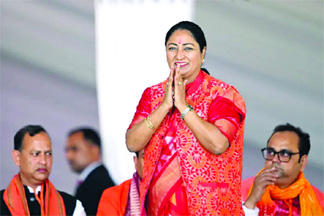
    Gupta, who became the fourth woman — and ninth overall — CM of the capital, offered prayers at Marghat Wale Hanuman Temple at Kashmere Gate before reaching the venue. She was followed in the swearing-in ceremony by New Delhi MLA Parvesh Verma who too drew enthusiastic cheers from the audience with some shouting, “Parvesh ji ko Jai Shri Ram”. Newly-elected MLAs Ashish Sood (Janakpuri), Dr Pankaj Singh (Vikaspuri), Manjinder Singh Sirsa (Rajouri Garden), Ravinder Indraj (Bawana) and Kapil Mishra (Karwal Nagar) followed.
    People had started gathering at the venue since early morning with many showing their support for Prime Minister Modi by wearing his masks and holding up his cutouts. Many were waving the Tricolour and party flags. A band performed patriotic and devotional melodies like “Ram Aayenge to angna sajaenge” and “Aai watan”.
    Union home minister Amit Shah was among the first senior leaders to reach the venue, followed by BJP national president JP Nadda and Rajasthan chief minister Bhajan Lal Sharma. The loudest cheers were, of course, for Modi when he entered the stage with ministers, NDA leaders and others on the stage standing up to greet him. The PM and CM exchanged greetings with Gupta wearing a broad smile. Several women who have worked with Gupta in the party’s women’s wing had turned up in large groups to show their support to the chief minister.
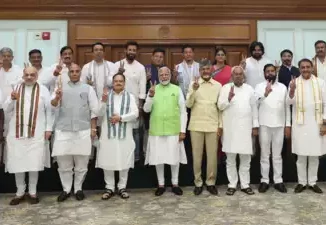
    The event was also attended by defence minister Rajnath Singh, Union minister Dharmendra Pradhan and Maharashtra chief minister Devendra Fadnavis. The stage was a showcase of NDA unity with Bihar deputy CM Vijay Kumar Sinha, Rajasthan deputy CM Prem Chand Bairwa, Goa CM Pramod Sawant, Andhra Pradesh CM Chandrababu Naidu, Haryana CM Naib Singh Saini and Madhya Pradesh CM Mohan Lal Yadav also present on the stage.

  • Oppn parties in Punjab slam Centre’s land ‘allotment’ for Haryana Assembly

    Oppn parties in Punjab slam Centre’s land ‘allotment’ for Haryana Assembly

    New Delhi (TIP)- Punjab’s ruling AAP and opposition parties on Thursday, Nov 14, clear the allotment of 10 acres of land in Chandigarh to Haryana for the construction of its assembly building. The AAP accused the BJP-led central government of conspiring against the state while the Shiromani Akali Dal (SAD) claimed any decision to allocate land to Haryana in the union territory would be unconstitutional. The Congress said the Centre’s clearance is “a calculated move to undermine Punjab’s rightful share over its capital”. The Union Ministry of Environment, Forest and Climate Change has reportedly granted environmental clearance for the land offered by the Haryana government to the Chandigarh administration in exchange for land to build the second assembly building.
    The Haryana government offered 12 acres of land in Panchkula in exchange for 10 acres of land near IT Park Road in Chandigarh.
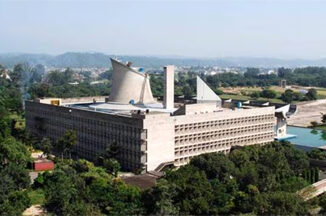
    At present, Punjab and Haryana share the Vidhan Sabha complex which is next to the Punjab and Haryana Civil Secretariat in Chandigarh, the joint capital of the two states.
    Punjab AAP spokesperson Neel Garg said Chandigarh is not just a piece of land but a matter tied to the emotions of three crore Punjabis.
    “The BJP-led central government is conspiring against Punjab,” he charged.
    Chandigarh belongs to Punjab in every sense as it was built by displacing 22 villages from Kharar and is politically, socially, economically and culturally linked to Punjab, he said.
    Garg accused the BJP government of deliberately creating a dispute with its environmental clearance. “The people of Punjab will never tolerate this,” he said.
    When Haryana was carved out of Punjab as a separate state, there was a promise that Chandigarh would eventually be handed over to Punjab after Haryana developed its own capital. Until then, Chandigarh would remain a union territory, the AAP spokesperson said.
    He also warned the central government not to “toy” with the emotions of Punjabis and demanded that this decision be revoked immediately.
    The SAD said any decision to allocate land to Haryana in Chandigarh would be unconstitutional as it would violate Article 3 whereby Parliament alone can change state boundaries.
    Senior SAD leader Daljit Singh Cheema urged Union Home Minister Amit Shah to rescind the decision and asserted that it was in violation of the Punjab Reorganisation Act, 1966.
    He said the Centre’s decision to allocate land to Haryana is a design to end Punjab’s right over Chandigarh.
    “It is clear that the Haryana government is colluding with the Centre against Punjab,” he added.
    Cheema also accused the AAP of being hand in glove with Haryana and the central government.
    “The AAP did not object when Home Minister Amit Shah made this announcement at a meeting of the North Zone Council meeting (in 2022)”, he claimed.

  • Gone are days for single party majority; alliances are back

    Gone are days for single party majority; alliances are back

    Institutions, including political outfits, always stay taller than individuals who come and go. Institutions stay. Of course, individuals contribute immensely to building institutions, but they seldom become indispensable.

    “The party that looked “unbeatable” till early this year, met its Waterloo in its own backyard of the Hindi heartland, including Uttar Pradesh which sends 80 of 545 Lok Sabha members. Known for its political acumen, some call this most populus state “Ultapulta Pradesh”,   it had earlier shown the longest ruling Congress door. After giving the Bharatiya Janata Party enough time in office, the State has now put its confidence in the Samajwadi Party giving it a record 37 seats, a performance that may have even surprised its leadership.”

    By Prabhjot Singh

    Politics is a game of glorious uncertainties. India, the biggest and most vibrant democracy,  has come a long way after it wriggled out of the regimen of mandatory alliances to a single-party majority rule in 2014. And after 10 years, coalitions have again become a political necessity. Though then the Bhartiya Janata Party had broken the hoodoo of coalitions at the center, it now desperately needs its alliance partners in its endeavor to earn the right to govern the biggest democracy in the world for its third term.

    More than 642 million people voted to give a fractured verdict while constituting the 18th Lok Sabha with no single party anywhere near the majority mark. In 2014, the BJP came out as the single largest party by winning the majority verdict. Though it stayed on with its alliance part,, including the oldest regional party, Shiromani Akali Dal,  for almost two terms, it parted company with some of its allies before testing deep troubled waters of the voter’s pool this year. Overconfident of its prowess of swimming to safety, it almost drowned itself in the battle of the ballot nearly allowing its sworn opponents and traditional rivals to swim to the podium.

    Elated at its earlier success starting in 2014, BJP went on improving its performance as it took its individual tally from 282 in 2014 to 303 in 2019 before setting for itself a gigantic task of 350 seats in the lower House of Parliament in the 2024 contest. The voters, however, did not think the way the party supremo and two-term Prime Minister Narendra Modi thinks. They sent a message loud and clear saying “We decide what we want”.

    The party that looked “unbeatable” till early this year, met its Waterloo in its own backyard of the Hindi heartland, including Uttar Pradesh which sends 80 of 545 Lok Sabha members. Known for its political acumen, some call this most populus state “Ultapulta Pradesh”,   it had earlier shown the longest ruling Congress door. After giving the Bharatiya Janata Party enough time in office, the State has now put its confidence in the Samajwadi Party giving it a record 37 seats, a performance that may have even surprised its leadership.

    Institutions, including political outfits, always stay taller than individuals who come and go. Institutions stay. Of course, individuals contribute immensely to building institutions, but they seldom become indispensable.

    The poll results will now obviously force Narendra Modi to rely on allies to form the government after a bitter and divisive election that was projected as a referendum on his popularity. It also now dims light on the coterie that had the country’s Home Minister and former party President as the confidant of the Prime Minister. The element of surprise is now with the I.N.D.I. Alliance provided  browbeats NDA in the battle of “horse trading”, a game that Narendra Modi and his coterie had set in motion just before the start of the 2024 battle of the ballot.

    Interestingly, the BJP candidates, including those who won over from other parties, including Congress,  contested in the name of Modi,  hoping not only for a landslide but also the accomplish the slogan of their leader “iss baar 400 ke paar”  saw success eluding them. They could win-win or were ahead only in 240 seats to emerge as the single largest party, a far cry from the 303 it had won last time in the 543-member Lok Sabha to mark the return of coalition politics.

    BJP’s key allies N. Chandrababu Naidu’s TDP and Nitish Kumar’s JD(U) had every reason to be pleased with the performance of their respective candidates as they won 16 and 12 seats in Andhra Pradesh and Bihar, respectively. With the support of its other allies, the BJP-led NDA  has been forced to a tight-rope walking on its course to reach the 272 majority mark. The TDP also swept the Assembly elections in Andhra Pradesh dislodging Y. S. Jagan Mohan Reddy’s YSRCP.

    Congress president Mallikarjun Kharge termed the poll outcome as the “victory of the people and that of democracy.”

    “We had been saying that this battle is between the public and Modi…This mandate is against Modi. This is his political and moral defeat. It is a big defeat for a person who sought votes in his name. He has suffered a moral setback,” Kharge told reporters at the AICC headquarters flanked by Congress leaders Rahul Gandhi and Sonia Gandhi after the good showing by the Congress.

    On the other hand, Narendra Modi with his 52-inch chest, has been on track to equal Jawaharlal Nehru’s record as the PM for a third consecutive term. His accomplishment is, however, subject to acceptance by allies to be in the government.

    In a post on X, Modi said, “I bow to the ‘Janata Janardan’ for this affection and assure them that we will continue the good work done in the last decade to keep fulfilling the aspirations of people.” He retained the Varanasi seat but with a reduced victory margin of nearly 1.53 lakh votes in Varanasi. In 2019, the margin was 4,79,505.

    It was not Modi alone. Others, including the Aam Aadmi Party, too, would love to put behind this debacle as quickly as it can. As a ruling party in Delhi, it drew a blank while in Punjab against its projected claim of 13-0, it ended with just three seats as four of its five Cabinet Ministers fell on the way to their run for Lok Sabha seats.

    And Punjab did the trick. BJP drew a blank from this border State even after it had won over three sitting MPs from other parties in its list of contestants. Two Independents – Amritpal Singh (Khadoor Sahib) and Sarabjeet Singh Khalsa (Faridkot)  – with their splendid triumphs had a message for the rest of the world “Do not take us for granted, we are different.”

    India Votes

    Party                         2014                            2019                       2024

    BJP                              282                                 303                         240

    Congress                     44                                    52                           99

    Trinamool Congress  34                                 22                            22

    Samajwadi Party       5                                    5                              37

    TDP                          16                                     3                              16

    YSR                           9                                     22                           4

    DMK                          *                                    24                           22

    SAD                          4                                      2                               1

    (The author is a senior journalist. He can be reached at prabhjot416@gmail.com)


  • Anti-BJP protests : Candidates facing farmers’ ire in Punjab

    The crackdown on protesting farmers at the Shambhu border in February is casting a shadow on the BJP’s poll campaign in Punjab. Party leaders and candidates are being shown black flags and stopped from entering villages, particularly in Malwa and Majha. These disruptions prompted state BJP chief Sunil Jakhar to lodge a complaint with the state’s Chief Electoral Officer last week, alleging that the AAP government had failed to ensure a level playing field for all candidates. The Punjab Police have claimed that they are taking steps to ensure the safety of the contestants, including those belonging to the BJP, but the latter is not convinced.

    Farmers from the state had launched the Dilli Chalo agitation earlier this year, seeking a legal guarantee for the minimum support price (MSP). However, they were prevented from reaching the Capital by the authorities in BJP-ruled Haryana, which resorted to a heavy-handed approach. The MSP issue has remained unresolved despite a series of talks between the Centre and some farm unions.

    The BJP has its task cut out in the state, where it is going solo after its efforts to mend fences with its old ally, the Shiromani Akali Dal (SAD), proved futile. The SAD had parted ways with the NDA in 2021 amid the farmers’ agitation over the contentious farm laws enacted by the Centre. Even the repeal of the laws did not help the BJP win over the state’s farming community, as seen in January 2022, when protesters forced PM Modi to go back without addressing a poll rally in Ferozepur. With its nominees also facing the heat in parts of rural Haryana, the saffron party can’t afford to ignore the anger and anguish of the region’s farmers. At the same time, the alleged infringement of the candidates’ right to campaign needs to be probed and accountability fixed for the lapses.

    (Tribune, India)


  • Sikh History This Week- March 24, 2023, to March 30, 2023

    24th March
    1664 Guru Har Krishan Ji visited Aurangzeb’s court. This is the time Guru Sahib visited Aurangzeb’s court, when Ram Rai emphatically declared that the decision of his father in selecting his younger brother as his sucessor to the pontificate of Guru Nanak was based on cogent reasons, and that he was now under the command of the new Guru.
    1847 The British being aware of the Sikh’s emotional and sentimental attachment to Golden Temple and other shrines, issued special instructions to the British subjects to be careful in maintaining the sanctity of the shrines.
    1922 Meeting at Rajowal by Kishan Singh Gargaj group to devise ways and means of reforming the toadies
    1945 Master Tara Singh denounces the Acharyae Formula.
    25th March
    1830 Baba Ratta Ji Nirankari was born.
    1921 13th Sikh Education Confernce was held in Hoshiarpur that and lasted until Mar. 27. This conference saw the rise of miltant Akalis who advocated non-cooperation with the British government and were deeply inspired by Master Mota Singh. They met sperately and created disturbances in the conference as well as worked on a sperate program. They were equally patriotic believing in the militant traditions of the Nihangs.
    1921 The militant Akalis hatched a conspiracy to murder the officials respobsinle for the Nanakana carnage. 1972 Mohan Singh Tur became President of Akali Party. 1981 The SGPC unanimously passed the resolution “Sikhs are a Nation.” With the passing of such a resolution by the Sikh Parliament and with the ratification of this resolution by the Jathedar of the Akal Takht on April 21, 1981, the issue stood finally decided by the whole of the Sikh nation. On May 11, 1981, the Akali Party also passed a resolution to that effect.
    1986 Surjit S. Barnala himself ordered firing at the Sikhs who were observing holy festival at Anandpur Sahib, killing several Sikhs.

    26th March

    1644 Gur Gadhi Diwas, Guru Har Rai Sahib Ji (1644).
    1746 The forces of Yahiha Khan and Lakhapat Rai seized and set fire to the Kahnuwaan forest. 7,000 Singh were martyred here while another 3,000 were taken to Lahore and martyred there.
    1746 Matta Sunder kaur Ji sent a mace of Kalgidhar to honor Jassa Singh Ahluwalia.
    1748 Raja Amar Singh of Patiala was born. He was a thorough gentleman.
    1923 Amar Singh, granthi of Kot Fatuhi, is arrested

    27th March
    1843 Raja Suchet Singh murdered. Raja Suchet Singh was brother of Raja Dhiyan Singh Dogra and Gulab Singh Jammu. He was a popular propenent of Sikh Raj. Sher-e-Punjab, Maharaja Ranjit Singh, personally bestowed the honor Raja on Suchet Singh.
    1923 Hazara Singh Sirbrah of Behbalpur is murdered.
    1924 The 4th shahihi jatha of 500 valiant Akali satyagrahies, led by Sardar Puran Singh Bahowal, marched from Anandpur Sahib to Gangsar, Jaito.

    28th March


    1552 Gur Gadhi Diwas, Sri Guru Amar Das Sahib.
    1620 Guru Hargobind Ji had to marry Nanaki despite his refusal. This was an unfortunate upshot of the jubilation in Sikh community caused by Guru Sahib’s release from seven years of incarceration. Within a few months two brides were pledged to him by their parents. Under the customs prevalent at that time, on Guru Hargobind’s refusal, those girls would have remained unmarried throughout their life. So he had to marry Nanaki on March 28, 1620, and Mehrai also called Marwahi on July 10, 1620. The first incident occurred too close to his release. Taken aback at the second incident, he announced that no one should pledge his daughter to him in future.
    1965 SGPC resolves at its general meeting to establish Punjabi Suba.

    29th March

    1552 Second Patshahi, Guru Angad Dev Ji departed this planet from Khadur Sahib. He served as Guru for 12 years and none months. Today is the actual date of joti jot, though its is observed on a different date by Guru Khalsa Panth.
    1552 Third Patshahi, Guru Amar Das Ji ascended to Guruship of Sikhsism. Amardas was influenced to Sikhims by Bibi Amro, daughter of Guru Angad Dev Ji. She was married to Amardas’s nephew. Bibi Amro was a very pious woman. She would get up early in the morning, take a bath and start reciting the hymns of Guru Nanak. One day Amardasheard Bibi Amro sing Guru Nanak’s Jap Ji and pauris of Asa-di-var. He was touched by the divinity and peity of the hymns. He learnt those gymns from her and started reciting them every morning.
    1699 Baisakhi day, Guru Gobind created the Khalsa order at Anandpur Sahib. Earlier Hukamnamahs were sent to Sikhs all over Hindustan and beyond to vist Anandpur. The people were asked to visit with their hair unshorn. The hill chiefs, who, according to one account, were taken into confidence about Guru’s program, were present in strength. He Abolished the corrupt and debased institution of ‘masands’. Created a small regular army and fortified Anandpurs with a ring of smaller fortresses around it.
    1748 The Sikhs assembled at Amritsar on Baisakhi day and by a gurmatta, decided to form Dal Khalsa by reorganization of over 60 arms jathas, bands, into eleven associatios (misls) under the overall command of’ Jassa Singh Ahluwalia. Nawab Kapur Singh because of his age sought retirement from active overall leadership.
    1922 Akali Dal renamed as “Shiromani Akali Dal”.
    1940 The Khalsa National Party at its meeting in Lahore, under Sunder Singh Majithia, saw danger in the division of India into Hindu and Muslim independent states, and said that the Sikhs would not tolerate for a single day the unadultrated communal rule of any community. As a logical sequence, it asked for restoration of Sikh sovereignty of Punjab, which was held in trust by the British during the minority reign of Maharaja Dalip Singh.
    1981 SGPC adopted the motion “Sikhs are a Nation”. When the Presdient Gurcharan Singh Tohra, was asked the question that the SGPC was turning political, he answered “On October 10, 1946, Ishar Singh Mahjaiol, had moved in the house a resolution for the creation of a Sikh State. The resolution was seconded by Sardar Swaran Singh. The “Sikhs Are a Nation” proposal was part of S. Ganga Singh Dhillon’s speech at 54th All India Sikh Educational Conference that took place on March 13, 14, and 15, 1981. In his presidential address, S. Ganga Singh Dhillon wrote: “SIKHS ARE A NATION We all are born equal, with a human right to preserve our religious and cultural heritage, improve our economic inheritance and freedom to mould our destiny.

    30th March

    1664 Patshahi Eighth, Guru Harkrishan Ji, left this planet for heavenly abode from Delhi. He was eight years of age, when he took over on himself the sufferings and sins of the people of Delhi. As a result, he left for heavenly abode. Today is the actual date of joti joot, though it is observed differently by Guru Khalsa Panth.

  • Challenges before Bhagwant Mann and his Government

    Challenges before Bhagwant Mann and his Government

    By Prabhjot Singh

    “Expectations of people of Punjab who voted out the two earlier ruling parties – Congress and Shiromani Akali Dal –  are high as they expect that instead of subsidies, the delivery systems in education and health care should be reliable and affordable. Similarly, civic issues, which the people have been fighting since Independence, need to be tackled in a more professional and competent manner. Corruption in public offices is another irritant that people want the new Government to handle with a firm hand.”

    After a landslide triumph in the just concluded Punjab Assembly elections, the Aam Aadmi Party (AAP) has set upon itself the onerous task of reviving not only the tottering economy but also in establishing the Rule of Law in this border State. After an impressive oath ceremony, attended by hundreds of thousands of the party workers and well-wishers at the historic Khatkar Kalan, the birthplace of Shaheed-e-Azam Bhagat Singh, the Chief Minister, Bhagwant Singh Mann, is faced among other things , a difficult challenge of not only naming members of his Council of Ministers but also in deciding who seven will sit in the Upper House of Parliament, Rajya Sabha, as representatives of AAP. These are ticklish issues as some loyalists workers and leaders tend to feel offended if their loyalty and sincerity to the party is not recognized. While some of the second time MLAs, including Harpal Cheema, Aman Arora and Baljinder Kaur look certain choices for inclusion in the Council of Ministers, there may be pressures on the Chief Minister from other quarters and groups also. There will be similar pressures for nomination to Rajya Sabha.

    Though these party level decisions will be taken in consultation with the national convener Arvind Kejriwal, Bhagwant Mann will have to put his head down to go about the task of restructuring the State Administration while following the legislative requirements in a time bound manner. He has to tone up the civil administration by making it  responsive to public needs.

    Convening of the session of the newly constituted Punjab Vidhan Sabha with a Pro-Tam Speaker administering oath of secrecy to all members, election of Speaker will follow. A date has also to be fixed for passing a vote on account as the new ruling party may need time to finalize its budget for the current financial year. The new excise policy that must become effective from April 1, too, needs to be drafted and approved by the Council of Ministers. While Vote on account must be done before March 31, the new Budget may take a couple of months and a special session of Vidhan Sabha. In between, the AAP government must take policy decisions on several issues of public interest, including implementation of promised 300 units of free power in the power tariff from April 1.

    The AAP national convener Arvind Kejriwal had been talking about replicating the Delhi model in Punjab with certain promises, including free 300 electricity units to all. Punjab has almost 1 crore electricity consumers, including 73 lakh domestic consumers, 14 lakh agriculture consumers, 11.50 lakh commercial consumers and 1.5 lakh industrial consumers. The State spends Rs 10,000 crores as electricity subsidy of which a major chunk – Rs 7180 crores – goes to the farm sector alone.

    The AAP government will also become cynosure of all eyes as it takes on the battle to fight mafias. The first step of the battle will get initiated with the announcement of the new Excise policy. How the State reins in those controlling the liquor trade, both in retail and wholesale, besides tightening control over the running of distilleries and breweries – major sources of evasion of excise duty – will be watched with bated interest. Simultaneously, it will face an uphill task of controlling  deeply entrenched sand and gravel mafia not only to bring down these essential building raw materials but also to check the massive drain of State resources. Illicit mining has also been posing a serious threat to the ecology and environment of the State.

    Expectations of people of Punjab who voted out the two earlier ruling parties – Congress and Shiromani Akali Dal –  are high as they expect that instead of subsidies, the delivery systems in education and health care should be reliable and affordable. Similarly, civic issues, which the people have been fighting since Independence, need to be tackled in a more professional and competent manner. Corruption in public offices is another irritant that people want the new Government to handle with a firm hand.

    Equally challenging will be handling the problem of unemployment and drain of youth to developed nations. Not only the able-bodied young men and women, especially those belonging to the 18-15 age group are heading for green pastures overseas, they are also adding to the debt of their aging and helpless parents and guardians by taking huge sums of money with them. The faith of the people in governance needs to be restored. It can be done only when the new Government with an unprecedented mandate starts delivering by keeping its pre-election promises. Fortunately, the coffers of the State are neither empty nor do they have any pending bills needing clearance. All the State needs is an honest government with a vision. Will Bhagwant Mann and his team deliver? Time will tell.

    (The author  is a veteran journalist with over three decades of experience covering a wide spectrum of subjects and stories. He has covered  Punjab and Sikh affairs for more than three decades besides covering seven Olympics and several major sporting events and hosting TV shows. For more in-depth analysis please visit probingeye.com  or follow him on Twitter.com/probingeye)

    For Jatin

    Categories: Breaking News, Front page,  Politics, India, Punjab,

    Tags:Facebook, WhatsApp, Twitter  LinkedIn,  snap chat, Bhagwant Mann, Kejriwal, Punjab, India, NRIs

  • What’s the problem if foreign celebrities support farmer stir; don’t know Rihanna, Greta: Tikait

    What’s the problem if foreign celebrities support farmer stir; don’t know Rihanna, Greta: Tikait

    Ghaziabad (TIP): For all the global uproar the farmers’ movement against the new agri laws has caused, the man at its centre seems oblivious of the celebrity support he has been getting. Rakesh Tikait, the 51-year-old Bharatiya Kisan Union (BKU) leader from the hinterlands of Muzaffarnagar in western Uttar Pradesh, welcomed the support from international artistes and activists, including Rihanna and Greta Thunberg, but acknowledged that he did not know them. Talking to the media at Ghazipur on the Delhi-Uttar Pradesh border on Thursday, Tikait, who is credited with reviving the agitation that appeared to be flagging after the January 26 violence in Delhi, sought to know who these people were. “Who are these foreign artistes?” Tikait said showing unawareness when asked about the foreigners supporting the farmers’ movement.

    When informed about American pop-singer Rihanna, adult star Mia Khalifa and Swedish teen climate activist Greta Thunberg, the Sisauli-born Tikait responded: “They may have supported us, but I don’t know them.”

    “If some foreigner is supporting the movement, then what is the problem. They are not giving us or taking anything away from us,” he said. Commenting on the futile attempt by 15 members of Parliament to reach Ghazipur and meet protesters on Thursday, the BKU national spokesperson said the MPs should have sat on the ground on the other side of the barricades where they were stopped by Delhi Police.

    “A barricading has been set up here. They had to come, but they should have sat down there itself. They would have been on the other side and we on this side (of the barricade),” he said.

    Tikait said he did not have any talk with the 15 MPs who had tried to come to Ghazipur to meet the protesters. They were also not allowed to speak to the protesters, he added.

    The 15 MPs from 10 Opposition parties, including the SAD, the DMK, the NCP and the Trinamool Congress, wanted to meet the protesters at Ghazipur. Members of the National Conference, the RSP and the IUML were also part of the delegation. MP and Shiromani Akali Dal leader Harsimrat Kaur Badal, who coordinated the visit, said the leaders were not allowed to cross the barricades and reach the protest site, where thousands of farmers are camping since November with a demand that the government repeal the new agri-marketing laws enacted last September.

    The farmers’ protest at Ghazipur, Tikri and Singhu at Delhi borders has now attained global spotlight with prominent international celebrities and rights activists talking about the stir. In its pushback, the government said the facts on the issue must be ascertained before rushing to comment on it, and asserted that the “temptation” of sensationalist social media hashtags and views is “neither accurate nor responsible”.

    Will not enter Delhi, say farmers as police prepare for Feb 6 chakka jam

    Farm unions agitating against three agriculture laws announced on Thursday that no protester will enter Delhi during a three-hour nationwide highway blockade on February 6 in a bid to avoid a repeat of the clashes and violence witnesses on Republic Day. Farmers in Punjab and Haryana drummed up support for the chakka jam, scheduled between 12pm and 3pm on Saturday, held village-level meetings and deputed special security volunteers to avert any clashes with security forces.

    In Delhi, Union home minister Amit Shah met national security adviser Ajit Doval and Delhi Police commissioner S N Shrivastava inside the Parliament complex to review the security situation. The Centre had already conveyed to Delhi Police that additional central paramilitary forces are on standby if required. Currently over 60 companies (6,000 personnel) of central paramilitary forces are assisting Delhi Police at the borders.

    Farm leaders said cultivators camping at Singhu, Tikri, and Ghazipur borders, and those who will join them by Friday, will carry out the chakka jam at their respective venues.

                    (Source: PTI/HT)

  • Member of India’s Parliament Prof. Prem Singh Chandumajra Meets with SAD leaders

    Member of India’s Parliament Prof. Prem Singh Chandumajra Meets with SAD leaders

    Assures the Sikh community of solving passport and visa related issues

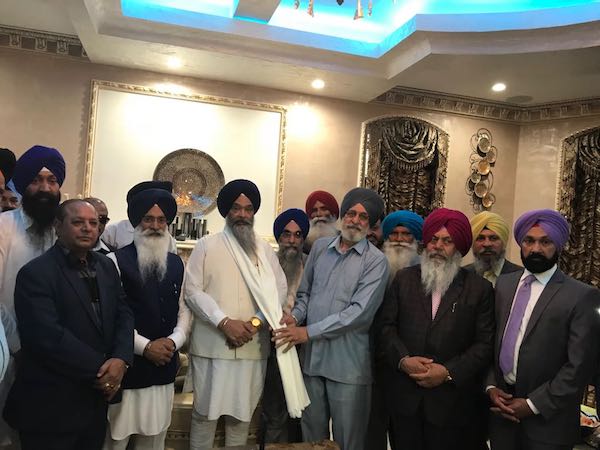
    NEW YORK(TIP): Prof. Prem Singh Chandumajra, Shiromani Akali Dal leader and Parliament Member from the historic Anandpur Sahib Parliamentary constituency visited New York recently and held a meeting with the local Shiromani Akali Dal leaders at the residence of SAD leader Raghbir Singh Subhanpur. A large number of party members attended the lunch meeting.

    Speaking on the occasion, Prof. Chandumajra said that he was aware of the problems the Punjabis, particularly, the Sikhs were having in respect of passport and visa and would take up the issue with the Consul General in New York. He said he had, on his visit to California, where he had gone to attend a wedding, taken up the matter with the Consul General in San Francisco, too. He blamed the government of India for not being sensitive to the difficulties the Sikhs faced for being denied the passport and visa.

    Speaking about the situation in Punjab under the Congress government of Captain Amarinder Singh, he said people were already fed up with the Congress government working. He accused the Punjab government of total inaction and said the State was being pushed in to deeper economic and social morass.

    Prof. Chandumajra with Subhanpur family

    Earlier, welcoming the visiting leader, SAD President Raghbir Singh Subhanpur said that the SAD leaders and workers in the US were always ready to support the party in Punjab. He spoke of the need to getting back in to the driver’s seat in Punjab in order to protect the interests of the Sikhs and the Sikh religion, which he said, was under threat from the present Congress government. He also spoke of the problems in getting passport and visa and requested the visiting leader to take up the issue with appropriate authorities here and in India.

    Speaking on the occasion, Master Mohinder Singh, one of the patrons of the SAD in USA had a long list of the infirmities of various systems in the State of Punjab. He bemoaned lack of basic infrastructure in schools and in hospitals. He spoke of the enormous inconveniences faced by NRI’s in courts in India, where cases were kept pending for long.

    Others who spoke on the occasion included Mohan Singh Khatra, President of New York unit of SAD, Himat Singh Sarpanch, one of the senior leaders of the party, and Kashmir Singh Pehowa, a general secretary of New York SAD.

    Sardar Ajit Singh Subhanpur, father of Raghbir Singh Subhanpur, honored the visiting leader with a siropao.