Tag: Siddaramaiah

  • Karnataka court accepts closure report in bribery case against CM Siddaramaiah

    A special court to try criminal cases against elected representatives has accepted the closure report filed by the Karnataka Lokayukta police in a bribery case involving Chief Minister Siddaramaiah.
    The case was based on allegations made by a BJP leader, who accused Siddaramaiah of receiving Rs 1.3 crore during his previous tenure as CM in exchange for appointing a steward at the Bengaluru Turf Club (BTC).
    In its ruling on January 18, the court stated, “The closure report filed by the Deputy Superintendent of Police, Karnataka Lokayukta, Bengaluru, dated 12.9.2024, is hereby accepted.” The court further observed that while records indicated that “Accused No.1 Mr Siddaramaiah had received a sum of Rs 1,30,00,000 from Accused No 2 L Vivekananda, the same cannot be held to be an act of quid pro quo towards his nomination as steward of BTC.” Previously, the special court had instructed the Lokayukta police to reopen and investigate the case.

  • Beta, beti, bhai and biwi… the ‘nepo’ netas in the fray

    Beta, beti, bhai and biwi… the ‘nepo’ netas in the fray

    Parivarvaad and Indian politics go hand in hand. The upcoming Karnataka Assembly elections are no exception. The Congress, often targeted for dynastic politics, is not the one to change. Its list of candidates is rife with nominees from political families. The Bharatiya Janata Party (BJP) and Janata Dal (Secular) also have names in the fray from influential backgrounds.
    There are daughters, sons, wives and brothers in the running. It’s all in the family.
    Let’s take a look at the big candidates fighting the Karnataka Assembly elections 2023 with ties to powerful political families.
    Congress’ ‘dynasty’ politics?
    Former chief minister and Congress veteran Siddaramaiah has replaced his son Yathindra from the Varuna seat. In the 2018 assembly election, the current chief minister hopeful had given this seat to his son.
    Congress president Mallikarjun Kharge’s son Priyank Kharge has been nominated from Chittapur SC seat.
    Karnataka Congress chief DK Shivakumar’s nomination has been accepted by the election commission from the Kanakapura assembly constituency, reported NDTV. In a surprise move, his brother – Bengaluru Rural MP DK Suresh – had filed nomination papers from the Kanakapura constituency on Thursday (20 April). As per Hindustan Times (HT), it was a precautionary step by Congress in case Shivakumar’s nomination was disqualified.
    Lingayat heavyweight Shamanur Shivashankrappa has been given a ticket from Davanagere South, while his son SS Mallikarjun is a candidate from the Davanagere North constituency.
    KH Muniyappa is a candidate from Devanahalli (SC) seat, while his daughter Roopakala M has been nominated from Kolar Gold Field- SC seat.
    Karnataka Congress working president and former minister Ramalinga Reddy is contesting from BTM Layout and his daughter – MLA Sowmya Reddy – has again been fielded from the Jayanagar seat.
    M Krishnappa and his son Priyakrishna will contest from Vijaynagar and Govindraj Nagar, respectively.
    Nivedith Alva, son of Congress veteran Margaret Alva, has been fielded from Kumta.
    JD(S) – All in the family?
    Most family members of former prime minister HD Deve Gowda are in politics and this is more highlighted by JD(S)’s ticket distribution. Father-son duos have also been nominated by the JD(S).
    Deve Gowda’s son HD Kumaraswamy has been Karnataka’s chief minister twice. Kumaraswamy will contest from the Channapatna seat, while his son Nikhil has been fielded from Ramanagara – the constituency currently held by his mother Anitha.
    Holenrasipura MLA HD Revanna, Deve Gowda’s other son and Kumaraswamy’s older brother, is again contesting from the seat.
    Revanna’s wife Bhavani wanted a ticket from the Hassan Assembly seat, however, Kumaraswamy resisted the idea, reported NDTV. Swaroop Prakash has been given a ticket by the party from the constituency.
    GT Devegowda is JD(S)’s candidate from Chamundeshwari, while his son Harish Gowda has been nominated from Hunsur.
    ‘Parivarvaad’ in BJP?
    Karnataka chief minister, Basavaraj Bommai, is the son of former chief minister the late Somappa Rayappa Bommai. The incumbent chief minister is the BJP’s candidate from Shiggaon in the Haveri district, where he will face Congress’ Yasir Ahmed Khan Pathan.
    Former Karnataka chief minister and party strongman BS Yediyurappa is not contesting the elections.
    As per a PTI report, Yediyurappa followed in his “lucky” Ambassador car when Vijayendra went to file his nomination for the May 10 Assembly election.
    MLA Ravi Subramanya, who is seeking re-election from Basavanagudi, is the uncle of Bengaluru South MP Tejasvi Surya.
    Mining baron Gali Janardhana Reddy’s brothers – Somashekhar Reddy and Karunakar Reddy – will be contesting from Bellary City and Harapanahalli, respectively.
    Ramesh Jarkiholi and Balachandra Jarkiholi are brothers, with the former allotted a ticket from the Gokak seat and the latter from Arabhavi.
    The family of late minister Umesh Katti, a Lingayat leader from the Belagavi district, has received two tickets. His son Nikhil Katti is the candidate from the Hukkeri Assembly seat and the late minister’s brother Ramesh Katti is fighting from Chikkodi -Sadalaga seat, as per The Hindu.
    BJP MP Karadi Sanganna’s daughter-in-law, Manjula Amaresh, has been given the ticket from Koppal. According to an Economic Times report, he sought the ticket for himself but the party was not in favour of fielding him or any of his family members. After he allegedly threatened to quit the party, the BJP took the move to nominate Amaresh so as not to lose another Lingayat leader.
    Snubbing sitting MLA Aravind Limbavali from Mahadevapura (SC) constituency, the BJP has nominated his wife Manjula Aravind Limbavali from the seat.
    Minister Shashikala Jolle is the nominee from the Nippani seat. Her husband Anna Saheb Jolle is a member of parliament from Chikkodi.
    Chincholi candidate Avinash Jadhav is the son of Gulbarga MP Umesh Jadhav.
    Chandrakant Patil, a candidate from Gulbarga North, is the son of BG Patil who was an MLC.
    Both Karnataka transport minister B Sriramulu (Ballari) and his nephew TH Suresh Babu (Kampli) have been given tickets.
    Tourism minister Anand Singh has been replaced by his son Siddharth Singh as the Vijayanagar candidate.
    Source: Firstpost

  • The pangs in birthing new political leaders

    The pangs in birthing new political leaders

    ”The year 2018 could have marked a decisive shift for the Congress, if only the leadership had captured the zeitgeist it was leading to. The party had won Assembly elections in three states which were in the BJP’s thralldom. Madhya Pradesh, Rajasthan and Chhattisgarh were not easy states to wrest from the BJP. This was the juncture at which the Congress could have addressed the leadership question on a clean slate, without getting daunted by the entrenched provincial Old Guard. This was the juncture to spot and nurture younger leaders from the grassroots to helm the states instead of allowing a sclerotic hierarchy to work the system on rickety limbs.”

    By Radhika Ramaseshan
    By Radhika Ramaseshan

    The year 2018 could have marked a decisive shift for the Congress, if only the leadership had captured the zeitgeist it was leading to. The party had won Assembly elections in three states which were in the BJP’s thralldom. Madhya Pradesh, Rajasthan and Chhattisgarh were not easy states to wrest from the BJP. This was the juncture at which the Congress could have addressed the leadership question on a clean slate, without getting daunted by the entrenched provincial Old Guard. This was the juncture to spot and nurture younger leaders from the grassroots to helm the states instead of allowing a sclerotic hierarchy to work the system on rickety limbs.

    The Congress displayed the spunk to shake up the system only in Chhattisgarh. It chose Bhupesh Baghel, then 57, as the chief minister in place of veteran TS Singh Deo, a running favorite, with a reported assurance to Singh Deo that the position was a rotational arrangement between him and Baghel. With just a year for Chhattisgarh to vote, the assurance, if real, never materialized. Baghel, a backward-caste Kurmi, not only survived internal challenges but also became a lynchpin of the national Congress organization. His ascendancy was a recognition and an acknowledgment on the Congress’s part that to survive and retain the base it is left with, strong state leaders were invaluable.

    The Congress missed the bus in MP and Rajasthan. In MP, Kamal Nath, 72 in 2018 and remarkably agile, positioned himself as the frontrunner through deft footwork, leaving younger leaders, notably Jyotiraditya Scindia, to search for options.

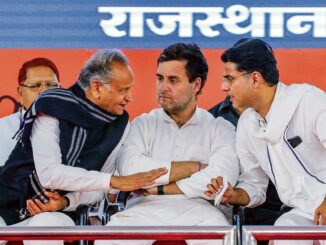
    In Rajasthan, evidently intimidated by the perception that Ashok Gehlot, then 67, had a formidable organizational network of his own (which inevitably failed after he completed his five-year term as the Congress’s rout in 2003 and 2008 testified), the party played safe and rooted for Gehlot to helm a third term. Like Scindia, a much younger Sachin Pilot, projected as Gehlot’s closest rival, was left hanging. The Congress’s fear was that Gehlot could inflict considerable damage to the party if driven up the wall.

    The grit displayed in Chhattisgarh — that was perhaps because Singh Deo was seen as less troublesome than Nath and Gehlot — evaporated in Madhya Pradesh and Rajasthan.

    It need not have played out that way because out of this trio of states, Chhattisgarh is regarded as a sure-fire winner a second time. If re-elected, it will prove that the limited experimentation paid off for the Congress.

    In Himachal Pradesh, the Congress top brass overlooked the time-honored metric of lineage and ‘stature’ when it went for Sukhvinder Singh Sukhu as the CM. Lok Sabha MP Pratibha Singh held on to her claim to the last, insisting that the victory symbolized a homage to her departed husband and former CM Virbhadra Singh. Hers was a contention whose emotional quotient might have worked in the old days but in an era in which ordinariness commands a higher premium over bloodline in politics, Sukhu, the son of a bus driver, pipped her to the post.

    The Congress awaits its next big leadership test in poll-bound Karnataka, where it is caught in a welter of rivalry between the old warhorses, Siddaramaiah and DK Shivakumar, who refuse to forfeit their assumed prerogative to lead the party even on peril of losing an election. Will the high command have the mettle to call their bluff or let the party go adrift amid their strife? By now, the Congress should have developed a second line of leadership, but it passed up the opportunity.

    Leadership transition in politics, as in every winner-takes-all venture, is painful. While change ushers in the arrival of the next generation, it also brings the possibility of a different functioning mode from what the elite and the rank and file are used to.

    Unlike industry, the fear in politics is partially unfounded because the original structure in which parties exist is rusted and will not countenance, let alone implement, the radical changes its timeworn frames are called on to do. Politics is essentially conservative and change-averse.

    The BJP under Prime Minister Narendra Modi is often described as unrecognizably different from the party that existed under Atal Bihari Vajpayee and LK Advani. That is not true. The BJP and Modi command a majority of their own and are, therefore, supremely well placed to execute the RSS’s agenda in almost every sphere of governance. A centralized political entity, allowing marginal latitude to the states, has been at the heart of the Sangh’s political philosophy. So, it is not surprising that the BJP’s command structures have been refashioned to enforce the might of the center in which the losers take nothing, not even the leftovers. The compulsions in the preceding dispensations were different. Vajpayee ran an unwieldy coalition because the BJP never gained the numbers to stand on its own. It had to contend with pesky allies as well as the Sangh’s incessant demands and could keep neither very happy.

    Does this mean that the seemingly invincible central BJP always overrides the states? Himachal partially busted the myth because the BJP’s rebels refused to heed Delhi’s entreaties to back off and help the official candidates. The BJP is struggling to get its Chhattisgarh, Bihar and Rajasthan organizations in place because these states are bereft of credible leaders to replace the veterans in Chhattisgarh and Rajasthan, while Bihar never had a helmsman. The BJP leaned so heavily on the Janata Dal (United) that the state party was eviscerated. The BJP’s lacunae do not solve the Congress’s problems. A stated objective of Rahul Gandhi’s Bharat Jodo Yatra was to re-energize the party organizations in the states. The aftermath? Days after the walkathon traversed Telangana, there was a virtual revolt against the state Congress president, A Revanth Reddy, for allegedly patronizing the TDP defectors over the original leaders. There are no short cuts.

    (The author is a Senior Journalist)