Tag: Sikh

  • Canada to issue a special commemorative stamp on World War I and the Quebec connections to the Canadian Sikh Soldiers

    The country has earlier issued two stamps in the honor of Sikhs — one on the 300th anniversary of Baisakhi in 1999 and another to mark the 100th anniversary of the Komagata Maru incident

    By Prabhjot Singh

    Now when Canada is holding Remembrance Day events that coincide with the two World Wars, Montreal-based businessman-cum-historian Baljit Singh Chadha has recalled the contribution of two of the 10 known Sikhs who served Canada in World War I. To commemorate the occasion, Canada Post has decided to come out with a special theme stamp honoring Sikh Canadian soldiers.

    The special stamp will be unveiled to the general public at the 18th annual Sikh Remembrance Day ceremony hosted by the Sikh community on November 2.

    This stamp is to commemorate and honor Sikh soldiers who have remained part of the Canadian military for over 100 years, including 10 Sikh soldiers who were enlisted for the World War I.

    It has been for more than a century that Sikhs have remained associated with the Canadian defense forces. (Photo credit/ GhaintPunjab)

    “Of the 10 known Sikhs who enlisted in the Canadian army and served Canada in World War I,’ says Baljit Singh Chadha by quoting from his book  “History of the Sikhs in Quebec”, that  there are significant connections to Quebec for at least two of them, Sunta Gouger Singh and Waryam Singh.

    “Most of the others would also have likely undergone training at Camp Valcartier in Quebec.

    “Sunta Gouger Singh, born in Lahore, Punjab, in 1881, enlisted at the Peel Street Barracks in Montreal on January 6, 1915, at the age of 32. His father and wife lived in Phillaur, Punjab, India. He had served for three years in the 32nd Punjab Rifles of the Indian Army. He joined the 24th Battalion (the Quebec Regiment) and sailed from Montreal to England on the S.S. Cameronia in May 1915. The battalion arrived in Boulogne, France in September 1915.

    “Sunta Gouger Singh was killed in action early in the war, on October 19, 1915, in the trenches near Kemmel, Belgium, just south of Ypres. At the time of his death, the battalion working parties were in the front-line trenches day and night, under heavy artillery bombardment. Gouger Singh’s gravestone is in the La Laterite Military Cemetery, near Kemmel. His grave is among those of 197 other Canadians, all from three infantry battalions, all buried together.

    “Strangely, Gouger Singh’s gravestone does not have the expected Canadian Maple Leaf, though his Canadian Battalion number is noted. The inscription is very unusual for a Canadian gravestone. The script is in the Gurmukhi language and reads: “God is one” and “Victory is to God.” There is no cross on the stone.

    While talking about  second Sikh soldier Waryam Singh, Baljit Singh Chadha writes in his book that “the Quebec Chronicle of December 31, 1917, records that the first passengers to use the new Quebec Bridge were some three hundred returned soldiers who had disembarked at St. John. Among them was Waryam Singh.

    “The Gazette reported that they “were brought directly through to the local discharge depot by special train which passed over the recently completed structure.” (The Gazette, January 1, 1918).

    “Along with 54 other wounded Canadians, Singh travelled across Canada by train, on the Imperial Limited, arriving in Vancouver on January 6, 1918. The Vancouver Daily World (7 January 1918) describes the “Royal Reception” these men were given across Canada: “The men enjoyed a most lavish welcome from the citizens all along the route from the east. At Quebec, Kenora, Calgary, Field and other places the patriotic and appreciative people turned out in crowds and showered the wounded and crippled men with gifts of all kinds.” (So far, no further reference to the reception at Quebec has been found.) Waryam was discharged in Vancouver in March 1918, still with impaired functioning of his shoulder (Gray 2014).

    “Waryam Singh enlisted in Barriesfield, Ontario in May 1915 and served in the 59th and 38th Battalions (Eastern Ontario Regiment). He served in Canada for 5 months, in Bermuda for 10 months, and England for 2 months before arriving in France in August 1916.

    He wrote letters home from France to India in 1916, describing both military action and more personal aspects of the war. Two letters describe events during the Battle of the Somme. In one of the letters to his father Wazir Singh in Kapurthala, India, in November 1916, Waryam wrote:

    “On the 4th of November there was a big fight, and much hand-to-hand fighting took place and many prisoners were taken… When we took the trenches some of the enemy escaped and some were taken. The dead were countless. The bravery which we showed that day was the admiration of the British soldiers. After the fight they asked me how it was that I was so utterly regardless of danger.”

    His battalion later moved north to take part in the capture of Vimy Ridge. There, in late April 1917, Waryam Singh was wounded in the shoulder. He remained on duty despite his wound, but then he also got “trench fever” and pneumonia and spent almost eight months in hospitals in France and England. He also underwent an operation on his shoulder because the wound had not healed, and a piece of shrapnel had to be removed. Waryam Singh was invalided to Canada and travelled on the hospital ship Braemar Castle to St. John, New Brunswick, in late December 1917, adds Baljit Singh Chadha.

    (Toronto based Prabhjot Singh is   an award-winning journalist recognized for investigative journalism, environment and business reporting, sports and feature writing. A Media Consultant, he has  remained associated with various news agencies, including Reuters, and media houses like PTC News (India/Canada), Parvasi Media (Canada)  the Liberal World (India), and The Indian Panorama, New York. He is interested in Indian Diaspora and the Sikh Diaspora in particular. His work has  appeared in various international and national newspapers, magazines and journals.)

  • Pentagon beard ban sparks outrage among Sikhs

    Pentagon beard ban sparks outrage among Sikhs

    WASHINGTON, D.C. (TIP): In a jolt to Sikh soldiers serving in the US army, Defense Secretary Pete Hegseth has announced a strict new grooming policy that effectively bans most kinds of beards in the US military, allowing exceptions only for elite special forces. The September 30 directive calls for all military branches to return to “pre-2010 standards” for grooming that disallow facial hair waivers.

    The move has drawn sharp criticism from civil rights groups, veterans and advocates for religious freedom who say it may force service members from communities such as Sikhs, Muslims, Jews and Black troops with skin conditions, etc. to choose between military careers and religious beliefs/health needs.

    While officials of the Shiromani Gurdwara Parbandhak Committee and the Akal Takht, citing lack of clarity on the matter, say they will comment once they go through the order and consult serving Sikh soldiers in the US army, former Jathedar Giani Harpreet Singh, president of a SAD faction, has demanded restoration of the provisions, recalling the services of soldiers from the community during the two world wars.

    Violates religious freedom: NAPA

    The North American Punjabi Association has called on the Trump administration to halt the implementation of the Pentagon directive. “Asking a Sikh soldier to shave his beard is the same as asking him to give up his religion,” said executive director Satnam Singh Chahal, adding it amounted to violation of religious freedom.

    Satnam Singh Chahal, Executive Director, NA

    The North American Punjabi Association (NAPA), expressing “deep concern” at the Pentagon’s directive, has termed it a “betrayal of trust” of those who have fought for years to gain religious accommodation in the armed forces. NAPA executive director Satnam Singh Chahal says the new rules will create serious implications for Sikhs, Orthodox Jews, Muslims, and other religious minorities whose faith requires them to maintain beards and other articles of faith.

    “This decision is not about discipline or lethality — it is about stripping away the dignity and religious identity of devout soldiers who serve this country with loyalty and honor,” says Chahal, emphasizing that keeping unshorn hair (“kesh”) is a non-negotiable religious mandate for Sikhs.

    NAPA has called on the Trump administration, members of the Congress and civil rights organizations to immediately intervene and halt the implementation of the directive.

    An attorney from the Sikh Coalition says: “For Sikh soldiers, shaving is like cutting off a limb.” In 2022, a federal court had ruled in favor of Sikh recruits keeping their beards and turbans in basic training.

    In his speech at Marine Corps Base Quantico, Hegseth had said: “If you want a beard, join special forces. If not, shave. We don’t have a military full of Nordic pagans.” He added that the era of “rampant and ridiculous shaving profiles” — waivers for medical or religious reasons — is over.

  • Hindu-Sikh unity event held in Sacramento

    Hindu-Sikh unity event held in Sacramento

    SACRAMENTO (TIP): Days after a Hindu temple in Canada was attacked by alleged Khalistani activists, Indian-Americans in Silicon Valley held a ‘Hindu Sikh Unity Interfaith’ event honoring the sacrifice of Sikh guru Tegh Bahadur.

    Hosted by Gurudwara Sant Nagar in Sacramento over the weekend, the event was attended by more than 200 members of Hindu, Sikh and other communities. Prominent among those who attended the event were Elk Grove City Mayor Bobby Singh-Allen, Commissioner of City of Elk Grove Bhavin Parikh, Council member of City of Rocklin Jill Gayaldo, Vice Mayor of Elk Grove Rod Brewer, and member of Interfaith Council of Sacramento Akram Keval.

    “Religious intolerance is plaguing our society. A few are dividing us and we must reject it. We gathered here to celebrate oneness. It is just the beginning; we have to show a better way. An attack on one is an attack on all of us,” said Singh-Allen.

    In his keynote address, Narinderpal Singh Hundal of Sant Sagar Gurdwara said, “We should all uphold the message of unity that Guru Tegh Bahadur Sahib gave by sacrificing himself to protect religion, and by obeying his command, maintain mutual brotherhood and love, and try to further propagate this mission.”

    Parikh said the guru’s sacrifice has a message that hate doesn’t have any place in this world. He said Sikhism teaches equality, humility and respect.

    “We all need to learn to appreciate and embrace other cultures and learn from them,” he added.

    Rewa Kaul, a Kashmir Pandit born in Srinagar and a resident of Bay Area, talked about how Guru Tegh Bahadur’s sacrifice defended the religious freedom of Kashmiri Pandits and Hindus who faced brutal oppression and were forced to convert to Islam under Mughal emperor Aurangzeb. She reminded the attendees to stay united.

  • Sikhs take out an Impressive Parade in celebration of Guru Nanak Dev Ji’s 555th Birth Anniversary

    Sikhs take out an Impressive Parade in celebration of Guru Nanak Dev Ji’s 555th Birth Anniversary

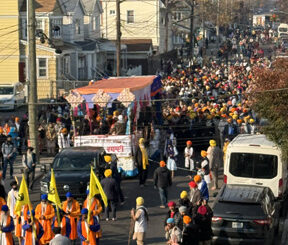
    RICHMOND HILL, NY (TIP): An impressive Parade (Nagar Kirtan) was taken out by the Sikh community of the Tri-State area of New York, New Jersey and Connecticut on November 9, 2024 in celebration of the 555th Birth anniversary of Shri Guru Nanak Dev Ji, the First Master of the Sikhs.

    Priests in attendance of Shri Guru Granth Sahib

    Thousands of devotees followed the Guru Granth Sahib, the Holy Book revered as the Living Master atop a motorized vehicle, with the priests attending and singing hymns (shabad kirtan). Ahead of the float carrying Shri Guru Granth Sahib were the Panj Piaras (the Five Beloveds- the first five disciples of the Tenth Master, Guru Gobind Singh, when he created Khalsa in 1699).

    All along the 3-mile route of the parade, a number of organizations and individuals served food and beverages, called langar (free food) to each and everyone. Langar (free food) is a unique feature of Sikhism.

    Community leaders walk beside the float carrying Guru Granth Sahib, with milling crowds all around.

    Sikhism is the youngest and the fifth most followed religion of the world. The Sikhs, known for their enterprise, are present in every part of the world, and contribute richly to their nations of adoption. The U.S. Canada, UK, account for a larger percentage of the Sikh population. The annual Guru Nanak parade is organized by Gurdwara Baba Makhan Shah Lobana Sikh Center in Richmond Hill in cooperation with the Sikh Gurdwaras and the Sikh organizations in the Tri-State area. The 2024 parade was in its 24th year.

    Young boys performed Gatka, a Sikh martial art. A former President of Gurdwara Baba Makhan Shah Lobana, Sardar Daler Singh is the trainer of the Gatka players.
  • Nikki Haley says she will vote for Trump in US presidential elections

    Nikki Haley says she will vote for Trump in US presidential elections

    WASHINGTON, D.C. (TIP): Former presidential hopeful Nikki Haley has said that she will vote for her ex-opponent and boss Donald Trump in the November US election, breaking her silence on the matter since exiting the Republican presidential primary more than two months ago.

    Haley, 52, however, stopped short of an official endorsement. Haley, who once served as Trump’s United Nations ambassador, was the last of his major rivals to drop out of the party primary contest, in early March. Interestingly, back in Apil 2021, Haley had said that she would not seek her party’s nomination if former President Donald Trump opted to run a second time.

    “Yes,” Haley said, when asked if she would support a second bid by Trump, in whose Cabinet she served for the first half of his administration.

    “I would not run if President Trump ran, and I would talk to him about it,” Haley said, asked by The Associated Press if a possible Trump bid could preclude her own effort, were he to announce first. “That’s something that we’ll have a conversation about at some point, if that decision is something that has to be made.”

    “I will be voting for Trump,” Haley said on Wednesday, May 22,  in response to a question during her appearance at the Hudson Institute, a top conservative think-tank in the American Capital, as she delivered a speech on national security and foreign policy.

    “As a voter, I put my priorities on a president who’s going to have the backs of our allies and hold our enemies to account, who would secure the border, no more excuses; a president who would support capitalism and freedom; a president who understands we need less debt, not more debt,” she said. “Trump has not been perfect on these policies. I’ve made that clear many, many times. But (Joe) Biden has been a catastrophe. So, I will be voting for Trump. Having said that… I stand by what I said in my suspension speech,” she said.

    Haley was born Nimarata Nikki Randhawa in Bamberg, South Carolina, to immigrant Sikh parents from Amritsar, Punjab. Haley is the first Indian-American to serve in a presidential cabinet.

    Haley said she has “no regrets” about her Republican primary bid: “We left it all on the field.” She also thanked the primary voters who have continued to back her even after she withdrew from the race — a potential warning sign for Trump. And she reiterated the call she’d made when exiting the race in March for the former president to reach out to those voters.

    “Trump would be smart to reach out to the millions of people who voted for me and continue to support me and not assume that they’re just going to be with him. I genuinely hope he does that,” Haley said in response to the question.

    Anti-Trump Republican voters largely coalesced behind Ms Haley’s presidential bid earlier this year and her dormant candidacy is still picking up support more than two months after she left the race.

    She won more than 20 per cent of the vote in at least two state primary elections over the past fortnight.

    But she did not call on her supporters to do the same. “I stand by what I said in my suspension speech,” she told the audience.

    Speculation is now likely to grow over whether Haley will formally mend ties with Trump and endorse him.

    In her speech, the former South Carolina governor slammed President Biden on his foreign policy and let China, Russia, and Iran grow stronger.

    “Since the fall of Afghanistan, North Korea has gotten more aggressive towards South Korea and Japan. China is preparing to invade Taiwan. Of course, Iran and Russia have already started wars of their own. Without the Afghanistan debacle, Iran would have thought twice before letting Hamas attack Israel. For that matter, Russia likely would not have invaded Ukraine,” she said.

    “While the Ukrainians have proven to be amazing fighters, Biden refuses to help them win. He gives them just enough to survive while Russian missiles and tanks grind their country to dust. It seems like the President wants a negotiated ceasefire in which Ukraine cedes some of its territory that Russia stole. That will only leave Russia as the winner and wanting more,” she alleged.

    The same goes for Israel, she said.

    Hamas was better positioned to attack Israel because Biden spent three-plus years appeasing Iran. He eased sanctions, forked over billions of dollars, and begged the Ayatollahs to get back in the nuclear deal, she said.

    “Biden has given Iran nothing but cash and time. Cash and time it used to strengthen its terrorist proxies. Cash and time are used to get to the brink of a nuclear bomb. Joe Biden’s legacy is already clear. He will go down in history as the commander-in-chief who refused to stop our enemies. He will be remembered for spending more on national debt interest than national defense. He weakened America while letting China, Russia, and Iran grow stronger,” Haley said.

    Biden campaign officials said Haley’s remarks would not sway the anti-Trump moderates and independents who reject the violence and division that Trump represents.

    “Nothing has changed for the millions of Republican voters who continue to cast their ballots against Donald Trump in the primaries and care deeply about the future of our democracy,” Michael Tyler, the communications director for Biden’s re-election campaign, said in a statement.

    “Only one candidate shares those values, and only one campaign is working hard every day to earn their support — and that’s President Biden’s.” The Biden campaign has been working behind the scenes to reach out to high-profile Republicans and Haley voters. It is also planning to roll out a grass-roots group with dedicated staff workers to organize Republican voters in key battlegrounds.

    (with inputs from  PTI)

  • Overarching Indianness transcends differences among groups

    Overarching Indianness transcends differences among groups

    India is one of the few nations in the world that has resolved the problem of separatism in so many states

    Over the decades, Gorkhas, Sikhs, Nagas, Manipuris and Kashmiris — to name only the most well-known — have declared their disaffection with the Indian state to be such as to merit breaking away. No one ever followed up on this intention. India is one of the few nations in the world that has successfully resolved the problem of separatism in so many states.

    “Indians call themselves — and quite assertively — Bengali, Tamil, Punjabi, Christian, Hindu, Muslim, Sikh, Jain, Parsi, Buddhist, etc. But from this, it does not follow that there is no such thing as India. Those are ascriptive identities that do not rule out the overarching identity of being Indian.”

    By M Rajivlochan

    As electioneering in India becomes more strident and voters are wooed by a focus on the faultlines in society, it would do us good to recall the nature of our nationhood. Countries come into existence because we focus on what is common among us rather than what is different. The ‘moral spirit of combination’ holds a nation together, wrote Rabindranath Tagore in 1917, when he was worried about the war that was going on in Europe and soldiers being pulled from all over the world into the battleground. In an essay on India’s nationhood, he said it was quite evident that this was a war of nations rather than that of tribes or religions. After all, Tagore wondered, being a nation was a much more evolved state for a society, since it enabled a much larger number of people to come together and harmonize their actions for the common good. Then, he penned down his thoughts on how different nations had been formed and the positive and negative consequences of it. The most visible negative consequence was that since 1914, European nations had been at war with one another, and millions of young men from India and Africa had been sent to Europe to fight. On the positive side, nations had ensured that people from diverse backgrounds — different from each other in language, religion and ethnicity — had come together and created a society and polity that benefited everyone.

    Tagore noted that nations were the highest form of social evolution. Thereby lies a very important insight for us to understand our own existence in the present times.

    Overcoming the natural differences of ethnicity, language and religion, nations came into being when their people wished to live together. Diversity, faultlines due to ethnicity, religion and language — all these come with birth. The desire to live together does not; it is crafted by human beings. What makes India unique in the comity of nations is the perpetual desire of people to live together, which is manifested in the fact that not only do we survive, we also make constant efforts to stay together.

    This has been so throughout history. There are ancient texts in which we referred to ourselves as the people of Jambudwipa, the land of the jamun tree. In the Kusa Jataka from the fourth century BC, Sakra, the king of the gods, gave the ugly Prince Kusha a necklace of pearls and told him to wear it, saying, “Tie this on you, then there will not be your equal for beauty in all Jambudvipa.” In later times, with an increasing contact with the outside world, those across the Sindhu river were referred to as Al-hind. Later, various East India companies came into being, not ‘South Asia companies’. India has been a singular civilization in history.

    This continues to be the case even today. Statements made by leaders of various groups that have taken up arms against the Indian state in modern times are interesting.

    Eno Rh Raising, the self-styled ‘home minister of the Government of the People’s Republic of Nagalim’, said in 2015 that the Nagas were a separate people with a history different from that of Indians. The occasion was the signing of a peace accord with the Indian Union. On August 3, 2015, the National Socialist Council of Nagaland (NSCN)-IM, the largest of the seven Naga insurgent groups, announced a historic peace agreement with the Centre, agreeing to create mechanisms for greater autonomy for Naga tribes living in Manipur and decommissioning of arms held by the NSCN (IM). Neither the Nagas nor the media reporting these twin statements saw anything contradictory in the spectacle of the leader of a people with a history different from that of India signing a peace accord with the very entity they were fighting against, while at the same time asserting their separate identity.

    Over the decades, Gorkhas, Sikhs, Nagas, Manipuris and Kashmiris — to name only the most well-known — have declared their disaffection with the Indian state to be such as to merit breaking away. No one ever followed up on this intention. India is one of the few nations in the world that has successfully resolved the problem of separatism in so many states.

    Speaking at a public forum last year, Bipul Kalita, an ex-member of the ULFA (United Liberation Front of Asom), said they laid down arms when they realized that 98 per cent of the people of Assam did not support militancy.

    The more simple-minded among intellectuals writing on India take these assertions of separateness literally to be a sign that the Indian Union barely exists, that it was brought into existence by the British; the presumption being that there was no entity called India before that.

    For Westerners to see us like that makes sense to them. Perhaps they see nations as monolithic entities. For Indians to imbibe and regurgitate this merely shows a people unaware of their own strengths and their long civilizational memories. Abrahamic benchmarks of nation and religion are of little use to us. Unlike Europe — which was troubled by religious wars from the times of the Crusades right up to the 19th century, marked by mass killings every few years — Indians did not carry out large-scale slayings.

    Exceptions prove the rule. The one fault line that resulted in the partition of the country expressed the one conflict that Indians were unable to resolve amicably. About this, the Congress Report on Communalism, published in 1931, mentioned that the so-called Muslim problem in India was entirely the creation of the British administration trying to divide India and Indians in ways that were not natural to the country. Subsequent events only substantiated the findings of the report. Even after Pakistan had been created as a country for Muslims, millions of them continued to live in India of their own volition. As a recent study by economist Shamika Ravi says, Muslims flourished in India. Their numbers went up from about 8 per cent in 1950 to around 14 per cent in the present times, even as the number of Hindus in Pakistan went down from 25 per cent to about 2 per cent in the same period.

    Indians call themselves — and quite assertively — Bengali, Tamil, Punjabi, Christian, Hindu, Muslim, Sikh, Jain, Parsi, Buddhist, etc. But from this, it does not follow that there is no such thing as India. Those are ascriptive identities that do not rule out the overarching identity of being Indian.
    (The author is a Historian)

  • Influential US Senators criticize India on allegations of plot to assassinate a separatist Sikh in New York

    Influential US Senators criticize India on allegations of plot to assassinate a separatist Sikh in New York

    WASHINGTON, D.C. (TIP): A bipartisan group of influential American Senators has criticized India after US prosecutors linked an Indian official to a man charged with conspiring to assassinate a Sikh separatist leader in New York. The Senators were speaking at a Congressional hearing ‘Transnational Repression: A Global Threat to Rights and Security’ organized on Wednesday, December 6, by the powerful Senate Foreign Relations Committee.

    Senator Ben Cardin, chairman of the Committee, said: “We’ve seen disturbing allegations against an Indian government official for involvement in planning to assassinate a US citizen in New York, who was critical of the Indian government. This follows allegations of India’s involvement in the killing of a Canadian Sikh leader. Earlier this year, the Modi government had labelled both critics as terrorists.” The hearing was organized with China in the focus, but India popped up several times, mainly because of the allegations from Canada and the US regarding the theme.

    US federal prosecutors on November 29 charged Indian national Nikhil Gupta with working with an Indian government employee in the foiled plot to kill Gurpatwant Singh Pannun, a Sikh extremist, who is an American and Canadian citizen.

    Describing it as a “matter of concern,” India has announced a high-level investigation and asserted that follow-up action will be taken based on the findings of the investigation panel.

    Earlier, Canadian Prime Minister Justin Trudeau on September 18 made an explosive allegation of the “potential” involvement of Indian agents in the killing of Khalistani extremist Hardeep Singh Nijjar, a Canadian citizen on Canadian soil on June 18. India has strongly rejected Trudeau’s allegations as “absurd” and “motivated.”

    “We often say we’re the oldest democracy in the world and India is the largest democracy in the world. This is not the behavior of a respectable democracy,” Democratic Senator Tim Kaine said during the hearing.

    Ranking Member Senator James Risch, who is a Republican, also raised the issue. “Governments who have gotten away with silencing dissidents inside their own country are now trying to stifle free speech around the world, including the United States. Just last week, the Department of Justice ….unsealed an indictment alleging an Indian government official engaged in a plot to assassinate a US citizen in New York City,” he said.

    “It should surprise no one that China is leading the world and using transnational repression to quash any sign of dissent,” he noted at the same time. Testifying before the committee, Michael J. Abramowitz, president of Freedom House, an advocacy group that raises awareness about the fascist threat to American security and values, said the Canadian Prime Minister has implicated the government of India in the June murder of a Sikh activist and a Canadian citizen in Canada. And just last week, the Department of Justice alleged in an indictment that an Indian national in India was hired by an Indian government official to orchestrate the assassination of a US citizen who is a Sikh activist, he said.

    “Congress should urge the executive branch to continue to raise transnational repression as a priority issue with our partners and allies. The United States must not hesitate to raise this issue directly at the highest levels with those countries perpetrating, transnational repression, even when those perpetrators are close partners such as Saudi Arabia and India,” Abramowitz said.

    Abramowitz said that this should be a matter that is in the bilateral relationship. “If it is being swept under the rug, then I think other governments will not take it as seriously,” he said.

    Senator Kaine said that it’s interesting to note that the Indian government’s reaction to the prosecution in the United States has been somewhat different than to the claim that their intelligence officials, at least one official, were implicated in the murder in Canada.

    “When the Canadian government Prime Minister Trudeau raised the issue and laid out the evidentiary case, the Indian government responded in a very negative way and asked Ottawa to recall about 40 Canadian diplomats that were in India. When the news of this prosecution in the United States came out, the Indian government at least suggested they were somewhat concerned and potentially chastened by this story and their comments have been a little bit more reasonable,” Kaine said.

    On Monday, the US State Department welcomed India’s decision by the Indian to set up a high-level committee to investigate the allegations of an assassination attempt by a junior Indian official on Pannun.

    “With respect to this specific case, there is an ongoing law enforcement matter at issue here, and we don’t talk about those from this podium. I would defer to the Department of Justice to do that,” State Department spokesperson Matthew Miller said in response to a question.

    “When this alleged incident was brought to our attention, we made it very clear at the most senior levels of our government to the most senior levels of the Indian government how seriously we would treat something like this. They have opened an investigation into the matter and we look forward to seeing the results of that investigation,” he told reporters at his daily news conference.

  • The message of Interfaith Actions comes loud and clear from the Parliament of World Religions

    The message of Interfaith Actions comes loud and clear from the Parliament of World Religions

    Islam, Sikh, Hindu, Jain and Christian faith leaders at the All-Faith Seminary International booth of Parliament of World Religions Expo.

    CHICAGO, IL (TIP): The message resonates with clarity and conviction: We must join hands, unite, and safeguard the religious rights of all faiths. The Parliament of World Religions (PoWR) has traversed a remarkable journey since 1893. The 1893 Parliament of the World’s Religions brought together 400 men and women, representing 41 diverse religious traditions. It was during this momentous gathering that Catholicism and Judaism gained recognition as significant American religions, and the luminous traditions of Hinduism and Buddhism were unveiled to the Western world.

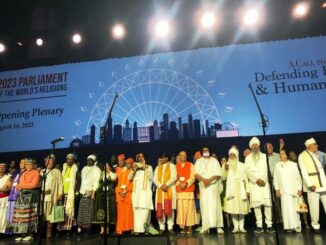
    In the contemporary landscape, where the specters of religious fanaticism and state-sanctioned alienation loom large, the initial tableau of the plenary challenges our reality. The camaraderie among individuals from Mexico, China, and India on the dais extends a warm invitation to stakeholders of faith, beckoning them towards a realm of peace, harmony, and genuine discourse on pressing matters. Chicago’s atmosphere was electric, and Mayor Brandon Johnson astutely proclaimed, “In this moment, seeking refuge solely within scriptures and holy texts falls short; it is essential to exhibit the most magnificent creation and power of humanity – the act of love.”

    PoWR 2023 resounded as a summons to conscience. The central theme was the defense of freedom and Human Rights. A sojourn through the exhibition hall became a journey into one’s moral compass. Here, spiritual traditions, religious collectives, faith-based seminaries, modern mantras for bonding, ancient sutras for equilibrium, poignant reflections on religious animosity, organizations dedicated to social progress, and revitalizing yoga meditations converged. One stall orchestrated interfaith harmonies through melodious songs, while another presented sobering data on minorities targeted by right-wing regimes. Tokens of memory took the form of pens, badges, shirts, chocolates, pins, and meticulously annotated leaflets and brochures. The Boston School of Theology extended courses to fathom the nuances of various religions, while the Divine Life Society resonated with masses, nurturing understanding through the prism of yoga. The panorama was a tapestry woven with the threads of diversity.

    The PoWR embodies an idea. Over 250 breakout sessions grappled with diverse subjects. The inner dialogues, cast as a broad mandate, often witnessed some gems eclipsed in the shadows. The spectrum of topics, spanning the gamut from deconstructing religious patriarchy to serendipitous revelations in the realm of anti-nuclear activism, enticed discerning minds. Yet, amidst the symphony of simultaneous sessions, flowing with the current was akin to chasing ephemeral wisps. The plenary sessions, a harmonious ensemble of thought, struck deep chords. The Women’s Assembly held profound significance, addressing the very core of female participation within faith-infused societies. Amidst this resplendence, the assembly advocating climate action, the council amplifying indigenous voices, and the solemn rite of climate repentance shone a luminous light on faith’s role.

    Packed Hall for the Closing Plenary or Parliament of World Religions in MCCormick Place of Chicago.

    Within the tapestry of aspirations, it was religious fanaticism that garnered the earnest ears of all. Rev. Jen Butler, the visionary founder of Faith in Public Life, lamented, “Religion, once the sanctuary of moral teachings, now stands manipulated, its moral fabric corroded by heinous acts of violence. Autocratic forces wield religion as an instrument for amassing power and maintaining control, from the prism of Russian Orthodox nationalism to the fervor of Catholic nationalism in Hungary and Poland, from India’s Hindutva to Israel’s nascent ruling coalition’s Jewish nationalism, and further to the evangelical and Pentecostal strains of religious nationalism in the U.S. and Brazil.” The expo center echoed this sentiment with a clamor of urgency.

    The Langar, an enchanting ritual embedded in past PoWR gatherings, enchanted thousands. Orchestrated by the Birmingham-based Nishkam Seva Jatha, this Sikh tradition was brought to life under the guidance of Bhai Sahab Mohinder Singh, who joyously proclaimed adherence to Sikh guru teachings through service to the world, transcending all biases. Faith leaders, adorned with white scarves, formed orderly queues, savoring Indian delicacies with hearts full of contentment. Within the tent, a grand theater of interfaith harmony and service unfolded. Nishkam Seva Jatha’s legacy of offering free langar since the 2004 PoWR was radiant.

    Expo area of Parliament of World Religions. More than 100 stalls from various Faith traditions.

    A poignant tribute unfolded for the 30,000 children lost to gun violence. Scraps of orange fabric coalesced into labyrinthine patterns or transformed into raw tools by the skilled hands of Shane Claiborne’s blacksmith forge. His declaration reverberated, “When we mold that metal, it resounds with the proclamation that the world can be reshaped.”

    The Parliament of World Religions 2023 encapsulates the elements required for reimagining our perceptions of faith. It beckoned forth distinguished faith leaders, entwining them in conversations that bear rich fruit. Concealed within closed chambers, the International Religious Freedom Roundtable murmured profound secrets, reminiscent of the hallowed halls of Washington. The Indian delegation of interfaith leaders radiated with fervor. The quest for a better world necessitates the exchange of ideas. PoWR has evolved into a pertinent platform for intricate discussions, where faith assumes a fresh and actionable agenda.

    (Photographs and Press release by Bhavya Srivastava)

  • Indian-origin UK based professor Jasjit Singh appointed by Singapore National University to internationally raise appreciation of Sikh way of life

    Indian-origin UK based professor Jasjit Singh appointed by Singapore National University to internationally raise appreciation of Sikh way of life

    SINGAPORE (TIP): The prestigious National University of Singapore on Wednesday, August 23,  appointed UK-based Indian-origin academician Jasjit Singh as a visiting faculty to conduct lectures on Sikh beliefs and raise appreciation of the Sikh way of life internationally. Singh, 51, currently an associate professor at the UK’s University of Leeds, is considered a leading authority in Sikh studies.

    “With his expertise on British Sikhism, Prof Singh will sharpen our scholarly lens on Sikh beliefs and practices and deepen our students’ knowledge and appreciation of the Sikh way of life not only in Singapore but internationally,” Professor Lionel Wee, Dean at National University of Singapore’s (NUS) Faculty of Arts and Social Sciences (FASS), said. He announced Singh’s appointment as the inaugural Central Sikh Gurdwara Board (CSGB) Visiting Professor (Chair) in Sikh Studies on Wednesday. “Singh is a leading authority in Sikh studies, he is also well-regarded as an innovator in his impact-related work as demonstrated by his meaningful engagements with minority ethnic communities and organizations in the UK,” Wee said.

    CSGB led the Sikh community here in raising the 1.06 million Singaporean dollars endowment fund, with the Singapore government matching dollar-for-dollar, for setting up with NUS FASS the first visiting professorship (Chair) in Asia, outside the Indian subcontinent.

    Singh began his one semester at FASS on August 7, in the new academic year 2023-2024.

    Singh is currently teaching an undergraduate course titled ‘Introduction to Sikhism’, where students will be introduced to the foundational tenets of Sikhism and its historical development in pre-colonial and colonial India.

    He will also deliver guest lectures on the Sikhs for undergraduate courses, ‘South Asia in Singapore’ and ‘World Religions’. At the NUS FASS South Asian Studies Program, he will also lead research on digital Sikhism – the study of the impact of the digital online environment on the religious lives of Sikhs and specifically how Sikhs in Singapore engage online.

    Additionally, Singh will deliver a series of workshops to the Sikh community and a public lecture open to all organized by the CSGB and NUS which are scheduled to take place in November 2023.

    Commenting on his appointment, Singh said, “This position provides me with the opportunity to teach students from a different social and cultural context to my own and to learn about how they perceive Sikhs and how these perceptions have been developed. It allows me to research a relatively underexamined but very significant part of the Sikh diaspora.”


  • TURBAN DAY celebrated with much enthusiasm at Times Square, New York

    • 2000+ Turbans tied on people to educate about the significance of the Turban
    A group of turbaned happy young ladies at Times Square Turban Day festival on May 6.
    A turbaned Chuck Schumer with organizers.

    NEW YORK CITY (TIP): Ritu Saluja told The Indian Panorama that “Turban is a Sikh’s crown and stands for Equality, Justice, and Humanity. We celebrated Turban Day this year on May 06 at Times Square, as an expression of Sikh faith and commitment to serve humanity. The purpose of organizing this event every year is to bring awareness among all citizens about Turban and its value in Sikh faith.” Tanu Singh added : “Considering the unfortunate discrimination and hate crimes faced by Sikhs who wear or tie turbans, we believe that it is more important than ever to break down barriers between different communities. This event represents a unique opportunity to tackle these issues and unite people in the spirit of respect and education.”

    The turban is an integral part of Sikh identity and has been worn by Sikhs for centuries. It not only represents the core values of our faith, but also signifies the responsibility to protect the rights of all individuals, regardless of their background, race, or religion. By participating in Turban Day, people who might not know can learn more about the importance of the Sikh turban.

    A young lady looks into a mirror as a Sikh police officer ties a turban on her head.

    To support this event and Sikh community in America, Senator Chuck Schumer of New York took to the stage and shared his views on how Sikh community has always been an integral part of the American society “We love the Sikh community, and it is a beautiful community. We welcome you as New Yorker’s and as Americans. You work hard, you believe in family, you have a great faith, and you help build and create our great community” He mentioned about passing the Asian Anti Hate crime bill to prosecute any action of hate, bigotry, and violence. He showed his solidarity to the Sikh community by wearing the Turban and shook a leg to famous Punjabi music.

    A bemused young turbaned kid in a pram holds a book on Turban.

    Besides tying more than 2000 colorful turbans on any fellow human coming from any background, skin color, religion and status, there were multiple artists from the Sikh community showcasing their culture and heritage.

    Young musicians from the Sikh Symphony California performed 31 ragas in 13 different taals (beats) using multiple Indian classical string instruments such as sitar, rabab, taus and tabla.

    A turbaned mother and her turbaned child pose for a photograph.

    Musician Biba Singh performed some popular numbers and multiple artists performed Bhangra and folk dance Gidda bringing attendees together to dance and enjoy music. Famous Bollywood artist Manmeet Singh (actor/writer/director) had a message for everyone “For a Sikh the Turban represents love, hard work and humility. When seen from away, for anyone in distress it indicates that they can come to a Sikh and seek help and support and no matter what the situation is they will be assisted”

    Turban Day at Times Square is organized by Turban Day Inc. and is the largest turban tying event in the world.
    “We have been running this event since 2016 and have tied more than 20,000 turbans over the years with the goal of educating more people. We firmly believe that knowledge and understanding are the most effective tools for combatting discrimination and building bridges between communities”, said Ritu Saluja.
    For any further queries contact:
    Tanu Singh or Ritu Saluja at contact@turbanday.org
    Follow us on:
    https://turbanday.org/
    https://www.instagram.com/sikhsofny/
    https://www.youtube.com/@TurbanDay

    Senate Majority Leader Chuck Schumer said of the Sikh community : “We love the Sikh community, and it is a beautiful community.”
    Young musicians from the Sikh Symphony California performed 31 ragas in 13 different taals (beats)
    Artists performing Bhangra.
    Milling crowds spilling enthusiasm.
    A rare distinction: Guinness Book record for “the most turbans tied in 8 hours”.
  • Multifaith prayers offered at Mahatma Gandhi’s Punya Tithi

    The welcome note was given by Arvind Vora who was instrumental in getting the Gandhi statue installed in the foyer of the HL Dennison building, the seat of Suffolk County.
    The author led a short meditation at multifaith prayers offered at Mahatma Gandhi’s Punya Tithi.

    Parveen Chopra

    LONG ISLAND, NY (TIP): Is there God? What about the afterlife? There is no conclusive answer or consensus on such questions. So, it is best to change the subject. As we do in ALotusInTheMud.com that I founded recently. In this web magazine, we try to curate content that people can use in their lives to be happier, healthier, productive and peaceful. So too when I was invited by Shanti Fund to do a presentation on my wellness + spirituality webzine at their Gandhi Punya Tithi prayers event on January 30, I skipped the speech and did something else altogether.

    The venue of the event co-hosted by Long Island Multi Faith Forum (LIMFF) was the foyer of H L Dennison building, seat of the Suffolk County, where a life size statue of Mahatma Gandhi welcomes you. The 150 strong gathering was multi-religious. Multifaith prayers followed one after the other, Christian, Hindu, Jain, Buddhist, Jewish, Muslim, Sikh, even Zoroastrian, Brahma Kumaris, and Bahai’s as well as by an eclectic group called Gathering of Light. Towards the end of the program when I was given the mike, I gave people the shortest meditation instruction possible: Close your eyes. Choose a short monosyllabic mantra, or name of your favorite deity or any name of God in your religion. Start repeating that word or mantra softly, mentally only. Continue till the mantra goes away and thoughts arise. When you become aware that you’ve lost your mantra, return to it gently. Don’t fight with thoughts or try to drive them away. It was a brief meditation session, 5-6 minutes only. But suddenly there was pin drop silence, suffused with spirituality. It was nice, some people told me at the vegetarian dinner that followed.

    A highlight of the program was Chui Chai Dance, from the Thai dramatic and dance repertoire.

    In his welcome note at the event, Arvind Vora, Chairman of LIMFF, mentioned that besides the Punya Tithi another annual event held in memory of Gandhi Ji at this location is the Mahatma’s birthday on October 2. Bakul Matalia of Shanti Fund conducted the program which began with the Mahatma’s favorite bhajan, ‘Vaishnav Jan to Tene Kahiye’ (Real devotees of God are those who feel the pain of others, who help those who are in misery but never let ego or conceit enter their mind), by Volunteers of Gayatri Pariwar. Organizers aimed for youth participation to get them exposed to the diversity of different faiths. Indeed, three presentations were made by youths – a Bahai group, Gayatri Gyan Kendra Youth and Look N Learn Jain Gyan Dhama.

    What I enjoyed the most was singing, and drum beat during the Jewish presentation by Cantor Lisa Ann Wharton and Akiva the Believer. They had the audience sing along and clap rhythmically. A highlight of the program was Chui Chai Dance, from the Thai dramatic and dance repertoire. It followed the Buddhist Presentation of Metta Sutta by two Thai monks. While rooted in your own cultural or religious tradition and yet be able to admire, interact with and learn about others’ traditions is what interfaith is – much needed in the multicultural polity and world we are living in.

    (small logo of Alotusinthemud.com. Parveen Chopra is the founder of ALotusInTheMud.com, a wellness and spirituality web magazine launched recently. He can be contacted at editor@alotusinthemud.com, Ph 5167100508.)

  • Indian-origin Sikh boy asked to remove turban during football match in Spain

    Indian-origin Sikh boy asked to remove turban during football match in Spain

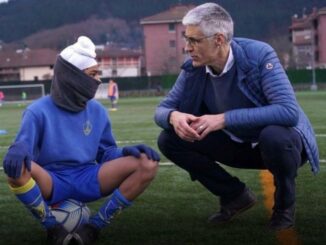
    MADRID (TIP): In Spain, a Sikh boy was asked by a referee to remove his turban during a football match. The whole situation was “humiliating” for 15-year-old Gurpreet Singh. The reason given to Gurpreet Singh from Arratia C team was that wearing “a hat” is prohibited as per the game rules.
    However, in all previous games, referees had allowed him to wear his turban.
    A post by Sikhexpo on Instagram read: “15-year-old Gurpreet Singh from Spain was told to remove his Patka during a football (soccer) match between Arratia C and a local rival Padura de Arrigorriaga. “The Arratia players interceded to explain that it is an element linked to his religion, with which he has always played. The referee insisted on his criteria. And both the players and the Arratia coach kept their pulse: they decided to leave the field of play as a sign of solidarity.”
    According to a local newspaper:
    The referee justified his decision by alluding to the fact that the 15-year-old was wearing “a hat”, and explained to the players that it is prohibited according to the regulations. Before this match, however, other referees allowed the youngster to play and have avoided that interpretation.
    This is how Pedro Ormazabal, president of Arratia, explains it: “He has been playing normally for at least five years, even in his first year as cadets and so far, this season. We have never had the slightest problem. It has been something that has been carried out with absolute normality. The first year we warned that he played like that, and everyone understood it.
    In the past day, however, the situation was even “humiliating” for the youngster. “It was the first minutes of the second half and, as soon as he left, the referee turned to him and urged him to take off his turban. In front of the whole world: of all the families, of the players… A matter like this cannot be left to the interpretation of the referees because what happened in Arrigorriaga could happen”, indicates Ormazabal.
    Fortunately for Gurpreet, his companions did not hesitate to side with him decisively. “The kids were the first to support him. The coach was also very clear. They decided to withdraw. Afterwards, he received the support of the rival team, especially through the coach, and from the families that had attended the game,” adds the president of the Arratian club.
    This Saturday, however, he returns to the competition. The Biscayan club is confident that the painful situation that occurred at the Padura facilities will not be repeated. And they are clear that they will not leave Gurpreet alone.”
    According to a FIFA ruling, men football players can wear turbans during matches.

  • Not by GDP Alone

    I am more inclined  to think as a common man rather than come out with a scholarly and pedantic analysis. I shall not go in to the nitty gritty of figures or make a presentation through graphs to exhibit gains and losses because these have only confounded the common man. I will not speak of when India will be a 5 trillion or 7 trillion economy.  I will  not make comment on  the growth of GDP. Nor  would I make any guesses about the fortunes of an Adani or an  Ambani.  I leave that to a Narendra Modi or a Nirmala Seetharaman. I shall be more interested in talking about where India stands when it comes to the people of India and their rights as human beings.

    For every Indian it was a bliss to be alive on 26th January 1950 when the Constitution of Secular India came in to being. For him it was a day when he was promised certain fundamental rights. Readers may please look into the Preamble to the Constitution of India. It is a day when every Indian felt he was going to see a new sunrise. It is a day that promised every single man, woman and child in India end of inequality and exploitation. It is a day that held the prospect of an end to bigotry. It is the day that spoke of an end of illiteracy. It is a day our leaders described as the day of a new awakening. It is a day of new life of liberty and freedom-the most cherished goals of every human being anywhere in the world. Indians bowed their heads in gratitude before the framers of the Constitution, led by the brilliant Dr. Bhim Rao Ambedkar. They felt they were just about to enter the Promised Land.

    Behind the veil of all external growth, all seeming progress, there is decadence in India. To the common people, equality is a word in Dr. Ambedkar’s Constitution of India, not the practice. How can one claim there is equality in India when the majority still is caught in the grinding machine of illiteracy, ignorance and poverty? How can one feel proud of the growing economic stature of the country (India will be a 5 Trillion economy by 2024 and an economic super power by 2050 or even earlier) when one does not get two square meals, is without a home and has neither a present nor a future?

    73 years of Republic and we  have still not been able to ensure justice to our people. “Might is Right” holds true in the land of the Buddha, Nanak and Gandhi. From far flung hamlets to the city, it is the might that rules. Even the politicians who are supposed to act as the custodians of the Constitution subscribe to the dictum. Dalits and minorities are at the receiving end. A case in point is the 1984 anti-Sikh riots in Delhi and elsewhere in India. Ten thousand Sikh men, women and children were butchered in cold blood then. Thousands of Sikh women became widows. Thousands of children became orphans.

    Look at all the cases being reported every day of  rape of dalit women, the police brutality, the gangsters’ reign, the highhandedness of government officials, the loot the politicians engage in day in and day out. Law seems to have taken leave of the country.

    A fresh case is of the top Indian wrestlers who have been forced to gather in Delhi to protest the sexual harassment of players by Brij Bhushan Sharan Singh, the President of Wrestling Federation  of India and his colleagues. Brij Bhushan Sharan Singh should have been arrested and interrogated, if the law had respect in the country, but  he will not be touched, because he belongs to the ruling party, and, on top of it, he is a “Bahubali”. Those who speak of Ram Rajya are the ones who do not practice Ram Rajya.

    The Non-resident Indians have been voicing similar concern at the lawlessness in the country when many pointed out that their property in India was being grabbed by unscrupulous elements and many had been framed in false criminal cases. They pointed the accusing finger at the police and civil officials who connived with criminals to rob the NRI’s of their legitimate property. How can government of India expect the NRI’s to come forward to invest in the country when they feel insecure? Law is on leave, probably a long leave.

    Where is Equality promised in the Constitution of the Republic of India? Where is Freedom? Where is Justice?

    Let us on this Republic Day ask ourselves these questions, for the sake of the Republic of India.

    SATYAMEV JAYATE!

  • UK court sentences Sikh man for drunk-driving; imposes fine, bans from roads for 22 months

    UK court sentences Sikh man for drunk-driving; imposes fine, bans from roads for 22 months

    LONDON (TIP): A 25-year-old Sikh has man has been fined and banned from roads for 22 months by a UK court for driving under the influence of alcohol. Police found open cans of alcohol in Sukhpreet Singh’s car after he was followed through a Derbyshire town swerving across lanes in November last year, the Derbyshire Live reported.

    The Southern Derbyshire Magistrates’ Court heard that Singh, a Pizza Hut worker and a resident of Higher Albert Street, Chesterfield, was driving without a license.

    According to prosecutor Becky Allsop, a witness informed that Singh’s car was swerving in and out of the zig-zag lines in the center of the road, and vehicles travelling in the opposite direction had to flash their lights at him. The witness, a driver, was following Singh’s car and had informed the police about him.

    The witness described the vehicle as coming to a stop in the middle of the road for no reason and then drove off again, still swerving all the way down the road, the report said.

    “The road he turned into had two lanes in each direction and Singh crossed both the carriageways, went over the central raised pavement and came to rest facing the opposite direction to the way he should have been,” Allsop was quoted as saying in Derbyshire Live.

    Singh had a breath test reading of 77 micrograms of alcohol in 100 milliliters of breath — almost twice the legal limit of 35, the court was informed. Sajid Majeed, mitigating, said Singh has pleaded guilty, and had no previous convictions of any kind. Majeed told the court that his client had moved to the UK with his wife from India and still takes care of the financial needs of his elderly parents back there.

    The court fined Singh 250 pounds, ordered him to pay 85 pound costs, a 100 pound victim surcharge and disqualified him from driving for 22 months, according to Derbyshire Live.

    The report added that the ban will be reduced by 25 per cent on the successful completion of a drink-drive awareness course, which Singh has agreed to undergo.

    (Source: IANS)

  • The University of North Carolina has allowed Sikh students to wear kirpan on campus

    The University of North Carolina has allowed Sikh students to wear kirpan on campus

    CHARLOTTE (TIP): The University of North Carolina, Charlotte, has updated its ‘Weapons on Campus’ policy to allow Sikh students to wear a kirpan, a religious expression of faith, on campus.

    The move comes about two months after a Sikh student at the university was arrested on campus for wearing the ceremonial dagger. According to the updated policy, the university will allow students to wear kirpans on campus if the blade length is under 3 inches and is “worn close to the body in a sheath at all times”. The university also said other religious accommodations, including a request to wear a larger kirpan, can be made to the Office of Civil Rights and Title IX and evaluated on a case-by-case basis. “The Office of Diversity and Inclusion, with support from Institutional Integrity, also conducted additional awareness training this week with our police department and will continue its work to expand our cultural education and training opportunities for all of campus,” a university statement, released this week, read.

    In its statement, the university thanked Sikh leaders, including nonprofit organizations—The Sikh Coalition and the Global Sikh Council—who provided expertise and perspective to help with the policy change. “We will continue to use this incident as an opportunity for learning and growth for our community,” said the statement, signed by Chancellor Sharon L Gaber and Chief Diversity Officer Brandon L Wolfe. The ruling was effective immediately, the university, which had apologized for the incident, said. A week after the September 22 incident, the university had shared a list of planned actions, including providing support and resources to the students affected by the event. It mentioned changing the school’s policy and providing additional education and training. The matter first came to light when the student uploaded a video on Twitter and said that the police had handcuffed him for refusing to let the officer remove his kirpan. Describing his suffering, the student wrote: “I wasn’t going to post this, but I don’t think I will receive any support from @unccharlotte. I was told someone called 911 and reported me, and I got cuffed for ‘resisting’ because I refused to let the officer take my kirpan out of the miyaan.” The video, which was seen by more than 21,00,000 people, amassed 56,000 likes and several comments in support on social media. The amritdhari, or baptized, Sikhs are required to carry five articles of the faith—kesh (uncut hair), kara (steel bracelet), kanga (small comb), kachera (undershorts) and a kirpan (resembling a knife or sword).


  • Sikh Gurdwara in Kabul attacked- Sikh man among 2 dead ;  3 attackers killed

    Sikh Gurdwara in Kabul attacked- Sikh man among 2 dead ;  3 attackers killed

    Modi, Jaishankar condemn the attack and demand safety of the Sikh population in Afghanistan

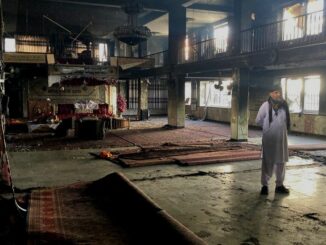
    KABUL/NEW DELHI/NEW YORK (TIP): Afghan Interior Ministry spokesman Abdul Nafi Takor on Saturday, June 18,  confirmed that attackers that stormed the Sikh gurdwara at Kart-e-Parwan area in Kabul have been killed. Several blasts tore through the gurdwara, killing two persons, including a Sikh, and injuring seven others, while Afghan security personnel thwarted a bigger tragedy by stopping an explosive-laden vehicle from reaching the place of worship of the minority community in the war-torn country.

    Takor also confirmed the death of a Sikh man in the gurdwara and an IEA soldier in the crossfire, while seven others were reported injured. Assailants belonging to ISIS Khursan had attacked the gurdwara early Saturday morning. Earlier in the day, Afghanistan-origin Sikhs living in the national capital, said they received calls from Gurnam Singh, president, Gurdwara Karte Parwan, informing them about the attack.

    Manjinder Singh Sirsa of the BJP said he has spoken to Gurnam Singh who informed him that the incident occurred at 6 am local time when a granthi was going inside the gurdawara for morning ‘parkash’ of the Guru Granth Sahib. ‘Parkash’ is the first prayer in any gurdwara. Reports also said, “hostages were on the second floor of the gurdwara”. Puneet Singh Chandhok, president, Indian World Forum, said Gurnam Singh had informed that the terrorists had launched a major attack. He called for immediate repatriation of minorities from Afghanistan.

    There were fewer  than 700 Sikhs and Hindus in Afghanistan at the time of the 2020 attack. Since then, dozens of families have left but many cannot financially afford to move and have remained in Afghanistan, mainly in Kabul, Jalalabad and Ghazni. Saturday’s incident is the latest targeted attack on a place of worship of a minority community in Afghanistan. In March 2020, at least 25 worshippers were killed and eight others injured when a heavily armed suicide bomber stormed a prominent gurdwara in the heart of Kabul, in one of the deadliest attacks on the minority Sikh community in the country. India expressed ‘deep concern’ over the attack, said “monitoring situation”. In the latest targeted assault on a place of worship of the Sikh community in Afghanistan, Gurdwara Karte Parwan in Kabul’s Bagh-e Bala neighborhood was attacked early Saturday morning and a gun battle lasting several hours between the terrorists and Taliban fighters ensued, said Abdul Nafi Takor, a spokesperson for the Interior Ministry.

    The three attackers were killed by the Taliban forces, the Pajhwok news agency reported. The attack is supected to have been carried out by from ISIS Khurasan. Taliban forces are gearing to take them on. Many have been killed, but numbers are not known as gurudwara is out of bounds for civilians, says eyewitness to attack. According to the statement from the Interior Ministry, an explosive-laden vehicle aiming to target the place was thwarted before reaching its goal. The gurdwara was attacked early in the morning when up to 30 people were inside, the BBC reported. Takor said a vehicle full of explosives was detonated outside of the gurdwara but that resulted in no casualties. “First the gunmen threw a hand grenade which caused a fire near the gate of the gurdwara,” the Associated Press quoted the Interior Ministry spokesman as saying. Khalid Zadran, a spokesman for the Kabul police chief, said the police operation ended after the last attacker was killed several hours later. “The security forces were able to act quickly to control the attack and eliminate the attackers in a short period of time to prevent further casualties,” he said. Local residents told the Afghan Islamic Press (AIP) news agency that four explosions occurred and the first one was comparatively heavy than rest of the three.

    In New Delhi, Prime Minister Narendra Modi condemned the “barbaric” terrorist attack on a gurdwara in Kabul and said he was praying for the safety and well-being of the devotees.

    “Shocked by the cowardly terrorist attack against the Karte Parwan Gurudwara in Kabul. I condemn this barbaric attack and pray for the safety and well-being of the devotees,” Modi tweeted.

    External Affairs Minister S Jaishankar also strongly condemned the “cowardly attack” on a gurdwara in Kabul and said the government was closely monitoring the situation following the incident.

    “The cowardly attack on Gurdwara Karte Parwan should be condemned in the strongest terms by all. We have been closely monitoring developments since the news of the attack was received. Our first and foremost concern is for the welfare of the community,” Jaishankar tweeted. “We are deeply concerned at the reports emanating from Kabul about an attack on a sacred Gurdwara in that city. We are closely monitoring the situation and waiting for further details on the unfolding developments,” the spokesperson of the Ministry of External Affairs also tweeted.

    Punjab Chief Minister Bhagwant Mann strongly condemned the attack and urged the Centre to extend immediate assistance to ensure the safety of minorities in the Afghan capital.

    BJP leader Manjinder Singh Sirsa also condemned the attack on a gurdwara in Kabul and said the terror strike has shattered the Sikh community’s hope of peace in Afghanistan.

    (With inputs from PTI and agencies)

  • IUDF opposes dividing the Indian American community by Hindutva groups

    NEW YORK (TIP): The Indo-US Democracy Foundation (IUDF), a newly formed think tank, deplores the attack on elected representatives in the U.S. by a cadre of people belonging to the Hindutva group, who support ideologies opposed by America.

     They are virtually threatening U.S. Representatives like Ro Khanna (California) and Pramila Jayapal (Washington) for not towing their line of Hindutva politics, which want to reshape India as a Theocracy or Hindu Rashtra. They even threatened Rep. Tom Suozzi of New York, a good friend of the Indian community, for demanding the restoration of democracy in Kashmir.

    The Hindutva forces in the U.S. follow the ideology of RSS, a militant organization in India, who want to make India a Hindu Rashtra and keep the Muslims, Christians, Sikhs, Dalits, and others as second class citizens, denying them equality in their ancestral land. It is not acceptable. It is un-American to profess such a fascist ideology in this land of the free.

     Rep. Khanna’s grandfather was a freedom fighter for India’s independence struggle and suffered greatly in jail for many years. Rep. Khanna rightly says that his grandfather fought for all Indians, and he cannot support divisive ideologies now. Rep.  Jayapal, too, demanded democratic rights for Kashmiris, who are citizens of India.

     The Hindutva forces in the U.S. may have money, power, and numbers; however, they forget that they have reached this level of success because of the democratic, secular, and tolerant fabric of this great country. While they enjoy the freedom and great opportunities in this nation, they are working hard on the sideline to deny these same rights and liberties to minorities and lower castes in India.

    These wolves in many garbs are busy trying to influence policies in Washington, often masquerading as champions for the Indian community in America.  Moreover, many Asian Indians in this country remained quiet for too long, under the false impression that India needed lobbying by these Hindutva groups for a better bilateral relationship. However, upon careful examination, these folks are exposed as more militant and strident in their voices than their so-called mentors in India, which is sad. It appears that they have brought their whole baggage of racism and bigotry to these shores and are working hard to convert others into the same.  In internet forums and discussion groups, they attack and denigrate anyone who is opposed to their ideology, often calling them traitors. Traitors to whom? These people seem to forget that their behavior is inconsistent with the values and traditions of this great country and is un-American.

     It is quite astonishing that some of these folks who are highly educated and better positioned in the social strata, denigrate Christianity and attack Islam in heinous terms. To intimidate others, they often use the legal system and also threaten actions from the Government of India, such as visa denial or cancellation of OCI Card.

    The Indian Diaspora is diverse and comprises many religions, regions, and languages. According to a Pew Research poll, 50% of the Indian Diaspora consists of Non-Hindus. And the majority of the Hindus in this country may also want to live in peace with one another. However, it is unfortunate that a small band of radical Hindutva supporters in this country is in the process of ruining the peace and harmony for everyone else.

    Here is a quote from the editorial of the Indian Panorama newspaper that captured the essence of the sentiment of the majority of the Indians who live here: “There is no harm in exercising one’s democratic rights in a democratic country. For long, Khalistanis have been demanding a Khalistan in India. It does not make a difference that there are people here who want a Hindu Rashtra. If the Khalistanis demanding Khalistan are anti-India and enemies of the nation, the same yardstick could be applied to those demanding a Hindu Rashtra. What is the difference? The demands of both the Khalistanis and the Hindutva supporters are divisive and against the interests of India and its 1.3 billion people.

     It is unfortunate that Indians who now are citizens of America should attempt to create hatred among people of Indian origin and divide them here in the U.S., where hundreds of ethnicities have learned to live in brotherhood and peace. Aren’t they committing a crime against America and American people? Nobody should be allowed to take advantage of the freedoms offered by the greatest nation on the earth. Nobody should be allowed to practice any form of terrorism in the greatest democracy in the world, which prides itself on the values of freedom and fraternity. President Trump, who has been bold enough to deal with the terrorism of all shades, should find a way to lock up people of foreign origin who promote hatred and create divisions and are a threat to the American National Security.

     Nobody should be allowed to take advantage of the freedoms offered by the greatest nation on the earth. Nobody should be allowed to practice any form of terrorism in the greatest democracy in the world, which prides itself on the values of freedom and fraternity. President Trump, who has been bold enough to deal with the terrorism of all shades, should find a way to lock up people of foreign origin who promote hatred and create divisions and are a threat to the American National Security.”

    Ref: https://www.theindianpanorama.news/other-stories/from-defending-a-diplomats-statement-to-advocating-hindutva-and-demanding-a-hindu-rashtra/

    https://indicanews.com/2019/09/07/ro-khannas-statement-against-hindutva-riles-bjp-supporters-but-is-hailed-by-others/