
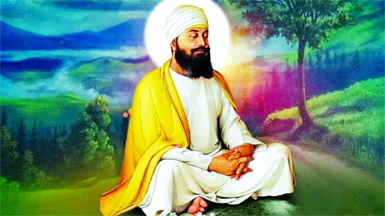

In the grand tapestry of Indian spiritual history, few figures radiate the moral force, courage, and spiritual clarity of Guru Tegh Bahadur, remembered with reverence as Hind di Ch?dar-the Shield of India. His life, shaped by renunciation, fearless sacrifice, and vast spiritual outreach, became a turning point in Sikh history. From his humble childhood as Tyag Mal, to the revelation of the Ninth Guru at Baba Bakala, to his extensive travels and founding of Sri Anandpur Sahib, Guru Tegh Bahadur’s journey remains a saga of unparalleled spiritual aura and civilizational defence.
From Tyag Mal to Tegh Bahadur
Guru Tegh Bahadur was born on 1 April 1621 in Amritsar to Guru Hargobind Sahib, the Sixth Sikh Guru, and Mata Nanaki. He was originally named Tyag Mal, symbolizing a life rooted in selflessness, meditation, and inner discipline. Yet, destiny had inscribed both stillness and velour into his path.
As a young boy, he displayed deep inclination toward contemplation, often absorbed in reflection even during the lively tempos of daily life in the Guru’s household. But fate had other tests in store. At the symbolic Battle of Kartarpur, where Guru Hargobind defended Sikh sovereignty, the young Tyag Mal fought with such remarkable courage that his father bestowed upon him the title “Tegh Bahadur”-Master of the Sword.
This duality of ty?g (renunciation) and tegh (courage) defined his personality: a warrior who avoided violence, but stood up when dharma demanded it; a saint who embraced silence, yet spoke with a thunderous moral spine when defending the oppressed.
For years after the Sixth Guru’s passing, Tegh Bahadur lived quietly with his family at Baba Bakala, immersed in deep meditation, humility, and seva. Little did the world know that this silence would one day become the voice of a nation’s conscience.
The Coronation at Baba Bakala: How the Ninth Guru Was Revealed
The announcement of the next Guru after Guru Har Krishan Sahib was cryptic: “Baba Bakale.” Amid the confusion, 22 claimants emerged at the village. It was a moment demanding both spiritual discernment and divine timing.
Enter Makhan Shah Lubana, a devout Sikh merchant. Having prayed for divine intervention during a storm at sea, he vowed to offer 500 gold coins to the true Guru if his life was saved. When he reached Baba Bakala, every claimant accepted only two coins – except one.
The recluse Tegh Bahadur, immersed in meditation, accepted the full 500, saying gently, “Why test the Guru?”
Makhan Shah ran to the rooftop and proclaimed: “Guru Ladho Re! I have found the Guru!”
The Sikh world erupted with clarity. On 20 March 1665, Tegh Bahadur was formally enthroned as the Ninth Guru of the Sikhs-a moment that reinstated spiritual unity and reaffirmed the lineage of Guru Nanak.
Guru Tegh Bahadur’s Extensive Travels:
Once enthroned, Guru Tegh Bahadur set out on one of the most extensive spiritual journeys undertaken by any Sikh Guru. These travels were not political tours-they were missions of consciousness, humility, and inner reform.
Across Eastern India: Bengal, Assam, and Bihar
Guru Tegh Bahadur travelled eastward to regions where Guru Nanak’s earlier message had taken root. At Dhaka, Sylhet, Pandua, and Assam, he engaged in inter-faith dialogue, uplifted local communities, and inspired devotional practice. His meeting with King Raja Ram Singh in Assam helped de-escalate conflict and promote peace-an act that revealed his quiet diplomatic wisdom.
Northern Plains: Haryana, Uttar Pradesh, and Delhi
At places like Kurukshetra, Agra, Mathura, and Allahabad, he spread Guru Nanak’s message of equality, compassion, and devotion. His kirtan gatherings drew Hindus, Muslims, and Sikhs alike. At Delhi, he encountered the turbulence of Aurangzeb’s reign-signalling the confrontation that history would inevitably record.
Malwa and Southern Punjab
He travelled extensively in Malwa, founding and blessing numerous villages such as Mandi, Talwandi Sabo, Bahadurgarh, Patiala region, and Mullowal. These regions blossomed into Sikh centres due to his spiritual presence and social upliftment.
The Philosophical Footprint
During these travels, Guru Tegh Bahadur composed hymns infused with deep detachment, spiritual clarity, and a philosophical understanding of life’s impermanence. His verses-now part of the Guru Granth Sahib-guide seekers toward fearlessness, humility, and liberation from ego.
Historic Encounters: Guru Tegh Bahadur and Contemporary Sikh, Hindu, and Muslim Leaders
Guru Tegh Bahadur’s life intersected with some of the most influential figures of the 17th century.
With Sikh Sangats and Saints
He rejuvenated distant Sikh congregations that had not seen a Guru in decades. His engagement with Sangats in Eastern India and Malwa revived spiritual vigour across communities.
With Hindu Leaders: A Voice for Collective Dharma
His later years saw a defining moment when Kashmiri Pandit scholars from Mattan sought protection from forced conversions under Aurangzeb. Their appeal echoed across India. Guru Tegh Bahadur’s response was simple yet epoch-making:
“Tell the Emperor that if he can convert Tegh Bahadur, all will follow.”
This was not a defense of any one religion; it was a defense of freedom of conscience-the right of every human being to worship without fear.
With Muslim Scholars and Saints
Contrary to popular simplification, Guru Tegh Bahadur engaged with several Muslim faqirs, saints, and leaders during his travels. His discussions emphasised the unity of the Divine, transcending sectarian divides. His martyrdom, too, saw Muslim figures-such as Saiyyad Adam Shah and others-decry cruelty and honour his sacrifice.
Sri Anandpur Sahib: The City Founded Under His Vision
In 1665, Guru Tegh Bahadur purchased land from Raja Deep Chand of Bilaspur and laid the foundation of Chak Nanki, which later became Sri Anandpur Sahib-one of the most sacred centres of Sikh history.
A City of Spiritual Learning and Martial Preparedness
Anandpur was envisioned as a place where: spiritual learning thrived, Sikh arts flourished, martial training coexisted with devotional practice, and communities lived under the ideals of equality and self-respect.
After Guru Tegh Bahadur’s martyrdom, it was here that Guru Gobind Singh forged the Khalsa in 1699-a direct continuation of his father’s vision to create a society free from fear, injustice, and oppression.
Legacy of Anandpur Sahib
To this day, Sri Anandpur Sahib stands as a living testament to the Ninth Guru’s foresight-an epicentre of Sikh courage, culture, and spiritual discipline.
Guru Tegh Bahadur’s martyrdom in 1675 at Chandni Chowk, Delhi, where he gave his life to protect religious freedom, remains unmatched. His sacrifice changed the course of history and catalysed the formation of the Khalsa under Guru Gobind Singh.
He is remembered not merely as a Sikh Guru, but as a defender of humanity, a guardian of civil liberties, and truly, Hind di Ch?dar-the Shield of India.
His life continues to inspire generations with its message of fearless righteousness, unyielding compassion, and unwavering commitment to truth.


Be the first to comment